Categories
Saved Web Pages

Opinion | Does It Matter That Investigators Are Closing In on Trump?

26convo1-facebookJumbo.jpg

The former president famously said his voters wouldn’t care if he stood in the middle of Fifth Avenue and shot someone. He may have a point.

The former president famously said his voters wouldn’t care if he stood in the middle of Fifth Avenue and shot someone. He may have a point.Credit…Damon Winter/The New York Times

  • Send any friend a story

    As a subscriber, you have 10 gift articles to give each month. Anyone can read what you share.

    Give this articleGive this articleGive this article

Gail Collins: Bret, which do you think is more of a threat to Donald Trump’s political future, the classified document drama at Mar-a-Lago or the legal challenge to his businesses in New York?

Bret Stephens: Gail, I suspect the most serious threats to Trump’s future, political or otherwise, are Big Macs and KFC buckets. Otherwise, I fear the various efforts to put the 45th president out of business or in prison make it considerably more likely that he’ll wind up in the White House as the 47th president. How about you?

Gail: Sigh. You’re probably right but I’m still sorta hoping New York’s attorney general can hit him in the pocketbook. He’s super vulnerable when it comes to his shady finances — I’m even surprised he can find lawyers who have confidence they’ll keep being paid.

Bret: No doubt the Trump Organization was run with the kind of fierce moral and financial rectitude you’d expect if Elizabeth Holmes had been put in charge of Enron. But the essential currency of Trumpism is drama, and what the New York and U.S. attorneys general have done is inject a whole lot more of it into Trump’s accounts.

Gail: I don’t think the news that Letitia James accused him of fudging his financial statements will upset the base — they’ve always known this is a guy who responded to the World Trade Center terror attack by bragging that his tower was now the highest building in Lower Manhattan.

Bret: A graceless building, by the way, far surpassed by the Chrysler Building, for those who care about architectural rivalries.

Gail: Maybe I need to stop obsessing about this and take a look at the rest of the public world. Anything got your attention in particular?

Bret: Am I allowed a rant?

Gail: Bret, rants are … what we do.

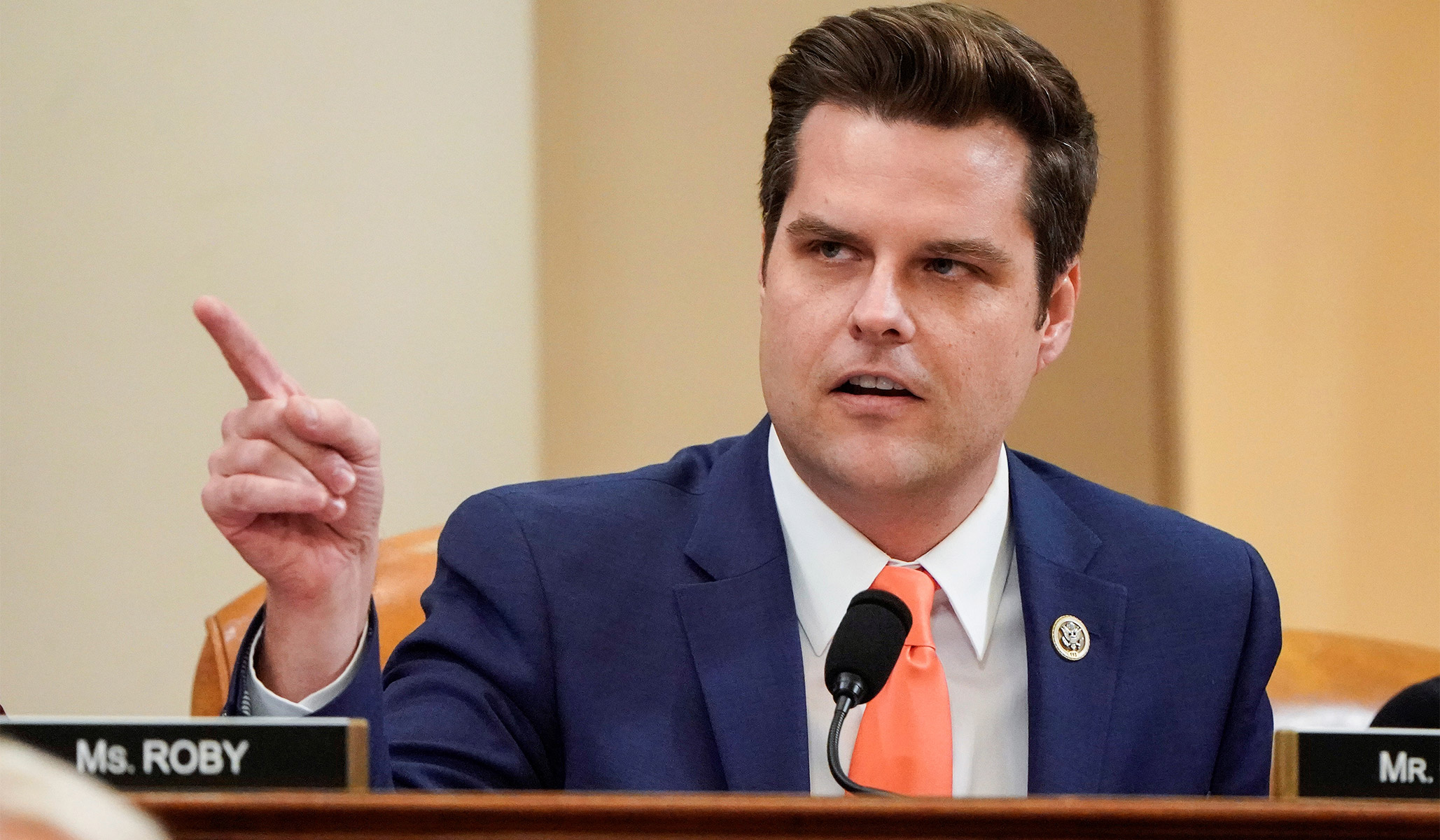
Bret: The investigation of Matt Gaetz, Republican of Florida, which looks like it’s about to fall apart, is an F.B.I. disgrace for the ages. It should force heads to roll. And Congress needs to appoint a Church-style committee or commission to reform the bureau. After the Ted Stevens fiasco, James Comey’s disastrous interventions with Hillary Clinton’s emails, and the bureau misrepresenting facts to the Foreign Intelligence Surveillance Court as part of its investigation of Trump and Russia, something dramatic has to change to save the F.B.I. from continuing to lose public trust.

Gail: Are you upset by the investigation or the fact that the investigation is failing?

Bret: I’m upset by a longstanding pattern of incompetence tinged by what feels like political bias. I don’t like Gaetz’s politics or persona any more than you do. But what we seem to have here is a high-profile politician being convicted in the court of public opinion of some of the most heinous behavior imaginable — trafficking a minor for sex — until the Justice Department realizes two years late that its case has fallen apart. We have a presumption of innocence in this country because we tend to err the most when we assume the worst about the people we like the least.

Gail: Nothing nobler than ranting about a basic moral principle on behalf of a deeply unattractive victim.

Bret: He’s the yang to Lauren Boebert’s yin. But no American deserves to be smeared this way.

Gail: While we’re on the general subject of crime, let’s talk bail reform. Specifically, New York’s new system, under which a judge basically lets out arrestees not accused of violent felonies. New info suggests this may be increasing crime. But I’m sticking with my support for the concept. Suspects who haven’t yet been tried shouldn’t get different treatment based on their ability to come up with bail.

Your turn …

Bret: New York’s bail reform laws are egregious because we’re now the only state that forbids judges from considering the potential danger of a given suspect. It leads to crazy outcomes, like the guy who was charged with the attempted stabbing of Representative Lee Zeldin at a campaign stop in July and was released hours later.

Another problem is that too many cities effectively decriminalized misdemeanors like shoplifting and have given up prosecuting a lot of felonies, which tends to encourage an anything-goes mentality among the criminally minded. We really need a new approach to crime, of the kind that Joe Biden and Bill Clinton pushed back in the early 1990s, when the Democrats finally became determined to be a law-and-order party again.

Gail: Biden’s generally held to a middle course that doesn’t drive anybody totally crazy. That’s why he got elected, after all. How would you say he’s doing these days?

Bret: I’m giving him full marks on supporting Ukraine. And I know Democrats have this whole “Dark Brandon” thing given Biden’s legislative victories, along with the chance that Democrats might hold the Senate thanks to bad Republican candidates. But I still don’t see things going well. Food prices keep going up-up-up and we’re heading for a bad-bad-bad recession.

You?

Gail: Going for Not At All Bad. Otherwise known as N.A.A.B.

Bret: I’m approaching the point of T.O.T.W.I.T.: The Only Thing Worse Is Trump.

Gail: You’re way off.

Biden may not have mobilized Congress the way we hoped, but he’s gotten quite a bit done — from funding the ever-popular infrastructure programs to reducing health care costs for the working and middle classes to finally, finally giving the Internal Revenue Service some funds to do its work more efficiently.

But he lost you after infrastructure, right?

Bret: He’s governed so much further to the left than I would have liked. Change of subject: What governor’s races are you following?

Gail: It’s always a lot harder to focus on other states’ governors than the senators but I gotta admit this year I’m hooked on …

Well, let’s start with one we’re going to disagree about. I’m guessing there’s no way you could be rooting for Beto O’Rourke in Texas, right?

Bret: Ah, no, except as a performance artist. When are Texas Democrats going to nominate a centrist who stands a modest chance of winning a statewide race?

What about the New York race? I don’t suppose you could have warm feelings for Lee Zeldin, could you?

Gail: Well, to get Zeldin as their gubernatorial nominee, New York Republicans passed up a bid by Rudy’s son, Andrew Giuliani, so I’d definitely put Zeldin in the Could Be Worse category.

Bret: Kathy Hochul’s main achievement to date has been to get taxpayers to put up $850 million for a new Bills stadium in Buffalo. That makes her perfect for Albany, which I don’t mean as a compliment.

Gail: Yeah, her Buffalo obsession is pretty irritating. But about Texas — Greg Abbott is one of those Make Everything Worse Republicans, who most recently made the headlines by shipping busloads of migrants to Northern cities. A move that did nothing to solve anything, but did help expose what a jerk he is.

Really, nothing Beto has ever done is that awful.

Bret: That’s because Beto has never done anything.

One Democrat I am excited about is Maryland’s Wes Moore, whom I know slightly and impresses me greatly. His book, “The Other Wes Moore,” will soon be required reading the way Barack Obama’s “Dreams From My Father” used to be. And, just to be clear, that’s me saying that Moore could one day be president.

Who else?

Gail: Your bipartisanship is making me feel guilty. But about the governors — one other guy who fills me with rancor is my ongoing obsession, Ron DeSantis of Florida, who’s terrible in all the ways Abbott is terrible but much worse since he’s already a serious presidential candidate.

Bret: And an effective governor who knows how to drive liberals crazy and whose state is attracting thousands of exiles from New York, California and other poorly governed, highly taxed blue states.

Gail: Sorry but having empty space to develop and few social services to support doesn’t make you effective, just well positioned.

But go on ….

Bret: Speaking of DeSantis, how do you think he’d fare in a theoretical matchup against California’s Gavin Newsom?

Gail: Oh boy, that’s pretty theoretical. DeSantis worries me because his policies are terrible — cruel and terrible. But he’s an obsessive campaigner with a smart pitch.

Have to admit I don’t have much of a feel for Newsom — in general it’s hard to be a national candidate if you’re running as a Democrat from a state that’s very liberal. Liberal for good and historic reasons, but hard to sell to folks in Kansas or North Carolina.

Here’s another Republican governor I’ve been mulling — what about Brian Kemp in Georgia?

Bret: I’m generally not a fan of Southern Republicans. But Kemp did stand his ground against three election deniers: David Perdue in 2022, Donald Trump in 2020 and Stacey Abrams in 2018.

Gail: Kemp is one of those Republicans — like Mike Pence and Liz Cheney — who I admire for their principled stands while realizing I would never vote for them. His abortion position, for instance, is appalling. So he goes in my Honorable But Wrong list.

We’re cruising toward the final stage of the Senate campaigns, too, Bret. Let me leave you with the thought that Arizona is looking great for my side and Ohio maybe conceivably possible.

Bret: And who’da thunk I’d be rooting for Democrats in both races?

Gail: Wow. To be continued.

Bret: In the meantime, Gail, I recommend reading Richard Sandomir’s beautiful obituary for two Jewish sisters who survived the Holocaust and passed away a few weeks ago in Alabama, 11 days apart. It’s a nice reminder of how much we all have to live for — and to wish all of our readers, Jewish or otherwise, a good and sweet new year.
Categories
Saved Web Pages

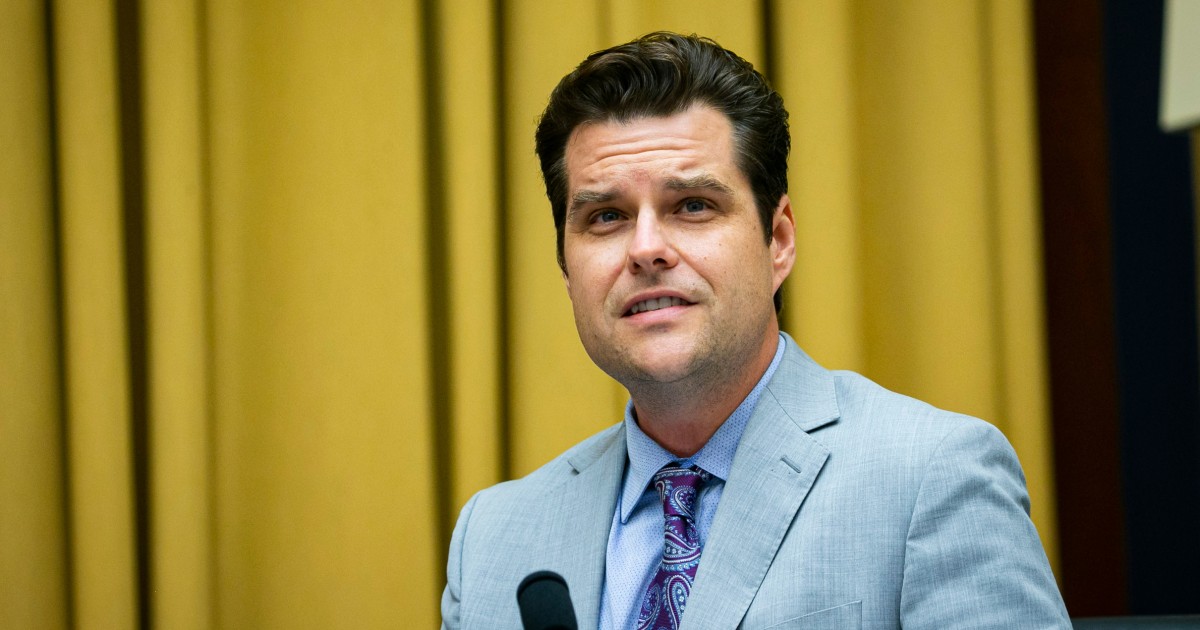
The Justice Department’s sex trafficking investigation into Rep. Matt Gaetz seems stalled, attorneys say

220923-matt-gaetz-ew-425p-e80ac0.jpg

The FBI seized Rep. Matt Gaetz’s cellphone in December 2020, marking the beginning of an investigation into whether the Florida Republican allegedly sex-trafficked a 17-year-old girl. In the time since, his former friend Joel Greenberg pleaded guilty to trafficking the same teen in exchange for helping the Justice Department’s investigation. Gaetz’s ex-girlfriend also struck a deal, obtaining immunity from federal prosecution in return for her testimony.

But the sex-trafficking investigation into Gaetz now appears stalled, according to seven attorneys who represent witnesses, people who have been subpoenaed or have spoken to investigators. The attorneys briefed on aspects of the case say federal investigators appear stymied by concerns about the credibility of two key witnesses or a lack of direct evidence implicating Gaetz, who has denied all wrongdoing.

Doubts about prosecuting Gaetz have mounted for months among many of those seven attorneys. It’s also an opinion held by some within the Justice Department, according to a recent Washington Post article. Citing people familiar with the matter, the paper reported that career prosecutors internally recommended that Gaetz not be indicted.

Gaetz’s attorney and the Justice Department declined to comment. Gaetz himself has long denied allegations that he had sex with a minor, that he ever transported the alleged victim across state lines to engage in prostitution or that he obstructed justice in an effort to cover up his actions — the three main potential crimes he has been investigated for, according to three sources familiar with those aspects of the case. 

“At a federal level, I could not ever imagine prosecuting a case where you have a documented liar like Greenberg and this other person as your top witnesses,” said Richard Hornsby, an attorney for former state Rep. Chris Dorworth, who was subpoenaed in the case.

While the sex-trafficking case appears stalled in the eyes of attorneys like Hornsby, another attorney involved in the investigation pointed out that “the Justice Department hasn’t formally closed this case.” That lawyer, like others who spoke anonymously, did not want to comment on the record given the sensitive nature of the case. 

The case is undoubtedly complex — one of the attorneys described it as having “tentacles” — and politically fraught. It also touches on systemic legal issues such as the expectation among some prosecutors and juries that women involved in sex crime investigations can be held to a higher, and unfair, standard. 

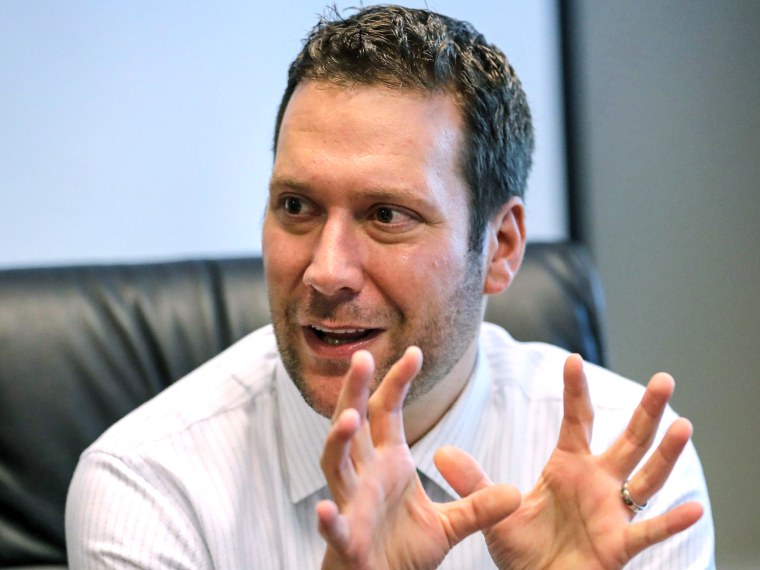
Former Seminole County, Florida, tax collector Joel Greenberg talks to the Orlando Sentinel in September 2019, during an interview at his office in Lake Mary, Fla.Former Seminole County tax collector Joel Greenberg talks to the Orlando Sentinel in September 2019, during an interview at his office in Lake Mary, Fla.Joe Burbank / Orlando Sentinel via Getty Images file

The prosecution’s star witness — Greenberg, Gaetz’s onetime friend and a disgraced elected tax official — pleaded guilty last year to six federal crimes. Those included a stalking charge for falsely smearing a political rival as a pedophile, identity theft and sex trafficking the same 17-year-old who is the alleged victim in the Gaetz case. A prosecutor in the case has labeled Greenberg a “prolific criminal.”

The alleged victim has been reluctant to speak to federal investigators about whether she had sex with Gaetz in 2017, when she was 17, according to a source briefed in the case and a message Greenberg sent to a mutual friend of his and Gaetz’s, Dorworth, when the investigation gained steam in 2020. 

The alleged victim, who turned 18 in December 2017, did not answer requests for comment from NBC News.

Another complication for prosecutors involves the alleged victim. She currently makes online pornography, which could trigger biases in jurors if the case were ever brought to trial, according to Barbara Martinez, a former assistant U.S. attorney who oversaw sex-trafficking cases in South Florida but is not connected to the Gaetz investigation. 

Martinez, who spoke generally about sex-crimes prosecutions and not the specifics of the Gaetz investigation, told NBC News that sex-crimes cases can involve witnesses or alleged victims who are involved in sex work or have a criminal history. 

“Many victims of trafficking have credibility issues because they have had a difficult life, been arrested, and/or suffered from other trauma. And frankly, that’s why they are often targeted and victimized by traffickers,” said Martinez. 

Greenberg’s attorney, Fritz Scheller, referring to the report that prosecutors may not move forward in a case against Gaetz, told NBC News: “While one could hesitate to draw a conclusion from a single news story, my hesitation stems from a different source — my knowledge of the evidence in this matter.  But to be perfectly cryptic, to the extent the government considers this matter closed, I do not.” 

He did not provide further details.

The ‘Wingman’ 

Joel Greenberg’s scandal-plagued term as the elected tax collector of Seminole County began in 2017, around the same time he and Gaetz became close. Both men were elected to their respective offices in the same year, and Gaetz at one point called Greenberg his “wingman.”

Both gained reputations as newsmakers, with Gaetz defending newly elected President Donald Trump on the national stage and Greenberg making waves at home. 

Soon after Greenberg took office, he became the subject of criticism from county commissioners for a move to an expensive new office building, while also coming under scrutiny for a proposal to arm tax collectors and for chastising a driver about her speeding while wearing a badge that made him seem like a law enforcement officer.

According to the plea agreement in his federal case, Greenberg met the minor in 2017 on a website that advertised itself as a place where ‘“sugar daddies’ could find ‘sugar babies,’” which five sources identified as SeekingArrangement. Greenberg also admitted in his plea agreement that he gave the minor and “others” ecstasy for “commercial sex,” that he introduced the minor to other men, and that he took the drug himself. In total, the plea agreement said, Greenberg from 2016 to 2018 made at least 150 transactions for sex worth $70,000, including commercial sex acts with the minor.

Gaetz, who was not named in the plea agreement, met the alleged victim through Greenberg, according to four sources who were friends with both men. 

NBC News is withholding the names of all the women to protect their privacy due to the nature of the case. SeekingArrangement has not commented on Greenberg, citing the ongoing investigation. The site has said it has no record of Gaetz ever having an account; Gaetz has long maintained he was not on the site.

Also according to that plea agreement, the alleged victim falsely claimed she was of age on her SeekingArrangement profile. Greenberg discovered her real age in September 2017, five months after he first texted with her.

Even if an underage person lies about his or her age, it’s still legally considered sex trafficking of a minor if an adult has sex with them and something of value changes hands.

In late 2019, a school teacher, Brian Beute, filed to run in a Republican primary against the first-term tax collector, who responded by engaging in a smear campaign. Greenberg created a fake Twitter account to make Beute look like a white supremacist, and Greenberg made a phony Facebook account and engaged in a false letter-writing campaign to frame Beute as a pedophile who abused his students, according to the indictment and plea agreement.

Former Seminole County tax collector Joel GreenbergFormer Seminole County tax collector Joel Greenberg leaves the federal courthouse in Orlando, Fla., after making a first appearance following his indictment on a federal stalking charge, on June 23, 2020.Joe Burbank / Orlando Sentinel via Getty Images file

In June 2020, Greenberg was arrested for the smears, precipitating a series of investigations and indictments that ultimately led to a 33-count indictment against him. The sex crimes inquiry into Gaetz began as part of the broader investigation into Greenberg. 

In December 2020, the FBI seized the congressman’s cellphone and the congressman subsequently furnished federal investigators thousands of records, mainly related to travel calendars and emails, according to a source. Gaetz reportedly lobbied former President Trump’s top aides for a pardon related to the Justice Department’s investigation toward the end of the administration.

The Gaetz investigation became public in March 2021, after The New York Times reported the general contours of the investigation. Earlier that month, Greenberg had been jailed after he violated probation to find his wife, who called 911 because she wanted to get away from him. They are now divorced. 

Greenberg now faces a mandatory-minimum prison sentence of 12 years. But in an effort to get a more lenient sentence, Greenberg pleaded guilty and has been cooperating with prosecutors. His sentencing is scheduled for Dec. 1.

In April 2021, CBS News reported that in addition to investigating Gaetz for alleged sex trafficking of a minor, federal investigators were examining a Bahamas trip he took in the fall of 2018 to see if it violated the Mann Act, which prohibits taking people across state lines to engage in prostitution. Two sources briefed on that aspect of the investigation confirmed that line of inquiry.

The alleged victim, who by that time was 18, Gaetz and others were on the trip, according to Politico, which cited three sources familiar with the Bahamas jaunt, including one who was there. Prosecutors wanted to know if any of the women on the trip were paid for sex and, therefore, were transported across state lines to engage in prostitution. 

The investigation into Gaetz gained some momentum earlier this year when his ex-girlfriend struck an immunity deal with prosecutors. Before her appearance, a source familiar with her thinking told NBC News she was willing to testify about Gaetz’s interactions with the alleged victim, that 2018 trip to the Bahamas, and a secretly recorded phone call between her, a former roommate of the alleged victim and Gaetz. It is during that conversation that federal investigators suspected Gaetz of attempting to obstruct justice, NBC News previously reported.

Since that time, seven others tied to Greenberg have been charged in a host of other crimes unrelated to the sex-crimes investigation: two in fraud schemes that are related to Greenberg’s office, two associates of Greenberg’s in an alleged real estate scam, and three with campaign finance-related crimes. At least one more friend of Greenberg’s is likely facing federal fraud charges, according to Greenberg’s fourth and final indictment issued March 30, 2021. None of those indictments show a link to Gaetz or suggest his involvement. 

All of the charges and investigations involving Greenberg were the result of the teacher’s friend, lawyer David Bear, insisting that law enforcement authorities seriously investigate the smears masterminded by Greenberg in the 2020 primary for tax collector.

Bear said it sounds “totally plausible” that prosecutors might not charge Gaetz.

“The U.S. attorney’s office and Department of Justice are very particular in what they prosecute and in making sure there’s a strong chance they will win the case,” he told NBC News. “They don’t prosecute 50/50 cases.”

Bear is a critic of Gaetz and says he bears responsibility for associating with Greenberg. But he said Greenberg’s criminality is problematic. 

“Greenberg is a prolific criminal. His story is going to be in criminology textbooks one day,” Bear said. 

The potential witnesses in the federal government’s inquiry into Gaetz is not limited to Greenberg, the alleged victim and Gaetz’s ex-girlfriend.

The alleged victim’s former roommate, who was on the three-way call with Gaetz and his ex-girlfriend, has spoken to prosecutors, according to two lawyers involved in the case. They say that at least one other woman who had been sexually involved with Gaetz has also spoken to investigators.

None of the women have been charged with a crime, but lawyers in the case are divided over whether some of the women could be charged with sex-trafficking the alleged victim, too, if evidence emerged they engaged in group sex with her.

Under the federal sex-trafficking law, anyone who has sex with a minor as part of an enterprise in which money changes hands can be criminally charged. The attorneys say that the federal government has expressed no interest in charging any of the women, but they say it could become an issue at trial if the women were ever used as witnesses.

‘This is Joel’s M.O.’ 

After Greenberg’s first arrest in June 2020, he tried to get Gaetz and Republican operative and Trump confidante Roger Stone to get him an election-year pardon, Stone said in an interview, confirming a Daily Beast article. 

Gaetz’s friend, Dorworth, said Greenberg threatened to bring him and Gaetz down if he didn’t get the pardon. Dorworth, who was subpoenaed to give records to the federal grand jury in the case, said Greenberg falsely accused him of wrongdoing and, to disprove the allegations, he wound up hiring a lawyer, furnishing text, phone and travel records to federal investigators, as well as three polygraphs. His attorney, Hornsby, confirmed the account.

“I’m not surprised prosecutors won’t move forward with the case against Matt because it’s built on lies and Joel Greenberg is the biggest piece of lying garbage trash I’ve ever seen in my life,” Dorworth told NBC News, previewing what would be his testimony for Gaetz’s defense if he were ever charged.

“This is Joel’s M.O.: He tries to frame people for what he did.”

Scheller, Greenberg’s attorney, said in response to Dorworth’s allegations: “In any case, the credibility of witnesses is always at issue. Thus, any prosecutor worth their salt will develop evidence, including documents and financial records, that corroborates the testimony of the witness. Although I have not received any communication from the federal government regarding the status of its investigation (nor would I), it does not merely depend on a couple of witnesses, let alone a single individual.”

Dorworth said he felt Greenberg tried to set him up in the sex-crimes investigation with a series of WhatsApp message exchanges shortly before Greenberg was first charged with sex trafficking the minor, according to his third, penultimate indictment in August 2020. Dorworth shared the messages with the FBI and with NBC News.

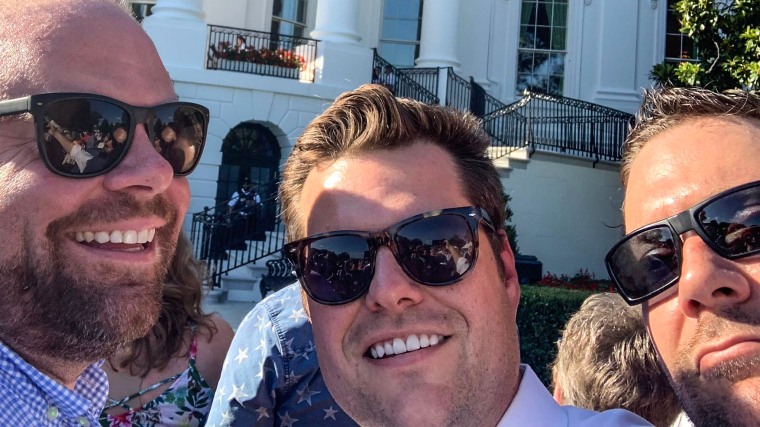
From left, Chris Dorworth, Rep. Matt Gaetz and then-Seminole County Tax Collector Joel Greenberg pose together outside the White House during a visit in 2019.From left, Chris Dorworth, Rep. Matt Gaetz and then-Seminole County Tax Collector Joel Greenberg pose together outside the White House during a visit in 2019.Orlando Sentinel via Getty Images file

In the messages, Greenberg suggested Dorworth had culpability and suggested that another attorney told him that Dorworth may need a lawyer. But Dorworth checked with that attorney, who Dorworth says told him that he never said Dorworth needed to get a lawyer.

Greenberg also said he wanted to warn Dorworth that “some chick” may say “she partied at your house or something.” Dorworth responded by saying that didn’t happen.

The messages show Greenberg said he was paying for the lawyer for the minor whom he later pleaded guilty to trafficking and said that “she doesn’t want to talk to” the FBI. Also, Greenberg said, the “link” between himself and the minor was money he paid her via a banking app.

“The feds are going through my Venmo history,” Greenberg said.

Dorworth has not been charged with a crime.

Greenberg’s Venmo could play a crucial role in a prosecution. In a so-called “confession letter” obtained by The Daily Beast, Greenberg wrote there was no direct payment between Gaetz and the 17-year-old. Instead, he wrote, he was the go-between who collected the cash.

A source who had been briefed on aspects of the investigation told NBC News that investigators had discussed a weakness in the case: there is no direct evidence of payment between Gaetz and the alleged victim and that prosecutors therefore had to rely on testimony from witnesses like Greenberg, who could be viewed a less credible by a jury.  

‘The king elephant’

Lyle Mazin, an attorney who represents two women who are also potential witnesses of the investigation, said it has so many “tentacles,” complexities and lawyers that it’s hard to get a global perspective of the case. But, he said, the feeling “amongst the attorneys seems to be it’s not going anywhere.”

Mazin said he believes top Justice Department officials could be concerned about the political ramifications of going after Gaetz and Trump, who is not connected to this case but is under other federal investigations concerning the Jan. 6 Capitol riot and the alleged possession and improper storage of documents related to national security.

Prosecutors probably can’t afford a not guilty verdict against Gaetz, he said, or a hung jury.

“To me, what leans me to thinking this is dead in the water is that DOJ eventually is going to go after Donald Trump,” Mazin said. “They [prosecutors] can’t put their foot over the line and get it chopped off … if they parade their circus of witnesses in there — even if it’s a perfectly good case and it’s a statutorily serious crime — I think they hurt themselves. I think they’re going after the king elephant.”

Another attorney in the case said the Justice Department is aware of the political complications around the investigation. 

Martinez, the former assistant U.S. attorney, said that pursuing a “high-profile target” could further complicate the case because prosecutors weigh the likelihood of conviction while deciding whether they should bring charges. 

“A victim’s difficult past alone is not a reason for a prosecution not to proceed. In fact, prosecutors have obtained convictions following trials in such cases,” she said, stressing she was not specifically addressing Gaetz’s investigation. “But when you’re the only victim in a case, it could be much more difficult to get a conviction and it could be much harder on the victim. As a former federal prosecutor, I had to decline some cases in which I believed the crime occurred but we determined that we simply couldn’t present a credible case.”

Gaetz has attacked the Justice Department for not doing more to prosecute alleged co-conspirators who tried to shake down his wealthy father, former state Senate president Don Gaetz, for $25 million in return for securing a presidential pardon of the congressman in the sex crimes investigation. Gaetz’s father went to the FBI and wore a wire to catch the suspects — one of whom has since pleaded guilty.

And if House Republicans win control of the chamber in November and make good on their promise to investigate the agency for its various investigations of Trump.

A Trump-appointed judge “could let the Gaetz defense turn into a circus because the victim’s past would come out in court,” the attorney said. “DOJ will pretend it’s not considering all of this in addition to the evidence. But you can bet they are.”

Categories
Saved Web Pages

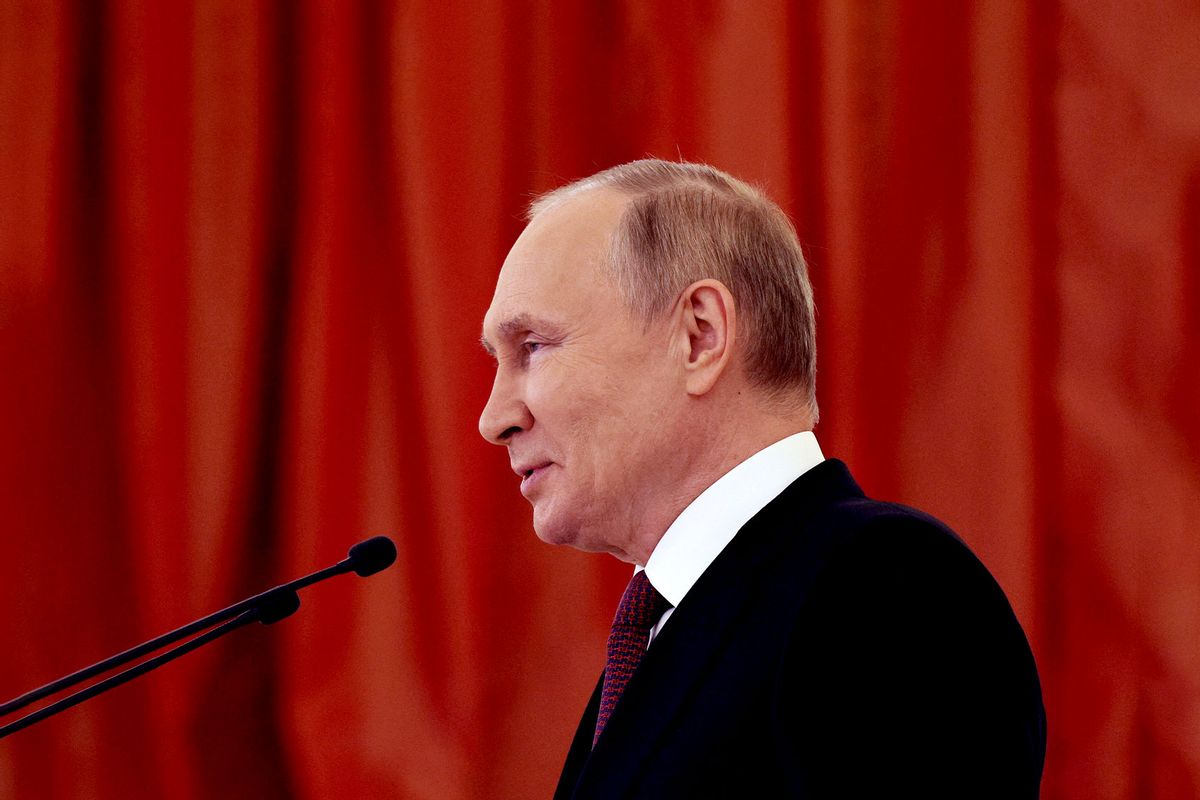
Putin allies are pushing for swift retaliation after an explosion on a key Crimean bridge delivered another humiliation for the Russian president

putin-allies-are-pushing-for-swift-retal

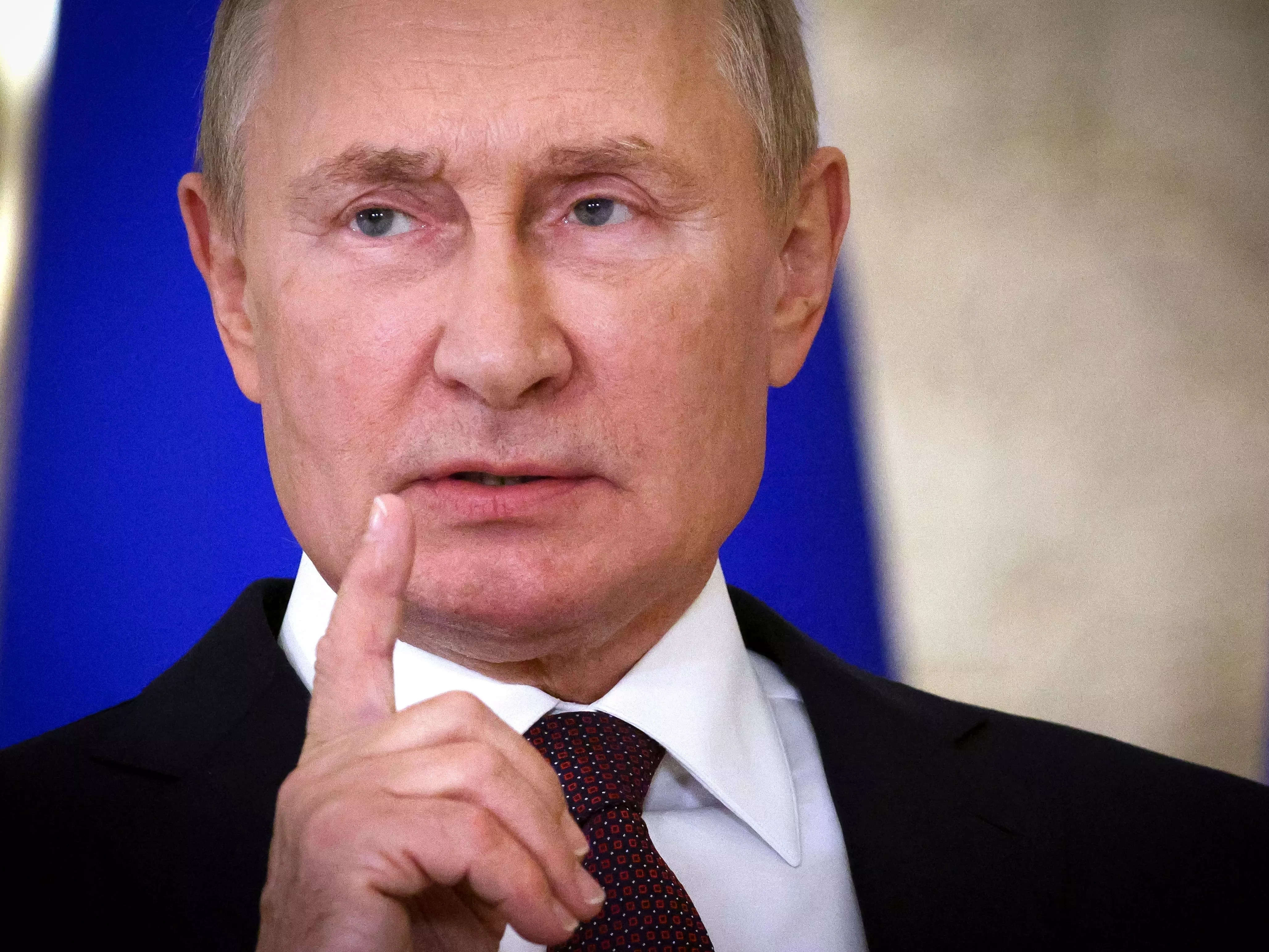
Allies of Russian President Vladimir Putin are calling for a swift response after an explosion on a crucial bridge linking the Crimean peninsula to mainland Russia.

The Kerch bridge collapsed Saturday at around 6 a.m. local time after a truck explosion set off fuel tankers while a train was crossing, Russian officials said.

Putin immediately ordered the source of the explosion to be investigated, but some in Russia quickly blamed Ukraine. Some Ukrainian officials offered subtle hints that they may have been behind the blast, which occurred the morning after the Russian president’s 70th birthday, but Ukraine has not formally taken responsibility.

The bridge provides a road and rail connection between Russia and Crimea, the Ukrainian territory that Russia illegally annexed in 2014. It serves as a key supply route for transporting essential goods like fuel and equipment to Russian forces, which are already said to be struggling as they try to ward off more Ukrainian counteroffensives.

The bridge also held personal significance to Putin, who oversaw its opening in 2018 by driving a truck across it in a symbolic show of the connection between Crimea and Russia.

—Михайло Подоляк (@Podolyak_M) October 8, 2022

The explosion on Saturday has been called a humiliation for Putin due to both the strategic and symbolic significance of the bridge, and has opened him up to additional public criticism over his handling of the war in Ukraine.

Some of his allies have publicly demanded retaliation, certain that Ukraine was behind the blast.

Sergei Markov, a politician and former adviser to Putin, called the explosion of the bridge a “terrorist attack” in a Telegram post and said it showed “the US and its Ukrainian proxy regime will move the red line further and further,” Politico Europe reported.

“No response from Russia? Even further. And again? Even further,” he wrote, urging Moscow to respond.

The explosion was also called a “terrorist attack” by Konstantin Dolgov, a member of Russia’s parliament, according to Politico Europe. He called it “another sinister manifestation of the terrorist nature of the puppet Kyiv regime,” adding: “Terrorists must be treated unequivocally!”

The calls for revenge come as Putin and the Russian military have faced increasing criticism in recent weeks, including from members of his inner circle, according to reports.

Though Ukraine has not claimed responsibility for the attack, the explosion of the bridge was celebrated by Ukrainians.

Categories
Saved Web Pages

The Case for Dismantling the FBI

matt-gaetz-hearing.jpg?fit=2057%2C1200

Categories
Saved Web Pages

Special forces continue to blow up railway tracks in Russia – British intelligence

6358e2f626543-screenshot_69.jpg

A partisan movement continues to create sabotage on the Russian railway, due to which the Russian Armed Forces have certain difficulties in transferring troops to the war in Ukraine.

This follows from a statement by the Ministry of Defense of Great Britain.

Thus, on October 24, the governor of the Belgorod Oblast of the Russian Federation, Vyacheslav Gladkov, reported that an explosive device damaged the railway in the area of the village of Novozybkove, approximately 15 km from the Russian-Belarusian border. The line is the main railway connection between Russia and southern Belarus. The Russian anti-war group Stop the Wagons claimed responsibility for the incident. This is already the sixth known case of sabotage against the infrastructure of Russian railways, which the group claimed, since June.

The British Ministry of Defense reports that the Russian armed forces mainly rely on rail transport to transfer troops to Ukraine, but with a network of more than 33,000 km, which mostly crosses isolated areas, the system is extremely difficult to protect from physical threats.

The Russian leadership is increasingly concerned that even a small group of citizens opposed to the war may continue sabotage.

We will remind, earlier in Shebekino, Belgorod Oblast, a fire started at an electrical substation, and Russian officials blame the Ukrainian military for the fire.

Meanwhile, Ukrainian partisans blew up the railway in the occupied Melitopol. The occupiers confirmed the detonation of the railway track, calling the actions of the partisans “a strike by Ukrainian militants.”

Categories
Saved Web Pages

Brittney Griner’s appeal denied by Russian court

?url=http%3A%2F%2Fmediadc-brightspot.s3.

A Russian court upheld the prison sentence levied against basketball superstar Brittney Griner on drug charges.

The WNBA player will serve nine years in a penal colony unless the U.S. government, which considers her to be wrongfully detained, can negotiate a deal to secure her release. She has been held since her arrest in February.

BRITTNEY GRINER AND PAUL WHELAN COULD BE FREED BY YEAR’S END, ADVOCATE SAYS

She did not appear in court and attended Tuesday’s proceedings via a video link from the detention center where she has been detained since her arrest, according to the New York Times.

“President Biden has been very clear that Brittney should be released immediately,” national security adviser Jake Sullivan said in a statement. “In recent weeks, the Biden-Harris administration has continued to engage with Russia through every available channel and make every effort to bring home Brittney as well as to support and advocate for other Americans detained in Russia, including fellow wrongful detainee Paul Whelan.”

“Brittney is a very strong person and has a champion’s character,” her lawyers said in their statement on Monday. “She of course has her highs and lows as she is severely stressed being separated from her loved ones for over eight months.”

Griner was convicted on Aug. 4 after pleading guilty to drug charges for bringing vape cartridges containing cannabis oil in her luggage through a Moscow airport in mid-February. During her original trial, she admitted to bringing the cartridges, though she said it was an accident.

The State Department revealed in July that the administration had made a “substantial proposal” to get them home following public pressure to get her back. The administration declined to provide specifics on the details of the suggested swap, but it’s been widely reported that it included the release of convicted Russian arms dealer Viktor Bout, who has been nicknamed the “Merchant of Death” for allegedly selling arms to sanctioned human rights abusers in various African nations.

Roughly two weeks ago, Russian Ambassador to the United States Anatoly Antonov visited Bout in prison, though it’s unclear whether the meeting was a precursor to a possible swap.

President Joe Biden was recently asked if there had been any progress about a possible meeting with Russian President Vladimir Putin regarding a possible swap, and he said, “Not with Putin.” The president also said that he would meet with Putin at next month’s G-20 Summit to discuss a possible swap but that otherwise, he doesn’t plan to speak with the Russian leader.

CLICK HERE TO READ MORE FROM THE WASHINGTON EXAMINER

Former U.S. Ambassador to the United Nations Bill Richardson, a longtime advocate for U.S. hostages abroad, said earlier this month that he believes Griner and Paul Whelan, another American considered wrongfully detained by the administration, could be returned by the end of the year.

Whelan, a Michigan man, is serving a 16-year prison sentence on espionage-related charges that he and his family vehemently deny. He has been held since late 2018.

Categories
Saved Web Pages

Hasidic Boys School in Williamsburg Admits to Widespread Fraud; Pays $8M as Gov’t Restitution

money.jpg

Hasidic Boys School in Williamsburg Admits to Widespread Fraud; Pays $8M as Gov’t Restitution

Edited by: TJVNews.com

The largest private Hasidic Jewish school in New York State admitted in federal court on Monday that they had illegally diverted millions of dollars from a variety of government programs, paid teachers off the books and requested reimbursements for meals for students that it never actually provided, according to a New York Times report.

As part of the widespread fraud, school officials took money intended to feed children and used it to subsidize parties for adults, federal prosecutors said.

In order to avoid facing criminal charges, the school, the Central United Talmudical Academy in Williamsburg, Brooklyn, agreed to pay fines and restitution totaling more than $8 million, according to a deferred prosecution agreement filed Monday in Federal District Court in Brooklyn, as was reported by the New York Times.

The all-boys school, which serves 2,000 youth in the Brooklyn neighborhood admitted to illegally shifting funds from government programs. Instead, the funds were used on parties and miscellaneous expenses not approved by the respective programs, the report indicated.

“Today’s admission makes clear there was a pervasive culture of fraud and greed in place at C.U.T.A.,” said Michael J. Driscoll, assistant director in charge of the F.B.I.’s New York office, referring to the school by its initials in a statement. “We expect schools to be places where students are taught how to do things properly. The leaders of C.U.T.A. went out of their way to do the opposite.”

In court on Monday, a lawyer representing the yeshiva, Marc Mukasey, said school leaders would work collaboratively with the government to fulfill its obligations under the agreement, which has been in the works since 2019, the report said.  After the hearing, Mr. Mukasey declined to comment further. School leaders did not respond to phone and email messages seeking comment, as was reported by the Times.

In recent weeks, the New York Times published an investigative piece about the alleged lack of secular studies programs in many yeshivas in the New York City area. The newspaper noted that some of these institutions were recipients of government funding and federal education grants.

For several years now, the New York Times has taken it upon itself to research the Hasidic private schools, writing about how the schools are “failing by design”.  The Times has taken a handful of Hasidic schools as a sample, faulting the private schools overall for minimal time invested in secular studies.

In response to the denigration heaped on yeshivas and the quality of education they provide to their students in the Times article, Rabbi Chaim Dovid Zwiebel of the Agudath Israel organization which represents the views of the large swath of the Orthodox Jewish community in New York City and across the United States, recently penned a letter to Eliza Shapiro and Brian Rosenthal, the two writers at the Times who produced the article in question.

Rabbi Zweibel said in this letter:  “The timing of this article is terrible. Hate crime statistics, specifically crimes targeting Jews, are spiking dramatically — and most of these crimes are being directed against Hasidic Jews. Is now the time to publish a major article in the most prestigious newspaper in the world portraying the Hasidic schools — and, by extension, the entire Hasidic community — in the most negative light imaginable? Obviously, no one in his right mind would accuse reporters with your surnames of being anti-Semitic, but don’t you realize how an article like this will fuel the anti-Semites of the world to escalate their attacks against Hasidic Jews?”

The Times also cites a standardized test in reading and math, administered in 2019 to 1000 students at the Central United Talmudical Academy, in which all students failed. The Times intentionally neglects to mention how other schools fared, or how many of the public schools throughout 37 states cheated on the same standardized test. The Times goes on to point at the public funding that the Hasidic schools have received over the years, saying the funding should be cut, because the schools allegedly fail to secure an adequate education to students.

The left-wing paper, continues pointing a finger at city and state officials for not taking action, saying this is because they fear backlash from influential Hasidic leaders who have a strong following when it comes time to vote. “There’s a significant population that you ignore at your peril,” said a political consultant quoted by the Times, Evan Stavisky, referring to the Hasidic community. “They are part of the fabric of New York politics.”

The Times also alleges that students are being “trapped” into dependency and joblessness, despite the fact that the government has endowed the schools with generous taxpayer funding– saying the Hasidic boys schools collected roughly $1 billion in the past four years.  Even the Times conceded that that “the schools receive far less taxpayer money per pupil than public schools do”.

The Times article also concluded that “students grow up and can barely support their own families”.  Still, as per the US Census Bureau data conducted this decade, the city’s greatest concentration of unemployment is by no means in Hasidic neighborhoods of New York City. Rather, such unemployment rates exist in districts 14, 15, 16, and 17 in the south and central West Bronx, and District 10 in northern Manhattan.

Hasidic Jews are, by and large employed in successful occupations.  The same article even conceded, “six days a week, often before the sun rises, boys file into classrooms and spend up to eight hours a day studying the Talmud and other ancient texts”, which clearly illustrates that the boys in these yeshivas receiving  a full day of instruction. The Times also alleged that corporal punishment is an acceptable occurrence in some of the Hasidic schools.  Richard Bamberger, spokesman for Hasidic schools, responded by saying the schools “have zero-tolerance policies against any violence.”

Speaking to the Jewish Voice on the condition of anonymity, a representative of the Tzedek Association, a Brooklyn based organization that advocates for Jewish education and other human rights causes, said on Tuesday that “The entire New York Times article was replete with countless egregious falsehoods and baseless accusations. He stated that, “the Times accuses yeshivas of employing corporeal punishment to students and that is patently untrue. There is absolutely no veracity to this insidious propaganda and the Times provided no concrete evidence to buttress its claim.”

balance of natureDonate

Categories
Saved Web Pages

America, Defender Of Democracy? Why The World (Still) Isn’t Buying It

profil-view-of-joe-biden.jpg?id=31987979

Traffic goes past the Foduna Casino and Hotel, a Chinese owned casino in Sihanoukville, Cambodia

Cambodia has been making headlines this year for all the wrong reasons: a rising Asian leader in “internet fraud,” “forced labor” and “human trafficking.”

But why, in particular, has Cambodia become a hub for online scams? How did international cyber fraud become so widespread in this Southeast Asian nation of 16.7. million? The answers begin with an unlikely source — land.

There is a joke familiar to many Cambodians: only generals with two stars or more can own land in Sihanoukville, a popular beachside destination in the south of the country. That land eventually changes hands and ends up belonging to Chinese investors, who turn it into hotels, casinos and, eventually now: cyber fraud activities.

Cambodia has private ownership of land, but its domestic politics has been turbulent for decades, with property rights still unclear. Large amounts of private land is still concentrated in the hands of the political elite through violent means, such as the forced conversion of private land into state land or the eviction of residents for commercial development.

In 2007, the government evicted long-time fishermen living in Sihanoukville, on the grounds of developing a public road, with 105 family houses burnt down by the police.

The seemingly unrelated factor of land is the basis for Cambodian becoming a hotbed of fraud in the virtual world. On July 15, the documentary Forced to Scam, released by Al Jazeera, revealed that the Special Economic Zone in Pursat province, in the west of the country, was in fact a cyber fraud park.

Often, these parks are in the form of offices that are leased to the owners of online gambling companies for rent and management fees. The “management fees” are collected by specialized properties, also known as zone managers. But law enforcement experts say the management cost is a protection fee charged by the landowners for providing political sanctuary to the companies.

As developing countries, Southeast Asian nations did not have the foundation of earlier Western countries that built national wealth through colonial advantages. Due to its disadvantaged position in the development of global capitalism, the Cambodian government has adopted “extractive” strategies to rapidly accumulate capital for national development, i.e. plundering and exploiting the country’s natural and land resources. But these strategies have created suffering too.

According to the World Bank, Cambodia’s economy has been growing at a rate of over 7% since 2011, thanks to its garment manufacturing and real estate sectors. But behind these gains lie a number of obvious disasters: forest destruction, drug and gun violence, and the proliferation internet scams.

Cambodia has now been ranked as the Southeast Asian country with the highest level of corruption for the fourth year in a row; it also has the highest rate of forest degradation over the last two decades, with vast areas of virgin forest destroyed by logging.

In the U.S. State Department’s latest Trafficking in Persons Report 2022, Cambodia was even downgraded from the original Tier 2 to Tier 3, highlighting the country’s extensive internet fraud parks and forced labor.

Cambodia’s complex political and economic structure has been shaped by the many changes of government and state institutions since the French colonization in 1863. After the formal independence of the Kingdom of Cambodia in 1953, the government was overthrown multiple times, notably with the Khmer Rouge communist regime from 1975 to 1979, the 1978–1989 Vietnam occupation, and the UN takeover from 1992 to 1993.

China has been the largest foreign aid donor to Cambodia since 2003.

It was not until 1998, when Hun Sen became the Prime Minister, that the political situation in Cambodia became more stable. Hun Sen used “democracy” as a cover to start moving towards a developmental authoritarian state, where one-party dominance and Hun Sen’s family patronage network provide an umbrella for corruption.

In terms of international relations, China has been the largest foreign aid donor to Cambodia since 2003, and the Sino-Cambodian alliance has gradually become a shield for Cambodia in the face of international democratic forces.

During the UN takeover, the West hoped that foreign aid would be used to boost Cambodia’s economic growth, thereby achieving social stability and, by doing so, promote Cambodia’s political democratization. But with the development of China’s Belt and Road Initiative and continued investment from Beijing, Cambodia’s dependence on the West has gradually diminished, providing a backstop to Hun Sen’s authoritarian rule.

The Belt and Road Initiative has not only brought Chinese capital to Cambodia, but also unsavory industries such as prostitution, gambling and drugs. Although naturally not planned developments under the initiative, they have attracted countless Chinese investors and speculators who have taken advantage of the opportunity to head overseas.

Under China’s harsh policies against such industries in the last decade, the organizers have been moving to Southeast Asia, such as Manila in the Philippines, Sihanoukville in Cambodia, and Myawaddy in Myanmar.

In 2019, there were 91 casinos with legal licenses in Sihanoukville, most run by Chinese. In addition, clubs in the city offer sex and drug services with the help of Cambodian officials. These establishments are sheltered by Cambodian officials in the form of shares, and they employ armed Cambodian gendarmes as security personnel.

With Cambodia’s only deep-water port, Sihanoukville is also a key development target of China’s Belt and Road project. Led by Cambodia’s pursuit for rapid economic growth and Chinese investment, Sihanoukville has grown from a small fishing village in a seaside port to become the third largest city in the country.

From the end of 2017 to mid-2019, Sihanoukville got the reputation of “gambling town” with a rumored “300,000 online gamblers,” and the sector relying on local protection forces to spread across Cambodia.

Many believe that Cambodia’s cyber fraud industry has evolved out of the legitimate gambling industry. In fact, the popular real estate investment, casino and online fraud industries have been developing in parallel. But problems mushroomed after the 2019 “818 Gambling Ban,” which required online gambling companies to leave Cambodia. Following the ban, a large number of online gambling companies began to move to places such as Myanmar, Dubai and Georgia.

The 818 gambling ban not only caused a mass exodus of legal online gambling companies, but also brought about another serious evil. The real estate investments, casinos, clubs, supermarkets and restaurants that grew up around the industry were all devastated, leaving countless investors broke and workers in Sihanoukville out of a job.

Many from Hong Kong and Taiwan came to Cambodia, trapped in cyber fraud activities.

Internet gamblers fled, investors lost money, businesses closed, casinos laid off staff – Sihanoukville’s economy came to a standstill overnight. This was the beginning of Sihanoukville’s descent into a Wild West. The city is home to many gangsters who rely on gamblers for their livelihood and have expert kidnapping techniques, so they formed professional gangs to kidnap Chinese people inside Cambodia and sell them to online fraud outlets. With the outbreak of the COVID-19 pandemic, the cost of selling people has risen in tandem with the cost of smuggling, recently hitting around $25,000.

As for business, due to China’s ongoing operations against illegal industries, anti-fraud propaganda and other policies, online gambling companies’ profits in mainland China were limited. In 2020, following the outbreak of the COVID pandemic, the Chinese government tightened its immigration policies.

As the online gambling and fraud industry is dominated by the Chinese population, China’s measures to restrict external mobilization have deprived them of a large part of their labor pool. Coupled with the rise of international fraud, they began to look for labor from other countries and to attract overseas workers with high pay.

This is how so many people from Hong Kong and Taiwan wound up coming to Cambodia, trapped in cyber fraud activities.

Countries and regions where online gambling companies congregate, such as the Philippines and Cambodia, are among the poorest regions in the world and attract desperate speculators. The nations themselves are eager to develop their economies and tackle poverty, and therefore accumulate national wealth by extracting domestic resources whatever ways possible.

Former president of Philippines Rodrigo Duterte, for example, has refused the Chinese government’s request to cancel online gambling licenses, citing the need to feed the people. Cambodia’s gambling ban in 2019, passed in exchange for free aid from China, has ultimately pushed organizations to operate covertly throughout Cambodia.

With Cambodian officials denying the existence of online gambling parks in Cambodia, these fraudulent companies have become even more brazen in human trafficking and abuse.

Why are online fraud companies alive and well? As well as being protected by developing countries, they draw in all kinds of people and industries to serve them. Multinational money laundering organizations transfer money for them. Information sellers continue to provide them with personal information and privacy from all over the world. Snakeheads (Chinese gangs) around the world secretly send them employees of different nationalities. Travel agencies provide them with visas and booking services.

It’s truly a global industry with global impact, but nowhere does it run deeper than in Cambodia.

Categories
Saved Web Pages

Russia’s War in Ukraine: Misleading Doctrine, Misguided Strategy

shutterstock_editorial_13454907e.jpg?ito

A vehicle with the sign “+”, markings often found on Ukrainian army vehicles, seen driving past a destroyed tank with the sign “Z”, markings often found on Russian military vehicles near the border of Kharkiv and Donetsk region, 2022.

couv_rnr40_page_1.png
Russia’s War in Ukraine: Misleading Doctrine, Misguided Strategy Download

The scope of problems with the chain of command and logistics, scant air support and poor morale indicates that Russian planning and preparations for the war were seriously flawed and misguided.

On the level of doctrine, the assertion of Russia’s ability to deter North Atlantic Treaty Organization (NATO), defined as the main adversary, by employing the complete set of nuclear, conventional and “hybrid” capabilities, laid the foundation for the failure of attack on what was presumed to be a frangible Ukraine. Strategic guidelines on gaining a quick and complete victory by establishing air dominance and executing offensive maneuvers by armored battalion tactical groups (BTGs), led to the confusion of poorly coordinated attacks without proper air support. The strategic culture, pro-forma conservative but distorted by bureaucratic sycophancy and corruption, produced inflexible chains of command, demoralization of poorly led combat units and ugly atrocities.

The sum total of these flaws is too high for the Russian army to learn useful lessons in the six months of fighting, so it has fallen back on the old pattern of positional warfare based on destroying the enemy by heavy artillery fire. The strategy of protracted war of attrition can lead to victory only if the economy and society are mobilized fully for delivering the necessary resources to the fighting army, but such mobilization—while proceeding in defiant Ukraine—remains politically impossible in discontented, isolated and economically degraded Russia.

Dr. Pavel K. Baev is a Research Professor at the Peace Research Institute, Oslo (PRIO). He is also a Senior Non-Resident Fellow at the Brookings Institution, Washington D.C., and an Associate Research Fellow at Ifri, Paris.

Military forces War in Ukraine Russia Ukraine

Categories
Saved Web Pages

Putin really could fall — but will that help the West as much as we think?

vladimir_putin_1243379448.jpg

The disarray and likely collapse of Vladimir Putin’s effort to mobilize 300,000 conscripts to fight in Ukraine suggests that his iron grip on power could someday soon be broken as quickly and surprisingly as the czar’s grip was broken in 1917 and the grip of Soviet totalitarianism was broken in 1990. But with what consequences?

A hundred years of Russian experiences with overthrowing autocracy suggest only another turn in a depressing cycle. Americans tried but failed to arrest that cycle when U.S. troops actually invaded to support anti-Bolshevik White Russians in the 1920s and when free-market evangelists in the 1990s put their dirty fingers into the Russian economy, only to wind up getting burned. 

In “The Unconquerable World: Power, Nonviolence, and the Will of the People,” Jonathan Schell reminded us that revolutionary Bolsheviks were surprised that the imperial regime fell quickly and with little bloodshed. Between 1989 and 1991, most Russians and Westerners were equally surprised by the speed with which the supposedly impregnable Soviet Union lost its grip on Eastern Europe and on Russia itself, vanishing almost as if in a puff of smoke. The reason is that autocracies that are run mostly on fear — on domestic terror — drain their people of the spontaneous energy and comity, or love, that can sustain a healthy society. So those societies fail. And if their public’s fear is displaced by contempt, they unravel.  

Huge upheavals in technology, economics, communications, migrations and demographics over these past hundred years have exposed the bankruptcy of fear as a social glue and have weakened the grip of old-style authoritarianism. But the new technologies and other arrangements have also intensified top-down surveillance, indoctrination and control in increasingly subtle and even seductive ways in the hands of rulers in Hungary, Singapore, Turkey and other countries whose elites are more imaginative than Czar Nicholas II or Joseph Stalin and their legatees. (See William Dobson’s “The Dictator’s Learning Curve.”)

Putin, who spent his childhood under Stalin and his formative years in the KGB, is almost a throwback to the old authoritarianism, and has not seemed to master the new authoritarianism’s greater subtlety and intimacy. Watch this three-minute video of Putin entering the Kremlin, which I posted here in Salon with another warning about him a few months ago. Notice the cartoonish postures of his guards and the obsequious deference of the nomenklatura, receiving him in ways that suggest that Putin’s curse may truly be Russia’s. For better or worse, Russian civil society has never had anything like America’s libertarian-individualist strain or its civic-republican ethos.

But are those differences really to the West’s advantage? Right now, American libertarian individualism and civic-republican cooperation are undergoing disturbing, funhouse-mirror distortions at the hands of Donald Trump, a professed admirer of Putin’s “genius.” Trumpism carries dangers that are metastasizing not only in America but also in Marine Le Pen’s France, Giorgia Meloni’s Italy and elsewhere in Western Europe.

The irony is that while Putin’s vulgar authoritarianism may be weakening in Russia, with unpredictable consequences, a new authoritarianism is rising among tens of millions of citizens in Western democracies who demand to be lied to and recruited by myths as simplistic as Putin’s, myths that tell them whom to scapegoat for their stress and dispossession and whom to follow to “fix it.”

Want a daily wrap-up of all the news and commentary Salon has to offer? Subscribe to our morning newsletter, Crash Course.

The demagoguery of Trump and his Fox News heralds is more a symptom of this spreading virus than the main cause of our crisis. That cause is partly conspiratorial and malevolent, but often it’s just mindless: Americans (and other Westerners) have been increasingly stressed and dispossessed in recent decades by the frantic financialization and consumerization of civil society. It’s groping and goosing us 24/7, bypassing our minds and hearts on its way to our lower viscera and our wallets by titillating us, intimidating us, tracking us, indebting us and leaving us enmeshed in a spider’s web of commercial come-ons and pressures.

Unlike Putin, Donald Trump is both a product and an accelerant of that social malady. Putin has his oligarchs and his rubber-stamp parliament, but he hasn’t mastered the new autocrats’ learning curve, which may be transforming the West even as he clings to the weakest elements of Russia’s old authoritarianism: a society running on fear more than on love.

WP Radio
WP Radio
OFFLINE LIVE