Categories
Saved Web Pages

Time to Investigate the FBI’s Sketchy CHS Program › American Greatness

GettyImages-1242655792.jpg

To the surprise of no one paying attention, the Department of Justice recently acknowledged the use of several FBI informants in its investigation of the Oath Keepers, an alleged militia group tied to the events of January 6. 

Prosecutors last week asked for a protective order to conceal from jurors information about confidential human sources (CHS) expected to testify during the seditious conspiracy trial of five members of the Oath Keepers; jury selection is now underway. Not only does the government want to prevent defense attorneys from asking personal questions that could reveal the informants’ identities but prosecutors don’t want the sources to publicly disclose any involvement in past or pending criminal investigations or details of “the FBI’s CHS program and the training and methods used by the FBI as part of their undercover operations.”

That request, of course, is to protect the bureau, not informants, in what appears to be just another corrupt, political, and unaccountable section of the FBI. 

For example, court filings in Special Counsel John Durham’s probe into Russiagate just revealed that Igor Danchenko, a subsource for the infamous Steele dossier now facing perjury charges, was hired by the FBI in March 2017 as an informant to shield the agency from questions about the dossier’s credibility in the early stages of the scandal. “[The] bureau put him on its payroll as a confidential human source, or CHS, making him part of the bureau’s untouchable ‘sources and methods’ sanctum and thereby protecting him and any documents referencing him from congressional and other outside scrutiny,” investigative reporter Paul Sperry wrote this week.

The FBI-hatched plot to “kidnap” Michigan Governor Gretchen Whitmer involved numerous informants working out of multiple FBI field offices. At trial, informants and agents confessed the rules were broken in the process of engineering the caper; violations included sharing a bed with a target, suggesting “overt acts” to produce incriminating evidence, and initiating the lead informant into a fake militia to advance the plot. Another longtime informant—a convicted felon many times over—committed at least two crimes while working the Whitmer fednapping ruse and was accused by the government of acting as a “double agent.”

None of this is necessarily news inside the department. An investigation by the Justice Department’s watchdog, Inspector General Michael Horowitz, identified “significant weaknesses with certain aspects of the FBI’s CHS program,” and spelled those out in a 2019 report. Oversight of both long-term sources and case-specific informants fell short of department standards, “creating a risk that CHSs are not adequately scrutinized.” FBI handling agents also failed to safeguard highly classified CHS material and often didn’t use secured lines of communication.

All this ineptitude doesn’t come cheap to American taxpayers. Horowitz found that the FBI spent an average of $42 million annually between 2012 and 2018 on informants—and that’s paid out in cash with little to no accountability. 

Dan Chappel, the lead informant in the Whitmer fednapping, received at least $60,000 in cash and personal items for roughly seven months’ work; the bureau even compensated Chappel for a loss after selling his home. Two months after six men were arrested for conspiring to kidnap Whitmer, an FBI agent handed Chappel an envelope with at least $23,000 in cash, presumably for a mission accomplished. (Agents could point would-be informants to financial incentives as a reason to become a source.)

“Some counterterrorism CHSs make hundreds of thousands of dollars,” Kyle Seraphin, an FBI whistleblower who worked in the bureau’s counterrorism division, told American Greatness by phone on Thursday. “Agents give piles of cash to their informants with five and six-figure payouts. And the informants working in criminal cases aren’t always upstanding citizens, Seraphin said. “Most are scumbags, usually. It’s rare you find one with a nine to five job.”

FBI agents are required to keep at least one source on the books, which often leads to problems for long-term informants. “They become needy, they call in the middle of the night, they get arrested,” Seraphin explained. “Sources are a pain in the ass.”

But CHSs serve an important purpose in the modern-day FBI: to advance a political narrative beneficial to the Democratic Party and Biden regime, particularly the existence of “domestic violent extremists,” i.e., Trump supporters. 

“Informants really push to hold together groups that don’t want to be together. The FBI keeps using [informants] as a hub in a wheel,” Seraphin said. Deploying informants also allows for the introduction of FBI undercover agents, which puts in motion a multifaceted effort that ultimately involves U.S. attorneys, FBI supervising agents, intelligence analysts, and main Justice if it’s associated with a suspected domestic terror attack.

The result, more often than not, Seraphin said, is the equivalent of entrapment. “There’s a moral definition that we all feel is entrapment but the legal definition is not the same. It’s predatory. People are building [their] FBI careers on predatory investigations of people who probably just need mental health care. They find the person they don’t like, then find the crime. It’s what they know, and it’s effective.”

This certainly was the case in the Whitmer fednapping scheme. Dozens of supervising agents, undercover employees, and informants stitched together the random group of outliers—the alleged ringleader, Adam Fox, lived alone in the dilapidated cellar of a strip mall vacuum repair shop without running water or a toilet—then organized training and surveillance trips to produce evidence before luring them to an arrest site in Ypsilanti, Michigan on October 7, 2020

But a Grand Rapids jury in April—Seraphin said these investigations rarely get to the prosecution stage—acquitted two men and ended with a hung jury for two others after the defense convinced jurors their clients had been entrapped by the FBI. (A second trial resulted in the conviction of the remaining defendants thanks to interference by the judge.) 

In a scathing closing argument during the first trial, Christopher Gibbons, Fox’s public defender, denounced the FBI’s conduct as “unacceptable in America. That’s not how it works. They don’t make terrorists so we can arrest them.”

Unfortunately, that is precisely what’s happening in America, and it’s beyond unacceptable—it threatens national security as the FBI ignores legitimate dangers and destroys innocent lives. Further, the definition of “domestic terrorism” is statutorily vague so it can apply to minor infractions in the Capitol protest, even for those who had no intention or knowledge that they were committing a crime. Absurd charges such as obstruction, conspiracy, and “parading” in the Capitol, a petty offense, are the equivalent of blowing up a jetliner or federal office building, according to the Biden regime. 

And propping up the phony narrative requires the use of sketchy informants, often working at the direction of equally sketchy FBI handlers. Forcing the government to tell the whole truth in court about the CHS program undoubtedly will expose another crisis-level scandal at the irredeemably corrupt Federal Bureau of Investigation.  

Categories
Saved Web Pages

Nearly half of the country now has serious doubts about the FBI. Here’s why

fbi_building_081322ap-jose-luis-magana_t

Like it or not, the FBI finds itself standing on a thin precipice that seems to add a new crack each week. If polls are to be believed, almost half the country now lacks trust in the FBI over concerns it is doing the bidding of one political party over another. That is a disaster for the bureau — unprecedented in magnitude — and could translate into an existential threat to one of the nation’s most important agencies as political fault lines shift.  

Millions of Americans have concluded that the FBI has been hyper-aggressive against Republicans, conservatives, and Donald Trump supporters while turning a blind eye or downplaying damning allegations against Democrats and leftists, from the Biden and Clinton families’ alleged pay-to-play schemes to Jane’s Revenge to antifa.

But it gets worse — as if political bias weren’t bad enough. The FBI has been regularly adding to a growing list of forceful arrests and searches of targets on the right that seem dramatically out of proportion to the alleged crimes being investigated. Early morning residential door-banging by a phalanx of heavily armed FBI agents traditionally was reserved — and used sparingly — for subjects of serious violent crimes known to be armed and dangerous. 

There was a reason for this. Residential arrests are particularly dangerous for everyone involved.  The subject has clear advantages at home, none of them good for law enforcement. A decision to confront menacing criminals where they live was normally made because the risk of attempting an arrest in a more public venue where innocents might be harmed was considered too great.  Therefore, the FBI took on all the peril of arresting a dangerous subject in his home in order to protect others. Residential arrests and searches typically were nobody’s favorite option inside the FBI.  

And so, it makes little operational sense to deploy these kinds of tactics in cases involving a dispute over documents, or sham Electoral College voters, or a diary belonging to the daughter of the president, or a failure to observe a congressional subpoena, or shoving someone outside an abortion clinic.  

Normally, cases involving individuals who are clearly not violent career criminals or flight risks would be handled with a summons to appear or, if necessary, a safe, low-key arrest in a controlled setting. Invasive searches were rarely a first option when a subpoena would more than suffice. Handcuffs were deemed to be ample restraint. During my FBI career, I never used nor saw used, with even the most dangerous criminals, ankle restraints like those allegedly slapped on one Trump adviser. Why arrest a Catholic pro-life protester at home when it’s established that he kneels to pray the rosary every week in front of an abortion clinic? Maybe the home arrest sends a better chilling message.  

Two other factors are feeding suspicions of unnecessarily aggressive FBI tactics. First, many of these investigations involve arcane criminal charges that were rarely, if ever, pursued for prosecution — but now, suddenly, they are. Second, in at least the search of Trump’s Mar-a-Lago resort, the Ashley Biden diary search, and the Catholic pro-life father arrest, there are substantial indicators of early attempts by defendants to cooperate with the Department of Justice (DOJ).  And yet, the front doors of homes were still banged on early in the morning.  

Add all this up on your favorite abacus and you get a whopper of a perception taking deeper and deeper root every week that the FBI is not just biased, but is also cooperating in a DOJ political effort to “send an intimidating message” through highly kinetic, show-of-force actions against individuals the Biden administration doesn’t like and wants to shut up.

The DOJ, and the attorney general in particular, have set their jaws and justified their actions by claiming they are simply following the rule of law and ensuring that no one is above that law.  Essentially they’re saying that perceptions of uneven application of the rule of law against conservatives that may arise from their actions simply don’t matter; they’re just doing their jobs.     

Well, here’s the rich irony of that argument. For nearly 30 years, the DOJ has investigated more than 70 police departments across the country for perceived “patterns and practices” of excessive and unconstitutional enforcement actions against certain constituencies such as minority communities or the mentally ill. The Justice Department often will assert that these perceived patterns indicate a form of “extrajudicial punishment” outside of conviction and sentencing. To the DOJ, mere perceptions of police excesses are considered reality. Guess what police departments will usually offer as a first line of defense: We were just doing our job. 

These DOJ investigations of police departments usually result in what is called a “consent decree,” in which the parties agree to certain reforms. Consent decrees can be a positive force for correcting patterns (aka, perceptions) of overly aggressive law enforcement actions against specific constituencies.  

The question, then, that now jumps out of the irony file is who has the authority to impose a consent decree on DOJ for its own current pattern of hyper-forceful and possibly extrajudicial punishment of a particular constituency consisting of political foes of the Biden administration?  Answer: No one. The DOJ is currently free to engage in patterns of aggressive, targeted enforcement actions that they will not allow police agencies to do.

This may help explain why congressional Republicans claim there is a growing list of FBI agents coming forward whom they characterize as “whistleblowers.” The FBI does not have a long tradition of whistleblowers showing up in force so, if true, it’s not something to be taken lightly. 

Ugly immigration rhetoric has deadly consequences Intimidation is the name of the game for red state legislatures

It’s important to remember that 99 percent of agents daily investigate what every law-abiding citizen wants them to. This summer saw 6,000 violent criminals arrested, thousands of illegal guns seized, and massive amounts of killer fentanyl taken off the street in a cooperative initiative with local police departments. Gangs have been dismantled; young children sexually trafficked by cartels have been rescued. Espionage arrests have been made and cryptocurrency extortions have been recovered.    

FBI agents working these matters understand that when a small slice of the FBI fosters a perception of one-sided, politically driven enforcement actions, it erodes the trust that Americans have traditionally placed in the FBI. When trust diminishes, the FBI loses access to cooperation it used to have. When cooperation is lost, fewer crimes are solved. Many agents are understandably upset with current trends. To be clear, the FBI does not have to cooperate with politically fraught DOJ agendas, no matter which party is in power — and it shouldn’t.  

Kevin R. Brock is a former assistant director of intelligence for the FBI and principal deputy director of the National Counterterrorism Center (NCTC). He independently consults with private companies and public-safety agencies on strategic mission technologies.

Categories
Saved Web Pages

Why are US Lawmakers Navigating Counterintelligence Threats?

Why-are-US-Lawmakers-Navigating-Counteri

Experts have concluded that our rising dependence on disruptive technologies has given a rise to counterintelligence threats. Basically, counterintelligence is the information gathered and the actions taken to identify and protect against an adversary’s knowledge collection activities or attempts to cause harm through sabotage or other actions. The primary goal of counterintelligence is to make certain that no information can be modified, destroyed, or leaked by malicious actors and is only authorized by people who have access to it. But the growing expansion of technology in our daily lives has made sure that threats to counterintelligence also rise, hence the governments are issuing notices to lawmakers navigating counterintelligence threats that they are shrewd and certain that under no circumstances the perpetrators can manipulate high-priority intelligence information and jeopardize the security of the citizens.

Quite recently, the US Senate Intelligence Committee released a report that focused on examining counterintelligence threats, not just for government entities, but also for the private companies and universities that are increasingly targeted by the foreign spy agencies that are apparently trying to steal the country’s avant-garde technological advances. Officials have denoted that the number of foreign intelligence threats is on the rise, and hence, the government and large-scale public companies are placed in the bull’s eye.

How are US Senators and Lawmakers Navigating Counterintelligence Threats?

Currently, US Senators have been protesting Apple’s decision to purchase memory chips from Yangtze Memory Technologies, which is a world-renowned Chinese chipmaker. They have ordered an investigation into the threat that this deal might pose to national security. These allegations come after Apple decided to purchase memory from the Chinese memory chip giant for its new iPhone 14 model. According to reports, the committee’s investigation, which encompassed classified briefings with intelligence officials and public discussions with private companies and US universities, revealed that approximately US$600 billion worth of US intelligence properties like designs, patents, and technological breakthroughs have been stolen.

After this revelation, the Senate Intelligence Committee has created a framework which would involve holding more hearings on the threat, along with modifying the existing counterintelligence threats law. Besides, foreign powers have been trying to exploit advanced technical abilities, sensitive technology, and the country’s intellectual property to launch malicious cybersecurity threats. Hence, US lawmakers have been fighting tooth and nail to ensure that these threats in hi-tech areas are minimized and eventually completely eradicated.

Integrating Advanced Threat Intelligence to Monitor Cybersecurity Issues

Executives from the intelligence committee in the US have suggested deploying the MI5 model, which is the UK’s domestic security system. The counterintelligence agencies basically encompass agencies like the FBI, the CIA and the State Department, and military services. Building an agency based on the MI5 model would dilute the strength of these agencies and focus the efforts of these agencies and high-profile targets. Universities in the US are already working on striking a balance between remaining open and welcoming foreign candidates, but as preserving intellectual property is becoming more difficult, they are requesting government officials to ensure safety and security for everyone residing in the country.

Categories
Saved Web Pages

Israel ducks blame for firm with ex-intel officers that bid to ‘shape’ US vote

psy-group-1024x640.jpg

A week after the US Senate issued a report accusing an Israeli company, Psy-Group, of attempting to meddle in US elections and, separately, of working on behalf of a Russian agent, Israel’s Defense Ministry said it is not aware of the company’s activities and has never considered itself responsible for regulating them.

Several of Psy-Group’s employees were graduates of Israeli intelligence units, including a former senior IDF intelligence officer, however, and Israel’s own export control legislation bars private firms from exporting intelligence knowledge and services without a license.

On August 18, the US Senate Select Committee on Intelligence released the fifth volume of its Russia investigation, which examines Russia’s attempts to meddle in US politics during the 2016 elections. An entire section of the report is devoted to the Israeli cyber-intelligence company, Psy-Group, which the report concludes pitched, but may not have carried out, covert influence services on behalf of the Trump presidential election campaign. “Psy Group representatives engaged with Trump Campaign senior officials in 2016 for a contract to perform work on behalf of the Campaign,” it states. “These engagements… purportedly never materialized into any Campaign work.”

The report also says that Psy-Group on separate occasions worked for at least two Russian oligarchs, including Oleg Deripaska, whom the report describes as “a proxy for the Russian state and intelligence services.”

Israel’s Defense Export Control Law strictly prohibits Israeli companies from exporting defense equipment, knowledge, technology, or services, including intelligence knowledge and services, without a license from the Ministry of Defense.

(Above and main image) Psy-Group marketing material

But when The Times of Israel contacted the Defense Ministry to ask whether Psy-Group had obtained a license to carry out covert influence campaigns in the United States or to work on behalf of Russian state actors, a spokeswoman replied, “Psy-Group does not appear on any of our lists. What this means is that they do not have a defense product that requires regulation. They are not on our list and it is not our responsibility to oversee them.”

‘The people in the Defense Export Control Agency… should have checked if Psy-Group was using knowledge or technology it acquired in the military. Who is making sure that these intelligence secrets don’t leak out of Israel?’ — Avner Barnea, former senior Shin Bet official

An Israeli expert consulted by The Times of Israel strongly contested this Defense Ministry assertion.

Dr. Avner Barnea, research fellow at the National Security Studies Center of the University of Haifa and a former senior official with the Israel Security Agency (Shin Bet), said, after reading the Senate Intelligence report, that the Ministry of Defense should have been regulating Psy-Group and preventing it from doing business with anyone connected to Russia or other foreign intelligence agencies.

Dr. Avner Barnea. (LinkedIn)

“The people in the Defense Export Control Agency are not serious, unfortunately,” he told The Times of Israel. “They’re bureaucrats who lack technological understanding. They should have checked if Psy-Group was using knowledge or technology it acquired in the military. Who is making sure that these intelligence secrets don’t leak out of Israel?”

According to the Senate committee report, Psy-Group was one of three influence companies with foreign ties that the committee investigated because it initially suspected that the company may have “played a role in shaping the outcome of the 2016 US presidential election.” The other two companies were Cambridge Analytica and Colt Ventures. Psy-Group was the brand name used by Invop Ltd., an Israeli company that went into liquidation in April 2018.

Psy-Group director Royi Burstien (Facebook)

Royi Burstien, the CEO of Psy-Group at the time of the activities described in the Senate report, is a lieutenant colonel (res.) in Israeli military intelligence.

The Senate Committee’s description of Psy-Group reveals its concerns that the company may have used or offered to use methods that the firm’s employees honed in Israeli intelligence.

“The Committee examined these specific companies and their activities related to the 2016 US election to better understand how foreign influence, including the use of techniques and methodologies honed by foreign governments and intelligence services, may have been exerted in 2016,” the report stated.

According to the Senate report, “[Psy-Group founder Joel] Zamel described Burstien’s background as including work in the intelligence field, conducting influence operations. The precise nature of Burstien’s work in the intelligence field is not known to the Committee.”

The committee also cited Psy-Group’s own literature and its emphasis on intelligence capabilities.

“The Committee reviewed several documents that described the suite of services offered by Psy Group. One corporate overview, entitled ‘Shaping Reality through Intelligence and Influence,’ sent from Psy Group to American international political consultant George Birnbaum in May 2016, highlighted Psy Group’s capabilities in ‘influence’ and ‘intelligence.’”

‘These guys came out of the [Israeli] military intelligence army unit,’ Birnbaum told the committee, ‘and it’s like coming out with a triple Ph.D. from MIT.’

The committee quoted another section of Psy-Group’s marketing material that said “Psy Group’s ‘intelligence offering’ included a ‘multi-level approach to intelligence collection’ that combined open source research, cyber operations including social engineering and ‘honeypots…to extract required information from the right sources,’ and ‘covert techniques and capabilities in the physical world.’”

Political adviser George Birnbaum during an interview with CNN in 2014. (YouTube/ GuariscoGroup)

The committee also interviewed Birnbaum, an international political consultant who helped put Psy-Group in touch with the Trump campaign. He told the committee that Psy-Group’s capabilities were unique, as a result of their military pedigree.

“These guys came out of the [Israeli] military intelligence army unit,” Birnbaum told the committee, “and it’s like coming out with a triple Ph.D. from MIT. The amount of knowledge these guys have in terms of cybersecurity, cyber-intelligence . . . they come out of a unit in which their minds in terms of understanding cybersecurity — the algorithms that they can create — it’s just so beyond what you could get [with] a normal education that it’s just unique…there are hundreds and hundreds of Israeli start-up companies that the founders are guys who came out of this unit.”

Familiar names

The intelligence committee report cites many names that may be familiar to consumers of Israel-related news.

According to the report, Psy-Group initially got in touch with the Trump campaign in March 2016, when Kory Bardash, the head of Republicans in Israel, emailed Birnbaum, as well as Eitan Charnoff, a project manager at Psy-Group.

iVote Israel website (Screenshot)

Eitan Charnoff served as the director of the widely publicized organization iVote Israel, a purportedly non-partisan group that encourages Americans in Israel to vote in US elections, but that was accused by some voters of flubbing their absentee ballot requests. He ran iVote Israel in 2016, while he was employed at Psy-Group.

Eitan Charnoff (Courtesy)

According to the Senate report, Bardash sent an email to Birnbaum and Charnoff saying “I have spoken to both of you about the other. Hopefully, you can have a mutually beneficial chat.”

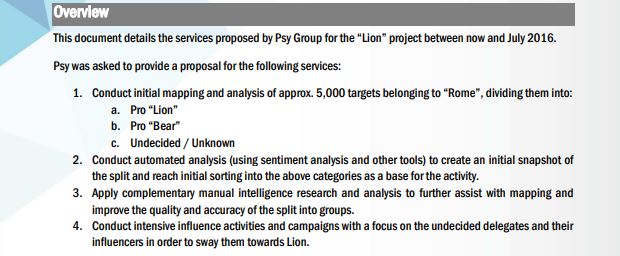
Later that spring and summer, according to the intelligence committee, Psy-Group pitched two influence and intelligence projects to the Trump campaign. These included offers to do opposition research on Hillary Clinton, offers to use fake social media profiles to covertly influence Republican National Convention delegates, and offers to target minority communities, suburban female voters, and undecided voters with covert messaging.

In internal company emails, employees also discussed the use of “hundreds of avatars driving negative messaging,” and “physical world ops like counter protests, hecklers, etc.”

According to Zamel, none of these campaigns were ever carried out: “Not a tweet, not a character, nothing,” Zamel told the committee. However, the committee noted that Zamel was paid over $1 million by George Nader, an adviser to the United Arab Emirates, with high-level Russian ties.

A screen capture from a Psy-Group proposal, reportedly for the Trump campaign, obtained by the New York Times.

The Senate report mentions the names of other Psy-Group employees who were included in emails discussing possible influence campaigns on behalf of Trump. One of these is Paul Vesely, an Australian-Israeli, who, in November 2017, posted an interview he gave on his LinkedIn profile concerning disinformation campaigns during the 2016 presidential election.

In the interview, Vesely discusses such campaigns in a knowledgeable way, although it is not clear whether he is referring to work that may have specifically been carried out by Psy-Group.

“The reason the techniques used on social media were so effective during the 2016 US presidential elections,” he is quoted as saying, “was because the messaging was segmented perfectly per target audience. This created both engaging and sometimes infuriating content tailored to appeal to specific segments of the US population. This simple yet effective marketing technique allowed millions of Americans to not just digest but crave the narrative these fake news accounts were spurting out. The second reason why the disinformation campaign was so successful was because it seemed to come from grassroots supporters even though it was being led by avatars. There is no greater power of influence than over people in a segmented group with similar interests one another’s outlook in an effective echo chamber. This echo chamber allowed real people to be involved with avatars and social group administrators who directed conversation and released information that varied in spectrum from being loosely based on truth all the way to being completely fictitious. No matter how distant the content was from the truth, when agreed upon and repeated in a group, it was extremely effective.”

The Senate Intelligence Committee said it could find no convincing evidence that Psy-Group carried out influence operations against the US on behalf of Russia. Nor did it draw a conclusion as to whether Psy-Group had carried out any influence campaigns against Americans at all.

“The Committee found no convincing evidence that Russia’s government or intelligence services worked with or through any of these companies in furtherance of Moscow’s 2016 US election interference. There are, however, limitations to the Committee’s understanding of this subject,” the report said.

The committee did, however, find that Psy-Group had worked for Russian oligarch Oleg Deripaska on another project involving a business dispute in Austria. Deripaska was introduced to Psy-Group by a man named Walter Soriano, according to the report.

“According to Burstien, Psy-Group undertook an “intelligence project” (codenamed “Project Starbucks”) in probably 2015 for Oleg·Deripaska involving a business dispute with a large Austrian company, possibly connected to real estate,” the report said.

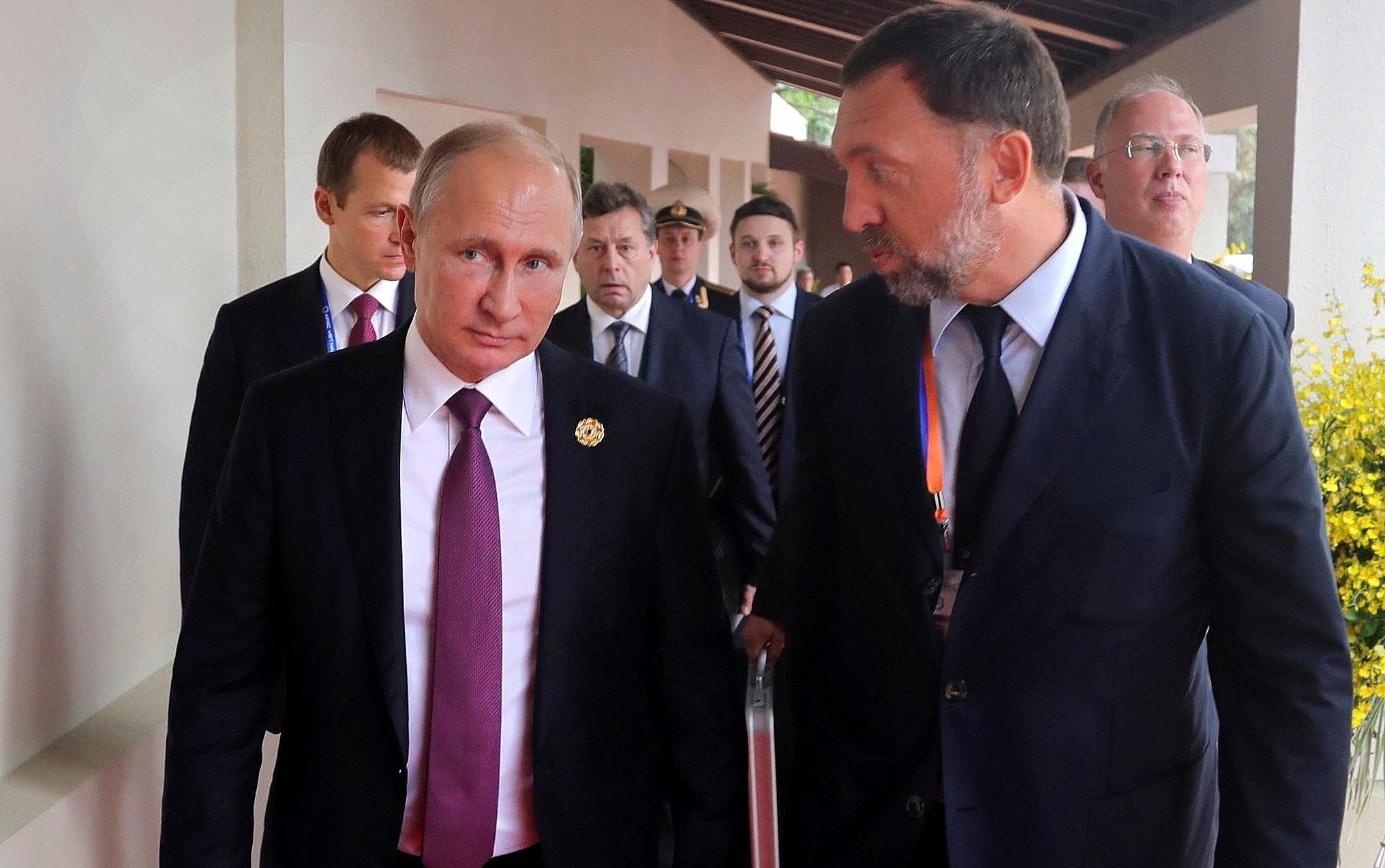
Russia’s President Vladimir Putin, left, and Russian metals magnate Oleg Deripaska, right, walking to attend the APEC Business Advisory Council dialogue in Danang, Vietnam, on November 10, 2017. (Mikhail Klimentyev, Sputnik, Kremlin Pool Photo via AP/File)

The report discusses Deripaska at great length, describing him as a key Russian operative.

“Deripaska has managed and financed Kremlin-approved and -directed active measures campaigns, including information operations and election interference efforts. Deripaska has conducted these activities in an effort to install pro-Kremlin regimes, control local economies and politicians, and strengthen Kremlin-aligned power brokers across the globe,” the report says.

The Times of Israel reported in May that Psy-Group allegedly carried out an online harassment campaign against pro-democracy activists in Ukraine, a campaign that would have strongly aligned with Russian government interests.

Categories
Saved Web Pages

The Walter Soriano files: Once claimed “close relationship” with Steve Wynn

walter-and-steve.png

August 1, 2019 7:17 pm Scott Stedman

The shadowy private intelligence/security consultant wanted for questioning by the Senate Intelligence Committee in their Russia probe, Walter Soriano, once claimed to have worked for Donald Trump’s friend and former RNC finance chairman Steve Wynn.

American billionaire Ruth Parasol, who hired the consultant Walter Soriano in the late 2000s to navigate a DoJ investigation into her company, swore under oath in 2012 that Soriano told her that he had a “close relationship” with Wynn.

Walter Soriano once said he had a "close relationship" with Steve Wynn

As previously reported by Forensic News, Parasol paid Soriano over $30,000,000 from 2009 until 2011 for multiple tasks. Soriano was hired to “resolving the DoJ issue”, “assisting Ms. Parasol… in relation to the PartyGaming business” and “investigating PartyGaming’s competitors.” PartyGaming was Parasol’s online gambling company.

Read the full declaration by Ruth Parasol in Israeli court in 2012:

Forensic News could not independently verify that Wynn had a close relationship with Walter Soriano. Lawyers for Soriano and representatives for Wynn Resorts did not respond to requests for comment. Parasol directed Forensic News to her lawyer (allegedly hand-picked by Soriano as claimed in the above lawsuit) who declined to comment.

An archived version of Soriano’s USG Security’s website shows that the company offered hotel security protection.

“Hotel Security Designed for the prevention, and implementation of:

– Violent Attacks – including Terrorism
– Public Order Disturbances
– Theft or Loss of Hotel Property
– Theft or Loss of Guests’ Possessions
– Minimal disruption to day-to-day running of the hotel
– Improvement & transparency to customer service
– Comprehensive risk assessment and security survey
– On-site Training for Security Officiers & Staff
– Security engineering during hotel construction or renovation to integrate security means into the structure
– Internal investigations into theft, fraud etc.

– Ongoing support, including consulting according to need, drills and surprise inspection of hotel security staff”

Before becoming close friends in the late 2000s, Trump and Wynn were fierce corporate competitors. In fact, in lawsuits in the late 1990s and early 2000s, Trump accused Wynn of using a private investigator to dig up dirt on Trump and the Trump Organization. The investigator, Louis Rodriguez, was working for Trump, and allegedly turned double agent.

[R]epresentatives of Wynn and Trump engaged in a nasty behind-the-scenes battle that generated allegations of fraud, money-laundering, perjury, conspiracy, and the theft of trade secrets.

The two real estate and casino magnates traded accusations of using spies, blackmail, and surreptitious recordings in order to gain dirt on each other. The two settled outside of court in 2000, and by 2011, Trump attended Wynn’s wedding.

Wynn, who had previously donated to Democrats and Republicans, rose to political prominence in 2016 when he heaped praise upon Trump. After the election, Wynn was handpicked to be a Vice Chair of the Trump inauguration and later tapped by Trump personally to become the Republican National Committee finance chairman. A year later, Wynn resigned from the post after numerous women came forward sharing experiences of Wynn’s sexual assault.

The connection between Steve Wynn and Walter Soriano is sure to pique the interest of investigators in the Senate Intelligence Committee and federal investigators.

The Senate suspects that Soriano may have knowledge of Russian election interference in 2016, due in part to his longstanding business and personal relationship with Russian oligarch Oleg Deripaska and Israeli Prime Minister Benjamin Netanyahu.

This article will be updated as more information is learned.

Forensic News is funded entirely by our readers. We don’t hide content behind paywalls or take money from corporate entities. Consider pledging your support so we can continue producing impactful investigative journalism.

Tags

ruth parasol Senate steve wynn Walter Soriano

Related Posts

Categories
Saved Web Pages

‘We’re with you,’ Biden tells Puerto Rico ahead of visit

LA5O4ONBXNFSDC7MOIFAPD2AAA.jpg

WASHINGTON (AP) — President Joe Biden on Monday will survey damage from Hurricane Fiona in Puerto Rico, where tens of thousands of people are still without power two weeks after the storm hit.

The Category 1 hurricane knocked out electrical power to the U.S. territory of 3.2 million people, 44% of whom live below the poverty line.

Power has been restored to about 90% of the island’s 1.47 million customers, but more than 137,000 others, mostly in the hardest hit areas of Puerto Rico’s southern and western regions, continue to struggle in the dark. Another 66,000 customers are without water.

President Joe Biden said, ‘Our hearts are heavy’ about the storm impacts in Florida, South Carolina and Puerto Rico, during Saturday remarks. (Source: CNN/Pool)

Biden has pledged that the U.S. government will not abandon Puerto Rico as it starts to rebuild again, five years after the more powerful Hurricane Maria devastated the island in 2017.

“We see what you’re going through, and we’re with you,” Biden told Puerto Ricans and Floridians in a message Sunday on his official Twitter account.

Florida is cleaning up after Hurricane Ian churned across that state last week, killing more than 60 people, decimating some coastal communities and flooding others. Biden plans to visit Florida on Wednesday to survey damage.

The president, accompanied by first lady Jill Biden and Deanne Criswell, the Federal Emergency Management Agency administrator, was to touch down Monday in Ponce, Puerto Rico, a city on the southern coast. Most of the storm damage is in southern Puerto Rico.

Aerial footage shows homes underwater in Puerto Rico after Hurricane Fiona struck.

Aerial footage shows homes underwater in Puerto Rico after Hurricane Fiona struck.

Puerto Rico Gov. Pedro Pierluisi said he would update Biden on recovery efforts.

“We will make sure to keep working together to ensure the continuity of a reconstruction already underway,” the governor tweeted on Sunday.

Fiona caused catastrophic flooding, tore apart roads and bridges, and unleashed more than 100 landslides when it hit Puerto Rico on Sept. 18. At least two people died after being swept away by floods, and several others were killed in accidents related to the use of candles or generator during the island-wide power outage.

Government officials have estimated some $3 billion in damages, but warn that costs could rise significantly as evaluations continue.

Some people in Puerto Rico wondered whether Biden’s visit would change anything as they recalled how President Donald Trump visited after Hurricane Maria hit as a more powerful Category 4 storm in 2017, and tossed rolls of paper towels into a crowd in a display that riled many.

Manuel Veguilla, a 63-year-old retired mechanic who lives in a remote community in the hard-hit northern mountain town of Caguas, said he didn’t expect his life to improve in the aftermath of Fiona, which cut off his neighborhood from any help for a week.

“They always offer the lollipop to the kids,” he said, referring to Biden’s visit. “But in the end, the outcome is always the same. The aid goes to those who have the most.”

Criswell, who discussed the aftermath of Fiona and Ian on four Sunday TV news programs, echoed Biden’s promise to Fiona’s victims.

“We have not left Puerto Rico,” she said on CBS’ “Face the Nation.”

Criswell said on ABC’s “This Week” that FEMA personnel were sent to the island before the storm hit and that “they’re going to stay with the people of Puerto Rico” through the recovery efforts.

Biden recently told Pierluisi that he authorized 100% federal funding for a month for debris removal, search and rescue efforts, power and water restoration, shelter and food.

The lack of electrical power on the island led to the temporary closure of businesses, including gas stations and grocery stores, as fuel supplies dwindled amid heavy generator use. As a result, many cheered the Biden administration’s decision to temporarily waive a federal law so that a British Petroleum ship could deliver 300,000 barrels of diesel.

Many also have begun demanding that Puerto Rico be fully exempted from the law, known as the Jones Act, that requires that all goods transported to Puerto Rico be aboard a ship built in the U.S., owned and crewed by U.S. citizens and flying the U.S. flag. This drives up costs for an island that already imports 85% of its food.

Sen. Marco Rubio, R-Fla., also said Puerto Ricans would not be forgotten.

Rubio said the island appeared to be “in better position to respond this time around” due to the prepositioning of personnel and supplies before the storm hit and because part of Puerto Rico’s electrical grid had been rebuilt after Hurricane Maria.

“We will do everything we can, we always have, to support Puerto Rico now in the recovery after this, yet another devastating storm,” Rubio said on CNN’s “State of the Union.”

___

Coto reported from San Juan, Puerto Rico.

Copyright 2022 The Associated Press. All rights reserved.

WP Radio
WP Radio
OFFLINE LIVE