Categories
Saved Web Pages

Biden order promises EU citizens better data privacy

3000.jpeg

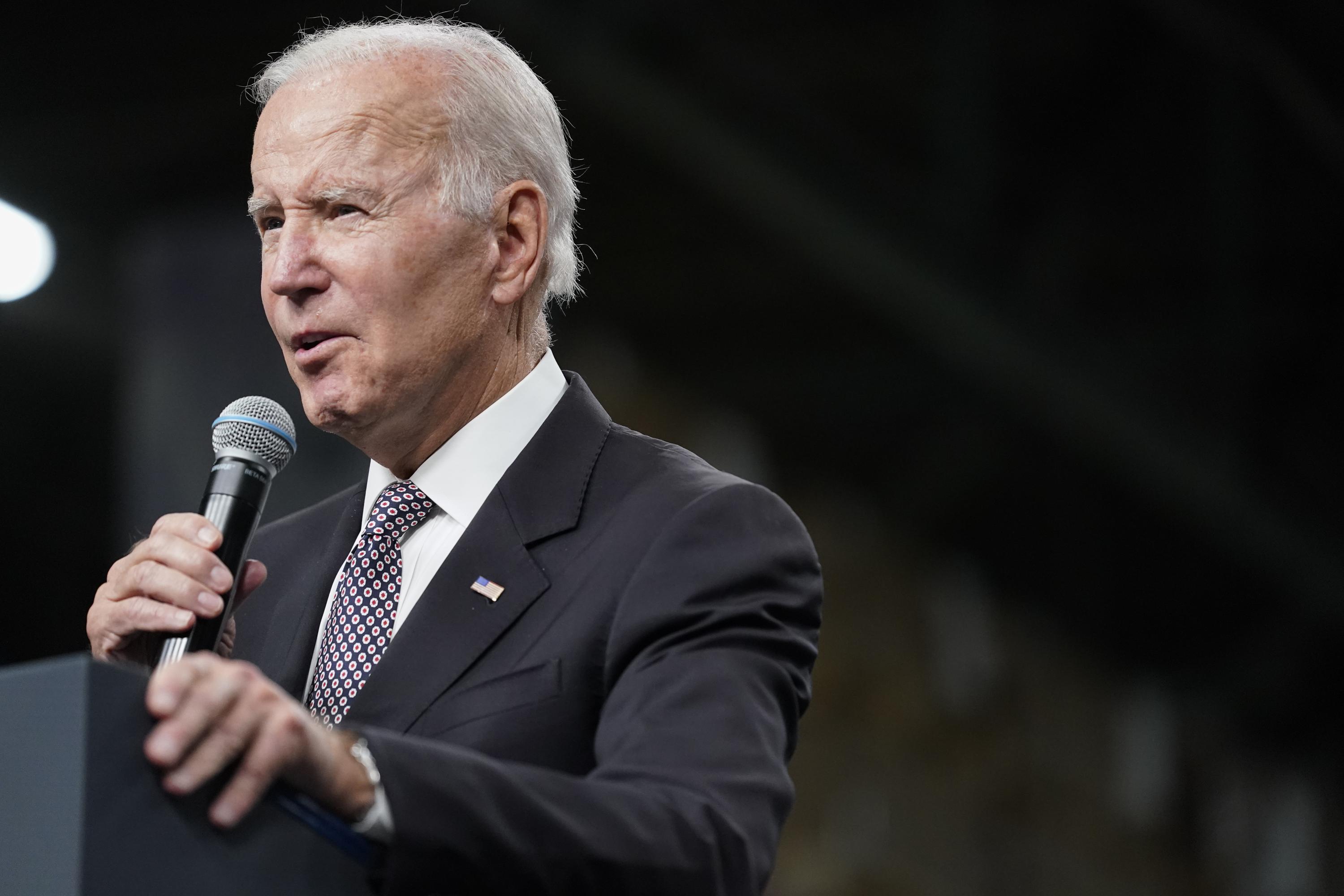
President Joe Biden signed an executive order Friday designed to allay European concerns that U.S. intelligence agencies are illegally spying on them. It promises strengthened safeguards against data collection abuses and creates a forum for legal challenges.

The order builds on a preliminary agreement Biden announced in March with European Commission President Ursula von der Leyen in a bid to end a yearslong battle over the safety of EU citizens’ data that tech companies store in the U.S. However, the European privacy campaigner who triggered the battle wasn’t satisfied it resolved core issues and warned of more legal wrangling.

The reworked Privacy Shield “includes a robust commitment to strengthen the privacy and civil liberties safeguards for signals intelligence, which should ensure the privacy of EU personal data,” Commerce Secretary Gina Raimondo told reporters.

“It also requires the establishment of a multilayer redress mechanism with independent and binding authority for EU individuals to seek redress if they believe they are unlawfully targeted by U.S. intelligence activities,” she added.

Washington and Brussels have long been at odds over the friction between the European Union’s stringent data privacy rules and the comparatively lax regime in the U.S., which lacks a federal privacy law. That has created uncertainty for tech giants including Google and Facebook’s parent company Meta, raising the prospect that U.S. tech firms might need to keep European data out of the U.S.

Industry groups largely welcomed Biden’s order but European consumer rights and privacy campaigners, including activist Max Schrems whose complaint kicked off the legal battle a decade earlier, were skeptical whether it goes far enough and could end up in the bloc’s top court again.

Friday’s order narrows the scope of intelligence gathering — regardless of a target’s nationality — to “validated intelligence priorities,” fortifies the mandate of the Civil Liberties Protection Officer in the Office of the Director of National Intelligence and directs the attorney general to establish an independent court to review related activities.

Europeans can petition that Data Protection Review Court, which is to be composed of judges appointed from outside the U.S. government.

The next step: Raimondo’s office was to send a series of letters to the 27-member EU that its officials can assess as the basis of a new framework.

The European Union’s executive arm, the European Commission, said the framework has “significant improvements” over the original Privacy Shield and it would now work on adopting a final decision clearing the way for data to flow freely between EU and U.S. companies certified under the framework.

Raimondo said the new commitments would address European Union legal concerns covering personal data transfers to the U.S. as well as corporate contracts. A revived framework “will enable the continued flow of data that underpins more than $1 trillion in cross-border trade and investment every year,” Raimondo said.

Twice, in 2015 and again in 2020, the European Union’s top court struck down data privacy framework agreements between Washington and Brussels. The first legal challenge was filed by Austrian lawyer and privacy activist Schrems, who was concerned about how Facebook handled his data in light of 2013 revelations about U.S. government cyber-snooping from former U.S. National Security Agency contractor Edward Snowden.

European consumer group BEUC said despite the extra safeguards, fundamental differences between American and European privacy and data protection standards are too wide to bridge.

“However much the U.S. authorities try to paper over the cracks of the original Privacy Shield, the reality is that the EU and U.S. still have a different approach to data protection which cannot be cancelled out by an executive order,” said the group’s deputy director general, Ursula Pachl. “The moment EU citizens’ data travels across the Atlantic, it will not be afforded similar protections as in the EU.”

Schrems said while his Vienna-based group, NOYB, would need time to study the order, his initial reading is that it “seems to fail” on some key requirements, including for surveillance to be necessary and proportionate under the EU’s Charter of Fundamental rights to avoid indiscriminate mass data collection.

While the U.S. included those two words, Schrems said the two sides don’t seem to have agreed they have the same legal meaning.

If it did, “the U,S, would have to fundamentally limit its mass surveillance systems to comply with the EU understanding of ‘proportionate’ surveillance,” Schrems said.

___

Chan contributed to this report from London.

Categories
Saved Web Pages

Polygamous sect leader release hearing set in case tied to transporting young girls across Arizona.

1ed2e012-f4ed-4a4c-b720-06eea118217a-7C5

When polygamist Samuel Bateman appears in Coconino Superior Court Friday afternoon for a detention hearing, the leader of a splinter faction of the Fundamentalist Church of Jesus Christ of Latter Day Saints may have bigger worries on his mind.

Bateman entered a plea of not guilty in both federal and state cases involving his relationships with underage girls, according to court documents. Bateman faces a federal case charging of destruction of evidence and an Arizona state case charging him with child abuse.

But leaked FBI documents and a flurry of social media criticism since his arrest suggests that his legal problems may be mounting. An FBI search warrant affidavit obtained and publicized by the Salt Lake Tribune last month raises the possibility of more serious sex-trafficking charges down the road. Unconfirmed public complaints on social media platforms by community members who know Bateman voice concerns about his relationships with minors. The fact that a federal judge ordered that Bateman remain in custody after his re-arrest by the FBI, a departure from his release a month earlier on state charges, suggests matters could take a turn for the serious for the 46-year-old Bateman.

Bateman, 46, calls himself a prophet and is sometimes described as a spiritual “father” to members of the sect. 

Against that backdrop, the lawyer representing Bateman, who calls himself a prophet and is sometimes described as a spiritual “father” to members of the sect, suggested the government is persecuting his client because of his religious beliefs.

Samuel Bateman: What you need to know about FLDS leader’s arrest

“Oddly, the federal government moved quickly on this matter, where other matters being handled by the FBI …  are moving ever so slowly,” said Adam Zickerman, founder of the Zickerman Law Firm in Flagstaff. “It begs the question of swift actions dealing with and against the freedom of religion.”

On Aug. 28, Arizona Department of Public Safety troopers found Bateman driving south through Flagstaff with three girls between 11 and 14 stashed in a horse trailer. Police pulled him over after seeing “children fingers moving in the gap of the rear trailer door.” They arrested Bateman, but he was released and went home to Colorado City, on the Arizona-Utah state line.

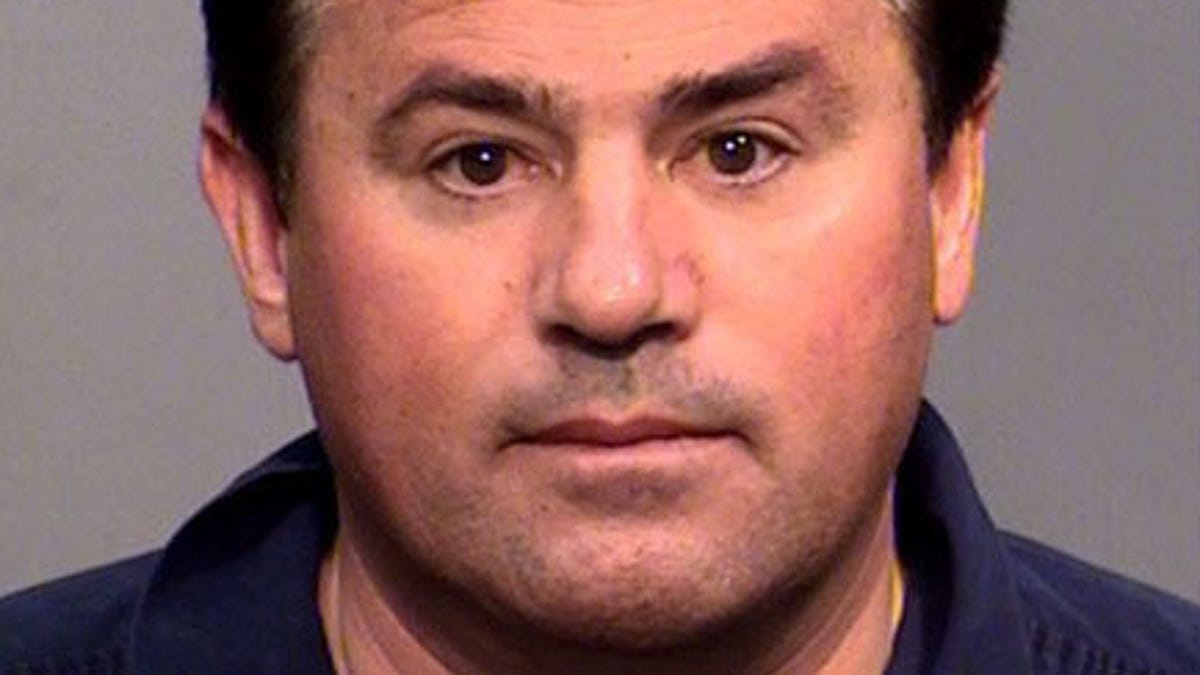
Samuel Rappylee Bateman

The FBI rearrested Bateman in Colorado City on Sept. 13.  

Agents executed a search warrant on his property and took Bateman into custody on charges related to the destruction of evidence. Federal prosecutors hold that Bateman began to destroy evidence from his phone during the Aug. 28 arrest.

According to reporting by the Salt Lake Tribune, the FBI searched his homes for “lingerie style underwear that could be worn by minors,” as well as evidence that he was paying to transport underage girls so he could marry them off or to enable sexual acts.

Since the federal raid, people who live in the community or were ex-members of the FLDS church have spoken out publicly on social media about ongoing concerns around Bateman’s relationships with his followers. They claim on TikTok and YouTube that law enforcement and FBI had their eye on Bateman for some time.  

During the FBI’s search, nine girls were taken from Bateman’s home and a warehouse in his name, according to media reports. They placed the girls into child protective services, but it is unclear if those girls and the three found in the horse trailer still remain in child protective custody.

Currently, Bateman sits in jail under U.S. Marshals Service custody. Arizona U.S. District Court Judge Camille Bibles ordered on Sept. 15  that Bateman sit in jail without bond because of public safety concerns and his ability to travel internationally. The judge mentioned that Bateman had traveled internationally in the past three years and noted his active pilot’s license.

Bateman’s homes and religious following is based out of the twin border cities of Colorado City, Arizona, and Hildale, Utah, known collectively to locals as ”Short Creek.” The area has long had ties to fundamentalist polygamous sects, most notably the splinter sect of the Fundamentalist Church of Jesus Christ of Latter Day Saints controlled by Warren Jeffs.

Reach crime reporter Miguel Torres at Miguel.Torres@arizonarepublic.com or on Twitter @TheMiguelTorres.

Categories
Saved Web Pages

Putin ally threatens to turn Chechens loose on Russian dissidents

?url=http%3A%2F%2Fmediadc-brightspot.s3.

Russian citizens who criticize the Kremlin could find themselves on the receiving end of a nasty visit from Chechen forces, according to an ally of Russian President Vladimir Putin.

Putin’s attempted “partial mobilization” of fighting-aged Russians into the war in Ukraine has prompted a wave of social displeasure, including a mass exodus of apparent draft dodgers and protests in the outlying regions where people are bearing the brunt of the war. Russian lawmaker Adam Delimkhanov, an ethnic Chechen politician known for threatening to decapitate the relatives of a human rights activist, warned university students against any display of disrespect.

“I want to tell you that, in the universities — including MGU, MGIMO — all universities in Russia, we already have an assignment from Ramzan Akhmatovych [Kadyrov], for us and our representatives to monitor every region,” said Delimkhanov, in a reference to Moscow State University and Moscow State Institute of International Relations. “If they in the regions are not coping with it, if the services are not coping, then we will manage it, and we’ll ask from everyone who defiles and insults our country, our anthem, our constitution, our president, V.V. Putin — you will all answer for this.”

Delimkhanov received the title of Hero of the Russian Federation from Putin in April, following Russia’s brutal destruction of Mariupol, the Ukrainian port city that fought block-by-block against the invasion. His message might flatter Putin, but it may not endear the Chechen leaders to potential conscripts — or the intelligence services currently responsible for internal security.

PUTIN ALLY URGES RUSSIAN DEFENSE MINISTER TO KILL HIMSELF AS LOSSES MOUNT

“Of course, it will anger FSB as well, I think, internally,” a senior European official with counterintelligence expertise told the Washington Examiner.

Chechen deputy Adam Deilmkhanov threatens all students of Russian universities with consequences if they stand against the regime. This is quite unheard of given he is Chechen, indicating increasing influence of this party in the country. pic.twitter.com/9fBSdP54Qn

— Dmitri (@wartranslated) October 5, 2022

Still, the warning emphasizes how Chechen forces, an ethnic and religious minority in Russia, have transitioned from the role of Putin’s favorite bogeymen to some of his most important loyalists.

“The President of Russia awarded me with the rank of colonel general,” Chechen strongman Ramzan Kadyrov said Wednesday. “The head of state called me and asked to wish all the people of Chechnya welfare, luck, and success in his name! Despite his workload, the commander in chief never forgets about important dates in our region.”

That’s a theatrical dramatic reversal of Chechnya’s place in Russian politics throughout Putin’s career. Just weeks after then-President Boris Yeltsin tapped Putin as prime minister and heir apparent in 1999, a series of bombings across Moscow and other Russian cities furnished Putin with an excuse to launch a military offensive in Chechnya that reversed Russia’s defeat in the First Chechen War from 1994 to 1996.

Those bombings are widely suspected to have been a false flag operation by Russian security services, given that an investigation into the apparent placement of explosives in Ryazan, a city in western Russia, led to three members of the FSB — the KGB successor agency that Putin led until his appointment as prime minister.

“There was a credible body of reporting, open source and others, that this was all — all those bombings were part of a black flag operation on the part of the FSB,” Sen. Marco Rubio (R-FL), who sits on the Senate Intelligence Committee and the Foreign Relations panel, said during a 2017 hearing. “And if you want to know the motivation, here is what it is: Putin’s approval ratings before the attacks against the Chechens were at 31%. By mid-August of that year, it was at 78% in just three months.”

The specter of Chechen terrorism has redounded to Putin’s advantage at other key junctures, such as the murder of Russian opposition leader Boris Nemtsov in 2015. The Kremlin attributed that killing, which occurred in the heart of Moscow, to Chechen separatists. And Kadyrov’s loyalty to Putin is just one side of a transaction that could shelter Delimkhanov from retaliation by any Russian security officials who take his warning as an insult.

CLICK HERE TO READ MORE FROM THE WASHINGTON EXAMINER

“In a sense, Chechnya at the moment has been more independent than Chechnya has been, ever,” the senior European official predicted. “Nothing will happen. FSB is not doing anything in Chechnya without Kadyrov’s approval.”

Categories
Saved Web Pages

Men Are Raped Almost as Often as Women in America. We Need to Talk About This.

1adc2ccd-8d88-46cf-bfd4-0f2d65124882.jpg

Last year the National Crime Victimization Survey turned up a remarkable statistic. In asking 40,000 households about rape and sexual violence, the survey uncovered that 38 percent of incidents were against men. The number seemed so high that it prompted researcher Lara Stemple to call the Bureau of Justice Statistics to see if it maybe it had made a mistake, or changed its terminology. After all, in years past men had accounted for somewhere between 5 and 14 percent of rape and sexual violence victims. But no, it wasn’t a mistake, officials told her, although they couldn’t explain the rise beyond guessing that maybe it had something to do with the publicity surrounding former football coach Jerry Sandusky and the Penn State sex abuse scandal.

Stemple, who works with the Health and Human Rights Project at UCLA, had often wondered whether incidents of sexual violence against men were under-reported. She had once worked on prison reform and knew that jail is a place where sexual violence against men is routine but not counted in the general national statistics. Stemple began digging through existing surveys and discovered that her hunch was correct. The experience of men and women is “a lot closer than any of us would expect,” she says. For some kinds of victimization, men and women have roughly equal experiences. Stemple concluded that we need to “completely rethink our assumptions about sexual victimization,” and especially our fallback model that men are always the perpetrators and women the victims. 

Sexual assault is a term that gets refracted through the culture wars, as Slate’s own Emily Bazelon explained in a story about the terminology of rape. Feminists claimed the more legalistic term of sexual assault to put it squarely in the camp of violent crime. Bazelon argues in her story for reclaiming the term rape because of its harsh unflinching sound and its nonlegalistic shock value. But she also allows that rape does not help us grasp crimes outside our limited imagination, particularly crimes against men. She quotes a painful passage from screenwriter and novelist Rafael Yglesias, which is precisely the kind of crime Stemple worries is too foreign and uncomfortable to contemplate.

I used to say, when some part of me was still ashamed of what had been done to me, that I was “molested” because the man who played skillfully with my 8-year-old penis, who put it in his mouth, who put his lips on mine and tried to push his tongue in as deep as it would go, did not anally rape me. … Instead of delineating what he had done, I chose “molestation” hoping that would convey what had happened to me.

Of course it doesn’t. For listeners to appreciate and understand what I had endured, I needed to risk that they will gag or rush out of the room. I needed to be particular and clear as to the details so that when I say I was raped people will understand what I truly mean.

For years, the FBI defined forcible rape, for data collecting purposes, as “the carnal knowledge of a female forcibly and against her will.” Eventually localities began to rebel against that limited gender-bound definition; in 2010 Chicago reported 86,767 cases of rape but used its own broader definition, so the FBI left out the Chicago stats. Finally, in 2012, the FBI revised its definition and focused on penetration, with no mention of female (or force).

Data hasn’t been calculated under the new FBI definition yet, but Stemple parses several other national surveys in her new paper, “The Sexual Victimization of Men in America: New Data Challenge Old Assumptions,” co-written with Ilan Meyer and published in the April 17 edition of the American Journal of Public Health. One of those surveys is the 2010 National Intimate Partner and Sexual Violence Survey, for which the Centers for Disease Control invented a category of sexual violence called “being made to penetrate.” This definition includes victims who were forced to penetrate someone else with their own body parts, either by physical force or coercion, or when the victim was drunk or high or otherwise unable to consent. When those cases were taken into account, the rates of nonconsensual sexual contact basically equalized, with 1.270 million women and 1.267 million men claiming to be victims of sexual violence.

“Made to penetrate” is an awkward phrase that hasn’t gotten any traction. It’s also something we instinctively don’t associate with sexual assault. But is it possible our instincts are all wrong here? We might assume, for example, that if a man has an erection he must want sex, especially because we assume men are sexually insatiable. But imagine if the same were said about women. The mere presence of physiological symptoms associated with arousal does not in fact indicate actual arousal, much less willing participation. And the high degree of depression and dysfunction among male victims of sexual abuse backs this up. At the very least, the phrase remedies an obvious injustice. Under the old FBI definition, what happened to Rafael Yglesias would only have counted as rape if he’d been an 8-year-old girl. Accepting the term “made to penetrate” helps us understand that trauma comes in all forms.

So why are men suddenly showing up as victims? Every comedian has a prison rape joke and prosecutions of sexual crimes against men are still rare. But gender norms are shaking loose in a way that allows men to identify themselves—if the survey is sensitive and specific enough—as vulnerable. A recent analysis of BJS data, for example, turned up that 46 percent of male victims reported a female perpetrator.

The final outrage in Stemple and Meyer’s paper involves inmates, who aren’t counted in the general statistics at all. In the last few years, the BJS did two studies in adult prisons, jails, and juvenile facilities. The surveys were excellent because they afforded lots of privacy and asked questions using very specific, informal, and graphic language. (“Did another inmate use physical force to make you give or receive a blow job?”) Those surveys turned up the opposite of what we generally think is true. Women were more likely to be abused by fellow female inmates, and men by guards, and many of those guards were female. For example, of juveniles reporting staff sexual misconduct, 89 percent were boys reporting abuse by a female staff member. In total, inmates reported an astronomical 900,000 incidents of sexual abuse.

Now the question is, in a climate when politicians and the media are finally paying attention to military and campus sexual assault, should these new findings alter our national conversation about rape? Stemple is a longtime feminist who fully understands that men have historically used sexual violence to subjugate women and that in most countries they still do. As she sees it, feminism has fought long and hard to fight rape myths—that if a woman gets raped it’s somehow her fault, that she welcomed it in some way. But the same conversation needs to happen for men. By portraying sexual violence against men as aberrant, we prevent justice and compound the shame. And the conversation about men doesn’t need to shut down the one about women. “Compassion,” she says, “is not a finite resource.”

Categories
Saved Web Pages

Nxivm leader Keith Raniere claims FBI planted child porn on his hard drive

keith-raniere-695.jpg?quality=75&strip=a

An attorney for Nxivm sex-slave cult leader Keith Raniere argued for his conviction to be overturned Tuesday — claiming in a court filing that the FBI planted child pornography on his computer hard drive. 

The motion to vacate the sentence was filed by attorney Joseph Tully on the same day he presented the convicted sex-trafficker’s appeal on different grounds to a federal court panel in Manhattan.

In the filing, Tully claimed nearly two dozen nude photos of a 15-year-old girl that were found on a hard drive kept by Raniere were actually put on the device by FBI agents. 

The metadata of the photos, Tully claimed, were manually altered to make the images appear like they had been produced in 2005, when the subject of the photos was 15. 

“The backup folder … where the contraband photographs were placed has all the hallmarks of fraud,” the attorney wrote in the court document. 

“The government used this 2005 date to establish some of the photos as contraband. Further, the photographs’ metadata within these subfolders were also manually altered to comport with the government’s 2005 narrative,” he went on. 

Prosecutors and the judge who oversaw Raniere’s case in Brooklyn federal court have not responded to the claims. A spokesperson for the Eastern District of New York prosecutor’s office declined to comment. 

Tanya Hajjar,Assistant US Attorney Tanya Hajjar said that Keith Raniere’s attorney Joseph Tully was not following directions in his cross-examination of Lauren Salzman. AP

Tully made similar accusations last week in an attempt to delay Tuesday’s appeal hearing before a three-judge panel. The US Court of Appeals for the Second Circuit rejected the request to postpone the hearing. 

During the hearing, Tully pushed for Raniere’s conviction to be vacated, arguing in part that the cult leader’s right to due process was violated because his trial attorney was allegedly cut off from cross-examining a key government witness. 

“I don’t think here the record established the defense had a full and fair opportunity to cross-examine the witness,” he told the panel. 

In response, Assistant US Attorney Tanya Hajjar told the panel that the judge instructed Raniere’s attorney to stop questioning the witness, former Nxivm “slave master” Lauren Salzman, because he was not following directions and causing her to break down on the stand. 

At the hearing Tuesday, an attorney for Raniere’s co-conspirator, Seagram’s liquor heiress Clare Bronfman, also argued for her sentence to be vacated by the appellate court. 

Clare BronfmanSeagram’s liquor heiress Clare Bronfman was sentenced to six years in prison. AP

The attorney, Ronald Sullivan, claimed the stiff six-year sentence Bronfman got was an unfair upward departure, in part because the judge unfairly determined she employed “willful blindness” to steer clear of the sex cult Raniere was leading. 

The judges hearing the cases will rule on them at a later date.

Raniere is serving a 120-year prison sentence after he was convicted on a host of charges, including sex trafficking and racketeering, for running a sex cult known as “DOS” that pulled members from his various self-help groups, including Nxivm. 

Additional reporting by Priscilla DeGregory

Categories
Saved Web Pages

Attorneys and Experts for Convicted NXIVM ‘Sex Cult’ Leader Keith Raniere Claim FBI Used ‘Manipulated’ and ‘Planted’ Evidence at Trial

Keith-Raniere-via-his-YouTube-channel.jp

NXIVM's Keith Raniere appears in a video.

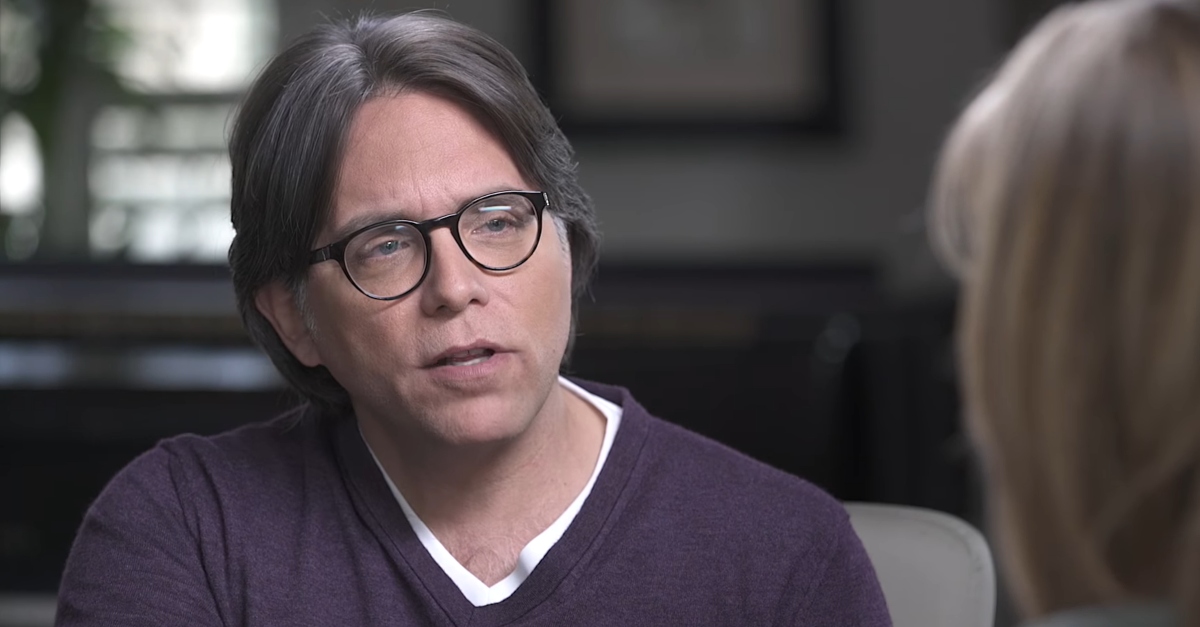
Keith Raniere appeared in a 2017 NXIVM YouTube video.

Attorneys and experts retained by convicted NXIVM “sex cult” leader Keith Raniere on Thursday alleged in a court filing and in a press conference that photographic evidence used to convict their client of child pornography and sexual exploitation charges was “significantly manipulated” by the government.

The assembled panel that alleged those claims in unison included Harvard Law School professors Ron Sullivan and Alan Dershowitz, California-based attorney Joseph Tully, former U.S. Attorney for the Eastern District of Arkansas Bud Cummins, former FBI Special Agent and Computer Forensic Examiner and Instructor Dr. J. Richard Kiper, and former FBI Senior Forensic Examiner Stacy Eldridge. Kiper and Eldridge are now private consultants.

Kiper asserted during the press conference that certain key evidence used against Raniere had been “significantly manipulated” — even “planted” — and that federal agents appear to have “extensively altered the media card used to justify the charges.”

Tully claimed the “level of government malfeasance is extreme” in Raniere’s case.  He also asserted that his client was suffering from retaliation in prison, including solitary confinement.

Raniere was convicted of all charges in June 2019 in U.S. District Court for the Eastern District of New York.  The counts against him included sex trafficking of children by force, fraud, or coercion; sex trafficking conspiracy; sex trafficking; attempted sex trafficking; racketeering conspiracy; forced labor conspiracy; involuntary servitude; wire fraud conspiracy; conspiracy to commit identity theft; sexual exploitation of a child; and possession of child pornography.

When Raniere, now 62, was sentenced to 120 years in prison, his attorneys asserted that he was not sorry for his actions and promised to someday clear his name.

Marc Agnifilo, Raniere’s trial attorney, had asserted that his client was simply misunderstood.

“You might find many things about him distasteful, but most of them aren’t part of the charges,” Agnifilo told the jury. “Disgusting lifestyles aren’t criminal.”

“Smallville” actress Allison Mack and Seagram’s heiress Clare Bronfman were among Raniere’s co-defendants.  Both Mack, a key recruiter, and Bronfman, who helped bankroll NXIVM, entered guilty pleas.

A federal judge eventually ordered Raniere to pay roughly $3.46 million in restitution to 21 trafficking victims, including the costs of “past or future” surgeries that did or would remove tattoos or scars from women Raniere branded as his “slaves.”

The panel of attorneys and experts assembled on Thursday apparently sought to effectuate Raniere’s promise to clear his name.
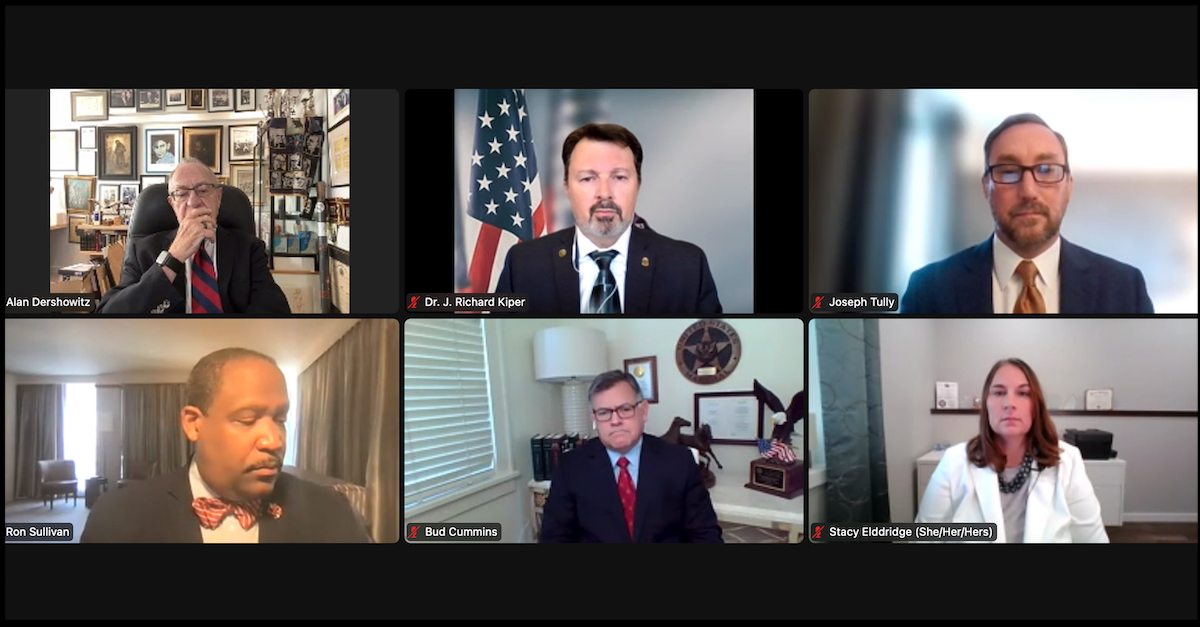
Keith Raniere's six experts and attorneys appeared in a Zoom call.

A collection of attorneys and experts gathered for a press conference via Zoom on Thurs., Oct. 6, 2022, to allege government malfeasance in the prosecution of Keith Raniere. (Image via screengrab.)

Sullivan, who said he is representing Bronfman, said new evidence “suggests photo manipulation” by the government. He said the allegedly faked evidence — which he said was entered in the “11th hour” — was “so prejudicial” that it resulted in a guilty plea by his client that he now apparently wishes to challenge.

Kiper alleged that “the file access dates for files on one of the devices” seized by the government “were updated while in the custody of the FBI.”  He argued that the dates suggest the evidence was altered.  He also asserted that the FBI broke “chain of custody” rules for the storage and transmission of the evidence from person to person while it was in the government’s possession.

Dershowitz said that the team’s allegations were “very credible and serious” and implored the U.S. Department of Justice to live up to its mission to seek justice and not merely convictions. He stressed that he believed the proper route going forward was for the DOJ to at a minimum agree to an evidentiary hearing on the defense allegations. He suggested a new trial or a dismissal of Raniere’s indictment would also be prudent, in his opinion.

The press conference came on the heels of a 64-page filing before the Second Circuit Court of Appeals, where Raniere’s case is currently lodged.  The motion, signed by Tully, asks the appellate court to pause its review of the case pending additional proceedings on the evidence matters the defense wishes to put into question.

“Mr. Raniere now moves this Court, by and through his counsel, to hold this appeal in abeyance to allow for the resolution of the two pending Rule 33 matters as there exists clear, substantive constitutional injuries uncovered by new evidence that may render appellate review unnecessary or at the very least will clarify the issues for this Court to resolve,” the Thursday morning motion reads.

The motion then points to “complex and technical newly discovered evidence finding manually altered digital evidence” in the underlying criminal prosecution. It calls the issues “significant and weighty” and alleges “the use of false testimony by the government to obtain a tainted conviction of Mr. Raniere.”

The filing also points to what it calls “newly discovered information that the government, in the eleventh hour of trial, swapped out one material FBI witness, whose testimony would have exculpated Mr. Raniere, with another material FBI witness, whose perjurious testimony wrongly inculpated Mr. Raniere” (emphases in the original).

“Damningly,” a declaration signed by Tully asserts, the first “examiner was reassigned to Ghana, Africa just days before he would have testified.”

An exhibit in support of the motion asserts that a hard drive and a camera memory card both exhibited “anomalies” when examined by defense experts.

The exhibit says the government used metadata to convince the jury that Raniere committed the racketeering acts of possession of child pornography and sexual exploitation of a child.  At issue were “22 nude photos found on a backup hard drive” which depicted a female identified as “Camila” at trial.

“The government alleged that the photos were taken when Camila was fifteen,” the exhibit states.  “However, by only visually looking at the photos, it was not self-evident that Camila was underage at the time the photos were taken, and Camila did not testify. Therefore, the government had to rely on digital evidence and argue two things: (1) that the 22 photos were taken when Camila was under 18, and (2) that the photos were taken by Keith Raniere.”

The argument continued as follows:

To show Camila was under the age of eighteen in the photos, the government used metadata, primarily the Exchangeable Image File Format, hereafter “EXIF,” Creation dates of the 22 alleged contraband photos. EXIF Creation dates are ‘birthdays’ of digital photos, assigned to them by the digital camera when the photos are taken. Other metadata involved were File System dates, such as “Creation,” “Modified,” and “Accessed.” In trial, the government argued that because EXIF data cannot be easily modified, and because the metadata and EXIF data for the 22 photos indicated that they were taken in 2005 when Camila would have been 15 years old, Camila was therefore underage in the photos.

The hard drive from which the photos were taken, according to the exhibit, was used to back up three computers, and the government disclosed it to the defense only in partial format and at a late hour in the proceedings.  Other data on the drive linked it to Raniere, prosecutors alleged, according to the exhibit.

The defense said the chain was far too attenuated to truly link Raniere to the photos and that the dates were altered to wrongly allege that “Camila” was under age.

“[A]fter trial, three top digital forensic experts were hired to analyze evidence relevant to the digital photos,” the exhibit indicates. “All three experts, to their surprise and dismay, found a multitude of anomalies that evidenced that the alleged contraband photos were manufactured and planted.”

The document elucidates and further alleges the following (again, the emphases are in the original):

The digital evidence had clearly been manually altered to make the photos appear as if they were taken on the specific camera in 2005 before being automatically backed up to the hard drive in 2009. The folders where the alleged contraband photos were located were created manually but made to look as if they were automatically created by a computer backup program in 2005. In fact, all the digital anomalies that the experts found on the backup hard drive and the camera card were designed to support the government’s narrative, which it used to secure convictions for the racketeering acts of possessing child pornography and sexual exploitation of a minor. In the prosecution’s own words, these 22 photos were “the heart of our racketeering conspiracy.”

Because the allegedly altered evidence was a proverbial linchpin to the entire case, Raniere’s attorneys are hoping that the entire prosecution will fall apart if prosecutors or the courts agree with their interpretation of the evidence in question.

The exhibit ties together that theme by asserting that witness who was reassigned to Ghana had would have laid bare the issues with the government’s attempts to date the photos in question.  The reassigned witness had previously testified in another case that “the FBI does not rely on metadata alone in determining a document’s date because metadata can be ‘manipulated,’” according to the pro-Raniere paperwork’s version of that testimony.

Tully’s declaration alleges that “the most probable reason behind” the investigator’s “reassignment” was “nefarious intent by government actors.”

Again, from the exhibit:

Such demonstrable and provable criminality in manufacturing, fabricating, and tampering with evidence by bad government actors, cannot be allowed to stand. The longer such manifest injustice is ignored, the greater the ripple effects will be in the long run, not only to our overall system of justice, but also within the daily operations of court dockets as these same bad government actors are no doubt currently involved in other cases.

When reached by Law&Crime, a spokesperson for the U.S. Attorney’s Office for the Eastern District of New York declined to comment on the accusations.

NXIVM, the group Raniere led, has long been described as an alleged “sex cult,” though the organization described itself as a “self-help” group.

The full motion and the exhibits are below:

Have a tip we should know? [email protected]

Categories
Saved Web Pages

FBI Experts Certify Planting of Evidence, Former US Attorney and Alan Dershowitz Call for Immediate Evidentiary Hearing

ein_logo_transparent.png

NEW YORK CITY, NY, USA, October 6, 2022 /EINPresswire.com/ — A press conference was held to unveil the findings of six forensic experts of FBI corruption in the case of US v Keith Raniere. Professor Alan Dershowitz, Central Park 5 Exoneree Dr. Yusef Salaam, and former US Attorney Bud Cummins, discussed the matter. Former FBI Special Agent and Forensic Examiner Dr. James Richard Kiper said that all six experts “concluded that the digital evidence devices used to convict Mr. Raniere of child pornography and sexual exploitation of a minor were significantly manipulated. Additionally, we know to a scientific certainty some of the evidence was altered while in the possession of the FBI.” Former Senior Forensic Examiner Stacy Eldridge said, “It is clear that the photos in this case were planted there.” Former FBI Forensic Examiner William Odom said, “In 25 years of digital forensic investigations, five of which was with the FBI, the amount of premeditation to perform this fraud — I’ve never seen anything like that.” Professor Dershowitz, who represents Raniere and Clare Bronfman, said, “If true, this is a historic level of corruption…There must be immediate action. There should swiftly be an evidentiary hearing. Appropriate relief may include a new trial or even dismissal of the indictment due to outrageous government conduct.” Dershowitz challenged the media to cover this issue and remarked, “This is a great test of our legal system. Whether you like Mr. Raniere or not, the question is, ‘Can we be fair to those we despise?’” Professor Sullivan, who represents Bronfman, said, “The only reason that Ms. Bronfman and the others accepted a plea bargain is because this so-called evidence appeared at the eleventh hour, and it was so prejudicial that they felt this was their only option.” Former US Attorney Cummins said, “If an independent investigation determines that this tampering occurred, there must be accountability. People have to be criminally prosecuted. This is very serious, and the people responsible need to be held accountable.” Joseph Tully, Raniere’s appellate attorney said, “It appears that [Mr. Raniere] is being retaliated against in the prison based on our filings…. Now, he is enduring more confinement in the SHU, again without cause, this time for over 60 days and counting. I call upon the warden of the facility where Mr. Raniere is housed, Warden Mark Gutierrez, to investigate Mr. Raniere’s conditions.” Earlier today, Tully filed a motion to stay Raniere’s appeal so that this evidence of FBI fraud and perjury could be presented in a hearing immediately before Judge Garaufis.

Tully wrote in an attachment to the motion, “When the tampering in this case is finally acknowledged in Court… the actions of any governmental actors subsequently proven to be involved, will need to be questioned and reexamined in all other cases in which they were allowed to work.”

Adriane T Schwartz Adriane T Schwartz

email us here

WP Radio
WP Radio
OFFLINE LIVE