Categories
Saved Web Pages

Putin’s rage: Russia wastes dwindling number of missiles ‘with no effect’

?url=http%3A%2F%2Fmediadc-brightspot.s3.

Russia doesn’t have enough cruise missiles to wage a scorched-earth campaign against Ukrainian civilians while fending off a Ukrainian counteroffensive to liberate occupied territory in the east, Western officials and analysts said.

“We know that they are running out of these cruise missiles, which is by the way the only precision, long-range weapon they still have,” a senior European military official told the Washington Examiner. “Soon, so early 2023, they will run out of it because that’s something the defense industry in Russia cannot produce anymore.”

Those estimates bode poorly for Russian President Vladimir Putin’s ability to sustain the blistering barrage that Russian forces unleashed this week. The bombardment targeted energy infrastructure and other civilian targets across the country in an apparent effort to cripple “the entire chain of supply” of electricity, according to Ukrainian energy officials.

BELARUS TROOPS MAY NOT BE USEFUL TO RUSSIA DURING UKRAINE WAR

“The upcoming winter will be challenging,” Ukrainian Prime Minister Denys Shmyhal said Wednesday. “Therefore, we once again urge everyone to prepare carefully for winter. It is desirable that every family has a stock of necessary basic things: warm clothes, candles, flashlights, batteries. It is vital to get prepared in case electricity or heat disappears as a result of massive missile attacks.”

That frigid fate strikes Russian hard-liners as a clear path to victory in the war, which has gone badly for the Kremlin in defiance of widespread presumptions that Russian forces could overwhelm Ukraine with a military that appeared on paper to be larger and better equipped than the defending force.

“The approaches to the special military operation have changed,” Russian politician Sergey Aksenov, the head of the Crimea region under Putin since the annexation of the peninsula that started the war in Ukraine in 2014, told Russian state media this week. “I’ve been saying from the first day of the operation that if such actions to destroy the enemy infrastructure were taken every day, we would have finished everything by May and the [Ukrainian government] would have been defeated. I hope that now the pace of the operation will not slow down.”

Ukrainian Energy Minister Herman Halushchenko confirmed that Russian forces had “dramatically targeted” his country’s energy infrastructure for the first time since “the beginning of the war.” Ukrainian officials claimed to have restored power “for almost 4,000 settlements and millions of consumers,” according to the prime minister’s figures, although Ukrainian officials have acknowledged also that the bombardments could strain their capacity going forward.

“If it wasn’t for today’s strikes, we would have already restored the energy supply, water supply, and communications that the terrorists damaged yesterday,” Ukrainian President Volodymyr Zelensky said Tuesday. “In some cities and districts, work is still ongoing. In some cities and districts, energy workers apply temporary restrictions on energy supply according to the schedule — this is necessary solely in order to maintain the stability of the energy system.”

Putin may have had a very good reason for choosing not to conduct such attacks earlier in the conflict, in the judgment of one Western military official.

“They will not make strategic or operational difference, these strikes, because the determination of the Ukrainian population will not be changed by harsh winter or by more bombing by the Russians,” the senior European military official said. “And it has no impact on the front line, what’s happening on the front line.”

The strategy favored by Aksenov and other hard-liners may fail to account for the depletion of Russia’s missile stockpiles over the last several months.

“There are signs that he’s running short in precision-guided munitions,” a second senior European official said this week. “I would argue that yesterday’s cruel and violent show of force was quite expensive, not only in terms of monetary value but also in terms of the effect on the Russian stocks of long-range precision-guided ammunition.”

President Joe Biden’s administration aspires to strangle Moscow’s military capacity through the imposition of economic sanctions that deprive Russia of access to materials needed for manufacturing key weapons.

“We are constraining Russia’s strategic economic sectors, including defense and aerospace, and we will continue to counter Russia’s attempts to weaken and destabilize sovereign nations and undermine multilateral institutions,” as the newly released White House National Security Strategy put it. “We have joined with allies and partners in Europe and around the globe to impose sanctions and export controls that will degrade Russia’s ability to wage future wars of aggression.”

Russian forces have a larger quantity of artillery shells and other munitions, per Western estimates, but Ukrainian forces have made their own effort to deprive the commanders of those supplies.

“Putin doesn’t have many options,” former U.S. Ambassador to Ukraine Bill Taylor told the Washington Examiner. “He doesn’t have many weapons, literally and figuratively. He’s in a bind. He’s gonna have a hard time continuing to knock out this infrastructure, just because he’s running out of these weapons.”

CLICK HERE TO READ MORE FROM THE WASHINGTON EXAMINER

The very fact that Putin declined to hit such targets early in the war reinforces the impression that their destruction holds little value for the Russian war effort. So his decision to change course this week leaves Western observers to wonder if his choices can be explained better by political motivations or as a function of the Russian military’s inability to hit the infrastructure targets, such as transportation facilities, that might have a more immediate impact on the battlefield.

“Is it because they deliberately choose other targets, softer targets, or don’t they have the precision to strike them?” the senior European military official mused. “I, for myself, I say they don’t have the precision. They don’t have the intel they would need for it. So it’s very symbolic, with no effect on the battle itself, the front line.”
Categories
Saved Web Pages

Police: Shooter kills 5, including officer, in N. Carolina

3000.jpeg

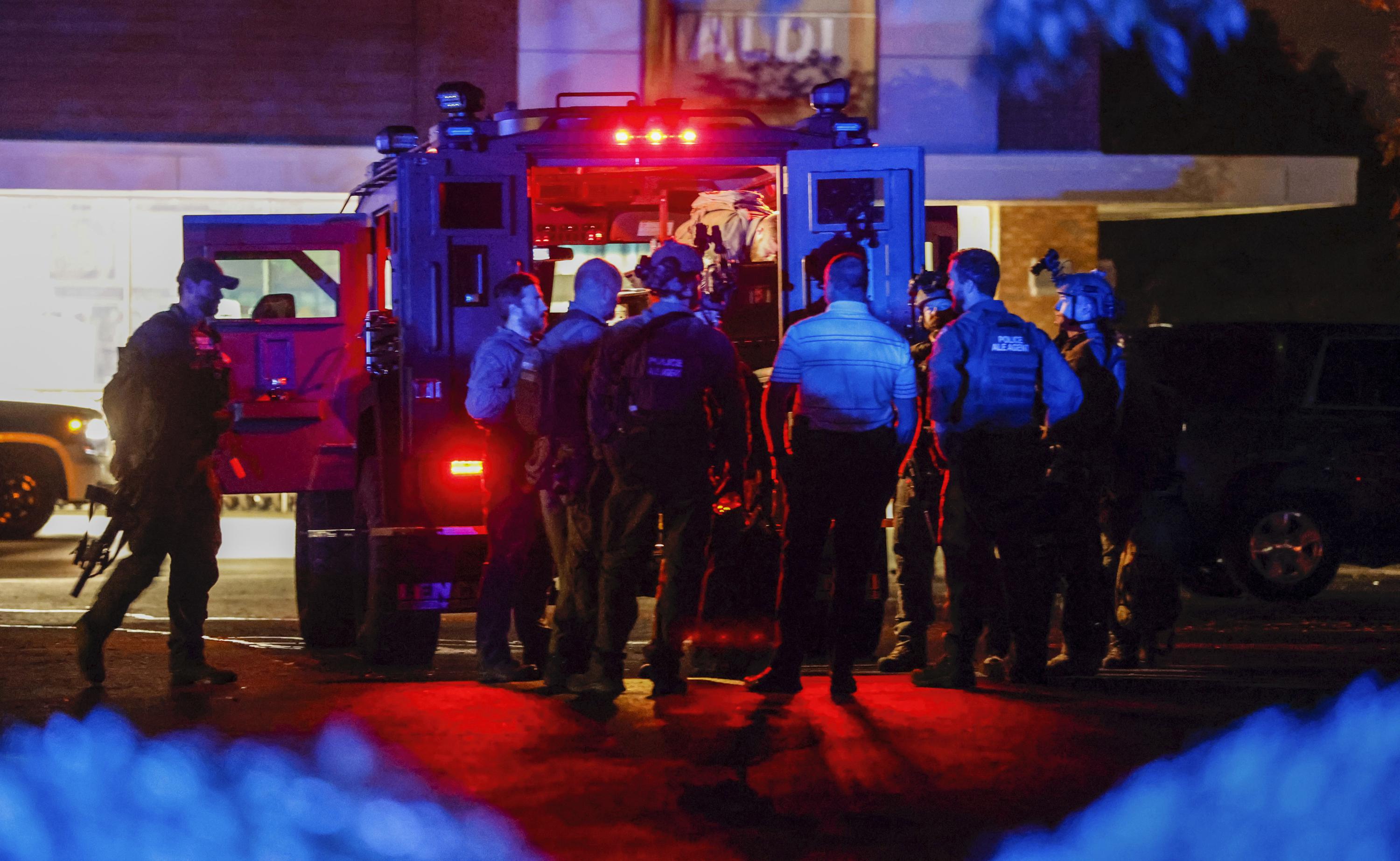
RALEIGH, N.C. (AP) — A shooter killed five people along a walking trail in North Carolina’s capital city and eluded officers for hours before he was cornered in a home and arrested, police said.

An off-duty police officer was among those killed Thursday by the suspect, who police only described as a white, juvenile male. He was arrested around 9:37 p.m., authorities said. His identity and age weren’t released. North Carolina law defines a juvenile as anyone under age 18.

The gunfire broke out around 5 p.m. along the Neuse River Greenway in a residential area northeast of downtown, Raleigh Mayor Mary-Ann Baldwin said. Officers from numerous law enforcement agencies swarmed the area, closing roads and warning residents to stay inside while they searched for the shooter.

Two people, including another police officer, were taken to hospitals. The officer was later released, but the other survivor remained in critical condition.

“Tonight, terror has reached our doorstep. The nightmare of every community has come to Raleigh. This is a senseless horrific and infuriating act of violence that has been committed,” Gov. Roy Cooper told reporters.

Authorities didn’t offer any details on a motive, but Baldwin joined Cooper in decrying the violence.

“We must stop this mindless violence in America, we must address gun violence,” the mayor said. “We have much to do, and tonight we have much to mourn.”

Early Friday, authorities searched a house a couple of streets over from where the shooting happened, WRAL-TV said.

The Raleigh shooting was the latest in a violent week across the country. Five people were killed Sunday in a shooting at a home in Inman, South Carolina. On Wednesday night two police officers were fatally shot in Connecticut after apparently being drawn into an ambush by an emergency call about possible domestic violence. Police officers have been shot this week in Greenville, Mississippi; Decatur, Illinois; Philadelphia, Las Vegas and central Florida. Two of those officers, one in Greenville and one Las Vegas, were killed.

Thursday’s violence was the 25th mass killing in 2022 in which the victims were fatally shot, according to The Associated Press/USA TODAY/Northeastern University Mass Killings database. A mass killing is defined as when four or more people are killed excluding the perpetrator.

Brooke Medina, who lives in the neighborhood bordering the greenway, was driving home at around 5:15 p.m. when she saw about two dozen police cars, both marked and unmarked, race toward the residential area about 9 miles (14 kilometers) from Raleigh’s downtown. She then saw ambulances speeding the other direction, toward the closest hospital.

She and her husband, who was working from home with their four children, started reaching out to neighbors and realized there was a shelter-in-place order.

The family closed all of their window blinds, locked the doors and congregated in an upstairs hallway together, said Medina, who works as a communications vice president at a think tank. The family listened to the police scanner and watched local news before going back downstairs once the danger seemed to have moved further away from their home.

“We’re just going to hunker down for the rest of the night and be very vigilant. Keep all of our lights on, doors locked,” she said.

She described the neighborhood known as Hedingham as a sprawling, dense, tree-lined community that’s full of single-family homes, duplexes and townhomes that are more moderately priced compared to other parts of the Raleigh area.

Allison Greenawalt, 29, who also lives in the neighborhood, said she was sitting on the couch with her cat around 5 p.m. when she heard “three shots in a pretty rapid succession.” She said police arrived quickly and that she’s grateful that they were there during the chaotic hours while she sheltered inside. Her husband, meanwhile, tried to drive home from work after the shooting and was turned away by police who had closed nearby streets, and he didn’t make it home until around 10:30 p.m., she said.

“I was sitting in our house with the lights turned off and the windows closed for the majority of the evening, just waiting to hear that” the shooter had been arrested, she said.

___

Dazio reported from Los Angeles. Associated Press writers Michael Kunzelman in Silver Spring, Maryland and Gary D. Robertson and Allen G. Breed in Raleigh contributed to this report.

Categories
Saved Web Pages

The News And Times

AVvXsEjp8rEdzhfi9x6IM-Te6NLirQ1Phr0i2b3s

My current impressions about the possible causes of the Crimea Bridge Explosion

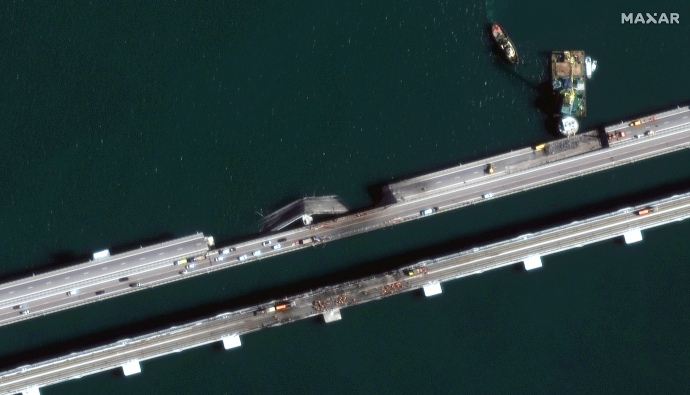
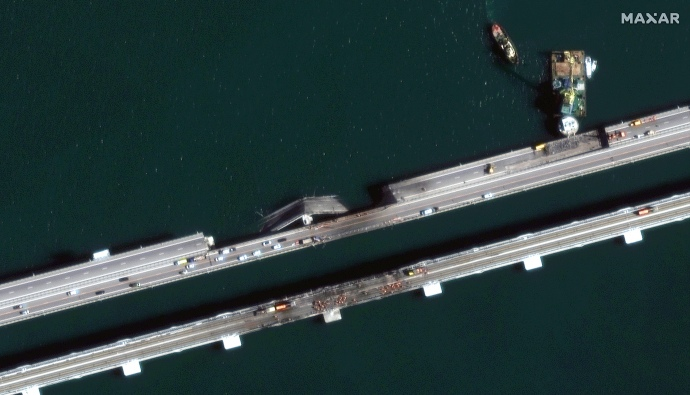
The two collapsed spans of the roadway look  CUT OUT, longitudinally and cross-sectionally, possibly in advance or shortly before the accident and as the preparation for it, possibly from the central, Crimea-outbound part of the highway. The third cross-sectional and partially longitudinal CUTS were probably made to limit the human casualties by stopping the traffic. 

The cuts appear to be very accurate, “surgical”. 

There might have been more than one truck involved, possibly several, possibly equipped with the specially designed and placed lasers or other types of the “cutting” devices. 

The role if the “plastic bombs” implied by the FSB is unclear. Any bomb would produce the radially spreading damage with a lot of debris, which we do not see here. 

The ignition of the fuel cisterns on the railroad above could be  caused by the mechanism separate from those inducing the “cuts’ on the roadway, and these two events were carefully timed to coincide with the sliding of its two sections, possibly assisted by the kinetic effect of the shockwave from the railroad blast. 

Categories
Saved Web Pages

Crimean Bridge blast: experts assess the damage

file-20221010-58076-btim8w.jpg?ixlib=rb-

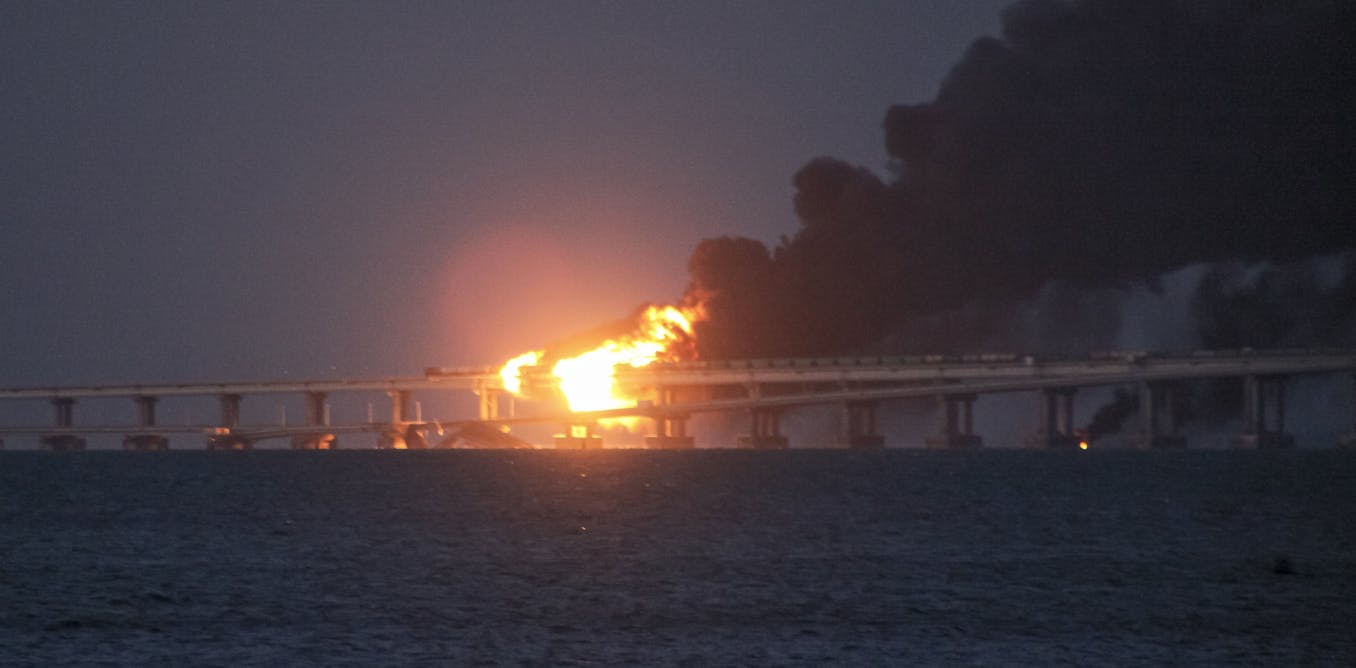
Early on Saturday, local time, a massive blast shook the Crimean Bridge (also known as the Kerch Bridge). Shocking images of the burnt rail bridge and collapsed road bridge have been shown around the world.

But Russia has moved quickly to return the bridge to operations, even though it appears to be significantly damaged.

Observers have been left wondering: what was the effect of the blast and fire on the surviving bridge elements, what repairs could be required, and when is it safe to re-open a bridge after such an event?

As experts in bridge safety and blast engineering, we have (some) answers.

The bridge

Built by Russia at a cost of some US$3.7 billion after the annexation of Crimea in 2014, the Crimean Bridge is Europe’s longest, linking Russia to Crimea across the Kerch Strait.

The 19-kilometre connection is a vital artery for economic and social links, and since Russia’s invasion of Ukraine it has also become a critical military asset for Russian supplies and telecommunications.

Despite the name, the Crimean Bridge is actually two bridges: one for road and one for rail. The road bridge is itself two independent bridge structures, while the rail bridge is a single bridge structure supporting two ballasted rail tracks.

Some general drawings and information on the bridge are available online.

The attack

The attacked section lies between Tuzla Island and Kerch, Crimea, on an east-west heading, and is midway between the island and the main arch span over the navigable waterway.

At this point the rail and road bridges are of a similar form of construction, known as a “composite slab orthotropic deck steel plate girder bridge”, spanning about 64 metres. This means there is a 20 centimetre concrete slab cast onto flat steel plates, stiffened with steel ribs, all supported by about 3.2 metre deep steel plate girders.

It is important to know this because the effect of the blast and inferno, and the subsequent repair and likely safety of the structure is very sensitive to the form of construction.

The aftermath

The blast caused one span to rupture at its middle. The adjacent span on the Crimean side remained intact, but was pulled off its bearings and also collapsed into the sea. A third span on the Tuzla side remains standing, while the next span over fell off its far bearings.

It appears the girders are continuous over the piers, with expansion joints only every four spans. Just like picking up a table cloth in the middle, the massive vertical force due to the blast would pull in the ends of the continuous steel girders, popping them off their supports.

The blast ignited what is presumably fuel in a tanker train on the adjacent rail bridge, causing an inferno that burned for at least an hour. Blazing fuel poured down over the southern side of the bridge, and was blown back in a northerly direction by the wind, exposing nearly all steel surfaces to the fire.

There is much debate as to the cause of the explosion. It is clear it originated at the road bridge, and the blast started the fire on the fuel train on the nearby rail bridge. It is not clear whether it originated above the bridge deck, or below.

Video images show a semi-trailer truck on the bridge at the time, and another angle shows what may be a wave caused by the bow of a boat below the bridge. Either could plausibly have been the source of the explosion.

Just after the explosion, a lot of sparks are visible. This may indicate the use of thermite in the explosives, which burns at temperatures hot enough to damage steel and cause fires in surrounding flammable objects.

What are the structural effects?

There is a long history of bridge failures due to fire and blast damage. High temperatures can weaken both steel and concrete, while blast shockwaves can result in violent fractures.

While steel can bend under high load without breaking, and the surviving girders of the Crimean Bridge may still be usable, the blast has likely caused severe localised damage. To determine how much life is left in the surviving road bridge, investigators ought to conduct detailed inspections and metallurgical sampling.

The fuel fire is also likely to have weakened the girders on the rail bridge, as well as those on the road bridge (as they were on the windward side of the inferno). The concrete pier shows extensive burn marks too, and so the concrete will be weakened, and the reinforcement inside it more susceptible to corrosion over the longer term.

Can it be repaired?

Sections of the upper structure of the rail and road bridges can be replaced. There are floating cranes with sufficient capacity to lift in replacement pre-fabricated steelwork.

The road and rail concrete decks and fitments can then be reinstalled. Such work would of course render the bridge inoperable for an extended period.

Is the bridge safe?

In structural engineering, safety is not an either-or proposition. It is measured on a continuum known as the probability of failure, or more positively, the reliability index of a structure.

There are guidelines on acceptable levels of safety for different types of structure, and different costs of providing safety. Engineers design new bridges to standards that aim to provide a very, very small probability of a failure occurring.

In assessing existing bridges for safety, engineers will aim for that same level of safety to be provided to the public.

For ordinary bridges, surrounded by a dense road network of alternative routes, there is no need to reduce the level of safety deemed acceptable. However, for key bridges such as the Crimean Bridge, it may be reasonable to accept a reduced level of safety when the costs associated with a disruption are very high.

These considerations are for normal civilian use. For military purposes, the levels of safety or risk to human life that are acceptable are dramatically different. The reasoning used in a normal civilian situation does not apply.

Where to from here?

The remaining road bridge has re-opened to car-only traffic. This may be reasonable, as the weight added by the cars is negligible compared to the weight of the bridge itself – and the political decision-making around acceptable levels of safety seems out of the ordinary.

Cranes have been shown lifting the fuel tanker wagon wreckage off the Crimea-bound rail line. It remains to be seen how the steel girders will perform under train travel. It is likely the trains will be instructed to go slow to reduce vibratory effects, and that wagons will not be fully-loaded.

Under normal circumstances, the blast and damage we have seen would result in an extended closure and repair works. Clearly, however, the circumstances are far from normal.

Categories
Saved Web Pages

FBI agent ‘sent spies to their death’

fallback-logo.png

An FBI spycatcher was accused yesterday of helping to send American agents to their deaths by trading secrets to Russia for $1.4m, in one of the biggest security breaches in United States history.

Robert Hanssen, a 56-year-old FBI veteran and father of six, faces charges stretching back more than 15 years, contained in a 110-page affidavit that details payments to Swiss bank accounts and in diamonds.

They include identifying former Soviet KGB double-agents who were working for the US.

“I think one of the worst parts is agents killed in the line of duty,” said Louis Freeh, the FBI’s director, who described the arrest as a coup for the bureau. “This case is a grave and tragic moment for us.”

Asked if the case was one of the worst breaches of US security, Mr Freeh replied: “I would characterise it in that fashion.”

Mr Hanssen, who has worked for the FBI for 27 years, was said to have been caught red-handed three days ago while leaving classified information at a “dead drop” in a park in northern Virginia. A payment of $50,000 was found nearby.

FBI agents said Mr Hanssen helped to cross-check and confirm intelligence sold by Aldrich Ames, thought to be the most damaging mole in CIA history. Ames, who was arrested six years ago, is serving a life sentence for revealing more than 100 operations and betraying about 30 agents, 10 of whom were executed.

Mr Hanssen, who is said to have offered his services to the former Soviet Union in 1985, gave details about KGB double-agents who had already been compromised by Ames.

“When these two KGB officials returned to Moscow they were tried and executed,” said Mr Freeh. “Two were executed and one was in prison and later released.”

John Ashcroft, the US attorney general, said: “The arrest should remind us that our free society is an international target in a dangerous world.”

Mr Hanssen, known to his Russian handlers by the code-name Ramon, is accused of passing on secrets about US electronic surveillance techniques. The four handlers did not know where he worked because he was able to use his experience to prevent both sides from following him.

High security clearance and sensitive assignments gave Ramon, who is thought to have been operating alone, access to details of US security operations. In the end, KGB documents that fell into the hands of FBI-CIA officers investigating a mole in their ranks led them to Mr Hanssen, who was due to retire in two months.

While he was supposed to have been operating as a counter-espionage officer spying on the spies in New York and Washington he was actually working for the Soviet Union and then Russia.

“In short, the insider betrayed his trust,” Mr Freeh said. “The FBI entrusted him with some of its most sensitive matters and the US government relied upon him for his service and integrity. The crimes alleged are an affront not only to his fellow FBI employees but to the American people.”

The Russian embassy in Washington declined to comment, but a security services spokesman in Moscow suggested that publicity about the case was politically motivated.

Plato Cacheris, a prominent Washington lawyer who is representing Mr Hanssen, said: “He’s quite upset, emotional. It’s a serious matter, an FBI agent charged with espionage.”

Mr Cacheris, whose previous clients have included Ames and Monica Lewinsky, spoke after Mr Hanssen appeared in court in Alexandria, Virginia, dressed in a black shirt and grey trousers. “We’ll have to see what the quality of the case is. As far as I know he is of good character,” Mr Cacheris said.

He said that Mr Hanssen, who has been working recently for the state department and is only the third FBI agent to have been accused of espionage, intends to plead not guilty. Mr Hanssen could face the death penalty if he is convicted.

Nancy Cullen, a neighbour of the Hanssen family, who live in a $300,000 (£200,000) split-level brick and cedar home in a Washington suburb, said: “We just can’t believe it… a dog and six kids and a regular routine.

“Part of the routine that made us feel guilty was that every Sunday they would pack up the van and go to church. They’re just a great family.” Mr Hanssen’s wife Bonnie teaches religious education part-time at a Catholic school.

“They didn’t appear to be unusual in any way,” said another neighbour. “They did nothing to raise a red flag or make me suspicious.”

WP Radio
WP Radio
OFFLINE LIVE