Categories
Saved Web Pages

Rishi Sunak, Now the Front-Runner for U.K. Prime Minister, Could Say, ‘I Told You So’

23uk-sunak-1-facebookJumbo.jpg

Mr. Sunak’s warnings about inflation and his fiscal conservatism may have cost him the post in September. But now his accurate assessments are easing his path to Britain’s top job.

  • Send any friend a story

    As a subscriber, you have 10 gift articles to give each month. Anyone can read what you share.

    Give this articleGive this articleGive this article
Rishi Sunak at a Conservative Party event in London in August.

Rishi Sunak at a Conservative Party event in London in August. Credit…Hannah Mckay/Reuters

Eshe Nelson
Oct. 23, 2022Updated 6:07 p.m. ET

LONDON — Rishi Sunak would have every right to be smug.

Throughout the summer, Mr. Sunak, Britain’s former finance minister — and now the front-runner for prime minister — warned against the economic policies of Liz Truss as he competed with her for the nation’s top job, and then lost. From the first television debate, when he described her plans as a “fairy tale,” to the final days of the contest, when he said he “struggled to see” how Ms. Truss’s tax cuts and spending plans would “add up,” he sounded the alarm.

For the past six weeks, Mr. Sunak has been lying low as his economic predictions have played out at a dizzying speed. Investors balked at Ms. Truss’s widespread tax cuts and increased borrowing; the pound slumped; government borrowing costs soared; the mortgage market was upended; and the central bank had to intervene. After just 44 days as prime minister, Ms. Truss resigned last week with her economic agenda in tatters.

Mr. Sunak’s relatively gloomy attitude over the summer, warnings about inflation and strict adherence to fiscal conservatism may have cost him the opportunity to be named prime minister in September. But less than two months later, these same characteristics and accurate prognosis of the effects of Ms. Truss’s program have eased his pathway to Britain’s top job.

After Boris Johnson, the former prime minister, took himself out of the running on Sunday, Mr. Sunak has cemented his commanding lead in the contest.

“He clearly comes with the huge advantage” of being able to say everyone was warned, said Jill Rutter, a former civil servant and a senior fellow at the Institute for Government, a London-based research group.

Liz Truss and Mr. Sunak in early September before a BBC interview as each sought to become Britain’s next prime minister.Credit…Jeff Overs/BBC via Agence France-Presse/ Getty Images

“Clearly, a lot of people are now thinking, he was right and Truss was wrong and they’ve proved that in spades,” she said. “The U.K. has paid a high price for that and will continue to pay a high price for that lost credibility.”

On Sunday, Mr. Sunak, 42, formally declared that he was running to be the leader of the Conservative Party and, by extension, the next prime minister. He is the front-runner in the number of members of Parliament who have publicly committed to him, ahead of the leader of the House of Commons, Penny Mordaunt.

“The United Kingdom is a great country, but we face a profound economic crisis,” Mr. Sunak said in a statement on Sunday, announcing that he was running. He added that he wanted to “fix our economy” and that he had a track record of delivery.

Mr. Sunak’s office declined a request for an interview on Sunday evening after Mr. Johnson’s withdrawal. But, in a tweet, Mr. Sunak praised Mr. Johnson for Brexit and the coronavirus vaccine rollout.

“I truly hope he continues to contribute to public life at home and abroad,” Mr. Sunak added.

Mr. Sunak’s rise in politics has been uncommonly rapid. In early 2020, at just 39 years old, he was catapulted into the position of chancellor of the Exchequer, in Britain’s treasury department, by Mr. Johnson. He has held a seat in Parliament only since 2015. Mr. Sunak became the nation’s most popular politician after spending hundreds of billions of pounds on emergency pandemic measures, including paying people’s wages and arranging generous grant and loan programs for businesses.

For a long time Mr. Sunak was considered Mr. Johnson’s heir apparent. But then his political star suddenly started to fall earlier this year.

His efforts to shrink the vast pandemic-era public spending were met with a drop in popularity and policy U-turns. In March, as inflation started to bite in Britain and fears grew over a cost-of-living crisis, Mr. Sunak announced only limited support to help vulnerable households. Two months later, he came up with a more generous plan that offered every household hundreds of pounds in discounts off energy bills.

The criticism of Mr. Sunak has been intensified by his wealth. Photographs of him wearing designer clothes and using “smart” coffee mugs that cost hundreds of dollars and revelations that he owned a Peloton exercise bike have created an image of someone who is out of touch with a population squeezed by the highest inflation rate in four decades.

While his Indian heritage shows the Conservative Party’s progress in diversifying its ranks, and would make him Britain’s first prime minister who was not white, Mr. Sunak has many of the traditional trappings of a Tory upbringing. He went to the fee-paying Winchester School and studied philosophy, politics and economics at Oxford University. He worked at the investment bank Goldman Sachs and two hedge funds before becoming a member of Parliament.

Mr. Sunak with his wife, Akshata Murthy, and their daughters, Anoushka and Krishna, in July.Credit…Peter Nicholls/Reuters

While studying for an M.B.A. at Stanford University, he met his wife, Akshata Murthy, a fashion designer whose father, Narayana Murthy, co-founded the technology giant Infosys and is one of India’s richest men. They have homes in London, in Mr. Sunak’s parliamentary constituency in Yorkshire and in Santa Monica, Calif., and were featured this year in The Sunday Times’s annual ranking of Britain’s wealthiest people.

In April, the revelation that Mr. Sunak’s wife claimed nondomiciled status in Britain — saving her millions of pounds a year in taxes on dividends from shares in her father’s company — suddenly put Mr. Sunak’s political future in doubt, and he had to beat back calls for his resignation.

It also emerged that he had retained a U.S. green card, which would allow him to live permanently in the United States, even while he was chancellor. Mr. Sunak gave up the green card last October, and in the spring his wife said she would pay taxes in Britain on her overseas income.

But Mr. Sunak’s wealth is likely to remain a political vulnerability for him, said Ms. Rutter, the senior fellow.

Wealth is “always going to be the difficulty for Sunak,” she said, “if he comes in and says we all have to make sacrifices.”

If he becomes prime minister, it is likely that Mr. Sunak will preside over spending cuts to government departments with already stretched budgets. Jeremy Hunt, the current chancellor, has warned of “difficult” spending decisions as he has tried to repair the damage to Britain’s fiscal credibility caused by Ms. Truss’s tax plan.

Though Mr. Sunak, as prime minister, would not be obligated to keep Mr. Hunt in that role, it would be risky for any new leader to deviate sharply from the fiscal plans that have brought some calm to British financial markets.

Mr. Sunak steered the British economy through more than two years of crisis, but Britain’s next prime minister faces enormous economic challenges.Credit…Sam Bush for The New York Times

As chancellor, Mr. Sunak raised taxes as a share of national income to their highest level in 70 years, a record he had to defend over the summer. He contrasted his pragmatic approach to public finances with Ms. Truss’s more carefree policy of not offsetting tax cuts with spending cuts or other plans to avoid increasing public debt.

“Liz’s plans are promising the earth to everybody,” he told the BBC in August. “I don’t think life’s that simple, and I think her plan risks making the situation worse when you’re borrowing that much money for tax cuts at a time when inflation’s already going up.”

In the end, several of Mr. Sunak’s policies from his time as chancellor are still intact, such as a plan to raise corporate taxes to 25 percent from 19 percent, and to keep the basic rate of income tax, at 20 percent.

Mr. Sunak has said that he wants to cut taxes but that inflation needs to come down first. As chancellor, his efforts to see to fruition a grander economic vision were scuppered by crisis, particularly Russia’s war in Ukraine.

In February, at a speech at City, University of London, Mr. Sunak said he wanted to build a “new culture of enterprise” and an economy focused on “free market principles.” In this vision, more government spending was not the answer to fixing Britain’s lackluster productivity growth. Private business investment was paramount. But just a few months later, he was announcing big spending plans to protect households from rising energy bills.

Mr. Sunak may have steered the British economy through more than two years of crisis, but Britain’s next prime minister faces enormous economic challenges.

The nation is likely to enter a recession and longstanding issues include low productivity growth and trade and labor market disruptions created by Brexit. Mr. Sunak also has political problems. His resignation was the tipping point in Mr. Johnson’s downfall in July, which means there are many in the party in Parliament and in the broader membership who will struggle to get behind him.

Mr. Sunak, or whoever the next prime minister is, will be caught between a rock and a hard place. On one side is an unruly and fractious Conservative Party and on the other side financial markets that expect strict discipline on public finances.

“It will take an immensely skillful politician to navigate their way through this,” Ms. Rutter said. “The really interesting question is, is Rishi Sunak skillful enough?”
Boris Johnson, then the prime minister, with Mr. Sunak, in 2020. Credit…Dan Kitwood/Getty Images
Categories
Saved Web Pages

Ukraine updates: Zelenskyy slams Russian ‘dirty bomb’ claims – DW – 10/23/2022

63350270_6.jpg

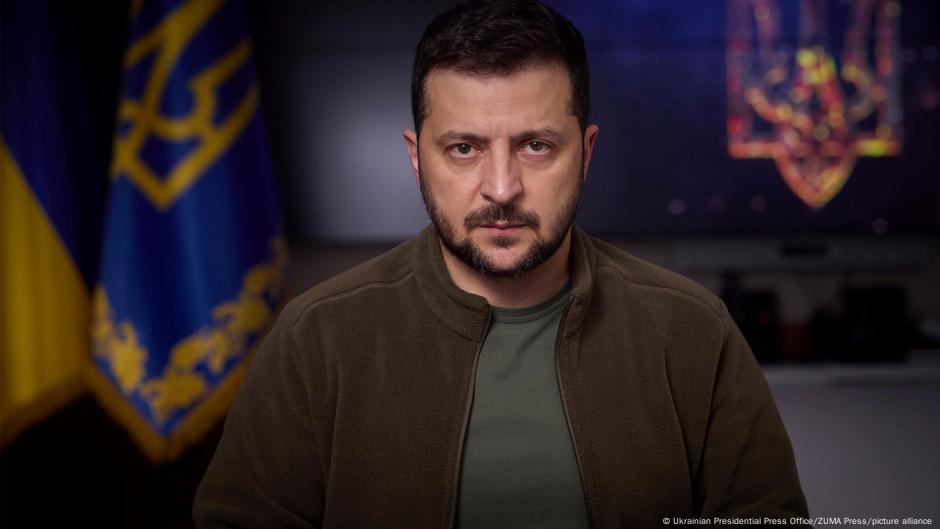
In his daily video address, Ukrainian President Volodymyr Zelenskyy dismissed Moscow’s claims that Ukraine was preparing provocations with the use of a “dirty bomb”, as suggested by Russia’s defense minister during telephone calls with NATO counterparts.

“If Russia calls and says that Ukraine is allegedly preparing something, it means one thing: Russia has already prepared all this. I believe that now the world should react as harshly as possible,” Zelenskyy said.

The Ukrainian president also said that only Russia was capable of using nuclear weapons in Europe.

“If anyone can use nuclear weapons in this part of Europe — it can be only one source — and that source is the one that has ordered comrade Shoigu to telephone here or there,” Zelenskyy said.

Earlier on Sunday, Ukraine’s Foreign Minister Dmytro Kuleba denounced Moscow’s claims as “absurd” and “dangerous”. “Russians often accuse others of what they plan themselves,” he added. 

Here are the other main headlines from the war in Ukraine on October 23:

Ukraine lost 90 percent of its wind power — government

Ukraine lost around 90% of its wind power capacity as a result of the Russian invasion. In the case of solar energy, the loss is 40-50%, Energy Minister Herman Halushchenko said on Ukrainian television on Sunday.

According to Halushchenko, before the war, renewables accounted for 10-11% of energy production in Ukraine.

Meanwhile, Kyiv’s energy operator said that scheduled “stabilization” power cuts have been introduced in the Ukrainian capital after Russian strikes on the country’s energy infrastructure.

Russia in recent days has repeatedly targeted Ukraine’s energy grid, destroying at least a third of the country’s power stations ahead of winter.

Russian, Western defense ministers discuss Ukraine in phone calls

Russian Defense Minister Sergei Shoigu told his British counterpart Ben Wallace on Sunday that Moscow was concerned Kyiv could be planning to use a “dirty bomb” in Ukraine.

It’s a claim Moscow has made before, without providing evidence. A “dirty bomb” refers to a conventional explosive device that disperses radioactive material.

Wallace “refuted” claims by Moscow that Western countries were facilitating a planned escalation of the war in Ukraine. “The defense secretary refuted these claims and cautioned that such allegations should not be used as a pretext for greater escalation,” Britain’s Ministry of Defence said in a statement, noting Moscow had requested the conversation.

Shoigu also repeated the “dirty bomb” claim in phone calls earlier in the day with the French and Turkish defense ministers. He also later spoke with US Defense Secretary Lloyd Austin.

“The situation in Ukraine, which has a steady tendency towards further, uncontrolled escalation, was discussed,” by Shoigu and France’s Sebastien Lecornu, Russia’s Defense Ministry said.

In a statement, Lecornu said France would not get drawn into any form of escalation in the Ukraine conflict, especially regarding nuclear options.

Meanwhile, Ukrainian Foreign Minister Dmytro Kuleba said that Russian claims are “absurd” and “dangerous.” “Firstly, Ukraine is a committed NPT member: we neither have any ‘dirty bombs,’ nor plan to acquire any. Secondly, Russians often accuse others of what they plan themselves,” he wrote on Twitter.

There have been growing fears that Moscow may resort to using tactical nuclear weapons in Ukraine, where counteroffensives by Kyiv’s troops have forced Russian units to go on the defensive.  

Moscow deploying mercenaries to defend occupied territories: UK Defence Ministry

In its latest assessment, Britain’s Ministry of Defence says Russia is planning to bring mercenaries to defend its occupied territories as it faces counteroffensives by Kyiv.

Wagner Group owner Yevgeny Prigozhin claimed online last week that his engineering teams were constructing an extensive fortified

“Wagner Line” of defenses in Russian-occupied Luhansk, the ministry said.

It added that a map Prigozhin had posted online “showed a section of newly constructed anti-tank defenses and trench systems southeast of Kreminna in Luhansk.”

Russia has been using the Wagner Group in conflicts for several years, including in Syria and the Central African Republic.

In a recent video, the mercenary group’s chief appeared to be recruiting Russian prisoners to fight in Ukraine. 

Russia withdraws officers from Kherson — think tank

The Institute for the Study of War (ISW) says Russia’s military leadership is pulling its officers out of the southern Ukrainian city of Kherson ahead of an expected advance by Ukrainian forces.

The think tank said Russian officers were being moved across to the eastern bank of the Dnieper River, while newly mobilized, less experienced troops would be left on the western side to slow the Ukrainian counteroffensive.

Kherson is the capital of a region of the same name that was illegally annexed by Russian President Vladimir Putin last month. The city has been in Moscow’s hands since early in the war. On Saturday, Russian-installed authorities there told all residents to evacuate immediately.

Ukraine’s military said Sunday that Russian forces were now mostly on the defensive, but were continuing to target energy infrastructure and launch attacks on several towns in the eastern Donbas.

The ISW think tank said Russia’s strategy of targeting power plants in recent days appeared to be aimed at hurting Ukrainians’ will to fight and forcing Kyiv to spend additional resources to protect civilians and energy infrastructure. 

Kherson front lines in flux

Russian forces in Kherson urged civilians to “evacuate,” with a post on Telegram noting that “Due to the tense situation at the front, the increased danger of massive shelling of the city and the threat of terrorist attacks, all civilians must immediately leave the city” and cross to the eastern side of the Dnieper River.

Russian forces are in control east of the Dnieper River.

After warnings of a Ukrainian counter offensive to recapture the city were announced, thousands of civilians left Kherson.

At Oleshky, which is the opposite bank of the bank of Dnieper, people were seen arriving by a river boat loaded with boxes, bags and pets.

Ukrainians pack their belongings and wait in line as they evacuate Kherson.As power outages continue, Russian forces in Ukraine’s Kherson urged civilians to evacuate. Image: Dmitry Marmyshev/TASS/IMAGO

Deputy Prime Minister Iryna Vereshchuk wrote on Telegram, “Kherson region! Just a little bit more. Hang in there. The Ukrainian Armed Forces are at work.”

G7 condemns Russia’s takeover of Zaporizhzhia nuclear plant

The leaders of the G7 nations condemned Russia’s kidnapping of the Ukrainian officials responsible for the Zaporizhzhia nuclear power plant.

In a statement, they condemned the abduction of the plant’s leadership and said that Russia must immediately return full control of the plant to Ukraine.

Russian forces took control of the nuclear plant in the initial aftermath of the February 24 invasion. 

The urgent meeting of the G7 leadership came a day after Moscow launched more than 80 missiles at Ukraine. The attack killed at least 19 people and left 105 injured.

The G7 also condemned Putin’s nuclear sabre rattling.

Former Motor Sich owner detained on treason charges

Ukrainian forces detained Vyacheslav Boguslaev, the former owner of Motor Sich, a well-known manufacturer of aircraft engines in Ukraine.

He has reportedly been charged with treason.

Several Ukrainian media outlets reported that after being detained, Boguslaev was whisked off to Kyiv. 

Reports quoted security sources who said that Boguslaev, a former member of parliament, was suspected of collaborating and assisting the Russian occupation of four Ukrainian regions, including Zaporizhzhia.

Citing security sources, Ukrainian journalist Iryna Romaliyska wrote in a Facebook post that Boguslaev was known for his pro-Russian views and was in contact with Russian intelligence services. Boguslaev allegedly helped to supply Moscow with aircraft parts, she said.

Kyiv warns of a ‘humanitarian catastrophe’ after Moscow’s airstrikes

The Ukrainian government warned that Russia’s escalating attacks on Ukraine’s energy infrastructure could spark a major “humanitarian catastrophe.”

Kyiv said at least 40% of Ukraine’s energy infrastructure has already been destroyed. The attacks have forced the country to brace for a cold winter with a limited supply of power.

Zelenskyy thanked energy service providers and grid operators who were working to rebuild critical sites despite the risk.

His office said Saturday that Russia’s airstrikes had damaged the Ukrenergo power company, leaving close to 1.5 million customers were left without electricity.

Mykhailo Podolyak, an advisor to Zelenskyy, tweeted that “By striking Ukraine’s critical infrastructure, the Kremlin wants to provoke new refugees” to Europe. He added that the only way to prevent a humanitarian catastrophe is to “transfer air defense and additional missiles fast.”

Ukrainian Prime Minister Denys Shmyhal also warned that the intensified Russian attacks would “trigger a new migration tsunami.”

Zelenskyy vows to down Russian missiles

As Russia continued to attack Ukraine’s critical civilian infrastructure, Ukrainian President Volodymyr Zelenskyy pledged that his military would up its air defense systems to counter incoming Russian missiles.

Zelenskyy said, “Those treacherous blows on critically important facilities are characteristic tactics of terrorists.” He added, “The world can and must stop this terror.”

Even though Ukraine currently doesn’t have the technical ability to down all of the missiles and drones Russia sends incoming, it is only a matter of time before Ukraine “will achieve that” with the help of partners, he said.

The latest airstrikes have caused power outages in many parts of the country.

In his nightly video address, Zelenskyy noted that Saturday Ukrainian forces downed 20 Russian missiles and more than 10 Iranian-made drones. Earlier, the Ukrainian air force confirmed that of 33 missiles fired at Ukraine by Russia that 18 were shot down.

ns/ar (dpa, Reuters)

Categories
Saved Web Pages

Ukraine war: this conflict is just further evidence that Putin’s Russia is now a rogue power – europeantimes.news

file-20221020-20-v4710.jpg?resize=691%2C

Given where most of the fighting and dying is taking place it is easy to think that the current European security crisis is primarily about Ukraine. This tendency is reinforced by the fact that Russia and the west are keen to keep the war limited to Ukrainian territory.

Vladimir Putin’s whole calculation has, from the outset, been based on two assumptions. First that Russia’s possession of nuclear weapons would deter western military intervention for fear of wider escalation. The second was that Europe’s dependence on Moscow’s gas supply would mute any sanctions from the west and that, in the long run, these factors would be used to force Kyiv to yield in some way to Putin’s demands.

For its part, the US and its allies have also been keen to limit the conflict, recognising that while Kyiv is fighting for its survival as an independent sovereign state, the first policy priority for the west is to avoid a general war in Europe. Putin’s frequent and lurid nuclear sabre rattling is also intended to remind the west that its meddling – even its continued military support for Kyiv – risks just that outcome.

This framing of the war also explains the constant calls for a negotiated resolution to the conflict. Many efforts to end the war, from the French president Emmanuel Macron to the business magnate Elon Musk, focus on the need for negotiation. By this they mean a compromise by Ukraine over parts of its territory, such as Crimea, or its security status regarding Nato membership and alignment with the west rather than Russia. Even the US president Joe Biden’s statement that Putin must be offered an “off ramp” is a recognition of the desire to solve the Ukraine crisis on these terms.

Read more: Ukraine war: how the Biden administration is responding to Putin’s threats to go nuclear

Yet this approach to a resolution of the war is flawed in two important ways. First, in ignores the clear evidence that neither side is interested in a negotiated solution as both Russia and Ukraine believe that they have more to gain by fighting. Indeed, both sides seem convinced that they can win.

For Ukraine its military successes and territorial advances demonstrate that the tide of the war has turned on the ground due to its better training, logistics, intelligence, equipment and morale. For Russia, weaponising winter, attacking Ukraine’s electricity infrastructure as well as mass mobilisation of reserve troops and regular threats of further escalation have convinced Moscow that in the long run it can break the will of Ukraine or its western backers.

Europe’s fragile security order

Perhaps more importantly however, framing the war in these terms misses the wider challenge that Putin’s invasion of Ukraine poses for both the future of the European security order – and indeed the rules of the international system as a whole. In short, the problem is not confined to the war in Ukraine.

file 20221020 17 3cobm7.png?ixlib=rb 1.1 - Ukraine war: this conflict is just further evidence that Putin’s Russia is now a rogue powerWhere Russian is the main language. Felipe Menegaz, Peter Fitzgerald, CC BY-NC-SA
The problem is that a major world power has gone rogue and abandoned its adherence to the basic principles of non-intervention. Principles that sit at the heart of the international system of states. It has done this by leveraging the threat of nuclear war as a central element of its approach.

Further, Putin has indicated that his imperialist aims are not limited to the areas that it has recently declared to be Russian territory. Indeed, Russia’s imperial aims stretch to all of Ukraine, and to all Russian-speaking enclaves in Europe, including the Baltic states and Moldova.

Russia has also, since 2015, propped up the Syrian regime of Bashar al-Assad, enabling its use of poison gas against its own people. Russian soldiers have also been active in Africa, through the Wagner Group, where their efforts in more than a dozen countries advance Moscow’s political influence and commercial interests.

Read more: Burkina Faso coup raises questions about growing Russian involvement in west Africa

In both the Middle East and Africa, Russia is exploiting what it sees as the strategic vacuum left by US hesitance and withdrawal. In explicitly calling for the end of the US led international order it is acting on an alternative vision for the international system where Russia’s self-serving imperial influence is on the march.

To grant concessions to Russia at Ukraine’s expense would do little to pacify Russia’s grandiose power ambitions – quite the opposite, it would merely feed the beast. Europe’s borders, and international frontiers more broadly, would be forever open to challenge in a world with such a state as a major power.

Future lessons

How this war ends matters hugely beyond the confines of Ukraine’s internationally recognised borders. Russia’s claim that everywhere that speaks Russian should be part of the Russian state has obvious parallels for Taiwan and China’s claim to its sovereignty.

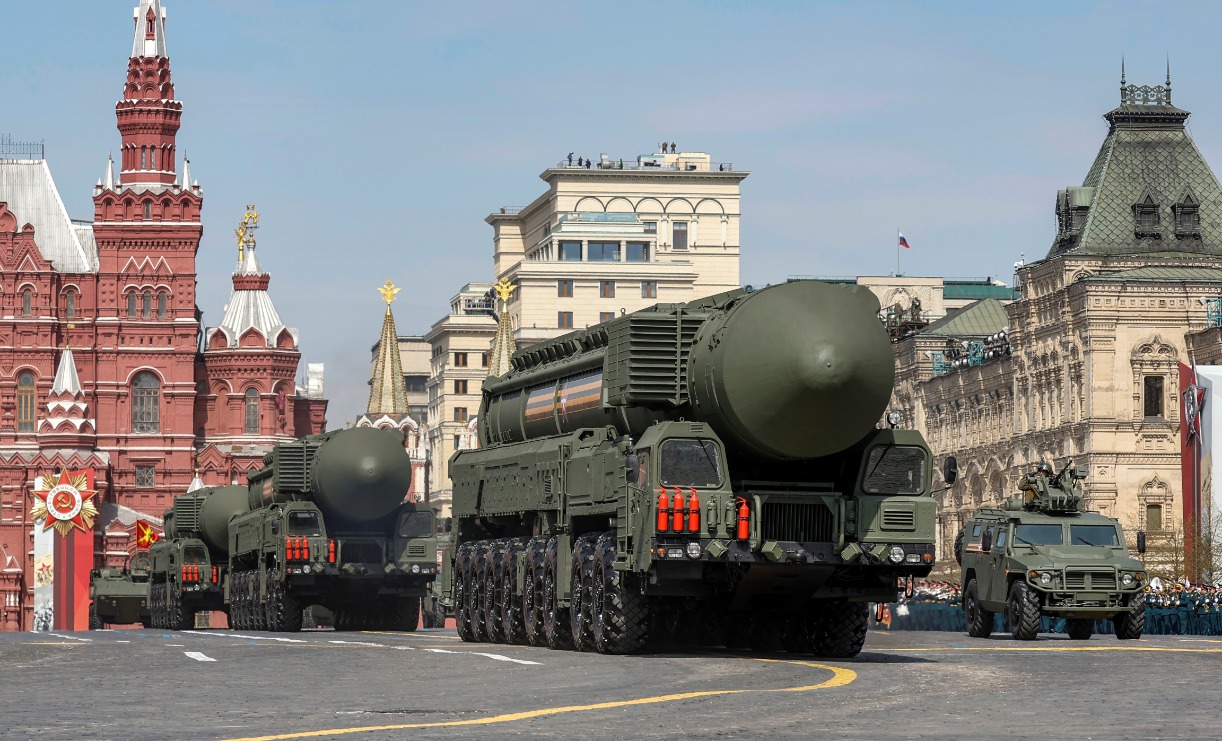
file 20221020 20 v4710.jpg?ixlib=rb 1.1 - Ukraine war: this conflict is just further evidence that Putin’s Russia is now a rogue powerNuclear fears: Vladimir Putin has repeatedly hinted he may use Russia’s nuclear arsenal in Ukraine. EPA-EFE/Sergei Ilnitsky

But even more importantly, Putin’s attempts at nuclear coercion are a fundamental challenge to the role of nuclear weapons within the international system. The lesson now drawn by many observers in Japan, South Korea, Taiwan and further afield is that possession of nuclear weapons is the only guarantee of a secure defence. And if the nuclear threat allows a weak army to make territorial gains by an illegal invasion of a neighbour, then the precedent set for offensive use of nuclear weapons in this way would be truly alarming.

By contrast, if Putin’s threat, or even limited use of nuclear weapons leads to Russia’s defeat in this aggressive war, then the signal sent to the international community is one that would diminish the status of nuclear weapons. If nothing else, this is worth supporting Ukraine’s fight for.

Read more:

Ukraine: UN General Assembly demands Russia reverse course on ‘attempted illegal annexation’

The Ukrainian people received the Sakharov Prize of the European Parliament

Categories
Saved Web Pages

Conventional Arms Alone Can’t Stop Russian Escalation

2022-05-07T115856Z_1142243398_RC2B2U92SP

Following Russian president Vladimir Putin’s decision to invade Ukraine, Russia has serially threatened Ukraine, NATO, and the West with nuclear threats. While dangerous in itself, Moscow’s threats are balanced by an equally dangerous reaction from the West, where multiple officials and experts have proposed that the United States take nuclear deterrence completely off the table. Ironically, this may make Putin more likely to use nuclear force.

This cluster of advocates for a conventional, non-nuclear response to Russian nuclear use is not new. The late Bruce Blair (the former Global Zero chief) told Congress in 2019 that he wanted the Russians to bear the moral weight of breaking the nuclear taboo, telling Rep. Mike Turner (R-OH) at a House Armed Services Committee hearing the United States should only respond conventionally to a Russian nuclear attack.

But French president Emmanuel Macron has now gone further, arguing recently that the West’s reaction must not include nuclear weapons under any circumstances. Now there is a difference between a “must” response and an “option” response. Rose Gottemoeller, a former U.S. arms control negotiator and NATO official, recently suggested that we choose only to use conventional forces should Moscow use nuclear weapons. Leon Panetta, the former secretary of defense, also called for the United States to respond but choose to do so only with strong conventional retaliatory strikes against Russian forces in Ukraine.

Panetta’s rationale assumes any use of theater or tactical nuclear weapons is too risky because there is no assurance a retaliatory strike will be small or limited. But he left the nuclear option on the table, as did Gottemoeller.

However, any move toward a “no use” policy would be a huge mistake for five reasons.

First, keeping the U.S. response at the conventional level will not necessarily prevent Russia from subsequently employing nuclear force. If Russia knows it can be defeated by the use of American or NATO conventional armaments alone, why would Russia not use nuclear force for the very same reason it intended to initiate nuclear strikes in the first place?

Second, the advocates of “no use” must know that U.S. military planners, when asked by Congress, explain that the United States can win a conventional military conflict against Russia only if nuclear weapons are not introduced into the fight.

Third, advocates of responding only with conventional strikes miss that in April 1999, Russia changed its strategy to what former U.S. Air Force general John Hyten described as an “escalate to win” doctrine that explicitly calls for the development of small-scale and highly accurate battlefield nuclear weapons with high political and diplomatic leverage.

Fourth, as noted by nuclear expert Franklin Miller, Putin sees a strategic gap between the U.S. vs Russian theater or shorter-range nuclear weapons capability. After all, Russia has somewhere between 2,000-5,000 such weapons while the United States has just 200 such gravity bombs deployed on fighter planes in Europe (and none in Asia).

And fifth, taking nuclear deterrence off the table completely, as Macron proposed, gives Putin and such adversaries a relatively free hand to use nuclear weapons with impunity, which obviously reduces the threshold at which nuclear war would be waged.

If the United States is serious about sustaining deterrence, the strategic gap with Russia needs to be narrowed. The United States is contemplating the development of a new nuclear-capable Navy cruise missile (SLCM-N) but the current administration has argued that it is not a “magic bullet” and that alternatives are available. However, while conventional alternatives might indeed be available, the question is whether they are sufficiently credible to deter Putin’s use of nuclear weapons and convince him that his theory of victory will lead to defeat.

It is obvious U.S. deterrence did not dissuade Putin from invading Ukraine. In fact, as Russian expert Stephen Blank, a senior fellow at the Foreign Policy Research Institute, has warned for over two decades, Putin’s idea of nuclear deterrence is not to prevent war but to deter the United States from coming to the defense of allies that are victims of Russian aggression.

Thus, far from deterring war, Putin sees nuclear weapons as instruments of war that allow revanchist states such as Russia to change borders through the use of nuclear threats. Nuclear weapons thus become instruments of offensive war—not deterrence. Putin threatens limited use because he also understands that disproportionate first use of nuclear weapons could easily engender a retaliatory response that leads to Armageddon.

But by keeping the numbers small, Putin believes he can “win” by coercing or blackmailing the United States to stand down. That is his theory of victory and unless we can deter it and negate it, we could very well lose.

Tulsi Gabbard, among others, has argued that the United States has no interest in challenging Russia, a nation with more nuclear weapons than any other on Earth, over Ukraine, a country in Russia’s sphere of interest. Similarly, protesters at a town hall meeting with Rep. Alexandria Ocasio-Cortez (D-NY), a progressive member of the congressional “Squad,” slammed her for voting for more military assistance for Ukraine and putting her constituents at risk of dying in a nuclear holocaust.

During the Cold War, the United States extended its nuclear umbrella over NATO and its western Pacific allies because Washington did not want to spend what it would take to conventionally defeat every Soviet, Chinese, or North Korean tank, ship, and aircraft. What is different today is that while the United States maintains an extended nuclear deterrent over its allies, it has not modernized its theater nuclear forces or carefully analyzed and assessed the strategy needed to sustain a credible deterrent since the end of the Cold War. For the first time in history, the United States now faces two nuclear-armed peer competitors.

The United States can defend its allies while preventing the use of nuclear weapons by anyone, anywhere. But that requires the United States and its allies to be prepared to counter any such use with sufficiently credible power, including by having the option to use nuclear force, to make adversaries stand down.

This requires not only the capability but the willingness to execute a nuclear response if necessary. Otherwise, our deterrent is based on a bluff, which is a dangerous policy. Telling adversaries that the prospect of nuclear escalation terrifies the United States and NATO, and would automatically herald Armageddon, also may render the use of nuclear weapons “unthinkable” and “unfeasible.”

However, this line of thinking undermines the extended deterrent that the United States has maintained for seven decades and thankfully kept the peace.

As Herman Kahn of the Hudson Institute once wrote, the best way to look credible is to be credible. If the United States would rather not be credible, then it should get out of the nuclear business altogether—an outcome that would open the door for others to use nuclear weapons without fear of a commensurate response.

America’s job is to remove that dangerous prospect. 

Peter Huessy is Senior Defense Fellow at the Hudson Institute and President of Geo-Strategic Analysis. These views are his own.

Image: Reuters.

Categories
Saved Web Pages

Transparently False: US Slams Russian “Dirty Bomb” Claims On Ukraine

Transparently False: US Slams Russian 'Dirty Bomb' Claims On Ukraine

Ukrainian President Volodymyr Zelensky sharply denounced the claims. (File)

Washington:

A senior US official on Sunday dismissed Russian claims that Ukraine is preparing to use a dirty bomb as “transparently false,” while the Pentagon chief “rejected any pretext for Russian escalation.”

Russian Defense Minister Sergei Shoigu made the allegation about a dirty bomb in a round of telephone conversations with Western defense chiefs.

Ukrainian President Volodymyr Zelensky sharply denounced it, calling the allegation a Russian pretext for just such an attack. “The world should react as harshly as possible,” he said.

A statement Sunday from US National Security Council spokeswoman, Adrienne Watson said, “We reject reports of Minister Shoigu’s transparently false allegations that Ukraine is preparing to use a dirty bomb on its own territory.

“The world would see through any attempt to use this allegation as a pretext for escalation.”

Shoigu conducted a round of telephone consultations with counterparts from Britain, France and Turkey, all NATO members, after first speaking Friday with Austin.

In those calls, Shoigu conveyed “concerns about possible provocations by Ukraine with the use of a ‘dirty bomb,'” the Russian Defense Ministry said.

Shoigu and Austin spoke Sunday, in what the Pentagon said was a followup call requested by Russia to their call Friday.

“Secretary Austin rejected any pretext for Russian escalation and reaffirmed the value of continued communication amid Russia’s unlawful and unjustified war against Ukraine,” said a statement afterward from Pentagon press secretary Pat Ryder.

When Shoigu and Austin spoke on Friday, it was only their second call since Moscow sent troops to Ukraine on February 24.

Zelensky on Sunday sharply dismissed the claim that Kyiv was preparing to use a dirty bomb.

“If Russia calls and says that Ukraine is allegedly preparing something, it means one thing: Russia has already prepared all this,” Zelensky said in a video address on social media.

“I believe that now the world should react as harshly as possible.”

“Even the very Russian threat of nuclear weapons — and even more so against our country, which has given up its nuclear arsenal… is a reason for both sanctions and for even greater strengthening of support for Ukraine,” said Zelensky.

A so-called dirty bomb is designed to contaminate a wide area with radioactive material, making it dangerous for civilians. It does not involve a nuclear explosion.

(Except for the headline, this story has not been edited by NDTV staff and is published from a syndicated feed.)

Categories
Saved Web Pages

RUSSIAN REQUIEM: Putin’s crumbling mafia state worse than USSR

BREZHNEV-e1666371327509.jpg?quality=100&

This advertisement has not loaded yet, but your article continues below.

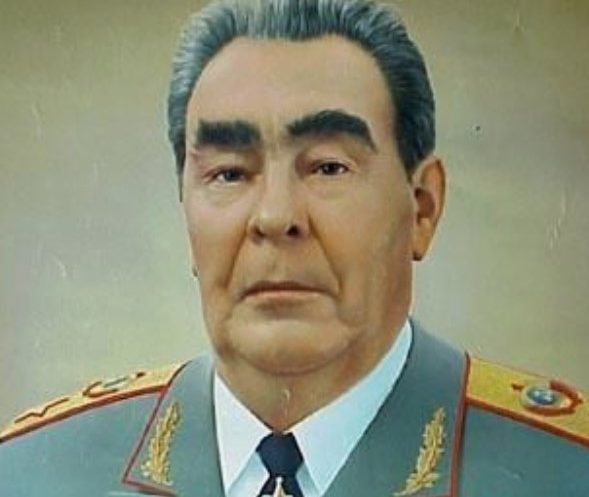
COME BACK, LEONID, ALL IS FORGIVEN: A new study says things are now worse in Russia than during the Cold War. Former Soviet pooh bah, Leonid Brezhnev. COME BACK, LEONID, ALL IS FORGIVEN: A new study says things are now worse in Russia than during the Cold War. Former Soviet pooh bah, Leonid Brezhnev.

Come back, Leonid Brezhnev, all is forgiven.

This advertisement has not loaded yet, but your article continues below.

Security experts say in a new report, Vladimir Putin’s Russian World Turned Upside Down, that things are now much worse in Russia than during the implosion of the Soviet Union.

opening envelope

From our newsroom to your inbox at noon, the latest headlines, stories, opinion and photos from the Toronto Sun.

By clicking on the sign up button you consent to receive the above newsletter from Postmedia Network Inc. You may unsubscribe any time by clicking on the unsubscribe link at the bottom of our emails. Postmedia Network Inc. | 365 Bloor Street East, Toronto, Ontario, M4W 3L4 | 416-383-2300

We encountered an issue signing you up. Please try again

Russia’s ill-starred invasion of Ukraine — destined to make Vladimir Putin’s country an international pariah for generations — has only exposed its shambolic demise.

Professor David Gioe, from King College London, and former British defence official, Dr. William Styles, argue Russia is going down the drain.

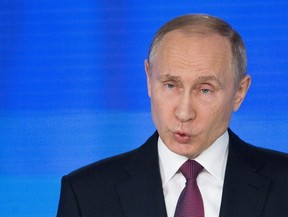
TRUST ME: Russian President Vladimir Putin gives his annual state of the nation address in Manezh in Moscow, Russia, Thursday, March 1, 2018.

TRUST ME: Russian President Vladimir Putin gives his annual state of the nation address in Manezh in Moscow, Russia, Thursday, March 1, 2018.

Photo by Alexander Zemlianichenko

/

AP

THE WAR IN UKRAINE 1.0

The paper argues that the bloodbath in Ukraine — which has seen Putin’s military slaughtered by the thousands — was a “strategic blunder of such magnitude” the country is in its worst shape in a generation.

“Putin’s miscalculation in Ukraine has weakened Russia at an elemental level, setting it back decades across all measurable and intangible axes of political, military, and economic power, hobbling Russian statecraft and strategic action for decades,” the new study said.

This advertisement has not loaded yet, but your article continues below.

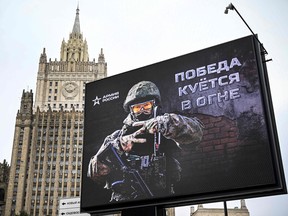
Russian Foreign Ministry is seen behind a social advertisement billboard showing Z letters — a tactical insignia of Russian troops in Ukraine and reading “Victory is being Forged in Fire” in Moscow on Oct. 13, 2022.

Russian Foreign Ministry is seen behind a social advertisement billboard showing Z letters — a tactical insignia of Russian troops in Ukraine and reading “Victory is being Forged in Fire” in Moscow on Oct. 13, 2022.

Photo by ALEXANDER NEMENOV

/

AFP via Getty Images

WAR DEAD

Putin’s disastrous invasion has seen a staggering number of casualties and is being compared to Hitler’s 1941 invasion of Russia in terms of military folly. The study estimates at least 65,000 casualties so far, but Kyiv has put the death toll around 80,000. Thousands of tanks and helicopters have also been lost. It notes: “Russia has irredeemably failed.”

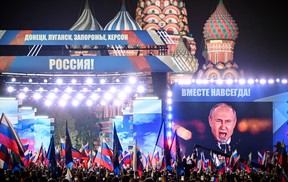
Russian President Vladimir Putin is seen on a screen set at Red Square as he addresses a rally and a concert marking the annexation of four regions of Ukraine Russian troops occupy — Lugansk, Donetsk, Kherson and Zaporizhzhia, in central Moscow on Sept. 30, 2022.

Russian President Vladimir Putin is seen on a screen set at Red Square as he addresses a rally and a concert marking the annexation of four regions of Ukraine Russian troops occupy — Lugansk, Donetsk, Kherson and Zaporizhzhia, in central Moscow on Sept. 30, 2022.

Photo by ALEXANDER NEMENOV

/

AFP via Getty Images

IT’S THE ECONOMY, STUPID

Russia’s humiliation hasn’t just been just on the battlefield. Western sanctions that kicked off soon after Putin slammed Ukraine have pulverized the Russian economy. The warlord can’t even access key components to make weapons of war.

Recommended video

In short: “Put simply, there is no military, economic, intelligence, diplomatic dimension, and no aspect of Russian civil society, that will not be negatively impacted, if only indirectly, by Putin’s misjudgment in Ukraine.”

This advertisement has not loaded yet, but your article continues below.

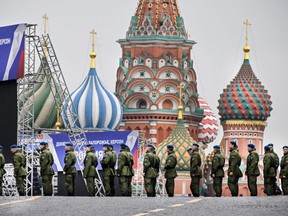
Russian soldiers stand on Red Square in central Moscow on Sept. 29, 2022, as the square is sealed prior to a ceremony of the incorporation of the new territories into Russia.

Russian soldiers stand on Red Square in central Moscow on Sept. 29, 2022, as the square is sealed prior to a ceremony of the incorporation of the new territories into Russia.

Photo by ALEXANDER NEMENOV

/

AFP via Getty Images

PARIAH 2.0

Russia’s stature on the diplomatic front is also at low ebb because of the attack on Ukraine. “[Putin’s] blunder has caused catastrophic harm to Russia across every facet of statecraft in the short term, and, moreover, has imperilled Russian development and prosperity for the future,” the report said.

“The ever-larger accounting of crimes and atrocities has further damaged the legitimacy of Russia as a state in the international system, cementing its pariah status.”

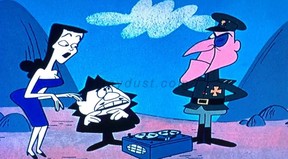
INTELLIGENCE FAILURE: Natasha, Boris and Fearless Leader. JAY WARD

INTELLIGENCE FAILURE: Natasha, Boris and Fearless Leader. JAY WARD

SPY VS. SPY

Experts have pointed to lousy intelligence for Russia’s quagmire. “Typically Putin’s favourite tool on the international stage, internal squabbling and blame shifting has severely damaged Russian intelligence capabilities,” the report said. “It has also faced considerable crises in the way of cyberattacks exposing vast swathes of data on the Kremlin’s security apparatus.”

This advertisement has not loaded yet, but your article continues below.

Plus: Ukraine decapitated Russian intelligence operations before the invasion.

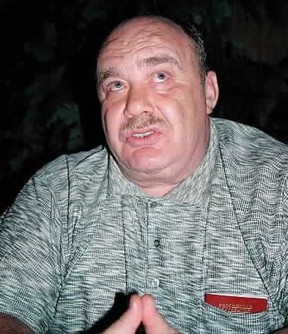
CORRUPT? WHO? US? The alleged head of the Russian mafia, Semyon Mogilevich, who is currently under investigation by the FBI and Interpol. That is if he’s alive.

CORRUPT? WHO? US? The alleged head of the Russian mafia, Semyon Mogilevich, who is currently under investigation by the FBI and Interpol. That is if he’s alive.

McMAFIA

Russia as a country is “fundamentally kleptocratic and corrupt.” This thievery has left Putin’s forces underequipped, with little food and triggered a slew of other logistical nightmares. His vaunted but “totally chaotic” conscription drive has left the newbies using Cold War-era equipment.

Russian President Vladimir Putin watches a test launch of the Sarmat intercontinental ballistic missile at Plesetsk cosmodrome in Arkhangelsk region, via video link in Moscow, Russia, April 20, 2022.

Russian President Vladimir Putin watches a test launch of the Sarmat intercontinental ballistic missile at Plesetsk cosmodrome in Arkhangelsk region, via video link in Moscow, Russia, April 20, 2022.

Photo by Sputnik/Mikhail Klimentyev

/

Kremlin via REUTERS

VLAD ALONE

Increasingly isolated, Putin’s decisions are said to be “uninformed” because of obsequious cronies telling the aspiring czar only what he wants to hear. “The [Russian] morale has gone,” the report said.

“You’ve got soldiers who simply don’t want to fight — these guys were told they would be welcomed with open arms by cheering crowds and the so-called ‘Ukrainian Nazis’ would collapse. Why should they die for Putin’s adventure?”

WINTER IS COMING: Russia will find the going hard this winter, as the Night Watch did in Game of Thrones. HBO

WINTER IS COMING: Russia will find the going hard this winter, as the Night Watch did in Game of Thrones. HBO

WINTER IS COMING

“If the winter is cold enough for the ground to freeze, then the Ukrainians will keep motoring,” Sir Richard told The UK Sun Online, adding that the famous “rasputitsa” rains will turn battlefields into a muddy nightmare.

“The Ukrainians are well-prepared, they’ve got the clothing, they’ve got the kit, and they’ve got the morale and the motivation — they are not going to stop.”

bhunter@postmedia.com

@HunterTOSun

Categories
Saved Web Pages

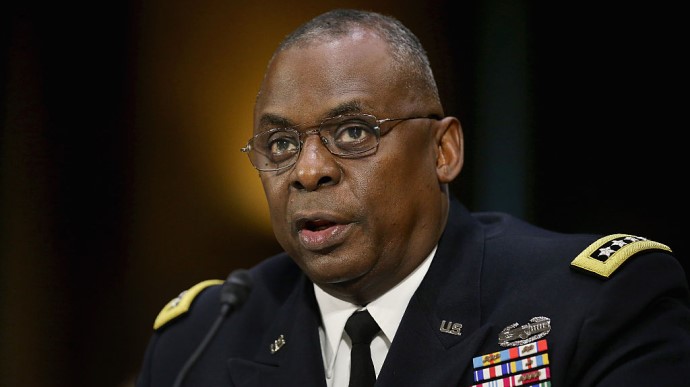
Глава Пентагона после общения с Шойгу поговорил с Резниковым

183280

490f5aa-ostin-getty.jpg

ЛЛОЙД ОСТИН, ФОТО GETTY IMAGES

Глава Минобороны США Ллойд Остин после телефонного разговора с российским коллегой Сергеем Шойгу провел также разговор с министром обороны Украины Алексеем Резниковым.

Об этом сообщает “Европейская правда” со ссылкой на пресс-релиз американского Минобороны.

В Пентагоне отметили, что Остин “подтвердил непоколебимую приверженность США поддержке способности Украины противостоять российской агрессии”.

“Министр обороны Остин также отметил неизменную поддержку международного сообщества в развитии прочности Украины и обеспечении ее способности защищать себя в будущем, о чем свидетельствуют обязательства по предоставлению помощи в сфере безопасности, взятые на себя союзниками и партнерами на последнем заседании Контактной группы по вопросам обороны Украины 12 октября этого года”, – отмечается в сообщении.

Дополнено. Резников в Twitter также рассказал о разговоре с главой Пентагона. По его словам, речь шла об усилении системы противовоздушной обороны Украины, а также ситуации с безопасностью.

“Глава Пентагона заверил меня: несмотря на то, кто с кем ведет переговоры, поддержка Соединенными Штатами суверенитета и территориальной целостности Украины остается непоколебимой”, – добавил он.

Напомним, перед этим российское Минобороны сообщило, что Шойгу и Остин обсудили “актуальные вопросы международной безопасности, включая ситуацию в Украине”.

Последний раз о разговоре Шойгу и Остина сообщалось 13 мая. Это был первый разговор глав оборонных ведомств РФ и США после начала российского вторжения в Украину.

Темы: СШАРезников

Categories
Saved Web Pages

US-Russia state media in hot war for hearts and minds

Russia-RT-US-VOA-RFA-Propaganda-Misinfor

The battle over Ukraine extends across the world: Information warfare is quickly evolving as key nations seek to influence public opinion and gain political support.

As during the Cold War, Russia and the United States are the two main combatants. Some efforts are clandestine, but plenty of material is broadcast to the public as each country attempts to, in the words of political linguists, “constrain the power and influence of the other … and win ‘hearts and minds’ … around the world.”

Key government-sponsored media outlets in the current battle are Russia Today, often known as RT, and two US government-backed operations, Voice of America and Radio Free Europe/Radio Liberty.

But it can be hard for many people to tell the difference between these outlets and independent news. As a propaganda scholar, I believe citizens of all nations deserve to know how their media have been filtered and when governments are seeking to influence their views.

My colleague Weston Sager and I developed a test for determining whether a particular media outlet is, or is not, a government mouthpiece. We examine key factors such as government control, funding, attribution and its resemblance to news.

At their best, these types of outlets provide official government information – at worst, blatant propaganda. Here’s how the main players in the US and Russia measure up.

Russia Today: Propaganda with some facts sprinkled in

RT is a multilanguage international media broadcaster that claims to be an “autonomous, non-profit organization.” But in reality, it has officially declared to the US State Department that it is an arm of the Russian government.

In lockstep with the Kremlin, RT has supported the 2008 Russian invasion of Georgia, the 2014 Russian invasion of the Crimean peninsula of Ukraine and the 2022 Russian invasion of mainland Ukraine.

The outlet has a history of publishing sensationalized and biased articles promoting Russian policies and accentuating the perceived failings of the United States and its allies. For example, in 2015, RT devoted extensive coverage to the Occupy Wall Street movement. Not only did this storyline allow RT to selectively showcase people protesting in the United States, it helped further Russia’s narrative that its economic system is superior to US capitalism.

More recently, RT has, without credible evidence, accused the United States of developing bioweapons in Ukraine and testing them on people there.

But this doesn’t mean that RT is “able to dispense with facts all together,” as propaganda often leverages truthful bits of information, nor that it is strictly anti-American. In 2010, for instance, RT published an interview containing accusations that the Republicans were exploiting racial fears ahead of midterm elections.

Then RT publicly defended the Obama administration against Fox News host Glenn Beck‘s accusations that Obama was turning the United States into a socialist country. Propaganda works by supporting themes that are in popular discourse at the time. It does not necessarily follow a linear path and may be counterintuitive at times.

In the wake of the 2022 Russian invasion of Ukraine, RT was blocked in many nations around the world to limit the spread of Russian propaganda. Nevertheless, RT continues to publish its content, especially in less developed countries where the Russian government is working to increase its international reputation and influence.

Voice of America is headquartered in the Wilbur J. Cohen Federal Building in Washington, D.C. AP Photo/Andrew Harnik

Major US outlets present mostly facts – that support American values

Voice of America and Radio Free Europe/Radio Liberty are the US government’s primary international media outlets, though there are other channels as well.

In 1942, during World War II, the US government established VOA to broadcast pro-Allied messages and to combat Nazi propaganda abroad. In the 1950s, the CIA founded RFE/RL to counter Soviet propaganda in Eastern Europe and the Soviet Union.

Both outlets are now overseen by the US Agency for Global Media, a part of the executive branch of the federal government. The agency receives over US$800 million in annual funding from Congress.

Similar to RT, VOA and RFE/RL claim that they are independent media outlets. In support of that claim, they often point to a vaguely defined “firewall” that is supposed to shield their editorial integrity from US government influence.

But the firewall is often strained under the weight of political pressure. In 2020, President Donald Trump’s newly appointed CEO of the US Agency for Global Media rescinded the firewall regulation, which compromised VOA’s independence in advance of the 2020 US presidential election.

In 2021, the firewall was legislatively strengthened, but questions remain about its effectiveness at preventing government influence.

Governmental influence over the editorial direction of U.S. state media can also come through legislation. In 2021, Congress introduced a bill that would instruct the agency to “facilitate the unhindered dissemination of information to Islamic majority countries on issues regarding the human rights and religious freedom of Uyghurs.”

From this rooftop in Prague, RFE/RL broadcasts across Eastern Europe and into Russia. Photo: AFP via Getty Images / Michal Cizek / The Conversation

Additional editorial pressure comes from federal law. VOA material must be “consistent” with US foreign policy objectives, “represent America,” “present the policies of the United States clearly and effectively” and include editorials that reflect the views of the US government. Under the same law, RFE/RL is required to support the US government abroad.

Additionally, federal law also more pointedly provides a new pathway for folding this into a larger outlet that would be expressly required to “counter state-sponsored propaganda which undermines the national security or foreign policy interests of the United States and its allies.”

VOA and RFE/RL have a history of providing slanted and incomplete portrayals of major events and issues. Scholarship has highlighted how, during the Cold War, RFE spread “rumors as fact” and displayed a “consistent pattern of downplaying or ignoring evidence that contradicted RFE’s vision of Eastern Europe as a totalitarian dystopia” early in the Cold War.

US government editorial pressure has also come indirectly through funding cuts, which VOA experienced after senators balked at spending tax money to produce “unpleasant news” surrounding Watergate. The Reagan administration was known to object to critical VOA coverage and also steered its “editorial voice” to align with the administration’s political agenda.

Today, VOA often publishes stories about the United States that promote American values, such as recent articles titled “Refugees Shape America” and “US International Festival Celebrates Traditional Food, Dance.”

On the other hand, RFE/RL is more focused on countering propaganda. It includes coverage that is often critical of US adversaries, such as “‘We Have To Pay For Our Indifference’: A Russian Deserter Speaks Out After Ukraine War Memoir Hits A Nerve” and “Putin Hints At ‘Changing Routes’ For Ukrainian Grain Exports, Warns Of Food ‘Catastrophe’.”

Even though VOA and RFE/RL sometimes publish pieces that show unflattering aspects of the United States, such as “The Global Legacy of January 6,” this is by design, as the outlets would lose credibility if they ignored important topics covered in independent media.

Concealed influence

Because VOA and RFE/RL rely on facts, the US State Department has argued that US government media are less threatening than Russian “disinformation.”

But the US approach is still risky: VOA and RFE/RL content more closely resembles independent news, so it is more difficult for readers to identify it as government-run media. This is especially problematic in cases in which the outlets are targeting US citizens, who may not be able to tell that they’re interacting with their own government.

Despite what VOA and RFE/RL claim, they are not independent. Both are funded by the US government and are used to deliver US policy abroad. Even though VOA and RFE/RL may look like news, they aren’t; like RT, their underlying purpose is to bolster their government’s influence around the world.

Weston Sager contributed to this article.

Jennifer Grygiel is Associate Professor of Communications (Social Media), Syracuse University

This article is republished from The Conversation under a Creative Commons license. Read the original article.

Categories
Saved Web Pages

Filmmaker releases documentary about Jan. 6 riot – is the FBI now investigating HIM as a domestic terrorist?

Capitol-Punishment.jpg

This piece contains editorial comments that belong to the U.S. veteran who wrote this story.

In what appears to be another attempt to weaponize federal law enforcement against those who tell the truth and push back against the progressive narrative, Chris Burgard recently received a visit from the FBI at his Texas ranch.

Here is what led to that encounter.

In November of 2021, Burgard released a documentary called Capitol Punishment. His film featured what he saw at the US Capitol on January 6th, He combined the footage of what he captured outside with cell phone video shot by individuals who went into the building, showing numerous perspectives that were not shown by the mainstream media.

The poster for the film is headlined:

EVERYTHING THEY TOLD YOU IS A LIE

Ironically, the very agency that is now looking into Burgard has seemingly ignored his movie from an evidentiary point of view.

“Capitol Punishment” director Chris Burgard described the chilling visit he allegedly got from the FBI after making his movie about January 6 and said “if this can happen to me, it can happen to anybody.”https://t.co/vVSdtPytaX

— OregonTeaParty (@OregonTeaParty) October 22, 2022

As stated in an interview with Burgard and his wife by PJ Media:

“Despite never having entered the Capitol building himself, the FBI has now come to Burgard’s ranch in Texas to interrogate him. As one might imagine, after filming extensive interviews with victims of the FBI witch hunt, this left Burgard, and his family shaken.”

They described the encounter.

On August 4th, an FBI agent went to their home, leaving his card on the door.

It was not clear from the interview if the agent simply left it on the door and drove away, or if he attempted to speak to someone but found no one at the home.

Lisa Burgard said that the entire process left her “unsettled.”

“There was no note attached, so I wasn’t sure, like, was it for Chris, was it for me, was it for the whole family? Were we supposed to call them back? I really didn’t know what to make of it, but it was a warning. I mean, I’ve never had anything like that happen before.”

Chris Burgard continued discussing the impact that this was having on his entire family.

“We had to have a family meeting afterwards because, you know, from doing the movie, my daughter knows those other girls that had their house raided and pulled out into the street. One of them was handcuffed. They were flash-banged.

And my daughter’s like, ‘Dad, you think they’ll raid us tomorrow? Should I keep the dogs in my room? Cause I don’t want them to shoot my dogs.’ I can’t tell you the stress this caused my family.”

Keep in mind, Burgard was privy to watching video after video of the FBI’s pre-dawn raids of the homes of individuals they believed to be associated with January 6th. He included those aspects in his documentary.

Agents shut down streets. They used “flash bang” grenades to stun and disorient the residents of those homes as they made entry.

Given his knowledge of FBI tactics surrounding, it stands to reason that he and his family might be scared of what might be coming their way.

During their family meeting, their 18-year-old daughter moved her father to tears.

“[She] says, ‘Dad, you can’t stop. Because people have to know that, even if you do stop, they’re still going to come after you.’ That was our decision to move forward.”

That is when Burgard lawyered up. His attorney assisted him in responded to the Bureau.

When the agent that left his card told them he only had three questions, the attorney told him to request to be able to respond in writing, which the FBI acquiesced to. Turns out, those three questions wound up being a total of nine.

He answered them and the FBI accepted is response. He has not received any indication that the inquiry into him has been closed.

For now, Burgard and his family still live with the uncertainty of what might happen next. Given the number of American citizens that are still being held without bond in prisons for what some believe amounts to nothing more than trespassing, it is easy to understand the trepidation they face each day with.

“It was very intimidating,” Lisa said. “We are law-abiding citizens and of course, we would cooperate. But it was with so many in our film, they just took it to an extreme. You never know who’s going to be next. It’s still unsettling and I don’t know how I feel about it. I hope that it’s going to be resolved soon and it doesn’t escalate into anything more.”

To the FBI’s credit, Burgard and his attorney both praised the field agents for how they conducted themselves.

Pointing out that the average rank-and-file agents are not aware of how deep the scope of this thing goes at the highest levels of FBI and DOJ administration, attorney Brian Chavez Ochoa also said:

“I think your on-the-street agents are dedicated and are loyal to the oath they took when they were sworn in.” 

It remains to be seen of Burgard and his family are awakened early one morning to the sound of clash shattering and a grenade exploding as the FBI makes entry into their home, or if his written statement truly sufficed.

Law Enforcement today will continue to follow this story and will provide updates when available.

https://fundourpolice.com/

Former NYPD intelligence officer: You’re being lied to about what really happened on January 6th, 2021. Here’s the truth.

Like most Americans, I watched the events that unfolded on January 6th, 2020 and was truly disgusted.  What started out as a peaceful rally, quickly devolved into chaos with protesters unlawfully entering the Capitol building, some damaging property, others assaulting Capitol police officers.

Once inside, some of the protesters entered the Well of Congress, others their office space, posing for pictures of themselves and posting on various forms of social media.  At one point, a group of protesters attempted to break down a barricaded door that was flanked by several uniformed Capitol Police officer.

For some unknown reason, the Capitol Police officer’s left the barricaded door position and moved to another location.  The same group of protesters then became more aggressive, pushing and striking the glass window of the door with what looked like flagpoles or clubs.

A man stationed on the interior side of the door, later identified as Lieutenant Michael Byrd of the Capitol police fired one shot from his service weapon, striking Ashli Babbit in the neck, an injury that proved to be fatal.

Much has been said about Lt. Byrd, his use of deadly physical force and the justification to shoot Ashli Babbit who was unarmed at the time of the incident.  Videos collected from the scene before the fatal shooting appeared to show Ashli’s attempts to stop some of the other protesters from causing further damage and entering the barricaded door.

On Thursday, June 9th, 2022, hearings regarding the January 6th, 2021 Committee, were broadcast live from Capitol Hill, with members of congress making their oral arguments and displaying edited videos from the rally.

A Capitol Police Officer by the name of Caroline Edwards gave testimony on what she experienced and witnessed from the events from January 6th, including how she was knocked unconscious by a bicycle rack thrown by protesters.

Officer Edwards states that after she regained consciousness, she and her partner Officer Sicknick were sprayed with a chemical irritant, adding “It was carnage…It was chaos”.

Former Capitol Police Chief Steven Sund acknowledged that a warning from the FBI field office in Virginia that read in part “Forecast in detail, the chances extremists could commit “War” was issued but that it wasn’t received until the following day (01-06-21).

The FBI disputed that claim by Chief Sund and was able to verify that the warning was in fact passed on to a Capitol Police officer assigned to the Joint Terrorism Task Force (JTTF) prior to January 6th.  Chief Sund states never read the report and wasn’t aware of the warning until after the rally had occurred.

In a separate Senate hearing held on January 11th, 2022, Senator Cruz questioned FBI Executive Assistant Director of National Security Branch Agent Jill Sanborn on whether the FBI agents or confidential informants actively participated in the January 6th riots, Agent Sanborn refused to answer the question stating “I can’t answer that”.

Senator Cruz asked Agent Sanborn “Who is “Ray Epps?” Agent Sanborn replied “I’m aware of who he (Ray Epps) is but I don’t have the specific background to him”. 

Senator Cruz then displayed several still enlarged pictures on posters of Ray Epps captured from video recorded on the night before (January 5th ) the January 6th rally with the captions from Mr. Epps that read “Tomorrow, we need to get into the Capitol, into the Capitol!”. In response to Mr. Epps, the crowd shouted “Fed, Fed, Fed, Fed, Fed, Fed” the assertion that Mr. Epps was an FBI Agent.

Senator Cruz asked Agent Sanborn “Is Ray Epps a Fed?” her response was “Sir, I cannot answer that question”.  Senator Cruz then presented a 2nd poster with pictures taken from video that depicted Mr. Epps whispering into the ear of another protester.

Within 5 seconds, both Mr. Epps and two other protesters began tearing down a barricade stationed in front of the Capitol.  Senator Cruz asked Agent Sanborn “Did Mr. Epps urge them to tear down the barricade?” Agent Sanborn replied “Sir, similar to the other answers, I cannot answer that”.

 Finally, Senator Cruz that displayed an FBI Wanted poster published on January 8th that depicted Mr. Epps picture on it along with several other protesters that offered cash rewards for information leading to their arrests and asked: “Did federal agents or those in service of federal agents actively encourage violent and criminal conduct on January 6th?

Agent Sanborn’s response: “Not to my knowledge Sir”. In the following poster presented by Senator Cruz, Mr. Epps picture was removed from the wanted poster on July 1st, 2021 without explanation.

As of this writing, the FBI has arrested 862 protesters from the January 6th rally with the most recent occurring on the morning of June 9th of Michigan GOP Gubernatorial Candidate Ryan Kelly, hours before the January 6th Select Committee was to begin their first hearing.

In anticipation of the large crowd, the Trump administration is on record in having offered National Guard Troops to DC Mayor Muriel Bowser and Speaker Nancy Pelosi, days in advance of the rally voicing security concerns.  Both Mayor Bowser and Speaker Pelosi declined the assistance.

Having served 20 years in the NYPD, I’ve lost count of how many protests I have worked throughout NYC.  From the riots in Crown Heights, Brooklyn, to Washington Heights in upper Manhattan to the Iraq War that began in front of the United Nations with well over 100,000 people in attendance.  In all of these protests, the appropriate planning and resources were allocated and adjusted as necessary.

As a former member of the NYPD Intelligence division, I frequently conducted plain clothes operations at these very same events as well as the use of confidential informants, to collect intelligence and address potential hotspots in order to maintain crowd control.

If the January 6th Select Committee is truly serious about finding the truth, about meeting out justice, there needs to be full transparency not deflection and obfuscation…we owe that to the American people…Especially for Ashli Babbit.

Christopher Strom is a US Marine, NYPD Intelligence Officer and author of “Brooklyn to Baghdad: An NYPD Cop Fights Terror in Iraq”.  Mr. Strom is also a frequent guest on major news media outlets, giving context on Counter Terrorism and Policing in America.

Want to make sure you never miss a story from Law Enforcement Today?  With so much “stuff” happening in the world on social media, it’s easy for things to get lost.  

Facebook Follow First

Categories
Saved Web Pages

Fact Check: Did Russia use lasers to target satellites over Ukraine border?

Russian residents in the city of Belgorod have been left puzzled after a pillar of light was spotted rising up into the cloudy night sky.

Numerous possible explanations have been put forward for the lights, including a Russian laser weapon or a natural phenomenon.

Belgorod is located about 25 miles north of the border with Ukraine.

The Claim

On October 4 and October 5, images and videos were posted to social media from residents in Belgorod showing how a yellow beam of light was shining high into the dark sky. The sky around the beam also appears to glow yellow.

The source is not clear in any of the images as buildings typically cover the lower part of the beam before it meets the horizon.

— Ququ Kodein🇺🇦🇭🇺🏳️🌈 (@ququ_kodein) October 4, 2022

Multiple possible explanations have been put forward as to the cause of the beam, with many military in nature, given Russia’s ongoing conflict with Ukraine.

“Over Belgorod works ‘Peresvet’,” wrote one Twitter user, referring to Russia’s Peresvet anti-satellite laser.

Daily Russian tabloid newspaper Komsomolskaya Pravda uploaded a video of the light to YouTube, and wrote in the description, translated from Russian: “A test of a top-secret weapon or a common natural phenomenon? Residents of Belgorod are at a loss.”

The Facts

A suggestion that the lights may be lasers was published by Moscow newspaper Moskovskij Komsomolets in an online article on October 5. The article claimed that military correspondent Andrey Rudenko had said the military was using “the latest weapons of the Russian Federation” that day. Rudenko added: “Due to the circumstances, we are unlikely to find out, but many people saw the glow in the sky today.”

This might suggest the lights could be attributed to the use of the Peresvet laser, but very little is known about it and it is unclear whether it would produce a yellow beam.

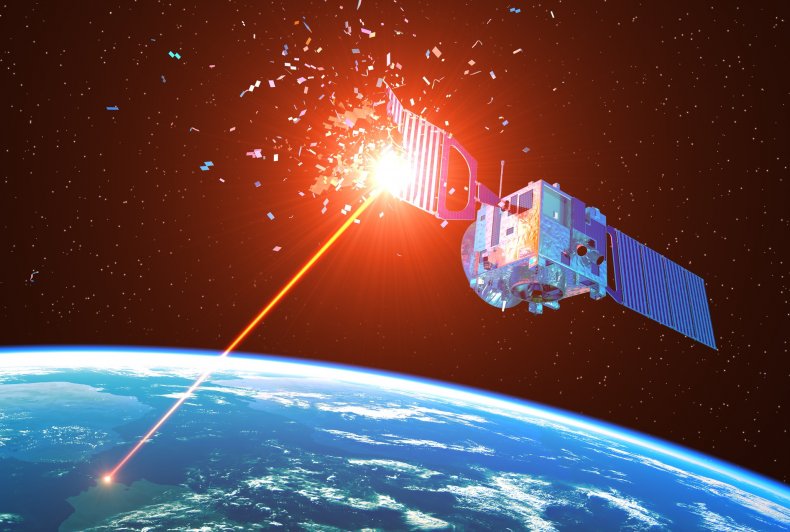
Laser hitting satellite

A stock illustration depicts a ground-based laser hitting and destroying a satellite. Russia claims to have a ground-based laser that blind blind satellites in orbit.
3DSculptor/Getty

According to military news website ArmyRecognition.com, Peresvet is in service currently with development having been announced by Russian president Vladimir Putin in 2018. It can reportedly ‘blind’ satellites at a distance of 930 miles.

However, some social media users also noted that it would be unlikely that a beam targeting a moving space satellite would be fixed in position and pointing directly upwards.

Another potential source of the lights is a natural phenomenon known variously as a light column or light pillar.

This explanation was put forward by Russian news outlet RBC, which cited Mikhail Leus, a specialist at the Phobos weather center, as saying, translated from Russian: “In fact, the light pillars observed in the sky are an optical phenomenon in the atmosphere, which bears such a name ‘light column’.

“Light pillars in the atmosphere are an optical phenomenon, a type of halo created by the refraction of light on ice crystals.”

This can happen when the sun or moon is located low above the horizon around sunrise or sunset. Other sources include greenhouses, of which there is an abundance in Belgorod, according to local media reports, with some allegedly owned by Russian oligarch Roman Abramovich.

Russian state media RIA Novosti, citing scientists at the Belgorod University, also concluded that the “halos” were likely caused by the greenhouses in the area.

Ken Carslaw is a professor in the Institute for Climate and Atmospheric Science at the University of Leeds in the U.K. Speaking to Newsweek, he also said this natural phenomenon was a possibility.

“These occur in clouds with flat ice crystals that are horizontally aligned so that they all reflect downwards in the same direction above a light source,” he said.

“Obviously to see this phenomenon you need ice. It’s currently about 11C in Belgorod, which means these clouds must be at least 1 km above the ground or probably more—ice in clouds usually doesn’t form until much lower temperatures.

“If there were any images showing this beam at much lower altitudes, then I wouldn’t have an explanation.”

Similar columns of light above Belgorod have been reported before—yellow columns stretching into the sky—and have been explained by local media as a meteorological phenomenon, an explanation that appears the most likely in this case too.

The Ruling

Unverified

Unverified.

The source of the beams of light seen in Belgorod, Russia, on October 4 and October 5 is unclear, but they are probably meteorological. Experts in meteorology have confirmed it is possible the lights are a natural phenomenon, and they have been noted to occur in the region in the past. While a Russian newspaper has alluded to reports of weapons tests, and Russia does claim to have top secret anti-satellite lasers, based on the evidence available this explanation seems unlikely.

FACT CHECK BY NEWSWEEK

Unverified: The claim could be true or false, but there is at the time of publication insufficient publicly-available evidence to prove so either way. The claim should be treated with caution and skepticism until more evidence becomes available to make a conclusive determination.

Read more about our ratings.

WP Radio
WP Radio
OFFLINE LIVE