Illustrations: Jeffrey Smith
James Cromitie was a man of bluster and bigotry. He made up wild stories about his supposed exploits, like the one about firing gas bombs into police precincts using a flare gun, and he ranted about Jews. “The worst brother in the whole Islamic world is better than 10 billion Yahudi,” he once said.
A 45-year-old Walmart stocker who’d adopted the name Abdul Rahman after converting to Islam during a prison stint for selling cocaine, Cromitie had lots of worries—convincing his wife he wasn’t sleeping around, keeping up with the rent, finding a decent job despite his felony record. But he dreamed of making his mark. He confided as much in a middle-aged Pakistani he knew as Maqsood.
“I’m gonna run into something real big,” he’d say. “I just feel it, I’m telling you. I feel it.”
Maqsood and Cromitie had met at a mosque in Newburgh, a struggling former Air Force town about an hour north of New York City. They struck up a friendship, talking for hours about the world’s problems and how the Jews were to blame.
It was all talk until November 2008, when Maqsood pressed his new friend.
“Do you think you are a better recruiter or a better action man?” Maqsood asked.
“I’m both,” Cromitie bragged.
“My people would be very happy to know that, brother. Honestly.”
“Who’s your people?” Cromitie asked.
“Jaish-e-Mohammad.”
Maqsood said he was an agent for the Pakistani terror group, tasked with assembling a team to wage jihad in the United States. He asked Cromitie what he would attack if he had the means. A bridge, Cromitie said.
“But bridges are too hard to be hit,” Maqsood pleaded, “because they’re made of steel.”
“Of course they’re made of steel,” Cromitie replied. “But the same way they can be put up, they can be brought down.”
Maqsood coaxed Cromitie toward a more realistic plan. The Mumbai attacks were all over the news, and he pointed out how those gunmen targeted hotels, cafés, and a Jewish community center.
“With your intelligence, I know you can manipulate someone,” Cromitie told his friend. “But not me, because I’m intelligent.” The pair settled on a plot to bomb synagogues in the Bronx, and then fire Stinger missiles at airplanes taking off from Stewart International Airport in the southern Hudson Valley. Maqsood would provide all the explosives and weapons, even the vehicles. “We have two missiles, okay?” he offered. “Two Stingers, rocket missiles.”
Maqsood was an undercover operative; that much was true. But not for Jaish-e-Mohammad. His real name was Shahed Hussain, and he was a paid informant for the Federal Bureau of Investigation.
Ever since 9/11, counterterrorism has been the FBI’s No. 1 priority, consuming the lion’s share of its budget—$3.3 billion, compared to $2.6 billion for organized crime—and much of the attention of field agents and a massive, nationwide network of informants. After years of emphasizing informant recruiting as a key task for its agents, the bureau now maintains a roster of 15,000 spies—many of them tasked, as Hussain was, with infiltrating Muslim communities in the United States. In addition, for every informant officially listed in the bureau’s records, there are as many as three unofficial ones, according to one former high-level FBI official, known in bureau parlance as “hip pockets.”
The bureau now maintains a roster of 15,000 spies, some paid as much as $100,000 per case, many of them tasked with infiltrating Muslim communities in the United States.
The informants could be doctors, clerks, imams. Some might not even consider themselves informants. But the FBI regularly taps all of them as part of a domestic intelligence apparatus whose only historical peer might be COINTELPRO, the program the bureau ran from the ’50s to the ’70s to discredit and marginalize organizations ranging from the Ku Klux Klan to civil-rights and protest groups.
Throughout the FBI’s history, informant numbers have been closely guarded secrets. Periodically, however, the bureau has released those figures. A Senate oversight committee in 1975 found the FBI had 1,500 informants. In 1980, officials disclosed there were 2,800. Six years later, following the FBI’s push into drugs and organized crime, the number of bureau informants ballooned to 6,000, the Los Angeles Times reported in 1986. And according to the FBI, the number grew significantly after 9/11. In its fiscal year 2008 budget authorization request, the FBI disclosed that it it had been been working under a November 2004 presidential directive demanding an increase in “human source development and management,” and that it needed $12.7 million for a program to keep tabs on its spy network and create software to track and manage informants.
The bureau’s strategy has changed significantly from the days when officials feared another coordinated, internationally financed attack from an Al Qaeda sleeper cell. Today, counterterrorism experts believe groups like Al Qaeda, battered by the war in Afghanistan and the efforts of the global intelligence community, have shifted to a franchise model, using the internet to encourage sympathizers to carry out attacks in their name. The main domestic threat, as the FBI sees it, is a lone wolf.
The bureau’s answer has been a strategy known variously as “preemption,” “prevention,” and “disruption”—identifying and neutralizing potential lone wolves before they move toward action. To that end, FBI agents and informants target not just active jihadists, but tens of thousands of law-abiding people, seeking to identify those disgruntled few who might participate in a plot given the means and the opportunity. And then, in case after case, the government provides the plot, the means, and the opportunity.
Here’s how it works: Informants report to their handlers on people who have, say, made statements sympathizing with terrorists. Those names are then cross-referenced with existing intelligence data, such as immigration and criminal records. FBI agents may then assign an undercover operative to approach the target by posing as a radical. Sometimes the operative will propose a plot, provide explosives, even lead the target in a fake oath to Al Qaeda. Once enough incriminating information has been gathered, there’s an arrest—and a press conference announcing another foiled plot.
If this sounds vaguely familiar, it’s because such sting operations are a fixture in the headlines. Remember the Washington Metro bombing plot? The New York subway plot? The guys who planned to blow up the Sears Tower? The teenager seeking to bomb a Portland Christmas tree lighting? Each of those plots, and dozens more across the nation, was led by an FBI asset.
Over the past year, Mother Jones and the Investigative Reporting Program at the University of California-Berkeley have examined prosecutions of 508 defendants in terrorism-related cases, as defined by the Department of Justice. Our investigation found:
- Nearly half the prosecutions involved the use of informants, many of them incentivized by money (operatives can be paid as much as $100,000 per assignment) or the need to work off criminal or immigration violations. (For more on the details of those 508 cases, see our charts page and searchable database.)
- Sting operations resulted in prosecutions against 158 defendants. Of that total, 49 defendants participated in plots led by an agent provocateur—an FBI operative instigating terrorist action.
- With three exceptions, all of the high-profile domestic terror plots of the last decade were actually FBI stings. (The exceptions are Najibullah Zazi, who came close to bombing the New York City subway system in September 2009; Hesham Mohamed Hadayet, an Egyptian who opened fire on the El-Al ticket counter at the Los Angeles airport; and failed Times Square bomber Faisal Shahzad.)
- In many sting cases, key encounters between the informant and the target were not recorded—making it hard for defendants claiming entrapment to prove their case.
- Terrorism-related charges are so difficult to beat in court, even when the evidence is thin, that defendants often don’t risk a trial.
“The problem with the cases we’re talking about is that defendants would not have done anything if not kicked in the ass by government agents,” says Martin Stolar, a lawyer who represented a man caught in a 2004 sting involving New York’s Herald Square subway station. “They’re creating crimes to solve crimes so they can claim a victory in the war on terror.” In the FBI’s defense, supporters argue that the bureau will only pursue a case when the target clearly is willing to participate in violent action. “If you’re doing a sting right, you’re offering the target multiple chances to back out,” says Peter Ahearn, a retired FBI special agent who directed the Western New York Joint Terrorism Task Force and oversaw the investigation of the Lackawanna Six, an alleged terror cell near Buffalo, New York. “Real people don’t say, ‘Yeah, let’s go bomb that place.’ Real people call the cops.”
Even so, Ahearn concedes that the uptick in successful terrorism stings might not be evidence of a growing threat so much as a greater focus by the FBI. “If you concentrate more people on a problem,” Ahearn says, “you’ll find more problems.” Today, the FBI follows up on literally every single call, email, or other terrorism-related tip it receives for fear of missing a clue.
And the emphasis is unlikely to shift anytime soon. Sting operations have “proven to be an essential law enforcement tool in uncovering and preventing potential terror attacks,” said Attorney General Eric Holder in a December 2010 speech to Muslim lawyers and civil rights activists. President Obama’s Department of Justice has announced sting-related prosecutions at an even faster clip than the Bush administration, with 44 new cases since January 2009. With the war on terror an open-ended and nebulous conflict, the FBI doesn’t have an exit strategy.
Located deep in a wooded area on a Marine Corps base west of Interstate 95—a setting familiar from Silence of the Lambs—is the sandstone fortress of the FBI Academy in Quantico, Virginia. This building, erected under J. Edgar Hoover, is where to this day every FBI special agent is trained.
J. Stephen Tidwell graduated from the academy in 1981 and over the years rose to executive assistant director, one of the 10 highest positions in the FBI; in 2008, he coauthored the Domestic Investigations and Operations Guide, or DIOG (PDF), the manual for what agents and informants can and cannot do.
A former Texas cop, Tidwell is a barrel-chested man with close-cropped salt-and-pepper hair. He’s led some of the FBI’s highest-profile investigations, including the DC sniper case and the probe of the 9/11 attack on the Pentagon.
On a cloudy spring afternoon, Tidwell, dressed in khakis and a blue sweater, drove me in his black Ford F-350 through Hogan’s Alley—a 10-acre Potemkin village with houses, bars, stores, and a hotel. Agents learning the craft role-play stings, busts, and bank robberies here, and inside jokes and pop-culture references litter the place (which itself gets its name from a 19th-century comic strip). At one end of the town is the Biograph Theater, named for the Chicago movie house where FBI agents gunned down John Dillinger in 1934. (“See,” Tidwell says. “The FBI has a sense of humor.”)
Inside the academy, a more somber tone prevails. Plaques everywhere honor agents who have been killed on the job. Tidwell takes me to one that commemorates John O’Neill, who became chief of the bureau’s then-tiny counterterrorism section in 1995. For years before retiring from the FBI, O’Neill warned of Al Qaeda’s increasing threat, to no avail. In late August 2001, he left the bureau to take a job as head of security for the World Trade Center, where he died 19 days later at the hands of the enemy he’d told the FBI it should fear. The agents he had trained would end up reshaping the bureau’s counterterrorism operations.
Before 9/11, FBI agents considered chasing terrorists an undesirable career path, and their training did not distinguish between Islamic terror tactics and those employed by groups like the Irish Republican Army. “A bombing case is a bombing case,” Dale Watson, who was the FBI’s counterterrorism chief on 9/11, said in a December 2004 deposition. The FBI also did not train agents in Arabic or require most of them to learn about radical Islam. “I don’t necessarily think you have to know everything about the Ku Klux Klan to investigate a church bombing,” Watson said. The FBI had only one Arabic speaker in New York City and fewer than 10 nationwide.
But shortly after 9/11, President George W. Bush called FBI Director Robert Mueller to Camp David. His message: never again. And so Mueller committed to turn the FBI into a counterintelligence organization rivaling Britain’s MI5 in its capacity for surveillance and clandestine activity. Federal law enforcement went from a focus on fighting crime to preventing crime; instead of accountants and lawyers cracking crime syndicates, the bureau would focus on Jack Bauer-style operators disrupting terror groups.
To help run the counterterrorism section, Mueller drafted Arthur Cummings, a former Navy SEAL who’d investigated the first World Trade Center bombing. Cummings pressed agents to focus not only on their immediate target, but also on the extended web of people linked to the target. “We’re looking for the sympathizer who wants to become an operator, and we want to catch them when they step over that line to operator,” Cummings says. “Sometimes, that step takes 10 years. Other times, it takes 10 minutes.” The FBI’s goal is to create a hostile environment for terrorist recruiters and operators—by raising the risk of even the smallest step toward violent action. It’s a form of deterrence, an adaptation of the “broken windows” theory used to fight urban crime. Advocates insist it has been effective, noting that there hasn’t been a successful large-scale attack against the United States since 9/11. But what can’t be answered—as many former and current FBI agents acknowledge—is how many of the bureau’s targets would have taken the step over the line at all, were it not for an informant.
So how did the FBI build its informant network? It began by asking where US Muslims lived. Four years after 9/11, the bureau brought in a CIA expert on intelligence-gathering methods named Phil Mudd. His tool of choice was a data-mining system using commercially available information, as well as government data such as immigration records, to pinpoint the demographics of specific ethnic and religious communities—say, Iranians in Beverly Hills or Pakistanis in the DC suburbs.
The FBI officially denies that the program, known as Domain Management, works this way—its purpose, the bureau says, is simply to help allocate resources according to threats. But FBI agents told me that with counterterrorism as the bureau’s top priority, agents often look for those threats in Muslim communities—and Domain Management allows them to quickly understand those communities’ makeup. One high-ranking former FBI official jokingly referred to it as “Battlefield Management.”
Some FBI veterans criticized the program as unproductive and intrusive—one told Mudd during a high-level meeting that he’d pushed the bureau to “the dark side.” That tension has its roots in the stark difference between the FBI and the CIA: While the latter is free to operate internationally without regard to constitutional rights, the FBI must respect those rights in domestic investigations, and Mudd’s critics saw the idea of targeting Americans based on their ethnicity and religion as a step too far.
Nonetheless, Domain Management quickly became the foundation for the FBI’s counterterrorism dragnet. Using the demographic data, field agents were directed to target specific communities to recruit informants. Some agents were assigned to the task full time. And across the bureau, agents’ annual performance evaluations are now based in part on their recruiting efforts.
People cooperate with law enforcement for fairly simple reasons: ego, patriotism, money, or coercion. The FBI’s recruitment has relied heavily on the latter. One tried-and-true method is to flip someone facing criminal charges. But since 9/11 the FBI has also relied heavily on Immigration and Customs Enforcement, with which it has worked closely as part of increased interagency coordination. A typical scenario will play out like this: An FBI agent trying to get someone to cooperate will look for evidence that the person has immigration troubles. If they do, he can ask ICE to begin or expedite deportation proceedings. If the immigrant then chooses to cooperate, the FBI will tell the court that he is a valuable asset, averting deportation.
A well-muscled 49-year-old with a shaved scalp, Craig Monteilh has been a versatile snitch: He’s pretended to be a white supremacist, a Russian hit man, a Sicilian drug trafficker, and a French-Syrian Muslim.
Sometimes, the target of this kind of push is the one person in a mosque who will know everyone’s business—the imam. Two Islamic religious leaders, Foad Farahi in Miami and Sheikh Tarek Saleh in New York City, are currently fighting deportation proceedings that, they claim, began after they refused to become FBI assets. The Muslim American Society Immigrant Justice Center has filed similar complaints on behalf of seven other Muslims with the Department of Homeland Security.
Once someone has signed on as an informant, the first assignment is often a fishing expedition. Informants have said in court testimony that FBI handlers have tasked them with infiltrating mosques without a specific target or “predicate”—the term of art for the reason why someone is investigated. They were, they say, directed to surveil law-abiding Americans with no indication of criminal intent.
“The FBI is now telling agents they can go into houses of worship without probable cause,” says Farhana Khera, executive director of the San Francisco-based civil rights group Muslim Advocates. “That raises serious constitutional issues.”
Tidwell himself will soon have to defend these practices in court—he’s among those named in a class-action lawsuit (PDF) over an informant’s allegation that the FBI used him to spy on a number of mosques in Southern California.
That informant, Craig Monteilh, is a convicted felon who made his money ripping off cocaine dealers before becoming an asset for the Drug Enforcement Administration and later the FBI. A well-muscled 49-year-old with a shaved scalp, Monteilh has been a particularly versatile snitch: He’s pretended to be a white supremacist, a Russian hit man, and a Sicilian drug trafficker. He says when the FBI sent him into mosques (posing as a French-Syrian Muslim), he was told to act as a decoy for any radicals who might seek to convert him—and to look for information to help flip congregants as informants, such as immigration status, extramarital relationships, criminal activities, and drug use. “Blackmail is the ultimate goal,” Monteilh says.
Officially, the FBI denies it blackmails informants. “We are prohibited from using threats or coercion,” says Kathleen Wright, an FBI spokeswoman. (She acknowledges that the bureau has prevented helpful informants from being deported.)
FBI veterans say reality is different from the official line. “We could go to a source and say, ‘We know you’re having an affair. If you work with us, we won’t tell your wife,’” says a former top FBI counterterrorism official. “Would we actually call the wife if the source doesn’t cooperate? Not always. You do get into ethics here—is this the right thing to do?—but legally this isn’t a question. If you obtained the information legally, then you can use it however you want.”
But eventually, Monteilh’s operation imploded in spectacular fashion. In December 2007, police in Irvine, California, charged him with bilking two women out of $157,000 as part of an alleged human growth hormone scam. Monteilh has maintained it was actually part of an FBI investigation, and that agents instructed him to plead guilty to a grand-theft charge and serve eight months so as not to blow his cover. The FBI would “clean up” the charge later, Monteilh says he was told. That didn’t happen, and Monteilh has alleged in court filings that the government put him in danger by letting fellow inmates know that he was an informant. (FBI agents told me the bureau wouldn’t advise an informant to plead guilty to a state criminal charge; instead, agents would work with local prosecutors to delay or dismiss the charge.)
The class-action suit, filed by the ACLU, alleges that Tidwell, then the bureau’s Los Angeles-based assistant director, signed off on Monteilh’s operation. And Tidwell says he’s eager to defend the bureau in court. “There is not the blanket suspicion of the Muslim community that they think there is,” Tidwell says. “We’re just looking for the bad guys. Anything the FBI does is going to be interpreted as monitoring Muslims. I would tell [critics]: ‘Do you really think I have the time and money to monitor all the mosques and Arab American organizations? We don’t. And I don’t want to.’”
Shady informants, of course, are as old as the FBI; one saying in the bureau is, “To catch the devil, you have to go to hell.” Another is, “The only problem worse than having an informant is not having an informant.” Back in the ’80s, the FBI made a cottage industry of drug stings—a source of countless Hollywood plots, often involving briefcases full of cocaine and Miami as the backdrop.
It’s perhaps fitting, then, that one of the earliest known terrorism stings also unfolded in Miami, though it wasn’t launched by the FBI. Instead the protagonist was a Canadian bodyguard and, as a Fort Lauderdale, Florida, newspaper put it in 2002, “a 340-pound man with a fondness for firearms and strippers.” He subscribed to Soldier of Fortune and hung around a police supply store on a desolate stretch of Hollywood Boulevard, north of Miami.
Howard Gilbert aspired to be a CIA agent but lacked pertinent experience. So to pad his résumé, he hatched a plan to infiltrate a mosque in the suburb of Pembroke Pines by posing as a Muslim convert named Saif Allah. He told congregants that he was a former Marine and a security expert, and one night in late 2000, he gave a speech about the plight of Palestinians.
“That was truly the night that launched me into the terrorist umbrella of South Florida,” Gilbert would later brag to the South Florida Sun-Sentinel.
Nineteen-year-old congregant Imran Mandhai, stirred by the oration, approached Gilbert and asked if he could provide him weapons and training. Gilbert, who had been providing information to the FBI, contacted his handlers and asked for more money to work on the case. (He later claimed that the bureau had paid him $6,000.) But he ultimately couldn’t deliver—the target had sensed something fishy about his new friend.
The bureau also brought in Elie Assaad, a seasoned informant originally from Lebanon. He told Mandhai that he was an associate of Osama bin Laden tasked with establishing a training camp in the United States. Gilbert suggested attacking electrical substations in South Florida, and Assaad offered to provide a weapon. FBI agents then arrested Mandhai; he pleaded guilty in federal court and was sentenced to nearly 14 years in prison. It was a model of what would become the bureau’s primary counterterrorism M.O.—identifying a target, offering a plot, and then pouncing.
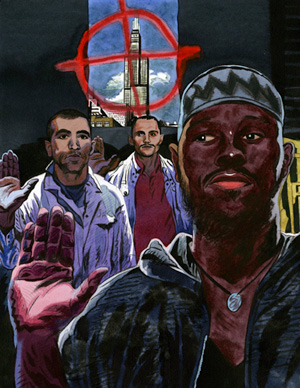 “These guys were homeless types,” one former FBI official says about the alleged Sears Tower plotters. “And yes, we did show a picture where somebody was taking the oath to Al Qaeda. So what?” Illustration: Jeffrey SmithGilbert himself didn’t get to bask in his glory; he never worked for the FBI again and died in 2004. Assaad, for his part, ran into some trouble when his pregnant wife called 911. She said Assaad had beaten and choked her to the point that she became afraid for her unborn baby; he was arrested, but in the end his wife refused to press charges.
The jail stint didn’t keep Assaad from working for the FBI on what would turn out to be perhaps the most high-profile terrorism bust of the post-9/11 era. In 2005, the bureau got a tip from an informant about a group of alleged terrorists in Miami’s Liberty City neighborhood. The targets were seven men—some African American, others Haitian—who called themselves the “Seas of David” and ascribed to religious beliefs that blended Judaism, Christianity, and Islam. The men were martial-arts enthusiasts who operated out of a dilapidated warehouse, where they also taught classes for local kids. The Seas of David’s leader was Narseal Batiste, the son of a Louisiana preacher, father of four, and a former Guardian Angel.
In response to the informant’s tip, the FBI had him wear a wire during meetings with the men, but he wasn’t able to engage them in conversations about terrorist plots. So he introduced the group to Assaad, now playing an Al Qaeda operative. At the informant’s request, Batiste took photographs of the FBI office in North Miami Beach and was caught on tape discussing a notion to bomb the Sears Tower in Chicago. Assaad led Batiste, and later the other men, in swearing an oath to Al Qaeda, though the ceremony (recorded and entered into evidence at trial) bore a certain “Who’s on First?” flavor:
“God’s pledge is upon me, and so is his compact,” Assaad said as he and Batiste sat in his car. “Repeat after me.”
“Okay. Allah’s pledge is upon you.”
“No, you have to repeat exactly. God’s pledge is upon me, and so is his compact. You have to repeat.”
Ultimately, the undercover recordings suggest that Batiste was mostly trying to shake down his “terrorist” friend.
“Well, I can’t say Allah?” Batiste asked.
“Yeah, but this is an English version because Allah, you can say whatever you want, but—”
“Okay. Of course.”
“Okay.”
“Allah’s pledge is upon me. And so is his compact,” Batiste said, adding: “That means his angels, right?”
“Uh, huh. To commit myself,” Assaad continued.
“To commit myself.”
“Brother.”
“Brother,” Batiste repeated.
“Uh. That’s, uh, what’s your, uh, what’s your name, brother?”
“Ah, Brother Naz.”
“Okay. To commit myself,” the informant repeated.
“To commit myself.”
“Brother.”
“Brother.”
“You’re not—you have to say your name!” Assaad cried.
“Naz. Naz.”
“Uh. To commit myself. I am Brother Naz. You can say, ‘To commit myself.’”
“To commit myself, Brother Naz.”
Things went smoothly until Assaad got to a reference to being “protective of the secrecy of the oath and to the directive of Al Qaeda.”
Here Batiste stopped. “And to…what is the directive of?”
“Directive of Al Qaeda,” the informant answered.
“So now let me ask you this part here. That means that Al Qaeda will be over us?”
“No, no, no, no, no,” Assaad said. “It’s an alliance.”
“Oh. Well…” Batiste said, sounding resigned.
“It’s an alliance, but it’s like a commitment, by, uh, like, we respect your rules. You respect our rules,” Assaad explained.
“Uh, huh,” Batiste mumbled.
“And to the directive of Al Qaeda,” Assaad said, waiting for Batiste to repeat.
“Okay, can I say an alliance?” Batiste asked. “And to the alliance of Al Qaeda?“
“Of the alliance, of the directive—” Assaad said, catching himself. “You know what you can say? And to the directive and the alliance of Al Qaeda.”
“Okay, directive and alliance of Al Qaeda,” Batiste said.
“Okay,” the informant said. “Now officially you have commitment and we have alliance between each other. And welcome, Brother Naz, to Al Qaeda.”
Or not. Ultimately, the undercover recordings made by Assaad suggest that Batiste, who had a failing drywall business and had trouble making the rent for the warehouse, was mostly trying to shake down his “terrorist” friend. After first asking the informant for $50,000, Batiste is recorded in conversation after conversation asking how soon he’ll have the cash.
“Let me ask you a question,” he says in one exchange. “Once I give you an account number, how long do you think it’s gonna take to get me something in?”
“So you is scratching my back, [I’m] scratching your back—we’re like this,” Assaad dodged.
“Right,” Batiste said.
“When we put forth a case like that to suggest to the American public that we’re protecting them, we’re not protecting them. The agents back in the bullpen, they know it’s not true.”
The money never materialized. Neither did any specific terrorist plot. Nevertheless, federal prosecutors charged (PDF) Batiste and his cohorts—whom the media dubbed the Liberty City Seven—with conspiracy to support terrorism, destroy buildings, and levy war against the US government. Perhaps the key piece of evidence was the video of Assaad’s Al Qaeda “oath.” Assaad was reportedly paid $85,000 for his work on the case; the other informant got $21,000.
James J. Wedick, a former FBI agent, was hired to review the Liberty City case as a consultant for the defense. In his opinion, the informant simply picked low-hanging fruit. “These guys couldn’t find their way down the end of the street,” Wedick says. “They were homeless types. And, yes, we did show a picture where somebody was taking the oath to Al Qaeda. So what? They didn’t care. They only cared about the money. When we put forth a case like that to suggest to the American public that we’re protecting them, we’re not protecting them. The agents back in the bullpen, they know it’s not true.”
Indeed, the Department of Justice had a difficult time winning convictions in the Liberty City case. In three separate trials, juries deadlocked on most of the charges, eventually acquitting one of the defendants (charges against another were dropped) and convicting five of crimes that landed them in prison for between 7 to 13 years. When it was all over, Assaad told ABC News’ Brian Ross that he had a special sense for terrorists: “God gave me a certain gift.”
But he didn’t have a gift for sensing trouble. After the Liberty City case, Assaad moved on to Texas and founded a low-rent modeling agency. In March, when police tried to pull him over, he led them in a chase through El Paso (with his female passenger jumping out at one point), hit a cop with his car, and ended up rolling his SUV on the freeway. Reached by phone, Assaad declined to comment. He’s saving his story, he says, for a book he’s pitching to publishers.
Not all of the more than 500 terrorism prosecutions reviewed in this investigation are so action-movie ready. But many do have an element of mystery. For example, though recorded conversations are often a key element of prosecutions, in many sting cases the FBI didn’t record large portions of the investigation, particularly during initial encounters or at key junctures during the sting. When those conversations come up in court, the FBI and prosecutors will instead rely on the account of an informant with a performance bonus on the line.
 Mohamed Osman Mohamud was an 18-year old wannabe rapper when an FBI agent asked if he’d like to “help the brothers.” Eventually the FBI gave him a fake car bomb and a phone to blow it up during a Christmas tree lighting. Illustration: Jeffrey SmithOne of the most egregious examples of a missing recording involves a convoluted tale that begins in the early morning hours of November 1, 2009, with a date-rape allegation on the campus of Oregon State University. Following a Halloween party, 18-year-old Mohamed Osman Mohamud, a Somali-born US citizen, went home with another student. The next morning, the woman reported to police that she believed she had been drugged.
Campus police brought Mohamud in for questioning and a polygraph test; FBI agents, who for reasons that have not been disclosed had been keeping an eye on the teen for about a month, were also there. Mohamud claimed that the sex was consensual, and a drug test given to his accuser eventually came back negative.
During the interrogation, OSU police asked Mohamud if a search of his laptop would indicate that he’d researched date-rape drugs. He said it wouldn’t and gave them permission to examine his hard drive. Police copied its entire contents and turned the data over to the FBI—which discovered, it later alleged in court documents, that Mohamud had emailed someone in northwest Pakistan talking about jihad.
Soon after his run-in with police, Mohamud began to receive emails from “Bill Smith,” a self-described terrorist who encouraged him to “help the brothers.” “Bill,” an FBI agent, arranged for Mohamud to meet one of his associates in a Portland hotel room. There, Mohamud told the agents that he’d been thinking of jihad since age 15. When asked what he might want to attack, Mohamud suggested the city’s Christmas tree lighting ceremony. The agents set Mohamud up with a van that he thought was filled with explosives. On November 26, 2010, Mohamud and one of the agents drove the van to Portland’s Pioneer Square, and Mohamud dialed the phone to trigger the explosion. Nothing. He dialed again. Suddenly FBI agents appeared and dragged him away as he kicked and yelled, “Allahu akbar!” Prosecutors charged him with attempting to use a weapon of mass destruction; his trial is pending.
The FBI’s defenders say the bureau must flush out terrorist sympathizers before they act. “What would you do?” asks one. “Wait for him to figure it out himself?”
The Portland case has been held up as an example of how FBI stings can make a terrorist where there might have been only an angry loser. “This is a kid who, it can be reasonably inferred, barely had the capacity to put his shoes on in the morning,” Wedick says.
But Tidwell, the retired FBI official, says Mohamud was exactly the kind of person the FBI needs to flush out. “That kid was pretty specific about what he wanted to do,” he says. “What would you do in response? Wait for him to figure it out himself? If you’ll notice, most of these folks [targeted in stings] plead guilty. They don’t say, ‘I’ve been entrapped,’ or, ‘I was immature.’” That’s true—though it’s also true that defendants and their attorneys know that the odds of succeeding at trial are vanishingly small. Nearly two-thirds of all terrorism prosecutions since 9/11 have ended in guilty pleas, and experts hypothesize that it’s difficult for such defendants to get a fair trial. “The plots people are accused of being part of—attacking subway systems or trying to bomb a building—are so frightening that they can overwhelm a jury,” notes David Cole, a Georgetown University law professor who has studied these types of cases.
But the Mohamud story wasn’t quite over—it would end up changing the course of another case on the opposite side of the country. In Maryland, rookie FBI agent Keith Bender had been working a sting against 21-year-old Antonio Martinez, a recent convert to Islam who’d posted inflammatory comments on Facebook (“The sword is cummin the reign of oppression is about 2 cease inshallah”). An FBI informant had befriended Martinez and, in recorded conversations, they talked about attacking a military recruiting station.
Just as the sting was building to its climax, Martinez saw news reports about the Mohamud case, and how there was an undercover operative involved. He worried: Was he, too, being lured into a sting? He called his supposed terrorist contact: “I’m not falling for no BS,” he told him.
Faced with the risk of losing the target, the informant—whose name is not revealed in court records—met with Martinez and pulled him back into the plot. But while the informant had recorded numerous previous meetings with Martinez, no recording was made for this key conversation; in affidavits, the FBI blamed a technical glitch. Two weeks later, on December 8, 2010, Martinez parked what he thought was a car bomb in front of a recruitment center and was arrested when he tried to detonate it.
Frances Townsend, who served as homeland security adviser to President George W. Bush, concedes that missing recordings in terrorism stings seem suspicious. But, she says, it’s more common than you might think: “I can’t tell you how many times I had FBI agents in front of me and I yelled, ‘You have hundreds of hours of recordings, but you didn’t record this meeting.’ Sometimes, I admit, they might not record something intentionally”—for fear, she says, that the target will notice. “But more often than not, it’s a technical issue.”
Wedick, the former FBI agent, is less forgiving. “With the technology the FBI now has access to—these small devices that no one would ever suspect are recorders or transmitters—there’s no excuse not to tape interactions between the informant and the target,” he says. “So why in many of these terrorism stings are meetings not recorded? Because it’s convenient for the FBI not to record.”
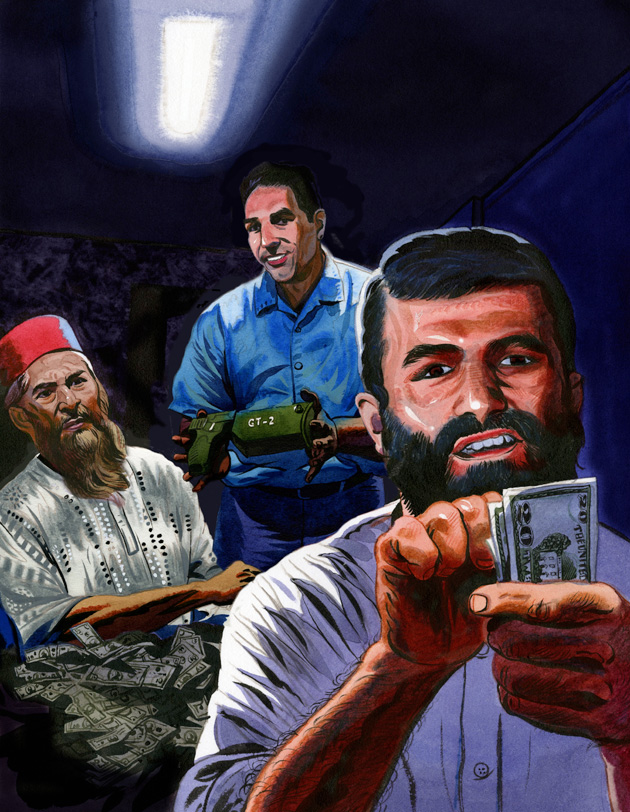
So what really happens as an informant works his target, sometimes over a period of years, and eases him over the line? For the answer to that, consider once more the case of James Cromitie, the Walmart stocker with a hatred of Jews. Cromitie was the ringleader in the much-publicized Bronx synagogue bombing plot that went to trial last year. But a closer look at the record reveals that while Cromitie was no one’s idea of a nice guy, whatever leadership existed in the plot emanated from his sharply dressed, smooth-talking friend Maqsood, a.k.a. FBI informant Shahed Hussain.
A Pakistani refugee who claimed to be friends with Benazir Bhutto and had a soft spot for fancy cars, Hussain was by then one of the FBI’s more successful counterterrorism informants. (See our timeline of Hussain’s career as an informant.) He’d originally come to the bureau’s attention when he was busted in a DMV scam that charged test takers $300 to $500 for a license. Having “worked off” those charges, he’d transitioned from indentured informant to paid snitch, earning as much as $100,000 per assignment.
At trial, informant Hussain admitted that he created the “impression” that his target would make big money by bombing synagogues in the Bronx.
Hussain was assigned to visit a mosque in Newburgh, where he would start conversations with strangers about jihad. “I was finding people who would be harmful, and radicals, and identify them for the FBI,” Hussain said during Cromitie’s trial. Most of the mosque’s congregants were poor, and Hussain, who posed as a wealthy businessman and always arrived in one of his four luxury cars—a Hummer, a Mercedes, two different BMWs—made plenty of friends. But after more than a year working the local Muslim community, he had not identified a single actual target.
Then, one day in June 2008, Cromitie approached Hussain in the parking lot outside the mosque. The two became friends, and Hussain clearly had Cromitie’s number. “Allah didn’t bring you here to work for Walmart,” he told him at one point.
Cromitie, who once claimed he could “con the corn from the cob,” had a history of mental instability. He told a psychiatrist that he saw and heard things that weren’t there and had twice tried to commit suicide. He told tall tales, most of them entirely untrue—like the one about how his brother stole $126 million worth of stuff from Tiffany.
Exactly what Hussain and Cromitie talked about in the first four months of their relationship isn’t known, because the FBI did not record those conversations. Based on later conversations, it’s clear that Hussain cultivated Cromitie assiduously. He took the target, all expenses paid by the FBI, to an Islamic conference in Philadelphia to meet Imam Siraj Wahhaj, a prominent African-American Muslim leader. He helped pay Cromitie’s rent. He offered to buy him a barbershop. Finally, he asked Cromitie to recruit others and help him bomb synagogues.
On April 7, 2009, at 2:45 p.m., Cromitie and Hussain sat on a couch inside an FBI cover house on Shipp Street in Newburgh. A hidden camera was trained on the living room.
“I don’t want anyone to get hurt,” Cromitie told the informant.
“Who? I—”
“Think about it before you speak,” Cromitie interrupted.
“If there is American soldiers, I don’t care,” Hussain said, trying a fresh angle.
“Hold up,” Cromitie agreed. “If it’s American soldiers, I don’t even care.”
“If it’s kids, I care,” Hussain said. “If it’s women, I care.”
“I care. That’s what I’m worried about. And I’m going to tell you, I don’t care if it’s a whole synagogue of men.”
“Yep.”
“I would take ’em down, I don’t even care. ‘Cause I know they are the ones.”
“We have the equipment to do it.”
“See, see, I’m not worried about nothing. Ya know? What I’m worried about is my safety,” Cromitie said.
“Oh, yeah, safety comes first.”
“I want to get in and I want to get out.”
“Trust me,” Hussain assured.
At Cromitie’s trial, Hussain would admit that he created the—in his word—”impression” that Cromitie would make a lot of money by bombing synagogues.
“I can make you $250,000, but you don’t want it, brother,” he once told Cromitie when the target seemed hesitant. “What can I tell you?” (Asked about the exchange in court, Hussain said that “$250,000” was simply a code word for the bombing plot—a code word, he admitted, that only he knew.)
But whether for ideology or money, Cromitie did recruit three others, and they did take photographs of Stewart International Airport in Newburgh as well as of synagogues in the Bronx. On May 20, 2009, Hussain drove Cromitie to the Bronx, where Cromitie put what he believed were bombs inside cars he thought had been parked by Hussain’s coconspirators. Once all the dummy bombs were placed, Cromitie headed back to the getaway car—Hussain was in the driver’s seat—and then a SWAT team surrounded the car.
At trial, Cromitie told the judge: “I am not a violent person. I’ve never been a terrorist, and I never will be. I got myself into this stupid mess. I know I said a lot of stupid stuff.” He was sentenced to 25 years.
For his trouble, the FBI paid Hussain $96,000. Then he moved on to another case, another mosque, somewhere in the United States.
For this project, Mother Jones partnered with the University of California-Berkeley’s Investigative Reporting Program, headed by Lowell Bergman, where Trevor Aaronson was an investigative fellow. The Fund for Investigative Journalism also provided support for Aaronson’s reporting. Lauren Ellis and Hamed Aleaziz contributed additional research.
UPDATE: On September 28, Rezwan Ferdaus, a 26-year-old graduate of Northeastern University, was arrested and charged with providing resources to a foreign terrorist organization and attempting to destroy national defense premises. Ferdaus, according to the FBI, planned to blow up both the Pentagon and Capitol Building with a “large remote controlled aircraft filled with C-4 plastic explosives.”
The case was part of a nearly ten-month investigation led by the FBI. Not surprisingly, Ferdaus’ case fits a pattern detailed by Trevor Aaronson in this article: the FBI provided Ferdaus with the explosives and materials needed to pull off the plot. In this case, two undercover FBI employees, who Ferdaus believed were al Qaeda members, gave Ferdaus $7,500 to purchase an F-86 Sabre model airplane that Ferdaus hoped to fill with explosives. Right before his arrest, the FBI employees gave Ferdaus, who lived at home with his parents, the explosives he requested to pull off his attack. And just how did the FBI come to meet Ferdaus? An informant with a criminal record introduced Ferdaus to the supposed al Qaeda members.


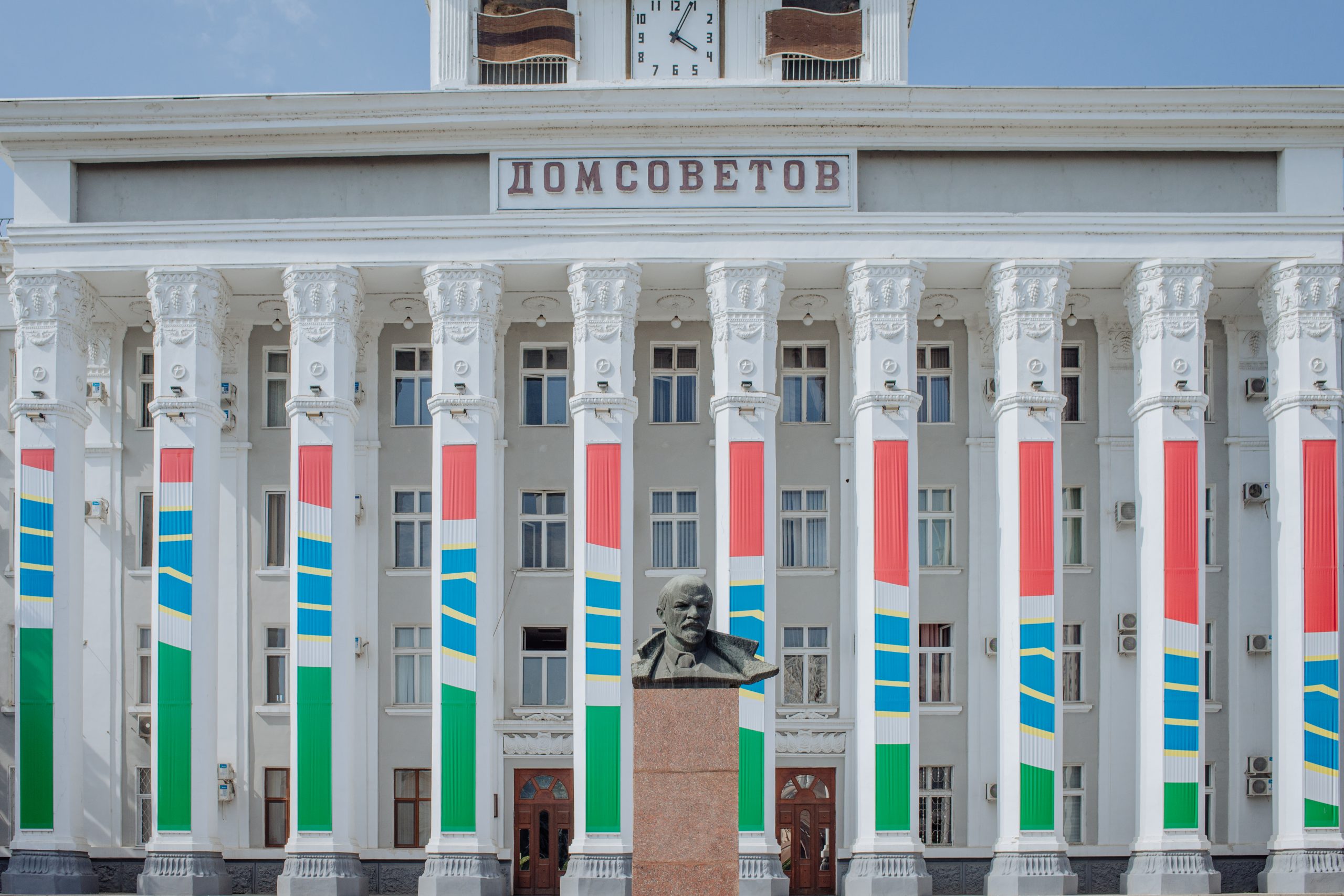
 A bust of Vladimir Lenin in front of the House of Soviets on July 30, 2022, in Tiraspol, Moldova. Transnistria remains strongly tied with its Soviet past. Fears that Russia will try to annex parts of Moldova still remain high.