Categories
Saved Web Pages

Putin’s Annexation and Lyman’s Encirclement

https%3A%2F%2Fbucketeer-e05bbc84-baa3-43

Image

Image

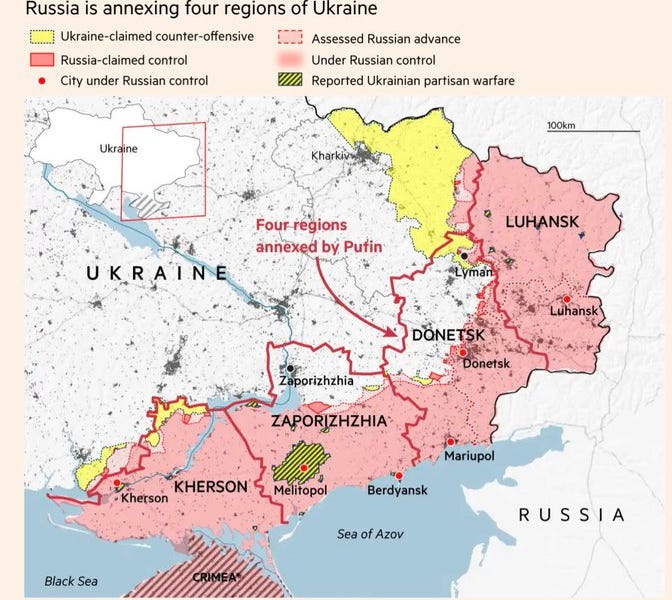
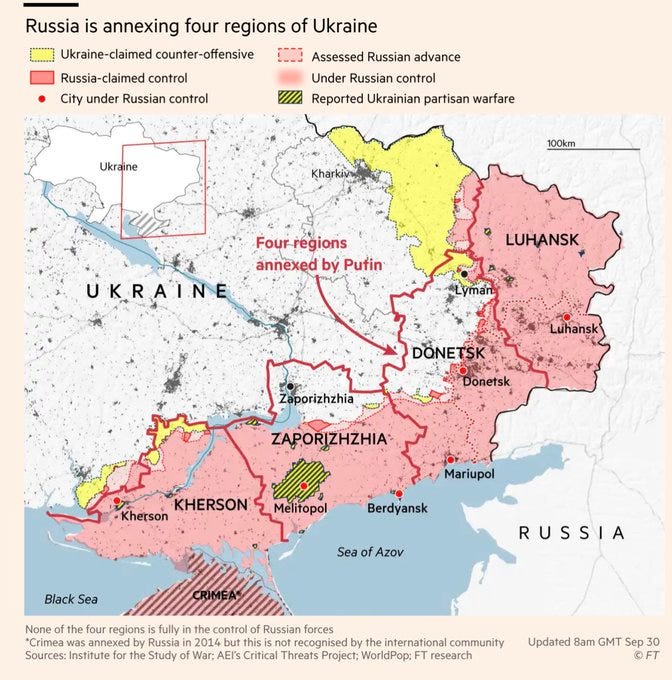
Even by his own standards Vladimir Putin’s speech on 30 September in the Kremlin’s St George’s Hall was unhinged. For those who can face reading it, it can be found here. As he ranted about the west, denouncing it in lurid terms for a range of evils, from imperialism to satanism, it seemed, as Mark Galeotti observed, that he was trying to convince himself as much the outside world about this grand civilisational struggle with the West. The rant had a purpose, which was to demonstrate the irrelevance of legality. The annexation of Luhansk, Donetsk, Zaporizhzhia and Kherson, now to join Crimea as part of the Russian Federation, goes directly against the Charter of the United Nations. Instead of this being acknowledged as a foundational document of international law, it was wrapped up in a denunication of the West’s claims about a ‘rules-based international order’, which only reflected their selfish and malevolent interests. Russia was under no obligation to follow those rules. If it wanted to expand its borders, it was fully entitled to do so.

Ever since the Kosovo War in 1999, and NATO’s use of the principle of self-determination and reports of atrocities to justify their support of the Kosovar Albanians, he has employed this same combination of claims to rationalise his violations of the sovereignty of neighbouring countries. Hence the contrived processes of sham referendums and fake claims of Ukrainian terror.

Implications for Diplomacy

Although it is always disturbing listening to these rants, the conclusion was not surprising. He explained that this was an irreversible move. This was his political offer:

‘I want the Kyiv authorities and their real masters in the West to hear me, so that everyone remembers this: people living in Luhansk and Donetsk, Kherson and Zaporizhzhia become our citizens forever. (Applause.)’

‘We call on the Kyiv regime to immediately cease fire, all hostilities, the war that it unleashed back in 2014, and return to the negotiating table. We are ready for this, it has been said more than once. But we will not discuss the choice of the people in Donetsk, Lugansk, Zaporozhye and Kherson, it has been made, Russia will not betray it. (Applause.) And today’s Kyiv authorities should treat this free will of the people with respect, and nothing else. This is the only way to peace.’

Should Kyiv do as he asked and accept the permanent transfer of these provinces, it is not clear what they would be getting in return: Putin presumably would be looking for Ukrainian neutrality and the ending of sanctions. If he was negotiating from a position of strength then these demands might have some credibility. But his position is weak. Ukraine’s only interest is total Russian withdrawal which Putin now says in constitutionally impossible.

Even those in the West most keen to push for a negotiation around the current territorial holdings should appreciate that however difficult it is to get Russia to withdraw from Ukraine, they are not going to convince Ukraine to withdraw from Ukraine. In addition, while Crimea had a separate status of all its own, because of its annexation back in 2014, it was possible to imagine how it might be dealt with in negotiations by special measures. Now it is just one of five illegally annexed provinces whose fate is tied together.

Putin has boxed himself in with these moves. Before it was possible to imagine, if always unlikely, that there could be some diplomatic means to bring the bloodshed to an end, for example by discussing forms of shared citizenship for those who wished to be attached to Russia or new forms of security arrangements. That path has now been blocked. The Ukrainian government’s response to the speech was to insist that they could not negotiate with Russia so long as Putin remains in power. The war is now destined to carry on to its own bitter end. It also means that even should the fighting conclude it is not clear how issues such as war crimes, reparations and the unwinding of the sanctions’ regime will be handled.

Implications for Nuclear Use

Nuclear threats were not as prominent in this speech as they had been in the mobilisation announcement of 21 September. There was a strong implicit reference when he spoke of Russia’s willingness to use ‘all available means’ to keep safe Russian territory, in its new expanded definition. There was also an explicit hint, when he referred to the US as ‘the only country in the world that twice used nuclear weapons, destroying the Japanese cities of Hiroshima and Nagasaki.’ He then added, ‘Incidentally, they created a precedent.’ In the years since 1945 enormous international efforts, many involving first the Soviet Union and then Russia, went into ensuring – successfully – that this precedent was not followed. But at least Putin did not follow this up with any overt nuclear threats. Conveying a sense of nuclear menace is part of his strategy, but that is not the same as identifying ways of employing these weapons to help turn the tide of this war without making everything a whole lot worse.

The nuclear issue does come into play with Zelensky’s response to Putin’s statement. He announced that he would seek to fast track the country’s accession to NATO. Holding back on that aspiration was the one big concession that Zelensky was keeping available as something that might be put on the table in a serious negotiation. But the Biden Administration quickly dismissed the idea that this could be addressed at speed. Once Ukraine joined NATO it would benefit from the alliance’s Article V and expect active engagement in Ukraine’s defence. This is exactly the development that Putin has been using his nuclear forces to seek to deter. But the application can stay on the table, a reminder to Russia that once nuclear weapons were used in any form they would no longer be serving a deterrent purpose.

Biden’s main response, as he dismissed the legitimacy of Putin’s move, will affect the course of the war. He announced that he was pushing forward with the next $12 billion assistance package to Ukraine and imposing more sanctions on Russia and members of the elite responsible for the prosecution of this war.

The Implications of Lyman

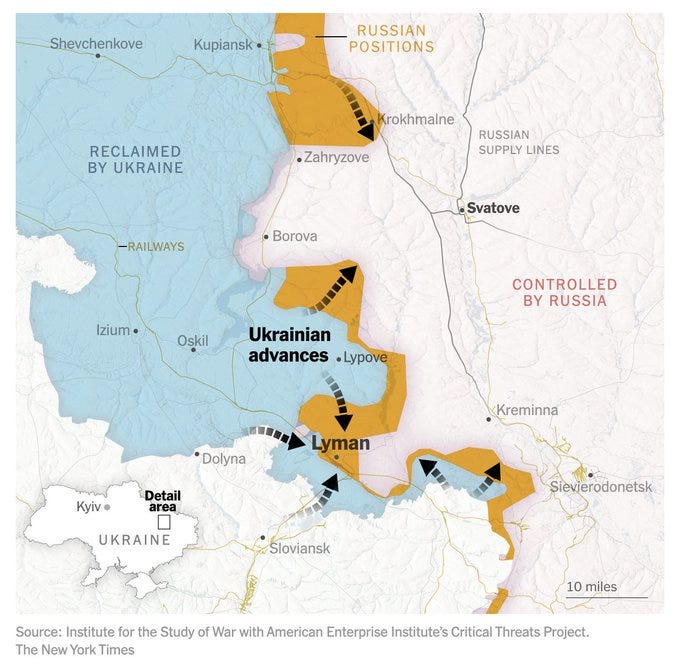
Meanwhile as this elite gathered to listen to Putin’s speech news was coming in from eastern Ukraine of the effective encirclement of the town of Lyman, a key logistical hub for the eastern Donbas, as anticipated in my previous post. I pointed there to the tension between a political strategy that must have the Russian flag in as many places as possible and a military strategy that should conserve scarce resources, and so trade space for time, abandon vulerable positions to establish stronger defensive lines that might be held until the newly mobilised forces can fill out the front lines. The political strategy has won. Putin’s fixation with taking and holding pieces of territory at whatever cost has made a full defeat more likely.

There were believed to be some 2,500 troops in Lyman along with a similar number already pushed out by Ukrainian forces from surrounding villages. Cut off from logistical support, the Russians do not appear to be settling down for a long drawn out defence of their position but instead are trying to get out in some shape or form. There are reports from Ukrainian sources that the Russian troops asked for permission to evacuate but this was denied. Now their position is even worse than shown in the above map. They are trapped, without supplies or reinforcements, and must either surrender or try to find their own way out in the face of heavy Ukrainian artillery fire. Ukrainian forces do not need to storm Russian positions. Instead they can use available forces to press on, making a point of crossing the border into Luhansk. The absence of the forces caught in Lyman, and growing logistical difficulties, means that Russian forces will continue to be pushed back. Ukrainian units are reported to be pressing Kreminna and may soon threaten the Russian positions in Lysychansk and Severodonetsk, taken in June after a long and costly (for both sides) struggle.

All this mocks Putin’s announcement, demonstrating that he can’t hold what he has just annexed. The qustion now is how long the Russian people and, most importantly, the members of the power elite, put up with this recklessness. Polling suggests that support for the war has fallen sharply. The latest shows that from 48% of Russians wanting the war to continue in August now only 29% are determined about pressing on. Another 15% are lukewarm and 48% want peace. Putin offers no way to fight or negotiate a way to victory. More men may so far have fled the country than joined the army. The audience at St George’s Hall look more perplexed than inspired, watching a man who has lost his swagger, caught up in a deluded world of his own construction, but out of which he has inflicted a real-world catastrophe.

Thank you for reading Comment is Freed. This post is public so please share it if you found it interesting.
Share

Categories
Saved Web Pages

RealClearInvestigations’ Picks of the Week

589314_6_.jpg

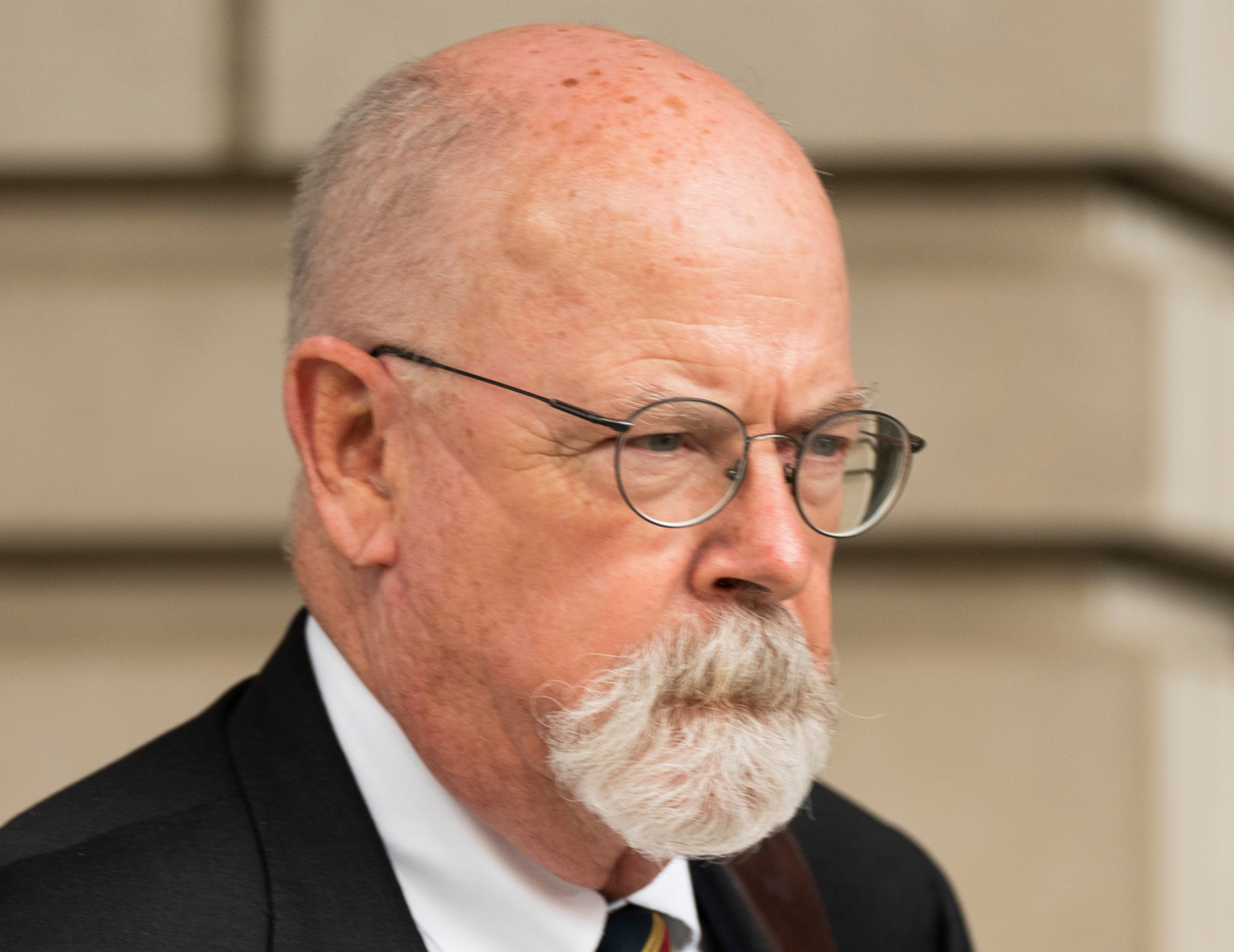
Since being named special counsel, John Durham has investigated and indicted unscrupulous anti-Trump informants – but none of the FBI agents who handled them and went along with their lies, Paul Sperry reports for RealClearInvestigations. That’s raising suspicions he’s letting investigators off the hook in his waning investigation of misconduct in the Russiagate probe. 

  • In recent court filings, Durham has portrayed the G-men as naive recipients of bad information tricked into opening improper investigations targeting Donald Trump and obtaining invalid warrants to spy on one of his advisers. 
  • But as the cases against the informants have gone to trial, defense lawyers have revealed evidence that undercuts that narrative. FBI investigators look less like guileless victims and more like willing partners. 
  • Case in point: Igor Danchenko, key fabulist behind the infamous Steele dossier, including its “pee tape” yarn. According to Durham, the nation’s premiere law enforcement agency was misled by a serial liar and con man – even though the evidence shows it knew of Danchenko’s dishonesty for years and said nothing as it pursued court spy authorizations. 
  • In fact, after learning of Danchenko’s fabrications, the bureau put him on its payroll. 
  • Sperry reviews chapter and verse of Durham’s tenure to reveal a pattern of pulled punches. The special counsel has even made excuses for the misconduct of FBI investigators, providing them a ready-made defense against any possible future prosecution, according to legal experts. 
  • Durham legal critic: “He started with a bang and is ending with a whimper.”


Featured Investigation
Opioids @ Work:
The Hidden Scourge Sapping the Economy

Opioids are taking an immeasurable toll on the American workforce, James Varney reports for RealClearInvestigations, exploring a largely invisible crisis sustained by fentanyl smuggling from China and likely to haunt the nation’s economic well-being for years if not decades to come.  The only thing certain is that the costs are staggering, according to physicians, counselors, economists, workers, and public officials:

  • First, record fatal overdoses of workers in their prime years mean untold years of lost productivity from the economy.
  • Next, opioid addiction’s rise in the U.S. has exerted strong downward pressure on the workforce participation rate – although precise causality is difficult to establish.
  • It’s similarly difficult to calculate just how much drug abuse has caused absenteeism and tardiness and swelled state disability rolls, but the connection is strong, experts say.
  • Opioids are a dirty secret that employers and workers are reluctant to talk about.
  • A neighborhood social media thread about opioids’ dire impact in the workforce unleashes a barrage of horror stories. Homeowners speak of an inability to find reliable handymen, painters, landscape workers, etc.
  • Tree service operator in suburban New Orleans: “If I’m lucky enough to have an employee that can pass a [urine analysis] the chances of them doing so after the first check is slim.”
  • The staying power of the crisis is suggested by other lasting national challenges, including the porous southern border – a major conduit for smuggled, Chinese-made fentanyl – and economic and social traumas set in motion by the pandemic.

Biden, Trump and the Beltway

Postal Service Surveilled Pro-Gun, Anti-Biden Protesters Washington Times
Intimidation? Forceful FBI Arrest of Pro-Life Protester National Review
FBI Misled Judge, Rifled Thousands of Safe Deposit Boxes LA Times
How GOP Leaders Secretly Kneecapped Trump Allies Washington Post
Border Surge Under Biden Sends Smuggling Prices Soaring Washington Times
DoJ Gives $41M to Group Fighting Illegal-Alien Deportation Fox

Other Noteworthy Articles and Series

Vulnerable CIA Websites Blamed for Deaths
Guardian

The CIA used hundreds of websites for covert communications that were so severely flawed that they led to the death of more than two dozen U.S. sources in China in 2011 and 2012 and also reportedly led Iran to execute or imprison other CIA assets. The findings, based on research conducted by security experts at the Citizen Lab at the University of Toronto, “raise serious doubts about the intelligence agency’s handling of safety measures,” this article reports.

Using just a single website and publicly available material, Citizen Lab said it identified a network of 885 websites that it attributed “with high confidence” as having been used by the CIA. It found that the websites purported to be concerned with news, weather, healthcare and other legitimate websites.

“Knowing only one website, it is likely that while the websites were online, a motivated amateur sleuth could have mapped out the CIA network and attributed it to the US government,” Citizen Lab said in a statement. … Citizen Lab began investigating the matter when it got a tip from [Reuters reporter Joel] Schectmann of a CIA asset in Iran who had been captured and served seven years in prison after using what Citizen Lab later determined was a “fatally insecure network.”

In a separate article for Reuters, Schectmann and Bozorgmehr Sharafedin report the case of Gholamreza Hosseini, a U.S. source in Iran who spent more than a decade in a Tehran prison for spying:

Hosseini was the victim of CIA negligence, a year-long Reuters investigation into the agency’s handling of its informants found. A faulty CIA covert communications system made it easy for Iranian intelligence to identify and capture him. Jailed for nearly a decade and speaking out for the first time, Hosseini said he never heard from the agency again, even after he was released in 2019. … Hosseini’s experience of sloppy handling and abandonment was not unique. In interviews with six Iranian former CIA informants, Reuters found that the agency was careless in other ways amid its intense drive to gather intelligence in Iran, putting in peril those risking their lives to help the United States.


Intercepted Calls Reveal
A Russian Army in Disarray

New York Times

Russian soldiers have made thousands of calls from the battlefield in Ukraine to relatives at home – many of which have been intercepted Ukrainian law enforcement agencies and obtained exclusively by the New York Times. This article reproduces snippets from these conversations in which the soldiers describe a crisis in morale and a lack of equipment, and say they were lied to about the mission they were on — all conditions that have contributed to the recent setbacks for Russia’s campaign in the east of Ukraine. “No one told us we were going to war. They warned us one day before we left,” one fighter said. “I didn’t know this was going to happen. They said we were going for training. These bastards didn’t tell us anything,” said another.

Soldiers complain about strategic blunders and a dire shortage of supplies. They confess to capturing and killing non-combatants, and they openly admit to looting Ukrainian homes and businesses. Many say they want to terminate their military contracts, and they rebut the propaganda broadcast by Russian news media back home with the stark realities of the war around them. … Soldiers describe tactical blunders and complain about their lack of weaponry and basic equipment, like night vision devices and proper bulletproof vests. Our own forces fucking shelled us,” [one soldier told his girlfriend]. 

Back home in Russia, the phone calls reveal that the mounting deaths are beginning to reverberate in military towns, where tight-knit communities and families exchange news of casualties. Relatives described rows of corpses and coffins arriving in their cities, as soldiers warn that even more bodies will soon return. One woman told her husband that a military funeral was held every day that week. In shock, some families say they have begun to see psychologists.

Hospital Chain Gamed Feds’ Drug Aid
New York Times

Ringed by public housing projects, Richmond Community Hospital in Virginia consists of little more than a strapped emergency room and a psychiatric ward. It does not have kidney or lung specialists, or a maternity ward. Its magnetic resonance imaging machine frequently breaks. And yet, this article reports, the hollowed-out hospital – owned by Bon Secours Mercy Health, one of the largest nonprofit health care chains in the country – has the highest profit margins of any hospital in Virginia, generating as much as $100 million a year. Much of its profit comes from …

… a federal program that allows clinics in impoverished neighborhoods to buy prescription drugs at steep discounts, charge insurers full price and pocket the difference. The drug program was created with the intention that hospitals would reinvest the windfalls into their facilities, improving care for poor patients. But Bon Secours, founded by Roman Catholic nuns more than a century ago, has been slashing services at Richmond Community while investing in the city’s wealthier, white neighborhoods, according to more than 20 former executives, doctors and nurses. “Bon Secours was basically laundering money through this poor hospital to its wealthy outposts,” said Dr. Lucas English, who worked in Richmond Community’s emergency department until 2018. “It was all about profits.”


Regulation-Heavy U.S.
Running Short of Land for Housing

Wall Street Journal

The United States, a country of wide-open spaces, is short on land. Or at least land where people can live, this article reports:

Land-use restrictions and a lack of public investment in roads, rail and other infrastructure have made it harder than ever for developers to find sites near big population centers to build homes. As people keep moving to cities such as Austin, Phoenix and Tampa, they are pushing up the price of dirt and making the housing shortages in these fast-growing areas even worse.

This historic land boom has provided a windfall for homeowners. Land now accounts for 47% of U.S. home values, up from 38% in 2012 and less than 20% in the early 1960s. The rising value of land is responsible for almost all of the surge in home values in recent decades, he said.

Paradise Lost:
Illegal Gold Mining Ravages Peru

NBC News

Highly organized crime syndicates have ravaged parts of the Peruvian Amazon mining for gold. As the mining operations expanded, so has the ecological devastation. In this exclusive report filled with stark illustrations, NBC News reports that the miners chopped down huge swaths of rainforest in what was once one of the most biologically diverse places on the planet. The toxic chemical they use to separate gold from the sediment – mercury – wreaked havoc on the land. Acre by acre, pristine vegetation was replaced by clay-colored sand and pools of contaminated water that poisoned fish and permeated the soil.

U.S. military and government officials told NBC News that these criminal organizations originating in countries that include not only Peru but Venezuela, Ecuador and Brazil have more people, hold more territory and possess about five times as much money as the collective militaries in the region. One group, the Brazil-based Red Command, is now believed to be trafficking gold as well as guns in Madre de Dios, the section of Peru that encompasses La Pampa.

As with most crimes, success depends on the cooperation of seemingly honest partners. Most of the illegal lucre reaches Switzerland, which refines around 70% of the world’s gold. Along the way, it’s melted down into bars and often mixed with gold that’s been extracted legally, making it impossible to trace, officials say. Some portion of the illegal gold from Peru arrives in the U.S., largely in the suitcases of smugglers traveling by plane, law enforcement officials said. It’s then sold to refineries in and around Miami that have a history of looking the other way.

Categories
Saved Web Pages

Truss Tried to Reassure Britons With Media Blitz. Her Woes Multiplied.

30uk-truss-facebookJumbo.jpg

In a round of interviews, the prime minister showed little sympathy for the pain that high interest rates could inflict on mortgage holders, critics said.

  • Send any friend a story

    As a subscriber, you have 10 gift articles to give each month. Anyone can read what you share.

    Give this articleGive this articleGive this article
Prime Minister Liz Truss’s Conservative Party now trails the opposition Labour Party by 33 percentage points in polling.

Prime Minister Liz Truss’s Conservative Party now trails the opposition Labour Party by 33 percentage points in polling.Credit…Maja Smiejkowska/Reuters

Mark Landler
Sept. 30, 2022, 12:08 p.m. ET

LONDON — For Prime Minister Liz Truss, it was a chance to steady the waters after days of turmoil in the financial markets over her new fiscal plan: eight rapid-fire interviews with local BBC radio stations from Leeds to Nottingham.

By the time Ms. Truss signed off from the last one on Thursday morning, her political woes had multiplied, leaving her new government in a state of disarray almost without precedent in recent British politics.

She was, critics said, robotic in defending a tax-cut plan that had been eviscerated by the markets, and showed little sympathy for the pain that high interest rates could inflict on mortgage holders. One host described her as a “reverse Robin Hood.” A listener on another station asked, “Are you ashamed of what you’ve done?”

Barely three weeks into her job, Ms. Truss has suffered a dizzying loss of public support. Her Conservative Party now trails the opposition Labour Party by 33 percentage points, according to a new poll by the market research firm YouGov. That is the largest Labour lead since Tony Blair’s early days as prime minister in 1998, and the kind of gap that usually results in a landslide election defeat.

Her plunging poll numbers have badly damaged Ms. Truss’s standing in her party, which is gathering on Sunday in Birmingham for what promises to be an anxious annual conference. Some speak openly of the party ousting her before the next election, though the mechanics for doing that remain complicated.

“This is by far the biggest and swiftest hit to a party’s opinion poll rating that British politics has ever seen,” said Tim Bale, a professor of politics at Queen Mary University of London. “For Tory MPs, this is like realizing on your wedding night that you’ve made a truly terrible mistake.”

Matthew Goodwin, a politics professor at Kent University and an expert on the Tory Party, said, “I can’t think in my lifetime of any British prime minister who has mismanaged her first few weeks in office like Liz Truss.”

What makes Ms. Truss’s predicament so difficult is that none of the escape hatches are appealing. Reversing some of her tax cuts — particularly the one for the top income bracket of people earning more than 150,000 pounds, or about $164,000, a year — would mollify the markets and probably some voters.

Tax cuts announced last week by Kwasi Kwarteng, Britain’s chancellor of the Exchequer, threw the markets into turmoil.Credit…Clodagh Kilcoyne/Reuters

But it would be a heavy psychological blow for a leader who ran her campaign, and has built her government, on the conviction that tax cuts and supply-side policies will reignite growth. Giving that up, Professor Bale said, would vitiate the ideological rationale of her government and potentially turn her into a lame-duck leader until the next election, which she will have to call by early 2025.

Sticking to her guns, which has been Ms. Truss’s response so far, leaves open the chance that Britain’s economy will pick up by the time she faces voters. But the stubborn threat of inflation all but guarantees that the Bank of England, Britain’s central bank, will keep raising interest rates. That will hurt people who need to refinance home mortgages and likely throw the broader economy into a recession.

When she was asked by BBC Radio Stoke about her fiscal plan’s impact on the housing market, Ms. Truss paused before saying, “Interest rates are a matter for the independent Bank of England.” She added that “interest rates have been rising around the world” and blamed much of the crisis on Russia’s war in Ukraine.

For the last few days, the bank has actually helped Ms. Truss by intervening in the market to buy British government bonds. That brought down interest rates and strengthened the pound, which had tumbled to its lowest level against the dollar since 1985. On Friday, the pound traded up to $1.11.

But the intervention, which was driven by fears of the damage done to British pension funds by the turbulent market, has put the Bank of England in an awkward position, economists said. It runs counter to the bank’s monetary policy of raising interest rates to cool inflationary pressures.

“The bank has had to reverse course on its objectives practically overnight,” said Eswar Prasad, a professor of economics at Cornell University. “It looks like the bank is being forced to clean up the adverse consequences of the U.K. Treasury’s actions.”

“This could have some longer-term implications for the bank’s independence, credibility, and effectiveness,” Professor Prasad continued. “That really hampers it in its ability to fulfill its objectives.”

Once the Bank of England completes its bond-buying program on Oct. 14, economists said they expected it to revert to its tighter monetary policy, which would suggest another increase in interest rates at its November meeting. The only government action that could forestall, or even moderate a sharp spike in rates, economists said, would be if the government reversed one of more of its tax cuts.

“Absent that U-turn, the bank is going to have to raise interest rates a lot,” said Adam S. Posen, who served on the Bank of England’s monetary policy committee. He said the bank needed to curb both the inflation from an expansionary fiscal budget and the additional inflation caused by a devalued pound.

Once the Bank of England completes its bond buying program, economists expect it to revert to its tighter monetary policy by possibly raising interest rates at its November meeting.Credit…Hannah Mckay/Reuters

Beyond the tug-of-war between fiscal and monetary policy, critics say Ms. Truss faces a more elemental problem: her chancellor of the Exchequer, Kwasi Kwarteng, has lost the faith of the markets in his economic stewardship.

That is partly because when Mr. Kwarteng announced the tax cuts last week, he did not submit the package to the scrutiny that a government budget normally receives. That fed fears that the tax cuts were “unfunded,” meaning that they would not be matched with cuts in spending and so would require massive borrowing.

On Friday, Mr. Kwarteng and Ms. Truss met at Downing Street with officials from the government’s forecasting agency, the Office of Budget Responsibility — a move designed to signal they now welcomed the scrutiny. The office will submit its projections for the cost of the fiscal program and its effect on Britain’s growth on Oct. 7, but the government will not publish the numbers until Nov. 23.

For Ms. Truss, the political fallout from her program’s botched rollout has been profound. Political analysts point out that she won the support of only a third of Conservative Party lawmakers in the first stage of the leadership contest. Now, the collapsing polls have left the lawmakers angry, fearful, and divided.

Unless the trends are reversed, many of the party’s members in Parliament will be swept out of their seats in the next election, particularly in the “red wall” districts of the Midlands and the North, where Ms. Truss’s predecessor, Boris Johnson, lured traditional Labour voters to switch to the Tories with his promise to “Get Brexit done.”

That realignment of British politics is in jeopardy. Professor Goodwin, of the University of Kent, said these voters did not want Ms. Truss’s low-tax, neoliberal economic policies. Adding to the alienation, he said, she was determined to relax immigration laws, another core issue for working-class voters.

“We’re seeing the complete implosion of the Conservative vote,” Professor Goodwin said. “They’re losing middle-class voters who are alienated by Brexit, and working-class voters who are alienated by their economic policy.”

For all the hand-wringing, it is not immediately clear what the Tories can do about it. Three months after evicting Mr. Johnson from Downing Street, few people want to go through with another protracted, divisive leadership contest.

Professor Bale said another option would be for the party to settle on a consensus alternative to Ms. Truss and then pressure her to step down, so the new leader could be crowned without any delay. The problem with this scenario, he said, is a lack of obvious candidates to step into the role of the party’s savior.

WP Radio
WP Radio
OFFLINE LIVE