Categories
Saved Web Pages

US defense chief insists Russia won’t use nukes in Ukraine

da10a22d-f2c5-4087-9201-cb886ec30f8c.jfi

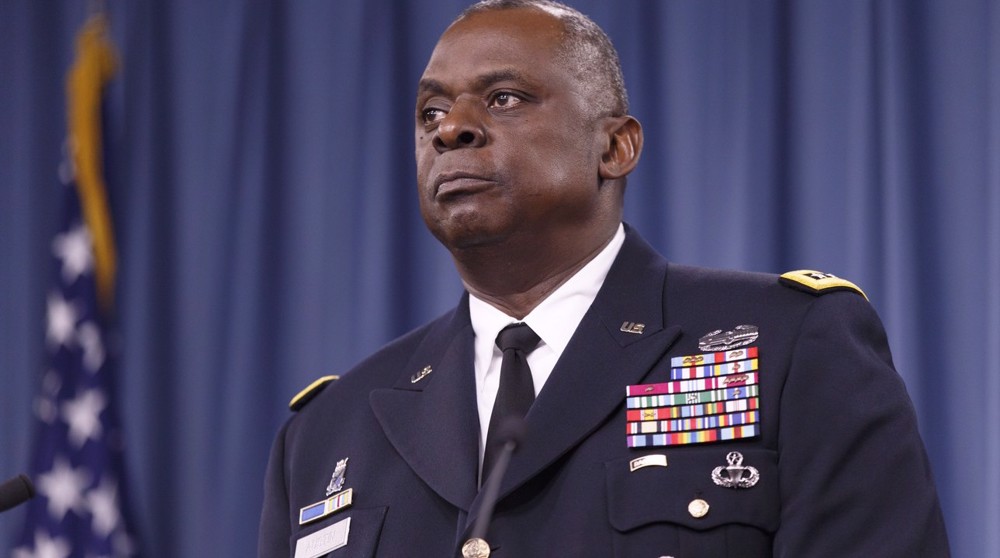
US Defense Secretary Lloyd Austin has insisted that Russia will not use nuclear weapons in Ukraine despite threats to do so if attacked, noting that Washington sees no evidence suggesting such moves.

“I don’t see anything right now that would lead me to believe that he [Russian President Vladimir Putin] has made such a decision,” Austin said in an interview with CNN’s Fareed Zakaria on Saturday and due to be aired on Sunday.

The Pentagon chief said that Washington had previously communicated these concerns to Moscow via top-level channels. When asked if he had any recent contacts with Russian Defense Minister Sergei Shoigu, Austin responded negatively.

Despite claiming that “there are no checks on Putin,” the Pentagon chief dismissed recent warnings by the Russian president – including his vow that he was not “bluffing” about Moscow’s willingness to use nuclear arms “to defend Russia and our people” – as unworthy of a global superpower. 

“This nuclear saber-rattling is not the kind of thing that we would expect to hear from leaders of large countries with capability,” Austin underlined, but then added: “Just as [Putin] made the irresponsible decision to invade Ukraine, you know, he could make another decision” to use nuclear weapons there. 

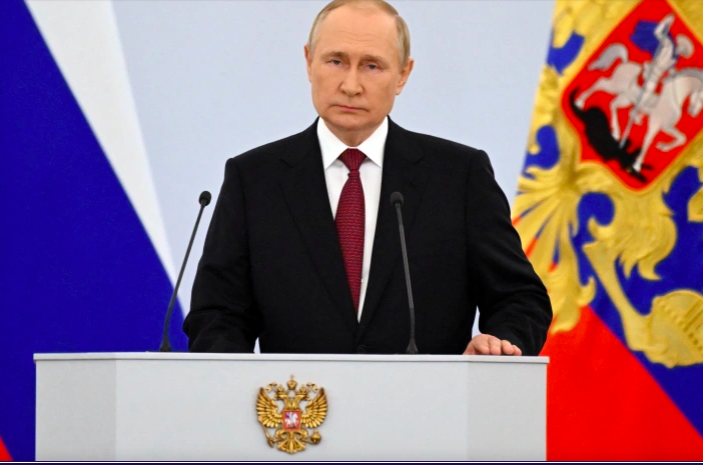
His remarks came after US officials and mainstream media outlets accused the Russian president of making “nuclear threats” against Ukraine in his speech to the nation on September 21, when he declared partial mobilization and status referendums in eastern Ukrainian regions of Donbass, Kherson and Zaporozhye.

What Putin had actually stated, however, was that Kiev and its Western sponsors had “resorted to nuclear blackmail,” insisting that Moscow would not hesitate to respond in kind if its security interests were threatened.

“I am referring not only to the Western-encouraged shelling of the Zaporozhye Nuclear Power Plant, which poses a threat of a nuclear disaster, but also to the statements made by some high-ranking representatives of the leading NATO countries on the possibility and admissibility of using weapons of mass destruction – nuclear weapons – against Russia,” Putin said at the time.

“I would like to remind those who make such statements regarding Russia that our country has different types of weapons as well, and some of them are more modern than the weapons NATO countries possess,” he then emphasized. “In the event of a threat to the territorial integrity of our country and to defend Russia and our people, we will certainly make use of all weapon systems available to us. This is not a bluff.”

The US defense secretary further claimed that Washington had previously communicated to his Russian counterpart Sergei Shoigu not to “go down this path and conduct this type of irresponsible behavior,” but when asked if he had any recent contacts with Shoigu, Austin responded negatively.

The Russian defense minister has repeatedly clarified that Moscow’s nuclear doctrine only allows the use of such weapons when “the very existence of the state is threatened” and last month rejected the notion of using nukes in Ukraine as “absurd.” 

The development came a day after Deputy head of Russia’s security council Dmitry Medvedev slammed Ukraine’s renewed bid to promptly join the US-led NATO military alliance as an effort that would only “hasten the start of World War III.”

“[Ukrainian President Vladimir] Zelensky wants to speed up NATO membership. Great idea. He just begs NATO to hasten the start of World War III,” Medvedev wrote in a Friday post on his Telegram channel as cited by Russia’s TASS news agency.

The statements came after the Ukrainian president formally applied for a fast-track NATO membership following the signing of a decree by his Russian counterpart for the formal accession of former eastern Ukrainian regions of Donetsk, Lugansk, Zaporozhye, and Kherson after holding referendums that overwhelmingly favored the move.

Washington, meanwhile, has repeatedly warned Moscow against the use of nuclear weapons, threatening “catastrophic” consequences as Kiev continues to shell the Zaporozhye Nuclear Power Plant, putting the world “on the brink of nuclear catastrophe,” in the words of Russian State Duma Chairman Vyacheslav Volodin.

This is while US officials have so far been evasive about how they would respond to a potential Russian nuclear strike, with President Joe Biden merely vowing that Russia would become an international “pariah,” suggesting that Washington’s response would depend “on the extent of what they do.”

Such warnings are intentionally vague, US officials told the Washington Post last month, and are delivered with the intent to create “strategic ambiguity” and keep the Kremlin on its toes about the response.

US senator vows ‘catastrophic’ response if Russia nukes Ukraine

Hawkish US Republican Senator Lindsey Graham also claimed on Thursday that any Russian use of nuclear weapons in Ukraine would be considered as an attack on “NATO itself,” prompting a “catastrophic” response.

Speaking during a joint press conference with Democratic Senator Richard Blumenthal of Connecticut, the North Carolina senator further insisted that in such an attack the radiation “would not be confined to Ukraine, you would be irradiating parts of Europe that are under the NATO banner.”

“If that day ever comes — and I hope and pray it doesn’t — [a nuclear strike] should be considered by NATO writ large and the United States as an attack by Russia on NATO itself,” he emphasized.

Graham and Blumenthal called the press conference to unveil legislation blocking foreign aid to any country recognizing the results of the referendums in Donetsk, Lugansk, Zaporozhye, and Kherson. 

Categories
Saved Web Pages

What happens next after Putin’s annexations in Ukraine

putinvladimir_093022ap_w.jpg?w=1280

Russian President Vladimir Putin’s move Friday to annex parts of southern and eastern Ukraine amid Moscow’s war in the country has elevated the stakes of the conflict, threatening to bring the Kremlin’s struggling military campaign closer to the doorsteps of the West.  

The stunning move has prompted a flurry of activity across the globe, including new U.S. and Group of Seven (G-7) sanctions targeting Russian government and military officials and their family members, international condemnation, calls for more weapons for Kyiv and a fresh push from Ukraine to join NATO.  

But Putin’s actions — an indication he has dug in his heels in his military campaign against Ukraine — have much broader and longer-term repercussions for the future, experts say. What exactly those will be, however, are hard to discern, with experts expressing a deep uncertainty over where the situation will go from here. 

“I think there will be continued warnings about breaking any of the red lines that have been put down. And there will be, I think, further strengthening of sanctions … Beyond that, it’s hard to anticipate exactly what might happen,” said career ambassador Thomas Pickering, who served as U.S. ambassador to the United Nations as well as Russia.  

Putin on Friday signed four “ascension treaties” to annex the Donetsk, Luhansk, Kherson and Zaporizhzhia regions of Ukraine after holding sham referendums in the areas. 

“This is the will of millions of people,” Putin told hundreds of dignitaries amid a lavish ceremony at the Kremlin in Moscow. 

Much of the world, including members of the G-7 and the European Union, have already vowed to never recognize the land grab, while Ukrainian President Volodymyr Zelensky called the move a “farce.”  

“The entire territory of our country will be liberated,” Zelensky promised in a pre-recorded video released after Putin’s speech. 

The annexations are the biggest territory grab in Europe since World War II and come as Putin has grown increasingly aggressive in his rhetoric due to a markedly successful Ukrainian counteroffensive earlier this month that took back large swaths of ground and forced Moscow’s forces to retreat. 

Putin continued that saber-rattling in a speech laden with anti-Western sentiments, pledging to defend the newly claimed regions with “all available means,” a non-veiled threat to use nuclear weapons. 

Russia has dangled the threat of an attack with a nuclear weapon since the start of its invasion of Ukraine, but the new land steal has spiked fears over how Moscow will respond to attacks in these territories now declared part of the Kremlin.

“Would he actually go to the use of nuclear weapons? Nobody knows. But it remains obviously something that he’s unprepared now to take off the table,” Pickering told The Hill. 

Another question raised is whether the Russians will stick to their messaging that taking the eastern-most area of Ukraine known as the Donbas region remains the limited objective of their invasion, as suggested in Putin’s speech. The Kremlin has focused on taking the area since its failed campaign to topple Kyiv, but it’s unclear whether Moscow will be open to ending the war should that be achieved.  

“Would that in its own way lead to discussions that could take place diplomatically over next steps that might tone things down? I think that’s a very optimistic view, but a moment not very likely given Mr. Putin’s dug in responses on every development that has taken place of upping the ante,” Pickering noted. 

Also undetermined is the renewed debate over whether NATO should allow Ukraine to join after the country on Friday announced it will file an expedited application to the military alliance, which Kyiv has sought to enter since Russia’s annexation of the Crimean Peninsula in 2014.  

The United States quickly urged that such a process “should be taken up at a different time,” according to national security adviser Jake Sullivan. 

“Right now, our view is that the best way for us to support Ukraine is through practical, on-the-ground support in Ukraine and that the process in Brussels should be taken up at a different time,” Sullivan told reporters Friday.   

But Jonathan Katz, director of Democracy Initiatives and a senior fellow with The German Marshall Fund of the United States, said Ukraine’s NATO bid is a serious application in the wake of Putin’s speech and amid his ongoing desperate bids to make gains in a war that has become bogged down in its seventh month.  

“It is not far-fetched that Ukraine — which will need security guarantees going forward, given Russia’s unrelenting war and Mr. Putin’s unwillingness to end this cycle of violence against Ukraine — they will need to be given some type of security guarantee and NATO is the place to do that,” Katz said.  

“It must be taken seriously. … how can anyone think that Ukrainians, or the West, the transatlantic community, can be safe with Mr. Putin doing what he’s doing,” he added.  

The issue will likely come up at a meeting of defense ministers for the North Atlantic Council Oct. 12 and 13 at NATO Headquarters in Brussels.  

For now, U.S. and Western officials say they are focusing on crippling Russia through economic means, with the Biden administration on Friday announcing a new round of sanctions. 

The sanctions, which come from the departments of Treasury, Commerce and State and in coordination with members of the G-7, are meant to target Moscow’s decisionmakers, Putin’s allies and entities that support Russia’s military-industrial complex. 

Secretary of State Antony Blinken said the sanctions are a clear warning that there will be “costs for any individual, entity, or country that provides political or economic support to Russia as a result of its illegal attempts to change the status of Ukrainian territory.” 

One thing’s certain in the aftermath of Putin’s move: continued U.S. support to Ukraine. 

The House on Friday passed a stopgap spending bill to stave off a government shutdown that included another $12.3 billion in aid for Ukraine.  

News also broke Friday that the Pentagon was preparing to step up efforts to train and equip Ukrainian troops through a proposal to create a new command based in Germany, as The New York Times reported. Such a command, which would be led by a top U.S. general, would streamline the current patchwork of training and assistance given to the Ukrainian military by the U.S. and allies since Russia attacked the country in February, according to the Times. 

And House Foreign Affairs Committee ranking member Michael McCaul (R-Texas) on Friday called for the U.S. and its allies to send Ukraine weapons it has so far held off from providing over fears doing so could escalate Russia’s ire. 

Zelensky advisor: Putin’s mobilization announcement ‘actually to our advantage’ Ukrainian intel shows Russian nuclear threat is ‘very high’: top Zelensky aide

“I urge the Biden administration to finally provide longer-range artillery, like [Army Tactical Missile System]. And I also urge key allies to immediately transfer much-needed systems, including German Leopard tanks and Marder infantry fighting vehicles,” McCaul said in a statement.  

Earlier this week the administration pledged another $1.1 million in lethal aid to the embattled country, bringing the total Pentagon commitment to Ukraine to more than $16 billion since February.  

The latest dollars will go to contracts for weapons to be delivered over the next several years — a signal that the U.S. believes Russia will continue to threaten Ukraine and the region for years to come.  

Categories
Saved Web Pages

Somebody has to take action on Putin

Putin.png

To the Editor:

How long is America (Biden) going to keep his tail between his legs when it comes to the Ukraine? Today, 25 people died in a caravan waiting to pick up relatives in a captured area to rescue them, were shelled by Russia. Biden is worried about Putin pushing a button. We have more buttons than he does.
Why hasn’t someone in Russia put a bullet in Putin’s head? The United Nations? What a waste of time and money. They’ve done nothing. I understand NATO etc. but to let people die? The United Nations had a committee to decide if Putin was a war criminal probably now in its sixth month. How long does it take? Not enough body count yet? A worldly disgrace to United Nations representatives who are supposedly not doing what their paid to do.

We need a stronger leader than Biden. Russians need to overthrow or assassinate Putin and save their own people. There’s enough Russian population [Mafia] in Coney Island, N.Y. to contact someone in Russia to take him out. Problem being no one in Coney Island is going to read this letter. Yo, Biden wake up!

Anthony Rizzo

Village of Alhambra

Categories
Saved Web Pages

Russia withdraws troops after Ukraine encircles key city

3000.jpeg

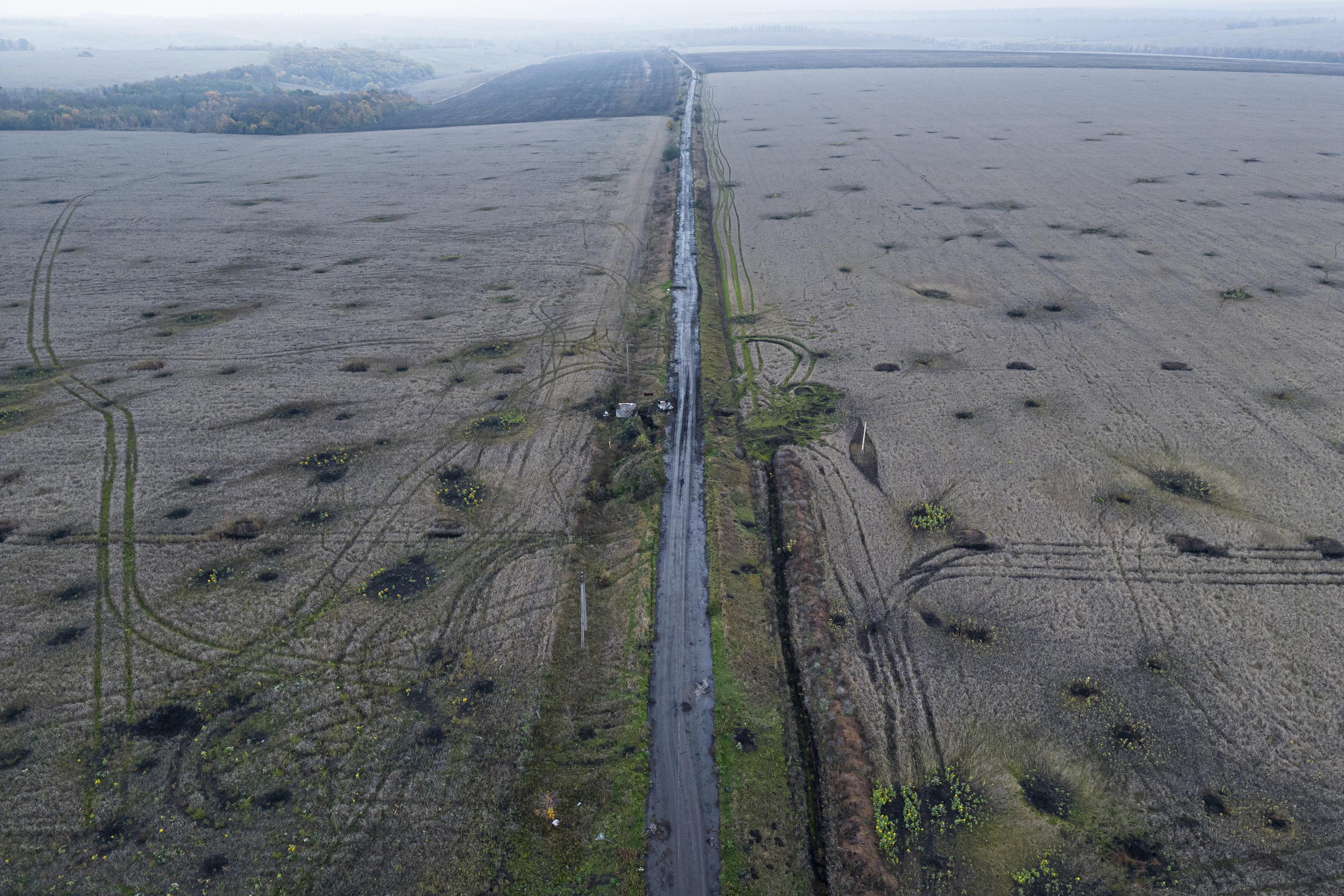
KYIV, Ukraine (AP) — After being encircled by Ukrainian forces, Russia pulled troops out Saturday from an eastern Ukrainian city that it had been using as a front-line hub. It was the latest victory for the Ukrainian counteroffensive that has humiliated and angered the Kremlin.

Russia’s withdrawal from Lyman complicates its internationally vilified declaration just a day earlier that it had annexed four regions of Ukraine — an area that includes Lyman. Taking the city paves the way for Ukrainian troops to potentially push further into land that Moscow now illegally claims as its own.

The fighting comes at a pivotal moment in Russian President Vladimir Putin’s war. Facing Ukrainian gains on the battlefield — which he frames as a U.S.-orchestrated effort to destroy Russia — Putin this week heightened threats of nuclear force and used his most aggressive, anti-Western rhetoric to date.

Russia’s Defense Ministry claimed to have inflicted damage on Ukrainian forces in battling to hold Lyman, but said outnumbered Russian troops were withdrawn to more favorable positions. Kyiv’s air force said it moved into Lyman, and the Ukrainian president’s chief of staff posted photos of a Ukrainian flag being hoisted on the town’s outskirts.

Lyman had been an important link in the Russian front line for both ground communications and logistics. Located 160 kilometers (100 miles) southeast of Kharkiv, Ukraine’s second-largest city, it is in the Donetsk region near the border with Luhansk region, both of which Russia annexed Friday after a local “referendum” was held at gunpoint.

Ukrainian forces have retaken vast swaths of territory in a counteroffensive that started in September. They have pushed Russian forces out of the Kharkiv area and moved east across the Oskil River.

Moscow’s withdrawal from Lyman prompted immediate criticism from some Russian officials.

The leader of Chechnya, Ramzan Kadyrov, blamed the retreat, without evidence, on one general being “covered up for by higher-up leaders in the General Staff.” He called for “more drastic measures.”

Meanwhile, on the Russian-annexed Crimean Peninsula, the governor of the city of Sevastopol announced an emergency situation at an airfield there. Explosions and huge billows of smoke could be seen from a distance by beachgoers in the Russian-held resort. Authorities said a plane rolled off the runway at the Belbek airfield and ammunition that was reportedly on board caught fire.

Russia annexed the Black Sea peninsula of Crimea from Ukraine in 2014 in violation of international law.

Russian bombardments have intensified in recent days as Moscow moved swiftly with its latest annexation and ordered a mass mobilization at home to bolster its forces. The Russian call-up has proven unpopular at home, prompting tens of thousands of Russian men to flee the country.

Ukraine’s president, Volodymyr Zelenskyy, and his military have vowed to keep fighting to liberate the regions Putin claimed to have annexed Friday, and other Russian-occupied areas.

Ukrainian authorities accused Russian forces of targeting two humanitarian convoys in recent days, killing dozens of civilians.

The governor of the Kharkiv region, Oleh Syniehubov, said 24 civilians were killed in an attack this week on a convoy trying to flee the Kupiansk district. He called it “сruelty that can’t be justified.” He said 13 children and a pregnant woman were among the dead.

“The Russians fired at civilians almost at point-blank range,” Syniehubov wrote on Telegram.

The Security Service of Ukraine, the secret police force known by the acronym SBU, posted photographs of the attacked convoy. At least one truck appeared to have been blown up, with burned corpses in what remained of its truck bed. Another vehicle at the front of the convoy also had been ablaze. Bodies lay on the side of the road or still inside vehicles, which appeared pockmarked with bullet holes.

Russia’s Defense Ministry said its rockets destroyed Ukrainian military targets in the area but has not commented on accusations that it targeted fleeing civilians. Russian troops have retreated from much of the Kharkiv region but they have continued to shell the area.

And a Russian strike in the Zaporizhzhia region’s capital killed 30 people and wounded 88, Ukrainian officials said. The British Defense Ministry said the Russians “almost certainly” struck a humanitarian convoy there with S-300 anti-aircraft missiles. Russian-installed officials in Zaporizhzhia blamed Ukrainian forces, but gave no evidence.

In other developments, in an apparent attempt to secure Moscow’s hold on the newly annexed territory, Russian forces seized the director-general of the Zaporizhzhia Nuclear Power Plant, Ihor Murashov, on Friday, according to the Ukrainian state nuclear company Energoatom.

Energoatom said Russian troops stopped Murashov’s car, blindfolded him and took him to an undisclosed location.

Russia did not publicly comment on the report. The International Atomic Energy Agency said Russia told it that “the director-general of the Zaporizhzhia nuclear power plant was temporarily detained to answer questions.”

The Vienna-based IAEA said it “has been actively seeking clarifications and hopes for a prompt and satisfactory resolution of this matter.”

The power plant repeatedly has been caught in the crossfire of the war. Ukrainian technicians continued running it after Russian troops seized the power station, and its last reactor was shut down in September as a precautionary measure amid ongoing shelling nearby.

In other fighting reported Saturday, four people were killed by Russian shelling Friday in the Donetsk region, governor Pavlo Kyrylenko said. The Russian army struck the southern Ukrainian city of Mykolaiv twice overnight, once with drones and the second time with missiles, according to regional Gov. Vitaliy Kim.

After Friday’s land grab, Russia now claims sovereignty over 15% of Ukraine, in what NATO Secretary-General Jens Stoltenberg called “the largest attempted annexation of European territory by force since the Second World War.”

Zelenskyy on Friday formally applied for NATO membership, upping the pressure on Western allies to defend Ukraine.

In Washington, President Joe Biden signed a bill Friday that provides another infusion — more than $12.3 billion — in military and economic aid linked to the war Ukraine.

___

Follow AP’s coverage of the war in Ukraine at https://apnews.com/hub/russia-ukraine

Categories
Saved Web Pages

President Ilham Aliyev met with Prime Minister of Greece in Sofia VIDEO

16646087273127516611_1200x630.jpg

Sofia, October 1, AZERTAC

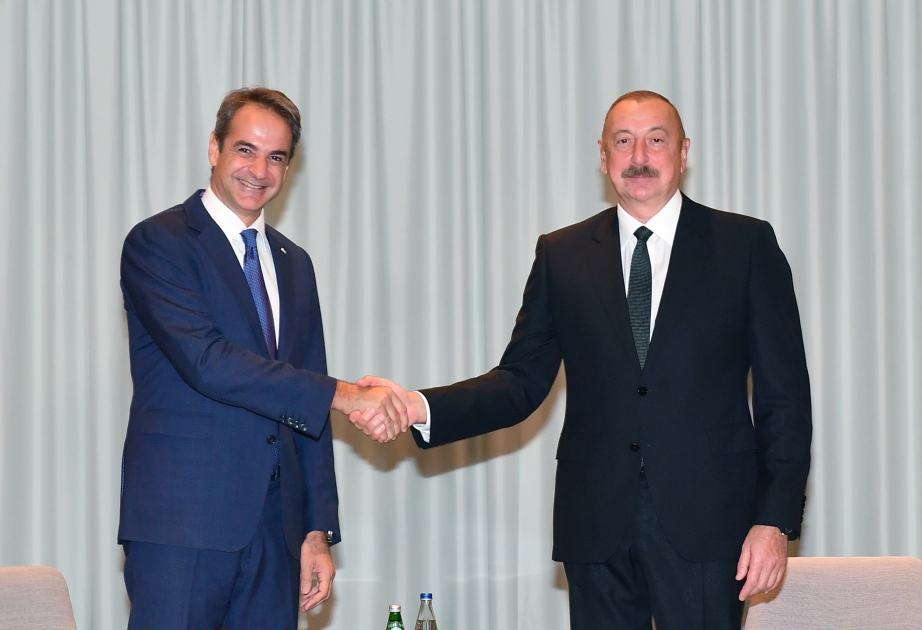
As part of the opening ceremony of the Greece-Bulgaria Gas Interconnector (IGB), President of the Republic of Azerbaijan Ilham Aliyev has met with Prime Minister of the Hellenic Republic Kyriakos Mitsotakis in Sofia, Bulgaria.

The issues of cooperation in the field of energy was pointed out at the meeting, and the importance of the TAP project was emphasized in this regard. The importance of the natural gas interconnector to be commissioned between Greece and Bulgaria, was also mentioned.

The sides also hailed the importance of the Memorandum of Understanding on Strategic Partnership signed between Azerbaijan and the European Union in the field of energy.

AZERTAG.AZ :President Ilham Aliyev met with Prime Minister of Greece in Sofia VIDEO

© Content from this site must be hyperlinked when used.

Report a mistake by marking it and pressing ctrl + enter

Follow us on social network

Categories
Saved Web Pages

An Alternative Red Scenario for the war between Ukraine and Russia

russian-tank-red.jpg

(Art direction: Jean-Dominique Lavoix-Carli)

The September 2022 Ukrainian counter-offensive against Russia is hailed as very successful. Ukrainian President Volodymyr Zelensky thanked the “true heroes” who allowed for a “very rapid liberation” of 8000 sq km by 14 September 22 “in the east, notably in the Kharkiv Oblast, and the south, notably in the Kherson oblast”, (e.g. BBC News, 12 September 22; CNN, 14 September 22).

Yet, U.S. President Joe Biden and other American officials, as well as Germany Defence Minister Christine Lambrecht first cautioned against a feeling of “premature victory”, of a “turning point in the war”, even though they acknowledge the territorial gains (Lolita Baldor and Ellen Knickmeyer, “US leaders avoid victory dance in Ukraine combat advances“, AP, 13 September 22; Reuters, “Too early to tell if Ukraine counter-offensive is turning point, Germany says“, 14 September 22). As time passed, on 18 September, President Biden appeared as far more confident in an interview, stating that “They’re defeating Russia” (Reuters, “Zelenskiy vows no let-up as Ukraine says troops cross Oskil river in northeast“, 19 September 2022).

What lies ahead?

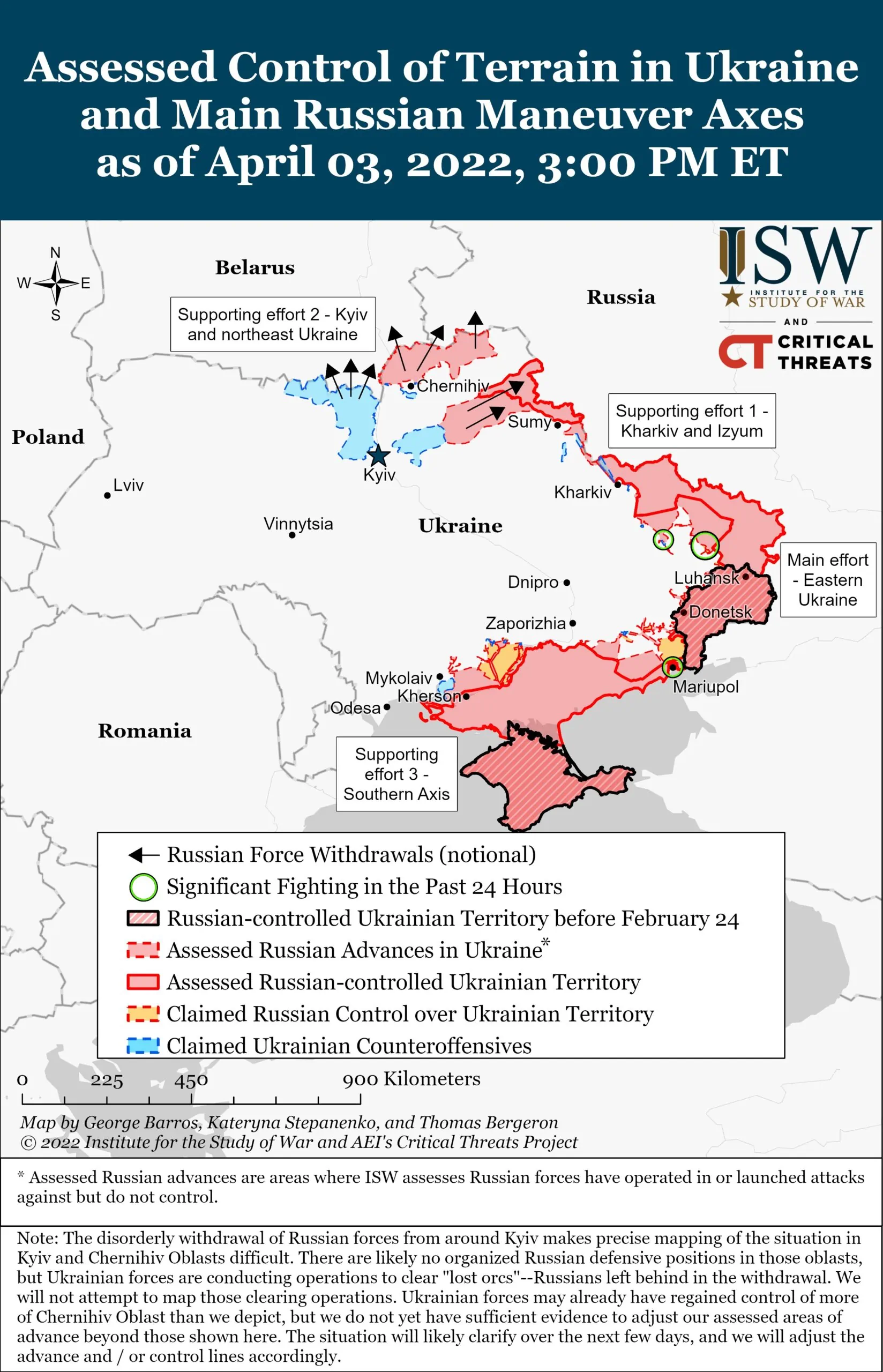
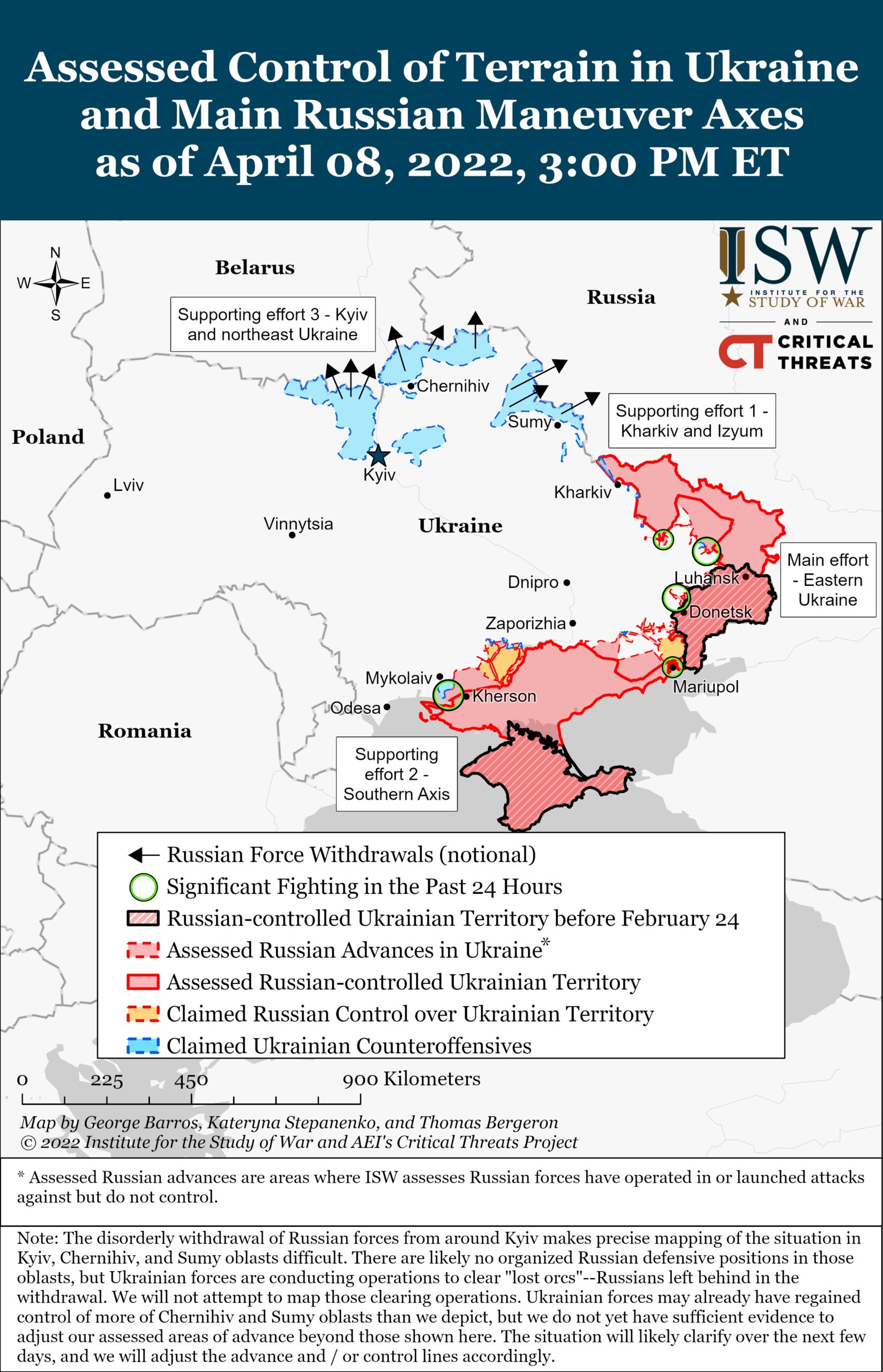
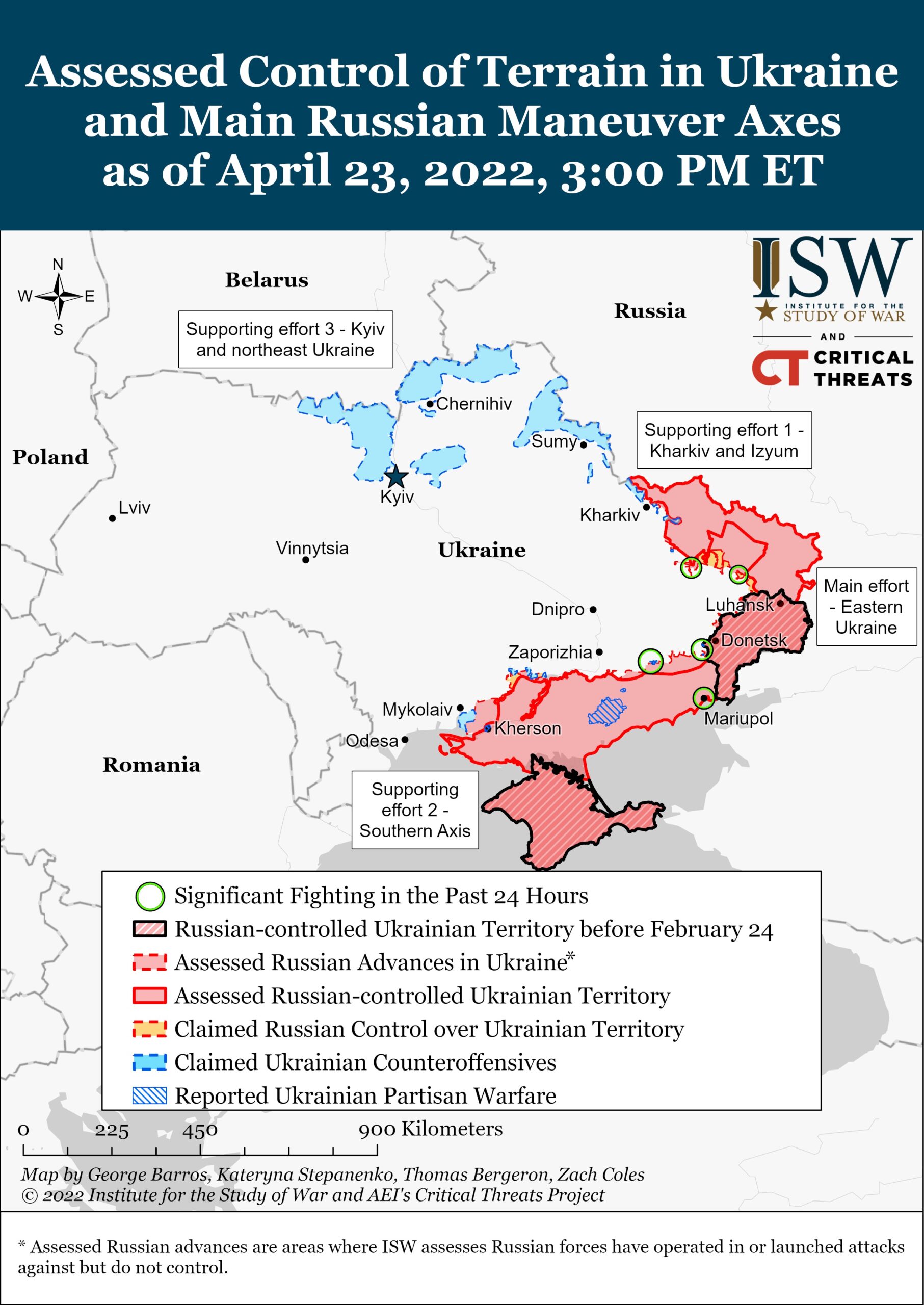
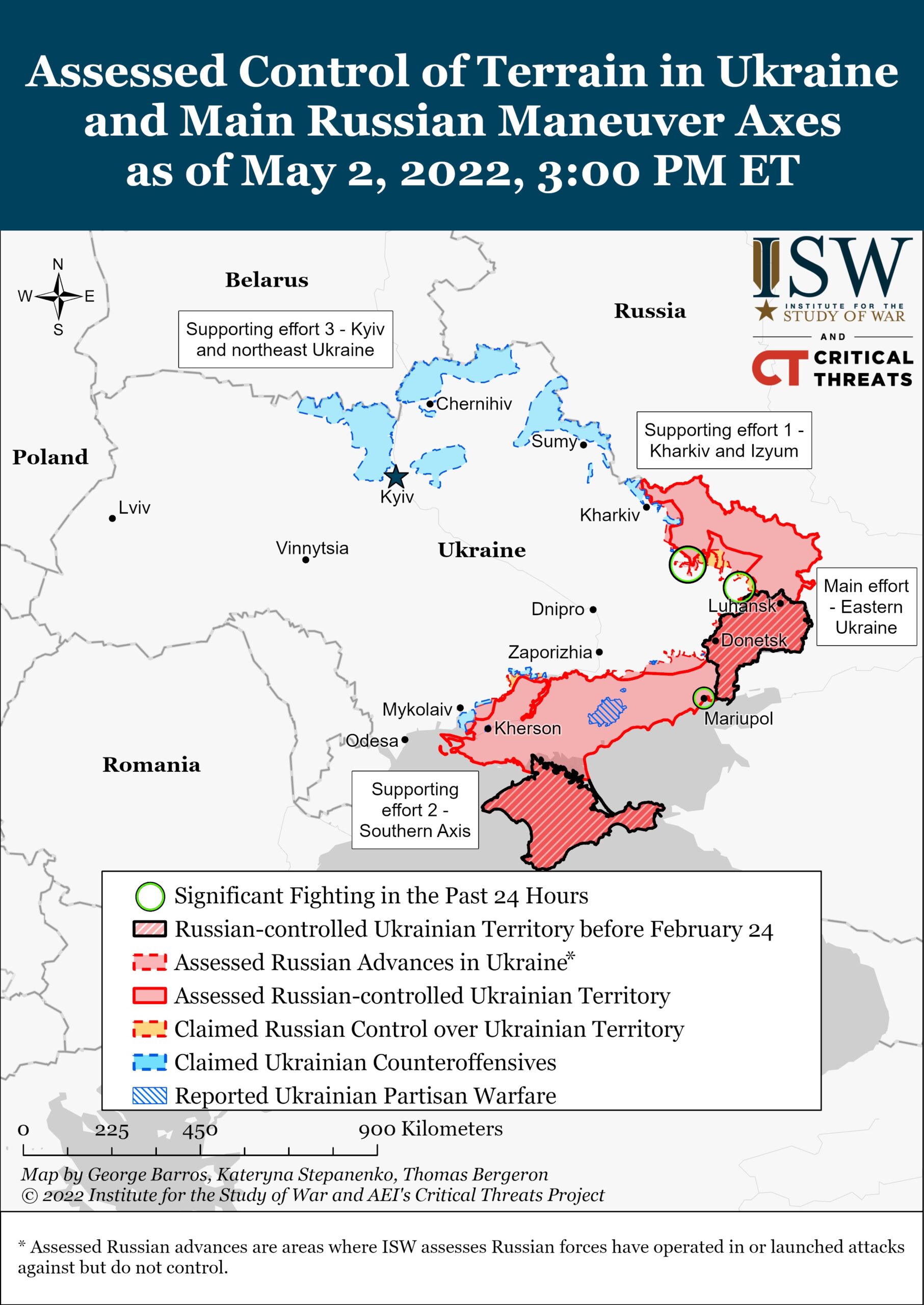
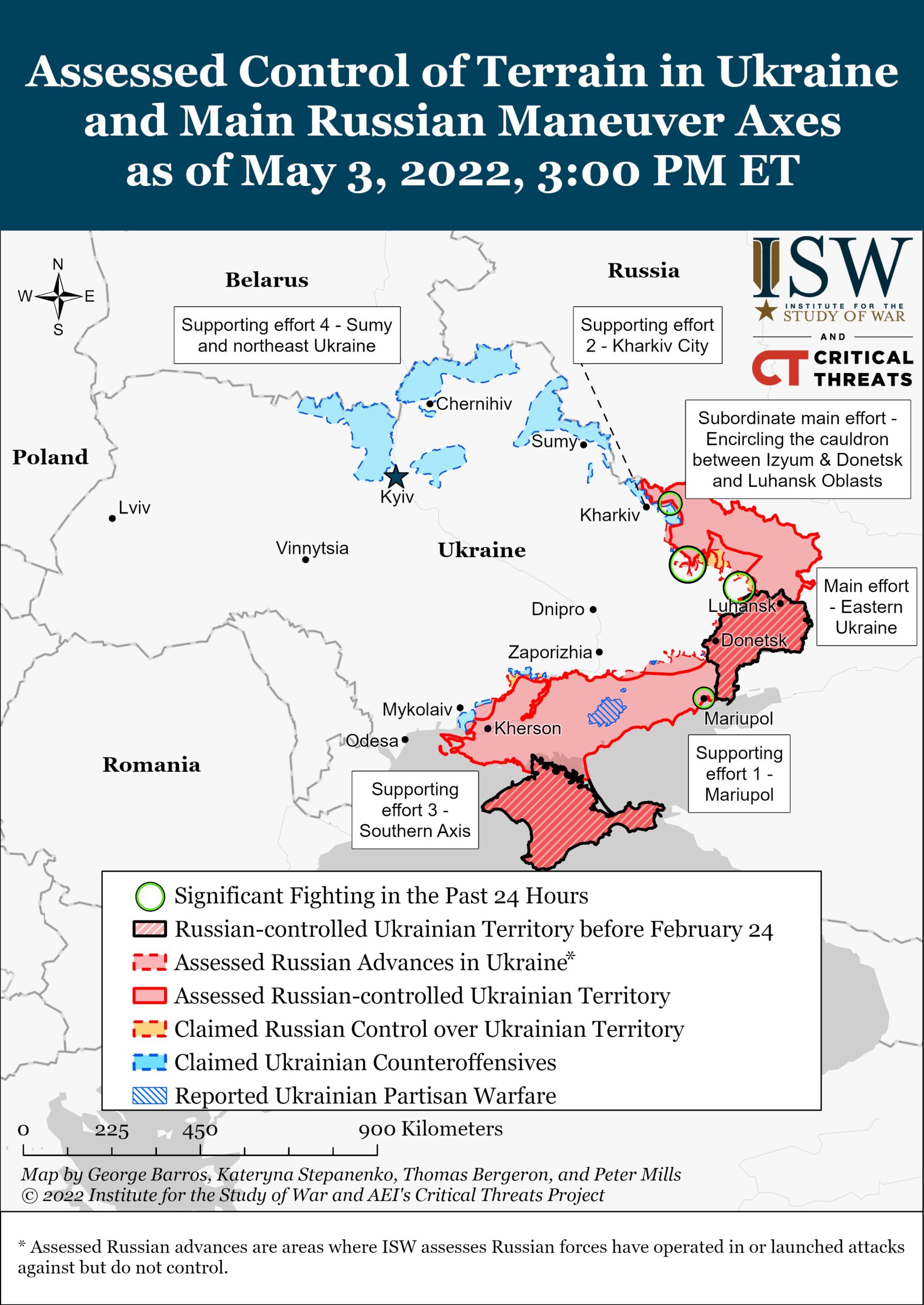
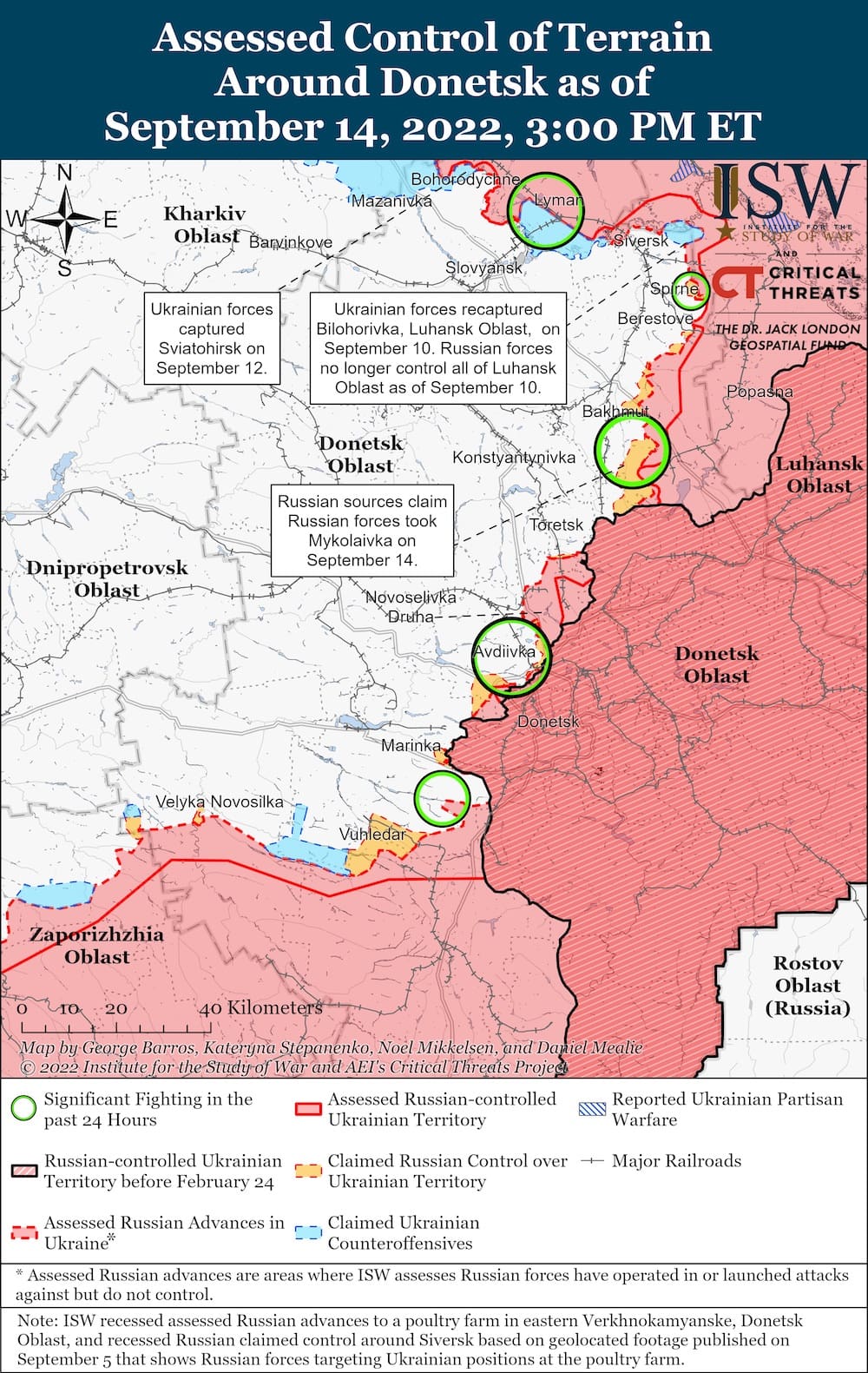
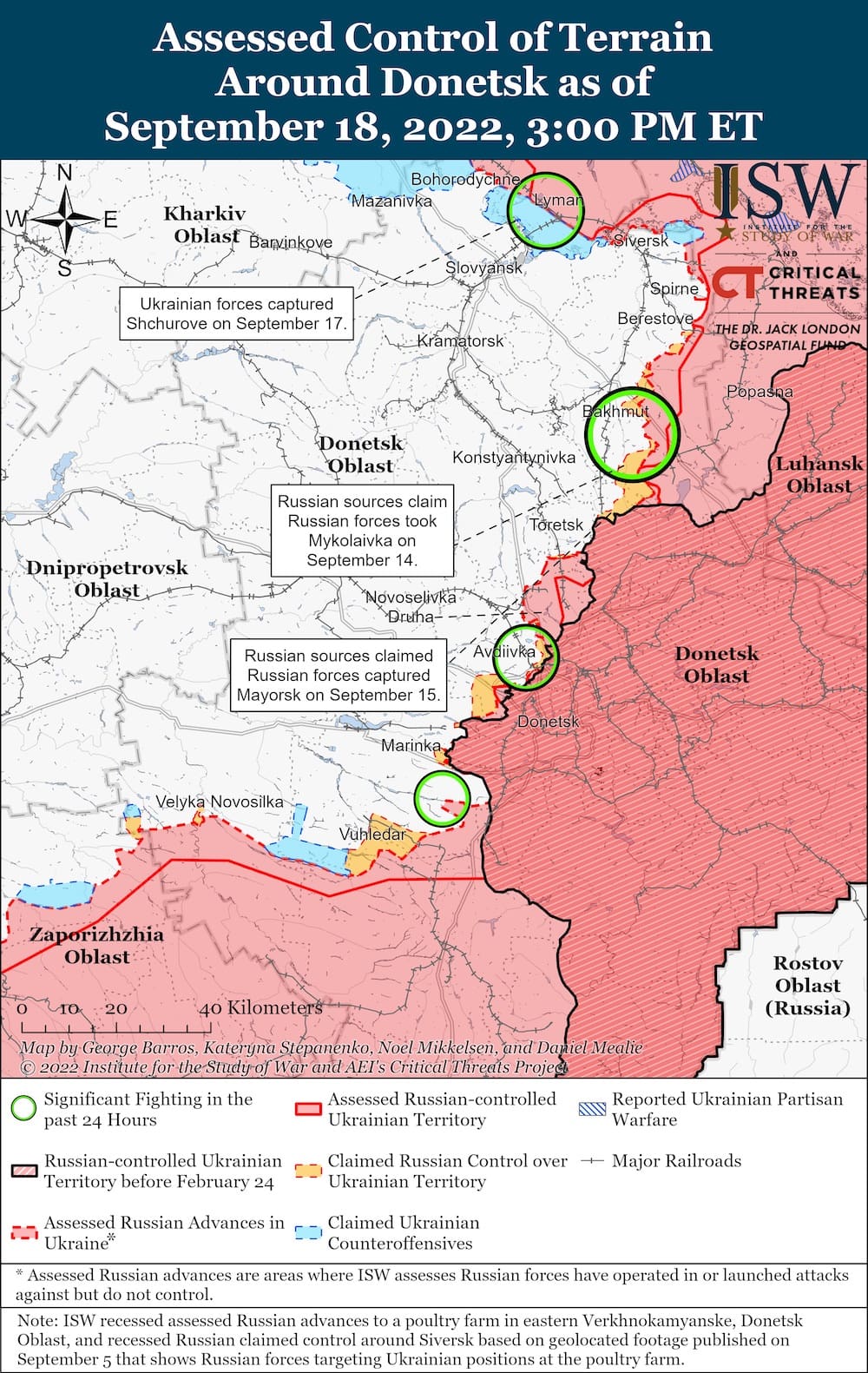
With this article we shall first briefly stress why it is important to look at a comprehensive set of scenarios, and why it matters even more in the context of a war where information is degraded by the use of propaganda or psyops. Then, we shall focus not on the scenario favoured in the West, which predicts a victory of Ukraine, as this scenario is well-known, but describe another scenario, different from the most common narrative. We shall call it the Red Scenario, in reference to red teaming (taking the point of view of the enemy). We mainly present explanations rather than scenario narrative (story-telling), using maps tracking the evolution of the control of the terrain in Ukraine by the two protagonists and established daily by the Institute for the Study of War. First we present our key hypotheses and then develop an explanatory narrative according to phases during the war.

The need for alternative scenarios

Useful and actionable scenarios are constituted in a set with evolving likelihoods

Many commentators tend to focus on a single scenario highlighting a Ukrainian victory and a Russian defeat. The current Ukrainian counter-offensive goes hand in hand with the Russian “debacle”, “rout”, “disaster”, “disintegration”, etc. This is indeed one scenario. Its narrative runs more or less as follows:

The current counter-offensive heralds coming successes for the Ukrainian army while showing deep seated problems within Russian forces that will lead to a string of defeats, until Moscow is vanquished.

However, proper foresight must consider all possible scenarios (see FAQ on scenarios), even those that are unlikely, contrary to one’s objectives or unpalatable. Actually those scenarios are even more interesting because they are those that allow for the best planning, for truly countering the enemy and finally for victory and success.

The likelihood of seeing a scenario taking place actually is something that is separated from the narrative of the scenario itself. The key variables for a set of scenarios are used both to craft the narrative and then to assess the probability of the scenario. Yet, to create a specific scenario for this set does not mean that this scenario is more likely than another. A good set of scenarios must consider all possible scenarios. Then according to reality the probability of each scenario is assessed, varies and evolves. This is where scenarios become most useful, because they help steer policy. However, to be able to reach this lofty aim, we need first to have a complete set of scenarios, and not only a couple of pleasant scenarios that fit our aims, beliefs and wishes.

Overcoming potential propaganda

Furthermore, a swift Ukrainian victory by heroes in the framework of a Russian rout could also be a way to narrate events that is part of the information operations (I/Os – psyops) of Ukraine and its allies (see Helene Lavoix, “Information Warfare and the War in Ukraine“, The Red Team Analysis Society, 24 May 2022). More surprisingly but not impossible, it could even be part of Russian I/Os and deception, as Russia is meant to be a master at using “reflexive control” (refleksivnoe upravlenie / рефлексивного управления).

As during war information is degraded and as we shall not know with certainty what is truly taking place on the ground until archives are opened – i.e. in 30, 60, or 100 years according to cases and countries, we need to rely on scenarios. Scenarios allow to make hypotheses and to take into account uncertainty, which is key when information is lacking or of dubious quality. Furthermore it will help us stretching our minds, asking inconvenient questions and thus think out of the box.

A Red Scenario – Main hypotheses

Our first hypothesis for this scenario is that Russia has two major territorial aims in Ukraine and only two.

The first territorial objective, as declared when Russia launched its “special operation”, is to free and protect the territory of the two separatist Republics of the Donbass: the Donetsk People’s Republic (DPR) and the Luhansk People’s Republic (LPR) (Address by the President of the Russian Federation, February 24, 2022, 06:00, The Kremlin, Moscow).

The second aim can be inferred from the same Russian Address, and consists in protecting Crimea (Ibid.). This means creating strategic depth for the peninsula, which would allow protecting it from any Ukrainian threat.
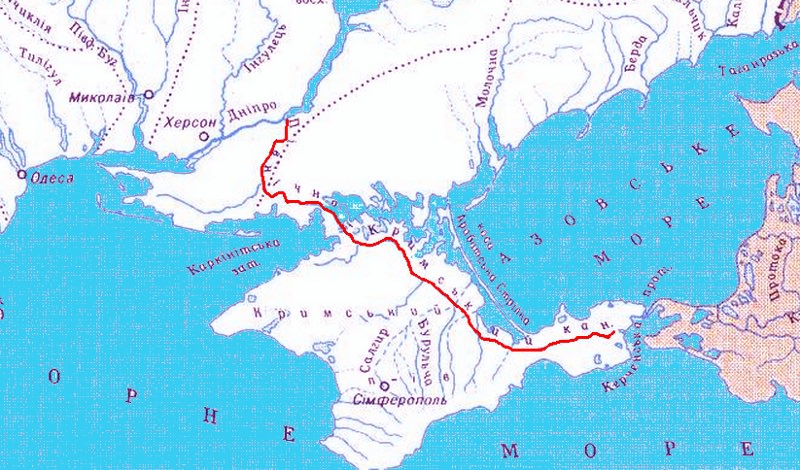
North Crimean Canal. Connects the Denpr at the Kakhovka reservoir with the east of Crimea – Berihert, CC BY-SA 3.0, via Wikimedia Commons

The importance of that goal is highlighted by one of the first actions of the Russian army on 24 February 22, thus at the very beginning of the war. It restored water flow to the North Crimean canal (Pivnichno-Krymskyi kanal) between the Dniepr River in Ukraine and Crimea, which had been cut off by Ukraine in 2014 (Reuters, “Russian forces unblock water flow for canal to annexed Crimea, Moscow says,” 24 February 2022).

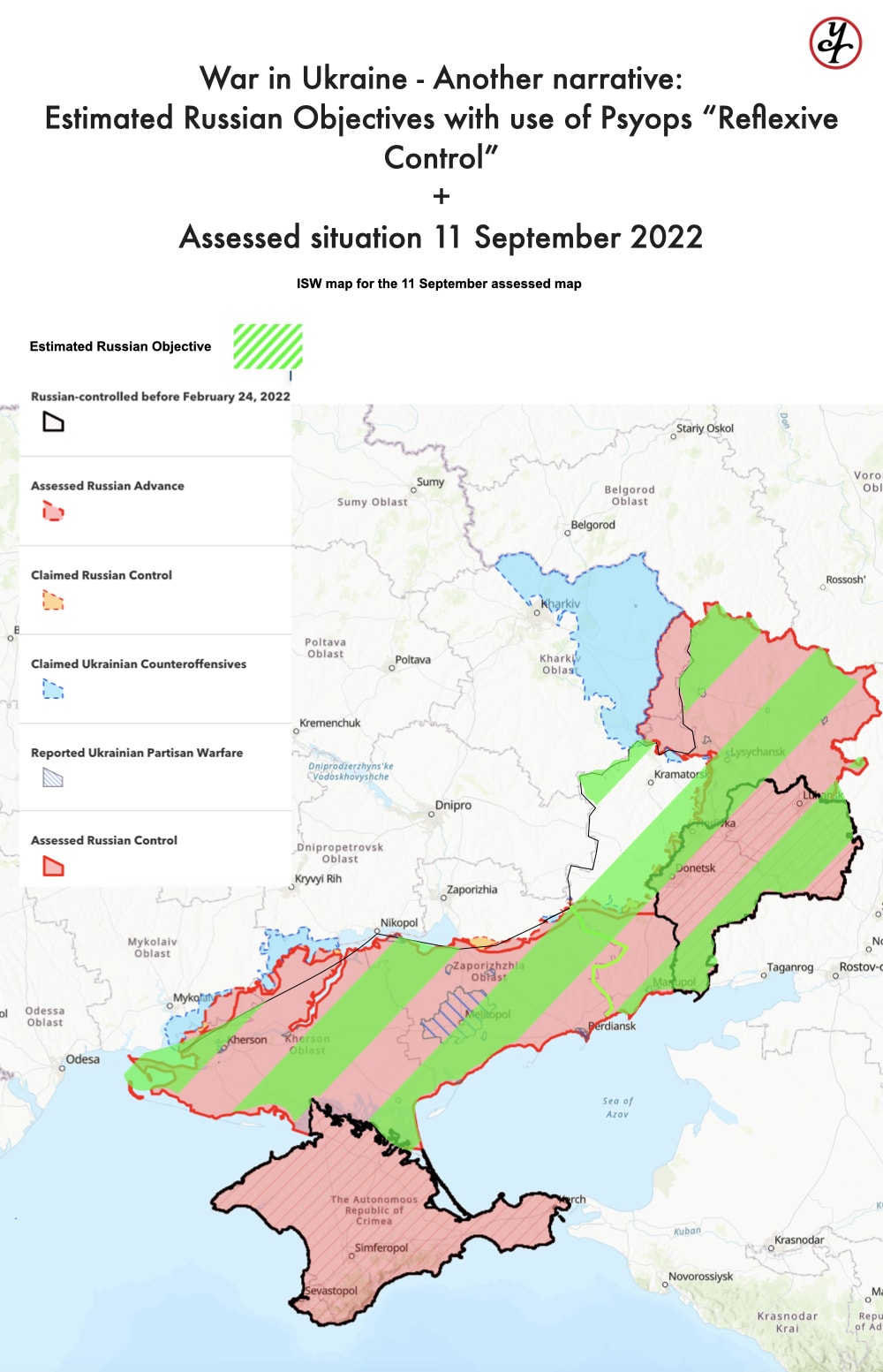
These territorial aims are shown on the map below. The size of the necessary strategic depth for Crimea is an estimate and may vary according to other factors. It is against this map that operations elsewhere will be evaluated.
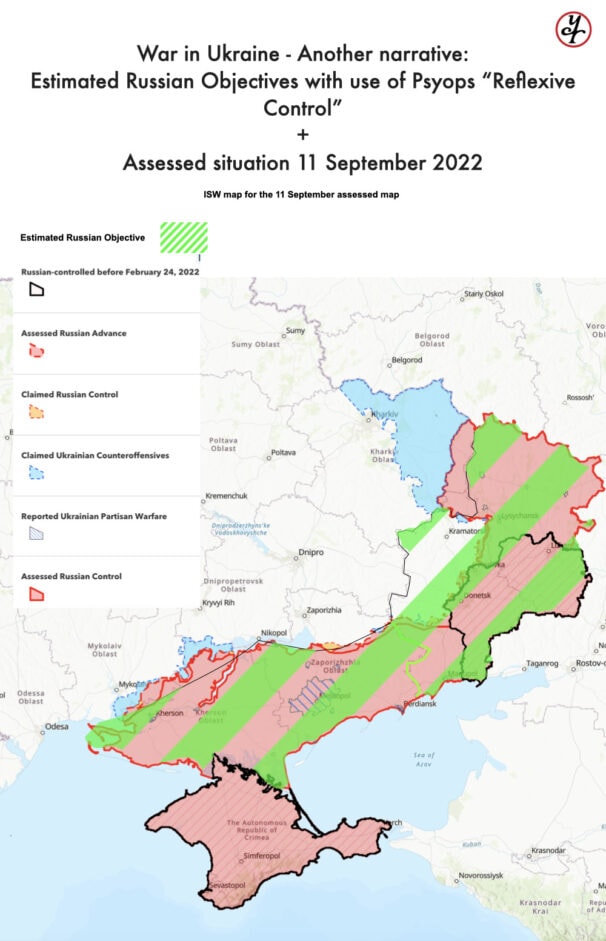
War in Ukraine 2022 – Russian objectives – Red scenario (on an ISW map as background)

The second hypothesis is that the Russian leadership is neither mad nor stupid, nor completely out of touch with reality, nor any of the extreme epithets and ungrounded emotional assertions that have been made about the Russian political authorities. This does not mean that leadership cannot be surprised. As for any system, analyses and evaluations may be flawed. Actions may not go as planned. The fog of war operates.

The third hypothesis or rather principle is that if something cannot be explained or understood when using prior reasoning and framework for understanding, then it is likely that the initial line of thinking is flawed.

A Red Scenario – Phases in the war

Phase 1 – 24 Feb 2022 to 29 March 2022

Creating the conditions for the conquest of the South (outside Donetsk and Luhansk Oblasts)

Considering the Russian territorial objectives for this scenario, all operations carried out outside Donetsk, Luhansk, Kherson and the southern part of Zaporizhzhia oblasts are either “decoy” operations or “negotiation” ones.

They aimed at focusing the attention and effort of the enemy and its allies on non-essential, indeed false aims. At best, if gains are achieved, they will be used for exchange during negotiation, against the territory that constitutes the real aim, or against other key objectives such as the neutrality of Ukraine.
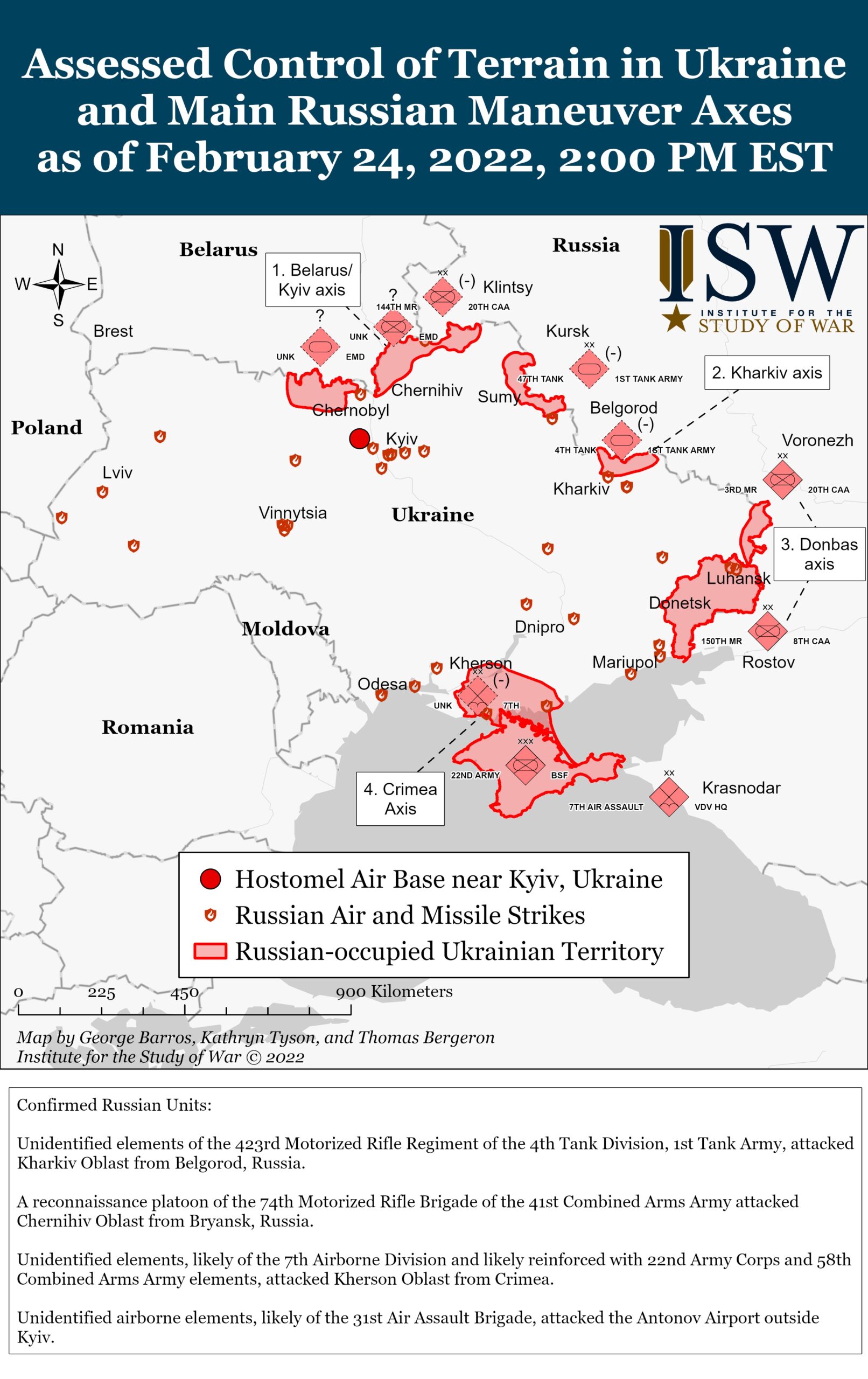
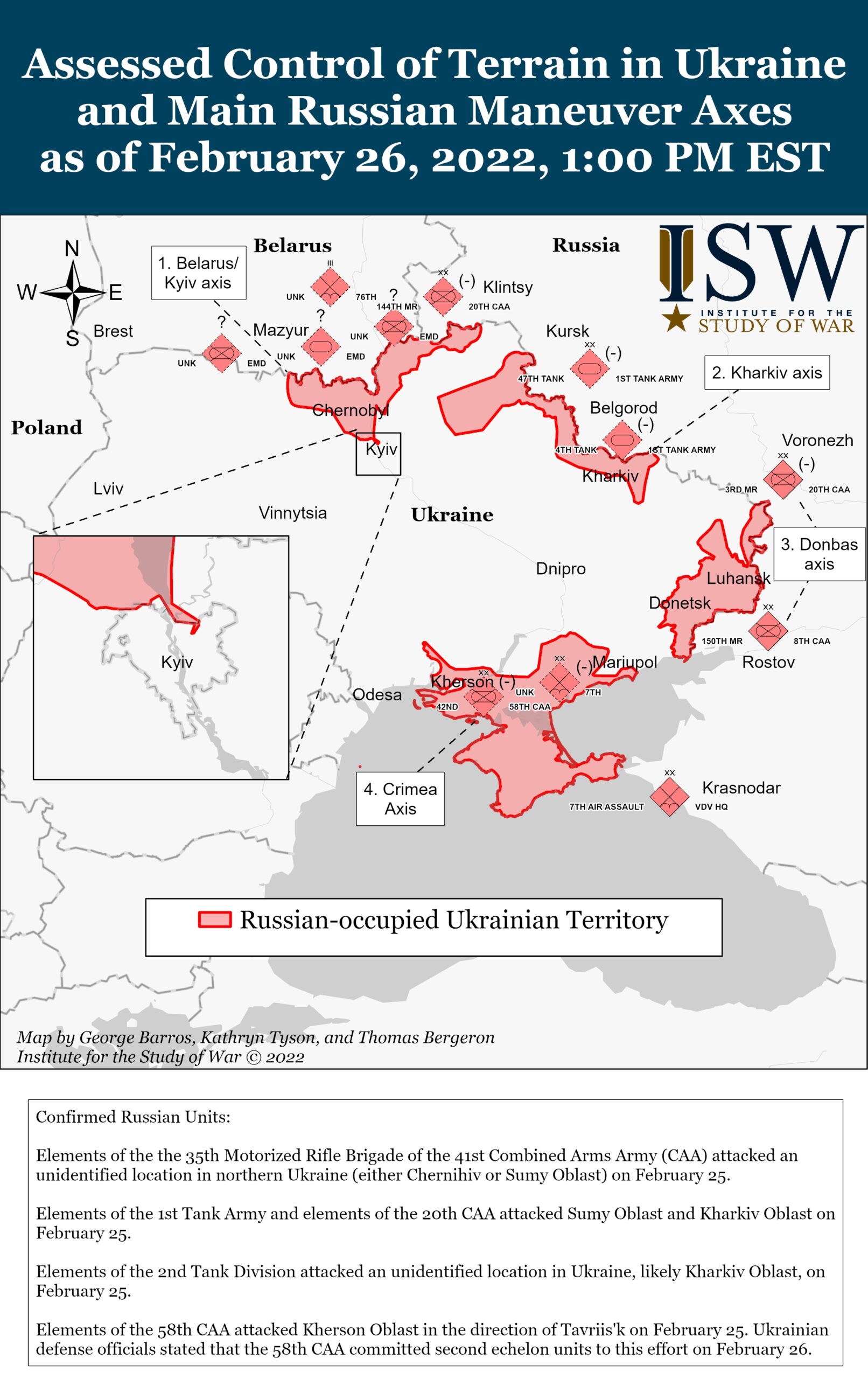
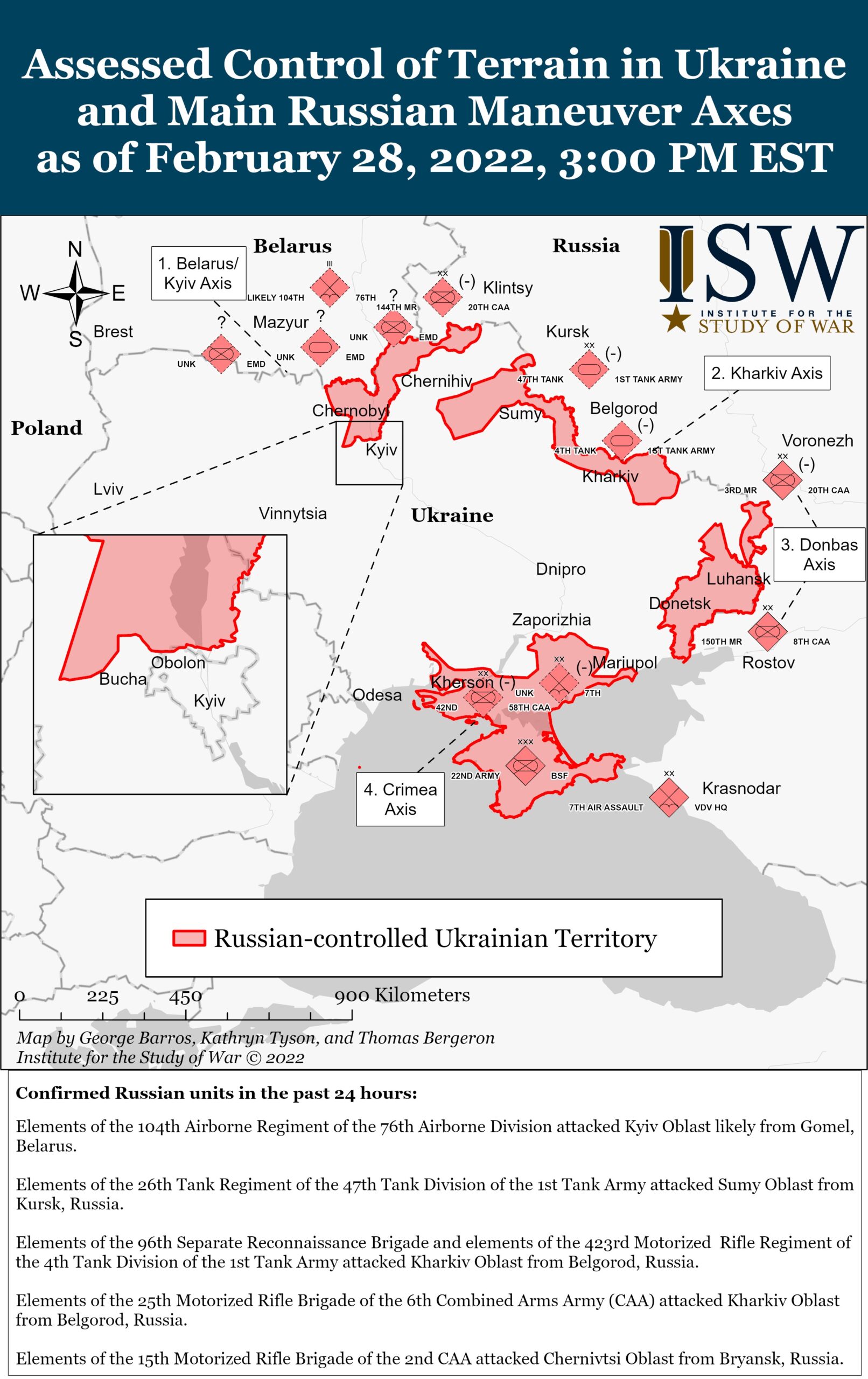
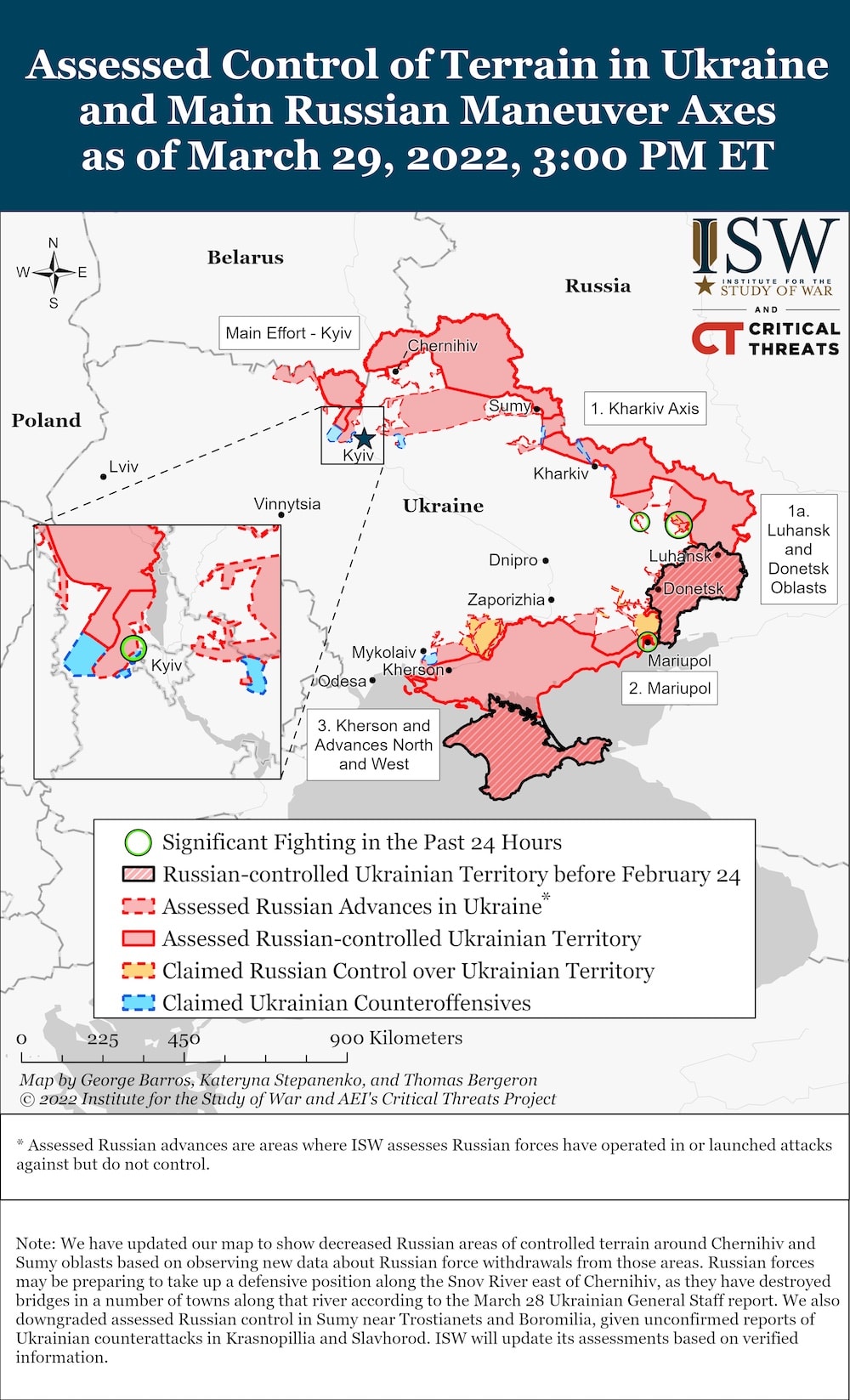
This phase ended on 29 March 22. Then, in the framework of the negotiations taking place in Istanbul, Russian Ministry of Defence announced to “fundamentally reduce military activity in the direction of Kiev and Chernihiv” in order to “increase mutual trust for future negotiations to agree and sign a peace deal with Ukraine” (DW; Asia Times 29 March 22).

As far as its territorial objectives are concerned, in one month, the Russian side succeeded in creating strategic depth for Crimea by taking a large part of Kherson and Zaporizhzhia oblasts. It made the junction with Donetsk Oblast or rather, from a Russian perspective, the DPR. It gave the latter its connection to the sea. Finally, it conquered a large part of Luhansk.

However, hardly any progress was made in the western part of Donetsk Oblast, which remained strongly in Ukrainian hands. There, the 2015 “contact line” acts as a quasi border where an attrition war started and would last.

All other territorial gains and operations – which includes Kiev, despite Western beliefs – were secondary or part of Russian psyops and could be abandoned to consolidate the territory taken that is part of the objectives.

On 1st April 2022, the massacres of Bucha and other locations around Kiev was then revealed, creating widespread outrage (e.g. Eliot Higgins, “Russia’s Bucha ‘Facts’ Versus the Evidence“, Bellingcat, 4 April 22). The negotiations stopped, despite initial Turkish hope to see them continuing (Daily Sabah, “Turkey expects more Russia-Ukraine peace talks, FM Çavuşoğlu says“, 7 April 22).

Phase 2 – April 2022

Withdrawal from the north and repositioning of forces on real territorial objectives with, as potential “decoy area”, Kharkiv Oblast

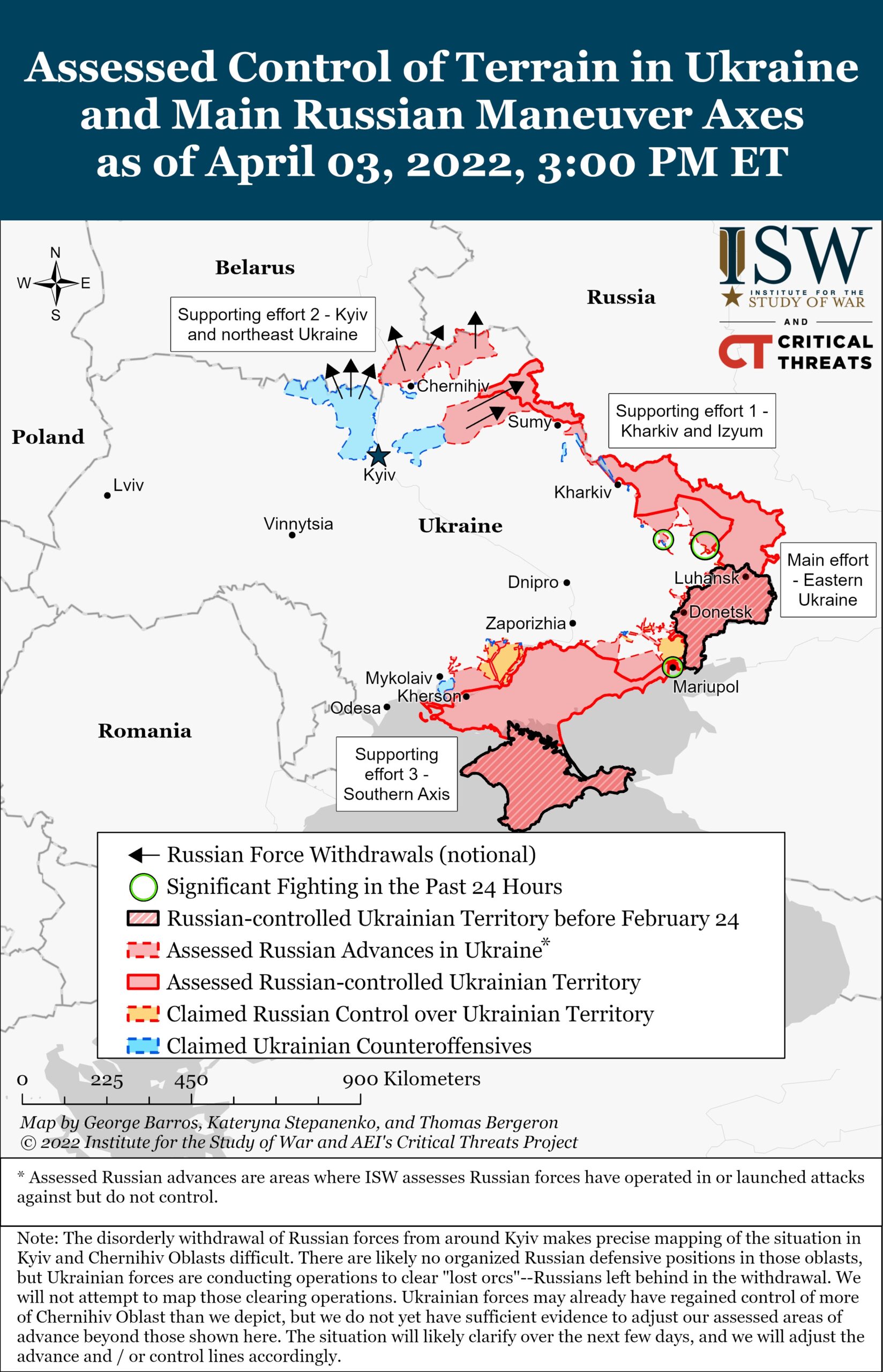
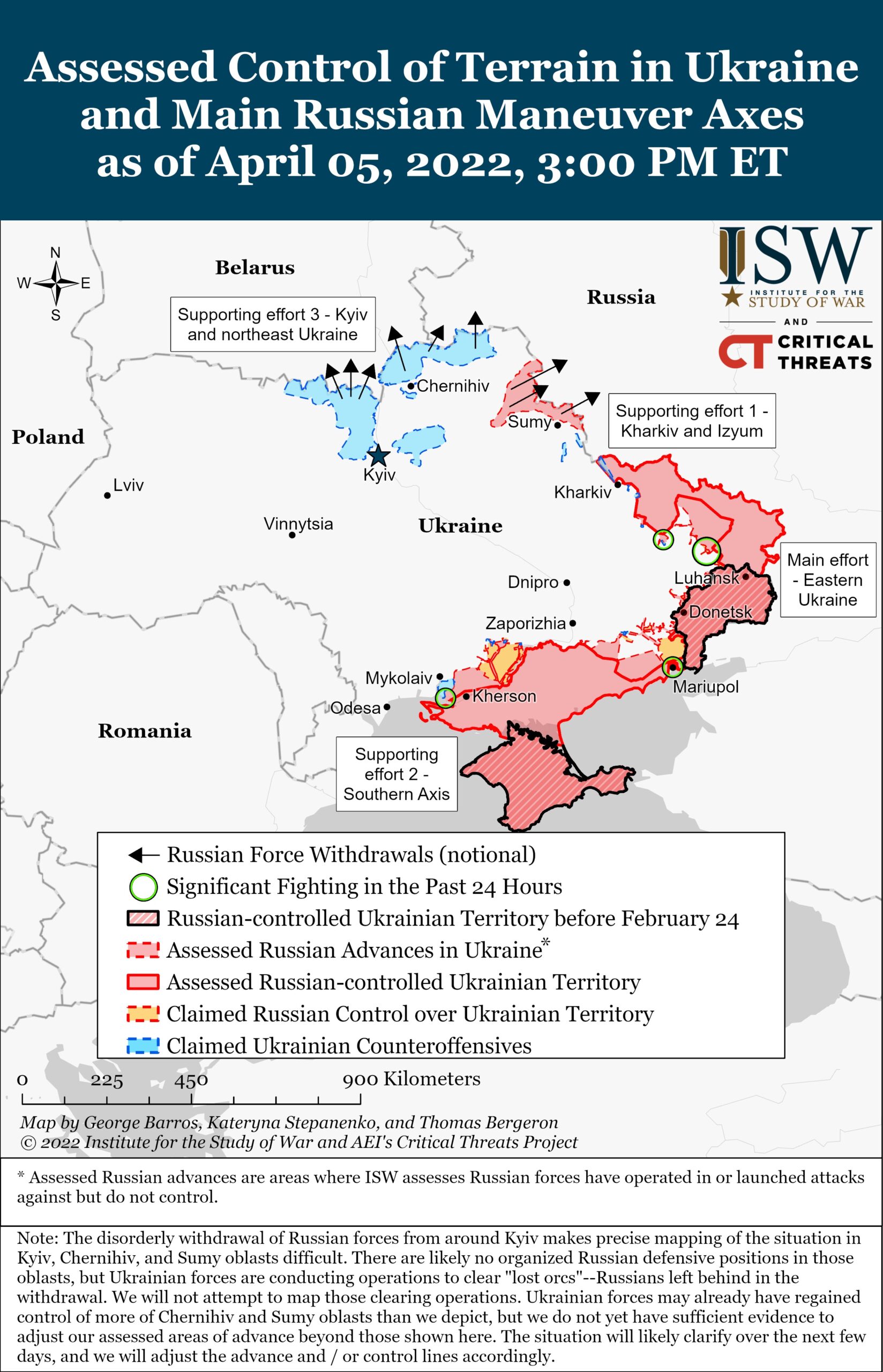
Throughout April, the Russian forces withdrew from all northern territories as stated at the end of March. They repositioned their forces where territory matters in terms of main goals and started consolidating what they had already conquered. Meanwhile they also began the slow grinding progress to conquer or free according to side the territory of Luhansk oblast for the LPR and of Donetsk Oblast for the DPR.

The only remaining territory not belonging to their main goals is in Kharkiv oblast. This area could then be used as “decoy” or way to pin down Ukrainian forces on areas that did not matter to the Russian side. The slow withdrawal from Kharkiv region started then.

Phase 3 – May 2022 to date

Attrition warfare, freeing/conquering Luhansk and Donetsk oblasts territory, keeping as much as possible of the southern oblasts.

Phase 3-1 – The conquest of Luhansk Oblast – Attrition warfare elsewhere

By 25 June 2022, in Luhansk, Severodonetsk fully fell to the Russian army (ISW, Russian Offensive Campaign Assessment, June 25). Lysychansk followed suit on 2 July and the border of the Luhansk Oblast was reached on 3 July (ISW, Russian Offensive Campaign Assessment, July 3).

Kharkiv Oblast remains a zone that is dispensable and does not belong to true Russian objectives. It is partly in Russian hands, but by mid-May, Ukrainian forces have regained a small part of this territory, east of Kharkiv (city).

Elsewhere, the frontline hardly moved compared with previous periods. Attrition warfare settled, with rather offensive objectives in Donetsk Oblast and defensive aims in Kherson and Zaporizhzhia Oblasts.

Assuming the new weapons Ukraine received from Western allies, notably the U.S., as well as intelligence and special forces support, and consequent Ukrainian actions do not change the strategic situation for Crimea, it is likely that Russia will mainly seek to consolidate its gain in the south.

The western part of Donetsk remains, however, apparently stubbornly out of reach. As it is the last objective that needs to be met, then it should be the focus of the next phase.
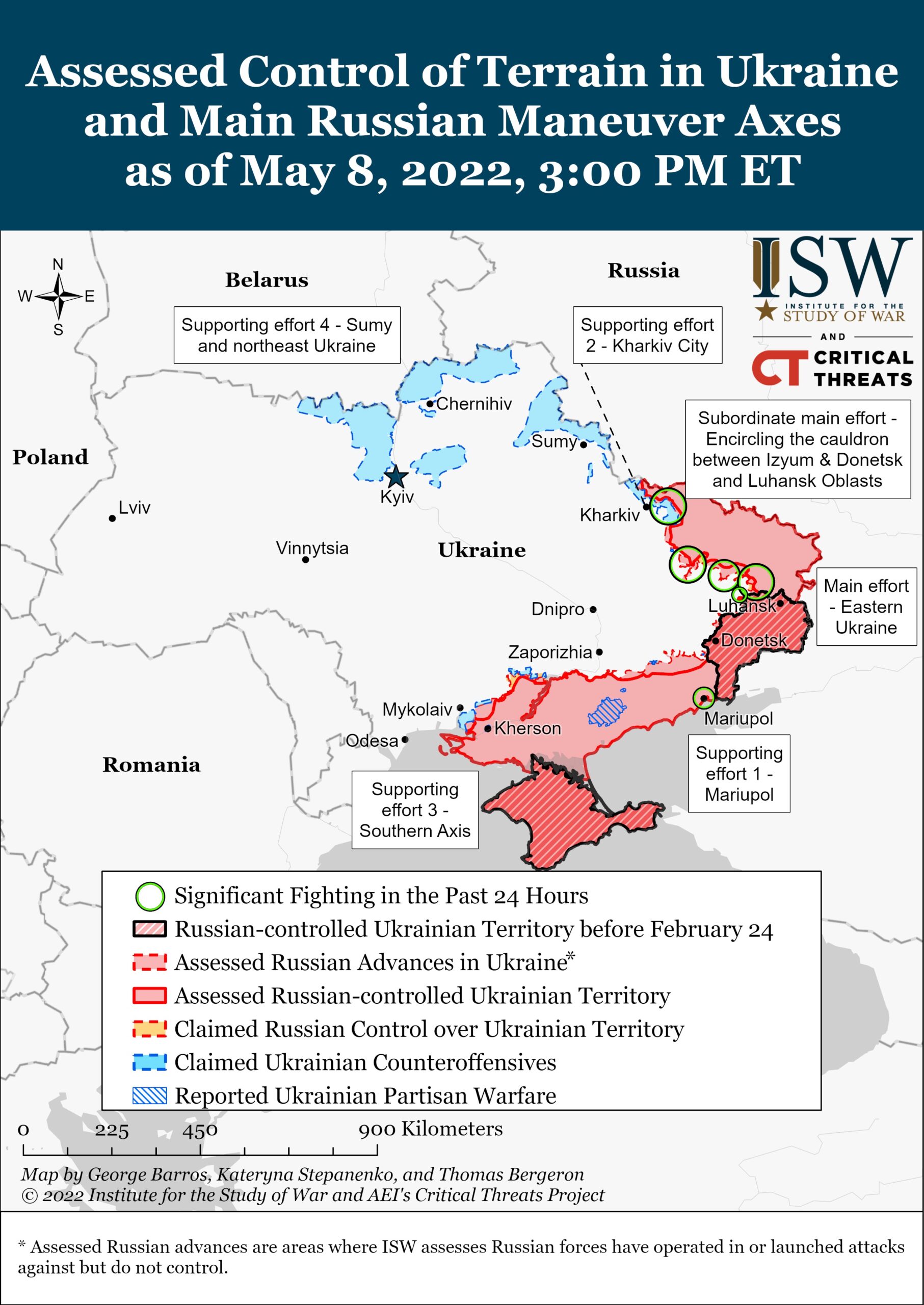
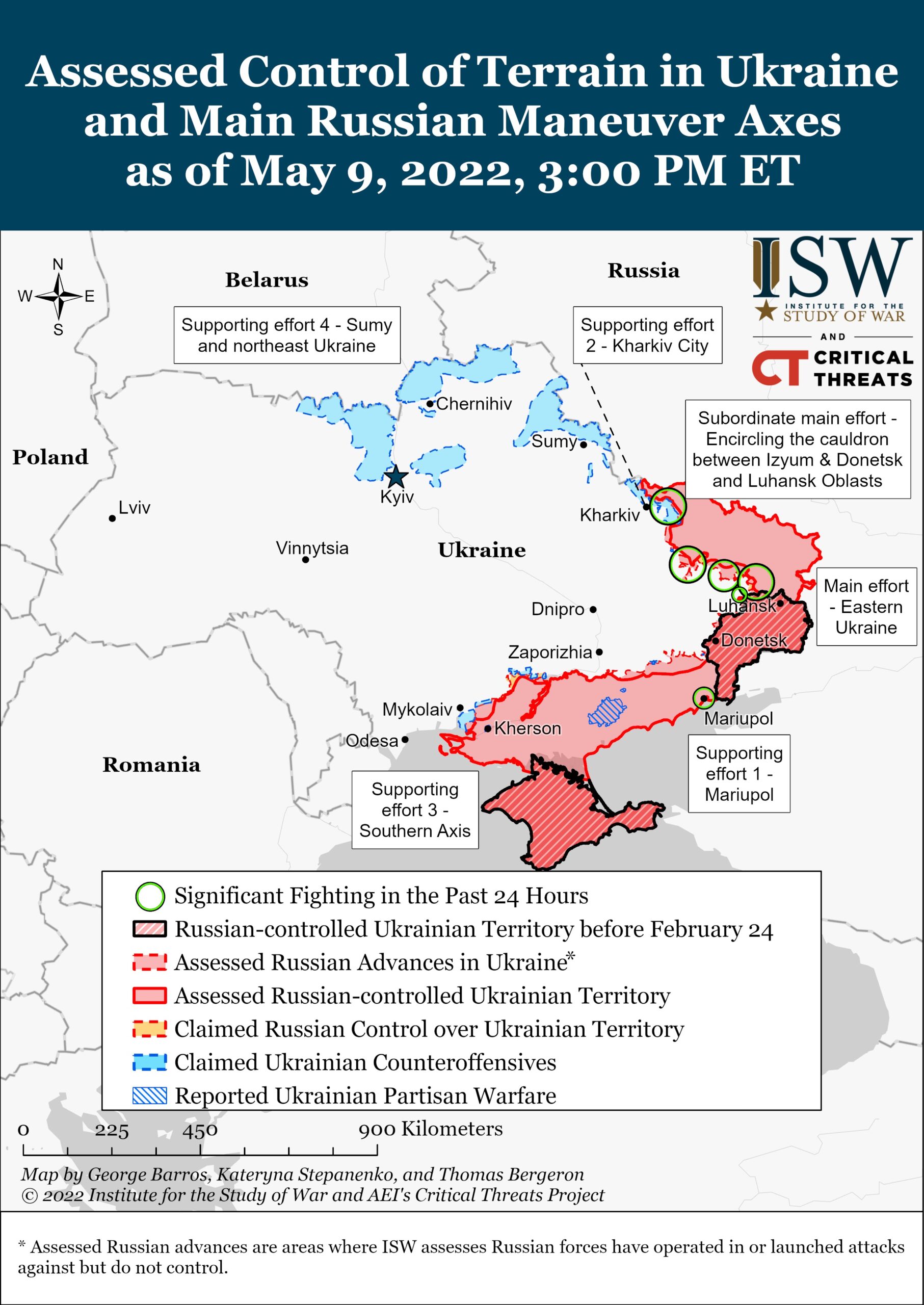
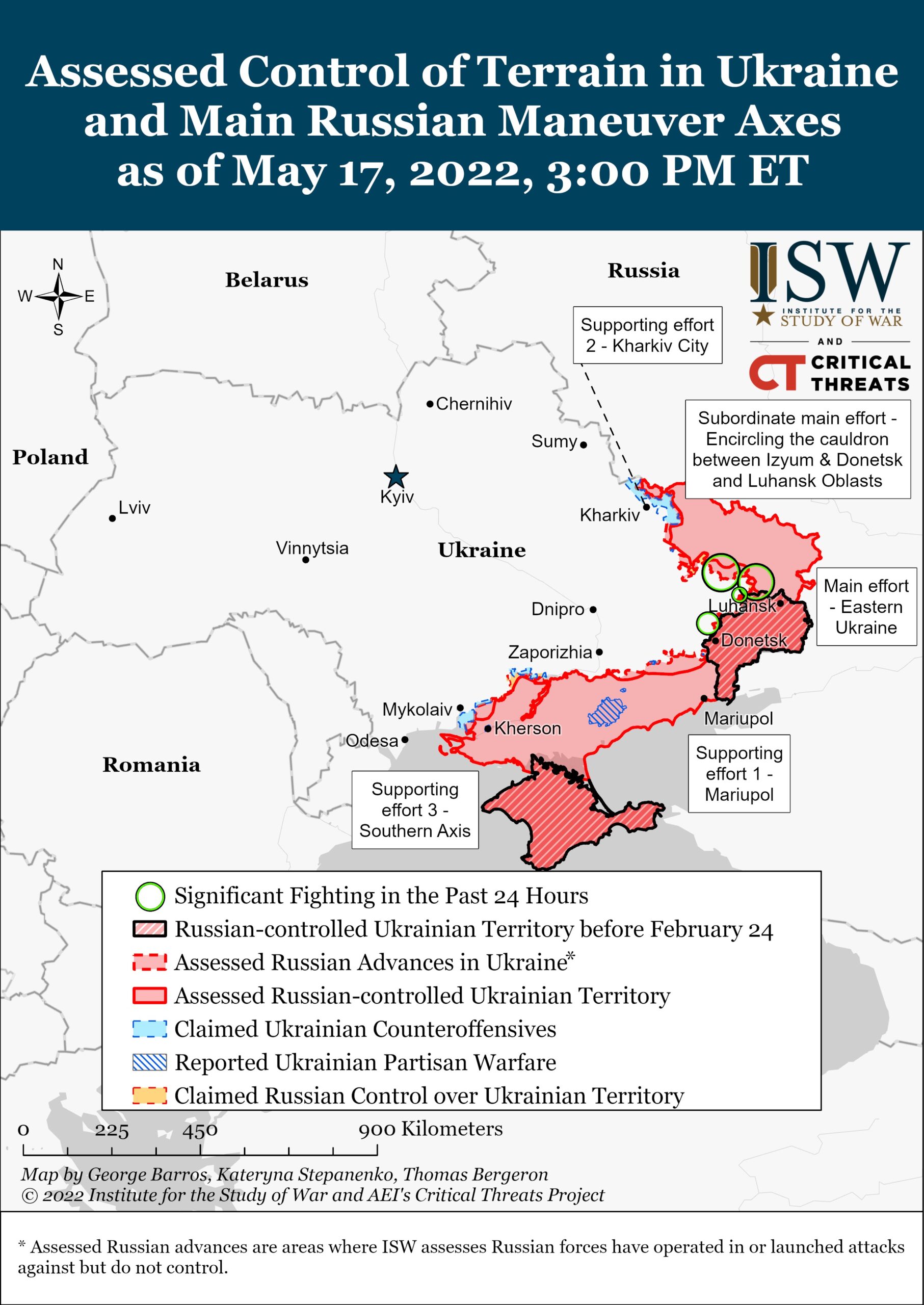
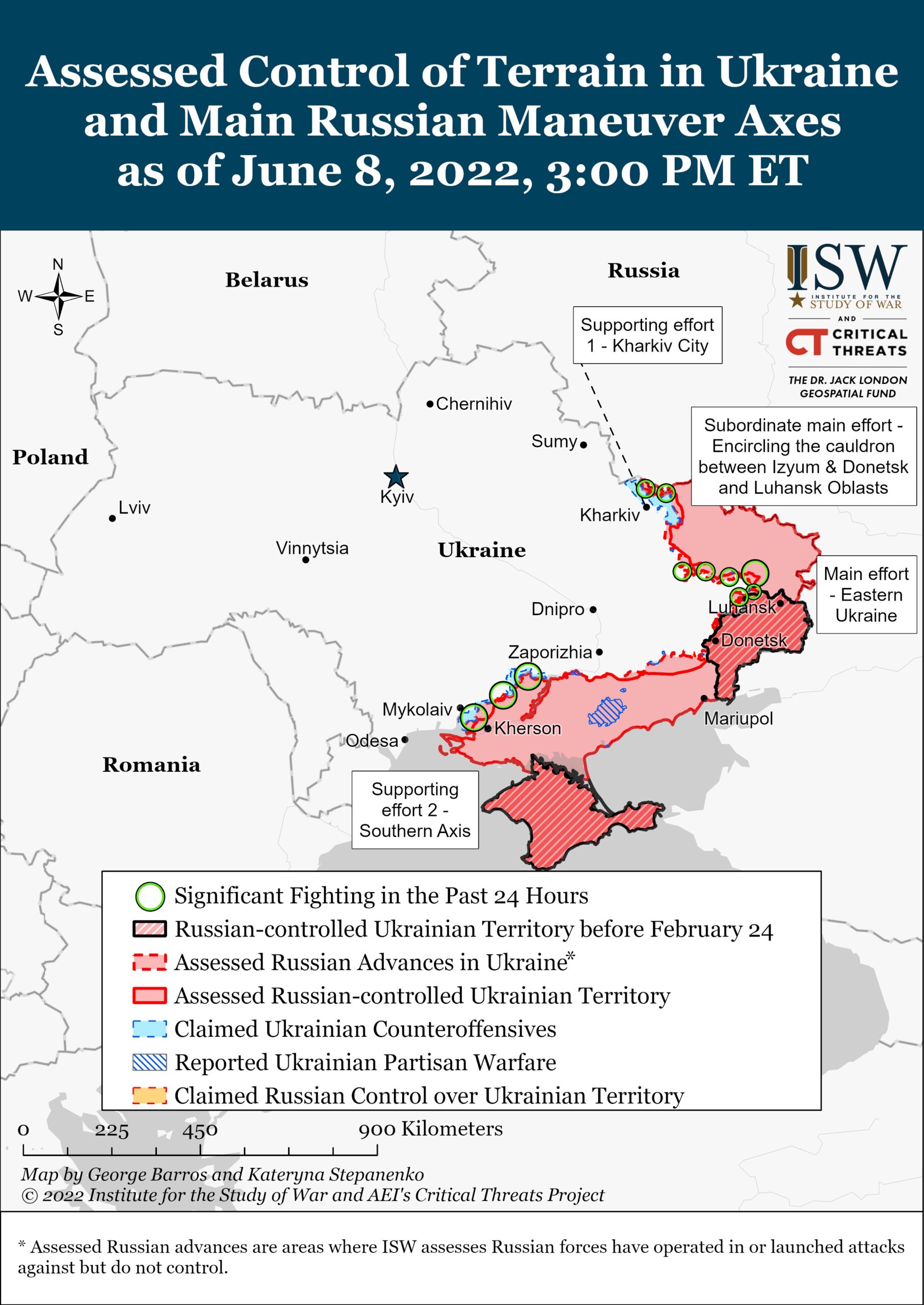
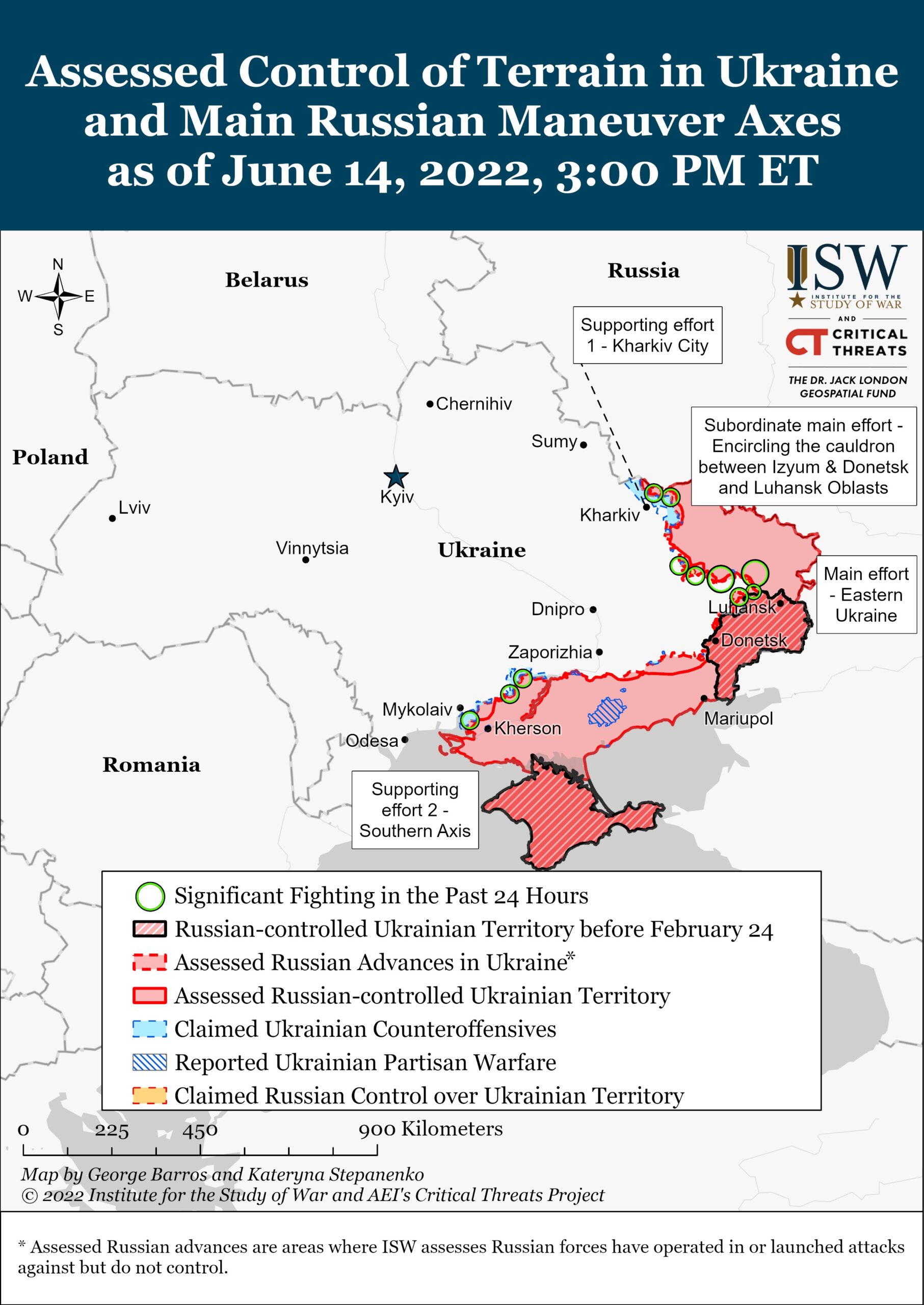
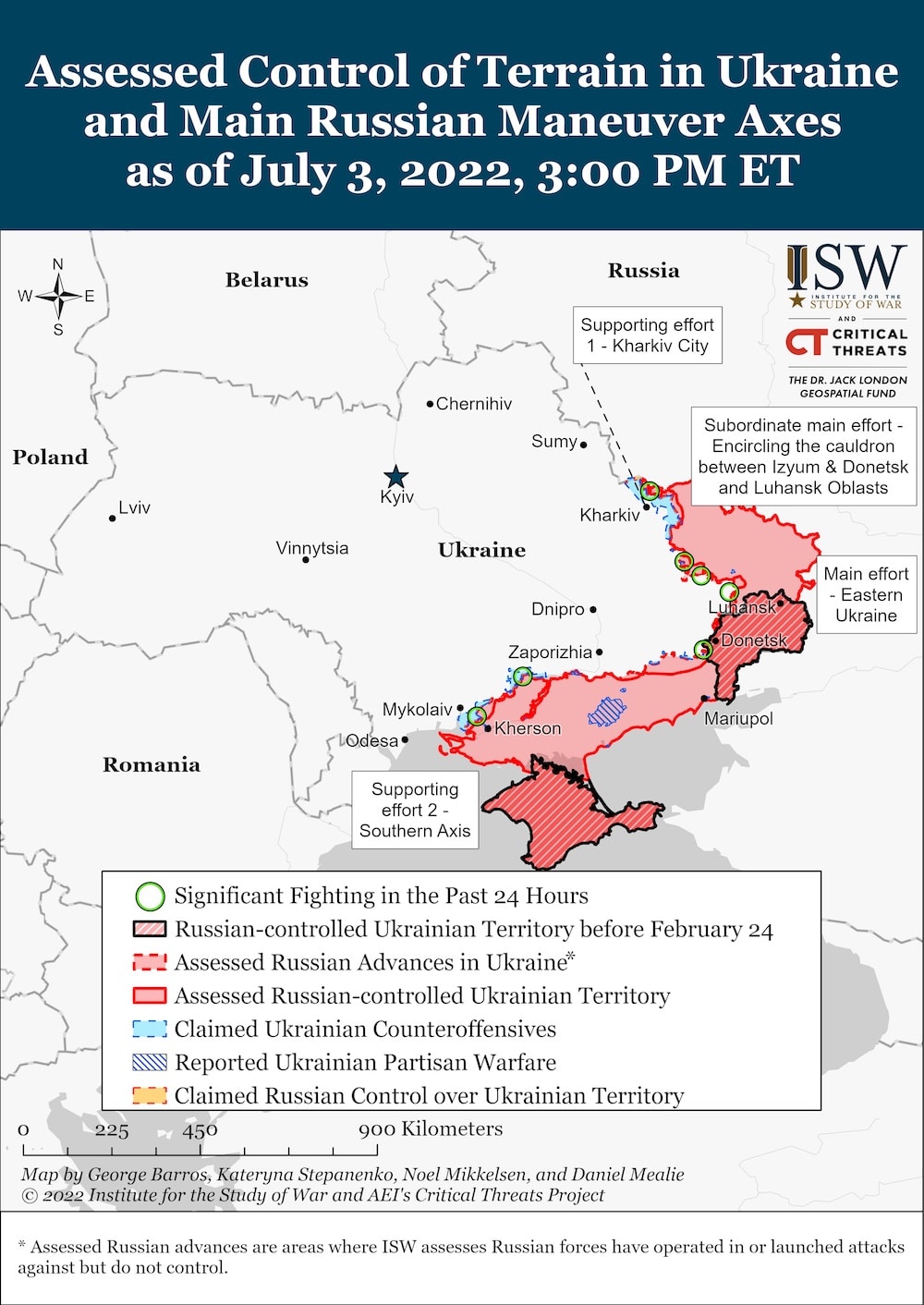

Hypothetical Phase 3-2 – Conquering Donetsk, Keeping what was taken and Ending the War?

Reflexive control again?

Russia must find a way to conquer what remains of the Donetsk oblast, which represents a large part of territory and demands overcoming entrenched Ukrainian defense. Meanwhile, it must also preserve what matters, the territory conquered that corresponds to its real objectives.

This also means countering the Ukrainian counter-offensive officially started on 29 August 22, but with earlier premises (Reuters, “Ukraine says long-anticipated southern offensive has begun“, 29 August 2022, Oleksiy Yarmolenko, Tetyana Lohvynenko, “The Russian army sacrificed a massive offensive in Donbas to strengthen its position in the south‘, 12 August 22).

By 14 September, Ukrainian troops have re-conquered 8000 sq km of Kharkiv oblast (DW, “Ukraine stabilizes counteroffensive gains in northeast“, 14 September 2022). Notably the Ukrainian army could mobilise enough men, with a smart strategy to surprise “the rather small Russian forces of the 144th Motorised Division reinforced with disparate independent units” (Michel Goya, “1918 en Ukraine ?“, La Voix de l’Epée, 11 September 2022). Russian forces did not really fight and the “massive Russian forces stationned in Izium retreated eastwards” (ibid.). Izium was re-taken by Ukraine (Ibid.). Actually, according to the maps below, the territory liberated seems to have stabilised on 12 September, and even up to 18 September with different declarations however (see below).
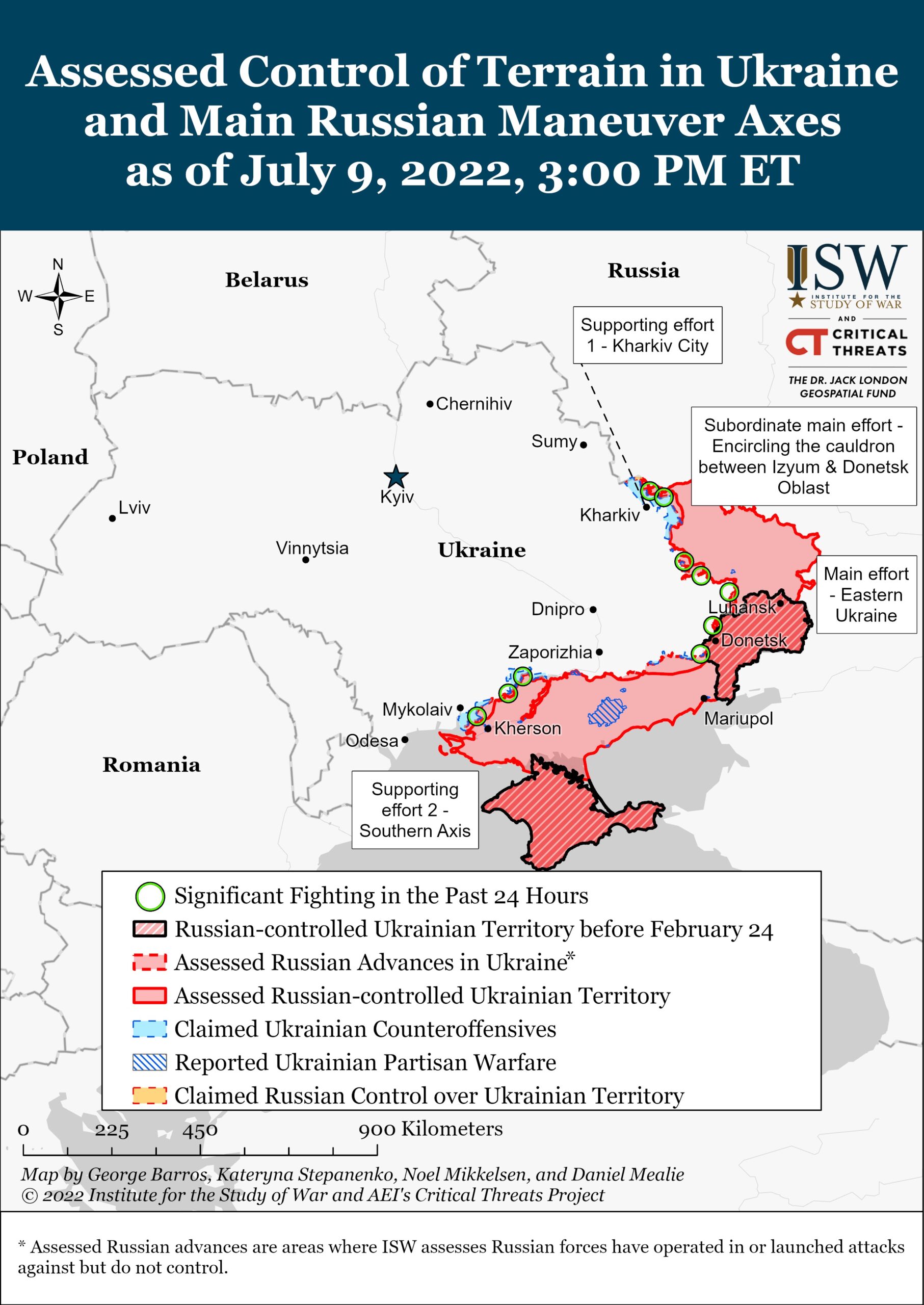
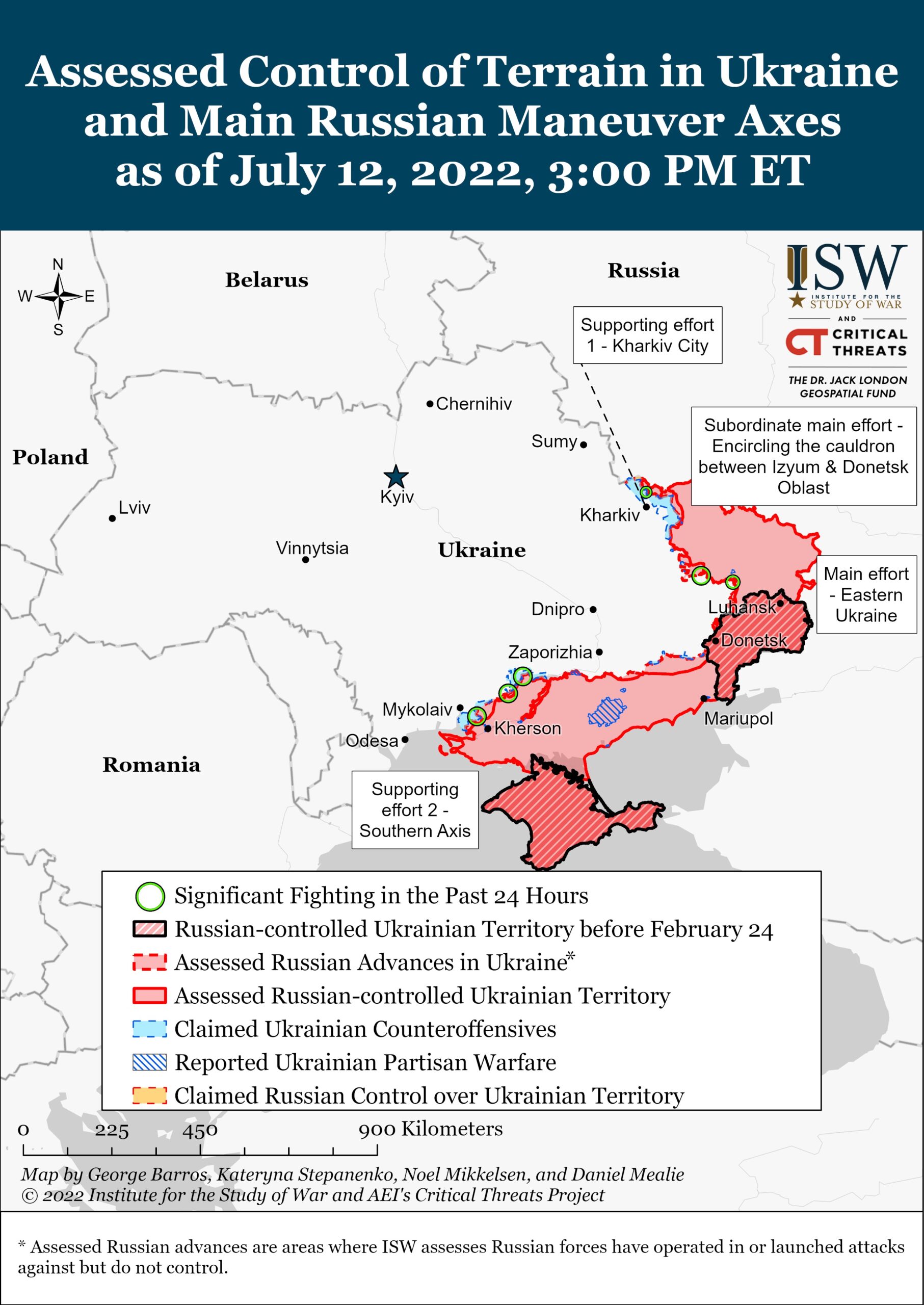
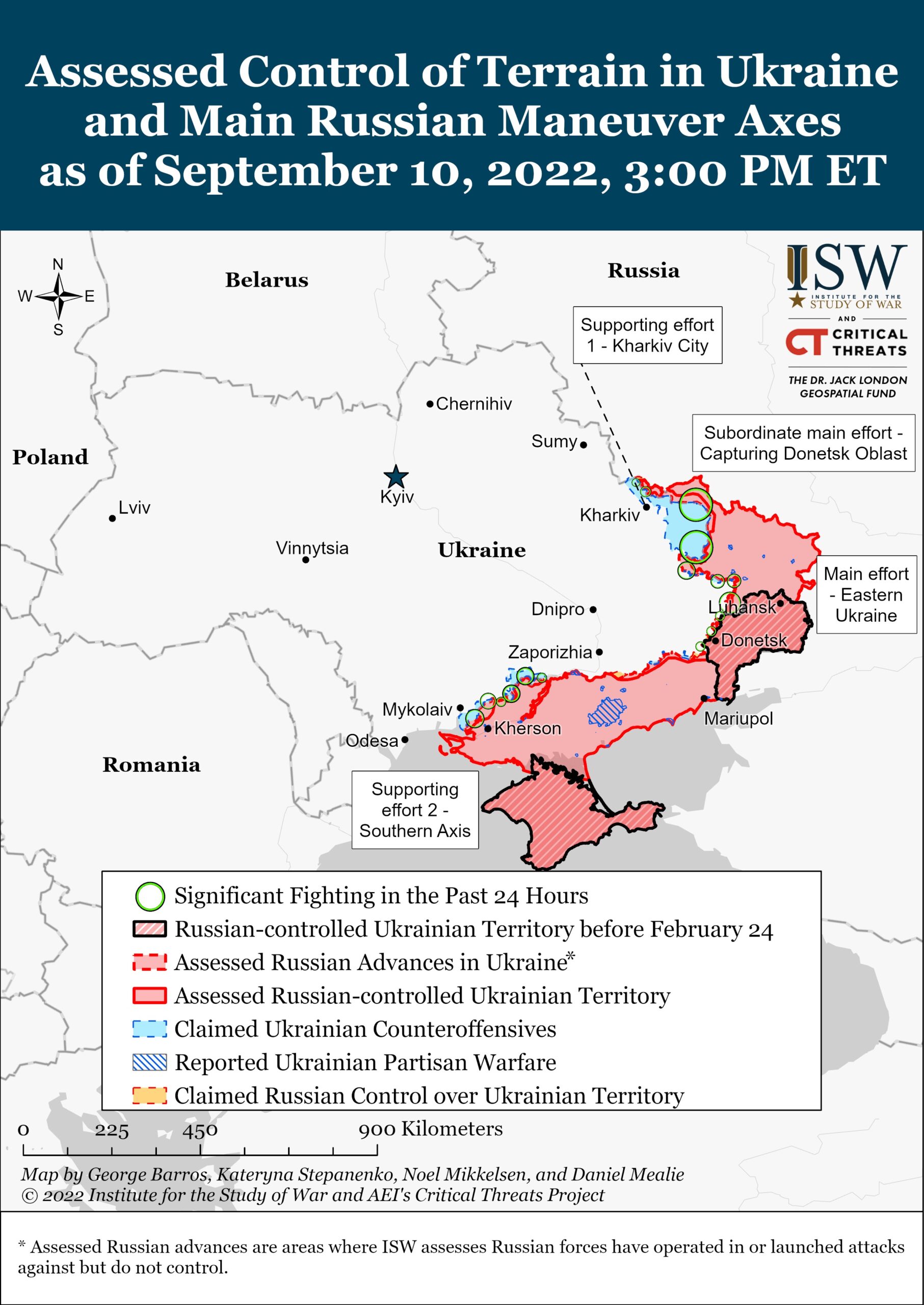
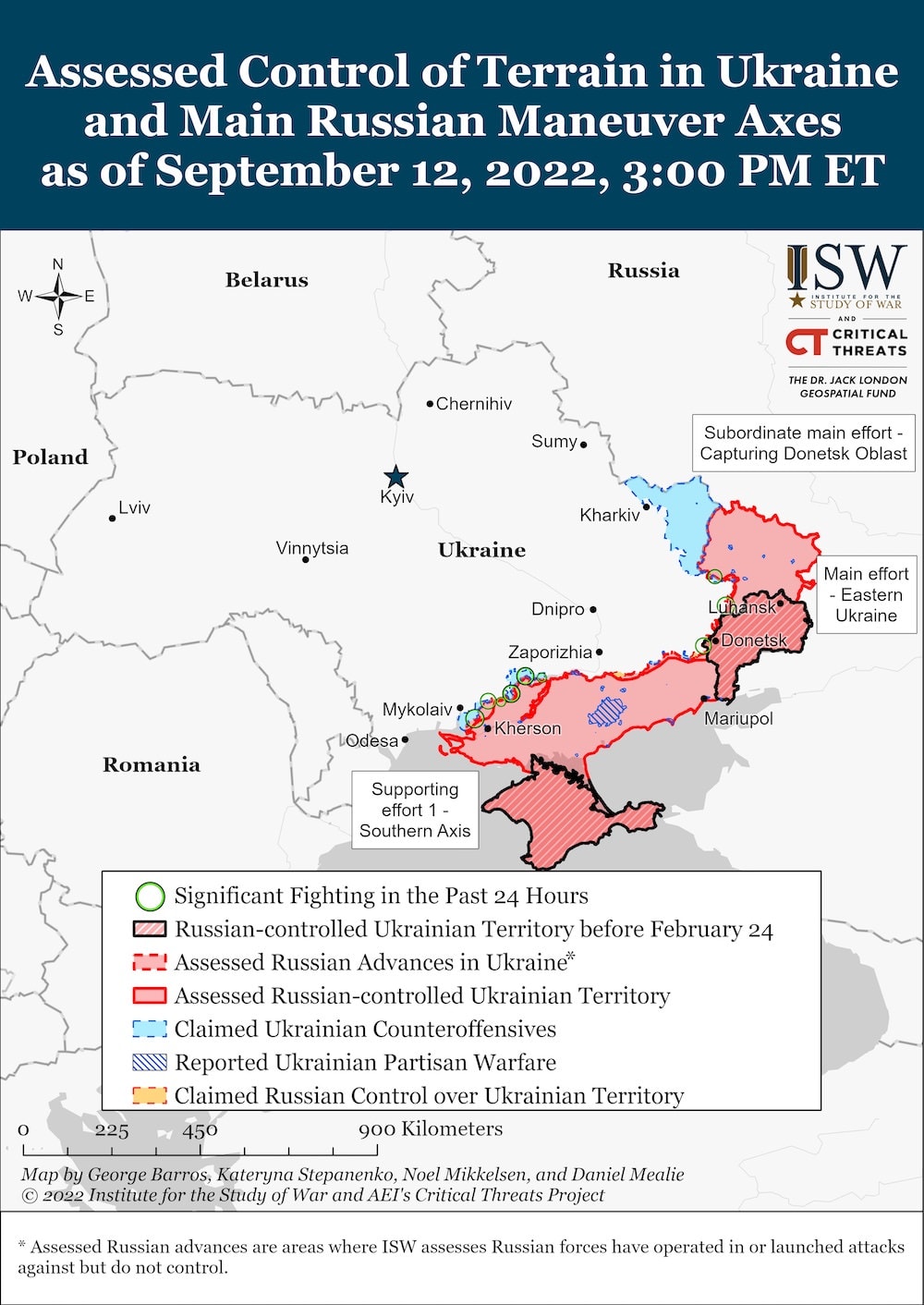
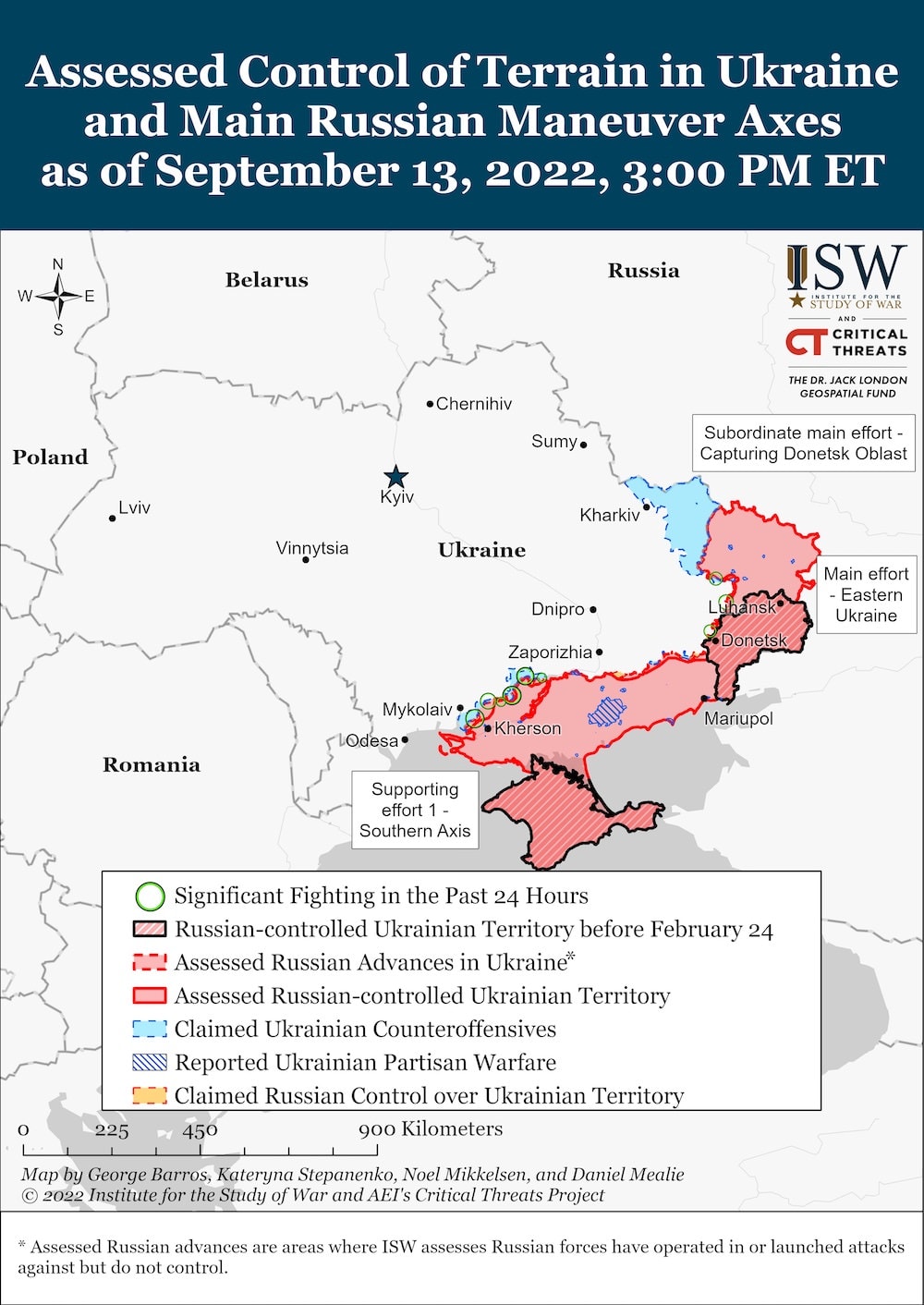
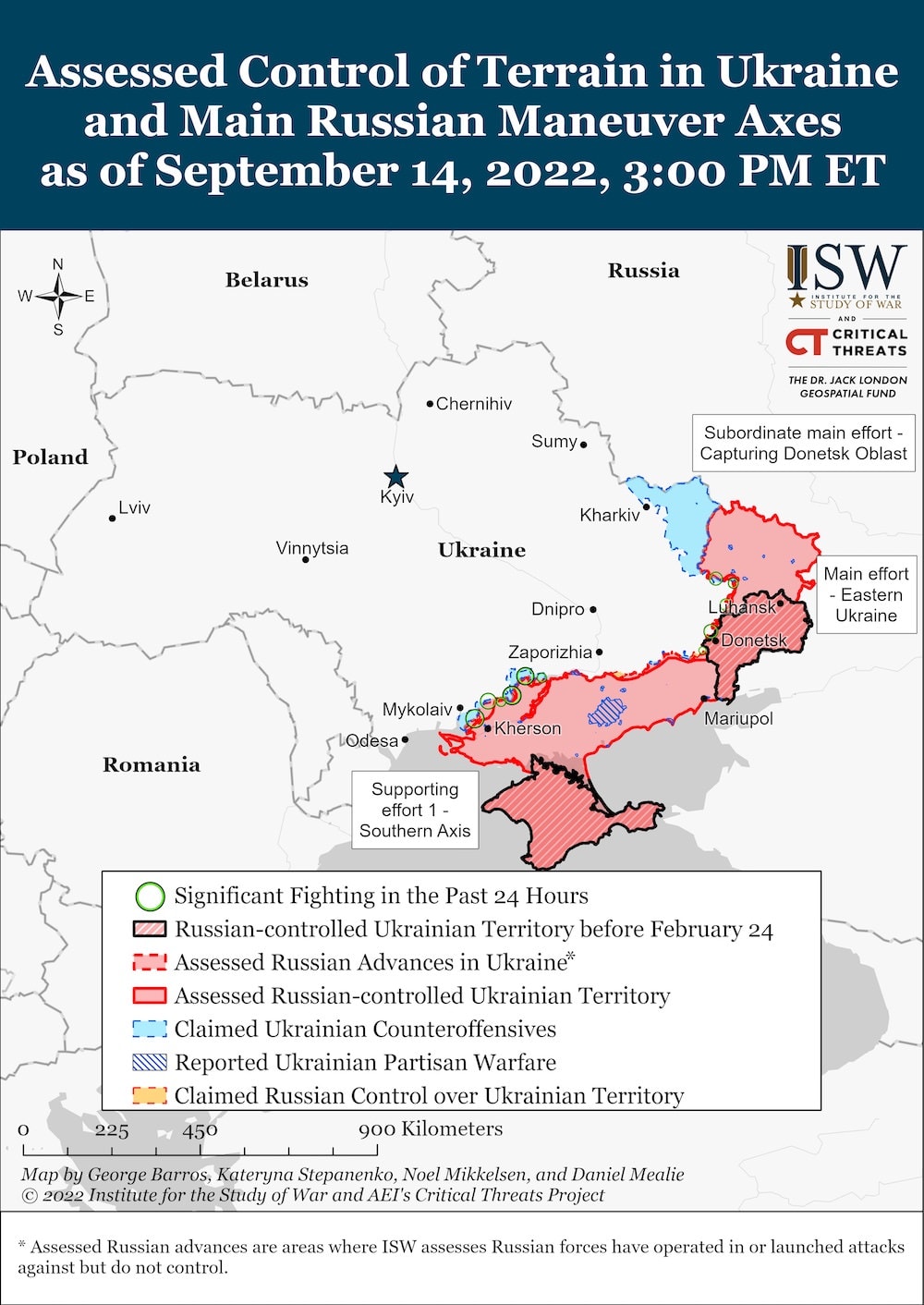
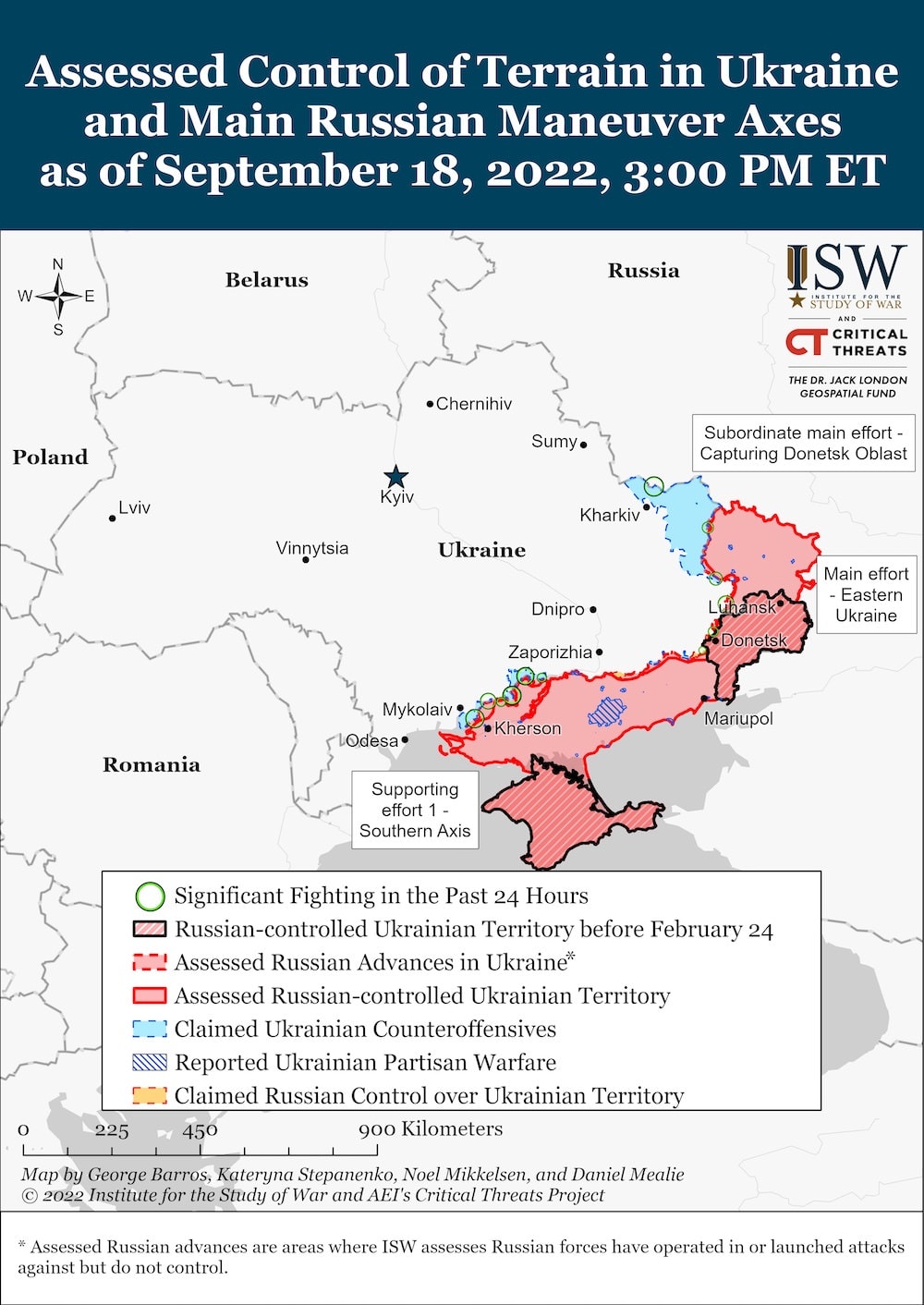
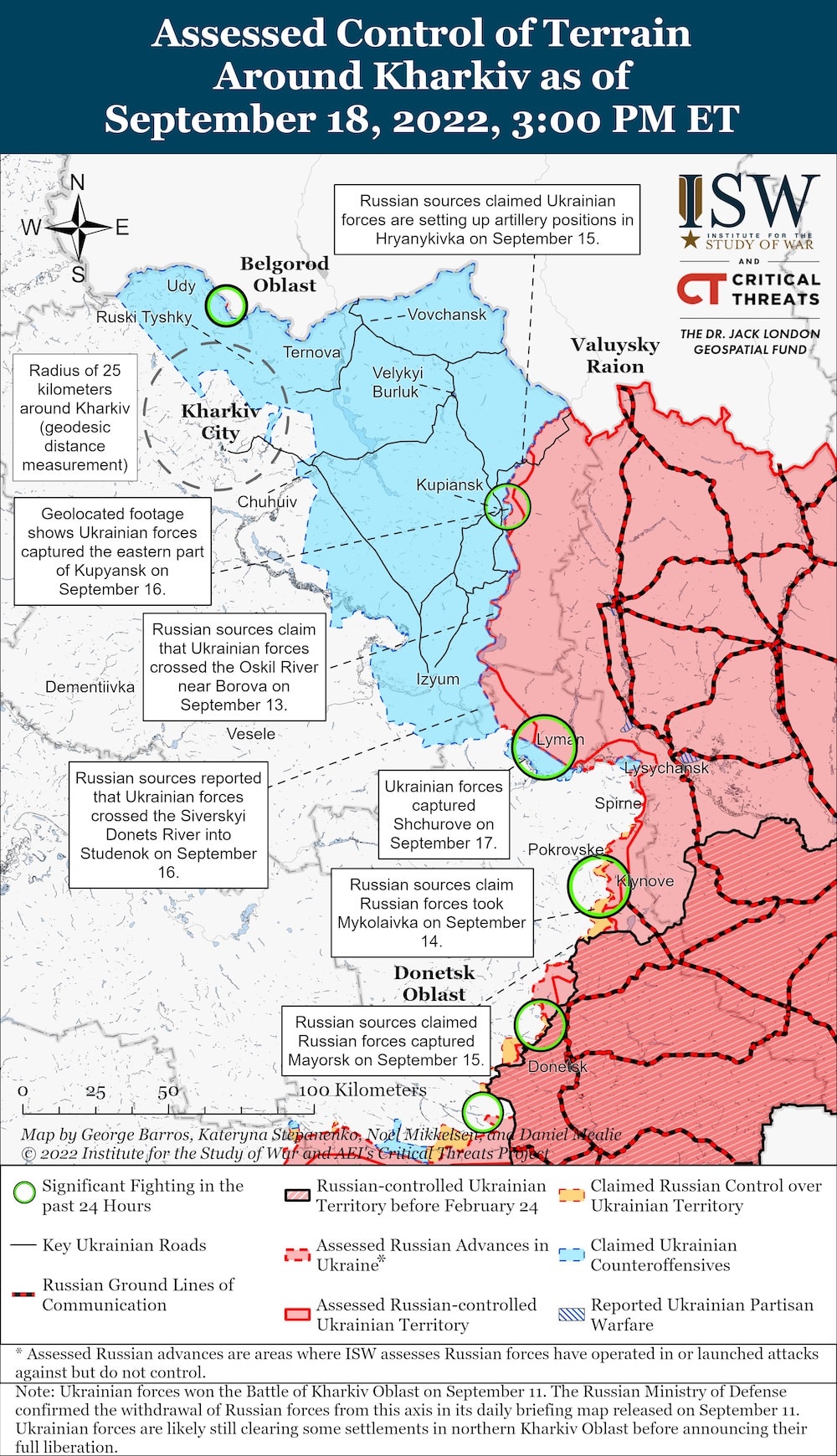

Whatever the rhetoric used to explain Ukrainian successes in Kharkiv oblast, be it withdrawal of Russian troops for repositioning elsewhere (Russian MoD Telegram) or plain defeat in losing a territory (by Western analysts and Russian nationalists military bloggers and discussions in the Duma as stressed by the ISW “Russian Offensive Campaign Assessment, September 13“), it remains that the territory held in Karkhiv was not part of the main Russian objectives. This area could, of course, have a tactical, operational and strategic use, but yet it was not part of the Russian aims. Furthermore, its value in obtaining territorial gains in Donetsk may not have been that high considering the absence of results of the previous months. Hence losing it may not be as crucial as commentators, whatever their nationality, including Russian, may think, if – and this is a key “if” – a new front line along the river Oskil, or along the border of Luhansk oblast is established.

The Russian “recognition” of defeat in Kharkiv that is hailed in the West as something new (see details in ISW, “Russian Offensive Campaign Assessment, September 13“) may not matter that much either, as long it is not followed by other defeats or series thereof in areas corresponding to main territorial objectives. In that light, the loss of a very small part of Luhansk oblast on 10 September may be far more important, if it were to be followed by other losses.

Moreover, considering Russian practice of reflexive control and psyops, we should not forget the possibility that not only the change of rhetoric regarding the Ukrainian victory in Kharkiv – i.e. Russia recognising defeat there – but also, most importantly the very swift loss of territory could actually be part of an information operation.

This could be a Russian version of Operation Fortitude, when the allies deceived the Germans about where they would land on D-Day. In terms of reflexive control, we may imagine that the Russians acted in such a way that they prompted the decision by Ukraine and its allies to attack militarily on Kharkiv oblast.

One possible indication that deception could have been at work comes from an inconsistency highlighted by military experts. Specialists wonder about the inability of the Russian army to detect “five armoured-mechanised brigades near the front in Zmiv”, despite all the Russian intelligence capabilities (Goya, “1918 en Ukraine ?“). The only explanations that are offered are a failure of tactical assessment in the chain of command and failure of understanding at highest level (e.g. Goya, “1918 en Ukraine ?“). Of course, these explanations may very well be correct. Yet, one possibility is not envisioned: would it be possible that detection took place and that nothing was done, purposefully, because something else is at work, indeed deception.

The questions we would need to ponder would then be: what would be the interest of the Russian leadership in not defending and thus losing territory? Then in acknowledging defeat? Which goals could this serve? Answers to these questions are multiple. For example, as far as acknowledging defeat is concerned, the ISW details some of them, notably in terms of Russian domestic politics with bearings on Ukraine. To these, we should also add answers, for example, that would be related to really repositioning Russian and pro-Russian forces on major objectives, to pinning down Ukrainian troops away from main Russian objectives, as well as answers related to creating conditions that could favour over-confidence in Ukrainian forces.

Of course, an alternative would be that indeed the Russian tried to focus their war effort elsewhere considering that Kharkiv oblast was not part of the main aims, that American and Ukrainian intelligence spotted it and that they smartly took advantage of the Russian strategy. If ever a “Reflexive Control” operation was at work, then in would have backfired.

Whatever the explanation, the Ukrainian advance also signals the disappearance of the last non-key position held by Russia, while a large part of Donetsk oblast remains to be conquered. A new line of front must be established that will be a defense line to protect Luhansk oblast, i.e. from a pro-Russian perspective, the LPR. This new front line could run along the Oskil River with as main cities Logachevka-Dvorichana -Kupyansk-Boroza-Lyman, possibly joining the Siverskyi Donets river. It would allow Russia to keep use of the railway, and protect le LPR “border”.

However, by 19 September 22, Ukraine would already be on the Eastern bank in some ares, and either fighting to keep that position, while Russia tries to repel Ukrainian forces (e.g. ISW, “Russian Offensive Campaign Assessment, September 18“), or in full control of it according to Ukrainian Armed Forces and President (Reuters, “Zelenskiy vows no let-up as Ukraine says troops cross Oskil river in northeast“, 19 September 2022).

If Russia proved unable to construct and hold that new front line, or if it considered the threat has now increased considerably considering the support given to Ukraine, then Russia might resort to escalate longer range attacks behind the front line to disrupt Ukrainian advances, as signaled by attacks during the first part of September (e.g. The Guardian, “Russian strikes knock out power and water in Ukraine’s Kharkiv region“, 11 September), or to other means. This could mean a change towards enlarging the scope of war. Russia could justify these attacks by a similar strategy used by Ukraine that now utilises longer range armament besides support such as intelligence provided by its allies, notably Americans, as well as foreign “mercenaries” and “advisors”.

Once the retreat, plus holding of the new front line, and repositioning are done, Russian and pro-Russian forces will likely focus on their main objectives, Donetsk oblast, while defending elsewhere, with the right bank of the Dniepr in Kherson Oblast – which includes Kherson – as potential focal line of defence for the south.

The choice of an offensive on Donetsk oblast could be supported by Russian advances south of Bakhmut over the second week of September, as shown on the maps below. Fighting also takes place in Spirne, Adviivka and south of Marinka. Russian advances are still small in terms of area, and the moves forward have only taken place on less than one week. We are thus more in the realm of signals than of certainty.
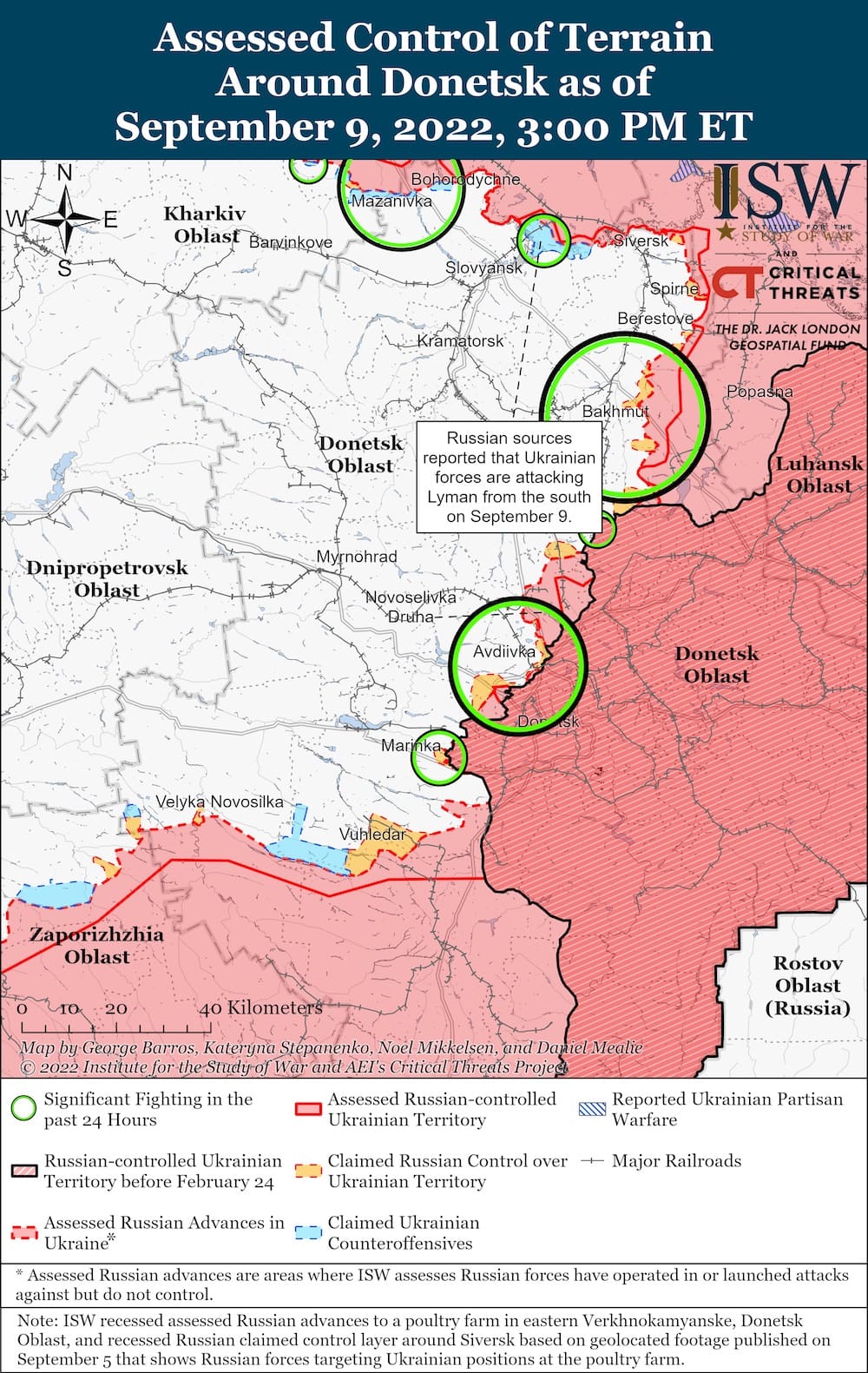
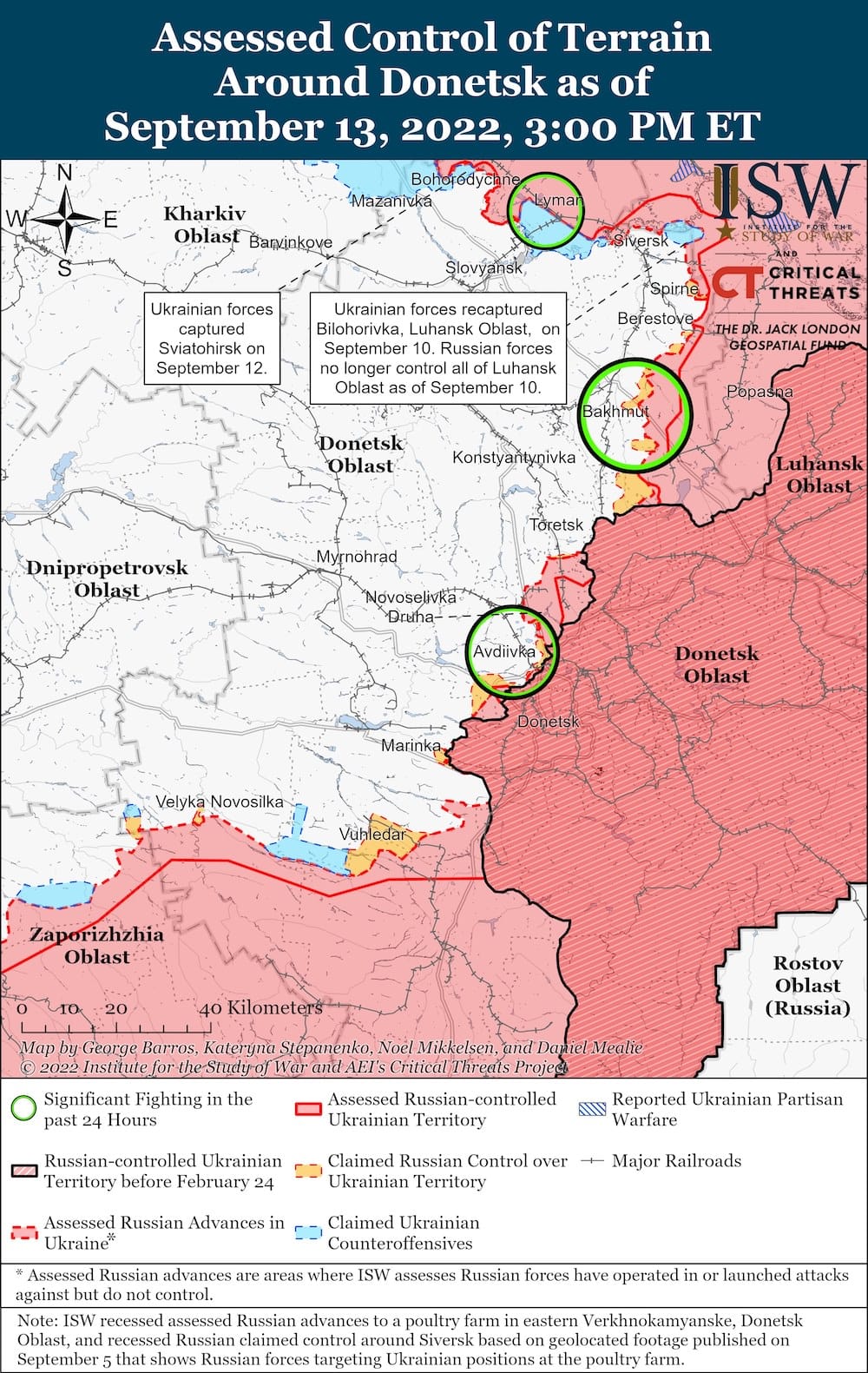
Ending the war? Patience and length of time…

Finally, we may ponder the following hypothetical situation. Let us imagine that Russia would conquer the whole of Donetsk oblast, and succeed in keeping what it has conquered elsewhere. How would it then end the war?

The polarisation at work in Ukraine and among its allies – i.e. the U.S. and Europe, would probably forbid any peace negotiations allowing Russia and the separatist Republics of the Donbass to keep the territory conquered. (e.g. Reuters, “Zelenskiy vows no let-up as Ukraine says troops cross Oskil river in northeast“, 19 September 2022)

If we assume that the Russian leadership is well aware of this key pitfall, then we may wonder if one possible Russian strategy is not to buy time or to be ready to wait until international conditions have changed.

The key actors which positions would need to change are Ukraine’s allies. The latter, from a Russian point of view, need to favour stopping the war and reaching a negotiated settlement recognising the territory conquered by Russia, the DPR and the LPR, plus probably the neutrality of Ukraine.

The Russian political authorities may thus position themselves for a kind of “intense frozen war” that would last at least over the winter 2022-2023.

Their bet would be that Europe notably will not be able to sustain a winter without energy or with a complicated energy situation, while a deep recession is very likely to be triggered (Blackrock commentary 12 September 2022; Jennifer Sor, “Europe will spiral into a severe recession as the energy crisis hikes inflation and weighs on GDP, BlackRock says“, 12 September 2022).

Relatively, Russia may suffer less of the sanctions it faces, all the more so it benefits from the rise in energy prices. Indeed, for example, a Russian economy ministry document expects to see “Russian earnings from energy exports to $337.5 billion this year, a 38% rise on 2021 revenue from oil” (Reuters, 17 August 22). However, Russia still has to face recession and probably long term economic damage (Bloomberg, “Russia Privately Warns of Deep and Prolonged Economic Damage“, 6 September 22).

Nonetheless, Russia is also most likely to withstand pain with more equanimity, compared with European populations, which are already showing signs of rebellion against energy prices (Reuters, “Can’t pay, don’t pay” – Italian group urges energy bill strike“, 15 September 2022).

Furthermore, the very aggressive American actions worldwide, aiming at remaining the leader of the world and enforcing its international order, notably against China, only strengthen the partnership and friendship between Russia and China (e.g. Al Jazeera, “French, US delegations visit Taiwan as tension with China festers“, 8 September 2022; Helene Lavoix, “The War between China and the U.S. – The Normative Dimension“, 4 July 2022, and “The American National Interest“, 22 June 22, The Red Team Analysis Society)Ministry of foreign affairs of the People’s Republic of China, “President Xi Jinping Meets with Russian President Vladimir Putin“, 15 September 2022). As a result, Russia is likely to have time on its side. Finally, the American stance may get out of hand, fundamentally upsetting the global strategic terrain.

Hence, Russia may choose to wait and keep waiting, while war goes on in Ukraine with its pains and hardships, and both Europe and Russia suffer of deep recession.

Winter is coming.

Featured image: Russian T-90 tanks during a parade in Volgograd region; 2010, www.volganet.ru, CC BY-SA 3.0, via Wikimedia Commons.

Categories
Saved Web Pages

South Caucasus in a geopolitical context of Russia: Analysis from Baku

0dd4acb5a0abd67cfd45e37556136ce8.jpeg

South Caucasus in the Russian geopolitical context

Resource constraints currently prevent Russia from playing a dominant role in the South Caucasus, and Moscow is in process of defining its interests in the new reality in the region. Such is the conclusion of the South Caucasus analytical center, located in Baku. Azerbaijani experts believe that after the second Karabakh war, Turkey has every chance of becoming a leader in this region.

The South Caucasus think tank in Baku has published a report on the situation in the region and Russia’s influence. JAMnews is republishing this material with slight amendations.

Russia and South Caucasus

The South Caucasus neighbors Russia, Turkey and Iran, all countries with an imperial past. At present, Russia is competing both with Turkey and Iran, as well as the United States and the European Union.

After the collapse of the USSR, the South Caucasus was accepted by Russia as part of the post-Soviet space. Relations with the post-Soviet states are regulated not only by the Ministry of Foreign Affairs of the Russian Federation, but also by the administration of the President of Russia.

In the 90’s Russia gave priority to relations with the West, leaving the South Caucasus in the background. Regional conflicts were frozen and despite mediation efforts, there was no progress in resolutions.

After Vladimir Putin came to power, the post-Soviet space came to the fore. In a speech in 2005, Putin called the collapse of the USSR “the geopolitical catastrophe of the century.” In subsequent years, relations with the post-Soviet countries overshadowed even relations with partner states with which Russia cooperates within various international organizations.
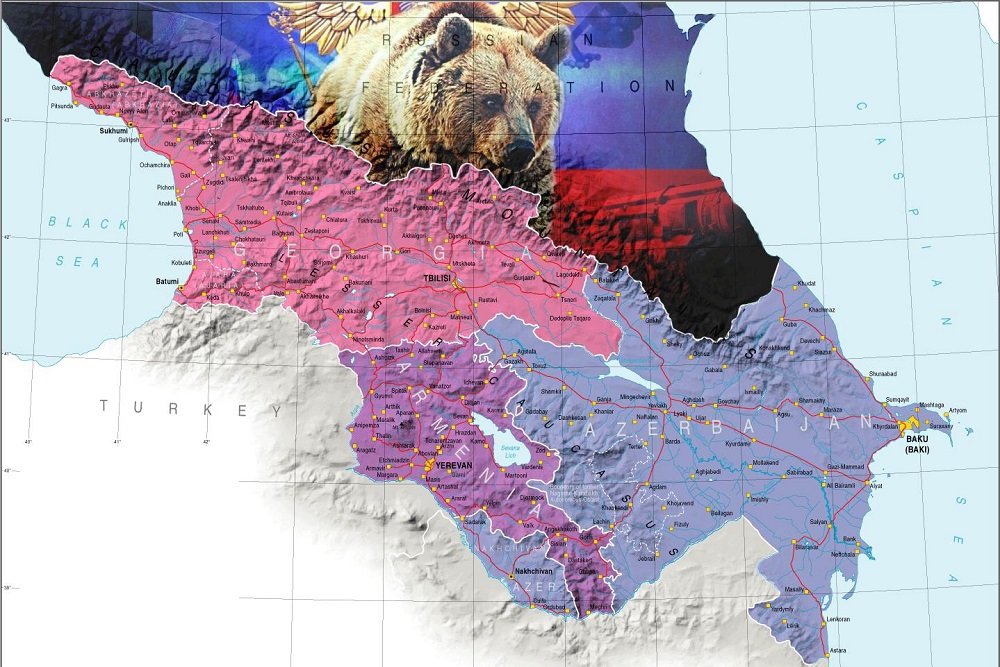
Despite the importance of the region and Moscow’s efforts, relations with nations of the South Caucasus are developing unevenly.

Classification of South Caucasian countries from the point of view of the Russian Federation

Maximalist expectations – Armenia. This country is positioned as a member of the EAEU and the CSTO.

The 102nd military unit of Russia is located in Gyumri, and the Russian Air Force is deployed in Erebuni. Russia guards Armenia’s borders with neighboring Iran and Turkey, as well as the country’s airspace.

Before the commissioning of the Iran-Armenia gas pipeline in 2007, Russia provided Armenia with its natural gas in full. ArmGosgazprom is 80% owned by Russia’s Gazprom, the Metsamor nuclear power plant is controlled by Russia’s Inter RAO, and the Armenian power grid is run by Russian billionaire of Armenian origin Samvel Karapetyan. Armenian railways have been leased under concession until 2038 to the Russian company South Caucasian Railways. Two out of three mobile operators operating in Armenia are Russian. Russia is the largest trading partner and the main owner of state debt in Armenia.

Minimalist expectations – Azerbaijan. This country, although not a member of the EAEU and the CSTO, does not aim to become a member of NATO and the EU.

Baku is pursuing a pragmatic policy with Russia. Even if some of Azerbaijan’s foreign policy steps are not consistent with the Kremlin’s position, they do not pose a threat to Russia’s security.

Territory of threat – Georgia. This country is defined by the desire to join NATO and the EU.

Three post-Soviet countries – Georgia, Ukraine and Moldova – are regarded by Russia as a threat to their security because of the possibility of deploying NATO military infrastructure there and using these states against the Russian Federation.

Mikheil Saakashvili’s ascension to power in Georgia actualized the country’s relations with NATO and the European Union. In 2007 Russian military bases were expelled from Georgia, with the exception of the territories of Abkhazia and South Ossetia. The “five-day war” in 2008 ended with Rusia’s recognition of the independence of the separatist regimes in the internationally-recognized territory of Georgia.

Ivanishvili’s victory partially restored relations, but did not take Georgia completely out of the Western vector. Tbilisi signed an association agreement with the EU, and in 2014 received a package of “enhanced cooperation” with NATO.

Low efficiency of soft power

The low effectiveness of Russia’s soft power (economic and humanitarian) prevents Moscow from building relations with the countries of the South Caucasus. For this reason Russia is attempting to interfere in the internal affairs of these states, seeking to adjust their foreign policy in accordance with its own interests.

The failure of such attempts forces Russia to be more pragmatic. After the second Karabakh war, Russia has been interested in creating a new balance in the South Caucasus in partnership with regional states without the participation of the West.

Pros and cons of the geographical location of the South Caucasus

Geographically, Russia, Turkey and Iran are in contact in the South Caucasus. The rivalry and cooperation of these countries, which are the main players in the Syrian crisis, also affect the South Caucasus.

For Russia’s geopolitical rivals the United States and the European Union, the South Caucasus is also important in terms of energy security and access to Central Asia.

Along with Central Asia, the South Caucasus is considered a convenient point for influencing Russia. Thus, an adequate balance of forces in this region is vital for Russia.

Russia itself is also considered a Caucasian state, inasmuch as in the North Caucasus there are seven autonomous republics and two territories that are part of the federal districts of the Russian Federation.

Balance of power in the South Caucasus

For thirty years after the collapse of the USSR, the balance of power in the South Caucasus generally suited Russia. During this period, the three states of the South Caucasus – Azerbaijan, Armenia and Georgia – built relations of various levels with Russia, Turkey and Iran.

Mathematically, the balance of power in the region can be characterized as follows:

  • Russia +2, -1. Alliance with Armenia (+), strategic partnership with Azerbaijan (+), zero relations with Georgia (-).
  • Turkey +2, -1. Alliance with Azerbaijan (+), trategic partnership with Georgia (+), zero relations with Armenia (-).
  • Iran +3. It has diplomatic relations with all three countries of the South Caucasus. But there are no allied and strategic partnerships.

Russia and Turkey each have one ally, one strategic partner, and one troubled state. But the main difference is that the problematic country for Turkey (Armenia) is an ally for Russia, and the problematic country for Russia (Georgia) is a strategic partner of Turkey.

This state of affairs could turn the South Caucasus into the locus of a new rivalry between Russia and Turkey. But Azerbaijan, which is both an ally of Turkey and a strategic partner of Russia, forms a necessary stability in the region.

What has changed after the second Karabakh war?

The results of the second Karabakh war in a certain sense changed the balance of power:

  • An ally of Turkey defeated an ally of Russia, and restored territorial integrity;
  • Russia, which has its military bases on the territory of Armenia and Georgia, according to the tripartite statement of November 10, 2020, deployed its peacekeeping forces in Azerbaijan;
  • With the participation of the neighbors of the region and the countries of the South Caucasus, a 3 + 3 group is being formed. This group, which does not involve the US and the EU, is in Russia’s interests;
  • There are prospects for the normalization of relations between Armenia and Turkey.

If these prospects turn into reality, the balance of power may change. The new conditions keep Russia’s relations with the countries of the region unchanged, but for Turkey there is a prospect of +3, which can turn it into a leading country in the region. Georgia’s refusal of the 3+3 group nullifies the same prospect for the Russian Federation.

Oddities of the post-conflict period

In the post-conflict period, steps that did not correspond to the interests of Russia were taken by Armenia. Pashinyan invited the EU as a mediator, and after that the mediating role of Russia, which had been the Kremlin’s monopoly for exactly a year, began to weaken.

Armenia has slowed down on decisions made via Russian mediation, and prefers to let the European Union fill that role.

And since February 2022, Russia has directed its attention and resources towards Ukraine.

In such conditions, due to Armenia’s refusal to grant Russia special rights in the Zangezur corridor, problems have arisen in relations between these two countries. Russia, though it cannot participate in regional processes to the same extent, is a supporter of fulfilling the conditions of the tripartite statement and opening regional roads.

Thus, limited resources currently do not allow Russia to play a dominant role in the region. Moscow is in the process of defining its interests in the new reality in the South Caucasus. This is the main reason for the Kremlin’s silence.

Another paradox of the post-conflict period is that Azerbaijan has become the most predictable state for Russia in the South Caucasus. Geostrategic prospects and economic expediency force Russia to take into account the position of the countries of the region and, first of all, the position of Azerbaijan.

Categories
Saved Web Pages

Macron Tells Aliyev to Respect Armenia’s Territorial Integrity

President Emmanuel Macron of France reiterated his demand on respecting Armenia’s territorial integrity during a phone call with Azerbaijani President Ilham Aliyev, the French president’s office reported in a statement.

Macron reportedly called Aliyev following his meeting on Monday with Prime Minister Nikol Pashinyan in Paris.

“The French President repeated his call to his Azerbaijani colleague on returning to the ceasefire and holding the troops in their initial positions. There are numerous deaths as a result of the clashes of the recent days. He also reminded about his demand to respect Armenia’s territorial integrity,” the Elysee Palace statement said.

Macron also told Aliyev that Pashinyan has voiced his willingness to continue negotiations over unresolved issues. Macron underscored France’s readiness to contribute to these talks.

Meanwhile, Armenia’s Defense Minister Suren Papikyan met with his French counterpart Sébastien Lecornu, with whom he discussed the current situation following the Sept. 13 attack by Azerbaijan on Armenia’s sovereign territory.

Armenia’s Defense Minister Suren Papikyan (left) during a meeting with France’s Defense Minister Sébastien Lecornu
Lecornu said that France will send a delegation to assess the current situation.

“We discussed the situation on the border with Azerbaijan where the hostilities must cease, and the Azerbaijani forces must return to their initial positions. I have announced the rapid dispatch of a French delegation to Armenia to assess the situation,” Lecornu said.

Meanwhile The French Co-Chair of the OSCE Minsk Group Brice Roquefeuil will visit Yerevan, according to France’s Foreign Ministry.

“By the end of the week the French Co-Chair of the OSCE Minsk Group Brice Roquefeuil will visit Baku, then Yerevan to support and encourage the search of solutions for all outstanding issues,” the French foreign ministry said, adding that Roquefeuil will also visit Georgia,” the statement said.

There a delegation of French senators currently in Armenia. They met on Wednesday with foreign minister Ararat Mirzoyan, Prime Minister Nikol Pashinyan as well as President Vahagn Khachatryan.

Categories
Saved Web Pages

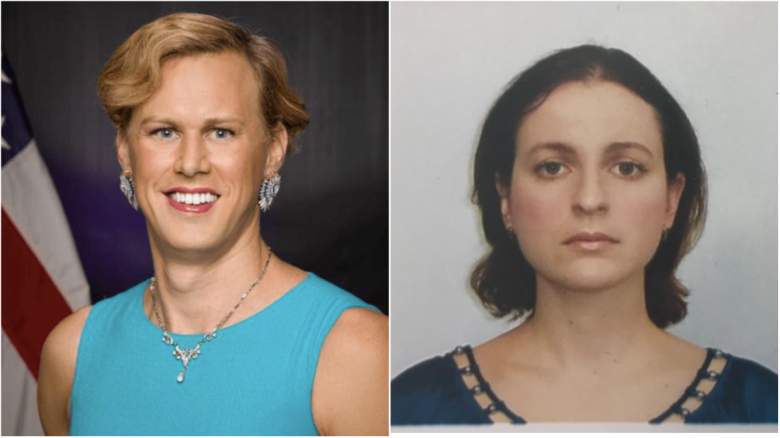
Jamie Lee Henry & Anna Gabrielian: 5 Fast Facts You Need to Know

anna-gabrielian-jamie-lee-henry.jpg?qual

anna gabrielian jamie lee henry

US Army/LinkedIn Major Jamie Lee Henry, left, and Dr. Anna Gabrielian.

Dr. Anna Gabrielian is a Johns Hopkins Hospital anesthesiologist accused along with her U.S. Army doctor spouse, Major Jamie Lee Henry, in a plot to provide soldiers’ medical info to Russia, federal authorities say. Gabrielian and Henry were indicted on September 28, 2022, in Maryland federal court on charges of conspiracy and wrongful disclosure of individually identifiable health information (IIHI), according to court documents obtained by Heavy.

According to the indictment, Henry worked as a staff internist at Fort Bragg in North Carolina and had secret security clearance. Gabrielian works in anestheiology and critical care medicine at Johns Hopkins Hospital in Baltimore and has also specialized in obstretic anesthesiology, according to her biography on the hospital’s website, which notes she speaks Russian and English. They live in Rockville, Maryland, according to prosecutors. Both Henry and Gabrielian, who have been married since 2015, are in custody, authorities said.

Gabrielian, 36, believed she was providing medical information on U.S. service members to a person working at the Russian embassy, prosecutors said in the indictment. But that person was really an undercover FBI agent who met with her in August and asked Gabrielian about assistance she had offered to the Russian embassy earlier in the year, according to the indictment.

Henry, 39, previously made headlines in 2015 by becoming the first active U.S. Army officer to come out as transgender. The indictment refers to Henry as Gabrielian’s husband and uses he/him pronouns, but in a 2015 article by BuzzFeed News, Henry used she/her pronouns and identified as a woman. It was not immediately known if Henry and Gabrielian have hired attorneys who could comment on their behalf.

According to a press release from the Department of Justice, Gabrielian was scheduled to make her first appearance in court in Baltimore on September 29, while Henry’s first court appearance hasn’t been set. “The indictment was announced by United States Attorney for the District of Maryland Erek L. Barron and Special Agent in Charge Thomas J. Sobocinski of the Federal Bureau of Investigation, Baltimore Field Office,” the DOJ said.

“If convicted, the defendants face a maximum sentence of five years in federal prison for the conspiracy, and a maximum of 10 years in federal prison for each count of disclosing IIHI. Actual sentences for federal crimes are typically less than the maximum penalties. A federal district court judge will determine any sentence after taking into account the U.S. Sentencing Guidelines and other statutory factors,” the DOJ said its press release.

Here’s what you need to know about Anna Gabrielian and Jamie Lee Henry:

1. Gabrielian Told the FBI Agent She Would ‘Provide Any Assistance She Could to Russia, Even If It Meant Being Fired or Going to Jail,’ the Indictment Says

anna gabrielian johns hopkins

GettyAnna Gabrielian works at Johns Hopkins.

According to the indictment, an undercover FBI agent approached Gabrielian on August 17, 2022, and told her “she was asked to contact” her “about the assistance she offered a couple months ago.” Gabrelian then asked the undercover agent if she was from the Russian embassy and the agent said she was, prosecutors said. Gabrielian told the agent she had reached out to the embassy by phone and email “offering Russia” her and her spouse’s assistance, according to the indictment. Gabrelian told the agent she was reaching out on behalf of her and Henry, but never mentioned Henry’s name in interactions with the Russian Embassy so Henry could pretend to be unaware of her actions if needed, according to the indictment.

Gabrelian and Henry conspired to provide private health information of Fort Bragg and Johns Hopkins patients to the Russian government to demonstrate their access to that information on U.S. military and government personnel, their willingness to provide that information to Russia and the “potential for the Russian government to gain insights into the medical conditions of individuals associated with the U.S. government and military, to exploit this information,” according to the indictment.

According to prosecutors, Gabrielian and Henry met with the undercover FBI agent, who they believed to be working for the Russian government, together, “to discuss ways in which they could help” Russia. The couple suggested they could obtain patient records for U.S. military members and family members to pass to the Russian government, prosecutors said.

Gabrielian told the agent during an August 17 meeting she was “motivated by patriotism toward Russian” and would “provide any assistance she could to Russia, even if it meant being fired or going to jail.” During the meeting, Gabrielian told the undercover agent “Henry, a military officer, was currently a more important source for Russia than she was, since Henry had more helpful information, including on how the U.S. military establishes an army hospital in war conditions and about previous training the U.S. military had provided to Ukrainian military personnel.”

jamie lee henry ukraine

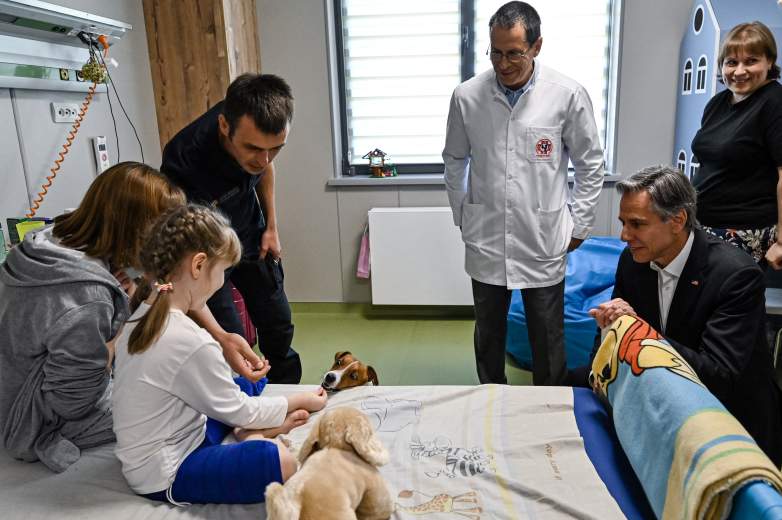
GettyMarina, 6, from Kherson region plays with a landmine sniffer dog, Jack Russell Terrier Patron, during US’ Secretary of State Antony Blinken’s (R) visit to a children’s hospital in Kyiv on September 8, 2022. Blinken made a surprise trip to Kyiv as the United States unveiled nearly $2.7 billion in new military support to Ukraine and neighbors to face Russia.

According to the indictment, Gabrielian and Henry met with the undercover agent at the agent’s hotel room. Gabrielian told the agent, “If you have a useful long-term weapon, that can be used for years. If you use it for something that’s not tactically advantageous, you’ve lost it for nothing. So if (Henry) can’t practice medicine, can’t be in the National Guard, you’ve lost an Army doctor. If I have to look somebody up, and I do look somebody up, you’ve lost a link to (Johns Hopkins) to establish those medical connections. It has to be something massively important, not just check if this person has polyps.”

Gabrielian met with the undercover agent again on August 24, according to the indictment. Gabrielian told the agent that “though Henry was a ‘coward’ and concerned about violating HIPAA by providing records” to the agent, “Gabrielian had no such concerns and violated HIPAA ‘all the time.’ Gabrielian further told the UC she would check with Henry about providing medical records from Fort Bragg patients and get back in touch.”

Gabrielian texted the undercover agent using coded language on August 25, according to the indictment, saying, “Jamie might have samples of his poetry laying around. He says he will look for them and decide if he has the bandwidth for another project over the weekend. I think it would be good for him to at least show you examples of his past work.”

Henry and Gabrielian met with the undercover agent on August 31 at a hotel in Gaithersburg, Maryland, according to the indictment. They gave the agent records related to the spouse of a current Office of Naval Intelligence employee and information related to a veteran of the U.S. Air Force. According to the indictment, Gabrielian “highlighted to the UC a medical issue reflected in the records of” the spouse of the ONI employee, “that Russia could exploit.”

The couple also accessed records for five people, including a retired Army officer, a current Department of Defense employee, the spouse of a U.S. Army veteran, and two spouses of deceased U.S. Army veterans, and gave that info to the undercover agent, according to the indictment.

2. Gabrielian Planned to Send the Couple’s Children to Turkey if They Were At Risk of Getting Caught & Henry Considered Volunteering to Join the Russian Army to Help With the War Effort in Ukraine, Prosecutors Say

anna gabrielian doctor

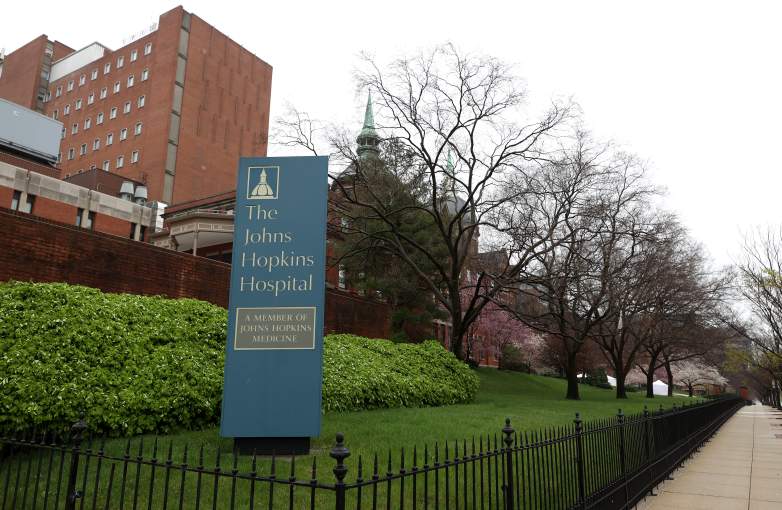
GettyA general view of The Johns Hopkins Hospital on March 28, 2020 in Baltimore, Maryland.

According to the indictment, Henry was “committed to assisting Russia” and “had looked into volunteering to join the Russian Army after the conflict in Ukraine began, but Russia wanted people with ‘combat experience,’” which Henry does not have. Henry told the FBI agent, “the way I view what is going on in Ukraine now, is that the United States is using Uksrainians as a proxy for their own hatred toward Russia.”

Henry told the agent, “My point of view is until the United States actually declares war against Russia, I’m able to help as much as I want. At that point, I’ll have some ethical issues I have to work through,” according to the indictment. Gabrielian said in reply to Henry, “You’ll work through those ethical issues,” the indictment states.

According to the indictment, Gabrielian told the undercover agent if she undertook an action that put her at “significant risk of arrest,” she wanted her and Henry’s children to “have a nice flight to Turkey to go on vacation because I don’t want to end in jail here with my kids being hostages over my head.”

Henry told the agent they had to take precautions so Henry could continue passing background checks for security clearance. Henry told the agent, according to the indictment, “I don’t want to know your name…because I want plausible deniability. In a security clearance situation, they want to know names and people and all this stuff.”

3. Gabrielian Received a Grant in 2020 for a Project Titled ‘Investigation & Optimization of Current Obstetric Anesthesiology Practice in Ukraine,’ Johns Hopkins Says

Anna Gabrielian, MD, was awarded the Center for Global Health’s Paul S. Lietman Global Health Travel Grant for her project titled “Investigation and Optimization of Current Obstetric Anesthesiology Practice in Ukraine.” Her mentor on the award is Dr. Oleg Turkot.

— JHU ACCM Research (@JHACCMResearch) July 21, 2020

According to a July 21, 2020, tweet from Johns Hopkins, Gabrielian, “was awarded the Center for Global Health’s Paul S. Lietman Global Health Travel Grant for her project titled ‘Investigation and Optimization of Current Obstetric Anesthesiology Practice in Ukraine.’”

Gabrielian proposed during a meeting with the undercover agent that they concoct a cover story where the agent, whom she thought was a Russian government agent, would be a “delightful medical translator who has reached out to met … and you want to talk with me about programs and how they can be expanded,” the indictment states.

According to the indictment, Henry told the agent that Gabrielian recommended reading the book “Inside the Aquarium: The Making of a Top Soviet Spy.” The 1986 book by Victor Suvorov “describes the recruitment and training of a Russian spy inside the headquarters of the Main Intelligence Directorate of the then-Soviet Union (nicknamed ‘The Aquarium’),” the indictment said. Gabrielian told the agent she told Henry to read the book, “Because it’s the mentality of sacrificing everything…and loyalty in you from day one. That’s not something you walked away from.”

On July 26, Henry tweeted a link to an article from CNN titled, “US approves treatment of wounded Ukrainian soldiers at US military hospital in Germany,” but did not add any commentary. In June, Henry tweeted a link to an article about Russian President Vladimir Putin.

4. Gabrielian, Graduated From the University of Pittsburgh School of Medicine in 2012 & Previously Worked at Allegheny General Hospital & Danbury Hospital

An indictment filed Wednesday charges two Maryland doctors with conspiracy and unlawful disclosure of medical information.

U.S. Army Dr. Jamie Lee Henry and Johns Hopkins anesthesiologist Dr. Anna Gabrielian are accused of attempting to provide info to the Russian government. pic.twitter.com/TNkpo2GoLF

— Paul Gessler (@PaulGessler) September 29, 2022

According to her biography on the Johns Hopkins website, Gabrielian graduated from the University of Pittsburgh School of Medicine in 2012. She had a residency in surgery at Danbury Hospital in Connecticut starting in 2014 and a residency in anesthesiology at Allegheny General Hospital in Pennsylvania in 2019, according to the hospital’s website.

She began a fellowship in anesthesia obstetrics at Johns Hopkins University School of Medicine in 2021 and was an instructor of anesthesiology and critical care medicine there, the hospital’s website says. Few other details about Gabrielian’s life and career were immediately available.

On September 9, 2022, Gabrielian gave a presentation on ophthalmic surgery and anesthesia in pregnancy and lactation at the Ophthalmic Anesthesia Society’s annual meeting, according to a program for the event. Gabrielian talked about understanding optimal surgery timing in pregnancy, identifying possible complications and understanding the implications of anesthetics on fetus and lactation, according to the program.

5. Henry Talked in an Interview About Being Outed as Trans by Medical Information

The Department of Justice said in its press release, “During the time of the alleged conspiracy, Henry worked as a staff internist stationed at Fort Bragg, the home of the Army’s XVIII Airborne Corps, headquarters of the United States Army Special Operations Command, and the Womack Army Medical Center.”

Henry was previously married before Gabrielian, according to a 2015 interview with Brightest Young Things. Gabrielian was also previously married and divorced, records show. Henry joined the Army at 17, according to the interview.

“After I became very ill as a result of a bicycle crash in 2008, I felt very vulnerable while being treated as a patient in the same hospital I worked as a physician. What made it worse was that, as a soldier, my medical records were not private, and when the question of mental illness came up, I felt stark naked,” Henry told Brightest Young Things. “When my then wife outed me to a military psychiatrist, I felt violated. Things kind of blew up from there. I experienced very intense gender dysphoria from 2008 until 2014, leading to the breakdown of a number of relationships, leading my entire social network with a few exceptions to shun me for being ‘sexually immoral’. From 2012 to 2014, I underwent depositions and public trials, because I wanted to continue having a meaningful relationship with my son.”

According to BuzzFeed News, Henry joined the ROTC at 17. Henry’s first rotation as a military doctor was in the psych ward at Walter Reed hospital, according to BuzzFeed. Henry came out amid a divorce and child custody battle, according to BuzzFeed. Henry told BuzzFeed, “I find my trans experience has allowed me to relate to people, because all of us suffer, and I could relate to people’s suffering. I’m able to comfort people that feel isolated and lost and alone and broken. I can sit down with them and look them in the eyes, and say, ‘I can walk with you through this. I care about you, and I mean it.’”

Henry said in the interview with Brightest Young Things, “My passion is service member health, which is a big reason I have stayed on with the military despite being given a number of opportunities to separate. The biggest part in supporting the health of service members is listening to them. Trauma has to be handled on an individual’s timeline and in a way that is unique to that individual.”

Categories
Saved Web Pages

“There is no need to duplicate formats”: about Armenia-Azerbaijan negotiations

309653014_462402772602235_19538398442225

Negotiation process between Armenia and Azerbaijan

Despite the ongoing tension after the hostilities of September 13-14, Armenian officials are not refusing negotiations with representatives of Azerbaijan. The next meeting of Foreign Ministers Ararat Mirzoyan and Jeyhun Bayramov is scheduled for October 2 in Geneva.

This information was confirmed by the press secretary of the Armenian Foreign Ministry Vahan Hunanyan: “Despite the provocations from Azerbaijan, Armenia will take part in the meeting. Thus, the statements of the Azerbaijani Foreign Ministry that Armenia is trying to disrupt the negotiations are groundless. Armenia, as before, is constructive, aimed at achieving a lasting peace in the South Caucasus, and expects the same of Azerbaijan.”

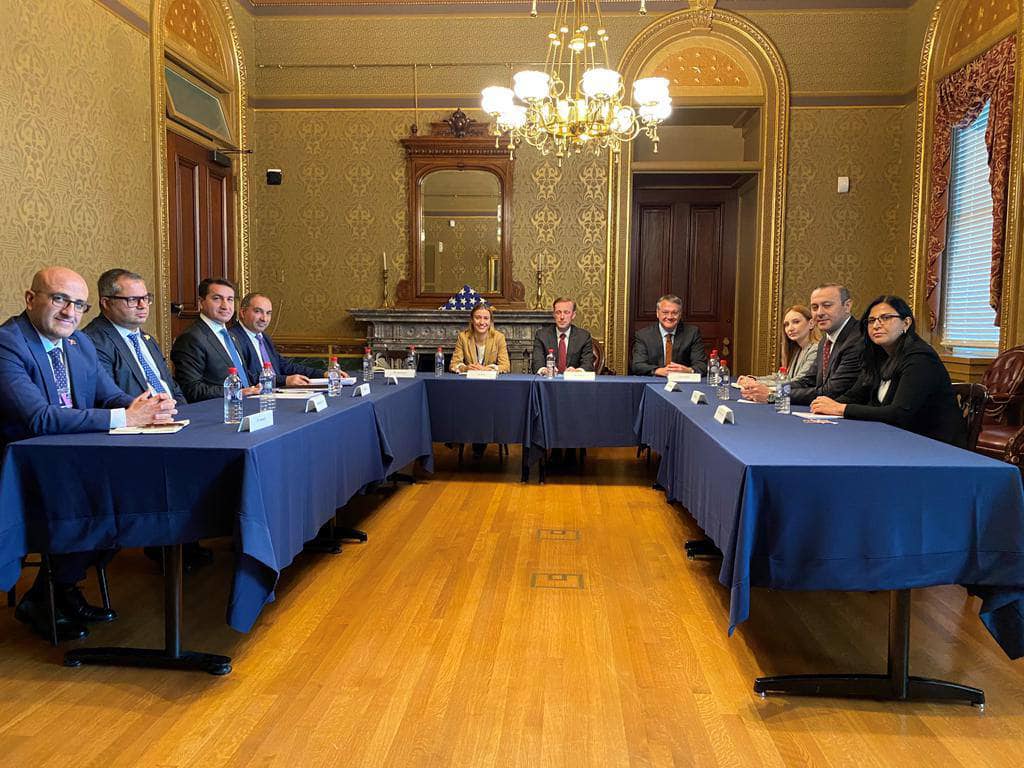
Earlier, on September 27, a meeting was held in the United States between Secretary of the Security Council of Armenia Armen Grigoryan and Advisor to the President of Azerbaijan Hikmet Hajiyev.

Azerbaijanologist Tatevik Hayrapetyan considers this format of meetings unnecessary, since the platform for negotiations between the foreign ministers of the two countries has long been used.

Details of the Grigoryan-Hajiyev meeting, topics of the Armenian-Azerbaijani talks, and xpert opinion on the expediency of their formats.

“Eliminating consequences of the September aggression”

Armen Grigoryan and Hikmet Hajiyev met at the White House on the initiative of US National Security Adviser Jake Sullivan.

According to the Armenian Security Council, the parties recognized the importance of eliminating the consequences of hostilities, and discussed

  • the need for peace in the region,
  • the process of a long-term peaceful resolution of the Nagorno-Karabakh problem.

Intense hostilities on the Armenian-Azerbaijani border began at midnight on September 13. On the evening of September 14, Armenia announced that, thanks to the intervention of international partners, an agreement had been reached on a ceasefire. The officially announced total number of dead and missing Armenian soldiers is 207 men. At least 20 soldiers were captured.

On the evening of September 28 the Armenian Defense Ministry reported that Azerbaijan had resumed hostilities, as a result of which three more soldiers were killed.

Jake Sullivan described the Grigoryan-Gadzhiev meeting as “direct and constructive.”

“We discussed the importance of preventing further violence and holding timely and focused negotiations. We have also outlined clear steps to achieve a stable and lasting peace,” he wrote on his Twitter page.

Hikmet Hajiyev also commented on the meeting on Twitter. The adviser to the President of Azerbaijan expressed gratitude to America for “discussing and promoting the agenda of lasting peace and stability in the region.”

The Secretary of the Security Council of Armenia and the Advisor to the President of Azerbaijan met three times in 2022. The talks were held in Brussels with the participation of EU Special Representative Toivo Klaar.

What issues are Yerevan and Baku discussing?

On September 28 Armen Grigoryan, who is in Washington, gave an interview to the Armenian service of the Voice of America. He called the meeting with Hajiyev productive.

According to Grigoryan, Armenia and Azerbaijan are discussing four interrelated issues: humanitarian problems, unblocking roads, delimitation and demarcation of the border, and the Nagorno-Karabakh conflict.

“We have tried to be clear about how we will move forward in these areas. The peace agreement between Armenia and Azerbaijan is connected with all this,” he said.

Grigoryan recalled that there are other formats for Armenian-Azerbaijani talks: with the participation of foreign ministers, vice-premiers, as well as heads of national security services. According to him, “the meetings of the leaders of the countries are due to the progress made in these formats.”

The Secretary of the Security Council of Armenia emphasized the positive effect of US involvement in regional processes.

As an example, he cited recent hostilities on the Armenian-Azerbaijani border. He said it was possible to stop the fighting thanks to the retaliatory actions of the Armenian army and American intervention.

Comment

Azerbaijanologist Tatevik Hayrapetyan says the Grigoryan-Hajiyev format raises questions:

“To be honest the format is incomprehensible to me, because if there is a platform for negotiations between foreign ministers, then why launch duplicate formats. What are these issues that cannot be discussed by the Ministers of Foreign Affairs, but are discussed by the Secretary of the Security Council and Advisor to the President of Azerbaijan?”

She considers direct communication between the heads of security services and defense ministers more understandable. Hayrapetyan believes that the problem is that Armen Grigoryan is not meeting with his Azerbaijani counterpart, but with Aliyev’s adviser.

The Azerbaijanologist considers this format not only problematic, but even dangerous, “just like Grigoryan’s statements”:

“It should not be forgotten that his response to Aliyev about the illegitimacy of Azerbaijan’s demand to use another route connecting Artsakh with Armenia instead of the Lachin corridor was used by Azerbaijan to unleash aggression in the Berdzor [Lachin] region on August 3. After that the route connecting Armenia with Nagorno-Karabakh was quickly changed. I’m not talking about that anymore. Before the attack on September 12, Grigoryan and Hajiyev met in Brussels in August.”

Tatevik Hayrapetyan also believes that the Brussels format of the Armenian-Azerbaijani talks has exhausted itself, and mediation should go to the United States and France:

“In the Brussels format there is not even a mention of Nagorno-Karabakh, there have never been any normal formulations arising from the interests of Armenia. This format has already proven its worthlessness. The mediation of the United States and France is more useful for us, including from the point of view of containing Azerbaijan.”

Negotiation process between Armenia and Azerbaijan

WP Radio
WP Radio
OFFLINE LIVE