Categories
Saved Web Pages

Why Russia Stole Potemkin’s Bones From Ukraine

27ukraine-potemkin-01-facebookJumbo.jpg

The 18th-century military commander and lover of Catherine the Great helped conquer Ukraine and looms large in the version of history the Kremlin uses to justify the war.

  • Send any friend a story

    As a subscriber, you have 10 gift articles to give each month. Anyone can read what you share.

    Give this articleGive this articleGive this article
A portrait of Prince Grigory Aleksandrovich Potemkin.

A portrait of Prince Grigory Aleksandrovich Potemkin.Credit…Fine Art Images/Heritage Images, via Getty Images

Marc Santora

KYIV, Ukraine — With Ukrainian forces bearing down on the occupied port city of Kherson this week, the Kremlin’s puppet rulers dispatched a team to an 18th-century stone cathedral on a special mission — to steal the bones of Prince Grigory Aleksandrovich Potemkin.

The memory of the 18th-century conqueror is vivid for those in the Kremlin bent on restoring the Russian imperium. It was Potemkin who persuaded his lover, Catherine the Great, to annex Crimea in 1783. The founder of Kherson and Odesa, he sought the creation of a “New Russia,” a dominion that stretched across what is now southern Ukraine along the Black Sea.

When President Vladimir V. Putin invaded Ukraine in February with the goal of restoring part of a long-lost empire, he invoked Potemkin’s vision.

Now, with Mr. Putin’s army having failed in its march toward Odesa and threatened with ouster from Kherson, his grand plans are in jeopardy. But among Kremlin loyalists, the belief in what they view as Russia’s rightful empire still runs deep.

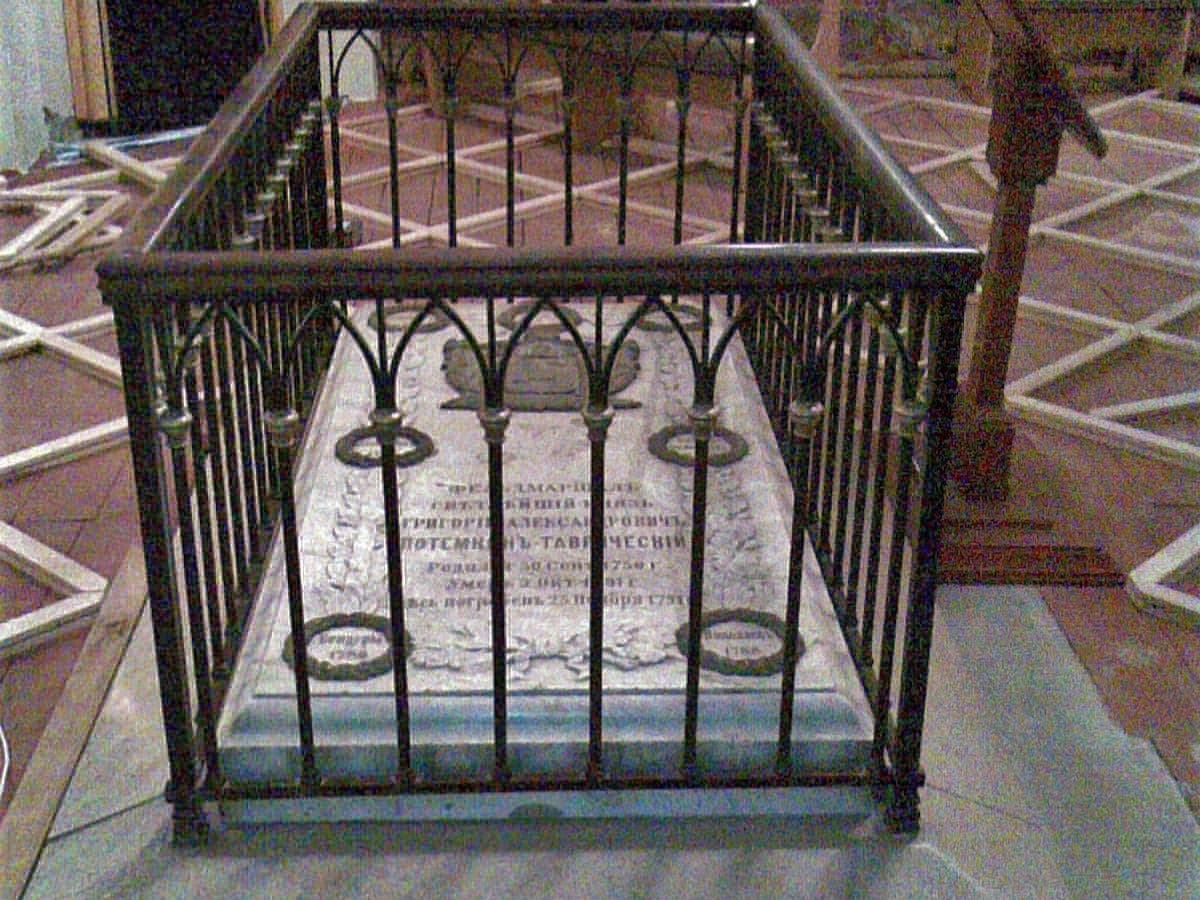
So it was that a team descended into a crypt below a solitary white marble gravestone inside St. Catherine’s Cathedral.

To reach Potemkin’s remains, they would have opened a trapdoor in the floor and climbed down a narrow passageway, according to people who have visited the crypt. There they would have found a simple wooden coffin on a raised dais, marked with a single cross.

Under the lid of the coffin, a small black bag held Potemkin’s skull and bones, carefully numbered.

Kremlin proxies have made no effort to hide the theft — quite the contrary. The Russian-appointed head of the Kherson region, Vladimir Saldo, said that Potemkin’s remains were taken from the city, on the west bank of the Dnipro River, to an undisclosed location east of the Dnipro, as Ukrainian troops edge closer.

“We transported to the left bank the remains of the holy prince that were in St. Catherine’s Cathedral,” Mr. Saldo said in an interview broadcast on Russian television. “We transported Potemkin himself.”

Local Ukrainian activists confirmed that the church had been looted and that, along with the bones, statues of venerated Russian heroes had been removed. By the count of the historian Simon Sebag Montefiore, author of the book “Catherine the Great and Potemkin,” it was the ninth time Potemkin’s restful peace had been interrupted.

Mr. Montefiore said in an interview that shortly after his book’s publication in 2000, the Kremlin contacted him to say how much Mr. Putin admired his work. But Mr. Montefiore said on Thursday that Mr. Putin’s reading of history was deeply flawed, and that his war has reduced to ruins Ukrainian cities such as Mariupol and Mykolaiv that Potemkin and early Russian imperialists helped to build.

Vladimir Saldo, the Kremlin-appointed chief of the Kherson region, speaking in Moscow’s Red Square in September, in a photo provided by Russian state media. Mr. Saldo says Potemkin’s remains have been taken from the city of Kherson.Credit…Pool photo by Maksim Blinov

(The term “Potemkin village” was coined to describe an impressive facade constructed to hide an undesirable state of affairs, although Mr. Montefiore says the term was incorrectly ascribed to the prince, whose achievements in present-day Ukraine were real.)

“Potemkin would have despised Putin and everything he stands for,” he said. Potemkin and Empress Catherine, he said, regarded that area as a cosmopolitan window onto the Mediterranean, populated by a vibrant mix of people of different ethnicities and national backgrounds.

The destruction of the cities that Potemkin helped build, he said, has cast Putin in the role of destroying those earlier triumphs.

The plundering of Potemkin’s grave is of a piece with Russia’s efforts to obliterate Ukrainian identity. Russian forces have destroyed and systematically looted Ukrainian treasures, including Ukrainian Orthodox churches, national monuments and cultural heritage sites. They sent specialists to abscond with gold antiquities from the Scythian culture dating back 2,300 years.

As of Oct. 24, UNESCO, the United Nations agency, had documented damage and destruction in more than 200 cultural locations.

But the bones of Potemkin, a famed military commander and statesman, have added resonance for the Kremlin. Mr. Montefiore, who chronicled the “outrageously libertine lifestyle and exuberant political triumphs” of Potemkin and Catherine, noted the special place in history the pair hold for Mr. Putin and the ultranationalists, as they try to meld “the gilded majesty of the Romanov empire with the grim glory of a Stalinist superpower into a peculiar modern hybrid.”

Russian rulers have not always viewed the legacy of Potemkin and Catherine admiringly — a fact underscored by the story of what has happened to Potemkin’s remains over the centuries.

When Potemkin died in 1791, the grieving empress ordered a grand funeral and had his body brought to Kherson, where it was displayed uncovered in a specially constructed tomb in a crypt, Mr. Montefiore wrote.

By the time Catherine died in 1796, it had become something of a pilgrimage site, infuriating her son and successor, Paul I, who ruled Russia until his assassination in 1801. He ordered that Potemkin be buried in an unmarked grave, with some reports suggesting that he directed a local official to smash and scatter Potemkin’s bones in the nearby Devil’s Gorge.

For years, it was unclear if the orders were carried out.

It was not until 1818 that a search of the crypt established that the remains were still there. In 1859 and again in 1873 the grave was opened again to determine that the remains were indeed those of the great prince. A telltale triangular hole in the skull, left there as part of the embalming process, established that they were.

As the Bolshevik Revolution raged, the crypt at St. Catherine’s was opened yet again and, as Mr. Montefiore noted in his book, there were yellowed photographs of revolutionaries holding up the remains.

In 1930, a young writer visited St. Catherine’s, which the Communists had renamed Kherson’s Anti-Religious Museum.

He found two strange exhibits holding “the skull of Catherine II’s lover Potemkin” and “the bones of Catherine II’s lover Potemkin.” Soon after the discovery, the remains were buried yet again in the crypt.

The grave was opened again in the 1980s by officials seeking to confirm the identity of the remains.

In researching his book, Mr. Montefiore went to St. Catherine’s himself to see the remains, which he wrote were still kept in a simple black bag inside the wooden coffin.

It is not clear where they are now or what the Kremlin plans to do with them. Mr. Montefiore fully expects Potemkin’s remains to make their way to Russia, where they could feature in “a chillingly crass and television spectacular of ultranationalism.”

Categories
Saved Web Pages

Russian forces steal remains of national icon Potemkin from grave in Kherson

newFile-5.jpg?quality=75&width=1200&auto

Russian forces have removed the remains of Grigory Potemkin, a Russian statesman, from his grave in Ukraine.

A Moscow-backed governor claimed the move was to protect one of their national icons during a Ukrainian counter-offensive in the city of Kherson, where he was buried.

Ukraine’s troops have been pushing ahead with efforts to reclaim the southern Kherson region and its capital, captured by Russian troops in the first days of the invasion.

Registration is a free and easy way to support our truly independent journalism

By registering, you will also enjoy limited access to Premium articles, exclusive newsletters, commenting, and virtual events with our leading journalists

Already have an account? sign in

Registration is a free and easy way to support our truly independent journalism

By registering, you will also enjoy limited access to Premium articles, exclusive newsletters, commenting, and virtual events with our leading journalists

Already have an account? sign in

A church in Kherson contained a grave to Potemkin

Public Domain

Ukrainian and Russian troops have been fighting for control of Kherson

Getty Images

Ukrainian troops have been preparing for a counter-offensive to capture Kherson

EPA

Categories
Saved Web Pages

Russia’s Shoigu says partial mobilisation complete, 82,000 recruits in conflict zone

MOSCOW: Russian Defence Minister Sergei Shoigu on Friday said that the “partial mobilisation” of 300,000 reservists to fight in Ukraine that Russia

announced in September was complete.

Speaking at a meeting with Russian President Vladimir Putin

broadcast on state television, Shoigu told Putin: “The task set by you of (mobilising) 300,000 people has been completed. No further measures are planned.”

Shoigu said that of the 300,000 mobilised recruits, 218,000 remained in training, while 82,000 had been deployed to the conflict zone, of which 41,000 had been assigned to their units.

He said that in future, recruitment for the Ukraine campaign would be based on volunteers and professional soldiers, rather than mobilising more of Russia’s several million reservists.

Putin declared a “partial mobilisation” of 300,000 reservists on Sept. 21, after a series of military defeats saw Russian forces routed from east Ukraine’s Kharkiv region and under increasing pressure in the southern Kherson region.

The move touched off an exodus of military-age men from Russia, with tens of thousands heading for countries including Georgia, Armenia and Kazakhstan, which allow Russians to enter without visas.

Over 2,000 people arrested at anti-mobilisation protests across Russia. There was public outcry over cases of men being mobilised despite medical exemptions, or a lack of military experience.

Responding to Shoigu, Putin

acknowledged problems with mobilisation, saying that they were “inevitable”, and said that it was necessary to make “corrections” to the development of Russia’s armed forces.

Categories
Saved Web Pages

Russia’s partial mobilisation is complete, Shoigu says

WGZGPQCL35LSBKLZKTIKZLUWJU.jpg

MOSCOW, Oct 28 (Reuters) – Russian Defence Minister Sergei Shoigu on Friday said that the “partial mobilisation” of 300,000 reservists to fight in Ukraine that Russia announced in September was complete, with tens of thousands of them already sent to the combat zone.

Speaking at a meeting with Russian President Vladimir Putin broadcast on state television, Shoigu said: “The task set by you of (mobilising) 300,000 people has been completed. No further measures are planned.”

Shoigu said that of the 300,000 mobilised reservists, 218,000 remained in training, while 82,000 had been deployed to the conflict zone, of which 41,000 were on active service with their units.

“I want to thank them for their dedication to duty, for their patriotism, for their firm determination to defend our country, to defend Russia, their homes, their families, our citizens and our people,” Putin said.

In future, Shoigu said, recruitment for the Ukraine campaign would be based on volunteers and professional soldiers, rather than mobilising more of Russia’s several million reservists.

Putin declared a “partial mobilisation” of 300,000 reservists on Sept. 21, after a series of military defeats saw Russian forces routed from east Ukraine’s Kharkiv region and under increasing pressure in the southern Kherson region.

The move touched off an exodus of military age men from Russia, with tens of thousands heading for countries including Georgia, Armenia and Kazakhstan, which allow Russians to enter without visas.

Over 2,000 people arrested at anti-mobilisation protests across Russia. There was public outcry over cases of men being mobilised despite medical exemptions, or a lack of military experience.

Responding to Shoigu, Putin acknowledged problems with mobilisation, saying that they were “inevitable”, and said that the Ukrainian campaign had shown the need for “corrections” to Russia’s armed forces.

Putin said: “Based on the experience of conducting the special military operation, we need to think over and make corrections to the way all components of the armed forces, including the ground forces, are constructed.”

Russia’s armed forces have struggled in the eight months since Putin ordered tens of thousands of troops into Ukraine, in what Moscow calls the “special military operation”.

Russian armed forces abandoned an attempt to seize Kyiv and other northern Ukrainian cities in April, before losing ground in the south and east to Ukrainian counter-attacks since August.

Reporting by Reuters; editing by John Stonestreet/Guy Faulconbridge

Our Standards: The Thomson Reuters Trust Principles.

Categories
Saved Web Pages

Is Putin scaling down his war aims?

post_arrow.png

Spotted

14:30

by Aris Roussinos

2GettyImages-489129208-scaled-1-1024x555

Credit: Getty

As the seasons change, the war in Ukraine has entered a new phase. Following a series of major reverses the Russians are digging in, in the hope that the autumn rains will bog down any further Ukrainian counter-offensives, perhaps allowing time to train and equip their newly-mobilised conscript army for a second push next spring.

In the meantime, Russia’s attention has shifted towards knocking out Ukraine’s electrical grid from the air. Over the past three weeks, waves of cruise missile and Iranian Shahed drone strikes have battered Ukraine’s power infrastructure, damaging or destroying around 40% of its power network, leading to blackouts and outages across the country, including western cities hitherto barely affected by the war. In his nightly address last night from a blacked-out Kyiv, standing next to a downed Shahed UAV, Zelensky asserted: “We are not afraid of the dark. The darkest times for us are not without light, but without freedom.” 

But if the disruption of power supplies continues into winter, it will affect civilian morale, as is no doubt intended. Urging Ukrainians to limit their electricity consumption on Wednesday, Zelensky stated that “Russian terrorists have created such difficult conditions for our energy workers that no one in Europe has ever seen or encountered” but “we need victory over Russia in the energy sphere as well.”

The coinciding of the new bombing campaign with the appointment of the Russian Air Force general Sergey Surovikin, who oversaw much of the brutal and successful aerial bombardment of rebel-held Syrian cities following Russia’s 2015 intervention, has naturally led to speculation that his appointment is an attempt to apply the “Syrian playbook” to Ukraine.

Yet expert analysts urge caution: as the Institute for the Study of War observed, all the Russian commanders overseeing the Ukraine war so far have previously commanded operations in Syria, using much the same methods. In any case:

 Whoever was appointed as theatre commander would have overseen the October 10 cruise missile strikes, which Ukrainian intelligence reported had been planned as early as October 2 (and which Surovikin certainly did not plan, prepare for, and conduct on the day of his appointment).

– Institute for the Study of War

If anything, the surprise is that Russia did not pursue this aerial campaign at the beginning of the war. A “shock and awe” campaign against civilian and dual-use infrastructure, like American bombing of Iraq’s power nodes in 2003, would ordinarily precede a ground offensive. Perhaps the better analogy is with the 1999 NATO bombing campaign against Yugoslavia, in which the destruction of the electric grid only began after three months of limited success striking military targets. 

NATO spokesman Jamie Shea briefed then that “the fact that lights went out across 70% of the country shows that NATO has its finger on the light switch now… We can turn the power off whenever we need to and whenever we want.” No doubt Putin, who frequently cites NATO’s Kosovo intervention as a precedent, is aiming to send a similar message. But the takeaway lesson is surely that Russia has dialled back its war aims, even as the conflict’s hardships affect a broader swathe of Ukraine’s civilian population.

Back in February, Putin ordered lightly-armed troops to invade much of Ukraine, leaving the country’s infrastructure intact in the seeming belief the war would end in days with a puppet government installed. In destroying Ukraine’s power grid, Putin is signalling, perhaps unintentionally, acceptance that his broadest ambitions will not be realised. Ukraine’s civilian infrastructure is now a target precisely because the country will not become part of Russia’s sphere of influence. The escalation of the bombing is in its own way a quiet admission of defeat.

Categories
Saved Web Pages

The Inevitable Indictment of Donald Trump

original.jpg

Merrick Garland hasn’t tipped his hand, but it’s clear to me that he will bring charges against the former president.

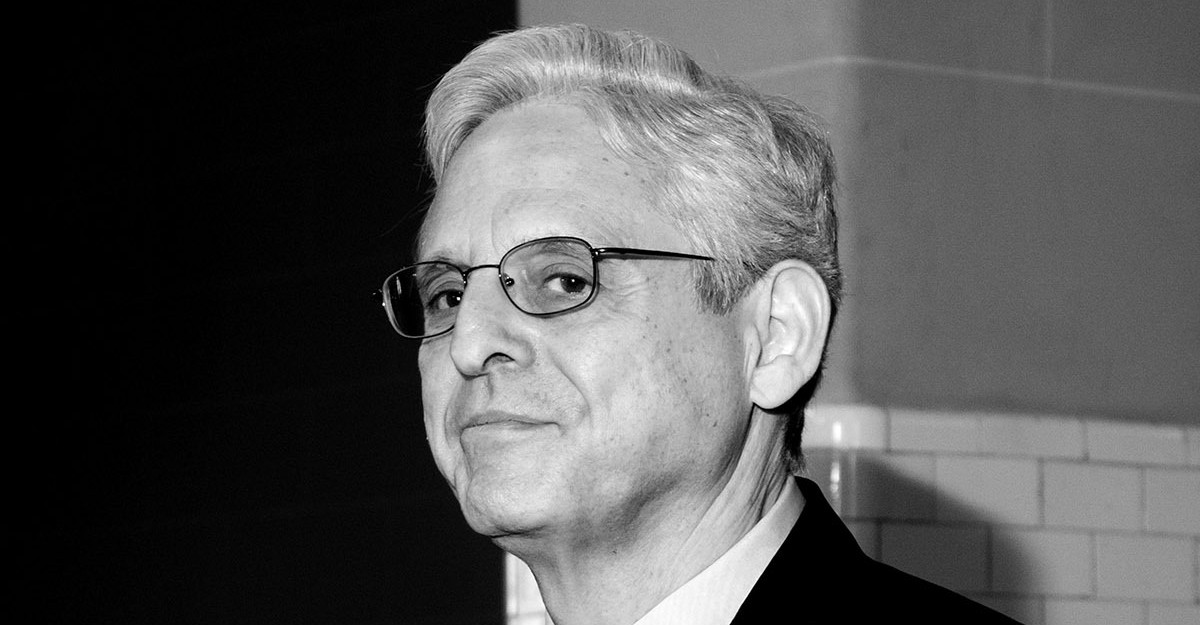
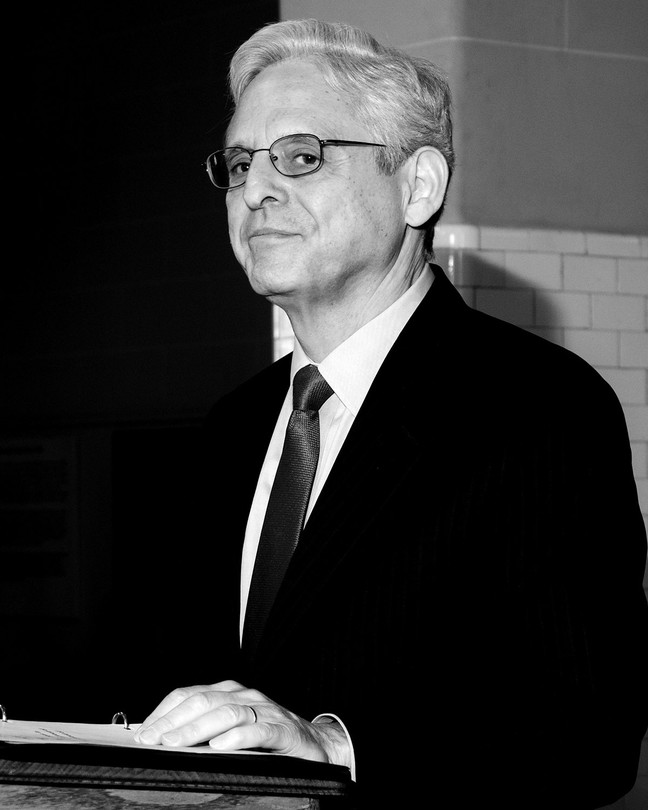
Black-and-white photo of Merrick Garland

Attorney General Merrick Garland welcomes new U.S. citizens on Ellis Island in celebration of Constitution Week and Citizenship Day, on September 17, 2022. (Jonno Rattman for The Atlantic)

As an appellate judge, Merrick Garland was known for constructing narrow decisions that achieved consensus without creating extraneous controversy. As a government attorney, he was known for his zealous adherence to the letter of the law. As a person, he is a smaller-than-life figure, a dry conversationalist, studious listener, something close to the opposite of a raconteur. As a driver, his friends say, he is maddeningly slow and almost comically fastidious.

And as the nation’s chief law-enforcement officer, he is a hyper-prudential institutionalist who would like nothing more than to restore—quietly and deliberately—the Justice Department’s reputation for probity, process, and apolitical dispassion. Which is why it is so difficult for me to imagine him delighting in the choice he now faces: whether to become the first attorney general in American history to indict a former president.

But this is what I believe he is preparing himself to do.

I have been observing Garland closely for months. I’ve talked with his closest friends and most loyal former clerks and deputies. I’ve carefully studied his record. I’ve interviewed Garland himself. And I’ve reached the conclusion that his devotion to procedure, his belief in the rule of law, and in particular his reverence for the duties, responsibilities, and traditions of the U.S. Department of Justice will cause him to make the most monumental decision an attorney general can make.

Let me be absolutely clear: Garland did not tell me he was going to indict Donald Trump. In fact, he did not tip his hand to me in any way—he is far too cautious to signal his intentions to even his closest friends, much less a reporter. Nor did his top aides suggest the announcement of an indictment. When his department says that it doesn’t discuss ongoing cases, it means it—at least in this case.

Before I lay out the reasons I believe I am correct in this assessment, I want to discuss why it is entirely possible I am not. The main reason to disbelieve the argument that Garland is preparing to indict is simple: To bring criminal charges against a former president from an opposing political party would be the ultimate test of a system that aspires to impartiality, and Garland, by disposition, is repelled by drama, and doesn’t believe the department should be subjected to unnecessary stress tests. This unprecedented act would inevitably be used to justify a cycle of reprisals, and risks turning the Justice Department into an instrument of never-ending political warfare.

And an indictment, of course, would merely be the first step—a prelude to a trial unlike any this country has ever seen. The defendant wouldn’t just be an ex-president; in all likelihood, he’d be a candidate actively campaigning to return to the White House. Fairness dictates that the system regard Trump as it does every other defendant. But doing so would lead to the impression that he’s being deliberately hamstrung—and humiliated—by his political rivals.

Garland is surely aware that this essential problem would be evident at the first hearing. If the Justice Department is intent on proving that nobody is above the law, it could impose the same constraints on Trump that it would on any criminal defendant accused of serious crimes, including limiting his travel. Such a restriction would deprive Trump of one of his most important political advantages: his ability to whip up his followers at far-flung rallies.

In any event, once the trial began, Trump would be stuck in court, likely in Florida (if he’s charged in connection with the Mar-a-Lago documents matter) or in Washington, D.C. (if he’s charged for his involvement in the events of January 6). The site of a Washington trial would be the Prettyman Courthouse, on Constitution Avenue, just a short walk from the Capitol. This fact terrified the former prosecutors and other experts I talked with about how the trial might play out. Right-wing politicians, including Trump himself, have intimated violence if he is indicted.

Trump would of course attempt to make the proceedings a carnival of grievance, a venue for broadcasting conspiracy theories about his enemies. The trial could thus supply a climactic flash point for an era of political violence. Like the Capitol on January 6, the courthouse could become a magnet for paramilitaries. With protesters and counterprotesters descending on the same locale, the occasion would tempt street warfare.

The prospect of such a spectacle fills Merrick Garland with dread, his friends say. Indeed, for much of his tenure he’s been attacked by critics who claim he lacks the fortitude to meet the moment, or to take on an adversary like Trump. Members of the House committee charged with examining the events of January 6 have publicly taunted Garland for moving tentatively when compared with their own aggressive and impeccably stage-managed hearings. Representative Adam Schiff has complained, “I think there’s a real desire on the part of the attorney general, for the most part, not to look backward.” Privately, even President Joe Biden has grumbled about the plodding pace of Garland’s investigations.

But I believe, if the evidence of wrongdoing is as convincing as it seems, he is going to indict Trump anyway.

Over the course of my reporting, I came to appreciate that the qualities that strike Garland’s critics as liabilities would make him uniquely suited to overseeing Trump’s prosecution. The fact that he is strangely out of step with the times—that he is one of the few Americans in public life who don’t channel or perform political anger—equips him to craft the strongest, most fair-minded case, a case that a neutral observer would regard as legitimate.

United States v. Donald Trump would be about more than punishing crimes—whether inciting an insurrection, scheming to undermine an election, or absconding with classified documents. An indictment would be a signal to Trump, as well as to would-be imitators, that no one is above the law. This is the principle that has animated Garland’s career, which began as the Justice Department was attempting to reassert its independence, and legitimacy, after the ugly meddling of the Nixon years. If Garland has at times seemed daunted by the historic nature of the moment, that is at least in part because he appreciates how closely his next move will be studied, and the role it will play in heading off—or not—the next catastrophe.

I have also come to see that the Garland of 2022 is not the same man who was sworn into office as attorney general in March of the previous year. At the age of 69, his temperament is firmly fixed, but a year and a half on the job has transformed him.

It was just a few months ago that I saw a different version of the attorney general begin to emerge. While his investigation of January 6 continued at its slow pace, his sparring with Trump over the documents at Mar-a-Lago escalated quickly. The former president is no longer a figure on television, but his adversary in court. Garland approached him with an aggression that suggested he was prepared to do the very thing that critics said he didn’t have the guts to do.

The Merrick Garland who took over the Justice Department may have hoped he could restore its reputation without confronting Trump, or dragging him to a courtroom. But the nation has changed in the intervening months, and so has he.
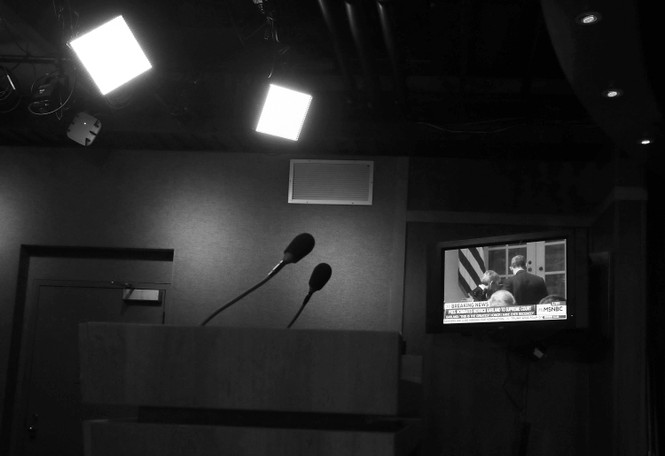
Picture of a TV screen showing President Barack Obama's announcement for his Supreme Court nominationPresident Barack Obama’s announcement for his Supreme Court nomination is shown on a TV in an empty Senate Radio TV studio on March 16, 2016, on Capitol Hill, in Washington, D.C. (Alex Wong / Getty)

Before he became attorney general, Merrick Garland’s life was defined by a job he has never held.

Twice, Barack Obama considered lifting him from the D.C. Circuit onto the Supreme Court, and twice Obama passed him over. After those failed attempts to move beyond the short list, Garland seemed to age out of the possibility, past the point where the actuarial tables suggest that an appointment is a worthwhile investment. Then, in 2016, Antonin Scalia died; Garland got his nomination after all—only to see it scuttled in the Senate by the obstructionist tactics of Mitch McConnell.

When Garland returned to the Court of Appeals after his nomination was blocked, he was greeted with an ovation from his colleagues. No doubt it was heartwarming, but the truth was that he was returning to an old routine after having been taunted with the job of his dreams. It would have only been human for his mind to ponder a fresh start.

In the fall of 2020, with polls showing Joe Biden primed to defeat Donald Trump, friends began asking, Would you ever want to be attorney general?

When Garland’s name showed up on the list of Biden’s potential AGs, it was fair to assume that he hoped the job would nudge the Supreme Court debacle out of the first paragraph of his obituary. But Garland told friends that he wanted to return to the Justice Department, where he’d worked as a young lawyer and first found his sense of professional purpose, to restore an institution that he revered. It had been damaged by a succession of Trump appointees, who carried out the policy of separating migrant children from their parents, distorted the findings of Robert Mueller’s investigation, and allegedly brought cases in order to settle the president’s political scores.

From the September 2022 issue: Caitlin Dickerson on the secret history of the U.S. government’s family-separation policy

As Garland prepared to take the job, he often sounded nostalgic for his first stint at DOJ, in the final years of the Carter administration, when he worked as a special assistant to Attorney General Benjamin Civiletti. Nobody thinks of the late ’70s as the height of idealism, but that’s how Garland remembers the time.

In the aftermath of Watergate, he sat by Civiletti’s side as he continued the work of reforming the Justice Department: writing new rules and procedures to prevent another president from ever abusing the institution. They were preserving the rule of law by bubble-wrapping it in norms, so that it would be thoroughly insulated from political pressure.

This June, I visited Garland in his wood-paneled office, one of the cozier rooms in DOJ’s cavernous building. He wore a navy suit that looked as if it had been purchased at Brooks Brothers in 1985. A tray of coffee with demitasses was laid out on a coffee table, but he sipped from a mug.

As Garland spoke about his approach to his job, he asked an aide to pass him a copy of a tattered blue book that was sitting on a side table, Principles of Federal Prosecution, published during his time with Civiletti. He kept extolling the neutrality of the department, how it should never favor friends or penalize foes, how it should only bring cases that persuade juries and survive appeals. “What I’m saying isn’t novel,” he said. “It’s all in here.”

Thumbing through the document, he seemed briefly distracted. I asked him if he’d had anything to do with its publication. “I helped edit it,” he said, and then wistfully recalled his mentors in the department who oversaw its production. It struck me that Garland isn’t just by-the-book. In some profound sense, he is the book.

This unbending fidelity to rules and norms has often looked impotent in the face of the democratic emergency that is Donald Trump. In his quest to avoid the taint of politics, Garland allowed certain Trump-era policies to remain in place. He ordered the DOJ to continue defending Trump against a defamation lawsuit filed by E. Jean Carroll, a writer who accused him of raping her. He has permitted the Special Prosecutor John Durham’s investigation of the origins of Russiagate to persist, despite a raft of Democrats clamoring for him to shut it down. (I should note here that Durham mentioned my reporting on Trump and Russia in court filings, and his lawyers asked witnesses about it in his prosecution of a Clinton campaign lawyer, whom a jury acquitted.) Those flash points created an impression of passivity; instead of rushing to confront the legacy of Trumpism, he seemed to be meekly deferring to it.

It is not difficult to see why anti-Trump partisans could grow frustrated with Garland’s obdurate commitment to the traditions of the department when Trump is so intent on trampling them. His faith in them feels antiquated—and detached from the Democratic Party’s broad reconsideration of norms that were once seen as pillars of the American system. Not so long ago, expanding the number of justices on the Supreme Court or eliminating the filibuster seemed like subversive thought experiments. Now they are touted as necessities for preserving majoritarian politics.

But the post-Watergate reforms that Garland wants to defend weren’t aimed at abstract threats. They emerged as responses to very real abuse committed within living memory. And they arguably did an effective job at blunting Donald Trump’s desire to turn the Justice Department into his plaything, even if they couldn’t prevent every transgression. Norms held and prevented nightmare scenarios from unfolding.

These norms may not hold the next time, but that doesn’t obviate their ethical power. No matter how much one fears Trump, the prosecution of a former president can’t be undertaken lightly. The expectation that political enemies will be treated fairly is the basis for the legitimacy of the entire legal system. That’s why Garland’s hand-wringing and fussiness matter. Any indictment he brings against Trump will have survived his scrutiny, which means that it will have cleared a high bar.
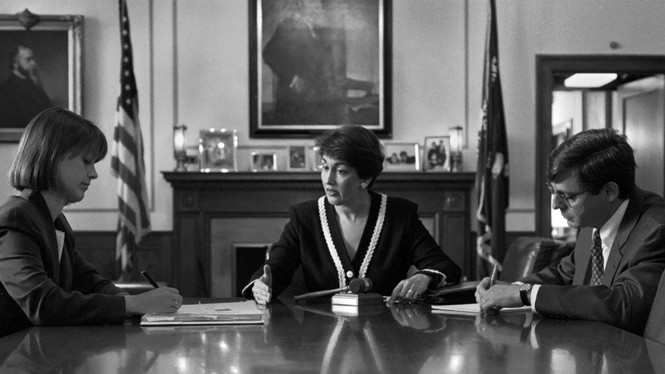
Picture of Jamie Gorelick, Deputy Attorney General, taking a meeting with Amy Jeffries, left, Counsel to D.A.G., and Merrick Garland, Principle Assistant to the D.A.G., right, in her office at the Justice Department. Photograph taken in September 1995  (Photo by Bill O'Leary/The The Washington Post via Getty Images)Deputy Attorney General Jamie Gorelick takes a meeting with Amy Jeffries (left), counsel to the DAG, and Merrick Garland (right), principal associate DAG, in her office at the Justice Department, in September 1995. (Bill O’Leary / The Washington Post / Getty)

When Garland talks about how he handles complex, emotionally fraught investigations, there’s a historical antecedent that he likes to cite as his formative experience. On the morning of April 19, 1995, the Department of Justice’s leadership learned that a bomb had destroyed much of a massive federal office building in Oklahoma City, ripping off its facade and killing 168 people, including 19 children in the building’s day-care center.

At the time, Garland held a job known as the PADAG, or the principal associate deputy attorney general. It’s a mystifying title, but one of the most prized offices in the department: It afforded him a seat in the attorney general’s morning meeting and access to DOJ’s most closely held secrets. Garland used his privileged position to ask if he could travel to Oklahoma City to oversee the investigation.

Before Garland left, Attorney General Janet Reno pulled him aside. Of all things, she wanted to talk about O. J. Simpson. The football star’s trial was going to be running on a split screen alongside the Oklahoma City investigation. Everything the public was about to witness in a Los Angeles courtroom would make the justice system look like a tawdry joke. She told Garland that his job was to show how the legal system could be the antithesis of that circus.

“I want you to be meticulous,” she told him. “I don’t want to have any chance of losing a conviction. I want this to be picture perfect, so that the public understands what justice is.”

The bombing case triggered a strong emotional reaction across America, particularly those who feared the emergence of right-wing militias. Although much more straightforward than the chaotic events of January 6, the crime ignited a similarly intense desire to quickly punish the perpetrators. But Garland vowed to Reno that he would take the long way around.

Paying strict attention to procedure came naturally to Garland, even when the FBI seemed inclined to take shortcuts. He ordered agents to obtain warrants and subpoenas from courts even when they weren’t unambiguously necessary. In his quest for immaculate justice, his investigators conducted 28,000 interviews.

These decisions arguably made the prosecution’s case harder and certainly delayed the gratification of a conviction. But they also guarded against humiliating slipups that might have provided the basis for an appeal. In the end, Timothy McVeigh’s attempt to overturn his conviction failed and he was executed in 2001. His co-conspirator Terry Nichols was sentenced to life, a sentence that an Appeals court affirmed.

David A. Graham: How did the Oklahoma City bombing shape Merrick Garland?

Garland has taken a similarly meticulous approach to Trump. Rather than starting with the offenses of the president himself, the department has devoted its resources to tediously building cases against every gym teacher and accountant who breached the Capitol on January 6, some 900 indictments in total. The volume of cases has risked overtaxing prosecutors—and pushing back the work of building more-complicated cases against Trump’s inner circle.

But what looks like donkeywork is a necessary step in a formulaic approach, a set of prescribed practices that have their own embedded wisdom. As Garland explains it, the department has no choice but to begin with the most “overt crimes,” and slowly build from there. To start with Trump would have reeked of politics—and it would have been bad practice, forgoing all the witnesses and cellphone data collected by starting at the bottom.

By focusing on Trump, Garland’s critics tend to underestimate the importance of the other arms of the January 6 prosecutions. The Justice Department has made an example of the foot soldiers of the insurrection, and has thus deflated attendance at every subsequent “Stop the Steal” rally. Evidence supplied by the minnows who invaded the Capitol helped the Justice Department indict leaders of the Oath Keepers (Elmer Stewart Rhodes) and Proud Boys (Henry “Enrique” Tarrio) on charges of seditious conspiracy, the most meaningful steps that the government has taken to dismantle the nation’s right-wing paramilitaries. (Both men have pleaded not guilty.)

From the November 2020 issue: Mike Giglio on the pro-Trump militant group that has recruited thousands of police, soldiers, and veterans

Based on subpoenas and the witnesses seen exiting the grand jury, the department is clearly moving up the ladder, getting ever closer to Trump’s inner circle and to Trump himself. But there comes a moment when the rule book that Garland reveres ceases to provide such clear guidance. That’s the juncture that allows for prosecutorial discretion. In the case of Donald Trump, the prosecutor is Merrick Garland and discretion would allow him to decide that an indictment is simply not worth the social cost, or that the case is strong but not strong enough. Garland’s critics fret that when confronted with this moment, his penchant for caution will take hold.

Over the course of his career, institutions were good to Merrick Garland—and he was good to institutions. He was a true believer in the American system. That’s why he struggled to come to terms with the reality of Mitch McConnell.

For 293 days after Obama announced his selection to fill Scalia’s seat, Garland was trapped in limbo, waiting for Senate Republicans to provide him a fair hearing. The whole world knew that they never would; Garland remained patient. One of his old teachers from Harvard Law School, Laurence Tribe, told me, “What was heartbreaking was to see that the system really wasn’t as good as he hoped it was.”

The human response to McConnell’s brazen tactics was rage. Garland’s wife and daughters certainly channeled that emotion, as did his friends and former clerks. The people around Garland couldn’t contain their fury, but he did. When friends would call to vent, he would try to comfort them, to tamp down their ire. “Don’t feel too sorry for me,” he told them. “I’ve had a great run. Don’t worry.”

Such placidity wasn’t anomalous. He was always the calm one, his friend Jamie Gorelick told me. Ever since college, he had counseled her to not let emotions roil her. Back then, she was enraged that Harvard gave free football tickets to men, not women. After a contentious meeting where she railed against the injustice, he took her aside: “You’re right to be upset, but you shouldn’t be this upset. Over time, this will get fixed.” Gorelick valued his circumspection so highly that she hired him to serve as her deputy in the Clinton Justice Department. Even then, his advice was the same. He encouraged her to put angry letters she wrote in a drawer, until she restored her sense of equilibrium.

This tendency could be described as repression. The theologian Reinhold Niebuhr had another name for it. He called it the “spiritual discipline against resentment,” a phrase from his theory of political persuasion. He urged victims of injustice to resist the self-defeating instinct to righteously trumpet their own victimhood. That’s not a personal credo for Garland, or anything like it. But with his preternatural self-control and his sense of rectitude, he seems to regard anger, especially on his own behalf, as a dangerous emotion.

This can make him seem out of step with the zeitgeist, which is defined by rage. On January 7, 2021, when Joe Biden unveiled him as his nominee, he seemed strangely detached from the depredations of the previous day, which he referred to only once, as “yesterday’s events in Washington.” He argued that the insurrection showed that “the rule of law is not just some lawyer’s turn of phrase.” Even accounting for Garland’s tendency to overthink his choice of words, his conclusion felt like a massive underreaction.

With the investigation of Trump, the legitimacy of the judicial system is at risk. Of course, the MAGA set will never regard an indictment of their leader as anything other than a sham. But the perceptions of the rest of the country matter too. And it’s important that, if DOJ moves forward with an indictment, the public views it as the product of a scrupulous examination of facts, not the impulse for revenge. Indicting the candidate of the opposing party, if it occurs, should feel reluctant, as if there’s no other choice.
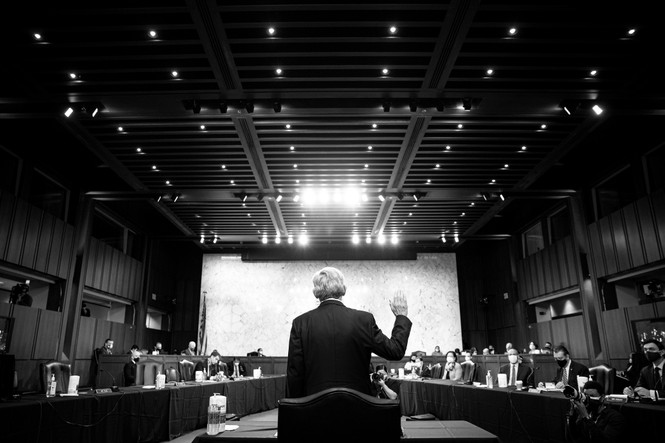
Picture of Merrick Garland being sworn in during his confirmation hearing before the Senate Judiciary Committee on Capitol Hill in Washington, D.C., the United States, Feb. 22, 2021.The attorney-general nominee Merrick Garland is sworn in during his confirmation hearing before the Senate Judiciary Committee on Capitol Hill in Washington, D.C., on February 22, 2021. (Al Drago / The New York Times / Redux)

It’s hard not to think of Garland as a character from another time. When I suggested this to him, he protested, jokingly (I think), citing a marker of cool highly significant to males in their 60s. “You know, I was there at the Bruce Springsteen concert in 1974, the one Jon Landau wrote about in his famous column in The Real Paper. ‘I’ve seen the future of rock and roll.’”

When he was on the bench, Garland would occasionally orient new clerks to his idiosyncrasies by playing a song by the band Vampire Weekend which contains the refrain, “Who gives a fuck about an Oxford comma?” It was amusing because the band was so distant from his range of expected cultural references, and because the strait-laced attorney general would never utter that sentence himself. It was also funny because Garland does care about punctuation, deeply.

Garland likes everything in its place. When, as a judge, he asked his clerks to prepare reading material, they would comb through it with a ruler in hand. The margins needed to be just so, with space for them to draw lines next to matters of import. A single line drawn parallel meant the clerks had material worthy of his attention; a triple line signaled the crux of the argument. When he found methods that worked, he clung to them. He may have been the last American to use WordPerfect.

Garland took office as attorney general with old-fashioned ideas about what was possible. He told his aides that he hoped he might help lower the temperature in the nation. He believed that he could use the department to restore a measure of civility that seemed to slip away during the Trump years.

One of the exhilarations of the new job was the sense of agency it offered. As a judge, he couldn’t pick and choose the matters that came across his desk. The docket was the docket. Now he could get exercised about an article in the morning newspaper, walk into his 9 a.m. meeting with deputies, and then insist that the department do something about it.

Every day, Garland kept encountering stories about appalling instances of harassment, a national epidemic of rudeness and rage. Flight attendants risked physical assault for asking passengers to wear masks. School-board officials received death threats. Police officers were harangued for doing their job.

Garland wanted to make an example of such behavior. The department began to aggressively prosecute illegal threats of violence, seeking stiff penalties for the sake of deterrence. But to his dismay, these efforts proved ineffective. No matter how many cases he brought, the DOJ couldn’t stanch the flood of invective. There was something profoundly wrong with the national culture, a dyspepsia that undermined the possibilities for collective coexistence and healthy democratic practice.

This year, as he came to understand the limitations of the job—all the broken facets of American life that the department is incapable of repairing—he began to appreciate the depths of the nation’s crisis. His public comments began to betray a sense of alarm. In May, he returned to Harvard to deliver a commencement address, issuing a grim report on the health of democracy. The historic metaphor he used to capture the urgency of the moment was the Justice Department’s founding in 1870, when its task was crushing the nascent Ku Klux Klan. Although the speech had grace notes of hope—the rousing calls to service that are de rigueur for the genre—it was hard to avoid its underlying pessimism, his warning that “there may be worse to come.”

At one point during my June visit, I called Garland an “institutionalist,” which I thought was an unobjectionable description of his political temperament. Upon hearing this, he turned to his aides, “I don’t think I’ve ever used the word to describe myself.” If I wanted, they would check, he said. But he was certain he had never uttered it.

I was surprised he would resist the term. I think he wanted me to understand that he is alive to the perils facing democracy—and isn’t naive about what it will take to defeat them. Norms alone are not enough to stop a determined authoritarian. It wasn’t quite a reversal in his thinking; radicalizing Merrick Garland would be impossible. But it was an evolution. His faith in institutions had begun to wobble.

With his optimism bruised, and his heightened sensitivity to the imminent threats to democracy, he’s shown a greater appetite for confrontation. There is no sharper example of this than his willingness to spar with Trump over the sensitive documents stashed at Mar-a-Lago. Searching the home of a former president is unprecedented. The warrant was executed knowing that Trump would demagogue the event—and that he might even encourage his supporters to respond violently.

With Trump, Garland has lately shown a pugnacity that few had previously associated with him. When Trump began to assail the search of Mar-a-Lago, Garland asked the court to unseal the inventory of seized documents, essentially calling out the ex-president’s lies. Rather than passively watching attacks on FBI agents, whom Trump scurrilously accused of planting evidence, Garland passionately backed the bureau. As Trump’s lawyers have tried to use a sympathetic judge to slow down the department’s investigation, Garland’s lawyers have responded with bluntly dismissive briefs, composed without the least hint of deference. (“Plaintiff again implies that he could have declassified the records before leaving office. As before, however, Plaintiff conspicuously fails to represent, much less show, that he actually took that step.”)

The filings can be read as a serialized narrative, with each installment adding fresh details about Trump’s mishandling of documents and his misleading of investigators. On August 31, the department tucked a photo into a brief, showing classified documents arrayed across a Mar-a-Lago carpet. This was both a faithful cataloging of evidence and sly gamesmanship. Garland permitted the department to release an image sure to implant itself in the public’s mind and define the news cycle. Lawfare described the entirety of that filing as “a show of force.”

In the Mar-a-Lago case, Garland is facing Trump in court for the first time. He arguably dillydallied on his way to the fight. But now that he’s entered it, he’s battling as if the reputation of the DOJ depends on winning it. During our interview, Garland reminded me that he was once a prosecutor himself. The unstated implication was that he knows what it takes to prevail.

There’s a date on the calendar when excessive meticulousness potentially precludes holding Trump to account. On January 20, 2025, Merrick Garland might not have a job. His post could be occupied by an avatar of the hard right. And any plausible Republican president will drop the case against Donald Trump on their first day in office.

The deadline for indicting Trump is actually much sooner than the next Inauguration Day. According to most prosecutors, a judge would give Trump nearly a year to prepare for trial, maybe a bit longer. That’s not special treatment; it’s just how courts schedule big cases.

If Trump is indicted for his role on January 6, he might get even more time than that, given the volume of evidence that the Justice Department would pass along in discovery. And if the evidence includes classified documents, the court will need to sort out how to handle that, another source of delay.

Depending on the charges, a trial itself could take another week—or as long as six months. That means Garland has until the late spring of 2023 to bring an indictment that has a chance of culminating in a jury verdict before the change of administration.

The excruciating conundrum that Garland faces is also a liberating one. He can’t win politically. He will either antagonize the right or disappoint the left. Whatever he decides, he will become deeply unpopular. He will unavoidably damage the reputation of the institution he loves so dearly with a significant portion of the populace.

Faced with so unpalatable a choice, he doesn’t really have one. Because he can’t avoid tearing America further apart, he’ll decide based on the evidence—and on whether that evidence can persuade a jury. As someone who has an almost metaphysical belief in the rule book, he can allow himself to apply his canonical texts.

That’s what he’s tried to emphatically explain over the past months. Every time he’s asked about the former president, he responds, “No one is above the law.” He clearly gets frustrated that his answer fails to satisfy his doubters. I believe that his indictment of Trump will prove that he means it.

Categories
Saved Web Pages

‘Lives could be at stake’: Trump document review to gauge whether US sources put at risk

ee98acea-a96c-4ffe-b43c-56a3047cc6ca-ald

75b02d6b-e8cf-43b9-97bf-0424ba949233-WWK

play
Here’s why a judge granted Trump’s request for a special master
For the first time ever, a special master has been granted to review documents in the criminal investigation of a former president. Here’s why.
  • Experts say it’s important to act swiftly to identify whether secret sources were compromised.
  • Because human sources report on foreign adversaries, experts say their lives could be at risk.
  • Experts say if sources or technology were revealed, information about adversaries could dry up.

WASHINGTON – As U.S. intelligence agencies gauge the potential damage from Donald Trump storing hundreds of classified documents at Mar-a-Lago, hanging in the balance is the threat to foreign sources of information recruited sometimes over a period of years and at great cost.

The documents at Mar-a-Lago were among the country’s most closely held secrets, dealing with human sources of intelligence and information that was supposed to be returned to agencies that provided it. Human sources are typically foreign nationals who risk prison terms and execution for spying on their own governments.

While much attention is trained on whether the former president broke the law, the Office of the Director of National Intelligence is assessing the potential security risks with the FBI to see what damage might have been done.

The risks of exposing the secrets can mean life or death. Past intelligence reviews found U.S. sources were executed after former CIA officer Aldrich Ames and former FBI agent Robert Hanssen passed documents dealing with human sources of intelligence to the Soviet Union or Russia.

Nobody has accused Trump of passing along secrets to foreign adversaries. But national security experts said even the notion the documents sat outside secure locations for 18 months could prompt agencies to pull intelligence sources from foreign countries or cut off contact as a precaution.

David Priess, a former CIA officer who presented the President’s Daily Brief, which provides a summary of high-level information and analysis about national security issues, said the investigation would seek to determine who may have had access to the secrets and whether any intelligence sources or methods were compromised. The investigation might find no secrets were lost. But in the worst case, the government might have to remove somebody from their clandestine post or stop using some spying technology.

“This is not a joke,” said Priess, author of “The President’s Book of Secrets.” “Ultimately, lives could be at stake.”

Investigators will try to nail down as firmly as possible whether information in the Mar-a-Lago documents was revealed to foreign adversaries, experts said.

“The intelligence community is made up of people that when they smell flowers, they ask where is the funeral. We’re generally worst-case-scenario type of people in the absence of evidence,” said Larry Pfeiffer, a 32-year intelligence official who was the senior director of the White House Situation Room and chief of staff to former CIA Director Michael Hayden. “The intelligence community could potentially be relocating assets as we speak or at a minimum telling assets to lay low.”

Hundreds of classified documents from Mar-a-Lago will be scrutinized

Security experts said the classified documents appeared to be handled carelessly as Trump stored more than 300 classified documents at Mar-a-Lago. Documents typically locked in a safe in a secure location were mingled with magazines and even clothing in a basement storeroom and in Trump’s office, the FBI says.

Even without accusing anyone of intentionally passing along secrets to foreign adversaries, security experts warn the documents could have been exposed to Mar-a-Lago staffers or spies who could have gained access to the resort.

The Office of the Director of National Intelligence is assessing the risks. Pfeiffer, who directs the Michael V. Hayden Center for Intelligence, Policy, and International Security at George Mason University, said that as part of that review FBI counterintelligence agents must conduct a thorough investigation to see what might have been revealed to adversaries.

While it is crucial that any damage assessment be done swiftly, Carl Ghattas, a former executive assistant director of the FBI’s National Security Branch, said the potential compromise of human sources would add new “urgency” to the effort.

“Ideally, we want to make contact with the individual (source) in person, if that was possible,” said Ghattas, emphasizing that he was speaking generally and had no knowledge of what might have been recovered in the Mar-a-Lago search.

“You want to make sure that the individual is in a safe place, but that person may not be easily accessible depending on location,” Ghattas said. “We take relationships with human sources very seriously; they are relationships built on trust developed over days, weeks, months and years. Any compromise could be seen as a violation of that trust. And the last thing you want is to put someone in jeopardy.”

Ghattas said a collateral risk, beyond exposing people to possible harm, is that intelligence breaches may send a signal to other potential sources, including law enforcement agencies and foreign intelligence services, that their information won’t be adequately protected.

“It can cause (potential sources) to question whether they should come forward,” he said.

In the past year, the federal government has recovered hundreds of documents with classification markings from Trump’s Mar-a-Lago estate, the most recent batch coming from the August search of the Florida property. They’ve include dozens of confidential, secret and top-secret documents.

Michael Patrick Mulroy, a former deputy assistant secretary of defense and retired former CIA officer, said generally speaking the documents wouldn’t reveal the human sources because policymakers are provided with information rather than the sources of the information. For example, a document could detail what Russian President Vladimir Putin was doing in Ukraine but not how the information was obtained, he said.

“Generally, it doesn’t reveal – and it shouldn’t ever reveal – to the folks who are reading it where it came from. It’s about the information,” Mulroy said.

Mulroy said the CIA, which tends to handle the most human intelligence, and other agencies go to great lengths to safeguard their sources. After a potential breach of information, officials investigate whether sources were revealed and whether they need to move them from their home countries.

Human sources of intelligence need to be protected because they are typically foreigners risking their own lives spying on their own government, Pfeiffer said.

“They’re breaking their own laws,” Pfeiffer said. “If they get caught, they’re either going to go to jail or they’re going to probably be killed or kicked out of the country.”

Short of evacuating compromised sources, options include cutting off contact temporarily, Pfeiffer said. If a foreign government detains a U.S. asset, the source could give up the names of U.S. contacts.

Mulroy said highly sensitive documents dealing with human sources are generally tracked and logged, with a relatively small number of people granted access. The folders should have serial numbers so intelligence agencies know what the documents contained, even if the folders are empty, he said.

“They don’t just print stuff and give it out and don’t know where it is,” Mulroy said. “Depending on what was recovered and what was not recovered – empty folders, for example – there would be a considerable counterintelligence effort to determine why this information was allegedly stored outside of a SCIF,” or Sensitive Compartmented Information Facility.

Suspicious activity at Mar-a-Lago occurred before the document storage was revealed 

The alarm among national security experts is partly because Mar-a-Lago is a sprawling resort where members, guests or staffers could have rummaged around for the classified documents.

The club, which hosts weddings and other special events, has a beach, pool and landscaped gardens. The 17-acre estate has a mansion with 58 bedrooms and 33 bathrooms, according to the FBI affidavit that called for a search of everywhere not occupied or rented by members of the club.

Foreign intelligence services tend to recruit service workers such as cleaners, gardeners and waiters, according to intelligence experts. U.S. agents have the capability to enter a room, copy documents and leave without a trace, so adversaries are presumed to be able to accomplish that, too, Pfeiffer said.

Mar-a-Lago has had suspicious run-ins in the past. 

Two Chinese nationals were convicted of trying to infiltrate Mar-a-Lago while Trump was president. Yujing Zhang was sentenced to eight months in jail for unlawful entry in a restricted building and making false statements after Secret Service agents discovered her roaming around Mar-a-Lago in March 2019.

Zhang “lied to practically everyone she encountered in the United States” and was found with numerous electronics in her purse, including a cellphone in a Faraday bag that blocks signals such as Wi-Fi and Bluetooth, according to prosecutors.

Trump brought the documents to Florida after leaving the White House in January 2021. In October 2021, The New York Times reported the CIA acknowledged that dozens of informants have been killed or compromised in recent years.

Trump’s lawyers contend there is no evidence he gave the documents to anyone.

In worst intelligence lapses, US sources have been killed

The costs to the U.S. could include lost intelligence and sources that took years to cultivate. A breach also could discourage sources from stepping forward and cooperating.

“It could mean that other sources we have may go: ‘Maybe I’m going to hold off for a little while because I saw what just happened. You told me the stuff I gave you, you were going to protect with your lives, and now you’re telling me it’s laying around in the basement of a golf resort in Florida. Maybe I don’t want to talk to you any more,’” Pfeiffer said. “Others may not want to talk.”

The Justice Department hasn’t revealed what the classified documents contained. But presidents tend to get the highest-level information.

“Odds are what the president is seeing is some of the most sensitive stuff that is out there,” Pfeiffer said. “Run-of-the-mill intelligence is not necessarily the stuff you’re going to be leaving with the president or that he’s going to say, ‘Hey, I want to read this a little more.’ It’s probably the most sensitive stuff.”

Priess said the documents wouldn’t have been marked top-secret “if there were not the potential for exceptionally grave damage to national security.” Court cases described incidents when sensitive information was revealed and sometimes people “have died,” he said. 

Dale Watson, a former top FBI counterterrorism and counterintelligence official, said initial damage assessments related to security breaches typically take only days to complete. But more definitive examinations can take months.

“You want to move very, very quickly,” Watson said, referring to the elevated stakes when human sources are put at possible risk.

Though some of the classified documents seized from Trump’s Florida estate were marked as containing information from confidential informants, the nature of the information has not been made public, and Watson said the mere presence of the material does not necessarily indicate that actual human sources were indeed compromised.

During his FBI tenure, which covered the Oklahoma City bombing and 9/11 attacks, such classified reports did not contain specific references to individual sources such that they could be immediately identified by name or location when shared with executive branch officials, including the president.

The president can request that such information be divulged, but Watson said that was rare. During post-9/11 White House briefings, Watson said, President George W. Bush never asked for such information.

“He (Bush) never asked me for a name,” Watson said. “We don’t withhold  that information, but we limited access by a strict need-to-know standard.”

A damage assessment, Watson said, would nevertheless consider whether unsecured classified records contained enough information that could lead to  human or even technical sources.

In some cases, intelligence officials will learn that sources have been compromised when information abruptly stops flowing or when the informants “start getting picked up.”

The government might not issue statements about the investigation’s progress, other than filings in court cases. But as with subpoenas in other cases, Priess said the people who are questioned might reveal themselves as witnesses who had access to the storage room or Trump’s office at Mar-a-Lago.

Estimating the length of the investigation is difficult because of uncertainties about what secrets were at risk. But the investigation could be lengthy because dozens of documents were at risk and documents were unsecured for 18 months.

“All I know is, it won’t be quick,” Priess said.

Ames, Hanssen illustrate worst cases

The risk of exposing human intelligence sources can be lethal, as revealed in the spy cases of Ames and Hanssen.

Ames, a 30-year CIA officer, pleaded guilty in 1994 to giving secrets to the Soviet Union and Russia that led to the execution of 10 CIA and FBI intelligence sources at the height of the Cold War, according to a summary of the case by the Justice Department inspector general.

Ames represented “the costliest breach of security in CIA history,” according to a report by William Webster, a former CIA and FBI director. Ames revealed more than 100 covert operations and betrayed more than 30 operatives spying for Western intelligence services, according to the report.

Ames said he routinely carried shopping bags full of classified documents out of the office, according to a Senate report about the case.

“In a statement read to the court at the time the plea agreements were entered, Ames admitted having compromised ‘virtually all Soviet agents of the CIA and other American and foreign services known to me’ and having provided to the Soviet Union and to Russia a ‘huge quantity of information on United States foreign, defense and security policies,’” the report said.

Ames acknowledged engaging in espionage from 1985 to 1994. He is serving a life sentence in Indiana.

“Within a matter of months, virtually its entire stable of Soviet agents had been imprisoned or executed,” the Webster report said. “The CIA was left virtually to start from scratch, uncertain whether new operations would meet the same fate as its old ones.”

Hanssen, a former FBI supervisory special agent, acknowledged engaging in espionage for 22 years, passing secrets to the Soviet Union and Russia 40 times, in what was “possibly the worst intelligence disaster in U.S. history,” according to the Webster report.

Hanssen turned over 6,000 pages of classified information and 26 diskettes of “extraordinary importance and value,” according to the report. He would simply “grab the first thing (he) could lay (his) hands on” before he headed to one drop with his Russian agents, according to the report.

At least three human sources among dozens he identified were executed, according to an inspector general’s report on the case.

“In the absence of any evidence, you have to assume the worst-case scenario,” Pfeiffer said. “It could put a real dark cloud over some of these assets.”  

Categories
Saved Web Pages

Rep. Scott Perry Quietly Drops Suit Against DOJ After FBI Seized Cellphone Data

635a0aaa2700003500d3d5b8.jpeg?cache=MaPy

The Republican first said in August that the FBI seized his phone while he was traveling with family.

Categories
Saved Web Pages

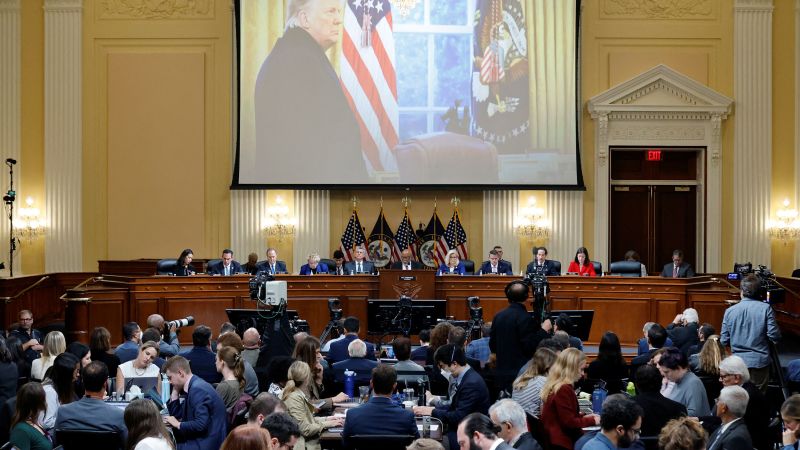
Trump’s lawyers have accepted service of House January 6 committee subpoena

221013155707-07-jan-6-hearing-101322.jpg

Lawyers for former President Donald Trump have accepted service of the subpoena from the House January 6 select committee, according to sources familiar with the matter.

Trump and his lawyers have until November to 4 to turn over documents sought in the subpoena and until November 14 to testify at a deposition.

CNN has reached out to Trump’s lawyers for comment.

Trump has criticized the committee but not said whether he would comply with the subpoena. He did recently share a Fox News story on Truth Social that claimed he “loves the idea of testifying.” But Trump also could fight the subpoena in court in what would likely be a lengthy legal battle that could outlast the committee.

Politico first reported on the subpoena being served.

The committee announced on October 21 that it had officially sent a subpoena to Trump.

On the day the subpoena was announced, Trump’s attorney David Warrington released a statement saying, “we are going to be handling this matter as counsel for President Donald J. Trump. We understand that, once again, flouting norms and appropriate and customary process, the Committee has publicly released a copy of its subpoena. As with any similar matter, we will review and analyze it, and will respond as appropriate to this unprecedented action.”

The subpoena to Trump set down a marker and made clear the committee wants information directly from the former President as the panel investigates the attack.

Republican Rep. Liz Cheney of Wyoming, who serves as vice chairwoman of the panel, said at a recent Harvard event she assumes Trump will fulfill his legal obligation and honor the committee’s subpoena, “but if that doesn’t happen, then we’ll take the steps we need to take after that, but I don’t want to go too far down that path at this point.”

Unlike with previous subpoena announcements, the committee released on Friday the entire subpoena it sent to Trump along with the documents it is requesting.

“As demonstrated in our hearings, we have assembled overwhelming evidence, including from dozens of your former appointees and staff, that you personally orchestrated and oversaw a multi-part effort to overturn the 2020 presidential election and to obstruct the peaceful transition of power,” Cheney and Democratic Rep. Bennie Thompson of Mississippi, the committee’s chairman, wrote in the subpoena letter.

Rep. Zoe Lofgren, a California Democrat who serves on the committee, was asked last week if she and her colleagues are open to the former President testifying before the panel. She told CNN’s Wolf Blitzer on “The Situation Room” that it’s “subject to negotiation,” but reiterated that Trump must respond to the subpoena first.

“We asked for the documents first, so that we can consider what additional questions we may wish to pose to him,” Lofgren added.

The panel summarized what it presented in its hearings to demonstrate why it believes Trump “personally orchestrated and oversaw” the efforts to overturn the election.

It said Trump “purposely and maliciously” disseminated false claims that the 2020 election was stolen in order to help his plan to overturn the election and to solicit contributions. The committee painted Trump as “orchestrating and overseeing” the effort to obtain false state electors. On pressure campaigns Trump enacted, the panel highlight said the former President attempted to “corrupt the Department of Justice,” by getting officials to make “false statements,” illegally pressured state officials to change election results, pressured former Vice President Mike Pence to refuse to count electoral votes on January 6 “despite knowing specifically that it was illegal,” and pressured members of Congress to object to valid electors.

In its subpoena, the committee also specifically demanded Trump turn over any communications, sent or received during the period of November 3, 2020, to January 20, 2021, with more than a dozen of his close allies who have emerged as key players in the broader plan to overturn the 2020 election.

The subpoena also demanded Trump turn over any communications, sent or received during the period of November 3, 2020, to January 20, 2021, with more than a dozen of his close allies who have emerged as key players in the broader plan to overturn the 2020 election:

  • Michael Flynn, Trump’s former national security adviser
  • Roger Stone, a long-time Republican operative, pardoned by Trump
  • Stephen Bannon, former Trump adviser, convicted of contempt of Congress
  • Rudy Giuliani, Trump’s former attorney
  • Jeffrey Clark, a former Justice Department official
  • John Eastman, a conservative attorney who worked with Trump to overturn 2020 election
  • Christina Bobb, a former One America News Network host and current Trump lawyer
  • Jenna Ellis, a former member of Trump’s legal team
  • Sidney Powell, a former member of Trump’s legal team
  • Kenneth Chesebro, an attorney behind legal theories for overturning 2020 election
  • Boris Epshteyn, a Trump adviser
  • Cleta Mitchell, an attorney who worked with Trump campaign after 2020 election
  • Patrick Byrne, a former Overstock CEO and election denier

The panel’s request for communications included Trump’s Signal communications. The committee also noted that it wants Trump to testify about his interactions with several individuals, including people on the same list, who invoked their Fifth Amendment rights when questioned by the committee about their dealings with the former President.

“This subpoena calls for testimony regarding your dealings with multiple individuals who have now themselves invoked their Fifth Amendment privilege against self-incrimination regarding their communications with you, including Roger Stone, Lt. Gen. Michael Flynn, U.S. Army (Retired), John Eastman, Jeffrey Clark and Kelli Ward,” the committee wrote in a letter to Trump.

In its most recent public hearing on October 13, the committee voted unanimously to subpoena Trump.

Ahead of that vote, Thompson said, “it is our obligation to seek Donald Trump’s testimony.”

Cheney said during the hearing that seeking the former President’s testimony under oath remains “a key task” because several witnesses closest to him invoked their Fifth Amendment right against self-incrimination in response to their interactions with Trump.

“We are obligated to seek answers directly from the man who set this all in motion,” Cheney said, referring to Trump.

CNN’s Sara Murray and Paula Reid contributed to this report.

Categories
Saved Web Pages

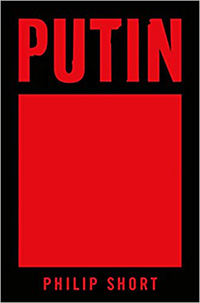
A New Putin Biography: Rich Stories of Early Life, and Some Needless America Bashing

BOOK REVIEW

Putin by Philip Short“Putin”
By Philip Short
Henry Holt and Co., July 2022

As Russia continues its devastating war in Ukraine, those inside and outside both countries strain to understand Russian President Vladimir Putin. Despite some shortcomings, Philip Short’s new biography “Putin” is valuable to anyone eager to learn more about Russia’s leader.

At nearly 700 pages, the book is exhaustive though not comprehensive, in that few if any biographers could have full access to the Kremlin’s internal operations or to Putin’s confidantes (if any truly exist). Short conducted nearly 200 interviews during eight years of research; his narrative of Putin’s pre-Moscow life, which makes up the first third of the book, is especially rich and engaging. These chapters establish Vladimir Putin as a human being—calculating, reticent, prideful, easily provoked and at times reckless—rather than a crafty super-spy or a comic-book villain.

Short has likewise usefully integrated the parallel stories of Putin’s career and Russia’s post-Soviet history. His prologue, about the 1999 apartment bombings that many see as covert state acts of terror to enable Putin’s rise to the presidency, illustrates Russia’s murky internal affairs. His description of St. Petersburg Putin’s post-KGB work in local government helps to decode the later Moscow Putin’s complex relations with Russia’s economic reformers. And his chronicle of Putin’s growing disappointment with the West during the George W. Bush administration sets the stage for the unraveling of U.S.-Russia relations.

Still, “Putin” is not flawless. While some have criticized Short’s characterization of Putin as “more sympathetic” than other English-language biographies by American, British and Russian émigré writers, the book’s true weakness lies less in Short’s presentation of Putin—which does not shy from the Russian leader’s flaws—than in an apparent contempt for U.S. foreign policy and some U.S. officials that sometimes distorts history.

Many might agree with Short’s view that Washington has made numerous mistakes—in managing U.S.-Russia relations and in Afghanistan, Iraq, Libya and elsewhere—and share his desire for greater humility from U.S. officials past and present. Nevertheless, Short’s editorial commentary detracts from “Putin” by derailing the narrative and presenting simplistic, at times misleading or baseless interpretations. This is especially evident in his account of the Bush administration and its policies. (I was a political appointee and a senior advisor to the under secretary of state from 2003 to 2005.)

One example is Short’s assertion that “neoconservatives in the White House” provoked Moscow to invade Georgia in August 2008 by pressing for NATO membership for Ukraine and Georgia. While a Russia-Georgia war might not have occurred in 2008 absent NATO’s April communique promising eventual membership, securing NATO Membership Action Plans (MAPs) for the two countries was a bipartisan project with support well beyond unnamed neoconservative aides to President Bush. Short does not acknowledge that one month before the NATO summit, in March, the U.S. Senate passed a resolution calling for MAPs for the two countries by unanimous consent. Moreover, while Washington was the most influential advocate for Ukrainian and Georgian membership, it was neither the only nor the most ardent supporter of the policy.

Short likewise goes somewhat astray in his discussion of Russia’s energy exports to Europe during this period, wrongly asserting that concerns over Europe’s dependence on Russian natural gas “took on additional significance” at the time of Gazprom’s 2006 cutoff of gas deliveries to Ukraine because “Washington was seeking European markets for U.S. exports of liquified natural gas.”

Washington (that is, the Bush administration) was not able to seek European or any other additional markets at that time. The surge in America’s natural gas production that enabled LNG exports occurred only during the Obama administration, when officials approved 24 export licenses and created conditions for the rapid expansion in exports under President Donald Trump. Where U.S. LNG exports were concerned, Trump often acted like a salesman-in-chief, but George W. Bush had no new LNG to sell. Nor would the entirety of America’s 2006 LNG exports have materially affected European imports from Russia: Germany’s alone were over 100 times larger than America’s total LNG exports in 2006.

“Putin” raises several important questions that the book does not answer fully. One is when and why Russia’s president lies. Short recounts several occasions when Putin was untruthful, such as Putin’s efforts to obscure his service in the KGB’s Fifth Main Directorate (the department charged with monitoring and suppressing dissent inside the Soviet Union) and to manufacture a story explaining his transition from KGB officer to St. Petersburg official. Short describes these falsehoods as conveniences or necessary for Putin’s purposes at the time but does not offer a systematic explanation for Putin’s dissimulation.

Short refers more often to Putin’s risk-taking, including some rather dangerous personal behavior in his youth, and to his later attempts at greater caution. Yet here also he does not present a theory to explain the Russian president’s behavior as a young man, a KGB officer and official or as head of state. As a journalist rather than an academic, Short appears more interested in the individual stories of Putin’s risky conduct than in their structure, classification and implications. Readers must each draw individual conclusions.

One intriguing question is only implicit in Short’s work: Is Putin out of touch with today’s Russia and, for that matter, with Russian-speakers in Ukraine and other post-Soviet countries? As the book progresses, and as Putin’s career advances, the narrative necessarily becomes increasingly remote. First-hand accounts from ordinary people who knew Putin in his early life understandably disappear in favor of publicly available information, though Short does present some details from his past interviews.

While Russia’s president continues to encounter ordinary people, these interactions—like those of any president in a large country—are highly structured. During the 22 years that Putin has been president or prime minister, Russia has evolved dramatically; he may have intimately understood public anger over Russia’s domestic chaos and international decline during the 1990s, but how well does he understand his country today? Short does not fully explore either Russia’s evolution or Putin’s connection to its disparate social groups.

In concluding “Putin,” Short grapples with one of the biggest questions in U.S.-Russia relations since 1991—was today’s hostility inevitable? In Short’s view, it was: “America, the dominant global power, believes that its role is to lead. Russia refuses to be led.” These two short sentences capture the enduring tension at the heart of Washington’s interaction with Moscow over the last 30 years. But they prompt another question—namely, if conflict was inevitable, how much does Putin really matter? That Russians appeared shocked by their president’s decision to invade Ukraine in February, notwithstanding broad agreement with his grievances toward America and the West, suggests that some of Putin’s choices have been unique and consequential. Likewise, while their approaches to European security have not been equivalent to Putin’s war, it is conceivable that leaders in Washington, London, Paris, Berlin and other Western capitals could have developed different policies to pursue their hopes and avoid their fears. Short effectively conveys Vladimir Putin’s bitterness that they did not.

The opinions expressed herein are solely those of the author. Photo by Kremlin.ru shared under a Creative Commons license.

WP Radio
WP Radio
OFFLINE LIVE