Categories
Saved Web Pages

Biden sends a careful but chilling new nuclear message to Putin in CNN interview

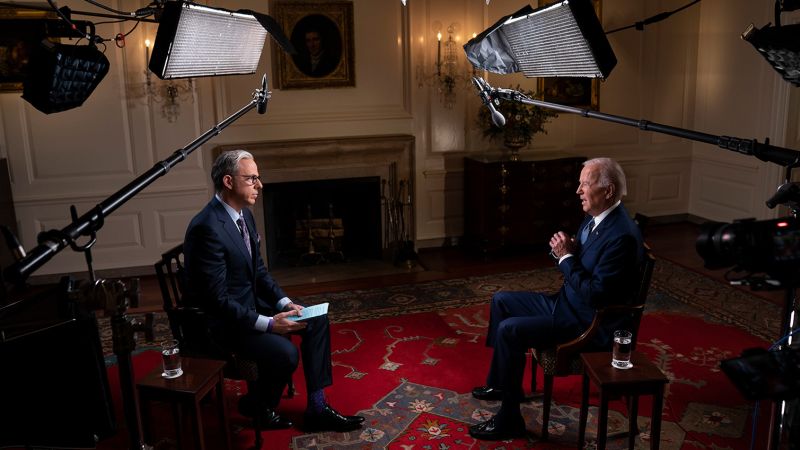
221012103259-05-tapper-interview.jpg?c=1

It’s never going to feel normal to hear a president discussing the danger of “Armageddon” – especially now, on camera.

But Joe Biden used an exclusive CNN interview on Tuesday to send another careful, yet clear and chilling message to Russian President Vladimir Putin about the disastrous consequences of using nuclear weapons in the war in Ukraine.

The first president since the 1980s to really have to game out calculations about nuclear arsenals and deterrence, Biden was asked by Jake Tapper whether he thought that Putin – who has warned he is prepared to use every option in Russia’s arsenal – might consider detonating one of the world’s most heinous weapons as an act of desperation in a losing war.

Biden replied: “I don’t think he will.”

But the President, who first touched on this subject at an off-camera fundraiser in New York last week, made crystal clear he was sending a public message to Putin about the dangers of thinking that using a lower yield, tactical nuclear bomb would be an isolated event.

“What I am talking about, I am talking to Putin. He, in fact, cannot continue with impunity to talk about the use of a tactical nuclear weapon as if that’s a rational thing to do,” Biden said, before warning of dangerous consequences of such a move.

“The mistakes get made, the miscalculation could occur, no one could be sure what would happen and it could end in Armageddon,” he said, again stressing that a nuclear blast that kills thousands of people could lead to events barreling way out of control.

Biden is stating the fear of some strategists who warn about a ladder of escalation that could occur if a nuclear bomb is used and triggers reprisals by the West – even though any initial US response would certainly go no further than conventional military action.

He also appears to be trying to create a narrative of deterrence around the specific situation in Ukraine. The logic of the US and Russia’s long-range strategic nuclear arsenals is that the use of them is deterred because a conflict would be suicidal for both sides. That equation does not exist in Ukraine, since the country has no nuclear arsenal and it’s hard to conclude that it represents a vital national interest that would lead Washington to respond in kind to Putin going nuclear. By stressing that even a tactical device – which could be small enough to destroy an airbase or large enough to reduce a city to ruins – could lead to something worse, Biden seems to be almost seeking to create a new chain of calculations in Putin’s mind.

Two moments in Tapper’s interview brought home the burden now borne by the man who is followed everywhere he goes by a military officer carrying the nation’s nuclear codes.

First the CNN anchor asked the President to state the US red line for the US and NATO in Ukraine and what Washington would do if Putin bombed a nuclear plant in Ukraine or set off a tactical nuclear weapon.

“It would be irresponsible for me to talk about what we would or wouldn’t do,” Biden said.

Then, Tapper prodded the President over whether the Pentagon had gamed out scenarios. Biden soberly replied: “The Pentagon didn’t have to be asked.”

Watch the full exclusive interview with President Joe Biden

Most experts and strategists estimate that there are many reasons why Putin would stop short of using a nuclear weapon – among them the possible risk of radioactive fallout crossing into Russia or the fact that the use of a tactical nuclear weapon may not actually be a sensible strategic option in the war.

But the fact he’s pushed himself into a corner, along with his obliviousness to civilian loss of life underscored again by his callous assaults on Ukrainian cities this week, suggests that a humanitarian impulse is unlikely to be part of his calculation. And Biden himself said in the interview that while he believed Putin was a “rational actor,” he had made significant miscalculations and his objectives were not rational. That leaves open the possibility of even more decisions that appear irrational to the West but may seem reasonable in Putin’s warped logic.

That is why Biden and experts who have dedicated their careers to staving off a nuclear apocalypse say the possibility that Putin may go nuclear must be taken so seriously – even if the chances remain very low and the US would likely be able to detect well ahead of time if Russia’s atomic devices were on the move.

“It’s not a probable event. It’s not even likely,” said Joseph Cirincione, a nuclear non-proliferation expert and former president of the Plowshares Fund, said on CNN’s “Newsroom” on Tuesday.

“But this is a low probability, high consequence event. If he uses even one nuclear weapon, he’s bringing us into a whole new world. He’s causing massive damage. And he’s running the risk of escalation with exchanges from the West that could lead to further exchanges, et cetera.”

Cirincione explained that even if Putin’s saber rattling represented a political threat designed to scare the West, it cannot be discounted.

“He has the means. He has the doctrine that allows him to use it. And he has the motive. He is losing this war. He has to do something to try to turn the tide of battle in desperation. He might turn to a nuclear weapon.”

While some critics have faulted the President for mentioning words like “Armageddon” and comparing his rhetoric to that of Putin, the motivations of the two men are very different. At a minimum, the Russian leader is boasting about nuclear weapons to scare the world. Biden is speaking publicly to stave off the possibility of disaster.

One reason the war in Ukraine is so dangerous is that nearly eight months in, there remains no prospect of any genuine diplomatic process that could defuse it. Ukraine’s forces, using US and allied weapons systems, are making remarkable progress on the battlefield and are determined to repel an unprovoked invasion that has caused carnage and extensive destruction. Putin has thrown so much personal prestige and Russian blood into the war he can hardly afford any outcome he cannot spin as a win, despite his autocratic grip on Russia.

Biden signaled in the Tapper interview that he saw no real rationale to meet Putin when both leaders are expected to be at the G20 summit in Indonesia next month. But he did leave one intriguing door open to the Russian leader, saying he’d sit down with Putin if he were willing to discuss the fate of US basketball star Brittney Griner, who was sentenced in August to nine years in prison after pleading guilty to drugs smuggling. The US says Griner and another American, former US Marine Paul Whelan, have been wrongfully detained. Washington has offered to swap jailed Russian arms trafficker Viktor Bout for the two Americans.

“Look, I have no intention of meeting with him, but look, if he came to me at the G20 and said, ‘I want to talk about the release of Griner,’ I would meet with him, but that would depend,” Biden said.

The President also downplayed the idea that more generally there was anything to talk about.

“He’s acted brutally, I think he’s committed war crimes, and so I don’t… see any rationale to meet with him now.”

Categories
Saved Web Pages

Russian Oligarch’s NYC Property Manager Arrested

ft-Russian-oligarchs-NYC-property-manage

Oleg Vladimirovich Deripaska with 11 East 64th Street, and 12 Gay Street (Google Maps, Getty)

Oleg Deripaska with 11 East 64th Street and 12 Gay Street (Google Maps, Getty)

Sometimes, it’s better not to pay that property bill.

A British man who managed New York real estate belonging to Oleg Deripaska was arrested after being indicted for allegedly violating U.S. sanctions against the Russian oligarch, the Department of Justice said in a statement.

Graham Bonham-Carter, a member of the politically connected family which includes celebrated actress Helena Bonham-Carter, was taken into custody in the U.K. for wire fraud in connection with funding U.S. properties purchased by Deripaska, the government said in a statement.

Under Deripaska’s employment, Bonham-Carter transmitted payments from a bank account in Russia held in the name of GBCM Limited to bank accounts held by Gracetown Inc. in New York City between March and December last year, according to the statement.

It said Gracetown used the funds from GBCM to “pay for various expenses…including staff salaries, property taxes and other services, and to maintain and keep up the U.S. properties.”

Those properties include townhouses in Lenox Hill and the West Village, which Deripaska bought for nearly $50 million in total, plus a mansion in Washington, D.C. They are among eight properties owned in New York City by Russians whose vast wealth largely derived from industries once owned by the Russian state.

The Real Deal has mapped those properties here.

Bonham-Carter allegedly violated sanctions placed on Deripaska in 2018 for actions the Russian government had taken in Ukraine, which it later invaded. The Justice Department cited emails since 2018 in which Bonham-Carter refers to Deripaska as “boss.”

However, it appears that nobody has paid property taxes lately at Deripaska’s New York City addresses, where more than $15,000 in interest has accrued on $175,000 due in 2022, according to the city’s Department of Finance.

Bonham-Carter also allegedly lied to an auction house after being confronted for trying to move a piece of Deripaska’s art from New York to London in an apparent violation of U.S. sanctions, according to the Justice Department.

Bonham-Carter was charged with three crimes — two related to sanctions violations and one count of wire fraud. Each count carries a maximum term of 20 years in prison. The government will seek to extradite Bonham-Carter, who appeared in a London courtroom Tuesday, to the U.S.

Categories
Saved Web Pages

Russia announces the arrests of eight people over the Crimea bridge blast.

10ukraine-briefing-02-facebookJumbo.jpg

  • Send any friend a story

    As a subscriber, you have 10 gift articles to give each month. Anyone can read what you share.

    Give this articleGive this articleGive this article
Smoke billowing from a fire on the Kerch Strait Bridge linking Crimea to Russia on Saturday.

Smoke billowing from a fire on the Kerch Strait Bridge linking Crimea to Russia on Saturday.Credit…Agence France-Presse — Getty Images

  • Oct. 12, 2022Updated 6:58 a.m. ET

KYIV, Ukraine — Russia’s domestic intelligence service announced the arrest of eight people on Wednesday in connection with the weekend bombing of the bridge linking Russia to the occupied Crimean Peninsula. Five are citizens of Russia, according to the agency, the F.S.B., and the others are Ukrainian and Armenian.

President Vladimir V. Putin has blamed Ukraine for the blast, which he called a “terrorist attack,” and retaliated with a barrage of missile strikes against civilian targets in Ukraine this week, killing more than 20 people.

In a statement, the F.S.B. offered Russia’s first detailed version of how it contends the blast took place. It said that the bomb had contained 22 tons of explosives that were shipped out of a port in Odesa, in southern Ukraine, in August. The explosives made their way to southern Russia, where they were loaded onto a truck that was driven onto the bridge and detonated, it said.

The details could not be independently confirmed. Russia maintains an effective blockade on the ports of Odesa, permitting only grain ships, inspected by international monitors, to leave under a deal brokered this summer by the United Nations.

The F.S.B., as Russia’s premier domestic intelligence service, has primary responsibility for security on the bridge. The bombing represented a profound lapse in the agency’s oversight, even as Ukrainian officials telegraphed for months their intentions to strike the structure.

The F.S.B said Ukraine’s military intelligence service, the G.U.R., had masterminded the blast, saying that the agency’s commander, Gen. Kyrylo Budanov, bore personal responsibility. A senior Ukrainian official, speaking on the condition of anonymity because of a government prohibition against discussing the episode, confirmed that Ukraine’s intelligence services had carried it out, and other senior officials have not denied Ukraine’s role.

But Ukraine’s government has not officially claimed responsibility for the explosion, and a spokesman for the G.U.R. dismissed the Russian assertions as “nonsense.”

What we consider before using anonymous sources. Do the sources know the information? What’s their motivation for telling us? Have they proved reliable in the past? Can we corroborate the information? Even with these questions satisfied, The Times uses anonymous sources as a last resort. The reporter and at least one editor know the identity of the source.

The F.S.B. and Russia’s main investigative committee “are fake structures serving the Putin regime, and so we will certainly not be commenting on their latest statement,” said Andrei Yusov, the G.U.R. spokesman.

The Crimea explosion, just after 6 a.m. on Saturday, was both a strategic and symbolic attack. The bridge is the sole link between Russia and Crimea, and a symbol for President Vladimir V. Putin of Russia of one of his greatest triumphs as leader: the illegal annexation of Crimea from Ukraine in 2014. The force of the blast sent a large chunk of the bridge tumbling into the sea and set fire to a train pulling fuel that was passing on a parallel railroad bridge.

The bridge is also the primary supply route for fuel and heavy equipment for Russia’s troops fighting in southern Ukraine. Any disruption to the structure would hinder Russian forces’ ability to fight at a time when Ukraine’s military is pushing deeper into territory taken by Russia at the start of the war.

The F.S.B.’s claims regarding the bomb’s size strain credulity, given the history of improvised explosive devices used in recent armed conflicts. During the American occupation of Iraq, the largest improvised bombs commonly made by insurgents were those placed in dump trucks, carrying approximately five tons of homemade explosives.

The most powerful non-nuclear air-dropped bomb used by the United States military — the GBU-43/B Massive Ordnance Air Blast, or MOAB — contains the equivalent power of just over nine tons of TNT. At 30 feet long and more than three feet in diameter, a MOAB can only be dropped from military cargo planes. The Pentagon has disclosed only a single use of the MOAB by U.S. forces in combat, during a 2017 attack on a suspected insurgent cave complex in Afghanistan.

Twenty-two tons is more than double the maximum capacity of most dump trucks. It appeared that Russia’s intelligence services were offering an estimate based on the loading limits for standardized 20-foot or 40-foot shipping containers, which are usually carried by tractor-trailers. In videos captured at the time of the blast, the truck that was detonated on the Kerch Strait Bridge did not appear to be carrying such a shipping container.

The F.S.B identified the driver of the truck as Makhir Yusubov, born in 1971. The senior Ukrainian official said it was likely that the truck’s driver had died in the blast, though it was not clear whether he was aware that the truck was carrying a bomb.

Shortly after the explosion, a man claiming to be Mr. Yusubov’s nephew gave an interview to a Russian news outlet claiming to be the owner of the truck, but denying that he had any knowledge about a plot to blow up the bridge.

Categories
Saved Web Pages

Name of Armenia citizen accused in Crimean Bridge explosion case is announced

default.jpg

Eight people have been arrested in the criminal case of the terrorist attack on the bridge crossing the Kerch Strait, five of them are Russian, and three are Ukrainian and Armenian citizens, informed the Public Relations Center (PRC) of the Russian Federal Security Service (FSB).

“The plotter of the terrorist operation at the Crimean Bridge is the Main Intelligence Department of the Ministry of Defense of Ukraine, its chief Kyrylo Budanov, employees and agency network. The explosive was found in 22 rolls of construction polyethylene film, with a total weight of 22,770 kilograms,” the respective press release stated.

Accordingly, at the beginning of August, the cargo was sent from the Odessa port to the Bulgarian Ruse port. It was sent from Bulgaria to Armenia through the Georgian port of Poti. Ukrainian citizens Mykhaylo Tsyurkalo, Denis Kovach and Roman Solomko, Georgian citizens Sandro Inosaridze and the broker named “Levan,” as well as Armenian citizen Artur Terjanyan participated in the transportation of this cargo. ։

The “ГУ АР ДЖИ ГРУП” LLC (Alaverdi, Armenia,) became the shipper, and the “Leader” LLC (Moscow) became the recipient of this cargo.

“The rolls were loaded into the truck of Mahir Yusubov, a Russian citizen, born in 1971, who left for Simferopol. And on October 8, 2022, at 06:03, an explosion was carried out in the direction of the Crimean Bridge,” the FSB added, in particular.

Categories
Saved Web Pages

В ФСБ установили организатора теракта на Крымском мосту

16024219

МОСКВА, 12 октября. /ТАСС/. Организатором теракта на Крымском мосту является глава военной разведки Украины Кирилл Буданов, взрывчатку доставляли из Одессы через Болгарию, Грузию и Армению. Об этом ТАСС сообщили в Центре общественных связей (ЦОС) ФСБ.

“Федеральной службой безопасности совместно со Следственным комитетом установлено, что организатором теракта на Крымском мосту являлось Главное управление разведки Минобороны Украины, его руководитель Кирилл Буданов, сотрудники и агентура”, – сообщили в ЦОС.

Отправка взрывного устройства из Одессы

Как отметили в ФСБ со ссылкой на данные следствия, взрывное устройство закамуфлировали в рулоны со строительной полиэтиленовой пленкой на 22 палетах общим весом 22 770 кг и отправили в начале августа из морского порта Одессы в болгарский Русе по контракту № 02/08/2022 между Baltex Capital S.A. (Русе) и ООО “Транслогистик УА” (Киев).

ФСБ задержала восьмерых соучастников подготовки теракта. “В настоящий момент в рамках уголовного дела задержаны пять граждан России, трое граждан Украины и Армении, участвовавшие в подготовке преступления”, – сообщили в ЦОС.

Всего в настоящее время установлены не менее 12 соучастников подготовки теракта. По данным ЦОС, к организации переправки груза из Болгарии в грузинский порт Поти, а затем в Армению были привлечены граждане Украины Ковач Денис Олегович, 1979 года рождения, Цюркало Михаил Владимирович, 1975 года рождения, Соломко Роман Иванович, 1971 года рождения, граждане Грузии брокер по имени Леван, Иносаридзе Сандро и гражданин Армении Терчанян Артур, 1985 года рождения.

С 29 сентября по 3 октября в терминале “Трансальянс” в Ереване груз растаможили по правилам ЕврАзЭС, произвели подмену документов, после чего отправителем уже являлось ООО “ГУ АР ДЖИ ГРУП” (Республика Армения, Алаверди), а получателем – ООО “Лидер” (Москва).

В дальнейшем на грузовом автомобиле DAF, зарегистрированном в Грузии, 4 октября груз пересек в пункте пропуска “Верхний Ларс” российско-грузинскую границу и 6 октября доставлен и разгружен на оптовой базе Армавира Краснодарского края.

При содействии Соломко, гражданина Украины Злоба Владимира Васильевича, 1987 года рождения, и еще пяти установленных россиян 7 октября документы на груз снова изменили, отправителем было указано ООО “ТЭК-34” (Ульяновск), а получателем – несуществующая фирма в Крыму.

В этот же день палеты загрузили в грузовой автомобиль россиянина Юсубова Махира, 1971 года рождения, который выехал в Симферополь, а 8 октября в 06:03 мск при следовании по Крымскому мосту осуществлен подрыв.

Контроль военной разведки Украины

Как отметили в ФСБ, “контроль за передвижением груза по всему маршруту и контакты с участниками преступной схемы транспортировки осуществлял сотрудник ГУР МОУ, представлявшийся “Иваном Ивановичем”. Он использовал для координации как приобретенный в интернете виртуальный анонимный номер, так и зарегистрированный на гражданина Украины жителя города Кременчуг Андрейченко Сергея Владимировича, 1988 года рождения.

“В настоящий момент в рамках уголовного дела задержаны пять граждан России, трое граждан Украины и Армении, участвовавшие в подготовке преступления, – сообщили в ЦОС. – Расследование теракта продолжается. Все его организаторы и соучастники, в том числе иностранные граждане, будут привлечены к ответственности в соответствии с российским законодательством”.

Что известно о ЧП на Крымском мосту

Categories
Saved Web Pages

EXPOSED: Before Ukraine blew up Kerch Bridge, British spies plotted it

AUDACIONS-COVER-IMAGE.jpg

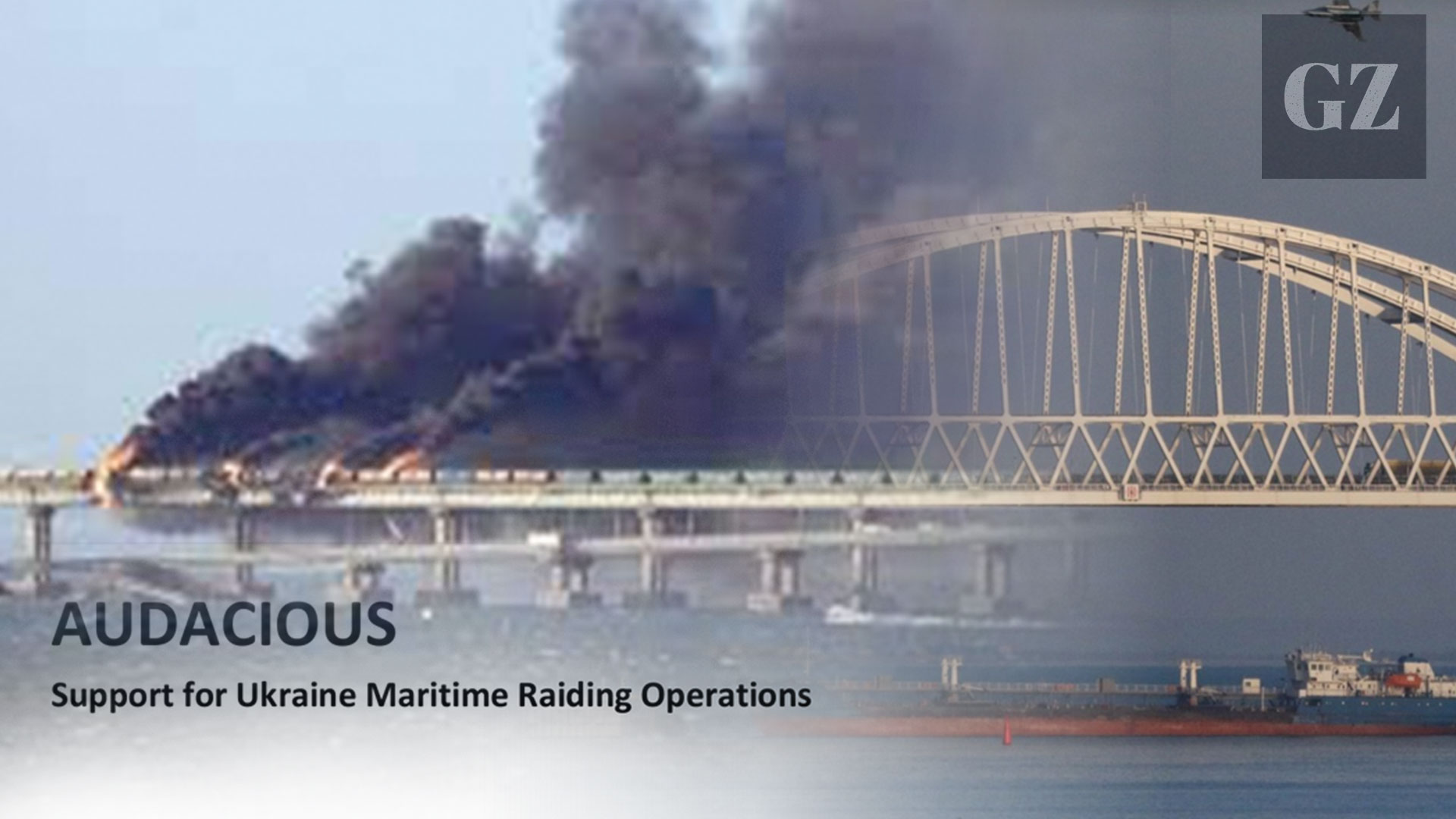
The Grayzone has obtained an April 2022 presentation drawn up for senior British intelligence officers hashing out an elaborate scheme to blow up Crimea’s Kerch Bridge with the involvement of specially trained Ukrainian soldiers. Almost six months after the plan was circulated, Kerch Bridge was attacked in an October 8th suicide bombing apparently overseen by Ukraine’s SBU intelligence services.

Detailed proposals for providing “audacious” support to Kiev’s “maritime raiding operations” were drafted at the request of Chris Donnelly, a senior British Army intelligence operative and veteran high ranking NATO advisor. The wide-ranging plan’s core component was “destruction of the bridge over the Kerch Strait.” 

Documents and correspondence plotting the operation were provided to The Grayzone by an anonymous source. 

The truck bombing of the Kerch Bridge differed operationally from the plot sketched therein. Yet, Britain’s evident interest in planning such an attack underscores the deep involvement of NATO powers in the Ukraine proxy war. At almost precisely the time that London reportedly sabotaged peace talks between Kiev and Moscow in April this year, British military intelligence operatives were drawing up blueprints to destroy a major Russian bridge crossed by thousands of civilians per day.

The roadmap was produced by Hugh Ward, a British military veteran. A number of strategies for helping Ukraine “pose a threat to Russian naval forces” in the Black Sea are outlined. The overriding objectives are stated as aiming to “degrade” Russia’s ability to blockade Kiev, “erode” Moscow’s “warfighting capability”,  and isolate Russian land and maritime forces in Crimea by “denying resupply by sea and overland via Kerch bridge.”

Read the complete blueprint: Support for Maritime Raiding Operations – Proposal

In an email, Ward asked Donnelly to “please protect this document,” and it’s easy to see why. Of these assorted plans, only the “Kerch Bridge Raid CONOPS [concept of operation]” is subject to a dedicated annex at the conclusion of Ward’s report, underlining its significance.

The content amounts to direct, detailed advocacy for the commission of what could constitute a grave war crime. Markedly, in plotting ways to destroy a major passenger bridge, there is no reference to avoiding civilian casualties.

Across three separate pages, alongside diagrams, the author spells out the terms of the “mission” – “[disabling] the Kerch Bridge in a way that is audacious, disrupts road and rail access to Crimea and maritime access to the Sea of Azov.”

Ward suggests that destroying the bridge “would require a cruise missile battery to hit the two concrete pillars either side of the central steel arch, which will cause a complete structural failure,” and “prevent any road re-supply from the Russian mainland to Crimea and temporally [sic] disrupt the shipping lane.”

An alternative “scheme” entails a “team of attack divers or UUVs [unmanned underwater vehicles] equipped with limpet mines and linear cutting charges” targeting a “key weakness” and “design flaw” in the bridge’s pillars.

This “flaw” is “several thin pylons used to support the main span,” which were intended to allow strong currents to flow underneath the Bridge with minimal friction. Ward pinpoints a particular area in which the depth of water around a set of pillars was just 10 meters, making it the “weakest part” of the structure.

In related emails obtained by The Grayzone, Chris Donnelly, the senior British army intelligence operative and former NATO advisor, declared the proposals to be “very impressive indeed.”

Reached by phone, Hugh Ward did not deny that he had prepared the Kerch Bridge destruction blueprint for Chris Donnelly.

“I’m going to have a chat with Chris [Donnelly] and confirm with him what he’s prepared for me to release,” Ward told The Grayzone, when asked directly if he drafted the “audacious” plan.

Asked again to confirm his role in the blueprint, Ward paused, then said: “I can not confirm that. I’ll have a chat with Chris first.”

A suicide attack on a $4 billion transportation artery 

At dawn on October 8th, an incendiary attack damaged the Kerch Bridge. A truck exploded, setting two oil tankers ablaze, causing two Crimea-bound spans of the roadway to collapse into the sea below, and killing three. 

While the affected section was quickly repaired and traffic resumed the next day, Western media has celebrated the incident as the latest Russian embarrassment and failure in the conflict with Ukraine. In some cases, journalists openly cheered and joked about what could plausibly be categorized as a war crime that claimed civilian lives.

The suicide strike targeted a connecting structure between Crimea and mainland Russia constructed at a cost of $4 billion, and whose opening provided a major public relations victory for the Kremlin, reinforcing Moscow’s renewed control of the majority Russian-speaking territory.

Upon its unveiling in May 2018, Russian President Vladimir Putin remarked:

“In different historical epochs, even under the tsar priests, people dreamed of building this bridge. Then they returned to this in the 1930s, the 40s, the 50s. And finally, thanks to your work and your talent, the miracle has happened.”

The Bridge has been heavily defended since February 24th, not least because it serves as a major transport route for military equipment to Russian soldiers in Ukraine. Russia has previously promised major reprisals in response to any strike on the structure. 

Following the attack, widespread euphoria erupted among Ukrainians, Ukrainian authorities, and Ukraine supporters on social media. Oleksiy Danilov, head of Ukraine’s national security and defense council, posted a video of the burning bridge alongside a black-and-white clip of Marilyn Monroe singing Happy Birthday, Mr. President — a reference to Putin turning 70 the same day.

Furthermore, Ukrainian media has reported via an anonymous source “in law enforcement agencies” that the attack was carried out by the Security Service of Ukraine. Yet, high-ranking Ukrainian officials, including chief presidential adviser Mykhailo Podolyak, are now backtracking, claiming instead that the incident was a Russian false flag. 

Such allegations have become commonplace in the wake of incidents in which Ukrainian – or Western – culpability seems likely or indeed certain, such as the Nord Stream pipeline explosions.

Lithuanian ex-Minister of Defense Audrius Butkevičius was involved in secret British intelligence plans to destroy Kerch Bridge.

Laying the foundations of World War III

While the attack on Kerch Bridge did not involve specialist divers, underwater drones or cruise missiles, there are indications that Ward’s plans were shared with the Ukrainian government at the highest levels. In fact, Chris Donnelly forwarded them to former Lithuanian Minister of Defense Audrius Butkevičius, before introducing the pair by email.

A leading figure in Lithuania’s anti-Communist movement, Butkevičius has admitted to deliberately leading pro-independence fighters into Soviet snipers’ line of fire on January 13th 1991. This incident is sometimes referred to as Vilnius’ “Bloody Sunday,” and is officially observed as the Day of the Defenders of Freedom. Butkevičius and his confederates knew the maneuver would provoke mass casualties, further inflaming the local population against Soviet leadership and encourage regime change, which is why they orchestrated it. 

More recently, Butkevičius co-owned Bulcommerce KS, a company that served as “the main intermediary in the supply of Bulgarian weapons and ammunition to Ukraine through third countries,” for use in the civil war in Donbas.

Butkevičius has been credibly accused of working for British intelligence. Email exchanges with Donnelly confirm he is in contact with Guy Spindler, a long-time MI6 officer who was posted in London’s Moscow Embassy concurrently with the infamous Trump-Russia “dossier” author Christopher Steele.

Reached by phone and asked if he reviewed the “Audacious” plan to destroy Kerch Bridge, Spindler told The Grayzone: “I have absolutely no idea what you’re talking about.”

Contemporary accounts suggest Spindler directly coordinated with Boris Yeltsin at the time of a failed coup against Mikhail Gorbachev in August 1991.

Butkevičius was also for many years a “senior fellow” at the Institute for Statecraft, a shadowy “charity” founded by Donnelly that manages a number of arm’s length military and intelligence operations on behalf of the British state and NATO, including the now notorious Foreign Office black propaganda unit, the Integrity Initiative.

Leaked Initiative files name Butkevičius as the organization’s key contact in Ukraine at the time of the country’s 2019 election. Three years earlier, he was one of the “escorting personnel” for five Ukrainian intelligence operatives whisked to London by the Institute for Statecraft in order to brief the British military on Russian “hybrid warfare” techniques. Alongside him was Vidmantas Eitutis, who at the time trained Ukraine’s army to conduct “active counterintelligence operations” in Luhansk.

In the Kerch Bridge sabotage proposal commissioned by Donnelly, Ward asks whether the Russian military knew how vulnerable the bridge supposedly was, and “what countermeasures could be expected” in response to its destruction (see image above).

The blitz of retaliatory missile strikes on Ukraine on October 10th provides a likely answer. It is also probable that if Ward’s outline was followed, Moscow’s reprisal would have been even more deadly, putting the lives of countless Ukrainians – and Russians – at significant risk.

Donnelly was clearly unmoved by such concerns, declaring the plans to be “very impressive indeed.”

A similar disregard for catastrophic consequences was evident in a private memo authored by Donnelly in March 2014, outlining “military measures” that Ukraine should take following Moscow’s seizure of Crimea. 

Stating that, “if I were in charge I would get the following implemented,” Donnelly advocated mining Sevastopol harbor using a “car ferry,” destroying fighter jets on Crimean airfields “as a gesture that they are serious,” using a “big microwave anti-satellite weapon” to take down Russian space installations, and turning to the West for oil and gas supplies. 

“I am trying to get this message across,” he concluded. These prescriptions have yet to be implemented, perhaps because they risk triggering an apocalyptic situation. Indeed, such “gestures” would amount to brazen provocations against a nuclear power, from which Ukraine’s oil and gas network was and remains exclusively designed to receive energy.

Yet it appears Donnelly and those around him would be content to see World War III erupt over Crimea. In fact, as the leaked documents obtained by The Grayzone will continue to demonstrate, provoking conflict between the West and Russia has long-been one of his ultimate objectives.

Categories
Saved Web Pages

Crimea bridge: The four ways Ukraine could have taken it down

TELEMMGLPICT000312055735_trans_NvBQzQNjv

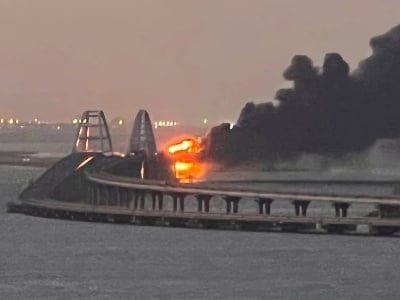
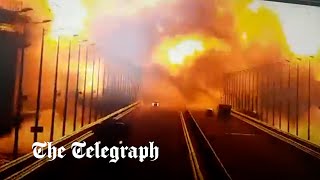
At approximately 6 a.m. local time on Saturday, an enormous explosion rocked the Kerch Strait Bridge connecting the Crimean Peninsula with Russia. As a result of the explosion sections of one of the two parallel road decks collapsed and a train carrying flammable fuel was set ablaze causing significant damage to the railway bridge.

The cause of the blast remains unknown, but several theories could explain the bridge’s partial collapse.

Russia said the blast was caused by a truck containing explosives, which were detonated on the bridge. 

Two separate surveillance cameras show that a truck travelling from the Russian side was in the centre of the collapsed span exactly as the explosion happened.

Images from the aftermath of the attack show signs of scorching on the collapsed bridge span and the intact one running parallel indicating an explosion occurring above or on the road deck. 

The guard rail posts running along the spans are also all blown outwards by the pressure of the blast away from the last known location of the truck.

An unnamed senior Ukrainian Official corroborated this theory, telling the New York Times, Ukrainian special forces orchestrated the attack, loading a bomb onto a truck.

Vladimir Putin also blamed the SBU for the strike last night.

A missile attack could have been the cause of the explosion, some analysts have speculated.

The only missile that would realistically have the range to hit the bridge is a MGM-140 ATACMS, which Ukraine is not known to possess.

No Western country has provided Kyiv with ATACMS, though some believe it was used to inflict large explosions at the Saki Airbase in August. The US has shipped HIMARS to Ukraine, but has continuously denied having supplied ATACMS.

Many of the same pieces of evidence pointing towards a truck-based explosion could also be used as evidence of a missile attack. 

The main physical piece of evidence rebutting the missile attack theory is the size of the explosion being an order of magnitude too large to attribute solely to the 500lb unitary warhead, which is carried by the ATACMS.

Video footage from a surveillance camera showing a wave below the Kerch strait bridge seconds prior to the explosion has fuelled the theory that an explosive-filled watercraft was used in the attack. 

However, the observed wave appeared below a span of the roadbridge, which remained intact after the blast.

Further images of the underside of the collapsed bridge span revealed a distinct lack of scorching or shrapnel damage. For an explosion of this magnitude originating from below the span, one would expect to see both.

Compared to the destruction on the top of the road, the bottom of the bridge was relatively unscathed.

Had a watercraft been used, the most likely culprit would have been an unmanned surface vessel. It follows an unmanned boat, believed to be Ukrainian, which washed up on shore near Sevastopol in September.

If such a vessel was used it would have been required to sail approximately 600 kilometers from the Ukrainian controlled coastline to the Kerch Bridge undetected by the Russian military.

Some observers claimed a watercraft could have been detonated while travelling parallel to the bridge rather than under it.

This theory has originated in part from traffic camera footage where it could appear that the blast originates slightly away from the centre of the roadway. 

However,  the guard rail posts on the collapsed span are bent outwards indicating the explosion happened towards the centre of the roadway.

The most unlikely theory at this time is the idea of a Ukrainian SOF (Special Operations Force) team placing explosives on the bridge and detonating them.

Placeholder image for youtube video: s2C2RVe_Wf8

The location of the Kerch Bridge would make both the infiltration and exfiltration of an SOF team extremely risky. And the size and location of the explosion does not match with that of a controlled demolition. 

The size of the blast would have required many hundreds of kilos of explosive to be placed, which given the security around the bridge would be close to impossible to get in position. 

Additionally, images of the collapsed span show that the blast happened in the middle of a span causing it to buckle in the centre and collapse.

This would not be a logical or practical location to place explosives for a controlled demolition.

Categories
Saved Web Pages

Zelenskiy Mocks Russia’s Claim Of Laser Weapon Ready To Deploy In Ukraine

7A3E6E74-5B3C-4122-AA18-367716ABB26B_cx0

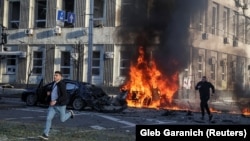
Men run the site of a blast in Kyiv on October 10.

Men run the site of a blast in Kyiv on October 10.

Ukraine’s ambassador to the United Nations has denounced Russia as a “terrorist state” during an emergency meeting of the UN General Assembly that came just hours after Ukrainian cities were struck by a wave of deadly missile strikes.

“Russia has proven once again that it is a terrorist state that must be deterred in the strongest possible ways,” said Ambassador Serhiy Kyslytsya.


RFE/RL’s Live Briefing gives you all of the latest developments on Russia’s ongoing invasion, Kyiv’s counteroffensive, Western military aid, global reaction, Russian protests, and the plight of civilians. For all of RFE/RL’s coverage of the war, click here.

The UN had scheduled the October 10 meeting to discuss a draft resolution condemning Russia’s recent annexation of four Ukrainian territories, a violation of international law.

But the session was soon dominated by Western condemnation of Russia’s decision to launch more than 80 missiles at Ukrainian cities in retaliation for what Moscow has called Kyiv’s “terrorist” actions, including a blast that damaged a key route for delivering supplies and reinforcements to Russian forces fighting in southern Ukraine.

The early morning strikes on Ukrainian infrastructure and urban residential areas hit major cities across the country, including Kyiv, killing at least 14 people and injuring 97, according to Ukraine’s Interior Ministry.

They were the most punishing attacks launched by Russian forces in months and were seen as a major escalation of the war launched by Moscow in February.

Ahead of the UN meeting, U.S. President Joe Biden said the strikes demonstrated the “utter brutality” of the war initiated unprovoked by Russian President Vladimir Putin.

“The United States strongly condemns Russia’s missile strikes today across Ukraine, including in Kyiv. These attacks killed and injured civilians and destroyed targets with no military purpose. They once again demonstrate the utter brutality of Mr. Putin’s illegal war on the Ukrainian people,” Biden said in a statement.

UN Secretary-General Antonio Guterres described the strikes as an “unacceptable escalation of the war” by Russia.

WATCH: Ukraine has reported dozens of missile strikes across its territory, including the capital, Kyiv, in a significant escalation of Russian attacks.

A spokesman for Guterres said in a statement ahead of the emergency UN meeting that the secretary-general was “deeply shocked by today’s large-scale missile attacks by the armed forces of the Russian Federation on cities across Ukraine that reportedly resulted in widespread damage to civilian areas and led to dozens of people being killed and injured.”

The 193-member UN General Assembly decided on October 10 to hold a public vote, rather than a secret ballot, on a draft resolution that would condemn Russia’s “illegal so-called referenda” held in Russian-occupied areas of Ukraine’s Donetsk, Luhansk, Kherson, and Zaporizhzhya regions, as well as Russia’s “attempted illegal annexation” of the territories.

Diplomats said the vote on the resolution would likely be held on October 12. The majority of countries, 107, voted in favor of holding a public vote, while 13 countries opposed, 39 abstained, and the remainder did not vote.

Russia vetoed a similar resolution in the 15-member Security Council in September.

Russian President Vladimir Putin, in a video call with members of Russia’s Security Council, said the October 10 strikes were retaliation for what he called Kyiv’s “terrorist” actions, including the October 8 blast that damaged the Crimea Bridge, a key rail and highway route for supplies and reinforcements for Russian forces fighting in southern Ukraine.

Putin said more such Russian strikes could be expected.

“Let there be no doubt,” Putin said. “If attempts at terrorist attacks continue, the response from Russia will be severe.”

Earlier, former Russian President and Prime Minister Dmitry Medvedev said the strikes on Kyiv and other major cities were only “the first response” to the explosion on the Crimea Bridge that left a column of train cars burning and sent one section of the highway into the Kerch Strait.

Russia has said that the suspected truck bombing was an act of terrorism carried out by the Ukrainian special services. Ukraine has not taken credit for the incident.

Following Biden’s comments, Russian Foreign Ministry spokeswoman Maria Zakharova blamed the United States for holding up possible negotiations to end the war, which Moscow officially calls a “special military operation.”

“We repeat once again especially for the American side: The tasks that we set in Ukraine will be solved,” Zakharova wrote on the ministry’s website.

“Russia is open for diplomacy and the conditions are well known. The longer Washington encourages Kyiv’s bellicose mood and encourages rather than hinders the terrorist undertakings of Ukrainian saboteurs, the more difficult will be the search for diplomatic solutions.”

Kyiv, which has retaken large swaths of Russian-occupied territory in Ukraine’s south and east in recent weeks, has ruled out negotiations with Putin, saying that Russia is making unacceptable demands and that Putin’s actions have made talks impossible.

Ukraine was left reeling by the early morning strikes on October 10.

While Putin said his forces had launched “precision weapons” from the air, sea, and ground to target key energy and military command facilities in Ukraine, the strikes hit residential areas and critical infrastructure facilities alike.

Ukraine’s State Emergency Service said on the Telegram messaging app that four cities — Lviv, Poltava, Sumy, and Ternopil — had no electricity following the attacks and that electricity supplies had been partially disrupted in other parts of the country. In the east, passenger rail service was cut off between Ukraine’s second-largest city, Kharkiv, and Izyum — a city that was taken shortly after Russia’s unprovoked invasion in February but which Kyiv recently retook in a major counteroffensive.

Several explosions rocked the center of the capital, Kyiv, and Ukrainian President Volodymyr Zelenskiy said in a video message filmed outside his presidential office that Russia had intentionally targeted the country’s energy infrastructure and timed the strikes to inflict the greatest number of human losses.

In his nightly evening address to the nation on October 10, Zelenskiy said from a damaged civilian area near a Kyiv university that “Ukraine cannot be intimidated. We united even more instead.”

International reaction to the October 10 missile strikes was swift, with the United States, the European Union, and NATO condemning the strikes and the Group of Seven announcing it would hold emergency talks on October 11 that would be preceded by an address by Zelenskiy.

U.S. Secretary of State Antony Blinken said in a statement that he had spoken with Ukrainian Foreign Minister Dmytro Kuleba to “reiterate U.S. support for Ukraine following the Kremlin’s horrific strikes.” Blinken said the United States would continue to provide “unwavering economic, humanitarian, and security assistance so Ukraine can defend itself and take care of its people.”


Photo Gallery:

Earlier, EU Foreign Affairs chief Josep Borrell also spoke with Kuleba after the attacks, which Borrell “condemned in the strongest possible terms.” The EU’s top diplomat also expressed his condolences for those who died in the strike and said those responsible would be held accountable.

NATO chief Jens Stoltenberg said in a tweet after speaking with Kuleba that he “condemned Russia’s horrific and indiscriminate attacks on civilian infrastructure in Ukraine.”

Ukrainian President Zelenskiy said in his morning video address that the strikes were an act of terrorism.

“This morning is difficult. We are dealing with terrorists,” Zelenskiy said, noting the Russian military’s use of Iranian drones to carry out the strikes.

“They are trying to destroy us and wipe us off the face of the earth…destroy our people who are sleeping at home,” Zelenskiy said.

Ukrainian commander-in-chief Valeriy Zaluzhniy said on Twitter that Russia used drones to launch a total of 75 rockets on Ukraine, more than half of which he claimed were destroyed by Ukrainian air defenses.

With reporting by dpa, AP, and Reuters
Categories
Saved Web Pages

Royal Navy’s new laser ‘death ray’ hailed exceptionally accurate after first set of trials

b25lY21zOjM0M2FjZmUwLTlkZWUtNGJjMC1iMjgw

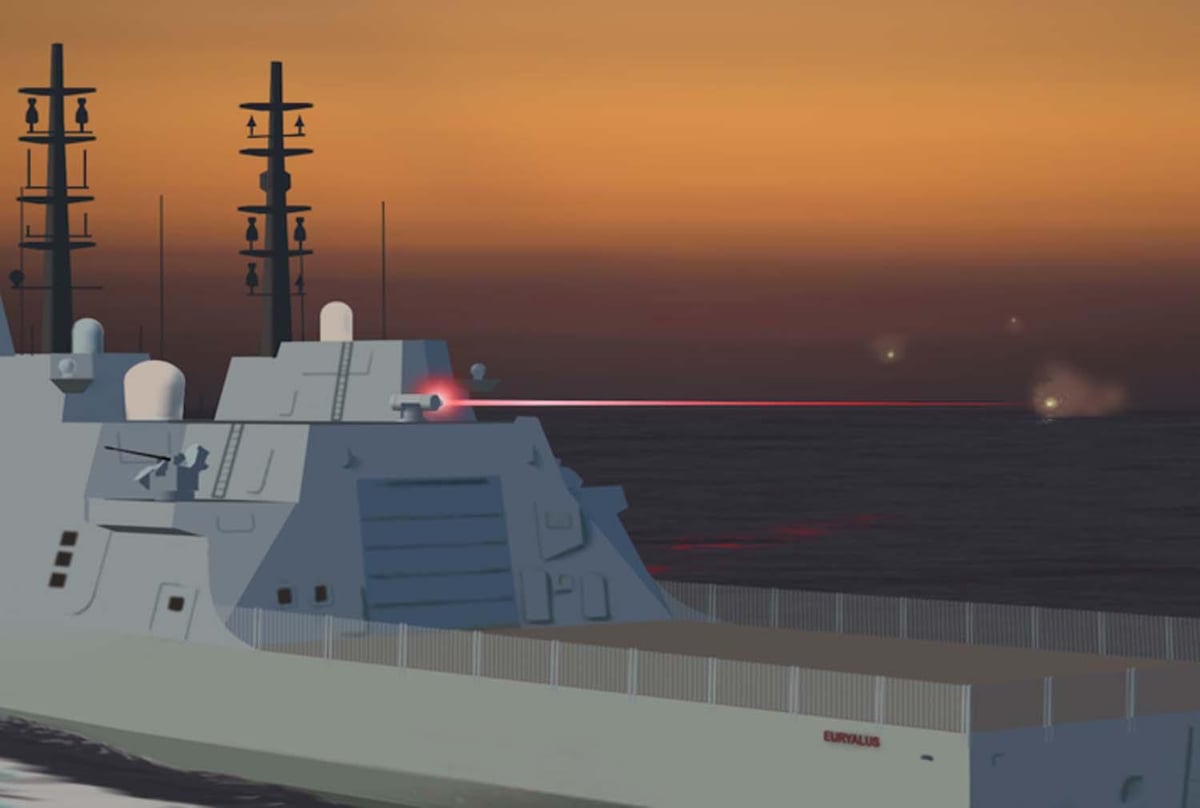
The £130m Dragonfire programme is one of the most advanced weapons systems currently being tested by the British military.

The ‘death ray’ will be capable of firing bursts of high-energy light particles that can rip apart targets in the blink of an eye.

It’s set to be rolled out across the UK armed forces, fitted on Royal Navy warships, RAF jets, helicopters and in land-based air defence variants.

An impression of the laser weapon in action on a Type 26 frigate.

Development of Dragonfire is being led by a consortium of international defence firms and the Ministry of Defence.

The first batch of trials has now been completed, which tested the accuracy of a low-powered version of the laser against targets in the air and at sea – with the consortium behind the project saying Dragonfire passed with flying colours with ‘exceptionally high accuracy’.

The success has now paved the way for the next phase of the trials, which will see the UK tested its first high-power laser version.

The Dragonfire system which has now completed its first set of accuracy tests on targets in the air and at sea.

Chris Allam, managing director of defence firm MBDA UK, said: ‘The success of these trials is a key step in the development of sovereign laser directed energy weapons.

‘It is the culmination of a lot of hard work from both the industry and Dstl (Defence Science and Technology Laboratory) teams, overcoming disruption due to Covid and technical challenges from the use of unique innovations in Dragonfire that are testing the very limits of what is physically possible in the laser weapons domain.’

Dragonfire was revealed in 2017, with the then-Second Sea Lord of the Royal Navy, Vice Admiral Jonathan Woodcock championing the system.

Addressing senior military figures and defence leaders during his 2017 Trafalgar Day speech, Vice Adm Woodcock said it had been hoped the first ‘capability demonstrator’ of the system would ‘fire in 2019’.

An impression of the laser system fitted on a Wildcat helicopter.

But delays hampered this plan, pushing back the planned rollout into the army and navy by the mid-2020s.

Speaking on Twitter today about the news of Dragonfire’s first tests, Sir Jonathan said: ‘Great to see but such a shame it’s not 2019, the date I set for it to be trialled at sea and the date signed up to by the consortium.’

Categories
Saved Web Pages

Putin has Called Core Myth of Russians into Question, Portnikov Says

Józef Brandt Potyczka Kozaków z Tatarami

Staunton, September 20 – By his incautious remarks about the absence of a state tradition in Kazakhstan and his invasion of Ukraine, Vladimir Putin has unintentionally called attention to and cast doubt on one of the most fundamental myths of the Russian state and people, that they descended from Kyiv rather than as is in fact the case from the Mongol horde.

Russians have long been accustomed to see their state tradition as extending from “Kievan Rus to Vladimir Rus to the yoke to Moscow Rus to the Russian Empire to the USSR and then to the Russian Federation,” Moscow commentator Vitaly Portnikov writes on Grani.ru.

And because of this widely accepted myth, he continues, Russians are not prepared to recognize that Kyiv “was one of the most important centers of the Grand Principality of Lithuania” and that however much Russians want to believe that Ukrainians were “invented by Austrians, Germans and other Jews in fact Ukrainians invented Russians.”

By his dismissive comments about Kazakhstan, Putin has brought Russia to “the moment of truth” when Russians must face up to their own involvement with and indeed formation by the Mongol horde and recognize that all the pretentions of the Moscow principles to land in Europe are “based on one single myth, the myth of Kievan Rus.”

Orthodox priests from the banks of the Dnepr promoted this myth, historians like Karamzin who himself sprang from a family with Mongol roots did so as well, and Muscovite rulers were all too willing to take it up to justify their claims to being part of Europe and having a right to subordinate Ukrainians and many others.

Not everyone accepted this myth immediately, Portnikov continues, but “by the beginning of the 20th century everyone in Russia already believed that Ukraine is Russia” and rejected the idea that Ukraine had an independent identity or existence. And then, Russians “tried to show Ukrainians they are Russians” and Ukrainians to “escape from this alien myth.”

When these Russian efforts failed and when Ukrainians recognized that they were their own people with their own goals, what did Moscow do? It invaded to seize parts of Ukraine which were never part of the Kievan Rus mythology: Crimea which had been a Muslim khanate and Novorossiya which had been a steppe.

And in doing so, Moscow made it too obvious to hide that where the population it had earlier moved into these regions ended so, too, did Russian influence. And the Kremlin compounded this by attacking what Russians had imagined as the center of Kievan Rus as “western agents” or worse.

In doing so, Putin and his regime showed themselves to be what they are: “fragments of the Horde” and not descendants of Kievan Rus. And as a result of the blood that has been shed in that cause, there is now a yawning gap between Russians and Ukrainians, one that will never allow the two peoples to see themselves as “brothers” or accept the Kievan Rus mythology.

They will thus “never again” see themselves “as a single whole in the civilizational sense.” And that, Portnikov says, “and on that in fact marks the final death of empire,” even if the descendants of the horde are being slow to recognize such an outcome.

WP Radio
WP Radio
OFFLINE LIVE