Categories
Saved Web Pages

Trump-Russia Probe Reporter Facing Defamation Lawsuit by Security Consultant Seeks Testimony of Ex-FBI Agent Charged in Puerto Rico Corruption Scheme

Scott-Stedman-Mark-Rossini.jpg

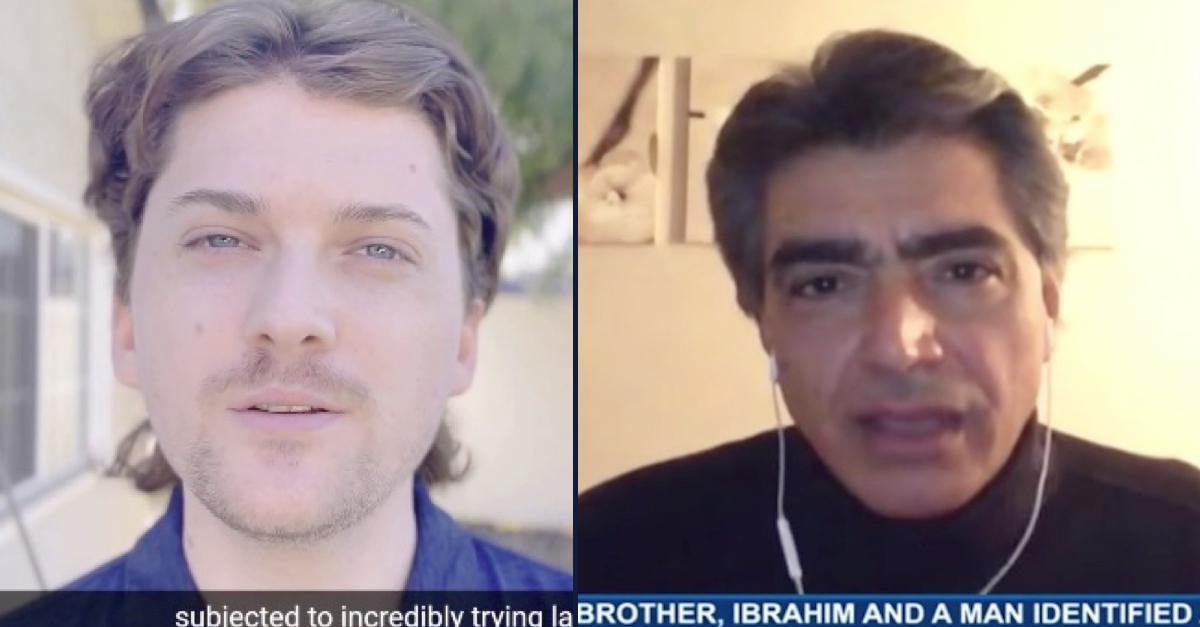
Left: Reporter Scott Stedman is seen in a fundraising video for his defense against a defamation lawsuit brought by a British businessman. Right: Mark Rossini is seen during an appearance on Newsmax in 2016.

Left: Reporter Scott Stedman is seen in a fundraising video for his defense against a defamation lawsuit brought by a British businessman (via GoFundMe video screengrab). Right: Mark Rossini is seen during an appearance on Newsmax in 2016 (via YouTube screengrab).

An American reporter accused of defaming a British-Israeli security consultant is looking to bolster his defense with deposition testimony from an ex-FBI agent implicated in a corruption case involving a former governor of Puerto Rico.

Scott Stedman, who has published multiple stories regarding former President Donald Trump’s alleged connections to Russian efforts to interfere with the 2016 presidential election, has asked a New York federal court to allow him to seek discovery from Mark Rossini, a former FBI agent who worked for security consultancy firm USG Security Limited (USG).

Rossini is currently facing federal criminal charges stemming from an alleged scheme between former Puerto Rico Gov. Wanda Vazquez Garced and an international bank run by Herrera Velutini. According to the Justice Department, Velutini’s bank was given regulatory leeway in exchange for funding Garced’s 2020 campaign. Rossini is accused of being one of the “intermediaries” in the scheme, allegedly lobbying Garced on Velutini’s behalf. Earlier this month, Rossini turned himself in to federal authorities, insisting he is innocent of the charges.

Rossini’s work for USG ties him to Stedman’s defamation case. The firm is run by Walter Soriano, a British-Israeli security expert who is suing Stedman for defamation over stories Stedman published regarding what Stedman described as Soriano’s links to “core figures associated with alleged Russian interference in the 2016 U.S. presidential election.”

Articles published on Stedman’s website Forensic News “detailed Soriano’s extensive relationships with Russian oligarchs and their agents, including, most prominently, Oleg Deripaska,” Stedman’s filing says. “Deripaska is an aluminum magnate with close ties to Russian president Vladimir Putin and Paul Manafort and was the subject of intense scrutiny for his involvement in Russian election interference activities.”

Stedman recapped his reporting on Soriano in his ex parte application for a discovery order, filed Tuesday:

Walter Soriano is a British-Israeli “security consultant” with ties to the Russian oligarchy. Forensic News learned of Soriano when a Politico report identified him as a person of interest in the Senate Intelligence Committee’s investigation into Russian interference in the 2016 U.S. presidential election. Forensic News picked up on the Politico report and ran with it. Forensic News and its journalists ultimately discovered and reported on a web of shadowy connections and secretive dealings that were largely forged through USG. Their investigations culminated in the publication of multiple news articles about Soriano and his ties to core figures associated with alleged Russian election interference, including Dmitry Rybolovlev and other Russian oligarchs.

That reporting, Stedman says, sparked Soriano’s lawsuit against Stedman and Forensic News. Soriano sued Stedman in England, where USG is based; Stedman has filed his request to depose Rossini in the Southern District of New York, where Stedman says Rossini resides.

Stedman says that Rossini would have knowledge about the information that he says formed the basis of his stories linking Soriano to Russia.

“Rossini likely possesses additional unique evidence that will aid Petitioners’ defense in the English Defamation Action,” the filing says. “Rossini’s tenure at USG spanned years and covered some of the most critical events described in Petitioners’ articles — events Soriano denies ever occurred. Rossini — as a USG contractor — also likely possesses contracts or paystubs that could help Petitioners discover additional evidence corroborating the truth of their reports on USG’s business relationships. This corroboration is critical to Petitioners’ defense in the English Defamation Action. It will help confirm the truth and accuracy of Forensic News’s reporting and defeat Soriano’s blanket denials of the facts Petitioners uncovered.”

Stedman says that information about the inner workings at USG is crucial to his defense in the defamation case.

“USG is at the center of virtually all of Soriano’s connections to Deripaska, Abramovich, Rybolovlev, Netanyahu, Molho, and others,” Stedman’s filing says. “Having worked for USG during the relevant time period, Rossini likely possesses information that would prove the accuracy of Petitioners’ reporting on these connections. Any such information would support the veracity of Petitioners’ reporting on Soriano’s vast web of connections. Rossini also likely possesses written agreements or other financial documents that would lead to highly probative evidence regarding payments USG made to individuals affiliated with Russian oligarchs, the Israeli elite, or cyber-surveillance and hacking firms. The discovery would therefore aid Petitioners in defeating the strike suit Soriano filed against them in England — a suit that would not even come close to prevailing in an American court.”

Stedman also alleges that Rossini “likely possesses knowledge and documents regarding USG’s financials (including an employment agreement or paystubs) that could lead to highly probative evidence regarding USG payments to entities described in Petitioners’ articles.”

Stedman told Law&Crime that testimony from Rossini could be the key to his defense in the defamation case.

“For years, Mark Rossini was employed by USG Security, the private intelligence company run by Walter Soriano,” Stedman said. “He was not a low-level employee. In fact, his business card listed him as USG’s ‘EU/US Senior Operations Officer.’ Because of his years-long work for USG and Soriano, Rossini likely has relevant knowledge that will prove the accuracy of my reporting on Soriano’s business activities.”

Stedman said that Rossini “very likely” has information about Soriano’s work for multiple Russian oligarchs, including the “silencing of Deripaska’s mistress Nastya Rybka in 2018.”

“I will continue to use every legal tool available to prove the accuracy of my reporting in the face of this abusive, retaliatory legal attack from a man who made millions enabling the Russian oligarchy,” Stedman added.

A lawyer representing Rossini in the corruption case did not immediately respond to Law&Crime’s request for comment.

In 2009, Rossini pleaded guilty to criminally accessing an FBI database for personal purposes and sentenced to probation. He was sentenced to one year of probation, 250 hours of community service, and ordered to pay a $5,000 fine.

Law&Crime left a message with Soriano’s company seeking comment.

Read the memo here:

[Images via GoFundMe and YouTube screengrab]

Have a tip we should know? [email protected]

Categories
Saved Web Pages

UNITED STATES/UNITED KINGDOM : Former FBI officer Mark Rossini in legal spat over consulting for Walter Soriano and CT Group

picto-INT-og.png

After a lengthy period below the radar after his departure from the FBI, Mark Rossini is in the spotlight again for his work with intelligence consultant Walter Soriano and with the influence firm CT Group in Puerto Rico. […] (666 words)

Only buy articles you are interested in

Unlimited access to the website

See our rates

Already have an account?

Do you want a free trial before subscribing?

Create your free account

Do you want a free trial before subscribing?

create a free account

Read this article here:

Sign up for real-time alerts and be notified of new editions!  

Once registered, you will be notified by a short message on your computer or mobile phone as soon as a new edition of our publication or an alert is published. Stay informed anytime, anywhere!

Categories
Saved Web Pages

Putin has his back to the wall with the clock ticking ever louder

220930114911-01-putin-ukraine-annexation

Hear Putin's announcement about citizens in newly annexed regions

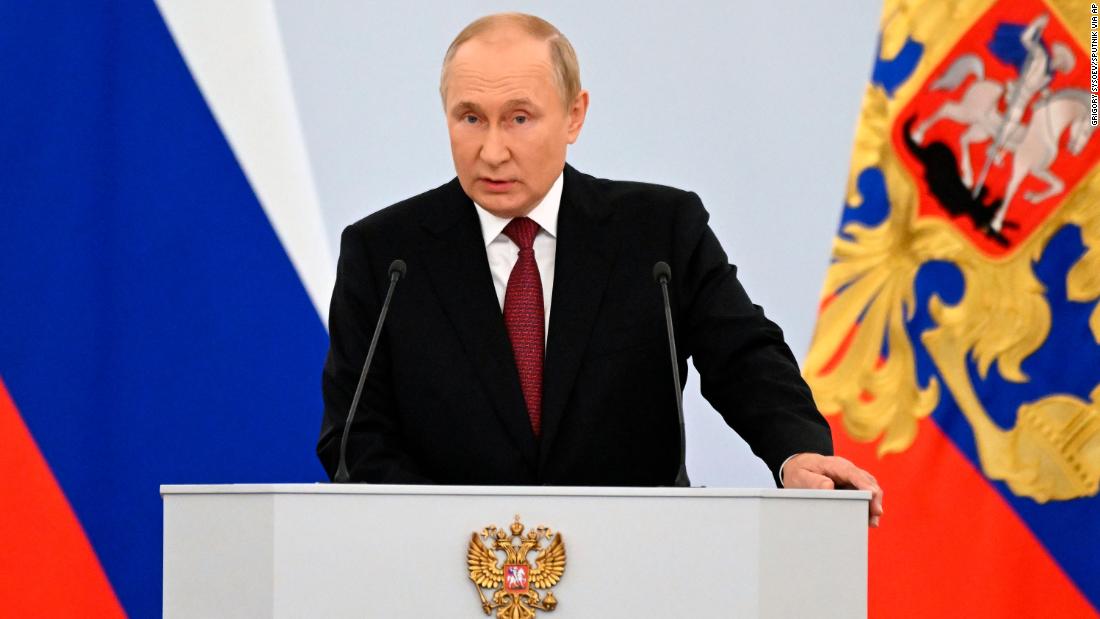
(CNN)Time is running out for Russian President Vladmir Putin, and he knows it.

Meanwhile his bombast continues: announcing the annexation of Ukrainian territories on Friday, Putin declared Luhansk, Donetsk, Zaporizhzhia and Kherson will become part of Russia “forever.” He is rushing to claim a victory and cement slender gains and sue for peace, running a dangerous political tab, regardless of the fanfare in Moscow.

He called on Ukraine to “cease fire” immediately and “sit down at the negotiating table,” but added: “We will not negotiate the choice of the people. It has been made. Russia will not betray it.”

He is doing his best to hide it, but he is losing his war in Ukraine. The writing is on the wall.

Andrey Kortunov, who runs the Kremlin-backed Russian International Affairs Council in Moscow, sees it, too. “President Putin wants to end this whole thing as fast as possible,” he told CNN.

Putin’s recent heavy-handed conscription drive for 300,000 troops won’t reverse his battlefield losses any time soon, and is backfiring at home, running him up a dangerous political tab.

According to official data from the EU, Georgia and Kazakhstan, around 220,000 Russians have fled across their borders since the “partial mobilization” was announced. The EU said its numbers — nearly 66,000 — represented a more than 30% increase from the previous week.

Independent Russian media quoting Russia’s revamped KGB, the FSB, put the total exodus even higher. They say more military age men have fled the country since conscription — 261,000 — than have so far fought in the war — an estimated 160,000 to 190,000.

CNN is unable to verify the Russian figures, but the 40 kilometers (around 25 miles) traffic tailbacks at the border with Georgia, and the long lines at crossings into Kazakhstan and Finland, speak to the backlash and the strengthening perception that Putin is losing his fabled touch at reading Russia’s mood.

The clock ticks loudly for Putin because his back is against the wall.

Kortunov says he doesn’t know what goes on in the Kremlin but that he understands the public mood over the huge costs and loss of life in the war. “Many people would start asking questions, why did we get into this mess? Why, you know, we lost so many people.”

Putin’s logical option, Kortunov says, is to declare victory and get out on his own terms. But for this he needs a significant achievement on the ground. “Russia cannot simply get to where it was, on the 24 February of this year, say, okay, you know, that’s fine. Our mission is accomplished. So we go home… …There should be something that can be presented to the public as a victory.”

And this is the logic Putin appears to be following, rubber-stamping the sham referendums in Ukraine’s Luhansk, Donetsk, Zaporizhzhia and Kherson regions, and declaring them part of Russia.

He used the same playbook annexing Crimea from Ukraine in 2014 and now, like then, threatens potential nuclear strikes should Ukraine, backed by its Western allies, try to take the annexed territories back.

Western leaders are in a battle of brinksmanship with Putin. Last Sunday US national security adviser Jake Sullivan told NBC’s “Meet the Press” Washington would respond decisively if Russia deployed nuclear weapons against Ukraine and has made clear to Moscow the “catastrophic consequences” it would face.

Leaders have also vowed not to recognize the regions as part of Russian territory.

US President Joe Biden said Moscow’s actions have “no legitimacy,” adding that Washington will continue to “always honor Ukraine’s internationally recognized borders.” The European Union said it “will never” recognize the Kremlin’s “illegal annexation,” and described the move as a “further violation of Ukraine’s independence, sovereignty and territorial integrity.”

There is little new in what Putin does, which, if nothing else, is making his moves more predictable, and therefore more readily analyzed.

Kurt Volker, who was US ambassador to NATO and US special representative to Ukraine under former President Donald Trump, believes Putin maybe gearing up for peace. “I think what he must be striving for, is to brandish the nuclear weapons, make all kinds of threats to Europe, and then say, okay, so let’s negotiate a settlement. And let me keep what I have already taken.”

Fiona Hill, who has advised three US Presidents on national security about Russia, also thinks Putin may be attempting an end game. “He feels a sense of acute urgency that he was losing momentum, and he’s now trying to exit the war in the same way that he entered it. With him being the person in charge and him framing the whole terms of any kind of negotiation. “

If these analyses are correct, they go a long way toward explaining the mystery of what happened under the Baltic Sea on Monday.

Both Danish and Swedish seismologists recorded explosive shockwaves from close to the seabed: the first, at around 2 a.m. local time, hitting 2.3 magnitude, then again, at around 7 p.m., registering 2.1.

Within hours, roiling patches of sea were discovered, the Danes and the Germans sent warships to secure the area, and Norway increased security around its oil and gas facilities.

So far, at least four leaks in Russia’s Nord Stream pipelines 1 and 2 have been discovered, each at the surface resembling a boiling cauldron, the largest one kilometer across, and together spewing industrial quantities of toxic greenhouse gases into the atmosphere.

Russian naval vessels were seen by European security officials in the area in the days prior, Western intelligence sources have said. NATO’s North Atlantic Council has described the damage as a “deliberate, reckless and irresponsible act of sabotage.”

Russia denies responsibility and says it has launched its own investigation. But former CIA chief John Brennan said Russia has the expertise to inflict this type of damage “all the signs point to some type of sabotage that these pipelines are only in about 200 feet or so of water and Russia does have an undersea capability to that will easily lay explosive devices by those pipelines.”

Brennan’s analysis is that Russia is the most likely culprit for the sabotage, and that Putin is likely trying to send a message: “It’s a signal to Europe that Russia can reach beyond Ukraine’s borders. So who knows what he might be planning next.”

Nord Stream 2 was never operational, and Nord Stream 1 had been throttled back by Putin as Europe raced to replenish gas reserves ahead of winter, while dialling back demands for Russian supplies and searching for replacement providers.

The Nord Stream pipeline sabotage could, according to Hill, be a last roll of the dice by Putin, so that “there’s no kind of turning back on the gas issues. And it’s not going to be possible for Europe to continue to build up its gas reserves for the winter. So what Putin is doing is throwing absolutely everything at this right now.”

Another factor accelerating Putin’s thinking may be the approach of winter. Napoleon and Hitler both failed to take Moscow as supply lines running through Ukraine were too long and arduous in winter. Volker says that what historically saved Russia is now pressing down on Putin: “This time, it’s Russia that has to supply lines, trying to sustain its forces in Ukraine. That’s going to be very hard this winter. So all of a sudden, for all these factors, Putin’s timeline has moved up.”

The bottom line, said Hill, is that “this is the result of Ukraine gaining momentum on the ground on the battlefield and of Putin himself losing it, so he’s trying to adapt to the circumstances and basically take charge and get every advantage.”

No one knows what’s really going on in Putin’s mind. Kortunov doubts Putin will be willing to compromise beyond his own terms for peace, “not on the terms that are offered by President Zelensky, not on the terms which are offered by the West… .[though] he should be ready to exercise a degree of flexibility. But we don’t know what these degrees [are] likely to be.”

According to Hill, Putin wants his negotiations to be with Biden and allies, not Ukraine: “He’s basically saying now you will have to negotiate with me and sue for peace. And that means recognizing what we have done on the ground in Ukraine.”

Having failed in the face of Western military unity backing Ukraine, Putin appears set to test Western resolve diplomatically, by trying to divide Western allies over terms for peace.

Volker expects Putin to pitch France and Germany first “to say, we need to end this war, we’re going to protect our territories at all costs, using any means necessary, and you need to put pressure on the Ukrainians to settle.”

If this is Putin’s plan, it could turn into his biggest strategic miscalculation yet. There is little Western appetite to see him stay in power — US Secretary of Defense Lloyd Austin said as much in the summer — and even less to let down Ukraine after all its suffering.

Putin knows he is in a corner, but doesn’t seem to realize how small a space he has, and that of course is what’s most worrying — would he really make good on his nuclear threats?

The war in Ukraine may have entered a new phase, and Putin may have his back against the wall, but an end to the conflict could still be a very long way off.

Categories
Saved Web Pages

Путин больше хочет удержать оккупированный юг Украины, а не Луганщину – ISW

81a9376---.jpg

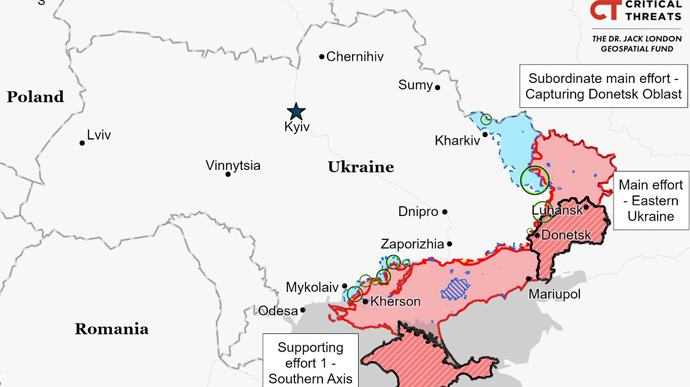
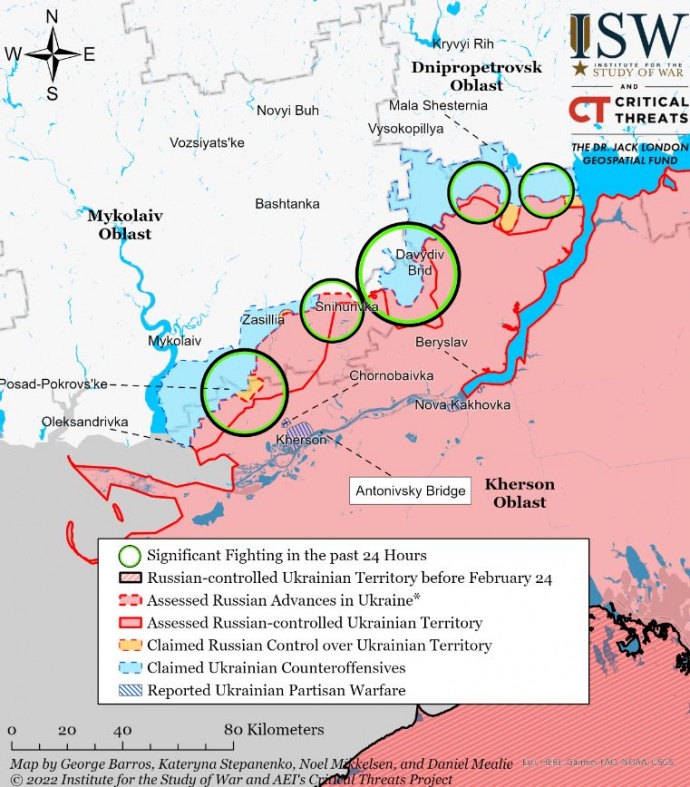
Вероятно российский диктатор Владимир Путин больше заинтересован в том, чтобы удержать оккупационный режим на территории Запорожской и Херсонской областей, а не укрепить позиции россиян на Луганщине. 

Источник: ISW 

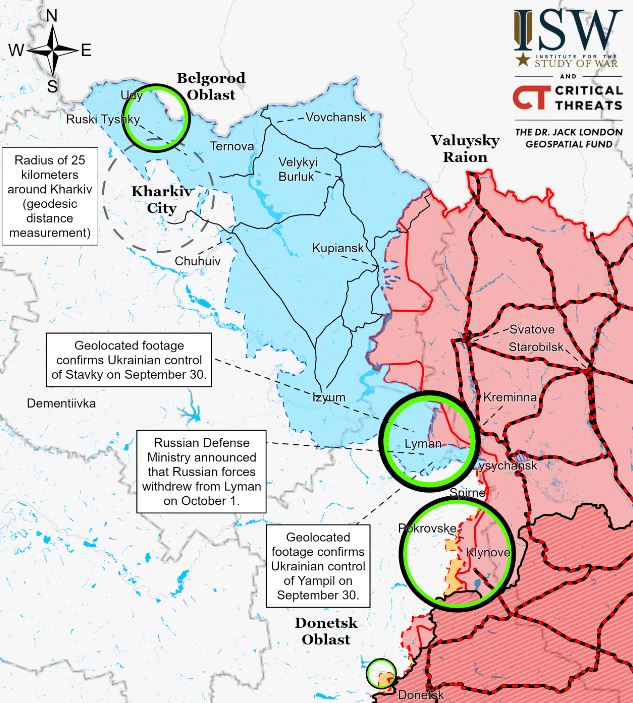
Дословно: “Поражение под Лиманом указывает на то, что президент России Владимир Путин уменьшает приоритетность защиты Луганской области в пользу удержания оккупированных территорий на юге Украины”.

Детали: Украинские и российские источники постоянно указывают на то, что российские войска продолжали укреплять российские позиции в Херсонской и Запорожской областях, несмотря на недавний крах Харьковско-Изюмского фронта и окружение сил РФ в Лимане.

Решение не укреплять уязвимые линии фронта в Купянске или Лимане почти наверняка было принято Путиным, а не военным командованием, и свидетельствует о том, что Путин заботится об удержании стратегически важных участков Херсонской и Запорожской областей значительно больше, чем о Луганской области.

Из-за критики и поражений на поле боя Кремль может готовиться к перестановкам в Минобороны РФ.


Также в ISW считают, что Россия, вероятно, ставит условия для того, чтобы взять на себя юридическую ответственность за ЗАЭС.


В частности, российские власти задержали директора ЗАЭС Игоря Мурашова. Оккупанты хотят передать ЗАЭС под контроль “Росатома” и создать новое юрлицо для этого.

Вероятно, РФ будет пытаться использовать свой контроль над ЗАЭС для давления на МАГАТЭ с целью легитимизации незаконной российской аннексии оккупированной украинской территории путем принуждения его признать законный контроль России над ЗАЭС.

Также сообщается, что российские войска совершили неудачную наземную атаку на Казачью Лопань на севере Харьковской области 1 октября.

Такие атаки указывают на то, что Путин, вероятно, сохраняет цель восстановить контроль над территорией за пределами областей, которые он незаконно аннексировал, и готов выделять российские военные ресурсы для таких наступательных действий, вместо того, чтобы посвятить их обороне против украинского контрнаступления на Донбассе.

Основные выводы:

  • Украинские войска освободили Лиман и, вероятно, зачистят населенный пункт с 1 октября.
  • Россия, вероятно, выдвигает условия для взятия на себя юридической ответственности за Запорожскую атомную электростанцию.
  • Украинские войска продолжают проводить контрнаступательные операции в Херсонской области и создают условия для дальнейшего наступления.
  • Российско-террористические войска осуществили наземные обстрелы Бахмута и Авдеевки Донецкой области и продолжают наносить планомерные удары по тыловым районам Украины на юге.
  • Российское военное руководство продолжает ставить под угрозу будущее восстановление вооруженных сил, отдавая приоритет немедленной мобилизации как можно большего количества личного состава для участия в боевых действиях в Украине.
  • Российские мобилизационные органы продолжают осуществлять дискриминационную мобилизационную практику.
Categories
Saved Web Pages

Army doctor tried to give military medical info to Russia, feds say

ILIGWIBDH5EQLPF5J7SPAXRUIY.jpg

A U.S. military doctor — who previously made headlines as the first known active duty Army officer to come out as transgender — and their spouse were federally indicted in Maryland on Wednesday for attempting to pass sensitive medical information about members of the military to a person who they believed worked for the Russian government.

Maj. Jamie Lee Henry, 39, a staff internist at Fort Bragg, North Carolina, with a secret-level security clearance, and their spouse, Dr. Anna Gabrielian, 36, an anesthesiologist and professor at Johns Hopkins University, communicated and met with an undercover FBI agent who posed as a Russian embassy employee.

During an Aug. 17 meeting in a Baltimore hotel room, Gabrielian told the undercover agent that “she was motivated by patriotism toward Russia to provide any assistance she could to Russia, even if it meant being fired or going to jail,” the indictment stated.

Previously, in the wake of Russia’s invasion of Ukraine, she reached out directly to the Russian embassy offering assistance from her and her spouse, though she reportedly did not tell Henry of this interaction, according to the indictment.

“My point of view is until the United States actually declares war against Russia, I’m able to help as much as I want,” Henry told the undercover agent in another meeting later that night, the indictment stated. “At that point, I’ll have some ethical issues I’ll have to work through,” Henry said, to which Gabrielian reportedly replied, “you’ll work through those ethical issues.”

Additionally, during the discussion, Henry shared that they had looked into volunteering for the Russian Army after its invasion of Ukraine began but noted their lack of combat experience prevented them from joining.

Also in the conversation, Gabrielian instructed Henry to read the book “Inside the Aquarium: The Making of a Top Soviet Spy,” a narrative about recruitment and training for the Soviet Union’s intelligence organization.

The initial meeting was followed by another interaction the next week between Gabrielian and the agent in which the medical professor called her spouse a “coward” for being concerned about violating government health privacy law.

Any issues Henry had, however, allegedly dissipated.

On Aug. 31, at a hotel in Gaithersburg, Maryland, Gabrielian provided the agent with medical information related to the spouse of a person currently employed by the Office of Naval Intelligence, and medical information related to someone described as an Air Force veteran.

“Gabrielian highlighted to the [undercover agent] a medical issue reflected in the records of [the military member’s spouse] that Russia could exploit,” the indictment said.

In the same meeting, Henry provided medical information related to five patients at Fort Bragg, including a retired Army officer, a current Department of Defense employee and spouses of active and deceased Army veterans.

Henry, a transgender woman, previously told BuzzFeed in 2015 that to their knowledge they were the first active duty service member to change their name and gender.

The couple is charged with eight counts of conspiracy and wrongful disclosure of individually identifiable health information.

Both were scheduled to make an initial appearance at the U.S. District Court in Baltimore on Thursday.

If convicted, the pair face a maximum of five years in federal prison for conspiracy and a maximum of 10 years in federal prison for each count of disclosing personal medical information.

“Henry is currently assigned to Fort Bragg, N.C. as a Staff Internist (61F/Medical Corps) with a rank of Major,” Army spokesperson Matt Leonard told Army Times via email, adding that Henry entered active-duty service in May 2007 and has no combat deployments.

Jonathan is a staff writer and editor of the Early Bird Brief newsletter for Military Times. Follow him on Twitter @lehrfeld_media

Categories
Saved Web Pages

US defense chief insists Russia won’t use nukes in Ukraine

da10a22d-f2c5-4087-9201-cb886ec30f8c.jfi

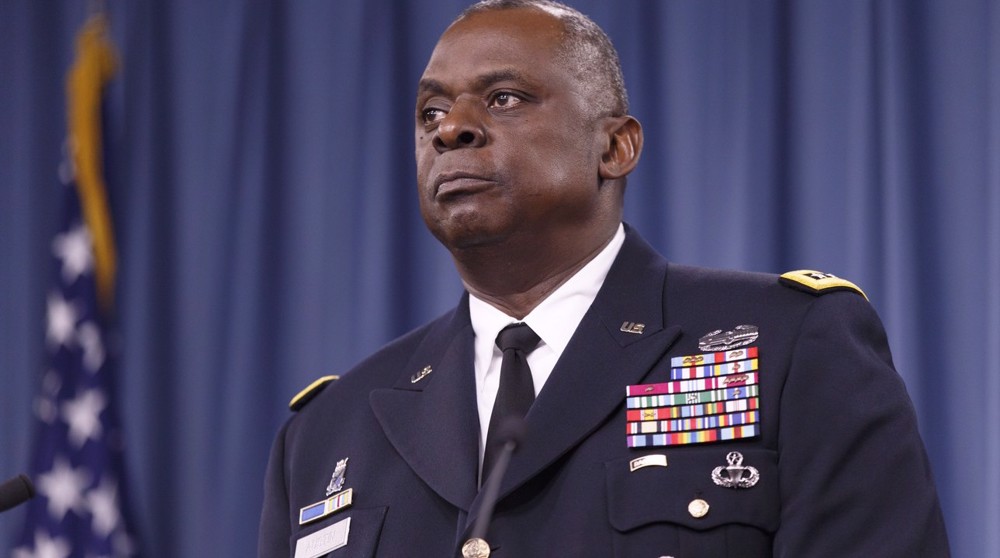
US Defense Secretary Lloyd Austin has insisted that Russia will not use nuclear weapons in Ukraine despite threats to do so if attacked, noting that Washington sees no evidence suggesting such moves.

“I don’t see anything right now that would lead me to believe that he [Russian President Vladimir Putin] has made such a decision,” Austin said in an interview with CNN’s Fareed Zakaria on Saturday and due to be aired on Sunday.

The Pentagon chief said that Washington had previously communicated these concerns to Moscow via top-level channels. When asked if he had any recent contacts with Russian Defense Minister Sergei Shoigu, Austin responded negatively.

Despite claiming that “there are no checks on Putin,” the Pentagon chief dismissed recent warnings by the Russian president – including his vow that he was not “bluffing” about Moscow’s willingness to use nuclear arms “to defend Russia and our people” – as unworthy of a global superpower. 

“This nuclear saber-rattling is not the kind of thing that we would expect to hear from leaders of large countries with capability,” Austin underlined, but then added: “Just as [Putin] made the irresponsible decision to invade Ukraine, you know, he could make another decision” to use nuclear weapons there. 

His remarks came after US officials and mainstream media outlets accused the Russian president of making “nuclear threats” against Ukraine in his speech to the nation on September 21, when he declared partial mobilization and status referendums in eastern Ukrainian regions of Donbass, Kherson and Zaporozhye.

What Putin had actually stated, however, was that Kiev and its Western sponsors had “resorted to nuclear blackmail,” insisting that Moscow would not hesitate to respond in kind if its security interests were threatened.

“I am referring not only to the Western-encouraged shelling of the Zaporozhye Nuclear Power Plant, which poses a threat of a nuclear disaster, but also to the statements made by some high-ranking representatives of the leading NATO countries on the possibility and admissibility of using weapons of mass destruction – nuclear weapons – against Russia,” Putin said at the time.

“I would like to remind those who make such statements regarding Russia that our country has different types of weapons as well, and some of them are more modern than the weapons NATO countries possess,” he then emphasized. “In the event of a threat to the territorial integrity of our country and to defend Russia and our people, we will certainly make use of all weapon systems available to us. This is not a bluff.”

The US defense secretary further claimed that Washington had previously communicated to his Russian counterpart Sergei Shoigu not to “go down this path and conduct this type of irresponsible behavior,” but when asked if he had any recent contacts with Shoigu, Austin responded negatively.

The Russian defense minister has repeatedly clarified that Moscow’s nuclear doctrine only allows the use of such weapons when “the very existence of the state is threatened” and last month rejected the notion of using nukes in Ukraine as “absurd.” 

The development came a day after Deputy head of Russia’s security council Dmitry Medvedev slammed Ukraine’s renewed bid to promptly join the US-led NATO military alliance as an effort that would only “hasten the start of World War III.”

“[Ukrainian President Vladimir] Zelensky wants to speed up NATO membership. Great idea. He just begs NATO to hasten the start of World War III,” Medvedev wrote in a Friday post on his Telegram channel as cited by Russia’s TASS news agency.

The statements came after the Ukrainian president formally applied for a fast-track NATO membership following the signing of a decree by his Russian counterpart for the formal accession of former eastern Ukrainian regions of Donetsk, Lugansk, Zaporozhye, and Kherson after holding referendums that overwhelmingly favored the move.

Washington, meanwhile, has repeatedly warned Moscow against the use of nuclear weapons, threatening “catastrophic” consequences as Kiev continues to shell the Zaporozhye Nuclear Power Plant, putting the world “on the brink of nuclear catastrophe,” in the words of Russian State Duma Chairman Vyacheslav Volodin.

This is while US officials have so far been evasive about how they would respond to a potential Russian nuclear strike, with President Joe Biden merely vowing that Russia would become an international “pariah,” suggesting that Washington’s response would depend “on the extent of what they do.”

Such warnings are intentionally vague, US officials told the Washington Post last month, and are delivered with the intent to create “strategic ambiguity” and keep the Kremlin on its toes about the response.

US senator vows ‘catastrophic’ response if Russia nukes Ukraine

Hawkish US Republican Senator Lindsey Graham also claimed on Thursday that any Russian use of nuclear weapons in Ukraine would be considered as an attack on “NATO itself,” prompting a “catastrophic” response.

Speaking during a joint press conference with Democratic Senator Richard Blumenthal of Connecticut, the North Carolina senator further insisted that in such an attack the radiation “would not be confined to Ukraine, you would be irradiating parts of Europe that are under the NATO banner.”

“If that day ever comes — and I hope and pray it doesn’t — [a nuclear strike] should be considered by NATO writ large and the United States as an attack by Russia on NATO itself,” he emphasized.

Graham and Blumenthal called the press conference to unveil legislation blocking foreign aid to any country recognizing the results of the referendums in Donetsk, Lugansk, Zaporozhye, and Kherson. 

Categories
Saved Web Pages

What happens next after Putin’s annexations in Ukraine

putinvladimir_093022ap_w.jpg?w=1280

Russian President Vladimir Putin’s move Friday to annex parts of southern and eastern Ukraine amid Moscow’s war in the country has elevated the stakes of the conflict, threatening to bring the Kremlin’s struggling military campaign closer to the doorsteps of the West.  

The stunning move has prompted a flurry of activity across the globe, including new U.S. and Group of Seven (G-7) sanctions targeting Russian government and military officials and their family members, international condemnation, calls for more weapons for Kyiv and a fresh push from Ukraine to join NATO.  

But Putin’s actions — an indication he has dug in his heels in his military campaign against Ukraine — have much broader and longer-term repercussions for the future, experts say. What exactly those will be, however, are hard to discern, with experts expressing a deep uncertainty over where the situation will go from here. 

“I think there will be continued warnings about breaking any of the red lines that have been put down. And there will be, I think, further strengthening of sanctions … Beyond that, it’s hard to anticipate exactly what might happen,” said career ambassador Thomas Pickering, who served as U.S. ambassador to the United Nations as well as Russia.  

Putin on Friday signed four “ascension treaties” to annex the Donetsk, Luhansk, Kherson and Zaporizhzhia regions of Ukraine after holding sham referendums in the areas. 

“This is the will of millions of people,” Putin told hundreds of dignitaries amid a lavish ceremony at the Kremlin in Moscow. 

Much of the world, including members of the G-7 and the European Union, have already vowed to never recognize the land grab, while Ukrainian President Volodymyr Zelensky called the move a “farce.”  

“The entire territory of our country will be liberated,” Zelensky promised in a pre-recorded video released after Putin’s speech. 

The annexations are the biggest territory grab in Europe since World War II and come as Putin has grown increasingly aggressive in his rhetoric due to a markedly successful Ukrainian counteroffensive earlier this month that took back large swaths of ground and forced Moscow’s forces to retreat. 

Putin continued that saber-rattling in a speech laden with anti-Western sentiments, pledging to defend the newly claimed regions with “all available means,” a non-veiled threat to use nuclear weapons. 

Russia has dangled the threat of an attack with a nuclear weapon since the start of its invasion of Ukraine, but the new land steal has spiked fears over how Moscow will respond to attacks in these territories now declared part of the Kremlin.

“Would he actually go to the use of nuclear weapons? Nobody knows. But it remains obviously something that he’s unprepared now to take off the table,” Pickering told The Hill. 

Another question raised is whether the Russians will stick to their messaging that taking the eastern-most area of Ukraine known as the Donbas region remains the limited objective of their invasion, as suggested in Putin’s speech. The Kremlin has focused on taking the area since its failed campaign to topple Kyiv, but it’s unclear whether Moscow will be open to ending the war should that be achieved.  

“Would that in its own way lead to discussions that could take place diplomatically over next steps that might tone things down? I think that’s a very optimistic view, but a moment not very likely given Mr. Putin’s dug in responses on every development that has taken place of upping the ante,” Pickering noted. 

Also undetermined is the renewed debate over whether NATO should allow Ukraine to join after the country on Friday announced it will file an expedited application to the military alliance, which Kyiv has sought to enter since Russia’s annexation of the Crimean Peninsula in 2014.  

The United States quickly urged that such a process “should be taken up at a different time,” according to national security adviser Jake Sullivan. 

“Right now, our view is that the best way for us to support Ukraine is through practical, on-the-ground support in Ukraine and that the process in Brussels should be taken up at a different time,” Sullivan told reporters Friday.   

But Jonathan Katz, director of Democracy Initiatives and a senior fellow with The German Marshall Fund of the United States, said Ukraine’s NATO bid is a serious application in the wake of Putin’s speech and amid his ongoing desperate bids to make gains in a war that has become bogged down in its seventh month.  

“It is not far-fetched that Ukraine — which will need security guarantees going forward, given Russia’s unrelenting war and Mr. Putin’s unwillingness to end this cycle of violence against Ukraine — they will need to be given some type of security guarantee and NATO is the place to do that,” Katz said.  

“It must be taken seriously. … how can anyone think that Ukrainians, or the West, the transatlantic community, can be safe with Mr. Putin doing what he’s doing,” he added.  

The issue will likely come up at a meeting of defense ministers for the North Atlantic Council Oct. 12 and 13 at NATO Headquarters in Brussels.  

For now, U.S. and Western officials say they are focusing on crippling Russia through economic means, with the Biden administration on Friday announcing a new round of sanctions. 

The sanctions, which come from the departments of Treasury, Commerce and State and in coordination with members of the G-7, are meant to target Moscow’s decisionmakers, Putin’s allies and entities that support Russia’s military-industrial complex. 

Secretary of State Antony Blinken said the sanctions are a clear warning that there will be “costs for any individual, entity, or country that provides political or economic support to Russia as a result of its illegal attempts to change the status of Ukrainian territory.” 

One thing’s certain in the aftermath of Putin’s move: continued U.S. support to Ukraine. 

The House on Friday passed a stopgap spending bill to stave off a government shutdown that included another $12.3 billion in aid for Ukraine.  

News also broke Friday that the Pentagon was preparing to step up efforts to train and equip Ukrainian troops through a proposal to create a new command based in Germany, as The New York Times reported. Such a command, which would be led by a top U.S. general, would streamline the current patchwork of training and assistance given to the Ukrainian military by the U.S. and allies since Russia attacked the country in February, according to the Times. 

And House Foreign Affairs Committee ranking member Michael McCaul (R-Texas) on Friday called for the U.S. and its allies to send Ukraine weapons it has so far held off from providing over fears doing so could escalate Russia’s ire. 

Zelensky advisor: Putin’s mobilization announcement ‘actually to our advantage’ Ukrainian intel shows Russian nuclear threat is ‘very high’: top Zelensky aide

“I urge the Biden administration to finally provide longer-range artillery, like [Army Tactical Missile System]. And I also urge key allies to immediately transfer much-needed systems, including German Leopard tanks and Marder infantry fighting vehicles,” McCaul said in a statement.  

Earlier this week the administration pledged another $1.1 million in lethal aid to the embattled country, bringing the total Pentagon commitment to Ukraine to more than $16 billion since February.  

The latest dollars will go to contracts for weapons to be delivered over the next several years — a signal that the U.S. believes Russia will continue to threaten Ukraine and the region for years to come.  

WP Radio
WP Radio
OFFLINE LIVE