Categories
Audio Sources - Full Text Articles

Exclusive Insight: Crackdown on Corruption in Odesa

On On Dec 5, Ukrainian law enforcement officers raided the premises of the Odesa City Hall to search the office of Mayor Gennadiy Trukhanov and his deputies. Investigators of the National Anti-Corruption Authority of Ukraine (NABU) in coordination with the Anti-Corruption Prosecutor’s Office seized documents in legal and financial offices of Odesa City Council.

The police also arrested Oleksandr Hranovsky (Aleksandr Granovsky) and Boris Kaufman, owners of the Vertex group, which controls the oldest hotels in Odesa (Bristol, Londonskaya, Passage), the largest cigarette distributor in Ukraine (TEDIS), and others real estate and commercial properties. This was reported by the local newspaper Dumskaya.net, which added that a third man was arrested but his identity is still unknown.

“On Dec 5, 2022, in compliance with the prosecutorial procedures of the Anti-Corruption Prosecutor’s Office, NABU investigators arrested three people suspected of creating a criminal organization that controlled Odesa City Council officials and of committing other crimes of corruption. Preliminary legal qualification according to part 1 of art. 255, part 3 of art. 369 of the Criminal Code of Ukraine,” the press release of the Anti-Corruption Prosecutor’s Office reported.

Hennady Trukhanov (C) talks during a High Anti-Corruption Court hearing on Oct. 11, 2021, set to determine his bail. On Oct. 6, Trukhanov was charged with organized crime and abuse of power.
Photo by High Anti-Corruption Court/Kyiv Post

“In fact, the criminal organization controlled all significant budget expenditures in Odesa and coordinated the main issues on the agenda of City Council sessions. To carry out criminal actions, people initiated a systemic corruption process of officials and deputies of the local council, which ensured that the necessary decisions were taken by the local government.”

Both entrepreneurs, considered by Ukrainian media to be very close to Mayor Trukhanov, notorious for his alleged corrupt practices, were taken from Odesa to Kiev. Hranovsky, a former lawmaker who had been closely linked to former president Petro Poroshenko, had already been placed on a wanted list by NABU.

That NABU had been investigating activities of the persons in question for some time is no secret. What is surprising is the acceleration of the law enforcement system’s actions while the war with Russia continues. It appears that the war itself has necessitated the fight against corruption and powerful “business” cliques to be stepped up, and especially in a city of such strategic importance as Odesa – the sea gate of Ukrainian export.

In fact, NABU suspects Hranovsky of having organized a scheme, due to which the Odesa port facility lost Hr 93.3 million.

In addition, on October 6, 2022, the former General Prosecutor of Ukraine, Iryna Venediktova, announced that she had signed the initiation of a criminal investigation into five suspects for allegedly developing, in the period from 2016 to 2019, a criminal plan to seize of local budget funds and of municipal land for speculation. Due to their plan, six land plots with a total area of 15.9 hectares were transferred to private ownership, and Hr 131 million was illegally taken from the city budget.

Subsequently, the Anti-Corruption Prosecutor’s Office said that the mayor of Odesa and three other city council officials had been informed of the suspected crime under Part 1 of Art. 255, paragraph 2 of the art. 364 of the Criminal Code of Ukraine. In total, 16 people were considered part of a criminal organization, of which 10 were members and the rest were accomplices.

What has just occurred in Odesa is not an isolated development and appears to be part of an unfolding broader offensive to curb corruption at a time when Ukraine’s security and reputation are having to be defended to the utmost.

The post Exclusive Insight: Crackdown on Corruption in Odesa appeared first on Kyiv Post.

Categories
Audio Sources - Full Text Articles

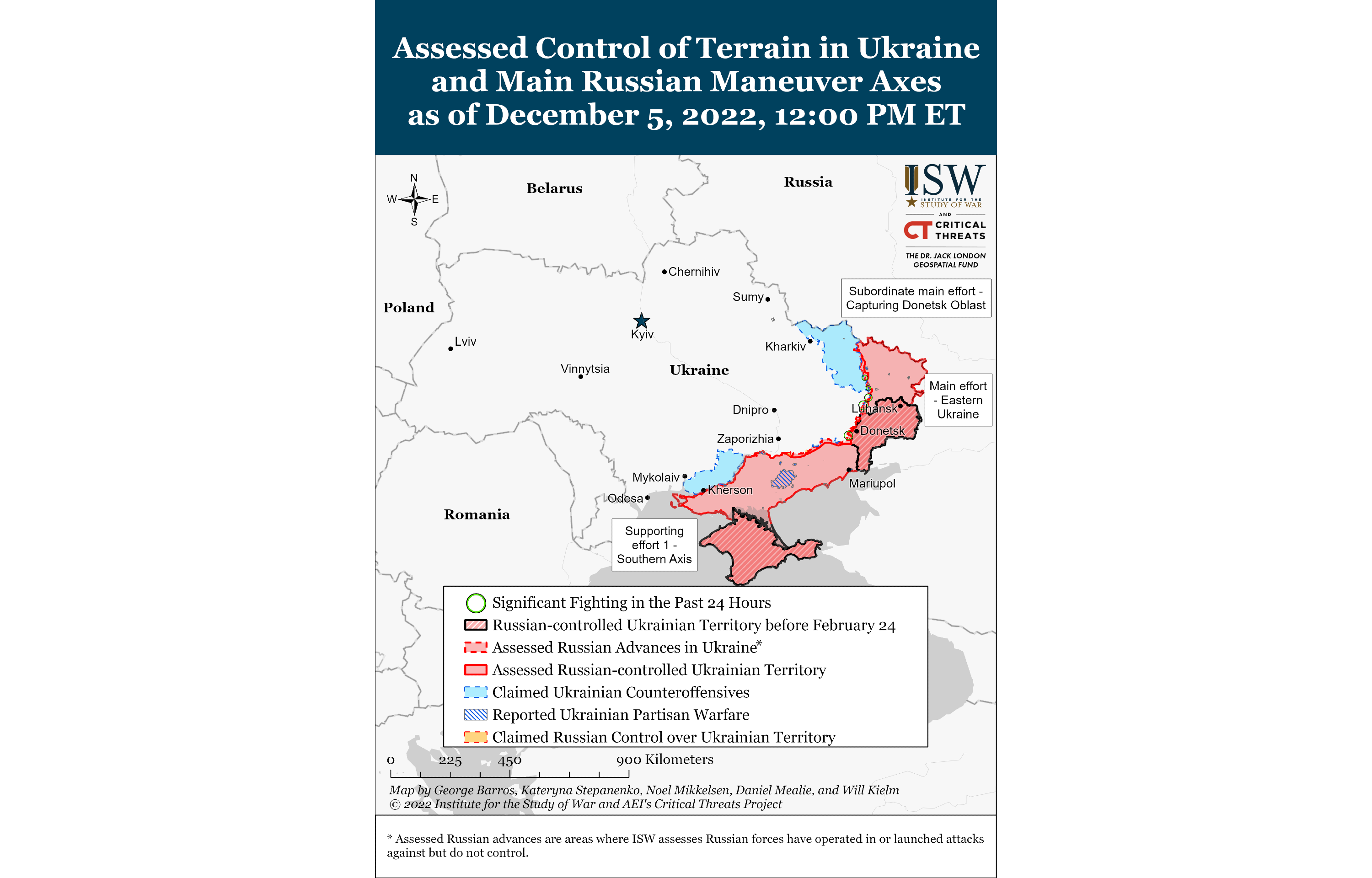
ISW Russian Offensive Campaign Assessment, December 5

draftukrainecotdecember052022.png

Key inflections in ongoing military operations on December 5:

  • Russian forces continued to defend their positions along the Svatove-Kreminna line against Ukrainian attacks.[16]
  • Russian forces continued to make incremental gains around Bakhmut but have not yet surrounded the city, and conducted offensive operations in the Avdiivka-Donetsk City area. Ukrainian sources claimed that small Russian assault groups of 15-20 personnel are attempting to penetrate Ukrainian lines.[17]
  • Russian occupation officials continued the forceful transfer of Ukrainian children from occupied territories in Donetsk and Luhansk Oblasts to Russia under the guise that the children require special medical care.[18]
  • Russian forces shelled more than 20 settlements on the right (west) bank of the Dnipro River and continued to strike Kherson City.[19]
  • Russian senator Andrey Klishas of the ruling United Russia party proposed the Kremlin restrict the ability of Russians who fled the country to avoid mobilization to secure work upon returning to Russia.[20]
  • Ukraine’s Main Intelligence Directorate (GUR) reported that the Russian military, in concert with the Russian Internal Ministry, is taking steps to launch an electronic database by February 2023 to document the personal details of all servicemen and restrict their movement even when out of uniform.[21]

Russian forces conducted another wave of missile strikes targeting Ukraine’s energy infrastructure on December 5. Russian and Ukrainian sources reported on December 5 that Russian forces conducted missile strikes targeting Ukrainian civilian and energy infrastructure in Kyiv, Odesa, Vinnetysia, and Zaporizhia Oblasts.[1]  The Ukrainian General Staff reported that Ukrainian air defenses shot down 60 of over 70 missiles launched.[2] Deputy Head of Ukraine’s Presidential Office Kyrylo Tymoshenko Kyrylo Tymoshenko stated that the Russian strikes damaged a power supply line in Sumy Oblast.[3] ISW previously assessed on December 2 that while Ukrainian and Western-provided air defenses are further reducing Russia’s dwindling supply of precision munitions, the small percentage of Russian strikes getting through Ukraine’s air defenses are nevertheless having significant effects on Ukrainian critical infrastructure.[4]

Ukrainian forces likely conducted strikes on two Russian strategic airbases on December 5, inflicting light damage while demonstrating Ukraine’s ability to strike Russian rear areas and possibly disrupt Russia’s campaign of strikes against Ukrainian infrastructure. The Russian Ministry of Defense and several milbloggers reported that Ukrainian forces used UAVs to strike the Engels-2 airbase in Saratov Oblast (approximately 315 miles from Ukrainian territory) and the Dyagilevo Air Base in Ryazan Oblast (approximately 285 miles from Ukrainian territory).[5] Both airbases house elements of Russia’s strategic bomber fleet, which Russia has employed to strike Ukraine throughout the war. Ukrainian Presidential Advisor Mikhail Podolyak tweeted that the Kremlin should have known that “if something is launched into other countries’ airspace, sooner or later unknown flying objects will return to departure point.” Still, Ukrainian authorities have not formally claimed responsibility for the strikes as of publication.[6] Russian sources claimed that a Ukrainian drone struck aircraft at the Engels-2 Airbase in Saratov Oblast, Russia, damaging strategic bombers and missile carriers.[7] Russian sources also claimed that a Ukrainian drone destroyed a Russian fuel truck at the Dyagilevo Air Base in Ryazan Oblast, Russia.[8] The Russian Ministry of Defense claimed that the strike intentionally targeted Russian long-range aircraft.[9] Ukrainian forces likely sought to disrupt Russian strikes against Ukrainian critical infrastructure and demonstrate Ukraine’s ability to target Russian strategic assets.

Anger over the Russian military’s inability to prevent the Ukrainian strikes on Russian strategic airbases over 280 miles from Ukrainian positions outweighed praise for the latest round of strikes against Ukraine within the Russian milblogger community. Russian milbloggers criticized Russian officials for failing to anticipate and prevent the drone strikes at the Engels-2 and Dyagilevo Air Bases on December 5.[10] Select milbloggers noted that Russian military officials have not adequately protected the airbases, with some suggesting that Russian officials did not adequately defend the bases despite knowing that they were clear targets for Ukrainian strikes.[11] Several prominent Russian milbloggers claimed that Ukrainian sabotage and reconnaissance groups must have launched the strike against the Engels-2 air base from inside Russian territory, asserting either that Ukrainian sabotage and reconnaissance groups are active inside Russia or – if the UAVs were launched from Ukrainian territory – that Moscow is under threat from Ukrainian territory.[12]

Russian milbloggers also called on Russian military officials to authorize significant retaliation strikes against Ukraine and intensify counter-terrorism measures within Russian territory.[13] The milblogger community complained that Russian military officials do not consider their suggestions and ignore open-source intelligence (OSINT) and that, had Russian officials taken milbloggers’ warnings into account, the two strikes on Russian military bases would have likely been prevented.[14] Select milbloggers suggested that the strikes on Engels-2 and Dyagilevo Air Bases threaten Russia’s legitimacy as a nuclear power as the strikes damaged aircraft capable of carrying multiple nuclear weapons.[15]

See the full report here.

The post ISW Russian Offensive Campaign Assessment, December 5 appeared first on Kyiv Post.

Categories
Audio Sources - Full Text Articles

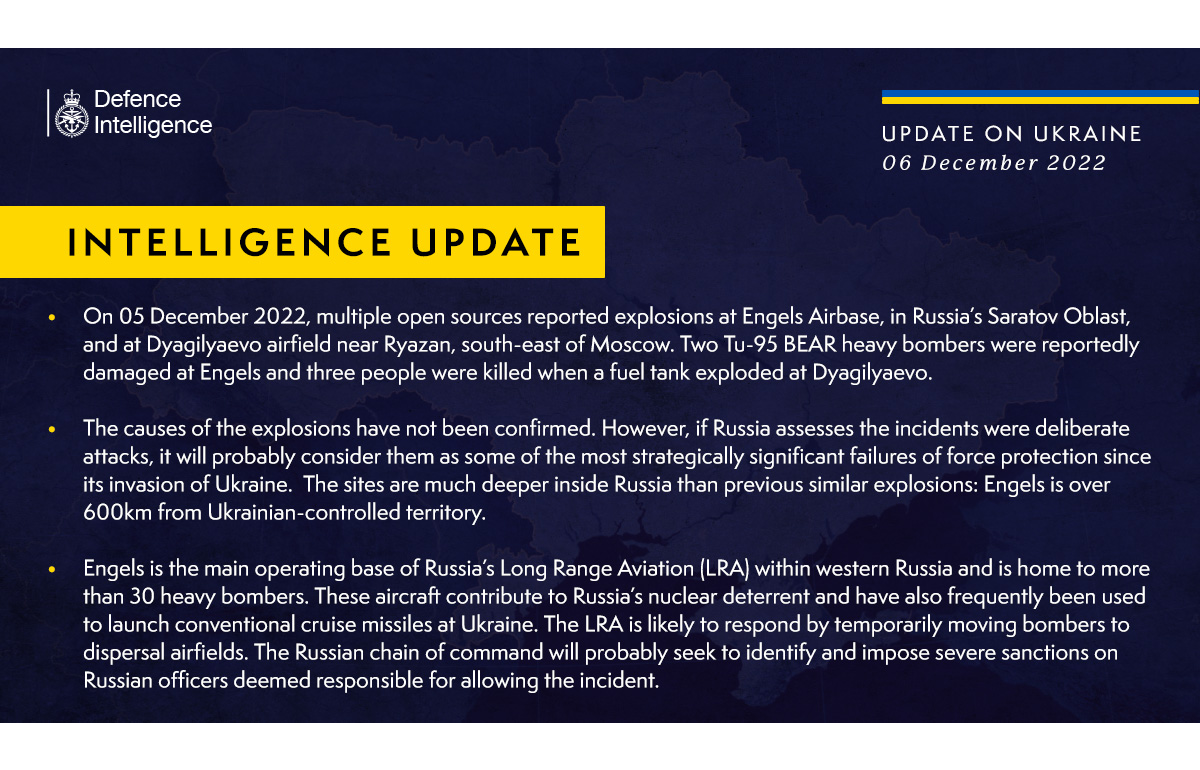
British Defence Intelligence update Ukraine – 06 December 2022

fjrrnhhxeaecirg.png

  • On 05 December 2022, multiple open sources reported explosions at Engels Airbase, in Russia’s Saratov Oblast, and at Dyagilyaevo airfield near Ryazan, south-east of Moscow.
  • Two Tu-95 BEAR heavy bombers were reportedly damaged at Engels and three people were killed when a fuel tank exploded at Dyagilyaevo.
  • The causes of the explosions have not been confirmed. However, if Russia assesses the incidents were deliberate attacks, it will probably consider them as some of the most strategically significant failures of force protection since its invasion of Ukraine.
  • The sites are much deeper inside Russia than previous similar explosions: Engels is over 600km from Ukrainian-controlled territory.
  • Engels is the main operating base of Russia’s Long Range Aviation (LRA) within western Russia and is home to more than 30 heavy bombers.
  • These aircraft contribute to Russia’s nuclear deterrent and have also frequently been used to launch conventional cruise missiles at Ukraine. The LRA is likely to respond by temporarily moving bombers to dispersal airfields.
  • The Russian chain of command will probably seek to identify and impose severe sanctions on Russian officers deemed responsible for allowing the incident.

The post British Defence Intelligence update Ukraine – 06 December 2022 appeared first on Kyiv Post.

Categories
Audio Sources - Full Text Articles

Armed Forces of Ukraine Day: Milestones in the Push to Evict Russian Invaders – Kyiv Post

These days, on Dec. 6, Ukraine celebrates the 31st anniversary of the Armed Forces of Ukraine. Kyiv Post highlights the critical achievements of the Armed Forces of Ukraine (AFU) in this war.

Hostomel airfield struggle

The most dramatic battle at the outset of the war took position in and all around Hostomel airfield about 15 kilometers northwest of Kyiv. In accordance to Ukrainian government accounts, the Russian goal was to seize the airfield and use it as a foundation for landing effective reinforcements, which would race into the cash, decapitate the governing administration, and just take about.

The landing of 20 to 30 aircraft, dependent on the resource, took place mid-early morning on Feb. 24. Ukrainians shot down two transport and 1 attack helicopter with hand-held guided missiles. A pair of hours later, Ukrainians introduced up artillery and, by mid-afternoon, a device of their possess helicopter-carried infantry experienced recaptured the airfield by early night, in accordance to official reviews.

Even so, a Russian infantry drive appeared to be nevertheless present and able of preventing, complicating communications involving the cash and forces to the north.

The Battle for Kyiv

From the incredibly beginning of the invasion, Russian troops attacked the northern areas of Ukraine in buy to occupy Kyiv. The aggressor planned to seize the Ukrainian cash in two or three times. Even before the offensive began, U.S. officials considered Kyiv to be doomed: Chairman of the Joint Chiefs of Staff Gen. Mark Milley advised lawmakers that Ukraine’s money could slide in 72 several hours if a whole-scale Russian invasion of Ukraine took location.

The Russian designs were being thwarted by Ukrainian defenders, who introduced Russian troops deep into the territory and then began cutting its offer routes, ambushing it, and merely masking it with hearth. Russian troops, beaten and exhausted, have been compelled to depart the Kyiv and Chernihiv areas on March 29.

The Kremlin claimed its steps as “increasing mutual have confidence in and building conditions for negotiations,” without the need of mentioning the truth that the AFU experienced encircled the Russian Federation (RF) forces and obliged them to retreat.

Russia’s Moskva flagship sinks

Considering that the full-scale invasion, the Ukrainian army has astonished gurus and partners with sudden blows a lot more than once. A single these types of “plot twist” took area on April 12: the flagship of the RF’s Black Sea Fleet, the Moskva, was hit by Ukrainian Neptune missiles. The Moskva flagship played a crucial purpose as both equally a command ship and an air protection unit.

The Russian Ministry of Protection was at first evasive about what experienced prompted “a fire” on board the missile cruiser, which then detonated the ammunition on board.

Although Russia has not formally acknowledged that the cruiser was attacked by Ukrainian missiles, its destruction was introduced as a “pretext” for all-out war. Community figures ended up publicly calling for a retaliatory strike from Kyiv, including the use of nuclear weapons.

“Gesture of goodwill” – RF forces flee from Snake Island

Russian forces occupied the strategic Snake Island in the western Black Sea on the first day of the war in Ukraine.

The island has been intensely fought above by both equally sides, with Ukraine carrying out large attacks on the Russian occupiers there for 4 months. The outpost became a image of Ukrainian resistance following a radio exchange, in which Ukrainian soldiers made use of an expletive in response to Russian requires from the Moskva missile carrier to surrender, went viral at the commence of the war.

On June 30, the Russian Defense Ministry announced a “gesture of goodwill.” The troops of the occupier still left Snake Island. The victory permitted Ukraine to partially open its ports, as perfectly as to manage a grain corridor for export.

The ongoing Donbas protection

In Putin’s online video information, which marked the beginning of a “special army procedure,” the Russian President claimed that the liberation and protection of the inhabitants of Russian-occupied territories of Ukraine was the key purpose for the invasion.

During 9 months of the war, Russian occupiers have unsuccessful to complete this intention. The Russian army captured the Luhansk region but at the price tag of massive losses in products and manpower.

The fight for the Donetsk area carries on, the Russian troops have not captured a single key metropolis, aside from Mariupol, which has been turned into ruins.

Now the occupiers are focusing their endeavours on Bakhmut, wherever they have made no significant progress, notwithstanding the statements of their propagandists.

The counteroffensive to liberate the Kharkiv location

When Kyiv’s lightning offensive rolled eastward across the Kharkiv area in mid-Sept. in opposition to reportedly weak resistance, AFU troops liberated dozens of villages and achieved the border with Russia.

In only seven days, AFU columns recaptured much more than 3,000 sq. kilometers of previously Russia-held territory and liberated extra than 30,000 Ukrainian citizens living in far more than 3,000 cities and villages. Most, positioned in far northeast Ukraine, experienced been less than RF command for nearly 6 months.

Ukrainian formal and social media sources instructed of chaos and confusion on roadways major eastward from the cities of Kupiansk and Oskil, and the metropolis of Izyum, with Russian models fleeing.

At to start with, the Kremlin attempted to go off Russia’s failure in Kharkiv as a “gesture of goodwill” and an “organized withdrawal of Russian troops from the Kharkiv region to the Donetsk location.” But this time, the authorities confronted significant criticism from all strata of the Russian population.

Kherson recaptured

Best Moscow generals, on Nov. 9, declared the withdrawal of all RF troops from the important port town of Kherson and the full suitable lender of the Dnipro River, marking 1 of the worst setbacks however in Putin’s try to annex Ukrainian territory.

Two days later, on Nov.11, the RF army’s high command claimed its troops in the Kherson sector experienced largely succeeded in escaping from an uncovered bridgehead on the north aspect of the Dnipro River, as dozens of outlying villages and hundreds of square kilometers of occupied territory were liberated by advancing Ukrainian troops.

The RF military’s capability to provide ground models in the Kherson perimeter experienced grow to be ever more shaky pursuing continuous AFU bombardments – applying typically U.S.-created, precision-guided munitions – of a few essential bridges and a single hydroelectric dam linking the bridgehead on the north financial institution of the river with RF military depots and reserves on the south financial institution.

Kherson experienced been the only regional money captured by Russia in the Kremlin’s 8-thirty day period war with Ukraine. The Kremlin, with excellent fanfare on Sept. 30, introduced Russia experienced annexed the Kherson region and that the some 500,000 citizens nevertheless living there experienced turn out to be Russian citizens, and that Russian state presence would be “eternal.”

Supply backlink

The post Armed Forces of Ukraine Day: Milestones in the Push to Evict Russian Invaders – Kyiv Post appeared first on Ukraine Intelligence.

Categories
Audio Sources - Full Text Articles

Crook sentenced to 18 months for stealing $20M in SIM swapping attack

Vulnerability-on-SIM-cards.jpg?fit=630%2

Nicholas Truglia, from Florida, US, was sentenced to 18 months in prison for stealing more than $20 million in a SIM swapping scheme.

DoJ announced that Nicholas Truglia (25) was sentenced to 18 months in prison for the theft of over $20 million worth of cryptocurrency through SIM swapping attacks. The man was ordered to pay $20,379,007 in restitution to the victim within 60 days. 

“Nicholas Truglia and his associates stole a staggering amount of cryptocurrency from the victim through a complex SIM swap scheme.” said U.S. Attorney Damian Williams. “Nevertheless, today’s sentencing goes to show that no matter how sophisticated the crime is, this Office will continue to successfully prosecute those who choose to defraud others.”

In January 2018, Truglia participated in a fraudulent scheme to hack into online accounts of the victims to steal cryptocurrency. The man gained unauthorized access to the online accounts of the victims through SIM swapping attacks.

Crooks conduct SIM swapping attacks to take control of victims’ phone numbers tricking the mobile operator employees into porting them to SIMs under the control of the fraudsters. Once hijacked a SIM, the attackers can steal money, cryptocurrencies and personal information, including contacts synced with online accounts. The criminals could hijack social media accounts and bypass 2FA services based on SMS used by online services, including financial ones.  

According to the indictment, one of the accounts compromised by Truglia contained over $20 million worth of cryptocurrency, which was transferred to accounts under his control.

The man shared the funds with other participants in the scheme and kept approximately $673,000 worth of the stolen funds.

The account compromised by Truglia was owned by the cryptocurrency investor Michael Terpin, who filed a complaint claiming that three million tokens worth $23.8 million had been stolen from his mobile phone in 2018. In May 2019, Terpin won $75.8 million in a civil case against Truglia, who reportedly defrauded him of crypto assets.

Truglia pleaded guilty in late 2021, and last week has been sentenced to 18 months in prison and three years of supervised release. He was also ordered to forfeit $983,010.72.

Follow me on Twitter: @securityaffairs and Facebook and Mastodon

Pierluigi Paganini

(SecurityAffairs – hacking, SIM swapping)

The post Crook sentenced to 18 months for stealing $20M in SIM swapping attack appeared first on Security Affairs.

Categories
Audio Sources - Full Text Articles

From flickering fireflies to lowly dung beetles, insects are vanishing

2022-12-06T07:19:56Z

As a boy in the 1960s, David Wagner would run around his family’s Missouri farm with a glass jar clutched in his hand, scooping flickering fireflies out of the sky.

“We could fill it up and put it by our bedside at night,” says Wagner, now an entomologist.

That’s all gone, the family farm now paved over with new homes and manicured lawns. And Wagner’s beloved fireflies – like so many insects worldwide – have largely vanished in what scientists are calling the global Insect Apocalypse.

(For related graphic, please click on https://tmsnrt.rs/3UtC8UM)

As human activities rapidly transform the planet, the global insect population is declining at an unprecedented rate of up to 2% per year. Amid deforestation, pesticide use, artificial light pollution and climate change, these critters are struggling — along with the crops, flowers and other animals that rely on them to survive.

“Insects are the food that make all the birds and make all the fish,” said Wagner, who works at the University of Connecticut. “They’re the fabric tethering together every freshwater and terrestrial ecosystem across the planet.”

TREE OF LIFE

It’s easy to think insects are doing OK. After all, they’re nearly everywhere — crawling through rainforest canopy, burrowing into soil, skimming freshwater ponds or, of course, flitting through the air.

On the biological “tree of life” — which classifies organisms to describe their evolutionary and genetic relationship to one another — insects fall under the branch, or phylum, called Arthropods, one of the 40 branches of the Animal Kingdom.

In terms of diversity, insects are unrivaled, representing two-thirds of the world’s more than 1.5 million documented animal species with millions more bugs likely still undiscovered, scientists say. By comparison, there are roughly 73,000 vertebrates, or animals with a backbone from humans to birds and fish — these represent less than 5% of the known Animal Kingdom, according to the International Union for Conservation of Nature (IUCN).

Their importance to the environment can’t be understated, scientists say. Insects are crucial to the food web, feeding birds, reptiles and mammals such as bats. For some animals, bugs are simply a treat. Plant-eating orangutans delight in slurping up termites from a teeming hill. Humans, too, see some 2,000 species of insects as food.

But insects are so much more than food. Farmers depend on these critters pollinating crops and churning soil to keep it healthy, among other activities.

* Insects pollinate more than 75% of global crops, a service valued at up to $577 billion per year, the Intergovernmental Science-Policy Platform on Biodiversity and Ecosystem Services (IPBES) says.

* In the United States, insects perform services valued in 2006 at an estimated $57 billion per year, according to a study in the journal BioScience.

* Dung beetles alone are worth some $380 million per year to the U.S. cattle industry for their work breaking down manure and churning rangeland soil, the study found.

With fewer insects, “we’d have less food,” said ecologist Dave Goulson at the University of Sussex. “We’d see yields dropping of all of these crops.”

And in nature, about 80% of wild plants rely on insects for pollination. “If insects continue to decline,” Goulson said, “expect some pretty dire consequences for ecosystems generally — and for people.”

DECLINE

Describing a stroll through Costa Rica’s Area de Conservacion Guanacaste rainforest, evolutionary ecologist Daniel Janzen in 2019 wrote: “Gone are the spiderwebs that decades back entangled those leaves. Gone is the nighttime sparkle in the leaves reflected from thousands of lycosid spider eyes.”

The world has lost 5% to 10% of all insect species in the last 150 years — or between 250,000 and 500,000 species, according to a February 2020 study in the journal Biological Conservation. Those losses are continuing, though estimates vary due to patchy data as well as uncertainty over how many insects exist.

In the tropics, insects can be “extremely hard to identify, because there are vastly more species than (we) are used to,” Janzen, a University of Pennsylvania professor, told Reuters. “There are more species within 100 kilometres of my dwelling in a national park in northwestern Costa Rica than in all of Europe.”

Not knowing exactly what’s out there makes it harder to detect trouble. One April 2020 analysis in the journal Science suggested the planet is losing about 9% of its land-dwelling insect population each decade. Another January 2021 paper tried to paint a clearer picture by synthesizing more than 80 insect studies and found that insect abundance is declining around 1% to 2% per year. For comparison, the human population is growing at slightly less than 1% per year.

“Even at the low end of 1% a year, after just 40 years you’re down more than one-third of species and one-third of individuals — a third of the entire tree of life lost,” said Wagner, who led the 2021 metastudy, published in the Proceedings of the National Academy of Sciences.

But the reality is likely worse. Wagner’s team offered an “incredibly conservative” loss estimate, he said, noting that many insect studies are conducted in protected areas such as nature reserves. Degraded farmland or cities would likely reveal far fewer insects.

The demise of insects can’t be attributed to any single cause. Populations are facing simultaneous threats, from habitat loss and industrial farming to climate change. Nitrogen overloading from sewage and fertilizers has turned wetlands into dead zones; artificial light is flooding out nighttime skies; and the growth of urban areas has led to concrete sprawl.

“Until recently, loss of land was the single greatest driver” of the decline, Wagner said. “But climate change is becoming a far more severe and ominous threat by drying out parts of the planet that were chronically wet. And that is absolutely catastrophic for a lot of insects.”

The introduction of non-native plants, which can dominate new environments, has also hurt insects. Because many insects have evolved to feed on or fertilize a single plant species, the disruption of the plant world can have an outsized effect. For example, the Tegeticula moth species pollinates California’s famed Joshua trees, while the succulent is the only food source for the moth’s offspring. If Joshua trees were to disappear, so too could the moth. And vice versa.

While the situation is bleak for insects at large, a few types of insects are thriving.

“It’s generally the pest insects that are thriving because they’re the ones that breed faster and are favored by human conditions, like all the waste we produce for them to lay their eggs in,” said Sussex’s Goulson.

Climate change is also giving some nuisance species a boost. Rising temperatures are driving major outbreaks of mountain pine bark beetles, which in two decades have decimated roughly 100,000 square miles (260,000 square kilometers) of North American forest. And with warmer, wetter weather, two disease-spreading mosquitoes Aedes aegypti and Aedes albopictus are expected to expand in Asia, North America and Europe, putting an additional 2.3 billion people at risk from dengue fever by 2080, a June 2019 Nature Microbiology study estimated.

As insects go, so go their predators.

In North America, nearly all songbirds feed insects to their young. But since 1970, the number of birds in the United States and Canada has fallen by 29%, or roughly 2.9 billion, which scientists theorize is tied to having fewer insects in the world. Some research also has linked insecticide use with declines in barn swallows, house martins, and swifts.

“Nature is just eroding away very slowly,” Wagner said. As insects disappear, “we’re losing the limbs and the twigs of the tree of life. We’re tearing it apart. And we’re leaving behind a very simplified and ugly tree.”

Related Galleries:

Beetles, which are sold as pets to several countries around the world and traded with the Kmushicoin cryptocurrency created by Tierra Viva, climb a trunk at the company’s production plant, where bio-compost and bio-fertilizer are produced, in Tunja, Colombia, October 8, 2021. REUTERS/Luisa Gonzalez/File Photo

Fireflies seeking mates light up in synchronised bursts inside a forest at Santa Clara sanctuary near the town of Nanacamilpa, Tlaxcala state, Mexico, July 24, 2017. REUTERS/Edgard Garrido/File Photo

A bee sits on a flower budding from an almond tree, which rely on natural pollinators for fertilization in an Almonds grove in Tel Arad, southern Israel March 4, 2020. REUTERS/ Amir Cohen/File Photo

A spider is pictured on the leaf of a lotus after the rain at a pond in Lalitpur, Nepal September 26, 2019. REUTERS/Navesh Chitrakar/File Photo

A zompopa ant, reared for human consumption, is pictured in the insect farm of biologist Federico Paniagua, who promotes the ingestion of a wide variety of insects as a low-cost and nutrient-rich food, in Grecia, Costa Rica July 13, 2019. REUTERS/Juan Carlos Ulate/File Photo

Dew drops gather on a spider as it rests on its web during the early morning in Lalitpur October 11, 2011. REUTERS/Navesh Chitrakar/File Photo

A bee sits on a cosmos flower at a park in Seoul, South Korea, September 13, 2021. REUTERS/Kim Hong-Ji/File Photo

Categories
Audio Sources - Full Text Articles

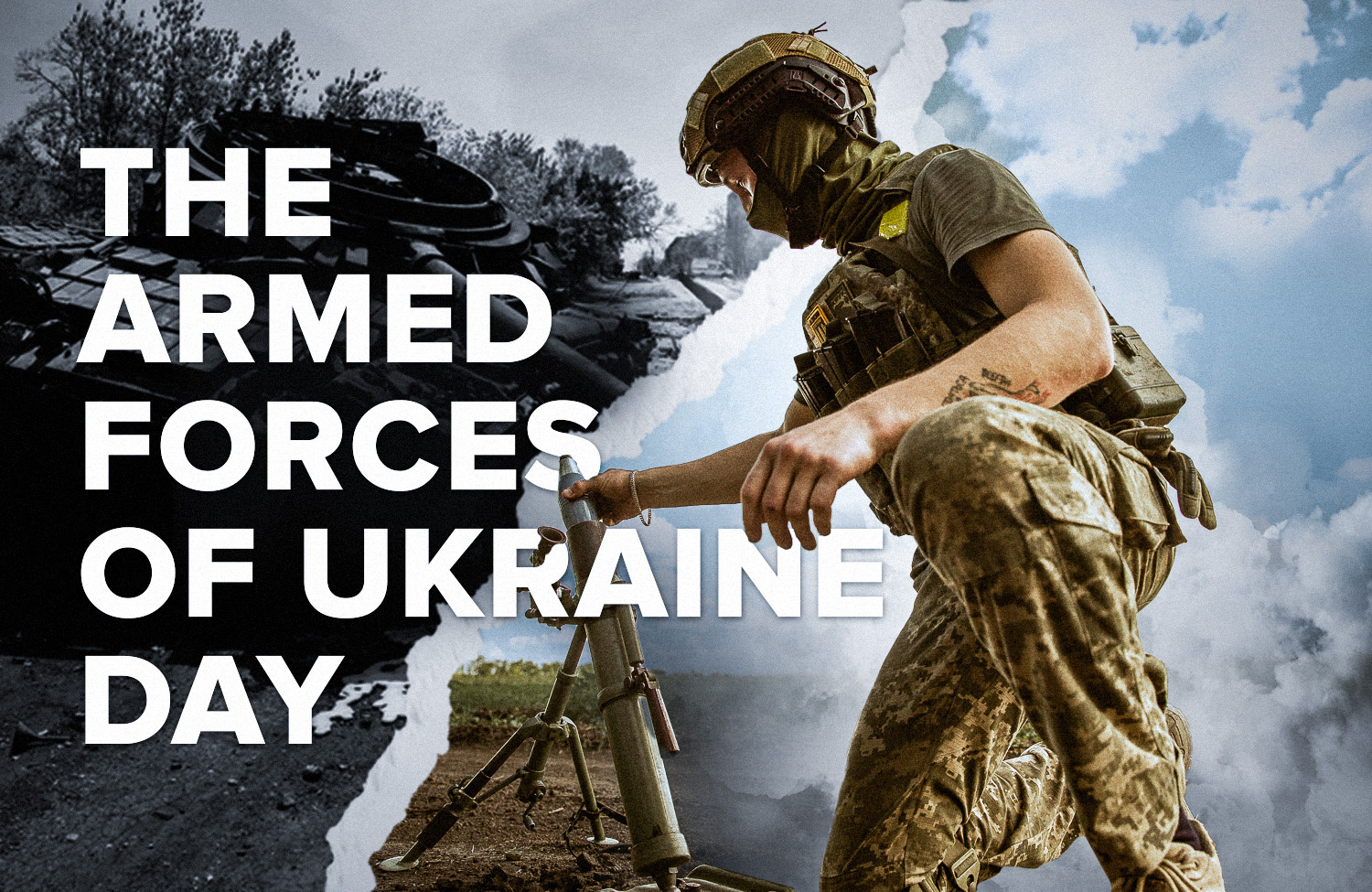
Armed Forces of Ukraine Day: Milestones in the Push to Evict Russian Invaders

den-zsu.jpg

Today, on Dec. 6, Ukraine celebrates the 31st anniversary of the Armed Forces of Ukraine. Kyiv Post highlights the key achievements of the Armed Forces of Ukraine (AFU) in this war.

Hostomel airfield battle

The most dramatic battle at the outset of the war took place in and around Hostomel airfield about 15 kilometers northwest of Kyiv. According to Ukrainian government accounts, the Russian goal was to capture the airfield and use it as a base for landing powerful reinforcements, which would race into the capital, decapitate the government, and take over.

The landing of 20 to 30 aircraft, depending on the source, took place mid-morning on Feb. 24. Ukrainians shot down two transport and one attack helicopter with hand-held guided missiles. A couple of hours later, Ukrainians brought up artillery and, by mid-afternoon, a unit of their own helicopter-carried infantry had recaptured the airfield by early evening, according to official reports.

However, a Russian infantry force appeared to be still present and capable of fighting, complicating communications between the capital and forces to the north.

The Battle for Kyiv

From the very beginning of the invasion, Russian troops attacked the northern regions of Ukraine in order to occupy Kyiv. The aggressor planned to seize the Ukrainian capital in two or three days. Even before the offensive started, U.S. officials deemed Kyiv to be doomed: Chairman of the Joint Chiefs of Staff Gen. Mark Milley told lawmakers that Ukraine’s capital could fall within 72 hours if a full-scale Russian invasion of Ukraine took place.

The Russian plans were thwarted by Ukrainian defenders, who launched Russian troops deep into the territory and then began cutting its supply routes, ambushing it, and simply covering it with fire. Russian troops, beaten and exhausted, were forced to leave the Kyiv and Chernihiv regions on March 29.

The Kremlin claimed its actions as “increasing mutual trust and creating conditions for negotiations,” without mentioning the fact that the AFU had encircled the Russian Federation (RF) forces and obliged them to retreat.

Russia’s Moskva flagship sinks

Since the full-scale invasion, the Ukrainian army has surprised experts and partners with unexpected blows more than once. One such “plot twist” took place on April 12: the flagship of the RF’s Black Sea Fleet, the Moskva, was hit by Ukrainian Neptune missiles. The Moskva flagship played a key role as both a command ship and an air defense unit.

The Russian Ministry of Defense was initially evasive about what had caused “a fire” on board the missile cruiser, which then detonated the ammunition on board.

Although Russia has not formally acknowledged that the cruiser was attacked by Ukrainian missiles, its destruction was presented as a “pretext” for all-out war. Public figures were publicly calling for a retaliatory strike against Kyiv, including the use of nuclear weapons.

“Gesture of goodwill” – RF forces flee from Snake Island

Russian forces occupied the strategic Snake Island in the western Black Sea on the first day of the war in Ukraine.

The island has been intensely fought over by both sides, with Ukraine carrying out large attacks on the Russian occupiers there for four months. The outpost became a symbol of Ukrainian resistance after a radio exchange, in which Ukrainian soldiers used an expletive in response to Russian demands from the Moskva missile carrier to surrender, went viral at the start of the war.

On June 30, the Russian Defense Ministry announced a “gesture of goodwill.” The troops of the occupier left Snake Island. The victory allowed Ukraine to partially open its ports, as well as to organize a grain corridor for export.

The ongoing Donbas defense

In Putin’s video message, which marked the beginning of a “special military operation,” the Russian President claimed that the liberation and protection of the population of Russian-occupied territories of Ukraine was the main reason for the invasion.

During nine months of the war, Russian occupiers have failed to complete this aim. The Russian army captured the Luhansk region but at the cost of huge losses in equipment and manpower.

The battle for the Donetsk region continues, the Russian troops have not captured a single major city, apart from Mariupol, which has been turned into ruins.

Now the occupiers are focusing their efforts on Bakhmut, where they have made no significant progress, notwithstanding the statements of their propagandists.

The counteroffensive to liberate the Kharkiv region

When Kyiv’s lightning offensive rolled eastward across the Kharkiv region in mid-Sept. against reportedly weak resistance, AFU troops liberated dozens of villages and reached the border with Russia.

In only seven days, AFU columns recaptured more than 3,000 square kilometers of formerly Russia-held territory and liberated more than 30,000 Ukrainian citizens living in more than 3,000 towns and villages. Most, located in far northeast Ukraine, had been under RF control for almost six months.

Ukrainian official and social media sources told of chaos and confusion on roads leading eastward from the towns of Kupiansk and Oskil, and the city of Izyum, with Russian units fleeing.

At first, the Kremlin tried to pass off Russia’s failure in Kharkiv as a “gesture of goodwill” and an “organized withdrawal of Russian troops from the Kharkiv region to the Donetsk region.” But this time, the authorities faced massive criticism from all strata of the Russian population.

Kherson recaptured

Top Moscow generals, on Nov. 9, announced the withdrawal of all RF troops from the key port city of Kherson and the entire right bank of the Dnipro River, marking one of the worst setbacks yet in Putin’s attempt to annex Ukrainian territory.

Two days later, on Nov.11, the RF army’s high command claimed its troops in the Kherson sector had largely succeeded in escaping from an exposed bridgehead on the north side of the Dnipro River, as dozens of outlying villages and hundreds of square kilometers of occupied territory were liberated by advancing Ukrainian troops.

The RF military’s ability to supply ground units in the Kherson perimeter had become increasingly shaky following continual AFU bombardments – using mostly U.S.-manufactured, precision-guided munitions – of three key bridges and one hydroelectric dam linking the bridgehead on the north bank of the river with RF army depots and reserves on the south bank.

Kherson had been the only regional capital captured by Russia in the Kremlin’s eight-month war with Ukraine. The Kremlin, with great fanfare on Sept. 30, announced Russia had annexed the Kherson region and that the some 500,000 residents still living there had become Russian citizens, and that Russian state presence would be “eternal.”

The post Armed Forces of Ukraine Day: Milestones in the Push to Evict Russian Invaders appeared first on Kyiv Post.

Categories
Audio Sources - Full Text Articles

Analysis: Investors look to emerging markets as planets align for end of dollar bull market

2022-12-06T07:08:57Z

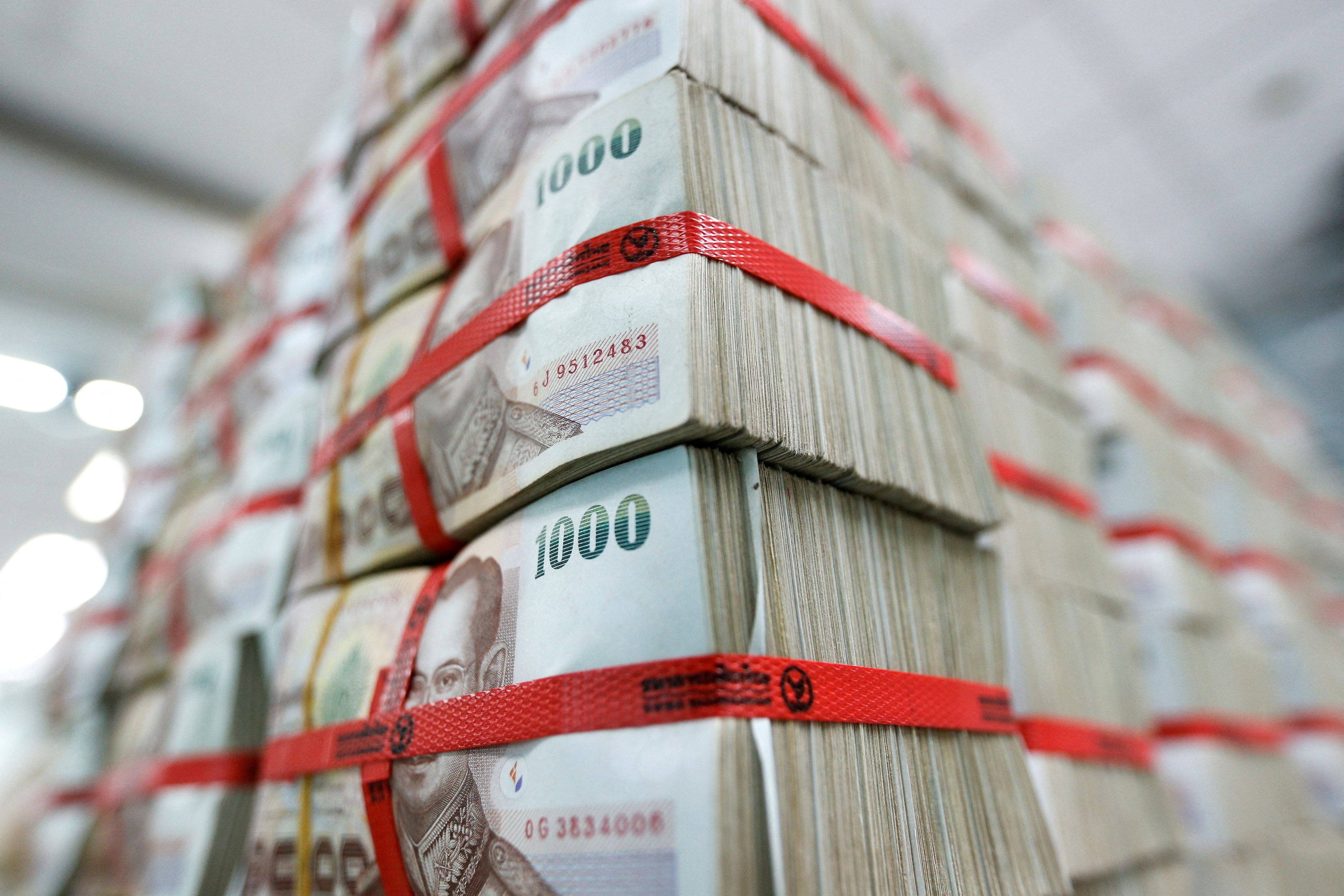
Thai baht notes are seen at a Kasikornbank in Bangkok, Thailand, May 12, 2016. REUTERS/Athit Perawongmetha/File Photo

As the U.S. dollar tumbles from multi-decade highs, some investors are betting emerging market currencies will be big winners from a sustained reversal in the greenback.

The MSCI International Emerging Market Currency Index (.MIEM00000CUS) is up nearly 5% from its lows and notched its best monthly gain in about seven years in November, as expectations that the Federal Reserve will soon slow the pace of its interest rate hikes bolstered the case for investors betting on emerging market currencies.

Signs of a broader turn in dollar sentiment are visible in the buck’s 8% decline against a basket of developed market currencies from its September highs. In futures markets in November, speculative traders swung to a net short position on the U.S. dollar for the first time in 16 months, calculations by Reuters based on U.S. Commodity Futures Trading Commission data showed.

“The planets are lining up for a dollar bear market,” said Paresh Upadhyaya, director of fixed income and currency strategy at Amundi US.

Emerging market currencies have outperformed their developed market counterparts this year, with MSCI’s index of emerging market currencies down 5% year-to-date, while the dollar’s G10 peers have lost nearly twice as much.

In addition to the possibility of slower Fed hikes, investors cited expectations that China will loosen its strict COVID-19 containment policy and comparatively rich yields found in many EM countries as reasons for adding to positions in emerging market currencies.

Amundi’s Upadhyaya is focusing on the currencies of high-yielding emerging market countries that have balanced current accounts and smaller budget deficits, including the Brazilian real , Peruvian sol = and Indian rupee .

Some emerging markets offer attractive yield even adjusted for inflation. For instance, the inflation-adjusted yield on the U.S. 10-year Treasuries is at 1.08%, compared with 6.07% for the Brazilian equivalent.

Investors have cheered the prospect of a shift in China’s COVID-19 policy, after rare street protests increased pressure on officials to ease some rules. China – the world’s second-largest economy and a key consumer of the commodities produced by many emerging market countries – is set to announce a further easing of its COVID curbs as early as Wednesday, sources said.

The Chinese yuan is up about 5% against the dollar since late October and posted its best weekly performance against the U.S. currency in at least two decades on Friday, while the Hang Seng Index rose 27% in November, its best month since October 1998.

“I think the cat is out of the bag. They can’t go back to their pure restrictive zero COVID policy,” said Jack McIntyre, a portfolio manager at Brandywine Global.

McIntyre has been increasing exposure to some Asian currencies, including the Thai baht and the Malaysian ringgit . Thailand’s currency rose 8% in November, while the ringgit has appreciated 6%.

Some investors think it may be too early to bet on a sustained dollar reversal. While Fed Chair Jerome Powell said last week it was time to slow the pace of coming interest rate hikes, the central bank could raise rates further than previously anticipated as it fights the worst inflation in decades.

At the same time, signs of stubborn inflation in next week’s U.S. consumer price data could reignite bets on Fed hawkishness and boost the dollar.

Investors broadly expect the Fed to raise rates by 50 basis points next week, after a spate of 75 basis-point rate increases.

Conversely, tightening by central banks around the world also risks sparking a global recession, a scenario some believe could hurt emerging market currencies and help the dollar.

A global slowdown “would create a safe haven bid and limit the ability of most cycle-sensitive currencies to rally against the dollar,” said Aaron Hurd, senior portfolio manager, currency, at State Street Global Advisors.

Others, however, are betting China’s reopening bodes well for certain emerging-market currencies.

Carlos Fernandez-Aller, head of Global FX and EM Macro trading at Bank of America, sees an eventual China reopening boosting the Thai baht, which he believes will benefit from an increase in tourism.

Analysts at Société Générale, meanwhile, said an easing of China’s COVID restrictions could buoy the South African rand , forecasting an 18% gain in total return terms for the commodity exporter’s currency next year.

“Improvements in fundamentals, valuations, and technical factors make the argument for stronger EM FX performance over the next year,” they wrote in a recent report.


Categories
Audio Sources - Full Text Articles

Analysis: Investors face dilemma as capital increases fill IPO void

2022-12-06T07:14:00Z

The logo of Swiss bank Credit Suisse is seen in front of a branch office in Bern, Switzerland November 29, 2022. REUTERS/Arnd Wiegmann/File Photo

Investors in European companies are being asked to plough money into a series of capital hikes as cash-hungry companies, including Swiss lender Credit Suisse (CSGN.S), look to equity markets to repair their balance sheets and fund costly turnarounds.

Still, despite the opportunity to buy shares at a discount, shareholders sometimes face a difficult choice between doubling down on their bets on a company or accepting dilution and seeking value elsewhere.

“It is often easier for investors to put money into a rights issue than in a company they are less familiar with,” said Alex Watkins, co-head of Equity Capital Markets (ECM) in Europe, the Middle East and Africa (EMEA) at JPMorgan.

“This is a test as to whether shareholders want to support a company they know well already,” he said.

In contrast with a drought of initial public offerings (IPO), EMEA companies have raised an overall 33.3 billion euros ($34.99 billion) through capital increases so far this year.

While this is the lowest level in the last five years and more than 50% lower than the 70 billion euros raised a year ago, it is not far from pre-pandemic volumes in 2019.

Credit Suisse and Societe Generale’s car leasing unit ALD Automotive (ALDA.PA) are the latest to brave rocky markets, as they try to raise 4 billion Swiss francs and 1.2 billion euros, respectively.

The rush to secure cash from investors comes as European companies are grappling with persistent inflation and the fallout of the energy crisis, while banks such as scandal-hit Credit Suisse and Italian lender Monte dei Paschi (BMPS.MI) are cutting costs as part of their turnaround efforts.

Meanwhile, fund managers’ cash holdings stand at a near 21-year peak, according to poll data from Bank of America.

After hovering close to the deal subscription price, shares in Credit Suisse have bounced back after the bank reassured markets that client outflows were being reversed, offering the bank underwriters a sigh of relief.

“It’s understandable if some investors are reluctant to invest in the capital increase,” said Andreas Thomae, corporate governance specialist at Deka Investment, which holds a small stake in the Swiss bank.

“On the other hand, it’s a very favorable transaction for shareholders, which also prices in the risk of the restructuring failing – otherwise, the price would be much higher,” he added.

Earlier in the autumn, minority shareholders took up only a tenth of Monte Dei Paschi’s 2.5 billion euro rights offer, leaving a group of sub-underwriting investors to hoover up the bulk of the paper not covered by the Italian state.

In July, the banking syndicate for Italian energy services group Saipem’s (SPMI.MI) 2-billion-euro cap hike was left with roughly a third of the offer after investors shunned the cash call.

“We don’t have a general position on rights issues. It’s case by case,” said Marc Festa, a portfolio manager with Alken Asset Management, which has been invested in ALD Automotive since Societe Generale listed the car leasing firm in 2017.

The London investment boutique said it planned to subscribe to ALD Automotive’s cash call, intended to fund a 4.9 billion euro tie-up with TDR Capital-backed LeasePlan.

“We think the acquisition of LeasePlan is a good strategic move to consolidate the car rental market in Europe,” Festa said.

William Higgons, president of Indépendance et Expansion AM, also said his fund would be partaking in the rights offer, despite the possibility of LeasePlan shareholders dumping shares after the lock-up period weighing on the stock.

“The return on equity of ALD is rather high, so it’s a good business to be in,” Higgons said, adding that car ownership is not as popular anymore. “I’m a long-term investor, so I think one day I’ll be right.”

Both Festa and Higgons were skeptical that next year would see a deluge of capital-raising activity, arguing that companies are generally well funded despite the economic uncertainty.

“Right issue volumes have been relatively low this year, and most of the companies that issued new shares were already in need of cash before recent volatility,” Watkins said.

“However, the market could see more firms turn to shareholders for funding given the rising cost of debt and changing outlook,” he added.

($1 = 0.9517 euros)

Categories
Audio Sources - Full Text Articles

Beijing drops COVID testing burden with wider easing eyed

2022-12-06T06:41:59Z

People in China’s capital Beijing on Tuesday were allowed to enter supermarkets, offices and airports without having to show negative COVID tests, the latest in a mix of easing steps nationwide after last month’s historic protests.

“Beijing readies itself for life again” read a headline in the government-owned China Daily newspaper, adding that people were “gradually embracing” the slow return to normality.

Authorities have been loosening some of the world’s toughest COVID curbs to varying degrees and softening their tone on the threat of the virus, in what many hope could herald a more pronounced shift towards normalcy three years into the pandemic.

“This might be the first step towards reopening from this pandemic,” Hu Dongxu, 27, told Reuters as he swiped his travel card to enter a train station in Beijing, which has also dropped the need for tests to ride the subway.

Both of the city’s airports also no longer require people to test to enter the terminal, state media reported on Tuesday, although there was no indication of changes to rules requiring passengers to show negative tests prior to boarding.

But further loosening beckons after a string of protests last month that marked the biggest show of public discontent in mainland China since President Xi Jinping took power in 2012.

China may announce 10 new national easing measures as early as Wednesday, two sources with knowledge of the matter told Reuters.

The prospect of of further relaxation of the rules has sparked optimism among investors that world’s second biggest economy would regather strength, and help boost global growth.

Yet, despite reassurances from authorities, commuter traffic in major cities such as Beijing and Chongqing remained at a fraction of previous levels.

Some people remain wary of catching the virus, especially the elderly, while there is also concern about the strain the loosening could put on China’s fragile health system.

“My parents are still very cautious,” said James Liu, 22, a student in Shenzhen in the southern province of Guangdong, where authorities “abruptly” dropped testing requirements for entry into the family’s residential compound.

China has reported 5,235 COVID-related deaths so far as of Monday, but some experts have warned that toll could rise above 1 million if the exit is too hasty.

Analysts at Nomura estimate that areas now under lockdown represent around 19.3% of China’s total GDP, equivalent to the size of India’s economy, down from 25.1% last Monday.

This marks the first decline in Nomura’s closely-watched China COVID lockdown index since the start of October, nearly two months ago.

Meanwhile, officials continue to downplay the dangers posed by the virus, bringing China closer to what other countries have been saying for more than a year as they dropped restrictions and opted to live with the virus.

Tong Zhaohui, director of the Beijing Institute of Respiratory Diseases, said on Monday that the latest Omicron variant of the disease had caused fewer cases of severe illness than the 2009 global influenza outbreak, according to Chinese state television.

China’s management of the disease may be downgraded as soon as January, to the less strict Category B from the current top-level Category A of infectious disease, Reuters reported exclusively on Monday.

“The most difficult period has passed,” the official Xinhua news agency said in a commentary published late on Monday, citing the weakening pathogenicity of the virus and efforts to vaccinate 90% of the population.

Analysts now predict China may re-open the economy and drop border controls sooner than expected next year, with some seeing it fully open in spring.

But more than half of Chinese say they will put off travel abroad even if borders re-opened tomorrow, according to survey of 4,000 consumers in China by consultancy Oliver Wyman.

But for all those wary of returning to normality, there are others clamouring for more freedoms.

“Let’s implement these policies quickly,” a Beijing-based lawyer surnamed Li wrote on WeChat, reacting to Tuesday’s announcement of the drop in testing requirements in the capital.

“Our lives and work have been affected for so long.”

Related Galleries:

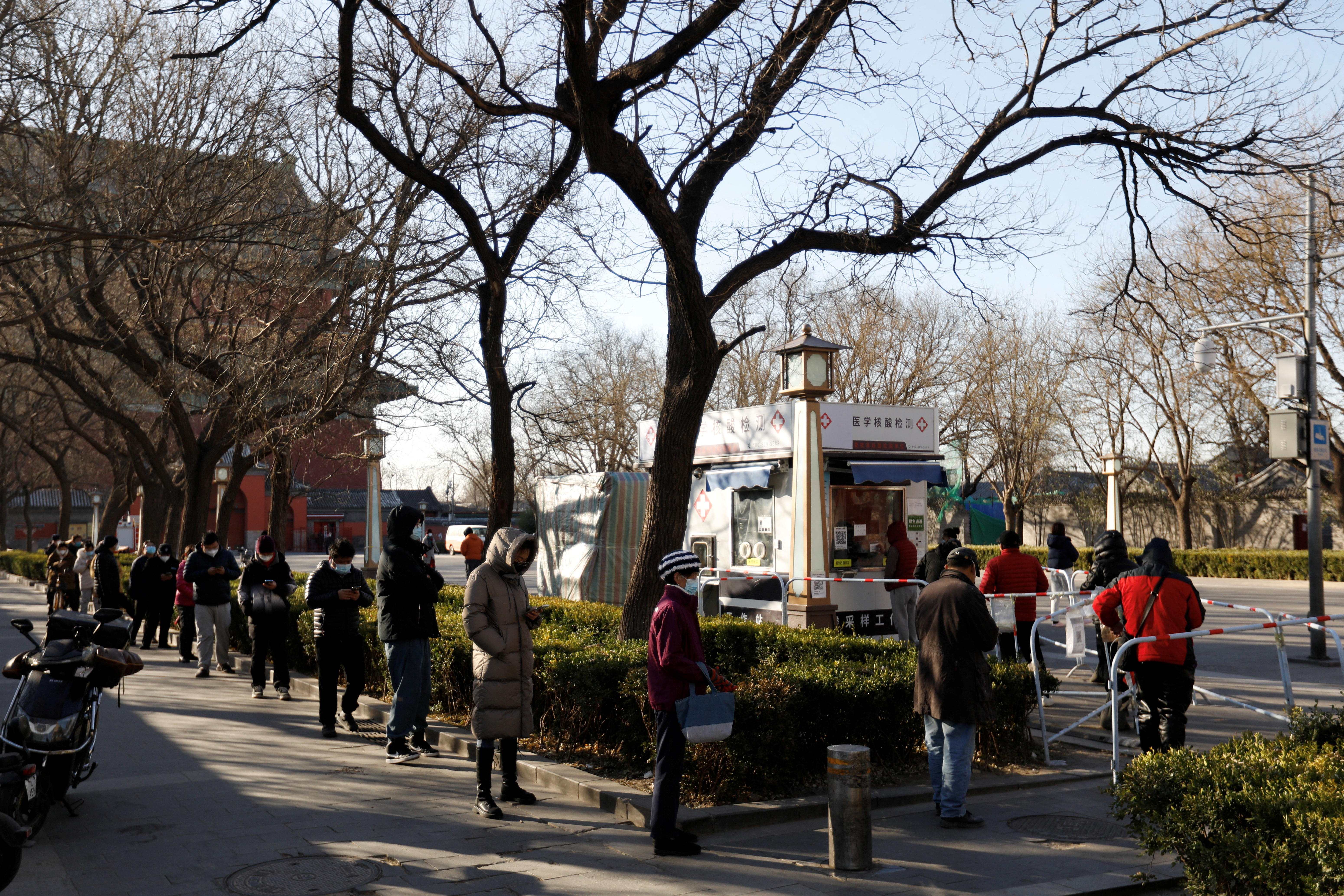
People line up at a nucleic acid testing site to get tested for the coronavirus disease (COVID-19) in Beijing, China December 6, 2022. REUTERS/Florence Lo

People shop for vegetables at a street stall amid the coronavirus disease (COVID-19) outbreak in Beijing, China December 6, 2022. REUTERS/Florence Lo

Students protest at the Nanjing Tech University demanding to be allowed to go home after a student tested positive for coronavirus disease (COVID-19) in Nanjing, Jiangsu Province, China, in this screen grab obtained by REUTERS on December 6, 2022.

A pandemic prevention worker in a protective suit piles up bags of medical waste outside a building where residents isolate at home as coronavirus disease (COVID-19) outbreaks continue in Beijing, December 5, 2022. REUTERS/Thomas Peter

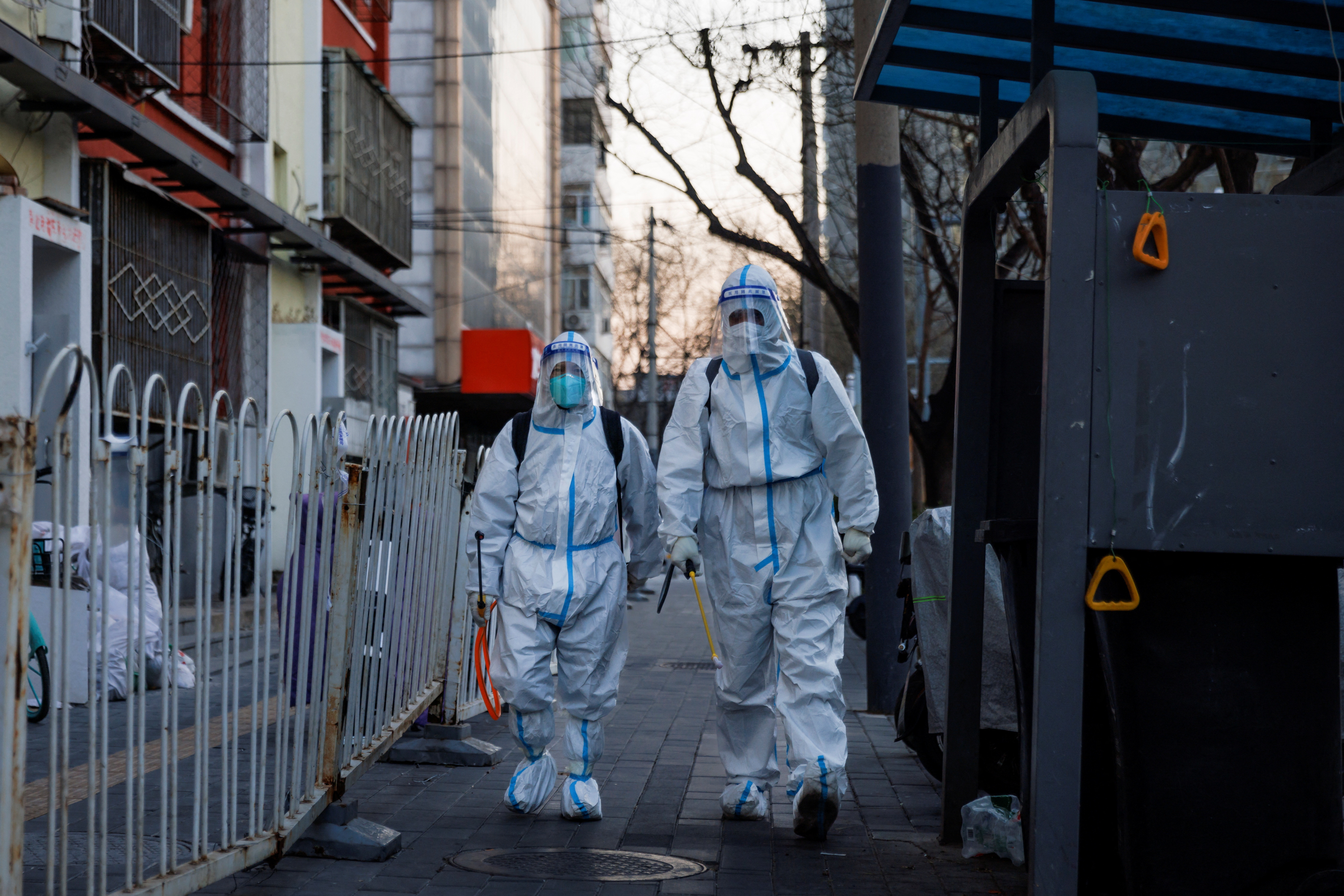
Pandemic prevention workers in protective suits walk in a street as coronavirus disease (COVID-19) outbreaks continue in Beijing, December 4, 2022. REUTERS/Thomas Peter

A woman gets tested at a nucleic acid testing site, as coronavirus disease (COVID-19) outbreaks continue in Shanghai, China, December 5, 2022. REUTERS/Aly Song

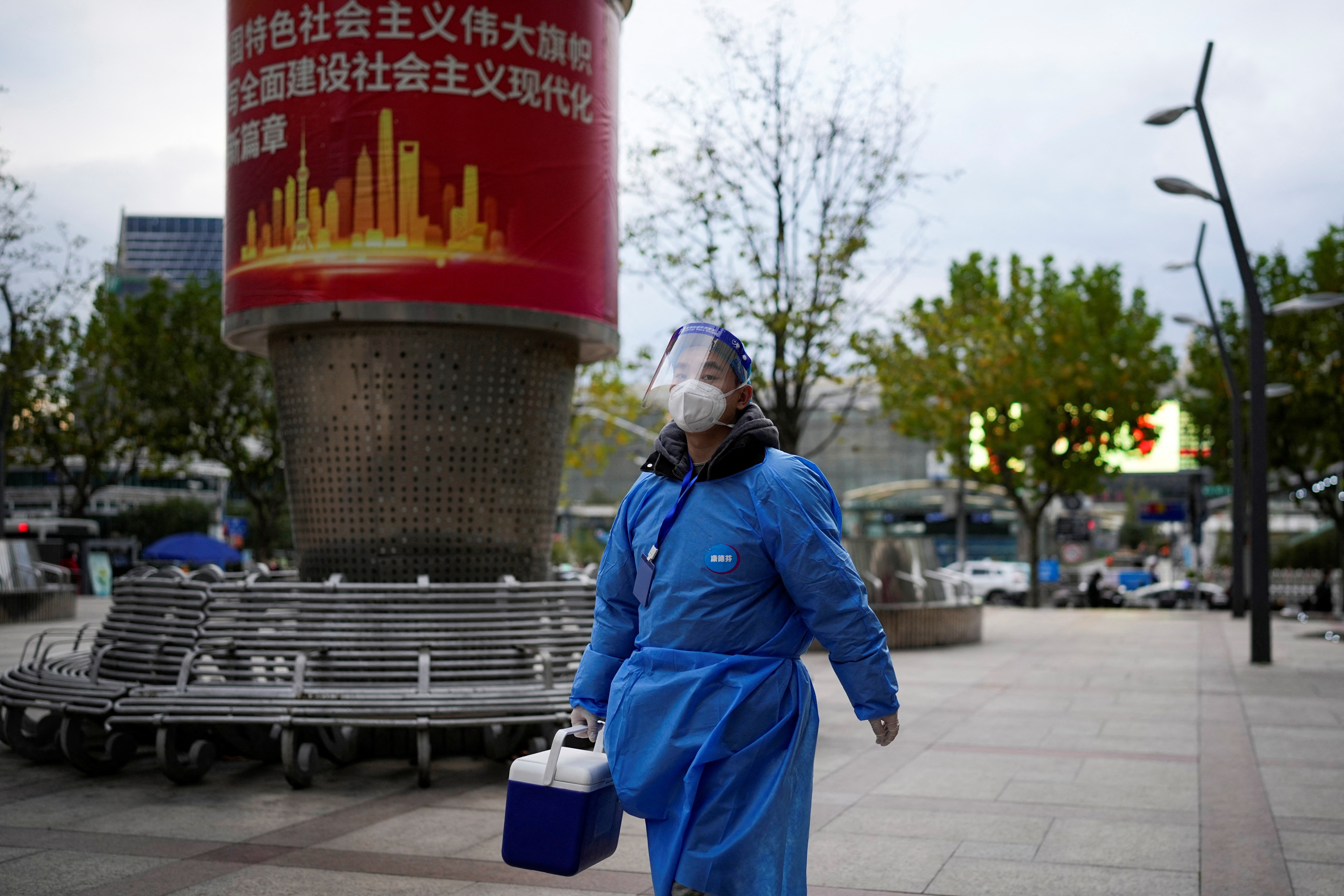
A worker in protective suit walks, as coronavirus disease (COVID-19) outbreaks continue in Shanghai, China, December 5, 2022. REUTERS/Aly Song
WP Radio
WP Radio
OFFLINE LIVE