Categories
Audio Sources - Full Text Articles

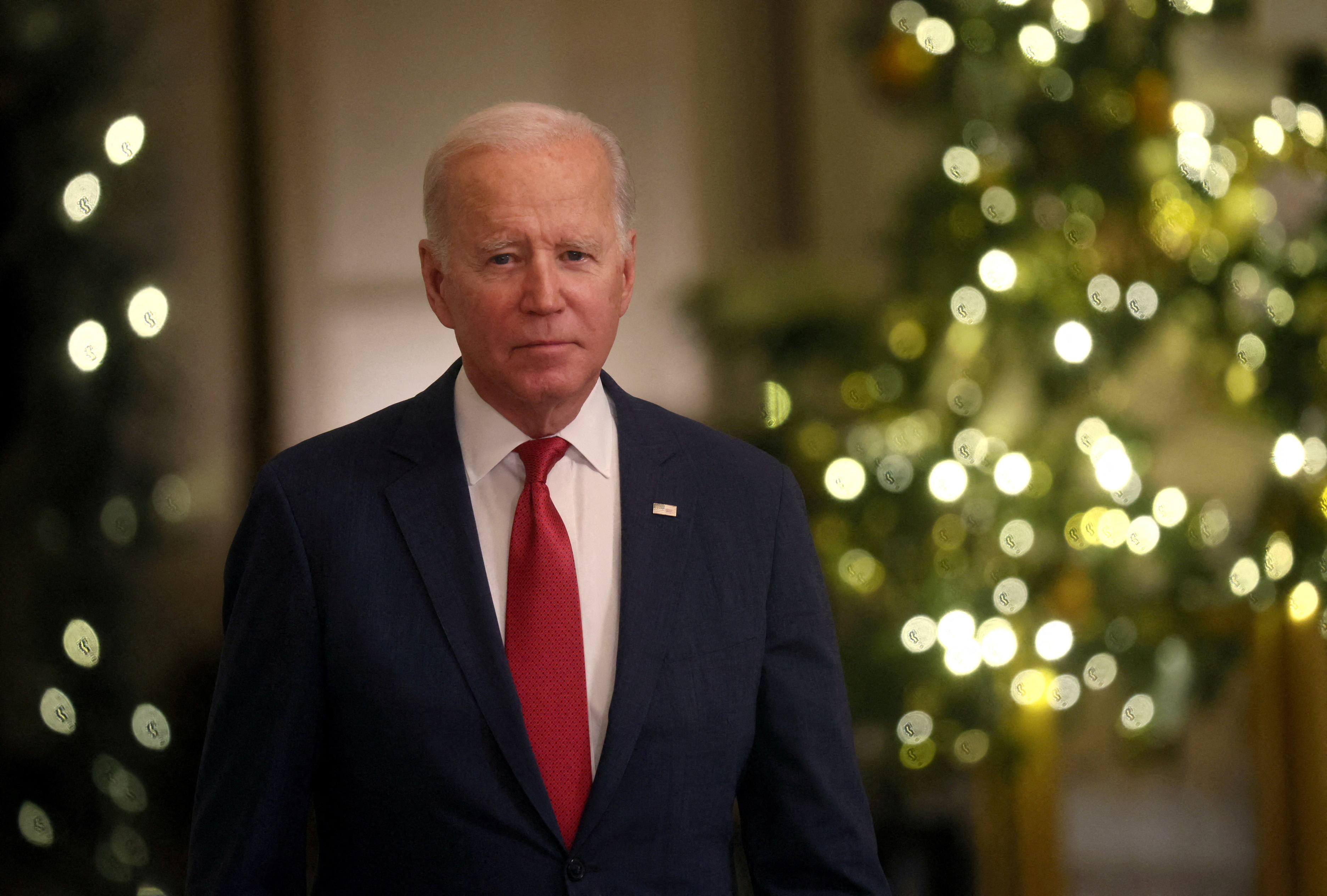
Forget politics, Biden urges Americans to embrace the Christmas spirit

2022-12-22T22:25:40Z

U.S. President Joe Biden delivers a Christmas speech at the White House in Washington, U.S., December 22, 2022. REUTERS/Leah Millis

U.S. President Joe Biden urged Americans on Thursday to cast aside the partisan politics that have divided the nation and embrace the caring spirit of the holiday season.

In a short holiday speech, Biden said Americans are emerging from a brutal couple of years where the COVID-19 pandemic robbed people of loved ones and new memories. He said Americans should embrace this time of year as reminder to care for one another and look past partisan divides and labels like Republican or Democrat.

“I sincerely hope that this holiday season will drain the poison that has affected our politics that has set us against one another. I hope this Christmas season marks a fresh start for our nation,” Biden said.

He noted that this time of year is especially difficult for those who have lost loved ones, noting the 50 years ago this week his wife and daughter were killed in a car crash.

“From the Biden family, we wish you and your family peace, joy, health and happiness. Merry Christmas. Happy holidays. All the best of the year. God bless you all and may God protect our troops. Thank you,” Biden said.

Categories
Audio Sources - Full Text Articles

Darren Star Talks Girlbosses and Attachment Style in Emily in Paris

When it comes to television, Darren Star has delighted decades of viewers with romantic takes on what the modern woman’s life could look like if the fantastical were reality. From Carrie Bradshaw’s enviable career (and shoe closet) as a Manhattan sex columnist on Sex and the City to Liza Miller’s miraculous second act in Younger, Star’s shows, with their unabashed embrace of wild desires and dreams, have become pop culture canon for their escapism and fun. Perhaps the most outsize example of Star’s brand of fantasy has been Netflix’s Emily in Paris, the effervescent series he created about Emily (Lily Collins), an indefatigable optimistic and career-obsessed American in Paris, whose work and play in the City of Love, are truly the stuff of dreams. Ahead of the third season, which released this week, TIME caught up with Star to talk about girlbosses, the power of positivity, and attachment theory.

[time-brightcove not-tgx=”true”]

Out of all the seasons of Emily in Paris so far, this one has really given the most pathos to Emily, who’s being forced to make big decisions when it comes to work and love. What prompted you to give Emily these kinds of looming life decisions?

I think it’s just the evolution of her character in the story—you know, she hasn’t been in Paris that long, so it’s took a number of months for her to develop the relationships that have now deepened on the show between her and the rest of the characters. This season, I also feel we spent more time getting to know the rest of the ensemble.

It’s definitely the most that I’ve seen her signature optimism be challenged on the show. Do you think that she needed to have a little opposition to her constant ebullience?

She needed challenges, both personally and professionally. She came here without having connections, but over the course of the three seasons, she’s gotten herself much more emotionally involved with the people she met here. Plus, she made a decision to make a life in Paris. She doesn’t feel like she’s passing through anymore, so her connections are deeper and her and her intention to be in Paris is so much stronger than it was for the first two seasons.

Obviously, Emily’s living in the city of love and has continual romantic dilemmas, but one of the greatest loves of her life is her job. This season, this is really apparent after she loses her job. And throughout the series, a running storyline is how her American work ethic of living to work instead of working to live is perpetually putting her close relationships in peril. I think Emily is in some ways, the most earnest, unabashed girlboss I’ve seen on TV—would you agree?

She is very earnest. Her heart’s always in the right place, she’s very concerned with making the right decisions and good decisions. I think she’s hard on herself and she’s very driven and career-oriented. She came to Paris for a job that gave her a sense of purpose; for the episodes where she was out of work, it was like her whole life is up in the air because she made a decision to stay in Paris for a job and that’s also why she [originally] came to the city. Every decision she’s made about her life was very career-oriented. I definitely think it was a good wake-up call for her to be unemployed for that brief moment, but even then, I think she had trouble with it.

Read more: Pop Culture Is Finally Getting Over the Girlboss Heroine. What Comes Next?

In recent years, there’s been a backlash against the girlboss in the zeitgeist; especially in media, there’s been a wave of content that skewers workplace ambition and girlboss feminism, but I found it surprising and honestly, kind of endearing, that Emily still really, truly believes in the power of the girlboss.

I feel like Emily is somebody who derives a lot of meaning from work. I don’t think she needs to run the world, but she likes to work. She’s smart. And she really sometimes can’t help herself when she thinks she might have the best ideas in the room. But I think that’s what turns her on—working. She derives a lot of happiness from it. I don’t think she’s doing it to climb the ladder unnecessarily. I think she’s doing it because it gives her life a lot of meaning and she can she enjoys it.

Emily isn’t the only ambitious working woman that you’ve brought to life onscreen. Looking at your work with both Sex in the City and Younger, many of your main characters have put a lot of value in their careers.

They’re all characters who derive a lot of pleasure from working; in the case of Younger, it felt like Liza had to go back to work in order to regain a sense of self.

Do you think it’s important to see this onscreen?

I can relate to characters who enjoy their work, find meaning through their work, but more than that, just have some passion for what they’re doing. And I think it’s a gift to be able to find meaning in your work and actually be excited about it; audiences like to live vicariously through characters who have found that and find meaning in not necessarily their their job, but in their life that they’re pursuing.

Do you think that the events of season three have given Emily a better grasp on the work-life balance of her French colleagues?

Emily is continually, by the fact that she’s living in France, being put in situations where she is forced to find a little work-life balance. I don’t think it comes naturally to her and she finds ways to almost evade it whenever she can. But I definitely feel she’s softened in that respect since she arrived in Paris to the end of season three—she’s a different person now.

Read more: Emily in Paris‘ Lucien Laviscount Is Ready to Be Your New Crush

This season, Emily faces the consequences of her avoiding confrontation both at work and in her personal life. I know Emily, with her social media savvy, would probably know this, but attachment theory went viral on TikTok this year. Do you think she has an avoidant attachment style?

Yes. Well, I think it probably ties into her being a bit of a people pleaser. She’s a character who wants to make everybody happy and feels like there’s a way that she can do that. In that respect, she is also very controlling. I think sort of that controlling aspect of her personality backfires on her quite often.

In spite of it all, Emily is still the most optimistic character on TV right now. How do you think she keeps her sense of positivity in this day and age?

It’s ingrained in terms of who she is. She definitely struggles, but she has a strong sense of perseverance—she always sees the glass as half full.

Categories
Audio Sources - Full Text Articles

“Play Misty For Me”

19121c5c768fb6ee35d5576afe2d9a7f?s=100&d

Help support Palmer Report! Our articles are all 100% free to read, with no forced subscriptions and nothing hidden behind paywalls. If you value our content, you’re welcome to pay for it:

Pay $5 to Palmer Report:

Pay $25 to Palmer Report:

Pay $75 to Palmer Report:


The title of this article comes from this film “Play Misty for me” which makes “Fatal Attraction” like the Brady Bunch. I must give attribution to the great folks online including Twitter and even some Palmer Report readers, who gifted Lake with this name, saying Kari Lake strongly reminds them of the star of this film.

These people are also noting this about Lake — how she is genuinely transforming before our eyes into a sort of crazed Misty-like insane woman. Lake, whose trial is going on even as I write this, made an admission the other day, which isn’t all THAT surprising when one thinks about it. Her lawyers are leaving her.

That’s right. Lake is having issues maintaining legal representation. This is likely because most of the legal community is indeed sane and does not want to be caught up in Misty’s latest stinker of a lawsuit. “We had attorneys who did walk away.” This is from Lake.

But it was the reason the Misty Lake gave for them leaving that caused me to chuckle. She — as usual — blamed it all on the Democrats. “The left is threatening them with their ability to make a living,” Lake said. “And some of our attorneys said, look, I got mouths to feed; I can’t do this case. I don’t want to be sanctioned.”

—

Click here to support Palmer Report! Our articles are all 100% free to read, with no forced subscriptions and nothing hidden behind paywalls. If you value our content, you’re welcome to pay for it:

Pay $5 to Palmer Report:

Pay $25 to Palmer Report:

—

Sign up for the Palmer Report mailing list

—

Follow Palmer Report on Facebook • Twitter • Post • Mastodon

—


Well, good for them! That means sanity is prevalent in our legal community. But not according to Lake. In her world, it is the fault of the democrats. I suppose she thinks the lawyers are puppets on our strings, and we made them say this.


But it gets better. Because Misty is playing the “I’ll take anybody” song. “I got to a point where I said I’ll take anybody,” Lake said. Literally begging anyone to take the case. That’ll work. “We’ll take Better call Saul to come in here,” she said.

I think Saul and 99 percent of the attorneys in the country have better things to do with that time. “Poor little me” is becoming Lake’s mantra. And I have to admit something. I’m rather enjoying her downward spiral. At least it likely ensures Misty won’t ever be able to play her song as an elected official anytime ever.

Save Palmer Report! Our articles are all 100% free to read, with no forced subscriptions and nothing hidden behind paywalls. If you value our content, you’re welcome to pay for it:

Pay $5 to Palmer Report:

Pay $25 to Palmer Report:

Pay $75 to Palmer Report:

Write for the Palmer Report Community Section.

Help support Palmer Report! Our articles are all 100% free to read, with no forced subscriptions and nothing hidden behind paywalls. If you value our content, you’re welcome to pay for it:

Pay $5 to Palmer Report:

Pay $25 to Palmer Report:

Pay $75 to Palmer Report:

The post “Play Misty For Me” appeared first on Palmer Report.

Categories
Audio Sources - Full Text Articles

Vice Society ransomware gang is using a custom locker

The Vice Society ransomware group has adopted new custom ransomware, with a strong encryption scheme, in recent intrusions.

SentinelOne researchers discovered that the Vice Society ransomware gang has started using a custom ransomware that implements a robust encryption scheme, using NTRUEncrypt and ChaCha20-Poly1305 algorithms.

Vice Society ransomware has been active since June 2021, it is considered by researchers a spin-off of the HelloKitty ransomware, the malware targets both Windows and Linux systems primarily belonging to small or midsize victims.

This group focuses on public school districts and other educational institutions, like other ransomware gangs it implements a double extortion model and publishes data stolen from the victims on a data leak site.

The new variant, dubbed “PolyVice”, was used in a recent attack and appended the file extension “.ViceSociety” to all encrypted files. The malware dropped ransom notes with the file name “AllYFilesAE” in each encrypted directory.

The researchers speculate the ransomware was in the early stages of development, they found debugging messages in the code.

SentinelOne noticed a significant overlap with the process implemented in the RedAlert ransomware, a circumstance that suggests that both variants were developed by the same threat actor.

Further investigation also revealed that codebase for the Vice Society Windows payload has been used to build custom-branded payloads for other ransomware groups, such as “Chily” and “SunnyDay.”

Vice Society ransomware

“We assess it’s likely that a previously unknown developer or group of developers with specialized expertise in ransomware development is selling custom-branded ransomware payloads to multiple groups. The details embedded in these payloads make it highly unlikely that Vice Society, SunnyDay, and Chily ransomware are operated by the same group.” continues the report. “The delivery method for this “Locker as a Service” is unclear, but the code design suggests the ransomware developer provides a builder that enables buyers to independently generate any number of lockers/decryptors by binary patching a template payload.”

Buyers can customize their ransomware without revealing any source code and can generate branded payloads to run their own RaaS programs.

The encryption scheme used by PolyVice combines asymmetric and symmetric encryption to securely encrypt files. It leverages a quantum-resistant NTRUEncrypt algorithm for asymmetric encryption, and an open source implementation of the ChaCha20-Poly1305 algorithm for symmetric encryption.

The PolyVice locker implement a multi-threading approach to parallelize the encryption process.

The malware uses the CreateThread function to spawn multiple workers and relies on a WaitForMultipleObject call to synchronize with the main thread,

The main thread and the worker threads use an I/O Completion Port to exchange data.

PolyVice worker reads the file content to determine the speed optimizations to apply which depend on the file size. The PolyVice ransomware applies intermittent encryption selectively.

  • Files smaller than 5MB are fully encrypted.
  • Files with a size between 5MB and 100MB are partially encrypted:
    • A total of 5MB of content is encrypted by splitting them into 2 chunks of 2.5MB. First chunk from the top and the second chunk from the bottom of the file.
  • Files bigger than 100MB are partially encrypted:
    • A total of 25MB of content is encrypted in intermittent mode split into 10 chunks of 2.5MB distributed every 10% of the file size.

“The adoption of the PolyVice Ransomware variant has further strengthened their ransomware campaigns, enabling them to quickly and effectively encrypt victims’ data using a robust encryption scheme.” concludes the report. “The ransomware ecosystem is constantly evolving, with the trend of hyperspecialization and outsourcing continuously growing.”

Follow me on Twitter: @securityaffairs and Facebook and Mastodon

Pierluigi Paganini

(SecurityAffairs – hacking, Vice Society ransomware)

The post Vice Society ransomware gang is using a custom locker appeared first on Security Affairs.

Categories
Audio Sources - Full Text Articles

No, Sam Bankman-Fried and his parents didn’t just shell out $250 million for bail. Here’s how it works.

Sam Bankman-FriedSam Bankman-Fried appeared in federal court in Manhattan on Thursday before being released as part of a $250 bail agreement.

David Dee Delgado/Getty Images

  • A New York federal court released Sam Bankman-Fried on Thursday on a $250 million bail.
  • He didn’t pay it upfront, but his parents’ Palo Alto home helps secure his promise not to flee.
  • Bankman-Fried said last month that he believed he had about $100,000 in his bank account.

Sam Bankman-Fried was released on a $250 million bail after a hearing on Thursday in New York federal court, where he is facing serious criminal charges over the collapse of his crypto exchange FTX. 

In granting what a federal prosecutor in the case called the “largest-ever” pretrial bond, Judge Gabriel Gorenstein required Bankman-Fried to hand over his passport and agree to be monitored and generally confined to his parents’ Palo Alto home. 

There were exceptions for “medical, substance abuse, or mental health treatment,” and necessary events Bankman-Fried would need to attend, like court dates, according to the bond agreement filed in court. 

Such large bail amounts don’t necessarily have to be paid out — but they need to be secured in some way, to provide assurance that a defendant won’t violate its terms. In this case, Bankman-Fried’s parents’ home in Palo Alto offers such a security, along with types of collateral posted by others who weren’t named in the filing. 

Bankman-Fried previously said in media interviews last month that he had seen just about $100,000 in his account at the time. 

The value of the home in question doesn’t necessarily need to correlate to the value of the bail amount — its function is to provide assurance that a defendant will comply with the conditions of their release. 

“These amounts are often just numbers — sometimes defendants will sign bonds in the amount of hundreds of thousands of dollars when everyone knows they don’t have a penny to their name,” said Andrey Spektor, a white collar partner at Bryan Cave Leighton Paisner LLP, and a former federal prosecutor in Brooklyn. 

A representative for Bankman-Fried declined to comment on the bail hearing. 

Bankman-Fried’s former associates, including ex-girlfriend and former Alameda CEO Caroline Ellison, and FTX co-founder Gary Wang, have also been released on bond after pleading guilty to their roles in the alleged schemes. 

They were both each asked to submit to a $250,000 bond — a much smaller amount than imposed on Bankman-Fried — and generally instructed to stay within the “continental United States,” according to their plea agreements.

Read the original article on Business Insider
Categories
Audio Sources - Full Text Articles

Publix grocery heiress was willing to give up to $3 million to the pro-Trump Jan. 6 rally, transcript reveals

Publix

Rob Wilson/Shutterstock

  • Publix supermarket heiress Julie Fancelli was willing to contribute up to $3 million for the Jan. 6 pro-Trump rally, a transcript shows.
  • Trump spoke to supporters at the rally before they stormed the Capitol.
  • The transcript released by the House select committee shows Fancelli gave money to Charlie Kirk, Alex Jones, and Roger Stone, the Washington Post reported. 

Publix grocery heiress Julie Fancelli offered up $3 million to fund the pro-Trump rally in Washington DC that led to storming of the US Capitol on January 6, 2021, according to transcripts released Wednesday by the House select committee investigating the insurrection. 

Fancelli, also a top donor to former President Donald Trump, contributed $1.25 million to right-wing figure Charlie Kirk’s groups Turning Point USA and Turning Point Action, and $200,000 to conspiracy theorist and right-wing talk show host Alex Jones, to facilitate the rally and transportation, The Washington Post reported.  

“Charlie Kirk is my hero,” Fancelli wrote in a text message revealed in a panel hearing.

Documents indicate that Fancelli also paid for Trump advisor Roger Stone to fly into Washington DC for the rally, the Post reported. 

Trump used the rally to promote baseless claims of election fraud before a group of supporters stormed the Capitol with plans to stop President Joe Biden’s election certification. The event turned deadly, and five people died. 

Some of Fancelli’s political donations were used for other Republican causes, including a PAC for Georgia’s 2021 runoff elections. Another $60,000 went towards speaking fees Donald Trump Jr’s fiancee, Kimberly Guilfoyle, per the transcript.

Fancelli, 73 is the daughter of the founder of the Publix chain of grocery stores. The Jenkins family, which Fancelli is a part of, has a fortune of $8.8 billion according to Forbes estimates.

Publix has 1,200 locations in the southern US, with a concentration in Florida, and is known for its loyal customers. The chain didn’t immediately respond to Insider’s request for comment, but previously said “Mrs. Fancelli is not an employee of Publix Super Markets, and is neither involved in our business operations, nor does she represent the company in any way. We cannot comment on Mrs. Fancelli’s actions.”

“The violence at the Capitol on Jan. 6 was a national tragedy. The deplorable actions that occurred that day do not represent the values, work or opinions of Publix Super Markets,” the statement said. 

When the House panel asked Fancelli if she intended for the rally to become violent, she said “no.”

Read the original article on Business Insider
Categories
Audio Sources - Full Text Articles

Mother nature is screaming for us to adopt a new diet. An agreement by nearly 200 countries could help identify flaws in how we produce food.

crop productionMore than a third of the Earth’s land is devoted to food production.

4loops/Getty Images

  • More than one-third of the world’s land is devoted to producing food. 
  • Food production drives deforestation and biodiversity loss. That adds to the climate crisis.
  • Hundreds of countries agreed, in part, to push businesses to reveal their environmental impacts. 

This article is part of Insider’s weekly newsletter on sustainability, written by Catherine Boudreau, senior sustainability reporter. Sign up here.

Our insatiable appetite for beef, chocolate, and baked goods affects more than just our waistlines. Mother nature is screaming for us to adopt a new diet, too. 

More than a third of the Earth’s land is devoted to food production. It’s a primary driver of deforestation and biodiversity loss that, in turn, releases greenhouse-gas emissions causing the climate crisis. As the global population grows and people in developing countries earn more money, the demand for food — especially meat — will further stress nature.

For a long time food companies could ignore how their operations contributed to the problem and how it threatened their bottom lines, in part because tracing raw goods through an opaque network of brokers and farmers was hard, and governments didn’t require that anyway.

That blind-eye approach is slowly shifting amid pressure from investors and regulators, underscored by a global deal on Monday at the UN biodiversity conference in Montreal. 

One of nearly two dozen targets agreed to by some 190 countries is getting businesses to track and disclose their impact on nature, as well as promote sustainable diets to consumers.  

“That clarion call to corporates was a major win,” said Jeffrey Parrish, the global managing director for Protect Oceans, Lands, and Water at The Nature Conservancy. “Companies need to be shifting toward zero-deforestation in their value chains.”

Earlier this month, the European Union ratified a law that would ban imports of beef, timber, coffee, rubber, soy, cocoa, and palm oil that are linked to deforestation. The US State Department in October also requested advice on potential legislation to combat deforestation in food supply chains and voluntary actions the private sector could take.

The commodities covered by the EU’s law are linked to forest loss in tropical regions such as the Amazon and Congo basins, Indonesia, and Malaysia. Forest loss has declined in those Asia Pacific countries in recent years because of government and industry efforts, but the world still lost 10 football fields of tropical forest every minute in 2021, mainly due to spikes in Brazil and the Democratic Republic of the Congo. In both countries, agriculture played a role. 

But there is still a long way to go before the problem is at the top of the C-suite agenda. 

MSCI recently analyzed its largest global equity index with more than 3,000 companies and flagged upward of 86% of those in the food industry for potentially contributing to deforestation. Fewer than 18% had disclosed a policy to address the problem.

MSCI identified companies that produced or used palm oil, soybeans, beef, or timber operated in high-risk areas for deforestation or had been involved in controversies linked to deforestation. 

“Deforestation risks often lie deep in the supply chain,” Arne Klug, MSCI’s vice president and biodiversity research director, told Insider in an email. “Establishing due diligence and supply chain monitoring programs for tens of thousands of suppliers is a difficult endeavor.” Klug said that task is getting easier thanks to new technology and a framework coming next year for companies that want to measure their impact on nature and exposure to risks. The biodiversity agreement struck in Montreal could serve as a roadmap for financial regulators as well. 

Read the original article on Business Insider
Categories
Audio Sources - Full Text Articles

Santa’s 25-acre North Pole home is now worth over $1 million — and it has hot cocoa on tap, according to Zillow

Christmas-themed bedroomZillow’s listing includes a bedroom fit with a stationary bike and hanging red coat to suggest it’s Santa’s bedroom.

Zillow

  • Santa’s fictional cabin is once again available for viewing on real estate site Zillow.
  • The 25-acre property was valued at $650,000 in 2016 and is worth an estimated $1.1 million in 2022.
  • Santa’s house is one of Zillow’s most viewed homes, according to the company. 

Zillow has launched a 3D-tour of Santa’s fictional 25-acre North Pole compound that includes an “Elf Village” made up of tiny homes and lots of red accents around the main cabin.

According to the off-market listing, Santa’s home is a three-bedroom, two-bathroom cabin built in 1822 and “steeped in Old World charm.” The property features reindeer stables, a sleigh parking garage, and a toy workshop for an estimated $1.1 million.

Although the listing is all in good fun, it’s become one of Zillow’s most-viewed homes on the site since it was first published in 2016, the company wrote in an official release. 

Santa Claus' kitchenSt. Nick’s kitchen is complete with red appliances and cookies ready for baking.

Zillow

In true Santa fashion, the listing boasts an oven with 12 different cookie settings and “cocoa on tap.” According to the release from Zillow, the home was only worth $650,000 when Kris Kringle laid his claim to it six years ago. Its value has increased nearly 77% since then.

“Santa gets a peek into millions of homes each year. Now, millions of Zillow surfers are getting a peek into one of the most famous homes in the world,” said Amanda Pendleton, Zillow’s home trends expert.

She continued: “Touring Santa’s house on Zillow has become a new, high-tech holiday tradition.”

Elf Village in snowSanta’s helpers have their own living quarters in “Elf Village,” according to Zillow.

Zillow

In addition to touring St. Nick’s cabin, users can also tour three tiny homes on the property as part of Elf Village — a part of the property added to the listing in 2017.

There’s also a link to the North American Aerospace Defense Command’s Santa Tracker, which tracks his route around the globe on Christmas Eve. NORAD has operated the Santa tracker since 1958, according to its official site. 

Read the original article on Business Insider
Categories
Audio Sources - Full Text Articles

TikTok owner ByteDance reportedly confirmed employees in US and China accessed the user data of some US citizens, including 2 journalists

Photo taken on Oct. 17, 2021 shows the tiktok booth at the 2021 Hangzhou International E-commerce Expo in Hangzhou, east China's Zhejiang Province. On May 8, 2022, the domestic various media from Hong Kong companies registry sites found that beat bytes (Hong Kong) co., LTD. Has been renamed the tiktok group (Hong Kong) co., LTD., effective time is on May 6, 2022.TikTok’s parent company consistently denies reports that it spies on Americans using its application.

CFOTO/Future Publishing via Getty Images

  • TikTok-owner ByteDance said workers accessed user data from US journalists and other private citizens, NYT reports.
  • ByteDance said the data collection was part of an unsuccessful attempt to track down leaks, per the report.
  • The revelation contradicts an earlier statement from TikTok that said the app had never been used to “target” journalists.

TikTok’s parent company ByteDance informed employees that some of its staff improperly accessed TikTok user data on some US citizens, including two journalists, The New York Times reported Thursday.

The China-based parent company, which is facing scrutiny from US lawmakers over privacy concerns, told employees in an email seen by The New York Times that an investigation found that the data was collected as part of an attempt to track internal leaks to the press.

The memo said that two US-based employees and two based in China were fired for taking part in the endeavor, which was unsuccessful in uncovering any leakers, according to The New York Times. 

Data, such as IP addresses and other sensitive information, were reportedly gathered from the TikTok accounts of 2 reporters: Emily Baker-White from Buzzfeed and Cristina Criddle from Financial Times, according to journalists from both publications. Other US citizens connected to the two reporters were also targeted, according to the Times.

ByteDance reportedly said it had restricted its audit and risk teams, now removing access to US data from that department moving forward. 

“The public trust that we have spent huge efforts building is going to be significantly undermined by the misconduct of a few individuals,” ByteDance CEO Liang Rubo reportedly wrote to employees in an email. 

TikTok’s parent company ByteDance did not immediately respond to comment from Insider. 

The revelation comes as TikTok faces increasing pressure from lawmakers worried it could be used as a tool by the Chinese government to spy on or influence US citizens. 

Last week, a bipartisan group of lawmakers introduced a bill that would ban “all transactions from any social media company in, or under the influence of, China, Russia, and several other foreign countries of concern.”

The Senate also recently voted to ban TikTok from all government devices. In a statement to Insider, TikTok called the bill “a proposal which does nothing to advance U.S. national security interests.”

TikTok has consistently denied reports that it tracks Americans using its application.

In response to a Forbes report from October that ByteDance planned to use the TikTok app to track the location of specific US citizens, TikTok tweeted, in part, “TikTok has never been used to ‘target’ any members of the U.S. government, activists, public figures or journalists, nor do we serve them a different content experience than other users.”

Read the original article on Business Insider
Categories
Audio Sources - Full Text Articles

SpyTalk Stocking Stuffer

Get 50% off for 1 year

Hey there. It’s gonna be cold, wet and snowy this weekend. Why rush out for last-minute gifts? Let your fingers do the walking. Stay home and give the gift that keeps on giving, day after day, week after week, month after month—some of the best writing and reporting from the intersection of U.S. intelligence, military affairs and foreign policy. With a gift of SpyTalk you’re gonna make somebody smile!

Ho, ho, ho. Merry Christmas from all of us here to all of you there! —Jeff Stein, Editor

SpyTalk is a reader-supported publication. To receive new posts and support our work, consider becoming a free or paid subscriber.

WP Radio
WP Radio
OFFLINE LIVE