Categories
Audio Sources - Full Text Articles

Police chief insists early Idaho investigations were proper

(NewsNation) — Moscow, Idaho, Police Chief James Fry told NewsNation in a one-on-one interview he believes the initial hours of the investigation into the deaths of four college students were handled properly, in response to concerns about the investigation’s stability.

The family of one of the victims, Kaylee Goncalves, felt police were too quick to rule out some people as suspects in the case, telling NewsNation they believe she may have had a stalker. Police have since said they cannot verify that Goncalves had a stalker.

NewsNation’s Brian Entin interviewed Fry on Thursday and asked if he felt the first 48 hours of the investigation were handled properly.

You can watch the full interview between Brian Entin and Chief James Fry on Dan Abrams Live Thursday night at 9 p.m. EST (8 p.m. CST).

“I do think they were handled properly,” Fry said. “We secured the scene quickly, we called in the state police, we did our due diligence in getting the things that we needed to do to have this be a solid case all the way through. We called in the state lab to collect evidence and I believe it was the initial stuff that we started and how we did things that will help bring this to a conclusion.”

Fry said police will continue to keep information from the public as they continue the investigation.

Those critical of the investigation have said the tight-lipped nature of the probe has allowed speculation to grow online among true-crime sleuths, arguing it can put innocent people at risk and slow down the investigation.

Investigators have conducted hundreds of interviews and waded into a flood of tips from the community and across the country.

The Moscow Police Department has been working with federal agencies, which Fry said is common in big cases, dismissing rumors that their presence is a signal the case has taken a turn for the worse.

“I think there’s some misconception out there with how we operate here in Moscow,” Fry said. “We’ve called in ATF in the past, we’ve called in the FBI in the past on many of these big cases because they have resources that we don’t, and we want to have the best investigators there.”

Along with federal agents, the Idaho State Police are also part of the investigation into the deaths of Goncalves, 21; Ethan Chapin, 20; Madison Mogen, 21; and Xana Kernodle, 20. They were killed in a house near the University of Idaho on Nov. 13.

A white Hyundai Elantra has become a focal point of the investigation, and the public’s attention. One car that met the description was identified in Oregon, but investigators have since determined it’s not connected to the killings.

Fry asked that people call in if they think they have spotted the car in question.

“We appreciate all the tips that we’ve gotten, not just from local Moscow but across the nation, and we’re following up on all those,” the chief said.

Information can be submitted to detectives in the following ways:

Tip Line: 208-883-7180

Email: tipline@ci.moscow.id.us

Categories
Audio Sources - Full Text Articles

Government funding bill to bolster U.S. antitrust regulators

2022-12-22T23:37:50Z

A $1.7 trillion government funding bill approved by the U.S. Senate Thursday will bolster U.S. regulators and make it easier for states to bring antitrust lawsuits.

The Federal Trade Commission (FTC), which has a number of major technology investigations underway, will get $430 million in funding, $53.5 million over last year’s levels “to bolster antitrust, privacy, and consumer protection work,” according to a summary from the House Appropriations Committee.

The U.S. Securities and Exchange Commission (SEC), which has been ramping up crypto-fraud investigations, is getting a 10% increase to $2.2 billion.

The National Labor Relations Board is receiving a $25 million increase to $299 million after not receiving a funding lift in more than a decade. The increase comes amid a big boost in unionization efforts.

The International Trade Administration, which investigates foreign trade practices, is getting a $55 million increase to $625 million.

The Commerce Department Bureau of Industry and Security (BIS), which overseas export controls and has been active in adding restrictions aimed at China and Russia, is getting a 25% increase in its budget to $191 million.

The spending bill includes a measure that strengthens state attorneys general by allowing them to choose the venue where they bring antitrust lawsuits. Texas and other states brought an antitrust action against Alphabet’s Google (GOOGL.O) in 2020 that the company succeeded in moving from Texas to a New York court.

The measure also lowers fees for the smallest mergers and raises them for bigger ones. Deals worth $5 billion or more would pay $2.25 million for their review.

The funding bill includes a new provision to ensure millions of working mothers have reasonable break time and a private place to pump breast milk.

The Transport Workers Union criticized the bill because it “leaves airline flight crews as the only profession in the country excluded from its labor protection.”

Related Galleries:

Signage is seen at the Federal Trade Commission headquarters in Washington, D.C., U.S., August 29, 2020. REUTERS/Andrew Kelly

People exit the headquarters of the U.S. Securities and Exchange Commission (SEC) in Washington, D.C., U.S., May 12, 2021. REUTERS/Andrew Kelly

The headquarters of the National Labor Relations Board (NLRB) is seen in Washington, D.C., U.S., May 15, 2021. REUTERS/Andrew Kelly


Categories
Audio Sources - Full Text Articles

Tesla offers rare year-end discounts on 2 top-selling models

DETROIT (AP) — Tesla Inc. is offering rare discounts through year’s end on its two top-selling models, an indication that demand is slowing for its electric vehicles.

The Austin, Texas, company started offering a $3,750 incentive on its Model 3 sedan and Model Y SUV on its website earlier this month, but on Wednesday doubled the discount to $7,500 for those who take delivery between now and Dec. 31.

The move comes ahead of a new federal tax credit of up to $7,500 that’s scheduled to take effect Jan. 1. Teslas weren’t eligible for a previous federal tax credit program because the company had reached a limit of 200,000 vehicles sold. Next year’s credits don’t have such a limit.

“This is a sign of demand cracks and not a good sign for Tesla heading into the December year-end,” Wedbush analyst Dan Ives said in an e-mail. “EV competition is increasing across the board, and Tesla is seeing some demand headwinds.”

Lower priced versions of the Models 3 and Y will be eligible for the federal tax credit come January due to limits on vehicle purchase prices outlined in the Inflation Reduction Act.

Without the discounts, the Model 3 starts at just over $48,000 including shipping, while the Y has a starting price of just over $67,000. To be eligible for the federal tax credit, vehicles can’t have a sticker price of over $55,000 for sedans and $80,000 for trucks and SUVs.

In a regulatory quirk, many vehicles like Teslas that are made in North America likely will be eligible for the full $7,500 tax credit from January into March because the Treasury Department is still working on rules requiring battery minerals and parts to come from North America. It’s likely that most of the vehicles will only be eligible for half the credit once the rules come out in March.

Tesla may be offering the discounts to juice sales before the end of the year in an effort to meet a pledge to grow vehicle sales by 50%.

On the company’s third-quarter earnings conference call in October, Tesla CFO Zachary Kirkhorn said Tesla will fall just short of its 50% sales growth target. But he later was contradicted by CEO Elon Musk.

Musk predicted 50% annual production and delivery growth, but also pointed to logistical problems shipping vehicles.

To reach the 50% sales growth target, Tesla must have a stellar performance in the fourth quarter.

Through September the company delivered 908,573 vehicles, compared with just over 936,000 vehicles a year ago. To increase sales by 50% over last year, which would amount to about 1.4 million vehicles, the company would have to sell more than 490,000 vehicles in the fourth quarter.

Industry analysts polled by data provider FactSet expect Tesla to deliver 431,000 vehicles in the fourth quarter, ending the year at 1,341 million.

Tesla shares have lost more than 60% of their value since Musk announced in April that he had taken a large stake in Twitter. Eventually Musk bought the social media site, and investors are worried about demand and that the CEO has been distracted from the car company.

Categories
Audio Sources - Full Text Articles

Ukrainian forces used Russian soldiers’ ‘panicked’ cell phone calls to pinpoint their locations and pick them off, report says

Ukrainian soldiers fire a Pion artillery system at Russian positions near Bakhmut, Donetsk region, Ukraine, Friday, Dec. 16, 2022.Ukrainian soldiers fire a Pion artillery system at Russian positions near Bakhmut, Donetsk region, Ukraine, Friday, Dec. 16, 2022.

LIBKOS/Associated Press

  • The New York Times published a detailed investigation on Russia’s blunders in Ukraine.
  • A Ukrainian official said they realized a large number of calls were made from foreign numbers.
  • They used the calls, and even a TikTok video, to locate the position of Russian troops and attack.

Russian soldiers in Ukraine made worried calls home as their efforts in Ukraine faltered — but their loved ones weren’t the only ones listening.

Ukrainian forces used the cell phone calls made by Russian soldiers to locate them and wipe the troops out in large numbers, according to an investigation published by The New York Times that details Russia’s blunders throughout the war.

“We listened to the Russian soldiers as they panicked and called their friends and relatives,” a Ukrainian official who leads the efforts to intercept the phone calls told The Times. “They used ordinary phones to make decisions about their further moves.”

Ukrainian authorities who monitor cell networks for criminal activity noticed that a large number of calls were being placed from foreign phone numbers in an area along the Ukraine and Belarus border. The officials deduced the unusual uptick in foreign numbers on the Ukrainian network were likely Russian soldiers.

Ukraine deployed teams of women to follow the soldiers’ calls and alert the Ukrainian military, which would carry out attacks using the information. “We understood where the enemy was, what numbers they were using,” the Ukrainian official told The Times.

At one point, Ukrainian forces used both the cell phone calls and a TikTok video to locate a unit of Chechen soldiers outside of Kyiv. Maj. Gen. Kyrylo Budanov, chief of Ukraine’s military intelligence, told The Times the unit’s location was confirmed only 40 minutes after the video was uploaded. Ukrainian forces then struck them with three missiles.

Ukrainian officials have frequently intercepted phone calls made by Russian soldiers since the invasion 10 months ago. Audio of the calls obtained by various outlets have captured Russian soldiers complaining about being unprepared and unorganized and hoping they would get injured so they could be sent home.

In new audio published by The Times, soldiers could be heard complaining about Russian President Vladimir Putin and saying they are being treated like “cannon fodder.”

Read the original article on Business Insider
Categories
Audio Sources - Full Text Articles

Sri Lanka“s cancer patients struggle amid economic chaos

2022-12-22T23:13:16Z

Priyantha Kumarasinghe starts his day in the small Sri Lankan town of Maharagama with a breakfast of two biscuits and a small glass of tea, followed by a round of cancer medicines.

The 32-year-old vegetable farmer was diagnosed with lung cancer in 2021 and started receiving treatment earlier this year just as Sri Lanka’s economy went into free-fall.

Amid crippling fuel scarcity and weeks of unrest, Kumarasinghe said he was unable to travel the 155 km (96 miles) between his home and Sri Lanka’s main cancer hospital on the outskirts of the country’s largest city, Colombo, for treatment.

“If I had been able to get treatment properly during June, July and August there is a good possibility I could have reduced the lung cancer,” he told Reuters.

“Because that was not possible that may be the reason why the cancer has grown.”

Kumarasinghe is among hundreds of cancer patients who have had their treatment upended by Sri Lanka’s worst economic crisis since independence from Britain in 1948.

Hospitals countrywide have struggled to contend with severe drug shortages, which have worsened over the last eight months, a representative of Sri Lanka’s largest doctors union told Reuters.

“All hospitals are experiencing shortages. There is difficulty in even sourcing basics like paracetamol, vitamin C and saline for outpatient services,” said Vasan Ratnasingam, a spokesperson for the Government Medical Officers’ Association.

Specialist facilities like cancer and eye hospitals are running on donations, Ratnasingam said.

Sri Lanka’s health ministry and senior health officials did not respond to calls from Reuters.

Battered by the loss of tourism and remittance earnings because of the pandemic, alongside an ill-timed tax cut, Sri Lanka slid into crisis in early 2022 after its foreign exchange reserves dried up, leaving it short of dollars to pay for fuel, food, cooking gas and medicines.

For months, the country of 22 million people faced hours-long power cuts and severe fuel shortages.

The economic hardship triggered protests, which in July ousted former President Gotabaya Rajapaksa after thousands took to the streets and occupied his official residence.

Currency depreciation and record inflation have pushed middle-class families like Kumarasinghe’s to the brink as they scrambled to meet higher living costs.

But the family has another crisis to contend with.

Doctors are now worried the cancer has spread to Kumarasinghe’s neck and spine, said his wife, Shashini Chamilka Maduhansi, 23.

The couple are awaiting results of an MRI scan that will direct future treatment, and have temporarily moved in with Kumarasinghe’s aunt whose rented home is close to the hospital.

Their five-year-old son has been left in the care of other family members.

Kumarasinghe used to make a living growing leeks, carrots and cabbages, which are now being tended to by his parents.

Besides inflation, his income has been badly hit by a chemical fertiliser ban implemented last year, which has since been reversed, but led to the price of fertilisers jumping to about 30,000 Sri Lankan rupee ($82.64) a bag from about 1,600 rupees previously, Kumarasinghe said.

“Every month I need about 70,000 rupees for expenses but it is hard to meet the costs,” he said.

“Medicine is not available at the hospital so it has to be bought from pharmacies. Every single type of medication is over 1000 rupees. I’m doing my best but it’s very hard.”

For decades Sri Lankans have benefited from a universal public healthcare system that subsidises treatment, including medicine for serious illnesses.

But services have been hampered by the dollar shortage, which has restricted imports of medicines, and limited public funds available to hospitals to provide care.

President Ranil Wickremesinghe has pledged to restore economic stability but has warned reforms will be painful as the country strives to increase taxes to put its public finances in order and work with creditors including India, Japan and China to restructure debt.

In September, the country entered a preliminary agreement with the International Monetary Fund (IMF) for a $2.9 billion bailout but has to put its huge debt burden on a sustainable track before disbursement can begin.

The economic hardship remains crushing for many.

Sathiyaraj Silaksana 27, has come to visit her five-year-old son S. Saksan suffering from leukemia, travelling 350 km with her husband to feed him.

“Due to the current crisis in Sri Lanka, we are facing severe problems in transport and food,” said Silaksana, 27, who is pregnant with her second child.

“I have no option but to pay for my son’s needs. My husband, is a construction worker. In order to pay for all these expenses we pawned our jewelry.”

($1 = 363.0000 Sri Lankan rupees)

Related Galleries:
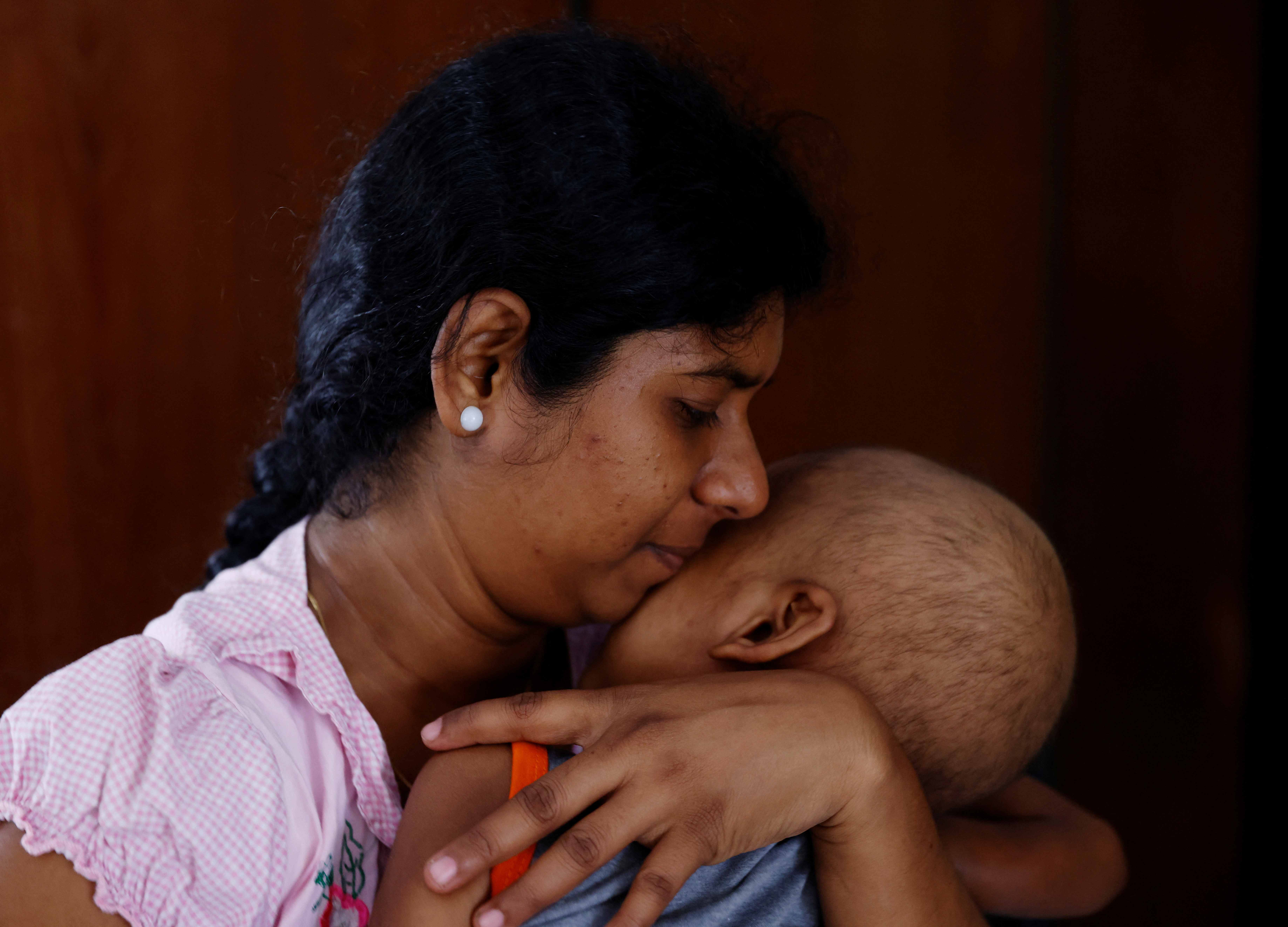
Sathiyaraj Silaksana, 27, holds her son S. Saksan, 5, who has been diagnosed with leukaemia, at a cancer care transit home near Apeksha Hospital, Colombo, Sri Lanka, August 12, 2022. “Due to the current crisis in Sri Lanka, we are facing severe problems in transport and food,” said Silaksana, “I have no option but to pay for my son’s needs. My husband, is a construction worker. In order to pay for all these expenses we pawned our jewellery.” REUTERS/Kim Kyung-Hoon

Priyantha Kumarasinghe, 32, who has been diagnosed with lung cancer which doctors think has spread to his neck and spine, has his head massaged by a relative at his aunt’s home in Homagama, Sri Lanka, November 10, 2022. Kumarasinghe started receiving treatment earlier this year just as Sri Lanka’s economy went into free fall. Amid a crippling fuel scarcity and weeks of unrest, Kumarasinghe said he was unable to travel between his home and Sri Lanka’s main cancer hospital for treatment. “If I had been able to get treatment properly during June, July and August there is a good possibility I could have reduced the lung cancer,” he told Reuters. “Because that was not possible that may be the reason why the cancer has grown.” REUTERS/ Dinuka Liyanawatte

Biscuits for Priyantha Kumarasinghe, 32, who has been diagnosed with lung cancer which doctors think has spread to his neck and spine, are seen on a plate at his aunt’s house in Homagama, Sri Lanka, November 10, 2022. Kumarasinghe dips biscuits into his tea as they are easy for him to swallow with a painful throat. “If I had been able to get treatment properly during June, July and August there is a good possibility I could have reduced the lung cancer,” he told Reuters. “Because that was not possible that may be the reason why the cancer has grown.” REUTERS/ Dinuka Liyanawatte

Priyantha Kumarasinghe, 32, who has been diagnosed with lung cancer which doctors think has spread to his neck and spine, eats food donated by a temple at a communal kitchen in a cancer care transit home near Apeksha Hospital, Colombo, Sri Lanka, August 12, 2022. Kumarasinghe started receiving treatment earlier this year just as Sri Lanka’s economy went into free fall. Amid a crippling fuel scarcity and weeks of unrest, Kumarasinghe said he was unable to travel between his home and Sri Lanka’s main cancer hospital for treatment. “If I had been able to get treatment properly during June, July and August there is a good possibility I could have reduced the lung cancer,” he told Reuters. “Because that was not possible that may be the reason why the cancer has grown.” REUTERS/Kim Kyung-Hoon

Ratnasingham Rajini, 45, watches her grandson S. Saksan, 5, who has been diagnosed with leukaemia, while he takes a nap in a corridor of a cancer care transit home near Apeksha Hospital, Colombo, Sri Lanka, August 11, 2022. “I have to give him something easy to eat like porridge every 2 hours but he doesn’t eat because of the strength of the medicine and side effects of the chemotherapy.” Said Rajini REUTERS/Kim Kyung-Hoon



Categories
Audio Sources - Full Text Articles

Senate Passes Justice for Victims of War Crimes Act

GettyImages-178714734-scaled-e1671742654

On Wednesday, Dec. 21, the Senate passed a bill that would update federal law to enable prosecution of alleged war criminals in the United States – regardless of the nationality of the perpetrator or the victim.

The Senate passed the bill hours before Ukrainian President Volodymyr Zelenskyy addressed a joint session of Congress. Russia’s illegal invasion of Ukraine has resulted in thousands of potential war crimes by Russian troops against Ukrainian civilians, including attacks on schools and hospitals and extrajudicial killings, torture, and gender-based violence.

The bipartisan Justice for Victims of War Crimes Act – which Senate Judiciary Committee chairman Dick Durbin (D-Ill.) and ranking member Chuck Grassley (R-Iowa) introduced in May – would expand the scope of existing laws that Congress passed in the mid-1990s. The bill’s key  provision would bolster efforts to hold alleged war criminals accountable in U.S. courts (see Just Security’s coverage of the Senate Judiciary Committee’s Sept. 28 public hearing on the bill here, and previous analysis by former State Department Legal Adviser Michael Matheson here).

The current War Crimes Act (18 U.S.C. § 2441) permits the prosecution of people who commit war crimes in the United States or abroad, but only if the victim or perpetrator is a U.S. national or service member. However, those who commit war crimes against non-U.S. nationals or service members – including Russian troops in Ukraine – evade prosecution, even if they enter the United States. The draft legislation would close this loophole by allowing prosecutors to try alleged war criminals no matter the nationality of the perpetrator or the victim.

The bill would further remove any statute of limitations and includes a requirement that the Attorney General (or a designee) provide a written certification that prosecution by the United States “is in the public interest and necessary to secure substantial justice.” The Justice Department, State Department, Defense Department, and White House all support the bill, which will next head to the House of Representatives.

IMAGE: Balanced weight scale, digital Illustration. (Via Getty Images)

The post Senate Passes Justice for Victims of War Crimes Act appeared first on Just Security.

Categories
Audio Sources - Full Text Articles

Hundreds of US rabbis pledge to block extremists in Israeli government from speaking in their communities

9-14-22-ben-gvir-3.jpg

(JTA) — More than 330 American rabbis, including some who occupy prominent roles in major cities, are pledging to block members of the Religious Zionist bloc in Benjamin Netanyahu’s new government from speaking at their synagogues and will lobby to keep them from speaking in their communities.

An open letter now circulating says they will not invite members of the bloc “to speak at our congregations and organizations. We will speak out against their participation in other fora across our communities. We will encourage the boards of our congregations and organizations to join us in this protest as a demonstration of our commitment to our Jewish and democratic values.”

Netanyahu announced his proposed new government including the Religious Zionists late Wednesday, although its details have yet to be finalized.

Israeli government ministers sometimes speak at American synagogues to drum up support for their initiatives and ideas. It’s not clear if figures who are harshly critical of non-Orthodox Jews, as Religious Zionist leaders have been, would accept invitations from their synagogues even if offered. Nevertheless, the letter’s uncompromising tone and the breadth of the signatories is a signal of a burgeoning crisis in relations between Israel and the U.S. Jewish community triggered by the elevation of the extremists, who won 14 seats in the Nov. 1 election.

Its signatories come from the Reform, Conservative and Reconstructionist movements. There are no Orthodox signatories.

Among the signatories are current and former members of the boards of rabbis in Chicago and Los Angeles; rabbis who lead the largest Conservative and Reform congregations in the Washington, D.C., area; former leaders of major Reform and Conservative movement bodies; the current leader of the Reconstructionist movement; and the rector of the Conservative movement’s Los Angeles-based American Jewish University. The letter was organized by David Teutsch, a leading Reconstructionist rabbi in Philadelphia, and John Rosove, the rabbi emeritus of Temple Israel in Los Angeles.

The letter outlines five Religious Zionist proposals that it says “will cause irreparable harm to the Israel-JewishDiaspora relationship”: changing the Law of Return to keep out non-Orthodox converts and their descendants; eroding LGBTQ rights; allowing the Knesset to override Supreme Court rulings; annexing the West Bank; and expelling Arab citizens who oppose Israel’s government.

How much of that agenda will make its way into governance remains to be seen. Netanyahu has said he is confident that he will be able to constrain some of the figures he plans to name to lead ministries.

Among these are Itamar Ben-Gvir, who has been tapped to control the police and who has been convicted of incitement over his past support of Israeli terrorist groups and inflammatory comments about Israel’s Arab population; Bezalel Smotrich, who has been accused by Israeli security forces in the past of plotting violent attacks against Palestinians, and who will supervise West Bank Jewish settlements; and Avi Maoz, who has described himself as a “proud homophobe” and has called all liberal forms of Judaism a “darkness,” and who will have authority over some aspects of education.

A number of U.S. Jewish groups spoke out against including the extremist faction in the government while Netanyahu was negotiating with the bloc, and more have done so since he announced the government’s formation on Wednesday. They include the Anti-Defamation League, the major non-Orthodox movements, and the liberal Jewish Middle East policy groups Partners for Progressive Israel, J Street and Americans for Peace Now.

Abe Foxman, the retired director of the ADL and a longtime bellwether of establishment Jewish support for Israel, said earlier this month that he is hopeful that Netanyahu can contain the extremists, but that “if Israel ceases to be an open democracy, I won’t be able to support it.”

Some organizations that spoke out in 2019 when Netanyahu considered a coalition with extremists were silent even as others sounded the alarm since the election, including the American Israel Public Affairs Committee and the Conference of Presidents of Major American Jewish Organizations. An AIPAC statement after Netanyahu’s announcement this week said, “Once again, the Jewish state has demonstrated that it is a robust democracy with the freedoms that Americans also cherish,” The Conference of Presidents has not issued a statement.

Orthodox groups have yet to pronounce on the new government. The Zionist Organization of America, which backs settlement building, has indicated it will support the new government.

The American Jewish Committee shifted its tone slightly from before the election, when it declined to speak out. In a statement after Netanyahu’s announcement, it sounded a note similar to Foxman’s, saying it would work with Netanyahu “to help ensure that the inflammatory rhetoric that has been employed by some members of the governing coalition — rhetoric unrepresentative of Israel’s democratic values, its role as a homeland for all Jews, and its unwavering quest for peace — will not define the domestic and foreign policies of the new government.”

The Biden administration has said that it will judge Israel’s government by its policies, not the individuals in Netanyahu’s cabinet.

This article originally appeared on JTA.org.

The post Hundreds of US rabbis pledge to block extremists in Israeli government from speaking in their communities appeared first on The Forward.

Categories
Audio Sources - Full Text Articles

Recalling Franco Harris’ ‘immaculate reception’ and the Pittsburgh bar mitzvah celebration it sidelined

12-22-22-ImmaculateReception.jpg

(JTA) — For many Jewish sports fans, major moments in sports history and Jewish milestones are entwined in memory. The Jewish Sport Report, the Jewish Telegraphic Agency’s weekly sports newsletter, is one place where those memories can be explored.

Today, we’re bringing you a recollection by David Eisner connected to Franco Harris, who died Tuesday — three days before the 50th anniversary of a historic catch he made as a Pittsburgh Steelers running back. Long before Eisner was an assistant secretary in the U.S. Treasury, where he worked from from 2018 to 2021, he was the football-obsessed younger brother of a boy whose bar mitzvah fell on the same day as a Steelers playoff game.

Here’s what Eisner told us about the day that sports fans know as the date of football’s “Immaculate Reception” — a Christmas-season pun on Harris’ feat.

***

This week was bittersweet for football fans, but especially for Pittsburgh Steeler fans. Legendary Steeler running-back Franco Harris passed away on Tuesday, and Friday marks the 50th anniversary of Franco’s Immaculate Reception, the play that the NFL designated the greatest in its 80-year history.

I was lucky enough to be at Three Rivers Stadium in my hometown 50 years ago to see the game on the afternoon of December 23, 1972.  But my memory of the game — and the catch — are only one many from that weekend.

First, it was the Steelers’ first playoff appearance in the team’s long (40-year) history. One of the original franchises in the NFL, the Steelers had been, for most of the years since 1932, one of the league’s worst — they had never before reached the playoffs. So, for long-suffering Steeler fans, and especially for longtime season-ticket holders like my family, this game was a very special event.

Game day was also a very special occasion for my family. It was the day of my brother Ken’s bar mitzvah at the Conservative synagogue we attended in Pittsburgh, Beth Shalom. Ken did a great job leading shacharit, the preliminary prayers, and reciting his haftarah. I am sure that no 13-year old ever had to manage the clock with the precision Ken demonstrated that day; there were more than a few in attendance who were keeping close watch, given the 1 p.m. game time.  And, no question, more than one attendee prayed harder for a Steeler miracle than they had ever prayed before.

My father was able to obtain extra tickets for the game from his friend and client, Jack McGinley, brother-in-law of the Steelers’ founding owner, Art Rooney. So immediately following services, a dozen or so male family members (and probably one-third of the rest of the synagogue) had a quick kiddush and headed to the stadium. “Lucky” Ken got to stay behind for lunch with the “ladies,” glued to his radio as home games were then blacked out on television.

One of the reasons Ken has ascribed for his all-star performance that day was the autograph of (none other than) Franco Harris that I slipped into his hand before services. I had obtained that autograph the day before when my father and I went to the airport to greet some out-of-town family and met Harris there; he was there to meet his parents, and graciously penned his signature for us.

I must admit that my memory of the play exists mostly from the 1,000 times I have watched replays. I suspect that, like me, most fans in the stadium that day looked down in disappointment when Raider Jack Tatum violently knocked the ball away from Steeler John “Frenchy” Fuqua and missed seeing Harris’ miracle catch live. I will never forget the joy I felt, however, as I watched Franco sprint into the end zone for the Steeler win, and the excitement we felt when my cousin Cary and I stormed the field with thousands of others to embrace Franco and the other players as they celebrated the victory.

This week, however, as we celebrate the 50th anniversary of Ken’s bar mitzvah, we mourn the loss of the great football player — and man — who turned a special day for our family into a sports history day for the ages. May the memory of Franco Harris be for a blessing.

***

One interesting side note: The “Immaculate Reception” pun was first uttered on air by a Jewish sportscaster, Myron Cope, who added color to Steelers broadcasts for 35 years. Cope, whose last name was actually Kopelman, was the first football announcer inducted into the National Sports Hall of Fame; his catchphrases included some drawn from Yiddish, including “feh!” and “yoi!”

But Cope did not coin the phrase: A woman called him after the catch but before his broadcast to suggest it, and he credited her by name on air, noting that she was Christian. The woman, Sharon Levosky, was in fact a Presbyterian, but she said many people mistook her for being Jewish because of her last name and recalled more than 20 years ago that Cope had not asked about her religion.

Want to share your own Jewish sports story? Email us at sports@jta.org — and sign up for the Jewish Sport Report, if you haven’t already, to make sure you don’t miss a memory.

This article originally appeared on JTA.org.

The post Recalling Franco Harris’ ‘immaculate reception’ and the Pittsburgh bar mitzvah celebration it sidelined appeared first on The Forward.

Categories
Audio Sources - Full Text Articles

International migration drove US population growth in 2022

The U.S. population expanded by 1.2 million people this year, with growth largely driven by international migration, and the nation now has 333.2 million residents, according to estimates released Thursday by the U.S. Census Bureau.

Net international migration — the number of people moving into the U.S. minus the number of people leaving — was more than 1 million residents from 2021 to 2022. That represented a growth rate of 168% over the previous year’s 376,029 international migrants, with every state gaining residents from abroad, according to the 2022 population estimates.

Natural growth — the number of births minus the number of deaths — added another 245,080 people to the total in what was the first year-over-year increase in total births since 2007.

This year’s U.S. annual growth rate of 0.4% was a rebound of sorts from the 0.1% growth rate during the worst of the pandemic from 2020 to 2021, which was the lowest since the nation’s founding.

“It’s welcome because we would have been back to almost flatline growth if not for this immigration,” said William Frey, a demographer at The Brookings Institution.

Regionally, the Northeast lost almost 219,000 people in a trend largely driven by domestic residents moving out of New York, New Jersey and Massachusetts, as well as deaths outpacing births in Pennsylvania. The Midwest also lost almost 49,000 residents, driven in part by people moving out of Illinois and deaths outpacing births in Ohio.

The South gained 1.3 million residents, the largest of any region, driven by population gains in Texas and Florida that exceeded 400,000 residents each. Other Southern states like North Carolina, Georgia, South Carolina and Tennessee had among the largest growth in numbers in the U.S.

Texas, the second most populous state in the U.S., surpassed the 30 million-resident mark, joining California as the only other state in this category.

But California lost more than 113,000 residents, and had a population just over 39 million in 2022, in what was the biggest annual decline behind New York’s more than 180,000-resident loss. The population decline was driven by more than 343,000 domestic residents moving out of California, and it helped drag down the West region’s population gain to only 153,000 residents.

Despite the overall population loss, California had the largest growth of any state in international residents, just a hair’s breadth ahead of Florida with more than 125,000 people. California also had the second highest natural increase, only trailing Texas. Births outpacing deaths and the international arrivals made California’s population loss smaller than last year, when it dropped by more than 358,000 residents.

Conversely, Florida had the largest natural decrease of any state, with deaths outpacing births by more than 40,000 people. But gains from international migration, as well the addition of more than 318,000 residents from domestic migration, the most in the nation, gave it the highest growth rate of any U.S. state at 1.9%.

The West region in 2022 lost some of its luster as a magnet for domestic migration. Without international migration and a sizeable natural increase from births outpacing deaths, the West region would have lost population due to domestic residents moving out of California, Oregon and Washington. Western hotspots like Utah, Idaho and Montana also had smaller gains than last year.

Some of the slower growth in the West has to do with the pandemic, which led to fewer people moving, and also the increasing cost of living in places once regarded as cheaper alternatives to California, according to Frey.

“There isn’t as much magnetism for those classic magnets for moving out of California,” Frey said.

Puerto Rico lost 40,000 residents, or 1.3% of its population, due to people moving away and deaths outpacing births, and its population now stands at 3.2 million residents.

___

Follow Mike Schneider on Twitter: @MikeSchneiderAP

Categories
Audio Sources - Full Text Articles

North Korea denies reports it offered munitions to Russia

2022-12-22T22:28:39Z

A North Korean flag flutters at the propaganda village of Gijungdong in North Korea, in this picture taken near the truce village of Panmunjom inside the demilitarized zone (DMZ) separating the two Koreas, South Korea, July 19, 2022. REUTERS/Kim Hong-Ji/Pool

North Korea’s foreign ministry denied reports it offered munitions to Russia, calling it “groundless,” and denounced the United States for providing lethal weapons to Ukraine, the North’s official KCNA news agency reported on Friday.

Japanese media reported earlier that North Korea had shipped munitions, including artillery shells, to Russia via train last month. The White House confirmed on Thursday the North has completed an initial arms delivery to a private Russian military company.

“The Japanese media’s false report that the DPRK offered munitions to Russia is the most absurd red herring, which is not worth any comment or interpretation,” a ministry spokesperson said in a statement carried by the KCNA.

According to the White House, the private Russian military company, Wagner Group, took delivery of infantry rockets and missiles from North Korea to help bolster Russian forces in Ukraine, though Wagner owner Yevgeny Prigozhin denied the assertion as “gossip and speculation”.

“The DPRK remains unchanged in its principled stand on the issue of ‘arms transaction’ between the DPRK and Russia which has never happened,” the North Korean spokesperson said, adding it is the United States that’s “bringing bloodshed and destruction to Ukraine by providing it with various kinds of lethal weapons.”

DPRK are the initials of the North’s official name, the Democratic People’s Republic of Korea.

In a separate statement, the North Korean foreign ministry also slammed the United States’ attempt to issue a U.N. Security Council presidential statement on its latest intercontinental ballistic missile launch.

“The DPRK has already and clearly warned that such foolish attempt of the U.S. may entail a very undesirable consequence,” the spokesperson said in the statement, calling the U.S. move a “very dangerous act” that the North “has to counter with action.”

North Korea has tested an unprecedented number of missiles this year, including an intercontinental ballistic missile designed to reach the U.S. mainland, in defiance of international sanctions.

WP Radio
WP Radio
OFFLINE LIVE