Categories
Selected Articles

Extra: Why The Idaho College Murders Are A Major Challenge For Investigators

In Moscow, Idaho this week, the local student body returned from their Thanksgiving break to a university on edge. It has now been over two weeks since the quadruple homicide on campus left four UI students dead. 

As Idaho State Police and an FBI Task Force pursue multiple investigative avenues for leads and suspects, the murderer remains at large, and authorities are encouraging anyone with information about the incident to report it to the police. Retired 

Recently on the FOX News Rundown, NYPD Inspector Paul Mauro, who was recently on the ground in Moscow, joined Jessica Rosenthal to discuss the case, why the authorities appear to be having so much trouble finding a suspect, the psychological mindset of the killer and why this is a ‘wakeup call’ for university safety across the US.

Due to time limitations, we could not include all of the conversations in our original segment. On the FOX News Rundown Extra, you will hear our entire interviews with NYPD Inspector Paul Mauro and learn more about the challenges law enforcement faces as they try to solve the crime that has captivated the nation.

Learn more about your ad choices. Visit megaphone.fm/adchoices

Categories
Audio Sources - Full Text Articles

Michael Novakhov retweeted: KSP: Planetary Colonisation in Just one Launch! is.gd/2OisC2 #instagram #science

Michael Novakhov retweeted:

KSP: Planetary Colonisation in Just one Launch! is.gd/2OisC2 #instagram #science

Categories
Audio Sources - Full Text Articles

idahomurders.org/cbmicwh0dhbzoi…

idahomurders.org/cbmicwh0dhbzoi…
Categories
Audio Sources - Full Text Articles

idahomurders.org/cbmitgh0dhbzoi…

idahomurders.org/cbmitgh0dhbzoi…
Categories
Audio Sources - Full Text Articles

idahomurders.org/family-of-idah…

idahomurders.org/family-of-idah…
Categories
Audio Sources - Full Text Articles

idahomurders.org/cbmidwh0dhbzoi…

idahomurders.org/cbmidwh0dhbzoi…
Categories
Audio Sources - Full Text Articles

US intel chief thinking ‘optimistically’ for Ukraine forces

KYIV, Ukraine (AP) — The head of U.S. intelligence says fighting in Russia’s war in Ukraine is running at a “reduced tempo” and suggests Ukrainian forces could have brighter prospects in coming months.

Avril Haines alluded to past allegations by some that Russian President Vladimir Putin’s advisers could be shielding him from bad news — for Russia — about war developments, and said he “is becoming more informed of the challenges that the military faces in Russia.”

“But it’s still not clear to us that he has a full picture of at this stage of just how challenged they are,” the U.S. director of national intelligence said late Saturday at the Reagan National Defense Forum in Simi Valley, California.

Looking ahead, Haines said, “honestly we’re seeing a kind of a reduced tempo already of the conflict” and her team expects that both sides will look to refit, resupply, and reconstitute for a possible Ukrainian counter-offensive in the spring.

“But we actually have a fair amount of skepticism as to whether or not the Russians will be in fact prepared to do that,” she said. “And I think more optimistically for the Ukrainians in that timeframe.”

In recent weeks, Russia’s military focus has been on striking Ukrainian infrastructure and pressing an offensive in the east, near the town of Bakhmut, while shelling sites in the city of Kherson, which Ukrainian forces liberated last month after an 8-month Russian occupation.

In his nightly address on Saturday, Ukrainian President Volodymyr Zelenskyy lashed out at Western efforts to crimp Russia’s crucial oil industry, a key source of funds for Putin’s war machine, saying their $60-per-barrel price cap on imports of Russian oil was insufficient.

“It is not a serious decision to set such a limit for Russian prices, which is quite comfortable for the budget of the terrorist state,” Zelenskyy said, referring to Russia. He said the $60-per-barrel level would still allow Russia to bring in $100 billion in revenues per year.

“This money will go not only to the war and not only to further sponsorship by Russia of other terrorist regimes and organisations. This money will be used for further destabilisation of those countries that are now trying to avoid serious decisions,” Zelenskyy said.

Australia, Britain, Canada, Japan, the United States and the 27-nation European Union agreed Friday to cap what they would pay for Russian oil at $60 per barrel. The limit is set to take effect Monday, along with an EU embargo on Russian oil shipped by sea.

Russian authorities have rejected the price cap and threatened Saturday to stop supplying the nations that endorsed it.

In yet another show of Western support for Ukraine’s efforts to battle back Russian forces and cope with fallout from the war, U.S. Under Secretary of State for Political Affairs Victoria Nuland on Saturday visited the operations of a Ukrainian aid group that provides support for internally displaced people in Ukraine, among her other visits with top Ukrainian officials.

Nuland assembled dolls out of yarn in the blue-and-yellow colors of Ukraine’s flag with youngsters from regions including northeastern Kharkiv, southern Kherson, and eastern Donetsk.

“This is psychological support for them at an absolutely crucial time,” Nuland said.

“As President Putin knows best, this war could stop today, if he chose to stop it and withdrew his forces — and then negotiations can begin,” she added.

___

Merchant reported from Washington, D.C.

Categories
Audio Sources - Full Text Articles

Iran executes four men convicted of cooperating with Israel – state media

2022-12-04T09:10:13Z

Iran on Sunday executed four men convicted of cooperating with Israel’s spy agency Mossad, Iranian state media reported.

The Islamic Republic has long accused arch-enemy Israel of carrying out covert operations on its soil. Tehran has recently accused Israeli and Western intelligence services of plotting a civil war in Iran, which is now gripped by some of the biggest anti-government protests since its 1979 Islamic Revolution.

Iranian state media reported on Wednesday that the country’s Supreme Court had upheld the death sentence handed out to the four men “for the crime of cooperating with the intelligence services of the Zionist regime and for kidnapping”.

Three other people were handed prison sentences of between five and 10 years after being convicted of crimes that included acting against national security, aiding in kidnapping, and possessing illegal weapons, the Mehr news agency said.

Tasnim news agency reported that the detainees had been arrested in June – before the current unrest sweeping the country – following cooperation between the Ministry of Intelligence and the Revolutionary Guards.

Categories
Audio Sources - Full Text Articles

“There is no future“: Lebanon“s new poor face long-term stagnation

2022-12-04T09:06:13Z

Unemployed and unable to support his family of four, Hussein Hamadeh, 51, now spends his days trying to find help to weather a protracted economic crisis that some Lebanese fear has become the new norm.

Hamadeh lost his stable job in carpentry and developed an illness that requires expensive medication.

He used to fish and sell his catch for extra income, but he said would-be buyers in his shanty neighbourhood on the coast by Beirut’s airport now cannot afford fish or do not buy it because power cuts mean they are unable to rely on refrigeration.

Like many Lebanese, Hamadeh’s family teeter on the edge of deprivation but never quite fall off the cliff, leading to an exhausting, anxiety-inducing life that leaves him feeling disoriented and unable to plan ahead.

“I have a very pessimistic view of the future. I take each day as it comes, there is no future for me,” Hamadeh said, as his daughters, aged 9 and 13, studied in the grey light that filtered through a window at their unlit one-bedroom home.

The formerly middle-income country’s financial system imploded in 2019, leading to a currency crash that the United Nations says has dragged four out of five residents into poverty.

A study by pollsters Gallup released last December, found nearly three in four people polled in Lebanon experienced stress “a lot of the day” during the previous day – a new high in its 16 years measuring trends in the country. Some 63% said they would leave the country permanently if they could

Aid keeps Hamadeh’s family afloat.

About $200 come from relatives and a government social assistance programme, and good neighbours help when they can. His children’s school expenses are mostly covered by a charity and a portion of his medicine is subsidised by the state.

“Today we had lunch, that means we’re done. We leave tomorrow for tomorrow. Before, we used to plan for a month or a year or two … now, we’ve lost that ability,” he said.

The crisis, by the admission of senior politicians themselves, was the result of decades of profligate spending and corruption that led the financial system, a main lender to the state, to collapse.

Economists say it will deepen as long as politicians delay passing reforms agreed with the International Monetary Fund in April and required to unlock billions of dollars in aid.

Basic state services have crumbled, subsidies on almost all goods have been removed and tens of thousands of Lebanese have left the country seeking jobs abroad in the biggest emigration wave since the 1975-90 civil war.

The World Bank has dubbed the crisis a “deliberate depression” orchestrated by political and financial elites. The government says it remains committed to implementing reforms that would pave the way for an IMF deal.

However, public pressure for reform that peaked during 2019 protests and after the August 2020 Beirut port blast has largely subsided, and parties that have ruled for decades still took the vast majority of seats in May’s parliamentary polls.

“The Lebanese people accept and become used to all economic, political and security conditions,” said Mohammad Chamseddine, a policy and research specialist at Beirut-based consultancy Information International.

He noted that many households had adjusted to the situation, living on aid and the few hundred dollars their relatives working abroad send back home each month.

While Lebanon had long relied on remittances, the flow has increased as some 200,000 people had emigrated since 2019, he said.

Meanwhile, basic state functions are increasingly propped up by international donors seeking to prevent total state failure.

The World Food Programme alone supports a third of the country’s 6 million population with food and cash aid; hospitals, schooling and even the salaries of security services are increasingly funded by international donors.

And the economy has become a two-tier system, split between those with access to hard currency – known as the “fresh dollar class” – who can afford to eat at restaurants or send their children to elite schools, and those who earn in local currency and can afford little more than basics.

Hamadeh says seeing restaurants full in upscale Beirut neighbourhoods fills him with sadness.

“It hurts, I won’t deny it. But we have gotten used to the wound. Our skin is used to it. We’ve become thick-skinned.”

Related Galleries:

Unemployed Lebanese Hussein Hamadeh gestures as he speaks during an interview with Reuters inside his home in Beirut’s southern suburb of Ouzai, Lebanon November 15, 2022. REUTERS/Mohamed Azakir

Wife and daughter of unemployed Lebanese Hussein Hamadeh are present inside their home in Beirut’s southern suburb of Ouzai, Lebanon November 15, 2022. REUTERS/Mohamed Azakir

Wife of unemployed Lebanese Hussein Hamadeh stands at the kitchen of her home in Beirut’s southern suburb of Ouzai, Lebanon November 15, 2022. REUTERS/Mohamed Azakir

A homeless man sits on a curb along a street in Beirut, Lebanon November 17, 2022. REUTERS/Mohamed Azakir

A beggar holds a sign reading “My mother is sick with cancer, she needs chemotherapy” in Sidon, Lebanon November 15, 2022. REUTERS/Aziz Taher

A boy stands near a dumpster in Beirut, Lebanon November 18, 2022. REUTERS/Mohamed Azakir

Categories
Audio Sources - Full Text Articles

China“s Xi unwilling to accept vaccines despite threat from protests-U.S. intel

2022-12-04T09:08:52Z

Chinese leader Xi Jinping is unwilling to accept Western vaccines despite the challenges China is facing with COVID-19, and while recent protests there are not a threat to Communist Party rule, they could affect his personal standing, U.S. Director of National Intelligence Avril Haines said on Saturday.

Although China’s daily COVID cases are near all-time highs, some cities are taking steps to loosen testing and quarantine rules after Xi’s zero-COVID policy triggered a sharp economic slowdown and public unrest.

Haines, speaking at the annual Reagan National Defense Forum in California, said that despite the social and economic impact of the virus, Xi “is unwilling to take a better vaccine from the West, and is instead relying on a vaccine in China that’s just not nearly as effective against Omicron.”

“Seeing protests and the response to it is countering the narrative that he likes to put forward, which is that China is so much more effective at government,” Haines said.

“It’s, again, not something we see as being a threat to stability at this moment, or regime change or anything like that,” she said, while adding: “How it develops will be important to Xi’s standing.”

China’s foreign ministry did not immediately respond to a request for comment sent on Sunday.

China has not approved any foreign COVID vaccines, opting for those produced domestically, which some studies have suggested are not as effective as some foreign ones. That means easing virus prevention measures could come with big risks, according to experts.

China had not asked the United States for vaccines, the White House said earlier in the week.

One U.S. official told Reuters there was “no expectation at present” that China would approve western vaccines.

“It seems fairly far-fetched that China would greenlight Western vaccines at this point. It’s a matter of national pride, and they’d have to swallow quite a bit of it if they went this route,” the official said.

Haines also said North Korea recognized that China was less likely to hold it accountable for what she said was Pyongyang’s “extraordinary” number of weapons tests this year.

Amid a record year for missile tests, North Korean leader Kim Jong Un said last week his country intends to have the world’s most powerful nuclear force.

Speaking on a later panel, Admiral John Aquilino, the commander of the U.S. Indo-Pacific Command, said China had no motivation to restrain any country, including North Korea, that was generating problems for the United States.

“I’d argue quite differently that it’s in their strategy to drive those problems,” Aquilino said of China.

He said China had considerable leverage to press North Korea over its weapons tests, but that he was not optimistic about Beijing “doing anything helpful to stabilize the region.”

Related Galleries:

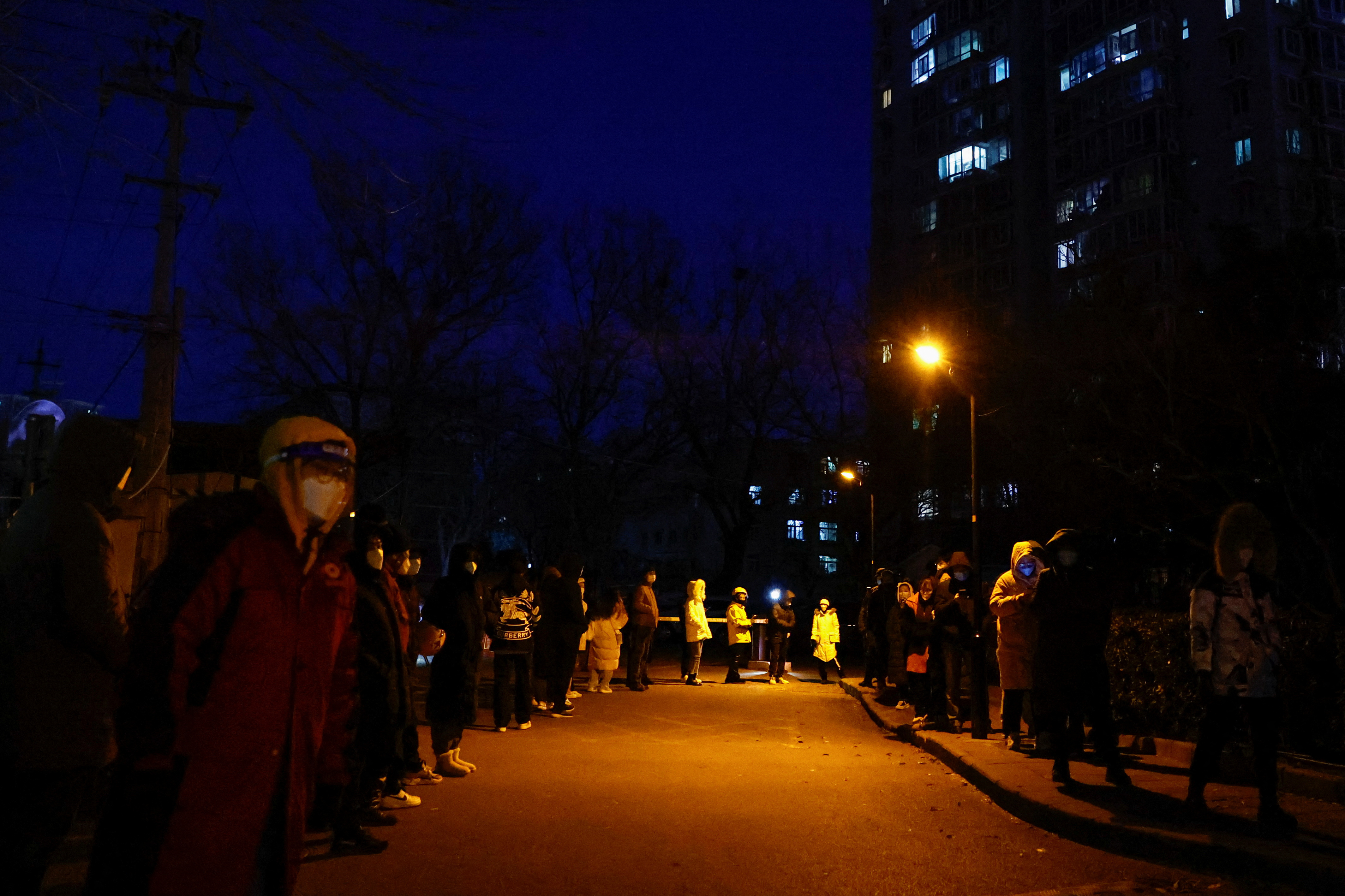
People line up to take a nucleic acid test for the coronavirus disease (COVID-19), near a residential compound in Beijing, China December 3, 2022. REUTERS/Tingshu Wang

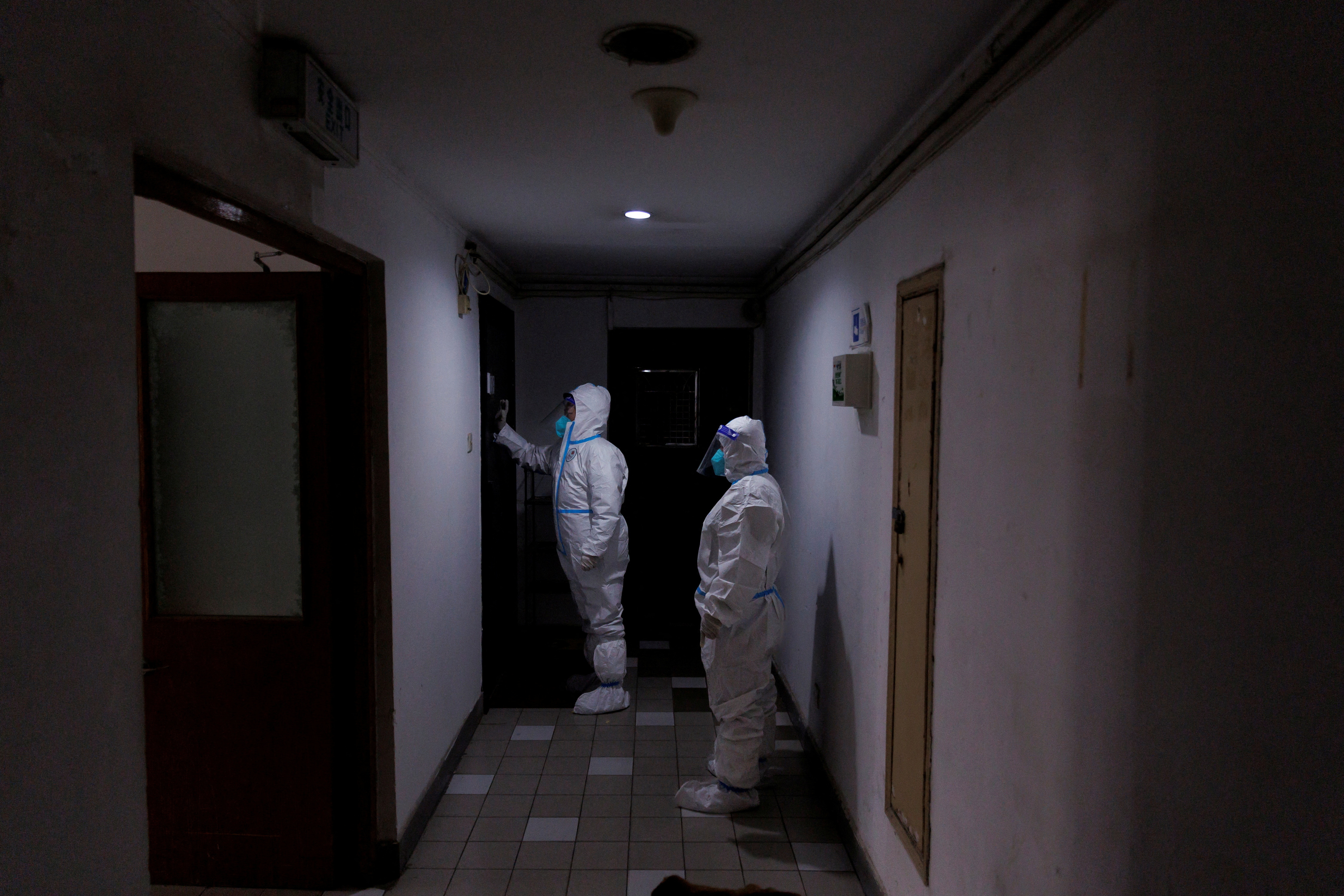
Pandemic prevention workers in protective suits knock on a resident’s door in an apartment building that went into lockdown as coronavirus disease (COVID-19) outbreaks continue in Beijing, December 2, 2022. REUTERS/Thomas Peter
WP Radio
WP Radio
OFFLINE LIVE