
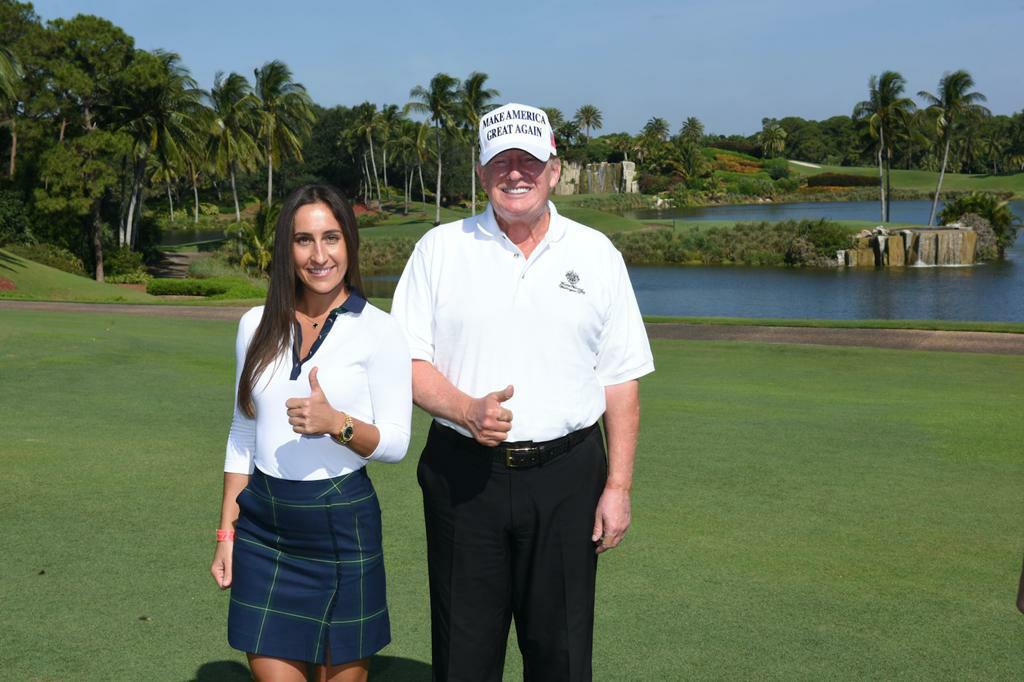
Little information is public about Ms. Yashchyshyn, who once worked for a suburban Miami business that specializes in providing pregnant Russian mothers the option to have their babies in the U.S. to gain citizenship, court records show.
But when a bitter court dispute erupted last year between her and a close associate with whom she once lived, the details of her whirlwind trips to Mar-a-Lago and other activities over the past several years began to surface and soon reached the attention of federal agents.
Valeriy Tarasenko, 44, a Florida businessman who was raised in Moscow, said he met Ms. Yashchyshyn in 2014 and allowed her to live in his Miami condo so that she would watch his children when he traveled on business.
They have since parted ways over what he alleged was her abuse of one of his children – accusations that Ms. Yashchyshyn vehemently denies.
He said he has met twice with FBI agents and spoke to them about multiple trips she made to Mar-a-Lago and what he claims were her efforts to make inroads in the Trump family and look for new streams of money.
She used “her fake identity as Anna de Rothschild to gain access to and build relationships with U.S. politician[s], including but not limited to Donald Trump, Lindsey Graham, and Eric Greitens,” he said in a court affidavit in Miami.

Donald J. Trump as President in 2017. (Carolyn Kaster/Associated Press)

Sen. Lindsey Graham, R-S.C., a Trump supporter, in 2020. (Susan Walsh/Associated Press)
-wikipedia-usdeptofstate.jpg)
Former Missouri governor Eric Greitens in 2018. (U.S. State Department)
Mr. Greitens is a former Missouri governor who resigned in 2018 after allegations of sexual misconduct. He held a fundraiser at a Palm Beach mansion last year where Ms. Yashchyshyn was invited.
Ms. Yashchyshyn, an officer in two Florida companies founded by Mr. Tarasenko — both devoid of any assets — claimed that whatever steps she took to gain money were directed by him.
“[E]very single move that I did, I’ve been told by Valeriy to do so,” she said in a deposition. “[A]fter a few incidents like that, I realized that he’s using me for his lifestyle and for his needs.”

Tatiana Verzilina, left, the former accountant for United Hearts of Mercy, promoted the charity with Ms. Yashchyshyn, but later filed a statement saying it was rife with fraud.
Ms. Yashchyshyn said that at one point when she tried to break from him, he repeatedly struck her. “Over time, Tarasenko became more controlling and aggressive over me,” she said in an affidavit.
“I am the victim right now, that’s all I can tell you,” she said in an interview.
Mr. Tarasenko, who was once detained in Moscow for carrying a police-style baton at a metro station in 1998, denied that he physically harmed her.
In 2015, Ms. Yashchyshyn became president of a Miami charity, United Hearts of Mercy — the same name of a charity founded by Mr. Tarasenko in Canada five years earlier.
The Miami entity was promoted on social media as a vehicle to help impoverished children but was actually a source of illicit funds for organized crime, according to a statement by a certified public accountant for the charity that was provided to the FBI.
After hundreds of thousands of dollars poured into the charity’s coffers two years ago, a payment processor, Stripe Inc., suspected fraud and stopped taking in money for a campaign that was supposed to help families ravaged by the pandemic.
The Post-Gazette emailed more than two dozen of the “donors” from Hong Kong, and every email bounced back, suggesting they were fake email addresses used to trick the payment processor.

A $19,100 “donation” to United Hearts of Mercy, flagged as fraud.
At the end of the charity drive, the accountant, Tatiana Verzilina, said she began to get calls from people who she suspected were from criminal groups, threatening violence and demanding the money.
The callers left “voice messages from unknown numbers with accents that if I do not return money, I and my family will be harmed or killed,” she wrote in her statement.
Though the charity was supposed to disclose its revenues to the public because of the amount of funds it took in, it failed to do so. Ms. Verzilina, who is now living in her native Russia, declined to talk about the case.
So far, it’s not clear where the funds went.
The FBI in Miami said it would not comment, but at least three people who live in South Florida said they have been interviewed by FBI agents in the past seven months about Ms. Yashchyshyn’s activities.
One of them, Sergey Golubev, a Russian-born U.S. citizen who was once married to Ms. Yashchyshyn, said they wed in 2011 so she could obtain U.S. residency and stay in the country, but the marriage was only on paper.
“At some point, she needed a permanent green card,” said Mr. Golubev, 48.
He said the FBI told him that agents were looking for her in connection with allegations about something “illegal — cheating people and stealing money,” but he said he didn’t know any details, and was unaware of her activities. He said he lost touch with her after their divorce in 2016.