Categories
Saved Web Pages

Lukes Publishes Op-Ed on Russian and Western Intelligence Services

Igor Lukes, Professor of International Relations and History at Boston University’s Frederick S. Pardee School of Global Studies, published a Forum24 article outlining the rise of espionage in Russia and the counterbalance from the West that followed.  

In his article, titled “Zpravodajské služby USA a SSSR v časech studené války (US intelligence services and the USSR during the Cold War),” Lukes describes intelligence services as central to Russia. Until the Cold War, he notes that Western democracies thought of intelligence services as “a fool’s game.” The United States, for example, established the Central Intelligence Agency (CIA) in 1947 as a result of fears that Joseph Stalin would try to strike the West. Lukes also shares the story of U.S. Cold Ward intelligence agents.

The full article can be read (in Czech) on Forum24‘s website.

Igor Lukes is a past winner of the 1997 Metcalf Award for Excellence in Teaching and the 2020 winner of the Gitner Prize for Faculty Excellence at the Pardee School. He writes primarily about Central Europe. His work has won the support of various other institutions, including Fulbright, Fulbright-Hays, the Woodrow Wilson Center, IREX, and the National Endowment for the Humanities. Read more about Professor Lukes on his faculty profile.

View all posts

Categories
Saved Web Pages

50 years ago, Nancy Anderson was found dead in her Hawaii apartment. A former deputy Nevada attorney general has been arrested.

nancy-anderson.jpg

September 16, 2022 / 11:16 AM / CBS/AP

A former deputy Nevada attorney general who ran for the state Supreme Court and was later affiliated with the infamous Mustang Ranch brothel has been arrested in Reno as a suspect in a 1972 homicide in Hawaii. Tudor Chirila Jr., 77, was being held Thursday in the Washoe County Jail without bail on a charge of being a fugitive from another state.

In a criminal complaint accusing Chirila of second-degree murder, Honolulu police said DNA evidence linked him to the fatal stabbing of 19-year-old Nancy Anderson.

nancy-anderson.jpg Nancy Anderson Honolulu Police Department

The Honolulu Star-Advertiser first reported that Chirila was arrested Wednesday — five decades after police say he stabbed the teen more than 60 times and left her body in her Waikiki apartment on Jan. 7, 1972. Anderson had moved to Hawaii in October 1971 and was working at a McDonald’s restaurant after graduating from high school the year before in Bay City, Michigan, the newspaper said.

It wasn’t immediately clear if Chirila had an attorney or will be appointed one. Jail records don’t indicate when he’s scheduled to make his initial court appearance.

The criminal complaint filed this week in district court in Hawaii said police had reopened the cold case multiple times since the killing and received a tip in December that Chirila could be a suspect.

In March, police obtained a DNA sample from Chirila’s son, John Chirila of Newport Beach, California, that identified him as the biological child of a DNA sample found at the crime scene, according to the criminal complaint.

This Sept. 14, 2022, photo provided by the Washoe County Sheriff's Office shows Tudor Chirila Jr. Tudor Chirila Jr. Washoe County Sheriff’s Office via AP

On Sept. 6, Reno police served a search warrant and collected a DNA sample from Tudor Chirila at his Reno apartment. Two days later he tried to die by suicide, and on Wednesday was booked into the county jail in Reno, the Reno Gazette Journal reported Thursday.

The Honolulu Police Department previously said it had sought the services of a DNA technology company to assist in the case.

Parabon Nanolabs told Hawaii News Now that genetic genealogy was used in analyzing the evidence along with DNA phenotyping, a process of predicting physical appearance and ancestry from unidentified DNA evidence.

Over the years, police in Hawaii investigated multiple suspects, including door-to-door knife salesmen who were there to try to sell knives hours earlier, the newspaper said. But the salesmen volunteered fingerprints and passed polygraph tests.

Other potential suspects questioned over the years included Anderson’s former boyfriends and the property manager where she lived.

Anderson’s family, including her nine siblings, have spent years searching for any sense of closure, Hawaii News Now reported.

“She was an integral part of our family and when she was killed it just left a hole in our hearts and in our family,” said Jack Anderson, Nancy’s brother.

Chirila, a longtime attorney in Reno, Carson City and the Lake Tahoe area, served as a deputy attorney general in the late 1970s and ran unsuccessfully for the Nevada Supreme Court in 1994.

In a 1998 federal indictment, U.S. prosecutors in Reno identified him as the former president of a company, A.G.E. Corp., that served as a front for Nevada brothel boss Joe Conforte.

The indictment accused Conforte and others of being part of an elaborate conspiracy to defraud the government in bankruptcy proceedings when the Mustang Ranch east of Reno was seized by the IRS, sold for back taxes in 1990 and illegally repurchased by Conforte and his cohorts.

The government claimed Conforte hid his assets during bankruptcy proceedings to cheat the government and buy back the legal brothel under hidden ownership, The Associated Press reported at the time.

Testifying as a government witness, Chirila acknowledged he knew the corporation was owned and controlled by Conforte, who had disappeared and was believed to be a fugitive in South America when the case went to trial in 1999.

Chirila filed suit against Conforte in 1998 seeking $14 million in damages, alleging Conforte wrongly fired him for cooperating with federal prosecutors.

First published on September 16, 2022 / 11:16 AM

© 2022 CBS Interactive Inc. All Rights Reserved. This material may not be published, broadcast, rewritten, or redistributed. The Associated Press contributed to this report.

Categories
Saved Web Pages

Xi Jinping’s coming checkmate of Putin

article_images-putinvladimir_xijinping_0

Ukraine has Russian President Vladimir Putin’s armed forces on the run and has recaptured land the size of the state of Maine in a matter of days. But a more serious setback is the public distancing of Russia by his so-called “no limits” partner, Chinese President Xi Jinping. It seems there are limits, and Xi articulated these before and after a meeting with Putin in Uzbekistan. Beijing is distancing itself from Moscow as its war against Ukraine falters.

Putin acknowledged that Xi raised “concerns” about his war against Ukraine. He added that the Kremlin would clarify its position on Ukraine, without explaining further. “We understand your questions and your concerns,” he said in remarks broadcast on Russian state television from the meeting, which took place at a summit of the Shanghai Cooperation Organization in Uzbekistan.

The day before the two met, Xi warned Putin against meddling in Kazakhstan. This was significant because the Kazakhs have been in Putin’s crosshairs since their leader openly criticized the war in Ukraine, then announced that Kazakh oil exports would be diverted to help Europe. Russians blocked the exports, then some hinted it may be invaded too.

Xi pledged to protect the country in a private meeting with leaders that was leaked. “We [China] will resolutely support Kazakhstan in the defense of its independence, sovereignty and territorial integrity,” he said. This was clearly a pre-emptive rebuke aimed at Putin’s imperialism designed to distance China from Russia as its invasion of Ukraine falters.

China has never endorsed the war against Ukraine. The 5,300-word Putin-Xi “no limits” partnership agreement made public on Feb. 4 made no mention of an invasion. Since then, China has kept its distance and stickhandled through the fallout without becoming a pariah like Russia.

This has been accomplished with duplicitous diplomacy. Beijing refuses to condemn Russia’s invasion of Ukraine, or to call it a war, but it also has not abrogated Western sanctions against Russia or provided any military aid. China’s agenda aims to keep its trading relationships intact with its biggest customers, Europe and America, but also to cop cheap energy from its authoritarian pal Russia.

The partnership has been uneasy for years. China vies with Russia for hegemony over Central Asia, with its vast resources and growing markets serving a population of 72 million. Beijing has already outsmarted Moscow by spending billions to build railways, highways and pipelines through Kazakhstan and other Central Asian nations to bypass Russia completely. Called the Middle Corridor, these infrastructure projects now link China directly to Europe and the Middle East as well as to the resources and economies of the Turkic world. Besides being a “sugar daddy” for the region, China benefits from the residual hatred in Central Asia for its former masters in Moscow.

The Europeans decoupling, and China’s disassociation, from Russia began even before Xi’s no-nonsense Kazakh comment. For starters, the Chinese leader landed another symbolic blow against Russia last week by refusing to attend Putin’s recent conference in Vladivostok and suggesting they meet instead in Uzbekistan, on the sidelines. “It indicates that Beijing carefully calibrates its level of public support for Moscow,” commented a wry observer.

They met as expected, posed for photos and made a predictable announcement about energy trade and economic cooperation. The reality is that massive energy trade projects were ballyhooed years ago, and back in February, but won’t come to fruition for years, if ever, given sanctions.

Why the Federal Reserve won’t be able to control inflation this time King Charles and an Irish revolutionary: A reminder of how politics can change

There are no oil or gas pipelines linking Russia to China — a lapse that should have prevented Putin from invading Ukraine and blackmailing Europe. But he simply couldn’t help himself. Now Europe decouples from its dependency on Russian oil and gas and signs up other sources, including Kazakhstan and Uzbekistan, thanks to Chinese pipelines and infrastructure improvements.

As Russia’s war continues to fail, Xi will step back further. Then, if Russia falls into a heap, China will gradually take over Siberia and whatever other regions want to build railways, highways or pipelines to Europe and Western prosperity. Checkmate for Xi.

Diane Francis is a non-resident senior fellow at the Atlantic Council in Washington at its Eurasia Center. She is editor at large at National Post in Canada, a columnist with Kyiv Post, author of 10 books and specializes in geopolitics, white-collar crime, technology and business. She writes a newsletter about America twice weekly on Substack.

Categories
Saved Web Pages

Opinion| Will the FBI interfere in determining next president of the US?

Marwa_El-Shinawy.jpeg-768x430-1.jpg

Once again, accusations against the Federal Bureau of Investigation (FBI) regarding interference in the presidential elections return to the political scene in the US.

For the first time in US history, a large force of the FBI stormed one of the private residences of former president Donald Trump at his home in Mar-a-Lago resort in Florida.

US media confirmed that the raid came after the FBI obtained a search warrant from the court and that it was indeed legal, stressing that the reason behind the raid was related to the presence of secret presidential documents that Trump took with him from the White House after the end of his term.

In an immediate response, the former US president published a statement through his account on the social networking site Social Truth — which he owns — to announce the storming of his home, attacking the US Public Prosecution saying that “what happened is misconduct on the part of the Public Prosecution.”

He also stressed that the justice system was being used as a weapon by Democrats and supporters of the extreme left to prevent him from running for president in 2024.

Moreover, Trump accused the FBI of “planting” evidence at his Mar-a-Lago residence during the raid on Monday. He added that the FBI did not allow anyone, including lawyers, to be anywhere near the places searched during the raid, noting that “everyone was asked to leave the building, and that they wanted to be alone, without any witnesses to see what they were doing or taking or planting.”

“Why did they insist so strongly that no one was watching them, and everyone was outside?” he asked, noting that the homes of former president Barack Obama and former secretary of state Hillary Clinton were not inspected despite the great controversies surrounding them.

This is not the first time that Trump has accused the FBI of working for the Democratic Party. In 2018, for example, Trump confirmed on his official Twitter account the involvement of the FBI — as well as the Departments of Justice and State — in information leaks, lies, and corruption.

This was after a sharp dispute between the institutions of the US over the nature of Russian interference in the elections that concluded with Trump’s victory. Not long after the accusation, the White House announced the release of a classified memo condemning the use of the FBI’s authority in the investigation of Russian interference in the 2016 US presidential election.

The White House deputy spokesperson at the time confirmed that the memo consisted of “four pages drafted by Republican Representative Devin Nunes — Chairperson of the House Intelligence Committee.”

This memo contained references to cases in which the FBI abused the US government’s monitoring powers in its investigations into Russian interference. In turn, the FBI and the Department of Interior tried to pressure Trump into not releasing the memo, stating that declassifying it “may harm national security and mislead the public.”

Trump then tweeted: “Leaders and investigators of the FBI and Department of Justice have politicised the sacred course of investigations for Democrats against Republicans.”  

Furthermore, a few weeks ago, Republican Senator and ranking member of the Senate Judiciary Committee Chuck Grassley announced that the FBI had been downplaying negative information about Hunter Biden in the run-up to the 2020 election.

Grassley said that an allegedly “highly credible” whistle-blower came forward and claimed that the FBI exerted widespread effort to downplay negative information about President Joe Biden’s son, describing information and intelligence about the president’s son as “potential misinformation” and closing the case immediately ahead of the 2020 presidential elections.

In fact, despite the FBI’s stated commitment to protecting elections and protecting the vote of the American electorate — since fair elections are the foundation of democracy — the FBI indeed has a long history of meddling in presidential elections since its inception, especially under the leadership of John Edgar Hoover, who was the first head of the FBI until he died in 1972.

For example, as John Hoover’s assistant William Sullivan tells us in his book, ‘The Bureau: My Thirty Years in Hoover’s FBI’, when Roosevelt began preparing for a third term, Hoover eliminated his rival Father Charles E. Coughlin — an ultra-conservative priest who was as a major thorn in Roosevelt’s side.

He said that in January 1940, 17 members of the pro-Coughlin Christian Front were arrested by the FBI and accused of plotting to murder several members of Congress. Whether the charges were accurate or not, the arrests wiped out Coughlin as an influential political figure.

Also, in the 1948 presidential campaign, the FBI leaked to Republican rival Thomas E. Dewey a lot of classified information around former President Harry Truman’s association with some politically corrupt officials in Kansas City.

Again, in the 1952 presidential campaign, the FBI managed to discredit Adlai Stevenson as an introverted homosexual who received less attention. According to Hoover’s biographer, Kurt Gentry, Hoover was the source of rumours that Stevenson had once been arrested on moral charges; the same rumours spread in 1956.

It is well known, of course, that after Hoover’s death, there was a massive reform campaign within the FBI’s office to ensure its integrity and impartiality. However, recent repeated allegations by Trump and some Republicans certainly reduce the credibility of the FBI in the eyes of the American people and may also undermine the integrity of the presidential elections as a whole, especially in light of the current great polarisation in US society and the questioning of the integrity of the past presidential elections.

It suffices to point out that according to the latest Gallup poll on the subject, public confidence in the FBI has declined in recent years. In 2019, 57% of American adults said the FBI was doing an “excellent” or “good” job. However, in 2021, it dropped to 44%.

This change is mostly due to lower confidence on the Republican side, which has seen a decline from 46 to 26% over the past two years. On the other hand, Democrats maintained slightly higher levels of confidence at 66%.

* Marwa Al-Shinawy is an Assistant Professor at the International American University for Specialised Studies (IAUS)

Categories
Saved Web Pages

Trump search affidavit reveals confidential source documents found at Mar-a-Lago, raising new alarms

aaf82a9d-59c2-4f4a-8f58-6bc93e46a86a-USP

7fa8cb68-3509-47c5-8c2c-45e0dcb3552b-WWK

play
Trump’s Mar-a-Lago home was searched by the FBI. Here’s why.
Former President Donald Trump said FBI agents searched his Mar-a-Lago home in Florida. Here’s why it matters.
  • FBI agents found records marked as “HCS” – a reference to clandestine human sources.
  • It often indicates a person recruited by U.S. intelligence, typically a foreigner, one expert said.
  • Mishandling of such information potentially endangers the source, experts told USA TODAY.

An initial examination of 15 boxes of documents retrieved from Donald Trump’s Mar-a-Lago estate earlier this year yielded a startling discovery that is now raising new alarms throughout the U.S. intelligence community.

Among nearly 200 “unique documents bearing classified markings,” FBI agents found records marked as “HCS” – a reference to clandestine human sources and some of the most guarded information in the government’s intelligence arsenal, according to a newly-unsealed affidavit supporting this month’s unprecedented search of Trump’s Florida property

The information, usually locked away in highly secure government facilities, instead was found, along with other “unfoldered” classified material, mixed among Trump’s personal property at the former president’s beach resort. It’s presence at Mar-a-Lago potentially endangered crucial sources of information or risked government secrets falling into the wrong hands, experts say.  

Human source information is so guarded because it often indicates the material came from a person recruited by American intelligence who is typically a foreigner, frequently someone who has access to the foreign government’s intelligence, their classified information, their leadership, defense secrets and the like, said Jamil Jaffer, who worked in the White House counsel’s office under President George W. Bush and helped send highly classified documents to the National Archives and Records Administration as part of the administration’s transition.

Mar-a-Lago search affidavit released: Unsecured storage, confidential documents: What Trump search affidavit reveals: live updates

“You are talking about people’s lives being at stake,” said former federal prosecutor Sarah Krissoff, adding that the discovery appears to have helped propel a deepening criminal investigation into obstruction and possible violations of the Espionage Act.

The explosive contents of the heavily-redacted affidavit also prompted a new call from Senate Intelligence Committee Chairman Mark Warner, D-Va., for a national security damage assessment.

“It appears, based on the affidavit unsealed this morning, that among the improperly handled documents at Mar-a-Lago were some of our most sensitive intelligence – which is one reason the Senate Intelligence Committee has requested, on a bipartisan basis, a damage assessment of any national security threat posed by the mishandling of this information,” said Warner, whose statement referred to the discovery of human source information.

“The Department of Justice investigation must be allowed to proceed without interference.”

Read the affidavit: Read the (redacted) affidavit that supported the search of Trump’s Mar-a-Lago resort

Trump, in a statement following the affidavit’s release, did not explain why he kept such sensitive information, focusing instead on the extensive redactions and the absence of specific references to nuclear weapons information.

Following the Mar-a-Lago search, The Washington Post reported that documents related to nuclear weapons were among the items investigators were seeking.

Andrew Weissmann, a former federal prosecutor who served on special counsel Robert Mueller’s team during the investigation into Russia’ interference in the 2016 election, described human intelligence as “the lifeblood of many intelligence investigations.”

“It is highly sensitive information,” Weissmann said. “It means people who are cooperating with national intelligence agents or law enforcement. If that information were leaked or publicly disclosed, it could lead to physical danger or retaliation against the cooperators.”

Exposure of such information, Weissmann said, could require the government to move those sources out of potential harm’s way.

Will Trump aides be charged?: Trump aides unlikely to face charges on their own in Mar-a-Lago probe, former prosecutors say

Jim Trainor, a former FBI counterintelligence agent who served as assistant director for the cyber division, said the consequences of such sensitive disclosures can have “generational implications.”

Trainor noted two dramatic examples of such compromises in the cases of former FBI double agent Robert Hanssen and ex-CIA officer turned KGB double agent Aldrich Ames, who provided crucial human intelligence that blew the covers of KGB agents working secretly for the U.S., which resulted in some being executed.

“The consequences of the potential disclosure of this information is the cost of getting these sources … the potential loss of life of the source if disclosed and the loss of intelligence that may or may not ever be acquired again,” Trainor said. “And that puts every human being’s life at risk in the country.”

Trainor added that the revelation of a former U.S. head of state handling classified documents in such a way may also inhibit intelligence information sharing agreements the U.S. has had in place since World War II with its so-called “five eye” allied partners, including the United Kingdom, Canada, New Zealand, Australia, who may no be worried that their sources and methods have been compromised.

Mixed in with the records marked as human source intelligence were other documents designated as “NDI” or national defense information. Because of the heavy redactions, it was not clear whether authorities determined whether the two categories were related in some way.

But the presence of such information clearly put federal investigators on notice that other information likely remained at risk on the Mar-a-Lago property, requiring the Aug. 8 search.

 “There is also probable cause to believe that evidence of obstruction will be found at the (Florida) PREMISES,” the affidavit stated.

In a separate document unsealed Friday, in which Justice officials made their case for redacting the affidavit, investigators also raised the potential risk to witnesses who have been cooperating with government’s investigation.

“First and foremost, the government must protect the identity of witnesses at this stage of the investigation to ensure their safety,” Justice officials wrote. “As this Court noted, if information relating to witnesses were disclosed, ‘it is likely that even witnesses who are not expressly named in the Affidavit would be quickly and broadly identified over social media and other communication channels, which could lead to them being harassed and intimidated.'”

The Jan. 6 investigation: Federal prosecutors questioning witnesses about Trump’s conduct related to Jan. 6 inquiry

Justice officials not only expressed concern for witnesses and the course of the investigation, but also for the safety of federal law enforcement agents.

“FBI agents who have been publicly identified in connection with this investigation have received repeated threats of violence from members of the public,” the Justice document said. “Exposure of witnesses’ identities would likely erode their trust in the government’s investigation, and it would almost certainly chill other potential witnesses from coming forward in this investigation and others.”

Yet, it was the affidavit’s chilling references to the volume, sensitivity and lack of security surrounding the material recovered at Mar-a-Lago that appeared to stand out from the otherwise blacked out pages, especially records related to human sources.

Jaffer, who also worked on these issues at the Justice Department’s National Security Division, noted that in the years since Edward Snowden, a former contractor for the National Security Agency who leaked information on the nation’s most secretive spy agencies and their programs, there have been general concerns about whether foreign assets could trust the American intelligence community, which has contributed to difficulty in recruiting human sources.

Trump served subpoena in June: Trump served subpoena at Mar-a-Lago home 2 months before FBI search

Revealing, leaking or otherwise disseminating human intelligence contained in classified documents “might reveal the identities of sources” who are cooperating with U.S. investigators, said Kenneth Gray, a retired FBI special agent who’s now a senior lecturer in the University of New Haven’s Department of Criminal Justice.

If human intelligence is publicly revealed from a document classified as top secret, that “could cause grave damage to national security,” he added. It could also endanger the cooperators.

“That’s the reason for the the classification. You don’t want to jeopardize the people who provided information,” said Gray. However, he said it’s not clear from the redacted affidavit whether any human intelligence information had been leaked. “Who knows if anyone had access to that material” at Mar-a-Largo? said Gray. 

What Trump said vs. what we know: Trump’s relentless attacks on Mar-a-Lago search lack context. What he said vs. what we know.

Categories
Saved Web Pages

Feds eye former top FBI agent’s links to Russia, Balkan countries

charles-mcgonigal.jpg?quality=75&strip=a

A former top New York FBI agent who helped trigger the investigation into the 2016 Trump campaign’s alleged ties to Russia has himself “come under scrutiny” by federal prosecutors for his own ties to the Kremlin and other foreign governments, a report said Thursday. 

A federal grand jury convened in 2021 may be examining former FBI Special Agent in Charge Charles McGonigal’s apparent links to a top aide to Russian oligarch Oleg Deripaska, Insider reported, citing a leaked grand jury subpoena document. 

McGonigal, who retired from the bureau in 2018, led the FBI’s counterintelligence division in New York and also served as the cyber-counterintelligence section chief in Washington, according to his LinkedIn page. 

In his role at agency headquarters, he was one of the first G-men to learn that a Trump campaign official claimed that the Russians had “dirt” on Hillary Clinton, helping spark the sprawling collusion investigation, Insider reported. 

McGonigalCharles McGonigal was special agent in charge of the Counterintelligence Division for the New York Field Office of the FBI under James Comey.Greatdecisions.tv

Deripaska, a Russian billionaire with ties to the country’s president, Vladimir Putin, played a central role in the investigation, which consumed much of Trump’s term of office, Insider reported. 

The November 2021 document obtained by Insider requests records and communications related to Spectrum Risk Solutions, a consulting firm. McGonigal helped another person “facilitate” an introduction between the firm and Deripaska’s aide, according to the report. 

The grand jury document also requests communications that the unnamed subject of the subpoena had with McGonigal regarding other foreign countries, including Bosnia and Herzegovina, Kosovo, Montenegro and Albania. 

Oleg DeripaskaRussian oligarch Oleg Deripaska addresses media representatives during a press conference in Moscow on June 28, 2022.AFP via Getty Images

The document asks that inquiries regarding the subpoena be directed to an FBI agent in Los Angeles, according to the report. 

It does not indicate whether McGonigal is the target of a grand jury investigation or whether his actions are part of a FBI probe into another person. 

McGonigal, who has not been accused of any wrongdoing, did not return a request for comment. He most recently worked as a senior vice president for security at a multibillion-dollar real estate company in New York, but a spokesman for the company told Insider he had left that post in January of this year.

Categories
Saved Web Pages

Russia takes a slice of the new Silk Road

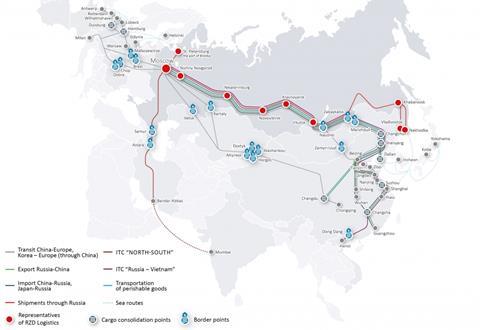
Container routes, RZD

New contracts for finished vehicle delivery on the railroads between Europe and Asia show that China’s Belt and Road Initiative has become a full-fledged competitor to the sea-shipping sector. The project has been up and running for only a few years, but it is seeing increasing volumes of deliveries and holds particular promise for carmakers with production capacities at both ends of Eurasia. Russian organisations such as the state-owned Russian Railways (RZD) are keen to take a slice of this growing business.

Speaking at a press conference in St. Petersburg in 2014, Vladimir Yakunin, former president of RZD, said that his company had been chasing a substantial increase in trans-Eurasian logistics, meaning the inland connection between Europe and Asia.

Yakunin said that major work was expected to be done to increase the railroad network on Russian territory, including by expanding the Trans-Siberian Railway and the Baikal-Amur Mainline to raise total capacity from around 100m tonnes of cargo per year to 500m or 600m tonnes per year in future. Some of this growth was expected to come from automotive products, and indeed RZD had already been running some trial shipments of vehicles from Germany to China, Yakunin added.

“In the coming years even renowned European brands will have to import some models from China, especially EVs” – Svyatoslav Kuchko, IHS Automotive

Since the time of the press conference, RZD has indeed been investing in new railroads and other infrastructure in this part of Russia. In fact, a comprehensive programme of development was adopted by the government in 2018 with an investment of 9 trillion roubles [$138.6 billion], and ambitions to support a fourfold increase in container transit volumes by 2024 plus a decrease of in delivery time to seven days on shipments from the Far East to the Western borders of Russia.

The planned development of trans-Eurasian logistics was one of the reasons why RZD had originally purchased French logistics provider Gefco, said Luc Nadal, Gefco’s chairman, at the same conference.

RZD

In November 2018, RZD made a big announcement disclosing details of new contracts in the area of trans-Eurasian finished vehicle logistics. Alexei Shilo, RZD commercial director, said that RZD had delivered the first batch of Mercedes-Benz vehicles from Bremerhaven, in Germany, to Chongqing in China. Transporting vehicles between the two countries by this route takes only 15 days as compared with 60 days by sea, Shilo estimated.

There were 112 vehicles in the inaugural shipment and Shilo said the German carmaker planned to contract RZD to deliver 20,000 finished vehicles in 2019 – a number which cannot yet be confirmed. He pointed out that another big carmaker interested in the overland route is Volvo, which started shipping vehicles from China to Europe by rail in June 2017. Porsche, meanwhile, confirmed in April this year that it had begun containerised shipments from Germany to China in order to supplement its ocean route.

According to Lyudmila Semyonova, deputy chairman of the logistics committee of Russia’s Industrial and Commercial Chamber, the increase in the finished vehicle flow on rail is primarily due to logistics subsidies in the rail sector allocated by the Chinese government,. This has prompted some logistics companies to consider new projects in this area, she added.

Gaining momentum
The substantial efforts put into developing trans-Eurasian finished vehicle logistics are now starting to bear fruits, according to Olga Stepanova, sales director of RZD Logistics.

“RZD launched that project of delivering finished vehicles in rail car transporters in 2018 and [since then] volumes have been growing,” she says. Stepanova notes that this was not the first project for the automotive industry; some finished vehicle shipments using containers have been occurring since around 2014.

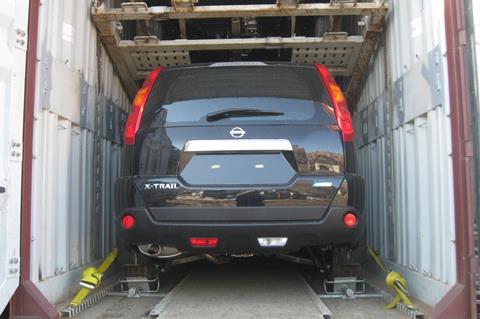
Containerised vehicle

“Since the launch of the One Belt, One Road project by Chinese President Xi Jinping [at the end of 2013] we have seen an increasing cargo flow on the route. First off, it is a reduction in the delivery time that is of interest both for the cargo shippers and the cargo receivers, and it is primarily important for expensive goods with high added value, so finished vehicles and automotive components are considered to be a big piece of that pie,” explains Stepanova.

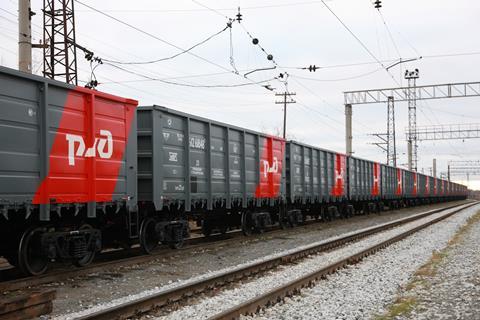
RZD sees heightened demand for finished vehicle delivery on trans-Eurasian routes, both in railcar transporters and in containers.

“In 2018, together with our daughter company, Far East Land Bridge, we had more than 9,000 cars delivered in containers by rail from Europe to China and in the reverse direction. In addition, almost 5,000 40-foot (12-metre) containers with automotive spare parts were delivered by rail as well.”

As for 2019, Stepanova says the operation is running “at least 30 trains per month” with automotive parts and vehicles between China and Europe. “In addition, there is at least one train per week on the route between China and Russia. If we compare the volumes in 2018 and in 2019, we recorded a twofold increase in flows. The growth is coming from the goods that previously were supplied by sea,” Stepanova states.

“One important aspect is that the trains are loaded in both directions. From Europe to China these are primarily luxury cars, while from China to Europe these are cars of the mass market segment,” she adds.

“Before the One Belt, One Road project was launched, sea delivery was cheaper by a factor of three or four times… now the costs of finished vehicle delivery using the railroad network come very close to those of sea delivery” – Olga Stepanova, RZD

Stepanova points out that most car manufacturers, including Mercedes and Volvo, are interested in reducing delivery time, but in addition there has been a shift in the price competitiveness of the trans-Eurasian railway deliveries, partly due to the Chinese logistics subsidies.

“Before the One Belt, One Road project was launched, sea delivery was cheaper by a factor of three or four times. When the project was launched, the gap shrank by nearly half, and thanks to the subsequent work that has been done, now in numerous ways the costs of finished vehicle delivery using the railroad network come very close to those of sea delivery,” Stepanova explains.

When it comes to such an expensive product as a car, there are multiple factors affecting the logistics costs, and storage time is among them, Stepanova points out. In addition, when carmakers are able to sell their products faster, they generate extra revenue by reducing capital turnover time.

Flow from China set to grow
In the near future, a strong increase in the supply of vehicles from Europe to China and especially vice versa is inevitable, according to Svyatoslav Kuchko, IHS Automotive’s Russian market analyst for automotive forecasting.

“China will reinforce its position as the world’s largest car market. Even if most vehicles sold there are locally built, in absolute figures the number of vehicles imported to China from Europe is still impressive. In 2018 it amounted to 560,000 units,” says Kuchko. IHS Markit expects light vehicles exports from Europe to China to increase by a further 30% in 15 years to reach 720,000 in 2033.

“The growth of Chinese vehicle exports to Europe could turn out even more impressive. In 2010 a negligible 3,600 vehicles were supplied to EU countries from China. In 2018 there were already 22,000. According to our assumptions, by 2033 this figure could increase more than 15-fold, exceeding 340,000 units a year,” he states.

Porsche China

Kuchko says this is not only because Chinese brands might finally gain ground in the EU market but because the industry is seeing the global redistribution of production, as OEMs come under increasing pressure to electrify their line-ups.

“China has already become the number one EV market and is also turning into the global assembly hub for electric vehicles. Therefore, in the coming years even renowned European brands will have to import some models from China, especially EVs – among them future generations of Smart and some EV models by Mercedes, Renault and Volkswagen,” Kuchko adds.

All in all, within the next 15 years the “turnover” of vehicles between China and the EU is likely to exceed 1m units per year, according to Kuchko. As a partner of the One Road, One Belt project, RZD could clearly benefit by offering a mode of transportation which is time-saving and cost-efficient compared with maritime shipments.

Work on expanding the traffic flow on this route is ongoing. During the 19th Shanghai Cooperation Organisation (SCO) summit in Bishkek, representatives of Kyrgyzstan called upon Mongolia to expand the railroad network in the country in order to secure an increase in cargo traffic on the route known as the China-Mongolia-Russia Economic Corridor, which is one of the main directions used for transit goods delivery in the region.

Mongolian President Battulga Khaltmaa said that transit flow through the country jumped by a factor of six between 2016 and 2018 and is poised for further growth in the coming years. During this conference, Russia, China and Mongolia agreed to accelerate the construction of a network of cross-border highways and facilitate customs clearance.

Q&A with Olga Stepanova, sales director of RZD Logistics

Olga Stepanova

What would be the impact on trans-Eurasian finished vehicle logistics if China decided to withdraw logistics subsidies?
My opinion is that the cargo flows that are already accustomed to railroad delivery will remain on these routes, but this, of course, will be the cargoes with high added value, including finished vehicles. This may be due to a kind of inertness in the industry, as transport companies that were shipping finished vehicles by sea for quite a long period of time were used to extended delivery times, while now they are used to a delivery time limited to two weeks. So it is very likely that the majority of carmakers would opt to sacrifice logistics costs instead of returning to long delivery periods that sometimes can be unpredictable.

What steps to improve Russian railway infrastructure have been taken in the past few years?
RZD has embarked on a comprehensive programme of development [launched by the Russian government in 2018 with an investment of 9 trillion roubles]. A lot of things have been done, not only in the area of finished vehicle transit, but in the area of transit as a whole. As of today, our railway infrastructure already enables us to run the transit trains without any delays. Some work needs to be done on the border, but this is a matter of paperwork, not infrastructure.

Are there any issues associated with vehicle delivery by rail over such long distances?
In view of these changes, some Chinese and European companies invested in new lashing material for finished vehicles. If in the past there was a lashing material that did not guarantee safekeeping of a finished vehicle inside the container, today we have ledges in the container and with the new lashing materials we are able to deliver the finished vehicles to their final destination safe and sound. We believe it is safer to transport finished vehicles in containers than when covered with some kind of a mesh. We have had no situations where finished vehicles were dinged. Basically, we can say that it is absolutely safe to transport finished vehicles by rail.

Which transport corridors are common on trans-Eurasian logistics?
There are three corridors for finished vehicle shipments: through Mongolia, through Kazakhstan and through the Zabaikalsk-Manchuria border crossing [Russian-Chinese border in the Far East]. Which route is chosen depends on the starting point and final destination, because China is a big country and there are different production complexes. We could give advice, but as a rule the client has his own preferences in terms of the specific route. As for the European side, a couple of years ago I would say there were certain limitations on the border in terms of infrastructure. There are still some bottlenecks on the border with Belarus and Poland, but these issues are fully manageable and the Belarus side has put a lot of effort into expanding infrastructure, and similar work is underway in Poland.

Do you believe the downturn in the Russian vehicle logistics market impacted the project?
Historically, in Russia most finished vehicles have been transported in automotive carriers. I would not say that there is some competition for the fleet between the domestic and transit supplies, because automotive carriers are extremely rarely used in finished vehicle supplies from China to Russia. If by rail, almost all supplies are coming in containers. If by sea, it’s always ro-ro carriers. The Chinese carmakers have set a target of expanding their share on the Russian market, and the import supplies of finished vehicle are steadily growing, even though some of these companies launch their localised production capacities in Russia.


Categories
Saved Web Pages

Си Цзиньпин пропустил ужин с Путиным и Эрдоганом на саммите в Узбекистане

69c502c832dbad5b1e914b299c9a8d64.jpg

InfoResist в Google News

Подпишитесь сейчас!

×

Categories
Saved Web Pages

Vladimir Putin and Xi Jinping: An increasingly unequal relationship

Mr Putin’s invasion of Ukraine, which has not gone according to plan, has weakened Russia. The Kremlin admits that the Russian army has suffered “significant losses”, while Western sanctions are putting the economy under intense pressure. In the Russia-China relationship, it feels more and more that Russia is the junior partner.

WP Radio
WP Radio
OFFLINE LIVE