Categories
Audio Sources - Full Text Articles

Wharton professor Jeremy Siegel breaks down why he blames the Fed for inflation — and warns the central bank now risks tanking the economy

jeremy siegelJeremy Siegel.

Steve Marcus/Reuters

  • Jeremy Siegel slammed the Fed for fanning inflation, and warned it may spark an avoidable recession.

  • The Wharton professor told Insider that he expects the Fed to cut interest rates later this year.
  • Siegel explained why some wage inflation is desirable, and sounded the alarm on the US money supply.

Jeremy Siegel blames the Federal Reserve for the historic spike in inflation last year, and fears the US central bank will drag the economy into an unnecessary recession, he told Insider in an interview this week.

The retired Wharton finance professor also predicted the Fed will reverse course and start cutting interest rates before the end of this year.

The buck stops at the Fed

Inflation reared its head last year because the Fed and Treasury went overboard in shoring up the economy during the pandemic, Siegel said.

He acknowledged that officials had to offer some aid to offset the painful impact of travel restrictions, business closures, and supply-chain disruptions. But they didn’t need to leave the floodgates open for two years, he said.

Excessive fiscal and monetary stimulus caused the US money supply to balloon between March 2020 and March 2022, he continued. The deluge of liquidity was the key driver of inflation, whereas labor shortages and the shock to food and fuel prices from Russia’s invasion of Ukraine last spring were relatively minor factors, he added.

“The core inflation was already in place,” he said.

Headline inflation soared as high as 9.1% in June, spurring the Fed to hike interest rates from virtually zero to nearly 5% within the past year, and to signal further increases are coming. While higher rates may slow the pace of price increases by deterring spending and borrowing, they can also soften demand and stall economic growth, boosting the risk of a recession.

“The Federal Reserve put on the brakes very, very hard,” Siegel told Insider, even though “inflation is basically over.”

The veteran academic pointed to rental and housing markets cooling off in recent months as proof the threat is fading fast. Moreover, he urged the Fed to allow some wage inflation. Higher salaries help fill gaps in the workforce, and many American workers need pay bumps just to keep up with soaring living costs, he said.

“We’re going to have some inflation in the service sector because of the wage increases,” he continued. “To crush those you would really have to crush the rest of the economy.”

Siegel’s view is that the Fed overheated the economy, and now it’s cooling it too quickly. Yet he still expects Fed Chair Jerome Powell and his colleagues to pivot from hiking to cutting in a matter of months.

“I think they will decrease the rate by the end of the year,” he said.

Siegel, a senior adviser to asset manager WisdomTree, also expressed concern about a rare decline in the total value of cash, bank deposits, and short-term savings in the US last year.

“That somewhat scares me,” he said, adding that the Fed should return to growing the money supply at a normal rate of around 5% a year. Americans running short of money could be disastrous, as consumer spending is key to US economic growth.

Finally, Siegel underscored his surprise at the shockingly strong jobs report for January. A resilient labor market slightly reduces the risk of a near-term recession, he said. However, he emphasized that if the money supply continues to shrink, “the chances of a recession later this year or early next year are going to be much higher.”

Read more: Why top Wall Street investors say there’s never been a better time to invest your money overseas — and where they say the 7 best opportunities are

Read the original article on Business Insider
Categories
Audio Sources - Full Text Articles

Zelenskiy, touring Europe, wins UK pledge to train pilots on NATO jets

2023-02-08T15:39:48Z

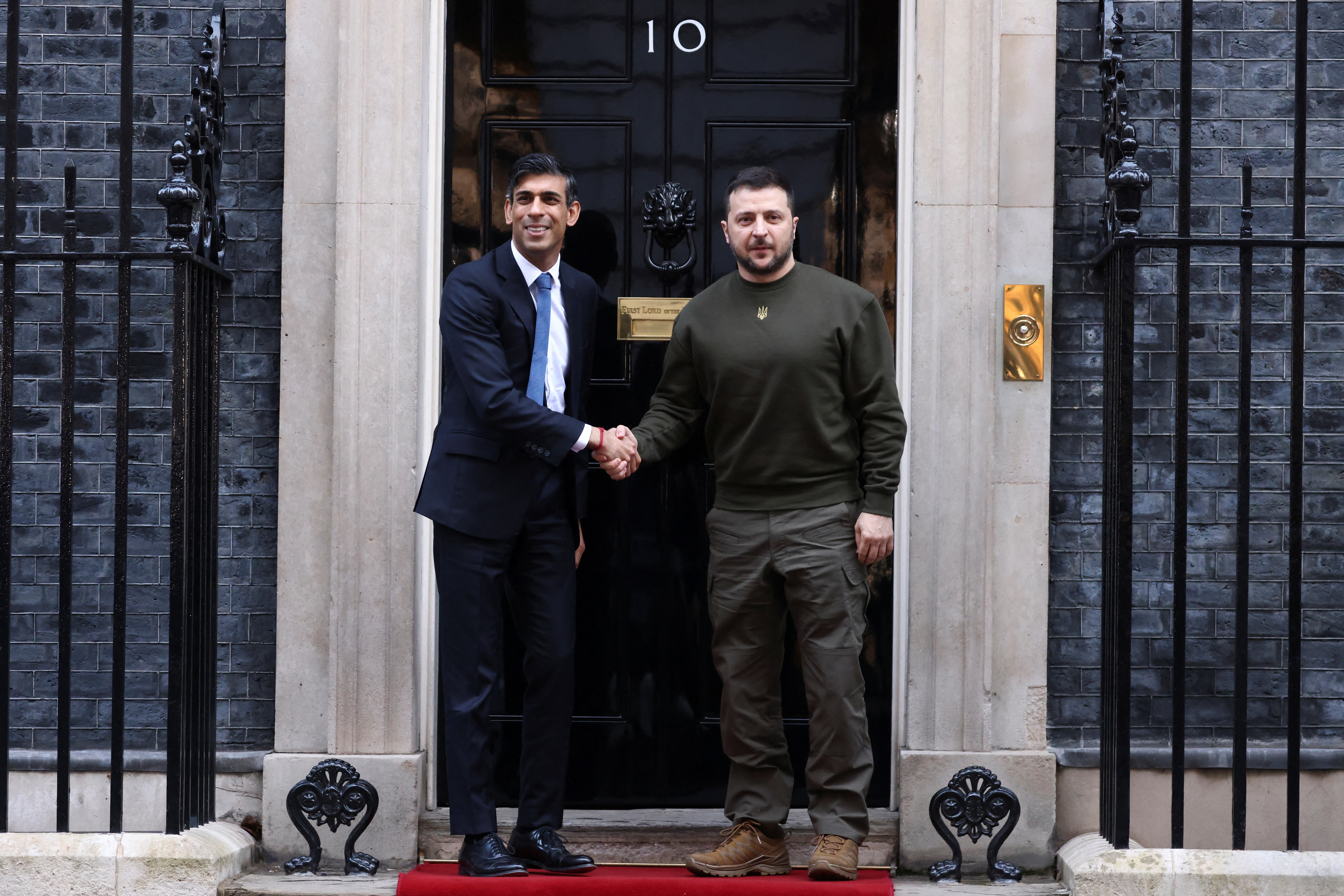
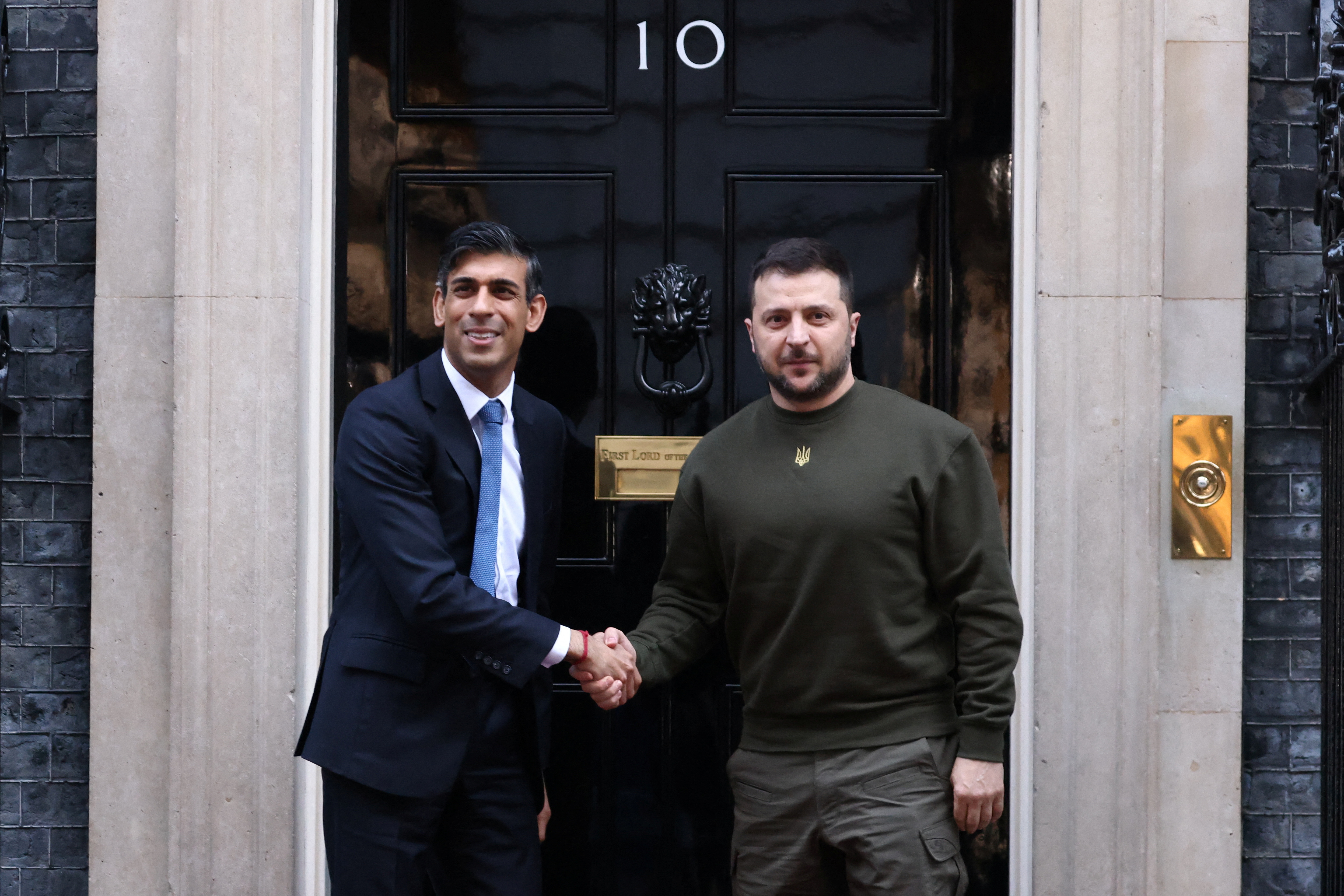
Ukrainian President Volodymyr Zelenskiy met British Prime Minister Rishi Sunak at Number 10 Downing Street on Wednesday (February 8) after arriving in London on a rare visit abroad.

Ukrainian President Volodymyr Zelenskiy embarked on a European tour on Wednesday to drum up aid, winning a British pledge to train Ukrainian pilots on advanced NATO fighter jets, a big step up in Western military support.

On just his second trip abroad since Russian forces invaded Ukraine last year, he met British Prime Minister Rishi Sunak and addressed parliament in London.

He was later due in Paris for dinner with French President Emmanuel Macron and German Chancellor Olaf Scholz, before a European Union leaders’ summit in Brussels.

In his speech to British lawmakers, Zelenskiy repeatedly hammered home his plea for combat aircraft, which he referred to as “wings for freedom”. Western countries have so far stopped short of providing warplanes or weapons that can strike deep inside Russia.

Ukraine “will do everything possible and impossible to make the world provide us with modern planes to empower and protect pilots who will be protecting us,” Zelenskiy said. He gave a pilot’s helmet to parliamentary speaker Lindsay Hoyle carrying the message: “We have freedom, give us wings to protect it”.

Two years ago he had left the British parliament thanking lawmakers for “delicious English tea”, Zelenskiy said. Now he would leave “thanking you in advance for powerful English planes”.

Shortly before his arrival, Britain announced plans to expand a programme training Ukraine’s military to ensure its pilots could fly sophisticated NATO-standard fighter jets.

The announcement gave no timeframe and stopped short of a commitment to provide Kyiv with British jets. But it signalled a notable shift in support that could pave the way for other countries to send planes.

Sunak told parliament that Britain would give Ukraine the support it needs to ensure a military victory this year.

Zelenskiy’s tour of Europe follows a surprise visit to Washington in December, and the choreography of meeting the British, French and German leaders the same day was a sign of his assiduous care in cultivating Western leaders and opinion.

As Zelenskiy wrapped up his London speech, air raid sirens rang out in the Ukrainian capital Kyiv. An all-clear later sounded.

He was also due to meet King Charles and visit Ukrainian troops training in Britain. Sunak’s office announced the addition of new names to Britain’s Russia sanctions blacklist, as well as plans for more military equipment for Kyiv, including unspecified longer range weapons.

Germany’s Scholz, speaking to lawmakers in Berlin, said he expected strong demonstrations of support for Ukraine from this week’s EU summit, and a new round of European sanctions on Russia around the anniversary of the invasion.

Scholz, publicly more cautious than some other Western leaders on arms deliveries, said decisions on weapons were best when coordinated behind the scenes, rather than announced by countries in a “public competition to outdo each other”.

Western countries have scaled up their pledges of military support for Ukraine since the start of the new year, culminating with an offer last month of tanks. Kyiv still wants longer range missiles as well as warplanes.

After major Ukrainian gains in the second half of 2022, Russia has recovered momentum, sending tens of thousands of freshly mobilised troops to the front. They have made incremental progress in relentless winter battles which both sides describe as some of the bloodiest fighting of the war.

Kyiv says it expects Moscow to broaden that offensive with a big push as the Feb. 24 first anniversary of the invasion approaches.

“They need to have something to show before their people, and have a major desire to do something big, as they see it, by this date,” Ukrainian national security chief Oleksiy Danilov told Reuters on Tuesday.

In the Netherlands, prosecutors concluded an investigation into the 2014 downing of a Malaysian airliner over eastern Ukraine, saying evidence pointed to involvement by Russian President Vladimir Putin but was insufficient to charge him.

A Dutch court has convicted two Russian agents and a pro-Russian Ukrainian separatist of murder for the missile strike which killed 298 passengers and crew. Moscow denies blame.

Russia launched its “special military operation” last year to combat what it describes as a security threat from Ukraine’s ties to the West, and claims to have annexed four Ukrainian provinces last year. It says Western supplies of weapons to Kyiv will only prolong the war.

Ukraine says the only way to end the fighting is for the West to give it the capability to drive Russian forces out.

Western fighter jets are at the top of Ukraine’s wish list. Neither Moscow nor Kyiv enjoys air superiority over Ukraine, limiting the use of piloted aircraft on both sides so far.

U.S. President Joe Biden said last month Washington would not send U.S. F-16s to Ukraine, and British officials have said Britain’s jets require too much training to be useful now. France and Poland are among countries that have kept the door open to sending jets as part of a collective Western decision.

The United States is expected to announce a $2 billion weapons package in coming days that would include new rockets with gliding bombs that double the range of rockets it sent last year. That would put all of Russia’s supply lines in mainland Ukraine as well as parts of the Russian-annexed Crimean peninsula within firing distance of Russian troops.

Related Galleries:

Ukraine’s President Volodymyr Zelensky and British Prime Minister Rishi Sunak meet outside Number 10 Downing Street in London, Britain, February 8, 2023. REUTERS/Henry Nicholls

Ukraine’s President Volodymyr Zelensky and British Prime Minister Rishi Sunak meet outside Number 10 Downing Street in London, Britain, February 8, 2023. REUTERS/Henry Nicholls

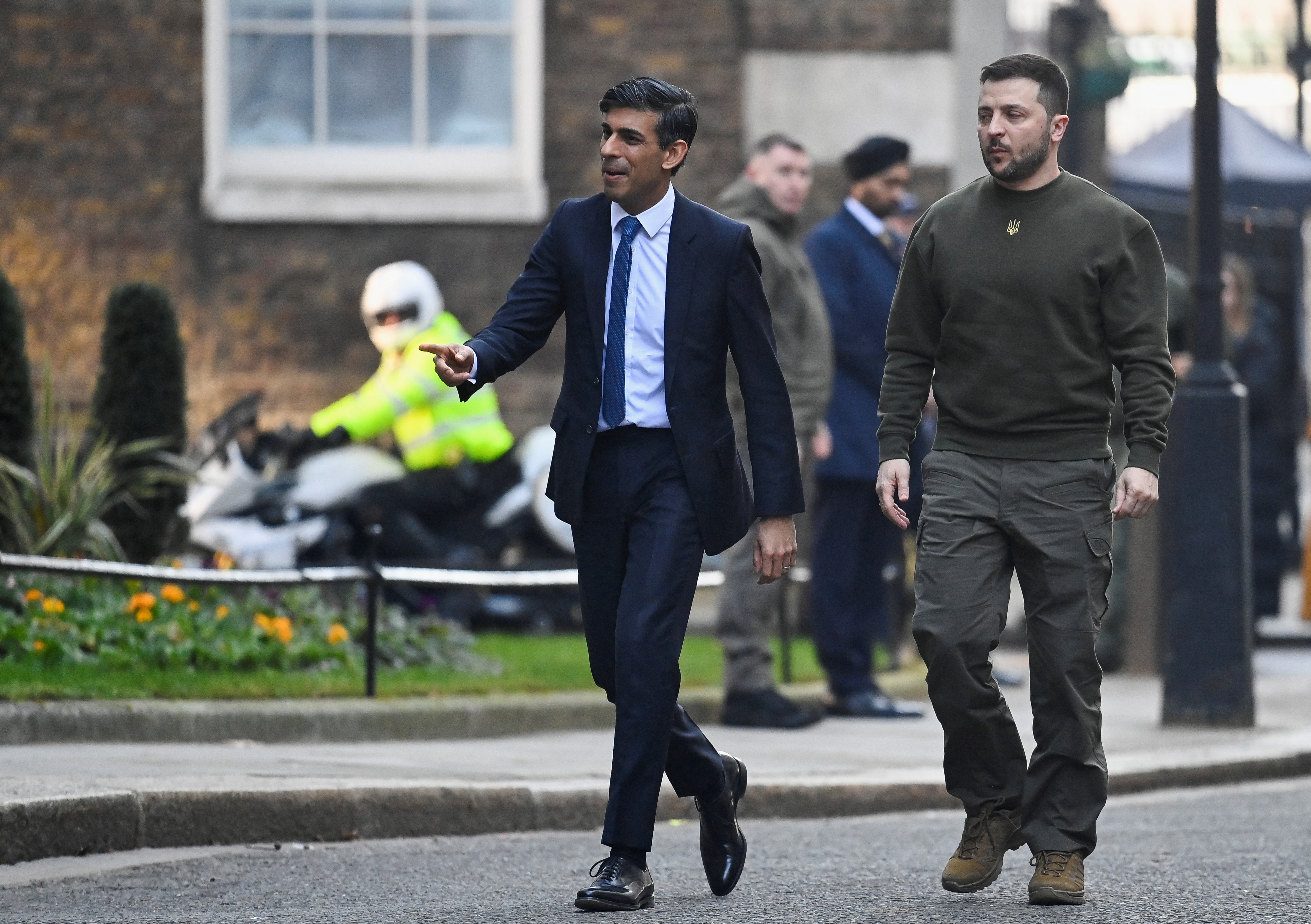
Ukraine’s President Volodymyr Zelenskiy and British Prime Minister Rishi Sunak walk outside Number 10 Downing Street in London, Britain, February 8, 2023. REUTERS/Toby Melville

Ukraine’s President Volodymyr Zelenskiy walks after arrival with British Prime Minister Rishi Sunak at an airport, amid Russia’s attack on Ukraine, in Stansted, Britain February 8, 2023. Ukrainian Presidential Press Service/Handout via REUTERS

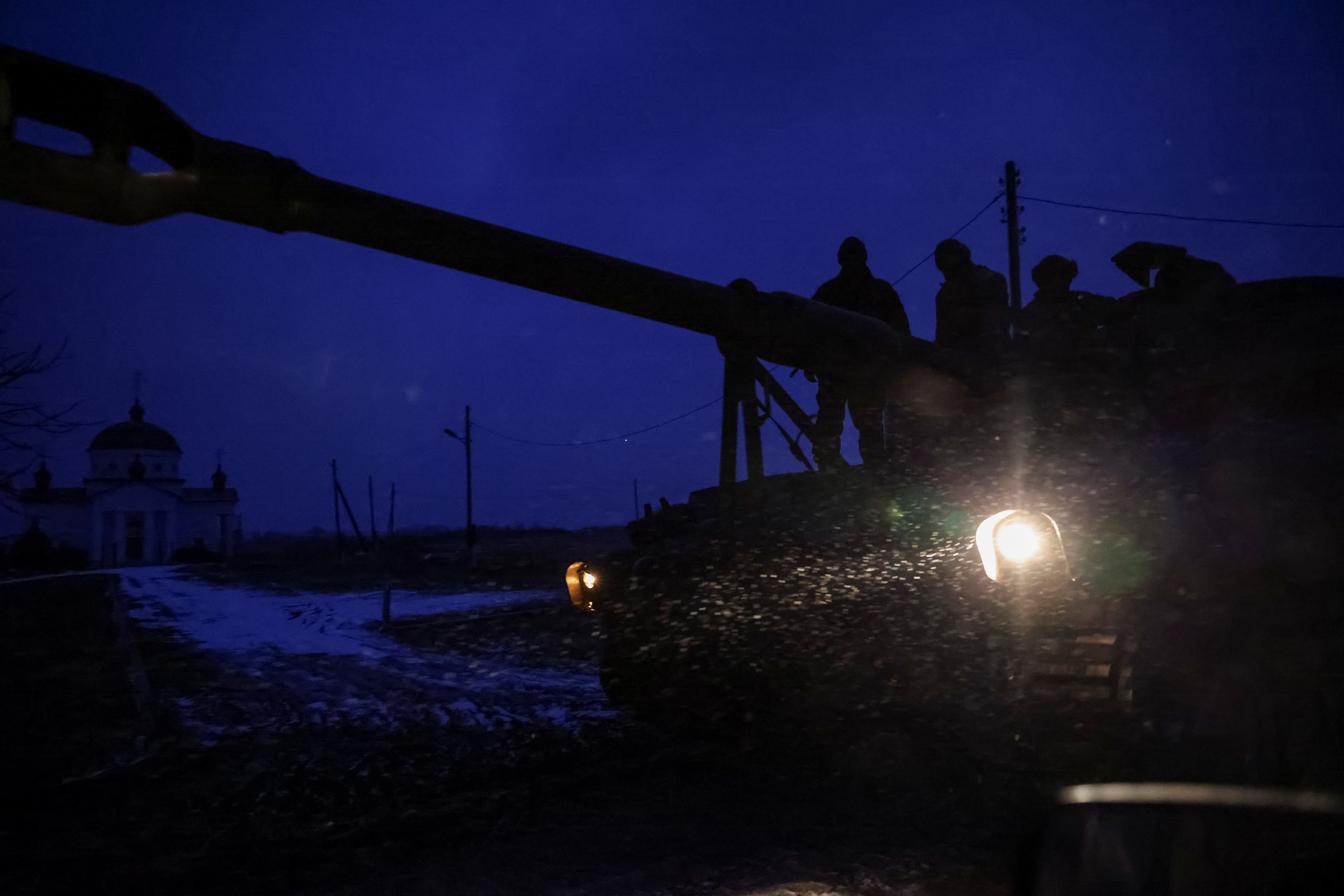
Ukrainian servicemen fire a BM-21 Grad multiple launch rocket system towards Russian positions on a frontline near the town of Marinka, amid Russia’s attack on Ukraine, in Donetsk region, Ukraine, February 7, 2023. REUTERS/Marko Djurica

Ukrainian service members ride a BMP-2 infantry fighting vehicle, as Russia’s attack on Ukraine continues, near the frontline town of Bakhmut, Donetsk region, Ukraine February 6, 2023. REUTERS/Yevhen Titov

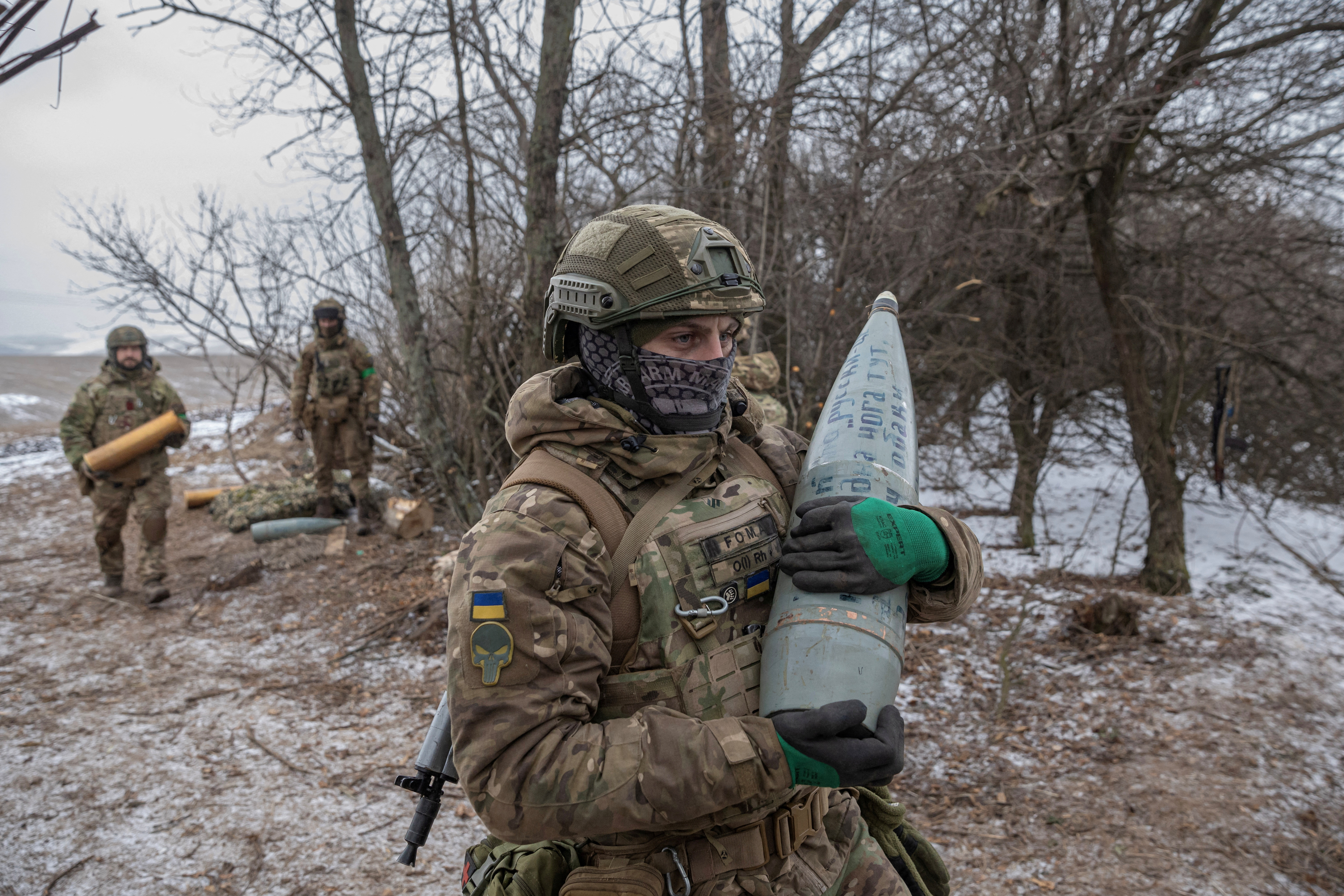
Members of the 3rd Separate Assault Brigade (Azov Unit) of the Armed Forces of Ukraine prepare to fire 152 mm howitzer 2A65 Msta-B, amid Russia’s attack on Ukraine, near Bahmut, in Donetsk region, Ukraine, February 6, 2023. REUTERS/Marko Djurica

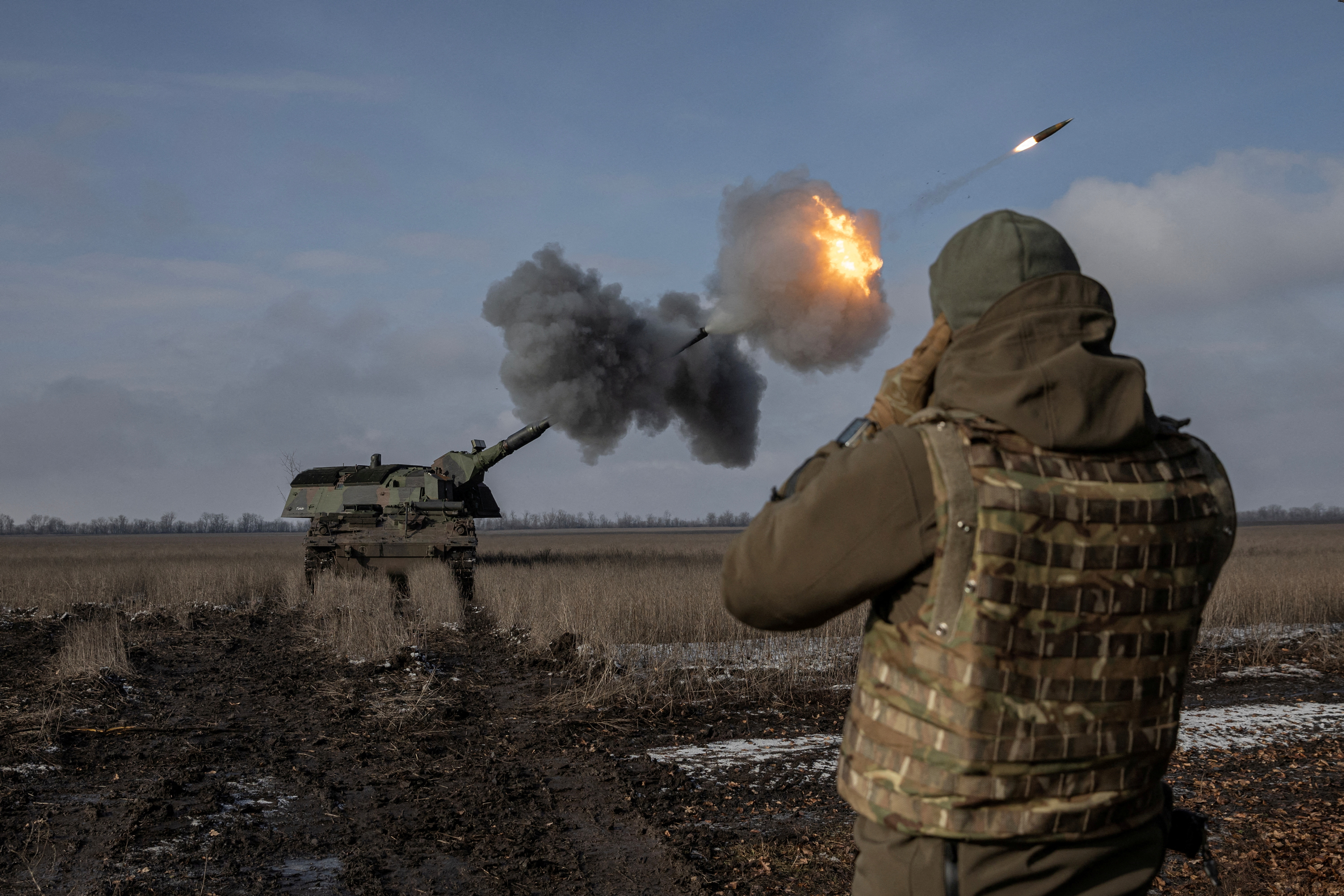
Ukrainian army from the 43rd Heavy Artillery Brigade fire the German howitzer Panzerhaubitze 2000, called Tina by the unit, amid Russia’s attack on Ukraine, near Bahmut, in Donetsk region, Ukraine, February 5, 2023. REUTERS/Marko Djurica

Ukrainian servicemen stand at a self-propelled howitzer, as Russia’s attack on Ukraine continues, near the frontline town of Toretsk, Donetsk region, Ukraine February 6, 2023. REUTERS/Yevhen Titov

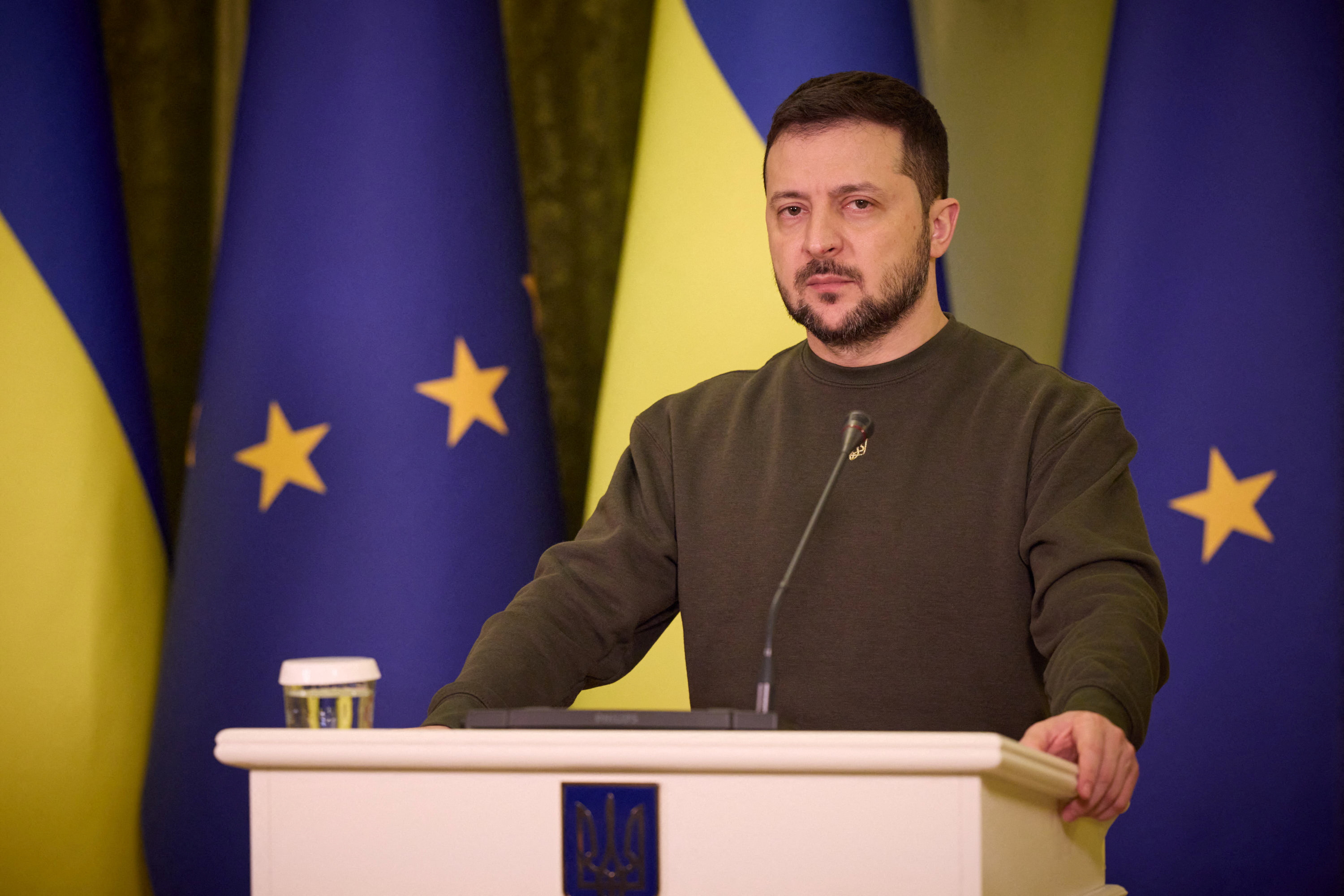
Ukraine’s President Volodymyr Zelenskiy attends a joint news briefing with European Commission President Ursula von der Leyen (not seen), as Russia’s attack on Ukraine continues, ahead of EU summit in Kyiv, Ukraine February 2, 2023. Ukrainian Presidential Press Service/Handout via REUTERS

A view shows a Russian Pantsir anti-aircraft missile system on combat duty in the course of Russia-Ukraine conflict in the Luhansk region, Russian-controlled Ukraine, January 25, 2023. REUTERS/Alexander Ermochenko

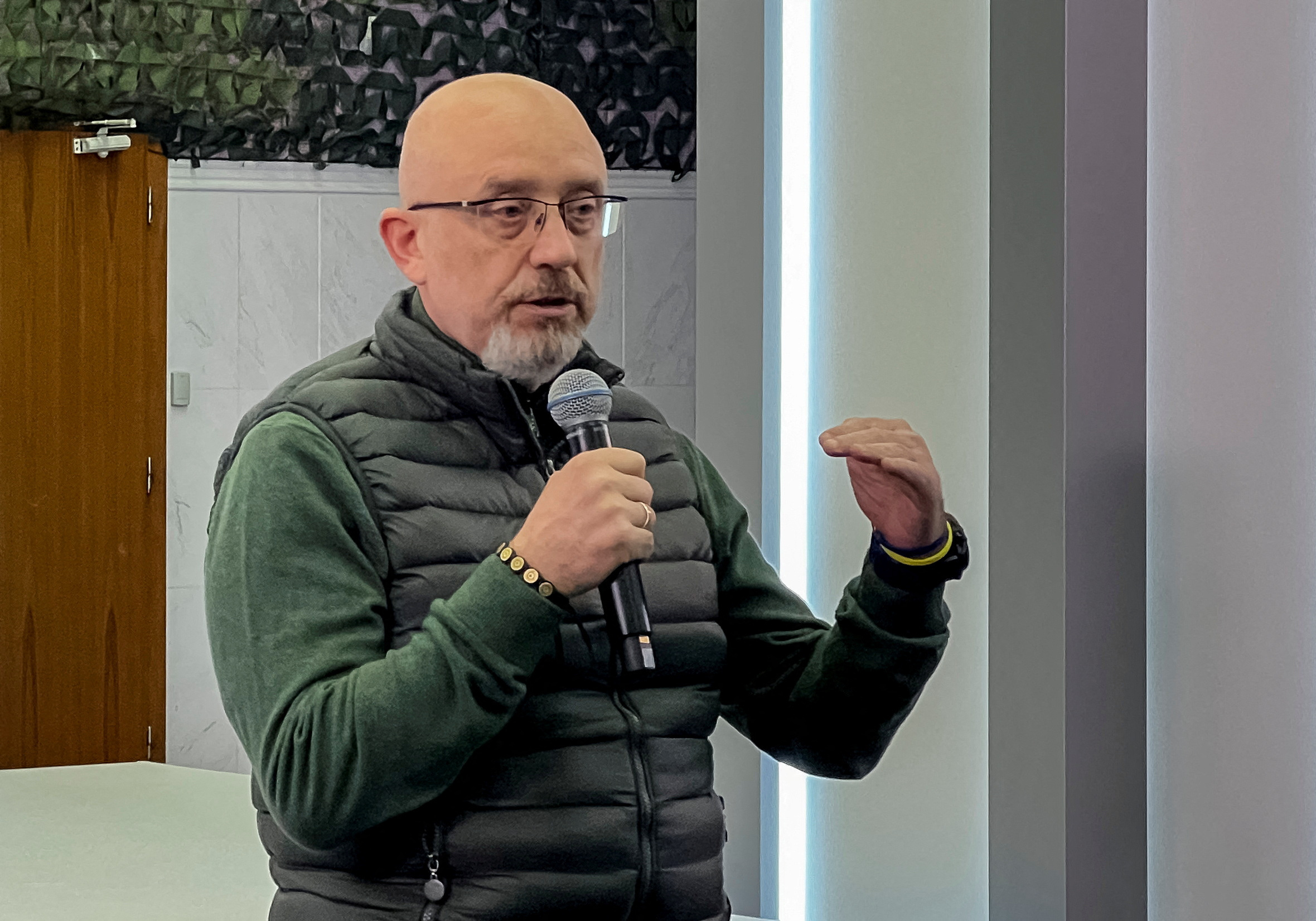
Ukrainian Defense Minister Oleksii Reznikov attends a joint news conference, as Russia’s attack on Ukraine continues, in Kyiv, Ukraine October 26, 2022. REUTERS/Max Hunder


Categories
Audio Sources - Full Text Articles

Russia: U.S. has questions to answer over Nord Stream explosions

2023-02-08T15:46:01Z

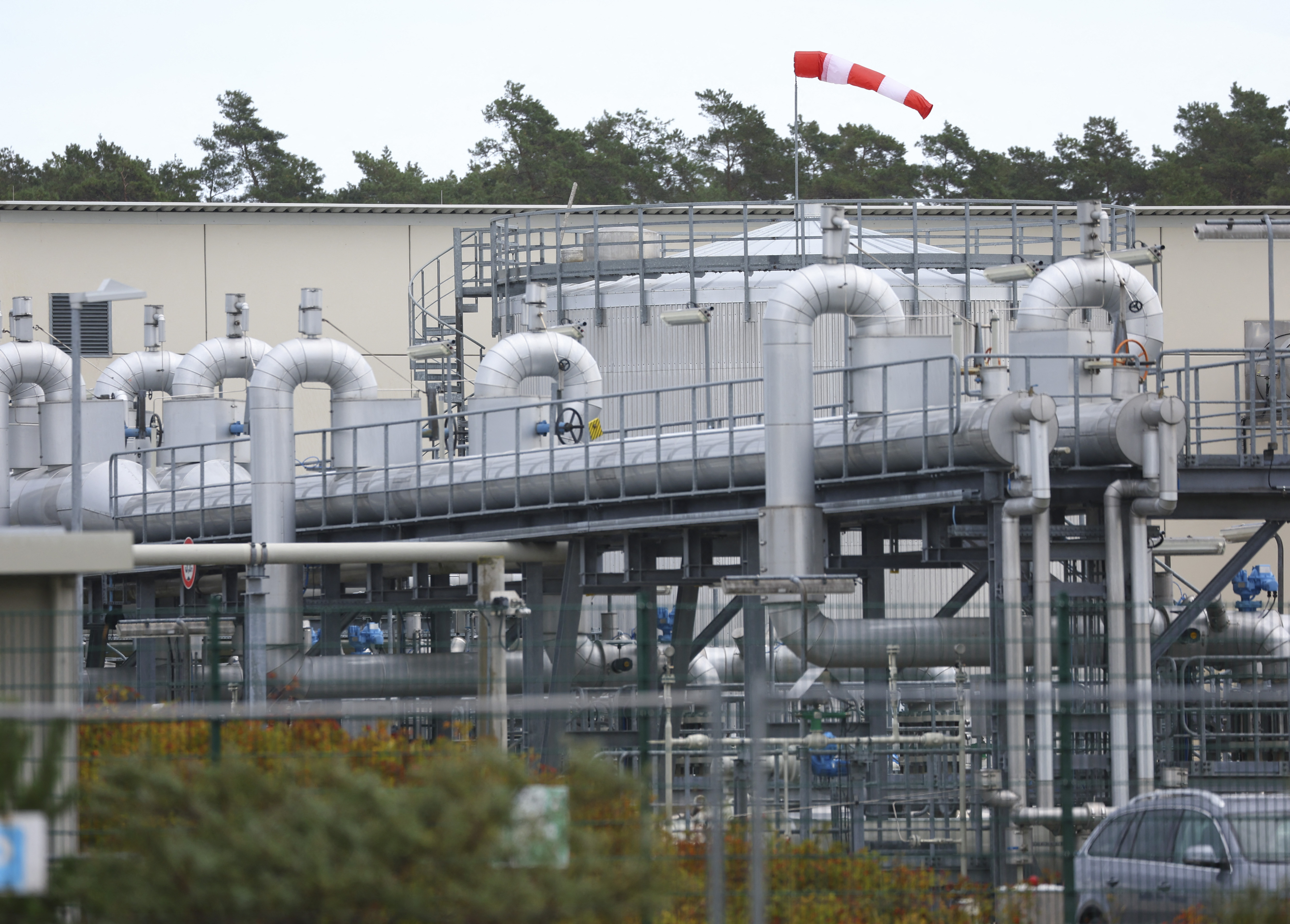
A wind gauge flutters over the landfall facility of the Baltic Sea gas pipeline Nord Stream 1 in Lubmin, Germany, September 19, 2022. REUTERS/Fabrizio Bensch

Russia’s foreign ministry said on Wednesday the United States had questions to answer over its role in explosions on the undersea Nord Stream gas pipelines last year.

Commenting on a report published earlier on Wednesday that said the United States was involved in the explosions, Russia’s Foreign Ministry spokeswoman Maria Zakharova called on the White House to comment on the “facts” that had been presented.

Reuters was unable to verify the report, published by U.S. investigative journalist Seymour Hersh on his blog, alleging U.S. involvement in the explosions.


Categories
Audio Sources - Full Text Articles

Selected Articles Review at 11 a.m. [Inoreader digest]

1636973850.png

Selected Articles Review at 11 a.m.

created by Michael Novakhov  •  Feb 08 2023

Selected Articles Review at 11 a.m. Daily
From The News And Times – https://thenewsandtimes.blogspot.com/
Current Selected Articles: https://www.inoreader.com/stream/user/1006407045/tag/user-favorites/view/html
All Current Articles: https://www.inoreader.com/stream/user/1006407045/tag/all-articles/view/html

On November 21, 2021, FBI agents acting on a court-ordered search warrant seized the personal electronic…
rferl.org 2h

Suspected Chinese spy balloon ‘likely stole nuclear intel’ in flight over missile silos  Express
“Putin in Beijing” – Google News 19h

2023-02-07T19:11:42Z U.S. Secretary of Labor Marty Walsh speaks with members of the media about railroad…
Las Vegas Shooting of 2017 – lasvegas-shooting.org 19h

2023-02-07T19:51:06Z Ukraine said on Tuesday the last 24 hours were the deadliest of the war so far for…
Las Vegas Shooting of 2017 – lasvegas-shooting.org 19h

“We cannot assume it’s ok because an officer passed vetting at the start of their career, has passed…
Times Radio 19h

Russia-Ukraine war live: Russians ‘eradicating towns’ in eastern …  msnNOW
“intelligence assessments and analysis of the Russia – Ukraine War 2022” – Google News 19h

Russia’s Military Masses Hundreds of Thousands of Troops for …  Democracy Now!
“FBI misconduct” – Google News 19h

Frenemies: US-Israel Spy Strains Emerge Over Iran  SpyTalk
“russian spies in united states” – Google News 19h

Russia pouring troops into Eastern Ukraine ahead of new offensive  The Telegraph
“intelligence assessments and analysis of the Russia – Ukraine War 2022” – Google News 19h

George Santos – latest news: Congressman expected to face House …  msnNOW
“Criminality in FBI” – Google News 19h

From Worst to Best – Anti-Money Laundering Capabilities in Latin America The latest Basel Institute…
FBI from Michael_Novakhov (35 sites) 19h

Spy balloon only a piece of China’s ‘brazen’ actions inside the US  Colorado Springs Gazette
“Christopher Wray” – Google News 19h

Russian man pleads guilty to laundering Ryuk ransomware money  BleepingComputer
ransomware – Google News 19h

FBI Whistleblower Interviewed by GOP House Committee, Top …  The Epoch Times
“Investigate the FBI Investigators” – Google News 19h

FBI from Michael_Novakhov (35 sites) 19h

Colonel Surov and Russian Links to Ortega’s Repression  Havana Times
“Counterintelligence Investigations” – Google News 19h

 Michael Novakhov’s favorite articles on InoreaderMichael Novakhov @mikenovposted at 14:37:17 UTC by Michael…
My Opinion – The News And Times 23h

COINTELPRO 2.0: How the FBI Infiltrated BLM Protests After Police …  Democracy Now!
“FBI misconduct” – Google News 23h

Headlines for February 07, 2023  Democracy Now!
“Robb Elementary Uvalde” – Google News 23h

You can unsubscribe from those emails at any time.

Inoreader. Take back control of your news feed. Follow us on Twitter and Facebook.
Innologica Ltd. 35 Akad. Boris Stefanov str., 1700 Sofia, Bulgaria

The News And Times Information Network – Blogs By Michael Novakhov – thenewsandtimes.blogspot.com
Categories
Audio Sources - Full Text Articles

Russian national pleads guilty to money laundering linked to Ryuk Ransomware operation

A Russian national pleaded guilty in the U.S. to money laundering charges linked to the Ryuk ransomware operation.

On February 7, 2023, Russian national Denis Mihaqlovic Dubnikov (30) pleaded guilty in the U.S. to one count of conspiracy to commit money laundering for the Ryuk ransomware operation.

Denis Mihaqlovic Dubnikov, 30, was arrested in Amsterdam in November 2021 and was extradited to the US in August 2022.

“According to the indictment, between at least August 2018 and August 2021, Dubnikov and his co-conspirators are alleged to have knowingly and intentionally laundered the proceeds of ransomware attacks on individuals and organizations throughout the United States and abroad.” reads the press release published by DoJ in August. “Specifically, Dubnikov and his accomplices laundered ransom payments extracted from victims of Ryuk ransomware attacks.”

The man received ransom payments from Ryuk operators and along with his co-conspirators used various financial transactions to conceal the ownership and the nature of the laundered proceeds.

According to the investigators, in July 2019, Dubnikov laundered more than $400,000 in Ryuk ransom proceeds. Individuals involved in the conspiracy laundered at least $70 million in ransom proceeds.

“Specifically, in July 2019, a United States-based company paid a 250 Bitcoin Ryuk ransom after a ransomware attack. On or about July 11, 2019, in Moscow, Russia, Dubnikov accepted 35 Bitcoin from a co-conspirator in exchange for approximately $400,000.” reads the press release. “The Bitcoin transferred to Dubnikov were directly sourced from the ransom paid by the American company. Dubnikov converted the Bitcoin to Tether and sent it to a second co-conspirator, who eventually exchanged it for Chinese Renminbi. Dubnikov’s co-conspirators laundered additional Bitcoin sourced from the original ransom payment. Dubnikov was compensated financially for his role in the scheme.”

Dubnikov will be sentenced on April 11, 2023.

Follow me on Twitter: @securityaffairs and Facebook and Mastodon

Pierluigi Paganini

(SecurityAffairs – hacking, Ryuk ransomware)

The post Russian national pleads guilty to money laundering linked to Ryuk Ransomware operation appeared first on Security Affairs.

Categories
Audio Sources - Full Text Articles

Local climate risk data could enable better decisionmaking by households and policymakers

By Jenny Schuetz, Adie Tomer, Caroline George, Joseph Kane, Julia Gill

The National Oceanic and Atmospheric Administration (NOAA) maintains a website documenting climate-related disasters that cause over $1 billion in losses. The agency lists 18 such events in 2022, including droughts and wildfires in the Southwest, floods in Kentucky and Missouri, hailstorms in the Upper Midwest, hurricanes in Florida, and tornadoes in the Southeast. The message of the data is clear: All U.S. communities will face disruptions to our daily lives from climate change, but the nature, frequency, and severity of these disruptions will vary widely across places in any given year.

While individual people and communities cannot alter the course of a hurricane or alleviate drought, there are numerous ways for them to lower their exposure to climate risk or mitigate the physical and financial impacts of climate-related events. Actions such as purchasing disaster insurance and building climate-resilient infrastructure should be part of holistic strategies to protect communities. But to take these actions, residents and their local governments first need to know what the relevant risks are. For example, while coastal Floridians know they are at a higher risk of hurricanes than their inland peers, it is much harder for them to assess the relative risk of wind damage and storm surges within their specific counties or neighborhoods. It’s similarly difficult to predict localized risks from more chronic climate stresses such as sea level rise and extreme heat.

And yet, more and higher-quality, higher-resolution data is becoming available for local assessment. At the same time, predicting the impacts of climate events on communities—damages to homes, businesses, and infrastructure—is becoming an ever more important and sophisticated part of the real estate and financial services industries. But two types of consumers who would greatly benefit from local climate risk data—households and local governments—still have limited access to this information.

In this brief, we discuss how households and local governments could use local climate risk data, explore the current availability of that data, and outline several challenges facing public and private data providers.

People and municipalities can use local climate risk data to adjust how and where they build

Providing people and local policymakers with geographic climate risk data allows them to alter their investment decisions and personal behavior in a variety of ways depending on what information they are given and their preferences and access to resources.

Take people’s housing choices. In choosing where to live and how much to pay for a home, people want to know the quality of local public schools, crime rates, proximity to parks, and the quality of local transportation. How climate change affects different neighborhoods—now and in the future—should factor into housing choices as well. A recent experiment conducted by the real estate company Redfin and a team of academic researchers found that when potential homebuyers were shown online listings disclosed to have high flood risks, they shifted their search toward lower-risk properties.

Households can respond to climate disclosures like those in the Redfin study in a variety of ways. Some may choose neighborhoods at higher elevation or decide not to live in a coastal community altogether. Others might place higher value on the lifestyle benefits of being near the ocean, but choose to rent rather than purchase a home to limit their financial risk. And awareness of local climate risks isn’t just important for people in the process of relocating. Climate risks have changed and will continue to change over time; people who bought their homes 10 years ago may not have been in areas with a high flood or fire risk at the time, but now face greater risks. Being aware of changes in climate risks helps households decide whether to purchase additional insurance, install a sump pump in the basement, or invest in stronger, wind-resistant windows, to name a few adaptive strategies.

Local governments would also benefit from greater awareness of place-specific variations in climate risk. Which bus stops, homes, and public spaces face the greatest exposure to extreme heat and would benefit from cooling features such as tree canopies or green roofs? Which neighborhoods are most likely to flood during major rain events, and how can cities use rain gardens or sewer upgrades to manage the deluge? Which roadways are the least resilient to major climate events and either need to be fortified or potentially abandoned?

The current state of local climate data needs improvement

While climate risk data has long been a part of how we plan and build American communities, older information systems are no longer fit for new climate realities. As early as 2011, a landmark publication from the National Academies of Sciences, Engineering, and Medicine called attention to the need for “widely-accepted approach[es] for conducting vulnerability assessments” and describes available data as “lacking.” Ten years later, the Government Accountability Office found that the Federal Emergency Management Agency’s flood hazard maps—which inform the National Flood Insurance Program—no longer “reflect the best available climate science or include information on current flood hazards.” Notably, many properties that do not fall inside these flood hazard zones—and therefore do not carry flood insurance—experienced flooding in large storms such as Hurricane Sandy. Recent wildfires in California and Colorado also revealed how many property insurance policies were misaligned to current risks.

Now, rapid innovations in environmental monitoring and digitized parcel data are helping public agencies, businesses, nonprofits, and community-based organizations modernize climate risk data. This data makes it possible to estimate risks of flooding, drought, wildfires, extreme heat, pollution, or coastal erosion for each parcel of land—if not each 10-square-meter coordinate—in the country. Some datasets develop metrics for specific climate risks or future emissions scenarios, while others produce indexes the general public can more easily understand. For example, the Environmental Protection Agency’s interactive mapping tool allows users to see risk levels for drought, wildfire, sea level rise, and aggregate flood risk for small neighborhoods (census block groups), as well as pollution from multiple sources. This granular data complements larger-scale data, such as the Climate Impact Lab’s county-level impact maps, which our colleagues have used to assess regional vulnerabilities in the U.S.

Improved climate risk data can result in compelling use cases for private investors and policymakers, such as granularly measuring urban heat islands, outlining climate resilience strategies for subsidized housing, developing new risk ratings to fundamentally transform the National Flood Insurance Program, estimating regional economic losses in the event of natural disasters, and tracking environmental justice burdens across disadvantaged communities. The different types of metrics and the geographic scales at which they are available offer flexibility in answering different policy or research questions. For example, while insurance firms may want to know expected damages for a given property across all climate risk categories, a county parks department may be more interested in drought and heat metrics at a neighborhood scale.

Of course, producing new, high-quality data and applications is not cheap. Environmental monitoring agencies such as NOAA will need federal funding to continue investing in equipment and staff expertise. And private data providers will need access to cash flow—whether through paying customers or outside investment—to keep updating and improving their products.

What risks do new data sources present, and how will society address them?

For all the potential benefits of more granular climate data, publishing it carries some risks.

One issue is the possibility of false certainty. Even with climate models constantly improving, emerging data sources will still have wide margins of error, particularly around predicting the most uncertain climate events, such as hurricanes. Yet it’s easy to imagine some individuals treating a single data source as gospel, even though there can be significant variation among similar data products and there is limited transparency regarding underlying analytical models. Governments and industry will need to find ways to manage uncertainty with their constituents and customers.

Another concern is how data could impact equity. America’s history of redlining offers a clear example of how mapping perceived risks can lead to disinvestment and discrimination. To the extent that climate risks overlap with racial, economic, and social characteristics, vulnerable communities could face additional barriers, such as higher property insurance rates or a lack of new infrastructure in places of need. Policymakers will need to write regulations that ensure ratings agencies, insurers, government agencies, and others are not discriminating against any people or places.

The price of data could create a barrier to adoption for public agencies, nonprofit organizations, and individuals as well. Datasets that are produced and managed by federal statistical agencies such as the Census Bureau and Bureau of Labor Statistics are made publicly available at no charge to users. But data products created by private firms are typically sold to individual subscribers such as insurance companies and credit rating agencies—often for substantial fees. Financial institutions are able and willing to pay for these services to mitigate fiduciary risk associated with climate change, but most civic organizations have tighter budgets. One example of using the data for public good comes from the nonprofit Climate Central, which has used their own proprietary data to conduct groundbreaking scientific research on flood risk in order to build global citizen awareness of climate vulnerability. The country’s wealthiest cities and counties may be inclined to spend local tax dollars to buy high-quality climate data, which could lead to wiser investments in infrastructure or the ability to counter predatory real estate practices. But it could also further exacerbate capacity differences between those wealthier communities and poorer ones that can’t afford such data.

Addressing these concerns won’t be easy, and will require experimentation. Processes like the Treasury Department’s Climate Data and Analytics Hub pilot are promising efforts. Finding the right balance between transparency and equity will require cities, states, and the real estate industry to test different approaches to implementation. Adaptation strategies that work for second-home owners in Miami may not work for low-income households in Houston’s flood-prone neighborhoods, so placing diverse voices into the policy discussion is essential.

shutterstock_1049860160.jpg?w=270
fblike20.png pinterest20.png twitter20.png email20.png rss20.png  
Categories
Audio Sources - Full Text Articles

Svitolina calls for Russians to be banned from Olympics

KYIV, Ukraine (AP) — Ukrainian tennis player and Olympic bronze medalist Elina Svitolina pushed for a total ban on Russian and Belarusian athletes from the 2024 Paris Games in an interview with The Associated Press on Wednesday.

Svitolina, who won her bronze medal in singles at the Tokyo Olympics in 2021, is visiting Ukraine for the first time since Russia invaded the country last year. She is the latest to call for a complete ban on athletes from Russia and Belarus because of the war.

“It’s going to be very sad, and the wrong message would be sent to the world if Olympics going to stay with the decision to put them (Russia and Belarus) under a neutral flag,” Svitolina said in the interview. “I don’t think this is the right decision.”

Svitolina, who had a baby with husband Gael Monfils in October, said sports and politics in Russia are inseparable.

“You can see that in Russia, sports are connected to the government,” Svitolina said.

On Friday, Ukraine’s sports minister renewed a threat to boycott the Paris Olympics if Russia and Belarus are allowed to compete and said Kyiv would lobby other nations to join.

A Ukrainian Olympic Committee meeting did not commit to a boycott but approved plans to try to persuade international sports officials in the next two months — including a discussion of a possible boycott. The leaders of Estonia, Latvia and Lithuania also urged the International Olympic Committee to ban Russia and said a boycott was a possibility.

Speakers at the Ukrainian Olympic Committee’s meeting raised concerns about Russia using the Paris Games for propaganda and noted the close ties between some athletes and the Russian military.

“Boycott would be one of the options because obviously what Russian army is doing to Ukrainian people, to Ukraine, it’s a horrible thing for us,” Svitolina said. “I cannot imagine going to the Olympics like nothing is happening to Ukraine.”

Svitolina said the decision to boycott should be discussed with the country’s Olympic committee with input from every Ukrainian athlete involved. She, however, didn’t hesitate to say what she thought was the right thing to do.

“Our men and women are at the front line right now fighting Russian soldiers and dying for our country and for our freedom as well,” Svitolina said. “And I’m very firm with my decision that boycotting is the right way to do it.”

After a month-long break, Svitolina said she is “actively preparing” to return to tennis in April. Her first visit to Ukraine marks the longest time she has been separated from her daughter.

“Of course, I want to be with her, but I have a bigger mission to do for free Ukrainian people,” said Svitolina, who came to the country as an ambassador of United 24, Ukrainian President Volodymyr Zelenskyy’s platform for collecting charitable donations.

During her brief stay, she also met Zelenskyy.

On Tuesday, Svitolina visited one of Kyiv’s maternity centers to donate a generator, needed to support the operation of the hospital. Hospitals in the country have often been disrupted by massive Russian missile attacks on Ukraine’s energy infrastructure.

She said this week’s visit triggered the feelings she felt on the first days of the invasion.

“It was extremely stressful for me. I was still playing on the tour then, competing at some tournaments. I couldn’t focus. I couldn’t live my life normally. It was a horrible time for me,” she recalled. “Visiting the maternity center really reminded me what I was going through and how strong these women are.”

Originally from Odesa, which now suffers frequent power outages because of damaged electricity infrastructure, Svitolina said Feb. 24 — the date that will mark one year since the invasion started — will forever be a tragic day for every Ukrainian.

“This is something that you would never wish your enemy to face,” Svitolina said. “It’s a very sad day.”

___

More AP Olympics: https://apnews.com/hub/2024-paris-olympic-games and https://twitter.com/AP_Sports

___

Russia-Ukraine War: https://apnews.com/hub/russia-ukraine

Categories
Audio Sources - Full Text Articles

The Proud Boys Jurors: Who Are They and Can They Be Fair?

800px-Meade_and_Prettyman_Courthouse.jpg

“I have been practicing in this district and in other districts for a long time,” said defense attorney Carmen Hernandez on Jan. 10, at the close of jury selection for five Proud Boys who are now on trial for seditious conspiracy in connection with the Jan. 6, 2021, insurrection. The case is being tried within blocks of the Capitol, the scene of the alleged crimes, in the U.S. District Court for the District of Columbia. “I have represented people charged with [using] machetes to kill [and] dismember persons,” continued Hernandez, who now represents defendant Zachary Rehl of Philadelphia. “I have never, never experienced the level of prejudice and ill-will toward a set of defendants.”

“There must be something in the water here that is new and different,” added defense lawyer J. Daniel Hull a few minutes later, representing defendant Joseph Biggs, of Ormond Beach, Florida, in the same matter. “I feel like … I’m listening to a whole race of people who … talk like Mr. Rogers, Teletubbies, or characters out of Fraggle Rock. I thought it would be bad … but I’m just really kind of amazed it’s been as bad as it is.”

Hull, Hernandez, and defense lawyers for the three other defendants were all begging U.S. District Judge Timothy J. Kelly to transfer the high-profile case to another judicial district. At least two lawyers wanted to send it to the Southern District of Florida, where lead defendant and former Proud Boy chairman Enrique Tarrio is from (Miami), while an attorney for defendant Dominic Pezzola lobbied for the Western District of New York, where Pezzola resided before his arrest (Rochester).

Hull’s ask was less fussy: “Anywhere but here.”

Do they have a point? Frankly, I don’t think so. As we’ll see, the legal standards for requiring transfer of venue are extremely high, and Judge Kelly culled the jury from a 150-person pool in a searching, two-step process that included 10 full days of individual questioning. By my tally, of the 16 ultimately seated jurors—counting four alternates—the defendants did not even lodge any objection to 11 of them, and in only one of the remaining five instances were the defendants unanimous in protesting the juror’s bias. (I do not know which of the jurors are alternates. The general practice in the D.C. courthouse is to keep that information secret—from both the jurors and the public—until the jury retires to deliberate.)

That said, I concede that, if I were a defendant, these 16 jurors—now 15, because one was excused after catching the coronavirus—would not be my dream panel. Although all sitting jurors swore they could put aside anything they’d read or heard before and decide the case solely on the evidence and the law, 13 of the 16 had heard of the Proud Boys; at least five thought the group held “far-right,” “extremist,” or “radical” views; and three of the latter associated the group with “white supremacism.” The defendants vehemently deny that the organization is—or that they are—racist, and defense lawyers frequently highlight to the jury, now that the trial is underway, that Tarrio, the group’s then-leader, self-identifies as Afro-Cuban.

Many seated jurors had also heard or read that the Proud Boys had been involved in the Capitol siege. Juror Two had heard they’d “probably had a hand in the planning of what happened and the attacking of the Capitol that day.” Juror Seven had heard something about the group “storming the Capitol”; Juror Eight remembered its members as having been “down on the Mall that day and making trouble.” Juror Ten had heard the group was involved in the “invading of the Capitol”; and Juror Fourteen had the impression that they had “basically planned this insurrection on the Hill.” Again, however, each averred that these were just “allegations” or their “impressions” from media, and all said they could decide the case based solely on the evidence introduced in court and on the law as it would be given to them by Kelly. 

Also troubling from the defense perspective were the empaneled jurors’ political leanings, as glimpsed from their extracurricular activities. Six jurors had participated in liberal-leaning protests or marches, while none mentioned conservative-leaning demonstrations. The protests included, in two cases, “women’s marches”; in two cases, “anti-gun” marches; and, in four cases, protests related to Black Lives Matter or George Floyd’s murder, which, as we’ll see, are of particular concern in this case. One sitting juror had a Black Lives Matter sign in her yard.

So let’s assess what we know about the 15 jurors against the key legal standards for juror impartiality. A careful look might well cause some readers to disagree with my conclusion that the jury is adequately impartial. The question is important because the alleged impartiality of this jury in this case—perhaps the most consequential of any Jan. 6 case brought to date—is almost certain to be an issue on appeal if any defendant is convicted.

Even before jury selection started, the defendants had collectively filed at least 16 submissions seeking to move the case out of Washington, D.C. In those submissions, the defendants raised some of the same allegations that many other Jan. 6 defendants have raised: extensive and prejudicial media coverage; bias resulting from presumptive personal trauma to D.C. residents from the event; the hearings of the House Select Committee to Investigate the January 6th Attack on the United States Capitol, which were said to have fanned the media flames and kept the events from fading from the public’s mind; the ubiquity of federal government employees in this “company town,” as Norm Pattis, co-counsel for defendant Joseph Biggs, has called it; and the district’s unusually homogeneous political hostility toward former President Donald Trump. (President Joseph Biden won 92.1 percent of votes cast in D.C. in the 2020 election.)

I have discussed these issues, including the key pertinent law, in an earlier article, and will not repeat that content here. (See “Escape From D.C.: Analyzing Jan. 6 Venue Transfer Motions.” See also “Are Jan. 6 Defendants Getting a Fair Shake From D.C. Juries? Comparing Jury and Bench Trial Outcomes.”) Suffice it to say, however, that while the Capitol insurrection was a singular and historic event, the American jury system has encountered many notorious and sensational crimes in the past without losing faith in local juries. Federal courts, for instance, allowed a D.C. jury to try the Watergate defendants; a Manhattan jury to try those charged with seditious conspiracy to bomb the World Trade Center in 1993; a Houston jury to try the Enron defendants; and a Boston jury to try the Boston Marathon bomber defendant. The latter bombing—broadcast live on television—killed three and maimed or wounded hundreds, and the defendant and his brother also murdered a police officer three days later while on the lam.

The U.S. Court of Appeals for the District of Columbia Circuit has held that a motion to change venue filed prior to jury selection should nearly always be denied, because the jury selection process will ordinarily be sufficient to weed out partiality. Still, those motions can be renewed after jury selection in the event that the process itself reveals exceptional circumstances. That’s what the defense lawyers were arguing last month: that this was one of those truly extraordinary cases. Defense attorney Pattis at one point called the voir dire “an unendurable farce,” though he later apologized for the remark.

The parties seem to agree that the key precedent at this stage is the 1961 Supreme Court ruling in Irvin v. Dowd. In that case, the Court, in a ruling by Justice Tom C. Clark, looked past the seated jurors’ professions of impartiality and overturned a conviction for failure to grant a change of venue.

That ruling sets out the key on-the-one-hand, on-the-other hand standard that governs this process. The pro-government half of the equation goes like this:

It is not required … that the jurors be totally ignorant of the facts and issues involved. In these days of swift, widespread and diverse methods of communication, an important case can be expected to arouse the interest of the public in the vicinity, and scarcely any of those best qualified to serve as jurors will not have formed some impression or opinion as to the merits of the case.

This is particularly true in criminal cases. To hold that the mere existence of any preconceived notion as to the guilt or innocence of an accused, without more, is sufficient to rebut the presumption of a prospective juror’s impartiality would be to establish an impossible standard. It is sufficient if the juror can lay aside his impression or opinion and render a verdict based on the evidence presented in court.

But the pro-defense half of the ruling was as follows. On the facts of that particular case, the court found that “the build-up of prejudice [was] clear and convincing,” and the jurors’ professions of impartiality were no longer sufficient. It wasn’t that the jurors were lying, necessarily; it was that they were likely unaware of the extent of their own unwitting bias.

 “The influence that lurks in an opinion once formed,” Justice Clark wrote, “is so persistent that it unconsciously fights detachment from the mental processes of the average man.”

The facts of Irvin v. Dowd were, indeed, exceptional. The defendant was accused of six murders in the vicinity of Evansville, Indiana. Although the judge granted a change of venue, he moved the case only to the adjoining district—a rural county of just 30,000 inhabitants. The prosecutor had issued press releases saying that the defendant had confessed to all six murders, and these had been widely amplified in the media. Newspapers further reported that the defendant, in an attempt to avoid a death sentence, had offered to plead guilty in exchange for a sentence of 99 years.

Of the originally convened pool of 430 potential jurors, 370 expressed opinions about guilt and 268 of those were excused for unshakeable views, like, “I think he should be hanged.” Another 103 were excused for conscientious objection to the death penalty, leaving so few—after hardship excusals (“deafness” or “doctors’ orders”)—that a panel of 14 was eked out with virtually no room to spare, according to Clark.

Eight of the 12 jurors finally seated in that case had expressed the view that the defendant was guilty, and one had said, “[I]t would take evidence to overcome their belief,” according to Clark.

Against that yardstick, the Proud Boys case does not seem to measure up to the defense lawyers’ rhetoric. The District of Columbia has a population of close to 700,000, compared to just 30,000 in the rural county in the Irvin case. Kelly started with a pool of 150 prospective jurors and had each of them initially respond in writing to at least 65 inquiries in a questionnaire. Kelly used their responses to winnow out people with clear hardships, manifest bias, obvious trauma from the events, relationships with parties or witnesses, and so on. 

Kelly then conducted 10 full days of questioning of the prospective jurors one-by-one in the courtroom—outside the presence of other prospective jurors. In light of their answers, lawyers were allowed to request “strikes for cause”—challenges based on bias—and Kelly granted dozens of those. After culling 45 “qualified jurors,” Kelly then had the parties exercise their peremptory challenges—meaning strikes of potential jurors for which the lawyers did not have to articulate any reason. The prosecution was given eight peremptories, the defense 12; and each side was afforded an additional two peremptories for choosing the four alternates. (The prosecution did not use two of its strikes.)

In this manner, Kelly seated 16 jurors, including four alternates. As mentioned, 11 of the 16 had not been the subject of any objection by any defendant during voir dire. One juror—to whom no objection had been lodged—contracted the coronavirus before the first day of trial and was excused before opening statements.

Before providing sketches below of the 16 final jurors, it’s necessary to explain another important challenge to seating a fair jury in this case. References to Black Lives Matter, or BLM, are an inextricable part of the Proud Boys prosecution. The Proud Boys appear to have used the terms “antifa” and “BLM” almost interchangeably in their private and public statements. In either instance they were referring to their arch enemies. From at least the summer of 2020 forward—the height of protests and riots stemming from the George Floyd murder—violent street brawling against antifa or BLM appears to have become a key Proud Boys activity, if not its raison d’être.

The case involves, for instance, proof of one particular confrontation between Proud Boys and BLM or antifa on the evening of Dec. 12, 2020. That night, after a pro-Trump rally, some Proud Boys ripped down a Black Lives Matter banner from the Asbury Methodist United Church—a historically Black church. In a video—excerpts of which have been shown to the jury—Tarrio watches approvingly as other Proud Boys burn it. (The government is introducing this vandalism to explain, among other things, why defendant Tarrio was not personally present at the Capitol on Jan. 6; he had been arrested on Jan. 4, as soon as he entered Washington, D.C., for the burning of the banner, and had been ordered to leave the city as a condition of release.)

Kelly has barred the government from identifying the burned banner as a BLM banner—the banner’s slogan is not legible from the nighttime video excerpts—or from saying that it was stolen from a church. Still, on one occasion already a witness fleetingly blurted out that it was a BLM sign that was burned, and it’s quite possible that jurors will put one and one together anyway.

Because of the frequent mentions of BLM, jurors were asked what they knew about Black Lives Matter. Every sitting juror had heard of it. That’s not surprising in a city where, in June 2020, the mayor renamed a stretch of 16th Street, in front of the White House, Black Lives Matter Plaza. In fact, she had those words painted across the entire width of the street in letters so large that they stretch two city blocks.

Most jurors expressed positive associations with BLM. As noted above, three said they’d participated in BLM rallies and one said she had a BLM sign in her yard. “They stand for equal treatment and equal justice under the law for black people, which is something that I support,” said Juror Two. Juror Seven understood BLM to be “for human rights, having equal rights with everybody else.” “It’s a movement that is focusing on systemic racial injustice and seeking to address those things and bring more attention to it,” said Juror Eleven. “Their motto is Black Lives Matter,” said Juror Eight. “As a black man, I guess I have some interest in that.”

According to my visual estimate, six of the 15 jurors are Black. I can’t confidently determine race visually, but at one point—ruling on a different issue—Kelly described nine of the 15 jurors as white—suggesting that my estimate is within a range of what the court also says.

That said, several jurors did evince some negative takes on Black Lives Matter. “It’s for obtaining equality for black people, but I don’t know if their message has been distorted,” said Juror One. Juror Four had heard that “some of the [BLM] funds were misappropriated,” and Juror Five had seen “a couple scandals about them, like not spending the money they’ve earned and their executives are buying expensive things.” Jurors Six and Nine said that, for them, “all lives matter,” which is a phrase one sometimes hears from those skeptical or critical of the movement. Juror Sixteen volunteered that BLM was something that “sort of took over Washington” and he then connected it to “regular vandalism over on my avenue.”

Here are short summaries of what emerged during voir dire about the 16 jurors finally selected for the Proud Boys case. Kelly has kept their identities secret from the public, though the attorneys know their names. Information about what they do, or did do, for a living was not always elicited during the voir dire questioning.

Juror One: White woman. She is a social media marketer and the daughter of congressional staffers. On the Proud Boys: “an organized group as opposed to people who showed up at the rally and then moved to the Capitol. … My impression is that it was just more violent intent.” She had heard of defendant Tarrio. On BLM: “It’s for obtaining equality for black people. But I don’t know if their message has been distorted.” Objections for cause: All defendants except Ethan Nordean.

Juror Two: White woman. She is an attorney in the Office of the Inspector General of the Internal Revenue Service. On the Proud Boys: “My understanding is it’s generally white supremacy and maybe some of the more far-right radical, far-right beliefs. I definitely don’t agree with them [but] they are entitled to their beliefs. … I remember hearing that they probably had a hand in the planning of what happened and the attacking of the Capitol that day.” On BLM: “They stand for equal treatment and equal justice under the law for black people which is something that I support.” She has a BLM sign in her yard. Other: She has participated in “women’s marches” and “some on gun violence. Those are my issues.” Objections for cause: All defendants except Nordean.

Juror Three: Black woman. Works for the Smithsonian’s command center operations, which she considered “sort of law enforcement.” On the Proud Boys: “I don’t recall exactly what it was.” On BLM: Went to a BLM rally in May 2020. No objections.

Juror Four: Black man. On the Proud Boys: Never heard of them. On BLM: “Some of the funds were misappropriated. It’s a movement obviously.” No objections.

Juror Five: White woman. Former legislative staff assistant at the Capitol, 2011-2013. On the Proud Boys: “I believe I read coverage of them playing a role in the incidents that occurred on January 6th. … I do believe it’s Republican leaning. And maybe “radical” … I’ve read some white supremacist connections to the Proud Boys exists.” On BLM: “Throughout June 2020 and 2021 … they were organizing in several cities and states … to support local … and national racial equity organizations. … I saw a couple scandals about them, like not spending the money they’ve earned and their executives are buying expensive things … I don’t know enough about about the organization to draw a conclusion. But the movement I do support.” Objection for cause: Defendant Joe Biggs alone objected.

Juror Six: Black woman. Manages a group home for the disabled. On the Proud Boys: Never heard of them. On BLM: “To me, all lives matter.” No objections.

Juror Seven: White man. On the Proud Boys: “The only thing that really stands out in my mind is … seeing the footage on television, storming the capitol.” On BLM: It’s “for human rights, having equal rights with everybody else. … I believe in Black Lives Matter. That I fully believe in.” Objection for cause: Defendant Rehl alone objected.

Juror Eight: Black man. Retired installer, technician, and supervisor at Verizon. On the Proud Boys: “A paramilitary group … down on the Mall that day and making trouble.” Had heard that defendant Tarrio met with Stewart Rhodes, leader of the Oath Keepers, in a parking garage prior to Jan. 6. On BLM: “Don’t know much. Just that their motto is Black Lives Matter. As a black man, I guess I have some interest in that.” No objections.

Juror Nine: Black man. On the Proud Boys: Never heard of them. On BLM: “For me, all lives matter.” Heard of BLM when “the gentleman in Minnesota died.” No objections.

Juror Ten: Black woman. Retired information technology (IT) specialist who had worked at the Library of Congress on Capitol Hill. On the Proud Boys: Heard “they had some form of helping to formulate or—maybe formulate is the wrong word—but had involvement in the invading of the Capitol.” On BLM: “It’s based on George Floyd and his case and police brutality and the efforts to bring about equal justice for minorities, particularly … African American minorities.” No objections.

Juror Eleven: White man. Attorney in the D.C. Office of Administrative Hearings. On the Proud Boys: “I associate the Proud Boys with a more conservative movement [and] libertarian thought. … I’m sure there are a lot of things I might disagree with, but, bottom line, I just don’t know enough … to really have strong opinions.” On BLM: A movement “stemming from police brutality against black individuals, so … focusing on systemic racial injustice and seeking to address those things and bring more attention to it.” He participated in a BLM rally through his church. Other: “I’ve shifted on the political spectrum over the years.” He listens to “CNN and Fox to be exposed to all viewpoints … I have family backgrounds on my side and my wife’s side on different ends of the political spectrum.” No objections.

Juror Twelve: White woman. Student at George Washington University studying applied economics and currently working as a data consultant. On the Proud Boys: “My only understanding is its connection to white supremacy.” On BLM: “It intends to put a focus on the inherent value of the lives of black people in light of, historically, black lives mattering less than others.” Other: Participated in a protest in D.C. after the death of George Floyd. Objections for cause: All defendants.

Juror Thirteen: EXCUSED ON FIRST DAY OF TRIAL DUE TO COVID-19. White woman. Project management adviser at the Pan American Health Organization. On the Proud Boys: “Very conservative group. … might have played a role in inciting some of the violence that occurred. … From what I read or heard … they played a very … specific role in what was happening.” On BLM: “I live in D.C., right. So there’s … a lot going on, right, in the last year or so. Police violence … targeting, profiling.” No objections. 

Juror Fourteen: White man. Lobbyist for the American Geophysical Union. On the Proud Boys: They “are labeled as an extreme, like, far-right organization. … There’s allegations that they, like, basically planned this insurrection on the Hill.” On BLM: “An organization that is trying to highlight the discrimination against people of color especially with relations to police interactions.” No objections.

Juror Fifteen: White woman. Communications associate at Population Action International, a nonprofit specializing in reproductive health. On the Proud Boys: “Don’t know much. … Would say they disagree with me on most things.” On BLM: Generally aware of “their work following certain instances of police brutality … I’ve also heard of fragmentation within the organization. … Some calling out leaders … for ‘hypocrisy.’” Other: Attended a women’s march and a protest following George Floyd’s murder. “I assume [BLM] had something to do with” the latter. No objections.

Juror Sixteen: White man. CEO of membership organization relating to health IT and patient records. Married to an attorney in the Office of the Comptroller of the Currency. Proud Boys: They have fairly strong opinions [from] a conservative point of view … I disagree [with those views].” … They were “alleged to have been involved in the January 6th event.” BLM: “That was something that sort of took over Washington … that was another situation where there was regular vandalism over on my avenue.” Other: “I have an opinion about firearms … and I personally do not support them.” No objection.

Two final observations about the jury and the defense challenges to it. First, the political affiliation of the jurors is not in the record. The attorneys know the jurors’ identities, however, and voting registration—to the extent a juror chooses to align with a party—is public information.

 Sabino Jauregui, an attorney for defendant Tarrio, alleged in argument last month before Kelly that “every juror is a Democrat.” Assistant U.S. Attorney Erik Kenerson pushed back on that claim, stressing that party affiliation is not in the record and noting that when Juror Five worked as a legislative aide, she did so for Republican members of Congress.

Legally, it’s unclear whether party affiliation is relevant to jury selection. In the Watergate case referenced earlier, five of the six judges on the en banc panel expressed caustic skepticism “that voting patterns are at all relevant to venue.” The sixth judge, however, would have reversed those convictions based on failure to move the trial to another district, citing, among many other factors, Washington’s “overwhelming concentration of supporters of the Democratic Party.”

Last month, in denying the defendants’ motions to transfer venue, Kelly stressed he had effectively inquired about the jurors’ “political valence” on his questionnaire, by inquiring whether they had such strong feelings about the 2020 election that they couldn’t be fair. “From my memory,” he said, there were “very few potential jurors who indicated that they felt so strong[ly] about the election that that was something we had to probe further.”

The final point relates to the defense argument that jurors must not be taken at their word in this case when they profess an ability to be fair. In response to that contention, Kelly stressed—and the record confirms—that he did not just take jurors at their word. “There were occasions where someone said … they could [be fair] and I struck them anyway. So it wasn’t a situation where just a person mouthing the words was convincing to me that they could be fair.”

On jury selection matters, the U.S. Supreme Court has accorded trial judges extraordinary leeway in assessing the impartiality of jurors. As Justice Clarence Thomas wrote for the Court less than a year ago in the Boston Marathon bomber case:

We have repeatedly said that jury selection falls “‘particularly within the province of the trial judge.’” … That is so because a trial “judge’s appraisal is ordinarily influenced by a host of factors impossible to capture fully in the record,” such as a “prospective juror’s inflection, sincerity, demeanor, candor, body language, and apprehension of duty.”

Given the legal standards laid out in Irvin v. Dowd and the long-standing deference to the trial judge in matters of jury selection, Kelly’s refusal to transfer venue in the Proud Boys case seems within his discretion. 

While it’s easy to understand why defendants would prefer to be tried on their home turf, that’s never been a consideration entitled to any weight at all. The Constitution contemplates that defendants will generally be tried in the state and district where the alleged crime occurred. The mere fact that a juror has been exposed to media coverage of a spectacular and infamous crime is not disqualifying. On the contrary, “those best qualified to serve as jurors” most likely will have been so exposed, the Supreme Court has recognized. The question is whether those individuals can put their preconceptions aside. Kelly has, after questioning each juror at length, concluded that these jurors can. Accordingly, he has empaneled a jury that seems to pass muster under all controlling precedents.

Categories
Audio Sources - Full Text Articles

We tried the AI-powered version of Microsoft Bing. Its huge, user-friendly search box and detailed responses make it so much better than Google.

Microsoft Bing search engine in pictured on a monitor in the Bing Experience Lounge during an event introducing a new AI-powered Microsoft Bing and Edge at Microsoft in Redmond, Washington on February 7, 2023.Microsoft’s AI-powered Bing being introduced during an event.

Jason Redmond/AFP via Getty Images

  • Microsoft announced the integration of an AI language tool into its search engine Bing. 
  • The news came amid a race between Microsoft and Google to compete against OpenAI’s ChatGPT. 
  • Insider gave Bing a try and its highly personalized answers won us over. 

Microsoft has unveiled an AI-powered version of its Bing search engine, intensifying its rivalry with Google, which on Monday announced its own AI chatbot, Bard. 

“The race starts today,” Microsoft CEO Satya Nadella said on Tuesday at an event announcing the launch.

Google has dominated the search engine space for the last two decades. It accounts for around 93% of the global search engine market, compared with around 3% for Bing, according to Statcounter, a web analytics service.

But if Microsoft’s multi-billion bet in OpenAI pays off, the new Bing search engine could knock Google from its perch.

Insider gave Bing a try. Here are our first impressions:

Huge search box

We were impressed straight away by the large search box in Bing, which included a prompt to “ask me anything.”

Compared with the one-line search box that Google offers, where sometimes you’re unsure whether you’ve made any typos or repeated a word, Bing allows you to see all of the 1,000 characters of your request. 

Its layout is very minimalist and feels more accessible than Google’s interface.

There’s a waitlist to access the feature but you can get to the front of the line by making Microsoft your default browser and downloading the mobile app on your phone. Insider gained access to it. 

We used one of the three suggested questions it offered and asked, “I am planning a trip for our anniversary in September. What are some places we can go that are within a 3-hour flight from London Heathrow?”

Screenshot of Microsoft's new AI tool integrated into Bing responding to the question: "I am planning a trip for our anniversary in September. What are some places we can go that are within a 3 hour flight from London Heathrow?"Screenshot of the new version of Bing responding to one of Insider’s questions.

Microsoft

The AI congratulated us on the anniversary and said: “There are many places you can go that are within a 3-hour flight from London Heathrow. Here are some suggestions based on your preferences and the best destinations in Europe in September.”

It suggested going to either Spain, France, or Italy, and gave reasons as to why we might want to go there. These included beaches, mountains, or art and history. 

Bye boring blank homepage

Another feature that surpasses Google is the search engine’s homepage background, giving you a default visual without the user having to customize it.

At time of publication, the default backdrop was a panorama of mountains with a pinkish sky.   

If you use Google, you will need to go and change the setting yourself. 

Button for AI tools

To help users make the most of its newly integrated AI skillset, Bing now features a button in the upper-right corner that lists a selection of writing tools.

The new features allow users to generate texts based on tone. There are five options, including “professional,” “casual,” and “enthusiastic.” You can also specify the length and format of the text to be generated.

Highly personalized answers 

Bing’s answer to our question, while generic, felt more personalized than Google’s response when we asked it the same question. 

In its response, the first link Google suggested was: “10 Short Flights from the UK to Somewhere Hot.” When we clicked, it took us to a blog post about exactly that – but it didn’t feel as helpful as Bing. 

Bing gave us three destinations, which was the perfect amount of suggestions as it didn’t require us to do a lot of sifting through the options.

Microsoft’s search engine felt like we had our own personal assistant somehow. Its response was tailored and detailed. Unlike Google, which would have required us to do some digging, Bing seemed more helpful.

It did, however, play it safe by suggesting destinations based on our preferences. It could have added a destination we were not familiar with or wouldn’t have thought about in the first place. 

Bing’s response also appeared to back up everything it suggested by hyperlinking to websites that it got the information from. It also added a footnote, much like you would see in academic writing. 

Overall, Bing’s highly tailored search suggestions and its huge user-friendly search box won us over. We think it’ll prove difficult for Google to compete against those points unless it implements changes to its one-line search bar. 

Read the original article on Business Insider
Categories
Audio Sources - Full Text Articles

Why these absurd red boots are suddenly all over TikTok and Twitter — and listing for as much as $1,000 on StockX

MSCHF big red bootThe MSCHF “Big Red Boot” will release on February 16.

Garrett Bruce

  • MSCHF’s oversized big red boots, releasing on February 16, have taken social media by storm.
  • The shoes are drawing comparisons to shoes seen on fictional cartoon characters like Astro Boy.
  • MSCHF, founded in 2016, is known for creating art concepts that poke fun at facets of everyday life.

Even if you’ve never heard of MSCHF, chances are you have come across many of their wacky sneaker and miscellaneous art concepts in the past. 

The latest viral release from the company is their “Big Red Boot,” which goes on sale February 16 for $350. The shoes are expected to fetch a sizable premium on resale markets. Prices on StockX are already well over $1,000, though asking prices should come down after release.

The shoes are drawing comparisons to footwear seen on fictional cartoon characters like Astro Boy or Boots from Dora The Explorer. In a release describing the boots, MSCHF said the boots were made of TPUrubber shell, EVA foam,  along with ‘Red’ and ‘Big.’ MSCHF calls these shoes “Cartoon boots for a Cool 3D World.” The release notes: “If you kick someone in these boots they go BOING!” 

@nicekicks MSCHF’s newest shoe is straight out of a cartoon! 🤯🔴 #mschf #sneakers #mschfsneakers ♬ original sound – nicekicks.com


MSCHF was founded by CEO Gabriel Whaley, a former BuzzFeed employee, in 2016. Its ethos since launch has seemingly been to make fun of everything its creators can think of a concept for.


Sarah Snyder in front of NYPD car in MSCHF bootsMSCHF commissioned a photo shoot with model Sarah Snyder.

Garrett Bruce

The latest release from MSCHF is timed with New York’s Fashion Week, and the company plays into a high-fashion theme with a photo shoot with model Sarah Snyder wearing the boots in various spots around the city. The absurdity of these boots calls to mind extreme puffy coats, accessories like Jacquemus’s comically tiny purse and Balenciaga’s $1,795 trash bag pouch, as well as cartoon character attire. 

“Our perspective is everything is funny in a nihilistic sort of way,” Whaley told Insider in a 2021 interview. “We’re not here to make the world a better place. We’re making light of how much everything sucks.”

Including boots, apparently. In the release, the company says: “You never design shoes to be shaped like feet. Big Red Boots are REALLY not shaped like feet, but they are EXTREMELY shaped like boots.” 

The response online has been predictably polarizing and prolific. 

—𝙿𝚊𝚛𝚊𝚗𝚘𝚒𝚊. (@luigihatesyou) February 6, 2023


Many of the brand’s previous artwork and retail releases have also gone viral. In 2019, MSCHF debuted custom Air Max 97 “Jesus shoes” that the company said were filled with 60 cc of holy water sourced from the River Jordan, according to a Hypebeast.

—Hotep Steve Martin (@VayaConDiosBruh) February 6, 2023

MSCHF again used Nike’s Air Max 97 silhouette to create “Satan Shoes” in 2021, in partnership with rapper Lil Nas X. The sneakers featured drops of real human blood from members of the art collective.

“We love to sacrifice for our art,” A MSCHF spokesperson told CNN at the time. 

—Matthew Welty (@MatthewJWelty) February 7, 2023

Nike later sued MSCHF, citing trademark infringement, forcing MSCHF to recall all of the shoes it shipped out to customers. 

MSCHF’s meme-worthy art interpretations additionally expand beyond footwear. In December, the brand debuted an ATM with a visual leaderboard of everyone’s bank accounts. MSCHF also recently created a cologne it says smells just like WD-40.

Read the original article on Business Insider
WP Radio
WP Radio
OFFLINE LIVE