Categories
Audio Sources - Full Text Articles

COP27: Multi-lateral lenders have failed poorest over climate – Commonwealth head

2022-11-17T09:02:23Z

The world’s multi-lateral banks have “demonstrably failed” low and middle income countries when climate disasters hit and need to better assess their vulnerability and resilience when offering support, the head of the Commonwealth told Reuters.

Pressure on development finance institutions such as the World Bank has grown over the last year amid concern not enough money was being funnelled to developing countries to help them prepare for and withstand the impacts of global warming.

U.S. climate envoy John Kerry said in a side event at the COP27 climate talks in Egypt on Tuesday that he wanted a plan to reform the lending practices of the banks to be ready by early next year.

As secretary general of the Commonwealth, a voluntary association of 56 countries that evolved out of the British Empire, Patricia Scotland said the current global financial architecture was not fit for purpose.

“We have to think again; we cannot continue with the old structure because the old structure has demonstrably failed,” she said, calling for a greater focus on the link between climate change and debt levels.

While in the past, fiscal prudence was seen as the best way to manage and grow a country’s economy, thereby meeting the needs of the people, climate change had upended the calculation.

“You could have been as prudential as you wished. You could have been as fiscally tight as you wanted. Go tell that to the hurricane. When the hurricane hits you and takes away 226% of your GDP and you go from a middle income country to a no income country, that’s got nothing to do with fiscal rectitude.”

The Commonwealth, which emerged after World War Two, presents itself as a partnership of equals.

To help better assess the vulnerability of countries to shocks including climate disasters, the Commonwealth had created the Universal Vulnerability Index, Scotland said, urging the World Bank and others to use it in their decision-making.

Rather than assessing a country’s state of development, and any likely financial assistance, through the lens of Gross Domestic Product, Scotland cited recent destructive flooding in Pakistan as an example of why it was important to factor in climate vulnerability as well.

“Many of the middle income countries are acutely vulnerable to climate, and Pakistan… (is) an example of that.

“Pakistan would be considered too big, too prosperous. It has 172 countries underneath it (in terms of economic output), but it’s the fifth most vulnerable to climate; and that middle income status did not protect them from the monsoons.”

“It didn’t protect them, and it didn’t protect the people who died either. So we have to think again.”

Categories
Audio Sources - Full Text Articles

Analysis: Unmasked and in charge, China“s Xi puts personal diplomacy back in play

2022-11-17T09:18:37Z

President Xi Jinping, conspicuously absent from the main stage of diplomacy during China’s COVID isolation, has been mostly smiles and handshakes on his return this week with a flurry of meetings that Beijing hopes will begin to mend frayed relations.

But in an exchange that went viral, a mask-less Xi was also captured on-camera giving Canadian Prime Minister Justin Trudeau a dressing-down at the Group of 20 (G20) summit over media leaks, apparently from their bilateral meeting a day previously. It was a rare, candid glimpse of the Chinese leader and a reminder of Beijing’s testy relations with the West.

China’s absence from face-to-face interactions during the pandemic has been costly, diplomats and other experts say, as ties with the United States and some Asian neighbours have badly deteriorated over a range of disputes.

With other leaders having so little recent access to top Chinese officials, Xi’s presence this week on the Indonesian island of Bali for the G20 followed by an APEC summit in Bangkok is magnified by its scarcity value.

The resumption of dialogue, including Xi’s first meeting with Joe Biden as U.S. president and the first direct talks with an Australian leader since 2016, is itself a positive, China-watchers said, even if it doesn’t immediately yield concrete results.

Besides Biden, Trudeau and Australia’s Anthony Albanese, Xi also met the leaders of South Korea, Italy, Argentina, Holland and France for bilateral talks in Bali. A meeting with Britain’s Rishi Sunak was cancelled because of scheduling issues, Downing Street said, while Xi is set to hold talks with Japan’s Fumio Kishida amd New Zealand’s Jacinda Ardern in Bangkok.

Leif-Eric Easley, a professor of international studies at Ewha University in Seoul, described Xi’s busy schedule as a “charm offensive” after China shut its borders for nearly three years and after Xi consolidated power last month by clinching a third term at the ruling Communist Party’s congress.

“The meetings are probably not enough to make progress on thorny economic and security issues but could prevent diplomatic relations from getting worse,” Easley said.

Xi’s week has been headlined by his three-hour session with Biden, which showed signs of a thaw in frosty bilateral relations and led to plans for U.S. Secretary of State Antony Blinken to visit Beijing early next year.

Daniel Russel, the top U.S. diplomat for East Asia under former President Barack Obama, said signs China might be willing to take preliminary steps toward cooperation on some global issues “should be treated as an experiment, not a done deal.”

And while Biden returned to Washington after the G20 and is to be represented at the APEC meeting by Vice President Kamala Harris, Xi is participating in both events, which are taking place in a region that China considers its backyard.

Ja Ian Chong, a political scientist at the National University of Singapore, said other leaders this week were trying to gauge the state of their China relationships, “especially now that the system is much less accessible and a lot more opaque than it was before.”

Xi was ferried around Bali in his own Hongqi (Red Flag) limousine – Mao Zedong used an earlier model – China’s version of the U.S. presidential “Beast” limo.

Unlike Biden, Xi even attended the G20 group dinner, after skipping the ceremonial meal during a September summit of a regional security group in central Asia that was his only other trip abroad during the COVID era.

For China, the outreach is an opportunity to retake initiative
in an increasingly heated competition for influence with the United States, whose assertiveness in the Pacific through its support for Taiwan and its AUKUS partnership with Australia and Britain has increasingly alarmed Beijing.

China is also squeezed by U.S. efforts to cut it off from advanced semiconductor technology, prompting Xi to speak out against “decoupling” and the politicisation of economic and trade issues with Prime Minister Mark Rutte of the Netherlands, home to chip equipment giant ASML.

“It’s in China’s interest to pick away at the United States’ partners as much as possible,” said Masafumi Iida, fellow at the National Institute for Defence Studies in Japan.

“That thinking shows in the way Xi has held summits with Australia’s Albanese and South Korea’s Yoon (Suk-yeol), in hopes to forge better relationships with them,” he said.

Returning to in-person diplomacy also gives Xi a platform to push Chinese initiatives that further cement its stature as leader of the emerging world. He made a plug for his Belt & Road Initiative in his session with Argentina’s Alberto Fernandez.

Domestically, where COVID outbreaks are resurgent and where Xi’s decade in power has been increasingly authoritarian, the week of summit meetings conveys global stature and a sense of normalcy, although coverage is limited mostly to state media.

Before COVID, Xi was an enthusiastic practitioner of in-person diplomacy as China expanded its presence on the world stage through initiatives such as Belt & Road, generating goodwill in particular among developing countries, whose leaders were honoured with a one-on-one meeting and photos with Xi.

Li Mingjiang, associate professor of international relations at Singapore’s S. Rajaratnam School of International Studies said perceived pressure in Beijing from Washington’s global assertiveness may have been “extra incentive” to hurry back.

“I think in the coming years you’ll see China indeed making a serious effort to implement its major power diplomacy,” he said.

Related Galleries:
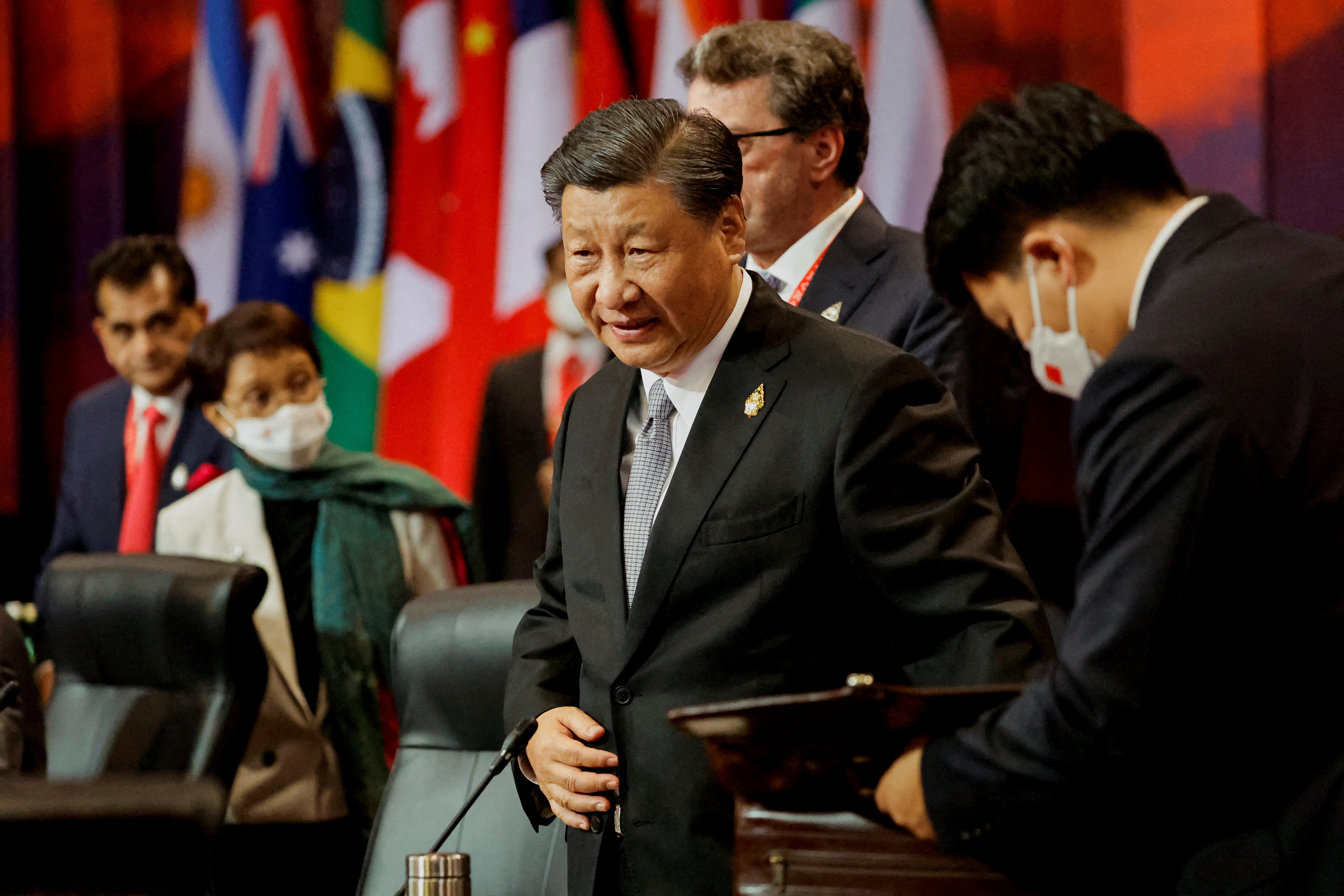
China’s President Xi Jinping attends a session during the G20 Leaders’ Summit, in Nusa Dua, Bali, Indonesia, November 16, 2022. REUTERS/Willy Kurniawan/Pool

Chinese President Xi Jinping and his wife Peng Liyuan arrive at Ngurah Rai International Airport ahead of the G20 Summit in Bali, Indonesia November 14, 2022. REUTERS/Ajeng Dinar Ulfiana/Pool

Categories
Audio Sources - Full Text Articles

Next Hot Spot? Dnipro River Crossing at Nova Kakhovka

000_32nc8dr.jpg

As Kyiv and Moscow redeploy forces and seek new objectives following the Armed Forces of Ukraine’s (AFU) liberation of the city of Kherson last week, a hydroelectric dam and the towns around it are already a new focus for fighting and, possibly, the scene of a surprise AFU crossing of the Dnipro River.

The main road and rail link across the Dnipro inside Kherson city was blown up by Russian Federation (RF) military engineers, who on Friday, Nov. 11 used det charges to drop multiple spans of the Soviet-era Antonovsky bridge into the 700-meter wide river. The controlled explosions took place early in the morning after the last thousands of retreating RF troops completed a total withdrawal from defensive positions on the northern, right bank of the river.

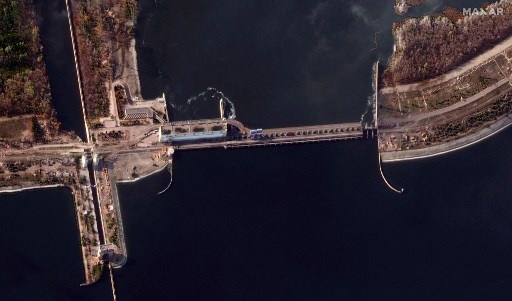
But Nova Kakhovka Hydroelectric Station’s causeway, some 50 km to the north-east, and upstream of Kherson, suffered comparatively little damage. Russian demolition teams there blew up three bridge spans near the right-bank village of Vesele but otherwise left the rest of the bridge, and all of the reinforced concrete and packed earth causeway on either side, effectively intact.

Images published by the U.S. satellite imagery firm Maxis on Nov. 11 showed a 45-meter gap which, on Nov. 16, a British Defence Intelligence update said made the dam impassible to all traffic. The nearest road and rail link over the Dnipro still standing is in Zaporizhzhia, some 180 km. further upstream.

For an offensively-minded AFU looking to move south and press its attack against retreating RF forces, officers in the southern sector told Kyiv Post that the Nova Kakhovka causeway has possibly become the most critical terrain, right now, along the entire fighting front in Ukraine. The AFU is well-equipped with assault bridges and construction engineers, they said, so if the Ukrainian army were to take control of the immediate vicinity, and push the Russians out, the gap could be spanned in hours.

The AFU has slapped a blanket ban on news reports from the region, citing a need to protect the security of ongoing operations. A Nov. 15 statement from the AFU’s Joint Forces South (JFS) confirmed strikes were in progress and that the AFU’s main objectives at present are the destruction of RF troops and ammunition depots. There was no mention of river crossings or ground fighting around Nova Kakhovka.

The RF-supporting CGTN television channel reported Nova Kakhovka is “the new epicenter” of the front and that shelling is constant, while the Moscow state-run RIA Novosti agency, on the morning of Nov. 15, published images of a masked soldier informing that Nova Kakhovka is absolutely quiet, power supplies are stable, and that shops are open. This was contradicted by the local news aggregator Nova Kakhovka City, which reported two precision AFU strikes in a forest near the city, destroying two RF ammunition bases.

According to social media accounts from local residents, small numbers of Russian troops remained in Nova Kakhovka after the bridge was blown up, but it did not seem like they were planning to stay. The blogger #novakakhovka_ua reported RF conscripts were searching for civilian automobiles to escape, that the city was mostly empty of RF troops, and that shellfire was continuous.

Multiple images appeared in Ukrainian social media on Nov. 16 of Nova Kakhovka town hall and a Russian flag purportedly torn down from the building’s flag pole, as well as unconfirmed accounts of AFU reconnaissance troops on the outskirts of the city. Some posters speculated Ukrainian troops were not just patrolling but had taken control of both ends of the causeway, and that RF forces in the vicinity were retreating. There was no official confirmation of this.

Anatoliy Shariy, a pro-Russia blogger with a reported 1.8 million followers likewise predicted in a Nov. 15 Telegram post a gradual but unstoppable Ukrainian military push across the Dnipro River to capture the crossing and liberate major cities to the South: “We (RF citizens) know the tradition. If they (the AFU) don’t take it with a fight today, they’ll take it without a fight tomorrow…The fate of these places is sealed. Kakhovka, Nova Kakhovka, in the other direction Berdyansk (the UAF advantage) is very powerful and soon, Melitopol.”

The post Next Hot Spot? Dnipro River Crossing at Nova Kakhovka appeared first on Kyiv Post.

Categories
Audio Sources - Full Text Articles

Netherlands to Announce Ruling on MH17 Case Today

1817029.jpg

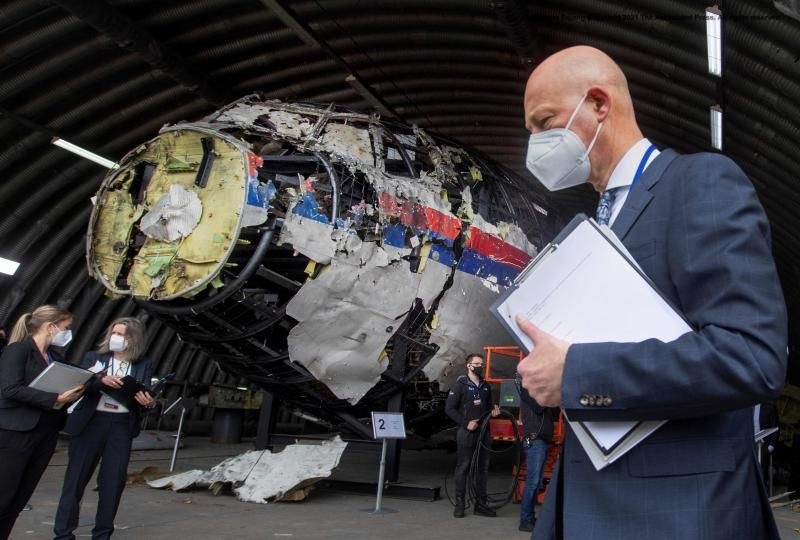
The Hague District Court at 14.30 (15.30 Kyiv time) will announce its decision in the case of the Malaysian Airlines flight MH17, which was shot down on July 17, 2014 in the sky over Ukrainian Donbas, flying from Amsterdam to Kuala Lumpur.

The trial went on for over two and a half years, starting on March 9, 2020. How long the announcement will take is unknown. “The court will announce the decision orally in open session, briefly explaining how they came to the ruling. The start is scheduled for 14.30, however, how long the announcement of the decision will last is unknown. The hearing will take place in the same way as all other hearing days, in the courtroom, where it is possible to broadcast live, a temporary press center has been set up for the press,” the court told Interfax-Ukraine on the eve of the meeting.

It is expected that relatives and friends of the victims from ten countries will come to make a decision – citizens of the Netherlands (two-thirds), Malaysia, Australia, Indonesia, Great Britain, Belgium, Germany, the Philippines, Canada and New Zealand died in the tragedy. According to media reports, about 40 people arrived from Australia alone. A lot of media interest is also expected.

The post Netherlands to Announce Ruling on MH17 Case Today appeared first on Kyiv Post.

WP Radio
WP Radio
OFFLINE LIVE