Categories
Audio Sources - Full Text Articles

Ukraine Spillover Fears Dominate G7 Ministers’ Meet

000_32n43a9.jpg

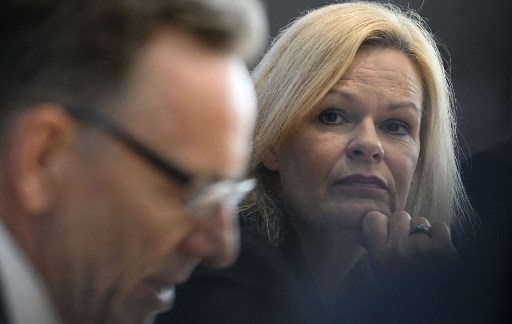
The fallout from Russia’s war in Ukraine and fears that the conflict could spill over into other countries dominated a gathering of G7 interior ministers in Germany on Thursday, Nov. 17.

German Interior Minister Nancy Faeser, who was hosting the two-day meeting of the club of rich nations, said the conflict was “currently the greatest threat” to security, after an apparently accidental missile blast killed two people in Poland on Tuesday.

Kyiv’s allies have raced to calm fears of an escalation in the war, saying the explosion was likely caused by a Ukrainian air defence missile — while stressing Moscow was ultimately to blame for starting the conflict.

The war “has massive consequences in all our countries”, Faeser told reporters as she arrived for the talks at Eberbach Abbey, nestled in the wine hills of the western town of Eltville.

“We want to strengthen our cooperation again and make concrete decisions,” she added.

EU home affairs commissioner Ylva Johansson, also attending the gathering, said the incident in Poland showed that Russia’s war “is threatening the whole of Europe”.

“That is why it’s so important that we keep united in the EU and together with our partners… and that we continue to support Ukraine in this war,” Johansson said.

“And of course we need to be very vigilant towards other threats that might come,” she added, from protecting critical infrastructure to keeping up the fight against criminal organisations who saw the war as “an opportunity”.

Other issues on the agenda at the G7 meeting, which ends on Friday, include cyber security, disinformation campaigns, human trafficking and the battle against extremism and terrorism.

The Group of Seven consists of Britain, Canada, France, Germany, Italy, Japan and the United States.

The post Ukraine Spillover Fears Dominate G7 Ministers’ Meet appeared first on Kyiv Post.

Categories
Audio Sources - Full Text Articles

Early Edition: November 17, 2022

GettyImages-73086221-1-e1512768873185.jp

Signup to receive the Early Edition in your inbox here.

A curated weekday guide to major national security news and developments over the past 24 hours. Here’s today’s news.

RUSSIA, UKRAINE – FIGHTING

NATO secretary general Jens Stoltenberg said yesterday that a Ukrainian air-defense missile, not a Russian weapon, had most likely caused the deadly explosion in Poland. However, he took pains to say that Ukraine was not to blame, adding that “Russia bears ultimate responsibility as it continues its illegal war against Ukraine.” Steven Erlanger and Marc Santora report for the New York Times

Russia’s continued assault on Ukraine’s energy grid is endangering the operation of the country’s nuclear power plants. In a statement yesterday the director of the U.N. nuclear watchdog Rafael Grossi called the new strikes “a very concerning development,” the effects of which highlight the vulnerability of all Ukraine’s nuclear facilities. Marc Santora reports for the New York Times.  

Chair of the U.S. Joint Chiefs of Staff Gen. Mark Milley argued yesterday that Ukraine may be in a position of strength to negotiate Russian withdrawal. Speaking following a meeting of allies who make up the Ukraine Contact Group, Milley laid out a comprehensive list of Russian failures, whilst highlighting that Ukraine has racked up “success after success after success.” This, Milley suggested,  may allow Ukraine to push for what it is unlikely to achieve militarily: a withdrawal of Russian forces. Oren Liebermann reports for CNN

RUSSIA, UKRAINE – GLOBAL RESPONSE 

Sanctions on Russia are disrupting the country’s military manufacturing industry and are having a detrimental effect on its economy, according to a senior U.S. Treasury Department official. The economic restrictions have forced Russian tank manufacturers to shut down for a period, making it difficult for the country to obtain key parts. The measures have also meant that Russian President Vladimir Putin has had to spend billions of dollars propping up the economy, diverting resources away from the war in Ukraine. Dylan Tokar reports for the Wall Street Journal. 

The expulsion of Russian spies from Europe in the wake of the war in Ukraine has damaged Russia’s ability to launch covert operations on the continent, the U.K.’s domestic intelligence chief has said. The decision to expel some 600 Russian officials – at least 400 of whom the U.K. intelligence services considered to be spies – has “struck the most significant strategic blow against the Russian intelligence services in recent European history,” MI5 Director General Ken McCallum said during an annual speech outlining the threats faced by the U.K. Max Colchester reports for the Wall Street Journal

RUSSIA, UKRAINE – OTHER DEVELOPMENTS 

The U.N. brokered Black Sea Grain Initiative has been extended for an additional 120 days. The deal has so far allowed millions of tons of grain to be exported from Ukrainian ports through the Black Sea. Its extension, which was announced by Ukraine, Turkey and the U.N., will help ease worries about widespread hunger amid global food shortages. Victoria Kim reports for the New York Times

Iranian drones used in Ukraine were largely made of parts manufactured by companies in the U.S., Europe, and other allied nations, new intelligence has shown. The findings demonstrate the limits of international sanctions: Tehran has been able to arm itself and its allies with new weaponry despite being the target of a comprehensive sanction regime. An investigation into the Western-origin parts has been launched by the U.S. federal agency responsible for enforcing export controls, according to industry officials familiar with the matter. Ian Talley reports for the Wall Street Journal

Ukrainian prosecutors began their on-the-ground investigations into war crimes committed in the recently liberated city of Kherson yesterday. No mass graves have been discovered in the city, but investigators said they had found 11 detention centers, including four sites they believed the Russians used to hold and torture civilians. Andrew E. Kramer reports for the New York Times

OTHER GLOBAL DEVELOPMENTS 

A Dutch court will deliver its verdict today in the trial of four men accused of shooting down Malaysian Airlines flight MH17 above Ukraine in 2014. The defendants, who have ties to the Russian security services, are all believed to be in Russian-controlled territory or Russia itself, making it unlikely that they will ever serve any sentence they receive. Constant Méheut reports for the New York Times. 

A former British ambassador, an Australian economist, and a Japanese journalist are expected to be amongst the 6,000 prisoners set to be released by Myanmar’s ruling military junta today. The pardons were granted on “humanitarian grounds,” according to media reports, and follow criticism of the junta at a recent summit of Southeast Asian leaders. Alex Stambaugh and Heather Chen report for CNN

U.S. RELATIONS 

North Korea has fired a ballistic missile off its east coast, in an apparent response to Sunday’s summit between the U.S., South Korea, and Japan.  Hours before the launch, North Korea’s Foreign Minister Choe Son Hiu warned that the summit, which aimed to bolster extended deterrence and counteraction against North Korea, would bring the situation on the Korean Peninsula into an “unpredictable phase.” Dasl Yoon reports for the Wall Street Journal. 

A U.S. federal government agency was compromised by Iranian government-sponsored hackers, who stole passwords on the network and installed software to generate cryptocurrency. The hack likely began in February, but the Department of Homeland Security (DHS) responded to the breach in June, the FBI and DHS’s Cybersecurity and Infrastructure Security Agency (CISA) said in a public advisory. The hackers exploited a widely known vulnerability that CISA wanted agencies about in Dec. 2021. Sean Lyngaas reports for CNN

OTHER DOMESTIC DEVELOPMENTS 

Republicans in the Pennsylvania House of Representatives voted yesterday to impeach Larry Krasner, the district attorney of Philadelphia whose progressive policies they blame for fueling violent crime in the city. The chamber impeached Krasner, a Democrat, by a vote of 107-85, largely along party lines. The two original impeachment articles didn’t allege any violations of law, but rather misbehavior in office. One article claims that Krasner’s policies have substantially contributed to the increase in crime in Philadelphia. The next step will be a trial in the Republican-led state Senate. Scott Calvert reports for the Wall Street Journal

The House Committee investigating the Jan. 6 attack pushed back on former Vice President Pence yesterday after he described the panel as “partisan” during an interview with CBS. Rep. Bennie Thompson (D-MS), the panel’s chair, and Rep. Liz Cheney (R-WY), who serves as vice chair, in a joint statement, criticized Pence’s comments as “not accurate,” while praising his actions on Jan. 6. Later Pence also appeared on CNN, where he argued that the committee had “no right to his testimony,” citing concerns about the separation of powers. Zach Schonfeld reports for The Hill

At least 60 instructors have been accused of sexual misconduct against high school cadets in the past five years, the House panel investigating the military’s Junior Reserve Officers’ Training Corps program has found. 58 of those allegations were substantiated, according to a congressional memo released yesterday by the House Oversight and Reform Committee’s majority staff. The figure of 33, initially reported by the New York Times in July, nearly doubled when the Pentagon this month acknowledged that there were in fact 60 allegations. Ellen Mitchell reports for The Hill

COVID-19

COVID-19 has infected over 97.997 million people and has now killed over 1.07 million people in the United States, according to data compiled by Johns Hopkins University. Globally, there have been over 635.235 million confirmed coronavirus cases and over 6.61 million deaths. Sergio Hernandez, Sean O’Key, Amanda Watts, Byron Manley and Henrik Pettersson report for CNN.

A map and analysis of all confirmed cases of the virus in the U.S. is available at the New York Times.

U.S. and worldwide maps tracking the spread of the pandemic are available at the Washington Post.

The post Early Edition: November 17, 2022 appeared first on Just Security.

Categories
Audio Sources - Full Text Articles

How to Prepare for Travel Chaos Over the Holidays

After two years of stop-and-start COVID-19 restrictions, Americans are ready to re-embrace holiday travel this year. If you’re hitting the road, expect company—lots of it. According to a recent survey from travel booking app Hopper, almost 60% of people plan to travel over Thanksgiving, the winter holidays or both.

“We have a lot of demand and fewer seats to book,” says Hayley Berg, Hopper’s lead economist.

The surge comes as travel and tourism companies are paying more for labor and other major costs like jet fuel—and passing those price hikes along to customers. Airfares have climbed by nearly 43% on a year-over-year basis, according to the October Consumer Price Index. Hotel rates were up by nearly 6.5% for the year, and experts predict this will rise further around the holidays. Hopper found that Thanksgiving hotel rates are an average of 13% higher than last year, while Christmas rates are up by 32%.

[time-brightcove not-tgx=”true”]

Higher prices are probably here to stay for the foreseeable future. Multiple airline industry executives have cited strong demand on recent earnings calls, and travelers seem willing to pay up: A survey by travel-planning site The Vacationer found that 16% of respondents are planning to spend more than $1,000 on Thanksgiving travel, and about 20% are planning to spend more than $1,000 taking trips over the winter holidays.

If you’re planning a get-together or getaway this holiday season, here’s what this means for you.

Fewer flights and pricier tickets

Airlines have pared back their schedules, especially to smaller destinations. This means residents of many smaller cities who used to be able to fly direct will now have to travel to a larger hub airport, says Kathleen Bangs, spokeswoman at flight-tracking company FlightAware. “The issue is it’s much, much harder for the regionals to find pilots,” she says. “They’re using bigger airplanes and they’re stuffing every seat” to maximize revenue, she adds.

Airlines are still operating fewer flights than they were before the pandemic: Compared with 2019, the number of seats available is lower by 3%, while the number of flights is down by 15%, says Henry Harteveldt, travel industry analyst and president of Atmosphere Research Group. “Airlines have been rebuilding their domestic schedules, but they’re still not operating the same number of flights they were before the pandemic,” he says.

If you can snag a seat, be prepared to pay more for it. “They’re going to start spiking very quickly,” Berg predicts. “We’re expecting airfares to peak [at] over $450 for Thanksgiving and $550 for Christmas,” she says, adding that both would be five-year record highs.

Fewer perks, more expensive rates at hotels

Around half of holiday travelers stay in hotels and home-rentals, according to a recent survey by consulting firm Deloitte. Those travelers will pay more as demand, particularly from higher-income households, stays strong.

“I think we will definitely see hotels and private rentals be very busy this holiday season especially in warm locations, ski locations and big cities,” says Michael Daher, leader of travel hospitality and services at Deloitte.

Those higher prices will be accompanied by fewer services and personal touches, though, as hotels continue to struggle with hiring. According to Jan Freitag, national director for hospitality market analytics at commercial real estate data and analytics firm CoStar, travelers are likely to find that customary daily housekeeping has been reinstated only at high-end hotels, and he says they can expect longer waits at understaffed restaurants.

Travel industry experts offer some pieces of advice to save money and make the travel experience less stressful:

  • Don’t wait to book: If you haven’t already booked your flights and you plan to travel over the holidays, the clock is ticking. “You may not get a seat on the flight or on the day you want to travel,” Berg says. “If you’re not flexible, you should be booking now, because many of those flights will sell out.”
  • Work remotely if you can: The rise of remote work is functioning as somewhat of a pressure valve for the demand squeeze. “Overall, travelers are adding an average of six days of travel across the season due to the ability to work remotely,” Daher says. “This whole concept of ‘laptop luggers’—folks who were planning to work a few days around the holidays—is one of the big benefits coming out of the hybrid work environment,” he adds. “For people who can be flexible, that’s going to be the best way to save money on airfare,” Harteveldt says.
  • Fly direct, or give yourself more time to connect: “I’m definitely very wary of tight connections,” says Tiffany Bowne, owner of high-end travel agency Lounge Couture. “Most of my clients are used to an hour connection—that’s really not enough time anymore.” For connections, especially on international flights, you want to have a two- or three-hour connection, Bowne says. “Anything less than that and you don’t have a very good window for your bags making the flight, either.”
  • Book refundable hotel stays: If you have your heart set on a particular hotel or type of room, Dengler says you should lock that in as soon as possible, but he adds that saving a small amount with a nonrefundable booking could give you buyer’s remorse if the rate later drops. “I recommend booking refundable hotel rooms now to give yourself flexibility in case prices drop,” he says. If hotels have rooms left, they tend to start lowering costs about 10 days before the holidays, Dengler says.
  • Be flexible: According to Phil Dengler, co-founder of The Vacationer, you’ll have a better shot of finding a cheaper flight if you’re willing to fly on off-peak days, like the weekend before Thanksgiving or on Thanksgiving Day itself. Around Christmas, Dengler says, the busiest travel days this year are likely to be Dec. 22, 23, in the run up to Christmas Day and Dec. 26 and 27 as people return home. While the window for finding a flight for a reasonable price is closing fast, “It’s not too late to get a good deal,” he says.
Categories
Audio Sources - Full Text Articles

Why Mark Cuban Is Selling Anti-Fungal Ointment for $7.34

Mark Cuban, the tech titan, Dallas Mavericks owner, and star of ABC’s Shark Tank, moves through the world like a friendly great white, all teeth and eyes and relentless motion. When we meet on an October morning at his office in the Mavericks’ headquarters, the serial entrepreneur, 64, is wearing a long-sleeved T-shirt advertising his last investment: Mark Cuban Cost Plus Drug Co. I was there to find out why a guy who’s made billions in tech, won an NBA championship, and become perhaps the most popular businessman on reality TV was spending his time and fortune hawking generic anti-fungal medications online for $7.34.

[time-brightcove not-tgx=”true”]

“To f–k things up,” Cuban explains. “That’s what capitalism is all about. Capitalism isn’t just, ‘Everybody should make as much money as they can.’ Capitalism is about finding solutions to problems and seeing what you can do to solve them.”

Cost Plus Drugs, which launched in January, is Cuban’s attempt to prove that disruption can be a form of benevolence. The for-profit online pharmacy aims to undercut the health care industry by selling generic drugs for everything from asthma to glaucoma to rheumatoid arthritis for a fraction of the typical price. Cuban likes to say that the company’s real product is transparency: in an industry where hospitals can sell cancer drugs at a 600% markup, Cost Plus sells generic medications for the cost of manufacturing them, plus a 15% markup and shipping fees. The goal, says Cuban, is to become the biggest low-cost provider of medication in America.

Though Cuban won’t say exactly how much of the company he owns, he calls the new online pharmacy a win-win. If established pharmacies keep charging patients artificially high prices, Cost Plus may emerge as a popular low-cost alternative. If the industry slashes consumer prices to compete, he’ll have almost single-­handedly brought reform to an industry that stubbornly resists it. “The incumbents could come along and copy us, get a heart, get a conscience,” Cuban says. “That would be OK.”

For decades, politicians have been promising to reduce the cost of prescription drugs, and for decades, they’ve mostly failed. To Cuban, the persistent inability to address runaway drug pricing has reinforced his dim view of the political system’s ability to solve big problems. He not only believes the health care system is broken. He also thinks American government is too messed up to fix it.

For a guy who expresses himself through assets and acquisitions (plus the occasional podcast episode), Cost Plus Drugs represents a billionaire’s search for meaning in a world that’s increasingly skeptical of the power of the über-rich. Cuban’s counterparts in the 0.01% have become political mega­donors, started global foundations, become patrons of the arts and humanities. He prefers to build his legacy the way he’s built his fortune: through entrepreneurship. Cost Plus Drugs is a kind of middle path between progressive reform and philanthropic giving, one that aims to disrupt predatory markets as a way of regulating them.

The venture has a long way to go to upend the $1.4 trillion pharmaceutical industry. Cost Plus Drugs offers about 1,000 medications in the U.S.—a small fraction of the drugs available—and does not yet take most insurance, although Cuban says that will change in 2023. While some customers say Cost Plus has lowered their medical bills, it’s too early to tell whether the model can scale. “Mark Cuban has managed to disrupt a very small slice of the health care system,” says Larry Levitt, executive vice president at the nonpartisan health-­policy organization KFF, who called out-of-pocket generic drugs the “low-­hanging fruit” of the system. “It remains to be seen whether he can figure out a way to expand that slice.”


Cuban’s email address is publicly available, and hundreds of investment pitches land in his inbox every week. He reads the first paragraph and deletes them 99% of the time, he says. But in 2018, Cuban got a cold email from Dr. Alex Oshmyansky, a radiologist, asking if he would consider investing in a company that sells generic medications for roughly the cost of production. He responded within five minutes. “The more questions I asked him about the drug side of things,” Cuban says, “the more obvious it was that there was an opportunity there.”

You might not expect that an entrepreneur as buzzy as Cuban would be drawn to the world of generic pharmaceuticals. But long before Oshmyansky’s email landed in his inbox, Cuban had been interested in the inefficiencies in the health care industry. He had taken note of the controversy surrounding “pharma bro” Martin Shkreli, who in 2015 jacked up the price of Daraprim, a lifesaving antiparasitic drug, from $13.50 to $750 per pill. “If the pharma bro can jack up prices, that means that there’s some distortion of pricing,” Cuban says. “And there must be a way to reduce them the same way.” Watching President Trump and congressional Republicans work to eliminate the Affordable Care Act without a viable replacement, he adds, convinced him that the two-party system was not well equipped to handle health care.

Cuban pushed Oshmyansky, who launched the company as a nonprofit in 2015, to turn the enterprise into a for-profit company, arguing it would be more sustainable if it weren’t reliant on fund­raising. His fortune has created a long runway, and his fame has allowed him to spread the word about an enterprise that might have otherwise languished in obscurity. “It’s not even so much Mark’s capital. It’s his celebrity that has been the magic key that’s unlocked a lot of this,” says Oshmyansky. “Mark’s platform is actually much more valuable than the capital he’s able to provide.”

The company has had some growing pains. Its staff of 33 has struggled to keep up with skyrocketing demand, even as the menu of drugs the company offers remains limited. (Selling each drug requires complex negotiations with manufacturers and regulators, and Cost Plus Drugs doesn’t yet offer medications like insulin, misoprostol, or epinephrine auto-­injectors for peanut allergies.) They’re building a manufacturing plant near its Dallas headquarters to make drugs on-site, but it won’t be finished for months. Some customers have complained that their medications take too long to arrive, or that customer service is slow. Cuban says these are the growing pains of a bare-bones team trying to serve more than 1.3 million accounts.

Other customers say that Cost Plus has already helped them. Andrew Hums, a 37-year-old auto salesman in Pennsylvania, says he saved more than $600 on a three-month prescription for an assortment of diabetes and blood-­pressure medication. “That’s more than a car payment for most people,” he says. “For some people, that’s rent.”

Cuban, who’s worth an estimated $4.6 billion, says he’s not in it to “make my next dollar.” Nor is he interested in a run for political office, despite the long-­standing rumors. “That’s the one thing I know I’d suck at,” he says. Instead, Cost Plus Drugs is part of a playbook to use his fortune for a new type of benevolent disruption. “I could go on to the next thing, and the next thing and the next thing,” he says. “But it wouldn’t be as a politician; it would be as a capitalist.”

Categories
Audio Sources - Full Text Articles

The Only Way the U.S. Can Win the Tech War with China

Grand historical inflection points rarely take the form of long bureaucratic documents, but sometimes they do. On October 7th the Department of Commerce issued its revised policy on AI and semiconductor technology exports to China. The 139 pages of new export control regulations placed a de facto ban on exports to China of the advanced computer chips that power AI algorithms. Since more than 95% of such chips used in China are designed by U.S. semiconductor companies and therefore subject to U.S. export controls, loss of access to U.S. chips puts China’s entire future as an AI superpower in jeopardy. AI was the top technology priority listed in the Chinese government’s five-year economic plan for 2021-2026, so this action makes clear that the U.S. intends to block China from achieving its top technological goal.

[time-brightcove not-tgx=”true”]

Ten days after the new policy came out, Secretary of State Antony Blinken gave a major speech in which he said, “We are at an inflection point. The post-Cold War world has come to an end, and there is an intense competition underway to shape what comes next. And at the heart of that competition is technology.”

In announcing the end of the post-Cold War era, Secretary Blinken did not quite say that a new Cold War with China has begun, but he came close. Restricting commercial trade in military-relevant technologies is straight out of the Cold War playbook, and the United States and China agree that leadership in AI technology is critical to the future of military power. Chinese military AI systems, including ones that advertise lethal autonomous weapon functionality—are known to be full of U.S. chips.

However, preventing a military AI revolution in China requires not only blocking the sale of U.S. chips, but also preventing China from making such chips themselves or buying them elsewhere. To block China’s alternate paths, the Biden Administration is exploiting U.S. technological dominance of key chokepoints in the global semiconductor supply chain. Specifically, the U.S. is choking off China’s access to U.S. chip design software, manufacturing equipment, and equipment components—all of which are areas where U.S. technology is a critical and nearly irreplaceable input.

Whether or not the current strategy is part of a new Cold War, the U.S. would do well to pay attention to a key lesson from that conflict: the critical importance of making export controls multilateral.

Currently, the October export controls are fundamentally unilateral. The most advanced Chinese chip manufacturing facilities will no longer be legally allowed to receive new advanced U.S. equipment. For the advanced equipment that they’ve already purchased, Chinese companies will no longer be allowed to receive software updates, spare parts, or even advice from U.S. companies or persons.

This is the equivalent of a technological death sentence.

Read More: The Chips That Make Taiwan the Center of the World

Those who don’t follow the semiconductor industry closely could be forgiven for thinking that this is a niche topic, but computer chips are a strategic industry with major geopolitical implications. The semiconductor industry is forecast to generate revenues of $646 billion in 2022, but more importantly, it is an irreplaceable enabler of tens of trillions of dollars of annual economic activity worldwide. Today, semiconductors are found not only in data centers, laptops, and mobile phones, but also in automobiles, washing machines, electrical grid infrastructure, and nearly every type of military weapon system more sophisticated than a bullet. In the United States, semiconductors directly account for only 0.3% of GDP, but analysis by Goldman Sachs found that they are an important production input to 12% of GDP. The importance of semiconductors is best demonstrated by the drastic economic consequences of the recent semiconductor shortage. Analysis by the U.S. Department of Commerce found that the shortage “shaved an estimated $240 billion off U.S. GDP in 2021. The auto industry alone produced 7.7 million fewer cars in 2021 due to lack of chips.” In other words, U.S. GDP was a full 1% lower than it would have been if the semiconductor shortage never occurred. For comparison, the average U.S. GDP annual growth rate over the past ten years has been a mere 2%.

If a shortage of chips can cut economic growth in half, imagine what fully losing access to chip supplies could do.

These export controls don’t cut China off from all U.S. chip technology, but they do prevent China from building the advanced chip factories it needs to be self-reliant. Without critical U.S. technological inputs, especially manufacturing equipment, China’s advanced chip factories are like airlines cut off from Boeing and Airbus—the duopoly that supplies nearly all the world’s commercial passenger jets. More than a hundred countries have national airlines, but far fewer countries are capable of making commercial passenger aircraft. Competition in advanced semiconductor manufacturing is even tighter than commercial jet aircraft. Only a handful of companies are capable of operating the factories that produce advanced semiconductors. For some critical pieces of semiconductor manufacturing equipment, there’s only a single supplier in the world. Often that single supplier is an American company. There are important non-U.S. suppliers of semiconductor manufacturing equipment—most notably in Japan and Europe—but these companies generally specialize in different technological areas and don’t sell products that replace U.S. technology. Keeping with the aircraft analogy, even if one country would sell engines to China and another country sells landing gear, China’s not going to be able to build or even maintain a viable airplane without American wings, radars, flight computers, and spare parts.

In its quest for semiconductor supremacy, China has no viable alternative to using U.S. technology, at least not in the near term. Those key U.S. technology suppliers—companies like Applied Materials, LAM Research and KLA—are the chokepoints where the U.S. government is strangling large segments of China’s AI and semiconductor industries.

The geopolitical stakes of a battle for control of the semiconductor industry are as high as it gets, and China’s leadership, including Communist Party General Secretary Xi Jinping, has long known this. These sort of export controls—as well as the far more extensive and punitive package that the United States and our allies levied upon Russia following its 2022 invasion of Ukraine—are precisely what Xi feared.

The export controls against Russia, however, were broadly multilateral. In choosing to deploy the October 7th export controls unilaterally, the U.S. has taken a major risk—as the failure of early Cold War export controls shows.

In 1946, the British jet engine industry—in dire financial straits after the end of World War II—cut a deal to sell 25 Rolls Royce Nene Jet engines to the Soviet Union along with a license for the Soviets to domestically produce the engine. At the time, the Soviet jet engine industry was significantly behind the British. The British government secured a promise from the Soviets that the engine would exclusively be used for commercial passenger and transport aircraft. However, the Soviets promptly reverse engineered the Nene and designed the MIG-15 military fighter jet around it. Soviet leader Joseph Stalin himself reportedly said of the British, “what fools would sell us their secrets?” For the U.S. and our allies fighting in the Korean War, the MIG-15 was the scourge of the skies. U.S. aircraft losses to the superior MIG-15s were so devastating that the U.S. was forced to ground its bomber fleet at a critical point in the war.

The shock of British “commercial” technology playing a key role in upgrading Soviet military aircraft—which was known even before MIG-15s were deployed in Korea—played a key role in persuading the U.S. and its allies to establish a multilateral system of export controls. Rather than just restricting the sale of outright weapons to the Soviet Union, the new multilateral regime included a far more extensive list of dual-use technologies on the list of prohibited exports. A new international organization was created to manage and update the list.

The British Nene example is apt because China is decades behind the U.S. state of the art in some aspects of semiconductor technology, but key U.S. allies—including Japan, the Netherlands, Germany, South Korea, and Taiwan—are not.

The U.S. is the undisputed overall leader in the semiconductor industry, but that’s as the central node of a global supply chain in which other countries also possess highly advanced technologies and lead in critical niches. Some companies in these other countries have competencies that are a strong starting point for developing alternatives to U.S. technology.

U.S. technology is irreplaceable over the near and medium term, so the immediate consequences of this policy are essentially guaranteed to be disastrous for China. However, if China succeeds in persuading U.S. allies to assist China by developing and providing alternatives to key pieces of U.S. technology, then the long-term outcomes of this policy could be disastrous for U.S. national security and economic competitiveness.

China has strong negotiating leverage with foreign companies due to the size of its domestic market, which equipment suppliers see as a critical source of both current revenue and future growth. Chinese purchases of semiconductor manufacturing equipment were 29% ($29.6 billion) of the global market in 2021, up from 15.6% ($6.46 billion) in 2016.

The Undersecretary of Commerce in charge of export controls, Alan Estevez, was recently asked about the prospects for bringing allies onboard with similar export controls against China. He responded, “we make agreements with countries not companies […] we expect to have a deal done in the near term. This was not a surprise to our allies.”

Let us hope he is correct. China’s government has demonstrated a willingness to invest more than $100 billion to strengthen its domestic semiconductor ecosystem. There are two bits of good news for the United States in this regard. First, Chinese government investments in semiconductors have a history of being squandered by corrupt Chinese officials. Many of the leaders of previous rounds of Chinese government investments have recently been arrested.

Second, in its race to dominate the global AI and semiconductor industries, China has made clear that it views international companies not as partners, but as means to an end in a quest for domestic self-reliance. Chinese intelligence operatives have been arrested for trying to steal key semiconductor technology information not only from the United States, but from many of our key allies. Similarly, frequent Chinese government-backed cyber-attacks are a major concern for U.S. allies. This most recent package of export controls is almost certain to make China more aggressive in its efforts, which should be persuasive evidence to U.S. allies that these types of controls are necessary.

Many American politicians love to say “we won the Cold War.” However, the critical word in that sentence is “we.” It was not just the U.S., but the U.S. and our allies around the world. Whether or not history will ultimately declare this new era a second Cold War, it should be obvious that the U.S. isn’t going to win this competition alone.

When asked what he is doing to bring on U.S. allies to this new export controls approach, Undersecretary Estevez said, “it’s not just me. It’s the National Security Advisor, the Secretary of Commerce. We’re all on the phone working this.”

The U.S. just bet the future of national security that our allies will back us at this critical historic juncture. Let us hope that they do.

Categories
Audio Sources - Full Text Articles

Adults Are Spending Big on Toys and Stuffed Animals—for Themselves

Visitors to the bustling Lego store in midtown Manhattan this holiday season may be surprised by what greets them upon their entrance. After waiting in a line so long that it requires a bouncer, they will find not only sections dedicated to Star Wars and Harry Potter, but also an area labeled “Adults Welcome.” Occupying about a third of the store’s floor space, it invites those who are young at heart, if not in body, to build. In neat stacks sit a Lego typewriter, a Lego grand piano, a Lego Colosseum, and a Lego version of the set of Friends. Some of the construction kits are eerily specific, like a Lego Real Madrid soccer stadium, a Lego Bugatti Chiron 42083, and a Lego version of the ’80s-era Nintendo NES gaming console.

[time-brightcove not-tgx=”true”]

Lego is far from the only toy company catering to a previously neglected sector of the market. Just a few blocks away, at FAO Schwarz, millennials crowd into the Funko Pop section, where they can buy big-headed figurines of characters like Elaine from Seinfeld and the exercise instructor Richard Simmons. In 2020, Hasbro introduced an adult version of Play-Doh perfumed with smells like “overpriced latte” and “fresh-cut grass.” In 2021, Fisher-Price brought a Bluetooth-enabled version of the vintage Chatter Phone toy—the one with a face on its dial pad—to the market for grownups. In October, McDonald’s started serving Adult Happy Meals, toys included.

Mattel, meanwhile, has added alcohol to the menu at the American Girl store, and in 2020 launched an adult-oriented wing of the company called Mattel Creations that partners with celebrities and fashion designers to create limited-edition toys. Its Tesla Cybertruck retailed at $400. A Gucci collaboration with Hot Wheels sold out online in less than a minute. Build-a-Bear, whose typical customers are young children looking to customize their snuggly playthings, introduced new “After Dark” stuffed animals—including a bunny named Pawlette who wears a T-shirt that declares “It’s Wine O’Clock Somewhere” and carries a bottle of red wine—in 2019. Last year they added a “Bear Cave” section to their website that you must be over 18 to enter.

Companies have long manufactured puzzles, board games, and coloring books marketed specifically to adults who need to reconnect with their inner child. And collectors have stocked their shelves with vintage Barbies. But mostly, toys have been the domain of children. Thanks to stress, COVID-19, and social media, however, the demographics of play have changed significantly in the past few years. As Richard Gottlieb, CEO of the consulting agency Global Toy Experts, explains, “Toy companies began to say, ‘We’re not in the kids business. We’re in the play business. And anyone can play.’”

Read More: Meet Mattel’s Gender-Neutral Doll

The pandemic was a boom time for the toy industry in general as people were stuck at home looking for things to do. After decades of single-digit annual growth, sales increased 17% in 2020 and an additional 14% in 2021. A lot of that uptick, says Juli Lennett, vice president and industry adviser for research firm NPD’s U.S. toy division, was in the “kidult” market.

Technically, NPD counts anyone over 12 as a kidult, since children tend to lose interest in toys in favor of social media and video games at that age. But toy giants like Lego and Mattel have conducted marketing research that indicates that, yes, grownups are the ones dropping $850 on a 7,541-piece Star Wars Millennium Falcon Lego set or $400 on neon He-Man action figures designed by the artist MADSAKI. An NPD survey found that kidults bought 24% of all toys from June 2021 to June 2022 and represented about two-thirds of dollar growth in the toy market. “The share of toy sales for ages 12 and up has nearly doubled since 2017,” says Lennett.

This isn’t some passing pandemic trend. Two years after the initial vaccine rollout, the cloud of gloom and exhaustion that descended upon adults hasn’t fully lifted. And kidults still just want to play.


Catharine Parker’s home in Chandler, Ariz., is filled with toys. The 36-year-old physician’s assistant has three children—a 4-year-old and twin 2-year-olds—so piles of stuffed animals are to be expected. But increasingly, the brightly colored rotund plushies in the family’s burgeoning collection of Squishmallows actually belong to Parker. The family collectively owns about 40 of the creatures, and Parker estimates they’ve spent $500 on them.

“The sweet spot for us has been an older age than a typical toy consumer,” says Jeremy Padawer, chief brand officer of Jazwares, maker of Squishmallows. “We think the 11-to-22-year-old brings it home. It’s aspirational to the younger kids in the house. Then the parent sees it and goes, ‘Wait, I kind of like this.’”
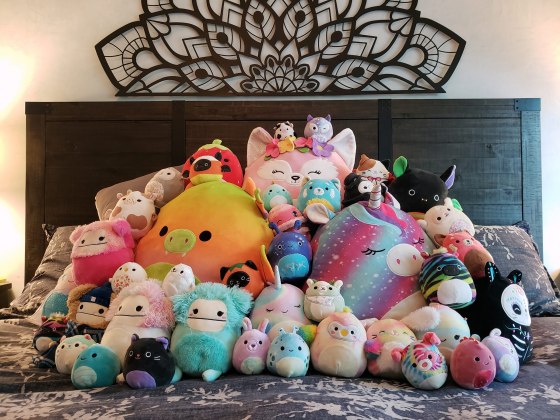
Catharine Parker's Squishmallow collection.
Courtesy of Catharine ParkerCatharine Parker’s Squishmallow collection.

The first Squishmallow entered Parker’s home in 2018, when her husband ran to the pharmacy to pick up medicine for their sick baby and threw one in the basket as a get-well gift. Another one arrived as a potty-training reward two years later. When Parker had twins, the Squishmallows proliferated. “I rationalized that they all ‘needed’ a big one to sleep with—we couldn’t leave anyone out,” Parker says. “Suddenly I was laying down on them as well and thinking maybe we could use a few to snuggle for ourselves.”

Jellycat, a British brand that makes similar toys, sells not only your typical plush puppies but also cuddly kale leaves, mushrooms, and blue cheese for grownup foodies. “Stuffed animals are kind of like an adult pacifier,” says Lennett. “Adults are going back to their childhoods to forget what’s going on in the world. Maybe it’s the pandemic, maybe it’s politics, maybe it’s war.”

Read More: How Cuddly Comfort Objects May Help Adults with Anxiety

Cindy Derrow, 56, played with Legos with her kids when they were young but purged her New York City apartment of their toys as they grew up. In April, however, she decided to buy a bouquet from Lego’s Botanical collection. When her husband contracted COVID-19 and had to isolate, Derrow spent her evenings building. “I like things that involve following instructions. I like knitting. I like baking,” she says. “But it’s an expensive habit.” The orchid bouquet retails at $50—one of the cheaper offerings among Lego’s adult-targeted toys—and won the inaugural Grown-Up Toy of the Year prize at the Toy of the Year Awards in February. Derrow is in good company: in February, Rihanna shared a picture on Instagram of a Valentine’s Day gift—a Lego bouquet.


It’s a wonder this marketing ploy took so long to arrive. But before adults would openly play with toys, many had to feel that it was socially acceptable to do so. Gottlieb argues that the pandemic hastened a generational shift. There was little time to play with toys during the Depression and World War II, he says, and although baby boomers had more opportunities than previous generations, “they were pushing up against a society that saw play as an indulgence for children.”

Video games paved the way for adult play, though for a time gaming was associated with nerds glued to computers in basements. Now geeking out is cool. Fantasy series and superhero movies have come to dominate pop culture; 40-something parents turn on the Xbox to fight zombies after putting the kids to bed. Barry Kudrowitz, a professor of design and merchandising at the University of Minnesota, points to the normalization of mobile games as the moment when adult play stopped being taboo. “We play games on our phones on the train. We still play all the time,” he says. “For our parents, at a certain point they had to stop. It’s not like they could bring Scrabble on the train.”

Toy companies have tried to target grownups for decades. In 2002, Lego created a program called Lego Serious Play, to be used by businesses to teach collaboration skills. Google, Procter & Gamble, and Harvard Business School have all participated. And the Danish company has spent the past few years determining how to market to a wider adult audience. “Our Adults Welcome campaign happened to coincide with the timing of the pandemic,” says Cristina Liquori, Lego’s head of U.S. marketing. Ads featuring adults finding zen with Legos aired in the U.S. in 2020. The company debuted a Lego-building competition show hosted by Will Arnett (star of The Lego Batman Movie) the same year. Mattel, too, launched its adult-targeted site during the pandemic by happenstance. It had always planned to debut Mattel Creations for the company’s 75th anniversary, in 2020.

Read More: Barbie’s Got a New Body: What That Says About American Beauty Ideals

But while pandemic boredom surely gave toy companies a boost, the kidult trend would not have taken off in the same way without social media. Kelly Bigley, a 31-year-old nurse in Olivehurst, Calif., noticed toy-themed videos popping up on TikTok. “I can’t afford to spend $70 on a kids’ toy for 30 minutes of entertainment, but I can binge-watch TikToks,” she says. She began collecting Mini Brands, little $5 balls that contain teeny toy versions of items like shaving cream and soy sauce bottles. “I don’t have the space to display a massive toy ambulance,” she says. “I could create my own little grocery store with these.”

Squishmallows launched in 2017 but soared in popularity during the pandemic, when they became a mainstay in dorm rooms, propelled by influencers like Charli D’Amelio, who posted a photo of herself with about 30 of them in February 2021. Posts tagged #Squishmallows have garnered more than 4 billion views on TikTok, and 65% of the people who purchase the toys for themselves are ages 18 to 24. “I can remember a time when having something like a Squishmallow in your college dorm room, you would have to hide it,” says Padawer. “But now we’re in a culture where young people say, ‘This is who I am, and I like who I am, and I’m going to share that with the world.’ ”

On TikTok, toys became a way to showcase one’s personality. A cynic might say defining one’s character through tangible things drives consumerism. But Mattel president and COO Richard Dickson argues toys provide much needed distraction. “The adult form of play is really about collectibility and display,” he says. “It’s conversational. It’s art. It’s levity. It’s joy. It’s fun. When you look at the world right now, we need lightheartedness.”

Millennials have frequently been labeled immature or stuck in arrested development, preoccupied with totems from their childhood. Every few months a conversation on Twitter flares up criticizing “Disney Adults” who make regular sojourns to Disney World sans children, or the fans who line up at midnight for Marvel movies. Those same critics roll their eyes at the trend of collecting toys. But given that this generation has suffered through two financial collapses, a pandemic, and an ongoing climate crisis, it’s hardly surprising that they find comfort in nostalgic indulgences that hark back to seemingly simpler times.

Most of Parker’s friends, in their 30s and 40s, have their own stuffed-animal collections or Legos, even if they don’t have kids. She argues that boomers also collected toys—they just looked different; model trains and baseball cards have been assigned some historic value greater than Squishmallows. Parker chafes at the label kidult, which she feels otherizes people who are just trying to find a bit of joy in dark times: “It feels very contrived.”


This holiday season, toy companies are hoping to appear on kidults’ wish lists. Basic Fun is selling $100 Lite-Brite wall art, and Razor is introducing an adult version of its scooter that retails for $600. Lego is egging on adult builders with tweets like “Normalize adults scheduling Lego building play dates.”

For now, the adult market continues to thrive. Gottlieb estimates that $2.4 billion worth of toys in the U.S. are sold every year to adults for their own use. A survey conducted last year by the Toy Association found that 58% of parents had bought toys and games for themselves. And after two years of double-digit growth, toy sales have slowed but are still up 3% year-over-year as of September, with the holidays ahead.


Photo Illustration by Rich Morgan for TIME A Richard Simmons Funko Pop, a Build-a-Bear “After Dark” stuffed animal, and the Mattel Creations Tesla Cybertruck

Companies are betting big on the future of grownup play. A consortium that includes former Disney CEO Bob Iger invested $263 million for a 25% stake in Funko this year, a major infusion for the pop-culture-themed figurines sold primarily to adults; Funko says the average age of its consumer is 36. Meanwhile, Mattel is projecting triple-digit growth for Mattel Creations over the next two years. “I don’t think it’s a trend,” says Dickson. “I think we’ve broken through, and we’re here to stay.”

Lennett says, given the volatile economy, it’s hard to predict how sustainable growth in the toy market—let alone the adult sector—will be. And the major players can’t rely on fickle social media algorithms forever. She predicts some adult buyers will move on. “But a lot will stay, especially if the industry can figure out why things go viral, why they connect with this group,” she says. “I think once adults have rediscovered their love of toys, that love doesn’t go away.”

Hunting down her favorite Squishmallows reminds Parker of the days when she and her mom would collect Beanie Babies. Parker’s would fill her bedroom, while her mother’s were secreted away in boxes to preserve their resale value. Parker is more lenient about mixing her Squishmallows with her daughters’, but now understands why her own mother kept a stockpile of stuffed animals. “There’s something very satisfying about collecting a whole pile of them and arranging them together like a little dragon’s hoard,” she says. “That comes across as slightly insane, but there’s no other way to put it.”

With reporting by Leslie Dickstein and Julia Zorthian

Categories
Audio Sources - Full Text Articles

Russia-U.S. spy chiefs discussed “sensitive“ questions, says Moscow

2022-11-17T11:43:36Z

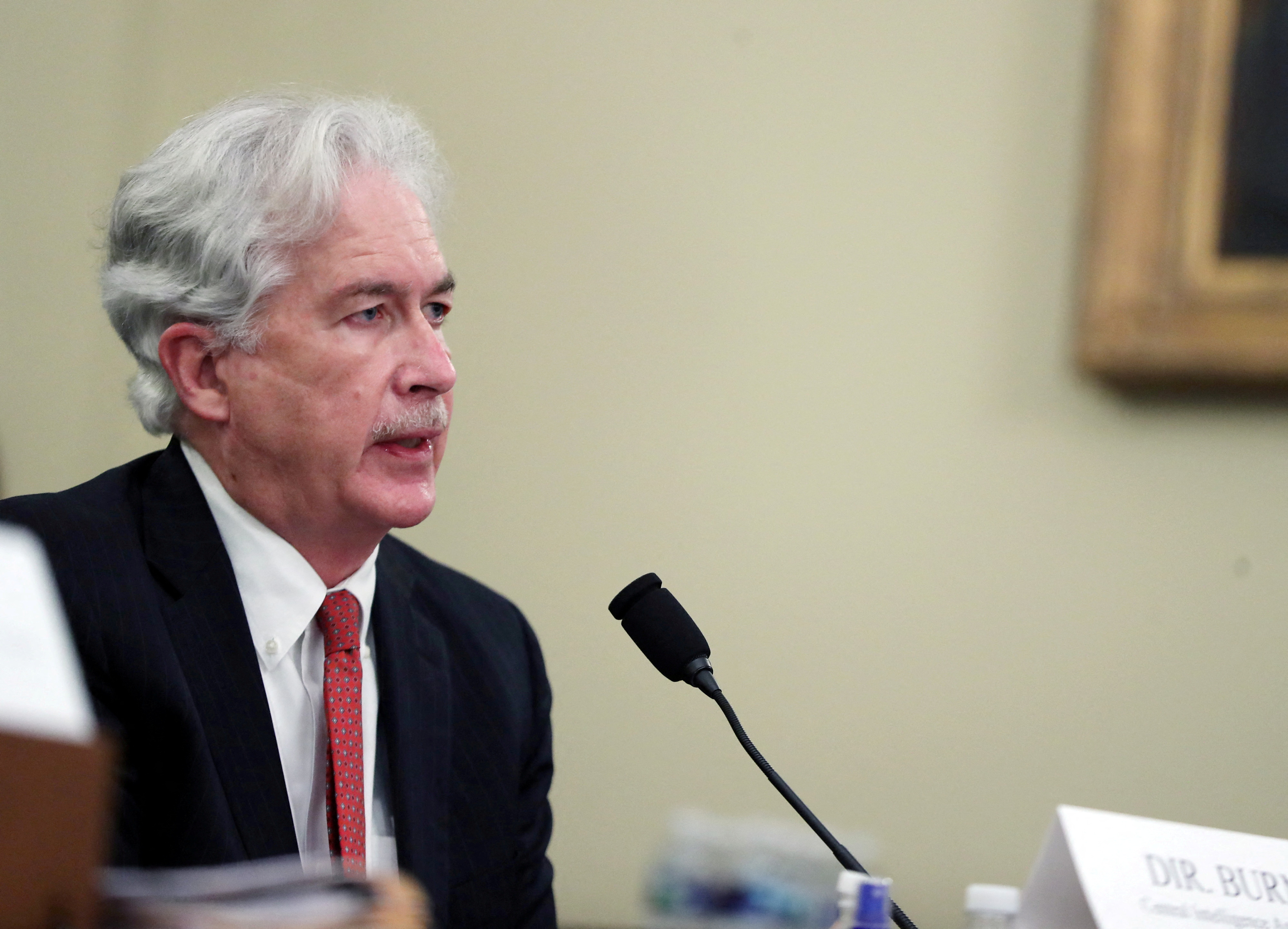
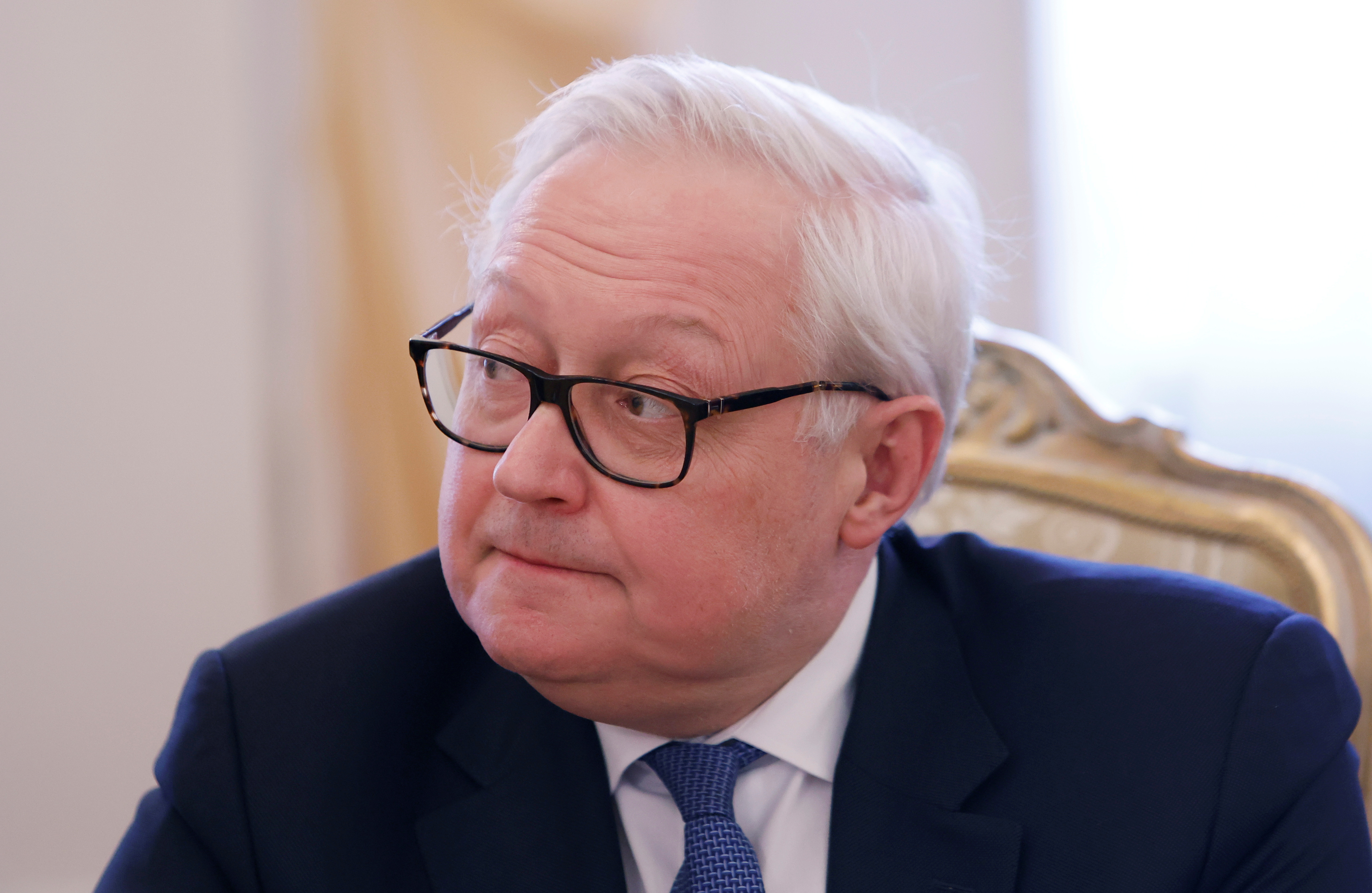
U.S. Central Intelligence Agency Director William Burns and President Vladimir Putin’s spy chief discussed “sensitive” questions when they met this week in Turkey, Russian Deputy Foreign Minister Sergei Ryabkov said on Thursday.

Burns cautioned Sergei Naryshkin, head of Russia’s SVR foreign intelligence service, about the consequences of any use of nuclear weapons, and about risks to strategic stability, the U.S. side.

It was the first known high-level, face-to-face U.S.-Russian contact since Russia invaded Ukraine in February. Burns, a former U.S. ambassador to Russia, was sent to Moscow in late 2021 by President Joe Biden to caution Putin about Moscow’s troop build-up around Ukraine.

“The contact (between Burns and Naryshkin) was initiated by the American side,” Ryabkov told RTVI. “The questions discussed there were of a sensitive nature.”

“Dialogue is going on but it is not of a systemic character,” he said. “But we are not standing there with our hat in our hand: the Americans need dialogue with us just as much as we need it with them.”

Ryabkov said more contact with the United States would take place later this month when a bilateral consultative commission on the New START arms treaty meets on Nov. 29 to Dec. 6 in Cairo.

Related Galleries:

CIA Director William Burns speaks during a House Intelligence Committee hearing on worldwide threats, in Washington, D.C., U.S., April 15, 2021. Tasos Katopodis/Pool via REUTERS/File Photo

Russian Deputy Foreign Minister Sergei Ryabkov attends a meeting of Foreign Minister Sergei Lavrov with Iranian Foreign Minister Hossein Amir-Abdollahian in Moscow, Russia March 15, 2022. REUTERS/Maxim Shemetov/Pool
Categories
Audio Sources - Full Text Articles

Air defense forces shoot down six missiles over Odesa region

630_360_1644276522-482.jpg

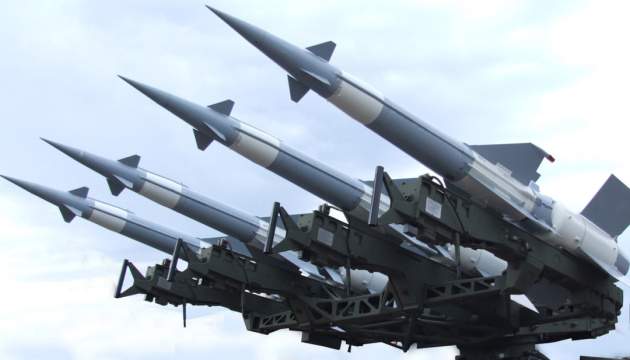
Ukraine’s air defense forces shot down 6 missiles over Odesa location amid Russia’s substantial missile assault on Ukraine.

The Odesa Town Council explained this in a Telegram put up, Ukrinform reviews.

“A missile assault was released on Odesa location. The enemy introduced Kalibr [missiles] from the Black Sea and made use of tactical aircraft, two Su-30 fired 6 air-primarily based missiles… Six missiles were ruined by air protection forces above the sea,” the report reads.

Read also: 4 missiles, five kamikaze drones shot down around Kyiv

It is famous that one missile struck a logistics facility in Odes and injured a single civilian. The blast wave destroyed structures of close by enterprises.

As noted, an enemy missile strike a essential infrastructure object in Odesa.

iy

Source link

The post Air defense forces shoot down six missiles over Odesa region appeared first on Ukraine Intelligence.

Categories
Audio Sources - Full Text Articles

Gobble, gobble, gulp! Food prices put the bite on U.S. Thanksgiving feast

2022-11-17T11:20:22Z

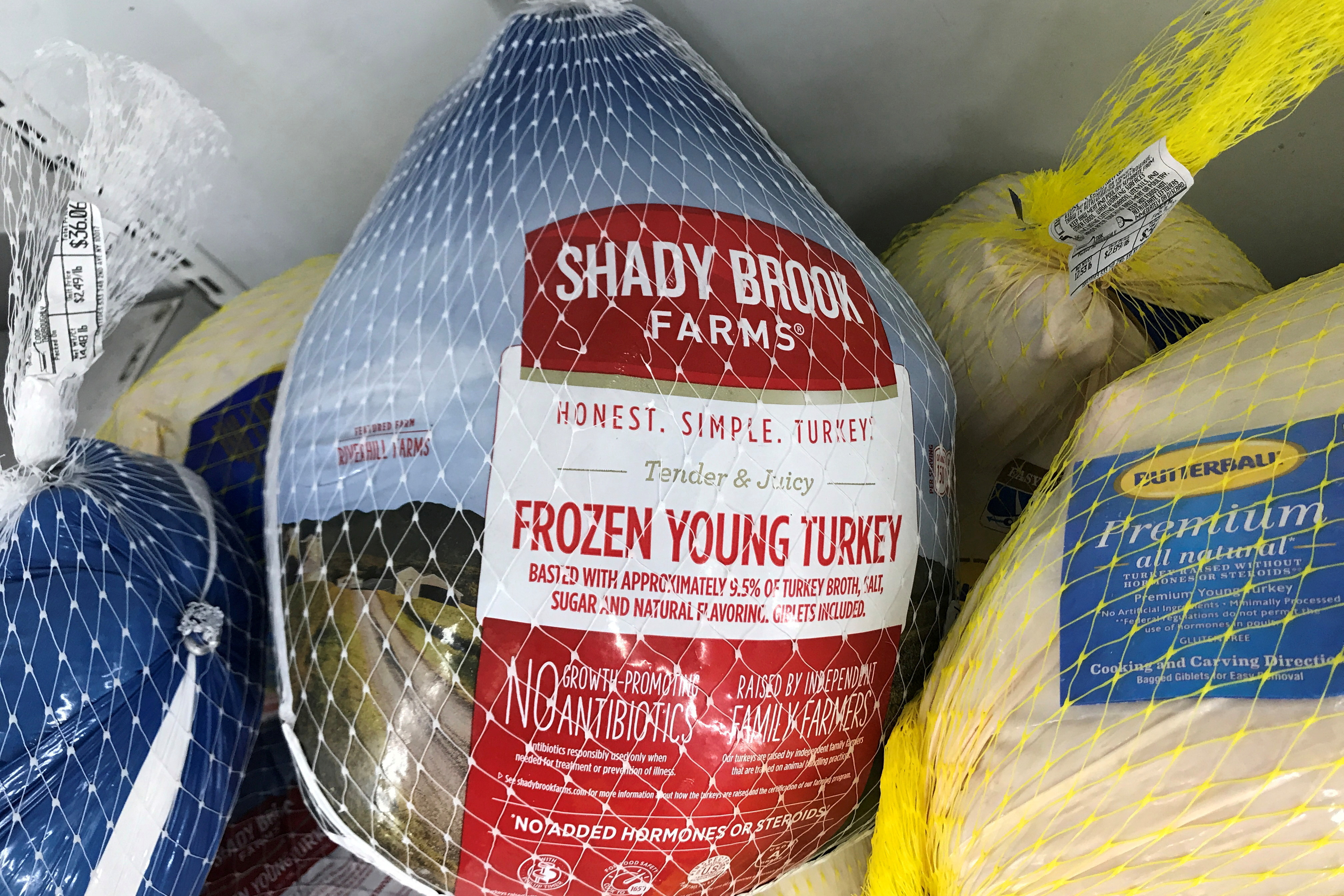
Frozen turkeys are pictured in a freezer case in the Manhattan borough of New York City, New York, U.S., November 19, 2020. REUTERS/Carlo Allegri/File Photo

Let the sticker shock begin: The upcoming U.S. Thanksgiving holiday, a time when families and friends typically celebrate with groaning sideboards, a stuffed turkey, and a more-is-better-than-less attitude, is going to cost roughly 20% more than last year, according to estimates compiled by the American Farm Bureau Federation in an annual survey of grocery prices.

Blame it on the weather, Russia’s invasion of Ukraine or corporations’ drive to maximize profits, all of which have had a hand in rising food prices, but this year’s jump is the largest since the Farm Bureau’s first Thanksgiving dinner cost survey in 1986.

Coupled with last year’s 14% increase, which was the second-largest, the price of a “classic” meal of turkey, stuffing, green peas, sweet potatoes, cranberries, rolls and pumpkin pie for 10 people has risen more than a third since 2020, at the outset of the worst U.S. inflation surge in 40 years, from $46.90 to $64.05.

“That kind of increase we recognize is a burden on some families, no question about that,” said Roger Cryan, the Farm Bureau’s chief economist, though he noted that discounting as the holiday approaches may allow consumers to lower the bill.

U.S. consumer prices rose 7.7% on an annual basis in October and had been increasing by as much as 9.1% earlier this year, triggering a Federal Reserve effort to tame price pressures with aggressive interest rate increases.

Food prices, particularly items bought for home consumption, have risen even faster, hitting a 13.5% annual rate in August and still rising 12.4% annually last month, a shock to one part of the household budget where prices had dependably increased less than incomes.

As food prices have risen, a U.S Census survey showed the share of households reporting food scarcity rising from 7.8% in August 2021 to 11.4% as of early October.

“If you’re in the grocery store right now, you see it, in any grocery store you go to, people making tradeoffs,” San Francisco Fed President Mary Daly said last week. “How many people can they invite? What are they going to serve? Are they going to trade down? Are we having a different kind of meal? Are we not having as many options?”

SKIP THE STUFFING?

As with other goods and services, there is a broad set of forces behind the Thanksgiving food spike.

An outbreak of avian flu cut turkey flocks, and while supply is adequate the Farm Bureau said the harvest of smaller birds along with higher feed prices has raised the cost of that Thanksgiving centerpiece by 21%, to an average $1.81 per pound in the 224 stores where surveyors checked prices during the Oct. 18-31 period.

That accounted for about half of the $10.74 increase in the full price of the classic meal this year. The largest percentage rise was for packaged stuffing, up 69% to $3.88, while a 1-pound tray of carrots and celery was up just 8%, to $0.88, and the price of cranberries fell 14%, to $2.57 for a 12-ounce bag.

For food items generally, key inputs like fuel and fertilizer prices have skyrocketed, said Wendiam Sawadgo, an agricultural economics professor at Auburn University, with some fruit farmers in Alabama, for example, now spending $1,000 an acre on fertilizer compared to around $600 in 2018.

“A big chunk was Ukraine and Europe not having fertilizer production for a good while. That was a big problem,” he said.

Grocery store margins also rose during the COVID-19 pandemic. Net profit after taxes hit 3% in 2020 and 2.9% in 2021, compared with an average of around 1.2% from 2015 through 2019, according to data from the Food Industry Association. Those were the highest margins the association has seen in reports dating back to 1984.

Andy Harig, a vice president at the association, said high demand for food at home early in the pandemic, when restaurants were closed or in-person dining was considered risky, gave food retailers leverage to boost profits. He said consumers also bought more higher-margin products like seafood during the crisis, while changes in shopping – including the rise in food delivery – let stores trim labor costs.

But he also said the net profit figure is expected to fall back to the long-run industry average of between 1% and 2%.

“It’s a penny industry,” Harig said. With restaurants recovering and wages rising, margins are likely already declining.

Still, the rising cost of necessities has been top of mind for U.S. officials, with consumer sentiment near a low point after a year when average gas prices reached $5 a gallon. Thanksgiving-related travel this year may at least be cheaper than it was, with airline and fuel prices having declined recently.

And there may be some respite on the food front as well.

Walmart Inc (WMT.N), for example, said earlier this month that it would leave prices for Thanksgiving staples unchanged from last year and keep them in effect through Christmas, including turkey for under $1 a pound.

Discounted turkey prices often lure consumers to grocery stores and supermarkets, and bargains intensify as the holiday approaches. The Farm Bureau noted that frozen turkey prices had fallen to 95 cents a pound as of this week.

Auburn’s Sawadgo said that shopping for alternatives can also bring down the cost, with one of his personal favorites, collard greens, selling right now at $1.14 a pound, down 3 cents from last year, according to U.S. Department of Agriculture data.

Sawadgo recently priced the goods for a Thanksgiving dinner for six at about $70.76, up 19% from $59.50 for the same basket last year.

“If you are not someone who shops the ads, this might be the year to do that,” he said.

Categories
Audio Sources - Full Text Articles

Toru Kubota, Japanese film maker held in Myanmar, has been freed – Kyodo

2022-11-17T11:05:52Z

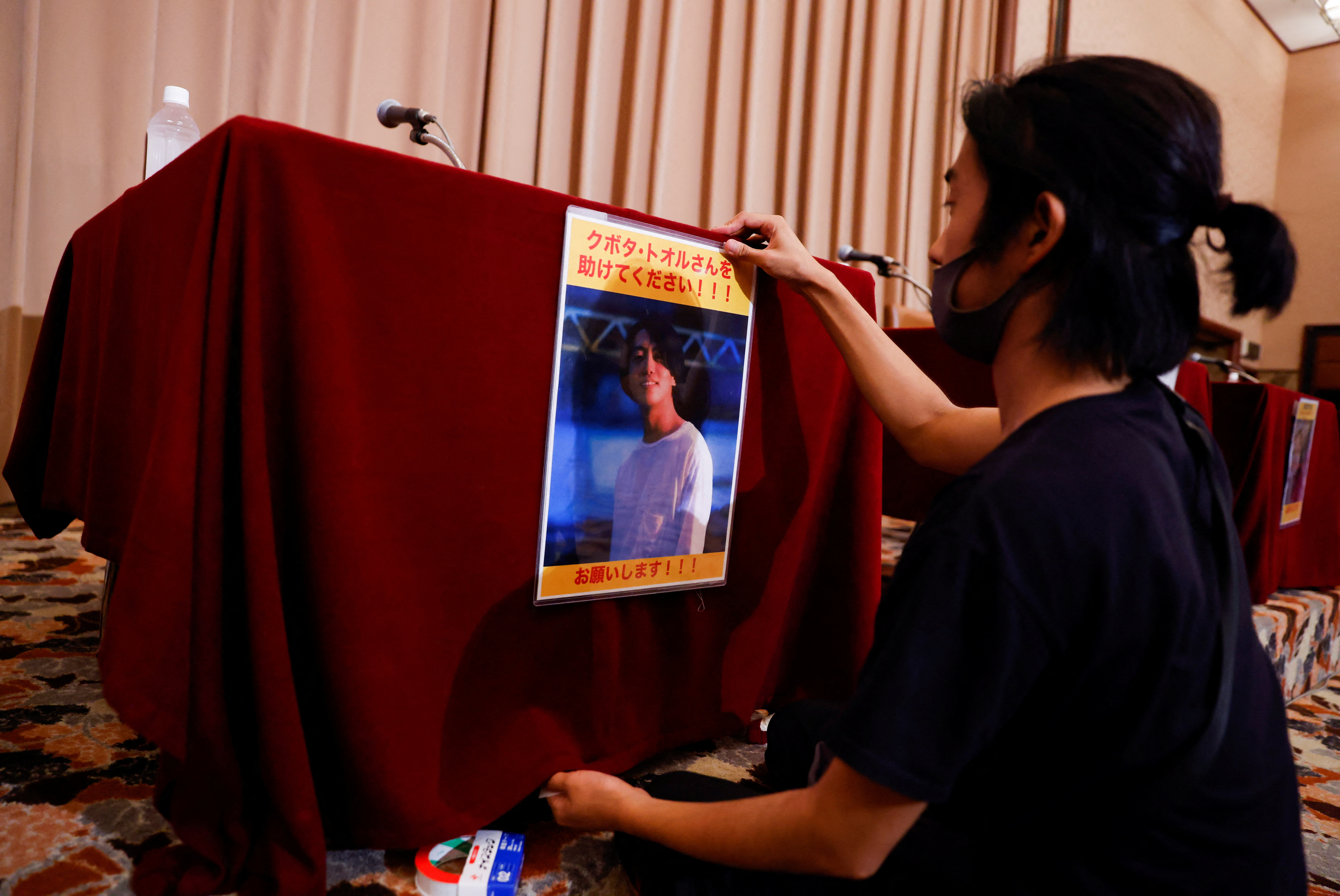
A staff member prepares to display the portrait photo of Japanese documentary filmmaker Toru Kubota, who has been detained in Myanmar after filming a protest that took place on July 30, 2022, before a news conference by his friends to call for his release at Japan National Press Club in Tokyo, Japan August 3, 2022. REUTERS/Issei Kato

Toru Kubota, a Japanese film maker held by authorities in Myanmar since being arrested in July, has been freed, Kyodo news agency reported on Thursday, quoting sources.

Kubota was arrested at a protest in Myanmar’s main city of Yangon and jailed on charges of sedition and violating immigration and other laws and last month was sentenced to a total of 10 years.


WP Radio
WP Radio
OFFLINE LIVE