Categories
Audio Sources - Full Text Articles

Malvertising campaign MasquerAds abuses Google Ads

Experts warn of a new Malvertising Campaign abusing Google Ads that targets users searching for popular software.

Guardio Labs researchers uncovered a malvertising campaign, tracked as MasquerAds and attributed to a threat actor known as Vermux, that is abusing Google Ads to target users that are searching for popular software.

The campaign aims at delivering tainted versions of popular software that deploy malicious payloads on the user’s machine, including info-stealing malware such as Raccoon Stealer and Vidar.

The threat actors behind this campaign used domains with typosquatted names that appeared on top of Google search results.

The attacker used a set of benign sites, which were designed to trick visitors into clicking on them, and then redirect them to rogue sites.

“The trick is simple — creating a benign site to be promoted with the wanted keyword and keeping it valid and safe in the eyes of the policy enforcer.” reads the analysis published by Guardio Labs. “Yet, the moment those “disguised” sites are being visited by targeted visitors (those who actually click on the promoted search result) the server immediately redirects them to the rogue site and from there to the malicious payload — usually also hiding inside reputable file sharing and code hosting servers like GitHub, dropbox, discord’s CDN, etc.”

Malvertising Campaign abusing Google Ads

Some of the software that was impersonated by the threat actors are Grammarly, Malwarebytes, Afterburner, Zoom, Slack, Brave, and Tor.

Threat actors put a significant effort into the malicious payload employed in the campaign, for example, they employed stealers that are able to avoid defense solutions. 

Malvertising Campaign abusing Google Ads

“Even for Virus-Total, it took several days since our submission to get more than a few heuristic detections” continues the report.

Vermux deployed hundreds of domains and its servers were located mostly in Russia, while the rogue ads mainly targeted users in USA and Canada.

“This “masquerAd” concept is simple yet does exactly what those actors need — abuse the trust we sometimes blindly give to Google and their promoted search results. Adding to the above, the abuse of reputable file-sharing services as well as well-known software brands make them evade even the most advanced EDRs on the market. It’s inevitable to apply a more behavioral and unbiased protection level — even for the plainest and most common action like googling something up…” concludes the report, which also includes Indicators of Compromise. “Don’t get fooled by misspelled domain names, and always double-check where you download your files from!”

Follow me on Twitter: @securityaffairs and Facebook and Mastodon

Pierluigi Paganini

(SecurityAffairs – hacking, Malvertising Campaign)

The post Malvertising campaign MasquerAds abuses Google Ads appeared first on Security Affairs.

Categories
Audio Sources - Full Text Articles

New York OKs human composting law; 6th state in US to do so

ALBANY, N.Y. (AP) — Howard Fischer, a 63-year old investor living north of New York City, has a wish for when he dies. He wants his remains to be placed in a vessel, broken down by tiny microbes and composted into rich, fertile soil.

Maybe his composted remains could be planted outside the family home in Vermont, or maybe they could be returned to the earth elsewhere. “Whatever my family chooses to do with the compost after it’s done is up to them,” Fischer said.

“I am committed to having my body composted and my family knows that,” he added. “But I would love for it to happen in New York where I live rather than shipping myself across the country.”

Democratic Gov. Kathy Hochul signed legislation on Saturday to legalize natural organic reduction, popularly known as human composting, making New York the sixth state in the nation to allow that method of burial.

Washington state became the first state to legalize human composting in 2019, followed by Colorado and Oregon in 2021, and Vermont and California in 2022.

For Fischer, this alternative, green method of burial aligns with his philosophical view on life: to live in an environmentally conscious way.

The process goes like this: the body of the deceased is placed into a reusable vessel along with plant material such as wood chips, alfalfa and straw. The organic mix creates the perfect habitat for naturally occurring microbes to do their work, quickly and efficiently breaking down the body in about a month’s time.

The end result is a heaping cubic yard of nutrient-dense soil amendment, the equivalent of about 36 bags of soil, that can be used to plant trees or enrich conservation land, forests, or gardens.

For urban areas such as New York City where land is limited, it can be seen as a pretty attractive burial alternative.

Michelle Menter, manager at Greensprings Natural Cemetery Preserve, a cemetery in central New York, said the facility would “strongly consider” the alternative method.

“It definitely is more in line with what we do,” she added.

The 130-acre (52-hectare) nature preserve cemetery, nestled between protected forest land, offers natural, green burials which is when a body can be placed in a biodegradable container and into a gravesite so that it can decompose fully.

“Every single thing we can do to turn people away from concrete liners and fancy caskets and embalming, we ought to do and be supportive of,” she said.

But not all are onboard with the idea.

The New York State Catholic Conference, a group that represents bishops in the state, has long opposed the bill, calling the burial method “inappropriate.”

“A process that is perfectly appropriate for returning vegetable trimmings to the earth is not necessarily appropriate for human bodies,” Dennis Poust, executive director of the organization, said in a statement.

“Human bodies are not household waste, and we do not believe that the process meets the standard of reverent treatment of our earthly remains,” he said.

Katrina Spade, the founder of Recompose, a full-service green funeral home in Seattle that offers human composting, said it offers an alternative for people wanting to align the disposition of their remains with how they lived their lives.

She said “it feels like a movement” among the environmentally aware.

“Cremation uses fossil fuels and burial uses a lot of land and has a carbon footprint,” said Spade. “For a lot of folks being turned into soil that can be turned to grow into a garden or tree is pretty impactful.”

___

Maysoon Khan is a corps member for the Associated Press/Report for America Statehouse News Initiative. Report for America is a nonprofit national service program that places journalists in local newsrooms to report on undercovered issues. Follow Maysoon Khan on Twitter at: twitter.com/MaysoonKhan.

Categories
Audio Sources - Full Text Articles

Live updates: Russia’s war in Ukraine

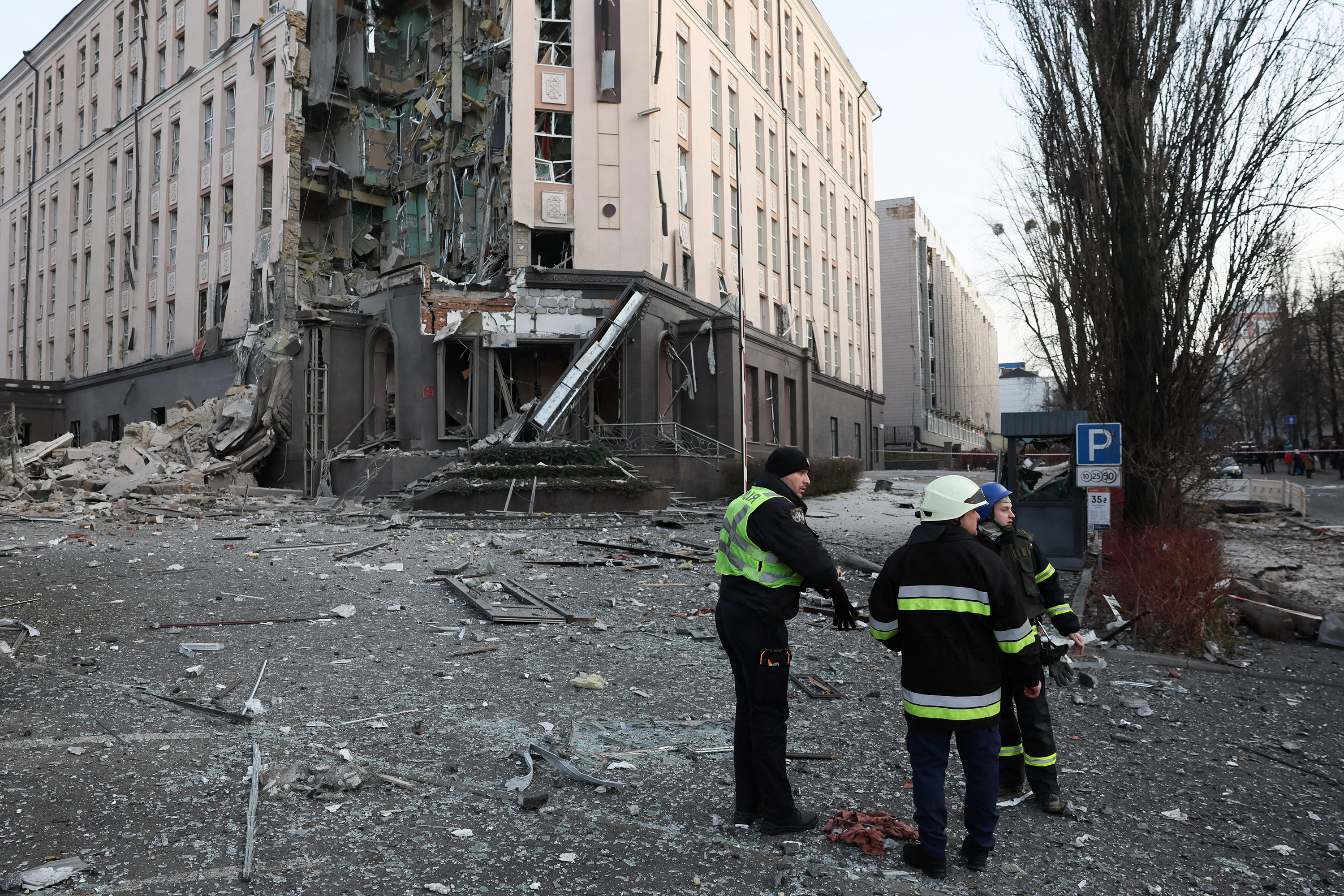
Rescuers work at the site of a building damaged after a Russian missile strike in Kyiv, Ukraine, on December 31.Rescuers function at the web site of a setting up destroyed following a Russian missile strike in Kyiv, Ukraine, on December 31. (Gleb Garanich/Reuters)

Kyiv Mayor Vitali Klitschko explained that at least one particular human being has been killed in explosions in the capital metropolis.

“In accordance to preliminary info, a person man or woman died in the Solomyansky district (of the city). A number of folks are wounded,” he explained on Telegram.

“Health professionals are hospitalizing three hurt ladies. Rescuers are working at the web pages of explosions,” Klitschko claimed.

The Kyiv town army administration stated that a non-public dwelling was weakened as a end result of a missile attack in Solomyansky district.

A hotel was strike in Pechersk district, and there was also destruction in Holosiivskyi district, it said.

Elsewhere: Residential properties were destroyed as a result of a strike in the area of Zaporizhzhia, in accordance to the president’s office. 

“Info about the victims and destruction is becoming clarified,” in accordance to Kyrylo Tymoshenko, deputy head of the Workplace of the President of Ukraine.

Tymoshenko did not specify the location of the strike. 

Resource link

The post Live updates: Russia’s war in Ukraine appeared first on Ukraine Intelligence.

Categories
Audio Sources - Full Text Articles

Pope Benedict’s Legacy Is Inextricably Bound to His Resignation—And Not Just Because It Was Unprecedented

He announced it in Latin, which was like him. Because of that choice, and because the event on the morning of Feb. 11, 2013, had been scheduled as a routine piece of Vatican business, several of the Cardinals present didn’t immediately realize what they had just heard. Benedict XVI, the great traditionalist, had announced his intent to do something no pope had in more than 600 years: “I renounce the ministry of Bishop of Rome, successor of Saint Peter.”

A pope does not resign—that had been the modern wisdom. Popes are not like studio heads; there is a supernatural element to their election and, the assumption went, a supernatural element to their departure. They waited until God took them.

[time-brightcove not-tgx=”true”]

Yet Benedict, then nearly 86 old and nearly a decade before his death on Saturday at age 95, knew that, tradition notwithstanding, there is no canon law against resigning. He explained that strength of mind and body are necessary “to govern the barque [ship] of St. Peter,” His own, he said, had deteriorated to the point where “I have had to recognize my incapacity to adequately fulfill the ministry entrusted to me.” A few days later he announced that he would spend the rest of his days in a life of prayer, “hidden to the world.”

Under normal circumstances—that is, if the conclave following his resignation had picked a pope who kept the barque pointing the same way Benedict had—his departure’s impact might have taken decades to clarify, and discussions of it would have been a bit theoretical. Years later people would still rehearse it for you. Fr. Thomas Reese, a church liberal whom Benedict once forced to resign from his post as editor of the Jesuit magazine America, lauded the retirement decision. “These days medicine can keep a Pope alive beyond his capacity to handle the affairs of office,“ he said. “It’s good and it’s important that he was humble enough to say, ‘You know, God can take care of this. I can step aside, and it’s God’s church, not my church.’” Pursuing humility to the opposite conclusion, R.R. Reno, editor of the more conservative journal First Things, said, “It’s a bad precedent. We don’t want the Pope to become like a CEO, who needs to resign if he becomes ineffective. I think it’s wrong to think that, through our human agency, we can solve the Church’s problem or avoid any institutional suffering.”

But such considerations were almost immediately rendered quaint. Because the 2013 conclave—to almost everyone’s surprise—played out so as to realize the resignation’s maximum potential for disruption.

When the Cardinals chose their peer Cardinal Jorge Mario Bergoglio, who took the name Francis, few expected a hard break from the more than 30-year tradition of theological and moral conservatism established by Benedict and his predecessor, Pope John Paul II. The conclave was looking, among other things, for someone to clean up the inefficient and corrupt papal bureaucracy, or Curia. This meant finding a pope-able candidate from outside Europe and the U.S., which supply much of the Curia staff. During the conclave, Bergoglio, the competent and magnetic Archbishop of Buenos Aires, may have played into this sentiment with a brief speech criticizing the Church’s “spiritual worldliness.” He had not made a name as a liberal, or he would not have been chosen.

However, in office, Francis shocked many by de-emphasizing Church animus against active homosexuals and remarried Catholics, and seemingly devoting as much energy to pursuing immigration justice and environmental stewardship as to banning abortion.

For more conservative Catholics, this was like losing your Prohibitionist father and discovering that your stepfather runs a still. And the what-ifs were brutal. If Benedict had not resigned, Francis would obviously not be Pope. But even if Benedict had just soldiered on for four years before resigning, Francis, who was 76 at the time he was chosen to succeed him, would probably never have been Pope—after age 80 Cardinals no longer attend the conclaves from which all modern pontiffs have been chosen. Instead, laments Reno, “we’re revisiting all the things that we fought about in the ’70s,” prior to John Paul’s papacy. “It’s all back.“

And with it, there emerged an acid countercurrent. Papal successions are always accompanied by weapons-grade gossip, but Francis’s was the first in the age of social media. Hints about conspiracy and threats of schism sped from the fringe to the mainstream with startling rapidity, and a retired pope who continued to live in Vatican City, go by his papal name and wear the Papal white cassock, became a kind of dust magnet. The not-so-silly season reached a peak in late 2014 when a conservative columnist for the New York Times, in a piece claiming that Francis could schism the Church, added the only half-facetious warning, “Remember, there is another Pope still living!”

Nobody forgot. A far-right minister in the Italian government displayed a T-shirt that read, “My Pope is Benedict.” Inevitably, the resignation debate gravitated toward modern Catholicism’s great black hole: the sexual abuse tragedy. Conspiracy theorists, determined to blame that scandal on homosexuality, speculated that a “gay lobby” in the Vatican, protecting its own, had blackmailed Benedict out. In 2016, the not-so-hidden retiree volleyed back that there had been a gay lobby, but he had “dismantled” it. In 2018, when the disclosure of predations by the now ex-Cardinal Theodore McCarrick cast a shadow on all three Popes (Francis, Benedict and John Paul II) who might have been expected to know and do something about it, Benedict released a 6,000-word statement blaming the disaster on 1960s sexual liberation and a moral philosophy some would say is reminiscent of Francis’s.

The 2019 Netflix movie The Two Popes, a fictional buddy prequel to Benedict’s resignation, picked up several Oscar nominations, and reflected what most people probably hoped was the vibe of the two men’s relationship. Real life that year was bumpier. Francis (briefly) entertained discussion of ordaining married men in priest-poor parts of the Amazon. Within months a book categorically opposing clerical marriage appeared, featuring a forward announcing “I cannot be silent”—with Benedict as co-author and pictured on the cover. There was an uproar; Archbishop Georg Gänswein, Benedict’s indispensable friend and secretary, claimed implausibly that Benedict had not known about his co-author status. Gänswein, who worked for both Popes, soon had his duties “redistributed” away from Francis. Early in 2022, a report commissioned by the Archdiocese of Munich found that Benedict mishandled at least four abuse cases while he was the city’s Archbishop. Gänswein called the charges unsupportable and said they played into the hands of a movement “that really wants to destroy the person and the work” of the retired pope.

Subsequently, Francis was at pains to deny that there was any kind of rift between him and Benedict, whom he called “sanctity personified.” He asserted to an Italian news agency that “Our relationship is really good, very good, and we agree on what needs to be done.” He added, “Anyone can say and think what they want.”

With Benedict’s passing, Roman Catholicism is again an unambiguously single-pontiff church—for the time being. Francis, citing Benedict’s precedent, has considered retirement, musing that if he were to step down he would drop any papal status for the title of Bishop of Rome Emeritus. “The first experience went very well,” he commented; but in the future “it would be better to define things or explain them better.” This time, everyone knows how important that could be to the church’s barque, downstream.

Categories
Audio Sources - Full Text Articles

The 10 biggest winners in the S&P 500 this year were led by an oil giant Warren Buffett owns. The top stocks saw a combined $357 billion increase in market value.

Warren Buffett at the University of Nebraska-LincolnWarren Buffett

University of Nebraska-Lincoln

  • Despite a big down year for stocks, a handful of names managed to print huge gains in 2022.
  • Oil stocks dominated the S&P 500’s top 10 winners this year as commodity prices spiked.
  • These are the index’s 10 best performing stocks in 2022, which added a combined $357 billion in market value.

2022 was a tough year for most stock market investors, with the S&P 500 finishing the year down 20% as inflation and higher interest rates dragged down investor sentiment.

But there were still some big winners in 2022, mainly in the energy sector as higher commodity prices sparked by Russia’s war against Ukraine led to record profits for oil companies like Exxon Mobil and others.

One investor who won big was billionaire Warren Buffett, as his Berkshire Hathaway built a substantial stake throughout 2022 in the S&P 500’s best performer: Occidental Petroleum. Buffett also owns a stake in Chevron, which was the 17th best S&P 500 performer in 2022 with a gain of about 50%.

The energy sector finished the year up 56%, making it the only one to print positive gains for the year. Meanwhile, about 70% of S&P 500 companies logged negative returns, making it all the more impressive for energy stocks to post such massive gains.

Combined, the top 10 performing S&P 500 stocks in 2022 added a total of $357 billion in market value. That pales in comparison to the $1.6 trillion in market value erased by the S&P 500’s top 10 losers, which included Tesla, Meta Platforms, and PayPal, among others.

These were the 10 top performing S&P 500 companies in 2022.

10. Valero Energy

FILE PHOTO: A Valero Energy Corp. gas station is pictured in El Cajon, California, U.S., August 8, 2017.   REUTERS/Mike Blake/File PhotoFILE PHOTO: Valero Gas Station in California

Reuters

Ticker: VLO
2022 Return: 68.1%
Market Value Gained: $18.1 billion

9. Halliburton

Oil pumps at sunset, industrial oil pumps equipment.

Getty Images

Ticker: HAL
2022 Return: 70.0%
Market Value Gained: $15.0 billion

8. First Solar 

solar panelSolar system installer Thomas Bywater adjusts new solar panels on the roof of a house in Sydney, August 19, 2009.

REUTERS/Tim Wimborne

Ticker: FSLR
2022 Return: 70.7%
Market Value Gained: $6.4 billion

7. APA

oil pumps drillA general view of the Russia’s oil major LUKOIL oil refinery near the town of Kagalym in western Siberia, July 7, 2004 in this file photo.

REUTERS/Viktor Korotayev

Ticker: APA
2022 Return: 70.7%
Market Value Gained: $5.6 billion

6. Schlumberger

FILE PHOTO - The exterior of a Schlumberger Corporation building is pictured in West Houston January 16, 2015. REUTERS/Richard CarsonThe exterior of a Schlumberger Corporation building is pictured in West Houston

Reuters

Ticker: SLB
2022 Return: 76.7%
Market Value Gained: $33.5 billion

5. Exxon Mobil

Exxon Mobil gas station

Carlos Jasso/Reuters

Ticker: XOM
2022 Return: 78.5%
Market Value Gained: $192.8 billion

4. Marathon Petroleum

Marathon gas station on May 22, 2014 in Chicago, IllinoisMarathon gas station in Chicago in 2014.

Scott Olson/Getty Images

Ticker: MPC
2022 Return: 81.6%
Market Value Gained: $20.8 billion

3. Hess 

Customers wait in line for fuel at a Hess gas station in Brooklyn, New York November 9, 2012. REUTERS/Brendan McDermidCustomers wait in line for fuel at a Hess gas station in Brooklyn

Thomson Reuters

Ticker: HES
2022 Return: 90.3%
Market Value Gained: $20.6 billion

2. Constellation Energy 

nuclear power plant

(Photo by Armin Weigel/picture alliance via Getty Images)

Ticker: CEG
2022 Return: 106.6%
Market Value Gained: $14.2 billion

1. Occidental Petroleum

occidental petroleumOil rig pumpjacks, also known as thirsty birds, extract crude from the Wilmington Field oil deposits area where Tidelands Oil Production Company, which is owned by Occidental Petroleum Corporation (Oxy), operates near Long Beach, California July 30, 2013. Occidental Petroleum posted a smaller-than-expected quarterly profit on Tuesday, hurt by lower oil prices in the Middle East and North Africa, where the fourth-largest U.S. oil company is considering an exit.

REUTERS/David McNew

Ticker: OXY
2022 Return: 114.8%
Market Value Gained: $29.8 billion

Read the original article on Business Insider
Categories
Audio Sources - Full Text Articles

It’s pretty rare for Americans to claim negative income on their taxes like the Trumps did for 4 years between 2015 and 2020

Former president Donald Trump and former first lady Melania TrumpFormer president Donald Trump and former first lady Melania Trump.

ALEX EDELMAN/AFP via Getty Images

  • Former president Donald Trump and former first lady Melania Trump reported negative adjusted gross income for four out of the six years from 2015 to 2020.
  • That’s according to newly released joint income tax returns for these years.
  • An IRS report shows it’s not that common for taxpayers to report adjusted gross income below $1.

Almost all American taxpayers end up reporting positive income to the Internal Revenue Service each year. That wasn’t the case for former president Donald Trump and former first lady Melania Trump in four of the six years between 2015 and 2020.

That’s according to tax returns released by the House Ways and Means Committee on Friday.

While adjusted gross income was positive in both 2018 and 2019 as seen in a summary table published on December 21 from The New York Times, that wasn’t the case for the other years in this time range.

The tax returns, as well as a previous report prepared by the Joint Committee on Taxation that included the former first couple’s adjusted gross income for 2015 to 2020, both highlight just how much income was reported to the IRS by Trump.

In 2020, the total income was -$4,694,058 and adjusted gross income was -$4,795,757. That follows after the tax return for 2019 shows a total income of $4,443,503 and an adjusted gross income of $4,380,714. 

Trump’s tax return isn’t the only one in 2020 that shows a negative adjusted gross income. However, according to a figure published in the Internal Revenue Service’s Individual Income Tax Returns Complete Report, there aren’t that many returns that report less than $1 compared to several higher adjusted gross income ranges.

The following chart shows how many individual income tax returns there were for tax year 2020 by adjusted gross income.

As seen in the chart, about 5.3 million returns had AGI of under $1, including those with negative AGI, out of the roughly 164 million total returns filed that year. In contrast, there were over 30 million returns with adjusted gross income from $50,000 to under $100,000 and just about 30 million returns with adjusted gross income of $30,000 to under $50,000.

This relatively lower figure for those returns with AGI under $1 can be seen not just in 2020 but other previous years. That includes in tax year 2015 when Trump’s return also shows a negative AGI and total income.

The political impact of the returns remains to be seen, as tax experts begin to pore through the newly released documents.

“The Democrats should have never done it, the Supreme Court should have never approved it, and it’s going to lead to horrible things for so many people,” Trump said in a statement on Friday. “The great USA divide will now grow far worse.”

As Insider’s Rebecca Cohen reported, Democratic Virginia Rep. Don Beyer, who is part of the House Ways and Means Committee, said in a statement after the release of the newly released tax returns that Trump “abused the power of his office to block basic transparency on his finances and conflicts of interest.”

“Despite promising to release his tax returns, Donald Trump refused to do so, and abused the power of his office to block basic transparency on his finances and conflicts of interest which no president since Nixon has foregone,” Beyer said. “Trump acted as though he had something to hide, a pattern consistent with the recent conviction of his family business for criminal tax fraud. As the public will now be able to see, Trump used questionable or poorly substantiated deductions and a number of other tax avoidance schemes as justification to pay little or no federal income tax in several of the years examined.”

Another member of the Committee released a statement last week. According to a press release, Rep. Lloyd Doggett has “been pressing since February 2017 for Trump’s taxes.”

“Trump claimed tens of millions of dollars in losses and credits without the type of substantiation an ordinary taxpayer would likely provide,” Doggett said.

Read the original article on Business Insider
Categories
Audio Sources - Full Text Articles

Sam Bankman-Fried’s FTX collapse is a nightmare of shady finances – and these bizarre schemes emerged recently

sam bankman fried released manhattan court sbfFTX founder Sam Bankman-Fried.

ED JONES/AFP via Getty Images

  • Since Sam Bankman-Fried stepped down as CEO and FTX filed for bankruptcy, a number of unusual details have come to light. 
  • Recently, it emerged that FTX reportedly told customers to wire money to a little-known, fake electronics retailer website.
  • FTX execs also allegedly hid $8 billion in liabilities in what Bankman-Fried referred to as “our Korean friend’s account.”

Both critics and proponents of crypto consider the nascent sector a Wild West, but the collapse of Sam Bankman-Fried’s FTX has given new weight to the term.

The ties between the pieces of his crypto empire — which included exchange FTX, hedge fund Alameda Research, and scores of smaller subsidiaries — remain complex. Since FTX’s November 11 bankruptcy filing, new, bizarre details surrounding the shady finances continue to pop up.

One SEC complaint said FTX told customers to wire money to a subsidiary that was a little-known fake online electronics retailer. North Dimension, as it was called, was critical in putting FTX customers’ funds to use in Alameda’s trading activity. 

The site’s been deactivated, but it was full of misspelled words and what appeared to be wrongly priced items. For example, one electronics item showed a “sale” price of $899, even though it listed a normal price of $410.

Revelations only get stranger from there. FTX execs hid $8 billion in liabilities in a customer account that Bankman-Fried referred to as “our Korean friend’s account,” a lawsuit from the Commodity Futures Trading Commission alleges. 

And court filings show that Bankman-Fried and FTX cofounder Gary Wang borrowed $546 million in promissory notes from Alameda earlier this year to buy Robinhood stock

Then, Alameda took out a loan and pledged those same shares as collateral. 

Bankman-Fried is now stuck in a four-way legal battle with FTX’s new leadership, as well as failed crypto lender BlockFi and creditor Antigua, for control of that Robinhood stake. 

Meanwhile, the SEC also alleges that FTX used $200 million of user deposits for venture capital investments. Half of that went to fintech company Dave, while half went to Web3 firm Mysten Labs. 

“FTX was an opaque company that was so centralized it relied entirely on one person,” Andrew Yeoh, chief marketing officer of Web3 firm Nillion, told Insider. “The point of decentralization is to prevent outcomes like FTX where one person can take advantage of trust. I think the public and certainly the industry is waking up to that.”

A centralized player in a decentralized environment

The SEC has alleged that Bankman-Fried orchestrated a years-long fraud scheme. He has denied criminal liability and is due to appear in a New York federal court on January 3 for charges of wire fraud and conspiracy.

Using customer funds for proprietary trading is a destabilizing practice, according to Jeffrey Blockinger, general counsel at Quadrata. The ensuing fallout, he explained to Insider, could end up pushing investors away from similar, rival exchanges.

To Darren Sandler, lead counsel at Republic Crypto, the entire saga is ironic and highlights the shortcomings of a centralized player in an ostensibly decentralized environment.

“The point of crypto is that it’s fully decentralized and trustless,” he told Insider. “Acts of fraud and misappropriation of funds should actually be impossible or extremely difficult to commit. Everyday participants shouldn’t have to trust crypto companies blindly or based on reputation.”

Read the original article on Business Insider
Categories
Audio Sources - Full Text Articles

15 of the most powerful images from Ukraine since the start of Russia’s invasion

ukraine soldierUkrainian artillery fires in the fiercely-contested Bakhmut region of eastern Ukraine on November 8, 2022.

Bulent Kilic/AFP via Getty Images

  • Russia launched an all-out invasion of Ukraine on February 24, changing European history.
  • Since then, almost eight million Ukrainians have fled bombings and devastation in the country.
  • The scale, devastation, and humanity of the conflict is captured in striking images like these.
On February 24 this year, Russia launched a full-scale invasion of its neighbor Ukraine, prompting vast lines of traffic out of Kyiv, the capital, as people fled.kyiv trafficInhabitants of Kyiv, Ukraine, leave the city following Russia’s invasion of Ukraine, on February 24, 2022.

Pierre Crom/Getty Images

President Volodymyr Zelenskyy quickly announced martial law, forcing many Ukrainians to say goodbye to their loved ones to fight.Ukraine farewell servicemanA Ukrainian soldier says goodbye to his girlfriend before departing in the direction of Kyiv at the central train station in the western Ukrainian city of Lviv on March 9, 2022.

Aleksey Filippov / AFP via Getty Images

Tides of people pushed to evacuate as Russian forces blasted the smaller cities surrounding Kyiv, prompting scenes like this in Irpin.irpinUkrainians crowd under a destroyed bridge as they try to flee crossing the Irpin river in the outskirts of Kyiv, Ukraine, on March 5, 2022.

AP Photo/Emilio Morenatti

Since the start of the war, around 7.8 million Ukrainians have left the country, 4.8 million of which have sought refuge in Europe, according to the UNHCR.

Thw wounded Ukrainian teacher Olena Kurilo made international headlines with this picture of her standing outside her destroyed home.kharkiv ukraineOlena Kurilo after a strike on an apartment complex outside of Kharkiv, Ukraine, on February 25, 2022.

Wolfgang Schwan/Anadolu Agency via Getty Images

Kurilo needed multiple surgeries in Poland and the UK to regain some of her eyesight, she told Anadolu Agency last month.

In March, Russia bombed a maternity hospital in Mariupol, injuring this pregnant woman. The woman and her baby later died.pregnant woman mariupolAn injured pregnant woman outside a maternity hospital damaged by shelling in Mariupol, Ukraine, on March 9, 2022.

AP Photo/Evgeniy Maloletka

Source: The Associated Press

In April, mass graves were uncovered in the Ukrainian town of Bucha in the wake of Russia’s occupation there. The images sparked revulsion around the world.Several men, dressed in white and some wearing masks, pull a body out of a ditch.A team pulls a body from a mass grave in Bucha, Ukraine, in April 2022.

Erin Trieb for Insider

Russia has denied responsibility for the killings of civilians in Bucha, The Guardian reported.

Russia’s invasion has had a profound impact on Zelenskyy, who is seen here both before the war in 2021, and during a visit to Bucha in April 2022.zelenskyy before and after ukraine warUkrainian President Volodymyr Zelensky in Berlin, Germany, on July 12, 2021 (left) and in Bucha, Ukraine, on April 4, 2022 (right).

Ronaldo Schemidt/AFP/Stefanie Loos/Pool via Getty Images

Source: Insider

In May, the Azovstal steelworks in Mariupol became the last pocket of resistance to Russian attack. Ukrainian soldiers stayed in the plant for months, rarely seeing sunlight. They eventually surrendered, but were hailed as heroes in Ukraine for their long resistance.Azovstal steel plantA Ukrainian soldier inside the ruined Azovstal steel plant stands under a sunlight ray in his shelter in Mariupol, Ukraine, on May 7, 2022.

Dmytro Kozatski/Azov Special Forces Regiment of the Ukrainian National Guard Press Office via AP

Fighters of the Azov Batallion said their wounded comrades were living in unsanitary conditions “without the necessary medication and even food.”Azov regimentTwo injured Ukrainian servicemen inside the Azovstal iron and steel works factory in eastern Mariupol, Ukraine, on May 10, 2022.

Dmytro Kozatsky/Azov Special Forces Regiment of /AFP via Getty Images

Ukraine was able to evacuate all of the remaining people in the steel plant in May, effectively ceding the city to Russia.

Source: ITV News

This heartbreaking photo, also taken in Mariupol, shows a father cradling the body of his teenage son who was killed by a Russian bomb.mariupol sonSerhii, the father of Iliya, cries over his teenage son’s lifeless body on a stretcher in Mariupol, Ukraine, on March 2, 2022.

AP Photo/Evgeniy Maloletka

Source: The New York Post

The fighting between the two countries has been relentless, dominated by artillery fire. These photo from Izyum, northeastern Ukraine, shows a a field covered in craters from shelling.shelling craters ukraineA field is covered with craters left by the shelling close to Izium, Ukraine, on September 13, 2022.

Kostiantyn Liberov via AP Images

The most senior US general, Mark Milley, said in November that around 100,000 Russian and 100,000 Ukrainian soldiers had been killed or wounded since February, according to the BBC.

Ukraine has been provided with military equipment like artillery pieces, long-range rocket launchers, and tanks, by more than 30 countries.ukraine soldierA Ukrainian soldier fires toward Russian positions outside Bakhmut, Ukraine, on November 8, 2022.

Bulent Kilic/AFP via Getty Images

Source: BBC

Ukraine has had some positive moments in the war, like the recapturing of the Kherson and Kharkiv regions, which led to this heartfelt moment between a civilian and a soldier.kherson residentA Kherson resident kisses a Ukrainian soldier in central Kherson, Ukraine, on November 13, 2022.

AP Photo/Efrem Lukatsky

But Russia has changed its tactics in the last few months, attacking vital power infrastructure in Ukraine and thereby plunging millions into darkness.cafePeople sit in a café without power on December 09, 2022 in Lviv, Ukraine.

Jeff J Mitchell/Getty Images

The war shows no sign of stopping. Earlier this month, Russian President Vladimir Putin said it may be a “long process.”sergei shoigu vladimir putinRussian President Vladimir Putin meets with Defence Minister Sergei Shoigu at the Novo-Ogaryovo state residence, outside Moscow, on October 28, 2022.

Mikhail Metzel/Sputnik/AFP via Getty Images

Source: The Washington Post 

Read the original article on Business Insider
Categories
Audio Sources - Full Text Articles

From TerraUSD’s meltdown to the collapse of a $32 billion crypto empire, here is a full timeline of the crypto market’s year in 2022

Bear market cryptocurrency

Nuthawut Somsuk/Getty Images

  • The Federal Reserve’s interest rate hikes spooked investors away from speculative bets like crypto in 2022.
  • The industry endured a series of collapses, including FTX, algorithmic stablecoin UST, and centralized lender Celsius.
  • Despite market doldrums, Wall Street giants like BlackRock inked majors crypto-related deals.

Crypto endured major blows this year as the industry’s market cap sits more than two-thirds below its record high. The nascent space took hits from a harsh macroeconomic environment, a slew of bankruptcy filings and criminal charges against top crypto executives.

Yet despite declines of over 60% for bitcoin and ether in 2022, venture funding continued to funnel into the space while major traditional financial institutions inked partnerships and expanded crypto-related offerings.

Insider spoke with several crypto experts and charted the most influential events for the industry in 2022. 

January and February

Non-fungible tokens, or NFTs, seemed all the rage in the beginning of 2022, especially after dictionary publisher Collins anointed the phrase as its “Word of the Year” in 2021. NFT monthly trading volumes peaked at $17 billion in January, according to Dune Analytics.

Popular collections, often called “blue-chip” projects, were selling for millions. Singer Justin Bieber even bought a Bored Ape Yacht Club NFT for $1.3 million.

Then NFT trading volumes began to decline in February, a month that also saw Sotheby’s cancel a live auction of 104 CryptoPunks NFTs valued between $20 million to $30 million due to lack of interest. Some say this signaled the end of the NFT hype. 

March

The macro backdrop began to worsen in March, when the Fed announced its first rate hike in years to combat decades-high inflation.

Investors turned away from speculative bets like cryptocurrencies, causing a further decline in token prices. Bitcoin’s reputation as an inflation hedge was called into question as the cryptocurrency started to trade in tandem with tech stocks.

Venture funding was still strong in the space though. Yuga Labs, creator of the Bored Ape Yacht Club NFT collection, raised $450 million in a seed round to give it a $4 billion valuation.

May

Amid the fifth straight month of losses in crypto markets, algorithmic stablecoin TerraUSD, or UST, lost its 1-to-1 peg to the dollar, causing mass liquidations and the eventual collapse of its $18 billion ecosystem.

Many retail participants lost their life savings because they were treating UST, which was advertised as a way to park your assets and earn 20% yields, as a savings account. 

“This began the great unraveling of crypto in 2022 and showed that, for way many projects, the emperor had no clothes.” Jeremy Epstein, CMO of blockchain startup Radix, told Insider. 

June and July 

Three Arrows Capital, the massive crypto investment firm that once reported $10 billion in assets, had exposure to UST and some reports put its exposure to sister token Luna at around $560 million. The firm filed for insolvency in June, leading to widespread contagion.

Three Arrows, commonly known as 3AC, invested in crypto startups and then allowed some of their portfolio companies to store funds with them as a custodian as well. Cofounders Kyle Davies and Su Zhu – both former derivatives traders for Credit Suisse – were hailed by many, with 3AC even called the “adult in the room.”  

Also in June, crypto lender Celsius paused all withdrawals and user activity on its platform. A month later, the firm filed for bankruptcy, listing $4.31 billion in assets and $5.5 billion in liabilities. The firm couldn’t hold to its promise of offering up to 17% annual yields to customers. 

In July, digital asset brokerage Voyager, which allowed users to store their digital assets on its platform, filed for bankruptcy.

“Certain failures of exchanges have highlighted the risks of centralized projects and served as a reminder of the dangers of granting a single entity or organization full financial control,” Daniel Kisluk, CMO of blockchain infrastructure developer Pendulum, told Insider.

September

The market then turned its attention to Ethereum’s Merge, an upgrade that cut energy usage on the smart-contract network by more than 99%. Crypto markets had a brief uptick in September. 

The Merge was the third most-important event in crypto’s history, after the invention of bitcoin and ethereum, blockchain developer Ben Edgington previously told Insider.

The upgrade was “fundamentally reengineering a chain which has hundreds of billions of dollars of value so we are swapping out the engine mid-flight,” he said.

Also in September, BlackRock announced a partnership with Coinbase’s institutional arm, Coinbase Prime. The world’s largest asset manager agreed to offer clients access to Coinbase’s crypto trading and custody services. 

November and December 

Sam Bankman-Fried’s once-$32 billion cryptocurrency empire collapsed in November, in what US prosecutors called the “worst financial frauds in American History.”

The cryptocurrency exchange, along with more than 130 of its associated entities, filed for bankruptcy protection on November 11. FTX’s asset were reportedly transferred to Bankman-Fried’s crypto hedge fund Alameda Research, leaving an $8 billion hole on the trading titan’s balance sheet. 

In December, Bankman-Fried was charged with multiple counts of fraud and released on a $250 million bail bond. FTX cofounder Gary Wang and Alameda Research CEO Caroline Ellison were charged with defrauding investors and are reportedly working with authorities.

Pendulum’s Kisluk said that while 2022’s numerous failures hurt confidence in crypto, the resulting bear market also represented an opportunity for the industry to “focus on creating and maximizing value for users, rather than on valuations” and shift toward decentralized finance and infrastructure projects.

Radix’s Epstein warned the industry must brace for more FTX contagion, but predicted crypto markets will rebound eventually.

“Ultimately, this year will be remembered as the year that, with great pain and discomfort we purged the toxic elements, preparing for healthier days ahead,” the exec said. 

Read the original article on Business Insider
Categories
Audio Sources - Full Text Articles

California bracing for storms over New Year’s weekend

SACRAMENTO, Calif. (AP) — Californians on Friday were bracing for heavy downpours and potential flooding from a series of rainstorms poised to usher in the new year.

An atmospheric river storm, a long and wide plume of moisture pulled in from the Pacific, began sweeping across the northern part of the state Friday and was expected to bring more rain through Saturday, according to the National Weather Service in Sacramento.

Officials warned rivers and streams could overflow and urged residents to get sandbags ready. A flood watch was in effect in much of Northern California through New Year’s Eve.

It was the first of several storms expected to roll across California over the next week. The current system is be warmer and wetter, while next week’s storms will be colder, lowering snow levels in the mountains, said Hannah Chandler-Cooley, a meteorologist at National Weather Service in Sacramento. All in all, the Sacramento region could receive a total of 4 to 5 inches (10 to 13 centimeters) of rain over the span of the week, Chandler-Cooley said.

In Southern California, moderate-to-heavy rain is expected on Saturday. The region will begin drying out on New Year’s Day and the Jan. 2 Rose Parade in Pasadena should avoid rainfall.

Heavy showers are forecast for Tuesday or Wednesday, the National Weather Service in Oxnard said.

The rain was welcomed in drought-parched California, but much more precipitation is needed to make a significant difference. The past three years have been California’s driest on record.

WP Radio
WP Radio
OFFLINE LIVE