Categories
Audio Sources - Full Text Articles

Ramaphosa“s future in balance over South Africa “Farmgate“ scandal

2022-12-01T06:53:13Z

CAPE TOWN (Reuters) -Cyril Ramaphosa’s future as South African president hung in the balance on Thursday, as his office said it was about to make an announcement a day after a panel report found preliminary evidence he may have committed serious misconduct.

South Africa’s President Cyril Ramaphosa has delayed appearing before lawmakers to answer questions to consider a report that found preliminary evidence that he may have violated his oath of office. David Doyle has more.

The inquiry centred on the alleged theft of millions of dollars of cash from the millionaire president’s Phala Phala game farm in 2020, which came to light in June and has been dubbed the “Farmgate” scandal.

The theft has raised questions about how Ramaphosa, who came to power on the promise to fight graft, acquired the money and whether he declared it.

The president has denied any wrongdoing and has not been charged with any crimes.

The rand fell more than 4% against the dollar before paring losses, and South Africa’s sovereign dollar bonds dropped sharply on speculation Ramaphosa would leave his post.

The country’s biggest opposition party, the Democratic Alliance, has called for an early election and the report has plunged the governing African National Congress (ANC) into crisis.

It also threatens Ramaphosa’s efforts to rekindle investor confidence in Africa’s most industrialised economy, after a decade of corruption scandals under former president Jacob Zuma.

The ANC said its executive committee would meet to discuss the panel report on Friday morning, delaying an earlier plan to meet on Thursday.

Asked by Reuters about a local media report that Ramaphosa was due to address the nation on Thursday, Ramaphosa’s spokesman Vincent Magwenya said: “An announcement is imminent. … I can’t confirm the date and time, we will advise.”

South Africa’s foreign minister Naledi Pandor called the panel’s report “a very troubling moment” in an interview at the Reuters NEXT conference, and two cabinet ministers called for Ramaphosa to resign.

A spokesperson for elite police unit the Hawks said its investigation into the theft at Ramaphosa’s farm was continuing, while the central bank said it did not comment on exchange control investigations.

The ANC is set to hold an elective conference later this month that will decide if Ramaphosa gets to run for a second term on the ANC ticket at a 2024 election.

“I think the president has to step aside now and answer to the case,” Nkosazana Dlamini-Zuma, Zuma’s ex-wife, who narrowly lost the ANC’s 2017 leadership contest to Ramaphosa, wrote on Twitter late on Wednesday.

Tourism Minister Lindiwe Sisulu, who has campaigned to be elected ANC leader this month, wrote: “CR MUST RESIGN NOW!”

Ramaphosa delayed a scheduled appearance in parliament to answer questions from lawmakers on Thursday, asking the chairperson of parliament’s upper house for time to “carefully consider … the next course of action to be taken,” a statement from parliament said.

The panel’s recommendations are not binding on parliament, which is set to debate the report on Dec. 6 and where the ANC holds a majority of seats.

If lawmakers decide to forge ahead with an impeachment process, the next stage would be the creation of an impeachment committee with far greater powers – including that of subpoena – than the panel of experts appointed by the speaker.

That committee would have the power to recommend Ramaphosa be removed from office, a decision which parliament would then have to take.


Categories
Audio Sources - Full Text Articles

Venezuela’s gold: 10 ways to address illicit financial flows from the mineral trade

By Robin Lewis, Mario Picon, Caitlin Purdy, Lilly Blumenthal, Supriya Sadagopan

Fighting corruption is an inherently complex challenge that requires transnational action. The stakes are high: Initiatives such as the Summit for Democracy and the United States Agency for International Development’s Combating Transnational Corruption Grand Challenge have underscored that multistakeholder efforts to combat corruption are a key pillar of advancing democratic renewal globally. Illicit financial flows (IFFs), defined as “illegal movements of money or capital from one country to another,” serve as a case in point. IFFs around the world facilitate corruption, deepen inequality, reduce economic security, and exacerbate environmental degradation. In low- and middle-income countries especially (but not exclusively), the consequences are particularly profound since IFFs lead to a “loss of what are often desperately needed resources to fund public initiatives or critical investments.”

Of course, no economy can tackle this problem alone: The globalized nature of financial systems means that solutions to IFFs require extensive cooperation across country lines and jurisdictions. In this piece, we examine key challenges associated with and recommendations to address IFFs from the production and trade of gold from Venezuela, which exemplifies many of the challenges associated with IFFs broadly.

Background

Venezuela’s gold production and trade illustrate many of the risks and harms associated with IFFs. Illegal mining, particularly of gold, is driving environmental damage, human rights abuses, and security threats for Venezuela and the region. Illegal gold mining regionally appears to be on the rise, fueled in part by high gold prices and limited political will and resources to tackle the problem. For example, in Colombia, an estimated 69% of its gold is mined illegally, and the illegal gold trade provides an estimated US$2.4 billion in revenue annually.

In 2011, then-President Hugo Chávez nationalized the mining industry, aiming to centralize state control of the sector. Following the country’s economic collapse, gold became a vital revenue source for the Maduro government. International sanctions on exports coupled with declining oil production have left the regime with few sources of income.

Compañía General de Minería de Venezuela (Minerven), the state gold company, does relatively little mining itself. Instead, experts note the government sources gold from a variety of small-scale mines across the country, including those controlled by illegal groups. Groups engaged in illegal mining include Venezuelan criminal syndicates, known as sindicatos, and Colombian illegal armed groups, notably dissidents from the FARC and the ELN. The government has also leveraged proceeds from the illicit gold sector to maintain the loyalty of the military, which charges protection payments to illegal mine operators, and of high-level political officials. This has happened in a context of “no democracy and no independence or balance of powers,” as well as a complex system of international corruption, leaving limited avenues for redress or change.

Gold is exported out of the country directly by the Banco Central de Venezuela (BCV), notably to countries such as Turkey, Iran, Uganda, Libya, and the UAE, or by illegal groups in the form of contraband. Illegal mining is believed to have supported the Maduro regime’s resilience following the U.S. Treasury’s 2019 decision to sanction Minerven.

Research by the Leveraging Transparency to Reduce Corruption (LTRC) initiative and many others,[1] together with expert insights emerging from a moderated panel discussion and subsequent workshop, helps to unpack these thorny challenges and potential paths forward.

Challenges and Recommendations

An uptick in gold production, the large number of actors involved in gold smuggling, and difficulties associated with tracing illicit gold flows have all contributed to a crisis with limited chances to even engage in its resolution. This includes the limited availability of trade and customs data (which could help anti-corruption advocates better diagnose the scope and origins of resource flows) and the complex, transnational nature of the problem.

Acknowledging those challenges, below are ten recommendations, informed by the expert discussions referenced above, outlining potential pathways to address IFFs through research, training, education, and engagement strategies. While these opportunities were identified in the context of illicit gold flows from Venezuela, many of these areas are relevant to combating IFFs more broadly:

  1. Address and engage key regional actors: Many experts underscored the critical role of stemming enablers of IFFs at the supply chain and regional trade levels. While laundering networks are undoubtedly global, gold from dispersed flows departing Venezuela seem to be laundered mainly within the Latin America and Caribbean (LAC) region via key regional transit hubs, particularly Colombia, the Dominican Republic, Brazil, Suriname, Guyana, and Panama.
  2. Support capacity building for local journalists: Supporting local journalists with training and funding to investigate potential IFFs and other corruption issues are important ways to advance transparency, which can help generate pressure for reform among anti-corruption champions. For example, journalists could be trained in how to use transaction-level data to investigate illicit flows, with the outputs disseminated through international outlets.
  3. Leverage incentives across the board: Since engagement is not expected with the regime in Venezuela, it is important to find other ways to incentivize better governance of natural resources. Several experts highlighted that greater collaboration among local and international organizations, engagement with indigenous communities, and coordination with the private sector and all actors along the value chain is essential.
  4. Think holistically: To fully address the challenge, conversations around combating IFFs must go beyond the point of extraction to discuss all players along the value chain and look at the different forms in which gold is traded (doré, scrap, jewelry, concentrates) with their respective vulnerabilities.
  5. Bridge implementation gaps: There are often significant gaps between due diligence standards and the completion or implementation of due diligence. New research could help us better understand how these bottlenecks happen and how to address them.
  6. Build awareness and capacity in stakeholders regarding due diligence: To complement the above, it is imperative to educate buyers, exporters, and traders on how to conduct their due diligence more effectively with suppliers. Several experts argued that governments around the world should be encouraged to put more pressure on exporters and trade centers to comply with robust due diligence standards.
  7. Examine free trade zones: As the OECD notes, Free Trade Zones can “serve as enabling mechanisms for both gold laundering and money laundering linked with gold,” and thus their role in facilitating gold flows and related financial crimes warrants greater attention.
  8. Improve data: Several experts have noted that trade and customs data are often inconsistent, inaccurate, or insufficient, and thus there is space for international institutions to help improve this data.
  9. Amplify awareness of environmental degradation: Organizations in Venezuela such as SOS Orinoco have been documenting the environmental degradation and human rights abuses caused by illegal mining in Venezuela. Several experts underscored that there is insufficient coverage of these issues both domestically and globally and noted that the international community (including global environmental protection organizations) are often reluctant to work in Venezuela.
  10. Look beyond gold: While flows from Venezuela’s gold sector are a critical area of reform, some experts noted that other resources, including critical or transition minerals, are being used to diversify criminal portfolios. More research is needed to understand the scope and scale of this problem.

The recommendations above provide a few notional suggestions of what can be done to combat IFFs. Moving forward, it is critical to build from these ideas by identifying who is best positioned to pursue them, and how to do this in a way that is conscious of risks to individuals or collectives. All of this must be done while managing the politics around actions needed, particularly in enabling countries.

The United States’ anti-corruption strategy, as well as the Summit for Democracy and its emphasis on commitments to strengthen democracy, seeks to protect human rights and fight corruption. These types of commitments can open an important window of opportunity for a larger transnational effort focused on countries that are the source of IFFs, as well as other countries where gold and money from its trade is laundered.

LTRC will continue engaging with international, subnational, and local organizations to better understand and identify opportunities to combat the challenge of IFFs and corruption more broadly through research, engagement strategies, and/or specific initiatives. We welcome interested organizations to connect with us by emailing LTRC@brookings.edu.


Footnotes:

[1] See e.g. highlights from a report by the OECD on “Gold flows from Venezuela: supporting due diligence on the production and trade of gold” and OECD’s due diligence guidance for conflict-affected and high-risk areas include recommendations for mitigating risks along the supply chain.

2009-03-27T000000Z_1977813399_GM1E53R14C
fblike20.png pinterest20.png twitter20.png email20.png rss20.png  
Categories
Audio Sources - Full Text Articles

Dear Bintel: I’m a Jewish anarchist, and increasingly uncomfortable in both communities

Untitled-design-27.jpg

The Forward has been solving reader dilemmas since 1906 in “A Bintel Brief,” Yiddish for a bundle of letters. Send your quandaries about Jewish life, love, family, friends or work to bintel@forward.com or @bintelbrief on Twitter, and check out the Bintel podcast.

Dear Bintel,

In my community organizing and religious life, I have had to become two separate selves.

I’ll explain: I’m a Jewish anarchist, but I’ve found that I cannot be Jewish in anarchist spaces. And I’m unable to be an anarchist in Jewish spaces.

My politics are partially informed by the Talmud and Torah. I have learned to love and welcome and provide care for the stranger (mutual aid); that it is righteous to question (authority? everything?); and just to oppose tyrants.

I have found that being open about my Jewish faith or identity in radical political circles can be met with a cold response — criticism of religion in general or, often, pressure to condemn Israel or Israelis. And in Jewish spaces, my radicalism can be seen as a turnoff to an older crowd or a perceived disrespect for tradition and religion in general. Shul becomes a quiet, ostracizing place of discomfort. 

Is there any way to bring these selves together? I’m sure I’m not the first to ask this, nor do I think I’ll be the last.

Signed,

Religious Radical 

Dear Religious Radical,

There will always be tension between anarchy and organized religion at a fundamental level.

Anarchism, as a political philosophy, is about rejecting authority and institutions. And theistic religions by definition have at least one major authority — are you there, God? It’s me, Religious Radical — not to mention human authorities like rabbis and priests.

Judaism is full of rules — kashrut, Shabbat, when to pray, how to dress, who to marry and even when to have sex with your spouse. Not every Jew observes every rule, but, to the casual observer, it is the antithesis of anarchism.

And, these days, leftist political groups are increasingly united in condemning Israel for its treatment of Palestinians. Plus, one of the fundamental tenets of anarchism is stateless societies. Israel is not just a state but one so focused on maintaining its borders that it built a wall to guard them. You can’t be surprised you’re getting pushback.

I have to give you some tough love here: Existing in both religious and anarchist spaces might just not be comfortable. But who says everything has to be comfortable?

You seem secure in your own relationship to your identities, both religious and political, which goes a long way. But you can’t expect a shul full of old traditionalists to immediately encourage your anarchism, nor can you expect a meeting of ardent anarchists to embrace God. 

You’re going to have to explain your dual identities, and I’d expect some fractious debate. From what I understand, the old saw about “two Jews, three opinions” applies just as well to anarchists.

You say you base your anarchist values in texts from our Jewish traditions. Try explaining that to those skeptics at shul — and in your anarchist meetings. I mean, the Talmud is a canonized book of people arguing. We even lionize Abraham and Moses for arguing directly with God. This kind of debate is exactly what draws you to both groups. So have it!

Maybe do some reading on the storied history of the Jewish anarchist movement. (Emma Goldman! Noam Chomsky!) Admittedly, most of these folks were vehemently secular, but they were also deeply Jewish. And Yiddish anarchist organizing was a pillar of the movement in the 20th century. Even some early Zionist thought was pretty in line with anarchism.

I get that defending integral parts of yourself doesn’t feel good. And let’s be real: Political talk about Israel nearly always feels fraught. You’re going to have to get personal, and get deep, and that’s scary — but it’s also core to bringing your full self to both spaces. No one can accept both sides of you if you don’t give them a real chance to get to know them.

And the good news is that both Jews and anarchists respect intellectual debate. So if you can show you’re grounded in the values of the respective community and have grappled with tough issues such as your relationship to God, to the texts and — even tougher — to Israel, people should accept it.

If they don’t, it’s time to go shul-shopping, and whatever the anarchist equivalent is. Not every Jewish space is dominated by an older, traditional crowd. And there’s about a billion different schools of anarchist thought — maybe you can even find a modern Yiddish radical space.

Once you’ve given people a chance to ask their questions and understand you, debate shouldn’t be a daily occurrence — you shouldn’t have to repeatedly pass some sort of ideological purity test. But if you’re going to hang out in spaces with specific ideologies and values, you’re going to have to pass it at least once.

Signed,

Bintel

Love or hate our advice? Got a problem you need help with? Email us.

The post Dear Bintel: I’m a Jewish anarchist, and increasingly uncomfortable in both communities appeared first on The Forward.

Categories
Audio Sources - Full Text Articles

Spanish PM, US Embassy Targeted in Wave of Letter Bombs

000_32wz3kz.jpg

Spanish police were investigating Thursday, Dec.1, a series of letter bombs sent to targets including the prime minister and the US embassy, similar to one which went off at the Ukrainian embassy, hurting a staff member.

The interior ministry revealed that an envelope with “pyrotechnic material” had arrived at Prime Minister Pedro Sanchez’s official residence on November 24. It was destroyed in a controlled explosion.

Spain’s High court meanwhile announced it had broadened an initial investigation over the Ukraine embassy letter bomb to cover the all the other incidents.

Both announcements came a day after the security officer at Ukraine’s embassy in Madrid suffered a light injury to one hand while opening a letter bomb addressed to the Ukrainian ambassador, an incident that prompted Kyiv to boost security at its embassies worldwide.

That letter, like the others discovered, arrived by regular mail.

Later in the evening, a second “suspicious postal shipment” was intercepted at the headquarters of military equipment firm Instalaza in the northeastern city of Zaragoza, the interior ministry said.

Instalaza makes the grenade launchers that Spain donates to Ukraine.

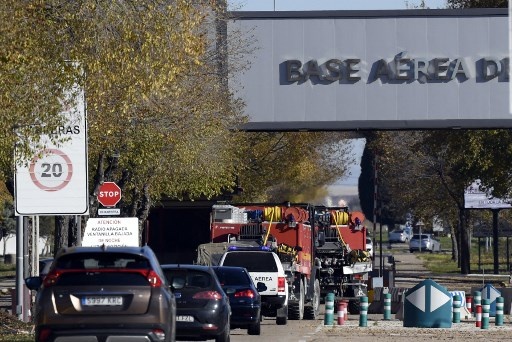
Then on Thursday morning letter bombs arrived and at the defence ministry; and at an air base in Torrejon de Ardoz, just outside Madrid, from where weapons donated by Spain are sent to Ukraine.

“The characteristics of the envelopes, as well as their content, are similar in the five cases,” Spain’s Secretary of State of Security, Rafael Perez, told journalists.

“There are signs that indicate that the letters came from Spanish territory, but I insist we must be prudent…we are at the beginning of the investigation.”

A few hours after he spoke the interior ministry said another letter “with similar characteristics as the others” had been intercepted at the US embassy in Madrid.

‘Terrorist methods’

Ukraine’s ambassador to Spain, Serhii Pohoreltsev, appeared to blame Russia for the letter bomb at its embassy.

“We are well aware of the terrorist methods of the aggressor country,” he said during an interview late Wednesday with Spanish public television.

“Russia’s methods and attacks require us to be ready for any kind of incident, provocation or attack,” he added.

But in a statement Thursday, Russia’s embassy in Spain said: “Any threat or terrorist act, especially those that target a diplomatic mission, is to be totally condemned.”

The letter to the defence ministry was addressed to Defence Minister Margarita Robles. The one sent to the air base was meant for a European Union satellite centre located there.

That centre supports the bloc’s foreign and security policy by gathering information from satellite imagery, according to its website.

After scanning the envelope that arrived at the air base by X-ray, security officers determined it contained “a mechanism”, the ministry statement said. Police were still analysing the envelope.

Ukraine’s Foreign Minister Dmytro Kuleba ordered the strengthening of security at all of their embassies, the country’s foreign ministry spokesperson said Wednesday after the letter bomb went off at the embassy in Madrid.

Spain’s interior minister said it had ordered increased security measures at all embassies and consulates in the country, as well as “other sites that require special protection”.

Security had already been boosted in February after the start of Russia’s invasion of Ukraine.

In addition to sending arms to help Ukraine, Spain is training Ukrainian troops as part of a European Union programme and providing humanitarian aid.

The post Spanish PM, US Embassy Targeted in Wave of Letter Bombs appeared first on Kyiv Post.

Categories
Audio Sources - Full Text Articles

Your Next House Could Be Made on an Assembly Line

Walking down the assembly line as the bell dings, marking a lunch break, Ken Semler points to a man carefully sealing the frame of a house with foam as evidence that this factory can build houses faster, cheaper, and better than traditional homebuilders.

“There’s no way you can do quality work in the field to the level you can in the factory,” says Semler, a tall, chatty man with a bristly mustache who is the president-elect of the Modular Home Builders Association. Factories like this one, run by a company called Apex Homes, may also be the key to solving America’s affordable housing crisis.

[time-brightcove not-tgx=”true”]

Sitting on the assembly line are so-called modules—pieces of a house—that will be wrapped in insulation and trucked to their final destination, which in this case is a ranch in Wyoming. There, a crane will put them together like a 3D puzzle. The whole process can be completed in a fraction of the time and at a lower cost than it would take to build a home on site.

“People are looking for an alternative way to build,” Semler says. “The old way is just getting too hard.”

The term “factory-built housing” might conjure the image of the small, boxy trailer-like home that sprung up to help address the housing crisis after World War II. But the modular homes manufactured here and in other factories are indistinguishable from the site-built homes in the neighborhoods they end up in. Unlike manufactured housing, which is wholly assembled in a factory and conforms only to a federal standard, modular housing is assembled on site and is required to follow specific state and local building codes. Companies build modular in styles like ranch, colonial, and chalet—Semler is building himself a 4,500 square foot modular home in Virginia in what he calls “Southern Living” style architecture.

Semler, who is also the CEO of a modular building company called Impresa Modular, has tried for years to convert the construction industry to off-site building (an industry term for modular.) A climate-controlled factory is a much easier place to build, he and other modular advocates argue, than a plot of land that is often remote, and that comes with unpredictable weather conditions. But in 2021, just 24,000 homes were built off-site, accounting for about 2% of all homes completed that year.

Still, the conditions may be right for modular single-family housing construction to finally take off, driven by a worsening shortage of construction workers and a growing housing affordability crisis. Home prices in September were 32% higher than they were in the same month in 2020, according to the S&P CoreLogic Case-Shiller National Home Price Index, and though higher interest rates may drive prices down, there is still a gaping shortage of housing in the United States. The country needs about 3.8 million more homes to keep up with population growth and make housing more affordable in its most high-opportunity areas.


Evan Angelastro for TIME A motivational slogan in the Apex factory above some completed modular housing projects and spec homes.

“In the United States, we’re under-supplied and housing needs to be more affordable. I think this is definitely part of the solution,” says Ryan Marshall, the CEO of PulteGroup, America’s third-largest home construction company, about offsite manufacturing. In January 2020, PulteGroup acquired Innovation Construction Group, a Florida-based company that builds house wall panels, roof trusses, and floor systems in a factory. In mid-November of this year, PulteGroup announced that it was opening a second factory, in South Carolina. Marshall says he hopes to open eight factories across the country in the next decade, which will supply parts for 70% of the homes the company builds annually.

Off-site manufacturing can reduce the amount of time it takes to frame a home by 75%, he says, and the factory’s use of robotic saws and nailers helps build homes more precisely. Modular also helps the company do more with fewer workers. “Our fundamental belief is that the available labor that exists in our country to build homes is retiring quickly,” he says.

A broken construction industry

Marshall is correct that there is a growing labor shortage in the construction industry. The National Association of Homebuilders (NAHB) says that there were a record 449,000 unfilled job openings in the construction industry in April. That and pandemic-related supply shortages have lengthened the amount of time it takes to build a house, to eight months or longer, according to the NAHB. Modular homes, on the other hand, take about half as long to build—up from 5-6 weeks before the pandemic—and can cut costs by 20%, according to a 2019 McKinsey report.

Many housing analysts argue that the traditional construction industry has a productivity problem. Even before the pandemic, it took, on average, 7 months from start to completion on a house, according to Census data. In 1971, by contrast, the same process took just 4.8 months.


Evan Angelastro for TIMEKen Semler stands in an Apex spec home on the factory property.

“It’s the only industry with negative traction,” says Margaret Whelan, who runs Whelan Advisory, an investment bank that works with construction companies trying to innovate. She calls the traditional construction industry and its big building companies “pale, male, and stale,” and suggests that is why they haven’t changed very much in decades.

The slow speed of housing construction has a very real impact on the average American, whether or not they are homeowners. If construction lags population growth, there is more demand for housing than there is supply, driving up costs.

Read More: Steamboat Springs’ Challenging Effort to House Everyone

Modular can speed up the construction process, advocates say. Modular home factories like Apex’s in Middleburg, Pa. can finish a home in a few weeks. Once the modules are shipped from the factory, the house can be assembled on site in a matter of days, or sometimes hours.

“If [modular construction] takes hold, it could give the industry a huge productivity boost, help solve housing crisis in many markets, and significantly reshape the way we build today,” a group of McKinsey partners wrote in the 2019 report, which also estimated that switching to modular could slash the time it takes to complete construction projects by 20% to 50%.

Building affordable housing faster

The bustling Middleburg factory shows just how efficient construction can be. Walk from one end of the cavernous factory to the other and you’ll see how a 64-foot by 13-foot floor—roughly the size of an oversized truck load—becomes a piece of a house, as workers add walls, windows, electrical wires, insulation, and siding as the module moves from one station to another on a rail track. At peak times, this happens quickly—Apex can move the modules down the assembly line as frequently as three times a day, meaning the floorboards of a house can move to the next station, where they get walls, insulation, and electrical wires. The company makes 175 to 200 homes a year, according to CEO Lynn Kuhns.

Some of the tasks that workers do on the assembly line might look familiar to anyone who has been on a construction site—at one station, a worker is hammering nails into the floorboards, while at another further down the assembly line, a worker pushes insulation into the walls. But certain technologies are unique to the modular sector, Semler says, like spray foam insulation, which helps create a thermal envelope that leaks less heat in the winter and cold air in the summer.

Because the work on the assembly line is repetitive, modular companies can bring in new workers who don’t have a lot of construction experience and train them to do one task, Semler says, which could help address the labor shortage in the construction industry.

Read More: The Cure for Inflation Means More Pain for Renters

The faster speed of the off-site construction industry appeals to people who don’t want to wait for years for a new home. Lori Griffin Schubert decided to buy a modular home after traditional builders told her that it would be at least a year and a half before they could start building her a home on a plot of land she and her husband had bought to retire on in western North Carolina. Schubert and her husband ended up paying $165 a square foot for their modular home, compared to the $400 per square foot they were getting quoted from on-site builders. It’s customized with a wood-burning fireplace, floor-to-ceiling windows, and 36-inch door, in case they need wheelchair access in the future, she says. The whole building process was completed in a few months, she says.


Evan Angelastro for TIMEEarly in the process, prefabrication work being performed at the Apex Homes factory.

“The more people we talked to, the more we heard that the [traditional] builders are getting inferior labor and inferior supplies, but the modulars have to go through inspections in every single step and the quality is so high,” she says.

Habitat for Humanity of Dutchess County recently finished two modular homes—one with two bedrooms, one with three—for low-income families in Wappingers Falls, about 75 miles north of New York City. The nonprofit’s CEO, Maureen Lashlee, says that during the pandemic, her organization had a hard time finding volunteers, even though the region has a huge need for affordable housing, with 6,000 families who are priced out of the market and who would need to rely on Habitat if they want to own a home. “We have to find a way to step up our game and I honestly believe that modular is the way to do that,” Lashlee says.

In an effort to boost capacity, the Habitat for Humanity in Buffalo, N.Y. is leasing a warehouse space to test building its own modular houses, creating an assembly line where volunteers can come and learn the basics of building. It allows the nonprofit to buy materials in bulk and have more control over variables like weather and pace. “We anticipate it will be a cost-saver,” says Stephanie Lawson, director of development and communications at the nonprofit in Buffalo.

A sometimes risky bet

For the modular sector to really take off, people like Semler need to convince more big homebuilders like D.R. Horton and Lennar, America’s two largest, to build homes, or at least pieces of them, off-site in a factory. But the cost of failures is high in the construction industry. There have already been some high-profile modular companies that went bust. Katerra, a modular builder that received $500 million in funding from SoftBank, filed for bankruptcy in June 2021 because of pandemic-related financial challenges. Blu Homes, a much-heralded modular company founded in 2007, was sold to another company in 2020 with some observers speculating its homes were too niche. And in the U.K. this summer, a joint venture between Japanese modular giant Sekisui House and British developer Urban Splash, backed by Britain’s housing and regeneration agency Homes England, also collapsed.

Because offsite construction still isn’t very common, modular builders also run into regulatory hurdles that may prevent the industry from growing, says John Burns, the founder of John Burns Real Estate Consulting. Every city and town has its own zoning laws and few have the resources to explore and understand new types of construction. “The biggest issue they have with single-family homes is that local cities don’t want to see it” because it complicates the jobs of housing inspectors and officials, Burns says.

In most places, states delegate third-party inspection companies to work with modular builders, Semler says. The third-party company reviews and approves the building plan, which allows the customer to get a building permit, and then the third-party company performs an inspection at the factory while the modules are being built. Local building inspectors are supposed to accept factory inspections, but, Semler says, many are still learning how the process works. “If you’re the first modular into that county,” he says, “You got a lot of explaining to do.”

Some of modular construction’s cost savings come from the labor differential between how much workers are paid in the modular factories and how much they would be paid on site, which has made construction labor unions skeptical of the industry. As modular construction spreads, some labor groups are trying to make sure their jobs don’t get outsourced to rural factories. In the spring of 2022, New York State Assembly Member Jessica Ramos, the chair of the Committee on Labor, introduced a bill that would require electrical and plumbing work for New York City modular construction to be supervised by a New York City-licensed worker—even if that work is usually done in a factory hundreds of miles away. The bill was passed by both the state Assembly and state Senate, and is awaiting Gov. Kathy Hochul’s signature, even though affordable housing advocates say it would be a blow to their efforts to reduce the cost of construction in New York City.

“We believe a bill like this will tack on additional costs even as the cost of construction goes up year after year,” says Katrell Lewis, VP, Government and Community Partnerships at Habitat for Humanity of New York City and Westchester County, which is building a few modular homes in Queens and has plans to use more modular units in its construction to reduce costs.


Evan Angelastro for TIMEA finished modular home by Apex in Middleburg.

Opposition like New York’s may hurt factories like the one in Pennsylvania, that build whole modules in a factory and that usually work on custom projects. This suggests that companies like the one acquired by PulteGroup, which builds parts in a factory, rather than whole homes, may have an easier time growing. Marshall, of PulteGroup, says that he chose this method because it still requires local plumbers and electricians and complies with local building codes. It also allowed PulteGroup to continue building the floor plans that it has used for years, he says, which consumers know and love.

There are other forces that might drive more modular construction. In May, President Joe Biden announced a plan to increase housing supply over five years that included promoting modular housing. And in Europe, homebuilders trying to reduce emissions and meet ESG goals have turned to modular construction because it generates 37% less carbon dioxide and half the construction waste of site-built homes.

Construction industry data suggests that homebuilders are starting to think a little more about modular. About one-quarter of builders surveyed in September 2020 said they planned to use a type of modular roofing going forward, compared to just 15% who said that before the pandemic, according to Home Innovation Research Labs, a subsidiary of the NAHB. About 16% planned to use factory-built open wall panels, compared to 9% who said that before the pandemic, setting the stage for the acquisition of modular companies, as PulteGroup did.

Read More: 3-D Printed Homes Could Help Solve the Housing Crisis

Even if the housing market starts to falter, Semler is confident that modular will still do well. Because the process is so fast, he argues, modular construction will appeal to investors who are building homes to turn into rentals—they’ll be able to start collecting rent more quickly if they build with modular, he says.

If nothing else, he’s determined to build a community of modular homes to show that it can work. Semler’s company, Impresa Modular, has its own factory in South Carolina, and it inked a deal last year with developer SLV Windfall Group, to build hundreds of homes for Savannah Lakes Village, a private lakefront community. The modular homes are traditional-looking 3,500 square foot houses with finished basements and porches.

Impresa has agreed to build more than 100 homes a year for the foreseeable future there to help meet current demand. “I think the perfect storm of rising material costs and shortage of labor means that modular’s moment is here,” Semler says.


 

Categories
Audio Sources - Full Text Articles

U.S. manufacturing sector contracts in November – ISM

2022-12-01T15:07:46Z

Autonomous robots assemble an X model SUV at the BMW manufacturing facility in Greer, South Carolina, U.S. November 4, 2019. REUTERS/Charles Mostoller/File Photo

U.S. manufacturing activity contracted for the first time in 2-1/2 years in November as higher borrowing costs weighed on demand for goods, but a measure of prices paid by factories for inputs fell for a second straight month, supporting views that inflation could continue trending lower.

The Institute for Supply Management (ISM) said on Thursday that its manufacturing PMI fell to 49.0 last month. That was the first contraction and also the weakest reading since May 2020, when the economy was reeling from the initial wave of COVID-19 infections, and followed 50.2 in October.

A reading below 50 indicates contraction in manufacturing, which accounts for 11.3% of the U.S. economy. Still, the index remains above the level that is typically associated with a recession in the broader U.S. economy. Economists polled by Reuters had forecast the index sliding to 49.8.

The Federal Reserve is in the midst of what has become the fastest rate-hiking cycle since the 1980s, as it battles inflation, raising the risks of a recession next year.

Fed Chair Jerome Powell said on Wednesday the U.S. central bank could scale back the pace of its rate increases “as soon as December.” The Fed has raised its policy rate by 375 basis points this year from near zero to a 3.75%-4.00% range.

Manufacturing is also being pressured by the rotation of spending back to services from goods as the nation moves away from the pandemic.

The ISM survey’s forward-looking new orders sub-index dropped to 47.2, remaining in contraction territory for a third straight month. Order backlogs also dwindled further also a function of improving supply chains.

The survey’s measure of supplier deliveries rose to 47.2 from 46.8 in September, which was the first decline below the 50 threshold since February 2016. A reading below 50 indicates faster deliveries to factories.

With supply chain bottlenecks easing, the outlook for inflation is improving. A measure of prices paid by manufacturers fell to a 2-1/2 year low of 43.0 from 46.6 in October. The drop, which also reflected a moderation in commodity prices, offers hope that inflation has already peaked.

Annual consumer prices increased below 8% in October for the first time in eight months.

The ISM survey’s measure of factory employment decreased to 48.4 from 50.0 in October. The decline is likely because of slowing demand for labor as manufacturers brace for economic turbulence.

The government reported on Wednesday that nondurable manufacturing job openings decreased by 95,000 at the end of October, contributing to a drop in overall vacancies in the economy. Still job openings remain considerably high and there were 1.7 openings for every unemployed person in October.

Categories
Audio Sources - Full Text Articles

Analysis: Mexican president“s electoral gambit breathes life into opposition

2022-12-01T15:13:50Z

The Mexican president’s determination to carry out a contentious electoral overhaul has helped unite a fractured opposition ahead of the last major elections before the country chooses a new leader in 2024.

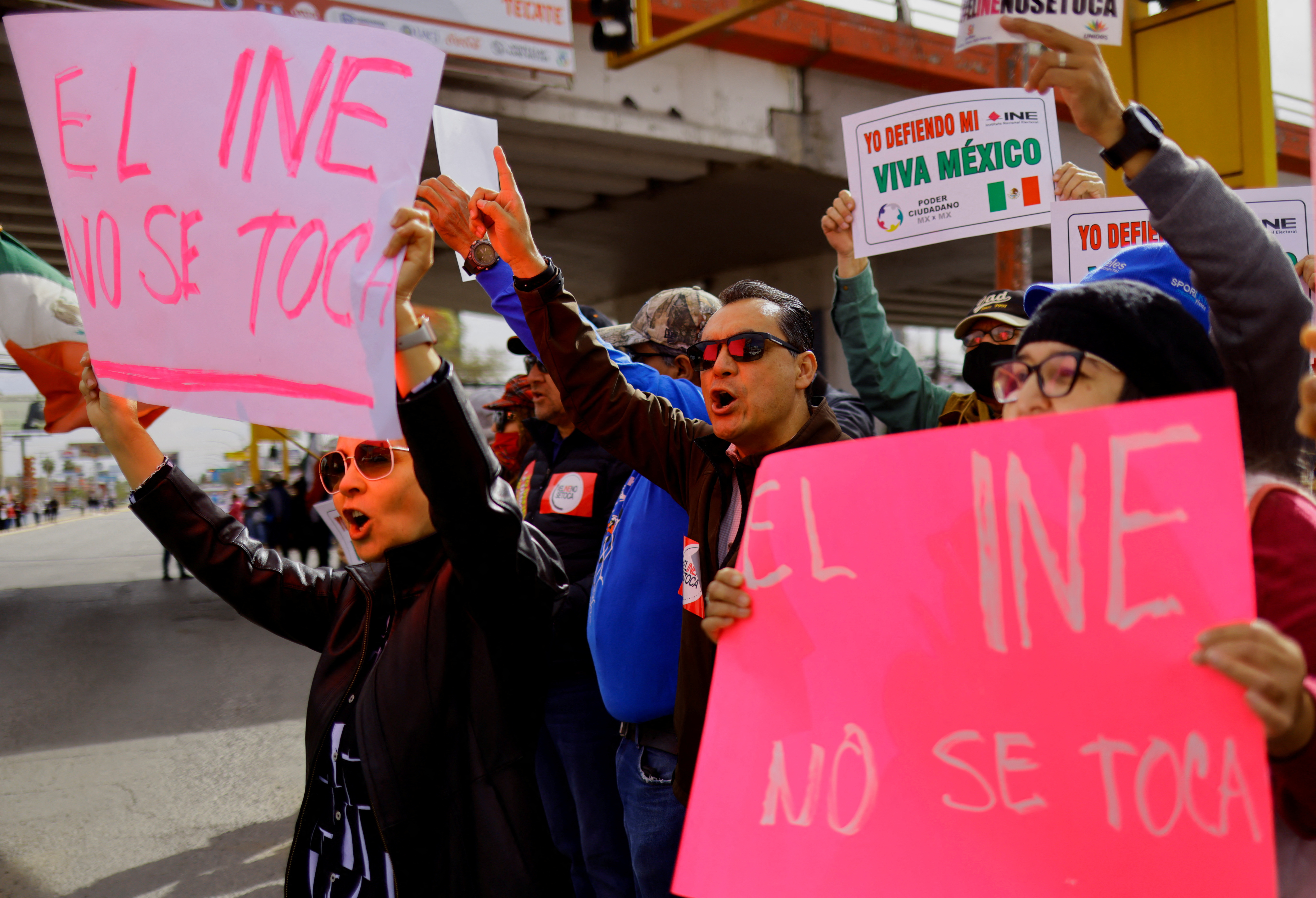
On Nov. 13, tens of thousands of Mexicans took to the streets to protest President Andres Manuel Lopez Obrador’s plan to slash funding for the National Electoral Institute (INE) –which oversees elections in Mexico — and reorganize the body in a way that could give him more control over it.

The protest was supported by the Institutional Revolutionary Party (PRI), helping to galvanize opposition to the overhaul which civil society groups fret risks undermining democracy under Lopez Obrador.

Opinion polls since the demonstration, the biggest against Lopez Obrador’s policies since he took office four years ago, showed backing for the opposition creeping up against the ruling leftist National Regeneration Movement (MORENA).

“MORENA must learn to listen, and these are times in which we cannot be arrogant, not listen and not see what’s happening in the country,” said Ricardo Monreal, MORENA’s Senate leader, and a presidential contender for 2024.

Resistance to the electoral reform, one of the president’s top legislative priorities, has shown the limits to his power and underlined why MORENA faces a battle to keep control of Congress in 2024 even if it is hotly favored to retain the presidency.

Before the protest, some opposition politicians had questioned the PRI’s willingness to vote down the INE overhaul, threatening to drive a wedge between MORENA’s adversaries.

But the demonstration revived hopes that the once dominant PRI can defend two of its remaining bastions in elections in the State of Mexico and the northern state of Coahuila next June.

Surrounding much of Mexico City, the State of Mexico is he country’s most populous region and a bellwether for voter sentiment going into the presidential election race. The PRI have never lost a gubernatorial contest there or in Coahuila.

A voter survey published this week by polling firm Buendia & Marquez for newspaper El Universal showed the PRI, the center-right National Action Party (PAN) and two other opposition parties collectively eating into MORENA’s still-commanding lead.

MORENA has more than twice the support of its nearest rivals, but the poll suggested that if the center-left Citizens Movement (MC) party joined forces with the rest of the opposition, elections could become significantly closer.

MC has so far shied away from working with the other opposition groups, trying to position itself as independent of MORENA and the more established opposition parties, which Lopez Obrador has pilloried as corrupt.

Some members of MC told Reuters the group could end up working with the opposition in 2023, although the party leadership has yet to endorse such a move.

Without opposition support, Lopez Obrador cannot pass his planned electoral overhaul, a constitutional reform which requires a two-thirds majority in Congress.

Debates began last week in congressional committees over the bill that also envisages reducing financing for political parties and limiting advertising time.

The president says the legislation will democratize the INE by having its commissioners elected by the public rather than by a two-thirds majority in the lower house.

However, under the reform the task of nominating candidates falls to a combination of the judiciary, Congress and the executive. Critics view that as a presidential power grab, something Lopez Obrador denies.

If the bill founders, Lopez Obrador has mooted lesser changes that only require a simple majority. But MORENA’s Monreal has questioned the validity of that plan.

Lopez Obrador may have a last chance to reshape the INE when four of its 11 commissioners step down next April.

Irrespective of whether the INE controversy animates voters, analysts say it is far from clear that the opposition have found candidates that capture the public’s imagination.

“Winning in Coahuila and the State of Mexico is more feasible than the presidential election,” said Antonio Ocaranza, a one-time spokesperson for former President Ernesto Zedillo.

“It’s one thing to agree to defend the INE and another to agree on a competitive candidate.”

Related Galleries:

People take part in a protest against the electoral reform proposed by Mexican President Andres Manuel Lopez Obrador and in support of the National Electoral Institute (INE) in Ciudad Juarez, Mexico, November 13, 2022. The signs read: “INE must not be touched” and “I defend my INE. Long live Mexico”. REUTERS/Jose Luis Gonzalez

An areal view shows people protesting against the electoral reform proposed by Mexican President Andres Manuel Lopez Obrador and in support of the National Electoral Institute (INE), in Monterrey, Mexico, November 13, 2022. REUTERS/Daniel Becerril
Categories
Audio Sources - Full Text Articles

Biden cites progress in tackling U.S. inflation

2022-12-01T15:01:23Z

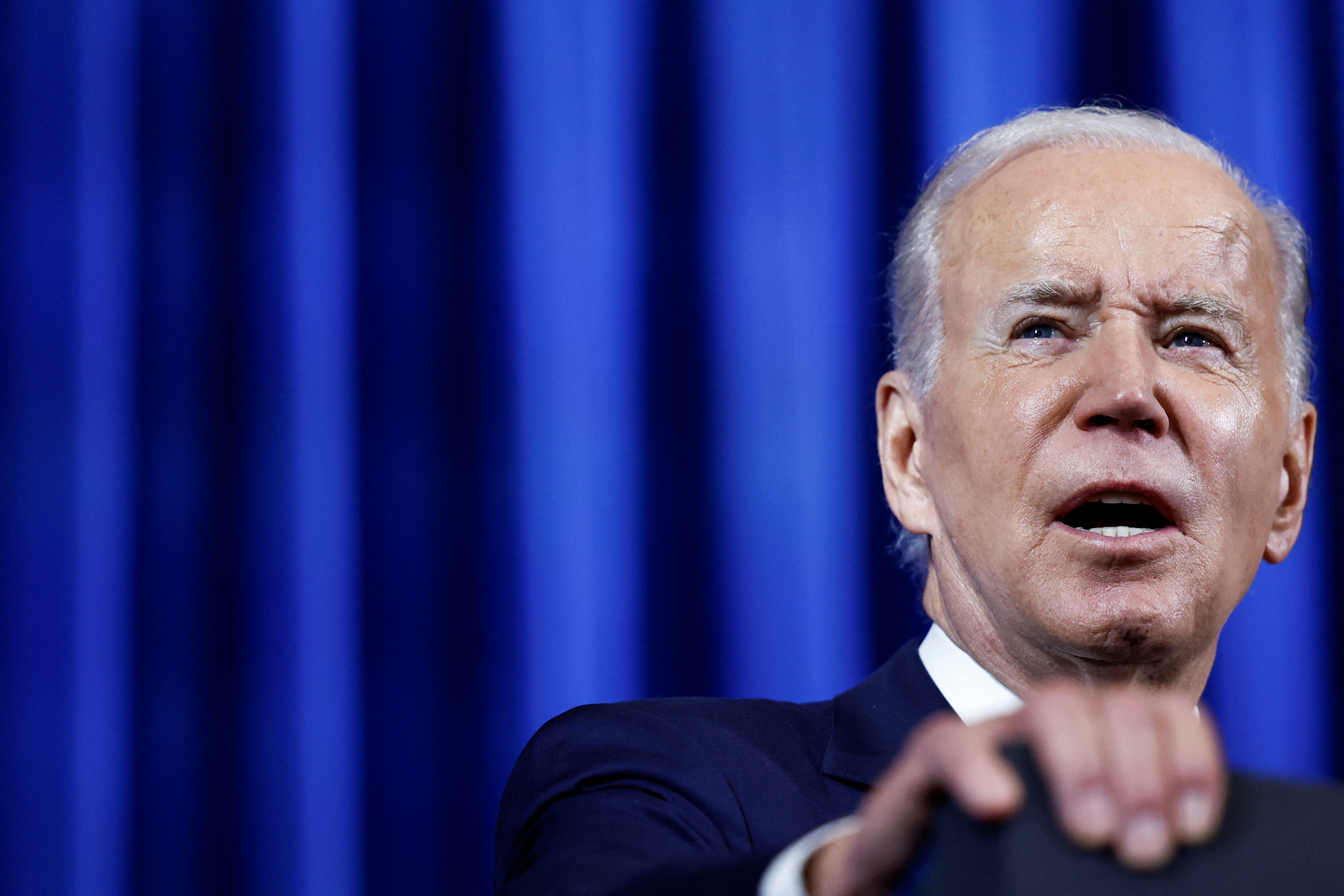
U.S. President Joe Biden addresses the White House Tribal Nations Summit at the Interior Department in Washington, U.S., November 30, 2022. REUTERS/Evelyn Hockstein

The United States is seeing initial signs of progress in tackling inflation, President Joe Biden said after U.S. consumer spending data released on Thursday showed spending accelerated while inflation pressures moderated.

“We are seeing initial signs that we are making progress in tackling inflation, even as we make the transition to more steady, stable economic growth,” Biden said in a statement released by the White House.

“It will take time to bring inflation back to normal – and there could be setbacks along the way – but the American people should have confidence that our plan to tackle inflation, without giving up all the historic economic gains American workers have achieved, is working,” he added.

Categories
Audio Sources - Full Text Articles

Kipchoge set for Boston Marathon debut next year

2022-12-01T15:09:15Z

Athletics – Berlin Marathon – Berlin, Germany – September 25, 2022 Kenya’s Eliud Kipchoge celebrates as he wins the Berlin Marathon and breaks the World Record REUTERS/Fabrizio Bensch

Kenya’s marathon world record-holder Eliud Kipchoge will make his Boston Marathon debut on April 17 next year, the 38-year-old said on Thursday, as he seeks a fifth victory in one of the six World Marathon Majors.

The two-times Olympic champion has already triumphed in the London, Berlin, Chicago and Tokyo marathons which are part of the majors and said in a statement released by his NN Running Team that he was ready for the next step.

“I’m happy to announce in April I will compete in the Boston Marathon,” Rio and Tokyo Olympic champion Kipchoge said. “A new chapter in my Abbott World Marathon Majors journey.”

Kipchoge, who has won 15 out of his 17 career marathons, shattered his own world record in September, winning the Berlin race with a time of 2:01.09 to shave half a minute off his previous world best set four years ago.

He has a total of 10 major titles but has previously not taken part in Boston and New York.

Kipchoge is the only man to run a sub-two hour marathon when he crossed the finish line in 1:59.40 on a specially designed track in Vienna in 2019. The time was not officially recognised, however, because it was not set in competition.

Categories
Audio Sources - Full Text Articles

Russia accuses U.S. of direct Ukraine war role, but says it“s open to potential talks

2022-12-01T15:14:14Z

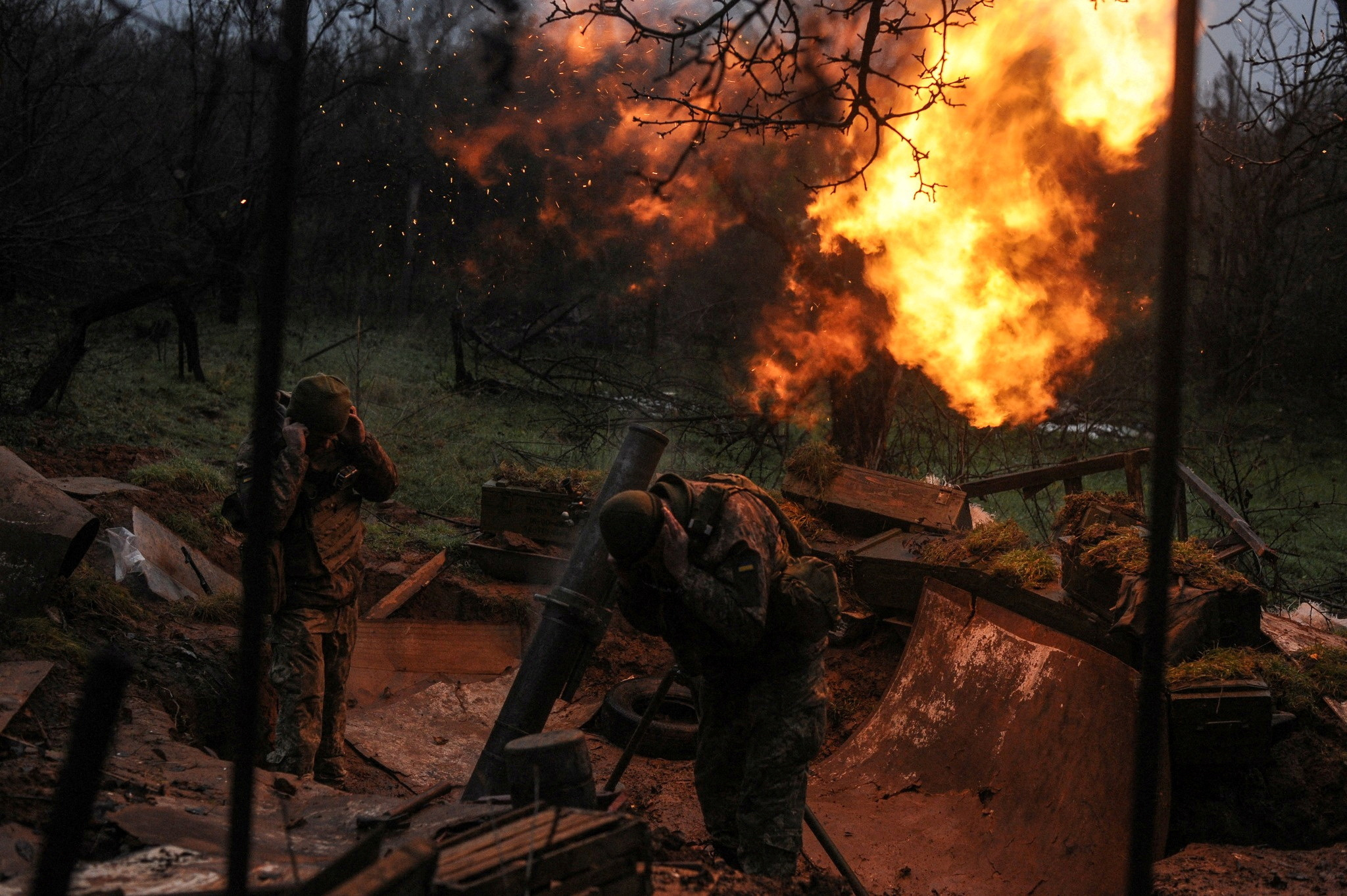
Ukrainian servicemen fire a mortar on a front line, as Russia’s attack on Ukraine continues, in Donetsk region, Ukraine, in this handout image released November 20, 2022. Iryna Rybakova/Press Service of the 93rd Independent Kholodnyi Yar Mechanized Brigade of the Ukrainian Armed Forces/Handout via REUTERS

Russian Foreign Minister Sergei Lavrov accused the United States and NATO of playing a direct and dangerous role in the Ukraine war and said Washington had turned Kyiv into an existential threat for Moscow which it could not ignore.

Russia’s top diplomat, speaking on Thursday during his annual news conference in Moscow, also accused the United States and NATO of trying to ratchet up tensions in the South China Sea and of trying to subvert any regional bodies designed to promote dialogue, such as the OSCE in Europe and ASEAN in Asia.

And he defended a Russian campaign that has used air, drone and missile strikes to destroy Ukrainian infrastructure, attacks that Kyiv and the West have called war crimes.

“We disable energy facilities (in Ukraine) that allow you (the West) to pump lethal weapons into Ukraine to kill Russians,” Lavrov said.

“So don’t say that the U.S. and NATO are not participants in this war – you are directly participating. Including not only with the supply of weapons, but also with the training of personnel – you train the (Ukrainian) military on your territory.”

Lavrov’s stance, revisiting familiar Russian talking points, is rejected by the West which says Moscow, which invaded Ukraine on Feb. 24, is the belligerent one. Western powers say they are arming and training Kyiv to help it recapture its own land and that Ukraine does not have territorial designs on Russian land.

Russia, which dominated Ukraine before the Soviet Union broke up in 1991, calls its intervention in its neighbour “a special military operation” to safeguard Moscow’s security.

Lavrov delivered his anti-Western tirade as Russia’s invasion of Ukraine ground through its tenth month with fighting raging in the east and officials in parts of Ukraine still battling to restore electricity knocked out by Russian strikes.

Lavrov accused the West of trying to use the conflict to destroy Russia. “Talk of the West being interested in some kind of peaceful settlement does not impress us,” he said.

“The West has publicly announced that it does not just want Russia to be defeated on the battlefield. It has said that Russia should be destroyed as a player altogether. And some are even holding special conferences speculating on how many parts to divide Russia into and who will lead which part.”

His comments appeared to be a reference to the fact that some Western politicians have said they want to ensure Russia cannot pose a threat to neighbouring countries in future, and to remarks by some Ukrainian politicians who have speculated how long Russia might hold together as one country.

Although Lavrov devoted most of the event to criticising the West, he made clear that Russia was open to the possibility of talks, both with Ukraine and the United States.

Russia is ready to listen to anyone who wanted to hold talks, he said. It had never shied away from any possible contacts between U.S. President Joe Biden and Russian President Vladimir Putin, and had shown willingness by receiving the German and French leaders when they wanted to discuss Ukraine.

Ukraine has said it will only be ready to hold talks once Russia had withdrawn from its territory, including from Crimea, which Moscow annexed in 2014.

Kyiv has said that Russia would only use talks as a chance to buy time and rebuild its armed forces.

Lavrov said this was “absurd” and complained about what he called the “naive” American expectation that Russia would continue talks on nuclear stability at a time when he said the West was using Ukraine to destroy Russia. Moscow pulled out of scheduled talks this week on the New START nuclear treaty between the two countries.

“For now we aren’t hearing any meaningful ideas,” said Lavrov. “(But) if there will be proposals from the president (Biden) and from other members of his administration, we’ll never shy away from contacts.”


WP Radio
WP Radio
OFFLINE LIVE