Categories
Audio Sources - Full Text Articles

Two popes in the Vatican – sometimes more crowd than company

2022-12-31T10:03:52Z

When Pope Benedict shocked the Roman Catholic Church in 2013 by announcing he would resign instead of ruling for life, he promised to stay in the Vatican “hidden from the world”.

He kept only half that promise. Benedict may not have been seen much, but he certainly was heard.

Benedict wrote, gave interviews and, unwittingly or not, became a lightning rod for opponents of Pope Francis, either for doctrinal reasons or because they were loath to relinquish the clerical privileges the new pope wanted to dismantle.

Despite Francis’ insistence that Benedict was like a “grandfather living in the house”, and that an emeritus pope was now an institution in the Church, the result was a sometimes cumbersome co-habitation that caused more than one headache.

Between the time he announced his resignation on Feb. 11, 2013 and the time it took effect on Feb. 28, Benedict and his secretary, Archbishop Georg Ganswein, unilaterally decided that he would be called “pope emeritus” and continue to wear a white cassock, albeit a slightly modified one.

There was no broad consultation with canon lawyers and no real precedent to go by – the last pope to abdicate was Gregory XII, who stepped aside in a political deal to end a schism in 1415 and spent the rest of his days in obscurity 300 km (190 miles) away from the Vatican.

Celestine V was pope for five months in 1294 before he quit, concluding there was far more holiness in his previous life as a mountain hermit than in the Vatican with its clerical and political intrigue.

Church law says a pope can resign if he does so with no outside pressure, but it lacks specific rules on his status, title and prerogatives.

It was last updated in 1983, when Pope John Paul was a robust, globe-trotting 63-year-old and a papal resignation was the furthest thing from anyone’s mind.

Benedict received visitors, many from Germany, who were eager to have their picture taken with him. They sometimes disclosed what he said, feeding a conservative, nostalgic Catholic faction bent on weaponising his words.

In 2016, he published a memoir “The Last Conversations”, the first time a former pope had judged his own pontificate after it was over.

In a 2019 article for a Catholic magazine in Germany, Benedict linked the Church’s child sexual abuse scandal to the sexual revolution of the 1960s, which he said had spawned a general collapse in morality.

Many theologians called his reasoning deeply flawed and accused him of trying to blame society in general for what was a structural problem within the Church.

The situation became so ideologically polarised that he once had to tell those who pined for his pontificate there was only one pope and it was Francis.

Leaked letters showed Benedict told a German cardinal who was part of a public assault on Francis’ legitimacy to sheathe his ideological sword.

As late as 2021, eight years after he resigned, Benedict still had to chide “some of my more fanatical friends” who never accepted his decision to step aside and who rejected the legitimacy of Francis.

The biggest imbroglio revolved around a book about priestly celibacy in early 2020 written primarily by Cardinal Robert Sarah, a conservative African who holds a senior Vatican post.

The book defended priestly celibacy in what some saw as an appeal to Francis not to change the rules after a proposal that he allow older married men to be ordained on a limited basis in the Amazon to deal with a shortage of priests.

Sarah said Benedict was co-author. Benedict demanded that his name be removed from the cover, saying he was a contributor not a co-author. The American publisher refused and Sarah rejected media accusations that he had taken advantage of the frail ex-pope.

Commentators said Benedict was being used by the Church’s right wing in a power play against Francis to influence the election of the next pope.

“The emeritus papacy has proved a disorderly institution, one vulnerable to manipulation,” wrote papal biographer Austen Ivereigh.

Ganswein, a conservative, was widely seen as having mismanaged the book episode. Pope Francis later removed him from a top job in the Vatican. No explanation was given.

The episode brought calls for clear rules.

“In the Catholic Church, symbols are important,” said Father Tom Reese, a Washington-based Catholic author and commentator for Religion News Service.

“Symbols communicate, they teach. If you are not the pope, you should not be wearing white. Having two men wearing white sitting next to each other makes them look like they are equals, when they are not,” he wrote.

Reese said an ex-pontiff should not be called pope, should wear either the red or black garb of a cardinal or priest and should return to using his own name – in Benedict’s case, Joseph Ratzinger.

Reese, a Church liberal, found agreement from an unusual source – conservative Australian Cardinal George Pell, a former Vatican treasurer and close associate of Benedict in his retirement.

“The protocols on the situation of a pope who has resigned need to be clarified, to strengthen the forces for unity,” Pell wrote in a book in 2020.

“While the retired pope could retain the title of ‘pope emeritus’, he should be re-nominated to the College of Cardinals so that he is known as ‘Cardinal X, Pope Emeritus’, he should not wear the white papal soutane (cassock) and should not teach publicly,” Pell wrote.

A pope is also bishop of Rome. Reese and others have suggested that a former pontiff be called “bishop emeritus of Rome” and be subject to the rules that cover retired bishops.

Those rules say any bishop emeritus “will want to avoid every attitude and relationship that could even hint at some kind of parallel authority to that of the diocesan bishop, with damaging consequences for the pastoral life and unity of the diocesan community”.

Francis, 86, has said several times he would readily resign instead of ruling for life if his health made it impossible to run the Church. He has said he would want to be called Bishop Emeritus of Rome and live not in the Vatican but in a home for retired priests in the Italian capital “because its my diocese”.

Related Galleries:
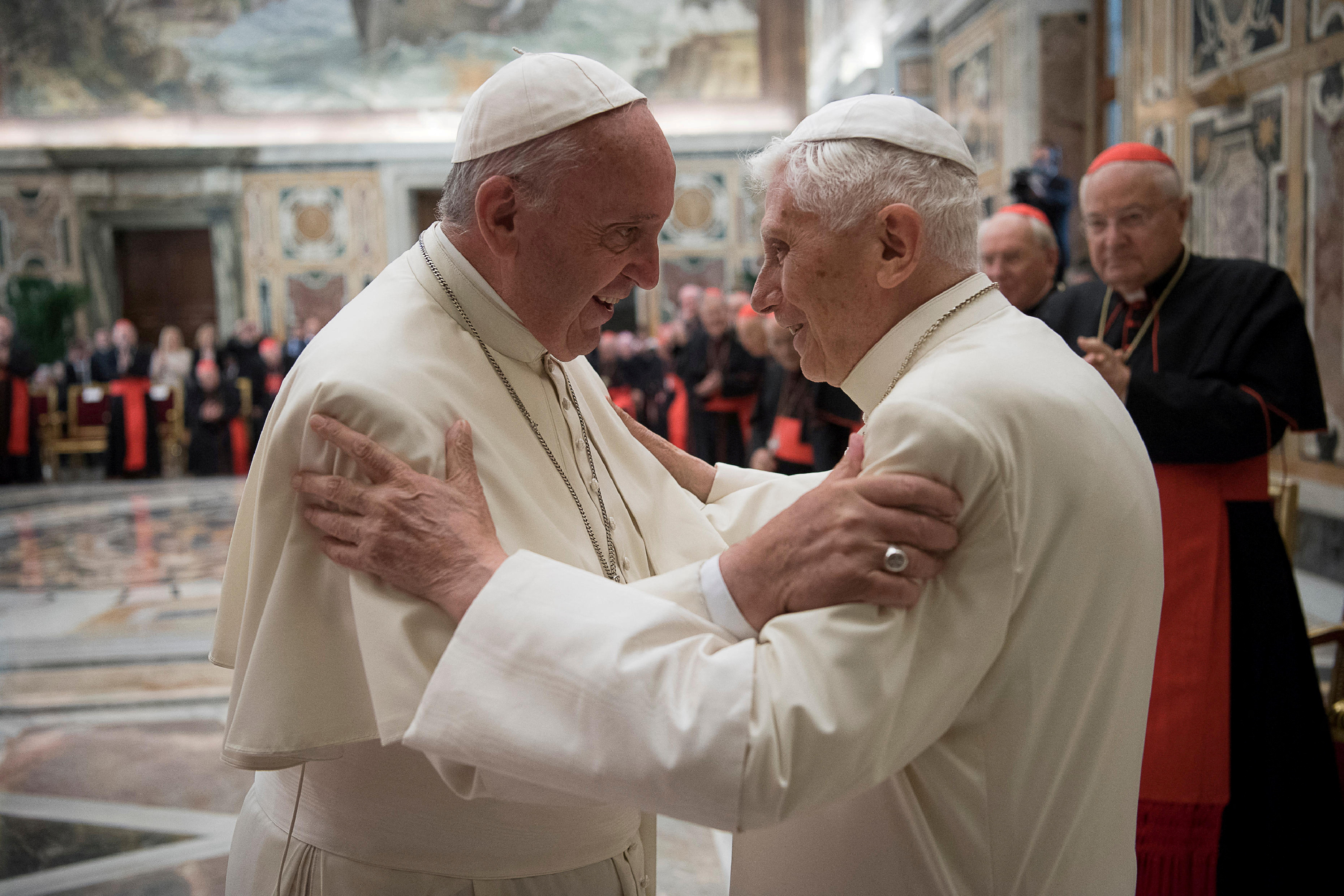
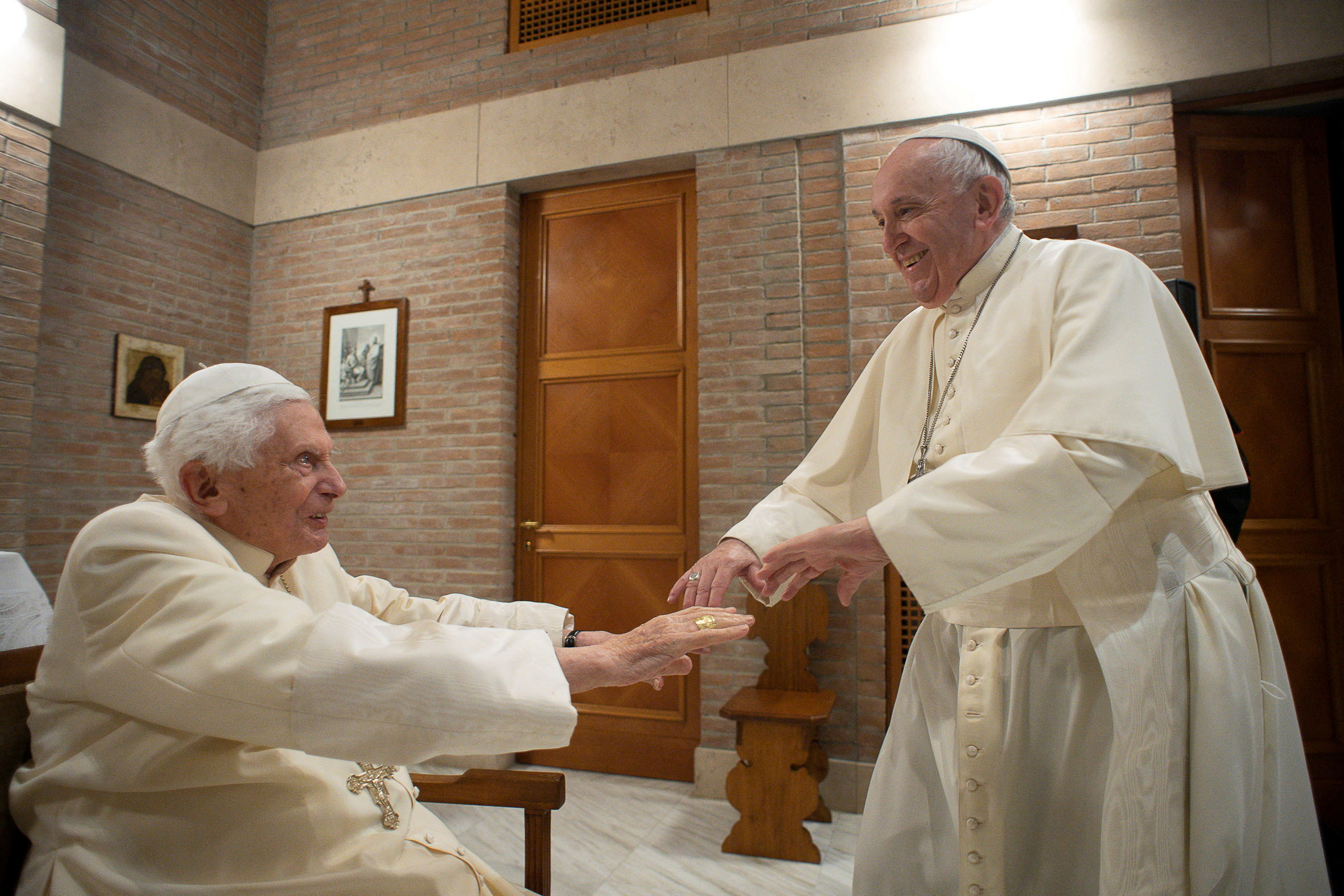
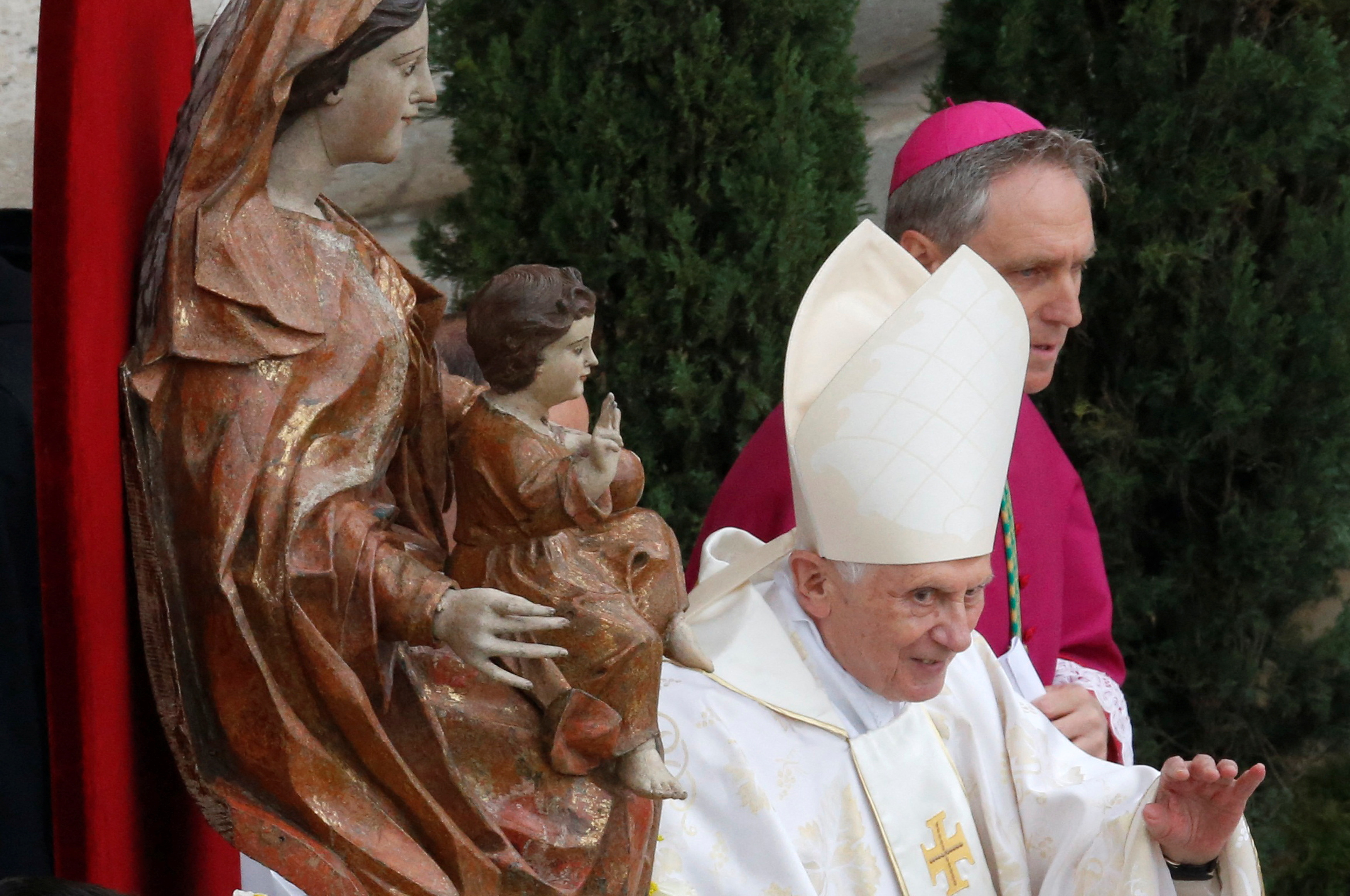
Former pope Benedict (R) is greeted by Pope Francis during a ceremony to mark his 65th anniversary of ordination to the priesthood at the Vatican June 28, 2016. Osservatore Romano/Handout via Reuters

Pope Francis greets Pope Emeritus Benedict XVI during a meeting following a consistory ceremony to install 13 new cardinals, at the Vatican, November 28, 2020. Vatican Media/Handout via REUTERS
Categories
Audio Sources - Full Text Articles

Former Pope Benedict dies aged 95

2022-12-31T10:11:49Z

Former Pope Benedict, who in 2013 became the first pontiff in 600 years to step down, died on Saturday aged 95 in the Mater Ecclesiae Monastery in the Vatican where he had lived since his resignation, a spokesman for the Holy See said.

“With sorrow I inform you that the Pope Emeritus, Benedict XVI, passed away today at 9:34 in the Mater Ecclesiae Monastery in the Vatican. Further information will be provided as soon as possible,” the spokesman said in a written statement.

The Vatican said his body will lie in state from Monday in St.Peter’s Basilica. The Vatican has painstakingly elaborate rituals for what happens after a reigning pope dies but no publicly known ones for a former pope.

Earlier this week, Pope Francis disclosed during his weekly general audience that his predecessor was “very sick”, and asked for people to pray for him.

For nearly 25 years, as Cardinal Joseph Ratzinger, Benedict was the powerful head of the Vatican’s doctrinal office, then known as the Congregation for the Doctrine of the Faith (CDF).

Conservatives in the Church have looked to the former pope as their standard bearer and some ultra-traditionalists even refused to acknowledge Francis as a legitimate pontiff.

They have criticised Francis for his more welcoming approach to members of the LGBTQ+ community and to Catholics who divorced and remarried outside the Church, saying both were undermining traditional values.

Related Galleries:

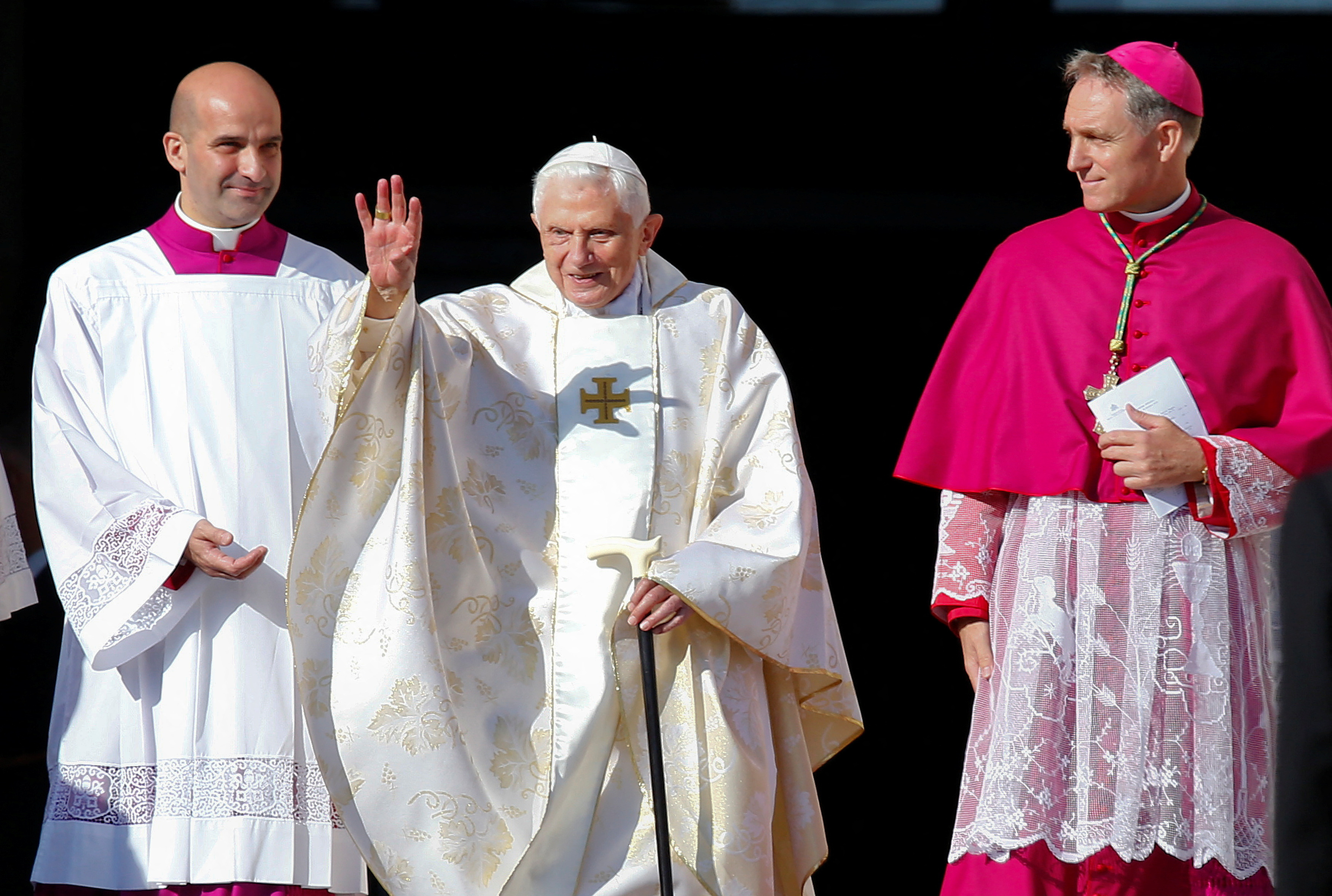
Emeritus Pope Benedict XVI waves as he arrives to attend a mass for the beatification of former pope Paul VI in St. Peter’s square at the Vatican October 19, 2014. REUTERS/Tony Gentile/File Photo

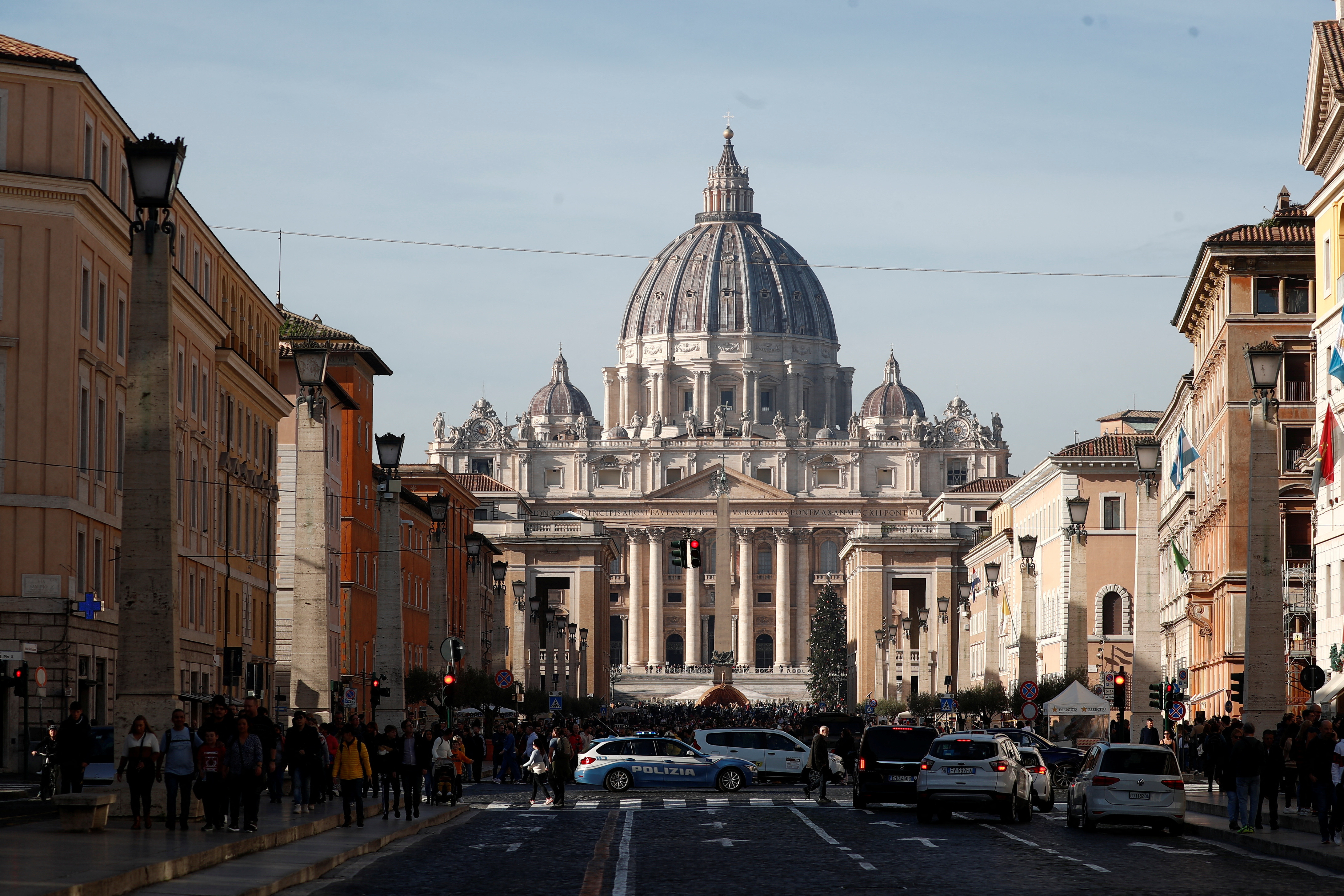
A view of St Peter’s Square after death of former Pope Benedict, at the Vatican, December 31, 2022. REUTERS/Guglielmo Mangiapane

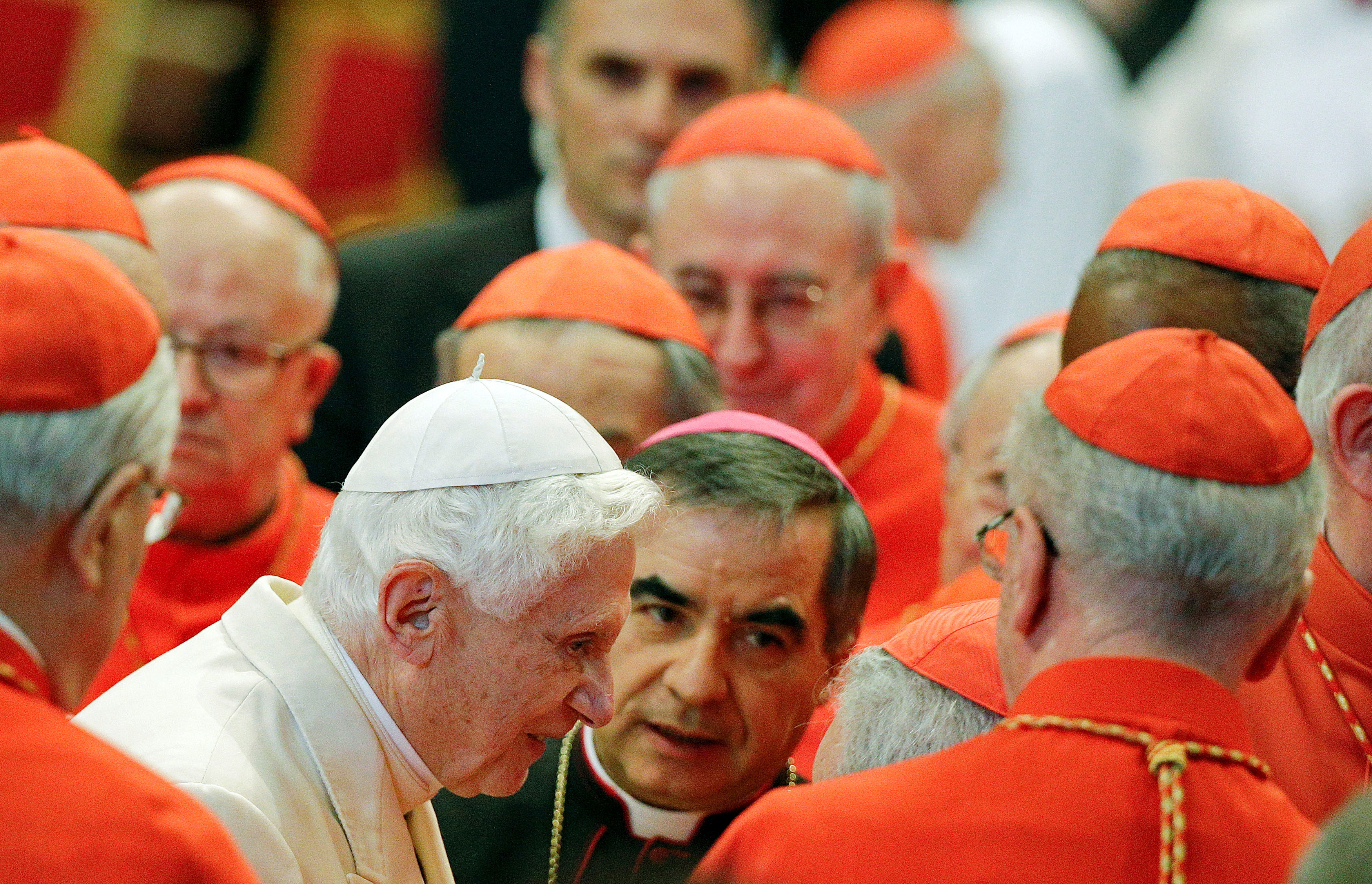
Pope Emeritus Benedict XVI is greeted by Cardinals as he arrives to attend a consistory ceremony in Saint Peter’s Basilica at the Vatican February 22, 2014. REUTERS/Max Rossi/File Photo

Former Pope Benedict XVI arrives to attend the canonisation ceremony of Popes John XXIII and John Paul II to start in St. Peter’s Square at the Vatican April 27, 2014. REUTERS/Stefano Rellandini/File Photo
Categories
Audio Sources - Full Text Articles

Factbox: Former pope Benedict, his papacy and resignation

2022-12-31T10:18:30Z

Former pope Benedict, 95, who in 2013 became the first pontiff in 600 years to step down, is “very sick,” his successor Pope Francis said on Wednesday (December 28).

Former pope Benedict, who died on Saturday, was the first pontiff in 600 years to resign from the post rather than rule for life.

Here are some facts about 95-year-old Benedict and his papacy.

– Benedict, the first German pope in 1,000 years, was elected on April 19, 2005 to succeed the widely popular Pope John Paul II, who reigned for 27 years. Cardinals chose him from among their number seeking continuity and what one called “a safe pair of hands”. For nearly 25 years, as Cardinal Joseph Ratzinger, he was the powerful head of the Vatican’s doctrinal office, the Congregation for the Doctrine of the Faith (CDF).

– An uncompromising theological conservative, Ratzinger left Germany and his post as archbishop of Munich in 1982 to head the CDF. His disciplining of Latin American priests who promoted Marxist-influenced Liberation Theology bestowed him with the sobriquet “God’s Rottweiler”.

– A weak administrator who admitted a “lack of resolve in governing and decision taking,” his eight-year papacy was marked by missteps and a leaks scandal. He antagonised Muslims by appearing to suggest that Islam was inherently violent. He angered Jews by rehabilitating a Holocaust denier and prompted international dismay by saying the use of condoms in the fight against AIDS only worsened the problem. The 2012 “Vatileaks” scandal helped unravel his papacy. Paolo Gabriele, Benedict’s butler, leaked secret documents that revealed corruption and feuding within the Vatican. Benedict said he stood down because bad health prevented him from bearing the full weight of the papacy.

– Child abuse scandals hounded most of his papacy but he is credited with jump starting the process to discipline or defrock predator priests after a more lax attitude under John Paul II. He ordered an inquiry into abuse in Ireland, which led to the resignation of several bishops. He disciplined the late Father Marcial Maciel, founder of the Catholic order the Legionaries of Christ and one of the Church’s most notorious predators. The Vatican under Pope John Paul II had failed to take action against Maciel despite overwhelming evidence of his crimes.

– In 2022, an independent report in Benedict’s native Germany alleged that he had failed to take action in four cases when he was Archbishop of Munich between 1977 and 1982. The frail former pope acknowledged in an emotional personal letter that errors had occurred and asked for forgiveness. His lawyers argued in a detailed rebuttal that he was not directly to blame.

– Although he promised to keep a low profile after his retirement, Benedict wrote, gave interviews and, unwittingly or not, became a lightning rod for conservatives who opposed Pope Francis. Some loyalists failed to accept that he had resigned the papacy willingly and continued to consider him “my pope”. The “two popes” confusion was compounded because he chose to continue wearing white and be known as “pope emeritus”. The resulting polarisation led to calls from both conservatives and liberals for changes in Church law to regulate the functions and status of former popes.

– Benedict produced more than 60 books between 1963, when he was a priest, and 2013, when he resigned. “In reality I am more of a professor, a person who reflects and meditates on spiritual questions,” Benedict said after his resignation.

– He played piano and had a preference for Mozart and Bach. As a classicist, he frowned on rock and roll as an “expression of base passions” and once called popular music a “cult of banality”. Pope Francis, by contrast, also loves classical music but appreciates Italian pop songs from the early 1960s and also likes tango music from his native Argentina.

Related Galleries:

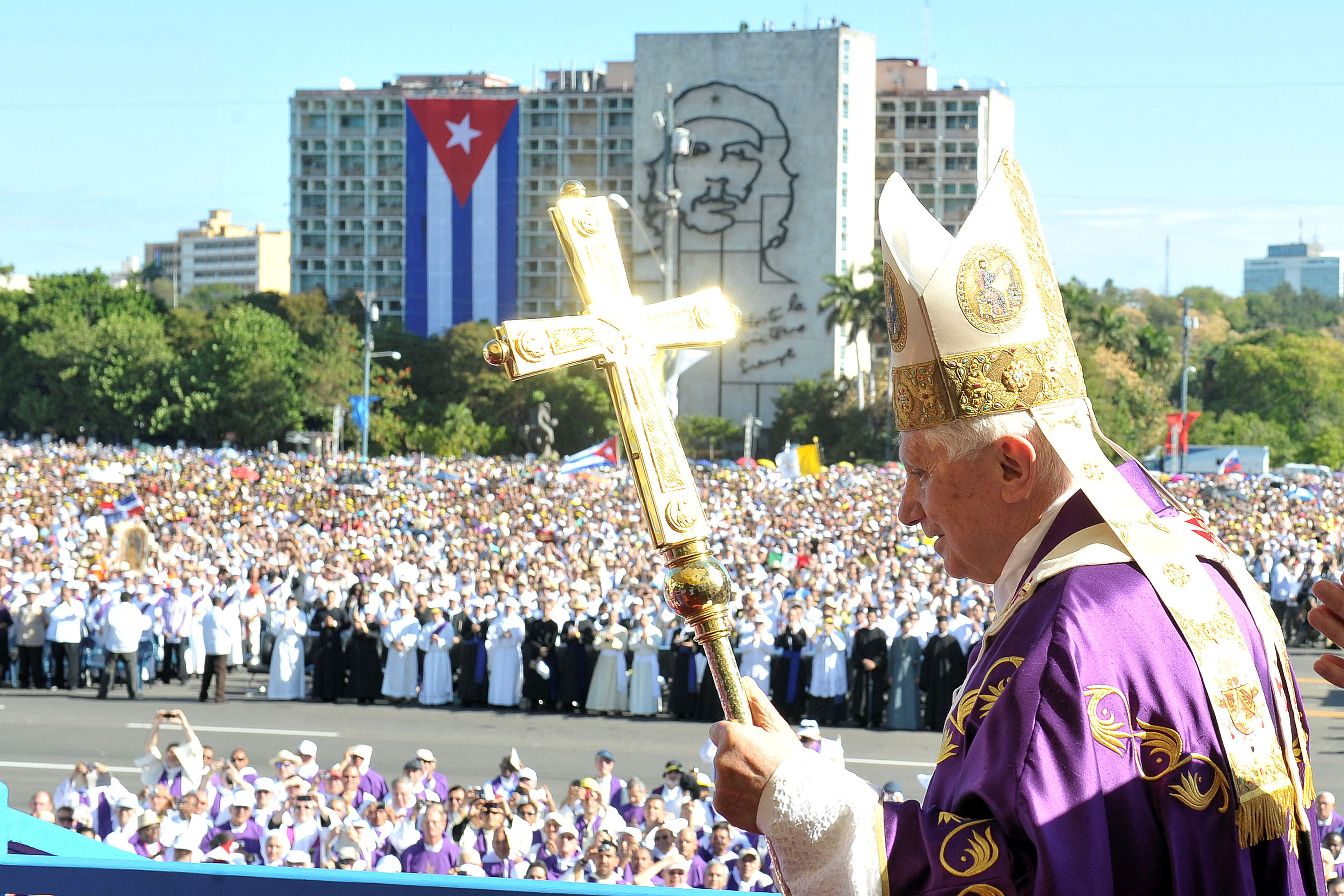
Pope Benedict XVI arrives to celebrate a mass at Revolution Square in Havana, Cuba, March 28, 2012. Osservatore Romano/Handout via REUTERS/File Photo

Pope Emeritus Benedict XVI is greeted by Cardinals as he arrives to attend a consistory ceremony in Saint Peter’s Basilica at the Vatican February 22, 2014. REUTERS/Max Rossi/File Photo
Categories
Audio Sources - Full Text Articles

‘Strong possibility’ Ukraine retakes all territory by end of 2023 – apart from Crimea | World News

Ukraine has a great likelihood to liberate all its territory – aside from Crimea – by the close of 2023, a armed forces skilled suggests.

Metropolitan areas like Severodonetsk, Melitopol and even Mariupol could be liberated if Volodymyr Zelenskyy’s forces maintain up their counteroffensive success, according to previous military intelligence officer Philip Ingram.

As we tactic the close of a year that has seen Vladimir Putin’s Russia invade its neighbour, producing untold destruction and bringing about the unparalleled return of war in Europe, Sky Information seems at what could occur in Ukraine in 2023.

In the months because the February 24 invasion that observed Kremlin forces arrive inside placing length of Kyiv, Ukrainian defenders have reclaimed extra than fifty percent of the land captured by Russia given that the commencing of the war.

President Zelenskyy has insisted that his troops will inevitably liberate all its territory, like parts in the Donbas and Crimea that have been occupied considering the fact that 2014.

When professionals remain break up on irrespective of whether that will ultimately be feasible, Ukraine’s forces have demonstrated their mettle and dedication again and once again on the battlefield.

The early days of the war saw the historic defence of the port town of Mariupol, in which a little band of troops held out for 82 days versus appalling odds – obtaining important time for defence forces somewhere else to regroup and get Western weapons.

More just lately, gorgeous counterattacks in the east and south have despatched Russian forces retreating from Kharkiv and Kherson.

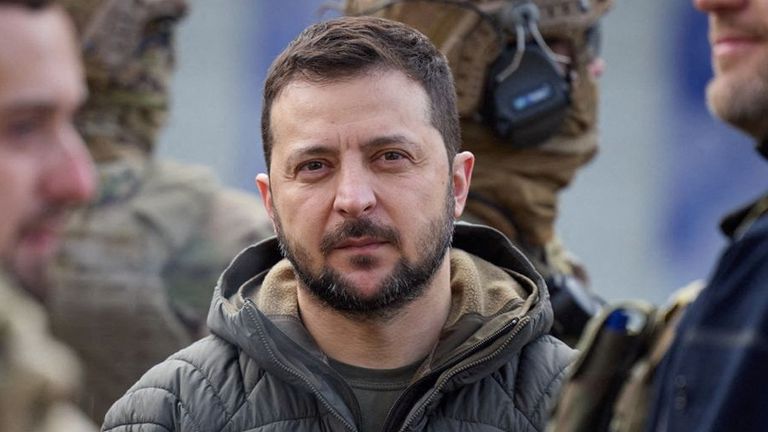
Ukraine's President Volodymyr Zelenskiy visits Kherson, Ukraine November 14, 2022. Ukrainian Presidential Press Service/Handout via REUTERS ATTENTION EDITORS - THIS IMAGE HAS BEEN SUPPLIED BY A THIRD PARTY.

Browse additional:
Folks ‘risk freezing to death’ amid assaults on electricity grid
Putin could use peace talks ‘as justification to rearm’

So what could transpire subsequent 12 months?

Previous intelligence officer Mr Ingram suggests it could all rely on what Ukraine does in the future several weeks as it seeks to advance once more.

He explained to Sky Information: “If their next counteroffensive is as profitable as the two they have carried out already – and I see no purpose why it shouldn’t be – there’s definitely a potent risk that they have recaptured all the territory in mainland Ukraine by the end of the yr.

“So I assume 2023 will be a calendar year of further more Ukrainian counteroffensives and successes.

“I feel at that stage we will be talking about the probable of operations to recapture Crimea.”

Mr Ingram reported additional Ukrainian successes would guide to an increase in dissent in just Russia, perhaps putting the rule of President Putin at hazard.

He claimed the recapture of Mariupol in unique would have a substantial psychological affect.

Having said that not all professionals concur on this long run for Ukraine about the future 12 months.

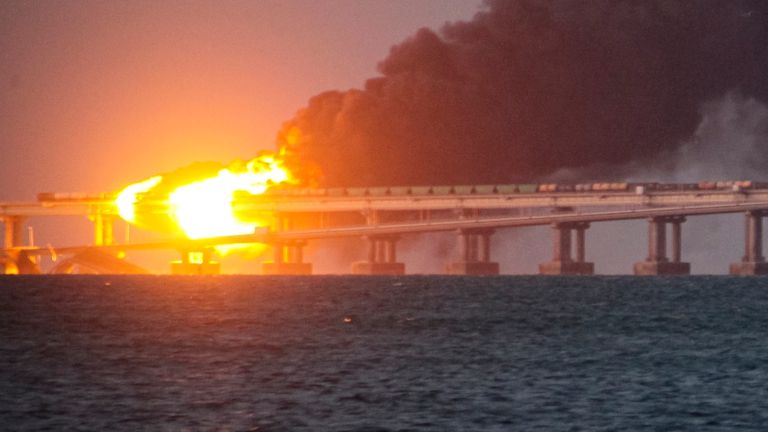
Kerch Bridge explosion. Pic: AP

Graphic:

The attack on the Kerch Bridge at Crimea was a big party in the war. Pic: AP

Supplies of Western weapons ‘not a bottomless pit’

Retired Air Vice-Marshal Sean Bell argued that the West can only aid Ukraine for so long, as weapons materials dwindle and the take care of of some international locations perhaps weakens amid superior power charges at home.

“When you appear at the scale of the weapons that have been provided, there’s not a bottomless pit,” he told Sky News.

“It truly is pretty tricky militarily to see the West getting able to maintain Ukraine for extra than a 12 months.”

He reported that while President Zelenskyy is publicly contacting for the return of all territory, guiding closed doors he may possibly be speaking “pragmatically” about the long term.

“I believe which is the place you have terrific statesmanship, since if profitable is about securing additional territory then, indeed, Putin’s gained.

“If Putin strategic aims are really to halt the enlargement of NATO, that has failed.

“If its intention is to restore Russia’s greatness, that has unsuccessful. If it can be to develop a more highly effective economic system, that has failed.

“So based on what metric we opt for from a grand strategic point of view, it is really really tricky to see this invasion becoming something other than abject failure.”

He mentioned it could effectively be that a peace is eventually brokered the place President Zelenskyy blames the West for forcing his hand but privately accepts that it is the only way to halt further decline of existence.

Source connection

The post ‘Strong possibility’ Ukraine retakes all territory by end of 2023 – apart from Crimea | World News appeared first on Ukraine Intelligence.

Categories
Audio Sources - Full Text Articles

Six killed, seven injured in Russian attacks on Ukraine over past day

630_360_1656512373-744.jpg

On December 30, 2022, six civilians had been killed and seven injured in Russian assaults on the territory of Ukraine.

The suitable assertion was made by Deputy Head of the Place of work of the President of Ukraine Kyrylo Tymoshenko on Telegram, an Ukrinform correspondent experiences.

According to the details from regional military administrations, three civilians ended up killed and 3 wounded in the Donetsk area, one particular wounded in the Zaporizhzhia area, two killed (like a single in mine blast) and one injured in the Kharkiv area, two hurt in the Kherson region, and a single killed in the Chernihiv location.

A reminder that, on December 30, 2022, Russian troops shelled the Chernihiv region’s Semenivka, getting killed a civilian.

mk

Source link

The post Six killed, seven injured in Russian attacks on Ukraine over past day appeared first on Ukraine Intelligence.

Categories
Selected Articles

Police reveal DNA led investigators to suspect in Idaho student murders – Yahoo! Voices

Police reveal DNA led investigators to suspect in Idaho student murders  Yahoo! Voices
Categories
Audio Sources - Full Text Articles

Liberals Rose to Fight the Assault on Abortion — but Not Trans Rights

Representative Nydia Velazquez, a Democrat from New York, from left, Representative Ilhan Omar, Democrat from Minnesota, Representative Jackie Speier, a Democrat from California, Representative Carolyn Maloney, a Democrat from New York, and Representative Alma Adams, a Democrat from North Carolina, march toward the US Supreme Court during a protest of the court overturning Roe v. Wade in Washington, D.C., US, on Tuesday, July 19, 2022. The high court's reversal of the 1973 landmark decision protecting the federal right to abortion has sent shock waves through the medical, legal and advocacy communities with the White House signing an executive order intended to preserve access to the procedure. Photographer: Al Drago/Bloomberg via Getty Images

Democratic Party representatives march toward the Supreme Court during a protest of the court overturning Roe v. Wade in Washington, D.C., on July 19, 2022.

Photo: Al Drago/Bloomberg via Getty Images

When 2022 is tallied in the annals of history, it will no doubt be remembered as the year the Supreme Court ended the constitutional right to an abortion. Yet, while the decadeslong right-wing assault on reproductive liberties reached new heights this year, it also met a broad wave of long overdue resistance, even in crimson red states. The midterm election results were in many ways a popular rebuke to the Republican pro-natalist agenda — cold comfort as that might be in a country of minority rule.

The mass efforts to defend abortion access have not been echoed in the fight for trans lives.

The crucial struggle for abortion access is, however, a response to only one front in the far right’s all-out war on bodily autonomy and reproductive freedom. In statehouses nationwide, Republicans consistently put forward extreme anti-abortion bills at the very same time that they have proposed bills to attack, immiserate, and eliminate trans people, particularly trans children.

The GOP has made clear that its anti-abortion efforts go hand in hand with an anti-trans eliminationist project; they are two sides of the same coin. The mass efforts to defend abortion access, however, have not been echoed in the fight for trans lives.

Rather, 2022 has seen right-wing attacks on trans rights increasingly aided by the tacit, if sometimes unwitting, transphobia of liberal political and media institutions — consider the numerous New York Times reports and columns, for example, that have this year put trans lives up for debate. This has been no less than a victory for fascism.

In previous years, liberal transphobia seemed largely the preserve of Britain’s media ecosystem. Looking across the Atlantic, to my birth country, I had felt a certain relief that in the mainstream U.S. discourse, anti-trans rhetoric was, for the most part, understood to be a mark of the far right.

This year anti-trans liberal feminism — the sort championed by author J.K. Rowling — has been mainstreamed in the very same opinion pages that once treated the position as an unpleasant British curiosity.

The far right has, meanwhile, only escalated its anti-trans onslaught, grimly secure in the knowledge that, unlike with abortion, no significant political pushback will come. This is in part thanks to U.S. transphobes who falsely consider themselves in opposition to the far right — like some New York Times columnists — as well as fangless Democrats who treat trans people as an afterthought. Even the anti-fascist left has not done enough to take up the fight for trans rights.

WILKES-BARRE, PENNSYLVANIA, UNITED STATES - 2022/11/20: A woman holds a Pride flag as others hold candles during the vigil. A crowd gathered at the Public Square for a Transgender Day of Remembrance Sunday evening. The vigil was to bring light to the rights of transgender people after a shooting at a gay club in Colorado. (Photo by Aimee Dilger/SOPA Images/LightRocket via Getty Images)

Pride flags and candles wave during the Transgender Day of Remembrance in Wilkes-Barre, Penn., on Nov. 20, 2022.

Photo: Aimee Dilger/SOPA Images/LightRocket via Getty Images

In 2022, state lawmakers filed a record number of anti-LGBTQ bills — nearly 300 — with many targeting trans kids in schools. Ten states barred trans students from playing sports, two states barred trans children from accessing the correct bathrooms, and two states banned discussions of sexual orientation or gender identity in schools (which, of course, only means the discussion of non-cisgender identities and non-heteronormative sexual orientations).

Republican Texas Gov. Greg Abbott directed state agencies to investigate parents of trans kids as child abusers, an effort Republicans in other states are looking to advance. In Congress, far-right extremist Rep. Marjorie Taylor Greene, R-Ga., introduced the first piece of federal legislation, co-sponsored by a whopping 40-plus House Republicans, to outlaw gender-affirming care for minors nationwide. That law would make providing such care a felony punishable by up to 25 years in prison.

The only thing holding many of these barbaric laws and policies at bay are lawsuits filed by trans children and their families, represented by attorneys like Chase Strangio of the American Civil Liberties Union.

The outlook for 2023 remains dark: Republicans will control the U.S. House and state lawmakers — with scant reason to limit their anti-trans eliminationist efforts — will continue apace. Immediately after the midterms, lawmakers in Tennessee filed bills to ban gender-affirming health care for children in next year’s state legislative session.

Meanwhile, outside statehouses and courtrooms, the far right has declared open season on LBGTQ spaces. It is now common practice for armed, self-identifying Christian nationalist militia members to harass family-friendly drag brunches and drag queen story hours. When a mass shooting last month at Club Q, an LGBTQ nightclub in Colorado Springs, left five people dead, the national response was one of shock but not surprise. Anti-LGBTQ violence felt all but inevitable.

The response from the usual liberal bastions wasn’t surprising either: There was handwringing about physically defending queer people. A week after the massacre, the New York Times editorial board chose to dedicate column inches to condemning armed anti-fascist groups who have been protecting queer spaces in response to this ongoing wave of armed fascist harassment.

Fascist propagandists like the Manhattan Institute’s Christopher Rufo — who cynically transformed “critical race theory” from a term of scholarly inquiry into a racist foghorn — have spoken publicly about stoking their conservative base with anti-LGBTQ myths of “groomers” and pedophiles.

It’s not a secret that the anti-trans panic has been manufactured by think tanks or that anti-trans legislation is drafted from model bills, circulated from the top down, and spewed from Tucker Carlson’s furiously contorting mouth into millions of living rooms every evening. There is nothing organic nor grassroots about this anti-trans moral panic, yet it is accorded the status of a legitimate public concern.

“Rufo is so confident in his disdain” for liberal establishment media, noted writer Max Fox in a recent essay for Parapraxis, “that he can be seen telling credulous liberal journalists precisely how he has manipulated them into carrying out his campaign.”

There is nothing organic nor grassroots about this anti-trans moral panic, yet it is accorded the status of a legitimate public concern.

It’s working: Liberals might not be echoing QAnon “groomer” conspiracies, but anti-trans panic abounds, reliably articulated as fear for the fates of children — notional children, who are presumed cis, that is. Time and again, I’ve heard ostensibly well-meaning liberals regurgitate the same sentences that were used in previous eras to treat gay identity, or interracial couples, as sites of potential peril. The refrain is the same: I support it, but won’t children suffer? And the answer should be the same too: Only if we maintain a world wherein such identities and relationships are deemed unnatural and unwanted.

This is not a question of showing liberal deference to personal identity. It’s about who is and is not permitted to produce and reproduce the world as they see fit. When it comes to queer and trans liberation, especially of queer trans people of color, we have this year seen the consequences of treating the recognition of identity as merely an issue of visibility or representation. Without a commitment to our shared liberation, without active solidarity, increased visibility for trans people can just mean greater exposure to risk.

We will carry the struggle for reproductive freedom into the new year. We must: Republican efforts to decimate reproductive health care have been horrifyingly successful, and they will not stop. Avoiding a red wave in the midterms did not restore abortion rights, let alone the free and accessible abortion and reproductive care we so need.

Yet we can’t win this fight unless we understand the right’s anti-abortion politics for what they are. That means seeing why the struggle for trans rights and reproductive justice must go together. For the most part, beyond a highly religious minority, those who are anti-abortion are not driven by a true belief in the inviolable value of all fetal life; Republicans would have and pay for fewer abortions themselves if that were true, and they would arguably care more about the lives of poor, Black pregnant women.

Republican efforts to decimate reproductive health care have been horrifyingly successful, and they will not stop.

Instead, when Republicans invoke the child who needs saving from abortion, they refer to a political construction, a figuration: the “innocent” white, cis child at the heart of the Republican political imaginary, reproduced within the confines of the private nuclear family. It’s this organization of white standing and property that anti-abortion politics aim to uphold.

It’s not an accident, then, that Republicans call upon the same myth of imperiled children to warn of trans indoctrination, grooming, or “social contagion” — with the very same notions of “purity” and traditionalist family reproduction at play.

Fascism holds this imaginary “innocent” child at its rhetorical center — and when it comes to abortion politics, liberals and leftists have rejected its invocation, insisting instead on prioritizing the health and well-being of actually living adults and children and their rights to bodily autonomy.

In the struggle for trans rights, all too many liberals — and some leftists — have interpellated notions about pure and innocent children who must be somehow protected from transness. That is, they have let fascism’s child win the day. Vanquishing the right’s pro-natalist fascism requires standing with trans children.

The post Liberals Rose to Fight the Assault on Abortion — but Not Trans Rights appeared first on The Intercept.

Categories
Audio Sources - Full Text Articles

2022 Man of the Year: Paul Whelan

In some ways, playing identity bingo is the ultimate cheat code to life these days. Pull a straight, and you can get away with anything.

Get caught carrying out one of the largest leaks of classified records in U.S. history? Not a problem—the president will spring you from prison, provided you change your name and mutilate your genitals. Want to manage America’s nuclear waste by day and get your rocks off stealing women’s clothes by night? You do you, as long as you’re a “genderfluid” spanking fanatic who ties your partners up like dogs in your sex dungeon. Do you identify as a wolf and howl at the moon? That will land you a fat monthly paycheck in some California cities.

But real heroes don’t take the easy way out. They find the strength to persevere and stay the course even in the face of unimaginable hardship.

Take for example Paul Whelan, the white, cisgender, heterosexual former Marine who has been held hostage in a Russian gulag since late 2018 on trumped-up espionage charges. President Joe Biden had the opportunity in December to release Whelan from his wrongful imprisonment. Instead, he swapped murderous arms dealer Viktor Bout, known as “The Merchant of Death,” for Brittney Griner, the America-hating black lesbian basketball player best known for being one of only six WNBA players to ever throw down a dunk.

It matters not that Whelan has maintained his innocence since his wrongful arrest and that Griner immediately confessed to violating Russian drug laws. American Federation of Teachers president Randi Weingarten said the quiet part out loud: Griner is black. And a woman, but also gay. Biden had no choice.

What a great relief!!! Extraordinary news, a basketball star, but also a gay, black woman is released. And yes of course we want other prisoners like Paul Whelan released.

— Randi Weingarten 🇺🇦🇺🇸💪🏿👩‍🎓 (@rweingarten) December 8, 2022


The Washington Free Beacon knows a grave injustice when it sees one. Griner will soon return to the basketball court to entertain a handful of WNBA fans while Whelan continues to rot in a Russian gulag, abandoned by his government.

Whelan, understandably, was utterly dejected upon learning Biden failed to secure his release. But the former Marine has maintained his innocence and stayed true to himself throughout a hellish ordeal that would have broken most men, and for that, Paul Whelan is a Washington Free Beacon Man of the Year.

The post 2022 Man of the Year: Paul Whelan appeared first on Washington Free Beacon.

Categories
Audio Sources - Full Text Articles

Editorial

4873d00f9e318cce9e175e24959c30c5.png?w=1

Kyiv Post New Year’s Editorial

Categories
Audio Sources - Full Text Articles

Results of the Stormy Year That Was 2022

5c9d3f2b5f3a70f5a774cf6c1d9b218c.jpg?w=1

Ukraine proved herself as a country in 2022. The Ukrainian political nation, together with its national and democratic identity, was finally established.

WP Radio
WP Radio
OFFLINE LIVE