Categories
Audio Sources - Full Text Articles

Special Report: Boy Scouts, Catholic dioceses find haven from sex abuse suits in bankruptcy

2022-12-30T11:07:29Z

Lawmakers around the United States have tried to grant justice to victims of decades-old incidents of child sexual abuse by giving them extra time to file lawsuits. Now some of the defendants in these cases, including church and youth organizations, are finding a safe haven: America’s bankruptcy courts.

In New York, nearly 11,000 cases flooded state courts, many seeking to hold Catholic dioceses responsible for sexual abuse by clergy, after a 2019 law suspended statutes of limitations that would have otherwise barred many of the lawsuits. In response, four New York dioceses that collectively faced more than 500 sexual-abuse claims filed for bankruptcy. That halted the cases — and blocked those from anyone who might sue later — and forced the plaintiffs to negotiate a one-time settlement for all abuse claims in bankruptcy court.

The pattern has taken hold across the United States, a Reuters review of bankruptcies precipitated by mass child sexual-abuse litigation found.

Many of the defendants turning to bankruptcy court are nonprofit organizations. In court filings dating back to 2009, the Boy Scouts of America, a New York boys & girls club and 13 separate Catholic institutions each have cited state laws extending abuse victims’ right to sue as factors in their decisions to seek bankruptcy protection.

Such bankruptcies are “the counterpunch” to the state laws enabling more victims to seek justice and compensation through lawsuits, said Stephen Rubino, a lawyer who’s represented clergy abuse victims for more than 30 years.

In all, 23 states, two territories and Washington, D.C., have passed laws that suspend statutes of limitations for sexual-abuse victims who were previously prevented from suing over older cases. The suspensions typically last a year or more, allowing plaintiffs to file new lawsuits involving old abuse cases during that period. California, New York and several other states passed such laws in 2019.

Bankruptcy courts are undermining the impact of the statutes, some legal experts and victims’ advocates say. Judges overseeing these Chapter 11 filings set their own deadlines to file a sexual-abuse claim for compensation from the bankruptcy settlement.

Victims who miss the bankruptcy claims-filing deadline receive nothing or are forced to compete for limited funds set aside for unknown future claimants, the Reuters review of bankruptcies found.

“As we dramatically increase access to justice through statutes-of-limitations reform, we have more organizations going into bankruptcy because, frankly, bankruptcy law favors the organizations,” said Marci Hamilton, the founder of Child USA, a group that has advocated for laws expanding sexual-abuse victims’ rights to sue.

Child sexual-abuse victims often don’t come forward until much later in life, sometimes past the age of 50, according to several victims’ lawyers and studies on abuse disclosure. Some are not aware of bankruptcy proceedings that affect them until it is too late.

Bankruptcy claims-filing deadlines can force victims to come forward before they are ready, Hamilton said. And abuse claimants have limited leverage in Chapter 11 cases that halt their litigation and shield organizations such as dioceses, schools or youth organizations from current and future lawsuits, she said.

“The federal bankruptcy law is just defective when it comes to sexual-abuse victims,” Hamilton said. “Their voice is just stolen from them.”

Reuters identified settlements in 23 bankruptcies precipitated by child sexual-abuse scandals that halted current and future lawsuits and forced claimants to seek compensation from a trust. The cases involved the Boy Scouts, 21 Catholic organizations and USA Gymnastics. The youth gymnastics organization filed for Chapter 11 protection in 2018 amid a surge of lawsuits alleging abuse by convicted child sexual abuser Larry Nassar. (Now in prison, Nassar could not be reached for comment.)

The Boy Scouts and USA Gymnastics did not comment for this story.

The Boy Scouts and others have argued that their bankruptcy plans seek to pay claimants fairly and equitably, whereas civil litigation can result in some victims winning large jury verdicts and others receiving smaller judgments or nothing. USA Gymnastics has said it sought bankruptcy protection “to pave the way toward a settlement” with abuse survivors, who last year approved a plan paying them $380 million.

The organizations also often conduct extensive marketing campaigns to ensure that potential victims know they can seek compensation in the Chapter 11 cases, a review of the cases shows. The Boy Scouts, for instance, said on a website the group set up for restructuring that it launched a “comprehensive noticing campaign” in the media.

The Madison Square Boys & Girls Club in New York City referred Reuters to a bankruptcy-court declaration filed in June by its chief financial officer, Jeffrey Dold. Dold said the organization sought Chapter 11 protection after trying and failing to resolve about 140 pending claims of sexual abuse by club employees and volunteers between the 1940s and 1980s, all filed after the passage of New York’s claims-revival law. The club filed bankruptcy, Dold said, “to provide a forum to address those claims fairly and equitably.”

The U.S. Conference of Catholic Bishops had no comment on the new state laws or their impact nationwide on Catholic organizations facing sexual-abuse lawsuits. In a statement to Reuters, it said it defers to state and local catholic leadership organizations on state laws and bankruptcies. The conference noted the importance of “pastoral outreach” to abuse victims and said that local dioceses have victim assistance coordinators to “assist survivors and accompany them as they seek healing.”

The nonprofit organizations’ bankruptcies don’t protect the individual abusers themselves, whom victims can still sue. But they do grant lawsuit immunity to the entities that oversaw employees or volunteers accused of abuse.

Lawyers defending organizations targeted by sexual-abuse claims, along with some plaintiffs lawyers, say bankruptcy provides a fair way to compensate victims, many of whom want to avoid the ordeal of a lawsuit and a potential trial. Moreover, organizations and insurers paying the settlements won’t agree to any deal that doesn’t shield them from additional liability, said Susan Boswell, a retired lawyer who represented dioceses in bankruptcies from Arizona to Minnesota.

“If you can’t have finality,” she said, “then you are not ever going to be able to get one of these cases done.”

America’s federal bankruptcy courts play a critical role in justice and commerce by giving businesses overwhelmed by debt an orderly process to settle with creditors during a reorganization or liquidation. Those debts can include liability from lawsuits over deadly products, fraud, sexual abuse or other wrongdoing.

The power of U.S. bankruptcy courts to grant lawsuit immunity to organizations in bankruptcy, their leaders and affiliated entities has expanded over time. And so have the legal tactics of entities seeking Chapter 11 protection: Some corporations engulfed in scandals are now creating subsidiaries solely to absorb their lawsuit liability and declare bankruptcy.

Nonprofit organizations facing sexual-abuse lawsuits have pulled another page from the corporate bankruptcy playbook: In striking settlements, they typically seek “nondebtor releases” for their associated entities, such as religious schools and individual parishes. Such releases shield people and entities from lawsuits over issues taken up in bankruptcy settlements. By piggybacking on a nonprofit’s Chapter 11 filing, its affiliated organizations or leaders often get these liability shields without having to file for bankruptcy themselves.

Judges often appoint someone to advocate for the interests of potential victims who have not yet sued or made a claim in bankruptcy court. Known as future claims representatives, these appointees are often lawyers or financial professionals who are paid by the debtor and tasked with estimating the number of future claims and the funds needed to cover them. The reality, however, is that late filers often end up competing for smaller amounts than those who meet the deadline, according to court records reviewed by Reuters and attorneys involved in the proceedings. Unknown claimants become “numbers on a chart,” Rubino said.

A former Boy Scout, C, alleges a Scout leader abused him when he was a teenager. Reuters agreed to identify the former Scout, now 40, only by his first initial.

He sought compensation in the Boy Scouts bankruptcy in June, long after a deadline of November 16, 2020 for filing claims. C is now unlikely to recover much, if anything, from the $2.46 billion settlement the Boy Scouts reached with claimants alleging sexual abuse, his lawyer said. That’s because claimants who miss the deadline face a gauntlet of additional hurdles and conditions, according to C’s lawyer and a review of the Boy Scouts settlement terms.

The Boy Scouts bankruptcy reorganization plan, approved by a judge in September, halts all lawsuits against the Boy Scouts, local councils, churches and other organizations that chartered scouting activities.

The bankruptcy’s claims-filing rules take precedence over a recent law passed in California, where C says he was abused, that expanded sexual-abuse victims’ rights to sue. The bankruptcy proceedings generally trump state laws because bankruptcy courts are federal, and typically have the power to override state statutes and halt state lawsuits or court orders.

U.S. Bankruptcy Judge Laurie Selber Silverstein reasoned in approving the Boy Scouts settlement that it was a better solution for victims than seeking compensation in trial courts.

Silverstein declined to comment for this story. In a July opinion approving aspects of the Scouts’ reorganization plan, she noted that insurance carriers, local Scouts councils and chartered organizations would not contribute to the settlement without receiving nondebtor releases from liability. She agreed with lawyers for the Boy Scouts and some claimants that the only alternative to a settlement was a “‘death trap’ of litigation with minimal recoveries in sight.”

“These boys–now men–seek and deserve compensation,” the judge wrote, for “abuse which has had a profound effect on their lives and for which no compensation will ever be enough.”

Beyond questions of fair compensation, C said the bankruptcy is preventing him from getting his day in court against the Boy Scouts to present what happened to him.

C grew up in an unstable home in northern California. His mother considered the Boy Scouts a safe environment for her son. For years after a Scout leader allegedly abused him and other boys, C struggled with acknowledging that what had happened to him was wrong, he told Reuters. He had trusted his Scout leader.

Within the past couple of years, he spoke at length with another former Scout about the leader’s behavior, he said. The emotional conversation prompted C to reflect on the damage in his own life stemming from the abuse. He said in an interview that his own struggles relating to others began to make more sense. C lives with his mother, sometimes sleeps in his car and has struggled to find a steady career.

“I’m waiting to stand in front of a judge,” C said, and hoping for that judge to say: “‘What happened to you was wrong.’”

‘THE PRIEST WOULD NEVER DO THAT’

Some plaintiffs’ attorneys say bankruptcy proceedings can provide a better way to compensate many sexual-abuse victims than trial courts. Victims often don’t want to go through the ordeal of suing their abusers or the organizations that may have enabled them, said Dan Lapinski, a Motley Rice LLC lawyer representing Boy Scouts claimants. For them, seeking compensation through bankruptcy can allow victims to file a claim confidentially and avoid reliving their trauma in open court.

“I have clients who fall into that category” in the Scouts matter, Lapinski said, noting that these victims might not have pursued their claim at all outside of bankruptcy court.

Financial coffers of individual dioceses are usually smaller than those of large corporations, said Boswell, the retired lawyer who has represented dioceses facing abuse allegations in bankruptcies. Expensive litigation cuts into the money available for compensation, she said, but a bankruptcy reorganization can attempt to pay all claimants equitably.

Still, there is often little left for claimants who come forward later, after bankruptcy filing deadlines pass.

In January 2020, a 59-year old former altar boy named Henry attended a church service in Minnesota on a visit back to the state to see family. After the service, Henry said, the priest spoke to parishioners about the financial impact of the 2018 bankruptcy of the local Winona-Rochester diocese, caused in part by sexual-abuse claims.

Henry knew the abuse first-hand. When he was 17, a priest assaulted Henry in a pool shower after swimming, he said in an interview. He had kept what happened to himself in part because he thought nobody would believe him, said Henry, who spoke on condition that he be identified only by his middle name.

Before clergy sexual-abuse scandals emerged worldwide, his community’s attitude was “the church would never do that, the priest would never do that,” he said. “You’re kind of squelched from the get-go.”

Finding out about the bankruptcy in church that day emboldened Henry to come forward, too, he said. Two days after the priest’s comments, he contacted a lawyer who filed a late claim on his behalf. But relatively little money — a maximum of $750,000 — had been set aside for claimants who came forward after a 2019 deadline. Henry received $20,000, which he described as “an almost laughable“ amount.

Henry could receive more money later, depending on how many additional claims are filed and how a trustee who determines payouts views his claim. But a final determination won’t be made until a deadline for filing late claims passes several years from now, according to documents Reuters reviewed. The judge in the case declined to comment.

By comparison, the settlement covering the 145 sexual-abuse claimants who filed on time was nearly $28 million. That would equate to about $190,000 per victim. The amount individual claimants might receive varies, depending on factors including the duration, severity and impact of their alleged abuse, according to court documents.

“What I don’t like is that they put some arbitrary cap on anybody who filed after” the deadline, Henry said.

Peter Martin, a spokesperson for the Winona-Rochester diocese, declined to comment on its bankruptcy proceedings. Martin did not respond to inquiries about Henry’s allegations of sexual abuse.

Statutes of limitations exist for good reason, some legal scholars say.

Historically, states enacted them to encourage plaintiffs to file timely lawsuits based on “reasonably fresh” evidence, said Marie T. Reilly, a professor at Penn State Law in University Park, Pennsylvania. Reilly argues that allowing victims to sue long after their alleged abuse threatens the integrity of the legal system in the name of exacting retribution against institutions such as Catholic dioceses.

Over time, memories deteriorate, witnesses die and documents can go missing, she said. “The ability to mount a defense deteriorates with the passage of time,” Reilly said.

New York State Senator Brad Hoylman, a Democrat, sponsored the state’s bipartisan legislation reviving child sexual-abuse claims. He told Reuters he pushed the bill because it can be especially difficult for individuals to come forward with allegations against abusers who are often “in positions of power and trust.”

For thousands of victims with revived legal rights to seek accountability from institutions in trial courts, bankruptcy filings can be crushing.

Doug Kennedy was a teenage Boy Scouts camp staffer in upstate New York when a camp director raped him repeatedly and forced him to engage in other sexual activity, according to a lawsuit he filed. His case was halted by the Boy Scouts bankruptcy. In the years after the assaults, he told Reuters, he buried his memories of the abuse.

The man Kennedy accused of abuse, Bruce DeSandre, declined to comment through his attorney. In a court filing, DeSandre denied Kennedy’s allegations of sexual abuse and argued that New York state’s revival law was unconstitutional.

When Kennedy, now a college professor, finally came to grips with his abuse, the statute of limitations for filing a lawsuit had passed.

In January 2019, he retreated to his office at Virginia Wesleyan University, drew the shades and watched a streaming feed of the New York state legislature’s vote to change the law and allow victims like Kennedy to file lawsuits over abuse that occurred long ago.

“I broke down, completely broke down,” he said.

He thought he would finally get a chance to get accountability for what was allowed to happen to him. Later that year, in August, he filed his lawsuit against defendants including a Boy Scouts local council and DeSandre.

About six months later, the Boy Scouts filed for bankruptcy. Kennedy said his feeling of hope drained away when he heard the news.

“Bankruptcy is not justice,” he said. “Bankruptcy is business.”

Related Galleries:

A victim of child sexual abuse, who Reuters agreed only to identify by his first initial, C, is pictured here at a California state park, December 23, 2022. REUTERS/Carlos Barria

A victim of child sexual abuse, who Reuters agreed only to identify by his first initial, C, is pictured here at a California state park, December 23, 2022. REUTERS/Carlos Barria

A victim of child sexual abuse, who Reuters agreed only to identify by his first initial, C, is pictured here at a California state park, December 23, 2022. REUTERS/Carlos Barria

A victim of child sexual abuse, who Reuters agreed only to identify by his first initial, C, is pictured here at a California state park, December 23, 2022. REUTERS/Carlos Barria
Categories
Audio Sources - Full Text Articles

Biden Signs $1.7 Trillion US Government Spending Bill

6c0aa0da33177a93d1463ef2422889cd.jpg?w=1

The bill includes $45 billion in emergency military and economic aid for Ukraine.

Categories
Audio Sources - Full Text Articles

FTX customer assets worth more than $3.5 billion have been seized by Bahamian regulators until they can be returned

FTX logo

Photo illustration by Jonathan Raa/NurPhoto via Getty Images)

  • FTX customer assets worth more than $3.5 billion have been seized by Bahamian authorities. 
  • The assets were transferred under their ownership for safekeeping, according to regulators. 
  • Customers and creditors will receive the funds after the Bahamas Supreme Court approves its delivery.   

FTX customer assets worth more than $3.5 billion have been temporarily seized by Bahamian authorities, according to the country’s markets regulator.

The assets were transferred to digital wallets under the control of regulators on November 12, shortly after FTX filed for bankruptcy, per a statement on Thursday from the Securities Commission of the Bahamas.

The move was aimed at safeguarding the assets, the regulator said, after more than $370 million were reportedly stolen from the crypto exchange in an apparent cyber attack after the firm went bust last month.

It also follows reports that up to $2 billion in customer money vanished from the exchange after its founder and former CEO Sam Bankman-Fried quietly transferred large amounts to FTX’s sister company Alameda Research. Those funds would then be used to make risky trades, venture capital investments, and lavish real estate purchases.

“The Commission determined that there was a significant risk of imminent dissipation as to the digital assets under the custody or control of FTXDM to the prejudice of its customers and creditors,” they said. 

“The digital assets transferred on 12 November 2022 to digital wallets under the exclusive control the Commission are being held by the Commission on a temporary basis, until such time as The Bahamas Supreme Court directs the Commission to deliver them to the customers and creditors who own them,” they added. 

FTX and more than 130 of its affiliates defaulted last month after the cryptocurrency exchange experienced a severe liquidity crunch and subsequent “run on the bank,” resulting in an $8 billion loss of customer money. Once viewed as the white knight of the crypto industry, Bankman-Fried, has since been charged with several counts of fraud and is currently under house arrest at his parents’ property. 

FTX customers whose money is stuck on the failed crypto exchange are now trying to get some of it back. But they are reportedly taking losses by selling their bankruptcy claims at steep discounts. They’ve also filed a class-action lawsuitagainst FTX to recover their funds.

Read the original article on Business Insider
Categories
Audio Sources - Full Text Articles

A woman drove for 10 hours to pick up her 78-year-old mom who got stranded for 5 days by the Southwest chaos, report says

Southwest Airlines Boeing 737 at Austin International Airport, TexasSouthwest has canceled almost 16,000 flights since December 22.

George Rose/Getty Images

  • A woman drove for 10 hours through torrential rain to pick up her 78-year-old mom in Oakland.
  • Tracy Hurst told The Mercury News her mother was stranded for 5 days by the Southwest chaos. 
  • Ita M. Kelly, who is diabetic, flew from New Orleans but her connection to Portland got canceled.

A woman drove for 10 hours in bad weather to pick up her 78-year-old mom who got stranded in Oakland for five days over the Christmas weekend by the Southwest Airlines chaos.

Tracy Hurst told The Mercury News that Ita M. Kelly had flown from New Orleans to Oakland with Southwest on Thursday December 22, but her connecting flight to Portland was canceled. 

“I was abandoned,” Kelly, who is diabetic and has bad knees, told the outlet. “Nobody reached out to me to help.”

Hurst said she tried to get a response from Oakland International Airport on Twitter. 

“I was asking ‘Can you check on her? Can you get her a wheelchair and maybe potentially put her in a sky lounge,'” she told The Mercury News, but didn’t get a response.

Kelly spent the Christmas weekend shuttling between a hotel and the airport, hoping to make it onto a flight, the publication reported.

An airport spokesperson eventually notified Southwest after seeing a tweet from Hurst, according to The Mercury News. A Southwest flight attendant located Kelly and they shared a hotel room on Monday night while her mother made the lengthy drive from Oregon in poor weather, the report added. 

A spokesperson for Southwest said “apologies for this are just beginning” in response to a request for comment from The Mercury News.

Southwest has faced huge disruption to its schedules since the winter weather began affecting travel on December 22 and has canceled almost 16,000 flights since then.

Shobi Maynard, a 22-year-old from Cleveland, Ohio, told Insider his Southwest flight got canceled right before Christmas, so he rented a car with three strangers and drove 20 hours home.

Another passenger, Brady Goodman-Williams, said his “quick” trip took 41 hours. He never made it to his destination, nor did his luggage.

Southwest asked corporate workers to volunteer for shifts to help with crew scheduling to restore its flight schedule. 

The airline expects to resume regular services on Friday and vowed to refund tickets and reimburse passengers for hotels, car rentals, and other expenses incurred after its mass cancelations ruined holidays plans for hundreds of thousands of people.

Hurst, Southwest Airlines and Oakland International Airport didn’t immediately respond to requests for comment from Insider.

Read the original article on Business Insider
Categories
Audio Sources - Full Text Articles

Thousands of laid-off employees from Meta and Twitter are competing for tech jobs, but staff from smaller firms are still in demand. Tech experts offer three reasons why.

job layoffs recessionTech experts say employees laid off by startups and small firms are also in demand by recruiters.

AndreyPopov/Getty Images

  • Tech workers laid off by startups don’t generally get as much support as those from giants like Meta and Twitter.
  • Tech experts told Insider that workers from startups are just as valuable as those from big tech firms. 
  • They explained three reasons why tech talent from startups are in high-demand with companies. 

Tech firms have laid off thousands of employees this year to brace for the upcoming recession. 

Over 150,000 tech workers have been laid off in 2022, according to the latest data, with Meta and Amazon laying off over 10,000 employees last month. 

Many of big tech’s former employees have since taken to social media to share their experiences of being laid off in viral posts, and have been inundated with job offers. After one former contract recruiter at Meta, Stephanie Washington, shared a post about being laid off on LinkedIn and got over five million views, she received interview offers from Lyft, Amazon, and TikTok. 

But employees laid off by startups are not so lucky. Hundreds of startups and small to mid-sized companies have also let go of staff including firms like SwyftX, Bybit, Polly, and DataRails.

One recruiter Adam Karpiak said in a LinkedIn post: “Absolutely hate how laid off folks only seem to get help when it’s a company that people know.

“Don’t get me wrong, I feel for everyone, but I can’t imagine being laid off and not getting much social love bc no one knows where they worked and their layoff didn’t make the news.”


Nikita Gupta, a technical recruiter and founder of job search company Careerflow, told Insider that recruiters feel “more confidence” in hiring people from big tech firms because they have already cleared a “grilling” application process before. 

But she emphasized that workers laid off by startups also have relevant skills and qualifications that can help them land roles. 

Gupta and another expert offered three reasons why employees from startups are in high demand with companies. 

1. Employees at startups have more expansive experiences 

David Richards, CEO of software firm WANdisco, said he prefers to hire startup employees because they already have “a wide variety of skills.” 

“The thing is about a really big company is that often you’re a small cog in a very big process and it’s almost like you’re a piece on the production line,” Richards explained adding that a “great brand name” isn’t enough to get hired. 

He said if he had the option to choose between a laid-off employee from Twitter and an employee laid off by a less well-known firm with the same credentials, he’d likely choose the latter. 

“[At big tech firms] the scope of your job is so narrow that you don’t get exposure to the wide variety of things that you do in a small company for example, in a small company, if I don’t build this feature the company might go out of business. But at Twitter, if I don’t build this feature, nobody cares.”

Richards asked: “How many people at Meta have been for a beer after work with the CEO? Zero.” 

Workers at startups have more access to senior management like the CEO which means “your proximity to the strategy of the business is much closer than it is in a larger company where you don’t really understand why decisions are being made, or what the objectives of the business are.” 

2. It’s about brand impact 

Gupta said that employees who have done impactful work at their companies are the most valuable hires. 

In interviews, candidates who emphasize the useful contributions they made to a company like increasing profitability or other amazing work are much more valuable than those who say “I was working in XYZ tech company and I was not making any impact.” 

“I don’t think brand matters at all,” she said. “If that small startup person has a good network and good connections and the person has made an impact, then no one can stop that person.” 

 3. Big tech employees are overwhelmed with offers 

Often big tech employees who have been laid off and gone viral on social media are overwhelmed with messages and offers, so reaching out as a recruiter has little impact. 

“Even if I leave a message there, even if I reach out to the person, they might already have a job,” Gupta said.

Gupta said she wouldn’t “rely” on a big tech employee for a role, but instead continue her sourcing and outreach to other candidates. 

“If I’m getting a candidate from a smaller company or a startup and I’m filling my role by those candidates, it would be good for me because the goal is to fill the role with a quality candidate,” she said. “So for me it does not matter whether they’re coming from Google or they’re coming from a smaller firm.”

Read the original article on Business Insider
Categories
Audio Sources - Full Text Articles

Year in Review: California Got Even Crazier in 2022

Progressives had a banger year in California, even by the Golden State’s standards.

From the Democratic supermajorities in the legislature to progressive city councils and a governor who likes to run campaign ads in Florida, California liberals did their best to, in the words of the late, great, P.J. O’Rourke, “enfeeble the individual and exhaust the economy.”

California Democrats love to say their state’s laws lead the way. But where, exactly, are they leading us? Here are some guideposts.

The California Climate Crisis Act

In August, the state legislature approved a plan to reduce carbon emissions by at least 85 percent by 2045. Critics predict the plan will cost about $4 trillion, add $50,000 to the cost of every new home, endanger “hundreds of thousands of jobs,” and could intensify the number of companies leaving the state. It’s unclear if the rules will apply to Democratic politicians’ wineries, which climate activists say hurt the climate by sucking up water, using pesticides, and employing gas-powered tractors. California also banned the sale of gas-powered cars starting in 2035.

 The Safer Streets For All Act

California’s pimps can now operate in the open after legislators decriminalized streetside sex solicitation in the name of equity. Supporters of the bill, authored by state Sen. Scott Wiener (D.), sought this repeal of California’s longtime anti-loitering law, claiming police used it to target minorities and transgender people. Victims of sex trafficking opposed the new legislation, since the anti-loitering policy helped cops find exploited kids.

Senate Bills 923 and 107: Transgender Health Care

Senate Bill 923 will mandate employees of private health insurance companies to undergo “cultural competency” training to ensure they’re fluent in transgender speak, so that they can best assist customers who want to schedule genital surgeries, breast removals, or voice-changing therapies.

Some of those patients may be young kids, who could soon undergo gender reassignment surgery without parental consent. In August, the legislature passed Senate Bill 107, which empowers California courts to take temporary jurisdiction of kids who come to California from out of state in search of hormone therapy or other transition treatment. 

SB 1327: Gun Bounties

Gov. Gavin Newsom (D.) was a driving force behind this law, which incentivizes Californians to sue state residents who buy, sell, lend, or transfer assault weapons. The state would cover the legal fees for any Californian who launches a successful suit and pay them at least $10,000 in additional compensation. The state’s ACLU chapter slammed the bill as “a radical and dangerous assault on our constitutional structure.” A federal judge in Southern California blocked parts of the law late this month, teeing up a potential Supreme Court case for 2023.

Abortion Bills Galore

California lawmakers went all-in on abortion this year, establishing a $20 million taxpayer-funded Abortion Practical Support fund to cover the expenses of out-of-state women who head west to undergo the procedure. A bill from Sen. Lena Gonzalez (D.)  barred private insurance plans from charging copays or deductibles for abortions. And a bill from state Sen. Anna Caballero (D.) required the state to establish an official “California abortion finder” website, which dismisses crisis pregnancy centers as “fake” clinics that disseminate misinformation.

Assembly Bill 2098: Policing Doctors’ Speech

Newsom in September signed Assemblyman Evan Low’s (D.) bill into law, giving the California Medical Board the power to punish and disbar doctors who disseminate what the state deems “misinformation.” The bill is specifically designed to stop doctors from spreading “misinformation” pertaining to COVID, like the idea that paper masks don’t stop transmission or that school closures do more harm than good. Lawsuits to block the bill are underway.

Stay tuned to see how these laws fare in 2023!

The post Year in Review: California Got Even Crazier in 2022 appeared first on Washington Free Beacon.

Categories
Audio Sources - Full Text Articles

2022 Men of the Year: The Jews

Benjamin Netanyahu

On Oct. 8, Kanye West went on Twitter and issued a declaration of war against “the Jews.”

“I’m a bit sleepy tonight,” he wrote. “But when I wake up I’m going death con 3 on JEWISH PEOPLE.”

The backlash was immediate. Within 24 hours, the Nazi-loving rapper lost over $1 billion in sponsorships, in the swiftest defeat of an enemy of the Jewish people since the Arab armies lost the Six Day War.

It was a massive downfall for the rapper, who went from dating supermodel Irina Shayk last year to palling around with a Hitler Youth cosplayer and creeping out Alex Jones.

Kanye wasn’t the only public figure to peddle vile anti-Semitism this year. As the Washington Free Beacon has documented, there has been a disturbing surge in anti-Jewish bigotry, from top universities and celebrities to public officials. Attacks against Jews are at a record high in the United States, with horrific acts of violence reported daily.

But even in the face of these challenges, Jews around the world brushed their shoulders off and continued to achieve excellence in 2022, proving yet again that haters can’t keep the Tribe down.

In Ukraine, Zelensky has held off the entire Russian army since February while still looking great on the cover of Vogue. Doja Cat crushed it at the Grammys. Two Jewish economists picked up Nobel Prizes. Jerry Bruckheimer got another blockbuster with Top Gun: Maverick, a Jewish journalist broke the biggest news story of the year, and scientists in the Jewish state are on the cusp of curing diabetes, brain tumors and world hunger.

For defying anti-Semitic losers while continuing to make monumental contributions across the globe, the Jews are Washington Free Beacon Men of the Year.

The post 2022 Men of the Year: The Jews appeared first on Washington Free Beacon.

Categories
Audio Sources - Full Text Articles

Rescuers search for bodies in ruins of Cambodia casino fire

2022-12-30T10:33:24Z

Cambodian rescue teams recovered several bodies on Friday from the charred rooms of a casino-hotel where a fire killed at least 27 people a day earlier, with more than 20 people still missing.

About 400 employees and patrons were in the Grand Diamond City casino and hotel in Poipet, a town on the Thai border, when the fire broke out in the early hours of Thursday, leaving the building gutted by the afternoon.

It was unclear what started the blaze but Sek Sokhom, head of the Banteay Meanchey provincial information department, said it may have been due to an electrical short circuit. An investigation was underway.

Authorities said they had to move slowly through the smouldering remains of the building in case it collapsed.

Dozens of rescue workers lined up outside the site on Friday, taking turns to go through the building room by room, while heavy machinery was used to clear blackened debris, video footage shared by a Thai volunteer rescue organisation Ruamkatanyu Foundation showed.

One survivor recounted seeing a light fixture throw off sparks that caused flames that reach the ceiling.

“Then it started getting chaotic. After the fire hit the ceiling, I don’t think it was ok,” Piyapol Sukkaew, a patron who was on the casino floor at the time, told Thai broadcaster Channel 7.

“It had gone on for half an hour and the fire trucks hadn’t arrived. After just five minutes, there was smoke everywhere.”

Cambodian Prime Minister Hun Sen on Friday expressed condolences for the victims and their families, and urged authorities to improve fire safety and response times.

Safety standards in Cambodia and other parts of Southeast Asia can be well below international standards and poorly enforced.

Chanathip Khokmanee, a provincial official in Sa Kaeo on the Thai side of the border said hospitals there had treated at least 112 people with injuries like burns, broken bones and respiratory problems.

Many of the victims were Thai, rescue workers said, and dozens of injured people were taken over the border to the Thai province of Sa Kaeo for treatment.

A key part of Cambodia’s tourism industry, casinos in the capital of Phnom Penh and on the borders with Vietnam and Thailand are a draw for visitors from Asian nations that ban gambling.

Those in Poipet employ Thai staff and are hugely popular with short-term Thai visitors as gambling is illegal across the border and unlicensed casinos operate underground there.

Related Galleries:

A general view of the Grand Diamond City hotel-casino where a fire broke out, in Poipet near Thailand border, Cambodia, December 30, 2022. REUTERS/Athit Perawongmetha

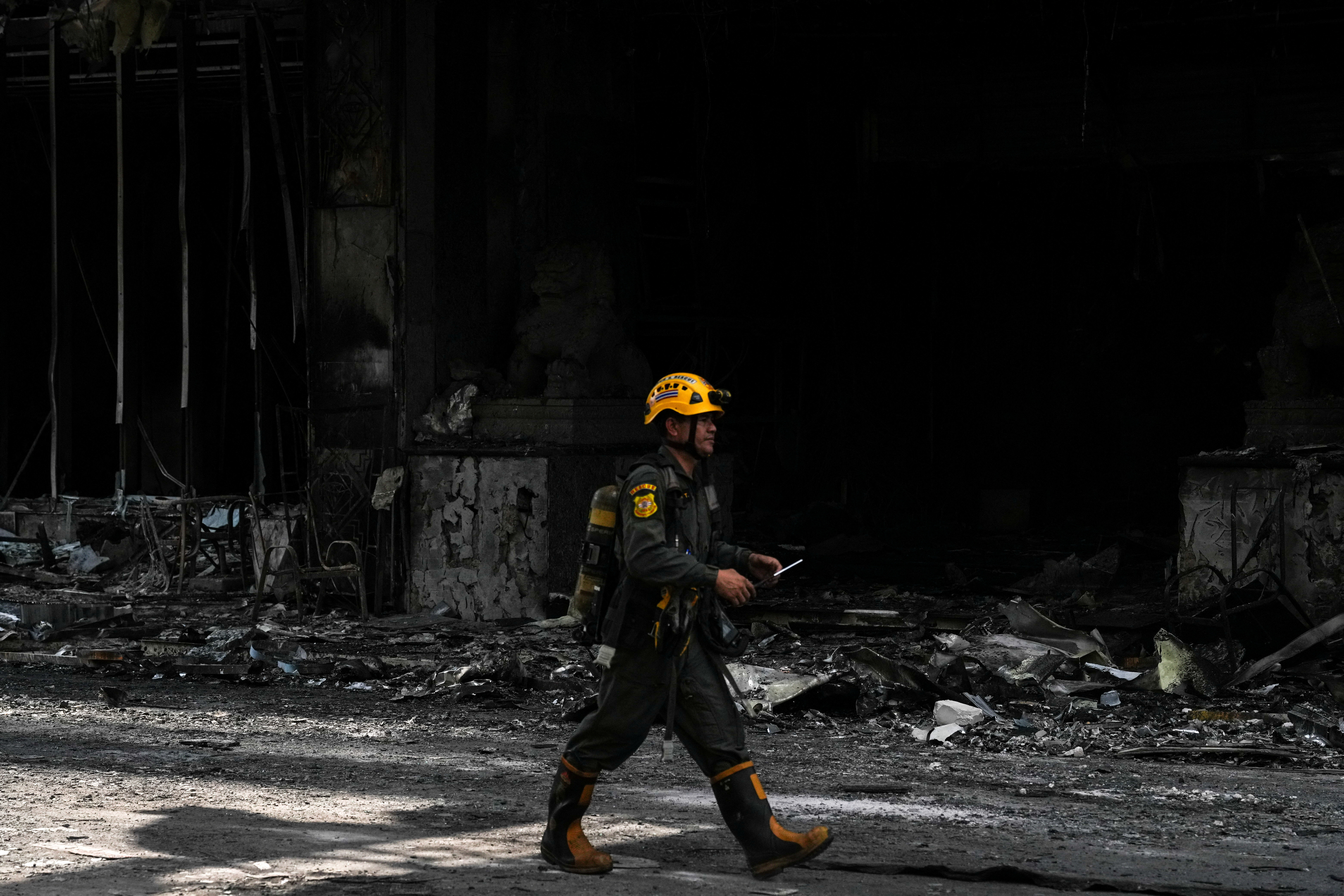
A rescue worker walks in front of the Grand Diamond City hotel-casino where a fire broke out, in Poipet near Thailand border, Cambodia, December 30, 2022. REUTERS/Athit Perawongmetha

Rescue workers work in front of the Grand Diamond City hotel-casino where a fire broke out, in Poipet near Thailand border, Cambodia, December 30, 2022. REUTERS/Athit Perawongmetha

Rescue workers walk in front of the Grand Diamond City hotel-casino where a fire broke out, in Poipet near Thailand border, Cambodia, December 30, 2022. REUTERS/Athit Perawongmetha
Categories
Audio Sources - Full Text Articles

Elon Musk’s government satellite network Starshield will help pump money into cash-strapped Starlink, experts say

SpaceX CEO Elon Musk next to a picture of a Starlink dish.Elon Musk’s SpaceX has launched a government satellite network called Starshield, which uses Starlink technology.

JIM WATSON/AFP via Getty Images/Taras Podolian/Gazeta.ua/Global Images Ukraine via Getty Images

  • SpaceX’s government satellite network Starshield will bring in extra cash for Starlink, per experts.
  • One analyst said Starlink, with one million users, doesn’t have enough customers to be viable.
  • Elon Musk has previously said that Starlink was “losing money.”

SpaceX’s new government satellite network, Starshield, is expected to help inject money into Starlink, according to analysts and industry experts.

The extra cash is crucial given that Musk has spoken about how Starlink was losing money and burning through $20 million per month to run the service in Ukraine during the war.

Elon Musk’s SpaceX announced Starshield on its website in early December, but has given no further details about the network. What is certain is that Starshield is intended to “support national security efforts” and will use Starlink technology.

Starshield, which is specifically for governmental use, will provide a means of financially boosting Starlink, experts in the satellite industry told Insider.

“Starlink needs to start earning some money,” Bill Ray, vice president analyst at management consulting firm Gartner, told Insider. 

He said Starlink needs between five and 10 million customers to be viable. SpaceX recently said Starlink has more than one million active subscribers worldwide. But Ray believes that isn’t enough.

“They need to ramp up very quickly. And if that means government customers, defense customers, yeah, absolutely,” Ray said. He said Starshield would be “an alternative revenue stream for Starlink” but it was “hard to say how much.”

Similarly, Edward Oughton, assistant professor of data analytics at George Mason University, told Insider Starshield would help generate extra streams of revenue.

“Starshield will be another SpaceX offering to utilize the launch vehicle capabilities that have been developed over the past two decades,” Oughton said.

On top of customer subscriptions that cost around $710 each upfront, Starlink receives funding through government contracts. The company landed a $2 million Air Force contract in August to provide Starlink in Europe and Africa, but was rejected $886 million in US subsidies by the Federal Communications Commission around the same time.

More recently, SpaceX asked the Pentagon to foot the bill for operating Starlink in Ukraine because the company couldn’t afford it, per CNN. SpaceX executives have also noted how Starlink terminals cost around $1,500 to make, but the company sells them for significantly less, at $499.

The big question is how much of a “cash cow” government-targeted products such as Starshield are, according to Brad Grady, research director at consulting firm Northern Sky Research.

“Starlink economics are hard to predict,” Grady said. He added that providing satellite connectivity for governments and military is “a growing opportunity” and is expected to be worth more than $90 billion over the next decade.

“The best way to maximize the returns from these customers is through a tailored, focused product offering,” he added.

SpaceX didn’t immediately respond to Insider’s request for comment.

Read the original article on Business Insider
Categories
Audio Sources - Full Text Articles

The not-quite-redemption of South Africa’s infamous ultra-marathon cheats

Runners are seen on a road and an overpass.One stretch of the Comrades Marathon from 2015.

RAJESH JANTILAL/AFP via Getty Images

They did an idiotic thing when they were young. 23 years later, it’s still the one thing most people knew about them.

Some of you will know this story already. Some of you will think you do. In South Africa, it’s lodged in the collective memory, sticky and stubborn. The race. The twins. The watches. The subterfuge. In the world of global running, meanwhile, it still makes lists of the greatest marathon cheats. Even now. Even 23 years later. 

But before the scandal and the shame, the comeback and the infamy, was the event itself. And to understand how things ended up where they did, there’s nowhere else to start but right there. 

It’s Wednesday, the 16th of June, 1990. South Africa, five years clean of apartheid rule, is the world’s darling. And today happens to be the day that Nelson Mandela will step down as the nation’s first Black president. In a few hours, he’ll hand over the reins to his deputy, Thabo Mbeki.

At 5:59 a.m., when this story starts, it’s still pitch black outside. We’re in Pietermaritzburg, a tidy colonial city an hour’s drive inland from Durban. In front of the red brick city hall stand 12,794 runners. It’s the starting line of the Comrades, a 89.9-kilometer (56-mile) race that cuts through the rolling hills that tumble out from here to the Indian Ocean. In addition to the runners gathered on the start line, and the tens of thousands who will flank the route from here to Durban, many South Africans are watching live on television.  

South Africans became obsessed with this homegrown event, the largest and oldest ultramarathon in the world, when a global boycott targeting its racist apartheid government barred the country from big international sporting events like the Olympics and the World Cup. In the lonely depths of South Africa’s isolation, winners of this insanely long race were catapulted to fame and landed lucrative sponsorship deals. Even after apartheid was toppled and South Africa was invited back into the global fold, the Comrades retained its caché, and now it also had big-ticket prize money.

One of the runners at the start line this morning, not yet attracting any attention, wears the race number 13018 – Sergio Motsoeneng. At 21, he’s one of the youngest runners here, competing in a field crowded with world champions, in a sport where people often peak in their 30s or 40s. He’s come here from Phuthaditjhaba, an impoverished area near the Lesotho border. He’s never run this far in his life.  

First prize in the Comrades is 100,000 South African Rand ($16,400 at the time). This year, the big corporate running clubs are offering additional money to runners who could break the course records. Sergio’s club is offering a R1 million ($164,000) bonus, the equivalent of 70 years of his father’s salary. Sergio has nine siblings to help support, and no job. This race is going to be his ticket out. 

From the loudspeakers, the theme song from the running cult film Chariots of Fire blasts into the crowd. Runners peel off the trash bags and ratty sweatshirts they’ve brought to keep warm while they wait. On a raised platform above the start line, Pietermaritzburg’s mayor lifts a handgun. He fires. The race is on.

A close-up of marathon runners in South AfricaRunners are seen taking part in the Comrades Marathon in 2018.

RAJESH JANTILAL/AFP via Getty Images

For years, the idea of winning the Comrades has vibrated through Sergio and his younger brother, Arnold, at a constant frequency. Beginning as teenagers, they won race after race, dominating the sport in Phuthaditjhaba, a small city in the bowl of the Maluti Mountains, a poor and rural corner of the country near South Africa’s border with Lesotho. They were rewarded mostly in dinky plastic trophies and bragging rights, plus the occasional cash prize. 

But the boys had bigger ambitions. When Sergio was about 15, and Arnold about 13, they started training informally with a white coach named Eugene Botha. Then in his late 20s, Eugene was short and jovial, with the twitchy excitability of a boxer. He’d been a pro runner in Johannesburg. Now, he ran a fire extinguisher business in the town of Bethlehem, 165 miles to the southeast. The tidy town center – once named the cleanest town in South Africa – was nearly all white. The township of matchbox houses and shacks crowded together on its perimeter was all Black. 

Eugene ran his business from his living room and coached high school running on the side. Sergio and Arnold noticed that his runners were good. They wanted to know how he did it. 

Eugene was charmed by the brothers’ drive to show what they could do on a bigger stage. “A runner can always recognize another runner,” Eugene tells me. “They were the best in Phuthaditjhaba. At all the races they entered, they won them by far.” Sergio, he says, “had the style, the strength, the everything.” 

Eugene’s business often brought him to Phuthaditjhaba, an hour drive from Bethlehem, and he began taking Sergio and Arnold on long runs through the mountains, or to a track for speedwork drills. It wasn’t yet clear to him if Sergio and Arnold were just Phuthaditjhaba good or once-in-a-generation good. But they had pluck.

From the start, the boys were impatient. They wanted to run longer distances, the ones with the big prize money. Hold back, Eugene told them. It didn’t make sense to punish their bodies like that, not when they had so much potential, not when they were just getting started.  

Against their mentor’s advice Sergio and Arnold decided the Comrades was the race to win. And not in ten years. Now. 

***

Five hours and 40 minutes after the crack of the start gun, Sergio Motsoeneng staggers across the finish line at Kingsmead Cricket Ground in Durban. He looks dazed as a race official drapes him in a blue and white Powerade towel. Ninth place, behind a mix of Black and white runners. It’s not the record-breaking run he was hoping for, but it is, unequivocally, a phenomenal performance. He’ll get R6000 ($1000) in prize money, plus a medal made of real gold. 

The TV commentators are stunned. A top ten finish from a no-name runner, and on his first go no less? “Motsoeneng coming through and surprising us all,” marvels Bruce Fordyce, a nine-time Comrades winner turned pundit.  

That night, there’s a dinner for Sergio’s running club, Rentmeester Reparil Gel, which takes its tongue-twisting name from the insurance company and pain relief gel that co-sponsor it. It’s one of the country’s elite clubs, and its runners have done well. Four, including Sergio, finished in the top ten, and three more in the top 50. Everyone is celebrating, drinking beer, slapping each other on the back. Andrew Kelehe, a runner who finished third — though he’d land in second place after another runner was disqualified for doping — and one of the coaches, John Hamlett, will tell me later that Sergio looked off. He’s being really quiet, maybe he’s sick. 

By the time Sergio arrives back in Phuthaditjhaba the next day, he’s all smiles. His family meets him outside their two-bedroom brick house in a flurry of hugs and tears. 

They all watched the race together on their tiny black and white TV, squinting for footage of Sergio at the front of the pack, they tell him. It was only at the end that they’d spotted him, as the TV cameras panned to Sergio sprinting to the finish just ten minutes behind the winner, arms pumping and face drawn. They’d spend the whole night singing and praising god and dancing in the street. 

“You’ve opened the future for all of us,” Joseph Mphuthi, another runner and an old friend of Sergio’s, tells him.

The prize money is a far cry from the R1.1 million Sergio had dreamed of, but it’s not nothing either. He buys groceries for the family, new shoes for himself, cloth for the tailoring business that Arnold has started in Bloemfontein, three hours away. 

Their father had told them, more than once, to cut it out with the running. He was fed up with his sons constantly begging him for taxi fare and race entry money, and he didn’t hesitate to tell them, you boys need real jobs. His rages were red-hot, often stoked by alcohol. 

But a top 10 finish in South Africa’s most prestigious race is something no one expected. This is the moment, Sergio thinks, when everything changes. 

***

A few weeks later, Eugene is home in Bethlehem when his phone rings. It’s someone from Rentmeester, Sergio’s running club. 

Do you know the runner, Motsoeneng? The caller asks.

Yes, I do.

Do you know there are two of them, brothers? 

I do. 

Would you be able to tell them apart?

Of course. 

Ok, says the man on the other end, we’re going to fax you some photos now. Please tell us what you see. 

A minute later, Eugene is staring at side-by-side images of a lanky Black runner wearing the number 13018. There’s a blue and green Rentmeester singlet hanging off his trim frame, a black cap is pulled low over his face, and he has on a pair of blue and yellow Nikes. 

Immediately, Eugene sees the problem. The runner on the right is clearly Sergio. Ropey and slight, he has soaring cheekbones and a torso so thin you can see the air ripple through his lungs when he breathes. His fists are balled and he’s wearing a pink watch on his right wrist. 

Eugene studies the picture on the left. This runner looks stockier and there’s a scar running down his right shin. His head is tilted forward, and his face is shrouded by the bill of his cap. He’s also wearing a watch, but it’s yellow and on his left wrist. 

Two side-by-side pictures of a runner.A side-by-side comparison of Sergio Motsoeneng and his brother, Arnold Motsoeneng, racing in the Comrades in 1999.

Gail Irwin/Reuters

Eugene’s stomach drops. The runner on the left – Eugene has no doubt – is Sergio’s brother Arnold.

Within a few days, the two pictures will be splashed across the front pages of South Africa’s biggest newspapers. 

***

The sun is setting quickly as I scramble up the steep hillside outside Phuthaditjhaba. Ahead of me, Arnold Motsoeneng moves nimbly, hopping over rocks and thorn bushes with the light, sure-footed steps of someone who has run this route many times before. 

For going on thirty years, this mountain he and Sergio nicknamed the Titanic, for its sharp pointed slope, is where they have trained, back and forth, up and down, until their legs and lungs burned. Tonight, though, we are walking, Arnold at the front, Sergio and another brother, Moratoe, at the back, and me in the middle, taking big ragged breaths in the thin air. “You doing ok?” Arnold calls back to me. His voice is warm and gentle, and he smiles at me with the same dazzling cheekbones that graced magazine covers in 1999 beside headlines about the “Crooked Comrades ‘Twins.'” I smile back, flashing him a thumbs up. 

A few weeks earlier, I was home in Johannesburg, Sergio’s number punched into my phone, screwing up the courage to start the call. By then, I’d spent hours scouring the internet for information about the Motsoenengs, reading article after article with titles like “Two Brothers, One Ultramarathon, and the Greatest Cheat in Running History” and “Top 10 Worst Sporting Cheats.” 

They all told the same basic story, although some of the details were fuzzy: In 1999, two lookalike brothers concocted a clever plan to win the Comrades. They ran the race as a relay, swapping their clothes and shoes in portable toilets along the route. If they hadn’t forgotten to swap their watches, too, they might have pulled it off. 

Some of the retellings had it — mistakenly — that the brothers were identical twins. One had Sergio and Arnold speeding between handoff points in a getaway car, as if part of an elegantly choreographed heist. One or two stories speculated that a third runner, a “Mr. X,” had also run parts of the race. 

The stories hinted at a bigger anxiety. This was, remember, a fragile moment in the life of the new South Africa. There were plenty of people out there, white people especially, who were still praying to see it fail. Reporters from the time wrote that the brothers were “getting rich” off their “skullduggery” and opined that they’d “turned an illustrious event into a race of shame.”

“People were saying, ‘look what they did to this race, that’s what they’ll do to the country,” remembers Dana Snyman, a white tabloid journalist from the time. 

So when I reached Sergio and made my pitch for an interview, it surprised me that he seemed willing to hear me out. Sure, what they’d done was unethical, I said. But they’d also grown up in apartheid South Africa, one of the most immoral systems imaginable. Weren’t they just giving themselves an advantage in a world that had disadvantaged them in every possible way? 

I tell him, their story rang like a kind of analogue prequel to twenty-first century shaming, where seemingly all of society lays into someone’s bad behavior and leaves them branded forever. They’d done an idiotic thing when they were young and now, 23 years later, it was still the one thing most people knew about them. I wanted to hear their side, and to know what they’d made of their lives in the long shadow of this scandal. 

Sergio invited me to come meet him. He’d show me around, he said, and help me make sense of what had really happened. “Trust me,” he said, “I’ll explain everything.” 

So that’s how I end up here, catching my breath on a mountain top. From up here, Phuthaditjhaba stretches out below us like a scale model of a city. The Motsoeneng brothers pointed out their schools, their favorite running routes, and the old track stadium where Sergio and Arnold won races as teenagers. 

Two men stand on an incline with mountains in the background.Arnold (left) and Sergio.

Ryan Brown for insider

In those days, they didn’t run for South Africa, but for QwaQwa – one of ten “homelands” established for Black South Africans. According to the apartheid government, South Africa was actually a mosaic of different, separate nations, coexisting in beautiful harmony, and QwaQwa was a tiny nub of land backing up against Lesotho. 

The homeland system, much like apartheid, was an elaborate display of racist make-believe. Tiny, non-contiguous territories – supposedly, the original territory of different Black South African ethnic groups – dotted across the country. Naturally, those territories comprised only 13 percent of the land, in a country where three quarters of the population was Black, and excluded the country’s best farmland, and its wealthy mineral reserves.

The family arrived here in 1987. Sergio and Arnold’s father Jonas was hired as a school caretaker, and squashed in the two-bedroom caretakers’ cottage. Jonas and his wife, Emily, were both from a nearby farm in “white” South Africa’s eastern Orange Free State, where their families had been long-term tenants of a family of white farmers. Emily left school in at the age of 10  to take care of the white family’s baby. Jonas milked their cows. 

Sergio could remember, when he was little, watching how the white farmer ran his tractor, harvesting field after field of maize and beans. When he was done, Sergio’s father and the other Black farmworkers walked those same fields, picking up for themselves whatever the white man had left behind. 

But if opportunities still seemed dim for Emily and Jonas’ generation, their children expected more. 

Even as most of the country remained under strict racial segregation, South Africa’s apartheid government cared enough about getting back into international sports that it agreed to integrate running. In 1975, Black runners, and women, were allowed to compete in the Comrades for the first time. 

Other major races also integrated, and soon, Black runners dominated the sport. Eugene, who started competing in the late 1980s, recalls competing in the 1991 City to City ultra-marathon from Johannesburg to Pretoria and finishing ninth, behind eight Black runners. As an incentive to keep up white runners’ spirits now that they were regularly bested by Black athletes, Eugene’s running club gave him a bonus for finishing first among white runners, he told me.

Sergio and Arnold were the athletes of their family. Although they were two years apart in age, they started school together on the farm, and from the time they were young, they were inseparable. Two boys who seemed to know each other’s thoughts without asking. Mafahla, the other kids called them, the twins. “We didn’t have another friend,” Sergio remembers. 

A view of mountains.The mountains around Witsieshoek rise high in the Drakensberg region in South Africa.

COLLART Hervé/Sygma via Getty Images

People were constantly confusing him and Arnold, stopping him on the street to congratulate him for a race Arnold had won, and vice versa. 

In his teens, Sergio was named to a South African development squad for young athletes, which meant he was supposed to focus on short-distance training and stay away from long races  But he couldn’t help himself, the prize money for marathons was too good. So yes, he once ran a marathon and then told officials to record the finish as Arnold’s.  

Who was it hurting? Everyone always said they looked like twins anyway. 

***

Back to 1999. Eugene can see the story has legs. 

Even before the photos dropped on his fax tray, there’d been questions. 

Not long after the race, Nick Bester, the Comrades’ 15th place finisher, lodged a complaint with the Comrades Marathon Association, the CMA. A timing mat showed that the runner registered as Sergio Motsoeneng passed the race’s halfway point 7 minutes behind Nick Bester. But somehow, that same runner beat him by eight minutes. 

At first, the Comrades dismissed the allegations. Then, Nick helped dig up these race photos. 

As soon as Eugene hangs up with the official from Sergio’s club, he calls Clem Harrington. 

A prosecutor in the old South Africa, Clem was also a Comrades veteran who’d run it 21 times before he turned 40, some kind of record. Clem was the kind of guy who could fight for – or against – anyone, and win. And that, Eugene thought, was what the Motsoenengs needed.  

They confront Sergio together, and Clem proposes a solution: Sell the story to a tabloid. Confess everything. Say how deeply sorry they are. The money’s gone, so use the tabloid’s fee to pay it back. You might save your running career. And it might still be a good one – after all, Sergio’s marathon best was a 2:19, and even running half a Comrades at the pace you did is no joke. 

Sergio agrees, and Clem negotiates the fee with the Huisgenoot, a Afrikaans tabloid known for its scoops and celebrity gossip. A few days later, reporter Dana Synman comes to the cottage in Phuthaditjhaba and interviews the brothers for four hours, while a knot of other journalists huddle outside.

“The overwhelming impression I got from them was sincere,” the journalist remembers. “They were desperate and they were naïve. They tried their luck, and they didn’t get away with it. It’s not like robbing a bank. To run a Comrades, even half a Comrades, that’s very tough.” 

The story appears on the cover of the Huisgenoot under the headline POOR BROTHERS’ DREAM BECOMES A NIGHTMARE. Inside, there’s a photo of Sergio with his arm draped over Arnold, the famous pink watch dangling from his wrist. “I am sorry about what happened at the Comrades,” Sergio is quoted saying. “But people also need to know: I did not kill. I’m just tired of being poor.”

A few days after the story appears, Eugene, Clem, and Sergio drive to Pietermaritzburg to return the medal and hand over that fistful of cash. Sergio tells the CMA board how sorry he is and Clem asks for the minimum sentence. “We ask South Africa to forgive him,” he pleads. 

Three men holdAn old photograph of Eugene, Clem, and Sergio, held by Eugene.

Curtesy of Eugene Botha

It’s been an embarrassing year all around for the CMA, actually. In addition to Sergio, two other runners in the top ten have been disqualified, both for doping. The winners’ tables keep shifting, prize money keeps getting returned. 

In the end, Sergio and Arnold get a five-year ban from the Comrades. Clem is satisfied – it’s punishment enough to scare them straight, and they’ll still be young enough to compete. They’ll have a chance, one day, to put this behind them, and maybe turn an embarrassing story into a triumphant one. 

But shame blooms out from the lie like a bloodstain, dark and heavy and hard to wash out. “My heart was broken,” says Emily, their mother. “I still don’t believe they ever cheated. 

“We just wanted to forget it ever happened,” Sergio’s wife, who was then his girlfriend, tells me. 

Not long after the scandal slid out of the public eye, Jonas Motsoeneng learned he had brain cancer. He died in the early hours of January 1, 2000, as South Africa spun into a new millennium. 

***

When we finally get into it, Sergio and Arnold claim can’t remember exactly when they decided they would cheat, or whose idea it was to begin with. Sergio had been training, really training, he says. But when he heard about Rentmeester’s R1 million reward, something inside him shifted. 

Together, they scrutinized the course map, which showed the portable toilets. They picked a spot, just before halfway, where they hoped it would be easy to slip in and out of the crowd. And that was it. 

It was Arnold who had started the race in Pietermaritzburg, they say. At the agreed-upon spot, they’d both slipped into the cramped space of a portable toilet and hurriedly peeled off their clothes. 

Suddenly, bang! There was a knock at the door.

Sergio, are you in there? It was Dewald Steyn, one of Rentmeester’s managers. I’ve got your energy drinks out here for you.

Inside the toilet, the men froze. They couldn’t open the door now. He’d see for sure that there were two of them inside.

I feel sick, Sergio called back out.

Hurry up, Dewald said. You’re losing time.

Outside, he waited. Inside, they waited.

Finally, Dewald said he’d leave the drinks, and walked off. Sergio and Arnold waited a little longer, then Sergio slipped out the door, and onto the road to run the race’s second half. Arnold waited a little longer, then hitched a ride back to Durban, where he caught a mini-bus taxi home. 

Runners line up to use portable bathrooms.Runners use the bathrooms before the start of the start of the 94th edition of the Comrades Marathon in 2019.

RAJESH JANTILAL/AFP via Getty Images

But many of the Motsoeneng’s contemporaries in South African running say the story still feels fuzzy, incomplete. “They were in the toilets so long, they would have had to cut the course to make up the time,” Nick says when I call him. 

And many suspect this hadn’t been the first time they cheated. Arnold entered the Comrades in 1998, but dropped out around halfway – had that been a dress rehearsal? A handoff gone wrong? And then there was the City to City Marathon in 1998. “We” – the front runners “were far, far ahead of the rest of the guys,” says Nixon Nkodima, another professional runner, tells me. “Then suddenly this guy” — Sergio — “comes out of nowhere and passes us, like he’s running a 5k pace [45k’s into an ultra]. I thought, maybe he’s on drugs.”

But Arnold, who has largely managed to stay out of the limelight, says there’s no reason for them to retreat. “The only thing is that we were looking for cash,” he tells me. “But apart from that, we knew we could make it.”

*** 

There’s a second chapter to this story that makes a bit of a mess of the narrative that made me want to talk to the brothers in the first place. 

When the ban that Clem had brokered lifted, both Sergio and Arnold started racing again, and winning. In 2009, Sergio made a triumphant return to the Comrades, and the following year, in 2010, he had a breakthrough race. In a photo taken as he sprints towards the finish line, he’s grinning, an inversion of the tense, drawn face he wore when he crossed the line a decade before. He finished third.

Speaking to the press afterwards, Sergio is again a model of contrition, saying he’s now a family man who’d paid his dues and learned from his mistakes. 

“It just goes to show he did not have to do what he did in 1999,” said Cheryl Winn from the Comrades Marathon Association, co-signing his narrative of redemption. “He has great ability.”

But six weeks later, the Comrades announced the results of its drug testing of top finishers. Sergio’s has come back positive for a performance-enhancing steroid called Norandrosterone.

*** 

“When they told me I’m positive, I told them, go to hell,” Sergio tells me now. He, of all people, knew how a decision like that could snap a life in two. 

We’re sitting on a covered porch, beside the brick house he’s been building for the last decade and a half in a neighborhood of Phuthaditjhaba called Elite. He’s been doing the work himself, by hand, adding a room every time he gets a bit of money. The building sits at a slightly precarious angle to the rocky ground. Its walls bow gently inward. 

Today, Sergio works as a teacher and drives an old green forest green Mercedes, which is parked out front. He has a daughter in university and a wife he lists in his phone as “The Love of My Life.” His ten pit bulls clatter around in the house. Both he and Arnold coach running on the side. 

In person, Sergio fizzes with charisma and warmth. But he also holds me at arm’s length. I ask to visit the school where he works, but he demurs, saying he would rather not remind his colleagues of the scandal. As it is, when he disciplines his students, he says, the pluckier ones demand to know why they should have to listen to a liar and a cheat like him. 

Of course he didn’t cheat at the Comrades in 2010, he tells me. He can’t prove it but offers some theories. 

Nandrolone, Sergio says, is found in uncastrated pigs, and there are known cases where athletes tested positive after consuming wild pork. He ate a lot of meat when he was training hard. And also, rumors have swirled for years about Comrades athletes and coaches spiking their rivals’ sports drinks, or swapping urine samples before they were shipped off to the lab. Maybe it was that.

And what about what happened to Ludwick Mamabolo, he says, the man whose Comrades win in 2012, two years after Sergio was disqualified, was revoked after he tested positive for a stimulant? His lawyers argued the Comrades’ procedures for doping testing had been so haphazard, it was impossible to say with any certainty if the sample tested had even been Ludwick’s at all. Ludwick was exonerated and got his title back. 

A runner reaching the finish line.Ludwick Mamabolo crosses the Comrades Marathon finish line in 2012. After he disqualified for testing positive for a stimulant, he challenged the test and got his title back.

RAJESH JANTILAL/AFP/GettyImages

I looked into all of it, and even spoke to Ludwick’s lawyer. But their cases seemed fundamentally different – you could slip the substance Ludwick tested positive for into a sports drink. Nandrolone, by contrast, is usually injected. South Africa’s anti-doping body, meanwhile, destroys case records after ten years, and I couldn’t find anyone who believed enough in Sergio to plead his case.

Except, of course, Arnold. “If he took it, I would know. Each and everywhere he goes, I go,” Arnold tells me. 

Those results shattered them both. “I knew, that’s it for him,” Arnold says. Gone, was any hope of convincing people they’d just made a stupid mistake all those years before. 

It doesn’t make any sense that Sergio would cheat, Arnold keeps saying. It just doesn’t make any sense. 

***

It’s hard, sometimes, not to read everything that happens in South Africa as a metaphor. This is a country where the jailers handed the keys to the inmates, and everyone was told to forgive. While the whole world watched, Nelson Mandela shook hands with apartheid’s last president, FW de Klerk, and told him, What is past, is past – “Wat is verby, is verby!”

The story of two young men, born into one of the most unequal societies on earth, trying – imperfectly, deceitfully – to find their way out of it also feels like something bigger than itself. It’s a version of what South Africans have been doing for a generation now since the end of apartheid. As Sergio tells me, “Nobody wants to be poor forever.”

A runner holds a portrait of Nelson Mandela.A Comrades Marathon runner holds a portrait of late South African icon Nelson Mandela in 2014.

RAJESH JANTILAL/AFP via Getty Images

For Sergio and Arnold, the past was something they believed they could, quite literally, outrun. It didn’t turn out like that, but it didn’t turn out like that for most Black South Africans either. In the generation since the end of apartheid, inequality has remained stubbornly persistent. The wealthiest 3,500 South Africans own more than the poorest 32 million. Much of the country’s elite is now Black, but so too are nearly all its poorest people.

When Sergio and Arnold cheated, it felt to many like it was saying something not just about them, but about the moral character of Black South Africans generally. Look, they said, this is who you’ve handed our country to. As I sat speaking to Sergio, South Africa’s president, Cyril Ramaphosa, was fighting for his political life after revelations that wads of cash, potentially ill-gotten, had been stolen from inside his sofa. 

Of course corruption isn’t limited to Black leaders, in South Africa or anywhere else. The apartheid regime was shot through with graft. Its first Black government inherited a state that was nearly bankrupt. And a generation, like Sergio and Arnold, came of age promised a world that was, for most of them, never going to materialize. 

“You have to be Zola Budd level to get out of here,” Eugene remarked to me, referring to the bare-footed white South African teenager who became a record-breaking runner for England in the 1980s. “People steal millions, and yet this [Sergio] is the guy they want to go after.” 

Now, sitting by Sergio’s house, I listen carefully as he lays out his theories about that 2010 race. 

I nod along, scribbling notes. It feels like we’re up on that mountain in Phuthaditjhaba again. The world is laid out below us, small and vast and we can’t quite make out all the details. 

***

Toward the end of my trip, I’m with Arnold, twisting my car up a steep road to the border with Lesotho.

A view of mountains.The Maluti Mountains, as seen from Butha Buthe, Lesotho, in 2021.

Sumaya Hisham/Reuters

He wanted to show me this route where they used to train, 20 kilometers up, 20 kilometers down, waving to the border guards as they went. The air is dry and thin, and smells of wood smoke. Below us, in the valley where the Motsoeneng brothers have lived nearly all of their lives, the high-altitude sun glints off tin roofs. A shepherd coaxes a small flock of grey sheep up a hillside. The vegetation is dry and crisp. 

Of the two Motsoeneng brothers, Arnold has always been the more reserved. In 1999, he faded into the background of the cheating scandal. Even now, he is content to let Sergio, clever, fast-talking, and brash, be the face of their story. 

I realize there’s something I haven’t asked him yet. When he was running in the Comrades, keeping pace with South Africa’s greatest runners, he knew it was a lie, but was it also a thrill? 

He smiles. It was one of those charmed days runners are blessed with every now and again, where you feel like you could run forever, he says. He was weightless. Nothing hurt.Even now, when he is training, he thinks, I wish it could feel like that day again, he says.

xxxxArnold with the kids her coaches.

Ryan Brown for Insider

The next day, I stood next to the dirt soccer field where Arnold coaches an elementary school cross country team, watching the kids plunk down backpacks and shed their school uniform sweaters. Here, on the edges of Phuthaditjhaba, the city slips in and out of focus. A city bus grumbles past, then a shepherd on horseback. 

A lot of the kids run barefoot, just as Arnold and Sergio did when they were that age. They call Arnold ntate, the Sesotho word for father. He explains the day’s drills, and they all take off running, arms untucked and flailing.  

Sometimes the kids get lazy and start cutting the corners, he tells me. “And I tell them, when you do that, you’re not cheating me. You are only cheating yourself.” 

Read the original article on Business Insider
WP Radio
WP Radio
OFFLINE LIVE