Categories
Audio Sources - Full Text Articles

Biden called Harris a ‘work in progress’ in the difficult early days of his presidency, new book says

Biden/HarrisBiden and Harris give their first press conference as presidential nominee and running mate on August 12, 2020.

Olivier DOULIERY / AFP) (Photo by OLIVIER DOULIERY/AFP via Getty Images

  • Joe Biden said early in his presidency that Kamala Harris was a “work in progress,” according to a new book. 
  • “Fight of His Life,” by Chris Whipple, chronicles the first two years of the Biden administration. 
  • Extracts from the book were published by Politico. 

President Joe Biden described Vice President Kamala Harris as a “work in progress” in the difficult early months of his presidency, according to extracts from a new book, published in Politico.

“Fight of his Life,” by journalist Chris Whipple, chronicles the first two years of Biden’s presidency and details tensions between the president and his vice.

Biden made the “work in progress” remark about Harris to a close friend, according to the book.

It says the president was annoyed when told that Harris’ husband, Second Gentleman Doug Emhoff, had complained about his wife’s policy assignments.

A senior White House advisor quoted in the book says Harris’ inner circle “didn’t serve her well in the presidential campaign — and they are ill-serving her now.”

It’s not the first time reports have emerged of tension between Biden and Harris. Earlier in 2022, Jonathan Martin and Alex Burns detailed disputes between the camps in their book “This Will Not Pass”.

Harris was at one point a contender for the 2020 Democratic presidential nomination and clashed with Biden during primary debates over his record on race. Biden later named Harris as his running mate.

After the Democratic election victory in 2020, Harris was handed responsibility for core Biden policy areas, including migration from the southern US border and voting rights. She faced criticism amid faltering or slow progress on both issues. 

Whipple told Politico that the Biden administration faced major setbacks in its first year but turned things around in its second year, citing the US response to Russia’s invasion of Ukraine and the renewed Build Back Better bill. 

Read the original article on Business Insider
Categories
Audio Sources - Full Text Articles

Winter storm causes hazardous holiday travel

(NewsNation) — A major winter storm continues to threaten more than 130 million Americans across 30 states this week, forecast to bring heavy snow, ice, flooding and even tornadoes Thursday to Saturday from the Plains and Midwest to the East Coast.

A surge of arctic air will follow, and the Christmas weekend could be the coldest in decades.

The storm is already causing major travel disruptions for holiday travelers. As of 6 a.m. CT, there have been 500 domestic flight delays and 206 domestic flight cancellations in the U.S,, according to FlightAware.

An early sign of trouble came Tuesday in Seattle, where a winter storm caused 221 flight cancellations and just over 500 delayed flights at Seattle-Tacoma International Airport, according to FlightAware. Greyhound also canceled bus service between Seattle and Spokane.

Airlines offered travelers the option of choosing new flights to avoid the bad weather. Delta, American, United and Southwest waived change fees at airports that might be affected.

Airports said they would work hard to stay open. Chicago’s O’Hare and Midway airports said they have 350 pieces of equipment and 400,000 gallons of pavement de-icing fluid between them to keep runways and taxiways clear.

According to the American Automobile Association (AAA), 2022 is anticipated to be the third busiest year for holiday travel since AAA began tracking in 2000.

AAA estimates that nearly 113 million Americans plan to travel between Dec. 23 and Jan. 2 — an increase of 3.6 million people over last year and closing in on pre-pandemic numbers. Plus, 102 million Americans are expected to drive to their holiday destinations as gas prices are on track to drop below $3 per gallon by Christmas.

The heaviest snow is expected in Idaho, Montana and Wyoming, according to the National Weather Service, and frigid winds will be fierce across the country’s midsection.

Several inches of snow were expected from Chicago through the Great Lakes region by Friday. Snow also was forecast in the lower Midwest.

The deep freeze will be particularly dangerous for people without homes. Salt Lake City will make 95 additional shelter beds available after five died in recent days amid sub-freezing temperatures, Mayor Erin Mendenhall, a Democrat, said.

In Kansas City, Missouri, emergency shelters are opening for anyone needing warmth, food or safety. Organizers warn, though, that capacity is limited overnight.

Meteorologists are warning people to stay off the roads as this storm could cause road closures, icy and snowy conditions as well as low visibility across the country.

In Oregon, one person died Tuesday after a semi-truck collided with an SUV. Police said a thin layer of ice on the highway may have been a contributing factor.

Whether designated to hit your town or not, NewsNation has compiled a list of tips from trusted officials on how best to prepare your home for a winter storm this cold season and the ones ahead. You can find that list here.

  • Passengers arriving at Chicago’s Midway Airport wait for their luggage just days before a major winter storm Tuesday, Dec. 20, 2022, in Chicago. (AP Photo/Charles Rex Arbogast)
  • Travelers are dropped off at the Los Angeles International Airport in Los Angeles, Monday, Dec. 19, 2022. Forecasters are warning of treacherous holiday travel and life-threatening cold for big parts of the nation. (AP Photo/Jae C. Hong)
  • A traveler walks in Terminal 3 at O’Hare International Airport in Chicago, Monday, Dec. 19, 2022. (AP Photo/Nam Y. Huh)
  • People wait in line to check in at Los Angeles International Airport in Los Angeles, Monday, Dec. 19, 2022. (AP Photo/Jae C. Hong)
  • Two people hug outside a terminal as travelers wait in line to check in at Los Angeles International Airport in Los Angeles, Monday, Dec. 19, 2022. (AP Photo/Jae C. Hong)
  • A TSA worker checks the identification of an airline passenger at O’Hare International airport in Chicago, Monday, Dec. 19, 2022. (AP Photo/Nam Y. Huh)
  • Rome DeGuzman sits on the floor of a terminal next to his two sons after missing a morning flight to Hawaii as travelers wait in line outside the building to check in at the Los Angeles International Airport in Los Angeles, Monday, Dec. 19, 2022. Forecasters are warning of treacherous holiday travel and life-threatening cold for big parts of the nation. (AP Photo/Jae C. Hong)
  • Wimberly Hoogendoorn from Houston, Texas, gathers her luggage at Chicago’s Midway Airport for a family holiday visit just days before a major winter storm Tuesday, Dec. 20, 2022, in Chicago. (AP Photo/Charles Rex Arbogast)
  • Southwest Airlines ticketing agent Karen, helps a departing family at Chicago’s Midway Airport just days before a major winter storm Tuesday, Dec. 20, 2022, in Chicago. (AP Photo/Charles Rex Arbogast)
  • A person cross-country skis on a sidewalk in Bellingham, Wash., early Tuesday, Dec. 20, 2022. Heavy snow, freezing rain and sleet have disrupted flights and motorists trying to travel across the Pacific Northwest. (AP Photo/Lisa Baumann)
  • A person uses a four-wheeler to plow snow northeast of Bellingham, Wash., on Tuesday morning, Dec. 20, 2022. Heavy snow, freezing rain and sleet have disrupted travel across the Pacific Northwest, causing widespread flight cancellations and creating hazardous driving conditions. (AP Photo/Lisa Baumann)
  • A person shovels snow outside Rome Grocery northeast of Bellingham, Wash., on Tuesday morning, Dec. 20, 2022. Heavy snow, freezing rain and sleet have disrupted travel across the Pacific Northwest, causing widespread flight cancellations and creating hazardous driving conditions. (AP Photo/Lisa Baumann)

The Associated Press contributed to this report.

Categories
Audio Sources - Full Text Articles

China’s Stunning U-Turn on Zero-COVID Takes Xi Jinping From Suffocating Control to Callous Inaction

Even for China, where the distance between official narrative and empirical evidence is often a chasm, the last few days have been jarring. On Tuesday, officials announced five deaths from COVID-19—up from two the previous day, which were the first recorded in the country since Dec. 3. On Wednesday, there were officially none. But a glance online tells a different story. Dozens of hearses line up at a Beijing crematorium; bodies wrapped in orange plastic pile in hospitals; patients on ventilators are crammed on a ward floor.

[time-brightcove not-tgx=”true”]

The decision by Chinese Communist Party (CCP) leadership to roll back its stringent zero-COVID policy and allow the virus to proliferate has led to a surge in cases and an immense strain on health services. It’s a quite staggering reversal. On Nov. 10, President Xi Jinping—the self-anointed “commander-in-chief” of a “people’s war” against the virus—instructed his Politburo to stick “resolutely” to “dynamic zero-COVID.” Residents of Shanghai were forcibly detained in quarantine facilities over the summer because of a single case in a neighboring housing block.

Read More: China’s Zero-COVID Trap

But zero-COVID was virtually abandoned on Dec. 7, with China’s top medical adviser now comparing the Omicron variant to “flu.” On Dec. 13, a tracking app that had tyrannized every life in China for the past three years was abruptly taken offline. On Sunday, officials in the central city of Chongqing decreed that mild or asymptomatic COVID-19 cases could “go to work as normal.”

The screeching U-turn underlines the fickle nature of strongman rule but also the immense paranoia of the CCP when faced with public discontent, such as the protests that erupted in late November across several Chinese cities. The catalyst was the deaths of at least 10 people in an apartment block fire in China’s western city of Urumqi that observers blamed on draconian pandemic controls keeping residents locked in their homes. (Officials deny this.) It spurred a wave of protests, with scores of people gathering on streets and university campuses across the country, shouting “we want freedom, not PCR tests,” and even “down with Xi Jinping.”

Read More: Detained Zero-COVID Protesters in China Share Their Stories

The sudden rollback of restrictions that followed “could be seen as a victory for people power,” says Yanzhong Huang, a senior fellow for global health at the Council on Foreign Relations.

Still, the policy climbdown is surprising. China’s security services were swift to track down and detain demonstrators, who were never close to forming a political opposition. “They never quite galvanized into a single, unified, politically actionable message,” says Wen-Ti Sung, a scholar specializing in Chinese elite politics at the Australian National University. But what likely spooked Xi was the breadth of discontent that zero-COVID engendered. Affluent Shanghainese, embattled students facing bleak job prospects, and migrant workers in southern factories all railed against its privations and related economic blowback in distinct but analogous acts of rebellion. Their concerns were well-founded; models suggest zero-COVID may have cost the Chinese economy $384 billion and reduced GDP growth by 2.2 percentage points.


China Faces Surge in Cases After Loosening Zero COVID Measures
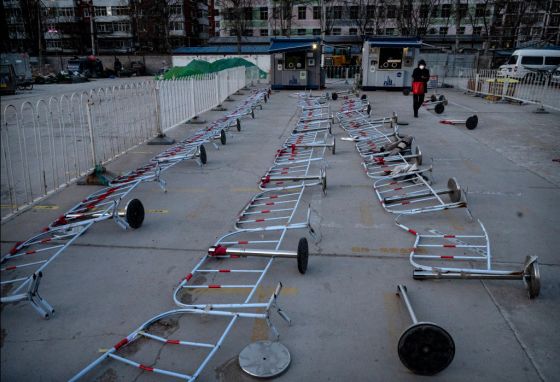
Kevin Frayer—Getty ImagesA woman walks by barricades as they are seen scattered on the ground at a testing site for COVID-19, on Dec. 19, 2022 in Beijing, China.

It’s perhaps unsurprising that a CCP spawned from popular revolution should fear the wrath of the masses most of all. In truth, however, over two-thirds of the 303 autocrats ousted from power worldwide between 1946 and 2008 were unseated by elite coups, with only a small minority bested by popular uprisings. The lesson being that rather than fear a mob over the horizon, leaders like Xi should be looking over their shoulder. It’s clear that he does the latter too, of course; by assuming a protocol-breaking third leadership term in November, while stocking his inner circle with loyalists and lackeys, Xi has doggedly insulated himself from potential rivals.

Herein may lie the problem. The fear was always that this new leadership’s homogeneity would undermine the quality of its policy-making. “That it has been having a hard time facing its first major test—smooth transition out of zero-COVID—has not been helpful in dispelling those concerns,” says Sung. The government saw the economic pain of zero-COVID and wanted to make adjustments. But local officials who for the past three years have been judged first and foremost on stamping out the virus were naturally hesitant. So the central leadership had to take bolder steps to force their arm such as dismantling the nationwide tracking apparatus. Cue the lurch from one extreme to another. Today, China is caught between Xi’s two festering paranoias—fear of the people, and of challenges within the party.

The consequences may be dire. With virtually no community exposure to the virus, and only low efficacy domestic vaccines, the surge in cases will no doubt result in many deaths—some models predict over 1 million—despite official denials. Zhang Wenhong, a prominent Chinese doctor often likened to America’s Dr. Anthony Fauci, has warned that China’s medical institutions will face their “darkest hour” by next month.

Instead, a new propaganda campaign has taken over. Previously, pandemic chaos in the West was painted as evidence of liberal democracy’s failings. Meanwhile, China’s success in banishing the virus was proof of a superior political system. But on Dec. 12, the CCP mouthpiece People’s Daily newspaper instead framed zero-COVID as a necessary stopgap to buy time while the virus’s severity waned and effective treatments were developed. Its dismantling, so it went, was always in the works. “Be the first person responsible for your own health,” it wrote.

The problems with this account are myriad and glaring. If this opening up was long-planned, then surely more efforts should have been made to vaccinate the elderly. Currently, only 42% of over-80s have had three doses of the vaccines, according to government figures. Today, people seeking boosters are being turned away from clinics due to a lack of supply. The most vulnerable could have been given more effective foreign vaccines. (On Tuesday, the U.S. offered China mRNA vaccines, though nobody expects the nationalistic CCP to accept.) In addition, effective antivirals like Paxlovid should have been stockpiled; one Chinese website sold out its supply in half-an-hour.

Public health experts also struggle with the logic of opening up some six months after most Chinese have had their last jab, given the rapidly decreasing efficacy of vaccines over time. Not to mention there’s just weeks before China’s Spring Festival—humanity’s largest annual migration, when some 200 million Chinese cram into buses and trains for long journeys to ancestral villages where medical facilities are rudimental at best.

“Even healthcare workers were caught off-guard [by the reversal],” says Huang.


China Faces Surge in Cases After Loosening Zero COVID Measures
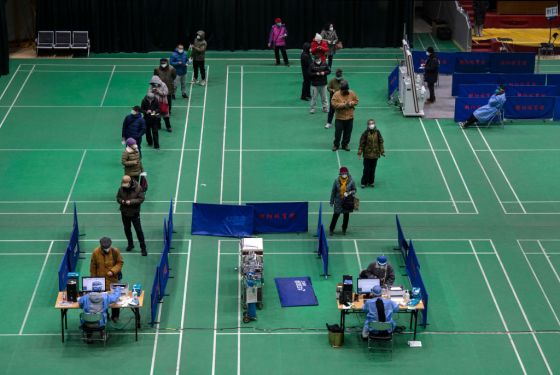
Kevin Frayer—Getty ImagesPeople wait in line to see a health worker at a temporary fever clinic set up by a hospital to treat potential COVID-19 patients in a sports centre on Dec. 18, 2022 in Beijing, China.

Yet the CCP’s account is already written. On Dec. 14, authorities stopped reporting infections deemed “asymptomatic,” which in China is often stringently defined as those not confirmed with a chest scan. Then, on Dec. 20, officials said that they would only include on its official COVID-19 death tally those who had tested positive for the virus and died of respiratory failure or pneumonia—excluding anyone with complicating conditions, as is frequently the case with elderly patients. The aim is to push home the message that China suffered the lowest COVID-19 toll of any major power.

Many Chinese will no doubt buy the propaganda. But a large number have had their eyes opened by the bungling of zero-COVID, the lives lost to suicides and treatable ailments that worsened in an ultimately futile attempt to stamp out the virus. The protests only serve to show that the party is, in fact, fallible and responsive to public anger, that the people have more power than anyone thought. “This will be very encouraging for Chinese civil society, which has had very little space to work in for years,” says Sung. The irony is, of course, that so far they have only nudged the CCP from suffocating control to callous inaction.

“I don’t know how anybody can have confidence in China anymore,” says one Shanghai resident, speaking to TIME on condition of anonymity for fear of official reprisals. “Disruption and unexpected things is one thing, but a government pulling the rug under your feet is quite another.”

Categories
Audio Sources - Full Text Articles

Half of the World’s Democracies Are in Retreat. Here’s What to Expect in 2023

The fight for democracy has been one of the most defining narratives of 2022. It featured in the U.S. midterms, the first electoral contest to take place since former President Donald Trump’s false claims that the 2016 presidential election was stolen. It was central to major elections in Hungary and Brazil, where incumbents suggested, without evidence, that the vote would be undermined by voter fraud and international interference.

But perhaps nowhere has the fight been more pronounced than in Ukraine, where the ongoing Russian invasion has come to represent the front-line of the global battle between the forces of democracy and authoritarianism. “They see the democracy and freedom of Ukraine as a question of their own survival,” Ukrainian President Volodymyr Zelensky told TIME’s Simon Shuster, referring to the Kremlin. “If they devour us, the sun in your sky will get dimmer.”

[time-brightcove not-tgx=”true”]

While Ukraine’s fortitude continues to be seen as a source of optimism about democracy’s strength, the world’s skies are already much dimmer than they used to be. Democracy in 2022 has been under siege, marked by attempted coups in Peru, contested elections in Brazil, and authoritarian crackdowns on peaceful protesters in Iran, China, and elsewhere. According to an annual report on the state of global democracy by the Stockholm-based International Institute for Democracy and Electoral Assistance, or International IDEA, half of the world’s democratic nations are in retreat. The most concerning cases can be found among the world’s biggest and most influential democracies, such as India, Brazil, and the United States.

Read More: Women of Iran: Heroes of the Year 2022

Below, what you need to know about how democracy fared in 2022.

How is democracy doing globally?

The short answer is “not well,” says Kevin Casas-Zamora, the former Costa Rican politician who now serves as secretary general of International IDEA. Since the organization started tracking democracy worldwide in 2017, it has found that the number of countries moving toward authoritarianism are more than double those that are moving toward democracy. Of the 104 democracies included in the study, 52 are considered to be eroding, up from 12 a decade ago. Among non-democratic countries such as Afghanistan and Belarus, nearly half are becoming more repressive.

“Democratic erosion affected 12% of democracies a decade ago,” says Casas-Zamora. “That proportion has gone up to 50% now.”

The extent of the erosion varies by region. In Europe, for example, democracy remains stagnant, with nearly half of its democracies having suffered erosion in the last five years, according to International IDEA. In the Asia-Pacific region, just over half (54%) of people live in democracies, the vast majority (85%) of which are considered weak or backsliding. The Americas, meanwhile, is home to three out of seven backsliding countries.

This democratic erosion coincides with another worrying trend: that the number of people who have faith in democratic systems to deal with the most pressing issues of the day—including rising food and energy prices, ballooning inflation, and recession—is steadily shrinking. Studies show that satisfaction with the democratic process around the world has suffered a notable decrease in recent years. Some 52% of people across 77 countries agreed that having a strong leader unbeholden to legislatures or elections is a good thing compared to 38% in 2009, International IDEA’s report said, citing a 2021 study by the World Values Survey.

What constitutes democratic “backsliding”?

Democratic backsliding, or “autocratization,” denotes an erosion of the norms and institutions that underpin democratic systems. While backsliding can be spurred by a major event such as a military coup, it can also be brought on at the hands of democratically-elected governments that, once in power, choose to subvert the basic tenets of democracy that enabled them to get elected in the first place. “That kind of democratic backsliding has become a sort of pandemic in its own right,” says Casas-Zamora, referencing “severely backsliding” countries such as Brazil and Hungary, both of which have seen their democratic institutions undermined by illiberal leaders Jair Bolsonaro and Viktor Orbán, respectively. India and the U.S., which have also seen their democracies tested in recent years, are classified by IDEA as “moderately backsliding.”

While the methodologies used to identify backsliding countries vary across organizations, in IDEA’s case, whether a country is deemed to be backsliding is determined by a number of variables, including the effectiveness of its institutions (can the state hold credible and regular elections?), its checks and balances (are there controls on executive power?), and how it safeguards fundamental rights (are civil liberties protected?). IDEA also takes into account other indicators such as impartial administration (is corruption an issue?) and civic participation (are citizens engaged beyond elections?).

IRAQ-IRAN-KURDS-POLITICS-RIGHTS-JUSTICE-WOMEN-DEMO
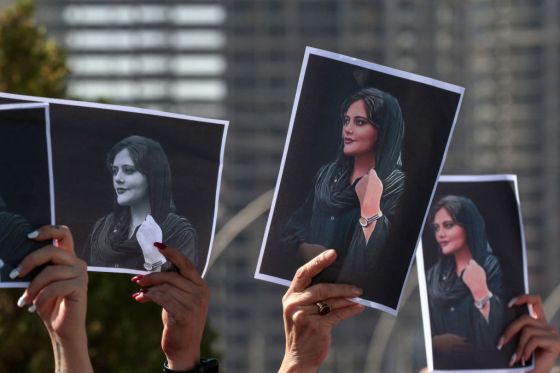
AFP via Getty ImagesWomen hold up signs depicting the image of 22-year-old Mahsa Amini, who died while in the custody of Iranian authorities, during a demonstration denouncing her death by Iraqi and Iranian Kurds outside the U.N. offices in Erbil, the capital of Iraq’s autonomous Kurdistan region, on Sept. 24, 2022. Safin Hamed—AFP/Getty Images

While these indicators are useful in assessing the health of democracies, “The way in which democracy is ailing varies from country to country,” says Casas-Zamora. “A single score ranking the countries would probably obscure much more than it would clarify.”

Why is democracy in retreat?

While there is no singular cause of the democratic erosion taking place around the world, there are thought to be a number of common challenges. Among the most talked about is the rise of heightened political polarization, fueled in part by the rise in populist-style “us versus them” politics. That polarization has been stark in the U.S., where it has resulted in gridlocked politics, heightened distrust in democratic institutions, and even political violence. Other notable causes include increasing distrust in the legitimacy of elections and widespread disillusionment in mainstream political parties.

But another, perhaps more fundamental cause is rising levels of inequality. “Democracy ultimately is a system predicated on a notion of equality between citizens,” says Casas-Zamora, “The grotesque levels of inequality that we are seeing, and that the pandemic made worse, go against the ethos of democracy.”

What can be done to strengthen democracy?

Apart from reducing inequality, one of the most important things that countries can do to stave off democratic backsliding is to ensure that its checks on executive power—including institutions such as the judiciary, the free press, and civil society—are safeguarded. For democracies, this also means ensuring that the credibility of its elections, the most important check on power in any democracy, is preserved.

“We are seeing not just transnational campaigns to subvert the legitimacy of electoral results all over the world, but also in many places we are seeing credible, competent, and autonomous electoral management bodies coming under political fire,” says Casas-Zamora, pointing to recent examples of election denial in Brazil and the U.S. “This is about playing defense.”

But democracies must also play offense, particularly when it comes to making the case for the democratic model as a superior form of governance. Casas-Zamora says leaders can do this in part by experimenting with new forms of civic engagement, such as citizens assemblies. They also need to be able to demonstrate that democracy is capable of solving the concrete problems that people face. “For 99% of people out there, the proof of the pie is in the eating,” he says. “We have to embrace, in a very conscious way, a very vigorous agenda to improve the quality of democratic governance, and that means we have to revisit questions of institutional design—how we design our democracies to be better able to make decisions and implement decisions in an efficacious way.”

Is there any causes for optimism?

While the state of global democracy is bleak, one of the few bright spots is the prevalence of civic action around the world, from the international demonstrations raising awareness about the climate crisis to mass protests in repressive regimes such as Iran and China.

Read More: ‘Not What You’d Expect in a Democracy.’ How Britain Is Waging War Against Climate Protesters.

“The number of social movements, the number of demonstrations, people going out in the street to demand their rights, is really extraordinary,” says Casas-Zamora. “People are willing, at an enormous risk, to go out on the street to demand their rights. This is a positive story.”

What can we expect in 2023?

If the trends are any indication, it’s that the acute challenges facing democracy are not going away.

“The next few years are going to be extraordinarily challenging for democracy and we’re going to see a lot of people on the street,” says Casas-Zamora. “This is a double-edged sword, because on the one hand this can create a lot of political instability; on the other hand, it’s also an exercise of democratic rights. It will create a lot of instability but it will also prove the willingness of people to demand their rights, which is not a bad thing.”

Categories
Audio Sources - Full Text Articles

A Warning for Today’s Super Rich From Ancient Rome’s Wealthiest Man

An ever more unequal society loses its links to democracy. Wealth is good. Excess wealth distorts. Those were the lessons of the last years of the Roman republic 2000 years ago. They are still lessons today.

Seven years on from Donald Trump’s first presidential campaign it’s easy to forget that his populism came from the Latin textbooks. When Trump was riding high, he followed closely (likely not knowingly) the populists of Republican Rome. Trump was no Julius Caesar, except maybe in his dreams, but his electoral pitch did owe much to Caesar’s uncle, Gaius Marius, Rome’s first ‘man of the people’ who won election after election, a record seven consulships, by attacking the elitism of his enemies and vaunting his own trustworthiness to the poor and left behind. When Trump used his purported wealth to prove his selflessness in seeking office (and in attacking Hillary Clinton as the client of the plutocrats) these were tactics that both Marius and Caesar would have instantly recognized.

[time-brightcove not-tgx=”true”]

In 2022 the Latin lesson continues. Early Rome prospered not because it was an egalitarian democracy but because it was generally more equal, open, and democratic than its rivals, For instance, freeing slaves when the Greeks thought that a step too far. But throughout the first century BCE Rome’s intermittent civil wars between its ‘haves’ and ‘have nots’ left one man eventually as the wealthiest politician of his time, maybe of all time. His name was Marcus Licinius Crassus.

Like Trump, Crassus made his first fortune in property, redeveloping land taken from the war’s losers, building flashy mansions for the winners. He went on to make a genuine massive fortune from mining and banking. He is best known today as the villain who crucified Kirk Douglas in Stanley Kubrick’s film, Spartacus, but, for all the gruesome theatre of crosses along the Appian Way, winning a slave war was little more than a sideshow for Crassus. He had created for himself a new kind of power, the permanent kind, the power to use money behind the scenes, pulling the strings of whichever puppet seemed to be in charge. He was the first tycoon.

Even Caesar himself was Crassus’s puppet at the beginning of his career. Crassus financed Caesar’s election campaigns, making sure at a stupendous cost that Caesar became pontifex maximus, the chief priest, the only man with a house in the Roman Forum. Once Crassus had helped Caesar to his military commands in Gaul, he watched his protégé’s back in Rome, bribing, moneylending, making speeches, and calling in favours in order to ensure, for a while at least, that Caesar became a useful counterweight to Crassus’s lifetime rival, Pompey the Great.

Caesar and Pompey both distorted the balance of Roman politics with vast wealth won, stolen if critics were frank, from conquered kings in Rome’s expanding empire. Crassus kept his place in this three-man oligarchy called the ‘Three Headed Monster’ by continuing to use his financial power to balance the influence of his more acclaimed military partners. Senators wore black to show their objection to this change to the traditional system of checks and balances but were powerless against the onslaught of against the dominance of the super-rich.

Gradually Crassus came to see that wealth alone would not be enough to maintain his place at the three-legged top table of Rome. Caesar, rich from Gaul and protected by loyal legions, did not need Crassus’s money anymore. Pompey, after a triumph through the streets of Rome parading giant golden statues and his own head in pearls, was probably for a time even richer than Crassus.

So, the man whose power rested on his reputation for wealth decided on a last campaign to keep himself up with Caesar and Pompey. He moved onto his rivals’ turf, trained personal legions as he had trained slaves for his building sites, and prepared to take on a neighbour in war. In 53 BCE, twenty years after the Spartacus rebellion, his fellow oligarchs allowed their colleague to plan an invasion of Parthia, a sprawling empire east of the Euphrates.

But Crassus, for all his commercial and organisational skill, was ill prepared. He was accountable only to Caesar and Pompey. The traditional senatorial systems of diplomacy and intelligence had broken down before the power of money. Crassus knew very little about his Parthian adversaries and, like Trump’s friend, Vladimir Putin, in the Ukraine today, he thought he knew much more than he did.

Crassus expected to face legionaries like his own led by a deal-making pragmatist like himself. Instead, his army faced a swirling mass of archers on ponies, their quivers perpetually replenished from a camel train, a whole new weapon system. Trying to negotiate a retreat, he squabbled over a horse. His head was cut down on to the sand, his mouth filled with molten gold to mark the greed that all the Parthians knew him for.

Back in Rome, the two remaining heads of the three-headed monster were soon at each other’s throats. Caesar, on the side of the populists, defeated Pompey, leader of the establishment, and ruled briefly as a dictator before his assassination on the Ides of March, 44 BCE. His chosen heir, Octavian, won a final civil war before establishing a system of one-man rule, supported by frail, almost fake, democratic institutions, which survived for centuries.

Categories
Audio Sources - Full Text Articles

Zelensky to Meet Biden and Address Congress in Washington, as War in Ukraine Rages On

WASHINGTON — Ukrainian President Volodymyr Zelensky was making his way to Washington on Wednesday for a summit with President Joe Biden and to address Congress in his first known trip outside the country since Russia’s invasion began in February.

Read More: Volodymyr Zelensky and the Spirit of Ukraine is TIME’s 2022 Person of the Year

Zelensky said on his Twitter account that the visit was “to strengthen resilience and defense capabilities” of Ukraine and discuss cooperation between his country and the U.S with Biden.

The highly sensitive trip is taking place after 10 months of a brutal war that has seen tens of thousands killed and wounded on both sides of the conflict, along with devastation for Ukrainian civilians. It also comes as U.S. lawmakers are set to vote on a year-end spending package that includes about $45 billion in emergency assistance to Ukraine and as the Pentagon prepares to send Patriot surface-to-air missiles to the country to defend itself.

[time-brightcove not-tgx=”true”]

Zelensky headed abroad after making a daring and dangerous trip Tuesday to what he called the hottest spot on the 1,300-kilometer (800-mile) front line of the conflict, the city of Bakhmut in Ukraine’s contested Donetsk province. He praised Ukrainian troops for their “courage, resilience and strength” as artillery boomed in the background.

In a statement Tuesday night, White House press secretary Karine Jean-Pierre said Biden looks forward to the visit and that the address to Congress will demonstrate “the strong, bipartisan support for Ukraine.”

“The visit will underscore the United States’ steadfast commitment to supporting Ukraine for as long as it takes, including through the provision of economic, humanitarian, and military assistance,” she said.

Zelensky was scheduled to meet with Biden at the White House in the afternoon and then join Biden for a news conference in the East Room. He was expected to address Congress in the evening.

In her invitation to Zelensky to address a joint meeting of Congress at the U.S. Capitol, House Speaker Nancy Pelosi said “the fight for Ukraine is the fight for democracy itself” and that lawmakers “look forward to hearing your inspiring message of unity, resilience and determination.”

U.S. and Ukrainian officials have made clear they don’t envision an imminent resolution to the war and are preparing for fighting to continue for some time. Biden has repeated that while the U.S. will arm and train Ukraine, American forces will not be directly engaged in the conflict.

Biden and Zelensky first discussed the idea of a visit to Washington during their most recent phone call, on Dec. 11, and a formal invitation followed three days later, said a senior U.S. administration official, briefing reporters on condition of anonymity because of the sensitive nature of the visit. Zelensky accepted the invitation on Friday and it was confirmed on Sunday, when the White House began coordinating with Pelosi to arrange the congressional address.

The White House consulted with Zelensky on security for his departure from Ukraine and travel to Washington, including the risk of Russian action while Zelensky was briefly out of the country, the official added, declining to detail the measures taken to safeguard the Ukrainian leader. The official said the U.S. expected Russia to continue its attacks on Ukrainian forces and civilian infrastructure targets despite the trip.

The tranche of U.S. funding pending before Congress would be the biggest American infusion of assistance yet to Ukraine — even more than Biden’s $37 billion emergency request — and is meant to ensure that support flows to the war effort for months to come.

On Wednesday, the U.S. was also set to announce that it will send a major package of $1.8 billion in military aid to Ukraine that will for the first time include a Patriot missile battery and precision guided bombs for its fighter jets, U.S. officials said.

The aid signals an expansion by the U.S. in the kinds of advanced weaponry it will send to Ukraine to bolster its air defenses against what has been an increasing barrage of Russian missiles in recent weeks. The package will include about $1 billion in weapons from Pentagon stocks and $800 million in funding through the Ukraine Security Assistance Initiative, officials said.

The decision to send the Patriot battery comes despite threats from Russia’s Foreign Ministry that the delivery of the advanced surface-to-air missile system would be considered a provocative step and that the Patriot and any crews accompanying it would be a legitimate target for Moscow’s military.

It’s not clear exactly when the Patriot would arrive on the front lines in Ukraine, since U.S. troops will have to train Ukrainian forces on how to use the high-tech system. The training could take several weeks, and is expected to be done in Germany. To date, all training of Ukraine’s forces by the U.S. and its Western allies has taken place in European countries.

The visit comes at an important moment as the White House braces for greater resistance when Republicans take control of the House in January and give more scrutiny to aid for Ukraine. GOP leader Kevin McCarthy has said his party’s lawmakers will not write a “blank check” for Ukraine.

Biden and Zelensky frequently have talked by phone as the White House arranges new tranches of military assistance for Ukraine. The calls have been mostly warm, with Biden praising Ukraine for remaining steadfast against the Russians and Zelensky thanking the U.S. president for support.

The one exception was a June phone call soon after Biden notified Zelensky that an additional $1 billion package was headed to Ukraine. Zelensky didn’t miss a beat in ticking off the additional assistance he said Ukraine needed.

That irked Biden, who underscored to Zelensky the American people’s generosity. But the brief moment of tension hasn’t caused any lasting difficulty, according to officials familiar with the episode.

Pelosi, who visited Zelensky earlier this year in Kyiv, encouraged lawmakers to be on hand for Wednesday evening’s address by the Ukrainian leader.

“We are ending a very special session of the 117th Congress with legislation that makes progress for the American people as well as support for our Democracy,” Pelosi wrote Tuesday in a letter to colleagues. “Please be present for a very special focus on Democracy Wednesday night.”

Later at the Capitol she said of Ukrainians, “They are fighting for democracy for all of us.”

Russia’s invasion, which began Feb. 24, has lost momentum. The illegally annexed provinces of Donetsk, Kherson, Luhansk and Zaporizhzhia remain fiercely contested.

With the fighting in the east at a stalemate, Moscow has used missiles and drones to attack Ukraine’s power equipment, hoping to leave people without electricity as freezing weather sets in.

In a video released by his office from the Bakhmut visit, Zelensky was handed a Ukrainian flag and alluded to delivering it to U.S. leaders.

“The guys handed over our beautiful Ukrainian flag with their signatures for us to pass on,” Zelensky said in the video. “We are not in an easy situation. The enemy is increasing its army. Our people are braver and need more powerful weapons. We will pass it on from the boys to the Congress, to the president of the United States. We are grateful for their support, but it is not enough. It is a hint — it is not enough.”

For his part, Putin on Tuesday hailed the “courage and self-denial” of his forces in Ukraine — but he did so at a ceremony in an opulent and glittering hall at the Kremlin in Moscow, not on the battlefield.

At the Kremlin ceremony, Putin presented awards to the Moscow-appointed heads of the four illegally annexed regions of Ukraine. In a video address honoring Russia’s military and security agencies, he praised the security personnel deployed to the four regions, saying that “people living there, Russian citizens, count on being protected by you.”

Putin acknowledged the challenges faced by the security personnel.

“Yes, it’s difficult for you,” he said, adding that the situation in the regions is “extremely difficult.”

Categories
Audio Sources - Full Text Articles

Early Edition: December 21, 2022

GettyImages-73086221-1-e1512768873185.jp

Signup to receive the Early Edition in your inbox here.

A curated weekday guide to major national security news and developments over the past 24 hours. Here’s today’s news.

FORMER PRESIDENT TRUMP’S TAX RETURNS

The House Ways and Means Committee voted yesterday to release former President Trump’s tax returns. The committee’s 24-16 vote along party lines followed a more than four-hour closed-door meeting. The Wall Street Journal reports. 

The House Ways and Means Committee yesterday released a summary report on the Inland Revenue Service’s (IRS) mandatory audit program for presidents. The report concluded that the IRS failed to audit Trump’s taxes as required under the program. Trump filed his 2015, 2016 and 2017 tax returns during his first two years as president, which should have triggered an IRS examination of those returns. However, the agency did not initiate an audit of any of the returns that Trump filed while in office until April 3, 2019 – the same day committee Chair Richard Neal (D-MA) first asked the IRS to provide six years of Trump’s tax returns. Benjamin Guggenheim reports for POLITICO. 

The committee also released a supplemental report from the Joint Committee on Taxation that offered a summary of Trump’s tax returns between 2015 and 2020. The report highlights some of the stall tactics that Trump and his legal team used during the audit process. Those included seeking additional information under the Freedom of Information Act, failing to provide all the facts needed to resolve certain issues and saying that they would probably have more relevant information to present in protest or appeals. Alan Rappeport reports for the New York Times. 

JAN. 6 ATTACK AND 2020 ELECTION PROBES 

Former President Trump’s White House ethics lawyer told Cassidy Hutchinson to give misleading testimony to the Jan. 6 committee, sources say. On Monday, the Jan. 6 committee alleged that it had evidence that a Trump-backed attorney urged a key witness to mislead the committee. Whilst the committee did not identify the people involved, CNN has learned that Stefan Passantino, the top ethics attorney in the Trump White House, allegedly advised his then-client, former White House aide Cassidy Hutchinson, to tell the committee that she did not recall details that she did. Hutchinson, who dropped Passantino before her public testimony, provided key insights into Trump’s state of mind and actions leading up to the Jan. 6 attack. Katelyn Polantz, Pamela Brown, Jamie Gangel and Jeremy Herb report for CNN. 

The Jan. 6 committee has begun handing over evidence and transcripts from its probe to the Justice Department. Much of the material from the committee’s probe relates to former White House Chief of Staff Mark Meadows and John Eastman, the Trump lawyer at the heart of the “fake elector” scheme. The committee has sent the Justice Department all of Meadows’ text messages and related evidence, as well as transcripts of interviews with several witnesses related to the “fake elector” scheme and the efforts by Trump and his allies to pressure states to overturn their election results, particularly in Georgia. Punchbowl News reports.

OTHER DOMESTIC DEVELOPMENTS

Elon Musk said yesterday he would resign as Twitter’s CEO once he found a replacement. Musk asked his Twitter followers on Sunday whether he should step down as Twitter’s chief executive, saying he would abide by the results of the poll. The survey attracted 17.5 million votes, with more than 57% agreeing he should step down. Musk will remain the company’s owner. Ryan Mac and Kate Conger report for the New York Times. 

Two New York men have been indicted for working with Russian hackers to hack the electronic taxi dispatch system at Kennedy International Airport. The scheme allowed taxi drivers in a holding lot waiting to pick up their next fare to jump the line – for a $10 fee. The scheme “enabled as many as 1,000 fraudulently expedited taxi trips a day,” the indictment said. The defendants, Daniel Abayev and Peter Leyman, have been charged with two counts of conspiracy to commit computer intrusion. Benjamin Weiser and Nate Schweber report for the New York Times. 

U.S. RELATIONS 

The U.S. military has captured six Islamic State (I.S.I.S.) operatives, U.S. Central Command announced yesterday. The operatives were captured during three raids in eastern Syria, which took place in the space of 48 hours. Those captured included a senior I.S.I.S. official who U.S. officials claim was involved in planning and enabling terrorist attacks in Syria. Ellen Mitchell reports for The Hill.  

The Taliban released two U.S. citizens who had been detained in Afghanistan. One of those released is thought to be Ivor Shearer, an independent filmmaker who had been held since August. State Department spokesperson Ned Price said the release was not part of a prisoner exchange and that no money was paid. It appeared to be a “good-will gesture” on the part of the Taliban, he said. Katie Rogers reports for the New York Times. 

Unrest in Iran and Russia’s war in Ukraine may have distracted Tehran and Moscow from interfering in the 2022 U.S. midterm election, according to a top U.S. military cyber official. “We collectively saw much less focus from foreign adversaries, particularly the Russians” in targeting the 2022 election compared to previous elections, Maj. Gen. William J. Hartman said in a press briefing. Hartman said he was “surprised” by the relative lack of activity from the Russians and Iranians during the midterm election, adding that the security services in both countries were preoccupied in the weeks and months before the election. Sean Lyngaas reports for CNN. 

RUSSIA, UKRAINE – U.S. RESPONSE 

Ukrainian President Volodymyr Zelenskyy will meet President Biden at the White House today, before delivering a prime-time address to a joint session of Congress. The trip by Zelenskyy to Washington is intended to “underscore the United States’ steadfast commitment to supporting Ukraine for as long as it takes,” White House press secretary Karine Jean-Pierre said in a statement. Michael D. Shear and Emily Cochrane report for the New York Times. 

Biden is expected to announce a $1.8 bil aid package for Ukraine today, senior administration officials said. The package will include, for the first time, a Patriot missile battery, the most advanced U.S. ground-based air defense system. Defense Secretary Lloyd Austin will send a Patriot battery that is already overseas to Ukraine, the officials said. Helene Cooper reports for the New York Times.   

Congressional leadership is working to introduce a bill condemning Russia as an “Aggressor State.” The designation would provide Biden with new sanctions authorities to target Russian officials. However, it falls short of Zelenskyy’s demand that the U.S. designate Russia a state sponsor of terrorism – a label that would compel the U.S. to impose costs on countries engaging with the Kremlin. Laura Kelly reports for The Hill. 

RUSSIA, UKRAINE – OTHER DEVELOPMENTS 

There is no conclusive evidence that Russia was responsible for the September attack on the Nord Stream 1 and 2 pipelines. This is according to over 20 diplomatic and intelligence officials across nine countries. Some officials went so far as to say they didn’t think Russia was responsible. Others who still consider Russia a prime suspect said positively attributing the attack to any country may be impossible. No one doubts, however, that the damage to the two Baltic Sea pipelines was deliberate. Shane Harris, John Hudson, Missy Ryan, and Michael Birnbaum report for the Washington Post. 

Russian President Vladimir Putin is expected to hold a meeting with the expanded board of Russia’s Defense Ministry today. Defense Minister Sergei Shoigu will present a detailed report on the invasion of Ukraine, and military targets for the upcoming year will be discussed. The meeting will be attended by military district commanders and chiefs of federal military authorities. An additional 15,000 military officials will join via videoconference. Niha Masih reports for the Washington Post. 

Deputy chairman of Russia’s Security Council, Dmitry Medvedev held surprise talks with Chinese leader Xi Jinping in Beijing. In a video posted on Telegram Medvedev said he and Xi had discussed the two countries’ “no limits” strategic partnership, as well as Ukraine. Reuters reports. 

Ukrainian President Volodymyr Zelenskyy made an unannounced visit to the front-line city of Bakhmut yesterday. During the visit, Zelenskyy handed out awards to Ukrainian forces defending the city. Fierce fighting had raged in the city for nearly six months. Isabel Coles reports for the Wall Street Journal. 

GLOBAL DEVELOPMENTS 

The Afghan government yesterday barred women from attending university. The latest blow to women’s rights under the Taliban was delivered in a letter from the higher education ministry. The letter ordered both private and public universities to suspend women from attending class and to inform the ministry once they had done so. Christina Goldbaum and Najim Rahim report for the New York Times. 

Mexico said yesterday that it had granted asylum to the family of ousted Peruvian President Pedro Castillo. At the same time, Peru’s Foreign Ministry declared Mexico’s ambassador to Peru persona non grata and accused Mexico of meddling in its domestic affairs. Mexican Ambassador Pablo Monroy has 72 hours to leave Peru, the ministry said. Tensions between the two countries have risen since Mexican President Andrés Manuel López Obrador threw his support behind Castillo following his failed attempt to dissolve congress on Dec. 7. Ryan Dube and Juan Montes report for the Wall Street Journal. 

COVID-19

COVID-19 has infected over 99.950 million people and has now killed over 1.09 million people in the United States, according to data compiled by Johns Hopkins University. Globally, there have been over 654.053 million confirmed coronavirus cases and over 6.67 million deaths. Sergio Hernandez, Sean O’Key, Amanda Watts, Byron Manley and Henrik Pettersson report for CNN.

A map and analysis of all confirmed cases of the virus in the U.S. is available at the New York Times.

U.S. and worldwide maps tracking the spread of the pandemic are available at the Washington Post. 

The post Early Edition: December 21, 2022 appeared first on Just Security.

Categories
Audio Sources - Full Text Articles

Elon Musk was never a liberal, and his plans for Twitter were never benevolent | Thomas Zimmer

Tech barons’ lip-service to democracy and pluralism was always conditional on preserving their own positions at the top

On Monday, Elon Musk polled Twitter users on whether he should step down as CEO. The answer was a resounding yes. As of now, he has not announced his resignation. Either way, Musk’s tenure has been a disaster for democracy.

Since Elon Musk took over Twitter, he has encouraged far-right conspiracy theories, consistently articulated rightwing extremist ideas and coddled extremists who propagated them, changed or undermined content moderation in a way that allowed hate speech and far-right abuse to flourish, and constantly derided Democrats, liberals and anyone he perceives as part of “the Left” in an escalating crusade against “wokeism.” He is now banning critical voices, including those of mainstream journalists, under obviously disingenuous pretenses.

Thomas Zimmer is a visiting professor at Georgetown University, focused on the history of democracy and its discontents in the United States, and a Guardian US contributing opinion writer

Continue reading…

Categories
Audio Sources - Full Text Articles

The January 6 committee is right. It’s time to prosecute the kingpin, Trump | Lawrence Douglas

The assault on the Capitol was not a spontaneous spasm of violence. It was the culmination of a concerted effort to reject the results of a fair election

Over the course of 18 months, the intrepid patriots on the House select committee investigating the January 6 insurrection tirelessly researched Donald Trump’s efforts to overturn the results of the 2020 election through fraud, intimidation, harassment and violence. The committee’s public hearings were an exercise in civic education, presenting the nation with a gripping, granular and truthful account of an unhinged president seeking to cling to power at all costs. Now they have gone one crucial step further. They have referred the matter to the justice department, urging that Trump be prosecuted.

Let us take stock of this astonishing moment. For the first time in American history, a congressional committee has recommended that a former president be criminally prosecuted – and not just for any crimes. The chief crimes at the heart of the referral – inciting insurrection, conspiracy to defraud the United States, and obstructing an official act of Congress – involve nothing short of an elaborate effort to frustrate and upend the peaceful transfer of presidential power, the bedrock of our constitutional democracy.

Lawrence Douglas is the author, most recently, of Will He Go? Trump and the Looming Election Meltdown in 2020. He is a contributing opinion writer for the Guardian US and teaches at Amherst College

Continue reading…

Categories
Audio Sources - Full Text Articles

Borderland Residents Shut Down Arizona Gov. Doug Ducey’s Illegal Wall

Last week, the Justice Department sued the state of Arizona and its governor, Doug Ducey, for installing a shipping container wall along the U.S.-Mexico border. This week on Intercepted: Ryan Devereaux, an investigative reporter with The Intercept, breaks down Ducey’s makeshift, multimillion-dollar container wall. Devereaux tells the story of everyday people and community members who live along the border, and how they stood up to the governor and won.

Ryan Deveraux: Michael and Christie Brown resisted putting a barrier around their beloved desert home for years, but the nights were getting too dangerous. It was a question of safety. They needed a fence. 

Michael Brown: My house is about ten miles north of the border.

RD: The Browns live at the foot of the rugged Huachuca Mountains in Cochise County, Arizona. Like many of their neighbors, the Browns’s worry was javelinas — tenacious borderland omnivores often mistaken for wild pigs. Their dogs had been attacked. Their garden was in peril. Javelina damage is the kind of thing that keeps the Browns up at night. A purported wave of migrants laying siege to their community is not. 

MB: In ten years I’ve only seen one migrant.

RD: But in late October, Gov. Doug Ducey began unloading thousands of shipping containers on the border in the Coronado National Forest. The container wall was supposed to thwart an alleged “invasion” of immigrants on the Brown’s doorsteps. 

Topped with concertina wire and welded together, the nearly 9,000-pound boxes would be stacked two-high on land where the Browns chop wood every winter, where they took their sons hiking and camping as kids, and where they still hike and camp to this day.

MB: This area I’ve cut wood there for probably ten years. So I’m out there a few times each year and it’s just a really peaceful, quiet, beautiful area — grasslands, oaks.

RD: The valley where Ducey was setting his sights was one of the few protected desert ecosystems still intact after the Trump years. 

MB: And on October 24th we heard that Governor Ducey had started stacking containers west of the Coronado National Monument.

RD: Two days after Ducey’s project began, the Browns climbed in their truck and set off into the mountains to see it for themselves.

MB: And we drove down to the border, we got close to the border and stopped for a guard — a private security guard.

[Audio from construction site plays]

RD: The scene was horrifying. Heavy duty pickups were ripping down the border road hauling in shipping containers on trailers. The containers were then transferred onto a large military truck that raced down the road running parallel to the border, blaring a loud horn as it passed. 

At the end of the line, the containers were wrapped in a thick chain and hoisted by backhoes. Swinging precariously through the air, they were plopped in the dirt then shoved into place with a forklift. The clanking and screeching of metal on metal filled the otherwise quiet landscape. The grinding of the heavy vehicles on the desert soil enveloped the entire area in a thick cloud of fine dust. 

As they neared the border, the Browns were stopped at an ad hoc checkpoint. A bald man, dressed in black with reflective sunglasses and body armor, approached. 

Christie Brown: Yeah, we can see your project…

MB: You don’t have any dust control here. You don’t have any signs posted up. 

Security Guard: There are signs posted up. 

MB: Where? 

CB: No there’s not. [CROSS TALK] We came all the way back here and there are no signs. 

RD: The guard wore no insignia and refused to say who he worked for. Michael asked if he could drive up to the containers and take some photos. 

MB: Can I drive up and look at it? 

Security Guard: No, you can’t. 

MB: Why not?

Security Guard: I’m not answering any more questions, sir.

RD:  Christie was incensed. 

CB: I’ll walk up there and take a picture of your sign. 

Security Guard: This is a dangerous area, ma’am. 

CB: Yeah, we just passed some of your dangerous drivers on the road, blowing dust everywhere, driving fast. 

RD: Suited with walkie talkies and a body cam, the guard shrugged. 

Security Guard: I mean, this is a desert. 

CB: This is our national land. 

Security Guard:  This is also the state of Arizona. 

CB: No it is not. This is federal property. 

Security Guard:  Are you a federal employee? 

Michael Brown: I was and I do know the laws. 

Security Guard:  OK.

CB:  And I know. I read the papers and I know this is an illegal operation and I don’t know why the national forest isn’t down here telling you to get the hell off their land. 

[Intercepted theme music plays]

Ryan Deveraux: This is Intercepted.

I’m Ryan Devereaux, an investigative journalist with The Intercept. 

For the past few months, I’ve been digging into Governor Ducey’s make-shift container wall. Ducey, who’s leaving office in January, has committed at least $95 million to this effort.

For seven weeks, the Biden administration watched as the governor broke law after law — laying a massive, unauthorized wall across a remote stretch of treasured public land. In the face of federal inaction, local residents put their bodies on the line to stop the project. Last week, after nearly two months of silence, the U.S. government filed a lawsuit against the governor demanding that the construction be halted.

As of this week, Ducey’s wall of containers still stands — though lawyers for the state have informed the federal government that construction on the project has ceased. Whether the existing containers will be taken down — and if so, when — remains to be seen. 

Arizona’s wall of shipping containers is a story about immigration and conservation, of public lands and insurrection. But as the weeks went by, it turned into something more.

In the shadow of Ducey’s wall, a roughly four-mile stretch of the U.S.-Mexico border became the setting for a remarkable and unlikely story of everyday people who, with no one to count on but each other, stood up against the most powerful man in their state and won. This is their story.

[Inquisitive music begins]

Michael Brown has lived in southern Arizona for nearly 50 years and knows as much about border walls as anyone. As an inspector and contract manager with the U.S. Army Corps of Engineers for two decades, he oversaw the construction of Border Patrol stations. In 2007, he installed the first federally contracted wall in Arizona. He continued to oversee border wall construction across the southwest before retiring in the spring of 2021. 

Looking out across the landscape, Michael saw a reckless operation that he would have shut down in a heartbeat. After their encounter with the guard at the container wall, Michael decided to walk through the brush, snapping photos of birds while taking in evidence of environmental damage. 

MB: And Christi stayed at the truck. And shortly after I started hiking, a truck pulled up close to her and just sat there and watched her.

RD:  A man parked nearby and climbed into the bed of his truck with a pair of binoculars. He watched Christie for an hour until Michael returned, then continued to watch as they drove away. An hour later, the Browns were back home when the doorbell rang.

MB: And we were home for about 20 minutes, and the doorbell rang and there were two deputy sheriffs and they said that my truck had been reported at the hotel of these border workers. And they came in. I asked them in.

RD: It was Sheriff Mark Dannels’ heavily subsidized and much-advertised border strike force. The deputies told the 67-year-old they’d received a complaint that a truck like his, carrying four suspicious men, was spotted outside a hotel where the governor’s contractors were staying. The men were frightened.

MB: They asked me if I had been down to the border. And I said I had. I told them we had spoken to a guard. I actually showed them a video of us speaking to the guard. Pretty shortly a third deputy pulled up at my house, which I really thought was odd, to send three deputies out. 

And so we talked for a bit. I showed them my house. They like the adobes and they soon afterwards left.

RD: Michael explained that he and Christie had simply gone to see the container wall. They never stopped at a motel. He showed the deputies cellphone video of their interaction with the guard. Before long, the deputies’ demeanor softened, they turned friendly and appeared satisfied. As they left, one of the men remarked to Michael that the governor’s wall was a “sensitive political situation.”

Sitting at his dining room table a month later, Michael was still processing the deputies’ visit.

MB: I knew the guards out there had taken my license plate number and made up something, I guess. So it was kind of surprising to have three deputies here.

RD: In the intervening weeks, Ducey had cut across nearly three miles of pristine desert despite multiple warnings from the U.S. Forest Service that he was breaking the law. But at this point the feds were doing nothing to stop him. The Browns were shocked.

MB: The Forest Service is mandated to preserve and to protect our national lands. These lands should be here for future generations. 

RD:  In the face of inaction, the Browns were left with one choice: gather as many friends, neighbors, and allies as they could and stop the governor themselves.

While the Browns were taking in their first ground-level glimpses of Ducey’s wall, Russ McSpadden was monitoring the scene from above. 

Russ McSpadden: I’ve been, I’ve been coming, um, to the site of, uh, construction activity here every week for a bit more than a month now. 

RD: Russ works for the Tucson-based Center for Biological Diversity. He was documenting the construction crew’s activity. 

RM: They’ve got bulldozers knocking over oak trees and forest service land and illegally building new roads, and then obviously placing shipping containers illegally at the border — just south of here, where they’ve completed a large section of wall runs, you know, right through jaguar critical habitat.

RD: Ducey selected AshBritt, a Florida-based disaster response company with significant ties to the Republican Party, for the Coronado container installation. When I reached out with questions, AshBritt directed me to contract the Arizona Department of Emergency and Military Affairs, the state agency responsible for the project. The department, in turn, directed me to the governor’s office.

Ducey’s office did not respond to questions for this story. A spokesperson for the governor did, however, speak to me during my earlier reporting on the container wall. Ducey’s press secretary, C.J. Karamargin, defended the project and said that the Biden administration had failed in its duty to secure the border, and that left the governor with no choice but to build a border wall himself.

During the Trump years, Russ was among a network of Arizona advocates who fought to counter the narrative that the former president’s vows to “build the wall” had amounted to nothing. They did so with compelling visual evidence, documenting the Department of Homeland Security tearing through many of the most treasured desert ecosystems on the planet, blowing up national monuments, and depleting a sacred Native American oasis. 

RM: It’s [a] globally recognized biodiversity hotspot for species, for species of cats, ocelot, jaguar, mountain lion, and bobcat live here, bears live here.

RD: Russ’s encyclopedic knowledge of Arizona’s backcountry is matched by his passion for the animals that live there. From iridescent bugs to lightning-fast pronghorn, Russ loves them all. But one borderland resident stands above all others: el tigre de la frontera, the jaguar. 

RM: It’s [a] federally protected habitat for this endangered species. And so, as part of my work is documenting and understanding the presence of jaguars in southern Arizona. There’s a really small number that exists in this state, and we’ve gotten photos and videos with trail cameras of a wild jaguar just to the mountains, just to the north of here.

RD: The Center for Biological Diversity has been central in the fight to return the big cats to their historic range across the American Southwest. As part of the Center’s legal efforts, the federal government was forced to designate about twelve hundred square miles in Arizona and New Mexico as critical jaguar habitat in 2014, limiting the kinds of activity permitted there. 

That habitat included land on the western slope of the Huachuca Mountains in the Coronado National Forest where Ducey began dropping his containers on October 24. 

[Sound of airplane] 

Russ was in a single-engine airplane flying low over the border when the project began. His phone rang. Robin Silver, a co-founder of the Center, was on the line. He told Russ to get to Coronado right away. Tell the pilot to land, he said, or better yet, fly to the installation site.

I happened to be in the air with Russ that day. For more than a month, we had both been trying to confirm rumors that Ducey was preparing a mass deployment of containers somewhere outside Nogales, likely in the Coronado National Forest. Hundreds of the metal boxes had been stored at an unused armory in the border city. But those boxes began quietly disappearing. The governor’s office was being cagey, confirming that Ducey was eyeing locations but refusing to confirm where. 

Russ and I took an airplane tour to scout for signs of activity in the Pajarito Mountains. By the time we touched back down in Tucson, it was clear we should have been flying further east. 

Two days after our flight, I climbed into Russ’s work truck. Setting off in the morning, we pulled into the Coronado National Memorial before noon, then hiked south along a ridge with a commanding view over the San Rafael Valley. 

[Sound of hiking] 

Though we were miles from the site, the noise of Ducey’s project echoed through the valley. One after another, pickups pulling containers came rumbling down the Forest Service road that leads to the border. Plumes of dust curled above them. Russ set his backpack in the grass and unloaded his drone. I leaned against a wire fence and squinted into the valley. In just two days, Ducey’s contractors had fashioned a shipping container fort to serve as their base of operations. Armed guards waited at the entrance.

[Sound of drone]

The drone zipped into the air and within seconds was out of sight. We spent two hours on the ridge watching Ducey’s trucks transform wilderness to junkyard. Trump’s wall building was jarring for anyone who saw it up close, but this ramshackle operation was something else entirely. 

Fox 10 Phoenix Anchor: The border battle between Governor Ducey and the federal government rages on tonight.

Fox 10 Phoenix Anchor: Today, the governor filed a lawsuit after the feds ordered Arizona to take down the double-stacked shipping containers that are filling the gaps along the border.

RD: On the Friday before Governor Ducey’s container installation began, a team of private attorneys filed a lawsuit in Arizona federal court on behalf of the governor against the Biden administration’s land management agencies.

Ducey was arguing that the federal land along the border actually falls under state jurisdiction, particularly in times of emergency and cases of invasion. Ducey declared both were present in Arizona in August.

Governor Ducey: The southern border is a federal responsibility. But in Arizona we’re taking every action possible – and I would say aggressive action – to protect this community, our state, and the law-enforcement professionals who keep us safe.

RD: The governor was saying all of this, despite the fact that the Biden administration was already in the process of filling those gaps. Ducey’s reading of the law would grant border governors unprecedented power to sidestep federal statutes that have governed public lands for generations. The Center for Biological Diversity quickly filed suit against Ducey citing the threat to jaguar habitat under the Endangered Species Act.

RM: The Center for Biological Diversity filed a 60 day notice of intent to sue for obstructing important migration corridors for jaguar and ocelot. This is an ESA, Endangered Species Act, violation.

RD: The Center also intervened as defendants in the governor’s lawsuit against the feds. Russ submitted a declaration in the case. That declaration was filed November 1, seven days before the midterm elections. Silver – the co-founder of the Center – was sending his images from the field directly to Biden’s top land managers, including the Ducey lawsuit defendants, as well as Department of Interior Secretary Deb Halaand. 

With four decades of experience suing the federal government, often successfully, Silver’s connections in Washington ran deep. The Center’s longtime co-founder demanded that the feds do their job and stop Ducey. The message he got back was clear: wait until the elections are through. 

Chris Hayes, MSNBC: We are now projecting that Democratic Secretary of State Katie Hobbs is in fact the winner in the Arizona gubernatorial race, this will make her [fade out].

RD: Less than 24 hours after Arizona’s polls closed on November 8, Russ and I were on the ground in Coronado. 

[Sound of truck blaring horn]

This time, instead of watching from the ridge, we drove directly to the site. Up close, the scene had a Mad Max feel. Swirling dust. A wall of containers crowned with razor wire. Trees snapped, trampled, and shoved into mangled heaps. The contractors had put down more than a mile of boxes since our last visit. The desert washes that provide run off for monsoon rains were blocked. Most startling of all were the bus-sized military vehicles racing down the narrow road running along the border. It felt genuinely unsafe for all living things in the area, including the workers.

[Sounds of trucks]

Security Guard: This area is very dangerous.

RM: Understand, but this is Forest Service. They can stop.

Security Guard: Please, don’t walk through here.

RD: We passed through the container fort on the way back to our vehicles. The contractors exploded, shouting that we couldn’t be there and that they would call the sheriff.

RM: We were walking, you know, we weren’t on the road. We were, we were just walking through back to our cars and, you know, one guy just started yelling and, and telling us to, to get outta here.

And I was pretty adamant that we were on Forest Service land and if he wasn’t Forest Service, he couldn’t tell us to do that. And, he threatened, he threatened the group, you know, it was a couple of us, and he said he’d put some people in the hospital recently and he was ready to do it again. You know, I mean, it was just a threat. It didn’t feel, I didn’t feel like he really meant it. He was just being a shithead. [Laughs]

[Suspenseful music starts]

RD: By mid-November, the federal government still hadn’t stepped in. Deep in the Huachucas, close encounters with Ducey’s project were beginning to have a radicalizing effect.

North of Ducey’s container wall, a zigzagging road leads the way to Tucson. The views in Lyle Canyon are stunning, but the backcountry highway is barely two lanes. The curves are blind. The shoulder is marked by drop offs and walls of earth. There are no lights.

Martin Brown — no relation to Michael and Christie — lives in the canyon and teaches high school art in Tucson. He treasures his scenic commute, but it requires taking off before dawn. The most dangerous portion of his drive is in the canyon. Last month, he nearly died there.

MB: Yeah, I would say that was the closest I’ve come to death, ever, you know. Every morning, I pass this convoy of trucks and I am terrified now after that experience. I just happened to go down a hill and around the corner and there was a truck in my lane. And if I hadn’t been coffee’d up and alert that day, I wouldn’t have made it, it would have hit me head-on. But I swerved off the road just in time and managed to not overcorrect – I don’t know how.

RD: Martin’s neighbor, Kate Scott, had her own close call with the governor’s contractors. She was outraged. Her greatest worry though was the environmental damage that the container wall was causing. 

Kate Scott: Arizona is blessed with along the border having all these incredible wildlife refuges, national monuments. You name it, we have it. And we were mortally wounded.

RD: A veterinary technician by training, Kate runs the Madrean Archipelago Wildlife Center, where she rehabilitates injured raptors.

KS: This is inhumane. It’s a crime against nature. Everyone in America should be mad because it’s going through their national forest and done in such a anti-democratic manner. It might as well be,  it’s another form of insurrection to me. It’s like you’re saying, “I’m not going to follow the rule of law, President Biden.”

RD: Kate wasn’t the only one feeling that way. Jennifer Wrenn and her husband and Andy Kayner live further south down Lyle Canyon. They are among Arizona’s closest residents to Ducey’s wall. For more than a month, their mornings began with the clamoring of convoys passing their front door. They continued non-stop until sundown. 

Last month, Jennifer put out an email call to her neighbors to see what could be done. She and Kate started talking. The Browns were looped in. Together, they began brainstorming the possibility of a protest at the construction site. Nobody knew, for sure, what that would look like. Would the contractors run them off? Would they call the sheriff? The group decided they needed to do a test run.

[Upbeat music begins]

On the morning of Sunday, November 20, the neighbors, along with the Browns, Russ from the Center for a Biological Diversity, and a handful of others, drove out to the container wall. As usual, they were met by one of the site’s private security contractors. This time, however, they had numbers. 

Security Guard: We talk to the Border Patrol, the sheriff, the Forest Service,” the guard said. Everybody comes out here and they all have our back.

Protester: You’ve been given injunctions against this!

Security Guard: I haven’t been given anything. I am security. That’s it. I’m out here trying to support my family. That’s it.

[CROSS TALK]

Security Guard: I’m not doing anything. I’m doing my job. 

Protester: But your job is protecting an illegal operation. 

Security Guard: Whether or not it’s illegal, it’s state-funded and whatever the case is.

RD: Michael Brown asked the man who he worked for.

Security Guard: I work for a security company.

MB: Who?

Security Guard: I was in the Marine Corps.

MB: What’s the name of your company?

Security Guard: I don’t need to tell you that. It’s a private company.

RD: The residents stuck around as one hour bled into the next. They noticed the construction stopped. At 3pm., the contractors packed up and left. They hadn’t put down a single container since the locals arrived. 

The test run at Coronado had been a revelation for the valley’s agitators: not only was protest possible, if people went to the site the work stopped. Kate circulated a call to action to trusted contacts. On the morning of November 29, the protesters converged on the container wall. Everybody had their signs. Many were of retirement age. 

Kate Brown: Well I want you all to know how thankful and grateful I am for you to be here today.

RD: The sound of approaching trucks came echoing down the canyon. The protesters scrambled to their vehicles. At 10:30 a.m., they reached the ad hoc checkpoint that led to the wall. They didn’t stop. 

A private security contractor with a pistol on his belt held a walkie talkie to his ear. A voice crackled through the receiver.

RM: What’s going on this way, this is closed?

Walkie Talkie Voice: “They got all their vehicles coming in. And they’re heading…”

RD: One of the massive military vehicles that ran containers to the end of the wall was preparing a delivery. The protesters stood in its way. The vehicle stopped. With the gargantuan container-mover half-parked on the border road, its one working headlight still on, Kate delivered an impassioned speech while the private security guards wandered over to the protesters’ cars and began eyeing their license plates. 

KS: This is your public land. They are here illegally, they have no say over you at all: your body, your person, your car, your equipment, your anything.

[Sound of sheriff pulling up]

Tim Williams: Tim Williams, I’m with the  Cochise County Sheriff office. Is there like a head guy around with you guys here? Someone that’s in charge.

RD: About two hours after the protesters arrived, a black pickup with tinted windows pulled into the site. Two men stepped out. Both wore ballcaps and beards. Badges swung from their necks as they approached. The larger of the two introduced himself as Sergeant Tim Williams, head of the Cochise County Sheriff’s Department’s Southeastern Arizona Border Regional Enforcement task force. That’s a special operations unit better known as SABRE. It was the same unit that visited the Browns’ home a month before. Williams explained that his office got a call about the protesters.

TW: So we understand that you guys are protesting here.  We just request that you guys keep it kind of civil and try not to get hurt or do anything like that stuff.

[CROSSTALK]

Michael Brown: We are. This is totally civil. 

Tim Williams: And we’re just requesting that on our side. You guys got any questions for us? No, alright.

RD: Michael did have a question. 

Michael Brown: Well, actually I do. Do you know how many people actually cross from that mountain west?

Tim Williams: Yeah, give or take right around 1,000 a month that we know of, probably, between 500 and 1,000 in this corridor here.

RD: Over the next hour, Williams painted a portrait of Coronado as a war zone, invoking language justifying lethal force that I often encountered covering U.S. drone strikes.

Protester: So how do you know that information?

Tim Williams: I actually run the border unit for the Sheriff’s office, so if you actually look up SABRE. It’s Southern Arizona Border Region Enforcement, there’s a whole bunch of things out there. We run a national camera system from all over the state of Arizona. So we actually see them on our cameras. And we have cameras all over this area watching. So we are actually able to document. So when I say that, you know, how many, we actually document how many come across.

So in the Cochise County area alone we’re up in the thousands that we see every month. And these guys are the ones decked out in camouflage. They all run from us. They’re all in groups. Most of them are what we call military-aged males.They’re between the ages of like 15 and 25 and they’re all coming across in large groups.

RD: Michael interjected.

MB: I cut wood out here. I’ve been doing it for 10-12 years.

TW: Yeah.

MB: I’ve only seen one.

TW: Yeah, let me see if I still have the picture…

RD: Williams insisted Cochise County was suffering a wave of unauthorized border crossers of historic proportions. 

RD: What do you attribute that explosion to?

TW: You know, a lot of them, the illegals will tell you directly that it’s President Biden has changed policy. 

RD: Which policy?

TW: The immigration. They feel like they come across – they’ll actually tell you that it’s changed, that’s what they’re actually coming across, is that President Biden has made it easier for them to be here.

RD: When the topic turned to the container wall rising up before us, Williams suddenly became guarded.

TW: So opinions are something I don’t talk about. But you can absolutely ask our elected officials on their opinions. I know when you do any project like this, environmental studies have to be done and all that stuff.

RD: They didn’t. For this project there were zero.

TW: That I have no idea.

RD: The morning after the protest, Coronado National Forest issued its first public statement on Ducey’s project. The message: stay away. 

The statement read: “The Forest Service has informed the State that the presence of the containers is unlawful. Until the situation is resolved, visitors to the Coronado National Forest, including those seeking to recreate, hunt, or collect fuelwood, should refrain from entering the area where the State’s activities are taking place or otherwise exercise caution when traveling the area.” The agency highlighted the presence of “unauthorized armed security personnel on site.”

[Mysterious music begins]

The Forest Service wanted to avoid a conflict, but the protesters on the ground were already in one. The same day the agency warned the public to stay away, demonstrators were back at the site. Once again, their presence stopped construction. It had become an ongoing effort to do what the federal government would not: protect public lands from illegal destruction. The protests continued and a new younger group of demonstrators joined in. Ducey needed to adjust.

On December 6, at 6:45 a.m., Kate returned to find the governor’s work crews had added 17 stacks of containers in the night. She alerted the growing group of volunteers. If Ducey’s contractors were going to work at night, then people needed to be on the ground at night. 

Within hours, a plan took shape. A shift schedule was created. Food and overnight supplies were purchased. There were eight public land defenders on the ground that night. They needed to secure two locations: the staging area where Ducey’s containers were kept, and the end of the wall where the heavy equipment was parked. 

The contractors arrived. For the protesters, there was no tapping out. If they moved, construction would commence. The contractors turned on their vehicles. Some slept while the activists stood. Four long, cold hours passed. At 3 a.m., the governor’s contractors gave up and left.

[Sounds of protesters talking by campfire]

People were ready for the contractors to try another night installation, but it didn’t happen. Instead, strangers and neighbors created a 24/7 encampment at the work site. I drove down from Tucson to spend the night.

[Protesters talking by campfire]

The moon was nearly full, casting a new light on the same landscape everyone saw during the day.

[Protester playing guitar and singing]

The next morning, we awoke to frost on our tents. The desert was still. Ducey’s men did not return for work.

About a week later with the protest movement continuing to block the placement of containers the feds finally stepped in. The Justice Department sued Ducey over the placement of the shipping containers. That same day, Ducey’s men began transferring the unused box to a state prison complex outside Tucson.

Ducey’s Democratic successor, Gov.-elect Katie Hobbs, has said she will stop adding containers to the wall. She has not, however, committed to taking the existing structures down. If she does, it could cost as much or more than it did to put them in. If she doesn’t, it will mean the collapse of a remarkable binational ecosystem and the death of a stunning Sonoran Desert landscape set aside for all to enjoy.

Credits

And that’s it for this episode of Intercepted. Follow us on Twitter @Intercepted.

You can also watch a video we produced about the neighbors’ efforts to stop Ducey’s wall and read the full story at The Intercept dot com. 

Intercepted is a production of First Look Media and The Intercept. 

Special thanks to video producer Kitara Cahana for the recorded interviews you heard in this episode.  

Jose Olivares is Lead Producer. Supervising Producer is Laura Flynn. Ali Gharib edited this story. Roger Hodge is editor in chief of The Intercept. And Rick Kwan mixed our show. Our theme music, as always, was composed by DJ Spooky.

If you’d like to support our work, go to theintercept.com/join — your donation, no matter what the amount, makes a real difference.

If you haven’t already, please subscribe to Intercepted. And definitely do leave us a rating or review — it helps people find us. If you enjoy this podcast, be sure to also check out Deconstructed, as well as Murderville.

If you want to give us feedback, email us at Podcasts@theintercept.com. Thanks so much.

We’re taking a short holiday break but will be back in the new year with new episodes.

Until next time, I’m Ryan Devereaux.

The post Borderland Residents Shut Down Arizona Gov. Doug Ducey’s Illegal Wall appeared first on The Intercept.

WP Radio
WP Radio
OFFLINE LIVE