Categories
Audio Sources - Full Text Articles

China races to install hospital beds as COVID surge sparks concern abroad

2022-12-20T05:11:24Z

Cities across China scrambled to install hospital beds and build fever screening clinics on Tuesday as the United States said Beijing’s surprise decision to let the virus run free was a concern for the world.

China this month abruptly began dismantling its stringent “zero-COVID” regime of mass lockdowns after protests against curbs that had largely kept the virus at bay for three years but at significant costs to society and the world’s second-largest economy.

Now, as the virus sweeps through a country of 1.4 billion people who lack natural immunity having been shielded for so long, there is growing concern about possible deaths, virus mutations and the impact, again, on the economy.

“We know that any time the virus is spreading, that it is in the wild, that it has the potential to mutate and to pose a threat to people everywhere,” U.S. State Department spokesperson Ned Price said on Monday, adding that the virus outbreak was also a concern for China’s economy and, in turn, global growth.

Beijing reported five COVID-related deaths on Tuesday, following two on Monday which were the first fatalities reported in weeks.

In total, China has reported just 5,242 COVID deaths since the pandemic erupted in the central city of Wuhan in late 2019, an extremely low toll by global standards.

But there are rising doubts that thee statistics are capturing the full impact a disease ripping through cities after China dropped curbs including most mandatory testing on Dec. 7.

Since then, some hospitals have become inundated, pharmacies emptied of medicines and streets have been unusually quiet as residents stay home, either sick or wary of catching the disease.

Some health experts estimate 60% of people in China – equivalent to 10% of the world population – could be infected over the coming months, and that more than 2 million could die.

In the capital, Beijing, security guards patrolled the entrance of a designated COVID-19 crematorium where Reuters journalists on Saturday saw a long line of hearses and workers in hazmat suits carrying the dead inside. Reuters could not immediately establish if the deaths were due to COVID.

Top health officials have softened their tone on the threat posed by the disease in recent weeks, a U-turn from previous messaging that the virus had to be eradicated to save lives even as the rest of the world opened up.

They have also been playing down the possibility that the now predominant Omicron strain could evolve to become more virulent.

“The probability of a sudden large mutation … is very low,” Zhang Wenhong, a prominent infectious disease specialist, told a forum on Sunday in comments reported by state media.

But there are mounting signs the virus is buffeting China’s fragile health system.

Cities are ramping up efforts to expand intensive care units and other treatment facilities for severe COVID cases, the state-run Global Times reported on Monday.

Authorities have also been racing to build so-called fever clinics, facilities where medical staff check patients’ symptoms and administer medicines. Often attached to hospitals, these clinics are common in mainland China and are designed to prevent the wider spread of contagious disease in healthcare settings.

In the past week, major cities including Beijing, Shanghai, Chengdu, and Wenzhou announced they had added hundreds of fever clinics, according to government WeChat accounts and media reports.

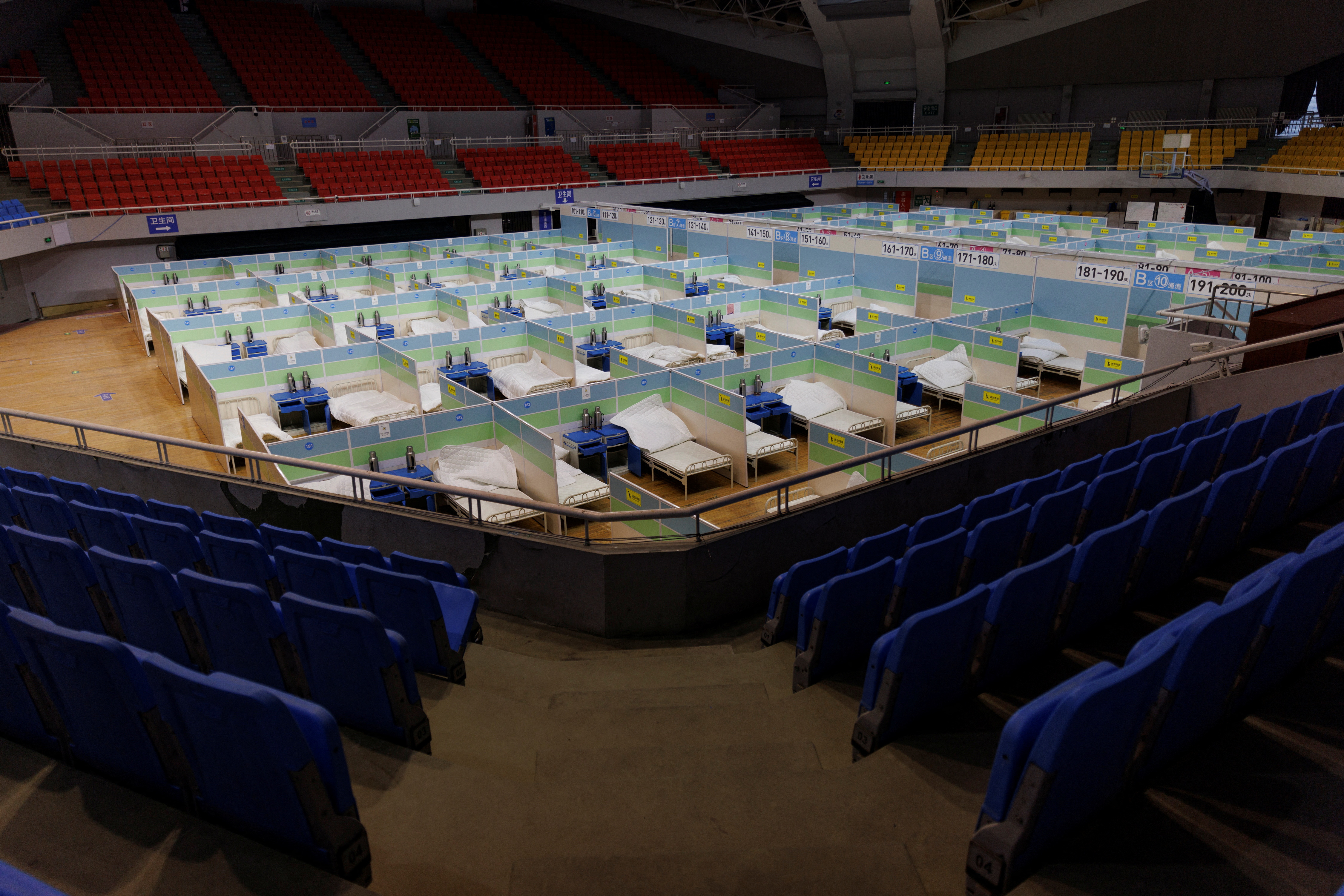
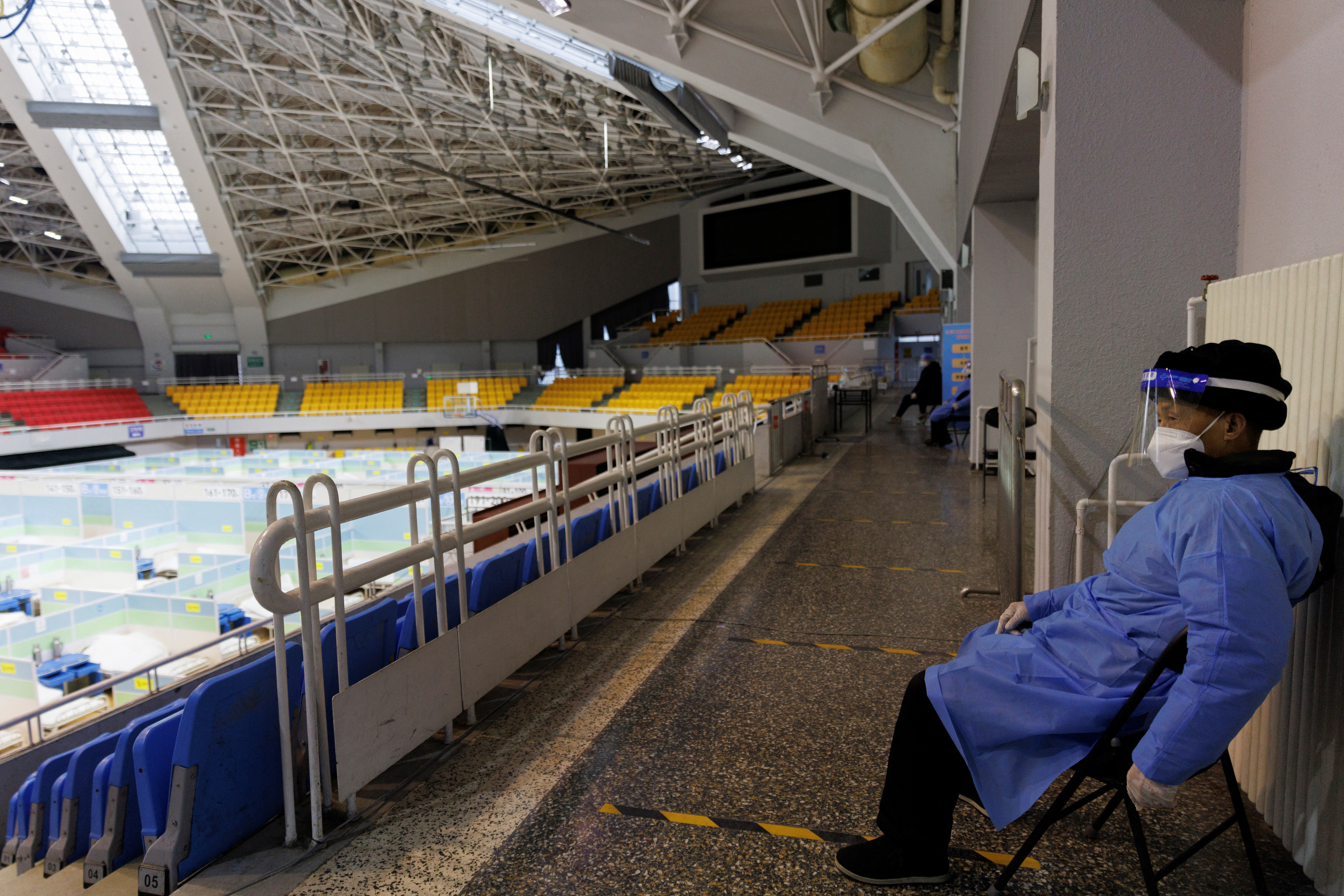
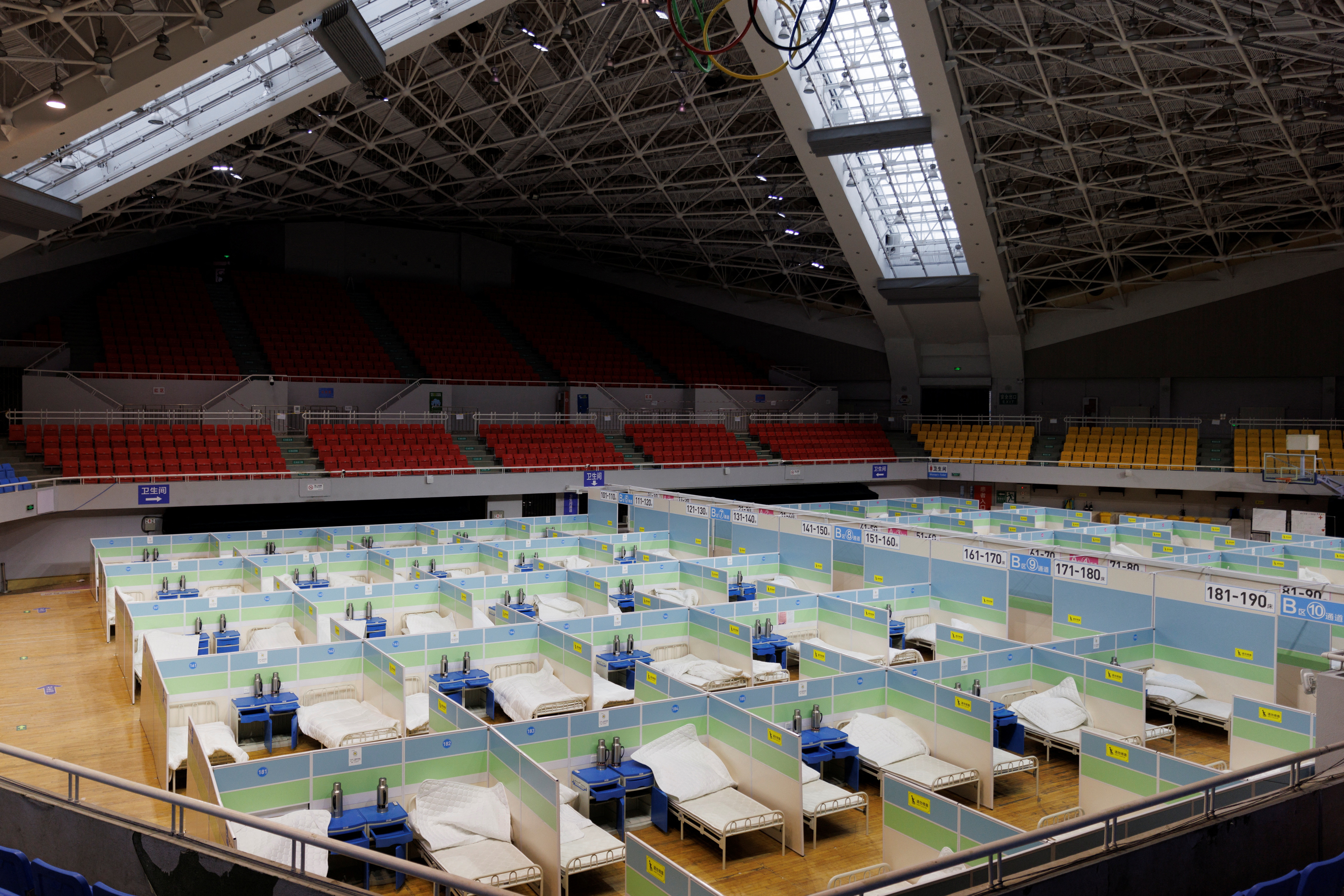
A gym in Beijing’s Shijingshan district was converted into a fever clinic late last week with cubicles containing more than 150 beds covering a basketball court, Reuters witnessed.

The spreading virus is expected to crimp China’s economy, expected to grow 3% this year, its worst performance in nearly half a century.

A survey by World Economics showed on Monday China’s business confidence fell in December to its lowest since January 2013.

China kept benchmark lending interest rates unchanged for the fourth consecutive month on Tuesday.

Related Galleries:
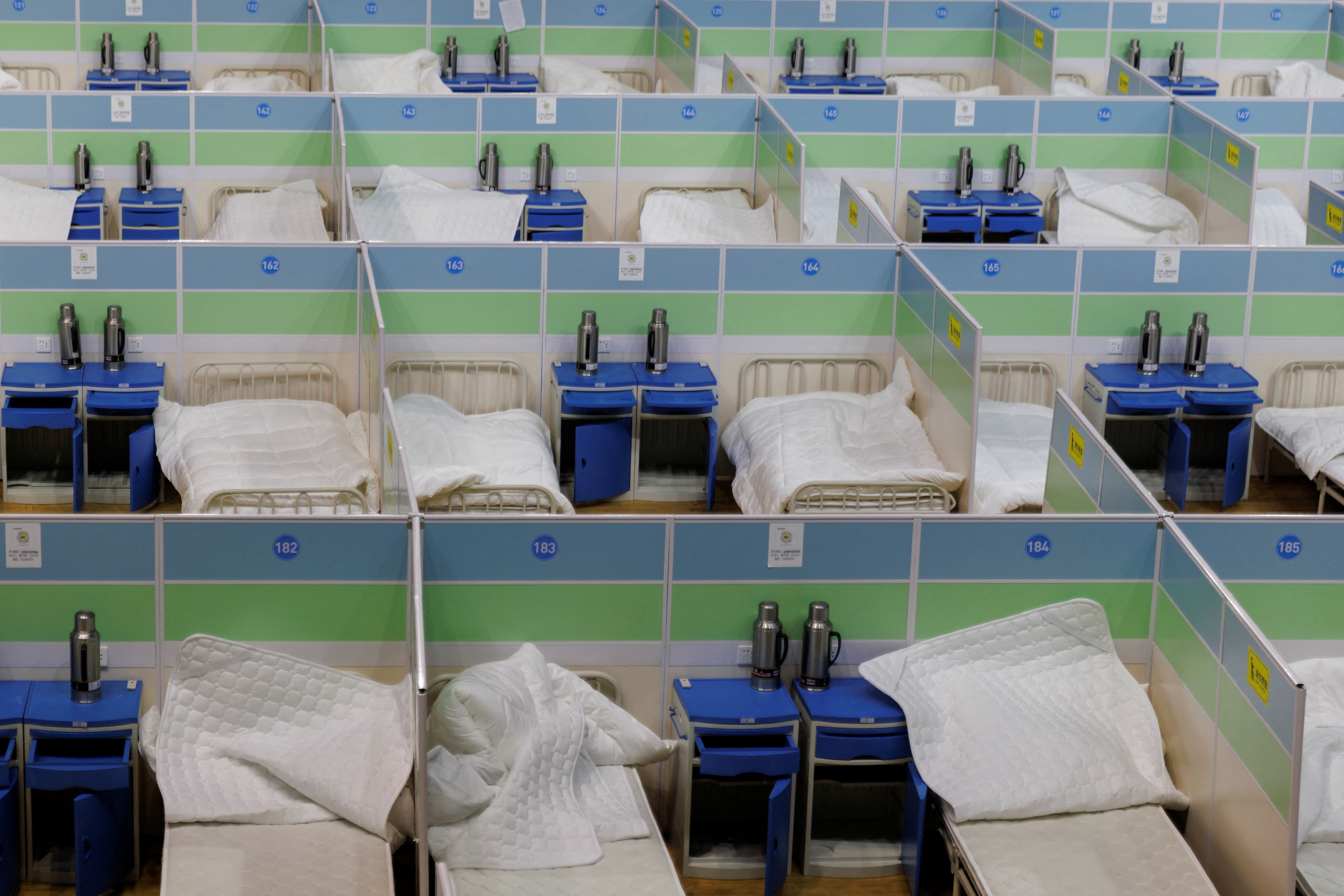
Beds are seen in a fever clinic that was set up in a sports area as coronavirus disease (COVID-19) outbreaks continue in Beijing, December 20, 2022. REUTERS/Thomas Peter

Beds are seen in a fever clinic that was set up in a sports area as coronavirus disease (COVID-19) outbreaks continue in Beijing, December 20, 2022. REUTERS/Thomas Peter

A security guard keeps watch in a makeshift fever clinic that was set up in a sports area as coronavirus disease (COVID-19) outbreaks continue in Beijing, December 20, 2022. REUTERS/Thomas Peter

Beds are seen in a fever clinic that was set up in a sports area as coronavirus disease (COVID-19) outbreaks continue in Beijing, December 20, 2022. REUTERS/Thomas Peter

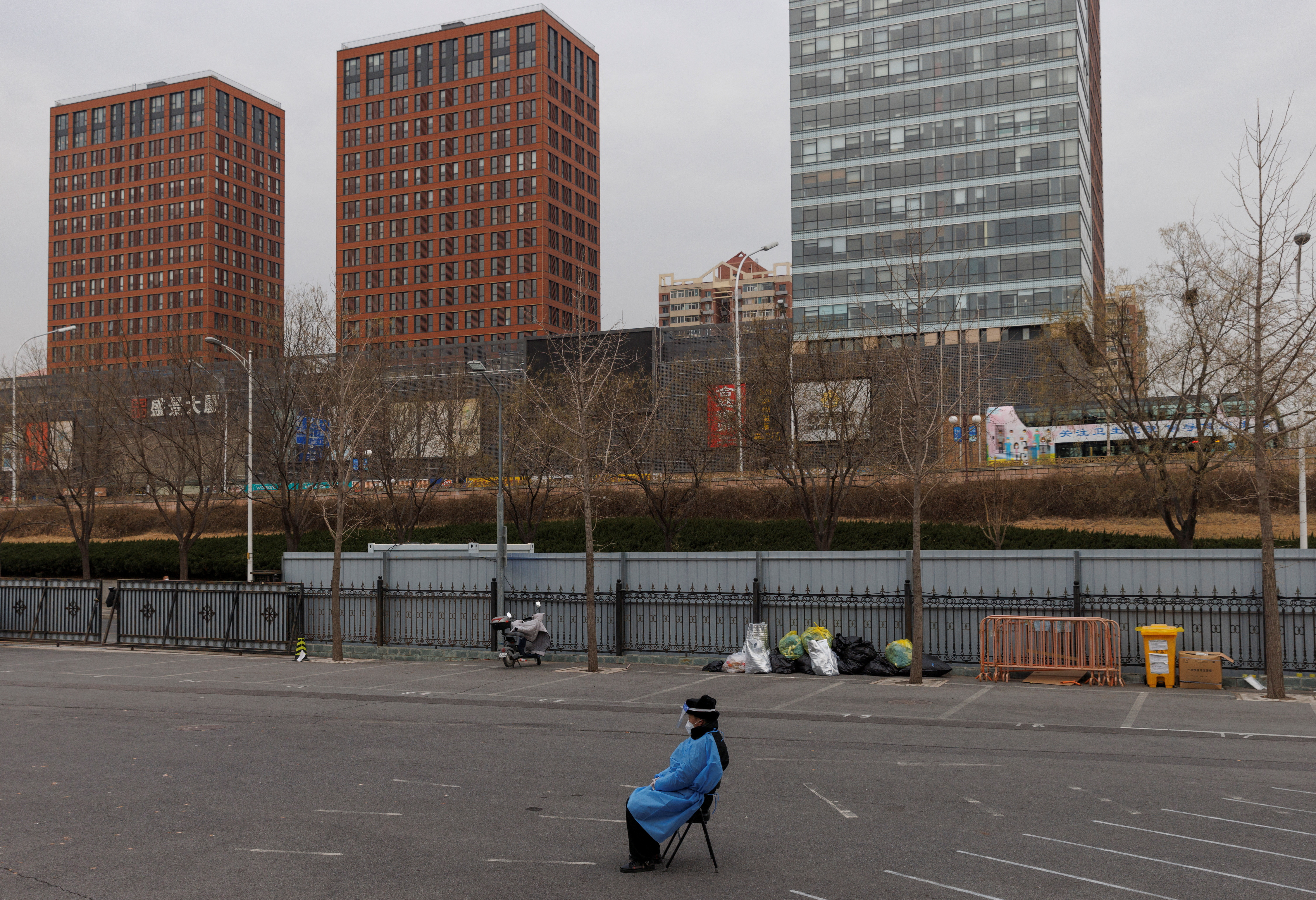
A security guard keeps watch outside a makeshift fever clinic that was set up in a sports area as coronavirus disease (COVID-19) outbreaks continue in Beijing, December 20, 2022. REUTERS/Thomas Peter

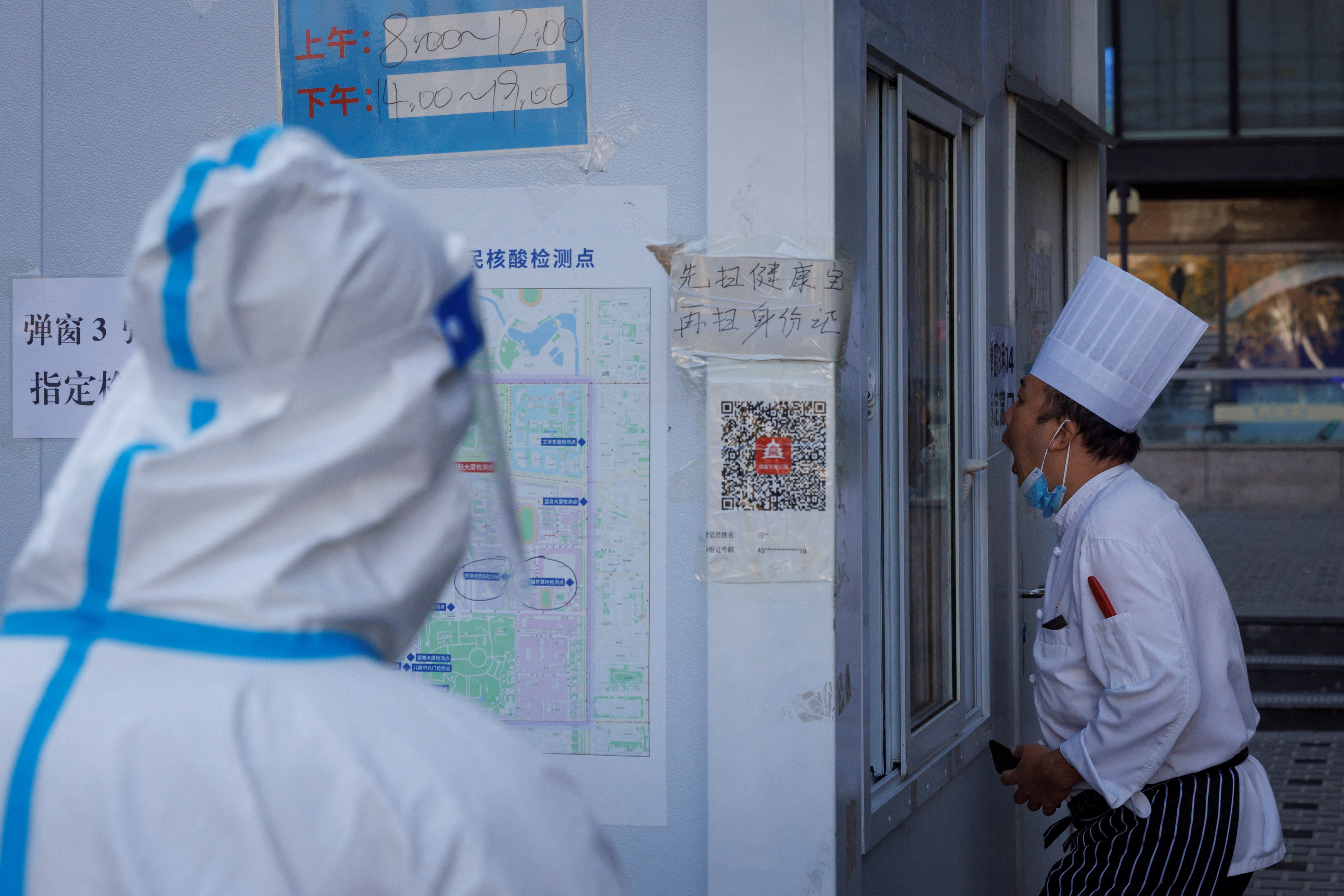
A chef gets a swab test at a testing booth as outbreaks of coronavirus disease (COVID-19) continue in Beijing, China, November 3, 2022. REUTERS/Thomas Peter/File Photo
Categories
Audio Sources - Full Text Articles

Jury selection to begin in Proud Boys Jan. 6 sedition trial

WASHINGTON (AP) — Jury selection will get underway Monday in the seditious conspiracy trial of former Proud Boys national chairman Enrique Tarrio and four other members of the extremist group accused of plotting to attack the U.S. Capitol on Jan. 6, 2021, in a desperate bid to overturn President Joe Biden’s victory.

Tarrio and four of his lieutenants are heading to trial in Washington just weeks after two leaders of another extremist group, the Oath Keepers, were convicted of seditious conspiracy in a major victory for the Justice Department’s extensive Jan. 6 prosecution.

Tarrio is perhaps the highest-profile defendant to face jurors yet in the attack that halted the certification of Biden’s win, left dozens of police officers injured and led to nearly 1,000 arrests. Tarrio, of Miami, and the others — Ethan Nordean, Zachary Rehl, Dominic Pezzola and Joseph Biggs — are charged with several other crimes in addition to seditious conspiracy.

If convicted of sedition, they could face up to 20 years in prison. Jury selection is likely to take several days and the trial is expected to last at least six weeks.

Tarrio wasn’t in Washington on Jan. 6 because he had been arrested two days earlier on charges that he vandalized a Black Lives Matter banner at a historic Black church during a protest in December 2020. But prosecutors say he was the leader of a conspiracy to stop the transfer of power from President Donald Trump to Biden.

Days before the riot, Tarrio posted on social media about “revolution,” according to court papers. Citing what they alleged was an encrypted message group created by Tarrio, authorities say members discussed attacking the Capitol. One message said: “Time to stack those bodies in front of Capitol Hill.” Another asked whether people were going to “push thru police lines and storm the capitol buildings?”

Prosecutors allege that even after his arrest, Tarrio kept command over the Proud Boys who attacked the Capitol on Jan. 6 and cheered on their actions from afar. As rioters stormed the building, he posted “don’t (expletive) leave” on social media, and then later “We did this…”

Nordean, Pezzola, Biggs and Rehl were part of the first wave of rioters to push onto Capitol grounds and charge past police barricades toward the building, according to prosecutors. Pezzola used a riot shield he stole from a Capitol police officer to break a window, allowing the first rioters to enter the building, prosecutors allege.

“January 6 will be a day in infamy,” Biggs said in a video outside the Capitol, according to court papers.

Nordean, of Auburn, Washington, was a Proud Boys chapter president; Biggs, of Ormond Beach, Florida, was a self-described Proud Boys organizer; Rehl was president of the Proud Boys chapter in Philadelphia; and Dominic Pezzola was a Proud Boys member from Rochester, New York.

Defense attorneys have denied that the Proud Boys leaders planned or led an attack on the Capitol.

Tarrio’s lawyers say he didn’t instruct or encourage anyone to go into the Capitol or engage in violent or destructive behavior. Nordean’s attorney accused the Justice Department of selective prosecution and targeting him based on his political associations and beliefs. Rehl’s lawyer asked the judge to toss the indictment on First Amendment grounds, arguing that the case rested solely on Rehl’s political views and free speech.

Another former Proud Boys leader, Jeremy Joseph Bertino, pleaded guilty to seditious conspiracy in October, and could testify against Tarrio and the others under a cooperation deal with the government.

Last month’s guilty verdicts for Oath Keepers founder Stewart Rhodes and Florida chapter leader Kelly Meggs were the first seditious conspiracy trial convictions in decades. Seditious conspiracy, enacted after the Civil War to arrest Southerners who might keep fighting the U.S. government, has rarely been brought in recent memory, with mixed results.

Jurors acquitted three other Oath Keeper defendants of seditious conspiracy, although they were convicted of other crimes. Four others associated with the Oath Keepers are also currently standing trial for seditious conspiracy.

___

Richer reported from Boston.

___

Follow AP’s coverage of the Capitol riot at: https://apnews.com/hub/capitol-siege.

Categories
Audio Sources - Full Text Articles

Researchers find new biomorphs hidden within Peru’s mysterious Nazca lines

A general view shows mapping of the Nazca lines images found in the Nazca as part of research led by Peruvian and Japanese researchers from Yamagata University who discovered 168 new designs at the UNESCO World Heritage site on Peru's southern Pacific coast in this undated photo released on December 19, 2022 by Yamagata University/Handout via REUTERS THIS IMAGE HAS BEEN SUPPLIED BY A THIRD PARTY NO RESALES. NO ARCHIVESA general view shows mapping of the Nazca lines images found by Peruvian and Japanese researchers who discovered 168 new designs at the UNESCO World Heritage site in this photo released on December 19, 2022

Yamagata University/Handout via REUTERS

  • Japanese researchers and Peruvian archeologists have discovered new geoglyphs in the Nazca lines.
  • 168 geoglyphs were found on Peru’s southern Pacific coast depicting cats, killer whales, and snakes.
  • The carved figures, averaging 6-19 feet in length, date between 100 BCE and 300 CE.

After two years of scanning Peru’s southern Pacific coast with drones, taking aerial photos, and conducting field surveys, researchers and archeologists have discovered 168 additional geoglyphs in the mysterious Nazca lines.

The massive, carved trenches — attributed by some to aliens — are the latest addition to over 800 straight lines, 300 geometric figures, and 70 animal and plant designs, which also called biomorphs, according to National Geographic.

A general view shows one of the Nazca lines images found in the Nazca plain as part of research led by Peruvian and Japanese researchers from Yamagata University who discovered 168 new designs at the UNESCO World Heritage site on Peru's southern Pacific coast in this undated photo released on December 19, 2022 by Yamagata University/Handout via REUTERS THIS IMAGE HAS BEEN SUPPLIED BY A THIRD PARTY NO RESALES. NO ARCHIVESA general view shows one of the Nazca lines images found in the Nazca plain as part of research led by Peruvian and Japanese researchers from Yamagata University.

Yamagata University/Reuters

The recently discovered carved figures average between 6 and 19 feet in length and include the outlined figures of cats, snakes, killer whales, and alpacas, according to a statement released by Yamagata University, which led the research. Previously known lines measure as long as 1,200 feet.

Researchers from Yamagata University, who conducted the mapping with help from Peruvian archaeologists, estimate the geoglyphs date between 100 BCE and 300 CE — approximately 1,700 to 2,100 years ago.

A general view shows one of the Nazca lines images found in the Nazca plain as part of research led by Peruvian and Japanese researchers from Yamagata University who discovered 168 new designs at the UNESCO World Heritage site on Peru's southern Pacific coast in this undated photo released on December 19, 2022 by Yamagata University/Handout via REUTERS THIS IMAGE HAS BEEN SUPPLIED BY A THIRD PARTY NO RESALES. NO ARCHIVESA general view shows one of the Nazca lines images found in the Nazca plain as part of research led by Peruvian and Japanese researchers from Yamagata University.

Yamagata University/Reuters

Yamagata University researchers will collaborate with IBM’s T.J. Watson Research Centre, to conduct an AI-based study on the distribution patterns of the latest Nazca geoglyphs, Art News reported.

The AI-based study is an expansion of previous research the scholars have conducted, which revealed 142 additional Nazca formations — including images of birds, monkeys, fish, snakes, and foxes.

“The discovery of 41 geoglyphs in this area was previously announced by Yamagata University in 2014 and 2015, which led to the creation of an archaeological park in 2017 in collaboration with the Peruvian Ministry of Culture to protect them,” read a statement from Yamagata University announcing the discovery. “With this discovery, a total of 77 geoglyphs are now known to be concentrated in this archaeological park.

Luis Jaime Castillo, a Peruvian archaeologist, told The Guardian that he suspects only 5% of all existing Nazca lines have so far been found.

A general view shows one of the Nazca lines images found in the Nazca plain as part of research led by Peruvian and Japanese researchers from Yamagata University who discovered 168 new designs at the UNESCO World Heritage site on Peru's southern Pacific coast in this undated photo released on December 19, 2022 by Yamagata University/Handout via REUTERS THIS IMAGE HAS BEEN SUPPLIED BY A THIRD PARTY NO RESALES. NO ARCHIVESA general view shows one of the Nazca lines images found in the Nazca plain as part of research led by Peruvian and Japanese researchers from Yamagata University.

Yamagata University/Handout via REUTERS

Though the reason for the creation of the Nazca lines remains unknown, some archaeologists believe the shapes held a sacred purpose or were early irrigation lines, while local guides believe the lines may relate to sources of water or maps of the region.

First formally studied in 1926, the exact methods used to create the lines, which are largely impossible to identify from ground level due to their size, also remain a mystery to researchers. 

“These geoglyphs were created by removing black stones from the surface of the earth to expose a white sandy surface below,” read the statement from Yamagata University, though it is unclear how the black stone was removed. 

In pop culture, the mysterious figures have prompted questions about whether they were created by alien visitors or as landing strips for ancient astronauts — particularly because they’re only recognizable from the air and human creators would have had no way of viewing their work with the limited technology of 2,000 years ago.  

A general view shows one of the Nazca lines images found in the Nazca plain as part of research led by Peruvian and Japanese researchers from Yamagata University who discovered 168 new designs at the UNESCO World Heritage site on Peru's southern Pacific coast in this undated photo released on December 19, 2022 by Yamagata University/Handout via REUTERS THIS IMAGE HAS BEEN SUPPLIED BY A THIRD PARTY NO RESALES. NO ARCHIVESA general view shows one of the Nazca lines images found in the Nazca plain as part of research led by Peruvian and Japanese researchers from Yamagata University.

Yamagata University/Handout via REUTERS

The ongoing geoglyph research seeks to reveal a pattern to the lines and has delineated boundaries for the UNESCO World Heritage site on Peru’s southern coast, which Reuters reports is facing threats from urban and economic developments.

“Some geoglyphs are in danger of being destroyed due to the recent expansion of mining-related workshops in the archaeological park,” Masato Sakai, a professor from Yamagata University who led the study, told Reuters.

Representatives of Yamagata University did not immediately respond to Insider’s request for comment.

Read the original article on Business Insider
WP Radio
WP Radio
OFFLINE LIVE