
Day: December 18, 2022
(NewsNation) — Washington has no immediate solution to the crisis at the southern border and with Title 42 on track to expire in a matter of days, it is likely going to get far worse.
Title 42, the COVID-19-era policy that has prevented hundreds of thousands of migrants from seeking asylum in the U.S. in recent years, is set to expire on Wednesday.
The rule has been used to deter more than 2.5 million migrants from crossing since March 2020.
“We, at every level of government, are doing everything we can to prevent people from coming into the country illegally,” said Texas Gov. Greg Abbott. “Or we’re repelling them, we’re arresting them, and putting them behind bars.”
Abbott says resources to handle the influx of migrants are wearing thin.
According to the Dallas Morning News, Texas has spent roughly 4 billion dollars on surging law enforcement to the border in “Operation Lone Star” since last year.
“If the courts are not going to intervene and put a halt to the removal of Title 42,” Abbott said. “It’s going to be total chaos.”
When Title 42 expires, Homeland security expects the number of migrants seeking asylum will rise dramatically on top of already record-shattering numbers.
Border agents encountered nearly 2.4 million migrants at the southern border this year —
averaging nearly 7,500 a day.
There is yet to be an exact figure on how much an increased surge will cost but the Biden administration expects it could be billions.
“The administration has asked congress to fund more than $3 billion to help us provide the resources that will be needed to process migrants, to make sure that people are treated humanely,” said senior White House advisor Keisha Lance Bottoms.
Beyond shelters, motels and local rec centers, some of the migrants are housed in detention centers or jails. The vast majority have no criminal record.
About 30,000 migrants are currently being housed in facilities run by U.S. Immigration and Customs Enforcement (ICE).
All of this is at the government’s expense.
“We know that the influx on Wednesday will be incredible,” said El Paso Mayor Oscar Lesser. “Will be huge.”
On Saturday Lesser declared a state of emergency. The city of Denver has issued an emergency declaration after hundreds of undocumented migrants came to the mile-high city unexpectedly.
“We’re going to run out of capacity to serve them,” said Denver Mayor Michael Hancock.
In New York, Mayor Eric Adams requested $1 billion from the federal government to handle migrants there.
In Washington, D.C., Mayor Muriel Bowser declared an emergency, funneling $10 million in district dollars to create an office of migrant services.
No matter the cost in dollars and cents, Democratic Congresswoman Veronica Escobar, who represents El Paso, says there’s also a human cost that shouldn’t go ignored as migrants seek refuge in the U.S.
“The federal government has addressed immigration as a Congress-only issue,” Escobar said. “We need to zoom out and realize this is a western hemispheric refugee crisis.”
Washington Post journalist Taylor Lorenz was suspended from Twitter on Saturday after asking Twitter CEO Elon Musk for comment on a story.
Lorenz says she and her colleague, Drew Harwell, publicly tweeted at Musk for an interview after they’d been unable to get in contact with him throughout the week. She later opened Twitter to see a message that said she was “permanently suspended” (though her account has already been restored as of Sunday.)
There was no reason given for the ban, the AP reports, though Musk said the account would only be “temporarily suspended” due to “prior doxxing action from the account.”
[time-brightcove not-tgx=”true”]
“The arbitrary suspension of another Post journalist further undermines Elon Musk’s claim that he intends to run Twitter as a platform dedicated to free speech,” said Washington Post executive editor Sally Buzbee in a statement. “Again, the suspension occurred with no warning, process or explanation — this time as our reporter merely sought comment from Musk for a story. Post journalists should be reinstated immediately, without arbitrary conditions.”
Musk, who tweeted his hope that” even [his] worst critics remain on Twitter, because that is what free speech means,” has been under fire after the social media site temporarily suspended several journalists, which Musk claims put his family at risk, on Dec. 15.
The banned accounts were from journalists covering Twitter’s permanent suspension of the account @elonjet, which tracked Musk’s private jet flights using publicly available data. The Twitter CEO explained the decision in a series of tweets that indicate a stalker followed a car carrying his son, and later blocked the car from moving and climbed onto the hood.
Harwell had his account temporarily suspended on Dec. 15 after tweeting that Twitter suspended their competitor Mastodon’s account because it linked to their website’s version of @ElonJet two days after its permanent ban, according to the LA Times. Other reporters were banned after they shared the Los Angeles Police Department’s statement that no crime reports were filed by Musk after the alleged stalking situation.
Since the incident, the suspended accounts of journalists from the New York Times, Voice of America and more have been restored after Musk used a Twitter poll on Saturday to ask the public when the journalists’ account should be restored. The option “now” won the poll.
On Sunday Twitter announced notable changes to the platform’s terms of service that bans users from promoting other social media platforms on Twitter. People won’t be able to promote content that contains links or usernames for accounts on Facebook, Instagram, Mastodon, Truth Social, Tribel, Nostr, and Post. Violation of the policy could result in punishments ranging from required deletion of tweets to temporarily locking an account.
Earlier this week, Twitter also changed its rules to prohibit the sharing of another person’s current location without consent.
This was Lionel Messi’s World Cup tournament, the whole way through. On Sunday, however, his superstar counterpart for France, Kylian Mbappé, did everything he possibly could to deny the greatest player of his generation his elusive first World Cup title.
But in the end, not even a Mbappé hat trick, in perhaps the most dramatic and heart-stopping soccer game in human history, could the thwart Messi’s magic.
Messi scored a pair of goals in a final that will be discussed and celebrated for decades, as Argentina defeated France in a 4-2 penalty shootout, after extra ended in an unbelievable 3-3 tie. The victory gave Argentina the third World Cup title in the soccer-mad nation’s glorious history, and its first since 1986. Messi now possesses the one trophy to elude him—the most important trophy in the world’s popular game.
[time-brightcove not-tgx=”true”]
Argentina dominated the start of the final in Lusail, Quatar, and took a 2-0 lead into the half. The roars of Argentinian fans seemed to drown out all sound in the stadium. In the 23rd minute, Messi stood focused, ready to take a penalty shot in a scoreless game that Argentina was firmly dominating. Messi stepped to the ball, stopped to juke out France keeper Hugo Lloris, and placed it in the right side of his net, his fourth penalty goal in the World Cup in five attempts. The pressure of the penalty shot suffocates most players. All tournament long, the gravity of these moments seemed to make Messi better.
Ángel Fabián Di María, who plays for Juventus in Italy’s Serie A, also starred for the Albecentis in the first half. It was Di María, after all, who drew the penalty that led to Messi’s goal. And in the 36th minute, Di María finished off a sequence that should be replayed by any soccer coach worth his or her salt, the world over, as model for unselfish behavior on the pitch. Messi started the counterattack with a flick on the outside of his foot, sending the ball to Julián Álvarez, who passed ahead to a sprinting Alexis Mac Allister, who sent a perfect cross to Di Maria, who then punched it in for a 2-0 lead.
By the time the 80th minute rolled around, France had yet to seriously threaten the Albicelestes. Suddenly, however, Mbappé unleashed his fury.
He converted a penalty shot to cut Argentina’s lead in half, 2-1. Messi and his mates would not cruise to their championship.
Then, one minute and 33 seconds later, fans witnessed what would seem impossible, if Mbappé wasn’t involved. Marcus Thuram won control of ball, lofting a pass to Mbappé on the left wing. Mbappé ripped a heart-stopping volley just past the left hand of Argentina keeper Emiliano Martínez. The game was tied, 2-2. Mbappé’s unmatched motor was fully turned on, and at this point, he looked ready to finish off a stunned Argentine side with a hat trick in regulation.
But regulation ended with the game still tied. In the second half of extra time, however, Messi delivered once again. In the 108th minute. A shot bounced off of French keeper Hugo Lloris and a sprinting Messi was right there, to rocket a rebound that clearly crossed the goal line before French defender Jules Koundé kicked it clear of the net. Goal, Argentina.
World Cup, Messi?
You would think. But Mbappé refused to concede. In the 118th minute, right before the final whistle, he fired a shot off of the right arm of Gonzalo Montiel of Argentina. Penalty. Mbappé calmly struck the penalty shot into the right side of the net to tie the game at 3-3, and became the first player since Geoff Hurst of England, in 1966, to net a hat trick in a World Cup final.
With momentum back in France’s control, Les Blues almost won its second straight World Cup at the buzzer. In the 120th minute, Mbappé delivered a near-perfect cross to Randal Kolo Muani, who leapt as high as he could: the ball, however, was barely too high for his header, and he couldn’t finish off the play. Moments later, Kolo Muani had another chance to score. But Martínez stuck out his left leg to make the most crucial last-second kick save in World Cup history, bar none. Martínez gave Argentina a chance to win the match—finally—in a penalty shootout.
Mbappé and Messi—who else?—traded goals in the first penalty shot for each team. Martínez made a clean save on a Kingsley Koman shot: Paulo Dybala of Argentina punched one right up the middle, while France’s Lloris dove to his left, to give Argentina a 2-1 advantage in the shootout. After Aurélien Tchouaméni of France missed wide left, and Leandro Paredes scored for Argentina, the Albicelestes could taste victory.
On Argentina’s next penalty shot, Montiel fired the ball to the left side of the net. Lloris didn’t have a chance. Argentina won the World Cup. Buenos Aires went berserk.
The final more than delivered on its promise of a star-studded matchup between Messi and his potential successor as a generational player, Mbappé. Messi won the Golden Ball at this Qatar World Cup, as the tournament’s best player. Mbappé won the Golden Boot, as the World Cup’s top goal-scorer. He finished with eight goals, to Messi’s seven.
France and Mbappé, who plays with Messi for the Qatar-owned club Paris Saint-Germain, were trying to become the repeat World Cup champions since Brazil, who earned championship trophies in 1958 and 1962. Mbappé, 23, and his mates will be a force for a generation. But today, Messi and Argentina just proved a little too much to handle.
The win ends years of World Cup frustration for Argentina fans. Argentina last won a World Cup in 1986, when the great Diego Maradona shined for the Albicelestes. Argentina made two finals—in 1990 and 2014—since then. But Germany triumphed in those two finals. (West Germany in 1990).
Argentina’s World Cup in Qatar began in disastrous fashion, with a shocking 2-1 loss to Saudi Arabia on Nov 22. Since then, however, Argentina went undefeated, outscoring its opposition 14-6 the rest of the tournament.
Of particular note, Argentina’s win serves as a fitting career capstone for Messi, the greatest player of his era, and one of the best of all-time. This has been a stellar tournament for Messi; he put his full array of skills on display. Yes, Messi scored plenty of goals in this World Cup, but his passing showed why he stands alone. In the quarterfinals against the Netherlands, Messi thread a ball through what seemed like the entire Dutch team: Nahuel Molina was the beneficiary of Messi’s brilliance, and scored to give Argentina a 1-0 lead in that game.
Messi’s assist against Croatia, in the semis, was a true work of genius. He went on a run down the right side of the field, spun twice while evading the defense before delivering a pinpoint pass to Álvarez, who scored to give Argentina a 3-0 lead and end all hope of Croatia returning to the World Cup final.
For years, Messi’s relationship with his home country was, well, complicated. He left Argentina at 13, to be trained at Barcelona, for whom he would make his competitive debut at 17 and scored an outrageous 672 goals. But he never seemed to shine as brightly for the national team, and many Argentine fans questioned his dedication to a place he left as a teen.
Messi always voiced his enthusiasm. “Argentina is my country, my family, my way of expressing myself,” he said in 2014. “I would change all my records to make the people in my country happy.” But after losing in the Copa América in 2016, Messi thought hard about retiring from the national team. He came back, but France knocked Argentina out of the 2018 World Cup, in the round of 16.
In 2021, however, Messi began to write a new narrative. Argentina defeated Brazil in the Copa America final, giving the Albicelestes its first major international trophy since 1993.
His outstanding play at this World Cup rallied millions of Argentinians across the globe. It also thrilled fans of all stripes who admire beautiful play. With this signature World Cup win, all questions about Messi’s love of country—and true iconic status in the history of the game—will never be uttered again.
Fans will just talk about the twists and thills of this game. And how lucky we were all were to live it.
2022-12-18T21:51:35Z
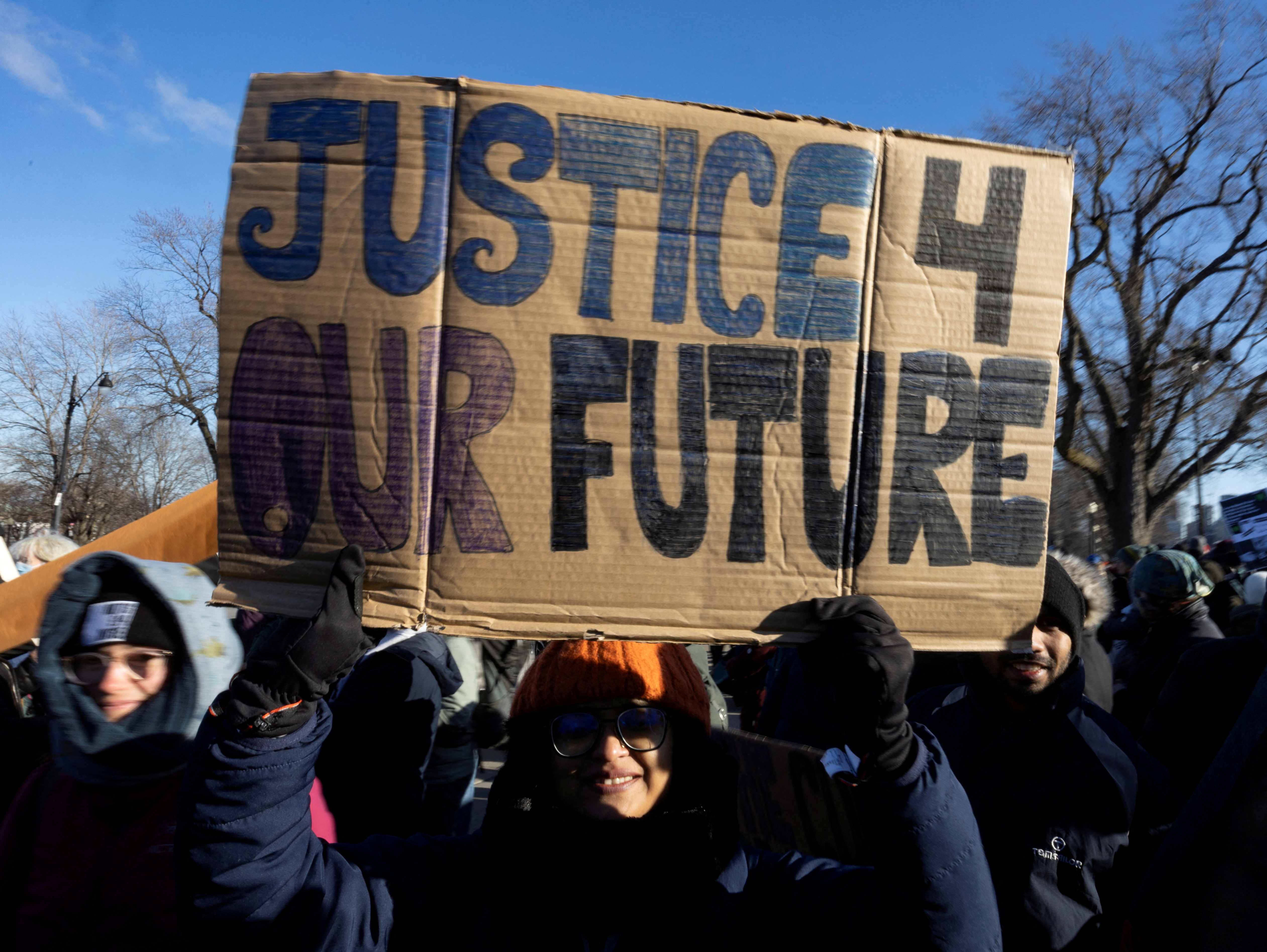
People take part in a march during COP15, the two-week U.N. Biodiversity summit in Montreal, Quebec, Canada December 10, 2022. REUTERS/Christinne Muschi/File Photo
Negotiators at a U.N. summit to protect nature were closing in on a new global deal on Sunday that could see 30% of land and sea protected by 2030, with hundreds of billions of dollars directed toward conserving the world’s wild places and species.
China, the president of the COP15 conference in Montreal, released a proposed text on Sunday morning that ministers welcomed, with some reservations.
“Another potential round of work needs to be done so we can align the resources and the ambition,” said Colombia Environment Minister Susana Muhamad. “But I’m very optimistic that, as the main goals have been landed and there is no, in general, opposition to these goals, we have made a very important step forward.”
Policymakers hope an ambitious deal can spur nature conservation the same way that an international pact in Paris in 2015 helped mobilize efforts to limit planet-warming carbon emissions.
The draft, based on the last two weeks of talks, sets a crucial financial target of $200 billion per year for conservation initiatives, though demands less from wealthy countries than some developing states had wanted.
It lays out support for protecting 30% of land and waters by 2030, a landmark goal informally known as 30-by-30, and suggests restoring 30% of degraded lands.
“We were surprised that (the text) is actually capturing most of the things we want to go for,” a negotiator from a European country told Reuters. On restoration, he noted that the text went with a more ambitious target of 30%, instead of 20%, which “is really good and ambitious and necessary.”
Businesses should also be asked to assess and disclose how they affect and are affected by nature loss, but the current document does not make such reporting mandatory.
EU Commissioner Virginijus Sinkevicius told reporters during a break that negotiators were “on the right track to finalise” a deal but highlighted shortcomings on numerical targets and expressed concern about an increase in funding from developed countries.
Ministers from nearly 200 governments need to come to a consensus on 23 proposed targets by midnight on Monday (0500 GMT Tuesday).
While optimistic, environmental campaigners worry the technical wording of the 30-by-30 target might not adequately address ocean conservation.
The target mentions protecting at least 30% of terrestrial, inland water, and coastal and marine areas.
However, it does not clarify whether this means 30% of land and separately 30% of oceans, said Brian O’Donnell, director of the non-profit Campaign for Nature, adding China needs to quickly clarify its intent.
“The target should split land and sea to make sure 30% applies to them respectively,” said Li Shuo, global policy adviser at Greenpeace East Asia.
The draft recommends allocating $200 billion per year from all sources, including the public and private sectors, for conservation initiatives – a target seen as critical for the successful implementation of any deal.
Developing countries were pushing for half of that – $100 billion per year – to flow from wealthy countries to poorer nations. However, the text mentions only that $20 billion to $30 billion per year comes from developed countries by 2030.
“Probably we will have to reach an agreement between $30 billion and $100 billion,” Colombia’s Muhamad told reporters.
The draft also notes that the money could come voluntarily from any country – a nod to developed nations’ desire that countries with large economies, such as China, also contribute funds.
Having China and Arab countries joining would be “a huge step forward,” Sinkevicius said.
Asked whether China should be considered a developing country, as still defined by the World Bank, he said, “I think we should not stick to 1992 descriptions but see the reality on the ground, and it’s very different from 1992.”
One of the greatest points of contention among delegates has been whether a new fund should be established for that money, improving on an existing structure. On Wednesday morning, developing country negotiators walked out of a financing meeting in protest. The draft deal does not mention setting up a separate facility.
The text suggests harmful subsidies should be reduced by at least $500 billion per year by the decade’s end but does not specify whether they should be eliminated, phased out or reformed.
Other proposals include directing policymakers to “encourage and enable” businesses to monitor, assess and disclose how they affect and are affected by biodiversity, but not making these processes mandatory.
Tony Goldner, who heads a group working on a framework for companies to manage and disclose economic risks related to nature, said a number of countries and financial firms would move toward mandatory disclosure anyway.
“At an institutional level, the train has left the station in any case because financial institutions are increasingly aware that nature risk is sitting on their balance sheets.”
Lastly, risks from pesticides and highly hazardous chemicals would be reduced by at least half, but the text does not address slashing their overall use.
Read more:
GRAPHIC-Disappearing plants jeopardize a green future
GRAPHIC-From flickering fireflies to lowly dung beetles, insects are vanishing
GRAPHIC-How daredevil drones find nearly extinct plants hiding in cliffs
2022-12-18T17:54:21Z
Veteran U.S. diplomat Henry Kissinger said the time is approaching for a negotiated peace in Ukraine to reduce the risk of another devastating world war, but the Kyiv government dismissed his comments as amounting to “appeasing the aggressor” and said there could be no deal involving ceding territory.
Kissinger, 99, and an architect of the Cold War policy of detente towards the Soviet Union as secretary of state under Republican presidents Richard Nixon and Gerald Ford, has met Russia’s Vladimir Putin multiple times since he first became president in 2000.
There is no end in sight to the conflict sparked by Putin’s Feb. 24 invasion of Ukraine, which has killed tens of thousands of people and driven millions from their homes. Russia now controls around a fifth of Ukraine.
The Kremlin says Kyiv must acknowledge Moscow’s annexation of southern and eastern regions. Ukraine says every Russian soldier must leave its territory, including Crimea, which Russia annexed in 2014. Kyiv applied to join NATO after Moscow announced the later annexations in September.
“The time is approaching to build on the strategic changes which have already been accomplished and to integrate them into a new structure towards achieving peace through negotiation,” Kissinger wrote in The Spectator magazine.
“A peace process should link Ukraine to NATO, however expressed. The alternative of neutrality is no longer meaningful,” Kissinger wrote.
Kissinger said that in May he had proposed a ceasefire under which Russia would withdraw to the front lines before the February invasion but Crimea would be the subject of “negotiation”.
The conflict in eastern Ukraine began in 2014 after a pro-Russian president was toppled in Ukraine and Russia annexed Crimea, with Russian-backed separatists fighting Ukraine’s armed forces in eastern Ukraine.
“Mr. Kissinger still has not understood anything … neither the nature of this war, nor its impact on the world order,” Ukrainian presidential aide Mykhailo Podolyak said on Telegram.
“The prescription that the ex-Secretary of State calls for, but is afraid to say out loud, is simple: appease the aggressor by sacrificing parts of Ukraine with guarantees of non-aggression against the other states of Eastern Europe.”
He added, “All supporters of simple solutions should remember the obvious: any agreement with the devil – a bad peace at the expense of Ukrainian territories – will be a victory for Putin and a recipe for success for autocrats around the world.”
Kremlin officials were not available for comment late on Sunday.
Aaron David Miller, a senior fellow at the Carnegie Endowment think tank, also dismissed Kissinger’s proposal, saying in a Twitter post:
“Henry Kissinger calls for cease-fire along borders pre war 2/24 with Russia disgorging its conquests and negotiations on territory seized in 2014. What Kissinger doesn’t allow for are politics on both sides making this idea impossible now, maybe never.”
CIA Director William Burns said in an interview published on Saturday that while most conflicts end in negotiation, the CIA’s assessment was Russia was not serious yet about a real negotiation to end the war.
Putin casts what he calls Russia’s “special military operation” as a watershed moment when Russia finally stood up to a Western bloc, led by the United States, seeking to capitalize on the 1991 fall of the Soviet Union by destroying Russia.
Ukraine and the West say Putin has no justification for what they say is an imperial-style war of occupation.
Kissinger warned that desires to render Russia “impotent”, or even seek the dissolution of Russia, could unleash chaos. Neither Ukraine nor any Western state has advocated either path.
2022-12-18T21:45:31Z
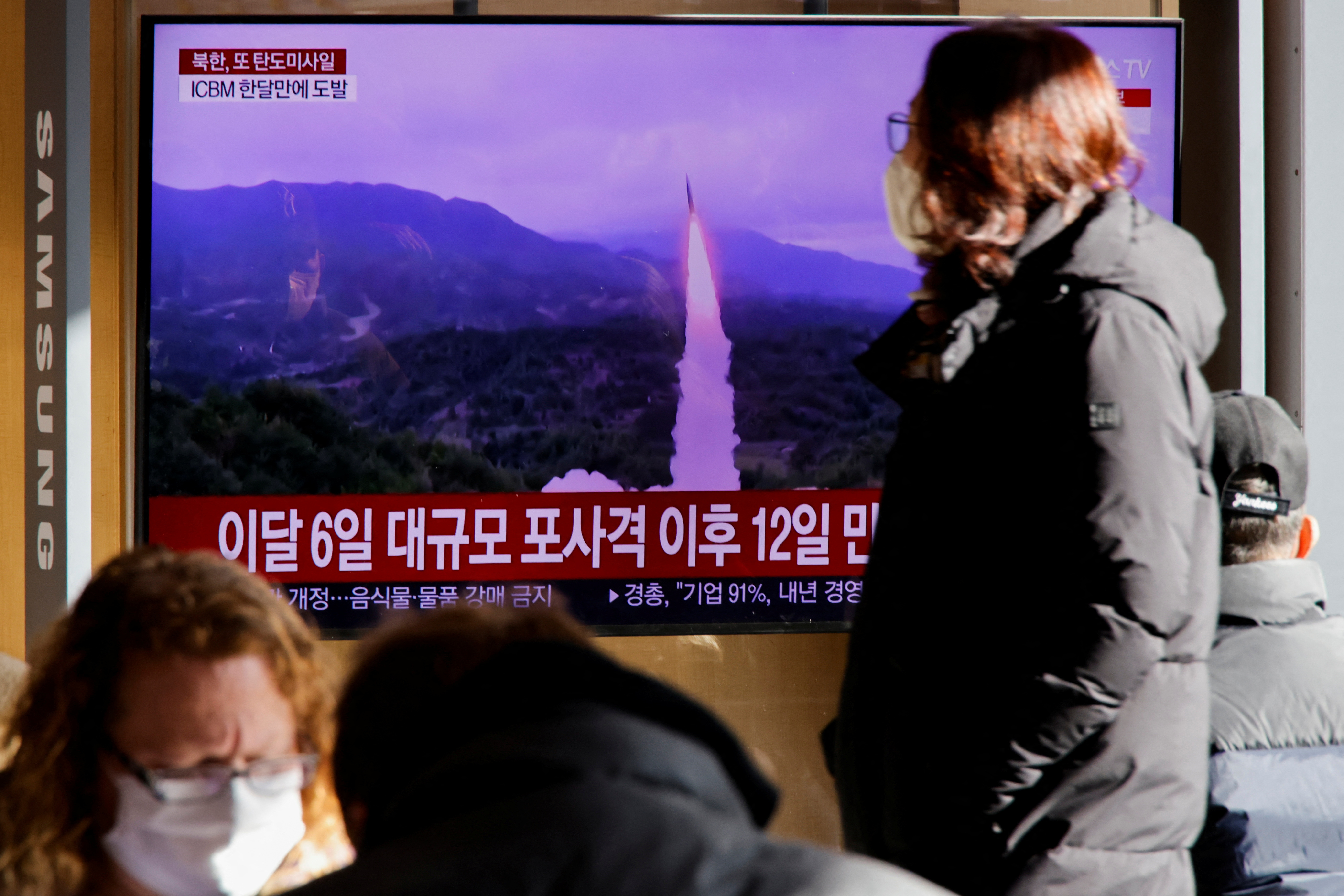
A woman walks past a TV broadcasting a news report on North Korea firing a ballistic missile off its east coast, in Seoul, South Korea, December 18, 2022. REUTERS/ Heo Ran
North Korea’s state media KCNA said on Monday the country conducted an “important, final phase” test on Sunday for the development of a spy satellite, which it seeks to complete by April 2023.
The report was released a day after the South Korean and Japanese militaries reported the isolated North’s launch of two intermediate-range ballistic missiles towards its east coast.
KCNA said the test, conducted at its Sohae satellite launching station in the northwestern town of Tongchang-ri, was aimed at reviewing the country’s capability of satellite imaging, data transmission and ground control systems.
A vehicle carrying a mock satellite was fired at the “lofted angle” of 500 km (311 miles), it added.
North Korea has conducted an unprecedented number of missile tests this year, including an intercontinental ballistic missile (ICBM) aimed at reaching the U.S. mainland, in defiance of international sanctions.
DOHA, Qatar (AP) — Lionel Messi is not ready to walk away from Argentina yet, despite ending his pursuit of a World Cup winner’s medal.
The soccer great secured the one major trophy that has eluded him in his storied career as Argentina beat France 4-2 on penalties in the final at Lusail Stadium on Sunday.
The match finished 3-3 through extra time with Messi scoring twice and converting his penalty in the shootout.
At 35, this is likely his last appearance in soccer’s biggest tournament, but he confirmed after the match that he intends to play on.
“Obviously, I wanted to complete my career with this, (I) can’t ask for more,” Messi said. “Finishing my career this way is impressive. After this, what else? I have a Copa América, a World Cup. Almost at the very end.
“I love soccer, what I do. I enjoy being part of the national team, the group. I want to enjoy a couple of more matches being a world champion.”
Messi has won the Ballon d’Or award for the best player in the world on seven occasions.
He has also won the Champions League four times with former club Barcelona, but the World Cup is the biggest prize in the sport.
“If he wants to keep playing, he can be with us, he is more than entitled to decide if he wants to stay with us,” Argentina coach Lionel Scaloni said. “It’s a huge pleasure to coach him, everything that he transmits to his team is unparalleled. It’s something I’ve never seen before.”
Messi put Argentina ahead from the penalty spot and played a part in Angel Di Maria’s goal that made it 2-0 after 36 minutes.
Mbappé scored two goals in a 97-second span to take the game to extra time,
Messi put Argentina back in front in the 108th minute, but Mbappe’s penalty in the 118th saw the Paris Saint-Germain star complete the first hat trick in a World Cup final in 56 years.
“It’s just crazy that it became a reality this way. I craved for this so much. I knew God would bring this gift to me, I had the feeling that this (World Cup) was the one,” Messi said. “It took so long, but here it is. We suffered a lot, but we managed to do it.”
___
James Robson is at https://twitter.com/jamesalanrobson
___
AP World Cup coverage: https://apnews.com/hub/world-cup and https://twitter.com/AP_Sports
QAMISHLI, Syria (AP) — Baran Ramadan Mesko had been hiding with other migrants for weeks in the coastal Algerian city of Oran, awaiting a chance to take a boat across the Mediterranean Sea to Europe.
Days before the 38-year-old Syrian Kurd was to begin the journey, he received news that a smuggler boat carrying some of his friends had sunk soon after leaving the Algerian coast. Most of its passengers had drowned.
It came as a shock, after spending weeks to get to Algeria from Syria and then waiting for a month for a smuggler to put him on the boat.
But having poured thousands of dollars into the journey, and with his wife and 4- and 3-year-old daughters counting on him to secure a life safe from conflict, the engineer-turned-citizen journalist boarded a small fishing boat with a dozen other men and took a group selfie to send to their families before they went offline.
After a 12-hour overnight journey, Mesko made his way to Almería, Spain, on Oct. 15, and then flew to Germany four days later, where he is now an asylum seeker in a migrant settlement near Bielefeld. He’s still getting used to the cold weather, and is using a translation app on his phone to help him get around while learning German. He said he’s hopeful his papers will be settled soon so his family can join him.
At least 246 migrants have gone missing while trying to cross the western Mediterranean into Europe in 2022, the International Organization for Migration says.
Mesko is among a growing number of Syrian Kurds making the journey to Europe on a winding course that includes travel by car and plane across Lebanon, Egypt, Libya, Algeria, then finally by boat to Spain. They say they are opting for this circuitous route because they fear detention by Turkish forces or Turkish-backed militants in Syria if they try to sneak into Turkey, the most direct path to Europe.
According to data from the European Union border agency Frontex, at least 591 Syrians have crossed the Mediterranean from Algeria and Morocco to Spain in 2022, six times more than last year’s total.
A Kurdish Syrian smuggler in Algeria said dozens of Kurds from Syria arrive in the Algerian coastal city of Oran each week for the sea journey.
“I’ve never had numbers this high before,” the smuggler told The Associated Press, speaking on condition of anonymity for fear of arrest by Algerian authorities.
Years of conflict and economic turmoil have left their mark on Syria’s northern areas, home to some 3 million people under de facto Kurdish control. The region has been targeted by Islamic State group militants, Turkish forces and Syrian opposition groups from the country’s northwestern rebel-held enclave. Climate change and worsening poverty spurred a cholera outbreak in recent months.
Like Mesko, many of the migrants come from the Syrian city of Kobani, which made headlines seven years ago when Kurdish fighters withstood a brutal siege by the Islamic State militant group.
The town was left in ruins, and since then, “not much has happened” to try to rebuild, said Joseph Daher, a professor at the European University Institute in Florence, Italy, adding that most development funding went to cities further east.
Recent events in northeastern Syria have given its residents an additional incentive to leave.
Turkey stepped up attacks on Kurdish areas in Syria after a bombing in Istanbul in November killed six people and wounded over 80 others. Ankara blames the outlawed Kurdish Workers’ Party and the U.S.-backed Kurdish militia, the People’s Protection Unit in Syria. Both have denied responsibility.
Since then, Turkish airstrikes have pounded areas across northeastern Syria, including Kobani, further battering its already pulverized infrastructure, and Ankara has vowed a ground invasion.
Bozan Shahin, an engineer from Kobani, recalled a Turkish airstrike last month.
“I saw my mother trembling in fear and holding my 4-year-old sister to keep her calm,” Shahin said.
He now wants to join the flow of Kurds headed from Syria to Europe.
“I have some friends who found a way to get to Lebanon through a smuggler and go somewhere through Libya,” he said. “I’m not familiar with all the details, but I’m trying to see how I can take that journey safely.”
The operation, which takes weeks and costs thousands of dollars, is run by a smuggler network that bribes Syrian soldiers to get people through checkpoints where they could be detained for draft-dodging or anti-government activism, then across the porous border into Lebanon, the migrants and smugglers said.
There, the migrants typically stay in crowded apartments in Beirut for about a week while awaiting expedited passports from the Syrian Embassy by way of a smuggler’s middleman.
With passports in hand, they fly to Egypt, where Syrians can enter visa-free, then take another flight to Benghazi in war-torn Libya before embarking on the journey to Algeria through another network of smugglers.
“We went in vans and jeeps and they took us across Libya through Tripoli and the coastal road and we would switch cars every 500 kilometers or so,” Mesko said.
During the journey across the desert, they had to cross checkpoints run by Libya’s mosaic of armed groups.
“Some of the guards at checkpoints treated us horribly when they knew we were Syrian, taking our money and phones, or making us stand outside in the heat for hours,” he said.
An armed group kidnapped the group of migrants who left before his and demanded $36,000 for their release, Mesko said.
By the time they reached the Algerian city of Oran, Mesko was relieved to take refuge in an apartment run by the smugglers. While they waited for weeks, he and the other migrants spent most of their time indoors.
“We couldn’t move freely around Oran, because security forces are all over and we did not cross into the country legally,” Mesko said. “There were also gangs in the city or even on the coast who would try to mug migrants and take their money.”
Human rights groups have accused the Algerian authorities of arresting migrants, and in some cases expelling them across land borders. According to the U.N. refugee agency, Algeria expelled over 13,000 migrants to neighboring Niger to its south in the first half of 2021.
Despite his relief at arriving safely in Germany with a chance to bring his wife and girls there, Mesko feels remorse for leaving Kobani.
“I was always opposed to the idea of migrating or even being displaced,” he said. “Whenever we had to move to another area because of the war, we’d come back to Kobani once we could.”
Mesko spends much of his time at asylum interviews and court hearings, but says he’s in good spirits knowing he’s started a process he only dreamed of months ago. He hopes to be granted asylum status soon, so his wife and daughters can reunite with him in Europe.
“Syria has become an epicenter of war, corruption and terrorism,” he said. “We lived this way for 10 years, and I don’t want my children to live through these experiences, and see all the atrocities.”
____
Chehayeb reported from Beirut. Associated Press writer Renata Brito reported from Barcelona, Spain.
___
Follow AP’s coverage of global migration at https://apnews.com/hub/migration
Joe Raedle/Getty Images
- Trump has called on House GOP holdouts to drop their opposition to McCarthy’s speakership.
- During a Brietbart interview, the former president said McCarthy “deserves the shot” to lead.
- There are currently five key conservative members who have not yet committed to McCarthy.
Former President Donald Trump last week urged holdout Republicans in the House GOP Conference to drop their opposition to Minority Leader Kevin McCarthy’s bid to become speaker, warning them that they were “playing a very dangerous game.”
In an interview with Breitbart News, Trump said that the California Republican, who has been an ally of the former president during his post-presidency, deserves a chance at leading the lower chamber. Republicans were successful in flipping the House in the midterms, but come January, they have a slim 222-212 edge.
“Look, I think this Kevin has worked very hard,” Trump said during the interview. “I think he deserves the shot. Hopefully, he’s going to be very strong and going to be very good and he’s going to do what everybody wants.”
“Now, I’m friendly with a lot of those people who are against Kevin. I think almost every one of them are very much inclined toward Trump, and me toward them. But I have to tell them, and I have told them, you’re playing a very dangerous game,” he added.
Five conservatives — Reps. Andy Biggs of Arizona, Matt Gaetz of Florida, Ralph Norman of South Carolina, Matt Rosendale of Montana, and Bob Good of Virginia — have so far continued to oppose McCarthy’s speakership.
Read the original article on Business Insider