Categories
Audio Sources - Full Text Articles

Biden not intending to speak to Putin until conditions for talks exist

2022-12-02T20:23:32Z

U.S. President Joe Biden said he has no immediate plans to contact Vladimir Putin but is prepared to speak with the Russian president if he shows an interest in ending the war in Ukraine, and only in consultation with NATO allies. Tamara Lindstrom produced this report.

U.S. President Joe Biden is not intending to speak to Russian President Vladimir Putin right now, the White House said on Friday, a day after Biden said he was willing to talk if Putin were looking for a way to end the war.

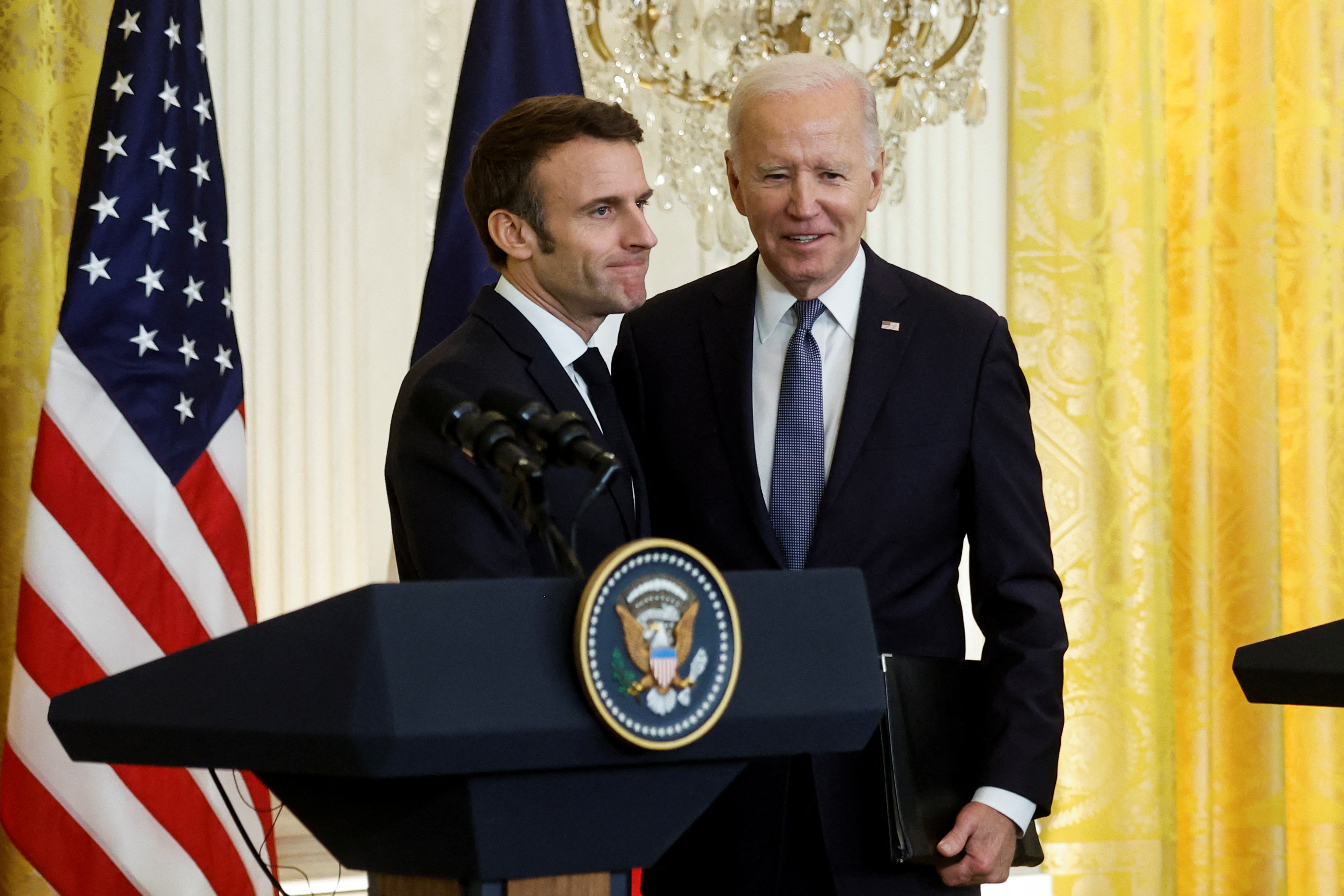
Speaking after a meeting on Thursday at the White House with French President Emmanuel Macron, Biden said he was ready to talk to Putin “if in fact there is an interest in him deciding he’s looking for a way to end the war”, adding the Russian leader “hasn’t done that yet”.

White House national security spokesperson John Kirby, asked about Biden’s comments, told reporters the conditions for such discussions were not there.

“We’re just not at a point now where talks seem to be a fruitful avenue to approach right now,” he said.

Earlier, the Kremlin responded to Biden’s apparent overture, saying the West must recognise what Moscow calls Russia’s “new territories” before any talks with Putin.

“The president of the Russian Federation has always been, is and remains open to negotiations in order to ensure our interests,” Kremlin spokesman Dmitry Peskov told reporters.

Kirby said only Ukraine could determine if and when there could be a negotiated settlement. Kyiv says peace talks are only possible if Russia stops attacking and withdraws.

Russia has previously said it is open to peace talks. Ukraine and allies fear any ceasefire without a total withdrawal would allow Russian forces to regroup in preparation for further attacks.

Peskov said Russia will not pull out of Ukraine.

He added that the search for ways to end the war was hindered by the U.S. refusal to recognise territory in Ukraine that Russia has annexed. Putin has proclaimed the southern region of Kherson and three other partly occupied regions of Ukraine to be part of Russia, in a move condemned as illegal by most countries.

Biden has not spoken directly with Putin since Russia invaded Ukraine on Feb. 24. In March, he branded Putin a “butcher” who “cannot stay in power”. However, he has signalled in recent weeks that Washington would like to entice Putin onto a diplomatic off ramp, after months of battlefield losses and stalled gains for Moscow.

Despite more than nine months of war, some contacts have been sustained between the sides, often through third parties including Turkey and Saudi Arabia. A deal that partially lifted a Russian naval blockade of Black Sea ports has allowed some grains shipments out of Ukraine, and another agreement on Russian fertilizers is in the works. Several large prisoner of war swaps have occurred.

But the fighting that has killed tens of thousands of people is unabated.

With winter tightening its grip, Western countries are trying to boost aid to help Ukraine withstand Russian missile and drone attacks on energy infrastructure that have left millions without heat, electricity and water.

Ukraine has driven Russian troops from swathes of occupied territory in recent weeks, including areas Russia claims to have annexed.

In the east, the town of Bakhmut is now the main target of Moscow’s artillery attacks, while Russian forces in Kherson and the Zaporizhzhia region remain on the defensive, Ukraine’s General Staff said in its latest battlefield update.

In a bid to reduce the money available for Moscow’s war effort, the European Union has tentatively agreed to a $60 a barrel price cap on Russian seaborne oil, diplomats said. The measure will need to be approved formally by all EU governments over the weekend.

The chair of the Russian lower house’s foreign affairs committee, Leonid Slutsky, told Tass news agency the EU was jeopardising its own energy security with the cap, and violating the laws of the market.

Putin told German Chancellor Olaf Scholz in a phone call that the Western line on Ukraine was “destructive” and urged Berlin to rethink its approach, the Kremlin said.

In Berlin’s readout on the call, Scholz’s spokesperson said the chancellor had condemned Russian air strikes on civilian infrastructure and called for a diplomatic solution to the war “including a withdrawal of Russian troops”.

Putin has said he has no regrets about launching what he calls a “special military operation” to disarm and “denazify” Ukraine. He casts the war as a watershed moment when Russia finally stood up to an arrogant West after decades of humiliation following the 1991 fall of the Soviet Union.

Ukraine and the West say Putin has no justification for what they cast as an imperial-style war of occupation.

Three people were killed and seven wounded in Russian shelling of the Kherson region over the past 24 hours, the regional governor said on Friday.

The regional capital of Kherson – recaptured by Ukrainian forces in mid-November – and other parts of the region were bombarded 42 times in the same period, Governor Yaroslav Yanushevych wrote on the Telegram messaging app.

Meanwhile, Russian-installed officials in Donetsk said three people died on Friday after Ukrainian forces shelled the eastern Ukrainian city.

Reuters could not independently confirm battlefield reports.

In a grisly development, several Ukrainian embassies abroad received packages containing animal eyes, Ukraine’s foreign ministry said on Friday, after a series of letter bombs were sent to sites in Spain including Kyiv’s embassy in Madrid.

Attacks on infrastructure are likely to increase the cost to keep Ukraine’s economy going next year by up to $1 billion a month, and aid to the country would need to be “front-loaded”, IMF head Kristalina Georgieva told the Reuters NEXT conference on Thursday.

Ukraine and the West say the strategy of knocking out power and heat deliberately intends to harm civilians, a war crime, something Moscow denies.

Related Galleries:
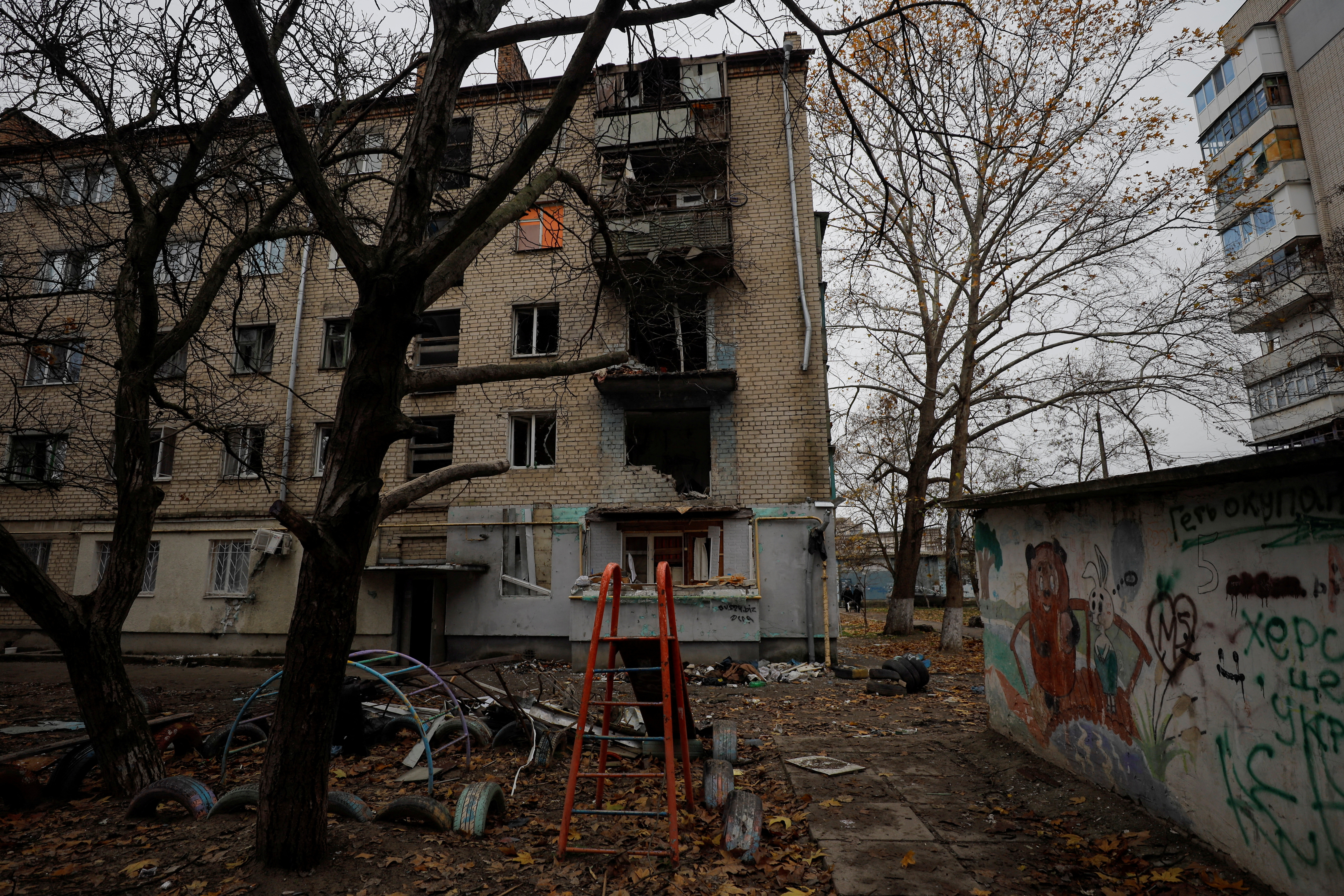
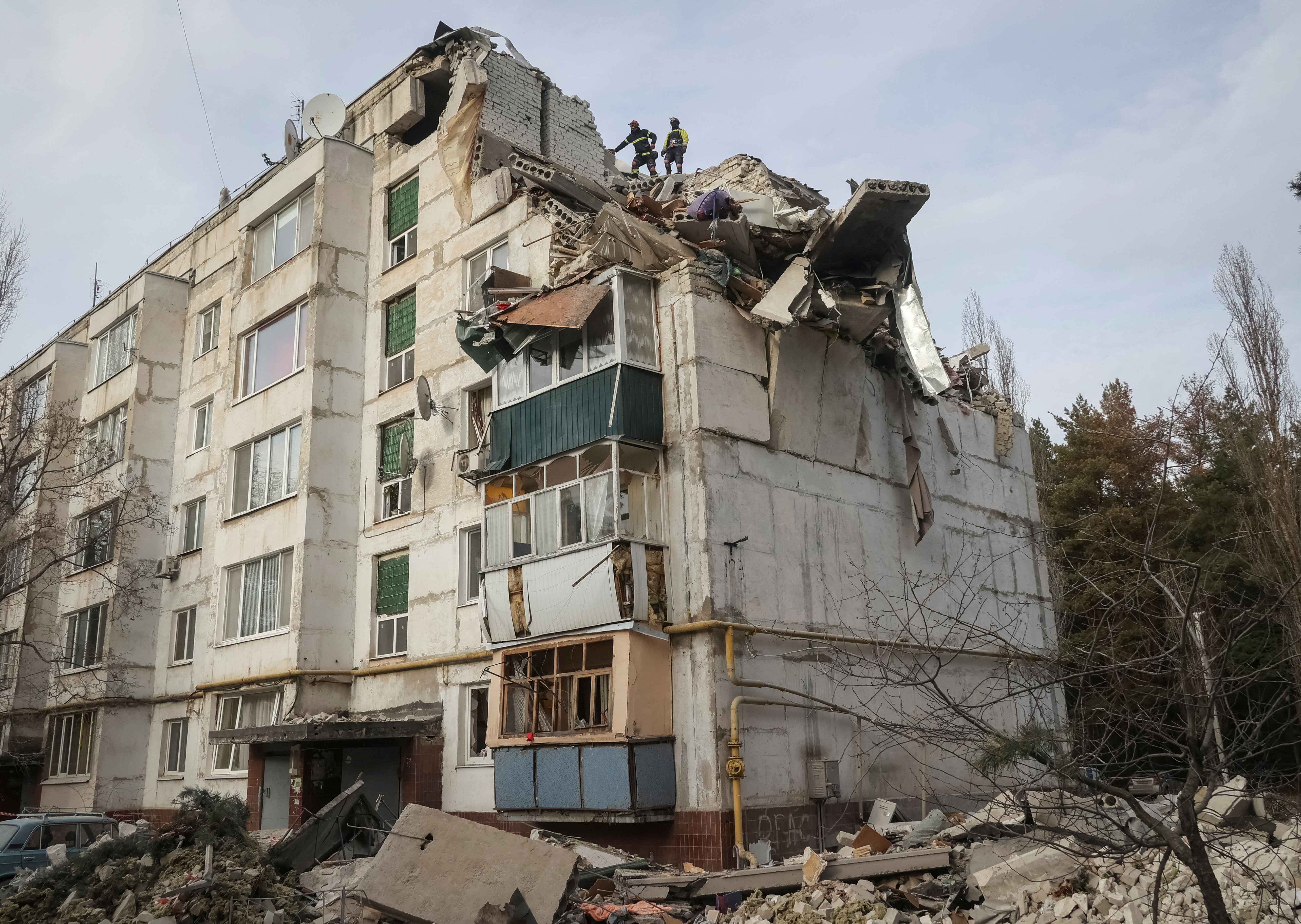
A view shows an apartment building damaged by a recent Russian military strike in Kherson, Ukraine November 27, 2022. REUTERS/Anna Voitenko/File Photo

A view shows a residential building damaged by a Russian missile strike, amid Russia’s attack on Ukraine, near the town of Chuhuiv, Kharkiv region, Ukraine December 2, 2022. REUTERS/Vyacheslav Madiyevskyy

French President Emmanuel Macron greets U.S. President Joe Biden at the conclusion of their joint news conference in the East Room of the White House in Washington, U.S., December 1, 2022. REUTERS/Jonathan Ernst

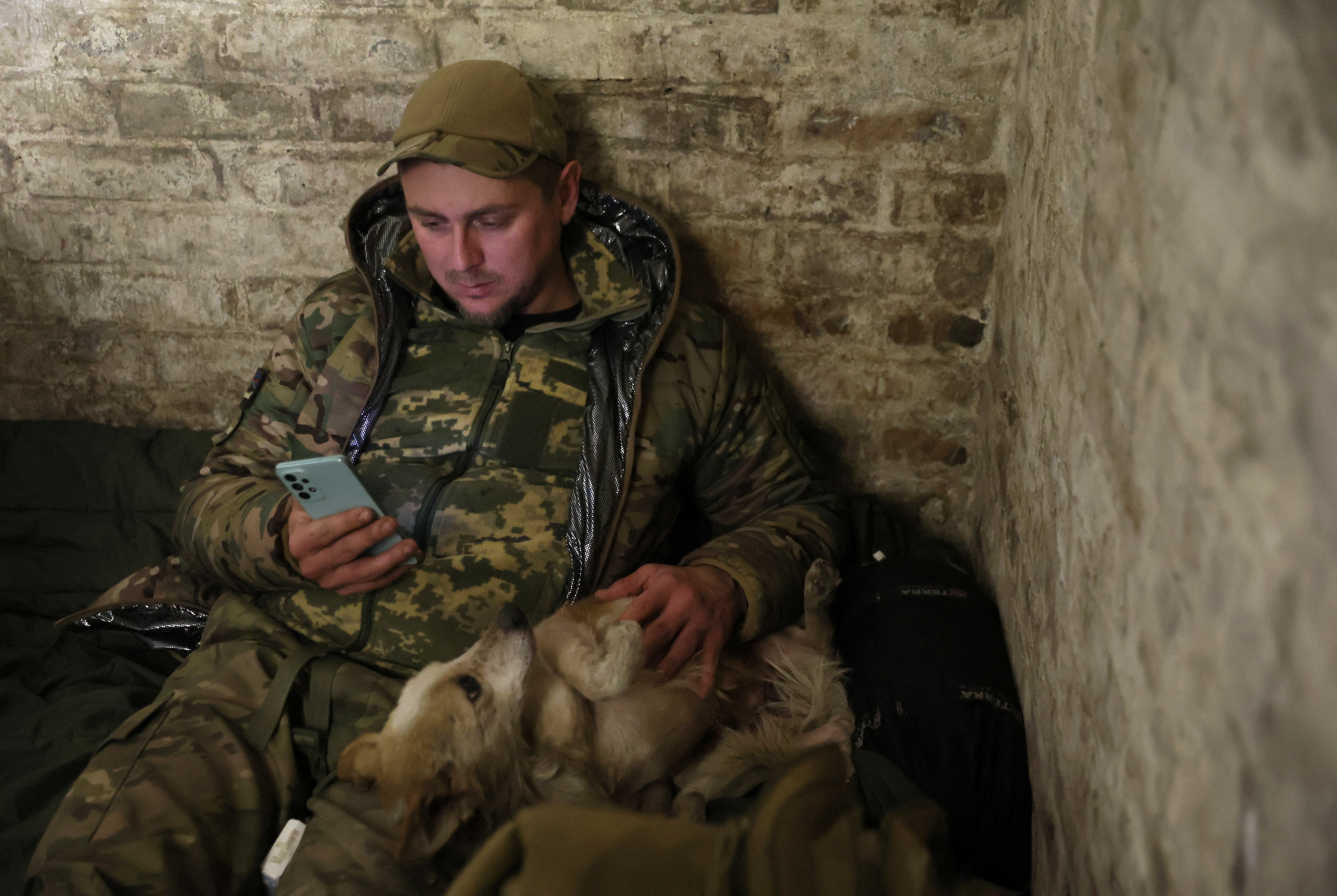
Yaroslav, 34, pets a dog while communicating target coordinates gleaned from drones to fellow service members in the field with the 24th Mechanized Brigade of King Danylo of the Ukrainian Army near Bakhmut in Ukraine, December 1, 2022. REUTERS/ Leah Millis

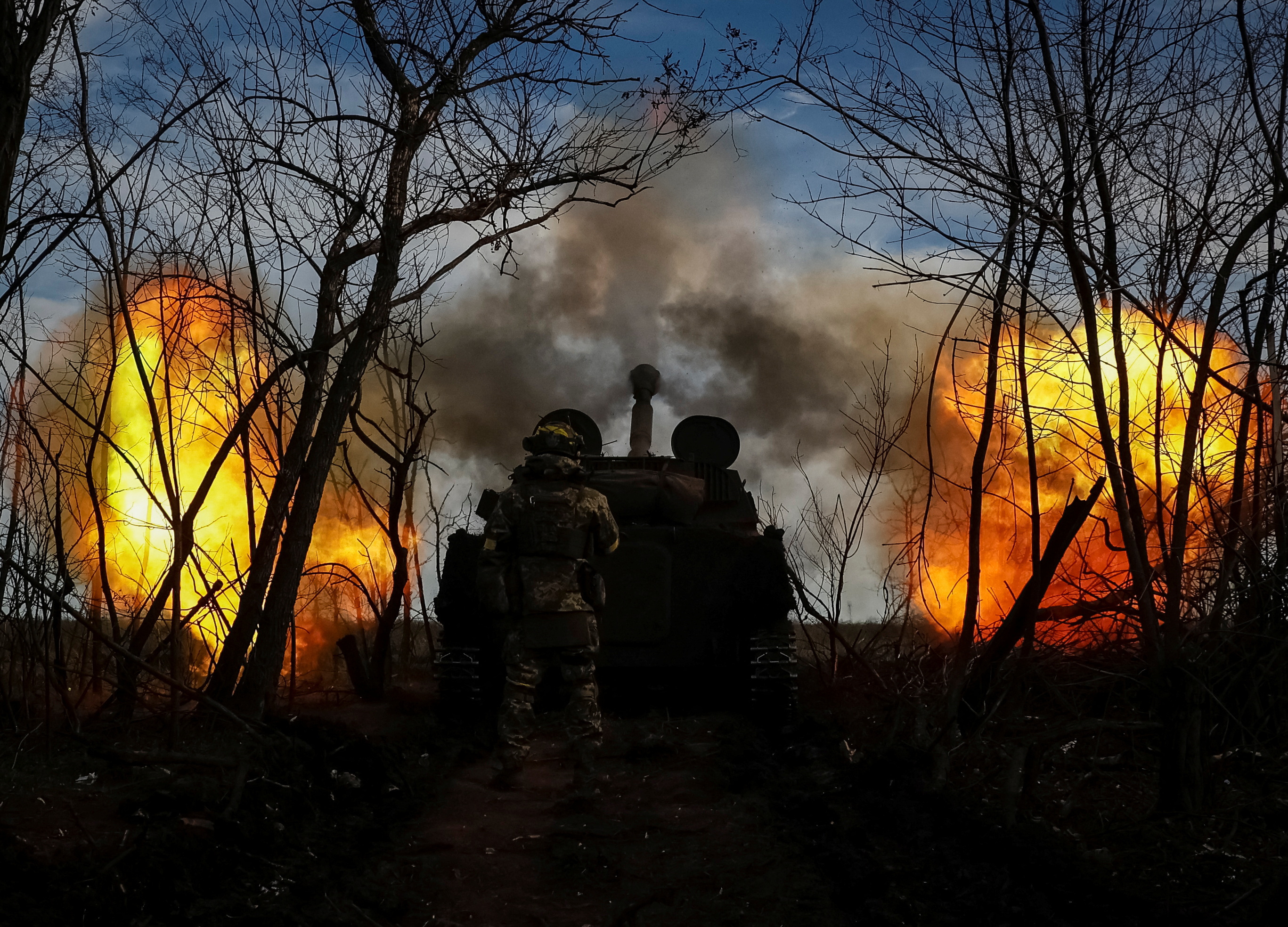
Ukrainian servicemen fire a self-propelled howitzer toward Russian positions, amid Russia’s attack on Ukraine, on a frontline in Donetsk region, Ukraine November 30, 2022. Radio Free Europe/Radio Liberty/Serhii Nuzhnenko via REUTERS

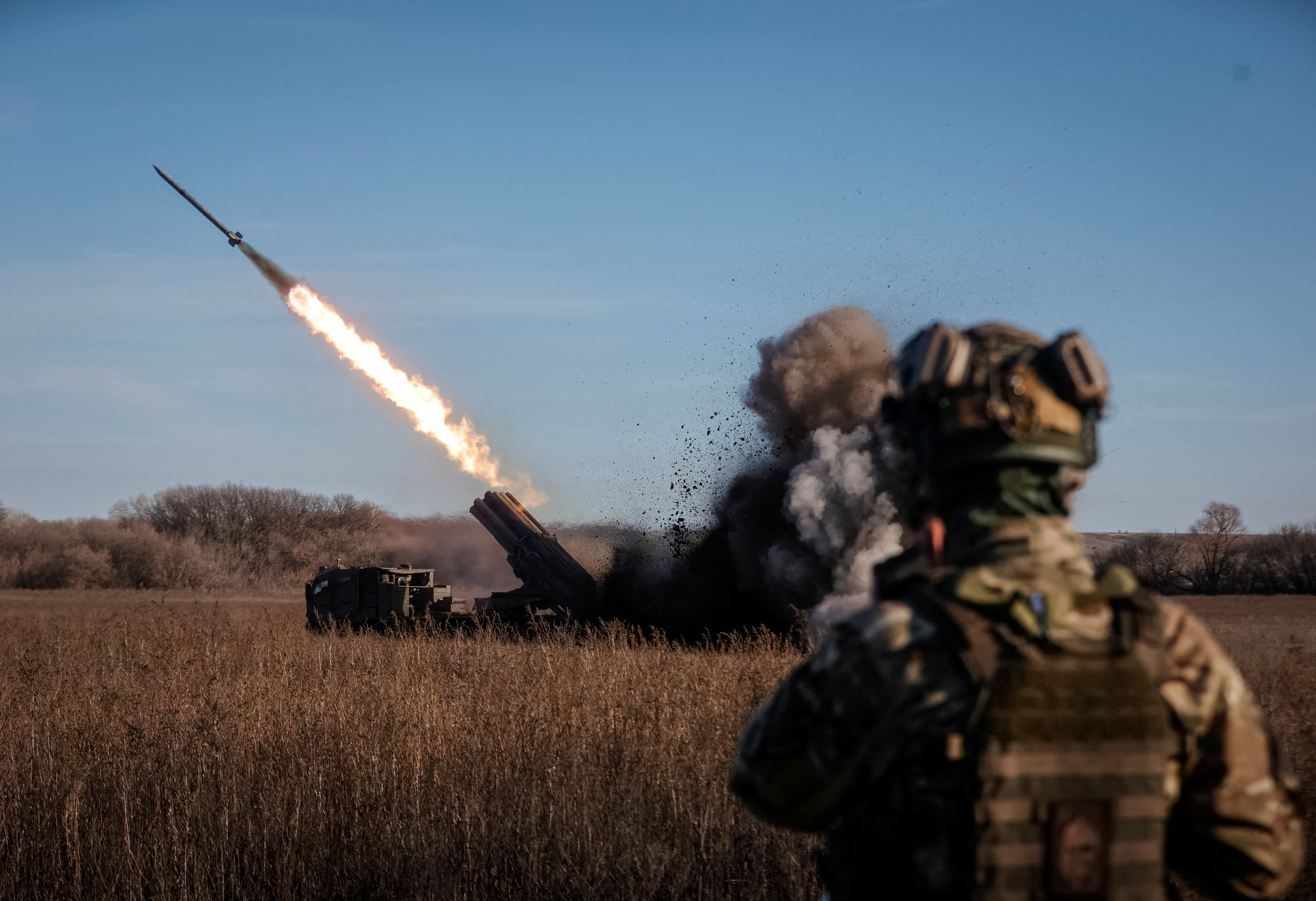
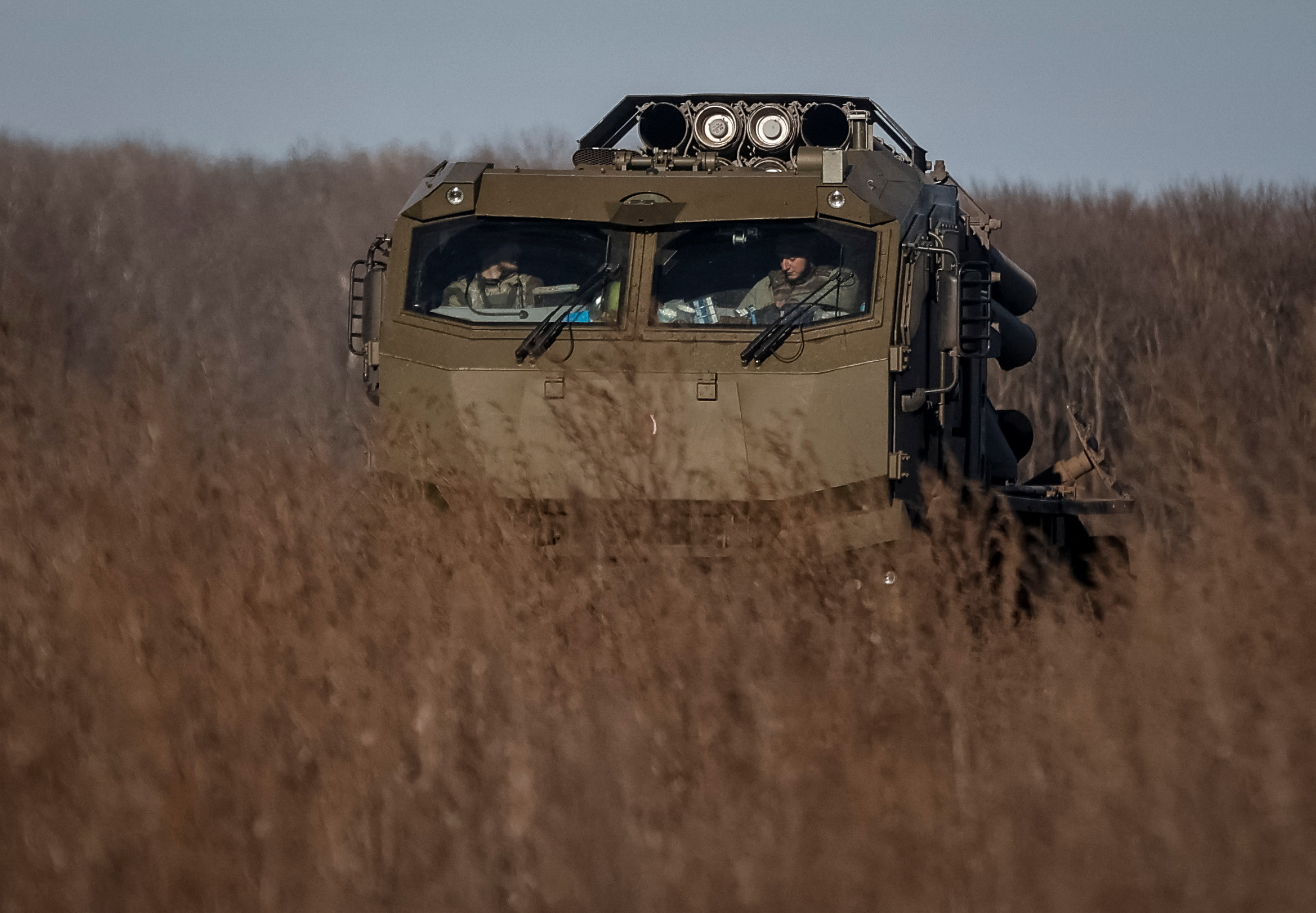
Ukrainian servicemen fire with a Bureviy multiple launch rocket system at a position in Donetsk region, as Russia’s attack on Ukraine continues, Ukraine November 29, 2022. Radio Free Europe/Radio Liberty/Serhii Nuzhnenko via REUTERS

Ukrainian servicemen prepare fire with a Bureviy multiple launch rocket system at a position in Donetsk region, as Russia’s attack on Ukraine continues, Ukraine November 29, 2022. Radio Free Europe/Radio Liberty/Serhii Nuzhnenko via REUTERS
Categories
Audio Sources - Full Text Articles

How news veteran Ben Smith got his start in journalism — at the Forward

Before he helped reinvent daily journalism as editor of BuzzFeed News, before he wrote the vaunted media column for The New York Times, before he produced a string of scoops about Barack Obama’s 2008 presidential campaign at Politico, and more than 24 years before he launched the new global news organization Semafor this fall, Ben Smith reported that rugelach might be entering the mainstream.

The year was 1998. Smith was a rising senior at Yale University. He was on assignment at the 44th Annual Fancy Food Show at the Javits Center. Yes, he was a summer intern at the Forward, an experience he credits for, well, his career.

“The Forward is where I fell in love with journalism, and with beat reporting,” Smith told me. “There’s something really amazing about covering a community that cares about what you write, that holds you accountable for what you write, and where your reporting has impact inside that community. Which is true of all good reporting, but was really palpable at the Forward.”

As Smith remembers it, he “wanted to do journalism in New York” and “somebody put me in touch with Seth Lipsky” — the legendary editor who founded the English Forward in 1990 — so he ended up as one of about 20 interns in the newsroom, then housed at the Workmen’s Circle building in Manhattan’s Garment District.

“I think basically anybody could be a Forward intern,” he laughed. “There was very little structure. There was sort of a pool of interns, and there was stuff people wanted done, and you stuck your hand up, and if you got it done fast, you stuck your hand up again. And if it was good, the editor would give you another assignment.”

That’s just how I remember my own summer internships, at the Middlesex News and the Chicago Tribune and the Los Angeles Times, in the early 1990s. Figure out what your boss needs most and exceed their expectations. Smith clearly put up his hand a lot, and “it was good.”

His bylines — “Benjamin Smith” back then, he switched to “Ben” on the advice of Peter Kaplan years later when he worked at The New York Observer — topped articles about slam-dancing in the Catskills and an 88-year-old apothecary where you could get shark cartilage to soothe your arthritis. He wrote about “twice-fried pommes frites with fixings” and the sports super-agent Leigh Steinberg’s book about integrity. He covered stabbings at a Jewish cemetery in Queens, a union calling for the end of sanctions on Iraq and a diamond merchant selling “Torah cards” — think baseball cards, only with biblical figures.

From our archives: One of Ben Smith’s clips from his Forward summer internship in 1998 about a pharmacy called Willner Chemists. Photo by Matthew Litman
Mostly, though, Ben Smith wrote about a state Senate race on the Upper West Side — where he’d grown up — that launched the career of one Eric Schneiderman, who rose to become New York’s attorney general and fell hard amid accusations of sexual misconduct. Back in that first campaign, Smith scooped that Schneiderman had taken a $5,000 donation from a Saudi prince, and the candidate gave it back.

“I just, like, immediately loved covering politics,” Smith said. “Seth brought this sense that the Forward was the inheritor of a really, truly, great tradition. Just a sense of the publication, which I think a lot of small publications do not have, that it has this past and potential future as a world historical player, not just a community newsletter. Which made it really fun.”

He was so into the Forward that he took Yiddish classes at the Workmen’s Circle. Lipsky tried to convince him to join the staff rather than return to Yale. His mom convinced him not to. After graduation, Smith worked at the Indianapolis Star, then at the Baltic Times in Latvia. When 9/11 happened, he “wanted to come home,” and called Lipsky, who was no longer with the Forward and was about to relaunch The New York Sun. Smith was one of its first staffers.

He went from there to The Observer, then the New York Daily News, then Politico, then BuzzFeed, then The Times and, now, Semafor, a newsletter-driven startup that launched in mid-October with 50 employees and $25 million in funding.

“Semafor” references a maritime and railroad system of signaling with flags, and is a word that sounds the same in many languages — which is meant to reflect a core principle of the new publication: that stories are inherently global.

“The world is so interconnected,” he explained. “If you just think about the great stories of this moment. The rise of right-wing populism, COVID, social media, inflation. Not, like, global stories in the sense of, ‘Oh, interesting, there’s a pattern,’ but global stories in the sense that you really misunderstand them if you think of them as American stories. I think the rise of antisemitism is another really good one.

“Not to say that there aren’t incredibly irresponsible people in the United States that are doing things that are part of the story,” he added, “but it’s something that’s happening all over Europe, and across other parts of the world. It makes sense to understand it as a global story.”

I wanted to talk to Ben about Semafor, and about the Forward, because he embodies perhaps more than any other journalist I know a balance between loyalty to the historic values that root our profession and vision to reinvent how they are expressed. It’s what our old boss Dean Baquet, former executive editor of The Times, says is key to innovation: the ability to distinguish between tradition and habits.

Tradition is the unchanging essence of what we do and who we are — skeptics, finder-outers, storytellers, accountability-holders. Habits adapt to time and technology: back in 1998, print newspaper articles; today, newsletters like this one and Semafor’s.

Today, Ben said, readers are interested in big global stories like the the war in Ukraine and climate change — and in hyper-sub-local information like whether the bagel store on the corner has changed its hours. “Next Door and Facebook actually are pretty decent at getting you the hours of the bagel place in a way that print never was,” he said. As for the day-to-day news items about crime and city councils that filled the metropolitan dailies we both grew up working at, it’s a puzzle we’re all still trying to figure out.

“If there’s a murder on your street, you will read any amount about it,” Smith noted. “If there’s a murder in another borough, I don’t know. If it’s very lurid, you will read about it, but if it was in Turkey and it was very lurid you would read about it. People’s attention and interest doesn’t actually map to the metro-area.”

The Forward sits in an interesting place on that map, serving not a metro area but an ethnic community — or, really, a collection of diverse communities with a common identity, Jewish, but many, many, many definitions of what that even means. As we continue to celebrate and reflect on our 125th anniversary year, it was inspiring to hear perhaps our most famous former intern talk about his very formative Forward experience.

The Forward “took itself seriously” and “really punches above its weight,” he said. “A small publication that is nominally the publication of a specific community can really hit really hard, nationally and internationally, when it wants to.”

Amen.


While I have you, I’m on the hunt for the next Ben Smith. Interns earn $15 an hour, up to 29 hours per week, and get to do as much as they stick up their hands for. Our innovation editor — and former intern — Talya Zax coordinates the program. Send a cover letter, resume and clips to jobs@forward.com.


The post How news veteran Ben Smith got his start in journalism — at the Forward appeared first on The Forward.

Categories
Audio Sources - Full Text Articles

EU tentatively backs $60-per-barrel price cap on Russian oil

BRUSSELS (AP) — The European Union tentatively agreed to a $60-per-barrel price cap on Russian oil, a key step as Western sanctions aim to reorder the global oil market to prevent price spikes and starve President Vladimir Putin of funding for his war in Ukraine.

After a last-minute flurry of negotiations, the EU presidency, held by the Czech Republic, said in a statement that “ambassadors have just reached an agreement on price cap for Russian seaborne #oil.” The decision must still be officially approved with a written procedure but is expected to go through.

They needed to set the discounted price that other nations will pay by Monday, when an EU embargo on Russian oil shipped by sea and a ban on insurance for those supplies take effect. The price cap, which was led by the Group of Seven wealthy democracies and still needs their approval, aims to prevent a sudden loss of Russian oil to the world that could lead to a new surge in energy prices and further fuel inflation.

The $60 figure sets the cap near the current price of Russia’s crude, which recently fell below $60 a barrel. Some criticize that as not low enough to cut into one of Russia’s main sources of income. It is still a big discount to international benchmark Brent, which traded at about $87 per barrel Friday, but could be high enough for Moscow to keep selling even while rejecting the idea of a cap.

There is a big risk to the global oil market of losing large amounts of crude from the world’s No. 2 producer. It could drive up gasoline prices for drivers worldwide, which has stirred political turmoil for U.S. President Joe Biden and leaders in other nations. Europe is already mired in an energy crisis, with governments facing protests over the soaring cost of living, while developing nations are even more vulnerable to shifts in energy costs.

But the West has faced increasing pressure to target one of Russia’s main moneymakers — oil — to slash the funds flowing into Putin’s war chest and hurt Russia’s economy as the war in Ukraine drags into a ninth month. The costs of oil and natural gas spiked after demand rebounded from the pandemic and then the invasion of Ukraine unsettled energy markets, feeding Russia’s coffers.

Now, more uncertainty is ahead. COVID-19 restrictions in China and a slowing global economy could mean less thirst for oil. That is what OPEC and allied oil-producing countries, including Russia, pointed to in cutting back oil supplies to the world in October.

That competes with the EU embargo that could take more supplies off the market, mean an oil squeeze and higher prices. Russia exports roughly 5 million barrels of oil a day.

Putin has said he would not sell oil under a price cap and would retaliate against nations that implement the measure. However, Russia has already rerouted much of its supply to India, China and other Asian countries at discounted prices because Western customers have avoided it even before the EU embargo.

Most insurers are located in the EU or the United Kingdom and could be required to participate in the cap.

Russia also could sell oil off the books by using “dark fleet” tankers with obscure ownership. Oil could be transferred from one ship to another and mixed with oil of similar quality to disguise its origin.

Even under those circumstances, the cap would make it “more costly, time-consuming and cumbersome” for Russia to sell oil around the restrictions, said Maria Shagina, a sanctions expert at the International Institute for Strategic Studies in Berlin.

Robin Brooks, chief economist at the Institute of International Finance in Washington, said the price cap should have been implemented when oil was hovering around $120 per barrel this summer.

“Since then, obviously oil prices have fallen and global recession is a real thing,” he said. “The reality is that it is unlikely to be binding given where oil prices are now.”

Others have criticized the measure, a brainchild of U.S. Treasury Secretary Janet Yellin.

Former Treasury Secretary Steve Mnuchin told CNBC during a panel in November at the Milken Institute’s Middle East and Africa Summit that the price cap was “not only not feasible, I think it’s the most ridiculous idea I’ve ever heard.”

___

Hussein reported from Washington, and McHugh from Frankfurt, Germany.

Categories
Audio Sources - Full Text Articles

Inflection point: making the Summit for Democracy matter at the IACC

By Joseph Foti, Renzo Falla, Kristen Rose, Norman Eisen, Lilly Blumenthal, Robin Lewis, Mario Picon

1. We’re at a moment of inflection for democracy—and corruption.

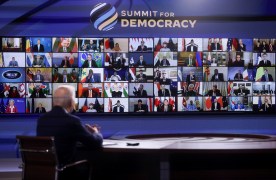
In December, civil society organizations, private sector entities, and government representatives will gather to discuss the state of corruption around the world at the International Anti-Corruption Conference hosted in Washington, DC. Participants will have the opportunity to share lessons learned from the past year and help hold governments accountable to their Summit for Democracy commitments.

Last December, more than 100 jurisdictions were represented at and participated in the first Summit for Democracy. At the event, jurisdictions, including the host—the United States government—submitted formal commitments. Commitments focused on countering authoritarianism, fighting corruption, and promoting human rights. And while these commitments represented important first steps, few countries have publicly reported any evidence of implementation.

Shortly following the first summit, the Biden administration announced a second Summit for Democracy to “take stock of the progress made.” The second Summit for Democracy can serve as a launchpad for broader, more sustainable, and better coordinated efforts. However, to maximize the impact of the second summit, we must examine what countries promised at the first and how—or if—they’ve followed through with those commitments. Otherwise, we risk losing another “year of action.”

2. Commitments to counter corruption are an important start.

While many Summit for Democracy commitments addressed issues of inclusion and civic space, anti-corruption commitments formed a significant subset. Over 40 countries made at least 125 commitments broadly related to anti-corruption. Half of these anti-corruption commitments were relevant to at least one value of open government (transparency, civic participation, or public accountability).

These commitments covered a range of policy areas. Around one-third addressed money in politics, including electoral reforms. For example, Ireland committed to establish an independent Electoral Commission that will work to regulate online political advertising and modernize the electoral registration process. Other commitments dealt with financial crimes and abuses of power, such as whistleblower protection reforms.[1]

Some commitments also focused on the intersection of anti-corruption and democratic freedoms. For example, the Slovak Republic committed to protecting journalists’ independence through transparency of media ownership and regulated political advertising. Similarly, the United States committed to support journalists in their efforts to expose corruption and ill-gotten gains.

3. Commitments must address context-specific challenges.

To be effective, commitments must be designed in consultation with the public to address each country’s specific challenges. New research from the Open Government Partnership (OGP), a multilateral initiative focused on advancing concrete commitments from governments to promote open government and combat corruption, and the Global Data Barometer on the state of open data in OGP countries can help support this effort.

While open data is only one element of financial integrity, it provides a sense of gaps and opportunities for reforms. Below we look at three key areas of financial integrity, the gaps according to the research, and to what extent those gaps were addressed by Summit for Democracy commitments.

Political finance

Political finance transparency is essential to leveling the political playing field and maintaining free and fair electoral competition. In addition, covert foreign finance is one way governments undermine public trust and the bond between voters and their representatives.

  • Policy gaps: About one-third of OGP countries do not publish any political finance data online. In addition, most available datasets lack identifying data on donors and are not published according to open data standards.
  • Commitment analysis: While many jurisdictions made Summit for Democracy commitments addressing electoral integrity, only six (Kosovo, Liberia, Mauritius, Republic of Moldova, Peru, and Taiwan) specifically focused on political financing.
  • Commitment examples: As part of the Summit for Democracy, Liberia committed to transparency and accountability in electoral funding while Moldova committed to increase sanctions and oversight for illegal financing of political parties.

Asset disclosure

Opening data on asset declarations allows the public to work alongside oversight institutions to monitor those entrusted to serve in their interest.

  • Policy gaps: All OGP countries require the collection of asset disclosure data, but two in five do not publish the data in any form. Most available datasets include information on income, assets, and liabilities, but do not cover family members. Asset declarations are also typically not machine-readable or bulk-downloadable.
  • Commitment analysis: Only four jurisdictions (Kosovo, Montenegro, Slovak Republic, and the United States) made Summit for Democracy commitments that specifically address asset disclosure.
  • Commitment example: In their 2020-2022 OGP action plan, Côte d’Ivoire committed to mandate annual asset disclosures, build an online platform for asset disclosure submissions, and publish reliable and up-to-date statistics.

Company beneficial ownership

Disclosing beneficial owners—those who ultimately control or profit from a business—is essential for combating corruption, stemming illicit financial flows, and fighting tax evasion.

  • Policy gaps: Two-thirds of OGP countries do not publish any company beneficial ownership data online. Where this data is available, it is typically not machine-readable and lacks important details such as the financial interests held by beneficial owners.
  • Commitment analysis: Nine jurisdictions made at least one commitment regarding the disclosure of beneficial owners. Several commitments included pledges to create publicly accessible registries.
  • Commitment examples: As part of the Summit for Democracy, Latvia committed to disclose the beneficial owners of joint-stock companies, while Canada committed to implement a publicly accessible beneficial ownership registry by 2025.[2]

4. What’s next?

Moving forward, it’s essential to assess the quality and strength of anti-corruption and other commitments, identify gaps in their implementation, and develop sustainable recommendations for advancing toward quality commitments. Organizations such as Brookings, International IDEA, and OGP are working together to conduct such monitoring and analysis in advance of the second summit and beyond. Civil society from participating countries must be closely integrated into this process. Accordingly, there must be a concerted effort from experts at the global and national levels to ensure visibility of these commitments and engagement from civil society.

The second Summit offers an important platform to take stock of progress toward commitments, but the work of identifying and monitoring reforms cannot stop there. To ensure this effort is sustainable in the months and years to come, civil society organizations and governments must integrate reforms into other vehicles. This could include getting commitments to reform built into vehicles such as OGP and the Financial Action Task Force (FATF)[3] action plans and developing high-level re-commitments at the upcoming OGP Global Summit.


[1] All Summit for Democracy commitments are visualized on International IDEA’s Commitment Dashboard here. They are also available as machine-readable data on OGP’s website here. The original written submissions made by governments can be found on the US State Department’s website here.

[2] In March 2022, the Canadian government pledged to implement the registry by the end of 2023.

[3] The Financial Action Task Force, or FATF, is an intergovernmental organization focused on combating money laundering and the financing of terrorism.

2021-12-09T160644Z_223295141_RC21BR9G7SU
fblike20.png pinterest20.png twitter20.png email20.png rss20.png  
Categories
Audio Sources - Full Text Articles

Russian War Report: Russian Telegram channel spreads digitally modified photo of Poland’s prime minister

As Russia continues its assault on Ukraine, the Atlantic Council’s Digital Forensic Research Lab (DFRLab) is keeping a close eye on Russia’s movements across the military, cyber, and information domains. With more than seven years of experience monitoring the situation in Ukraine—as well as Russia’s use of propaganda and disinformation to undermine the United States, NATO, and the European Union—the DFRLab’s global team presents the latest installment of the Russian War Report. 

Security

Heavy fighting in the Bakhmut trenches as Russia continues to attack critical Ukrainian infrastructure

Tracking narratives

Russian Telegram channel spreads digitally modified photo of Poland’s prime minister

War crimes and human rights abuses

New reports of Russian forces killing Ukrainian civilians

International response

European Parliament declares Russia a state sponsor of terrorism

US, Bulgaria, Lithuania expand support efforts

Heavy fighting in the Bakhmut trenches as Russia continues to attack critical Ukrainian infrastructure

The Russian army has been implementing defensive facilities in the Kherson region since October, preparing for either a Ukrainian army advance or an organized retreat. Russian forces remain entrenched in various parts of Kherson and southern Ukraine. Ukrainian forces reportedly damaged a rail bridge north of Melitopol that served as a critical supply route for Russian troops. 

After the successful Ukrainian counteroffensive in Kherson, Russian forces are likely to increase attacks on critical infrastructure, such as factories and warehouses. On November 19, the Russian armed forces attacked the Motor Sich plant in Zaporizhzhia with Iranian drones. Video emerged on Telegram of explosions at the site of the attack. The plant manufactures aircraft engines and industrial marine gas turbines.  

Russian forces are also expected to escalate the front line in the Donetsk region after the retreat at Kherson. The situation remains dire in Bakhmut, a strategically important city that has seen months of fighting as Russia attempts to capture the territory, which would provide the Russian army with an opportunity to launch an offensive. According to the Guardian, hundreds of soldiers from both sides are killed or wounded on the Bakhmut front on a daily basis. The fighting on the front includes artillery fire, with Ukrainian forces managing to inflict losses on Russian units with precision-guided shells. Bakhmut is heavily fortified and has sustained significant damage. Ukrainian forces also conduct patrols inside the city, fearing possible infiltration behind the defensive line.  

Ukraine’s Zaporizhzhia nuclear power plant was shelled on November 19 and November 20, according to the International Atomic Energy Agency, which warned that such attacks risk causing a nuclear disaster. Russia and Ukraine blamed each other for the attack on the facility, which is in Russian-controlled territory. While some media reports claim Russian forces are preparing to abandon the Zaporizhzhia power plant, the Kremlin denies it plans to leave the facility. The Russian wartime administration recently promoted the chief engineer of the Zaporizhzhia nuclear power plant to director.  

On November 23, Russia launched a large-scale missile attack targeting different regions of Ukraine, including Kyiv, where a missile hit a high-rise building. Strikes took place on critical infrastructure facilities across Ukraine, causing electrical outages that stretched from Kyiv to the western city of Lviv. Meanwhile, Moldova also experienced electrical outages as a result of the shelling in Ukraine, including in the occupied region of Transnistria. On December 1, electricity in Kherson was cut due to Russian shelling. Ukrainian authorities, fearing new attacks, began evacuating civilians from recently liberated areas of Kherson and Mykolaiv. Attacks targeting energy infrastructure will likely continue during the winter months and the new year.

Ruslan Trad, Resident Fellow for Security Research, Sofia, Bulgaria

Russian Telegram channel spreads digitally modified photo of Poland’s prime minister

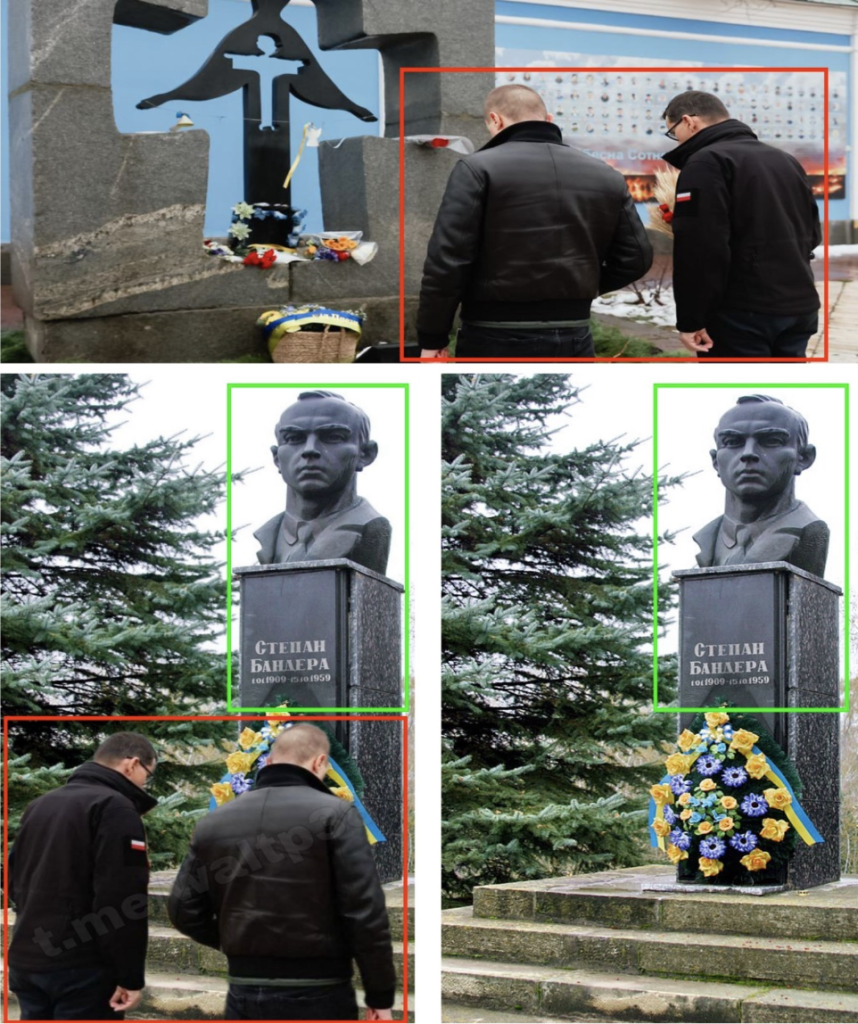
On November 26, a Russian Telegram channel disseminated a manipulated photo showing Polish Prime Minister Mateusz Morawiecki at a Stepan Bandera monument during his visit to Ukraine. The image was digitally modified, with the original photo of the prime minister taken at a memorial to Holodomor victims. The Russian Telegram channel Ненасытный Гардемарин (“Insatiable Gardes-Marine”) shared a false quote they alleged to have come from Morawiecki: “The memory of this great fighter against Russians will remain in our hearts forever. Bandera has always been a great friend of the Polish people.”  

Stepan Bandera is a polarizing figure in Poland and Ukraine for his role in the massacre of Polish civilians in 1943-1944. The Polish fact-checking platform Konkret 24 confirmed the alleged photo at the Bandera monument was digitally modified. The prime minister’s office published authentic images taken during Morawiecki’s visit to a monument for Holodomor victims in Kyiv, where he laid a symbolic wreath. The forgery extracted the prime minister and his companion’s bodies from the original photo, flipped the image, and then added it to a photo of the Stepan Bandera statue. A Yandex reverse image search revealed that the photo of the Stepan Bandera statue previously appeared on multiple websites, including Wikipedia.

Top: Prime Minister Morawiecki in front of the monument to Holodomor victims in Kyiv. Bottom left: the digitally modified image; Bottom right: a copy of the original Bandera monument photo on Wikipedia. (Sources: @PremierRP/archive, top; Telegram/archive, bottom left; Wikipedia/archive, bottom right)Top: Prime Minister Morawiecki in front of the monument to Holodomor victims in Kyiv. Bottom left: the digitally modified image; Bottom right: a copy of the original Bandera monument photo on Wikipedia. (Sources: @PremierRP/archive, top; Telegram/archive, bottom left; Wikipedia/archive, bottom right)

Two days before Morawiecki’s visit to Kyiv, pro-Kremlin Russian Telegram channels also spread images of forged questionnaires allegedly prepared by the Polish embassy in Ukraine. The pro-Kremlin Telegram channel Украина.ру (Ukraine.ru) asserted that the embassy organized the questionnaires to ask Ukrainian citizens whether they wanted to be under a Polish “protectorate.” The Telegram post also included a photo of a forged letter addressed to the Polish the consuls general in the Ukrainian cities of Lutsk and Lviv, asking them to conduct public opinion polls in Lviv and Volyn. According to the letter, the Consuls should submit the results of the polls to the embassy no later than November 21.  

The Telegram post also contained a video of a printer making copies of the questionnaires. The documents contained the logos of two Polish organizations, the White Eagle Association of Poles (Orzeł Biały) and the Polish-Ukrainian Cooperation Foundation (PAUCI). The forged documents are written in Ukrainian. Konkret24 translated the documents and found three questions visible in the video regarding the respondent’s nationality, whether they count on Poland increasing support for Ukraine, and a partially obscured question appearing to ask their thoughts on a Polish protectorate over the Volyn region.  

A spokesperson for the Polish foreign ministry denied the questionnaires were authentic. “Entries regarding the preparations for the referendum on joining the western regions of Ukraine to Poland are disinformation,” he stated.  

The alleged forgery appears to be another attempt to trigger disputes between Poland and Ukraine. The DFRLab has previously reported on similar false claims that Poland intends to occupy the Western part of Ukraine.

Givi Gigitashvili, Research Associate, Warsaw, Poland

New reports of Russian forces killing Ukrainian civilians

Russian armed forces reportedly killed a family on November 18 in the village of Komysh-Zoria, Zaporizhzhia, according to Ukrainian news agency Ukrainska Pravda, citing anonymous law enforcement officials and Ukrainian security services. The online Ukrainian publication Obozrevatel also reported on the killing, claiming that pro-Russian militants from the Donetsk People’s Republic and soldiers from Ossetia drove into the occupied settlement to Pochtovaya Street, where the family had lived.  

Radio Free Europe/Radio Liberty’s Ukraine division published an article on November 30 about atrocities reportedly committed by a high-ranking Russian officer. Sergey Safonov, commander of the 27th Separate Guards Motor Rifle Brigade, allegedly stabbed an elderly Ukrainian woman to death while retreating from the Kharkiv region.  

Meanwhile on November 22, a Russian missile strike damaged a maternity ward at the central district municipal hospital in Vilnyansk, Zaporizhzhia. Civilian casualties were reported.

Ruslan Trad, Resident Fellow for Security Research, Sofia, Bulgaria

European Parliament declares Russia a state sponsor of terrorism

On November 23 , members of the European Parliament voted to adopt a resolution designating Russia as a state sponsor of terrorism. The final vote was 494 in favor and fifty-eight against, with forty-four abstentions. The resolution was in response to Russian atrocities in the war against Ukraine, including strikes against hospitals, schools, shelters, and other civilian targets. The resolution also called for the Russian state-backed Wagner Group and Chechen forces led by Ramzan Kadyrov to be added to the European Union’s list of persons, groups, and entities involved in terrorist acts. 

Ruslan Trad, Resident Fellow for Security Research, Sofia, Bulgaria

US, Bulgaria, Lithuania expand support efforts 

The US Department of Defense submitted a purchase order for the production of UKR/TPQ-50 lightweight anti-mine radars for use in Ukraine. These radars can track the trajectory of mortar fire at up to ten kilometers, calculating the location of the mortar. The order is scheduled to be completed in June 2023.  

According to Bulgarian Minister of Defense Dimitar Stoyanov, Bulgaria will send at least nine Boeing C-17 Globemasters to Ukraine. Bulgaria has sought logistical assistance from the US and the United Kingdom to help deliver the shipment of military transport aircraft. 

Lithuania, meanwhile, will provide Ukraine forces with 25,000 pieces of winter clothing. The country’s defense ministry will spend $2 million purchasing warm clothing for Ukraine, according to Ukrainian sources.

Ruslan Trad, Resident Fellow for Security Research, Sofia, Bulgaria

The post Russian War Report: Russian Telegram channel spreads digitally modified photo of Poland’s prime minister appeared first on Atlantic Council.

Categories
Audio Sources - Full Text Articles

US star Pulisic on track to play against Dutch in World Cup

DOHA, Qatar (AP) — Christian Pulisic is on track to play for the United States in its World Cup round of 16 match against the Netherlands on Saturday,

Pulisic left Tuesday’s final group stage match against Iran at halftime after bruising his pelvic bone in a collision with the goalkeeper while scoring in the 38th minute. The Americans won 1-0 to advance.

“It looks pretty good, but we’ll have to see him today on the pitch to get confirmation of that,” U.S. coach Gregg Berhalter said before Friday’s training session.

Pulisic, a 24-year-old winger, said Thursday he was feeling better.

Forward Josh Sargent left the Iran match in the second half after hurting his right ankle.

“With Christian we’re hopeful, with him a little less so,” Berhalter said.

___

AP World Cup coverage: https://apnews.com/hub/world-cup and https://twitter.com/AP_Sports

Categories
Audio Sources - Full Text Articles

US military halts patrols against Islamic State in Syria

WASHINGTON (AP) — U.S. forces have stopped joint military patrols in northern Syria to counter Islamic State extremists, as Turkish threats of a ground invasion stymie those missions with Kurdish forces. Other more limited security patrols by U.S. and Kurdish troops, particularly around prisons, will begin again on Saturday, officials said.

U.S. Central Command on Friday said American troops have paused all of the joint operations with the Kurdish-led Syrian Democratic Forces against IS in Syria. The Pentagon had said Thursday that the patrols were ongoing but reduced.

“The SDF continues to conduct patrols and maintain security at the al-Hol displaced persons camp and the detention facilities prisons,” said Army Col. Joe Buccino, the Central Command spokesman. “ISIS remains a threat to regional security and stability. We remain committed to the enduring defeat of ISIS and look forward to the resumption of operations against ISIS in the future.”

John Kirby, spokesman for the National Security Council, told reporters on Friday that, as in the past, when there are Turkish operations in northern Syria, it has had an impact on the counter-ISIS operations as SDF forces concentrate on defending themselves in northern Syria.

In a statement, the SDF said the other partnered patrols will begin Saturday in the border area. The U.S. said those patrols are not to counter the Islamic State militants.

“A state of calm and reassurance prevailed among the population along the border area after U.S. Defense Secretary Lloyd Austin informed his Turkish counterpart Hulusi Akar on Wednesday that Washington strongly opposes Turkey’s launch of a military operation in northern Syria,” the SDF said in its statement.

Turkey has launched a barrage of airstrikes on suspected militant targets in northern Syria and Iraq in recent days, in retaliation for a deadly Nov. 13 bombing in Istanbul that Ankara blames on the Kurdish groups. Turkey’s President Recep Tayyip Erdogan has also threatened a ground incursion, without specifying when it would be launched.

No U.S. forces or personnel have been hit by any of the strikes. But on Nov. 26, the U.S. military said two rockets targeted U.S.-led coalition forces at bases in the northeastern Syrian town of Shaddadeh. There were no injuries or damage to the base. There are roughly 900 U.S. troops in Syria, including in the north and farther south and east.

Earlier this week, Mazloum Abdi, the commander of the SDF, told reporters that counter-IS operations had been “temporarily paused” because of the recent Turkish airstrikes, and that gains made in the fight against the extremist group may be “threatened.”

But Ryder said the missions had been continuing, although they were more limited because of the SDF’s request.

Austin spoke by phone with Turkish Minister of National Defense Hulusi Akar on Wednesday, relaying the department’s strong opposition to any potential ground invasion in northern Syria, said Ryder. He declined to detail Akar’s response to the U.S. concerns.

“The focus here is, from the United States standpoint, on ensuring that terrorist organizations like ISIS cannot reconstitute,” Ryder told reporters on Thursday. He said there has been progress on that since the group emerged in 2014 — which is when the extremists took over large swaths of Iraq and Syria. “We don’t want to see that progress be wasted.”

Categories
Audio Sources - Full Text Articles

Wall Street falls as jobs report keeps Fed on hike path

2022-12-02T19:40:33Z

Traders work on the floor of the New York Stock Exchange (NYSE) in New York City, U.S., November 21, 2022. REUTERS/Brendan McDermid

U.S. stocks fell on Friday, although major indexes recovered from their lowest levels, as the November payrolls report fueled expectations the Federal Reserve would maintain its path of interest rate hikes to combat inflation.

The Labor Department’s jobs report showed nonfarm payrolls rose by 263,000, above expectations of 200,000 and wage growth accelerated even as recession concerns increase.

The U.S. unemployment rate remained unchanged, as expected, at 3.7%.

Investors have been looking for signs of weakness in the labor market, especially wages, as a precursor to faster cooling of inflation that will enable the Fed to slow and eventually stop its current rate hike cycle.

Stocks had rallied earlier in the week after Fed Chair Jerome Powell’s comments on scaling back interest rates hikes as early as December.

Still, equities were off their lowest levels of the day that saw each of the major indexes tumble at least 1%.

“If anything, I am actually encouraged by how the market is clawing its way back from the level we were at today, it is another indication the market is looking for at least a seasonal December rally,” said Sam Stovall, chief investment strategist at CFRA in New York.

“The market is beginning to look across the valley and say, ‘OK, a year from now the Fed will likely be on hold and considering cutting rates.'”

The rate-setting Federal Open Market Committee meets on Dec. 13-14, the final meeting in a volatile year that saw the central bank attempt to stifle the fastest rate of inflation since the 1980s with record interest rates increases.

The Dow Jones Industrial Average (.DJI) fell 99.32 points, or 0.29%, to 34,295.69, the S&P 500 (.SPX) lost 21.92 points, or 0.54%, to 4,054.65 and the Nasdaq Composite (.IXIC) dropped 85.66 points, or 0.75%, to 11,396.79.

Even with Friday’s weakness, the S&P 500 and Nasdaq were poised for a second straight week of gains, while the Dow showed modest losses for the week.

Information technology shares (.SPLRCT) bore the brunt of selling pressure among the 11 major S&P 500 sectors, down 1.23% as the worst performer on the day.

Growth and technology companies such as Apple Inc (AAPL.O), down 1.36%, and Amazon (AMZN.O), off 1.36%, were pressured by concerns over rising rates. The S&P 500 growth index (.IGX) lost 0.79%.

Ford Motor Co (F.N) declined 2.13% on lower vehicle sales in November, while DoorDash Inc (DASH.N) shed 2.10% after RBC downgraded the food delivery firm’s stock.

Declining issues outnumbered advancing ones on the NYSE by a 1.22-to-1 ratio; on Nasdaq, a 1.01-to-1 ratio favored decliners.

The S&P 500 posted 17 new 52-week highs and no new lows; the Nasdaq Composite recorded 59 new highs and 84 new lows.

Categories
Audio Sources - Full Text Articles

Does the Pentagon report on China’s military correctly judge the threat?

By Michael E. O’Hanlon

This week, the Pentagon released its annual report on Chinese military and security developments over the past year. That capped a busy season for the Government Printing Office: the National Security Strategy, National Defense Strategy, Nuclear Posture Review, and Missile Defense Strategy all came out publicly last month.

All the documents, not just this most recent one, emphasize China. Although it is Russian President Vladimir Putin who is raining down death and destruction on Ukraine, issuing nuclear threats to the West, and distorting energy as well as food markets worldwide, China gets pride of place as security challenge number one — even though China has not employed large-scale military force against an adversary since its 1979 war with Vietnam. Given Beijing’s capacities, the Pentagon is convincing when it describes China as its “pacing challenge.” But we Americans have demonstrated before the veracity of the slogan that if it’s worth doing, it’s worth overdoing — and we are tending towards overhyping the China threat in a way that could raise the risks of war.

To be sure, Beijing deserves most of the blame for today’s unsettled Indo-Pacific region, with its big military buildups, threatening words and actions towards Taiwan as well as other neighbors, menacing behavior in the East China Sea and South China Sea, and increased repression at home. Indefensibly, Chinese President Xi Jinping has also given succor to Putin as the latter wages his heartless and unjustifiable war in Europe. But on several key points, the recent U.S. government reports, as well as American policy more broadly, go too far:

  • The Pentagon report, like other documents, correctly criticizes Xi’s support for Putin, including the joint statement released just before Russia attacked Ukraine in February announcing that the China-Russia relationship knows no bounds. However, the relationship does in fact have bounds — and very important ones at that. To date, China has not sent weaponry to Russia during the Ukraine war, despite Putin’s requests that it do so, a point U.S. President Joe Biden once acknowledged in passing this fall. Yet the Pentagon’s 2022 Annual Report on China and other official documents, in explaining the nature of the Russia-China relationship, fail to acknowledge this crucial point.
  • The Pentagon’s latest report, again accurately, complains that China’s military budget has continued to grow at roughly a 7% annual rate of late. China now spends an estimated $250 billion to $300 billion a year on its armed forces, second worldwide only to America’s nearly $800 billion. Yet Beijing’s military budget, while robust, remains at less than 2% of GDP — the level considered a minimal acceptable effort within the NATO alliance. America’s own level exceeds 3% of GDP. Of course, NATO is a defensive alliance. China’s recent behavior – from the Senkaku islands in the East China Sea, to its missile launches near Taiwan, to the creation and militarization of artificial islands in the South China Sea, to (limited but quite lethal) aggression against Indian soldiers in the Himalayas – is not generally defensive. Yet it is still important to note that China is hardly engaged in blatant arms racing.
  • The Pentagon report sounds the clarion call that China appears to have the capacity, and a plan, to expand its nuclear forces from their current level of about 400 warheads to somewhere between 1,000 and 1,500 by 2035 or so. This is certainly not good news for American strategy. However, an established superpower like the United States with 5,000 nuclear warheads of its own should not be surprised that a rising superpower like the PRC may desire to have 20% to 30% of that total itself.
  • The Pentagon also harps on the fact that, by ship count, China now has the world’s largest navy — generally failing to note that, because U.S. ships are typically much bigger, America’s naval tonnage exceeds China’s by a ratio of about two to one. Neither of these metrics is conclusive, and others are important too. But the frequency with which Washington complains about the number of ships in China’s navy wrongly implies that fleet size is the central standard of excellence for modern maritime capability, and that China therefore has somehow malevolently moved ahead of us in overall strength.
  • Washington rightly objects to Beijing’s claim of sovereignty over the South China Sea, and the Chinese military’s proclivity to harass U.S. Navy ships there. China is indeed in the wrong with these expansive claims and dangerous actions. However, U.S. views that free transit by other nations’ navies within the economic zones of another country should always be permitted are not universally accepted themselves. For example, under its reading of the U.N. Convention on the Law of the Sea, even India believes that any country wishing to traverse the exclusive economic zones of another nation (within 200 nautical miles of the coastline, generally) should request permission for such a transit in advance. Yet we accuse Beijing of fundamentally challenging the rules-based order with its own behavior. We need to temper our anger, even as we continue the freedom of navigation operations.
  • The Biden administration’s National Security Strategy prioritizes China as the “most consequential strategic competitor” of the United States. This, like the National Defense Strategy’s framing of China as the Pentagon’s “pacing challenge,” is reasonable. But in other ways, we seek too often to stir the pot. Terms like pacing challenge stand in stark contrast to the administration’s frequent and highly inflammatory use of the term “genocide” to describe China’s treatment of its Uyghur population in Xinjiang province. Beijing does commit severe repression against the Uyghurs. A recent U.N. Human Rights Council investigative report chose the correct language, determining that China has been committing “…serious human rights violations…” in its August 2022 report on the subject. Yet diluting a culture and even curtailing some reproductive rights of a minority population, however morally reprehensible, do not constitute genocide. That latter term has a potent historical meaning that conjures up images of gas chambers and mass butchery. Whatever State Department lawyers may argue, what China does in Xinjiang is terrible, but it is not genocide, and the U.S. government should stop using that term.

The China challenge is going to be with us for a long time. We need to choose our words and our strategies with calm, balance, and precision.

2022-11-19T095914Z_1610273366_MT1SIPA000
fblike20.png pinterest20.png twitter20.png email20.png rss20.png  
Categories
Audio Sources - Full Text Articles

What to expect from the new Russian oil price cap

The Russian oil “price cap,” which Group of Seven (G7) countries have been promising for some time in response to Russia’s war in Ukraine, is finally becoming a reality. Last week, the US Treasury Department’s Office of Foreign Assets Control (OFAC) published a determination to pursue the cap, along with detailed guidance for market actors. On Friday—after an extended period of haggling—European Union (EU) ambassadors reportedly signed off on an initial fixed cap of sixty dollars per barrel. Other participating members in the price cap will also have to sign off in the coming days.

When we first looked at the debate in June, Secretary Janet Yellen’s Treasury was a strong proponent, but the EU was skeptical. By October, the EU had become a strong advocate and included in its eighth package of sanctions a promise to implement the cap before the EU ban on seaborne imports of Russian oil comes into effect on December 5.

A senior US team was in Brussels two weeks ago to iron things out. The fact that details as fundamental as the level of the cap are being agreed so close to the deadline betrays the extent to which conversations have been heated. Contracts on shipments that will arrive after December 5 have already been signed, and we hear the cap will only apply to shipments which are “loaded” after the date.

As implementation of the price caps finally gets under way, we will get answers to three critical questions:

1. How will the price cap work? And will it work?

The cap prevents firms in participating countries from providing shipping, insurance, and other services including trading and brokering to shipments of Russian crude oil that are sold above a certain per-barrel price, in this case sixty dollars. In practice, the onus will be on these providers to ask their clients for proof that they have bought at a cap-compliant price.

OFAC’s guidance shows some regard for the fact that shipping and insurance firms may not have complete information about how much their clients pay for each shipment. It calls upon them to request attestations that the cap has been respected via simple, and already standard, contract provisions. Firms that are requesting these (and have no reason to believe they are false) aren’t likely to face enforcement actions. This approach does give OFAC and its counterparts the authority to pursue whoever may have lied in an attestation, for instance by making a separate transaction above the cap.

For now, the cap isn’t as low as some would wish. Russian oil is already trading at a discount: about sixty-nine dollars per barrel compared to eighty-six dollars for Brent crude.

Some EU member states were pushing for a much lower cap—one which would remove Russia’s ability to turn a profit. They obtained a slight drop from a proposed sixty-five-to-seventy dollars to a (reportedly) final level of sixty. Even this was enough to generate concerns over implementation from the US Treasury. 

At sixty dollars Russia would still turn a strong profit. The much-discussed Chinese and Indian buyers the measure is designed to affect would simply use the cap in their negotiating tactics. When the stakes are low, it isn’t worth circumventing Western (especially European) firms’ hold on the shipping and insurance markets. If it were, Iran and Venezuela would have had an easier time exporting their oil in recent years.

We also think there will be opportunities for cheating, especially if the price difference between Russian-made Urals crude and Brent crude increases.

History has shown that it is possible for the shipping industry to misrepresent or obscure the origin of its cargo. Meanwhile, exemptions for certain pieces of the Russian production complex (notably the Sakhalin-2 project, which was heavily funded by Japan) suggests that there will be “un-capped” Russian barrels still floating into the market. The cap doesn’t fully address blends that include Russian crudes (perhaps intentionally), suggesting that there may be additional opportunities to maneuver Russian barrels through refined or partially refined products. Finally, it will be difficult for countries enforcing the cap to truly track the price paid, given the market’s opacity.    

The primary onus for compliance is placed on the unregulated brokers and traders of Russian oil products. The crucial test of this policy’s viability will lie in enforcement of the cap when breaches inevitably happen. OFAC has threatened cheaters with consequences, but taking action against them may well chill participation by other participants in the scheme and further undermine the dual policy goals of keeping Russian product on the market but cutting revenues for Moscow. 

2. What kind of global impact can we expect?

Washington, Brussels, and other capitals will be judged on whether we see Russia’s export revenue decline without prices at the pump at home increasing too much. As long as these two conditions are fulfilled, it doesn’t matter whether the cap is the decisive factor.

For now, the cap is not significantly below the price of Russian crude, so it’s not clear how Moscow will respond. Indeed, Russian President Vladimir Putin has just approved an increase in production. Assuming most of Russia’s supply remains on the market, the effect on prices will be small.

Should global prices increase and the cap force Russia to accept an even higher discount, we do expect Moscow to respond by selling less. The question is whether this is a little less or whether most of Russia’s supply becomes temporarily unavailable. Prices are well down from their July peak. This is mainly due to the risk of a G7 recession, but it is also true that engagement from the governments behind the price cap has reassured market participants. We had initially feared that additional layers of complexity would add tension to the market and result in higher prices.

However, the cap also becomes harder to enforce if prices increase and stay high. Between a sixty-dollar cap and an eighty-six-dollar Brent price, it may not be worth taking the risk of being fined and Russian revenues will be down compared to 2022 anyway. But the temptation will grow with the market price.

While G7 governments decided that a floating cap was too complicated, participating countries can always decide to move the fixed cap by committee. The cap could be moved down if G7 governments believe that enforcement is working. It could also be moved up.

3. What kind of impact can we expect on the Russian economy?

Russia’s export revenues have fallen since the record-breaking second quarter of 2022, due to lower oil prices and lower volumes of gas sold. The second factor—lower volumes—is partly due to Russia’s decision to reduce gas flows into Europe.

Consequently, the Russian government is already struggling to finance the increasing costs of its war in Ukraine and day-to-day spending (some of which is indexed to inflation). The latest budget foresees deficit spending in 2022 and for the three years to come. Initially, the gap was meant to be filled by transfers from the National Welfare Fund, which receives some of the oil and gas export income every year. But the government has now turned to borrowing on domestic markets.

The outlook is certainly bleak. Perhaps bleak enough to argue that Russia needs its oil revenue and will therefore continue to sell, even if the cap becomes more of a constraint than it will be to start with.


Reed Blakemore is the deputy director of the Atlantic Council’s Global Energy Center.

Charles Lichfield is the deputy director of the Council’s GeoEconomics Center.

Brian O’Toole is a nonresident senior fellow at the GeoEconomics Center and a former senior adviser to the director of the Office of Foreign Assets Control at the US Department of the Treasury.

The post What to expect from the new Russian oil price cap appeared first on Atlantic Council.

WP Radio
WP Radio
OFFLINE LIVE