Success. That’s the potential outcome that the United States, Ukraine, allied and partner governments, and private-sector actors must now prepare to confront. Ukraine’s counteroffensives, backed by expanded and accelerated US and allied support, continue to push Russian forces out of Ukrainian territory, although at a reduced rate. These hard-won successes, however, bring with them possible challenges that also must be addressed.
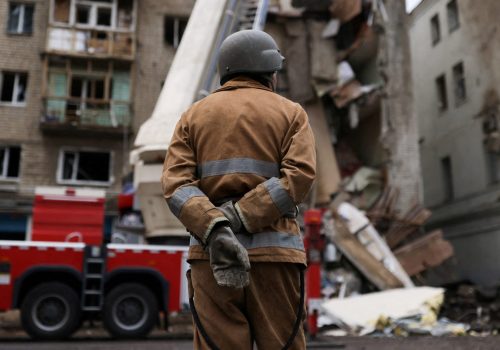
In the short term, there are fresh threats from Moscow—attacks on electricity, water, and heat as winter approaches, sham annexations of occupied territories, mobilizations of new troops, reduced but persistent nuclear risk, and Russian prisoners to manage. Areas that Ukraine has liberated from Russian forces need immediate governance, cleanup, humanitarian assistance, and economic revival. Over the longer term, Ukraine will have to rebuild destroyed infrastructure; institute the economic and political reforms required for European Union (EU) membership; and be capable of ensuring its security.
How exactly to meet these looming challenges while exploiting present and future opportunities?
It is, of course, up to the Ukrainians to determine their priorities and their supporters to assist as much as possible, which is also consistent with US interests. But what’s urgently needed is a four-front, long-haul strategy for helping Ukraine win the war against Russia and the peace that follows—one built to withstand the dramatic developments that are sure to play out over the coming years, not just over the next weeks and months of this rapidly evolving conflict.
Building on a Strategy Consortium meeting with leading experts on Ukraine and Russia, we have developed just such a strategy. Among our top recommendations in the military, economic, political, and diplomatic domains are the following:
- The United States needs to make explicit that it supports Ukrainian victory and Russian defeat in terms of the Kremlin’s strategic goal of destroying the Ukrainian nation and Ukrainian identity.
- Washington should not be self-deterred by Russian nuclear threats.
- The United States and its allies and partners should confiscate the currency reserves of the Central Bank of Russia, which are currently frozen in the West, and transfer these reserves to the Ukrainian government, with appropriate oversight, as needed for budget support, with the balance used for fast recovery, cleanup, and the rebuilding of infrastructure.
- In meetings with their Ukrainian contacts, senior Western officials should raise issues related to political and economic reform alongside urgent war-related matters. But to ensure that Ukraine can maintain its war effort, at a time when it risks losing up to 35 percent of its gross domestic product (GDP) this year, economic assistance as a whole cannot be conditioned on political reform at this point.
- The most important step Ukraine and the West can take to contribute to diplomacy is to support Ukraine’s war effort with military equipment, training, and economic support.
Below is our proposed strategy in full.
Military recommendations
The United States needs to make explicit that it supports Ukrainian victory and Russian defeat in terms of the Kremlin’s strategic goal of destroying the Ukrainian nation and Ukrainian identity. It should commit to helping the Ukrainian people achieve a democratic, independent, sovereign, prosperous Ukraine that has the means to deter and defend itself against any future Russian aggression.
The United States, NATO allies, and other key partners need to plainly articulate a strategic narrative and rationale for that goal. This narrative might take the following form:
- Without a shred of justification, Vladimir Putin ordered a new attack on Ukraine, a peaceful, sovereign nation that, like the Russian Federation, has been independent for thirty years. Putin’s aggression represents a clear and present danger to US and European security and prosperity. As Putin has made clear, a Russian victory would put NATO allies at severe, unacceptable risk. Moreover, Putin’s aggression is a campaign with genocidal features aimed at erasing a sovereign Ukraine from the map and eradicating Ukrainians’ cultural and national identity. If Russia prevails, other nations in the region, including NATO allies, could be next. The Ukrainians are justly defending their sovereignty, freedom, and independence, as well as principles enshrined in the Charter of the United Nations and the Helsinki Final Act including that borders may not be changed by force. It is in the interests of the United States, NATO, and other partners to support Ukraine in defending its right to exist and to help the Ukrainians defeat Russian aggression and thwart Putin’s revisionism. It is also in their interest to reestablish the principles of respect for national sovereignty, territorial integrity, and internationally recognized borders—principles that are widely embraced throughout the world as critical to international peace and security.
Given the great risk to US security and prosperity if the Kremlin wins in Ukraine, it is essential for the president, other senior administration officials and congressional leaders in both parties to explain clearly and regularly to the American people why it is in the US interest to provide ongoing, substantial assistance to Ukraine.
The Ukrainians have demonstrated skill and competence in defending their nation. They know best how, when, and where to defeat the Russians, including what weapons are needed to do it faster and with less loss of life. While the United States should consult with Ukrainian officials on the issue, it is the Ukrainians who will have to decide and execute any military operations. The US and allied role is to continue to provide and accelerate military support for the overall Ukrainian campaign plan.
The United States and NATO allies should provide the amount and kind of military support the Ukrainians require, short of deploying NATO forces to Ukraine. This is even more important now as Putin mobilizes new forces and in the process spurs unrest in Russia. The Ukrainians are justified in using their weapons, including those received from Western partners, to attack any Russian forces that attack them wherever those attacking Russian forces are located. The United States and NATO should get the requested weapons to Ukraine faster to enable a successful counteroffensive, especially as the Kremlin rushes new conscripts to the battlefield. Russia should be left in no doubt that the use of weapons of mass destruction, or any form of attack on NATO members, would have catastrophic consequences. The United States and NATO should be prepared to respond to such use or such an attack accordingly. That policy should be publicly announced, and the United States and NATO should quietly move conventional and nuclear weapons systems into position to be prepared to execute that policy, taking into account the scale and nature of the Russian attack. The United States must recognize that it is far easier for Putin to threaten nuclear war than to initiate it. Therefore, Washington should not be self-deterred by Russian nuclear threats.
This is an immediate issue as the Kremlin-run sham referenda in four areas of Ukraine that it does not fully control have yielded the expected putative results in favor of joining Russia. At the same time, Moscow is stating that it will use all its capabilities, including nuclear weapons, to defend the “motherland” and intimating that this would now apply to these territories. Moscow’s purpose is to deter Ukraine (with US support) from extending its counteroffensive to those parts of Ukraine currently under Russian control. As the United States has not discouraged Ukraine from conducting operations against targets in Crimea, it should not discourage Kyiv from operations designed to regain control over any Ukrainian territories Russia now purports to annex in the east and the south. The United States should also reiterate the excellent warnings conveyed publicly by President Joe Biden on 60 Minutes and at the United Nations against Moscow’s use of weapons of mass destruction in Ukraine.
In managing and treating Russian prisoners of war (POW) and conducting war-crimes trials, Ukraine must continue to adhere to the Geneva Convention. We recommend the United States and NATO assist Ukraine in establishing a civil-military board to oversee POW camps and treatment regimes. Ukraine should also seek, accept, and facilitate Red Cross and Organization for Security and Co-operation in Europe (OSCE) observation and assistance. The United States, Ukraine, and other partners should demand that Russia’s treatment of POWs adhere to the Geneva Convention and that Russia provide Red Cross and OSCE access to them.
Economic recommendations
With its GDP projected to decrease by up to 35 percent this year, Ukraine needs dramatically increased budgetary and economic support to keep its economy afloat as it defends itself against the Russian invasion. The most urgent need is for monthly budget support, which the United States has provided, but the EU has not fully delivered. Since the United States is providing the preponderance of the military support (although the Europeans should do much more), it is only fair to ask that Europe provide the preponderance of the economic support, which will help ensure sustained US public and congressional support for Ukraine. This section outlines urgent and medium-term recommendations for policymakers.
The United States, the European Union, and their allies and partners should focus on addressing Ukraine’s monthly budget deficit challenge to enable Kyiv to sustain the war effort. The United States needs to exhort the EU to deliver on its budget support. Ukraine is running a nonmilitary budget deficit of $5 billion per month. The United States gives $2.5 billion a month through a World Bank trust fund, while the EU disbursement to this point falls short of its total commitment of $10.2 billion.
Furthermore, the United States needs to continue to focus on grants to Ukraine, not loans, and urge European governments and international financial institutions to do the same. Before the war, Ukraine had a public debt of 50 percent of GDP; with a falling GDP and exchange rate, the country’s rising public debt is expected to reach 95 percent of GDP at the end of this year. This is untenable and will require debt restructuring. Therefore, Ukraine needs grants, which the United States gives, and not loans, which is what the EU and international financial institutions (IFIs) currently give.
The United States, the EU, and their allies and partners should increase sanctions on Russia to include all Russian banks and oligarchs. At the same time, they should confiscate the currency reserves of the Central Bank of Russia currently held and frozen in the West. They should transfer these reserves to the Ukrainian government with appropriate oversight, as needed for budget support, with the balance used for fast recovery/cleanup and rebuilding of infrastructure. The currency reserves held and frozen in the West amounted to $316 billion as of January 1, according to the Central Bank of Russia. Germany held $96 billion, France $61 billion, Japan $57 billion, the United States $39 billion, the United Kingdom $31 billion, Canada $17 billion, and Austria $15 billion.
The United States should work with the aforementioned countries (including through the EU and Group of Seven) to pass national legislation that would enable confiscation and transfer of these funds to the government of Ukraine. Canada has already legislated confiscation of Russian assets. Central bank reserves, not oligarch assets, are initially the right target. These funds are liquid, and they involve the least amount of administrative and legal work. Work should then be undertaken on whether and how to reach oligarch assets and transfer them to the Ukrainian government for similar purposes.
The United States and EU should advocate for as large of an International Monetary Fund aid package for Ukraine as possible. Ukraine has already begun discussions with the IMF.
The United States and the EU should provide humanitarian assistance to help Ukrainians get through this winter, including support for rapid repairs of critical energy, water, and heating systems. Having lost the initiative on the battlefield, Russia is targeting Ukraine’s civilian infrastructure ahead of the winter. The United States and the EU should give Ukrainians humanitarian support to stay warm through the winter and to protect and quickly fix damaged infrastructure.
There is a need to address the energy crisis in Europe and to help ensure Europe is prepared for winter. The United States should encourage Germany to extend the life of its last three nuclear reactors for at least another year. The United States should also speed up its permitting process to allow the number of liquefied natural gas terminals in the United States to expand and bring more terminals online. Appropriate US officials should consult closely and frequently with European counterparts to help them think through the problem, offer innovative suggestions as to how energy can be managed more efficiently and effectively, and extend whatever other assistance the United States can provide. The US effort in Ukraine has a lot riding on the European energy issue if solidarity with European allies is to be maintained.
The United States and EU should encourage their business communities and universities to offer job training and vocational education to Ukrainians. There is an acute need for job training to support the unemployed and internally displaced persons within Ukraine. More vocational training could help the unemployed find jobs in the near term and restart the Ukrainian economy.
Political recommendations
The priority task in Ukraine right now is to defeat the major conventional attack Putin launched in February. Ultimately, promoting political and economic reform remains critical to Ukraine’s future, but it is currently a secondary priority to defeating Putin’s war aims. That said, the United States and its allies and partners must still keep reform on the agenda in Ukraine. Without attention to these matters, Ukraine risks winning the war and losing the peace. Ukraine needs to defeat Russian aggression as a priority. But the United States and its allies and partners should build upon the prospects for Ukraine’s EU accession and the growing intolerance within Ukrainian society for corruption to set the stage for major reform, especially as the country begins to rebuild after the war. To this end, we put forth the following recommendations:
While Ukraine and supportive governments are properly directing most of their attention to the war, senior Western officials should nonetheless periodically raise political and economic reform issues alongside urgent war-related matters in meetings with their Ukrainian contacts; however, to ensure that Ukraine can maintain its war effort at a time when it risks losing up to 35 percent of its GDP this year, economic assistance as a whole should not be conditioned on reform. If, notwithstanding, donors do decide to impose conditions on such assistance, they should all use the seven EU accession criteria, five of which pertain to governance and anti-corruption actions.
The West is providing enormous resources to Ukraine, which has offered to accept any tracking mechanism that its donors request. To ensure that the aid they provide is being used properly, the United States and its allies and partners should set up an appropriate system for the various assistance streams and do so in ways that are as simple and impose as little administrative burden on the Ukrainians as possible. The establishment of such a tracking mechanism could help manage criticism in donor countries that aid to Ukraine will be lost to corruption; on the military side, it could also help get equipment to the front faster.
As a priority matter on any reform agenda, the United States, the EU, and IFIs should support the appointment of reformers to key positions in Ukraine’s justice sector: the various prosecutorial agencies and the courts. They should also carefully monitor the state of play with media in Ukraine. Since the war began, all the major television stations have been combined into one station overseen by the government, advertising revenues have dried up, making it more difficult for independent media to stay afloat, and Rada TV (the Ukrainian equivalent of C-SPAN) was recently taken off air. The objective of US, EU, and IFI efforts should be to ensure that Ukrainians have access to free media and a plurality of voices.
Diplomatic recommendations
The most important step Ukraine and the West can take to contribute to diplomacy is to support Ukraine’s war effort militarily and economically. Moscow is only likely to negotiate in earnest if it faces defeat on the battlefield. Postwar diplomatic settlements often reflect the balance of power on the ground.
Ukrainian President Volodymyr Zelenskyy and the West should reject Russian cease-fire proposals that would lock in Russian territorial gains. Under Putin’s leadership, Russia has never returned conquered territory to its original, legal jurisdictions. A “frozen” conflict will be used as a means of further destabilization of Ukraine and preparation for a new conflict when the time is right. When it is agreed, a cease-fire should be unconditional and not made contingent on sanctions relief. Once sanctions against Russia are removed, it is most unlikely that they will be restored. Sanctions should not be lifted until Russian forces withdraw from Ukraine’s territory and Russia pays compensation for the damage caused by its invasion. The United States and its allies and partners should maintain a strictly enforced export control regime on Russia to deny it the things it needs to maintain its military effort. All should be steadfast in opposing the allure of what would be an unrealistic and short-lived peace.
Any postwar settlement should include clear security guarantees for Ukraine. Ukraine must be able to deter Russia in order to prevent a recurrence of the war. These security guarantees could take a few different forms:
- NATO membership should be the goal, but it may be hard to achieve unanimous support in the alliance for Ukraine’s accession in the near term. Still, the prospect of membership should remain on the agenda for consideration at a more favorable moment. Ukraine’s demonstrated military prowess makes clear that the country would enhance NATO’s defense capacity.
- In the interim, as part of a settlement to the conflict, powerful countries with an interest in Ukraine’s sovereignty and independence, such as the United States, the United Kingdom, Poland, and others should promise some form of bilateral security guarantees.
- As the Biden administration’s actions suggest, Washington and the West should pursue a US-Israeli model, whereby the United States and other Western powers provide a sufficient quality and quantity of military and financial aid to ensure that Ukraine is able to build a military force capable of deterring and, if deterrence fails, defeating a further Russian invasion.
The West also should work to embed Ukraine more closely in other multilateral institutions, including eventual EU membership. Furthermore, NATO should consider ways to continue to enhance its partnership with Ukraine, even if Kyiv does not immediately become a full member of the alliance.
Stephen J. Hadley is a principal of Rice, Hadley, Gates & Manuel LLC, the chairman of the Atlantic Council’s International Advisory Board and an executive vice chair of its Board of Directors, a member of the United States Institute of Peace’s Board of Directors, and the former national security advisor to the president of the United States from 2005 to 2009.
William Taylor is a vice president for Russia and Europe at the US Institute of Peace, a former US ambassador to Ukraine from 2006 to 2009, and a former chargé d’affaires at the US embassy in Kyiv in 2019.
John E. Herbst is the senior director of the Atlantic Council’s Eurasia Center and a former US ambassador to Ukraine from 2003 to 2006.
Matthew Kroenig is the acting director of the Atlantic Council’s Scowcroft Center for Strategy and Security, a professor of government and foreign service at Georgetown University, and a former US. Intelligence and Defense Department official.
Melinda Haring is the deputy director of the Atlantic Council’s Eurasia Center.
Jeffrey Cimmino is an associate director of the Scowcroft Strategy Initiative within the Atlantic Council’s Scowcroft Center for Strategy and Security.
This strategy paper benefited from the insights of workshop participants, including Philip Breedlove, Paula Dobriansky, Anatoliy Grytsenko, Mark Hertling, David Kramer, Joseph Nye, Barry Pavel, Stephen Sestanovich, James Sherr, Alexander Vershbow, and Masha Yovanovitch. These participants support the general thrust of the paper, though not necessarily every recommendation.
Related content
The post Preparing for victory: A long-haul strategy to help Ukraine win the war against Russia—and secure the peace appeared first on Atlantic Council.