Categories
Audio Sources - Full Text Articles

Egypt’s Climate Summit Was a “Rehearsal” for COP28 in Dubai

At COP27 in Sharm El-Sheik, Egypt, climate justice and human rights advocates found ways to come together and make their voices heard, despite the country’s repressive regime. But some worry about what comes next, for Egyptian activists when they are no longer in the international spotlight, and for climate activism at next year’s U.N. summit in Dubai.

The post Egypt’s Climate Summit Was a “Rehearsal” for COP28 in Dubai appeared first on The Intercept.

Categories
Audio Sources - Full Text Articles

Serbia charged over locker room Kosovo flag at World Cup

DOHA, Qatar (AP) — The Serbian soccer federation was charged by FIFA on Saturday for hanging a political banner about neighboring independent state Kosovo in the locker room before playing Brazil at the World Cup.

It showed a map of Serbia that included the territory of its former province, which has been an independent state for nearly 15 years, and the slogan “No Surrender.”

Photos circulated of the banner draped over the lockers of Milos Veljkovic and Andrija Zivkovic ahead of the team’s 2-0 loss to Brazil on Thursday in Qatar.

Kosovo’s soccer federation formally complained to FIFA and its sports minister, Hajrulla Ceku, described the image as using the World Cup to promote “hateful, xenophobic and genocidal messages.”

FIFA cited a section of its disciplinary code that covers misconduct including “offensive gestures, signs or language” and “using a sports event for demonstrations of a non-sporting nature.”

Soccer’s governing body gave no timetable for a verdict, though Serbia next plays on Monday against Cameroon.

Since Kosovo was made a member of FIFA and UEFA in 2016, the European soccer body has ensured for security reasons that its national teams cannot be drawn with Serbia or Bosnia- Herzegovina in qualifying groups for the World Cup and European Championship.

The issue of Kosovo’s independence sparked a 1998-99 war in which about 13,000 people died. Serbia launched a brutal crackdown to curb a separatist rebellion by the territory’s ethnic Albanians. NATO bombed Serbia in 1999 to end the war.

Kosovo unilaterally broke away from Serbia in 2008. The Serbian government, with support from China and Russia, has refused to acknowledge Kosovo’s statehood. The United States and most of its European allies recognize Kosovo as an independent country.

___

AP World Cup coverage: https://apnews.com/hub/world-cup and https://twitter.com/AP_Sports

Categories
Audio Sources - Full Text Articles

Come Back Alive Fund hands over 15 sets of SIGINT equipment to Ukraine’s Army

630_360_1666678408-503.jpg

Getting into account the great importance of data Ukrainian forces acquire on the enemy with the enable of signals intelligence (SIGINT), the “Occur Back again Alive Charity Fund, alongside one another with the Infozakhyst analysis and production heart is handing in excess of 15 sets of SIGINT machines to the Military.

The push assistance of the Major Intelligence Directorate of the Ministry of Protection reported this on Telegram, according to Ukrinform.

”With the assist of these kits, Ukrainian troopers will be equipped to strengthen the processes of gathering and processing intelligence relating to the enemy,” the statement reads.

Study also: Lithuanians raise $250,000 for naval drone for Ukraine – Fedorov

As reported, the Odesa Law enforcement Section wrote that a lot more than UAH 3 million truly worth of Russian-created tableware  was handed above to the Armed Forces units in the town.

Source link

The post Come Back Alive Fund hands over 15 sets of SIGINT equipment to Ukraine’s Army appeared first on Ukraine Intelligence.

Categories
Audio Sources - Full Text Articles

World Cup analysts cite more goals from crosses, penalties

DOHA, Qatar (AP) — More crosses creating more goals. Winning penalties with “total genius” like Cristiano Ronaldo. Pressing opponents to quickly win back the ball.

FIFA’s expert analysts picked their World Cup trends Saturday from the first 16 games after each team played once.

What the Technical Study Group saw was more and better crosses bearing fruit with a big increase in the number of goals — 14 instead of three — coming from wide areas compared to the 2018 tournament at the same stage.

The nine penalty kicks awarded in the first 16 games put this World Cup on track for a record 36 in the entire 64-game tournament. There were 29 given by referees in 2018 when they first had video reviews.

Clever players should get as much credit as new technology, according to Sunday Oliseh, a midfielder who played at two World Cups for Nigeria and is studying games in Qatar for FIFA.

“Maybe the strikers are getting smarter? If you look at the penalty that Ronaldo got,” he said about the Portugal star seeming to tempt a Ghana defender into a tackle that was judged a foul.

“People can say what they want about this man, but the smartness and the ingenious thought to just being patient and wait for that split second to touch the ball first before you,” Oliseh said, “and continue my leg so that your contact will hit my leg.”

“That is total genius,” he added.

Ghana coach Otto Addo might disagree. He described the penalty as “ a special gift from the referee.”

Ronaldo got off the turf to open the scoring in Portugal’s 3-2 win, one of the seven penalties converted among the 41 total goals in 16 games through Thursday.

That’s a solid average at a World Cup — a rate of 2.56 per game compared to the record of 2.67 at a full, 64-game tournament.

Helping make up for the four scoreless draws, the FIFA analysts highlighted, was the impressive delivery from wide areas.

The 14 goals stemming from crosses resulted from a better supply in Qatar where 56 crosses have led to goal attempts compared to just 35 in Russia four years ago, FIFA’s analysis said.

Four games without goals — when the first 36 games in 2018 failed to produce a 0-0 draw — can be explained by teams’ caution to avoid losing their first game.

Oliseh said the Portugal-Ghana game was drab until Ronaldo’s penalty “then it became a funfair” with a rush of second-half goals.

“As the tournament progresses we will see teams becoming a bit braver,” said Alberto Zaccheroni, the Italian coach who led Japan at the 2014 World Cup.

Teams that committed to pressing opponents deep in their own half were rewarded with regaining possession in dangerous areas and avoided chasing back toward their own goal, Zaccheroni said.

FIFA data showed England, Spain, Germany and Argentina were most effective at “counter-pressing” tactics many players routinely use at their clubs.

Coaches now having five substitutes meant their teams could keep “physically very taxing” energy levels high for the full game, Zaccheroni said.

___

AP World Cup coverage: https://apnews.com/hub/world-cup and https://twitter.com/AP_Sports

Categories
Audio Sources - Full Text Articles

Iran shuts out noise at World Cup but United States looms

DOHA, Qatar (AP) — After a World Cup start clouded by a disastrous loss and persistent questions about the civil unrest back home, Iran is celebrating the prospect of its first ever trip to the knockout stage.

But first, Team Melli faces the United States.

Iran defeated Wales 2-0 Friday and collected the three points to rise from the bottom of Group B. England and the United States played to a scoreless draw on the same day — setting up a politically fraught match between Iran and the Americans on Tuesday that will decide which team goes through to the round of 16.

The prospects of advancement certainly weren’t as bright at the start of the tournament when Iran was routed by England 6-2.

“I told the players, very clear: Football is a game of a different moments. It’s not because you win or you don’t win. Sometimes you lose your dignity, you lose your honor. After the first game, we were bleeding in our pride,” said Carlos Queiroz, the Portuguese coach who also led Team Melli at the 2014 and 2018 World Cups.

Queiroz’s task was to convince his team that all was not lost. But at the same time, Iran’s players were facing pressure to answer for the wave of protests in Iran.

The turmoil was sparked by 22-year-old Mahsa Amini’s death in September while in custody for allegedly violating Iran’s compulsory dress code for women. Her death has become a rallying cry against the country’s treatment of women.

The players did not sing the national anthem before the loss to England in an apparent show of solidarity with protestors, but in the days before the match against Wales, it became clear that the team wanted to focus solely on soccer. Queiroz even sparred verbally with a reporter following a pre-match news conference.

The tensions were heightened following the reported arrest Thursday of former national team player Voria Ghafouri in Iran for his criticism of the government.

The players sang their anthem, although not forcefully, before the game against Wales and then went on to win on a pair of second-half stoppage-time goals. Rouzbeh Cheshmi, who scored the go-ahead goal, suggested afterward the team felt pressured.

“I believe at this time, certain things happened for the players that were not quite fair. I believe that they were judged improperly and therefore they received some non-football pressures,” Cheshmi said. “I believe that the entire family of the Team Melli helped each other and as a result the entire team were able to win. I scored the goal, that is true, but the team did the work.”

But Iran could not entirely escape the discord at home: Outside the stadium pro-government fans clashed with the few who dared to wear “Women, Life, Liberty” T-shirts, a slogan of the movement. Those in the shirts had to change before they were allowed in the stadium.

While the victory gave Iran back its joy, in the words of Quieroz, it will undoubtedly bring even more focus on geopolitics ahead of the deciding match with the United States. In addition to the over-arching tensions between the two nations, U.S. Soccer had taken a progressive stand for women’s rights, granting equal pay between its men’s and women’s team — including the equal division of World Cup prize money.

As it stands in Group B, if Iran can beat the United States, it will move on. The Americans win and they’ll advance, but a draw or a loss sends them home.

England leads the group after the scoreless draw with the Americans. England will qualify for the knockout stage with a win or a draw against Wales. The Welsh will need a victory to keep even slim hopes of advancing alive.

If Wales beats England, Iran will need at least a draw against the United States and goal difference will matter.

“Now we need to be sure that we are good enough to go to the second round. So we start immediately the preparation to play against the U.S., which is a brilliant team as well, as we saw them against Wales,” Queiroz said. “Our preparation starts with a good rest, refresh the minds and put all the complementary and garbage things outside of our minds and focus on our goal, because what we want to do it to give this gift to Iranian fans.”

___

AP World Cup coverage: https://apnews.com/hub/world-cup and https://twitter.com/AP_Sports

Categories
Audio Sources - Full Text Articles

Why the Idea of a ‘Normal’ Body Is So Insidious

The first dressing room I remember was at Hudson’s, a Detroit-based department store where middle-class people in my town went to get things that were “nice.” It was the place where my mother bought me overalls and hair bows, where she bought herself high-heeled shoes displayed like pastries on wooden pedestals.

On those shopping trips, my mother would gather a pile of clothes, hunting and pecking her way through the various women’s departments. We both loved this part. For me, the initial search on a shopping trip is when optimism is at its peak, the time when all the garments on offer might actually fit, when they still might actually look good. It is during the second act of the shopping experience when it all goes awry.

[time-brightcove not-tgx=”true”]

My mother, always so neat and thoughtful, hung up her garments before changing out of her own clothes. She had once worked in a Hudson’s, and so was aware of all the perpetual folding and steaming that the saleswomen had to do. She unfurled each pair of new pants, stepped inside them, and examined herself in the mirrors.

This was the hard part.

My mom rarely liked clothes once she wore them. The promise she’d seen in each garment on its hanger was dashed once she had buttoned and zipped it onto her body. The hem was revealed to be too long, the waist too wide; the material hugged her too tight. But her language—our language—for what was wrong was never about the clothes. Instead, it was about ourselves. “I’m too short,” she’d say, or, “My arms are too flabby.” And always, always: “My butt is too big.” In other words: The clothes are not flawed. I am.

Read More: Inside the Fight to Take Back the Fitting Room

In addition to all the other tacit work the fashion industry does to define what different body types mean, clothing offers a frank materialization of rightness. Pants are a physical object you can hold in your hands, reminding you that there are parts of your body that literally do not fit. For everything that reveals itself to be too big, or too small, there is the clear indication that somewhere there is a thing that is just right, a body that is in the middle, a body that is correct.

This middle thing is somehow both an ideal and an average, made perfect by not being too much of anything. But what is this middle thing, this normal thing? My mother always said her butt was too big. I often say the same thing. But “too big” compared to what?

“Normal” is an insidious concept—and one that the fashion industry has long tried to define. Bodies are bespoke, yet most clothes made since the 1920s are mass-produced industrial products: when the pants don’t fit, it’s because the proportions of a body don’t match up to the proportions that the clothing companies imagined for it. But the fashion industry isn’t the only entity that has invested in the damaging idea of “normal”—it has long been used by society at large to other and exclude.

Norma’s butt is 29 inches across, from hip bone to hip bone. It’s round and pert and, because it’s made of stone, alarmingly smooth. It is substantial, a handful, but no one would call it big. If it were made of flesh, it would fill out a swimsuit nicely, but I doubt it would elicit a long second look. Norma has the Goldilocks butt, the Goldilocks body. Everything about her, at least according to the people who designed her, is “just right.”

In June 1945, Norma made her first appearance, at an exhibition hall at the American Museum of Natural History in New York. On the other end of the hall stood her male counterpart, Normman. The pair were representations of the “typical” reproductive human adult male and female, and were created by gynecologist Robert Latou Dickinson and artist Abram Belskie.

Norma was not voluptuous and she was not skinny. She was strong, robust, and capable of bearing many children—not too sexy, but clearly fertile. As her name suggests, Norma was not, in any real way, exceptional. She was normal.

But just what did that mean? The statue suggests a very specific concept of normal: she was white, heterosexual (Normman steadfastly stood by her at all times in the exhibition hall to reassure us of that), and able-bodied. She was a little dour, offering none of the seduction of classic statuary, and stood perfectly erect, arms by her sides, posed as if in a scientific drawing. She was appealing (as her name suggests) in her normal-ness—and that was the intent.

Norma and Normman were a project of American eugenics, the racial science invented by Francis Galton that had built on the work of Georges Cuvier and other 19th-century thinkers to create and enforce a hierarchy of human bodies. While one strain of eugenicists in the United States was working hard to eliminate the unfit through sterilization, others were busy encouraging the “right” people to have children. Those involved in this branch of eugenics—called positive eugenics—tried to make it as clear as possible which Americans they thought should be procreating.

Standing in the halls of the most famous natural history museum in America, Norma and Normman exemplified to visitors what kinds of adult bodies, and people, were “fit.” The museum displayed them as singular objects, creations meant to codify the aesthetics of normality in the immediate aftermath of World War II, when normal was what many people very much aspired to be.

In the interests of maintaining a “scientific” approach, Belskie and Dickinson relied on data in the creation of Norma and Normman, rather than subjective preference. The specifications for Normman’s creation had been easy enough to come by: during World War I, the military had measured every drafted U.S. serviceman. There also was data from men who had volunteered to be measured at the Chicago World’s Fair, as well as statistics from the early years of the Ivy League posture studies and insurance company physicals. They just had to be added up, divided, and voilà! The average American man.

Norma’s creation, however, proved to be more difficult. Women didn’t serve in the military at the time, and, at first, there seemed to be no large repository of measurements of the female population. But Belskie and Dickinson were living in an age of metrics, a time when it seemed that all things could and must be measured, managed, and known. Surely the female body was of interest to researchers somewhere.

In 1945, they finally found the data set they were looking for. Five years earlier, a group of researchers had measured thousands of American women at the USDA’s Bureau of Home Economics, one of the only places where female scientists and statisticians could find a home in the first half of the 20th century. The effort had been led by a chemist named Ruth O’Brien, who worked to find a way to create standard sizes for ready-made clothes.

The study, funded by the Works Progress Administration and lasting for one year, sought to discover the girths, lengths, and heights of the American woman in all her difference. To do so, O’Brien sent government-employed measurers to Illinois, Maryland, Arkansas, New Jersey, North Carolina, and California. In municipalities across the country, “measuring squads,” as she called them, recruited volunteers from local women’s clubs. Each was asked to wear cotton measuring shorts and a not-too-tight-fitting bandeau bra and was invited to step onto a measuring platform, where they were weighed using a government-issued scale. Then, the measurer took 58 additional measurements, including “sitting spread girth,” “anterior crotch length,” and “maximum thigh girth.” The squads brought in 15,000 surveys, but O’Brien ultimately only used 10,000. She discarded the other 5,000 for one of three reasons: there had been a gross error, there were too many young people in the data set, or the volunteers weren’t white. The truth was, O’Brien wasn’t interested in data for all American women; she wanted data from all American-born white women.

Read More: Can Gen X Women Love Their Bodies?

In his article about Norma and Normman, “A Portrait of the American People,” which ran in the museum’s magazine in 1945, Harry L. Shapiro, the curator of physical anthropology at the American Museum of Natural History, praised the statues for helping to codify the “White American”—a category of person he feared was in danger of being sullied and diminished through racial mixing. Shapiro, who would go on to be the president of the American Eugenics Society, also emphasized how the average could be an ideal. “Norma and Normman, although they were designed to conform with the average adult before the onset of the ravages of age, exhibit a harmony of proportion that seems far indeed from the usual or the average.” Their averageness was notable and, paradoxically, unique. Shapiro said, “Let us state it this way: the average American figure approaches a kind of perfection of bodily form and proportion; the average is excessively rare.”

When I first read Shapiro’s conflation of the word normal with perfection, I found it to be a bit of a stretch. Perfection, after all, suggests an apex rather than a middle, a singular kind of human who is, in some sense, above all others. The way I’d always understood it, a perfect human woman would be smarter, more beautiful, thinner, and more graceful than the rest. She’d be special, not typical.

And yet, Shapiro’s formulation does make intuitive, if not actual, sense. I had often found my own body to be, in some small sense, abnormal. My large butt, my slightly crossed eye, and my poor performance in any and all sports always felt like defects when, in fact, they were characteristics of mine that were surely quite common. And yet, those characteristics never felt normal, because the notion of normal is not about averages or commonly occurring traits, but instead about an unattainable ideal.

The idea of normal, it seems, always comes with some kind of agenda. In the case of Norma, the minds that collated her measurements were enthusiastic eugenicists, motivated by a desire to effectively eradicate insufficiently white, disabled, and queer people. They were openly attempting to engineer a race of perfectly normal Americans, equating full citizenship with having this decisively average, yet demonstrably unattainable, body. By codifying normal, the Norma boosters were also codifying abnormal, which is always the implicit project of the creation of an ideal.

But if the creation of Norma proves anything, it’s that no body actually is normal. Despite all her rigorous measuring, Ruth O’Brien’s study failed—even after measuring thousands of women and crunching and tabulating all the data, there were too many variables for her to create a meaningful set of recommendations for ready-to-wear clothes. She failed to find the superlative normal that she craved, because creating something singular inevitably separates it from the group. Her project couldn’t work because bodies aren’t standard.

It’s tempting to think that we have outgrown Norma, that we have transcended the pernicious fantasy of an empirical and enforceable “normal.” But the truth is that while the material of normalcy is a moving target, the concept of “the normal” is extraordinarily durable, even if there are no scientists and sculptors openly regulating it. It may not be staring us down in a museum of hygiene, but it is always lurking—in dressing rooms, in magazines, in the endless scroll of Instagram.

Copyright © 2022 by Heather Radke. From the forthcoming book BUTTS: A Backstory by Heather Radke to be published by Avid Reader Press, an Imprint of Simon & Schuster, Inc. Printed by permission.

Categories
Audio Sources - Full Text Articles

Taiwan president quits as party head after China threat bet fails to win votes

2022-11-26T14:27:30Z



Polls opened in Taiwan on Saturday (November 26) in local elections that President Tsai Ing-wen has framed as being about sending a message to the world on the island’s determination to defend its democracy in the face of China’s rising bellicosity.

Taiwan President Tsai Ing-wen resigned as head of the ruling Democratic Progressive Party (DPP) on Saturday after her strategy to frame local elections as showing defiance to China’s rising bellicosity failed to pay off and win public support.

The elections for mayors, county chiefs and local councillors are ostensibly about domestic issues such as the COVID-19 pandemic and crime, and those elected will not have a direct say on China policy.

But Tsai had recast the election as being more than a local vote, saying the world is watching how Taiwan defends its democracy amid military tensions with China, which claims the island as its territory.

The main opposition party the Kuomintang, or KMT, was leading or claimed victory in 13 of the 21 city mayor and county chief seats up for grabs, including the capital Taipei, compared to the DPP’s five, broadly in line with expectations and similar to the results of the last local elections in 2018.

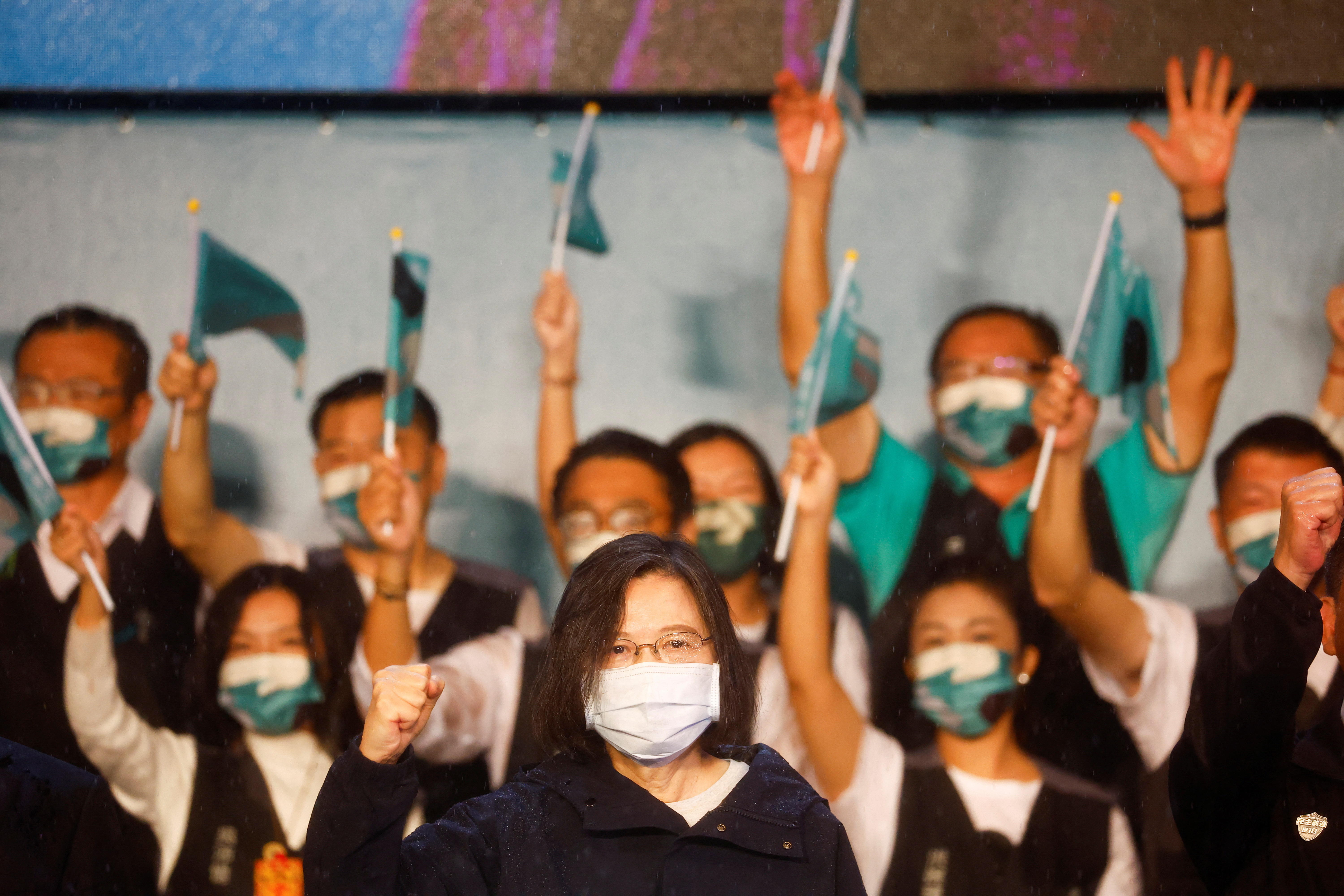
“The results failed our expectations. We humbly accept the results and accept the Taiwanese people’s decision,” Tsai told reporters at party headquarters as she quit as party head, which she also did after 2018’s poor results.

“It’s not like the DPP has never failed before,” Tsai, who will continue serving as president until 2024, added. “We don’t have time to feel sorry. We fell, but we will stand up again.”

Tsai said she had rejected a resignation offer from Premier Su Tseng-chang, also a senior DPP member, adding she had asked him to stay in office to ensure her policies would be properly implemented.

The Cabinet said Su had agreed to stay due to the need for stability amid the “arduous” domestic and international situation.

China’s response was muted, with the official Xinhua news agency simply noting Tsai’s resignation “to take responsibility for the party’s performance in Taiwan’s local elections”.

Both the DPP and KMT, which traditionally favours close ties with China though strongly denies being pro-Beijing, had concentrated their campaign efforts in wealthy and populous northern Taiwan, especially Taipei, whose mayor from the small Taiwan People’s Party could not run again due to term limits.

The KMT has accused Tsai and the DPP of being overly confrontational with China, and of trying to besmirch the party for being “red” – a reference to the colours of the Chinese Communist Party.

It focused its campaign on criticising the government’s response to the COVID-19 pandemic, especially after a surge in cases this year.

KMT Chairman Eric Chu celebrated their victory, but said they would also protect Taiwan’s freedoms.

“We will insist on defending the Republic of China and protecting democracy and freedom,” he told reporters, using Taiwan’s official name. “We will also work hard to keep regional peace.”

China carried out war games near Taiwan in August to express anger at a visit to Taipei by U.S. House Speaker Nancy Pelosi, and its military activities have continued, though on a reduced scale.

The election took place a month after the 20th congress of China’s Communist Party, where President Xi Jinping secured an unprecedented third term in office – a point Tsai repeatedly made on the campaign trail.

Focus will now turn to the 2024 presidential and parliament election, which Tsai and the DPP won by a landslide in 2020 on a pledge to stand up to China and defend Taiwan’s freedoms.

Tsai is serving her second term in office and cannot stand again as president because of term limits.

Related Galleries:

People line up to cast their votes on election day in Taipei, Taiwan, November 26, 2022. REUTERS/Ann Wang

Staff prepare the ballot box ahead of election day in Taipei, Taiwan, November 26, 2022. REUTERS/Ann Wang

People line up to cast their votes on election day in Taipei, Taiwan, November 26, 2022. REUTERS/Ann Wang

Taiwan President Tsai Ing-wen casts her vote at a polling station during local elections in New Taipei City, Taiwan, November 26, 2022. REUTERS/Carlos Garcia Rawlins

Staff prepare the ballot box ahead of election day in Taipei, Taiwan, November 26, 2022. REUTERS/Ann Wang

Taiwan’s President Tsai Ing-wen attends a campaign rally of the Democratic Progressive Party (DPP) ahead of the local elections, in Taipei, Taiwan November 25, 2022. REUTERS/Carlos Garcia Rawlins

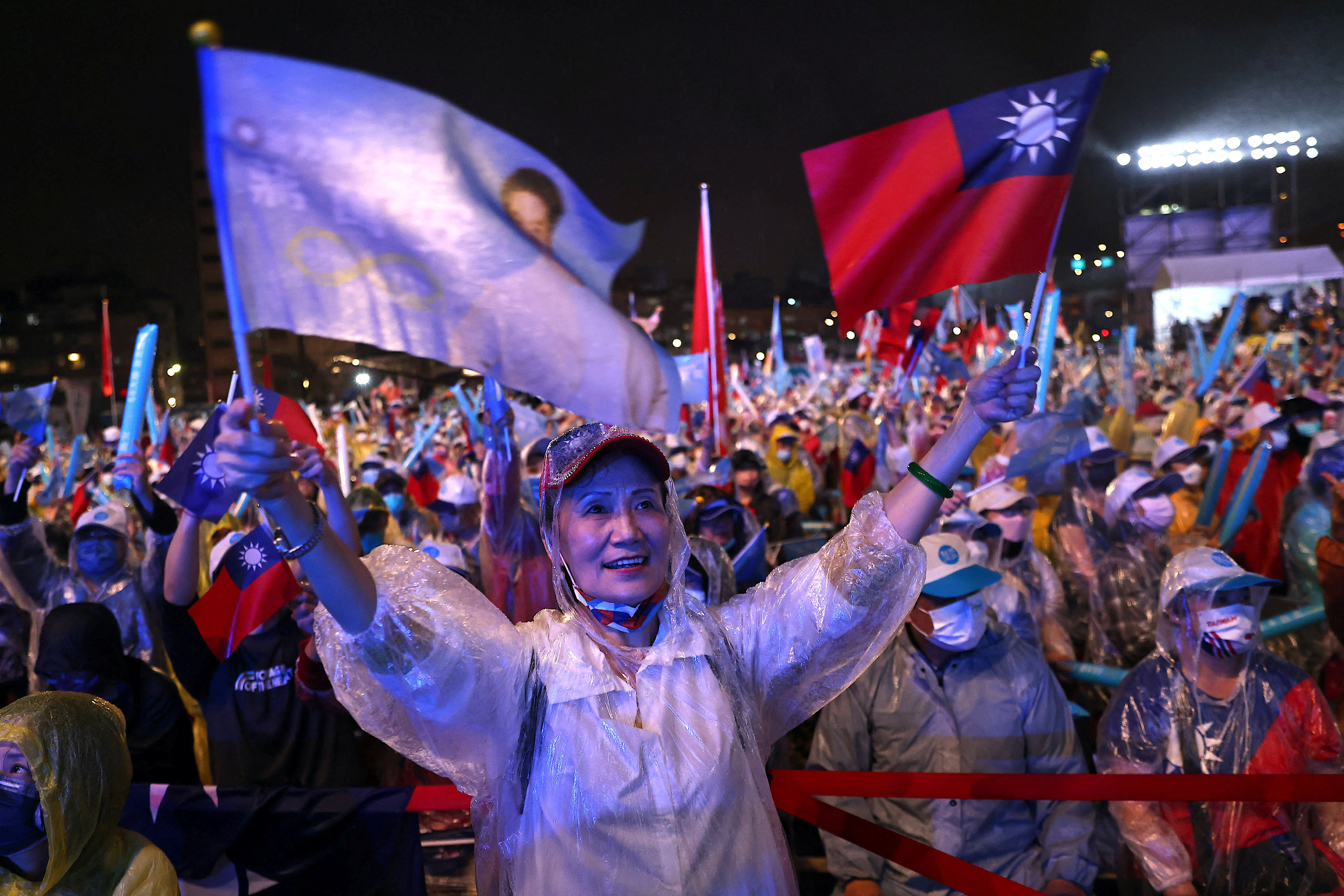
Supporters of Wayne Chiang, Taipei mayoral candidate of the oppositions party Kuomintang (KMT), attend a rally ahead of the election in Taipei, Taiwan, November 25, 2022. REUTERS/Ann Wang
Categories
Audio Sources - Full Text Articles

Another 12 Ukrainians Returned From Russian Captivity

photo_2022-11-26-14.38.53.jpeg

Ukraine returned 12 compatriots from Russian captivity: eight military and three civilians, one of whom was considered missing.

That’s according to the head of the President’s Office, Andriy Yermak, who broke the news on Telegram, Ukrinform reports.

“Another POW exchange. We managed to free 12 of our people. Among them are four Navy troops, two national guardsmen, border guards, and one is from Territorial Defense. There are also three civilians – a family couple and another man who was considered missing. Among the military are two officers, as well as seven privates and sergeants,” Yermak said.

He noted that among the troops there are defenders of Mariupol, the Chornobyl Nuclear Power Plant, and Snake Island. At the same time, the head of the President’s Office recalled that this week 98 Ukrainians were returned from Russian captivity.

“We are working on the release of all our people. We are not stopping. I’m grateful for the efforts of the Coordination Headquarters on POW treatment,” he emphasized.

The post Another 12 Ukrainians Returned From Russian Captivity appeared first on Kyiv Post.

Categories
Audio Sources - Full Text Articles

The real reason Donald Trump and Kanye West are now trying to destroy each other

Keep Palmer Report going! Our articles are all 100% free to read, with no forced subscriptions and nothing hidden behind paywalls. If you value our content, you’re welcome to pay for it:

Pay $5 to Palmer Report:

Pay $25 to Palmer Report:

Pay $75 to Palmer Report:


Keep Palmer Report going! Our articles are all 100% free to read, with no forced subscriptions and nothing hidden behind paywalls. If you value our content, you’re welcome to pay for it:

Pay $5 to Palmer Report:

Pay $25 to Palmer Report:

Pay $75 to Palmer Report:

Sign up for the Palmer Report Mailing List.


Donald Trump and Kanye West have the same problem: they’re both pretending to run for President in 2024, but the media is usually only willing to help promote one fake campaign at a time. No wonder they’re attacking each other. They’re each screwing up the other’s con.

There’s only honor among thieves until they get in each other’s way. When two thieves find themselves trying to con the same mark, they both know that neither one can succeed unless one of them backs down. They each come up with reasons why the other should be the one to back down in the name of doing the “honorable” thing.

The trouble for Trump and Kanye is that they each, for their own reasons, need this. Kanye is a once-respected musician and businessman who’s already nearly destroyed himself by constantly generating negative attention for himself. He thinks that pretending to run for President in 2024 will at least keep him relevant, and that if he gives that up, he’ll just fade away.


Trump knows he’s about to be indicted on federal criminal charges like espionage, and is pretending to run for President in 2024 so he can raise money from his remaining supporters and keep up his lavish lifestyle in the meantime. Trump can’t stop himself from going to prison. But he can line his pockets for now by pretending he’s going to be a 2024 candidate, and given that New York is targeting his assets even as the Feds are targeting his freedom, he must try to line his pockets for now by pretending he’s going to be a 2024 candidate.


So it’s not difficult to figure out why these two con artists are at an impasse. They’re both pandering to the same far right loons in order to stir up controversy, relevance, and income. They’re both doing it by pretending to run for President in a future election cycle that hasn’t even come close to existing yet. They both need the mainstream media’s complicity to keep their respective cons going, even though the mere presence of both means the media can’t help either of them. They’re each too desperate to back down. And they’re both unstable enough to keep harming themselves in the name of trying to take out the other.

Keep Palmer Report going! Our articles are all 100% free to read, with no forced subscriptions and nothing hidden behind paywalls. If you value our content, you’re welcome to pay for it:

Pay $5 to Palmer Report:

Pay $25 to Palmer Report:

Pay $75 to Palmer Report:

Write for the Palmer Report Community Section.


Keep Palmer Report going! Our articles are all 100% free to read, with no forced subscriptions and nothing hidden behind paywalls. If you value our content, you’re welcome to pay for it:

Pay $5 to Palmer Report:

Pay $25 to Palmer Report:

Pay $75 to Palmer Report:

The post The real reason Donald Trump and Kanye West are now trying to destroy each other appeared first on Palmer Report.

Categories
Audio Sources - Full Text Articles

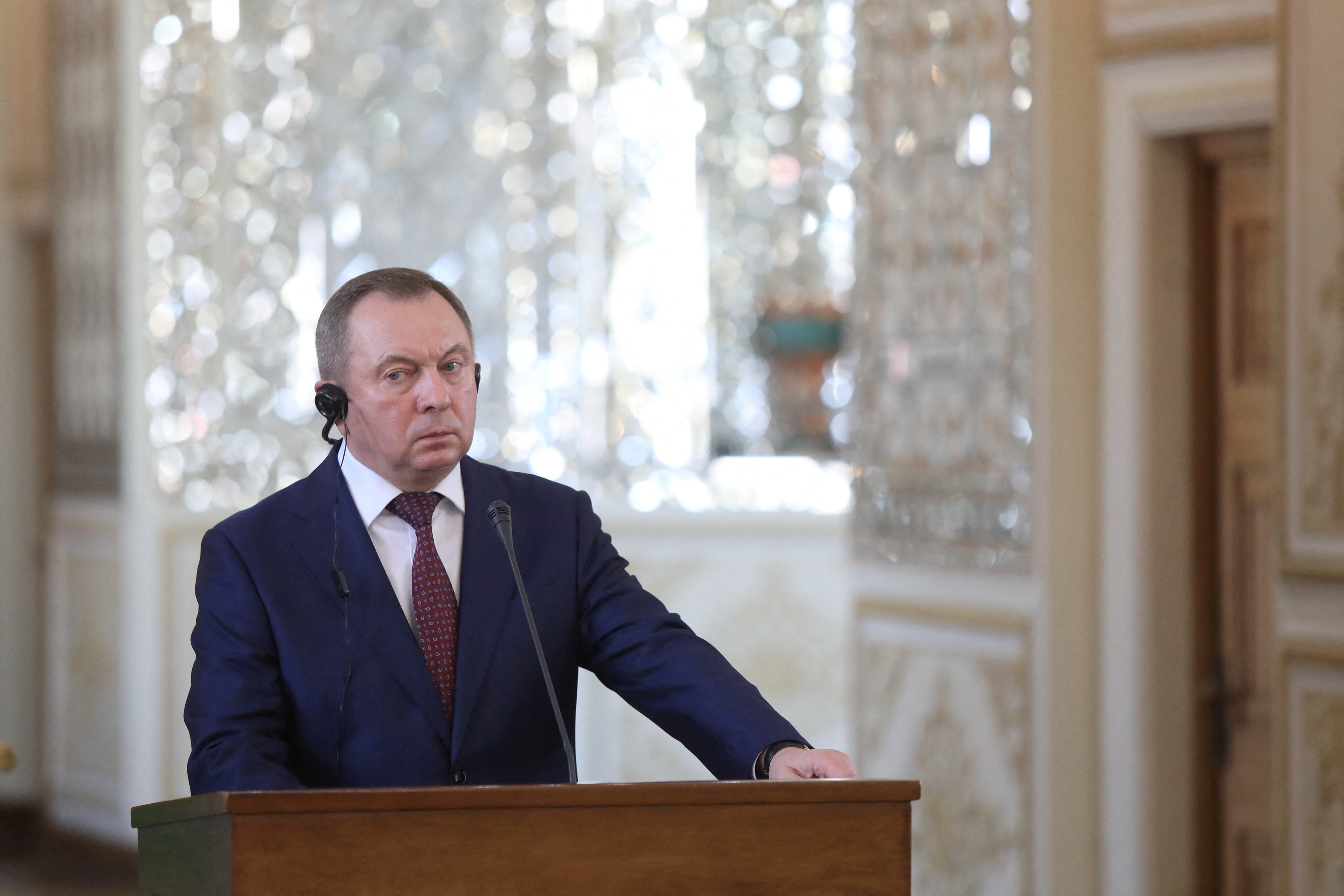
Belarus foreign minister Makei dies -Belta

2022-11-26T13:52:04Z

Belarusian Foreign Minister Vladimir Makei looks on during a joint news conference with Iran’s Foreign Minister Hossein Amir-Abdollahian (not pictured), in Tehran, Iran October 26, 2022. WANA (West Asia News Agency)/Handout via REUTERS

Belarus foreign minister Vladimir Makei has died at the age of 64, the state news agency Belta reported on Saturday.

Makei had held his post since 2012.

WP Radio
WP Radio
OFFLINE LIVE