Categories
Audio Sources - Full Text Articles

‘Losing critical time’: Idaho student’s sister speaks out

(NewsNation) — Families are still looking for answers after four students at the University of Idaho were found stabbed to death inside their home.

Police spoke to the media for the first time three days after the bodies were found and backtracked on previous information that there was no threat to the public. No suspect has been named by police. Alivea Goncalves, sister of victim Kaylee Goncalves, said she doesn’t blame the police for being overwhelmed, but noted “we’re losing critical time” in the investigation.

From what Alivea understood about her sister’s life, there have never been any threats. She said there’s no high-risk lifestyle that could explain this, and it has taken her by shock.

“I don’t want to impede on anything. But I want more people speaking out. And if that takes the police to push that agenda, that’s fine. But unfortunately, I feel like it’s been me and the families pushing that agenda. And that’s been really difficult,” Alivea added.

Categories
Audio Sources - Full Text Articles

EXPLAINER: How a Boebert-Frisch House recount would work

DENVER (AP) — Colorado’s election recount rules could help determine the extent of Republicans’ slim majority in the lower chamber of Congress by deciding the outcome of Republican Rep. Lauren Boebert’s reelection race against Democrat Adam Frisch.

The thin margin in the sprawling 3rd Congressional District, which covers the state’s largely rural western and southern territory, could trigger a rare automatic recount. The Associated Press declared the race too close to call Thursday night with Boebert up by 551 votes out of nearly 327,000 cast and nearly all votes counted. The AP won’t make a call until after the recount, if there is one.

Until election night, Boebert was considered practically unbeatable in the conservative district after her anti-establishment rhetoric built a loyal base and brought national attention alongside fellow hard-liners such as Georgia Rep. Marjorie Taylor Greene.

Frisch, a former councilman in the resort town of Aspen who campaigned on a largely conservative platform while minimizing his Democratic Party affiliation, tried to entice disaffected Republicans by attacking what he called Boebert’s “antics” and “angertainment.”

For both parties, the stakes are high. So how will it work? Q: WHEN IS A RECOUNT TRIGGERED IN COLORADO?

A: In Colorado, an automatic recount is triggered when the margin of votes between the top two candidates is at or below 0.5% of the leading candidate’s vote total. Candidates can also request a recount, paid for by their campaign, if the votes fall outside of that margin.

Boebert’s lead as of Thursday night translated to about 0.34%.

Q: WHAT WOULD BE THE TIMELINE FOR A RECOUNT?

A: Colorado Secretary of State Jena Griswold has until the end of the day Dec. 5 to declare whether the vote margin is tight enough to require a mandatory recount. Counties must complete the retabulation by Dec. 13.

Q: HOW DOES A RECOUNT ITSELF WORK?

A: Griswold’s office will send out the rules and relevant dates to the counties. County clerks then run what’s called a logic and accuracy test on their voting equipment. The test feeds imitation ballots through the system to ensure that the machines’ counts match a hand count. If a machine fails the assessment, ballots will be hand counted.

If the machines pass the tests, the ballots are then rescanned. If the machine can’t determine a voter’s choice, bipartisan teams review those ballots to determine who gets those votes.

The whole process is overseen by a canvass board staffed by both Democratic and Republican representatives.

Q: HOW COMMON ARE RECOUNTS IN U.S. ELECTIONS?

While historical data on U.S. House race recounts isn’t readily available, statewide election recounts are extremely rare. Nationwide, there have been 31 recounts in statewide races since 2000.

Q: HOW OFTEN DO RECOUNTS REVERSE THE RESULTS?

Just three of those recounts changed the outcome of the election, and the largest initial margin between the candidates in those races — 261 votes — was considerably smaller than Boebert’s lead.

The largest swing in terms of number of votes was in the 2018 Florida Senate race. In the initial count there, Rick Scott led Ben Nelson by 12,562 votes. After a machine recount and a manual recount, Scott eventually won by 10,033 votes, for a shift of 2,529 votes, or 0.03%, out of 8.2 million votes cast.

In Colorado, the last statewide recount was triggered automatically over two decades ago in a race for State Board of Education. The retabulation upheld the initial results.

___

Jesse Bedayn is a corps member for the Associated Press/Report for America Statehouse News Initiative. Report for America is a nonprofit national service program that places journalists in local newsrooms to report on undercovered issues.

___

Check out https://apnews.com/hub/explaining-the-elections to learn more about the issues and factors at play in the 2022 midterm elections.

Follow AP’s coverage of the elections at: https://apnews.com/hub/2022-midterm-elections

Categories
Audio Sources - Full Text Articles

Dead to Me Was a Love Story All Along

Spoiler alert: this article discusses major plot points from the series finale of Dead to Me

Black comedy can be a pitiless art, wringing laughs from the pain of characters who can’t stop compounding their own mistakes. At first, Netflix’s Dead to Me looked to be an especially brutal example of the form. Christina Applegate’s Jen Harding, a Laguna Beach real estate agent and the mother of two boys, is reeling in the aftermath of her husband Ted’s hit-and-run death when she meets Judy Hale (Linda Cardellini), a nurturing bohemian type, at a grief support group. Now prone to fits of rage, Jen lashes out when the group’s conversation turns to forgiveness. “How do you forgive someone who hits your husband with their car and then drives away, leaving him to bleed to death on the side of the road?” she demands. “How do you forgive that?”

[time-brightcove not-tgx=”true”]

She’s about to find out, because Judy and her ex-fiancé Steve (James Marsden)—who Judy had said died in order to join the grief group—were in the car that killed Ted. By the time Jen learns this terrible secret, the women have become inseparable and Judy has moved into Jen’s guest house. The revelation blows up their friendship, of course. But then Jen shoots the real, obnoxious Steve; he dies in her pool; and Judy’s back in the picture. The plot becomes cyclical from there, rotating through the many crimes and cover-ups, lies and confessions, of these flawed but well-meaning women. At times, it’s been hard to imagine where creator Liz Feldman’s 100-car pileup of ironies could be leading. But in its third and final season, Dead to Me resolves into something much more optimistic than it initially appeared to be. It’s still a show that cackles in the face of murder and deception. More than that, though, it’s a love story.

I’m not talking about romance in the traditional sense, although the show’s final scene does paint a picture of Jen and her kids living happily ever after—or, at least, happily until the next devastating revelation—with Steve’s kind, corny, self-destructively grieving twin brother, Ben (also played by Marsden). The core bond is the one that grows, in fits and starts and wild blow-ups and tearful reconciliations, between Jen and Judy. Each woman has a long list of good reasons to hate the other. Instead, everything they’ve learned about each other finally fosters a sort of radical, mutual acceptance. Jen knows that Judy has done awful things, and vice versa, but they’ve also come to trust each other’s motivations. Which is crucial because it provides a peace of mind that neither character is getting from a romantic partner or parental figure.

3
Saeed Adyani—NetflixChristina Applegate, left, and Linda Cardellini in Dead to Me

To transform into a warmer version of itself, Dead to Me had to become a tragedy—one that contrasts the sudden, macabre ends met by cheating Ted and cruel Steve with poor Judy’s slow, painful death from cancer. It navigated that transition with care, putting the writing on the wall through references to mournful pop-culture touchstones from Beaches to “Seasons in the Sun” to the classic book Sadako and the Thousand Paper Cranes and its inspiration, Sadako Sasaki. Even Love Story, that quintessential weepy about young love and untimely death. All of it helped lay the groundwork for an ending that resonated as more than just another crazy twist.

The finale finds Jen and Judy driving to the late Steve’s beachfront getaway in Mexico. Judy is on the run, sort of, after selflessly confessing to the murder Jen committed. Happily, their problems with the cops, the FBI, the Greek mafia, and more get resolved quickly and, in large part, offscreen. The workings of the criminal justice system were never Dead to Me’s strong suit or main concern, and the investigator characters don’t get much in the way of a send-off. In fact, you could say the same about most of the supporting cast, from Jen’s frequently exasperated older son, Charlie (Sam McCarthy), to Judy’s sometime love interest, Michelle (Natalie Morales), who returns for a brief arc in season 3. The show’s limited interest in anyone besides Jen, Judy, and eventually Ben can be a bit disappointing. But the empathy and authenticity it brings to its two leads’ final weeks together make it hard to complain much about the trade-off.

That Jen has evolved into a person capable of forgiveness is apparent when she and Judy unexpectedly find the car that killed Ted in the garage of Steve’s vacation home. “It’s OK to hate it,” Judy says, offering her friend a golf club to “smash the sh-t” out of the vehicle if she wants. “How could I hate it?” Jen replies. “It brought me to you.” They embrace, and it’s the kind of mushy moment that the women might have mocked together back in season 1. A lot of hugging and sobbing happens in this finale. None of it grates, though, in part because Applegate and Cardellini have such wonderful friend-chemistry, in part because the characters have been through so much together—and also in part because, to the very end, their banter remains as salty as it is sweet. Enumerating her regrets during the drive to Mexico, Judy wonders aloud: “Why didn’t I have sex with everybody, constantly?” “Herpes,” Jen mutters, under her breath.

DEAD TO ME - CHRISTINA APPLEGATE as JEN HARDING and LINDA CARDELLINI as JUDY HALE in DEAD TO ME. Cr. Courtesy of NETFLIX / © 2022 Netflix, Inc.
NetflixChristina Applegate, left, and Linda Cardellini in Dead to Me

Midway through the season, Judy tells Francine, the woman who administers her chemo, that she can’t have kids. “I didn’t get chosen,” she sighs. “Maybe you got chosen for something else,” says Francine. She’s right. Judy was chosen, by Feldman at least, to do the very thing she set out to do in befriending the widow of the man she accidentally helped kill: make a positive difference in Jen’s life. By the time she vanishes into the sea, after assuring Jen that “You’re not leaving me; I’m staying,” Judy hasn’t just made Jen a more tender, less anger-driven person. She has also, serendipitously, brought Jen together with Ben, who happens to be the father of Jen’s late-in-life daughter-to-be. One of her last acts is to encourage Jen to tell Ben—in prison at the time for a hit-and-run that closed out Season 2—about the baby and make sure she grows up knowing her father.

This is all moving stuff. (The fact that Applegate was diagnosed with multiple sclerosis while shooting the season, along with the close bond she and Cardellini developed over years of working together, further heightens the story’s poignancy.) Whatever the future holds for Jen, it will be shaped by Judy’s optimism. But Dead to Me wouldn’t be Dead to Me if it didn’t also leave us with bracing hints of cynicism and uncertainty. “Why didn’t you name her Judy?” a blunt grief-group regular demands, months after Judy’s death, when she meets baby Joey. “Because that would be weird, Linda,” Jen deadpans. Then there’s the very last, picture-perfect scene. Jen and Ben lounge poolside, as the baby naps and her brothers splash around in the water. One huge loose end remains untied: Ben still doesn’t know that the woman he loves killed his brother. “Ben,” says Jen, a note of dread entering her voice. “I have to tell you something.”

It’s the final line of the show. I didn’t predict it, but as soon as the words came out of Applegate’s mouth and the credits started to roll, it felt obvious that this was the only possible ending. We had to return to the refrain that had shaken up so many relationships over the course of three seasons. Just as Jen’s bluster and Judy’s cheer counterbalanced one another, it was the combination of sweetness and pith that made Dead to Me such a twisted delight.

Categories
Audio Sources - Full Text Articles

Nancy Pelosi Reflects On the Not-Quite-End of An Era

Ever since the election, Nancy Pelosi says, congressional Democrats have been begging her to remain as their leader. Of course, she knew what they were really doing: currying favor, just in case.

“Our members were just exploding my phone to stay,” she says, “which is a nice thing, because if I don’t stay, then they’ve gotten the points for saying ’stay,’ and if I do—“ she trailed off, laughing. No matter what she decided, they knew it would be in their interest to be on her good side going forward.

For two decades, it has been in every congressional Democrat’s interest to stay in Pelosi’s good graces. Since winning her first leadership position in 2001, she has ruled the House Democratic caucus with an iron fist and a velvet glove, keeping her fractious party in near-lockstep during historically tumultuous times. From the Iraq War to the financial crisis, through health-care reform and government shutdowns, through two presidential impeachments, a pandemic and an insurrection attempt, she has been a constant force and consummate operator. No national politician of her era can match her combination of legislative prowess, vote-counting savvy, negotiating skill, and fundraising ability.

[time-brightcove not-tgx=”true”]

On Thursday, it was finally time to move on—sort of. Shortly after noon, she gave a brief speech on the House floor, announcing that she would not seek re-election as leader of the House Democrats. It was time, she said, “for a new generation to lead the Democratic caucus that I so deeply respect.” Yet she couldn’t bring herself to step away completely: she owed it to her constituents in San Francisco, she said, to stay on as a rank-and-file member of Congress and finish her two-year term. Like the man who fakes his own death and then sneaks into the funeral, she would stick around to see how her people tried to get along without her.
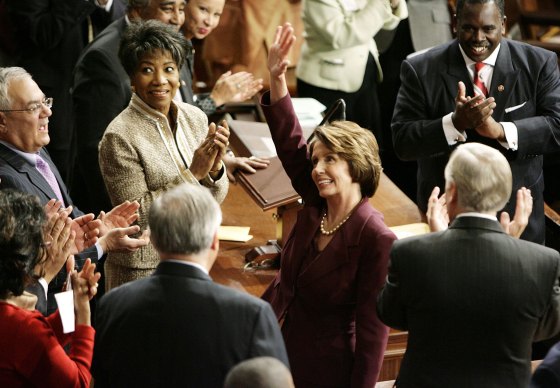
Speaker of the House Nancy Pelosi waves to colleagues while being nominated as the next Speaker of the House during a swearing in ceremony for the 110th Congress in the House Chamber of the U.S. Capitol in Washington, DC., on Jan. 4, 2007.
Chip Somodevilla—Getty ImagesNancy Pelosi waves to colleagues while being nominated as the next Speaker of the House during a swearing in ceremony for the 110th Congress in the House Chamber of the U.S. Capitol in Washington, DC., on Jan. 4, 2007.

Just after her speech, the 82-year-old House Speaker sat at a white-clothed table in a small, ornate room off the House floor known as the Board of Education, a hidden chamber where former Democratic Speaker Sam Rayburn used to hole up and relax. Then-vice president Harry Truman was playing cards with Rayburn here in 1945 when he learned that FDR had died and he would become President. One wall Rayburn had painted with a Texas seal; on two others, Pelosi recently added her own touches: a painting of the Golden Gate Bridge, and a tribute to women’s suffrage.

Pelosi was contemplating the not-quite-end of the era and struggling to unwrap a package of chocolate-chip cookies. “What was important to me was how we did in the election, because we were on a bad path,” she told a small group of reporters. “Storming the Capitol, really? And the reaction of Republicans, not taking a stand? And I knew we could win.”

Her party had just lost the House, weeks after a crazed intruder broke into her California home and bludgeoned her husband with a hammer. But it hardly felt as if Pelosi was giving up in defeat. In an election that history and many forecasters predicted would deliver a Republican wave, Democrats surprisingly held their own. The resulting GOP majority will be a narrow one, with the Senate remaining in Democrats’ hands.

The Oct. 28 attack on Paul Pelosi, the Speaker’s husband of 59 years, influenced her decision to remain in Congress, but not in the way many people thought. “It was not, ‘Oh, well, since they did that, I can’t even think of something else,’” she says. “No, it had the opposite effect. I couldn’t give them that satisfaction.”

Read More: Nancy Pelosi Doesn’t Care What You Think Of Her.

This steely tenaciousness, this refusal to let others decide her path, is a running theme of my biography of Pelosi. It has been the hallmark of her political career, from forcing her way into the male-dominated ranks of congressional leadership to standing up to former President Donald Trump. As the youngest child and only daughter of three-term Baltimore mayor Thomas D’Alessandro, politics was in Pelosi’s blood; she first set foot on the House floor as a young child, when her father was serving in Congress. But when she finally ran for office herself at the age of 47—after raising five children and serving for decades as a political fundraiser, strategist and volunteer—it was from a different coast, under a different name, with a political identity all her own.

Nancy Pelosi at election headquarters on primary election night, on April 7, 1987.
Deanne Fitzmaurice—San Francisco Chronicle/Getty ImagesNancy Pelosi at election headquarters on primary election night, on April 7, 1987.

Ask Pelosi about her legacy, and the first thing she’ll mention is the Affordable Care Act. However flawed and incomplete the 2010 law’s guarantee of universal access to health care may have proven, it represented the fulfillment of a century of liberal aspirations, and the pinnacle of Pelosi’s legislative craft. She moved mountains to get it through the House, at one point nearly breaking down in tears as she begged a group of liberal feminists to swallow an unsavory compromise on abortion funding. Then, after a special election robbed Democrats of their supermajority in the Senate, she urged then-President Obama not to give up on the historic legislation. “If the gate’s closed, you go over the fence,” she said at the time. “If the fence is too high, we’ll pole-vault in. If that doesn’t work, we’ll parachute in. But we’re going to get health-care reform passed for the American people.” Though most of the drama around the bill’s passage revolved around the Senate, it never could have happened without Pelosi’s determination and drive.

Speaker of the House Nancy Pelosi stands behind President Barack Obama as he signs the Affordable Health Care for America Act during a ceremony with fellow Democrats in the East Room of the White House on March 23, 2010.
Win McNamee—Getty ImagesSpeaker of the House Nancy Pelosi stands behind President Barack Obama as he signs the Affordable Health Care for America Act during a ceremony with fellow Democrats in the East Room of the White House on March 23, 2010.

She did it knowing there might be a political cost, and indeed there was. Republicans gained 63 seats in the House in the 2010 midterm elections, an election in which Pelosi was a central figure. Republicans made her the subject of millions of dollars’ worth of attack ads across the country, capitalizing on their base’s visceral loathing of her and giving Peosi unusual prominence for a congressional leader.

But Pelosi believed in gaining power not for its own sake but in order to do something with it. Obamacare is part of a legacy that includes two decades of liberal policy victories, from allowing gay people to serve openly in the military to the historic climate investments of this year’s Inflation Reduction Act. “This is a very difficult job,” she told us. “You have to really know how to be a legislator.”

These legislative successes were all the more remarkable for the era in which they came. Faced with unrelenting Republican opposition, she held together the diverse Democratic caucus and drove a hard bargain in negotiations across the aisle. After Donald Trump became president, she led her party back to power, becoming Speaker for the second time in 2019 in the middle of a government shutdown over border-wall funding. Pelosi refused to budge, and Trump soon capitulated. She would go on to impeach him twice while simultaneously negotiating with his Administration to secure trillions in COVID-19 relief funding.

Read More: Why Nancy Pelosi Is Going All In Against Trump.

Pelosi rejects the notion that she bears any blame for the toxic state of politics. “I don’t take any responsibility for what the Republicans have done to the Congress. This is not about gridlock,” she says. “This isn’t about some sort of equivalence between Democrats and Republicans. They are anti-science, anti-government, and that’s where they are.”

The GOP’s lack of decency was apparent in many Republicans’ reaction to her husband’s attack, Pelosi says. “Just think if your spouse were in that situation and people would make a joke of it, like it was funny,” she added. “Collecting money for bail for the perpetrator, putting out a conspiracy theory about what it was about. It’s so horrible to think that the Republican Party has come down to this.” This attitude, she says, was part of what voters recoiled from the midterms.

Pelosi served as Speaker of the House under four Presidents
Mark Wilson—Getty Images (2); Chip Somodevilla—Getty Images; Jim Watson—Pool/AFP/Getty Images

Pelosi never groomed a successor, something for which she was often criticized. Ambitious Democrats languished for decades waiting for an opening in House leadership. She has often expressed the view that power is never given but must be taken by those who seek it. “I didn’t think that was the right approach, to anoint somebody,” she told us Thursday. “It’s really important for people to have the legitimacy that they were chosen by the members.”

A free-for-all appears unlikely. Pelosi’s longtime deputy Steny Hoyer, a fellow Marylander who has known her since they worked for the same Senator in 1963, announced Thursday that he would also stay in Congress but not in leadership. Rep. Hakeem Jeffries of New York, the 52-year-old chair of the Democratic caucus, appears almost certain to win the minority leader position in the Democratic leadership elections scheduled for Nov. 30, becoming the first Black man to lead a party in Congress. The first woman Speaker, in passing the torch, will make history once again.

Pelosi intends to spend the next two years in valedictory mode. “My life ahead is full of thank-yous,” she says, to her constituents and all the others who have supported her over the years. She does not plan to serve on any committees and she does not want to serve as a sort of shadow speaker from the sidelines. “Thanksgiving is coming,” she says. “I have no intention of being the mother-in-law in the kitchen saying, ‘My son doesn’t like the stuffing that way, this is the way we make it in our family.’ They will have their vision. They will have their plan. It’s up to the caucus to decide which way they want to go.”


Categories
Audio Sources - Full Text Articles

Gubernatorial candidate Lake claims Arizona election fraud

(NewsNation) — Arizona Republican gubernatorial candidate Kari Lake said she is collecting evidence about potential election fraud after she lost the 2022 governor’s race to Democrat and Arizona’s current Secretary of State Katie Hobbs.

Lake posted a video to Twitter captioned “Arizona, we are still in the fight.

In the video, Lake told her supporters that the fight isn’t over and that she is collecting evidence against what she called the “broken-election system” in Arizona.

“For two years, I’ve been sounding the alarm about our broken-election system here in Arizona. And this past week has confirmed everything we have been saying,” Lake said, claiming that, “The fox was guarding the henhouse.”

However, Megan Gilbertson, the communications director for the Maricopa Elections Department, said Arizona election officials were dedicated to making sure all votes were secure, saying: “We have a well-oiled machine here in Maricopa County and really dedicated election officials that are working hard to make sure that the vote is secure, counted accurately and that we can provide the results to the public.”

Lake claimed the elections in Arizona were unfair after multiple issues at polling locations on Election Day with tabulating machines and printers. She claimed that malfunctioning tabulation machines forced voters to wait in line for hours in order to exercise their right to vote.

“Our election officials failed us miserably,” Lake said. “What happened on Election Day is unforgivable.”

On Election Day, Maricopa County voters found themselves facing issues with machines at some polling places failing to scan completed ballots. Election officials moved to correct the problem and voters were allowed to place their ballots in a secure drop box to be counted once the issue was resolved or cast their votes at a different polling place. There has been no widespread evidence of election fraud reported in Arizona’s 2022 election.

In the weeks leading up to the election, Arizona faced problems with voter intimidation, including armed individuals at ballot drop boxes. Election workers also found themselves on the receiving end of threats and harassment.

Lake and Hobbs were at the center of the state race that gained national attention. Lake ran on a platform elevating claims spread by former President Donald Trump that the 2020 election was stolen. Lake, a former news anchor, took a hardline stance on such issues as immigration, crime and the teaching of critical race theory in schools.

Decision Desk HQ projected Hobbs to win Arizona’s 2022 governor race Monday. But Lake was far from conciliatory on social media Monday night.

Lake tweeted out in response, claiming that “Arizonans know BS when they see it.”

Categories
Audio Sources - Full Text Articles

APEC summit host Thailand urges leaders to put aside differences

2022-11-18T02:02:26Z

Thailand, the host of the APEC summit, urged leaders of the group meeting in Bangkok on Friday and Saturday to “rise above differences” and focus on resolving pressing global economic issues in areas such as trade and inflation.
Established to promote economic integration, the Asia-Pacific Economic Cooperation (APEC) forum consists of 38% of the global population and 62% of gross domestic product and 48% of trade.

China’s President Xi Jinping is attending the summit, while the United States is being represented by U.S. Vice President Kamala Harris.

While Thailand hopes to make progress on forming a Free Trade Area of the Asia Pacific (FTAAP), the talks come amid geopolitical tensions over the war in Ukraine and other flashpoints such as Taiwan and the Korean peninsula.

Thailand’s Foreign Minister Don Pramudwinai said on Thursday the meeting of the 21-member bloc was taking place at a “pivotal juncture” with the world facing multiple risks.

“That’s why APEC this year must rise above these challenges and deliver hope to the world at large,” he said in a statement.

Security was tight at the APEC summit with around 100 anti-government protesters gathered and planning to march on the meeting venue on Friday morning.

Xi, warning against Cold War tensions in a region that is a focus for competition between Beijing and Washington, said on Thursday the Asia-Pacific is no one’s backyard and should not become an arena of big power rivalry,

“No attempt to wage a new cold war will ever be allowed by the people or by our times,” Xi said in written remarks prepared for a business event linked to the summit.

Relations between the world’s two largest economies have been strained in recent years over issues like tariffs, Taiwan, intellectual property, the removal of Hong Kong’s autonomy and disputes over the South China Sea, among others.

In a move that may be seen by Beijing as a provocation, a senior U.S. official said Vice President Harris will on visit the Philippine islands of Palawan on the edge of the disputed South China Sea Tuesday.

The trip will make Harris the highest-ranking U.S. official to visit the island chain adjacent to the Spratly Islands. China has dredged the sea floor to build harbours and airstrips on the Spratlys, parts of which are also claimed by Brunei, Malaysia, the Philippines, Taiwan and Vietnam.

Harris will visit Palawan after attending the APEC meeting, which follows a series of regional summits so far dominated by geopolitical tension over the war in Ukraine.

At a G20 meeting in Bali earlier this week, countries unanimously adopted a declaration saying most members condemned the Ukraine war, but that also acknowledged some countries saw the conflict differently.

Russia is a member of both G20 and APEC but President Vladimir Putin has stayed away from the summits. First Deputy Prime Minister Andrei Belousov will represent him at APEC.

Australian Prime Minister Anthony Albanese is among those also attending the main meeting, while French President Emmanuel Macron is a special guest.

Xi held a rare summit with Japanese Prime Minister Fumio Kishida while in Bangkok, the first leadership-level meeting between the countries in nearly three years, after which Kishida said he conveyed concerns about peace in the Taiwan Strait.

China’s CCTV reported that Xi told Kishida the Taiwan issue involved the political foundation of ties between their two countries, and territorial disputes should be properly managed.
The meeting came a day after tensions simmered in Bali, where Xi criticised Canadian Prime Minister Justin Trudeau in person over alleged leaks of their closed-door meeting, a rare public display of annoyance by Xi. Trudeau is also in Bangkok.

Related Galleries:

Thailand’s Prime Minister Prayuth Chan-ocha, wife Naraporn Chao-ocha, China’s President Xi Jinping and wife Peng Liyuan attend the Gala dinner of the APEC Summit 2022, in Bangkok, Thailand, November 17, 2022. Thailand Government House/Handout via REUTERS

China’s President Xi Jinping and wife Peng Liyuan attend the Gala dinner of the APEC Summit 2022 in Bangkok, Thailand, November 17, 2022. Thailand Government House Handout via REUTERS

Thailand’s Prime Minister Prayuth Chan-ocha, wife Naraporn Chao-ocha and Canadian Prime Minister Justin Trudeau attend the Gala dinner of the APEC Summit 2022 in Bangkok, Thailand, November 17, 2022. Thailand Government House Handout via REUTERS
Categories
Audio Sources - Full Text Articles

Score one for Joe Biden

Keep Palmer Report going! Our articles are all 100% free to read, with no forced subscriptions and nothing hidden behind paywalls. If you value our content, you’re welcome to pay for it:

Pay $5 to Palmer Report:

Pay $25 to Palmer Report:

Pay $75 to Palmer Report:


Keep Palmer Report going! Our articles are all 100% free to read, with no forced subscriptions and nothing hidden behind paywalls. If you value our content, you’re welcome to pay for it:

Pay $5 to Palmer Report:

Pay $25 to Palmer Report:

Pay $75 to Palmer Report:

Sign up for the Palmer Report Mailing List.


It seems hard to believe, but President Joe Biden signed the Infrastructure Investment and Jobs Act (“Bipartisan Infrastructure Law”) into law one year ago Tuesday. Under Trump, “infrastructure week” was a “punchline,” as the White House has called it, coming and going without meaningful progress. This past year, however, has shown what a remarkable success this landmark piece of legislation has already proven to be.

Within just one year since the Bipartisan Infrastructure Law took effect, the Biden administration has announced over $183 billion in funding and over 6,900 specific projects, reaching over 4,000 communities across the entire United States. The law passed in a bipartisan manner, with the 19 Republican Senators and 13 Republican House members who joined the Democrats getting called “traitor” by Rep. Marjorie Taylor Greene and receiving death threats.

Among other achievements, the Bipartisan Infrastructure Law has addressed the repair or replacement of 2,800 bridges, awarded funds for more than 5,000 new clean transit and school buses, and approved state plans for water funding, EV charging networks, and expanding high-speed internet services. Addressing accessibility, $1.75 billion has been announced to adapt transit stations that were constructed before the Americans with Disabilities Act of 1990 (ADA).


To make sure America succeeds in the 21st century, an Affordable Connectivity Program has already brought low-cost, high-speed internet plans to more than 14.8 million households, in addition to providing up to $100 toward the purchase of a computer. Launched in May, the $45 billion “Internet for All” initiative is on track to offer fast, reliable, and affordable internet service to all Americans by the end of this decade.


To celebrate the Bipartisan Infrastructure Law’s first successful year, the White House just published updated state and territory fact sheets about “the largest long-term investment in our infrastructure and competitiveness in nearly a century.” Thanks to Biden’s leadership, America is getting rebuilt in a way that’s stronger and cleaner, bringing increased affordability and accessibility, and creating jobs. With laws like this, all Americans win.

Keep Palmer Report going! Our articles are all 100% free to read, with no forced subscriptions and nothing hidden behind paywalls. If you value our content, you’re welcome to pay for it:

Pay $5 to Palmer Report:

Pay $25 to Palmer Report:

Pay $75 to Palmer Report:

Write for the Palmer Report Community Section.


Keep Palmer Report going! Our articles are all 100% free to read, with no forced subscriptions and nothing hidden behind paywalls. If you value our content, you’re welcome to pay for it:

Pay $5 to Palmer Report:

Pay $25 to Palmer Report:

Pay $75 to Palmer Report:

The post Score one for Joe Biden appeared first on Palmer Report.

Categories
Audio Sources - Full Text Articles

Saved Web Pages – Daily Report at 9 p.m. [Inoreader digest]

1636973850.png

Saved Web Pages – Daily Report at 9 p.m.

created by Michael Novakhov  •  Nov 17 2022

The most notable news articles in full text version.
Current Page:
https://www.inoreader.com/stream/user/1006407045/tag/web-pages/view/html

OPINION: During the Trump administration, the FBI paid $5 million to an Israeli software company for…
washingtontimes.com 5h

A number of officials from the US Federal Bureau of Investigation made efforts to advance the deployment…
timesofisrael.com 6h

Continue reading the main storyChristopher Wray, the F.B.I.’s director, told Congress last December that…
nytimes.com 12h

Threat intelligenceSC StaffNovember 16, 2022Even though FBI Director Christopher Wray said in a Congressional…
scmagazine.com 12h

LONDON—The mass expulsion of more than 400 Russian spies from Europe in the wake of the war in Ukraine…
wsj.com 13h

You can unsubscribe from those emails at any time.

Inoreader. Take back control of your news feed. Follow us on Twitter and Facebook.
Innologica Ltd. 35 Akad. Boris Stefanov str., 1700 Sofia, Bulgaria

The News And Times Information Network – Blogs By Michael Novakhov – thenewsandtimes.blogspot.com
Categories
Audio Sources - Full Text Articles

Guatemala finds hundreds of pre-Hispanic artifacts in U.S. couple“s house

2022-11-18T01:27:20Z

Over 1,200 Mayan antiques were found at the house of two U.S. citizens in Guatemala, authorities said on Thursday, days after the same couple was arrested and later released for stealing historical artifacts.

Authorities on Wednesday found 722 archaeological pieces in various sizes and materials at the Antigua Guatemala home of Allison Jolluck and Giorgio Salvidor Rossilli, as well as 500 smaller pieces, following an investigation for crimes against Guatemala’s cultural heritage.

Neither Jolluck nor Rossilli were available for comment.

Guatemalan authorities said they also seized documents, books, a laptop, compact discs, two cell phones, and a stuffed bird, possibly a quetzal, the symbol of Guatemala.

The couple, who were not home during the raid, are free on bail after paying a fine of 50,000 queztal ($6,400) each last Tuesday. They had been arrested the day before while transporting 166 pre-Hispanic artifacts in their vehicle.

The public prosecutors’ office had said the couple could evade criminal proceedings because they are United States nationals. The previous Thursday, Jolluck had been stopped attempting to leave Guatemala with two pre-Hispanic pieces.

Moises Ortiz, a spokesman for the prosecutor’s office, said the evidence collected at the house was an important step of the proceedings. Guatemala’s prosecutor’s office will have three months to carry out an investigation of the couple.

The artifacts found this week were delivered to the culture ministry for protection and analysis, authorities said.

World culture ministers at a UNESCO conference in Mexico City two months ago pledged to boost efforts to repatriate stolen and illegally traded artifacts to their countries of origin, many of which remain in museums or private collections.

Categories
Audio Sources - Full Text Articles

What to watch on Friday at COP27

2022-11-18T01:22:31Z

A plastic waste panda is displayed at the Green Zone during the COP27 climate summit, in the Red Sea resort of Sharm el-Sheikh, Egypt, November 17, 2022. REUTERS/Emilie Madi

The official events at the COP27 climate talks are winding down ahead of the scheduled end date on Friday, but the negotiations for a final deal are dragging on.

Countries remain deeply divided over many important issues, with the talks threatening to extend into the weekend.

On Friday, watch for glimmers of agreement on sticking points, which include funding for countries being ravaged by climate impacts and how much scrutiny countries should face in their domestic actions for delivering on climate targets.

Meanwhile, negotiators working on a separate track to nail down details around global carbon offset trading may announce incremental progress made so far.

And the government of Vanuatu will reveal how it will ask the International Court of Justice for an opinion on the obligations of governments regarding climate change – a decision it hopes to then put before the United Nations for a vote.

For daily comprehensive coverage on COP27 in your inbox, sign up for the Reuters Sustainable Switch newsletter here

WP Radio
WP Radio
OFFLINE LIVE