Categories
Saved Web Pages

Ex-CIA engineer convicted of biggest theft of secret information in agency’s history

AP22194746172983.jpg

Published July 14, 2022 8:49am EDT

A former CIA programmer was convicted Wednesday of federal charges in connection to the massive Vault 7 theft of secret information provided to WikiLeaks in what the Justice Department describes as “one of the most brazen and damaging acts of espionage in American history.” 

Joshua Adam Schulte was once a CIA programmer “with access to some of the country’s most valuable intelligence-gathering cyber tools used to battle terrorist organizations and other malign influences around the globe,” according to a statement released by U.S. Attorney Damian Williams. 

However, when Schulte “began to harbor resentment toward the CIA, he covertly collected those tools and provided them to WikiLeaks, making some of our most critical intelligence tools known to the public – and therefore, our adversaries,” Williams, of the Southern District of New York, said. “Moreover, Schulte was aware that the collateral damage of his retribution could pose an extraordinary threat to this nation if made public, rendering them essentially useless, having a devastating effect on our intelligence community by providing critical intelligence to those who wish to do us harm.” 

Schulte, who chose to defend himself at a New York City retrial, told jurors in closing arguments that the CIA and FBI made him a scapegoat for an embarrassing public release of a trove of CIA secrets by WikiLeaks in 2017.

 FBI WARNS SMUGGLERS ARE HOLDING MIGRANTS FOR $10K RANSOM AT TEXAS STASH HOUSES AFTER CLEARING MEXICO BORDER 

He watched without visibly reacting as U.S. District Judge Jesse M. Furman announced the guilty verdict on nine counts, which was reached in mid-afternoon by a jury that had deliberated since Friday, The Associated Press reported. 

In this courtroom sketch, Joshua Schulte, center, is seated at the defense table flanked by his attorneys during jury deliberations, Wednesday, March 4, 2020, in New York. Schulte, the former CIA software engineer accused of causing the biggest theft of classified information in CIA history, has been convicted at a New York City retrial. A jury reached the guilty verdict against Joshua Schulte on Wednesday, July 13, 2022 in federal court in Manhattan. 

In this courtroom sketch, Joshua Schulte, center, is seated at the defense table flanked by his attorneys during jury deliberations, Wednesday, March 4, 2020, in New York. Schulte, the former CIA software engineer accused of causing the biggest theft of classified information in CIA history, has been convicted at a New York City retrial. A jury reached the guilty verdict against Joshua Schulte on Wednesday, July 13, 2022 in federal court in Manhattan.  ((Elizabeth Williams via AP))

The so-called Vault 7 leak revealed how the CIA hacked Apple and Android smartphones in overseas spying operations, and efforts to turn internet-connected televisions into listening devices. Prior to his arrest, Schulte had helped create the hacking tools as a coder at the agency’s headquarters in Langley, Virginia.

A sentencing date was not immediately set because Schulte is still awaiting trial on charges of possessing and transporting child pornography. He has pleaded not guilty.

Attorney Sabrina Shroff, who advised Schulte during the trial, told Schulte’s mother after the verdict that the outcome was a “kick to the gut, the brain and heart.” It was unclear if Shroff was expressing her own sentiments or Schulte’s.

In his closing, Schulte claimed he was singled out even though “hundreds of people had access to (the information). … Hundreds of people could have stolen it.”

“The government’s case is riddled with reasonable doubt,” he added. “There’s simply no motive here.”

The logo of the U.S. Central Intelligence Agency is shown in the lobby of the CIA headquarters in Langley, Virginia  March 3, 2005. 

The logo of the U.S. Central Intelligence Agency is shown in the lobby of the CIA headquarters in Langley, Virginia  March 3, 2005.  (REUTERS/Jason Reed/File Photo)

Prosecutors alleged the 33-year-old Schulte was motivated to orchestrate the leak because he believed the CIA had disrespected him by ignoring his complaints about the work environment. Therefore, he tried “to burn to the ground” the very work he had helped the agency to create, they said.

Assistant U.S. Attorney David Denton encouraged jurors to consider evidence of an attempted cover-up, including a list of chores Schulte drew up that had an entry reading, “Delete suspicious emails.”

While behind bars awaiting trial, prosecutors said he continued his crimes by trying to leak additional classified materials as he carried on an “information war” against the government.

Once the jury left the courtroom for deliberations, the judge complimented Schulte on his closing argument.

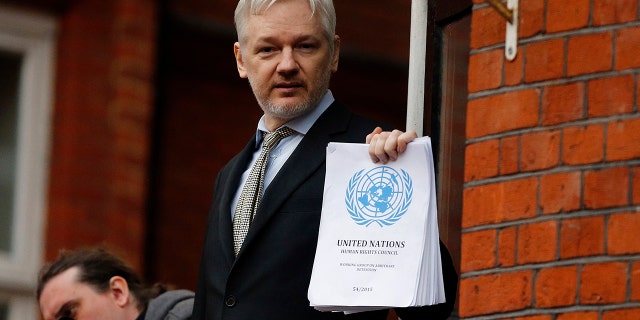
In this Friday, Feb. 5, 2016 file photo, WikiLeaks founder Julian Assange stands on the balcony of the Ecuadorean Embassy to address waiting supporters and media in London. 

In this Friday, Feb. 5, 2016 file photo, WikiLeaks founder Julian Assange stands on the balcony of the Ecuadorean Embassy to address waiting supporters and media in London.  ((AP Photo/Frank Augstein, File))

“Mr. Schulte, that was impressively done,” Furman said. “Depending on what happens here, you may have a future as a defense lawyer.”

A mistrial was declared at Schulte’s original 2020 trial after jurors were deadlocked on the most serious counts, including illegal gathering and transmission of national defense information. Schulte told the judge last year that he wanted to serve as his own attorney for the retrial.

He has not announced whether he wants to represent himself at his next trial, which involves allegations that after leaving the CIA, Schulte moved to New York from Virginia with a computer that contained images and videos of child pornography he had downloaded from the internet from 2009 to March 2017.

CLICK HERE TO GET THE FOX NEWS APP

Schulte has been held behind bars without bail since 2018. Last year, he complained in court papers that he was a victim of cruel and unusual punishment, awaiting two trials in solitary confinement inside a vermin-infested cell of a jail unit where inmates are treated like “caged animals.”

The Associated Press contributed to this report. 

Categories
Saved Web Pages

Joshua Schulte: Former CIA hacker convicted of ‘brazen’ data leak

After joining the CIA in 2010, Mr Schulte soon achieved the organisation’s highest security clearance. He went on to work at the agency’s headquarters in Langley, Virginia, designing a suite of programmes used to hack computers, iPhones and Android phones and even smart TVs.

Categories
Saved Web Pages

Early Edition: July 14, 2022

GettyImages-73086221-1-e1512768873185.jp

Signup to receive the Early Edition in your inbox here.

A curated weekday guide to major national security news and developments over the past 24 hours. Here’s today’s news.

JAN. 6 ATTACK & 2020 ELECTION PROBES

The Justice Department has asked the Jan. 6 committee to turn over evidence it has gathered regarding the plot by former President Trump and his allies to put forward false slates of pro-Trump electors. Rep. Bennie Thompson (D-MS) disclosed the request to reporters on Capitol Hill yesterday, and a person familiar with the panel’s work said discussions with the Justice Department about the false elector scheme were ongoing. Thompson also said the Justice Department’s investigation into “fraudulent electors” was the only specific topic the agency had broached with the committee, suggesting that the department is sharpening its focus on that aspect of Trump’s efforts to overturn the election. Luke Broadwater reports for the New York Times. 

Trump tried to call a member of the White House support staff who was talking to the Jan. 6 committee, two sources familiar with the matter have revealed. The call was made after former Trump White House aide Cassidy Hutchinson testified publicly to the committee. The White House staffer was in a position to corroborate part of what Hutchinson had said under oath, according to the sources. The support staffer, who was not someone who routinely communicated with Trump, declined to answer or respond to Trump’s call and instead alerted their lawyer. Ryan Nobles, Dana Bash, Annie Grayer and Zachary Cohen report for CNN

Whilst the Jan. 6 committee is “concerned” by Trump’s alleged phone call to a witness it will be up to the Justice Department to determine whether this broke the law, Thompson said yesterday. “You know, we are concerned obviously about the witness. And we’re not going to put that witness in unnecessary jeopardy,” Thompson told reporters, a day after the panel first revealed the alleged call to an unidentified witness. When asked if he thought the Trump call had been an attempt to intimidate a witness, he said he considered the attempted contact “highly unusual. Dareh Gregorian, Kyle Stewart and Kate Santaliz report for NBC News

Sen. Lindsey Graham (R-SC) is aiming to quash a subpoena for his testimony before a special grand jury investigating Trump’s efforts to overturn the 2020 election results in Georgia. “I just filed a motion to quash the subpoena. We’ll see what the court says,” Graham told CNN yesterday. Fulton County District Attorney Fani Willis, who is leading the investigation into Trump and his allies, said in court filings that the grand jury needed to hear from Graham about at least two calls Graham made to Georgia Secretary of State Brad Raffensperger and his staff in the wake of the 2020 election. In Graham’s filing to block the subpoena, his attorneys said the senator’s calls to Georgia officials were legislative activity and that his activities are protected under the Constitution’s speech and debate clause. Sara Murray, Jason Morris and Ted Barrett report for CNN.

OTHER DOMESTIC DEVELOPMENTS

A former CIA employee charged with carrying out the largest leak of classified data in the agency’s history was convicted on all counts in federal court yesterday. Joshua Schulte – who was accused of handing over reams of classified data to WikiLeaks in 2016 – was convicted of illegally gathering and transmitting national defense information and obstructing a criminal investigation and grand jury proceeding, among other charges. Mark Morales reports for CNN

The Pentagon carried out successful tests of two different hypersonic missile systems recently, the U.S. Air Force and Defense Advanced Research Projects Agency announced yesterday. The AGM-183A Air-launched Rapid Response Weapon (ARRW) had its second consecutive successful test on Tuesday after a series of testing failures earlier in the program. In addition to the successful test of the ARRW, the Pentagon also conducted a successful test of the OpFires missile. The development of hypersonic weapons has been a key priority for the Pentagon amid competition with China and Russia. Oren Liebermann reports for CNN. 

The House yesterday voted to create a secure government system for reporting UFOs. The bipartisan amendment to the National Defense Authorization Act, passed by voice vote without debate, is part of an effort to exert more oversight over an enduring intelligence-gathering challenge that has gained more attention in recent years. The amendment would require a dedicated internal reporting system for the “immediate sharing” of information related to unidentified aerial phenomena, or UAP, “previously prohibited from reporting under any nondisclosure written or oral agreement” or order. The measure is aimed at current and former military personnel, government civilians and contractors. The amendment also seeks to compel current and former officials to reveal what they might know about the mysterious phenomena by promising to protect them from reprisal. Bryan Bender and Lawrence Ukenye report for POLITICO

The House yesterday approved an amendment for the yearly defense spending bill that compels government officials to prepare a report on instances of white supremacy and neo-Nazi activity in uniformed services and federal law enforcement. The amendment, sponsored by Rep. Brad Schneider (D-IL), was added in a party-line 218-208 vote to the House version of the National Defense Authorization Act with Democrats in support and Republicans in opposition. The measure would require the FBI director, the secretary of the Department of Homeland Security, and the secretary of Defense to publish a report analyzing White supremacist and neo-Nazi activity within their ranks, and presenting ways to thwart it. Mychael Schell reports for The Hill.  

U.S. RELATIONS

President Biden and Israeli Prime Minister Yair Lapid are expected to sign a new joint declaration today underscoring Israeli-American alliance. The declaration will be aimed at expanding the security relationship between the nations and countering efforts by Iran to destabilize the region, according to senior administration officials. The new declaration includes “a commitment to never allow Iran to acquire a nuclear weapon,” one official previewing Biden’s schedule said. The declaration will express support for the Abraham Accords, one of Trump’s legacy achievements that normalized relations between Israel and several Arab countries and pursued an expansion of growing Arab-Israeli security and economic ties. It will also outline shared concerns of the two nations, including food security as well as supporting Ukraine’s sovereignty as Russia’s invasion of the country continues. Kate Sullivan reports for CNN

The House is set to vote this week on a bipartisan measure to significantly restrict Biden’s ability to sell advanced U.S. fighter jets to Turkey. Senate Foreign Relations Committee Chair Bob Menendez (D-NJ) is also refusing to sign off on the transfer. These efforts taken together make it nearly impossible for the administration to follow through on its stated desire to sell the jets to a NATO ally that critics say is embracing authoritarianism and violating the sovereignty of neighboring nations. However, whilst congressional opposition makes the sale of advanced fighter jets to Turkey exceedingly difficult, Biden could declare a state of emergency to circumvent Congress – a step taken by former President Trump when lawmakers wouldn’t approve his bid to sell weapons to Saudi Arabia and the United Arab Emirates. Andrew Desiderio reports for POLITICO. 

In a written statement yesterday, China claimed its military had “driven away” a U.S. destroyer that sailed illegally into territorial waters near the Paracel Islands in the South China Sea the previous day. The U.S. Navy swiftly pushed back on this accusation saying in a statement that the destroyer “asserted navigational rights and freedoms in the South China Sea near the Paracel Islands, consistent with international law.” The statement called China’s claim “false” and the “latest in a long string of PRC actions to misrepresent lawful U.S. maritime operations and assert its excessive and illegitimate maritime claims at the expense of its Southeastern Asian neighbors in the South China Sea.” Ellen Mitchell reports for The Hill. 

RUSSIA, UKRAINE – FIGHTING

A pair of SU-27 Russian fighter jets have tried to bomb Snake Island, according to the South Ukrainian Operational Command. The targeting of Snake Island is significant, as Russian forces had abandoned the island on Jun. 30 following a Ukrainian offensive. The island, located in the Black Sea off Ukraine’s southern coast, is widely seen as strategically important to the war as it grants access to the Danube River and its small inland ports to ships carrying Ukrainian grain. Yulia Kesavia reports for CNN

Three Russian missiles have struck the Ukrainian city of Vinnytsia, killing 12 people including a young child and wounding dozens. National police said an office block had been hit, nearby residential buildings were damaged and a medical center was destroyed. Ninety people sought medical attention and about 50 of them were in a serious condition, the police added. Ukrainian President Volodymyr Zelenskyy condemned the attack as an act of terrorism. Max Hunder reports for Reuters. 

RUSSIA, UKRAINE – U.S. RESPONSE

The U.S. has called on Russia to immediately stop its systematic “filtration” and forced deportation of millions of Ukrainians in territories under Moscow’s control. “The unlawful transfer and deportation of protected persons is a grave breach of the Fourth Geneva Convention on the protection of civilians and is a war crime,” Secretary of State Antony Blinken said in a statement yesterday. Blinken also called on Russia to allow outside observers access to the so-called “filtration camps”  through which those who are detained and deported pass. Christopher Miller reports for POLITICO. 

Russian officials have no place at this week’s meeting of the Group of 20 major economies (G-20), Treasury Secretary Janet Yellen has said. Speaking at a news conference on the sidelines of a G-20 meeting of finance officials, Yellen called on the global community to hold Russia accountable for the war and its dramatic impact on energy prices and rising food insecurity. Yellen dodged a question about whether she would walk out when Russian officials spoke, as she and other Western leaders did during the last such meeting in Washington in April, but said she would condemn Russia’s invasion of Ukraine “in the strongest possible terms”. Andrea Shalal reports for Reuters. 

U.S. Tech companies are failing to keep up with Russian propaganda techniques Ukrainian officials have warned. Ukrainian officials who have flagged thousands of tweets, YouTube videos and other social media posts as Russian propaganda or anti-Ukrainian hate speech say the companies have grown less responsive to their requests to remove such content. New research by a Europe-based nonprofit initiative confirms that many of those requests seem to be going unheeded, with accounts parroting Kremlin talking points, spewing anti-Ukrainian slurs or even impersonating Ukrainian officials remaining active on major social networks. As a result, researchers say, Kremlin-backed narratives are once again propagating across Europe, threatening to undermine popular support for Ukraine in countries that it views as critical to its defense. Will Oremus reports for the Washington Post. 

RUSSIA, UKRAINE – GLOBAL RESPONSE

U.N. Secretary-General Antonio Guterres said that negotiations between Russia and Ukraine took “a critical step” forward yesterday in ensuring the export of grain from Ukraine’s Black Sea ports. Guterres cautioned that “more technical work will now be needed” to reach an agreement, “but the momentum is clear … I’m encouraged. I’m optimistic, but it’s not yet fully done.” The U.N. chief spoke in New York, hours after military officials from Russia, Ukraine and Turkey met with U.N. humanitarian chief Martin Griffiths in Istanbul to discuss stumbling blocks to a deal. Turkey’s defense minister said agreements would be signed when negotiators meet again in Istanbul next week. Ayse Wieting, Suzan Fraser and Edith M. Lederer report for AP

The chief prosecutor of the International Criminal Court (ICC) has called for an international “overarching strategy” to coordinate efforts to bring perpetrators of war crimes in Ukraine to justice. “The simple truth is that, as we speak, children, women and men, the young and the old, are living in terror,” ICC Prosecutor Karim Khan said as he opened a Ukraine Accountability Conference in The Hague. “They’re suffering in Ukraine and in so many different parts of the world. Grieving about what they lost yesterday, holding their breath about what they could lose today, and what tomorrow can bring. At a time like this, the law cannot be a spectator.” Some 40 nations from the European Union and around the world sent representatives to today’s conference hosted by Khan, Dutch Minister of Foreign Affairs Wopke Hoekstra and European Union Justice Commissioner Didier Reynders. Mike Corder reports for AP.

The Ukrainian Ministry of Foreign Affairs “strongly condemns” the decision by North Korea to officially recognize the “so-called” independence of the Russian-occupied Luhansk and Donetsk regions in Ukraine, according to a statement released yesterday. Ukraine announced the severance of diplomatic relations with the country. “We consider this decision as an attempt by Pyongyang to undermine the sovereignty and territorial integrity of Ukraine, a gross violation of the Constitution of Ukraine, the UN Charter and the fundamental norms and principles of the international law,” the ministry’s statement said. Josh Pennington Hancocks and Alex Stambaugh report for CNN

RUSSIA, UKRAINE – OTHER DEVELOPMENTS 

More than 100 of Ukraine’s Azov fighters will face trial, Denis Pushilin, leader of the Russian-backed separatist Donetsk People’s Republic (DPR), has said. “They have already been transferred from the places where they were kept as prisoners to the pre-trial detention center. All further steps are being prepared for them. A tribunal awaits them.” Western governments and human rights groups fear those convicted may face the death penalty, as last Friday, the DPR parliament abolished its ban on executions. Josh Pennington and Alex Stambaugh report for CNN.

OTHER GLOBAL DEVELOPMENTS

Sri Lankan President Gotabaya Rajapaksa has left the Maldives on a Saudi airlines flight bound for Singapore after fleeing Sri Lanka a day earlier amid mass protests over the country’s economic crisis. It is not clear if Mr Rajapaksa will stay in Singapore or whether he will use it as a layover destination. He had previously pledged to resign by Wednesday but has failed to submit a formal resignation so far. The leader, who as president enjoys immunity from prosecution, is believed to have wanted to leave Sri Lanka before stepping down to avoid the possibility of arrest by an incoming administration. Zubaidah Abdul Jalil reports for BBC News

At least 31 people have been killed in the last week during renewed fighting in eastern Democratic Republic of Congo. The U.N. says intense clashes between the Congolese army and several rebel groups have spread to the Beni territory where five bodies were recovered yesterday. Locals say the death toll might be even higher as dozens of people are still missing. Emmanuel Igunza reports for BBC News. 

COVID-19

COVID-19 has infected over 89.22 million people and has now killed over 1.02 million people in the United States, according to data compiled by Johns Hopkins University. Globally, there have been over 559.591 million confirmed coronavirus cases and over 6.36 million deaths. Sergio Hernandez, Sean O’Key, Amanda Watts, Byron Manley and Henrik Pettersson report for CNN.

A map and analysis of the vaccine rollout across the U.S. is available at the New York Times.

A map and analysis of all confirmed cases of the virus in the U.S. is available at the New York Times.

U.S. and worldwide maps tracking the spread of the pandemic are available at the Washington Post.

A state-by-state guide to lockdown measures and reopenings is provided by the New York Times

Categories
Saved Web Pages

Twitter down as social media giant experiences global outage

AP22193773213058.jpg?quality=75&strip=al

Twitter appeared to be experiencing a global outage on Thursday morning, with users encountering error messages and unable to log in to the social media app.

DownDetector, a site that tracks web outage reports, noted a spike among Twitter users around 8 a.m. ET. The site noted that Twitter’s app, website and server connection appeared to be affected by the problem.

“Gave me the option to log out or refresh. tried to log out and it said twitter was over capacity,” one Twitter user wrote.

“TWITTER WAKE UP I DONT LIKE THIS WAKE UP,” another user said.

Despite the trouble experienced by users, Twitter’s status page still noted that all of its systems were “operational.” The hiccup’s cause is still unclear.

Twitter representatives did not immediately return a request for comment.

A spike showing the outage at Twitter.A spike showing the outage at Twitter.downdetector.com

In February, Twitter experienced a pair of sweeping outages that hindered user access for extended periods. The company later said it had addressed a “technical bug that was preventing timelines from loading and Tweets from posting.”

The latest issue arose as Twitter gears up for a legal battle with billionaire Elon Musk, who walked away from his $44 billion takeover deal with the company due to concerns about spam bots in its user base.

Twitter filed suit against against Musk this week in a bid to force the deal to proceed.

Categories
Saved Web Pages

Ukraine security guarantees will not be same as for NATO members, German Chancellor Scholz says

TSAFHAHQDVNYNCKX5ZFR7VN2VQ.jpg

BERLIN, July 3 (Reuters) – Germany is discussing security guarantees for Ukraine with its allies in preparation for a time after the war, but these will not be the same as for a member of the transatlantic alliance, German Chancellor Scholz told the broadcaster ARD on Sunday.

“We are discussing with close friends the question of the security guarantees we can give. This is an ongoing process. It is clear that it will not be the same as if someone were a member of NATO,” Scholz said. read more

Scholz, who took office in December, has faced accusations at home and abroad of failing to show leadership in the Ukraine crisis and failing to convey empathy for citizens struggling with the soaring inflation that it has helped to fuel.

Register now for FREE unlimited access to Reuters.com

But the Social Democrat chancellor, whose mechanical style of communication has earned him the nickname “Scholzomat”, said he did not want to be one of the “politicians who each week make a promise but then don’t keep 90% of them”.

“Especially in such difficult times, it’s not the time for people who constantly say something, but for people who make sure that basic decisions are made,” he said.

Scholz said he was “very worried” about the impact of soaring energy inflation, but that the government needed to assess the impact of its latest multibillion-euro relief package before considering a new one.

“Next year will be the biggest challenge,” he said. “For this year, almost everyone who has done the calculations says we’re going to offset about 90% of the price increases for the lower and medium income households through the measures already decided.”

Asked if he felt the effect of inflation in his own life, he said he had shopped for groceries “just yesterday”, and was able to name correct prices for a range of different goods.

Scholz countered suggestions that he was over-cautious by pointing to his government’s record increase of the minimum wage and its radical shift in defence policy: breaking with decades of refusal to send arms to a conflict zone and creating a 100 billion euro ($104 billion) fund to upgrade the army.

Asked whether his three-party coalition government with the Greens and Free Democrats would introduce a default speed limit on motorways to reduce energy consumption, Scholz referred to their coalition pact, which ruled this out.

On COVID-19, he said Germany would not shut schools and non-essential businesses again if infection rates rose significantly this year, but that face masks would play a bigger role. read more

($1 = 0.9590 euros)

Register now for FREE unlimited access to Reuters.com

Reporting by Sarah Marsh and Ludwig Burger; Writing by Maria Sheahan; Editing by Kevin Liffey

Our Standards: The Thomson Reuters Trust Principles.

Categories
Saved Web Pages

In Ukraine war, a race to acquire smarter, deadlier drones

Russia_Ukraine_War_60064.jpg

KYIV, Ukraine (AP) — Drone camera footage defines much of the public’s view of the war in Ukraine: grenades quietly dropped on unwitting soldiers, eerie flights over silent, bombed-out cities, armor and outposts exploding into fireballs.

Never in the history of warfare have drones been used as intensively as in Ukraine, where they often play an outsized role in who lives and dies. Russians and Ukrainians alike depend heavily on unmanned aerial vehicles to pinpoint enemy positions and guide their hellish artillery strikes.

But after months of fighting, the drone fleets of both sides are depleted, and they are racing to build or buy the kind of jamming-resistant, advanced drones that could offer a decisive edge.

The urgency was reflected by the White House’s disclosure Monday that it has information that Iran will be rushing “up to several hundred” unmanned aerial vehicles to Moscow’s aid. Iranian-supplied drones have effectively penetrated U.S.-supplied Saudi and Emirati air-defense systems in the Middle East.

“The Russian drone force may still be capable, but exhausted. And Russians are looking to capitalize on a proven Iranian track record,” said Samuel Bendett, an analyst at the CNA military think tank.

Next slide

Photo: ASSOCIATED PRESS/Natacha Pisarenko

Next slide

Photo: ASSOCIATED PRESS/Michel Euler

Next slide

Photo: ASSOCIATED PRESS/Natacha Pisarenko

Next slide

Photo: ASSOCIATED PRESS/Evgeniy Maloletka

Next slide
Next slide

Photo: ASSOCIATED PRESS/Natacha Pisarenko

PreviousNext

Meanwhile, Ukraine wants the means “to strike at Russian command and control facilities at a significant distance,” Bendett said.

The demand for off-the-shelf consumer models remains intense in Ukraine, as do efforts to modify amateur drones to make them more resistant to jamming. Both sides are crowdfunding to replace battlefield losses.

“The number we need is immense,” a senior Ukrainian official, Yuri Shchygol, told reporters Wednesday, detailing the first results of a new fundraising campaign called “Army of Drones.” He said Ukraine is initially seeking to purchase 200 NATO-grade military drones but requires 10 times more.

Outgunned Ukrainian fighters complain that they simply don’t have the military-grade drones needed to defeat Russian jamming and radio-controlled hijacking. The civilian models most Ukrainians rely on are detected and defeated with relative ease. And it’s not uncommon for Russian artillery to rain down on their operators within minutes of a drone being detected.

Compared with the war’s early months, Bendett now sees less evidence of Russian drones getting shot down. “The Ukrainians are on the ropes,” he said.

Adding to the defenders’ woes: The Ukrainian hero of the war’s early weeks, the Turkish-made Bayraktar TB-2 laser-guided, bomb-dropping drone, has become less effective in the face of denser Russian air and electronic defenses in eastern Ukraine. It was the star of many a patriotic Ukrainian video.

“Russians are in a much better position because they fly long-range drones” designed to evade electronic countermeasures, a Ukrainian air reconnaissance unit leader recently told Associated Press journalists outside Bakhmut near the front lines.

On the ground, Russia’s more plentiful electronic warfare units can cut off drone pilots’ communications, interrupt live video and drop the vehicle from the sky or, if it has homing technology, force it to retreat.

Hence the need for advanced drones that can survive radio interference and GPS jamming and rely on satellite communications and other technologies for control and navigation.

Ukraine’s most urgent need is for drones able to help newly arriving longer-range Western artillery hit distant targets, said Marine Capt.-Lt. Maksym Muzyka, a founder of UA Dynamics, a Ukrainian drone maker.

In mid-June, a top adviser to President Volodymyr Zelenskyy specified in a tweet listing various desired armaments that Ukraine needs 1,000 drones if it is to end the war.

The Russian stock of long-range military drones exceeds Ukraine’s, but Kremlin supplies are also diminished. Russian troops also fly a lot of $2,000 off-the-shelf quadcopters — often supplied by soldiers’ relatives and volunteers, according to social media posts tracked by drone researcher Faine Greenwood.

A Russian deputy prime minister who oversees Kremlin arms industries lamented in a TV interview last month that prewar drone development was not more robust. Yuri Borisov also said Russia was stepping up manufacture of a wide range of drones “although it can’t be done instantaneously.”

Russia has lost about 50 of its most plentiful model of drone, the Orlan-10, but apparently has dozens or scores more, Bendett said.

A new report from Britain’s RUSI think tank puts the current lifespan of a Ukrainian drone at roughly a week. Russian electronic warfare units are “imposing significant limitations on Ukrainian reconnaissance in depth” — and Ukraine desperately needs radar-seeking killer drones that can destroy them.

As it stands, Russian forces are “generally able to bring accurate artillery fire down on (Ukrainian) targets three to five minutes” after a reconnaissance drone has identified them.

The war is unlikely to produce more tales of civilian drone operators like the teen whose off-the-shelf surveillance drone helped the Ukrainian military devastate a Russian armored column moving toward the capital, Kyiv, in the week after the Feb. 24 invasion. Operating those drones on today’s front lines is terribly risky.

A Ukrainian drone operator who goes by the call sign Maverick said his fellow pilots often go deep behind enemy lines. Otherwise their drones lack the range to correct Ukrainian artillery fire. That puts them constantly in the sights of enemy artillery.

The U.S. and other Western allies have shipped hundreds of drones, including an unspecified number of “kamikaze” Switchblade 600s that carry tank-piercing warheads. They can fly at 70 mph and use artificial intelligence to track targets. But their range is limited, and they can only stay aloft about 40 minutes.

Potentially of greater utility for reaching Russian ammunition dumps and command posts are the 121 advanced military drones called Phoenix Ghosts that the U.S. acquired for Ukraine in May.

Their specifications are mostly secret, but they can fly for six hours, destroy armored vehicles and have infrared cameras for night missions, said retired Air Force Lt. Gen. David Deptula, a board member of Aevex Aerospace, the manufacturer.

Other drones similarly suited to reconnaissance and artillery spotting include Ukraine’s homegrown Furia, each of which costs $25,000.

About 70 percent of the roughly 200 Furias that Ukraine purchased after Russia initiated hostilities in 2014 have been downed, said Artem Vyunnyk, CEO of the manufacturer, Athlon Avia. Production is resuming at a new factory, he said, but domestic suppliers alone can’t begin to fill Ukraine’s drone gap.

The Ukrainian military’s General Staff did not respond to questions about the unmanned aerial vehicles it seeks from allies. Pentagon spokeswoman Jessica Maxwell also declined to comment on Ukraine’s drone requests.

But Shchygol, the head of Ukraine’s state service for special communication, made it clear Wednesday that priorities include “kamikaze” drones and models capable of surviving Russia’s thick electronic warfare curtain.

The first missiles fired at an enemy by a U.S. drone came in 2001 against the Taliban in Afghanistan. Since then, drones have become integral to modern warfare, including in the Syrian civil war and the brief but intense 2020 war between Armenia and Azerbaijan over the disputed Nagorno-Karbakh region.

Their proliferation has spawned an entire industry devoted to countermeasures.

Anti-drone equipment supplied to Ukraine by Western companies include gear that can identify not just a drone’s location but its make and model based on the radio frequencies it uses. It then knows how best to disable the drone.

The ever more complex electromagnetic cat-and-mouse game makes Ukraine the world’s latest crucible of military technology innovation.

“Everybody now wants drones, special drones, unjammable and whatsoever,” said Thorsten Chmielus, CEO of the Germany company Aaronia, which has contributed technology to Ukraine.

The rapid advancement leads to his nightmare: “Everybody will have millions of drones that can’t be defeated.”

___

Bajak reported from Boston. AP journalists Nomaan Merchant and Lolita Baldor in Washington, Bernat Armangue in Bakhmut, Ukraine, and Alex Turnbull in Paris contributed to this story.

___

Follow AP’s coverage of the Russia-Ukraine war at https://apnews.com/hub/russia-ukraine

Copyright 2022 The Associated Press. All rights reserved. This material may not be published, broadcast, rewritten or redistributed without permission.

Categories
Saved Web Pages

U.S., Israel to sign joint pledge on denying nuclear weapon to Iran

IAE5KWJKJ5MT5LG5YWIC73FLCI.jpg

JERUSALEM, July 14 (Reuters) – U.S. President Joe Biden and Israeli Prime Minister Yair Lapid on Thursday will sign a joint agreement pledging to prevent Iran from acquiring a nuclear weapon on the second day of Biden’s Middle East trip.

A senior Biden administration official, describing the joint declaration for reporters in a conference call, said the agreement will expand on the long-standing security relationship between the United States and Israel.

“This declaration is pretty significant, and it includes a commitment to never allow Iran to acquire a nuclear weapon and to address Iran’s destabilizing activities, particularly threats to Israel,” the official said.

Register now for FREE unlimited access to Reuters.com

Biden, on his first Middle East trip since taking office in early 2021, arrived in Israel on Wednesday and has talks with Israeli leaders on Thursday. He will appear at a joint news conference with Lapid.

Biden will meet Palestinian leaders in the occupied West Bank on Friday and hold talks with leaders of Saudi Arabia and other Gulf allies in Jeddah on Saturday.

Biden faces an uphill battle persuading Iran to rejoin the Iran nuclear agreement that his predecessor, Donald Trump, abandoned in 2018.

U.S. President Joe Biden delivers remarks during a welcoming ceremony at Ben Gurion International Airport in Lod, near Tel Aviv, Israel, July 13, 2022. REUTERS/Ammar Awad

Biden is likely to face questions from Israel and from Gulf states such as Saudi Arabia and the United Arab Emirates about the wisdom of reviving the Iran nuclear deal and what the United States will do to counter Iran’s regional actions, regardless of whether the deal is resurrected.

In an Israeli television interview on Wednesday, Biden said the deal represented the best chance of holding up Iran’s attempts to develop a nuclear bomb.

“The only thing worse than the Iran which exists now is an Iran with nuclear weapons and if we can return to the deal, we can hold them tight,” he said. Asked if the United States could use force if needed, he said: “If that was the last resort, yes.”

Some Israeli as well as Gulf Arab officials believe the deal’s sanctions relief would provide Iran far more money to support proxy forces in Lebanon, Syria, Yemen and Iraq. They are also skeptical about whether the Biden administration will do much to counter Iran’s regional activities.

Iran denies that its nuclear programme is aimed at acquiring nuclear weapons.

The U.S. official, asked if the declaration is about buying some time with Israel as Washington pursues negotiations with Iran, said: “If Iran wants to sign the deal that has been negotiated in Vienna, we have made very clear we’re prepared to do that. And, at the same time, if they’re not, we will continue to increase our sanctions pressure, we will continue to increase Iran’s diplomatic isolation.”

The official said the joint agreement will pledge ongoing U.S. military aid for Israel and will emphasize support for the Abraham Accords, the agreements between Israel and a handful of Arab states that the Trump administration helped broker.

Register now for FREE unlimited access to Reuters.com

Reporting by Steve Holland and Jarrett Renshaw; Additional reporting by Arshad Mohammed; Editing by Howard Goller

Our Standards: The Thomson Reuters Trust Principles.

WP Radio
WP Radio
OFFLINE LIVE