Categories
Saved Web Pages

Kamala Harris’ director of public engagement is leaving his role

220316151345-01-kamala-harris-covid-file

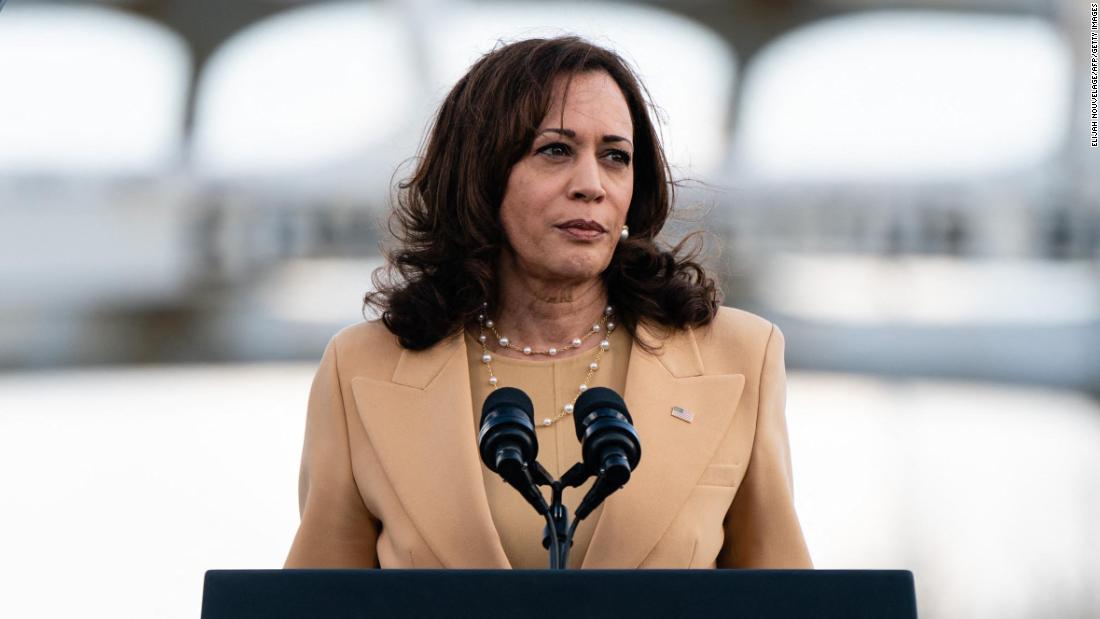
(CNN)Vice President Kamala Harris’ director of public engagement and intergovernmental affairs is leaving his position, a White House official told CNN.

Michael Collins announced his departure in a letter to staff after 16 months in the role.

“It has been a difficult decision, but I’ve decided to leave this amazing experience in the middle of August and transition to the next stage of my life,” he wrote. “I’m so grateful to the Vice President for trusting me with this privilege and was honored to support the President’s and Vice President’s tireless, committed and historic work.”

Collins’ departure comes two weeks after two of Harris’ senior officials — Rohini Kosoglu and Meghan Groob — announced their departures. There has been a regular cadence of exits from the vice president’s office since late last year.

Kosoglu, was one of Harris’ longest-serving aides, and worked as Harris’ domestic policy adviser after serving as her senior adviser during the transition and serving as chief of staff in both her Senate office and past presidential campaign.

Groob, who was director of speechwriting, announced her departure after working in her position less than four months. She took over the speechwriting job for Kate Childs Graham who announced her departure in February.

The West Wing has also had a flurry of staff changes as Democrats head into campaign season for the midterms.

Multiple sources told CNN on Friday that White House communications director Kate Bedingfield will be staying on in her role, a surprise reversal decision that came after the White House previously announced she would be leaving.

Additionally, multiple mid-level aides have moved to higher profile positions in the administration after an internal push by White House chief of staff Ron Klain to finalize Biden’s senior team for the coming months in preparation for a heated political season in advance of the midterm elections.

This story has been updated with additional details.

CNN’s Shawna Mizelle contributed to this report.

Categories
Saved Web Pages

Russian man spent years as puppeteer behind US political groups, officials say

6452.jpg?width=1200&height=630&quality=8

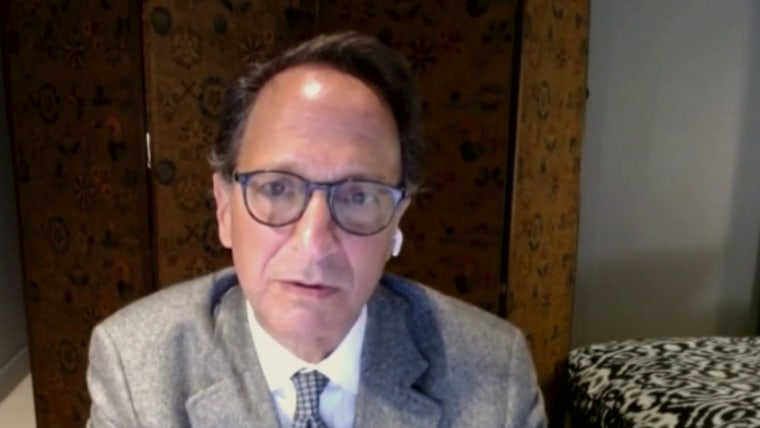
A Russian man orchestrated a yearslong effort to puppeteer political groups in Florida, Georgia and California to sow discord in the US, spread pro-Russia propaganda and meddle in American elections, justice department officials alleged on Friday.

Aleksandr Viktorovich Ionov of Moscow was charged with conspiring to have US citizens act as illegal agents of the Russian government, according to a justice department statement. If convicted, he faces up to five years in prison.

The indictment against Ionov was linked to a raid by federal agents of the Uhuru Movement’s headquarters in St Petersburg, Florida, on Friday, the Tampa Bay Times reported, citing US officials.

The Uhuru Movement belongs to the African People’s Socialist party and purports to unite “African people as one … for liberation, social justice, self-reliance and economic development”.

At a news conference on Friday, a Uhuru leader declared openly that his group was “in support of Russia” and dismissed the raid as an attack meant to isolate Africans in the US who are fighting for liberation.

“We can have relationships with whoever we want to make this revolution possible,” said the leader, Eritha “Akile” Cainion.

The movement’s St Petersburg headquarters recently made headlines for unrelated reasons after a man using a flamethrower set fire to a flag flying outside the building, leading to his arrest.

According to the justice department, Ionov was acting on behalf of the FSB Russian intelligence agency when he financially supported the groups at the center of the case, none of which are explicitly named in the indictment. He allegedly ordered them to publish pro-Russian lies and coordinated actions by them intended to further Russian interests.

The department also claimed Ionov influenced a US political group in Florida under his control to interfere in local elections, supporting the St Petersburg, Florida, political campaigns of two people in 2017 and 2019. It listed the group and individuals as “unindicted co-conspirators” but did not name them.

From at least December 2014 to March 2022, the department said, Ionov and at least three other Russian officials engaged in a malign foreign influence campaign targeting the US.

Separately, the US treasury department on Friday imposed sanctions on Ionov, his fellow Russian national Natalya Valeryevna Burlinova, and four Russian entities it accused of backing the Kremlin’s mission of interfering in elections abroad, including in the US and Ukraine.

According to the justice department, the four entities in question are: the Anti-Globalization Movement of Russia (AGMR), which Ionov founded and presides over; Ionov Transkontinental; Stop-Imperialism; and the Center for Support and Development of Public Initiative Creative Diplomacy (Picreadi).

The Russian embassy in Washington did not immediately reply to an email seeking comment on the indictment or the US sanctions, which among other things block the property in American jurisdiction of those named.

Reuters contributed this report

Categories
Saved Web Pages

House intelligence committee speaks about new DNA bio-weapons

60621765-0-image-a-71_1658623225917.jpg

Published: 02:15 BST, 24 July 2022 | Updated: 16:01 BST, 27 July 2022

A member of the U.S. House Intelligence Committee warned that bio-weapons are being made that use a target’s DNA to only kill that person.

Speaking at the Aspen Security Forum on Friday, US Rep Jason Crow of Colorado warned Americans to not be so cavalier about sharing their DNA with private companies due to the coming of the new type of weapon. 

‘You can actually take someone’s DNA, take, you know, their medical profile and you can target a biological weapon that will kill that person or take them off the battlefield or make them inoperable,’ Crow said.

The congressman said the development of the weapons is worrisome given the popularity of DNA testing services, where people willingly share their genetic mapping with businesses to gain insight on their genealogy and health.    

‘You can’t have a discussion about this without talking about privacy and the protection of commercial data because expectations of privacy have degraded over the last 20 years,’ the Democratic lawmaker said. 

‘Young folks actually have very little expectation of privacy, that’s what the polling and the data show.”

Crow, a former Army Ranger who served three tours of duty in Iraq and Afghanistan, continued: ‘People will very rapidly spit into a cup and send it to 23andMe and get really interesting data about their background.’ 

U.S. Rep Jason Crow, of Colorado, warned that bio-weapons are being made that use a target’s DNA to only kill that person during the Aspen Security Forum on Friday

The congressman said the development of the weapons were worrying given the popularity of DNA testing services like 23andMe

23andMe has repeatedly stated that it does not sell off customers’ private information, but other DNA companies have provided information to police upon request

‘And guess what? Their DNA is now owned by a private company. It can be sold off with very little intellectual property protection or privacy protection and we don’t have legal and regulatory regimes to deal with that.’

‘We have to have an open and public discussion about… what the protection of healthcare information, DNA information, and your data look like because that data is actually going to be procured and collected by our adversaries for the development of these systems.’

23andMe has repeatedly stated that it does not sell off customers’ private information, but other DNA companies have provided information to police upon request.

US Senator Joni Ernst of Iowa, a member of the Senate Armed Services Committee, said the US rivals could use such DNA bio-weapons to target food supplies on a vast scale. 

Ernst warned that biological weapons could be used to target specific animals that citizens, troops or cities depend on, bringing about scarcity and food insecurity to weaken people. 

 ‘Food insecurity drives a lot of other insecurities around the globe,’ Ernst said. 

‘There’s a number of ways we can look at biological weapons and the need to make sure not only are we securing human beings, but then also the food that will sustain us.’  

US Senator Joni Ernst, a member of the Senate Armed Services Committee, said the US rivals could use such DNA bio-weapons to target food supplies on a vast scale

Earlier this week, the Washington Examiner reported on just how easy it could be for privately-owned databases to be used to develop bioweapons such as the ones touted by Crow.

The publication explained how DNA belonging to a target – or the close relative of a target – could be stolen and used to form a biological weapon effective against that person only. 

That technology could lead to highly-targeted assassination programs, and also make it much harder for killers to be tracked down.

Similar technology could be deployed against US agriculture by designing weapons which target only a certain breed of farm animal, or crop. 

That could plunge the country into famine, and leave the US on its knees in the face of hostilities from a rival like Russia or China. 

Army General Richard Clark, commander of the US Special Operations Command, highlighted how Russia had already shot to infamy with a less-sophisticated version of the same scheme.

Discussing the nerve agent poisoning of former double agent Sergei Skripal in England in 2018, he said: ‘Russia is willing to use those against political opponents. They’re willing to use them on their own soil, but then to go in on the soil of a NATO ally in the UK and use those … and as we go into the future, we have to be prepared for that eventualities. 

‘And I don’t think we talk about it as much as we should and look for methods to continue to combat.’

Skripal and his daughter Yulia were poisoned with the nerve agent Novichok in the English town of Salisbury, and almost died from their injuries. Britain’s then-Prime Minister Theresa May blamed Russia for the outrage days later.  

Last year, US Sen. Marco Rubio sounded the alarm that Russian and Chinese labs were processing the DNA tests of Americans through Medicare and Medicaid. 

‘It is ridiculous that our current policies enable the Chinese Communist Party to access Americans’ genomic data,’ Rubio said in a statement. 

‘There is absolutely no reason that Beijing, which routinely seeks to undermine US national security, should be handed the genomic data of American citizens.

In 2018, Ancestry, 23andMe, Habit, Helix, and MyHeritage all signed on to the policy drafted with the help of The Future of Privacy Forum, a non-profit, in support of ‘advancing responsible data practices in support of emerging technologies,’ according to Gizmodo.

The guidelines, titled Privacy Best Practices for Consumer Genetic Testing Services and released on Tuesday, deal with scenarios where users’ personally identifiable and anonymous genetic information might be shared with law enforcement (without a warrant) and other third parties.

The new voluntary policies call for requiring separate consent from users before sharing ‘individual-level information’ with other businesses and more transparency about the number of requests for data received by, and fulfilled for, law enforcement.

While all the companies have said they agree to these standards of practice, there is no law enforcing the rules. 

Categories
Saved Web Pages

FBI failures before the Capitol siege avoided the Jan. 6 committee’s scorn. Not for long.

220719-fbi-accountability-january-6-capi

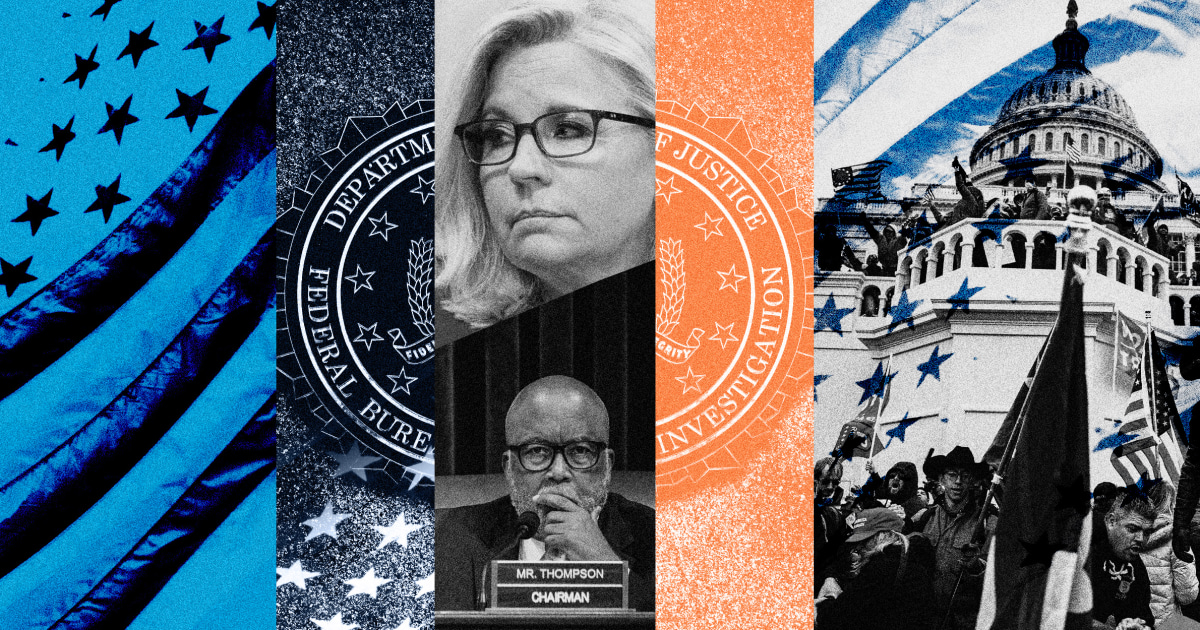
WASHINGTON — Although the House Jan. 6 committee has presented evidence of the carnage law enforcement faced at the Capitol that day, little time has been devoted to law enforcement’s failure to predict and prevent the attack — at least not publicly.

But behind the scenes, sources tell NBC News, those failures have not been from forgotten. As the committee prepares for an additional round of public hearings in September, they’re expected to put more focus on the intelligence and law enforcement failures at the FBI and Department of Homeland Security that left police woefully underprepared for the mob that stormed the Capitol. Those failures will also be a key component of the committee’s final report on Jan. 6.

One of the online sleuths who has worked with both the Jan. 6 committee and the FBI has a little story that helps illustrate a lot of the bureau’s challenges in the sprawling federal investigation into the Capitol attack and why the bureau didn’t do more to make sure law enforcement was prepared ahead of the Capitol attack, given all the alarm bells going off all across the web.

When they needed to send a large file to the Jan. 6 committee, they popped the files over on Dropbox.

When they needed to give something to the FBI, a special agent drove over to their home to transfer the files manually.

1658954604376_now_mtp_clip_dojprobe_2207

Due to late-breaking revelations, the committee’s public presentations in June and July skewed more towards Trump’s actions before and during the Capitol attack. But there’s a lot that got left on the cutting room floor, including new information gathered by the “blue team,” which is focused on law enforcement failures leading up to the attack, as NBC News reported back in January.

A committee aide told NBC News last week that this team of investigators are singularly focused on the preparedness of and response by law enforcement, intelligence agencies, and the military.

“The team has conducted more than 100 interviews and depositions touching on these matters of security and intelligence across several federal and local agencies, including the Federal Bureau of Investigation, Department of Homeland Security, Fusion Centers, Office of Intelligence & Analysis, among others,” the aide said. “The team is looking into what intelligence these agencies had at their disposal; how that intelligence was analyzed, stitched together, and distributed; and whether law enforcement operationalized that intelligence.”

The “blue team,” a separate source told NBC News, is headed by Soumya Dayananda, who spent more than a decade as a federal prosecutor — and worked the case against Joaquin “El Chapo” Guzman — before joining the committee.

Liz Cheney said in an interview on Fox News Sunday last week that the Blue team’s work will be featured in committee’s final report and would “likely” be featured in upcoming hearings.

“What we aren’t going to do… is blame the Capitol Police, blame those in law enforcement, for Donald Trump’s armed mob that he sent to the Capitol,” Cheney said. “Clearly there were intelligence failures, clearly the security should have operated better than it did. But this was a mob Donald Trump sent to the Capitol, and I think that’s important to keep our eye on.”

The FBI has been generally defensive about its preparations ahead of Jan. 6, and noted in the past that they took some actions to discourage extremists from traveling to D.C. ahead of the attack. But a new FBI statement to NBC News indicated the bureau had “increased our focus on swift information sharing” and “improved automated systems established to assist investigators and analysts” since Jan. 6.

There’s a limited timeframe to help call attention to the need to fix the intelligence failures. If Republicans take back the House in the midterms, as many analysts expect, oversight could very quickly flip from examining FBI shortcomings to investigating alleged law enforcement overreach against those who stormed the Capitol on Trump’s behalf. Instead of trying to understand how to make sure the FBI can make sure they are prepared for domestic extremist violence in the future, some congressional Republicans have downplayed the insurrection, protested the pre-trial detention of some Jan. 6 rioters whom they recast as “political prisoners,” and flirted with the “fedsurrection” conspiracy that posits the FBI instigated the attack to set up Trump supporters.

The potential for lethal violence because of Trump’s false claims about the 2020 election wasn’t a big secret. Law enforcement officials raised concerns about the lethal danger of Trump’s rhetoric both in the lead-up to and immediately after the November 2020 election. NBC News ran a story on the night of Jan. 5, 2021 about the violent threats spreading across Twitter, TikTok, Parler, and TheDonald message board.

One of the individuals who raised concerns before the attack was Bill Fulton, a former FBI informant and expert in right-wing extremism, who sounded the alarm in November 2020 that Trump was “walking” his supporters “to the edge” with his rhetoric about the election.

“You have the president of the United States taking these people to the edge, and the second that something happens he’s going to turn around and go, ‘Well, I didn’t tell them to do that,'” Fulton said, ominously, at the time.

In a recent interview, Fulton said the bureau faces a host of challenges in trying to prevent domestic extremist attacks, including legacy systems and processes that aren’t as frictionless as the communications and organizational technologies used in modern workplaces.

“You have to remember, this is the federal government, dude. Bureaucracy is in the FBI’s f**king name,” Fulton told NBC News this month.

He also noted it was critically important that, even as the bureau takes overdue steps to improve open-source intelligence, that First Amendment rights are well-protected.

“What we don’t want is the FBI becoming Hoover’s FBI again. We don’t want the FBI out there investigating people for no reason, right?” Fulton said. “And we don’t want those investigations to last forever.”

In a statement to NBC News, the FBI stated that the bureau “continues to evolve to combat persistent threats posed by domestic violent extremists” across the country.

“Since the attack on the U.S. Capitol on January 6, 2021 the FBI has increased our focus on swift information sharing with all our state, local, tribal, and territorial law enforcement partners throughout the United States,” the statement read. “We also have improved automated systems established to assist investigators and analysts in all of our 56 field offices throughout the investigative process. The FBI is determined to aggressively fight the threat posed by all domestic violent extremists, regardless of their motivations.”

The congressional investigation won’t be the final word on why law enforcement officials didn’t do more. In the weeks after the Capitol attack, the Justice Department’s inspector general announced a review examining “the role and activity of DOJ and its components in preparing for and responding to the events at the U.S. Capitol on January 6, 2021.”

The review, the DOJ inspector general said in a Jan. 15, 2021, announcement, “will include examining information relevant to the January 6 events that was available to DOJ and its components in advance of January 6; the extent to which such information was shared by DOJ and its components with the U.S. Capitol Police and other federal, state, and local agencies; and the role of DOJ personnel in responding to the events at the U.S. Capitol on January 6.”

The review would also address “any weaknesses in DOJ protocols, policies, or procedures that adversely affected the ability of DOJ or its components to prepare effectively for and respond to the events at the U.S. Capitol on January 6.” A spokesperson for the DOJ inspector general said that the review “remains ongoing.”

Categories
Saved Web Pages

New York becomes second major US city to declare health emergency over monkeypox

220730183146-new-york-city-monkeypox-pub

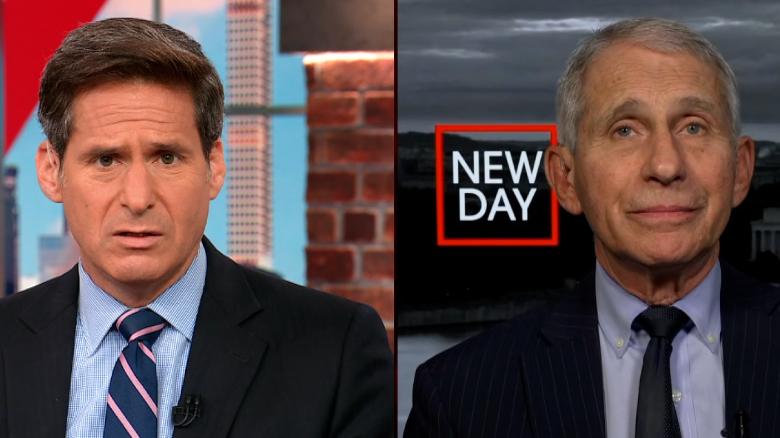
Fauci says US needs to do 'much better' on monkeypox effort

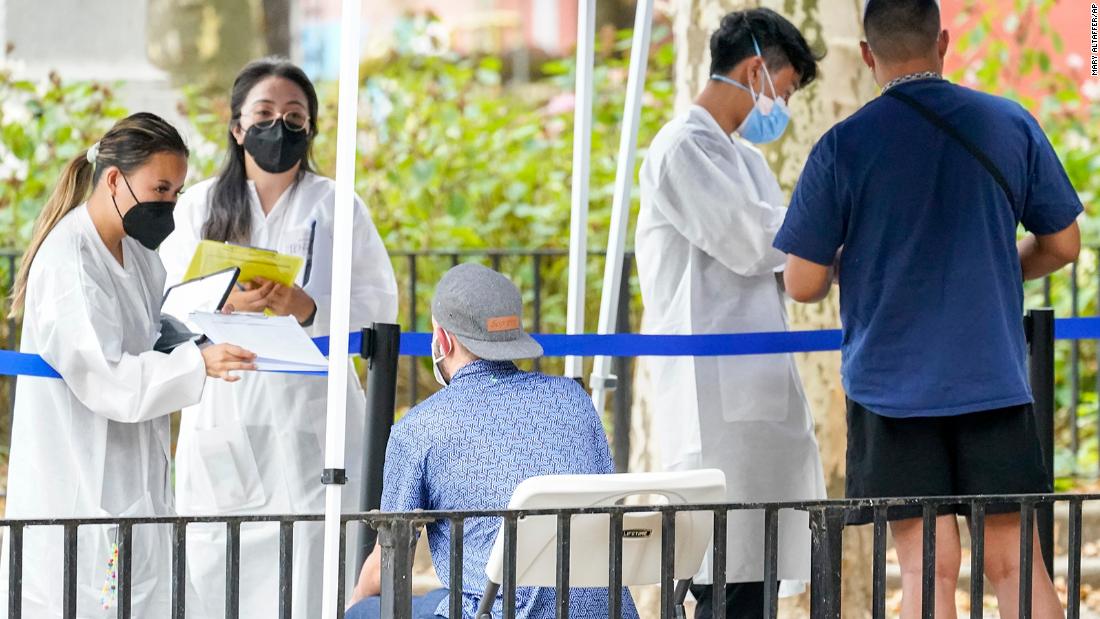
(CNN)New York City officials declared monkeypox a public health emergency Saturday, saying the city is the epicenter of the state’s outbreak and the move will boost measures to help slow the spread of the disease.

“We estimate that approximately 150,000 New Yorkers may currently be at risk for monkeypox exposure,” Mayor Eric Adams and Dr. Ashwin Vasan, commissioner of the city’s health and mental hygiene department, said in a joint statement. “This outbreak must be met with urgency, action, and resources, both nationally and globally, and this declaration of a public health emergency reflects the seriousness of the moment.”

The declaration takes effect immediately, the statement said.

It comes just a day after New York Gov. Kathy Hochul issued an executive order declaring a state disaster emergency, saying “more than one in four monkeypox cases in this country” are in the state. Among several other actions, the governor’s order expands the number of people eligible to administer monkeypox vaccines, requires providers to send vaccine data to the state’s health department and will boost ongoing response efforts including efforts to get more vaccines and expand testing capacity, the governor’s office said.

Other leaders in the US — and across the globe — have been sounding the alarm over monkeypox as infection numbers continue to rise and vaccine supply is falling short of demand. Experts including Dr. Anthony Fauci have stressed the monkeypox outbreak needs to be taken seriously and handled in a more rigorous manner, while federal officials continue to weigh a nationwide public health emergency declaration.

San Francisco became the first major US city to declare a local health emergency on Thursday in an effort to strengthen its preparedness and response amid “rapidly rising cases” and high demand for the vaccine, the city said. The declaration goes into effect on Monday.

“We know that this virus impacts everyone equally — but we also know that those in our LGBTQ community are at greater risk right now,” San Francisco Mayor London Breed said in a statement. “Many people in our LGBTQ community are scared and frustrated. This local emergency will allow us to continue to support our most at-risk, while also better preparing for what’s to come.”

In Washington, the federal government is continuing to monitor the response to monkeypox and will use it to consider whether to declare the outbreak a public health emergency, US Health and Human Services Secretary Xavier Becerra said Thursday.

“We will weigh any decision on declaring a public health emergency based on the responses we’re seeing throughout the country. Bottom line is, we need to stay ahead of it and be able to end this outbreak,” he said.

Former US Food and Drug Administration Commissioner Dr. Scott Gottlieb warned earlier this month it may be too late to contain the outbreak, telling CBS, “The window for getting control of this and containing it probably has closed.”

Last weekend, the World Health Organization declared the monkeypox outbreak a public health emergency of international concern after convening its second emergency committee on the issue.

WHO defines a public health emergency of international concern as “an extraordinary event” which constitutes a “public health risk to other States through the international spread of disease” and “to potentially require a coordinated international response.”

Categories
Saved Web Pages

NYC declares monkeypox public health emergency

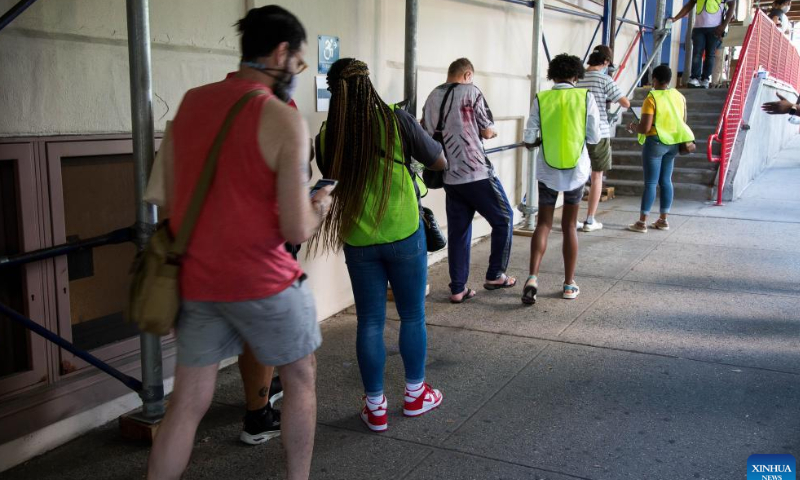
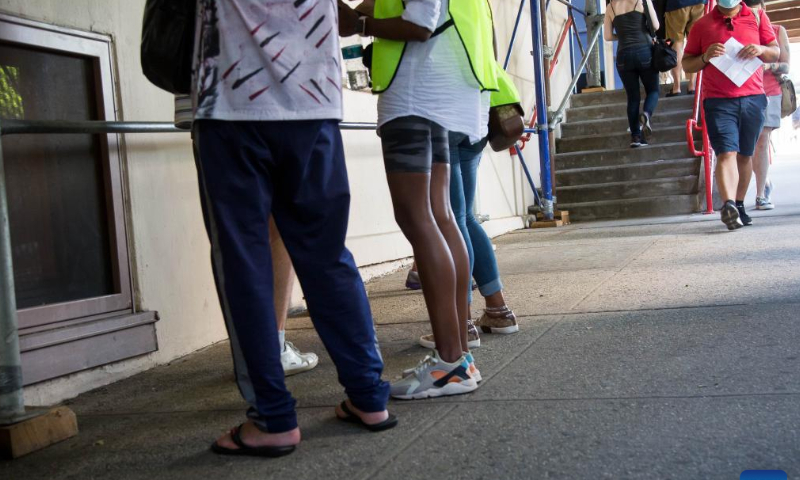
People wait in line at a monkeypox vaccination site in the Brooklyn borough of New York, the United States, on July 30, 2022. New York Governor Kathy Hochul declared a state disaster emergency late Friday night due to the growing monkeypox cases in the state. Photo: Xinhua

People wait in line at a monkeypox vaccination site in the Brooklyn borough of New York, the United States, on July 30, 2022. New York Governor Kathy Hochul declared a state disaster emergency late Friday night due to the growing monkeypox cases in the state. Photo: Xinhua

 New York City on Saturday declared a public health emergency due to the monkeypox outbreak.New York City Mayor Eric Adams and city Health Commissioner Ashwin Vasan made the announcement in a joint statement as a total of 1,383 monkeypox cases have been reported in New York State.”New York City is currently the epicenter of the outbreak, and we estimate that approximately 150,000 New Yorkers may currently be at risk for monkeypox exposure,” the statement read.The declaration will allow the health department to issue emergency orders under the city health code and amend code provisions to help slow the spread.The announcement came one day after New York Governor Kathy Hochul declared a state disaster emergency over the outbreak. On Thursday, the state health department called monkeypox an “imminent threat to public health.”Data from the U.S. Centers for Disease Control and Prevention showed that 5,189 cases had been confirmed nationwide as of Friday.The World Health Organization declared monkeypox a public health emergency of international concern on July 23.

People wait in line at a monkeypox vaccination site in the Brooklyn borough of New York, the United States, on July 30, 2022. New York Governor Kathy Hochul declared a state disaster emergency late Friday night due to the growing monkeypox cases in the state. Photo: Xinhua

People wait in line at a monkeypox vaccination site in the Brooklyn borough of New York, the United States, on July 30, 2022. New York Governor Kathy Hochul declared a state disaster emergency late Friday night due to the growing monkeypox cases in the state. Photo: Xinhua

 
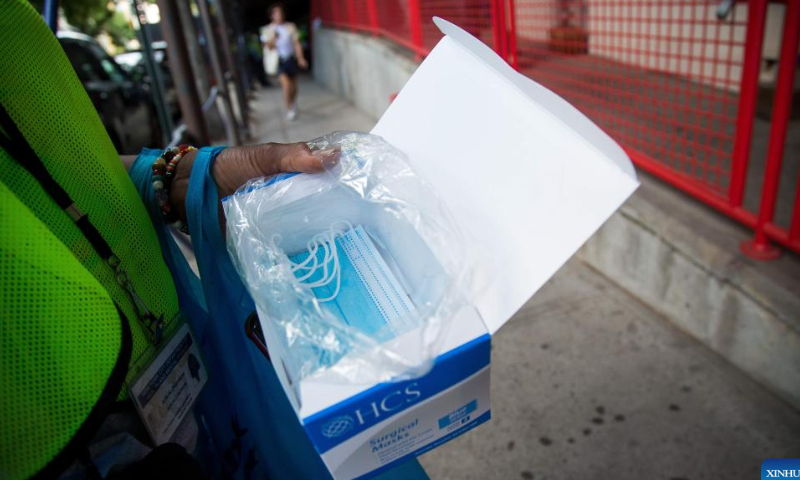
A staff member holds a box of masks at a monkeypox vaccination site in the Brooklyn borough of New York, the United States, on July 30, 2022. New York Governor Kathy Hochul declared a state disaster emergency late Friday night due to the growing monkeypox cases in the state. Photo: Xinhua

A staff member holds a box of masks at a monkeypox vaccination site in the Brooklyn borough of New York, the United States, on July 30, 2022. New York Governor Kathy Hochul declared a state disaster emergency late Friday night due to the growing monkeypox cases in the state. Photo: Xinhua


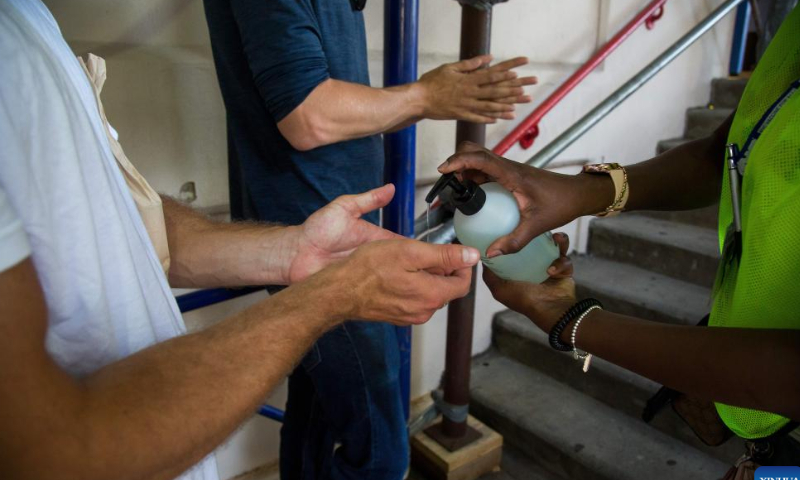
A man sanitizes his hands at a monkeypox vaccination site in the Brooklyn borough of New York, the United States, on July 30, 2022. New York Governor Kathy Hochul declared a state disaster emergency late Friday night due to the growing monkeypox cases in the state. Photo: Xinhua

A man sanitizes his hands at a monkeypox vaccination site in the Brooklyn borough of New York, the United States, on July 30, 2022. New York Governor Kathy Hochul declared a state disaster emergency late Friday night due to the growing monkeypox cases in the state. Photo: Xinhua


A man sanitizes his hands at a monkeypox vaccination site in the Brooklyn borough of New York, the United States, on July 30, 2022. New York Governor Kathy Hochul declared a state disaster emergency late Friday night due to the growing monkeypox cases in the state. Photo: Xinhua

A man sanitizes his hands at a monkeypox vaccination site in the Brooklyn borough of New York, the United States, on July 30, 2022. New York Governor Kathy Hochul declared a state disaster emergency late Friday night due to the growing monkeypox cases in the state. Photo: Xinhua


Categories
Saved Web Pages

Russian Navy Day Celebrations Canceled In Crimea’s Sevastopol After Reported Drone Attack

ddf2faa2-e4cb-4aab-b5ff-96f8efdc806f_w12

A firefighter works in a residential area damaged by a Russian missile strike in Kramatorsk in Ukraine's Donetsk region.

A firefighter works in a residential area damaged by a Russian missile strike in Kramatorsk in Ukraine’s Donetsk region.

Ukrainian President Volodymyr Zelenskiy has announced that the government has decided on the mandatory evacuation of people in the eastern Donetsk region, which site of intense fighting with Russian invading forces.

In a late-night televised address on July 30, Zelenskiy also said that the hundreds of thousands of people still in combat zones in the larger Donbas region needed to leave.

“The more people leave Donetsk region now, the fewer people the Russian Army will have time to kill,” he said, adding that residents would be given compensation.


RFE/RL’s Live Briefing gives you all of the latest developments on Russia’s ongoing invasion, how Kyiv is fighting back, Western military aid, worldwide reaction, and the plight of civilians and refugees. For all of RFE/RL’s coverage of the war, click here.

Deputy Prime Minister Iryna Vereshchuk was quoted by Ukrainian media as saying the evacuation needed to take place before winter begins since the region’s natural gas supplies had been destroyed.

Zelenskiy said hundreds of thousands of people were still living in areas of Donbas where fighting was fierce.

“Many refuse to leave, but it still needs to be done,” he said. “If you have the opportunity, please talk to those who still remain in the combat zones in the Donbas. Please convince them that it is necessary to leave.”

Earlier, the Ukrainian military said on July 30 that it had killed more than 100 Russian soldiers and destroyed two ammunition dumps in fresh fighting in the Kherson region, where Kyiv is concentrating its biggest counteroffensive since the start of the war.

The military’s southern command said that rail traffic to Kherson over the Dnieper River had been cut, potentially further isolating Russian forces west of the river from supplies in Russian-annexed Crimea and the east.

Ukraine has used Western-supplied long-range missile systems to badly damage three bridges across the river in recent weeks, making it more difficult for Russia to supply its forces.

“As a result of fire establishing control over the main transport links in occupied territory, it has been established that traffic over the rail bridge crossing the Dnieper is not possible,” Ukraine’s southern command said in a statement.

It said some 170 Russian soldiers had been killed and seven tanks destroyed in fighting on July 29 in the southern region.

The claims cannot be independently verified.

The Berislav district was particularly hard hit, according to Dmytro Butriy, the pro-Ukrainian governor of the Kherson region. Berislav is across the river, northwest of the Kakhovka hydroelectric power plant.

“In some villages, not a single home has been left intact, all infrastructure has been destroyed, people are living in cellars,” Butriy wrote on Telegram.

Officials warned residents to stay away from Russian ammunition dumps.

“The Ukrainian Army is pouring it on against the Russians and this is only the beginning,” Yuriy Sobolevskiy, the first deputy head of the Kherson regional council wrote on the Telegram app.

The Kherson region, which borders Crimea, fell to the Russians soon after the February 24 invasion.

Russian forces continued rocket attacks on towns and cities across Ukraine’s sprawling front line overnight, killing at least one person and hitting civilian targets, Ukrainian officials said on July 30.

The mayor of the southern port city of Mykolayiv said that at least one person was killed and six others were wounded in shelling that hit a residential area. The strikes left “windows and doors broken, and balconies destroyed,” Oleksandr Sienkevych wrote on Telegram.

A school building was hit in Kharkiv, the country’s second-largest city, Mayor Ihor Terekhov said. Russian rockets also hit a bus station in the city of Slovyansk, according to Mayor Vadym Lyakh. There were no immediate reports of casualties.

Britain’s Defense Ministry said on July 30 that Russia had likely established two pontoon bridges and a ferry system to compensate for bridges damaged in recent Ukrainian strikes.

In its regular bulletin the ministry said “it is likely” that Ukraine has also “successfully repelled small- scale Russian assaults from the long-established front line near Donetsk city in the Donbas.”

The previous day, the ministry tweeted that the Kremlin was “growing desperate” as Russia “has lost tens of thousands of soldiers” in the unjust war it “won’t win.”

On July 30, Britain’s MI6 foreign intelligence agency, Richard Moore, retweeted the Defense Ministry’s comment, saying Russia is “running out of steam.”

With reporting by Reuters and unian.net
Categories
Saved Web Pages

How Russia Spread a Secret Web of Agents Across Ukraine

01460000-0aff-0242-25c3-08da70b0d54a_w12

When the first armored vehicles of Russia’s invading army reached the heart of Chernobyl nuclear plant on the afternoon of Feb. 24, they encountered a Ukrainian unit charged with defending the notorious facility.

In less than two hours, and without a fight, the 169 members of the Ukrainian National Guard laid down their weapons. Russia had taken Chernobyl, a repository for tonnes of nuclear material and a key staging post on the approach to Kyiv.

The fall of Chernobyl, site of the world’s worst nuclear disaster, stands out as an anomaly in the five-month old war: a successful blitzkrieg operation in a conflict marked elsewhere by a brutal and halting advance by Russian troops and grinding resistance by Ukraine.

Now a Reuters investigation has found that Russia’s success at Chernobyl was no accident, but part of a long-standing Kremlin operation to infiltrate the Ukrainian state with secret agents.

FILE - A sandbag barricade sits on a building close to the New Safe Confinement (NSC) structure over the old sarcophagus covering the damaged fourth reactor at the Chernobyl Nuclear Power Plant, in Chernobyl, Ukraine April 16, 2022.


FILE – A sandbag barricade sits on a building close to the New Safe Confinement (NSC) structure over the old sarcophagus covering the damaged fourth reactor at the Chernobyl Nuclear Power Plant, in Chernobyl, Ukraine April 16, 2022.

Five people with knowledge of the Kremlin’s preparations said war planners around President Vladimir Putin believed that, aided by these agents, Russia would require only a small military force and a few days to force Ukrainian President Volodymyr Zelenskyy’s administration to quit, flee or capitulate.

Through interviews with dozens of officials in Russia and Ukraine and a review of Ukrainian court documents and statements to investigators, related to a probe into the conduct of people who worked at Chernobyl, Reuters has established that this infiltration reached far deeper than has been publicly acknowledged. The officials interviewed include people inside Russia who were briefed on Moscow’s invasion planning and Ukrainian investigators tasked with tracking down spies.

“Apart from the external enemy, we unfortunately have an internal enemy, and this enemy is no less dangerous,” the secretary of Ukraine’s National Security and Defense Council, Oleksiy Danilov, said in an interview.

At the time of the invasion, Danilov said, Russia had agents in the Ukrainian defense, security and law enforcement sectors. He declined to give names but said such traitors needed to be “neutralized” at all costs.

Ukraine’s State Bureau of Investigation is conducting a probe into whether the National Guard acted unlawfully by surrendering its weapons to an enemy, a local official told Reuters. The State Bureau of Investigation didn’t comment. The National Guard defended the actions of its unit at the plant, pointing to the risks of conflict at a nuclear site.

Court documents and testimony, reported here for the first time, reveal the role played by Chernobyl’s head of security, Valentin Viter, who is in detention and is being investigated for absenting himself from his post. An extract from the state register of pre-trial investigations, seen by Reuters, shows Viter is also suspected of treason, an allegation his lawyer says is unfounded. In a statement to investigators, Viter said that on the day of the invasion he spoke by phone with the National Guard unit commander. Viter advised the commander not to endanger his unit, telling him: “Spare your people.”

One source with direct knowledge of the Kremlin’s invasion plans told Reuters that Russian agents were deployed to Chernobyl last year to bribe officials and prepare the ground for a bloodless takeover. Reuters couldn’t independently verify the details of this assertion. However, Ukraine’s State Bureau of Investigation has said it is investigating a former top intelligence official, Andriy Naumov, on suspicion of treason for passing Chernobyl security secrets to a foreign state. A lawyer for Naumov declined to comment.

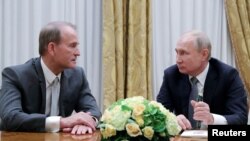
At a national level, sources with knowledge of the Kremlin’s plans said Moscow was counting on activating sleeper agents inside the Ukrainian security apparatus. The sources confirmed Western intelligence reports that the Kremlin was lining up Oleg Tsaryov, a hotelier, to lead a puppet government in Kyiv. And a former Ukrainian prosecutor general disclosed to Reuters in June that Ukrainian politician Viktor Medvedchuk, a friend of Putin, had an encrypted phone issued by Russia so he could communicate with the Kremlin.

FILE - Russia's President Vladimir Putin (R) attends a meeting with leader of Ukraine’s Opposition Platform - For Life party Viktor Medvedchuk in Saint Petersburg, Russia July 18, 2019.


FILE – Russia’s President Vladimir Putin (R) attends a meeting with leader of Ukraine’s Opposition Platform – For Life party Viktor Medvedchuk in Saint Petersburg, Russia July 18, 2019.

Tsaryov said the Reuters account of how Moscow’s operation overall unfolded “has very little to do with reality.” He did not address his relationship with the Kremlin. A lawyer for Medvedchuk declined to comment. Medvedchuk is in a Ukrainian jail awaiting trial on treason charges that pre-date the Russian invasion.

Though Russia captured Chernobyl, its plan to take power in Kyiv failed. In many cases, the sleeper agents Moscow had installed failed to do their job, according to multiple sources in Russia and Ukraine. Ukraine Security Council Secretary Danilov said the agents and their handlers believed Ukraine was weak, which was “a total misconception.”

People the Kremlin counted on as its proxies in Ukraine overstated their influence in the years leading up to the invasion, said four of the sources with knowledge of the Kremlin’s preparations. The Kremlin relied in its planning on “clowns – they know a little bit, but they always say what the leadership wants to hear because otherwise they won’t get paid,” said one of the four, a person close to the Moscow-backed separatist leadership in eastern Ukraine.

Putin now finds himself in a protracted, full-scale war, fighting for every inch of territory at huge cost.

But the Russian intelligence infiltration did succeed in one way: It has sown mistrust inside Ukraine and laid bare the shortcomings of Ukraine’s near 30,000-strong Security Service of Ukraine, or SBU, which shares a complicated history with Russia, and is now tasked with hunting down traitors and collaborators.

FILE - Members of the Security Service of Ukraine check the social media of a man suspected to be a Russian collaborator after he was detained at his home in Kharkiv, Ukraine, May 12, 2022.


FILE – Members of the Security Service of Ukraine check the social media of a man suspected to be a Russian collaborator after he was detained at his home in Kharkiv, Ukraine, May 12, 2022.

This internal Ukrainian turmoil burst into partial view on July 17. In a video address to the nation, President Zelenskyy suspended SBU head Ivan Bakanov, whom he has known for years, citing the large number of SBU staff suspected of treason. Ukrainian law enforcement sources told Reuters that some SBU staff recounted in conversation with them that they were unable to reach Bakanov for several days after Russia invaded, adding to a sense of chaos in Kyiv. Bakanov didn’t respond to Reuters’ requests for comment.

Zelenskyy also said 651 cases of alleged treason and collaboration have been opened against individuals involved in law enforcement and in the prosecutor’s office. More than 60 officials from the SBU and the prosecutor general’s office are working against Ukraine in Russian-occupied zones, Zelenskyy added.

Asked to comment on Reuters’ findings, the Ukrainian presidential administration, the SBU and the prosecutor general’s office did not respond. Kremlin spokesman Dmitry Peskov said: “All these questions have no relation whatsoever to us, therefore there is nothing for us to comment on here.” The Russian intelligence agency, the FSB, and the defense ministry did not respond to Reuters’ questions.

KGB ties

Moscow’s spy apparatus has been intertwined with Chernobyl for decades. After the 1986 disaster, when a reactor blew up scattering radioactive clouds across Europe, the Soviet KGB stepped in. More than 1,000 KGB staff took part in the clean-up, according to a declassified internal memo to a Ukrainian government minister, dated 1991. Then-KGB boss Viktor Chebrikov ordered his officers to recruit agents among the plant’s staff and instructed that a KGB officer should hold the post of deputy boss of the plant in charge of security, according to another memo – an internal KGB communication from 1986.

Even after Ukraine became independent in 1991, Moscow’s spy chiefs remained powerful there. The first head of Ukraine’s domestic intelligence service was Nikolai Golushko, who started his career in Soviet Russia. Before his appointment he led the Ukraine arm of the Soviet KGB. Golushko kept most of the Soviet-era officers in their jobs, he wrote in a 2012 memoir.

After four months as Ukraine’s spy chief, Golushko moved back to Moscow to rejoin KGB headquarters, and in 1993 became head of Russia’s newly created Federal Counter-Intelligence Service, precursor to today’s FSB.

In Moscow, Golushko received a visit from the deputy head of Ukraine’s State Security Service, Golushko wrote in the memoir. He recalled how Oleg Pugach, the Ukrainian official, asked for Golushko’s help finding fabric to make the uniforms for Ukraine’s intelligence officers. Golushko also wrote that Kyiv, short of its own resources and expertise, signed deals under which the SBU agreed to share intelligence information with Moscow. In exchange, Moscow provided supplies, technology and expert help with investigations. Reuters approached Golushko for comment. A colleague from an intelligence veterans’ group told Reuters Golushko, now 85, was in ill health and could not answer questions. Reuters was unable to reach Pugach and couldn’t independently confirm Golushko’s account.

Intelligence officers working at Chernobyl officially became part of Ukraine’s security apparatus in 1991, but they continued to take orders from Moscow, said the person with direct knowledge of the invasion plan. “In effect, these were FSB employees,” said the person. The SBU did not respond to questions about Chernobyl or historical ties to Russian intelligence.

FILE - A general view of the New Safe Confinement (NSC) structure over the old sarcophagus covering the damaged fourth reactor at the Chernobyl Nuclear Power Plant, in Chernobyl, Ukraine April 7, 2022.


FILE – A general view of the New Safe Confinement (NSC) structure over the old sarcophagus covering the damaged fourth reactor at the Chernobyl Nuclear Power Plant, in Chernobyl, Ukraine April 7, 2022.

The Chernobyl nuclear plant is a vast facility. A giant steel structure encases Reactor No. 4, ground zero of the 1986 disaster. The plant lies just 10 kilometers at the closest point from the border with Belarus, in a dense and highly irradiated forest. Russia’s war planners considered control of Chernobyl to be strategically important because it sat on the shortest route for their advance on Kyiv, according to Western military analysts.

The source with direct knowledge of the invasion plan said that in November 2021 Russia started sending undercover intelligence agents to Ukraine, tasked with establishing contacts with officials responsible for securing the Chernobyl power plant. The agents’ goal was to ensure there would be no armed resistance once Russian troops rolled in. The source said Chernobyl also served as a drop-off point for documents from SBU headquarters. In return for payment, Ukrainian officials handed Russian spies information about Ukraine’s military readiness.

Reuters could not independently verify details of the source’s account, and neither Ukraine’s State Bureau of Investigation nor the SBU responded to the news agency’s questions. But a review of Ukrainian testimony and court documents and an interview with a local official show that Kyiv is conducting at least three investigations into the conduct of people who worked at Chernobyl. The investigations have identified at least two people suspected of providing information to Russian agents or otherwise helping them seize the plant, according to these documents.

One of the men suspected by Ukrainian prosecutors and investigators of helping Russian forces is Valentin Viter, a 47-year-old colonel in the SBU. At the time of the Russian invasion, Viter was the deputy general-director of the plant responsible for its physical protection.

In May last year, Viter oversaw a routine training exercise that was meant to simulate an attack by armed saboteurs. Armed members of the National Guard unit that protects Chernobyl took part, and rehearsed repelling the attackers by force. Viter said the exercise was a success, according to a video interview posted shortly afterwards on the plant’s website. He also said he hoped Chernobyl’s security team would “not need to apply the knowledge and skills we acquired in a real-life situation.”

Viter was seconded from the SBU to work at Chernobyl as security chief in mid-2019, according to a statement he gave to investigators. In a further statement, he said that on Feb. 18 this year – six days before the Russian invasion – he went on sick leave with a respiratory problem.

By then, Russia was bolstering its troops in Belarus in preparation for an invasion, U.S. officials said at the time. Satellite images shot by U.S. satellite imagery company Maxar on Feb. 15 showed a military pontoon bridge under construction across the Pripyat River in Belarus, north of the power plant. Ukraine’s police, and the SBU, were on heightened alert in response to the Russian threat, and the national police chief said in a statement at the time that security was reinforced at the Chernobyl plant.

On the morning of the Russian invasion, Feb. 24, Viter said, in a statement to investigators, that he was at his home in Kyiv. He telephoned the head of the Chernobyl National Guard unit, who was at his post. By then, people at the plant knew a column of Russian armored vehicles was heading their way.

Viter, according to his testimony to Ukrainian investigators, told the commander, in Russian: “Spare your people.” Viter had no official authority over the National Guard, and Reuters could not determine whether the commander was heeding Viter’s words when the unit surrendered after discussions with the Russian invaders. A National Guard statement identified the unit commander as Yuriy Pindak.

FILE - Trenches dug by the Russian military are seen in an area with high levels of radiation called the Red Forest, near the Chernobyl Nuclear Power Plant, in Chernobyl, Ukraine, April 16, 2022.


FILE – Trenches dug by the Russian military are seen in an area with high levels of radiation called the Red Forest, near the Chernobyl Nuclear Power Plant, in Chernobyl, Ukraine, April 16, 2022.

When the Russian soldiers finally retreated from Chernobyl after a 36-day occupation, they took Pindak and most of his unit away as captives. Ukraine says the guards are being held in Russia or Belarus. Russian officials did not comment on the unit’s whereabouts.

Ukraine’s State Bureau of Investigation is conducting a probe into whether the National Guard broke the law by laying down arms, said Yuriy Fomichev, mayor of the town of Slavutych where most of the Chernobyl workers live. Fomichev said he was not aware of anyone having been charged. The State Bureau of Investigation didn’t respond to Reuters’ questions about the matter.

The National Guard declined to comment on the actions of individual commanders and members of the unit tasked with protecting Chernobyl. “Fighting on the territory of nuclear facilities is prohibited by the Geneva Convention,” it said, adding that this was “one of the reasons” why there was no heavy fighting at the site. It referred questions about any investigation to the Bureau.

Article 56 of an additional protocol to the Geneva Conventions states that nuclear power plants and other dangerous installations should not be attacked.

Viter was arrested in western Ukraine and is now in pre-trial detention there on suspicion of absenting himself from his post. An extract from the court’s register, seen by Reuters, shows that law enforcement agents have initiated a second investigation into Viter for suspected treason by “deliberately assisting the military units of the aggressor country, the Russian Federation, in carrying out subversive activities against Ukraine.” They have yet to uncover evidence tying him to Russian special services.

Viter has said in court statements that he fled Kyiv for the safety of his family two days after Chernobyl was seized but tried to stay in contact with colleagues at the plant.

His lawyer, Oleksandr Kovalenko, said Viter had a legitimate reason for being off work and was unaware that he should stay at Chernobyl. The lawyer said any treason allegation was unfounded and Viter had not been served with a letter of suspicion, a step which usually precedes charges. According to the lawyer, Viter said “Spare your people” to remind the National Guard commander that many people depended on him. Viter did not discuss surrender, Kovalenko said. He added that investigators had not asked Viter about any exchange of documents at Chernobyl.

Cash and emeralds

The extent to which Russia infiltrated Chernobyl has focused Ukrainian authorities’ attention on the SBU, the agency Viter worked for, sources said. In particular, military prosecutors on Viter’s case are interested in his connection to a former Ukrainian official called Andriy Naumov, according to sources with knowledge of the investigation and a transcript of Viter’s questioning seen by Reuters.

Previously an official in the Ukrainian prosecutor’s office, by 2018 Naumov had been appointed head of COTIZ, a state enterprise responsible for estate-management of the radioactive exclusion zone around Chernobyl. A major part of COTIZ’s role was to promote “extreme tourism” in the exclusion zone, but the enterprise also had a role in keeping the site secure, according to its website.

After his stint at Chernobyl, Naumov was made the head of the SBU’s department of internal security, a division that investigates other officers suspected of criminal activity. Last year, the agency said it thwarted an assassination attempt on Naumov by other SBU officers. Naumov was later fired as department chief, according to Ukrainian media outlet Ukrainska Pravda and a law enforcement source.

Naumov vanished shortly before the invasion, a person in law enforcement said. He eventually turned up in Serbia in June. A Serbian police statement issued on June 8 said police and anti-corruption agents had arrested a Ukrainian citizen identified by the initials “A.N.” on the border with North Macedonia. He had been trying to cross into North Macedonia from Serbia. A search of the BMW in which he was a passenger uncovered $124,924 and 607,990 euros in cash, plus two emeralds, the statement said. It said the individual and the unnamed driver of the BMW, who was also detained, were suspected of intending to launder the cash and emeralds, which police believe originated from criminal activities. Volodymyr Tolkach, Ukraine’s ambassador to Serbia, publicly confirmed the arrested man was Naumov.

The State Bureau of Investigation confirmed a local media report that it is conducting a pre-trial investigation into Naumov for state treason. It said it was looking into whether Naumov collected information on the security set-up at Chernobyl while working at the plant and later at the SBU and passed it to a foreign state. The statement did not say what grounds it had for suspecting he passed on secrets or if it had specific evidence linking him to Russia.

On March 31, President Zelenskyy issued a decree stripping Naumov of his brigadier-general rank. The same day, the Ukrainian president announced in an emotional address that Naumov and another SBU general were “traitors” who violated their oath of allegiance to Ukraine. Zelenskyy did not make reference to Chernobyl.

Naumov remains in detention in Serbia and could not be reached for comment. His lawyer in Serbia, Viktor Gostiljac, declined to comment. The SBU did not reply to questions about Naumov.

Decapitation

For Russia’s war planners, seizing Chernobyl was just a stepping stone to the main objective: taking control of the Ukrainian national government in Kyiv. There, too, the Kremlin expected that undercover agents in positions of power would play a crucial part, according to four sources with knowledge of the plan.

Yuriy Lutsenko, who served as Ukraine’s prosecutor general from 2016 until 2019, revealed to Reuters that at the time he left the role “hundreds” of Defense Ministry employees were under surveillance, approved by his office, because they were suspected of ties to the Russian state. Lutsenko said he believed there were similar numbers of suspected spies in other ministries.

Russia’s war planners were also counting on other allies to help in the takeover, five sources said.

One of the most visible loyalists was Viktor Medvedchuk, a leader of Ukraine’s Opposition Platform – For Life party. Putin is god-father to one of Medvedchuk’s children. Since 2014, Medvedchuk has been a vocal opponent of the popular protests that called for closer ties to the European Union.

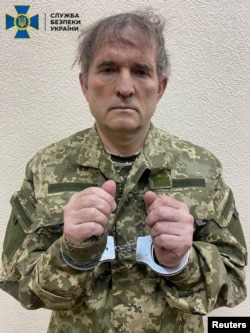
FILE - Pro-Russian Ukrainian politician Viktor Medvedchuk is seen in handcuffs while being detained by security forces in unknown location in Ukraine, in this handout picture released April 12, 2022.


FILE – Pro-Russian Ukrainian politician Viktor Medvedchuk is seen in handcuffs while being detained by security forces in unknown location in Ukraine, in this handout picture released April 12, 2022.

Medvedchuk was charged with state treason on May 11, 2021. Investigators from the SBU alleged at the time that Medvedchuk passed secret details about Ukrainian military units to Russian officials, and intended to recruit Ukrainian agents and covertly influence Ukrainian politics. The day before the invasion, he left his home in Kyiv and was planning on leaving the country, in violation of the terms of his bail, according to the SBU.

Medvedchuk was detained on April 12, Zelenskyy announced that day. Zelenskyy immediately posted pictures of him handcuffed, in Ukrainian military fatigues and looking bedraggled. Medvedchuk has since been in detention.

Medvedchuk has denied the treason charges, saying they were falsified and part of a political plot against him. Kremlin spokesman Peskov told reporters on April 13 Medvedchuk had no back-channel communication with the Russian leadership.

Lutsenko, the former Ukraine prosecutor general, told Reuters that before the Russian invasion, Medvedchuk used an encrypted telephone that was issued to him by the Kremlin, equipment reserved only for the most senior Russian officials and pro-Russian separatist leaders. Lutsenko said Ukrainian investigators had managed to hack the encrypted phone system, without disclosing what they found.

Medvedchuk’s lawyer, Tetyana Zhukovska, declined to comment until a court has handed down a decision in the case. The Ukrainian prosecutor’s office did not comment.

Another key figure, according to three sources familiar with the Russian plans, was Oleg Tsaryov, a square-jawed 52-year-old former member of Ukraine’s parliament. He was picked by Kremlin invasion planners to lead the new interim government they planned to install, these sources said. Their comments are the first confirmation from within Russia of U.S. intelligence assessments, reported by the Financial Times earlier this year, that Moscow was considering putting Tsaryov in a leadership role in a puppet government in Kyiv.

Tsaryov has been under Ukrainian and U.S. sanctions since 2014, when, after a bid to win election as Ukrainian president collapsed, he headed up a body called “Novorossiya,” or New Russia. The group pushed the idea of turning southeastern Ukraine into a separate pro-Russian statelet. By the start of this year, he was in Russian-annexed Crimea, where he owns two hotels.

In the early hours of Feb. 24, at the start of the invasion, Tsaryov told his more than 200,000 Telegram followers he had crossed into Kyiv-controlled territory. “I’m in Ukraine. Kyiv will be free from fascists.”

But Zelenskyy did not capitulate. Any expectations in Moscow that he would flee Kyiv or negotiate a deal that would cede to Russia’s demands soon evaporated. In the weeks that followed, Ukrainian forces halted Russian troops’ advance on Kyiv.

Tsaryov never made it to the capital. On June 10, he posted an advertisement to his Telegram followers for his seaside hotel in Crimea, where a one-night stay costs 1,500 rubles ($28) per person per night. Tsaryov is now spending his time in Crimea with visits to Moscow, according to his social media posts.

Paranoia and mistrust

Russia’s campaign of infiltration did, however, stir suspicion and mistrust at some levels of the Ukrainian state, which hampered its ability to govern, especially in the first few days after the invasion.

One stark incident that fueled the tensions in Kyiv’s power corridors related to the death in early March of Denys Kirieiev, a former bank executive, several sources said. He was a member of the Ukrainian delegation that took part in short-lived talks with Russian negotiators on the Ukraine-Belarus border, starting on Feb. 28. A photograph showed Kirieiev sitting alongside Ukrainian officials at the negotiating table.

An advisor to the Zelenskyy administration said, in an online interview, that officers from the SBU shot Kirieiev while trying to arrest him as a Russian spy.

But Ukraine’s Military Intelligence Agency said Kirieiev was its employee and intelligence officer, and that he died a hero while conducting an unspecified special assignment defending Ukraine. A source close to the Ukrainian military told Reuters that Kirieiev was indeed a spy working for Ukraine. He had access to the highest levels of the Russian leadership, this source said, and was feeding back valuable information on invasion plans and other matters to his handlers in Kyiv.

Amid the chaos early in the war, Bakanov, then the head of the SBU, left Kyiv for at least three days after the Russian invasion, according to three people in Ukrainian law enforcement. Two of these people said some SBU staff recounted they were unable to reach Bakanov for several days after Russia invaded. In suspending Bakanov on July 17, Zelenskyy cited an article in Ukraine’s Armed Forces statute, under which servicemen can be relieved of their duties for improper conduct leading to casualties or a threat of casualties.

Bakanov and the SBU did not respond to Reuters’ questions.

Zelenskyy, in his speech, stressed the toll Russian infiltration was taking on his embattled country by speaking of the numerous officials who have been accused of betraying Ukraine.

“Such an array of crimes against the foundations of the national security of the state … poses very serious questions to the relevant leaders,” Zelenskyy said.

“Each of these questions will receive a proper answer.”

Categories
Saved Web Pages

Russian hackers target Williams sisters in Olympic drug use leak

hack1.jpg?quality=75&strip=all&w=1024

Russian hackers broke into a World Anti-Doping Agency database and posted confidential medical data of prominent American athletes online.

WADA said Tuesday the attack — which targeted some female members of the United States team that competed at the Rio de Janeiro Olympics — was carried out by a “Russian cyber espionage group” called Fancy Bears.

The hackers revealed records of “Therapeutic Use Exemptions,” which allow athletes to use substances that are banned if there is a verified medical need.

The group’s website said it had information about a number of American athletes, including tennis sisters Serena and Venus Williams as well as multiple gold medal-winning gymnast Simone Biles and basketball star Elena Delle Donne.

“We will start with the U.S. team which has disgraced its name by tainted victories,” the group said, adding that more revelations about other teams were forthcoming.

Speaking on behalf of the Williams sisters, the International Tennis Federation said the players had been given permission to use the drugs.

Venus Williams wrote in a statement: “The applications for TUEs under the Tennis Anti-Doping Program require a strict process for approval which I have adhered to when serious medical conditions have occurred. The exemptions posted in the hacked report are reviewed by an anonymous, independent group of doctors, and approved for legitimate group of doctors.”

USA Gymnastics said in a statement that Biles, who won four gold medals in Rio, obtained the proper permission to take prescription medicine on the WADA banned list. Biles wrote on Twitter she takes medication for ADHD.

Having ADHD, and taking medicine for it is nothing to be ashamed of nothing that I’m afraid to let people know.

— Simone Biles (@Simone_Biles) September 13, 2016

“By virtue of the TUE, Biles has not broken any drug-testing regulations, including at the Olympic Games in Rio,” the organization said. “Simone and everyone at USA Gymnastics believe in the importance of a level playing field for all athletes.”

The breach was decried as an illegal invasion of privacy and an attempt to discredit anti-doping authorities.

“These criminal acts are greatly compromising the effort by the global anti-doping community to re-establish trust in Russia,” World Anti-Doping Agency director general Olivier Niggli said in a statement.

WADA said it “extended its investigation with the relevant law enforcement authorities.”

hack2.jpg?quality=90&strip=all&w=300US gold-medal-winning gymnast Simone BilesUPI

WADA previously warned of cyberattacks after its investigators published reports into Russian state-sponsored doping.

Russian news agencies quoted Kremlin spokesman Dmitry Peskov as saying any possible Russian government or secret service participation in the hacking was “out of question.”

Last month, hackers obtained a database password for Russian runner Yuliya Stepanova, a whistleblower and key witness for the WADA investigations. She and her husband, a former official with the Russian national anti-doping agency, are now living at an undisclosed location in north America.

The International Olympic Committee said it “strongly condemns such methods which clearly aim at tarnishing the reputation of clean athletes.”

“The IOC can confirm however that the athletes mentioned did not violate any anti-doping rules during the Olympic Games Rio 2016,” the Olympic body said.

Niggli said: “WADA deeply regrets this situation and is very conscious of the threat that it represents to athletes whose confidential information has been divulged through this criminal act. We are reaching out to stakeholders … regarding the specific athletes impacted.”

Those behind the breach have adopted the name “Fancy Bears,” an apparently tongue-in-cheek reference to a collection of hackers which many security researchers have long associated with Russia.

In a statement posted to its website early Tuesday, the group proclaimed its allegiance to Anonymous, the loose-knit movement of online mischief-makers, and said it hacked WADA to show the world “how Olympic medals are won.”

Internet records suggest Fancy Bears’ data dump has been in the works for at least two weeks; their website was registered on Sept. 1 and their Twitter account was created on Sept. 6. Messages left with the group were not immediately returned.

With AP and Reuters

Categories
Saved Web Pages

Inside Simone Biles’ shocking exit: Anatomy of an Olympics breakdown

simone-biles-olympics-tue-1-inset-1.jpg?

Simone Biles is the golden girl, interrupted, of the Tokyo Olympics.

America’s beloved gymnast announced July 27 that she was withdrawing from the team competition following a “stunning breakdown” at the long-delayed 2020 Olympics, citing mental health issues — and not an injury — that were exacerbated by the pressure to be “head star” at the Summer Games.

After her unexpected departure, the USA women’s gymnastics team ended up taking home the silver medal without 24-year-old Biles, a four-time Olympic gold medalist.

However, the decision to focus on competing for her own well-being instead of medals — while jarring to many US fans — wasn’t a complete shock to some diehard Biles followers.

After a fraught performance at Tokyo prelims on July 26, Biles already seemed to be hinting at a struggle. She opened up on Instagram, saying: “I truly do feel like I have the weight of the world upon my shoulders at times.”

Simone Biles announced Tuesday that she was withdrawing from the team competition at the Tokyo 2020 Olympics, citing mental health issues.Simone Biles announced July 27 that she was withdrawing from the team competition at the Tokyo 2020 Olympics, citing mental health issues.AFP; Getty Images

She continued, “I know I brush it off and make it seem like pressure doesn’t affect me but sometimes it’s hard, hahaha! The Olympics is no joke.”

And at a press conference after her teammates’ silver medal win on July 27, Biles hinted at a more serious weight on her shoulders.

“Whenever you get in a high-stress situation, you kind of freak out. I have to focus on my mental health and not jeopardize my health and well-being,” she said.

“We have to protect our body and our mind … It just sucks when you’re fighting with your own head.”

But Biles clearly hid the full inner turmoil she was experiencing — a private agony that bubbled to the surface on July 27 when she formally withdrew from the team competition.

“There’s more to life than just gymnastics,” Biles told reporters at a press conference alongside her teammates. “It’s very unfortunate that it happened at this stage, because I definitely wanted it to go a little bit better. [I will] take it one day at a time and we’re gonna see how the rest goes.”

Simone Biles of Team United States competes on vault during the women's team final on day four of the Tokyo 2020 Olympic Games on Tuesday.Simone Biles of Team United States competes on vault during the women’s team final on day four of the Tokyo 2020 Olympic Games on July 27.Getty Images

USA Gymnastics released a statement July 27 declaring that Biles’ withdrawal following her vault rotation was due to an unspecified “medical issue” and she would “be assessed daily to determine medical clearance for future competitions.”

Biles countered that her only injury was “just a little to my pride … physically, I feel good, I’m in shape,” she told NBC’s Hoda Kotb. “Emotionally, that kind of varies on the time and the moment.”

The gymnast also said her main inspiration to “focus on my well-being” was tennis ace Naomi Osaka, who shocked fans by pulling out of this year’s French Open and skipping Wimbledon due to stress, triggered by the mandatory press conferences after each match.

Biles also follows in the footsteps of 23-time Olympic gold medalist Michael Phelps, who revealed in 2018 that he suffers from depression and crippling anxiety.

Her path to Olympic glory has been a challenging one. Here is a look back at all the times Biles has been open about her mental health struggles, including her childhood experiences, living with ADHD and the abuse she suffered at the hands of disgraced gymnastics trainer Larry Nassar.

Simone Biles of Team United States is consoled by coaches Cecile Landi and Laurent Landi after stumbling on the landing while competing in vault during the Women's Team Final on day four of the Tokyo 2020 Olympic GamesSimone Biles is consoled by coaches Cecile Landi and Laurent Landi after stumbling on the landing while competing in vault at the Tokyo 2020 Olympic Games. Getty Images

She was in foster care as a child

Biles was traumatized during her early childhood in Spring, Texas, when her birth mother, Shannon Biles, became unable to care for her and her three siblings. The foursome went in and out of foster care, but Biles was adopted in 2003 by her loving maternal grandfather and his wife. The pair have long encouraged her passion for gymnastics. In her 2016 memoir, “Courage to Soar: A Body in Motion, A Life in Balance,” the sportswoman discussed the disruption to her formative years, writing: “my biological mom was suffering from drug and alcohol abuse and she was in and out of jail, I never had mom to run to.”

The Russian gold medal team stands on the podium near the silver-winning US team — including Simone Biles — at the Tokyo 2021 Olympic Games on Tuesday.The Russian gold medal team stands on the podium near the silver-winning US team — including Simone Biles — at the Tokyo 2020 Olympic Games on July 27.REUTERS

Her high school peers were bullies

As a teen whose intense training schedule led to peak fitness, she developed somewhat bulky muscles. As a result, Biles was bullied at school. In an appearance on the “Today” show four years ago, she recalled that classmates would make derogatory comments about her athletic figure.

“People would say mean things to me all the time,” she said. “They used to call me a ‘swoldier,’ which didn’t make me feel the best. I wore sweaters or jackets all year to cover my arms.”

Simone Biles competes on the balance beam at the Tokyo 2020 Olympic Games on Sunday.Simone Biles competes on the balance beam at the Tokyo 2020 Olympic Games on July 25.AFP via Getty Images

She was treated by a sports psychologist at 16

After a poor performance at the 2013 US Classic, Biles’ confidence plummeted. She consulted Houston-based sports psychologist Robert B. Andrews, who helped her manage her nerves and use her excitement to improve her skills.

“After working with Robert, I was able to recover and get my confidence back,” she said in a joint interview with Andrews in 2014. The expert also taught her ways to “calm down” after competing. “I found that I was getting too intense,” Biles admitted. “Working with Robert also helped ease my fears and I found more confidence.”

Simone Biles competes in the artistic gymnastics vault event on Sunday at the Tokyo 2020 Olympic Games.Simone Biles competes in the artistic gymnastics vault event on July 25 at the Tokyo 2020 Olympic Games.AFP via Getty Images

Her ADHD diagnosis was made public by hackers

In 2016, hackers managed to access Biles’ health records and released unauthorized, previously unknown details about her mental health. They exposed her as having ADHD, a condition for which she was prescribed medication.

Biles came out fighting, taking to Twitter to explain she was not cowed by the diagnosis. She defiantly posted: “Having ADHD, and taking medicine for it is nothing to be ashamed of, nothing that I’m afraid to let people know.”

Having ADHD, and taking medicine for it is nothing to be ashamed of nothing that I’m afraid to let people know.

— Simone Biles (@Simone_Biles) September 13, 2016

Discussing the disorder in an NPR interview, Biles said: “At a very young age, I didn’t realize what the diagnosis was. But it was a very good outing for me to get some energy out and then come home tired, do some homework and go to bed easier.” She added that she never saw it as a disability: “Other kids have it as well. And it’s just we’re more active and hyper than them, and I never think of that as a downfall. If anything, I see it as a cool thing ’cause, like, we have more energy.”

She revealed she was abused by Larry Nassar

Larry Nassar listens during his 2018 sentencing in Michigan.Larry Nassar listens during his 2018 sentencing in Michigan.AP

In 2018, Biles revealed she was one of the more than 100 female gymnasts who accused team doctor Larry Nassar of molestation.

Besides saying the abuse brought about suicidal thoughts, she released a lengthy statement on her social media platforms. It was posted the day before a sentencing hearing at which Vassar heard victim impact statements.

“Most of you know me as a happy, giggly and energetic girl. But lately … I’ve felt a bit broken and the more I try to shut off the voice in my head the louder it screams,” Biles wrote.

Her brother almost went to jail

Biles' brother, Tevin Biles Thomas, was charged in the fatal shooting of three people at a New Year’s Eve party in Cleveland, Ohio. He was later acquitted.Biles’ brother, Tevin Biles Thomas, was charged in the fatal shooting of three people at a New Year’s Eve party in Cleveland, Ohio. He was later acquitted.Twitter: @Simone_Biles

If 2018 wasn’t bad enough, Biles endured another family crisis. Tevin Biles Thomas, the golden girl’s older brother, was charged in the fatal shooting of three people at a New Year’s Eve party in Cleveland, Ohio. He was ultimately acquitted this spring after a judge agreed with defense lawyers that there was insufficient evidence to justify a guilty verdict.

The pandemic put her ambitions on hold

Like many athletes with their hearts set on competing in the 2020 Olympics, Biles’ dreams were dashed when the country locked down in March 2020.

In an interview with Glamour, Biles “sat idle” for seven weeks and became depressed and thought of quitting.

“I wanted to give up,” Biles told the mag. “But it would have been dumb because I’ve worked way too hard.”

A masked Simone Biles lowers her head in Japan on Tuesday.A masked Simone Biles lowers her head in Japan on July 27.REUTERS

WP Radio
WP Radio
OFFLINE LIVE