Categories
Michael Novakhov - SharedNewsLinks℠

Ukraine-Russia war latest: Moscow threatens direct strike on Germany in fresh escalation against Europe and UK


Michael_Novakhov
shared this story
.

Zelensky declares Russian airspace ‘completely unsafe’ in warning to airlines and passengers

Former Russian president Dmitry Medvedev has threatened Germany with a “direct strike” on its military production facilities after Berlin accused Moscow of being behind a drone attack on Leipzig Airport last month.

Medvedev, the deputy chair of Russia’s security council and a routinely outspoken provocateur, wrote on Telegram that Germany’s leadership “deserve a direct strike on all German military equipment production facilities … and quite possibility on several other locations in Berlin as well”.

In an ominous addendum he suggested: “Every terror has sponsors. At the moment, these are the heads of Western countries, primarily European ones. And they often travel to Kyiv by train…”

Airport workers last month found a drone laden with explosives and a detonator at the airport, an important civilian freight and NATO logistics hub in eastern Germany that is also a base for several giant Ukrainian Antonov An-124 cargo planes.

Germany has blamed Moscow for the attack, characterising it as part of hybrid warfare meant to intimidate and cause divisions in countries that have supported Ukraine over the Russian invasion.

Russia denies involvement and has vowed to respond to what its foreign ministry spokesperson called “anti-Russian action”.

7 minutes ago

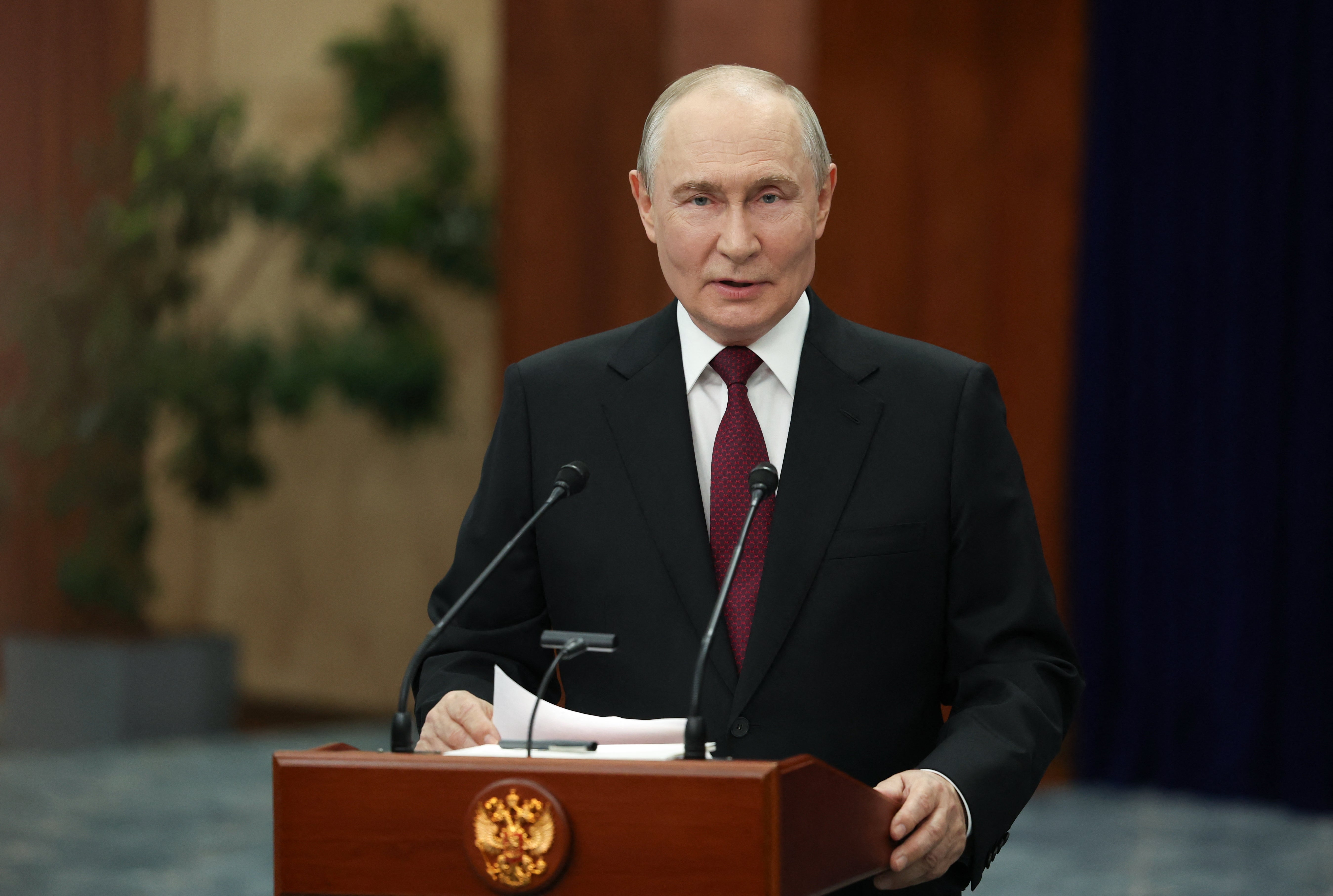
The latest: Putin issues new threat over Russian attacks on UK sites

Vladimir Putin has said it is a “military secret” whether or not Russia is weighing up possible strikes on British military sites, in an ominous new warning over the UK’s support for Ukraine.

The UK last month agreed to provide Ukraine with blueprints for the Scalp weapon, a version of the British Storm Shadow missile, which Britain has already provided to Kyiv and can be used to hit more targets within Russia itself.

Asked how Russia will respond to the decision – and whether he is weighing up possible strikes on UK military sites on British territory – the Russian president said: “That’s a secret, a military secret”.

Read the full story:

James Reynolds2 September 2026 14:00

38 minutes ago

Watch: Zelensky declares Russian airspace ‘completely unsafe’ in warning to airlines and passengers

Zelensky declares Russian airspace ‘completely unsafe’ in warning to airlines and passengers

James Reynolds2 September 2026 13:30

1 hour ago

Germany airport attempted attack had hallmarks of state sponsored terrorism, says EU’s Kallas

The attempted attack in Leipzig had all the hallmarks of state sponsored terrorism, the European Union’s foreign policy chief Kaja Kallas said this morning

She added that Europe needs to coordinate on what more can be done given the escalation of Russia’s attacks on Ukraine.

The German government said on Tuesday ‌that it had ‌concluded that Russia was responsible for the attempted ⁠drone attack last month.

Speaking ahead of an informal gathering of European foreign ministers in Ireland, Kallas also said that work is ongoing on 1,600 sanctions listings related to Russia’s military complex and “maybe there are more to be added”.

Arpan Rai2 September 2026 13:00

1 hour ago

Former Russian president threatens ‘direct strike’ on Nato member Germany

Former Russian president Dmitry Medvedev has threatened Germany with a “direct strike” on its military production facilities after Berlin accused Moscow of being behind a drone attack on Leipzig Airport last month.

Medvedev, the deputy chair of Russia’s security council and a regularly outspoken provocateur of the West, wrote on Telegram that Germany’s leadership “deserve a direct strike on all German military equipment production facilities … and quite possibility on several other locations in Berlin as well”.

In an ominous addendum he suggested: “Every terror has sponsors. At the moment, these are the heads of Western countries, primarily European ones. And they often travel to Kyiv by train…”

Airport workers last month found a drone laden with explosives and a detonator at the airport, an important civilian freight and NATO logistics hub in eastern Germany that is also a base for several giant Ukrainian Antonov An-124 cargo planes.

Germany has blamed Moscow for the attack, characterising it as part of hybrid warfare meant to intimidate and cause divisions in countries that have supported Ukraine over the Russian invasion.

Russia denies involvement and has vowed to respond to what its foreign ministry spokesperson called “anti-Russian action”.

James Reynolds2 September 2026 12:48

1 hour ago

Russia suggests possible three-way meeting between Trump, Putin and Xi

Kremlin aide Yuri Ushakov has said there could be a trilateral meeting between Russian president Vladimir Putin, US president Donald Trump and Chinese leader Xi Jinping.

China is set to host the Asia-Pacific Economic Cooperation (APEC) summit in Shenzhen in November.

The possibility of a three-way meeting between the leaders is being considered ahead of the summit, he said.

Arpan Rai2 September 2026 12:40

1 hour ago

Germany expects Russia to respond after blaming Moscow for Leipzig drone incident

The German government expects Moscow to respond with measures after it blamed Russia for an attempted drone attack on a major air freight hub last month, a government spokesperson said on Wednesday, adding that Berlin is prepared for those measures.

“At the same time, we assume that the Kremlin has understood yesterday’s message loud and clear. These hybrid attacks will not achieve their political objective,” the spokesperson added.

Berlin said on Tuesday that it had concluded that Russia was responsible for the attempted drone attack at Leipzig/Halle airport and ordered a series of measures in response, including the closure of a consulate and a Russian cultural centre in Germany.

James Reynolds2 September 2026 12:33

1 hour ago

Putin says it’s a ‘military secret’ whether Russia could strike UK facilities

President Vladimir Putin said Russia’s thinking on possible strikes against UK military facilities was “secret”.

Asked at a press conference in Kyrgyzstan whether Russia was considering strikes on British military assets, Putin said simply: “It is a military secret.”

Last week, Russia warned that it could strike British military ​targets inside and outside Ukraine in response to Ukrainian attacks on targets inside Russia using long-range British cruise missiles.

Russian foreign ministry spokesperson Maria Zakharova said Britain was just “one step away” from becoming legally complicit in what she called “terrorism” against Russian civilians, and warned of “inevitable catastrophic consequences” unless the UK changed course.

(AFP/Getty)

Arpan Rai2 September 2026 12:20

2 hours ago

Russia and US see grounds for financial ties, says finance minister

Dialogue between Russia and the US should continue to find common ground in economics, which should make it easier ⁠to discuss political issues, Russian finance minister Anton Siluanov said.

Siluanov said both nations agree that there are grounds for developing financial ties despite complications, after his bilateral meeting with US treasury secretary Scott Bessent on Monday.

Siluanov, who said he was meeting with Bessent for ‌the first time, said he ‌believed that people from the financial world sometimes may find common understanding faster than politicians.

“So we must always keep talking; we need to continue the dialogue. If we find strong points of common interest – and they do exist – we need to develop them. Then political issues will also be easier to resolve,” he said,

However, a source ‌familiar with the ministers’ meeting ⁠said Bessent made clear to Siluanov ⁠no economic relief for Russia or agreements on other ‌issues were possible ​until its war ‌in Ukraine ends, reported Reuters.

Arpan Rai2 September 2026 12:00

2 hours ago

Explosion heard in Kyiv

An explosion has been heard in the Ukrainian capital of Kyiv on Wednesday morning, witnesses said.

Renewed Russian strikes would make this the seventh consecutive day of attacks on the city.

Arpan Rai2 September 2026 11:40

2 hours ago

Zelensky confirms Trump’s request to pause strikes on Russia

Volodymyr Zelensky has said his forces held back on attacks on Russia last week in response to a request from the Trump administration.

“When the Americans asked us to pause strikes on Moscow and St. Petersburg on 25, 26 and 27 August, we observed that pause. There were no strikes on Russia, while strikes on Ukraine continued,” he said.

Stating that Ukraine supports every move in the direction of peace, Zelensky said: “When another global power asked us to pause strikes in the direction of Vladivostok for a specified period of time, we agreed to ensure that as well. New meetings in Moscow are now being prepared, and we will take that into account.”

Zelensky declares Russian airspace ‘completely unsafe’ in warning to airlines and passengers

Arpan Rai2 September 2026 11:20

Categories
Michael Novakhov - SharedNewsLinks℠

Exclusive: Musk opposes allowing Ukraine to use Starlink for strikes on Russia, despite recent media reports, sources say


Michael_Novakhov
shared this story
from The Kyiv Independent.

SpaceX CEO Elon Musk remains opposed to allowing Ukraine to use Starlink for strikes deep inside Russia, despite recent media reports suggesting otherwise, three sources familiar with the matter told the Kyiv Independent.

Kyiv has long sought U.S. approval to use the technology to strengthen its campaign against Russia, including to target ballistic missile launchers. President Volodymyr Zelensky raised the issue during a closed-door meeting with U.S. President Donald Trump on July 28, but Ukraine has yet to receive approval.

The Financial Times reported on Aug. 30 that Musk was open to Ukraine using Starlink-equipped drones to strike targets in Russia, but said the decision would ultimately be a political one requiring approval from the White House.

One of the sources said Musk does not believe allowing Ukraine to use Starlink for operations inside Russia would help bring the war to an end.

“Musk wants a deal in this war, not escalation,” the source said.

Musk allegedly held talks with former Defense Minister Mykhailo Fedorov that were “extremely unsuccessful,” after which the SpaceX CEO became convinced that he did not want to grant Ukraine permission to use Starlink for such operations, the source added.

Ukraine’s relationship with Musk has traditionally been entwined with the figure of Fedorov, who had worked with SpaceX to supply Starlink to the Ukrainian military in the first phases of the full-scale war.

Fedorov, who was controversially dismissed from his post in mid-July, initiated talks with Musk over restricting Starlink access for Russian forces operating in Ukrainian territory. After leaving office, Fedorov said on Aug. 7 he was still in talks with Musk, but did not elaborate on the nature of the discussions or what had been achieved.

Fedorov said that restricting access to the terminals is crucial, warning that Starlink access could give Russia “the ability to control operations from Moscow, fly over roads, change flight paths beyond the reach of our radars and acoustic sensors, take out all the F-16s and Patriots, and strike all military targets.”

President Volodymyr Zelensky said on Aug. 22 that an alleged miscommunication between Ukraine’s Defense Ministry, Musk, and U.S. President Donald Trump failed to secure Starlink access over Russia and also damaged Kyiv’s painstakingly recovered relationship with the White House.

Zelensky said he had previously been told by the Defense Ministry that Musk had approved the use of Starlink over Russia and that he only needed to secure the blessing of U.S. President Donald Trump.

Then, after convincing the U.S. president and agreeing on a funding package with EU leaders Ursula von der Leyen and Antonio Costa, Zelensky learned that Musk had given no such approval.

“He (Trump) said that I kind of tricked him because Musk denied Ukraine the use of Starlink on the territory of Russia,” Zelensky said.

“I went back to our defense ministry, and they said that maybe that’s how it was indeed.”

Despite the setback, Zelensky said that his team, together with members of the Trump administration, has been continuing talks with Musk in the hope of a breakthrough.

“So far, (Elon Musk) has said that this constitutes an escalation,” Zelensky said. “However, he may change his mind once he sees further arguments.”

“And we have already begun to receive different, more encouraging feedback. We are awaiting relevant meetings and so on. If no one makes a big fuss about this, I think we might see results,” Zelensky added.

After the conversation with Fedorov, Musk’s representatives said the decision on whether Ukraine should be allowed to use Starlink-equipped drones for strikes inside Russia should be addressed by the Trump administration. However, the administration indicated that SpaceX should decide whether to allow such use, a Ukrainian official told the Kyiv Independent.

An antenna of the Starlink satellite-based broadband system stands in a yard next to the wooden posts on which shoes are dried on April 7, 2024 in Kupiansk, Ukraine. (Yan Dobronosov/Global Images Ukraine via Getty Images)

Musk’s decision in February 2026 to cut off use of the service for Russian forces was crucial to Ukraine’s battlefield successes this year.

According to Zelensky, providing Starlink to Ukraine could reduce “precisely those capabilities that Russia is relying on to drag out the war.”

On top of allowing flawless high-speed communications between combat positions and command posts, Starlink internet, when mounted on drones, allows for an almost unjammable connection not constrained by the limits of traditional radio antennas.

In 2026, Ukrainian forces have increasingly used Starlink-enabled drones to strike targets in Russian-occupied territory, particularly within the “middle-strike” range of 50-200 kilometers (30-125 miles) from the front line, where Ukrainian attacks have disrupted Russian logistics routes.

The terminals do not, however, work over Russian territory, where Ukraine’s ongoing deep strike campaign against Russian military targets, oil infrastructure, and logistics facilities aims to enact strategic offensive pressure on Moscow.

Using Starlink-equipped drones over Russia has also been touted as a potentially effective counter against Russian ballistic missile attacks on Ukraine, by quickly striking the launchers of Russian Iskander and North Korean ballistic missiles when they move out to launch locations.

Ballistic missiles are among the most dangerous threats to Ukraine, as the U.S.-made Patriot is currently the only air defense system in the country’s arsenal capable of intercepting them, and Ukrainian forces face a critical shortage of Patriot missiles. Russia launched nearly 70 ballistic missiles at Ukraine in the first 10 days of August, with only one intercepted, according to Ukraine’s Air Force.

Categories
Michael Novakhov - SharedNewsLinks℠

Starlink для ударов по территории путинской России: радостные сплетни и суровые реалии


Michael_Novakhov
shared this story
from Економічні новини.

Categories
Michael Novakhov - SharedNewsLinks℠

Ukraine war briefing: Russian sky full of our drones and not safe, Zelenskyy warns airlines


Michael_Novakhov
shared this story
from The Guardian.

  • Volodymyr Zelenskyy has warned airlines and passengers against using Russian airspace because it will be filled with Ukrainian drones for the duration of the war. “Today, we want to warn every airline that uses Russian airspace, every insurer, and everyone who still uses Russia’s key airports: Russian airspace is becoming completely unsafe,” said Ukraine’s president. “Ukraine does not threaten civilian aviation as such – not a single civilian aircraft. There will simply be drones in Russia’s skies on a scale that has to be taken into account.” Vladimir Putin responded by calling Zelenskyy’s comments “a declaration of state terrorism”.

  • Russia has started deliberately targeting the country’s railway network, Dan Sabbagh and Luke Harding write, with six employees killed on Tuesday in the latest strikes on Kyiv. Ukraine’s state-owned railway company, Ukrzaliznytsia, said its workers died when a ballistic missile plunged into a locomotive depot. The Russians hit other railway facilities during a massive bombardment of Kyiv and surrounds. At least 12 people died, with a dozen wounded, including three children. The railway has been a lifeline for Ukraine’s civilians in wartime, transporting millions and bringing world leaders to Kyiv, including Joe Biden and Andy Burnham.

  • The German government has concretely blamed Russia for the botched drone attack at Leipzig airport that unsuccessfully targeted a Ukrainian cargo plane, Kate Connolly writes from Berlin. Berlin said all indications were the Russian state provided the knowhow and equipment to “low-level agents” on the ground. Russia will face penalties – its consulate in Bonn will be closed, and Russian House, a purported cultural and science institute in Berlin, will be evicted after allegedly serving as a base for hybrid attacks and spying. A clampdown on Russia’s shadow fleet operations in German waters is planned. New blacklists of Russians would be drawn up and border controls tightened on Russians entering Germany, said the foreign minister, Johann Wadephul. The EU is preparing to toughen sanctions against Russia.

  • The Russian wartime economy risks going “berserk”, Vladimir Putin’s ⁠international development envoy was quoted ⁠as saying on Tuesday. Boris Titov told business outlet RBC: “This is not an economy at all, it’s a kind of ‘berserk mode’ that can only exist for a ‌very limited time, and the necessity of which should be considered very carefully.” Titov’s ⁠comments echo a statement by Moscow’s mayor, Sergei Sobyanin, who argued that “killing a normal ​economy is equivalent to killing the whole ​country”. Andrei Klepach, the chief economist at the ​state development bank, lost his job last month after a public speech highlighting the economic challenges posed by the war.

  • Ukraine ⁠damaged ⁠oil-processing units ​at ⁠Russia’s ⁠Novatek ​Ust-Luga ‌complex ‌in the Leningrad region during ‌an attack on Tuesday, ‌Kyiv’s ​military ⁠intelligence ​said. Key components of the oil refining facility and process equipment were damaged, said the GUR, and a major fire broke out. Russia attacked Ukraine’s Black Sea export infrastructure ⁠and a border crossing with Romania in the southern region of Odesa, Ukrainian officials said on Tuesday. Ukrainian state energy firm Naftogaz said Russia ​also damaged its Odesa combined heat ‌and power plant with missiles ‌and drones. Russia’s ⁠defence ⁠ministry said ⁠its forces ​struck ‌two ‌cargo ‌vessels in ‌the port ​of Pivdennyi, ⁠near ​Odesa, claiming they were carrying military goods. The claim could not be verified.

  • David Petraeus has urged the UK to help lead a reinvention of Nato by adapting to a fundamental shift in warfare in the wake of the Ukraine war. The retired US army general and CIA ex-director told the House of Lords that Ukraine was the “defining military laboratory” of this century. Swift US technological advances in the defence sphere were not enough, Petraeus said, and nor was other nations simply purchasing better technology. He said Britain had shown “strategic clarity” after Russia’s full-scale invasion. “That now presents Britain with another opportunity: to become the first major western nation to organise its defence institutions around the new concept of warfare that Ukraine has been pioneering, and, in doing so, to help lead the transformation of Nato itself.”

  • Russia’s presence at US-hosted G20 talks has caused unease among participants, the Canadian finance minister has said. Francois-Philippe Champagne said “it created discomfort, no doubt about that … The G7 has always been very united in our support for Ukraine and the Ukrainian people in the face of the illegal invasion and the suffering that we see.”

Categories
Michael Novakhov - SharedNewsLinks℠

CIA Enters ‘Scale Phase’ of AI Adoption


Michael_Novakhov
shared this story
from Comments on: CIA Enters ‘Scale Phase’ of AI Adoption.

The Central Intelligence Agency (CIA) is entering the scale phase of its artificial intelligence (AI) implementation and has hundreds of AI projects underway, Israel Soong, deputy director of the CIA’s Office of AI, said Tuesday. 

After years of work, Soong said during a Federal News Network webinar that the agency has successfully rolled out an AI literacy program to thousands of officers, built a state-of-the-art model repository, deployed a chatbot, and partnered with four major cloud providers to bring frontier model capabilities to the agency. 

In some cases, Soong said that the agency is able to make new models available to users within seven to 10 days after they are released. 

“Over the past few years, we’ve made significant investments in foundational infrastructure to make AI broadly available across the CIA,” Soong said. “And right now, we’re kind of at an inflection point. Like, we’ve moved decisively beyond asking, ‘Should we adopt AI?’ to asking, ‘How do we operationalize it responsibly at scale?’” 

“In other words, we successfully completed an additional adoption phase, and now we’re expanding the capabilities and trying to transform mission execution,” he added. 

The next step for the agency is to continue to accelerate the adoption of AI while eliminating redundancies and prioritizing resource allocations, Soong said. 

“Now what we need is strategic stewardship,” he explained. “Now we’re trying to work AI into our mission workflows, not just as experimental tools, but as reliable capabilities changing how our workforce operates daily.” 

One way the CIA is doing that is by embedding large language models, retrieval-augmented generation techniques, and chatbot-style interfaces directly into analysts’ daily workflows, Soong said. The goal, he added, is to free officers from time-consuming data review and allow them to focus on more complex mission tasks. 

“Already, we’re seeing significant benefits to CIA’s intelligence mission,” Soong said. “It’s not the AI or the cloud in isolation, but all the elements of the AI tech stack working together, … that integrated approach of the two stacks is key.” 

In the future, Soong says that AI agents will also play a role in the CIA’s daily operations, picturing a world where  there are “teams of CIA officers managing teams of AI agents.” 

“There’s a potential for AI to assist analysis, but also identify blind spots for the analyst and generate novel hypotheses for them to consider when they write about their analysis. Also, we could have AI autonomously identify intelligence gaps and generate novel collection strategies,” Soong explained, adding that the CIA is aiming to have officers spend 80% of their time thinking critically about intelligence instead of collecting it. 

“Imagine this in the future,” he said. “AI agents have already … triaged the overnight intelligence for you. They’ve highlighted the most relevant operational developments, and they’re also combining and collating the intelligence reporting for you to review as you drink your morning coffee.” 

For now, Soong said the CIA’s next AI push centers on deploying smaller models and AI agents at the tactical edge so officers in remote or hostile environments can use AI with little or no connectivity.   

Categories
Michael Novakhov - SharedNewsLinks℠

What we know about weapon used by suspect in Charlie Kirk’s fatal shooting


Michael_Novakhov
shared this story
.

Subscribe to Reuters to continue reading.

Unlimited access to Reuters globally trusted news.

Final price$1/week

Charged as $4 in advance every 4 weeks.You can cancel anytime.

Categories
Michael Novakhov - SharedNewsLinks℠

Has the Trump Light Switch Finally Turned On?


Michael_Novakhov
shared this story
.


Jonathan Sweet

Army Col. (Ret.) Jonathan Sweet (@JESweet2022) served 30 years as a military intelligence officer. His background includes tours of duty with the 101st Airborne Division and the Intelligence and Security Command. He led the U.S. European Command Intelligence Engagement Division from 2012-14.


Mark Toth

Mark Toth

Mark Toth (@MCTothSTL) writes on national security and foreign policy. Previously an economist and entrepreneur, he has worked in banking, insurance, publishing and global commerce. A former board member of the World Trade Center, St. Louis, he has lived in U.S. diplomatic and military communities around the world.

Categories
Michael Novakhov - SharedNewsLinks℠

Decadent Ideology, Decaying Fraternity

French Catholic philosopher Chantal Delsol, a member of France’s prestigious Académie des Sciences Morales et Politiques, is known for her searing accounts of totalitarian ideology and her penetrating works on modern European politics and culture that richly reward any reader who gives them close attention. Over the years, many of her books have been translated into English, including Icarus Fallen: Search for Meaning in an Uncertain World and The Unlearned Lessons of the Twentieth Century: An Essay on Late Modernity. Her latest work to be translated into English, Prosperity and Torment in France , is an analysis of the current state of affairs in French politics, economics, and cultural life that reveals key lessons for modern democracies around the world.

In particular, Delsol examines the seeming paradox of a wealthy France, whose people are unsatisfied with the current state of affairs despite the almost unrivaled free social services provided to its citizens. On one level, the book is a grim account of a nation that has become historically defined by various ideologies, turning even good ideas and political forms like republicanism into rigid concepts closed to further political development. In a style reminiscent of Tocqueville, Delsol considers how the French people are caught between the tremendous benefits provided by the government and their devotion to ideological abstractions like egalitarianism, individualism, and secularism.

“France,” Delsol declares, “is a country that is particularly smitten with ideologies. It prefers ideas to reality.” She remarks that “Marxism was so entrenched that it was necessary to wait until the fall of the Berlin Wall for it to fade away: only universal ridicule could put an end to it, but certainly not the lucidity of our brilliant brains.” Delsol describes how in a widespread appeal to a “farcical Marxism,” French domestic politics was dominated from 1972 into the early 1980s by the “Programme commun” or “Common Program,” signed into law by the French Socialist Party, the Communist Party and the Radical Party of the Left.

France’s national motto, “Liberté, égalité, fraternité,” originated during the Revolution of 1789. In this book, Delsol describes in withering detail how these ideological formulae have become closed and seemingly incapable of answering the severe challenges that confront France in the twenty-first century. France cannot afford to stand still or act as if these new controversies can be dismissed with the stand-pat answers that it has developed for decades, if not centuries.

The author also notes that “it is so good to live in France.” French citizens are “pampered by a welfare state the likes of which exists nowhere else.” Its citizens “do not pay for health care, or schooling.” France has some of the highest levels of welfare spending in the world, but also an economy with a high GDP and a significant level of economic redistribution. She observes that “French grief is incomprehensible in the face of the ‘fortune’ and the abundance that can be objectively verified. However, if a self-governing people orients itself politically by modern ideologies of egalitarianism or humanitarianism, it will be perpetually disappointed. [She concludes that] … this grief comes from a propensity to expect perfection here below—the habit of an ideologue.” The author anticipates that many will find her analysis “pessimistic.” Though she shares her belief that a nation with France’s history and longevity can reform itself, it cannot do so without “lucid diagnostics.”

French citizens now freely indulge in a technologically driven individualism, making it almost impossible to envisage the civic fraternity needed to make the republican ideal possible.

Delsol observes that France’s decline from being part of the leading cohort of nations to a mid-tier power has been difficult to endure. She also remarks that other values specific to “eternal” France are also fading. Delsol notes that the weight of its celebrated national education system now burdens the nation with its abundant mediocrity and declining performance. Delsol concludes that the suboptimal results are because of top-down control, and a purported ability to deliver free education at all levels with minimal cost consciousness guarantees. Yet, to critique it or to openly suggest that the stringent limits placed on private education should be lifted is to risk public censure. The social justice good that public schools supposedly serve endures in the national psyche, despite years of poor results. This, despite the angling and maneuvering by those with means to get into the best government schools or pull strings and gain admission to one of the few private school slots.

Likewise, the vaunted nature of the republican ideal in France also seems stilted, ideological even, in a country of tremendous individualism. France is starting to resemble other Western countries, and this has produced the impression that their national substance is being stolen from them. Less republican, egalitarian, and exceptional, what then will be left of France?

Delsol argues that republicanism requires generous actions, not ideological control over people. If citizens do not freely choose to place the country first, then forcing such actions smacks of authoritarianism. Yet French citizens now freely indulge in a technologically driven individualism, making it almost impossible to envisage the civic fraternity needed to make the republican ideal possible. No one, though, will admit to a reduced identification with republicanism. Delsol wonders why the former trappings of republicanism no longer captivate French hearts. She answers that republicanism as a government ideal has become ideologically corrupted.

Republicanism in France replaced the socialist ideal with the collapse of the Soviet Union. Until that moment, the national imagination was socialist, Delsol informs. Republicanism became something of a substitute for Marxism for leading intellectuals. This can be seen in how republicanism, which is always tied to a concrete place, a country, and for a specific people and their virtues, was reconceived as a humanitarian universalist program. Republicanism was for the world; thus, the spectacle of French youth, Delsol reports, rushing to various ports of entry to protest on behalf of migrants entering France. The French Republic must automatically accept them. But from socialist histrionics to republican humanitarianism are the “moments of great hope and moments of great bitterness.” France loves “the union of hearts in comparison with people’s freedom.” True, it seems, but the French nation in Delsol’s analysis suffers from a profound deficit of encountering reality on its truthful terms, choosing instead to attempt to fill reality with an exaggerated political longing.

Delsol argues that, in a period of individualism, the republican form must incorporate a “high degree of democracy.” The ideology of French republicanism is failing because it lauds an abstract sense of social justice and the common good at the expense of concrete local, religious, and even racial commitments; Delsol suggests that the solution is to extend citizens a greater freedom of choice than that currently offered by the French state. Only in this manner can the union of republicanism be open to a citizenry that no longer wants to ask the state for permission to engage in various commercial, educational, and consumer pursuits. However, another paradox emerges with this argument for greater individual liberty, and that is the French citizenry’s love for equality, which is necessarily threatened by perhaps allowing more options and choices in healthcare, schooling, work, and commerce. Can the French publicly admit that more substantial options are needed other than those provided by the government? The remedy itself is a threat to still cherished but hardly flourishing social settlements.

Delsol notes that France is a disciple of the sixteenth-century thinker Jean Bodin, who emphasized centralized sovereignty of the state as opposed to that of Bodin’s contemporary, German thinker, Johannes Althusius, of the same period, who articulated a federalism and subsidiarity thesis of actions by people in intermediate groups and associations. The French rationalistic conception of state control leads to remarkably different outcomes from the subsidiarity model, Delsol concludes. One of those outcomes is an isolating individualism that results from the existence of only two densities: man and the state. “Centralization increasingly produces the need for the state.”

The individual becomes less, losing agency and direction, requiring increasing assistance from the state. Such is the direction of French politics, Delsol articulates, which evolved dramatically in the age of the twentieth-century welfare state, whose existence continues unabated into the present day. The result is maternalistic government. Delsol argues that this path can be tied directly to the French Revolution, which consisted of a regicide and then a coalescence “around the symbol of Marianne, the mother of the republic.” The arts of association were never possible in post-revolutionary France, as associations and corporations were abolished, leaving individuals solitary and reduced to their own capacities. Delsol pointedly asks, “What else can the individual do, without the right to associate when acting?” Consequently, the citizens are reduced to the welfare state and begging a maternalistic government to meet every need. The citizens have an “infantile attitude” constantly demanding more resources from a state that is always giving and promising. The state as mother and the citizen as infant need one another.

Delsol states that such servility to the government undergirds the French preference for “equality to liberty: they prefer everyone to be dealt with in the same manner.” The republican ideal in France requires one standard for everyone to maintain a proper political union. In the face of declining quality of public services and mounting debt, most French citizens still want the state “to decide for everyone about minimum wages, working hours, school curricula, retirement age, and so on.” The French would prefer the unemployed to be equally cared for by the state on a large level rather than be thrust into competitive employment situations and risk inequality, or work in “little jobs.” Delsol’s damning observation entails that freedom and responsibility for one’s life are removed from any conception of citizenship.

Delsol notes that Macron isn’t engaging in democratic politics, which makes way for alternatives, but in a style that leads to “a war against all.”

Such egalitarianism extends even to philanthropy, where it is done quietly for fear of offending people with displays of financial inequality. State subsidies are the first-order method for helping various causes. This even extended to donations to repair Notre-Dame Cathedral after the 2019 fire, where the public turned against anyone “chasing after glory” by making significant donations. Again, state grants for such repairs were foremost in their minds. The Pinault family (owner of luxury goods, fashion houses, Christie’s auction house, travel companies, and vineyards, among many others) announced that it would not seek a tax deduction for its considerable gift to the repair of the Cathedral. One of the wealthiest families in France wanted to announce its equal status with everyone else.

Yet considerable threats continue to mount to the French political model. The left-right divide now faces both communist and reactionary populist elements that capitalize on the deep mistrust that exists in French society for the justice system, unions, corporations, Parliament, and the rich. A system built on corporatism at the expense of the human person’s freedom is now seen as corrupt and governing at the cost of the public. The left-populist elements offer more government services and programs, more statism. But the right-populist element proposes to make the French nation the center of its rule. One struggles to see either populist movement engaging in the economic, education, and welfare state reforms described by Delsol to raise the quality of services, increase choice, and spark growth.

The secularism of French life faces a challenge posed by the millions of Muslims who have been given entrance to the country and who report in polling data and behavior great loyalty to the Koran and a much lower level of belief in the French constitution. In a less emphatic vein, rising numbers of young French citizens, despite the pressures placed on them to abdicate their Catholic faith or at least keep it private, remain loyal to the church. While Catholicism is undoubtedly weak in French life, and this by dint of political atheism dominating the country for over a century, perhaps the laity are rebounding in their faith as they watch former national promises made come apart at the seams.

But the most dramatic pressure comes from the challenge to French humanitarian values that undergird the European Union project. The populist right counteroffer is home, a concrete place called France, which can’t be rearranged by migratory flows, climate change regulation, and a flattening of human life without any sense of history, loyalty, and love. French President Emmanuel Macron surely senses this when he refers to the National Rally party, formerly the National Front party, as the “enemy.” Delsol notes that Macron isn’t engaging in democratic politics, which makes way for alternatives, but in a style that leads to “a war against all.” But if the French economic and social model is under duress, if not on the brink of collapse, and its defenders refuse to change, then the next metamorphic change in political leadership in France will likely have to be won decisively.

The only question is if the populists have a program that can restore common sense by giving voice to French citizens who want their country’s sovereignty enforced and expanding freedom and virtue in a manner suitable to the restoration of the nation. The French nation, so heavily defined by an interwoven collection of ideologies, will have to become less. A nation of independent citizens, creatures, family members, and workers will have to become more.

Categories
Michael Novakhov - SharedNewsLinks℠

The Equity Trap

In 2002, the US Census Bureau published a report showing that college graduates earned nearly $1 million more over a lifetime than high school graduates—a gap approaching $2 million in 2025 dollars. The widely cited report reframed inequality as a credentials gap. If more people earned degrees, the logic went, wage gaps would close.

But correlation isn’t causation. The data didn’t prove that degrees caused higher earnings—only that degree holders tended to earn more. Still, the message stuck: underserved groups held fewer degrees, so policymakers assumed the solution was to remove barriers to college.

The harder path—improving K–12 academic preparation—would have required sustained investment in curriculum, teacher quality, and school accountability. Instead, leaders chose the shortcut: eliminate placement tests, ban remedial courses, and expand access by mandate. It was easier to legislate and more politically attractive. But it didn’t build capability. It just lowered the bar.

What this logic missed was how college creates value in the first place. Institutions don’t conjure skills out of thin air—they select for readiness and refine it through competition and academic rigor. Admissions standards exist to match students with programs they’re prepared to complete. Remove those filters, and the meaning of the credential collapses.

In 2009, President Barack Obama declared that “every American will need to get more than a high school diploma … by 2020.” College completion became a civic obligation and a macroeconomic strategy. If credentials alone created prosperity, we could solve inequality with a printing press. But degrees don’t create skills—they signal them. And when standards collapse, the signal fades. So does public trust. 

Removing placement tests didn’t eliminate academic screening—it just delayed it. Students hit barriers in coursework instead of admissions. Those aiming for high-value degrees were quietly diverted when they couldn’t keep up.

In fields like business, engineering, and health sciences, the first required math course often assumes years of preparation. At San José State University, for example, business majors must complete Business Calculus, which requires precalculus, which requires college algebra. For a student who hasn’t mastered Algebra II in high school, that’s a three-course ladder they can’t climb.

Engineering is even more demanding. Calculus I is the entry point—and it defeats many students who passed AP Calculus in high school. Success in these courses isn’t about cramming. It’s about a decade of structured math—long nights at the kitchen table, mastering foundations from elementary school onward.

Students who can’t keep pace in high-demand majors aren’t dismissed. They’re redirected into fields with lower expectations and weaker economic returns. Engineering becomes business. Business becomes psychology, communications, or justice studies. Institutions call it “flexibility.” But the outcome is the same: students land in programs with minimal quantitative demand and limited economic payoff.

Telling every student they can be whatever they want, regardless of academic record, isn’t guidance. It’s false hope disguised as empowerment.

Research confirms this shift disproportionately affects Black and Hispanic students: after California Assembly Bill 705 effectively eliminated remedial courses, they were more likely to be routed into SLAM (statistics and quantitative reasoning) rather than BSTEM (algebra and calculus) pathways—regardless of academic preparation—suggesting a new form of racialized tracking under the banner of equity.

One of the most influential studies driving this trend—Jo Boaler’s “Railside” project—claimed that de-tracked, collaborative math instruction improved outcomes for low-income students. It was widely cited and helped justify the elimination of eighth-grade Algebra I in California. But when independent researchers identified the school and examined public data, the reported gains vanished. Standardized test scores and college readiness outcomes didn’t improve. The lesson is stark: when feel-good pedagogy replaces real preparation, students are told they’re succeeding—right up until they hit the wall. 

We see the pattern in degree production. Between 2001 and 2022, annual bachelor’s degree awards rose by roughly 770,000—representing a nearly 40% increase relative to the US population. Low-return majors surged: psychology degrees rose 76%, criminal justice 126%, and interdisciplinary studies 194%. These fields are easy to scale, light on math, and often disconnected from clear career pathways. This surge wasn’t driven by student choice—it was institutional triage. Faced with waves of underprepared students, colleges expanded programs unlikely to screen them out.

The belief that every American should earn a bachelor’s degree was a costly mistake. Four years of college is expensive—not just in tuition, but in lost wages and delayed entry into productive work. And most jobs in the economy don’t require it.

The bachelor’s degree was designed for pursuits that demand sustained intellectual training—law, medicine, engineering, and education, for example. It rewards abstract reasoning, structured inquiry, and disciplinary depth. That model has real value—but only when such cognitive demands are central to the task. Not every domain of human activity calls for this kind of formal abstraction, just as not every person is built to lift their body weight in the heat or crawl through a 36-inch coal seam. Recognizing differences in skills and abilities contributes to specialization—something Adam Smith, in 1776, identified as essential to the wealth of nations.

So why try to universalize it? Not because the labor market demanded it, but because the politics of inequality did. As credentialed professionals pulled ahead and working-class wages stagnated, policymakers embraced a seductive narrative: if degrees equal earnings, then more degrees must mean more mobility.

Rather than address structural inequality directly, they offered a workaround: “learn to code.” At a 2014 White House event, President Obama urged students, “Don’t just play on your phone—program it.” It sounded empowering. But it blurred the line between cultural aspiration and practical workforce preparation.

The Hour of Code didn’t rebuild the trades or close wage gaps. It dressed inequality in borrowed tuition and vague tech dreams. Most jobs in America still rely on applied skill, not theory. Training, not abstraction. There’s nothing wrong with saying college isn’t for everyone. What’s wrong is pretending it is—and calling that equity. 

We didn’t just lower the bar—we raised expectations and sold students a story. Young people are the unwitting pawns in a larger political script. They’re told the “good people” have secured their seat at the table—and if they pull up a chair, economic mobility awaits. Just work hard.

But what they aren’t told is that the system doesn’t bend to support them—it bends to preserve itself. When students fall short in high-demand majors, they aren’t expelled. They’re taught a lesson in bait and switch. Colleges steer them into programs with lower academic demands and weaker labor market alignment. The institution meets its enrollment targets. If students refuse to switch majors, they drop out—no degree, plenty of debt—only to realize too late they weren’t prepared. Either way, the result is the same: a system that avoids accountability while the student shoulders all the risk.

At San José State University, roughly 27% of bachelor’s degrees are awarded in these low-math, low-ROI fields. These aren’t pipelines to professional careers. They’re pressure valves—used to keep students enrolled after hitting academic obstacles.

Most students don’t choose these majors out of passion. They choose them because they were redirected—and no one told them the economic tradeoffs. The tuition is the same. The time is the same. But the return is radically lower. This is not guidance. It’s enrollment management. And it’s funded by students who believed they were preparing for their futures.

Survey after survey confirms that students attend college for economic mobility. Steering them into debt-financed credentials with limited value isn’t equity—it’s a betrayal of the public trust. Higher education has a solemn mission. It should elevate students, not quietly reroute them to protect enrollment targets.

Real equity doesn’t require lowering expectations. It requires telling the truth. Even Mad Magazine understood the problem back in 1975.

The great philosopher Tom Koch wrote of guidance counselors:

Most counselors take pride in their Vocational Guidance techniques, which consist of signing you up for all the courses you’ll ever need to launch a career that you don’t want and they don’t understand. But even after you’ve taken every course and graduated with every honor, a Guidance Counselor is seldom ever able to find you a job as a New York Disc Jockey or a Hollywood Talent Scout or a Boston Symphony Conductor. More likely, his Placement Service will offer you work as a Super Market Box Boy or a Steel Mill Furnace Stoker or a Shepherd (Mad Magazine #175, June 1975).

That was satire from my old comic book collection, but for many students today, it’s reality.

Students deserve honest, structured, and data-grounded guidance. This isn’t ancillary—it’s a core function of public education. Programs must disclose entrance requirements, academic demands, graduation rates, and labor market outcomes. But real equity requires more than transparency—it requires honesty. Students need a clear-eyed assessment of where, how, and whether they fit before investing years and debt. That might mean being told college isn’t the right path for them—or it might reveal where they’re a great match. There’s no shortage of meaningful work in this country. What’s missing is the guidance to help students find their place in it.

Advising should be anchored in objective data: curriculum catalogs, NCES and Scorecard outcomes, and Department of Labor wage statistics. Placement must reflect demonstrated readiness—not race, zip code, or inflated transcripts. Passion matters, but it must be matched with preparation. Telling every student they can be whatever they want, regardless of academic record, isn’t guidance. It’s false hope disguised as empowerment.

Technology makes bias-resistant, transparent guidance possible. All that’s missing is the leadership to make it real. Pretending all majors are equally accessible and equally valuable isn’t guidance—it’s misdirection. 

Higher education was never designed to prepare students for every job in the economy. Its value lies in preparing students for fields that genuinely require deep academic preparation—and in being honest when that preparation is lacking. Turning college into a universal credentialing system is a fool’s errand: it dilutes purpose and erodes credibility.

Rather than making college the goal, our education system’s mission should be to prepare students for a rewarding adult life. That might mean technical training, on-the-job experience, or, for some, bachelor’s degrees.

A just system doesn’t sort by race, wealth, or prestige. It aligns knowledge, skills, and abilities with opportunity—and respects every path that leads to productive work. But in the name of equity, we lowered standards to raise degree totals. The result wasn’t mobility—it was misdirection. Unprepared students were steered into college full of hope, only to land in majors with low academic demands and limited value.

Preparation and selectivity weren’t obstacles to justice—they were its foundation. Real equity doesn’t mean rerouting ambition into academic dead ends. It means telling students the truth, honoring all forms of work, and making sure that when a degree is awarded, it actually means something.

Categories
Michael Novakhov - SharedNewsLinks℠

Generic Equivalents to Natural Law

While routinely invoked by Protestant Reformers during the Reformation, natural law ethics did not have a good twentieth century among Protestant theologians, particularly those in the Reformed (or “Calvinistic”) tradition. Karl Barth famously blasted natural law ethics. Cornelius Van Til blasted both Karl Barth and natural law ethics. More recently, albeit more irenically, Calvin College philosophy Professor James K. A. Smith detailed “What’s Wrong with Natural Law?

Despite the criticism, or perhaps because of it, the pendulum started swinging back earlier this century. Interest in natural law ethics revived not only among distinctly Reformed and Lutheran scholars, but among Evangelical scholars more generally. This May, Zondervan Academic published Natural Law: Five Views. The book seeks to introduce today’s Protestants to the renewed attention to natural law. To do so, it includes contributions by Catholic as well as Reformed and Lutheran commentators on natural law. It also includes a chapter by one “anti-natural law” theologian.

For the most part, the book’s editors and the four “pro” natural law authors each provide a helpful précis for their particular tradition’s view of natural law. These views are the classical view, the Lutheran view, the Reformed view, and the “new natural law” (a la Germain Grisez, John Finnis, and others).

Each chapter, and the back-and-forth discussion between the contributors that follows each chapter, accomplishes the editors’ and authors’ goal: each contributor provides a brief, chapter-length summary of their tradition’s distinctive emphases and provides sources and citations for the interested reader to follow up.

All that is useful enough. Yet a thought kept nagging me while reading the short volume: The editors and the contributors (except for the “anti-natural law” contributor, of course) seem distinctly interested in promoting “natural law” as a distinctive label or brand name. Pressing the brand name, however, risks muddying waters that the editors and authors aspire to clarify, and losing at least two distinct groups that natural lawyers presumably would count as allies or cobelligerents.

On the one hand, there is a set of scholars and commentators who, like natural lawyers, are moral realists yet who reject or find inadequate some elements of natural law systems. Moral realists hold that moral requirements are objectively true, as opposed to moral requirements being subjective or relative. In the main, all natural lawyers are moral realists, but not all moral realists are natural lawyers.

On the other hand, there are scholars and commentators who actually, if implicitly, apply or draw on forms of natural law methodologies in their arguments, but who want to reject the natural law brand name for one reason or another.

We’ll start with this second set first.

Natural Law in Name vs. Natural Law in Substance

C. S. Lewis, whom the editors and several of the contributors cite with approval, exemplifies brand-name ecumenism in his book, The Abolition of Man.

The thing which I have called for convenience the Tao, and which others may call Natural Law or Traditional Morality or the First Principles of Practical Reason or the First Platitudes, is not one among a series of possible systems of value. It is the sole source of all value judgments. If it is rejected, all value is rejected. … The effort to refute it and raise a new system of value in its place is self-contradictory.

What is critical in Lewis’s view is not whether one applies the “natural law” label to one’s view, but the substantive commitment to moral realism, whatever one terms it.

Lewis, for example, would welcome Ronald Dworkin’s echo of the “reductio” Lewis asserts in The Abolition of Man regarding the self-refuting nature of moral skepticism. In his book Law’s Empire, Dworkin writes that if a person “really believes, in an internally skeptical way, that no moral judgment is really better than any other, he cannot then add that in his opinion slavery is unjust.” This is a form of the “reductio” that Lewis employs, even if the affirmative content of the objective morality each asserts ultimately differs at signal points.

Yet while Dworkin devoted much of his career to arguing that morality cannot be separated from law, he nonetheless resisted the claim that his theory reflected some version of natural law theory. He did so not because it wasn’t true, but rather because he didn’t deem it “a very important objection.” He observed that labeling his theory a natural law theory merely “suggests a different way of reporting” what his theory is about.

Or consider Michigan Law Professor Scott Hershovitz, who argues a different version of Dworkin’s thesis in his recent book, Law Is a Moral Practice. Hershovitz, too, does not deny that he engages in natural-law reasoning. Rather, he rejects the label as just not “helpful” in identifying the nature of his argument, given the wide variation in theories that go under the label.

Whether they are moral realists who reject the natural law label or moral realists who accept the natural law label, it seems that in this day and age the wedge issue is moral realism versus the rejection of moral realism.

To be sure, natural law jurisprudence should not be identified with natural law ethics, but the two sets of literature do intersect. Both Dworkin and Hershovitz advance a form of moral realism in their arguments, although neither thought it necessary to anchor their moral realism in a deeper metaphysical system. (Dworkin, for instance, did not believe in God.)

On the other hand, the “anti-natural law” contributor to the “Five Views” volume, Peter Leithart (with whom I co-edited a book), argues that “natural law” does not apply to his thought because he believes it necessary to posit a deeper metaphysical system of thought to account for knowledge of law, and this requires divine rather than natural revelation. (More on this point below.) Despite rejecting the natural law label in application to his view, the volume’s editors wonder whether Leithart is “truly ‘Anti-Natural Law.’”

It seems to me that many who reject the natural law label nonetheless either apply a natural law methodology or assert a form of moral realism that rejects moral relativism, an outcome the editors of the Five Views book suggest is realized uniquely by natural law theories.

Natural Law Methodologies vs. the Natural Law Brand Name

The irony is that many scholars and commentators who ignore or reject the natural law label nonetheless employ one or another form of natural law methodology. The question then is whether it is worth the effort to persuade these scholars to apply the brand name to their product. This, as opposed to the possibility that self-identified natural law aficionados can, like C. S. Lewis, simply declare victory and focus on the substantive debate over the content of natural law principles.

To make this argument, we first need to identify what are “natural law” methodologies. Here, the heterogeneity of natural law theories can be a problem. I suspect that some scholars reject the natural law label because they think it requires a commitment to a methodology they do not employ or to which they object. Without any claim to exhaustiveness, and with the proviso that methodologies can overlap, I would generally follow Russell Kirk, with some differences by way of emphasis, and count at least four basic types of natural law methodologies:

  • Connaturalism and/or an intuitive commitment to some form of moral realism as self-evident (cf., Aquinas, ST I-II. q. 91, a3).
  • Principles and actions that promote achieving the human teleology, that is, achieving the human end or “nature” in the Aristotelian sense (see, for example, Aristotle’s Politics I.2, 1252b30-34 or Nichomachean Ethics I.7, 1097b24-29).
  • Rejection of self-refuting propositions. (See, for example, John Finnis; Aquinas, ST I-II. q. 94, a2).
  • Empirically observed universal, or near-universal human beliefs and/or behavior. (See, for example, Edward O. Wilson’s empirical/biological argument, or Aquinas, ST I-II. q. 94, a3, ad.2, or Lewis’s argument in The Abolition of Man.)

As I mentioned, these types can overlap. For example, Finnis’s argument in Natural Law and Natural Rights asserts both that the “basic goods” he identifies are “self-evident” and asserts the claim that to reject any of the basic goods he identifies is self-refuting.

The larger point of the exercise, however, is that any number of commentators who reject the label “natural law” nonetheless implicitly employ natural law methodologies. Dworkin and Hershovitz, for example, seem to employ a form of moral intuitionism.

The question is how much energy natural law advocates want or need to invest in persuading these folk expressly to apply a natural law nomenclature to their work versus the alternative that C. S. Lewis modeled, of simply recognizing that those who are not against us are for us, and focus attention and resources on substantive questions.

Anyone who reasons from a human telos, an image of human flourishing, implicitly engages in a natural law methodology even though the content or conclusions of their theory may diverge.

Consider the difference between Aristotle’s and Aquinas’s teleologies. Both Aristotle and Aquinas conceive of a human nature through what it means for a human to be wholly mature or fully flourishing. But Aristotle identifies flourishing with “an activity of the soul in accord with virtue,” while Aquinas identifies it with realizing the beatific vision. To be sure, there can be overlap between these two views, perhaps substantial overlap. But they are not necessarily the same thing.

The point of observing this is to note that anyone who reasons from a human telos, an image of human flourishing, implicitly engages in this sort of natural law methodology, even though the content or conclusions of their natural law theory will diverge depending on the distinctive telos they reason from.

Whether the image of human flourishing is that of Maslow’s hierarchy of needs, the freedom of the Jeffersonian yeoman, or overcoming Karl Marx’s alienation, all posit a telos that can be understood to identify a human “nature” to which the Aristotelian methodology can apply.

I want to emphasize that I am not suggesting that it doesn’t matter what we posit as the human telos or our view of human flourishing. It matters critically; analysts will argue over which image of human flourishing is correct or appropriate.

The point is that deriving moral or political implications from a concept of human flourishing—any concept of human flourishing—is a natural law methodology, whether one calls it that or not. That Aristotle and Aquinas (or others) disagree about the ultimate nature of the human telos does not mean that one or the other is therefore not engaging in natural law reasoning. Nonetheless, the promiscuity of natural law theory here is one reason scholars such as Hershovitz don’t think it’s helpful to be identified with natural law.

So, too, for example, Dworkin and other secular scholars. Despite not believing in God, Dworkin nonetheless embraced a form of moral intuitionism that required him to posit a form of moral realism. Pertinent to the Five Views book, this moral realism—the belief that moral principles were objective and could be known and applied—would seem to be consistent with the minimal threshold that the Apostle Paul identifies for non-believers reflecting the requirements of the law “by nature” in his letter to the Romans, a canonical text for natural law (Romans 2:14-15).

Even the likes of nineteenth-century legal positivist scholar John Austin, who expressly warred against the notion of “natural law” in jurisprudence (calling it “stark nonsense”), was nonetheless a moral realist. Austin assented “without hesitation” to the view that “all human laws ought to conform to the Divine laws.” He agreed that “if human commands conflict with the Divine law,” then the human law should be “disobey[ed]” in favor of the Divine law. While insisting that “law” can be identified by positive attributes alone—he insisted that “the existence of law is one thing; its merit or demerit is another”—Austin was nonetheless a moral realist.

Sin and the Problem of Gaps in Apprehension of Natural Law

The Protestant theologians who criticize natural law are moral realists as well. In the main, they object to the notion that natural law is accessible to reason on account that sin impacts humans so dramatically that it can limit natural knowledge of morality in significant ways. This creates a very practical problem for an argument commonly deployed to argue for natural law. The argument is that “natural law” is moral knowledge shared generically by humanity across culture and across time. In response, some Protestant theologians have argued that if sin so dramatically affects moral knowledge that there are gaps in the human conscience at particular times and cultures, then natural law cannot or does not provide a universally accessible moral system.

Many who reject the natural law label nonetheless either apply a natural law methodology or assert a form of moral realism that rejects moral relativism.

The issue revolves around whether sin affects the moral conscience so significantly that natural law fails to meet the threshold for robust versions of moral responsibility.

While Aquinas is often forwarded as a paradigmatic natural lawyer, it seems to me that he goes further down this anti-natural law road than is often conceded. Divine law, which is biblically revealed law for Aquinas, is needed not only for matters beyond what is accessible to reason (Aquinas includes the Gospel in this category), but also for matters that are accessible to reason but to which access has been “impeded” by sin. Aquinas writes:

It was fitting that the Divine law should come to man’s assistance not only in those things for which reason is insufficient, but also in those things in which human reason may happen to be impeded. … Through being habituated to sin, [human reason] became obscured in the point of things to be done in detail. … The reason of many men went astray to the extent to judging to be lawful things that are evil in themselves. Hence there was need for the authority of the Divine law to rescue man from both of these defects (ST I-II. Q. 99, A.2).

The issue here pertains to the robustness of natural law, that is, the problem of gaps in apprehension of natural law.

Note first that, for Aquinas, this is not a minor problem for humanity. Aquinas observes that being “habituated to sin” is the “reason … many men went astray” in approving evil things.

Secondly, in referring to moral sense being “obscured … in detail,” Aquinas means that the natural law becomes obscured on specific moral points, but these can be significant moral points. One example of impeded human reason that Aquinas discusses is German barbarians for whom “theft, although it is expressly contrary to the natural law, was not considered wrong” (ST I-II. Q.94, A.4). So, too,

the natural law can be blotted out from the human heart, either by evil persuasions, just as in speculative matters errors occur in respect of necessary conclusions; or by vicious customs and corrupt habits, as among some men, theft, and even unnatural vices, as the Apostle states (Rom. 1), were not esteemed sinful. (ST I-II. Q.94, A.6).

Let’s take Aquinas’s example of theft and consider how this would create a very practical problem for the deployment of natural law in concrete situations. Let’s say that the moral conscience is working just fine for nine of the Ten Commandments. But the consciences of “many men” in our society have gone astray on the natural law behind one commandment, the commandment against theft. The practical problem is that it is specifically when there’s a failure to follow the law that we would want to appeal to conscience to persuade people to stop stealing. But it’s precisely on the point of theft (in my hypothetical) that the appeal to conscience wouldn’t work because reasoning has been impeded regarding this principle.

The natural lawyers’ habitually appeal to Romans 2:14, when Paul discusses that “Gentiles who do not have doing by nature the things of Law,” doesn’t help at this point. This canonical text for Christian natural lawyers contains an opening conditional (a condition that is often elided over). Paul writes, “For when Gentiles who do not have the Law do by nature the things of the Law.” Paul’s argument here does not require that Gentiles by nature recognize all the things stipulated in the Law. His argument is only that “when” they do, their conscience bears witness to the Law.

Paul’s argument is consistent with the possibility of gaps in apprehension of natural law. Take the Ten Commandments again, and Aquinas’s example of ancient German barbarians thinking that theft is morally permissible. As long as their conscience “accuses” them regarding one of the other nine commandments, then Paul’s argument is satisfied. Their consciences “accuse them” on one or more of these other grounds, and, therefore, they know they have sinned (which is the bigger point that Paul is making in the passage).

The problem that “gaps” create for natural law systems is that natural law cannot be offered as a theory that accounts for a universal morality accessible to all people … except when it doesn’t.

Whether they are moral realists who reject the natural law label or moral realists who accept the natural law label, it seems that in this day and age, the wedge issue is moral realism versus the rejection of moral realism. As C. S. Lewis suggests, it doesn’t matter all that much what label we apply to the view as long as it’s some form of moral realism. I’m not suggesting that advocates of one view or the other shouldn’t burn any of their free time arguing over whether Coke is better than Pepsi or vice versa. At the same time, we don’t want to get caught up in a form of natural-law sectarianism akin to what Emo Philps lampooned with his telling “die heretic” joke.

WP Radio
WP Radio
OFFLINE LIVE