Categories
Audio Sources - Full Text Articles

Renewed Russian Missile Strikes Hit Power Grid, Big Shoot-Down Over Kyiv – Kyiv Post

Russia introduced new missile strikes on Thursday, Nov. 17, 2022, towards Ukrainian energy grid and gas infrastructure, causing injury and inflicting casualties in the centre of the place, but, according to news experiences, failing to penetrate air defenses close to the cash, Kyiv.

Missiles fired by Russian bombers traveling in excess of the western Rostov region hit power infrastructure servicing the central-japanese town of Dnipro. The midday strikes reportedly took down sections of the electric power grid and injured 14 men and women, Prime Minister Denys Shmyhal mentioned in responses to Kyiv reporters. Reaction teams have been on the scene repairing the destruction, Dnipro-based mostly information media described.

In accordance to a Nov. 17  Ukrnafta countrywide gasoline enterprise assertion, Russian missile strikes broken natural  gas transportation infrastructure “in the east of the nation.”

Dnipro’s Yuzhny equipment-building manufacturing unit, where Ukraine reportedly manufactures its individual prolonged-selection missiles, also was focused. There was no data about possible damage.

A strike deal of four cruise missiles and 5 Iran-made Shahed drones failed to break by air defenses about the funds and all the weapons have been shot down, Kyiv regional protection commander Ivan Kuleba stated in a statement. Social media posted by Kyiv inhabitants confirmed  two weapons falling in flames.

Somewhere else in the state on Nov. 17, a one missile struck a “local infrastructure facility” in the southern city of Odesa, according to Maksym Marchenko, Odesa Armed service Administration head.

Kharkiv governor Oleh Synyehubov mentioned that Russian missiles strike “critical infrastructure” and hurt three men and women. The Kremlin in the past has made use of shorter-vary S-300 missiles to hit Kharkiv, Ukraine’s next-biggest city positioned 35 kilometers from Russia’s border. Synyehubov did not specify the kind of weapons employed in the assault.

No main interruptions of ability assistance have been described in Odesa. In Kyiv, energy supply furthermore appeared uninterrupted by the Thursday assault but rolling blackouts owing to power grid hurt prompted in prior assaults remained in place. Most firms and residences in the cash have electric power 12-14 hrs a working day in four-to-five-hour intervals.

Russia released its most important at any time wave of missile strikes versus Ukraine on Tuesday, Nov 15. According to Armed Forces of Ukraine (AFU) promises, of approximately 100 missiles introduced, Ukrainian anti-plane missiles, fighter aircraft and gun defenses shot down 77 weapons.

Ukrainian President Volodymyr Zelensky, in Thursday comments released by the Bloomberg information agency, thanked western nations for donating missiles and radars to guard Ukraine from Russian air assaults, but, he stated, Ukraine’s air defenses at existing toughness can not quit every weapon Russia fires.

Also on Nov. 15, according to information experiences, two Ukrainain S-300 anti-plane missiles fired at incoming Russian cruise missiles landed in Poland, killing two Polish citizens. Zelensky blamed Russia for the incident, arguing that if Russia hadn’t invaded Ukraine then Ukraine would not be pressured to defend its skies.

In distinction to Russia, whose leader, President Vladimir Putin, has declared a war objective of forcing all Ukrainians to live in cold, dark flats, the AFU has concentrated prolonged-range strikes on mostly military services targets.

Ukaine’s Army Standard Team described on Wednesday, Nov. 16, that their campaign was continuing, professing a strike on  a Russian Federation (RF) command middle in the southern town of Melitopol killed or wounded far more than 100 RF army officers and staff in a series of explosions. The statement did not specify the weapon or weapons used to make the assault. There was no rapid affirmation in RF-controlled media.

The longest-array weapons gained by Ukraine by means of foreign support, the U.S.-made HIMARS precision rocket procedure, has a highest selection of 70 km. – nicely brief of the selection essential for AFU forces to hit Melitopol.

On Monday night, Nov. 14, explosions strike an RF air base in the RF-occupied Crimea peninsula. On Wednesday afternoon, Nov. 16, in Mariupol, in accordance to Ukrainian military resources, an RF motor vehicle repair service base blew up, also from a long-array AFU attack. Each assaults took put very well outdoors HIMARS vary.

Source backlink

The post Renewed Russian Missile Strikes Hit Power Grid, Big Shoot-Down Over Kyiv – Kyiv Post appeared first on Ukraine Intelligence.


Categories
Audio Sources - Full Text Articles

Macron says World Cup in Qatar ‘should not be politicized’

PARIS (AP) — French President Emmanuel Macron said Thursday that “sports should not be politicized,” days after it was announced — to criticism — that he would attend the World Cup in Qatar if France reaches the semifinals.

Speaking in Bangkok, Macron said issues about Qatar’s human rights record and the environment were “questions you have to ask yourself when you award the event.”

Qatar won the hosting rights for this year’s tournament in a FIFA vote in 2010.

The World Cup has sparked multiple controversies — from the living conditions of migrant workers to the impact on the environment of air-conditioned stadiums and the place of LGBTQ people, women and minorities.

The first World Cup to be held in an Arab country opens on Sunday. On Monday, the presidential Elysee said Macron will go to the Qatar if the country’s national team reaches the semifinals, specifying that the French president “wrote them a message” to this effect.

Last month, the city of Paris said it will not broadcast World Cup matches on giant screens in public fan zones amid concerns about Qatar’s human rights record.

It follows similar moves by other French cities, despite France being the defending champion.

___

AP World Cup coverage: https://apnews.com/hub/world-cup and https://twitter.com/AP_Sports

Categories
Audio Sources - Full Text Articles

The Latest | UN Climate Summit

SHARM EL-SHEIKH, Egypt (AP) — Senior western officials have met with the Egyptian diplomat chairing this year’s U.N. climate talks amid concerns that negotiators may not be able to reach an agreement.

Alok Sharma, the British official who chaired last year’s talks in Glasgow, the EU’s climate chief Frans Timmermans and Canada’s Climate Minister Steven Guilbeault told Egypt’s Foreign Minister Sameh Shoukry that “there are still lot of gaps remaining” in the draft decisions.

Sharma’s office said the three officials told Shoukry that the recent pledge made by the Group of 20 major developed and emerging economies in Bali “should be the baseline and not a ceiling” at the climate talks, known as COP27.

“The last thing anyone wants is for this COP to end without consensus,” they said, according to Sharma’s office.

___

KEY DEVELOPMENTS:

— Lines in the sand need redrawing to reach climate deal

— Women lead climate talks’ toughest topic: reparations

— Scientists try to bolster Great Barrier Reef in warmer world

___

A draft decision proposed by host Egypt for this year’s U.N. climate talks has surprised negotiators who say it includes ideas never previously discussed at the two-week talks.

This includes a call for developed countries to achieve “net-negative carbon emissions by 2030” — a far tougher target than any major nation has so far committed to and which would be very hard to achieve.

Diplomats, speaking on condition of anonymity due to the sensitivity of the issue, say the 20-page draft released early Thursday is far more bloated than what would normally have been expected at this stage of negotiations.

The talks are due to wrap up on Friday but it is not unusual for the annual meeting to go into overtime.

___

Follow AP’s climate and environment coverage at https://apnews.com/hub/climate-and-environment

___

Associated Press climate and environmental coverage receives support from several private foundations. See more about AP’s climate initiative here. The AP is solely responsible for all content.

Categories
Audio Sources - Full Text Articles

House Homeland Security Committee hearing on Tuesday, FBI Director Christopher Wray – YouTube youtube.com/results?search… youtube.com/watch?v=rSRaPg…

House Homeland Security Committee hearing on Tuesday, FBI Director Christopher Wray – YouTube youtube.com/results?search… youtube.com/watch?v=rSRaPg…
Categories
Audio Sources - Full Text Articles

Yes, Tech Can Be Toxic. A Whale Showed Me Otherwise.

Locked down in London at the height of the pandemic, bombarded with scary news, I’d felt my connection with nature starting to fray. The daily hour we were allowed to walk in the park for exercise became for me (and many others) a lifeline. And for these walks, I took my phone—not to chat, but to learn.

Despite being a well-traveled wildlife filmmaker, I was shamefully clueless about the names and habits of many of the species native to my homeland. Soon a tree-identifying app introduced me to the flora I’d been strolling past. A bird-call app helped me discern the difference between the great tits, blue tits, and goldfinches.

[time-brightcove not-tgx=”true”]

But although my phone unexpectedly became a soothing nature guide, I’d long understood that tech can supercharge our innate connection with the non-human world.

In 2015 while kayaking in Monterey Bay with my friend Charlotte, a humpback whale shot out of the sea, as if a building made of flesh and bone had grown out of the water. Its breach took it arcing through the air and down onto us. It landed on the kayak, smashing us below the surface. Somehow we survived. Afterwards we paddled back to shore, ringing with adrenaline, exhilarated to be alive and sure no one would believe us.

By chance, a tourist filmed the collision on their phone. They put it on YouTube, and their video went viral: a 30-ton whale arcing through the air, tiny humans beneath disappearing in a white explosion. A living wonder was spread via the internet, and a fleeting incident become part of a bigger story.

Scientists analyzed the video and told us that the whale had seen us and turned away from us mid-flight, an action which saved our lives. Then researchers at Happywhale.com used AI to identify who the whale was. The site is a giant “citizen science” project, a database of whale-watchers’ and scientists’ humpback photographs. They told me where it was born, how old it was, who its mother was. I was astonished. As one of the whale’s “followers,” whenever it is sighted again I now receive an email. It’s been sighted 16 times since 2015, last in 2020.

The initiative now has an app that allows scientists and naturalist guides to identify a whale in a fraction of a second. If you’re going whale-watching and get a good photo, Happywhale’s app can tell you the life story of the whale you’ve snapped, and you can add a piece to its puzzle.

Technology can help us “talk” to nature

It’s easy to feel overwhelmed by technology’s utopian promises or toxic fallout. Many environmentalists, including myself, feel an instinctive uneasiness about machines getting between us and the experience of nature and wildness. But there is a choice over how to wield these powers, and we can be conscious about where and how we use them.

During the pandemic, I spent hours pointing my phone at branches and flowers and holding it up to record birdsong, as they sang in skies untroubled by aircraft noise. One day I met Eugene, an elderly volunteer who’d planted many of the trees I’d come to know. He was skeptical of the app’s abilities at first, but when I showed him the results, he found them accurate. Then Eugene led me around the park and together we filled in his gaps—the rare species and cultivars he’d been unable to ID himself.

For my book, How To Speak Whale I have spent the last four years researching how new technologies are transforming what we know of other species, especially whales and dolphins (the cetaceans). With machine help, we have a new appreciation and understanding of these diverse and mysterious animals.

Some pass tests for self-awareness, others seem to intentionally intoxicate themselves. There’s evidence they mourn their dead, form “friendships” and team up to hunt and play with other species (including us). They have cultures. They have powerful and controlled voices which they use to communicate and sing, teaching each-other how to survive. Some seem to have “names” for themselves and their social groups.

We know these things because of tech like waterproofed recording devices, some even suction-mounted onto the bodies of whales and algorithms that find patterns in the data.

Scientists are often taking devices developed for humans—cameras and batteries miniaturized for cell phones—water and shock-proofed for extreme sports, facial and voice recognition, the language mapping techniques of Google Translate, and pointing them towards other species. In the human realm, these same tools may have dangerous uses—repressive regimes can use them to track activists, for example.

But software follows whatever marching orders it’s been given. Right now projects are underway to attempt to use software to decode the communications of whales and perhaps even to speak to them.

At the time of writing, Happywhale has identified almost all the humpback whales in the North Pacific. Its incredible algorithm was co-written across continents by Jinmo Park, a software engineer in South Korea, and Ken Southerland of Portland, Oregon. Happywhale’s database of over half a million photographs is a powerful biological research tool, but it is also an empathy machine—a way for whale watchers of all stripes, professional and casual, to become part of a larger project that forges a connection between human and whale lives.

One of Happywhale’s best-known whales is Fran. When she returned to Monterey Bay with her first calf, her followers rejoiced. When she washed up dead last month, killed by a boat collision, her passing was mourned by dozens in person and untold people online, who triggered calls for better protections for these animals.

Phone up, phone down

As the great environmentalist Rachel Carson wrote, “exploring nature…is largely a matter of becoming receptive to what lies all around you” and that’s something technology can do for us—more than we often realize.

The year before the whale leapt onto me, my father, Michael, was coming to the end of his life.

He’d always been fascinated by space. We’d call each other up to get excited together about the latest deep space imagery, of the discoveries of satellites and Mars missions. In the last year of his life I was visiting him at his cottage in the Yorkshire dales. The skies are very clear there, with little light pollution. I’d heard Saturn was unusually close and clear. I carted his telescope out in front of the cottage. I didn’t know how to find Saturn, and my father was too ill to lean down to look through the lens, let alone show me where to point it. I knew there wasn’t much time, it was very cold and he was tired and frail.

I downloaded an app, which I held up to the sky, and it pointed me to the planet. I lined it up and found its moons bright, its rings crisp. I knelt on the wet grass and my dad leaned on my back and looked through the lens and gasped. This was eight years ago but it is blazed into my heart.

Still, there are times to put our phones down.

Now, strolling around the park, I don’t need the app. I know almost all those trees. I help water the young saplings, and I watch them, not to learn what they are, but to observe them, and to be present, as they change with the seasons.

Categories
Audio Sources - Full Text Articles

As Recession Bites, Britain Is Embracing Austerity Once More. That Could Backfire

Set against the backdrop of a recession and the highest inflation rate in decades, British Prime Minister Rishi Sunak and his finance minister, Jeremy Hunt, unveiled on Thursday a massive package of spending cuts and tax rises designed to balance Britain’s financial books and restore its credibility in international markets. But the question on everyone’s mind is whether the latest plans are a political decision, not an economic necessity—and one that could hurt ordinary Britons while putting the U.K. on shakier economic footing.

Britain’s latest economic plan—its second in as many months following former Prime Minister Liz Truss’s market-crashing budget in October—sets out £55 billion roughly divided between public spending cuts and tax hikes over the next five years. Among the main tax and spend measures include a freeze on the income threshold at which people begin to pay taxes (effectively a stealth tax that results in people paying more in taxes as their wages rise with inflation) and an increase in the windfall tax on oil and gas producers. Many of the proposed public sector cuts will not take effect until after the next election, slated for January 2025 at the latest, thus forestalling some economic pain and creating a political problem for the next government.

[time-brightcove not-tgx=”true”]

The Office for Budget Responsibility, a fiscal watchdog, released its November growth forecast following Hunt’s statement—predicting that Britain’s economy would shrink by 1.4% next year, with living standards falling 7% over the next two years and wiping out the last eight years of gains.

The scale of the economic overhaul might remind many Britons of the austerity measures introduced by David Cameron’s government in the aftermath of the 2008 financial crisis under then-finance minister George Osborne, resulting in what a United Nations report described as “great misery” for many Britons that included decimated public services and rampant poverty, contributing to people dying younger across the U.K. In a statement to the House of Commons on Thursday, Hunt, who once described Osborne as his “old friend,” said that the plan would help Britain “face into the storm,” while prioritizing stability, growth, and public services.

No one can say that they weren’t warned austerity was coming. In his first speech outside 10 Downing Street last month, Sunak, who took office with the support of around 200 Conservative MPs after Truss was forced to step down, told Britons that “difficult decisions” would have to be made in order to restore economic stability and confidence in the country. His remarks came on the heels of weeks of economic insecurity following his predecessor’s libertarian gamble that tanked the pound and cost the country an estimated £30 billion ($35 billion), or nearly half of the country’s so-called “fiscal black hole,” after Truss’s government announced a series of unfunded tax cuts that would largely benefit the wealthiest Britons, spooking global markets and prompting a rare rebuke from the IMF.

Read More: Why U.K. Nurses Voted to Strike for the First Time Ever—and What That Means for Hospitals

As Sunak—who was previously finance minister under former Prime Minister Boris Johnson—and Hunt have suggested, filling this black hole is imperative to restoring sound public finances and British credibility on the world stage. But many economists take a different view. As they see it, the black hole is not so much an economic certainty but a cosmic mirage—one that risks plummeting the country further into recession and stunting growth at the worst possible time.

For all of the focus on the fiscal black hole, there doesn’t appear to be a clear public understanding of what it actually means. According to James Meadway, the director of the Progressive Economy Forum and a former economic advisor to former Labour Party Shadow Chancellor John McDonnell, it is “this certainly colorful metaphor for something very technical and imprecise.” The arithmetic behind the so-called black hole is based on Britain’s economic growth forecasts (which is lagging behind other G7 countries), the interest rates on the government’s outstanding borrowings (which soared under Truss, but have fallen since), and the government’s own debt target levels, explains Meadway. George Dibb, the head of the Centre for Economic Justice at the liberal Institute for Public Policy Research think tank, put it like this: “The black hole is the difference between the government’s own stated fiscal rules and their spending plans.”

In the case of this government, the target is for debt to fall as a share of the economy within five years. In other words, how big the black hole is depends in part on what the government deems to be sustainable public finance. “This context of black holes makes it sound like some kind of hole that we are about to fall into [or that] there are red lines, which if we cross, the economy is going to go into crisis—and that’s not the case,” says Dibb. Rather, the fiscal black hole “is the result of political choices,” he says. “If the government chooses to have a certain fiscal rule, that black hole could disappear instantly.”

None of this is to say that Britain’s economic outlook is at all good. The country has taken on considerable debt in its response to the COVID-19 pandemic as well as its efforts to shield British households and businesses from the worst effects of the energy crisis spurred by Russia’s invasion of Ukraine. Inflation, which last month hit a 40-year high of 11.1%, is chipping away at the value of the government’s previous commitments, including for sectors that are already being squeezed such as the National Health Service. Public sector workers such as rail operators, teachers, and nurses are demanding higher wages to keep up with inflation. It hasn’t helped, of course, that the interest rates on government borrowing have also soared, thanks in large part to Sunak’s predecessor Truss.

“We are materially worse off given rising energy prices and rising government debt—there is no way around that,” says Dibb. But as he and others argue, massive spending cuts won’t resolve these issues. Rather, they simply create a “doom loop” in which a lack of investment leads to low productivity and slower economic growth or even a recession, thus triggering continued spending cuts and tax rises that can even lead to higher debt levels had austerity not been pursued. “Cutting your spending as we go into recession is the opposite of a Keynesian response,” he says, referring to a school of economic thought that calls for economic stimulus in difficult conditions.

Part of the reason that governments resort to spending cuts is because they are politically easiest to do. They are also bolstered by the argument, made by those who helped introduce austerity in 2010, that spending cuts give governments more capacity to borrow when major crises such as the COVID-19 pandemic arrive. But this, like the fiscal black hole itself, can be misleading. Because what Britain had in financial readiness to tackle the pandemic, it lacked in public health sector resilience to deal with its worst effects, in part because the National Health Service had been was crippled by years of austerity. “You’ve chased this financial outcome, the government seems to have less debt than it might have otherwise, you have much more capacity to borrow,” says Meadway, “but you’ve actually damaged the real economy and wider society, which is your real barrier against shocks in the future.” In apparent anticipation of concerns over the NHS, Hunt announced that the government would commit to increase the health service’s budget by an extra £3.3 billion in each of the next two years.

While the desire for fiscal responsibility is one reason that the government has taken these budgetary steps, the other stems from its desire to restore Britain’s international credibility, especially after Truss’s tax cuts unleashed turmoil on the financial markets. “They want to demonstrate that the grown ups are back in the room and these people are back in charge who are sensible and doing all the things which are not going to lead to further market turmoil,” says Dibb. But in seeking to please the markets, however, the government may have overcorrected—inflicting more economic pain than is strictly necessary.

Categories
Audio Sources - Full Text Articles

EXCLUSIVE Brittney Griner taken to penal colony in Russia“s Mordovia region – source

2022-11-17T13:16:40Z

U.S. basketball star Brittney Griner has been taken to a penal colony in the Russian region of Mordovia, a source familiar with the case told Reuters on Thursday.

In August, Griner was sentenced to nine years in a penal colony on drugs charges following her arrest at a Moscow airport in February with vape cartridges containing cannabis oil in her luggage.

She was moved from a detention centre near Moscow on Nov. 4 to be taken to an undisclosed prison location. Russian authorities have given no information on her whereabouts for nearly two weeks.

The source said she had been taken to Female Penal Colony IK-2 in Yavas, about 500 km (300 miles) southeast of Moscow.

Related Galleries:

U.S. basketball player Brittney Griner, who was detained at Moscow’s Sheremetyevo airport and later charged with illegal possession of cannabis, stands inside a defendants’ cage during the reading of the court’s verdict in Khimki outside Moscow, Russia August 4, 2022. REUTERS/Evgenia Novozhenina/Pool/File Photo

U.S. basketball player Brittney Griner, who was detained at Moscow’s Sheremetyevo airport and later charged with illegal possession of cannabis, sits inside a defendants’ cage before the court’s verdict in Khimki outside Moscow, Russia August 4, 2022. REUTERS/Evgenia Novozhenina/Pool/File Photo
Categories
Audio Sources - Full Text Articles

Analysis: Shocked by Ukraine war, Russian neighbour Kazakhstan looks west

2022-11-17T13:15:15Z

There is little doubt that Kassym-Jomart Tokayev will extend his rule over Kazakhstan by seven years in presidential elections on Sunday. What is less clear is how the former diplomat can reduce his resource-rich country’s dependence on Russia without alienating it.

Tokayev – who opinion polls predict will comfortably win reelection at the weekend – has pushed back publicly against territorial claims made by Russian President Vladimir Putin in Ukraine, souring relations between the former Soviet republic and Moscow.

Russia and Kazakhstan share the world’s longest continuous land border, prompting concern among some Kazakhs about the security of a country with the second-biggest ethnic Russian population among ex-Soviet republics after Ukraine.

At a forum in St. Petersburg in June where Tokayev shared the stage with Putin, he said his government did not recognize Russian-controlled regions in eastern Ukraine and that Kazakhstan upheld the inviolability of internationally recognised borders.

His blunt remarks took observers by surprise and prompted angry threats from some pro-war commentators in Russian media.

And last month, when Tokayev hosted a summit of Central Asia presidents, he held face-to-face meetings with other leaders but no bilateral talks with Putin, amid a cooling in relations.

The 69-year-old Tokayev took office in 2019 after Kazakhstan’s previous president resigned amid protests. After surviving unrest in January triggered by fuel price rises, Tokayev unveiled sweeping reforms – including changes to the constitution and a hike in the minimum wage – and called snap elections.

Amid popular demand for sweeping change, he has also accelerated plans to increase the amount of Kazakh oil exported west across the Caspian Sea, avoiding Russia to the north.

Kazakhstan currently relies heavily on the Caspian Pipeline Consortium (CPC), one of the world’s largest pipelines that crosses Russia to the Black Sea port of Novorossiisk. Out of total exports of 68 million tonnes a year, 53 million tonnes of Kazakh oil move through it.

While there is nothing to replace that volume, a push announced last week to increase trans-Caspian shipments tenfold in the coming years, to 20 million tonnes, was the clearest sign yet of a move by Tokayev’s government to limit economic reliance on Russia.

“We have developed a roadmap to diversify (oil) exports,” Prime Minister Alikhan Smailov told reporters. “Work is underway to expand and increase oil export capabilities in all directions.”

But meeting that target will not be easy. The chief executive of Khazakhstan’s state oil firm KazMunayGaz said this week that the target of 20 million tonnes was a “medium-term” aim.

“Comparing something that is good, cheap, and works (CPC) with something new, unknown, and more expensive: this is not an easy decision to make from the economic point of view,” Magzum Mirzagaliyev said.

Kazakstan’s presidency and Russia’s foreign ministry did not immediately respond to a request for comment to this story. A spokesman for Tokayev said in July that Russia remained a strategic partner and that plans to diversify energy supply routes were not driven by politics.

The main alternative route to the CPC is the Baku-Tbilisi-Ceyhan (BTC) pipeline, which originates in Azerbaijan on the opposite side of the Caspian to Kazakhstan. From Baku, oil can also travel by pipeline to the Black Sea port of Supsa in Georgia and from there onto world markets.

But getting Kazakh oil to Baku requires either tanker shipments across the sea or the construction of a trans-Caspian pipeline. The existing fleet is modest, and pipeline talks between the sea’s littoral states have stalled for decades over territorial disputes.

Both options would be needed to reach the 20 million tonne target as Kazakh ports on the Caspian lack the necessary capacity and there is no tanker fleet in place to move such volumes.

Smailov said last week that Kazakhstan would start by sending an additional 1.5 million tonnes a year via BTC starting from 2023, gradually rising to 6-6.5 million tonnes.

He did not detail how the target would be reached. Kazakhstan’s Aktau port, the only one equipped to load oil tankers, can handle up to 5.5 million tonnes. Another port, Kuryk, can be used to load train ferries carrying oil.

Smailov said Kazakhstan’s biggest oil producer, Chevron-led (CVX.N) Tengizchevroil, had doubled its railcar fleet to move crude to Georgia’s Black Sea port of Batumi, which is owned by Kazakhstan and can be reached via Russia or the Caspian.

The company did not immediately respond to a request for comment.

Three traders said the Kazakh unit of France’s TotalEnergies (TTEF.PA) had started regular shipments via BTC since September, taking a hit to profits in favour of stability. TotalEnergies did not immediately respond to a request for comment.

Tokayev has also called for oil storage facilities to be built on the Caspian coast, which would prevent pipeline disruptions from immediately affecting production.

To the east, a pipeline running from Kazakhstan to China is currently used to transport about 10 million tonnes of Russian crude a year, roughly half of its capacity, plus some 2 million tonnes of Kazakh crude.

Kazakhstan’s ability to fill that pipeline is limited by demand on the Chinese side and pricing, which is reviewed annually.

Since the outbreak of war in Ukraine, Central Asia’s five former Soviet republics have increasingly been standing up to Moscow, aware of their new-found leverage as Russia looks to their markets and trade routes in a bid to circumvent Western sanctions.

One senior government official said a resounding election win for Tokayev could embolden him to further distance himself from Russia.

The official, who declined to be named to discuss sensitive political issues, said Tokayev wants to prove he can lead his country of 20 million people without a patron, after he split from his long-serving predecessor Nursultan Nazarbayev in January following the unrest over fuel price increases that escalated into an attempted coup.

Putin backed Tokayev and a Russia-led military bloc sent troops to Kazakhstan at a time when the Khazak leader could not fully trust his own security forces, prompting criticism that he would now be in Moscow’s debt.

His actions since Russia launched its invasion of Ukraine in February suggest otherwise.

Kazakhstan has called for peace and refused to recognise referendums by which Russia claimed to have annexed some Ukrainian regions – votes derided as a sham by Ukraine and the West.

Even before the war, the official said Kazakhstan had resisted a push by Moscow in 2020 for a single currency and joint parliament within the post-Soviet Eurasian Economic Union, as part of a five-year strategic plan.

The official said Kazakhstan’s government was reassessing its relations with Russia, although the giant neighbour still has significant leverage.

The CPC has suffered more disruptions this year than at any other time, forcing Kazakhstan to trim its 2022 oil production and exports in a setback to state finances.

The pipeline twice reported damage to mooring points, limiting throughput, and a Russian court also sought to suspend the pipeline’s operations, citing spill concerns. read more

Related Galleries:

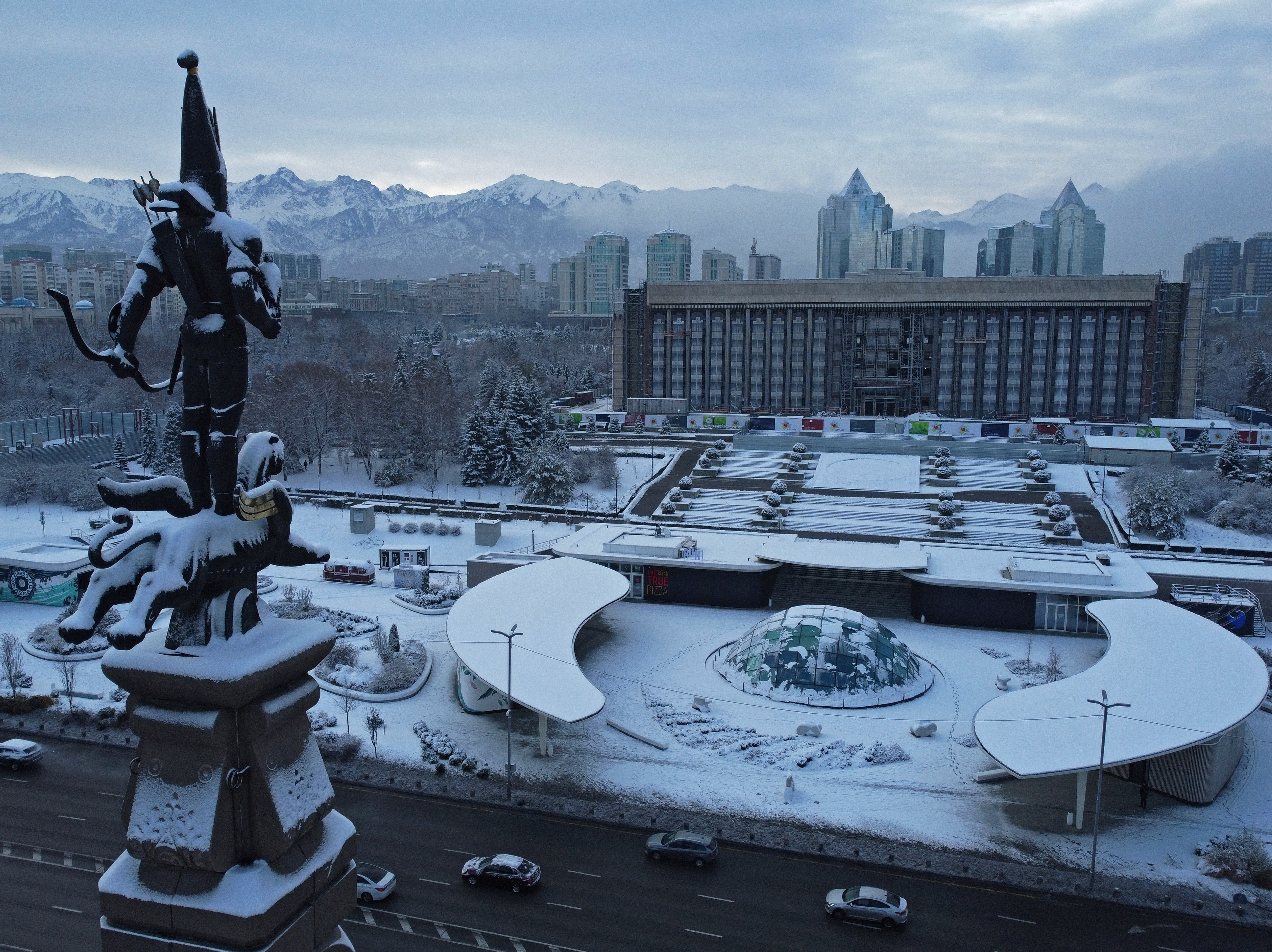
A view shows the Monument of Independence in front of the city administration headquarters in Almaty, Kazakhstan, November 17, 2022. REUTERS/Pavel Mikheyev

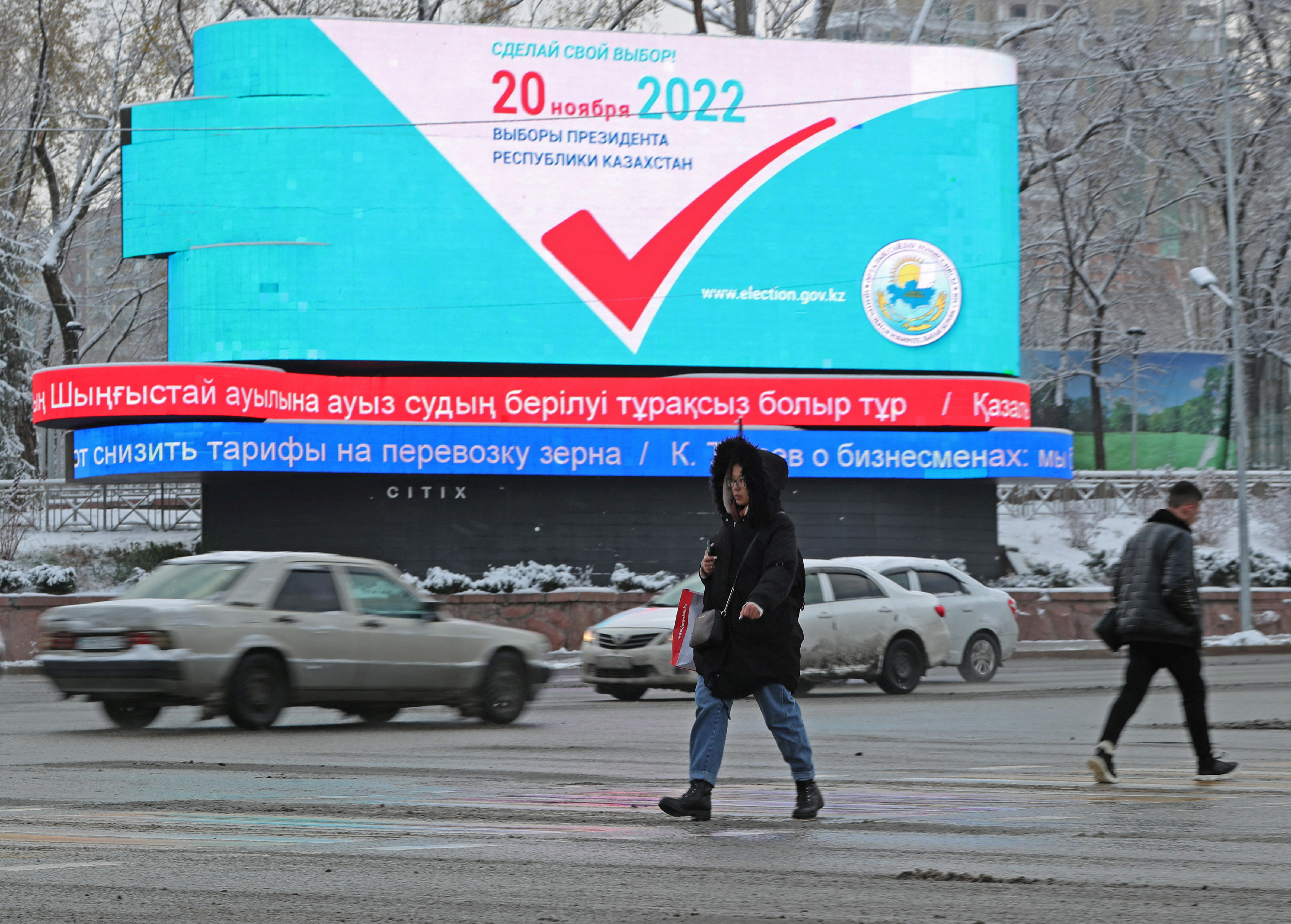
People walk past a board informing of the upcoming presidential election in Almaty, Kazakhstan November 17, 2022. REUTERS/Pavel Mikheyev

Kazakh political scientist Dimash Alzhanov attends an interview with Reuters in Almaty, Kazakhstan, November 16, 2022. REUTERS/Pavel Mikheyev

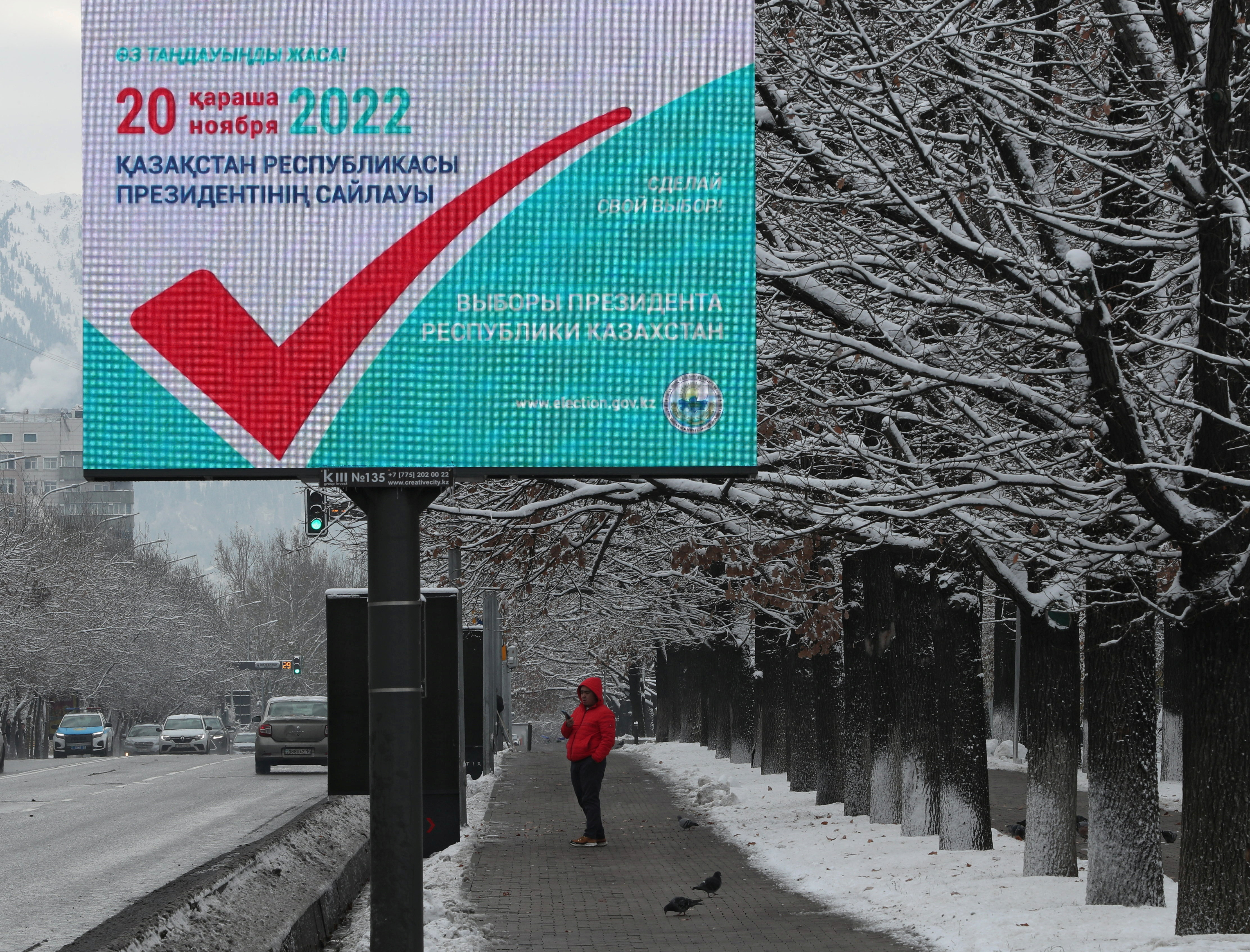
A man stands near a board informing of the upcoming presidential election in Almaty, Kazakhstan November 17, 2022. REUTERS/Pavel Mikheyev

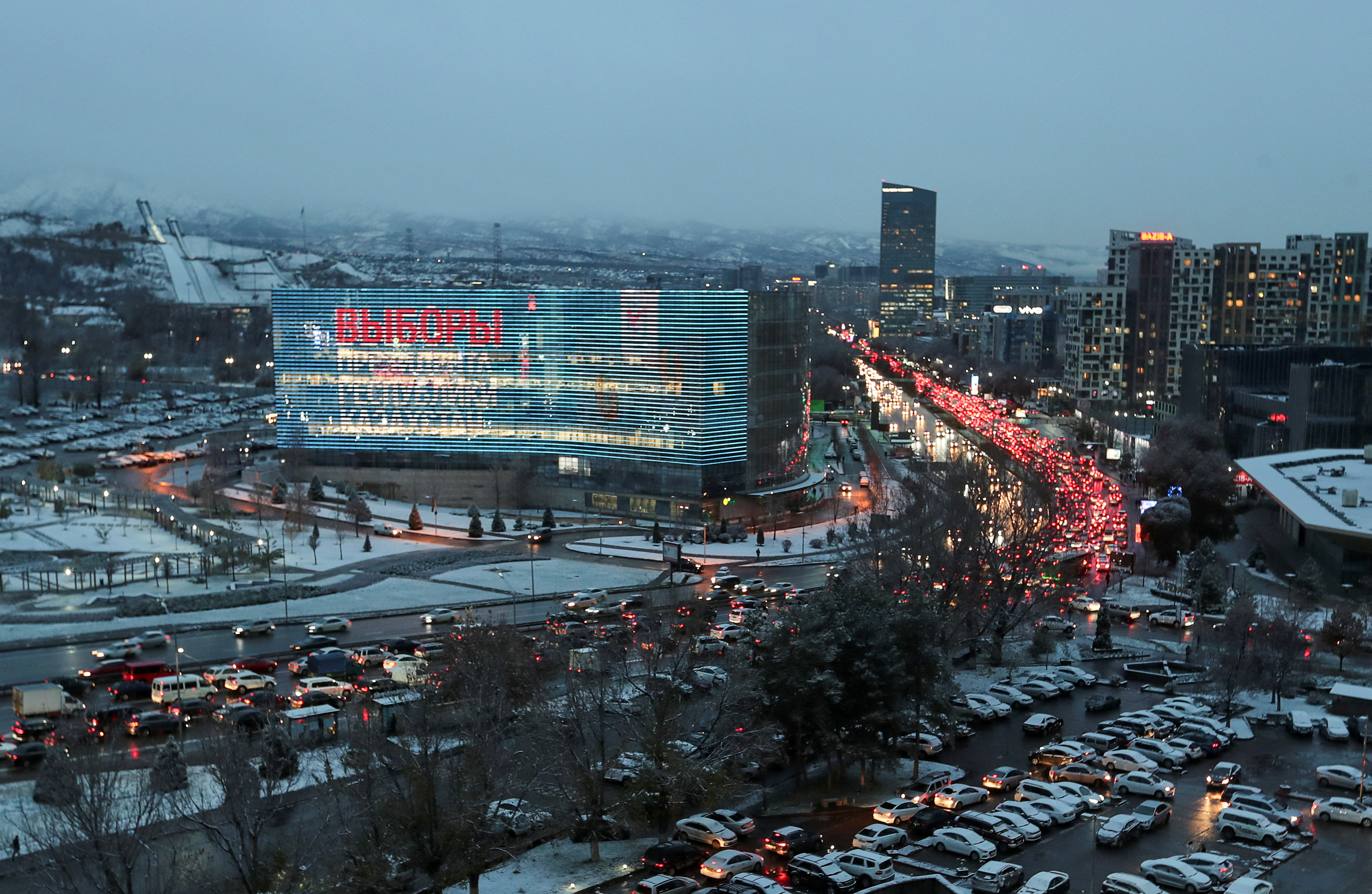
An electronic screen, installed on the facade of a business centre, displays information on the upcoming presidential election in Almaty, Kazakhstan, November 16, 2022. REUTERS/Pavel Mikheyev
Categories
Audio Sources - Full Text Articles

Dutch court says Russia had “overall control“ of separatists in Ukraine at time of MH17 downing

2022-11-17T13:13:26Z

Judges sit in the courtroom as the Dutch court announces its ruling in the MH17 trial of three Russians and a Ukrainian in the Schiphol Judicial Complex, Badhoevedorp, Netherlands, November 17, 2022. REUTERS/Piroschka van de Wouw

The Dutch court handling the trial of four suspects in the downing of Malaysia Airlines flight MH17 on Thursday said Russia had overall control of the separatist forces in eastern Ukraine at the time when the plane was shot down.

“From half May 2014 Russia had so called overall control over the People’s Republic of Donetsk,” presiding judge Hendrik Steenhuis said referring to the region where the passenger flight was show down on July 17, 2014.

In the ongoing ruling, the court had earlier said the plane was shot down by a Russian-made missile.

Categories
Audio Sources - Full Text Articles

COVID pandemic led to surge in superbug infections, EU agency says

2022-11-17T13:02:21Z

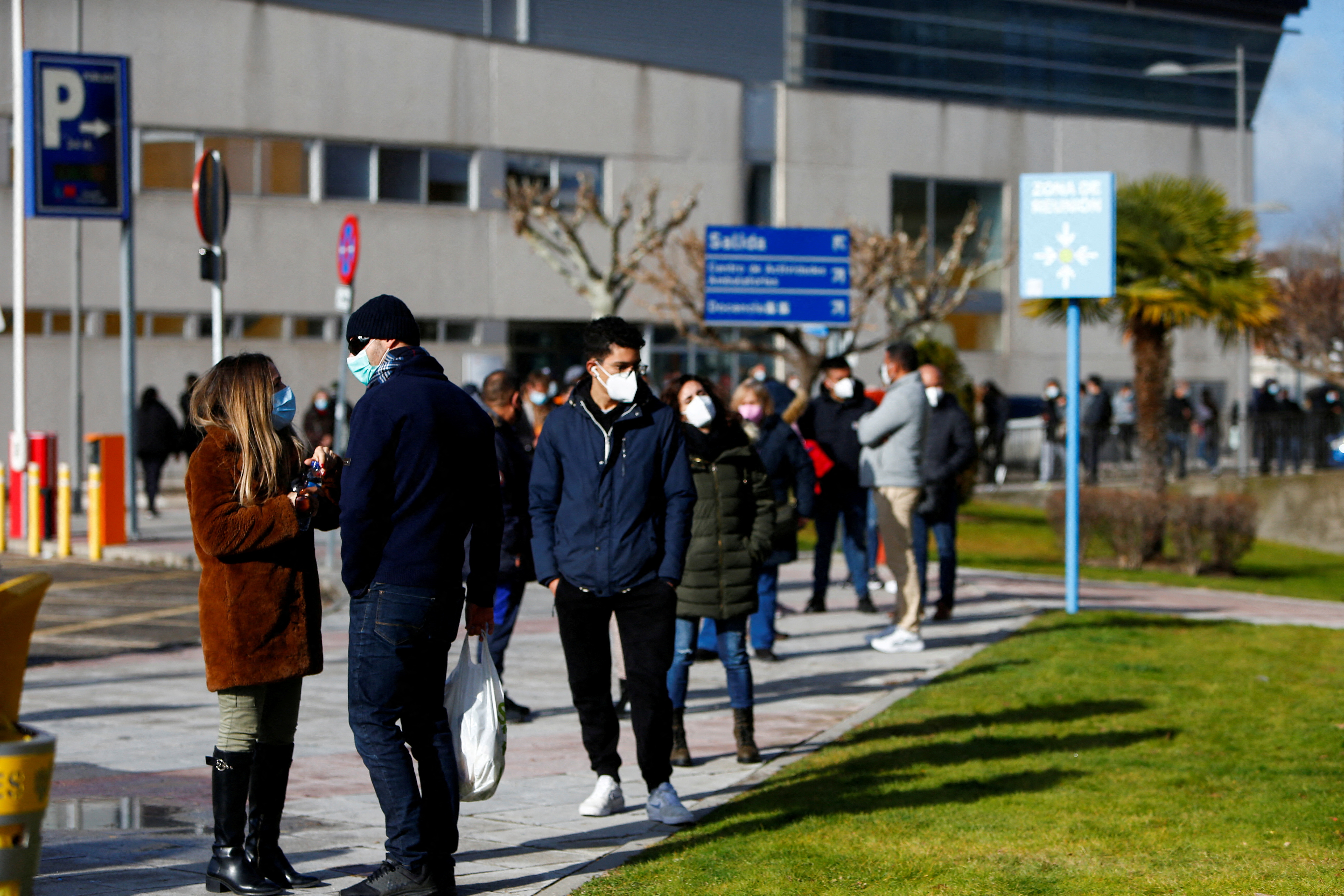
People queue to get tested for the coronavirus disease (COVID-19) after the Christmas holiday break, amid the COVID-19 pandemic, at Doce de Octubre Hospital in Madrid, Spain December 27, 2021. REUTERS/Javier Barbancho

Infections from some antibiotic-resistant pathogens known as superbugs have more than doubled in health care facilities in Europe, an EU agency said on Thursday, providing further evidence of the wider impact of the COVID-19 pandemic.

The European Centre for Disease Prevention and Control report said reported cases of two highly drug-resistant pathogens increased in 2020, the first year of the COVID-19 pandemic, then sharply jumped in 2021.

The surge stemmed from outbreaks in intensive care units of hospitals and in European Union countries where antimicrobial-resistant infections were already widespread, ECDC official Dominique Monnet told a news conference.

Data showed that in Europe last year, reported cases of the Acinetobacter bacteria group more than doubled compared with pre-pandemic annual numbers. Cases of another bacteria, Klebsiella pneumoniae, which is resistant to last-resort antibiotics, jumped by 31% in 2020 and by 20% in 2021.

The report did not include data on how many people died from the infections in 2020 and 2021. Experts say it can be challenging to definitively attribute the cause of death when patients were hospitalised for COVID-19, for example.

Some scientists link the rise in hospital-acquired superbug infections during the pandemic to wider antibiotic prescriptions to treat COVID-19 and other bacterial infections during long hospital stays.

Monnet said that was “the most plausible hypothesis”, but his agency had yet to conduct thorough analysis.

He also said the data showed decreases in cases of some other common superbugs in European hospitals. The ECDC believes that is because the COVID crisis led operations to be postponed.

The European report is consistent with a trend noted last year in the United States, where government data showed that U.S. deaths from drug-resistant infections jumped 15% in 2020.

Drug-resistance evolves through the misuse or overuse of antibiotics.

Concerns about it are not new. Experts call superbug infections, including fungal pathogens, a silent pandemic that causes more than a million deaths annually but does not draw attendant focus or funding for research.


WP Radio
WP Radio
OFFLINE LIVE