Categories
Audio Sources - Full Text Articles

Bankrupt crypto lender Celsius used Quickbooks for its accounting just like FTX, report says

crypto illustration celsiusCelsius went bankrupt last year as the so-called “crypto winter” engulfed the digital-asset market.

(Photo by Jakub Porzycki/NurPhoto via Getty Images)

  • Bankrupt crypto lender Celsius used QuickBooks to log its finances just like FTX. 
  • The company went bust last July as the cryptocurrency market underwent a huge sell-off. 
  • According to an examiner’s report, Celsius’ tracked its finances in 15 QuickBooks files and failed to produce consolidated statements. 

Bankrupt crypto lender Celsius used QuickBooks to log its finances – just like FTX

That made it challenging to analyse the company’s transactions after it went bust, given Quickbooks is “geared mainly toward small and medium-sized businesses,” said court-appointed examiner Shoba Pillay on Tuesday, per Decrypt

QuickBooks is an accounting tool for small and medium-sized businesses, but not ones with billions of dollars in revenue or assets under management, like FTX or Celsius. The tool came under the spotlight after FTX imploded, as its new CEO John Ray III revealed that the crypto exchange used it to run its multibillion-dollar business. 

According to Pillay, Celsius’ tracked its finances in 15 QuickBooks files and failed to produce consolidated statements.  Later, Pillay found “significant discrepancies” between account balances in Celsius’ QuickBooks files and those used to create consolidated statements, per Decrypt. 

The court examiner found the “files produced by Celsius were not the original files used to prepare the consolidated financial statements.”

“Celsius retroactively prepared consolidation files from its historical accounting records,” the examiner’s report alleges. 

Celsius filed for bankruptcy last July, after it froze customer withdrawals on its platform a month earlier as the so-called “crypto winter” hit the digital-asset industry. Before it collapsed, Celsius managed $11 billion worth of assets and had around 1.7 million users. 

A detailed probe into the troubled crypto lender found that Celsius misled customers when it advertised its business model. Its downfall mirrors other high-profile crypto collapses like FTX and Genesis in recent months, putting investor confidence on shaky ground. 

Celsius did not immediately respond to Insider’s request for comment.

Read the original article on Business Insider
Categories
Audio Sources - Full Text Articles

Investors are hooked on the ‘heroin’ of Fed rate cuts but the focus will turn to earnings gloom, Morgan Stanley’s top strategist says

mike wilson morgan stanley bloomberg tvMarkets are hooked on the “heroin” of potential Federal Reserve interest rate cuts, according to Morgan Stanley’s chief US equity strategist Mike Wilson.

Bloomberg TV

  • The Federal Reserve’s not going to start cutting interest rates soon, Morgan Stanley’s top strategist said.
  • When investors realize that, the focus will shift to the weakness in earnings, Mike Wilson told CNBC.
  • “There’s no ‘heroin’, so to speak – we’re going to price to fundamentals, which are clearly deteriorating in our view,” he said.

Investors are hooked on the “heroin” of potential Federal Reserve interest-rate cuts but could receive a rude awakening after the central bank’s Wednesday statement, according to Morgan Stanley’s chief US equity strategist.

Mike Wilson said he’s expecting the market to soon shift its focus to weakening corporate earnings rather than the Fed slashing rates – and he thinks stocks will lose their shine as a result.

“Once this event gets past us, and the market realizes the Fed’s not cutting rates — there’s no ‘heroin’, so to speak —we’re going to price to fundamentals, which are clearly deteriorating, in our view,” he told CNBC’s “Fast Money” Tuesday.

The Fed’s Federal Open Market Committee concludes its two-day meeting later Wednesday, when Chair Jerome Powell is set to share policymakers’ latest interest-rate decision. Over 99% of traders expect the central bank to raise rates by 25 basis points this month, according to CME Group’s Fedwatch Tool.

In 2022, the US central bank raised the cost of borrowing from near-zero to around 4.5% in a bid to tame inflation running at 40-year highs. But with once-soaring prices starting to cool, many investors now expect the Fed to start cutting rates by the end of 2023.

Wilson said that January’s stock market rally could actually encourage the Fed to hold interest rates higher for longer, in a bid to crush any bubbly exuberance that might fuel further run-ups in inflation.

“They’ve done the hard work, they’ve got rates to 4.5% — like, why quit now? Particularly with the froth coming back now – financial conditions are actually where they were a year ago, when they started raising rates,” he told CNBC.

“So there’s no incentive for them to do it. But I’ve got no idea what they’re going to do.”

Stocks broke out of 2022’s downturn by rallying in January. The benchmark S&P 500 stock index jumped 6.2% in the month, and the tech-heavy Nasdaq Composite climbed 10.7%.

But many strategists have put the gains down to investors’ blindly focusing on hypothetical Fed rate cuts while ignoring other factors, such as earnings. Corporate earnings look set to weaken over the next quarter due to the threat of a potential recession.

BlackRock’s Karim Chedid told Insider last month that investors can no longer rely on the old investing playbook that would expect for the Fed to pivot later in 2023, while top economist Mohamed El-Erian has repeatedly warned of potential headwinds that could disrupt the breathless rally.

“We’re such an equity culture, everybody wants to put the equity cart in front of the horse – that’s not the way it works, and it’s a mistake,” Wilson said. “For US equities, it’s going to be a reflection of when we think earnings are closer to reality and valuations reflect that too.”

“It’s a two-way story,” he added. “The Fed will be part of that story, but I think it’ll be cutting rates long after the market has bottomed.” 

“That’s my general view, because the Fed is going to have to hold firm. I think they’re going to do their job.”

Read more: There’ll be a reckoning for investors who don’t adjust to a brand new investment playbook, says BlackRock iShares strategist

Read the original article on Business Insider
Categories
Audio Sources - Full Text Articles

There’s a massive disconnect between markets and the Fed – and Jerome Powell’s messaging could fall upon deaf ears

Happy hump day, readers. I’m senior reporter Phil Rosen. 

If the collapse of FTX has been the headline story over the last several months, it certainly feels like ChatGPT has taken the mantle for the near future. 

The bot’s parent company took in $10 billion from Microsoft a couple of weeks ago, and the language tool has proven it can do just about everything except your dishes and laundry. 

Oh — and it also can’t quite balance a portfolio. 

Remember Watson? That was the last bot that seemed to alter the fabric of society — it even won Jeopardy

As it turns out, Watson has more than just game shows in his (its?) wheelhouse. While ChatGPT wows us with its text capabilities, the IBM supercomputer has quietly powered an ETF that’s doubled the returns of the broader market. 

I’m serious.

But enough about bots. We can’t stop them.

Let’s break down what to know ahead of the Federal Reserve’s widely expected interest rate hike today. 


If this was forwarded to you, sign up here. Download Insider’s app here.


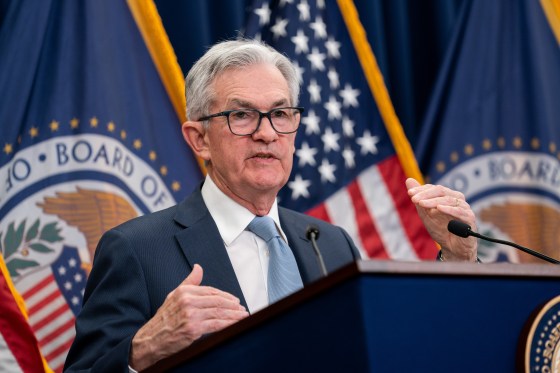
jerome powellFederal Reserve Board Chairman Jerome Powell arrives at his news conference following the closed two-day Federal Open Market Committee meeting in Washington, U.S., May 1, 2019.

Yuri Gripas/Reuters

1. Today’s rate hike decision probably won’t surprise anyone, as markets have long priced in a 25-basis-point move for the February and March meetings. 

If all goes as planned, this will mark the eighth consecutive rate hike since March last year, which falls in line with what the Fed warned in December: 

“The Committee anticipates that ongoing increases in the target range will be appropriate in order to attain a stance of monetary policy that is sufficiently restrictive to return inflation to 2 percent over time.” 

That means more rate hikes are on the way. 

But markets have yet to act as if that were the case — stocks have enjoyed their best January since 2019.

All eyes will be on Jerome Powell as he steps up to the podium today. To Michael Reinking, the New York Stock Exchange’s senior market strategist, the chairman will likely try to temper market enthusiasm with another hawkish message. 

“[Powell’s] message will likely continue to focus on the duration of time rates will stay at a restrictive stance,” Reinking said. “How he couches where we are in achieving that restrictive stance will be closely watched.”

Just like before December’s meeting, stocks have rallied leading up to the decision. Reinking pointed out that markets are just about desensitized to hawkish commentary.

Gene Goldman, the chief investment officer for Cetera Investment Management, told me on a call yesterday that rate hikes can take 12 to 15 months to have an impact on the economy, which means repercussions from last year’s first tightening efforts are only now beginning to emerge. 

Goldman said he’ll be watching for three things in Powell’s speech: 

  • Powell will talk tough: “He’s going to push back on financial markets. The dot plot says rates will be between 5% to 5.25% by the end of this year, but markets are pricing in 4.5%.”
  • More rate hikes are coming: “Powell might acknowledge that the economy is slowing down and inflation is easing, but he’s also going to signal the Fed’s job is not over.”
  • This time could be different: “It’s possible Powell signals that we won’t need to push the economy into a recession. The labor market and housing market are different than they were in 2008, so maybe there’s a different path forward here.”

In any case, according to Reinking, unless Powell musters up some serious aggression, any messaging will ultimately fall upon deaf ears

“[That] could add to the squeeze that has been ongoing since the start of the year,” he explained. “If this happens, the real test will be holding above the December highs.”

What will your investment strategy look like following another interest rate hike from the Fed? Tweet me (@philrosenn) or email me (prosen@insider.com) to let me know. 


In other news:

NYSE traders

NYSE

2. US stock futures fall early Wednesday, as markets brace for the Fed’s much-anticipated policy decision. Meanwhile, Snap shares sank over 14% in premarket trading after the social-media company missed on revenue in its fourth-quarter earnings. Here are the latest market moves

3. Earnings on deck: Meta, Alibaba, T-Mobile, all reporting.

4. US home prices could crash 20% this year, according to KPMG. The housing market has come under pressure in recent months, but the current downtrend may only be the beginning of what’s to come. These are the cities and regions that could see the largest declines.

5. The biggest risk to the market isn’t a recession in 2023. In JPMorgan’s view, the biggest risk is actually the possibility that there’s no recession at all — this is why.

6. Bank of America said Tesla and Ford’s EV price cuts make no sense. Currently, electric-vehicle demand is greater than supply, which makes for odd timing for such dramatic reductions. But in the near-term, Elon Musk’s company has the edge over its rivals because of its size and scale.

7. Gautam Adani pulled through with a $2.5 billion share sale on Tuesday. The Indian billionaire has endured a stock-market storm thanks to Hindenburg’s fraud allegations. Here are the latest updates.

8. Jeff Erdmann has been the best wealth advisor in the US for 7 years running. The Merrill Lynch pro explained how he’s keeping clients’ money safe — and how he’s gearing up for a recession. 

9. Goldman Sachs recommended these 17 stocks right now. Strategists said this batch of names have strong international exposure and are poised to profit from the economic recoveries of China and Europe. Get the list.

C3ai stock price on Feb.1, 2023C3ai stock price on Feb.1, 2023

Markets Insider

10. Shares of C3.ai have soared 85% over the past month. Investors are flocking to stocks that have exposure to artificial intelligence, thanks to the growing popularity of ChatGPT. C3.ai announced Tuesday it would integrate the viral bot into its product suite.


Curated by Phil Rosen in Los Angeles. Feedback or tips? Tweet @philrosenn or email prosen@insider.com

Edited by Max Adams (@maxradams) in New York and Hallam Bullock (@hallam_bullock) in London.

Read the original article on Business Insider
Categories
Audio Sources - Full Text Articles

China’s shrinking population is a grim omen for the rest of the world

Flag map of China shrinking on blue grainy backgroundChina will lose half its population by the end of the century. The population decline is a warning for the US and Europe.

Alyssa Powell/Insider

The country’s shrinking population is a grim omen for the rest of the world

China’s population is shrinking. While the massive country is still home to 1.4 billion people — nearly one out of every five people on Earth — China’s National Bureau of Statistics announced that its population shrank in 2022, falling by roughly 850,000 people. 

This shocking statistic is only the start of China’s population decline. This year India is set to surpass China’s population, and in a few years it will surpass China’s working-age population — people 20 to 69. The United Nations has estimated that if China’s birth rate remains at its super-low level and the country fails to position itself as an attractive destination for migrants, the country will lose nearly half of its population by the end of this century, a contraction of roughly 700 million people. 

Strong growth in its working-age population over the past several decades allowed China to become the world’s factory — over 70% of solar panels, 60% of farm machines, and 25% of robots are constructed with components from Chinese suppliers. Because of its manufacturing prowess and importance to supply chains, China’s shrinking working-age population has enormous, direct effects on the global economy. It’s also an omen for the US and Europe: If they don’t turn around their shrinking birth rates, they face the same economic fate as China.

Fewer children, fewer workers

For decades China’s fertility rate — the number of live births per woman — has declined, helping slow the country’s population growth. In 2022, it hit the lowest level on record, 1.1 children per woman. In the main population centers of Beijing and Shanghai the fertility rate cratered to 0.7 children per woman. China’s one-child policy, which restricted couples to only one child, is not solely to blame (though it played a small role). When the one-child policy was implemented nationwide in 1980, the fertility rate had already fallen to 2.6 from more than 6 children per woman in 1970. In 1991, it fell below 2.1 children per woman, the level needed to keep the population stable over time. At that moment a demographic timer was set, and now the alarm is ringing.

The specter of population decline has for years worried the Chinese government, leading the country to relax its restrictive one-child policy in 2016. The Chinese government began encouraging its citizens to have up to three children by enticing them with cash incentives, discounted real estate, and extended maternity leave. But it appears those efforts have been largely unsuccessful.

Unlike many developed economies in the West, China and other major economic powers in Asia aren’t using immigration to offset declining fertility. Instead, they’re closing themselves off. The proportion of migrants as a percentage of the total population in Japan in 2020 was only 2%. In India it was 0.3%, and in China it was as low as 0.1%. It is practically impossible for foreigners to obtain Chinese citizenship. In contrast, 17% of people living in Germany in 2021 were born abroad, and a third of them had obtained German citizenship.

Fewer children and fewer immigrants means fewer workers in the long term. The UN forecasts suggest the workforce in China will shrink more in the coming years than it will in almost any other country, and the precipitous population drop will set the stage for a reversal of its decades of strong economic growth, meaning living standards can’t improve as quickly. This is a gigantic challenge for the Chinese economy — and for Xi Jinping’s ambitious plans to make China the world’s largest economy and dominant superpower.

The shrinking workforce has already caused the government to shift its economic focus. After decades of export-led, labor-intensive manufacturing growth, the government’s 14th five-year plan — the latest set of growth targets and economic reforms set by the Chinese Communist Party, in 2021 — focused on orientating the economy toward its domestic market and investing in higher-value-add products. Instead of being an intermediate step in the global supply chain — importing raw goods and parts, using cheap labor to manufacture finished products, and then shipping that merchandise abroad — Beijing wants its own workers to produce those final goods and sell them to shoppers in its own country.

This shift is imperative because so much of the Chinese economy is dependent on an ever growing population. Take the demand for real estate: In the past two decades, Chinese people have invested 70% of their wealth in real estate. In the US, that share is only 35%. The construction and real-estate sector accounts for roughly a quarter of China’s total economic output. China builds like no other country: It has built entire cities from scratch, and it consumes half of the concrete produced worldwide. And China is apparently planning further growth: In 2017, 65 million empty apartments — enough to house the population of France or California — were waiting for young families. 

But how long will demand for real estate last? Who will move into the empty apartments when the population shrinks? What will happen to this massive industry when the number of Chinese consumers declines and there are fewer people to continue investing? And what will happen to the elderly Chinese people who have tied up so much of their wealth in their homes?

A shrinking workforce wouldn’t just hurt China’s economy — it would have spillover effects for the US and Europe. China’s manufacturing sector, for example, would likely struggle to maintain its recent growth streak. So in the coming decades, China’s economy would not lift global growth rates as it has in the past. Productivity growth in the country could also stagnate. Economists have long tracked the correlation between population density and innovation — a larger population means a larger pool of potential entrepreneurs — so a shrinking population means China’s ability to disrupt markets could decline as well. Taken together, China’s slowing economy would have severe knock-on effects for the rest of the world. 

The trouble with closed borders 

China’s population decline also serves as an omen for countries that have birth rates at or below the replacement level, such as the US and many places in Europe. Europe is facing the same demographic turning point as China — the continent’s population is projected to decline by 21%, or 157 million people, by the end of the century. Nigeria is set to overtake Europe as the third-largest labor force later this century.

Among today’s largest economies, only the US has a projection of positive population growth, though at very low levels. But the projected growth is due not to increasing fertility but to immigration. Pew Research Center has estimated that in the second half of the century, one-third of the US population — more than 100 million people — will be migrants and their US-born children.

And immigrants to the US punch above their economic weight. More than 40% of the 500 largest US companies were founded by immigrants or their children, from tech giants like Google to the wholesale chain Costco to the jeans brand Levi’s. The influence of immigrants on American prosperity is not relegated to the startup scene; the story of the rags-to-riches millionaire — or at least of middle-class success — is repeated frequently. This is impressively demonstrated by a recent study that followed millions of parents and their children and found that the children of immigrants of almost every nationality achieved social advancement at least as often as their peers from nonimmigrant families. For immigrants at least, the American dream is alive and well.

That said, immigration is notoriously hard to forecast and is increasingly politicized. But without an injection of immigrants, the working-age population in the US is likely to decline, harming the country’s economy. But if American policymakers can keep the door open to new residents, the US will be one of the few industrialized nations that won’t have to contend with a shrinking population, which could prove a decisive factor in its race against China for dominance in the global economy.

The Great People Shortage is not an abstract threat — it has very real consequences. Already, many companies are facing major challenges in filling their open positions, especially in crucial industries like healthcare and education. And in the coming years, both in China and in the West, many more sectors and fields will struggle to find workers. The lack of train drivers, teachers, engineers, doctors, firefighters, nurses, and programmers will have more far-reaching consequences down the road. With fewer employees, companies will produce or perform less, resulting in fewer sales, less economic growth, and ultimately less prosperity for everyone. And in China, the problem exists on a far more dramatic scale. Unless nations manage to turn things around, the problem will only accelerate, and it could spell disaster for the economy.


Sebastian Dettmers is the CEO of StepStone, which is owned by Axel Springer, the parent company of Insider. He is also the author of a new book on the future of the world’s population.

Chris Forman is the founder and CEO of Appcast, which was acquired by StepStone in 2019. He is a recognized expert in recruiting and talent management.

Andrew Flowers is the lead labor economist at Appcast. He is a recognized expert on economic policy, the US labor market and macroeconomy.

Read the original article on Business Insider
Categories
Audio Sources - Full Text Articles

Republicans aren’t going to tell Americans the real cause of our $31tn debt | Robert Reich

The rich used to pay taxes. Now they loan money to the US government – at a profit that everyone else pays for

The dire warnings of fiscal hawks are once again darkening the skies of official Washington.

They’re demanding that the $31.4tn federal debt be reduced and government spending curtailed – thereby giving cover to Republican efforts to hold America hostage by refusing to raise the debt ceiling.

Robert Reich, a former US secretary of labor, is professor of public policy at the University of California at Berkeley

Continue reading…

Categories
Audio Sources - Full Text Articles

Apple and Google app stores get thumbs down from White House

WASHINGTON (AP) — The Biden administration is taking aim at Apple and Google for operating mobile app stores that it says stifle competition.

The finding is contained in a Commerce Department report being released by the administration on Wednesday as President Joe Biden convenes his competition council for an update on efforts to promote competition and lower prices.

The report from the department’s National Telecommunications and Information Administration says the current app store model — dominated by Cupertino, California-based Apple Inc. and Mountain View, California-based Google LLC — is “harmful to consumers and developers” by inflating prices and reducing innovation. The firms have a stranglehold on the market that squelches competition, it adds.

“The policies that Apple and Google have in place in their own mobile app stores have created unnecessary barriers and costs for app developers, ranging from fees for access to functional restrictions that favor some apps over others” the report said.

In an op-ed in The Wall Street Journal in January, Biden called on Democrats and Republicans to rein in large tech firms without mentioning Apple or Google by name.

“When tech platforms get big enough, many find ways to promote their own products while excluding or disadvantaging competitors — or charge competitors a fortune to sell on their platform,” Biden said. “My vision for our economy is one in which everyone — small and midsized businesses, mom-and-pop shops, entrepreneurs — can compete on a level playing field with the biggest companies.”

A legal battle over app store dominance is already playing out in the courts.

Apple has defended the area surrounding its iPhone app store, known as a walled garden, as an indispensable feature prized by consumers who want the best protection available for their personal information. It has said it faces significant competition from various alternatives to video games on its iPhones. And Google has long defended itself against claims of monopoly.

The Commerce Department report said “new legislation and additional antitrust enforcement actions are likely necessary” to boost competition in the app ecosystem.

Alan Davidson, the NTIA administrator, told reporters the report “identifies where legislation would be needed to address some of these issues.”

On another competition front, the White House said the Consumer Financial Protection Bureau would move forward with a proposed rule to limit credit card late fees, which the bureau estimates would save consumers roughly $9 billion in late fees annually.

Rohit Chopra, the bureau’s director, said the rule is projected to reduce typical late fees from roughly $30 to $8 for missed payments and could go into effect as soon as 2024.

“Historically, credit card companies charge relatively small penalty amounts for missed payments, but once they discovered that these fees could be a source of easy profits, late fees shot up with a surge occurring in the 2000s,” Chopra told reporters. “And in recent years, these late fees have surged to as much as $41 for a missed payment. These fees add up, with consumers being hit with $12 billion a year in late fees in addition to the billions of dollars in interest they’re paying.”

The bureau is the nation’s financial watchdog agency created after the Great Recession.

Categories
Audio Sources - Full Text Articles

Child welfare algorithm faces Justice Department scrutiny

PITTSBURGH (AP) — The Justice Department has been scrutinizing a controversial artificial intelligence tool used by a Pittsburgh-area child protective services agency following concerns that it could result in discrimination against families with disabilities, The Associated Press has learned.

The interest from federal civil rights attorneys comes after an AP investigation revealed potential bias and transparency issues about the opaque algorithm that is designed to assess a family’s risk level when they are reported for child welfare concerns in Allegheny County.

Several civil rights complaints were filed in the fall about the Allegheny Family Screening Tool, which is used to help social workers decide which families to investigate, AP has learned.

Two sources said that attorneys in the Justice Department’s Civil Rights Division cited the AP investigation when urging them to submit formal complaints detailing their concerns about how the algorithm could harden bias against people with disabilities, including families with mental health issues.

A third person told AP that the same group of federal civil rights attorneys also spoke with them in November as part of a broad conversation about how algorithmic tools could potentially exacerbate disparities, including for people with disabilities. That conversation explored the design and construction of Allegheny’s influential algorithm, though the full scope of the Justice Department’s interest is unknown.

All three sources spoke to AP on the condition of anonymity, saying the Justice Department asked them not to discuss the confidential conversations, and two said they also feared professional retaliation.

Wyn Hornbuckle, a Justice Department spokesman, declined to comment.

Algorithms use pools of information to turn data points into predictions, whether that’s for online shopping, identifying crime hot spots or hiring workers. Many child welfare agencies in the U.S. are considering adopting such tools as part of their work with children and families.

Though there’s been widespread debate over the moral consequences of using artificial intelligence in child protective services, the Justice Department’s interest in the pioneering Allegheny algorithm marks a significant turn toward possible legal implications.

Supporters see algorithms as a promising way to make a strained child protective services system both more thorough and efficient, saying child welfare officials should use all tools at their disposal to make sure children aren’t maltreated. But critics worry that including data points collected largely from people who are poor can automate discrimination against families based on race, income, disabilities or other external characteristics.

Robin Frank, a veteran family law attorney in Pittsburgh and vocal critic of the Allegheny algorithm, said she also filed a complaint with the Justice Department in October on behalf of a client with an intellectual disability who is fighting to get his daughter back from foster care. The AP obtained a copy of the complaint, which raised concerns about how the Allegheny Family Screening Tool assesses a family’s risk.

“I think it’s important for people to be aware of what their rights are and to the extent that we don’t have a lot of information when there seemingly are valid questions about the algorithm, it’s important to have some oversight,” Frank said.

Mark Bertolet, spokesman for the Allegheny County Department of Human Services, said by email that the agency had not heard from the Justice Department and declined interview requests.

“We are not aware of any concerns about the inclusion of these variables from research groups’ past evaluation or community feedback on the (Allegheny Family Screening Tool),” the county said, describing previous studies and outreach regarding the tool.

Allegheny County said its algorithm has used data points tied to disabilities in children, parents and other members of local households because they can help predict the risk that a child will be removed from their home after a maltreatment report. The county added that it has updated its algorithm several times and has sometimes removed disabilities-related data points.

The Allegheny Family Screening Tool was specifically designed to predict the risk that a child will be placed in foster care in the two years after the family is investigated. It has used a trove of detailed personal data collected from child welfare history, as well as birth, Medicaid, substance abuse, mental health, jail and probation records, among other government data sets. When the algorithm calculates a risk score of 1 to 20, the higher the number, the greater the risk. The risk score alone doesn’t determine what happens in the case.

The AP first revealed racial bias and transparency concerns in a story last April that focused on the Allegheny tool and how its statistical calculations help social workers decide which families should be investigated for neglect – a nuanced term that can include everything from inadequate housing to poor hygiene, but is a different category from physical or sexual abuse, which is investigated separately in Pennsylvania and is not subject to the algorithm.

A child welfare investigation can result in vulnerable families receiving more support and services, but it can also lead to the removal of children for foster care and ultimately, the termination of parental rights.

The county has said that hotline workers determine what happens with a family’s case and can always override the tool’s recommendations. It has also underscored that the tool is only applied to the beginning of a family’s potential involvement with the child welfare process. A different social worker who later conducts the investigations, as well as families and their attorneys, aren’t allowed to know the scores.

Allegheny’s algorithm, in use since 2016, has at times drawn from data related to Supplemental Security Income, a Social Security Administration program that provides monthly payments to adults and children with a disability; as well as diagnoses for mental, behavioral and neurodevelopmental disorders, including schizophrenia or mood disorders, AP found.

The county said that when the disabilities data is included, it “is predictive of the outcomes” and “it should come as no surprise that parents with disabilities … may also have a need for additional supports and services.” The county added that there are other risk assessment programs that use data about mental health and other conditions that may affect a parent’s ability to care for a child.

The AP obtained records showing hundreds of specific variables that are used to calculate the risk scores for families who are reported to child protective services, including the public data that powers the Allegheny algorithm and similar tools deployed in child welfare systems elsewhere in the U.S.

The AP’s analysis of Allegheny’s algorithm and those inspired by it in Los Angeles County, California, Douglas County, Colorado, and in Oregon reveals a range of controversial data points that have measured people with low incomes and other disadvantaged demographics, at times measuring families on race, zip code, disabilities and their use of public welfare benefits.

Since the AP’s investigation published, Oregon dropped its algorithm due to racial equity concerns and the White House Office of Science and Technology Policy emphasized that parents and social workers needed more transparency about how government agencies were deploying algorithms as part of the nation’s first “AI Bill of Rights.”

The Justice Department has shown a broad interest in investigating algorithms in recent years, said Christy Lopez, a Georgetown University law professor who previously led some of the Justice Department’s civil rights division litigation and investigations.

In a keynote about a year ago, Assistant Attorney General Kristen Clarke warned that AI technologies had “serious implications for the rights of people with disabilities,” and her division more recently issued guidance to employers saying using AI tools in hiring could violate the Americans with Disabilities Act.

“They are doing their jobs as civil rights investigators to get to the bottom of what’s going on,” Lopez said of the Justice Department scrutiny of Allegheny’s tool. “It appears to me that this is a priority for the division, investigating the extent to which algorithms are perpetuating discriminatory practices.”

Traci LaLiberte, a University of Minnesota expert on child welfare and disabilities, said the Justice Department’s inquiry stood out to her, as federal authorities have largely deferred to local child welfare agencies.

“The Department of Justice is pretty far afield from child welfare,” LaLiberte said. “It really has to rise to the level of pretty significant concern to dedicate time and get involved.”

Emily Putnam-Hornstein and Rhema Vaithianathan, the two developers of Allegheny’s algorithm and other tools like it, deferred to Allegheny County’s answers about the algorithm’s inner workings. They said in an email that they were unaware of any Justice Department scrutiny relating to the algorithm.

Researchers and community members have long raised concerns that some of the data powering child welfare algorithms may heighten historical biases against marginalized people within children protective services. That includes parents with disabilities, a community that is a protected class under federal civil rights law.

The Americans with Disabilities Act prohibits discrimination on the basis of disability, which can include a wide spectrum of conditions, from diabetes, cancer and hearing loss to intellectual disabilities and mental and behavioral health diagnosis like ADHD, depression and schizophrenia.

LaLiberte has published research detailing how parents with disabilities are disproportionately affected by the child welfare system. She challenged the idea of using data points related to disabilities in any algorithm because, she said, that assesses characteristics people can’t change, rather than their behavior.

“If it isn’t part of the behavior, then having it in the (algorithm) biases it,” LaLiberte said.

___

Burke reported from San Francisco.

____

Follow Sally Ho and Garance Burke on Twitter at @_sallyho and @garanceburke. Contact AP’s global investigative team at Investigative@ap.org or https://www.ap.org/tips/

Categories
Audio Sources - Full Text Articles

Russia focuses on eastern Ukraine for possible new offensive

KYIV, Ukraine (AP) — Russia is mustering its military might in the Luhansk region of Ukraine, local officials said Wednesday, in what Kyiv suspects is preparation for an offensive in the eastern area in coming weeks as the anniversary of Moscow’s invasion approaches.

The Kremlin’s forces are expelling local residents from their homes near the Russian-held parts of the front line so that they can’t provide information about Russian troop deployments to Ukrainian artillery, Luhansk Gov. Serhii Haidai said.

“There is an active transfer of (Russian troops) to the region and they are definitely preparing for something on the eastern front in February,” Haidai said.

Military analysts anticipate a new push soon by Moscow’s forces, with the Institute for the Study of War saying in an assessment late Tuesday that “an imminent Russian offensive in the coming months is the most likely course of action.”

A new offensive might also coincide with the invasion anniversary on Feb. 24.

The General Staff of the Armed Forces of Ukraine reported Wednesday that Russia is also concentrating its efforts in neighboring Donetsk province, especially in its bid to capture the key city of Bakhmut.

Donetsk and Luhansk provinces make up the Donbas, an industrial region bordering Russia that President Vladimir Putin identified as a goal from the war’s outset and where Moscow-backed separatists have fought Ukrainian authorities since 2014.

The regional governor of Donetsk, Pavlo Kyrylenko, posted images of the aftermath of the shelling in Bakhmut, showing huge black holes in residential buildings in the embattled city.

He said that Russia is “actively deploying new military personnel to the region.”

Donetsk was one of four provinces that Russia illegally annexed in the fall, but it controls only about half of it. To take the remaining half, Russian forces have no choice but to go through Bakhmut, which offers the only approach to bigger Ukrainian-held cities.

Russian forces have been trying for months to capture Bakhmut. Moscow-installed authorities in Donetsk claimed Russian troops are “closing the ring” around the city.

Russian shelling of Bakhmut, where most residents have fled and others spend much of their time in cellars, killed at least five civilians and wounded 10 others on Tuesday, Ukraine’s presidential office said Wednesday.

Ukraine is keen to secure more Western military aid as it tries to fend off the much larger Russian forces. It has already won pledges of tanks and now wants more.

Mykhailo Podolyak, an adviser to Ukrainian President Volodymyr Zelenskyy, tweeted Wednesday that talks are underway on securing longer-range missiles and fighter jets from Ukraine’s allies.

Asked to comment on media reports about a new package of U.S. military assistance to Ukraine expected to be announced soon, Kremlin spokesman Dmitry Peskov described it as “a direct path to inciting tensions and taking the escalation to a new level.”

“It will require additional efforts on our part, but it won’t change the course of events,” he said in a conference call with reporters.

The Western allies are trying to broaden their coalition in support of Ukraine.

NATO Secretary-General Jens Stoltenberg said Wednesday in Tokyo that he sought stronger cooperation and more “friends” for the alliance in the Indo-Pacific region.

___

Follow AP’s coverage of the war in Ukraine: https://apnews.com/hub/russia-ukraine

Categories
Audio Sources - Full Text Articles

Why High Interest Rates Aren’t Going Away—and What That Means for Your Money

Inflation is starting to ease, but don’t expect interest rate relief just yet.

On Wednesday, the Federal Reserve is poised to raise its benchmark interest rate for an eighth time since March, a sign that its campaign to control price increases is far from over.

The rate will likely be raised at a less aggressive pace than the previous year, with Fed officials expected to increase it by just 0.25% compared to the 0.5% rate hike in December. Before that, the Fed announced four 0.75% rate hikes in a row. The move would put the interest rate at a range of 4.5% to 4.75%, the highest level in 15 years.

[time-brightcove not-tgx=”true”]

For borrowers, the higher rate means paying even more interest on credit cards, student loans and other types of variable-rate debt. But for the overall economy, policymakers are adamant that if they don’t keep fighting inflation by making it more expensive for business and people to borrow money, price spikes could re-accelerate and require even more painful measures in the future.

“I think the Fed is getting close to where they want to hold rates steady and not keep raising them,” says William English, a former senior Fed economist and finance professor at the Yale School of Management. “They have been playing catch up for a while but are probably reasonably content with how things are playing out and will want to avoid making a big change in the outlook for policy at this stage.”

The Fed’s challenge

Since the Fed’s last rate hike, inflation has meaningfully slowed and consumers are beginning to spend less—suggesting that the economy is playing out the way the Fed had hoped. The latest Consumer Price Index data shows that inflation declined to 6.5% in December compared with a year earlier, down from 7.1% in November and a recent peak of 9.1% in June. But many economists and Wall Street investors are worried that the Fed will raise rates too high and for too long, putting the economy at risk of a deep recession.

“The Fed is very close to saying that they have won the battle and addressed the inflation problem,” says Jeffrey Roach, chief economist at LPL Financial. “But the battle is not quite over. They need to remember the other half of their mandate is growth.”

Fed officials predicted in December that they would lift rates to just above 5% in 2023, then hold them at a high level throughout the year. Economists and Wall Street investors will be paying particular attention on Wednesday to how Fed chair Jerome Powell discusses what may come next: Will the Fed continue to ride the brakes, or will it start to give the economy some gas?

U.S.-WASHINGTON, D.C.-FEDERAL RESERVE-INTEREST RATES-HIKE
Liu Jie––Xinhua via Getty ImagesU.S. Federal Reserve Chair Jerome Powell attends a press conference in Washington, D.C., the United States, on Dec. 14, 2022.

Many Fed officials are in favor of smaller rate hikes to allow time to evaluate the impact of their policies, given all the uncertainty around how the economy may respond. “If you’re on a road trip and you encounter foggy weather or a dangerous highway, it’s a good idea to slow down,” said Lorie Logan, president of the Federal Reserve Bank of Dallas and a former top official at the New York Fed, in a speech earlier this month. “Likewise if you’re a policymaker in today’s complex economic and financial environment.”

Still, the Fed’s long-term outlook is currently unclear. “It’s hard to tell if high rates are here to stay,” English says. “It’s very difficult to calibrate monetary policy very precisely, and so they’re doing the best they can but where rates will be a year from now is just quite uncertain.”

Higher interest rates mean that it’s more expensive to borrow money, which economists say should slow both big purchases and new hiring. But recent economic data suggests the job market remains very strong, with a 3.5% unemployment rate, the lowest level in half a century. Plus, many workers are seeing wage gains, leaving the Fed in a challenging spot to navigate since a strong job market could signal a re-acceleration in growth and inflation.

“There’s a huge concern that a tight labor market will bid up wages,” Roach says. “As wages rise, so will aggregate demand and pricing pressures in the economy.” The possibility of rising wages is one of the reasons why the Fed is considered likely to take a cautious stance and avoid pulling its interest rate hikes back prematurely.

Why the Fed keeps raising interest rates

The Fed hopes its rate hikes will temper demand for consumer goods and services by making it more expensive to borrow money. The philosophy is that if goods and services become too pricey, fewer people will buy them, and sellers will have to lower their prices to retain customers. For example, a car dealership may be forced to slash the price on a new car if potential buyers are unwilling to pay the extra interest rates for auto loans.

It may sound like a simple formula, but the reality is much more complicated. The Fed envisions bringing inflation down to about 2%—its preferred pace of price rises across the economy. The challenge is that the Fed doesn’t have many levers to pull to achieve that goal—and rising interest rates makes it harder for businesses to grow and more expensive for Americans to buy houses, cars and other big-ticket items.

“Without interest rate hikes, inflation could become embedded—and that’s problematic,” says Greg McBride, chief financial analyst at Bankrate. He added that in the 1970s, the Fed pumped the brakes on rising interest rates and inflation soon returned. “It plagued the economy for years and it took more severe action from the Fed in the early 1980s to finally put inflation in the rearview mirror, but it came at a very high cost that could have been avoided if inflation had been dealt with completely six, seven years prior to that.”

“I don’t know that this rate hike is a difficult decision,” McBride says. “I think the tougher decision is still to come. And that is, at what point do they stop raising the rate? And then after that is—how long do they keep breaks at that level?”

How the high interest rates impacts credit cards and other debt

Rising interest rates can have a number of effects on borrowers, many of which can be difficult to bear. Those with credit card debt should brace for more interest rate shock in the coming months, since most credit cards have a variable interest rate that rises as the federal funds rate also increases.

Average credit card rates are currently at 19.93%, an all-time high, according to Bankrate. By comparison, the average credit card interest rate stood at around 16.3% at the outset of 2022. The rise in credit card rates has already put a strain on the growing number of borrowers who carry a balance from month to month, as incomes have not kept pace with inflation.

McBride advises cardholders with debt to consider transferring their balance to lower-interest options, such as a 0% interest balance transfer card. He says cardholders should also refrain from putting additional purchases on credit cards unless they can pay the balance in full at the end of the month with enough money set aside for other expenses.

Some home shoppers could also find it more difficult to afford a home. While mortgage rates don’t follow the federal funds rate exactly, they are influenced heavily by the central bank’s policy. Each time the Fed raises its benchmark rate, variable home loan rates tend to move in tandem. That means anyone shopping for a new home in early 2023 may continue to pay significantly more for a mortgage than a year ago.

The weekly average for a 30-year fixed rate mortgage is now 6.4%, down from mid-November, when it peaked at 7.08%. But the rate is still relatively high and leaves homebuyers with considerably less purchasing power.

Those looking to finance a car should also plan to shell out more money. The Fed’s rate hikes will increase interest costs for new auto loans, which are currently at a 6.18% rate for a five-year new car loan, up from 3.96% at the beginning of 2022. Car shoppers with higher credit scores may be able to get better loan terms.

But there is some light for consumers. The recent run of interest rate hikes has likely pushed up the interest consumers can make on their cash savings. Some online savings accounts are touting rates as high as 4.35%, while certain certificates of deposit may provide higher rates.

“Savings are finally getting rewarded,” McBride says. “You’ve kind of got the best of both worlds for savers now in that interest rates are still rising, and the rate of inflation is declining. So that’s a double-win for savers.”

Categories
Audio Sources - Full Text Articles

‘Cultural Betrayal Trauma Theory’ Adds Another Devastating Layer to Recent Shootings

After having spent the first 17 years of my life in Southern California, I finally returned to my home state in 2021, living this time in San Mateo County where Half Moon Bay is. Having since moved 3,000 miles away to Boston, my memories of California are now tainted with grief from the two recent mass shootings in Half Moon Bay and Monterey Park that resulted in innocent people’s deaths, injuries, and immeasurable grief.

Like many others, I worried these were racist attacks against people of Asian and Latino descent, given the context of anti-Asian, anti-Latino, anti-immigrant, and pro-white nationalist rhetoric, hate, and violence.

[time-brightcove not-tgx=”true”]

However, both alleged shooters were Asian men who opened fire on their own communities: other Asian people in Monterey Park and other Asian people and Latinos in Half Moon Bay. Many Asian Americans around the country are reeling from the violent murders themselves, as well as grappling with how this violence could come from inside the Asian American community. As Manjusha Kulkarni, co-founder of Stop AAPI Hate, said: “He chose to do harm on his fellow Asian Americans, so I think that’s kind of like that additional level of hurt.”

What is this additional level of hurt? Why does it exist?

My research with cultural betrayal trauma theory provides some insight. The crux of cultural betrayal trauma theory is fairly intuitive. It is that Black, Indigenous, and other People of Color (BIPOC), as well as other marginalized groups like the LGBTQ+ community, develop solidarity with each other to protect ourselves from the discrimination and oppression we face. In Monterey Park, that solidarity was in the cultural celebration of the Lunar New Year. These are spaces for communities to live more freely from the laws and policies against our humanity and the indignities of dehumanization from other people’s bigotry. These spaces are ours.

When violence happens within these spaces—perpetrated by one of our own—it has an “additional hurt,” known as cultural betrayal, because it violates that solidarity. As Frances Wang, reporter at NBC Philadelphia tweeted, “Victims were of Asian descent. Suspects are of Asian descent. It’s the Lunar New Year. What is happening. Does it ever stop.”

A cultural betrayal in violence can make dangerous the places, spaces, and relationships that we so need to be safe. Why? Our society of white supremacist discrimination and oppression is the reason why many feared that white people’s racist hate was the motivation for these murderous shootings. As painful as that would have been, what could have remained was solidarity within the Asian American community—the notion that “we still have us, and we will support each other as we combat this violent oppression.” With the alleged shooters both being of Asian descent, the solidarity and safety within the “us” is tarnished.

Read More: What Dancing Means to Asian American Elders Like My Parents

This additional hurt of cultural betrayal is indicated in my research with Asian Americans and Pacific Islanders (AAPIs). In a study I conducted in 2015, AAPI participants completed a survey that asked about their mental health and experiences of physical, sexual, and psychological violence. The research findings show that violence within the community is linked with symptoms of post-traumatic stress disorder (PTSD), hallucinations, and hypervigilance. Importantly, when the impact of violence from outsiders is statistically accounted for, cultural betrayal trauma is still linked with these mental health outcomes.

With the same methodology of surveys, our research with Latinos has similar findings: cultural betrayal within physical violence, psychological violence, sexual assault, sexual harassment, race-based violence, and police brutality, impacts mental and physical health, especially when the perpetrators are strangers. Future research can further examine if this cultural betrayal harm exists between communities of color, as was the case in the alleged shooter’s murders of both Asian people and Latinos in Half Moon Bay. Together, what this research is showing is that yes, the violence is harmful, and cultural betrayal in that violence explains even more harm.

When cultural betrayal tragedies occur, it can be easy to reprise stereotypes of the marginalized group to place the blame for violence on them, while also justifying dominant society’s discrimination against them. This discriminatory blame doesn’t just come from outsiders—it can come from inside the communities in question, too.

In one of my research studies, BIPOC participants completed surveys that asked about their experiences of physical, sexual, and psychological violence, as well as the thoughts they believed about their communities, such as endorsing negative racial stereotypes about their own group, known as internalized prejudice. The findings show that even when statistically accounting for violence perpetrated by outsiders, cultural betrayal trauma is associated with the cultural harm of internalized prejudice: When the “us” is infiltrated with prejudice against ourselves, then what are we left with?

While research hasn’t shown whether internalized prejudice and its associations with cultural betrayal trauma are sustained over time, one thing is clear: Internalized anti-Asian hate from these mass murders is a heavy burden that does not need to be added to an already devastating situation. Violence is a human problem—not a minority problem.

The ultimate cause of cultural betrayal has always been in front of our noses: discrimination—discrimination within our institutions, governments, policies, and society. After all, it is the discrimination that threatens our lives and livelihoods routinely. It is the discrimination that creates the need for protection from white capitalist society in the U.S. It is the discrimination that would manipulate these tragedies in California into a vehicle to spew more hate, more harm, and more violent policies.

As we bear witness to the impact of these murderous violent acts that have stolen lives and fractured communities, now is the time to create space for silence, stillness, respect, reverence, and mourning. Now is the time for solidarity and healing from these mass shootings and murders, from the enduringly volatile discrimination against Asian and Latino Americans, and from the cultural betrayal that discrimination produces in the violence. Now is the time for creating a world in which both violence and cultural betrayal are replaced with peace and equality.

WP Radio
WP Radio
OFFLINE LIVE