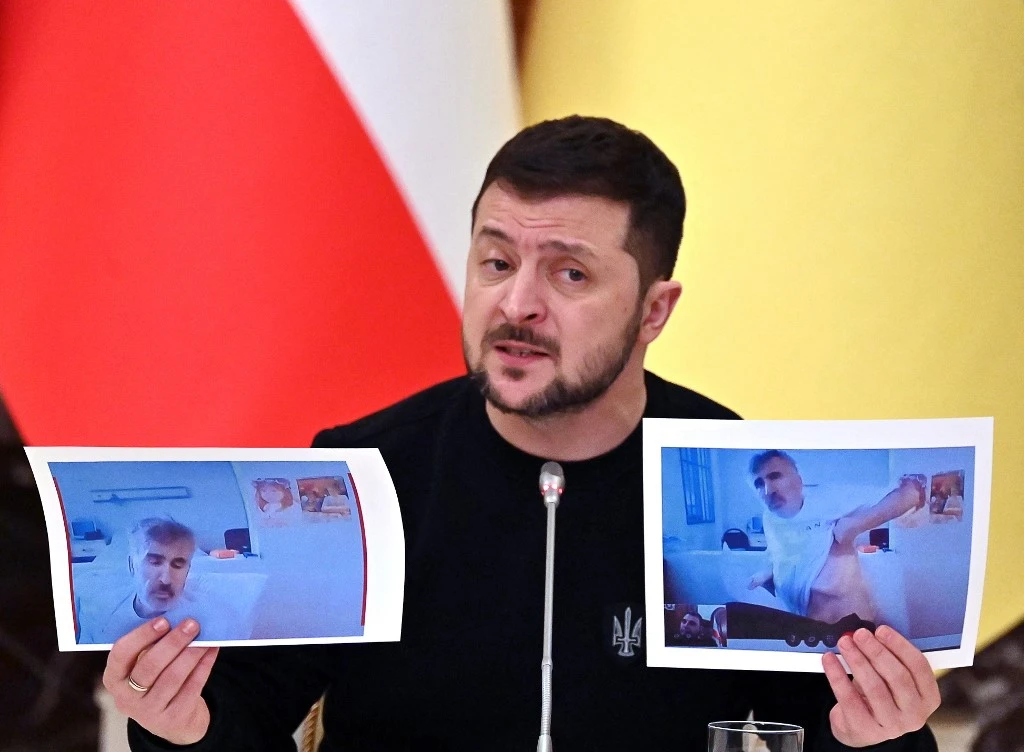
Zelensky blasts Georgian government for its treatment of Saakashvili.
 The Brooklyn Times - bklyntimes.com
Michael Novakhov retweeted:
For most of the last century, our economy led the world by a significant margin. Along the way we stopped.
I ran for president to invest in America again. And that’s what we’ve done.

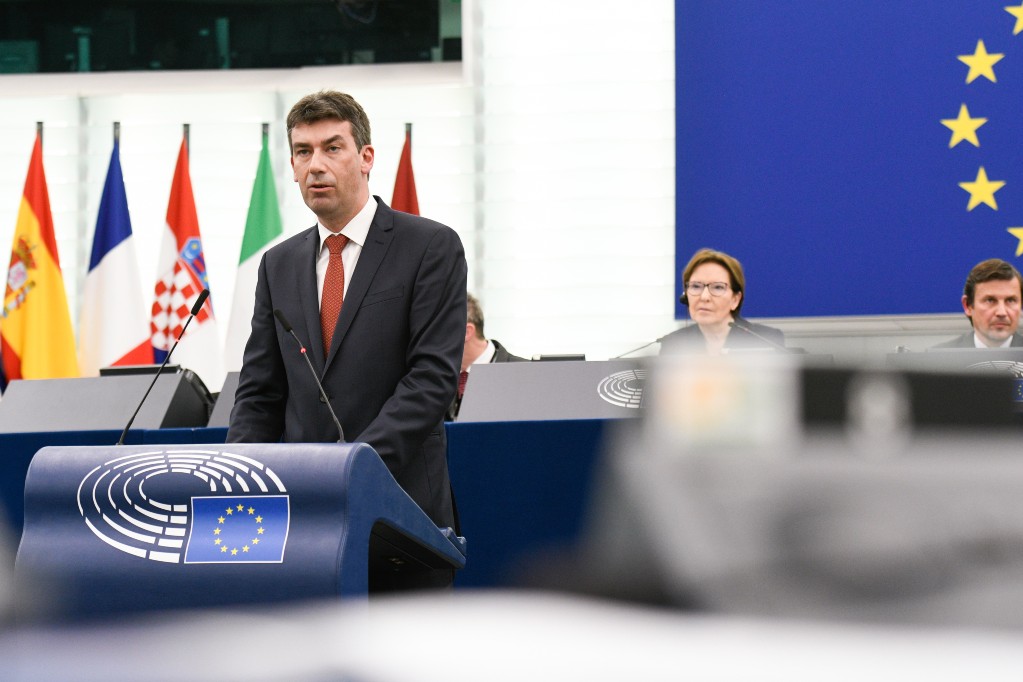
Discussions to create a Special Tribunal on the crime of aggression against Ukraine are proceeding rapidly. On Jan. 19, the European Parliament adopted a new resolution on the establishment of a tribunal, which underlined that:
[T]he special international tribunal must have jurisdiction to investigate Vladimir Putin and the political and military leadership of the Russian Federation, but also Aliaksandr Lukashenka and the political and military leadership in Belarus.
The same week, both Germany and the United Kingdom, publicly expressed support for a hybrid aggression tribunal integrated into Ukraine’s national justice system.
A few days later, on Jan. 26, the Parliamentary Assembly of the Council of Europe adopted a resolution calling for the creation of a Special Tribunal with a statute which would:
[C]learly state that personal immunities would not apply to incumbent State officials, in line with the practice of other international criminal tribunals, and that functional immunities would in any event not be applicable to the crime of aggression
Thus, one important consideration in the ability of any Special Tribunal to try senior members of the Russian and Belarusian leadership is the question of immunities under international law. There is growing commentary on the application or non-application of immunities before a Special Tribunal (for example, see this Just Security post by Astrid Reisinger Coracini and Jennifer Trahan and this publication by The Netherlands’ Advisory Committee on Public International Law).
The Open Society Justice Initiative and our colleagues at the International Renaissance Foundation have published an analysis of how personal and functional immunities could apply to prosecutions before a Special Tribunal.
Our analysis highlights that the ability to try senior Russian officials for the crime of aggression will depend on the specific nature of the tribunal. In particular, whether the Special Tribunal constitutes an international court or tribunal will substantially determine its authority to deny the personal immunity of President Putin and a small number of other high-level Russian officials.
Personal immunity, or immunity ratione personae, is a status-based immunity which applies to a small number of high-level State officials because of their office, specifically the head of State, head of government and minister of foreign affairs.
The Appeals Chamber of the International Criminal Court (ICC) and the Appeal Chamber of the Special Court for Sierra Leone (SCSL) both found that a head of State does not have personal immunity before an international tribunal (ICC, Al-Bashir, Judgment in the Jordan Referral, paras. 113-117; SCSL, Charles Taylor Decision on Immunity, paras. 52-53). The two Appeals Chambers emphasized that international courts and domestic courts differed in nature. In particular, both courts stressed that the par in parem principle, according to which one sovereign cannot exercise jurisdiction over another sovereign, does not apply to international courts. According to the ICC Appeals Chamber, international courts “act on behalf of the international community as a whole,” they “do not act on behalf of a particular State or States” (para. 115). Thus, the first characteristic of an international court able to decline to recognize the personal immunity of a head of State – and by analogy of a head of government, and minister of foreign affairs – is that it acts on behalf of the international community.
Acting on behalf of the international community is a necessary, but, we argue, not sufficient criterion of assessing whether a court is international for these purposes. Arguably, any domestic court acts on behalf of the international community whenever it properly adjudicates international crimes. However, this alone does not enable such a court to overcome the personal immunity of high-level foreign officials. The second critical characteristic of an international court is that it exercises jurisdiction on behalf of multiple States. In explaining its finding that the SCSL was an international court, the SCSL Appeals Chamber emphasized that the SCSL “is not a national court of Sierra Leone and is not part of the judicial system of Sierra Leone exercising judicial powers of Sierra Leone” (para. 40). While an international court must exercise jurisdiction on behalf of a multiplicity of States, this leaves open important questions, which we discuss further in our analysis, notably the number of States on whose behalf the international court must exercise its jurisdiction.
Our paper considers four different models of a Special Tribunal established:
Our assessment is that a Special Tribunal which is endorsed by the General Assembly has the strongest claim to the status of being recognized as an international tribunal because of the broad membership of the U.N., whether that Tribunal would be established by agreement between Ukraine and the U.N., the EU, or the Council of Europe. One outstanding question here is the number of States which would have to support the U.N. General Assembly endorsing the Special Tribunal. Article 18 of the U.N. Charter distinguishes between “important questions” (decided by a majority of members present and voting) and “other questions” (decided by a two-thirds majority of the members present and voting).
The Fully Regional Model presents some claim to the status of being an international tribunal. The Council of Europe has a larger membership than the EU with 46 Member States. We consider that a unanimous endorsement by the Council of Europe would support the claim that the Special Tribunal would be acting on behalf not of Ukraine, but of the entire region.
The Multilateral Model raises again the question of the number of States that would have to ratify the agreement establishing the Special Tribunal for personal immunity not to apply. Personal immunity would likely continue to apply if the Special Tribunal were established through a treaty signed by Ukraine and a small number of States.
The Internationalized Model could take many different forms, in terms of staffing, location, funding, and type of law, among other considerations. A Special Tribunal exercising Ukrainian jurisdiction which is not endorsed by the General Assembly, a regional organization, or many States, would not be international in nature and would likely be restricted by the personal immunity of senior Russian officials. We acknowledge, however, that different arguments have been advanced suggesting that Ukraine may deny personal immunity based on a right of self-defense (e.g., by Dapo Akandeat 41:20), under international humanitarian law to target or detain the commander-in-chief of the opposing armed forces (e.g., by Tom Dannenbaum on Just Security or Miguel Lemos, or as a countermeasure (e.g. by Anton Moiseienko).
Functional immunity, or immunity ratione materiae, is a conduct-based immunity which applies with respect to acts performed in an official capacity. Our analysis suggests two alternative ways to consider the application of functional immunity before a Special Tribunal.
First, one can argue that an exception to functional immunity exists for international crimes and that this exception extends to the crime of aggression. The Nuremberg Tribunal enshrined the principle that a person’s official position does not exempt them from individual criminal responsibility (as articulated in Principle III of the Principles recognized in the Charter and Judgment of the Nuremberg Tribunal). According to this first line of reasoning, the status of the Special Tribunal as an international tribunal is irrelevant: officials accused of aggression would not enjoy functional immunity before any court, whether international or national. However, some have questioned the existence of an exception to functional immunity for the crime of aggression. The International Law Commission adopted the position in Draft Article 7 on the Immunity of State officials from foreign criminal jurisdiction that the exception to functional immunity only applies in respect of certain international crimes. Crucially, the ILC did not include the crime of aggression on the list of international crimes, which suggests that functional immunity could continue to apply in respect of the crime of aggression. Thus, proceedings against Russian officials for the crime of aggression may face challenges if they rely on an exception to functional immunity.
Second, one can argue that, irrespective of the existence of an exception to functional immunity for the crime of aggression, functional immunity would not apply before a Special Tribunal which amounts to an international tribunal. The decisions of the ICC and SCSL Appeals Chambers both related to the (non-)application of personal immunity, rather than functional immunity, before international courts. However, the reasoning of the ICC Appeals Chamber is also helpful when considering whether functional immunity would apply before an international court. Indeed, the par in parem principle would not apply where a court that is international passes judgment on the conduct of a State official performed in an official capacity. The International Court of Justice in the Arrest Warrant case noted that a former foreign minister, who only benefits from functional immunity and no longer personal immunity, could be prosecuted “before certain international courts” (Judgment, para. 61). Thus, functional immunity would not prevent prosecutions before a Special Tribunal which amounts to an international tribunal.
Diplomatic discussions now underway on the merits of supporting a Special Tribunal will have to weigh the relative merits of different models and consider which have stronger claims to the status of an international tribunal before which immunities would not apply. As the full-scale Russian invasion approaches its first anniversary, inaction is not an option.
The post In Evaluating Immunities before a Special Tribunal for Aggression Against Ukraine, the Type of Tribunal Matters appeared first on Just Security.
In 1513, Juan Garrido, a free conquistador from the Kingdom of Kongo, became the first known African to arrive in North America when he explored what’s now Florida via a Spanish expedition.
Now, in 2023, Florida, the state where Black history began in America, is blocking an in-depth Black history class from being offered in its schools.
Garrido’s story is in the official framework for AP African American Studies, the College Board’s newest Advanced Placement course in nearly a decade. The course framework was viewed by TIME in advance of its release on Feb. 1, the beginning of Black History Month. As TIME previously reported, the course is being piloted at 60 schools nationwide.
[time-brightcove not-tgx=”true”]
But in January, the Florida Department of Education informed the College Board that it would not approve the curriculum unless certain changes are made. Among the course materials it objected to are references to Black Lives Matter and reparations. According to the official framework, students are not required to know about these topics for the AP exam, but they are listed as examples of possible research topics students may want to pursue.
Despite the lies from the Biden White House, Florida rejected an AP course filled with Critical Race Theory and other obvious violations of Florida law. We proudly require the teaching of African American history. We do not accept woke indoctrination masquerading as education. pic.twitter.com/Anw7Ui2JJv
— Manny Diaz Jr. (@SenMannyDiazJr) January 20, 2023
Elaborating on the decision in a Jan. 23 press conference, Florida Governor Ron DeSantis, a former history teacher and college history major, said, “We want education not indoctrination,” arguing that the class is “pushing an agenda on our kids.”
Florida has become a ground-zero for the latest front of the culture wars. Last spring, DeSantis signed into law the STOP W.O.K.E. Act, which aimed to regulate how schools and workplaces talk about race and gender. Though a federal judge blocked a provision aimed at private businesses, it’s still had a chilling effect. College professors are opting not to teach classes on racism, and there are restrictions on professional development opportunities for teachers aimed at preventing critical race theory from being taught in K-12 schools (even though it’s rarely taught below the graduate level).
While Florida teachers are required to teach African American history, AP African American Studies would offer students a chance to earn college credit. On Jan. 25, civil rights lawyer Ben Crump announced he’s ready to sue DeSantis, with three AP honors students as lead plaintiffs.
To comment on Florida’s criticism of the curricula, TIME talked to one of its architects, Evelyn Brooks Higginbotham, professor of history and of African and African American Studies at Harvard University. The College Board created the course, and Higginbotham and her Harvard colleague Henry Louis Gates Jr. were the primary scholars who reviewed it.
In the below conversation, she explains what’s in the course and what’s not in the course.
HIGGINBOTHAM: Those narratives that they were singling out aren’t in the curriculum itself. What they see is buzzwords. They are picking on buzzwords that they know will inflame the hearts of some of their constituency. Communism was a buzzword in the 1950s against interracial marriage. If you were interracially married in the South, you became a communist. If people have political reasons for not wanting to see this [course], then no matter what arguments you give them, it won’t matter. So at this point, what I’m just interested in is stating what this course is and what we will do. And it’s exciting.
We’re not pushing theory. Those things come up. Theory is replete in academia. Critical race theory built off of critical legal theory. Critical legal theory isn’t Black. Theory is everywhere. You’ve got Darwin’s theory of evolution and natural selection, Einstein’s theory of relativity, bad theorists who are absolutely racist like Morton and Agassiz [who tried to use science to claim Blacks were inferior]. You’ve got religious theories. Theory is a part of higher education. But that’s not what this course is about.
That’s a very old fashioned way of thinking about history. American history is not the American history of the great white male anymore. America wasn’t made by just simply the people who left their autobiographies, libraries, and manuscript papers in the Library of Congress.
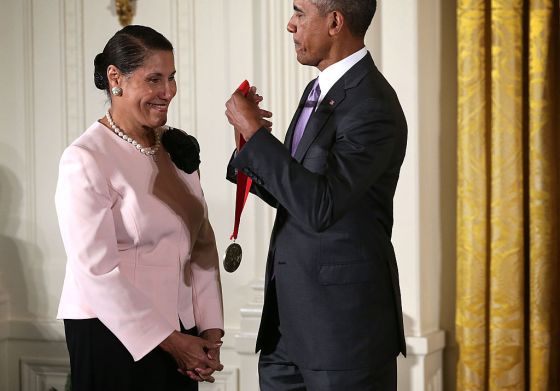
Alex Wong—Getty ImagesU.S. President Barack Obama (R) presents the 2014 National Humanities Medal to Evelyn Brooks Higginbotham (L) during an East Room ceremony at the White House September 10, 2015, in Washington, DC. Evelyn Brooks Higginbotham was honored for illuminating the African-American journey in her writings and edited volumes.
One of our goals is to have students look at topics from a variety of angles. This is the farthest thing from indoctrination. How you look at a subject from different angles is best done through interdisciplinary work. And this is an interdisciplinary course.
The big difference is that when you indoctrinate, you are not seeking a questioning mind. You’re just trying to put an idea into pretty much a blank mind and think that that will be accepted unquestioningly. This is exactly the opposite of what the AP course is doing. The AP course is trying to give a sense of the different ways to talk about a particular topic. And so there’s room for debates on a variety of things.
One of the major points that comes out of this course is that Black people are not a monolith. The people of African descent are themselves of different ethnicities, of different ideologies and political persuasions. They are different as far as income, as far as education. And we’re trying to capture that complexity. There’s certain things that will be similar. But the richness of it is the complexity within a narrative that allows for students to disagree. And we want students to disagree. We want respectful and civil debate.
Governor DeSantis said [Florida has] Black history, but [AP African American Studies] is a different type of Black history. No. This is a Black history that is based on facts and not theories. It is a Black history that uses primary sources, meaning those records of the times—the newspapers of the time, letters, correspondences, archival records of the times. It means looking at our laws, our Constitution, our judicial decisions. It means reading the Congressional Record. So this isn’t something that is made up.
For many people, the idea of kingdoms in Africa will be shocking because when I was growing up, watching television as a child in the 1950s and early 1960s, there was the portrayal of African people as though they were merely savages. And those kinds of images were everywhere, even children’s games. People of African descent should be understood in a new light.
The biggest misperception is that this is somehow neophyte. African American Studies is over 50 years in the academy. And when it first started in the academy, it started in the white schools. Over 200 primarily white schools had Black studies in one form or another—programs, centers, departments—in 1969. This is not some ghettoized knowledge that will not land you a job.
Yes. Absolutely. Obviously he doesn’t know American history, or Florida history.
The first time Black people came to North America was not in 1619. I have to remind people that when we talk about Jamestown, we’re talking about the British. When we talk about Black people, we’ve got to go into the earlier century—and that earlier century is the story of Florida. That’s one of the ironies of this whole resistance on the part of the governor, because the story of Florida, which was settled by the Spanish, starts in the early 1500s.
Did you know that in 1528, Africans were part of an expedition to settle in an area which would be near present-day Tampa Bay? It’s not until 1565 that St. Augustine is established [in present-day Florida]. Well, St. Augustine is the oldest surviving city in the United States. Enslaved Blacks and some free Blacks were crucial in the building of that city, along with whites, and along with some native indigenous people. Then as early as the early 1700s, St. Augustine develops this Black town called Fort Mose. The Spanish governor of Florida chartered this settlement called Fort Mose. And it was a settlement for free Blacks and also a settlement for slaves of the British that were fleeing to Florida from South Carolina. I would love to see teachers take the students there.

U.S. stock indexes opened lower on Wednesday as investors cautiously awaited the Federal Reserve’s decision on interest rates later in the day, while chipmaker Advanced Micro Devices climbed on an upbeat outlook.
The Dow Jones Industrial Average (.DJI) fell 46.44 points, or 0.14%, at the open to 34,039.60. The S&P 500 (.SPX) opened lower by 6.53 points, or 0.16%, at 4,070.07, while the Nasdaq Composite (.IXIC) dropped 11.41 points, or 0.10%, to 11,573.14 at the opening bell.

Airlines canceled over 1,800 flights in the United States on Wednesday, after an ice storm hit states from Texas to West Virginia.
A total of 1,897 flights within, into or out of the United States were canceled, while 750 flights were delayed as of 8.41 a.m. ET, according to flight-tracking website FlightAware.
“This week’s winter storm is having an impact on our operations, accounting for a significant number of cancelations,” American Airlines Group Inc (AAL.O) said in a statement, adding that it proactively canceled flights and notified passengers.
The Federal Aviation Administration (FAA) on Tuesday warned in a tweet that travelers could expect to see some snowy conditions in certain areas including Dallas, Fort Worth and Memphis, which could delay certain flights.
“The ongoing winter storm will continue to bring hazardous impacts to North and Central Texas through at least early Thursday morning,” The U.S. National Weather Service said in its Dallas-Fort Worth, Texas area forecast discussion.
Fort Worth, Texas-based American led the cancellations with nearly 800 flights, while low-cost carrier Southwest Airlines Co (LUV.N) followed with cancelling 501 flights.
Southwest did not immediately respond to a Reuters request for comment.
The latest cancellations come nearly a month after Southwest faced U.S. government backlash for canceling 16,700 flights over the holidays, as bad weather overwhelmed its crew scheduling system.
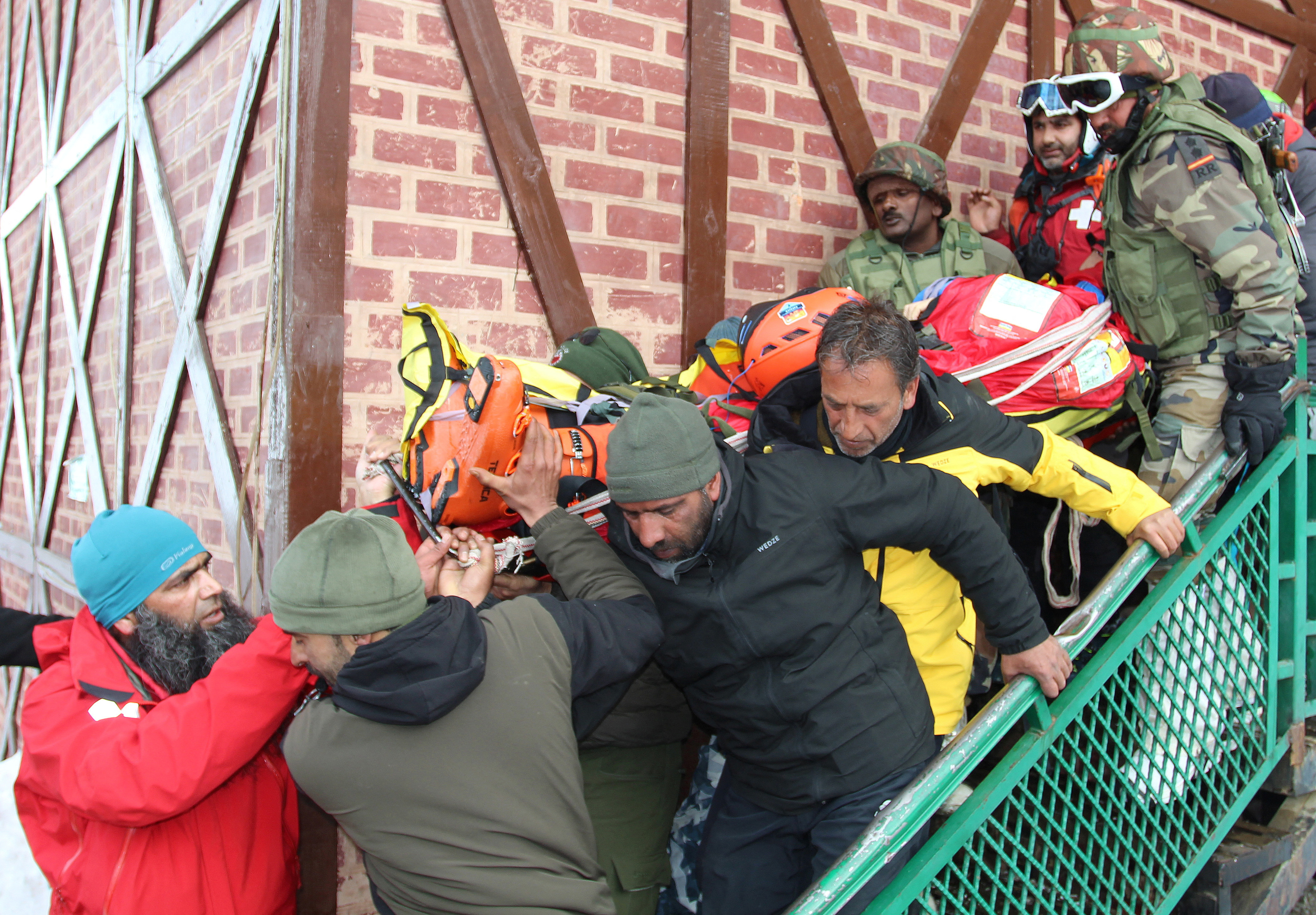
Two Polish skiers were killed and 21 other people rescued in Indian Kashmir on Wednesday after an avalanche swept through the popular ski resort of Gulmarg, police said.
The skiing group was made up of Russian and Polish nationals and two local guides, police said.
A rescue operation was launched following the incident, Kashmir’s police chief Vijay Kumar told Reuters, and two bodies were recovered. Police later said 21 skiers and two local guides had been accounted for.
The skiers were hit by the avalanche in the Affarwat area of Gulmarg, Kumar said, days after heavy snowfall in the hills of Kashmir, a disputed Himalayan region claimed in full by both India and Pakistan, though each country only controls parts of it.
Police identified the two Polish skiers as Krzysltof, 43, and Adam Grzech, 45. Their bodies have been moved to a hospital.
A video of the avalanche shared on social media, which Reuters could not immediately verify, showed a wall of snow roaring down a mountain side, sending skiers and other onlookers scurrying for safety.

National Football League quarterback Tom Brady, who won seven Super Bowls and is widely considered the greatest quarterback in league history, said on Wednesday that he was retiring, a year after he made the same announcement only to change his mind weeks later.
“I am retiring for good,” Brady said in a 53-second video message that he posted on Twitter. “Thank you guys for allowing me to live my absolute dream.”
The 45-year-old Brady spent 20 seasons with the New England Patriots before relocating to Florida and leading the Tampa Bay Buccaneers to a Super Bowl championship in 2021.
He retired after last season but reversed course 40 days later and returned to the Buccaneers, leading them to the playoffs again in the current season before the team was eliminated by the Dallas Cowboys last week.
In October, halfway through the season, Brady announced that he and his wife, supermodel Gisele Bundchen, had ended their 13-year marriage. They have two children together.
The northern California native is widely regarded as the best quarterback in league history. He appeared in a record 10 Super Bowls, winning the game seven times. He also won the Super Bowl MVP award five times and his 15 Pro Bowl selections are the most in league history. He was named the league’s most valuable player three times.
A lightly regarded prospect coming out of the University of Michigan, Brady was the 199th pick in the 2000 NFL Draft. But he made the most of his opportunities and quickly turned around the fortunes of the Patriots franchise. He would go on to build one of the greatest dynasties across any sport.



US Army photo
Ukraine is getting America’s powerful Abrams tank — but generals disagree over how difficult it will be to operate.
Berlin’s contorted decision-making process on whether to allow delivery of its widely-operated Leopard 2 tanks to Ukraine has been at the forefront of the news cycle in January as German Chancellor Scholz, and his officials issued contradictory messages regarding whether they would “release the Leopards.”
Fearing Russian escalation, Scholz seemingly conditioned authorization on Washington also donating its M1 Abrams main battle tanks to diffuse responsibility.
A M1A2 Abrams tank fires at a target during an exercise.
Maj. Randy Ready/US Army
Finally, on January 24, Berlin announced it would donate a company of 14 Leopard 2A6 battle tanks with long-barreled guns to Ukraine and open the way for many additional donations from the Leopard’s numerous operators. But perhaps a quid-pro-quo was at work.
The same day, word spread that US President Joe Biden would announce he was sending 31 M1 Abrams tanks to Ukraine.
That could be the first tranche of a more significant transfer — as has proven the case for the Bradley fighting vehicle.
Both the Leopard 2 and M1 Abrams are broadly comparable in performance — heavier at 60-70 tons, faster, harder-hitting, and with much better sensors than the 45-55 ton main battle tanks used by Russia and Ukraine. Both will require 2-3 months of training for Ukrainian crews and maintainers at minimum before deployment.
However, the M1 Abrams’ deployment amounts to a rapid about-face for Washington. Immediately prior, Defense Secretary Lloyd Austin dismissed the Abrams as too logistically demanding — “a very complicated piece of equipment” — compared to Germany’s Leopard 2.
A German Leopard 2 tank during a demonstration in Munster in May 2019.
Christophe Gateau/picture alliance via Getty Images
This assertion spurred an online debate amongst senior retired officers, all vocal supporters of Ukraine with experience commanding M1 Abrams-equipped units.
Retired US Lt. Gen. Mark Hertling, who has commanded everything from platoons to an entire armored division of Patton and Abrams tanks, supported Austin’s take, tweeting:
“Ukrainian Army commanders who I talk with want tanks, but have admitted they struggle with logistics, repair parts getting to the right places, and resupply. So reducing the burden must be a key consideration — and in my professional opinion, the Abrams would cause more of a burden due to training and resupply to a force that’s in a tough fight. Also, in my view, Leopard 2s would means less of a burden.”
But retired Australian Gen. Mick Ryan, former commander of an Abrams brigade in arid northern Australia, argued such arguments were “… excuses … entirely absent when these tanks were sold to Iraq, Egypt and Australia — all of whom possess very light military logistic capabilities.”
A US Army maintenance crew reattaches a 30-ton turret to an Abrams M1A2 tank in Kuwait in September 2019.
US Army/Kevin Fleming
Retired Gen. Barry McCaffrey, commander of the 24th Infantry Division that destroyed Iraq’s 1st Armored Division at Rumaila in one day, also endorsed the Abrams, noting its integration by earlier foreign operators. “An experienced Ukrainian tank crew could fight in 30 days,” he concluded.
And retired Lt. Gen. Ben Hodges, formerly chief of US Army Europe, agreed the difficulties of adoption were exaggerated: “The Ukrainians will figure all of that out. Please no more condescension from DoD.”
But Hertling disagreed that withholding the M1 Abrams was a “political decision” and didn’t find the examples of non-US Abrams operators persuasive. “Countries we’ve sold it to took years — and [US] contractors — to field and sustain them.”
While it’s certain Ukraine will get both Leopard 2s and M1 Abrams, it’s still worth examination — just how serious were those downsides cited by Austin prior to the change?
A sailor guides a Marine M1A1 Abrams tank on Camp Pendleton’s White Beach.
US Marine Corps
Broadly speaking, the US has a staggering 3,700 Abrams tanks estimated to be in storage, according to IISS’s Military Balance 2021, and builds more yearly — even if the Army doesn’t want them — to keep the factory in Lima, Ohio open.
And the Marine Corps recently retired all of its 400+ M1A1 tanks. There are also 2,000-3,000 Leopard 2s in service or storage, though divvied up between numerous operating countries in a variety of models.
But there are 13 countries in/around Europe operating Leopard 2s, and only one — Poland — that just began operating the M1 Abrams. That means there’s a lot of Leopard 2 inventory, maintenance depots, and spare parts geographically close to Ukraine.
Still, there’s one other big Abrams operator in Europe — the US Army. While US armor in Europe briefly dwindled to zero in 2013, it ticked back up after Russia’s invasions of Ukraine in 2014 and 2022, notably including a rotating armor brigade in Poland.
Dave Demorrow, a retired Army non-commissioned officer-in-charge with 18 year’s experience serving in mechanized units, particularly in an intelligence role, sparred online with Hertling regarding the availability of M1 hulls and spare parts in Europe.
US Marines inventory gear during an exercise in Finland in May 2019.
US Marine Corps/Lance Cpl. Scott Jenkins
Demorrow, who organizes donations of gear and equipment to Ukraine and runs a military museum in Texas, told me over the phone that besides the rotating brigade in Poland he believes there are 2-3 additional brigade-sets of M1s pre-positioned in Europe.
He states, between that and Poland’s purchase of hundreds of M1s, there’s a healthy supply of spare parts. That could reflect unspecified “enhancements” the White House promised last year.
However, Maj. Joe Minarick of the 278th Armored Cavalry Regiment of the Tennessee Army National Guard wrote to me that he “would not expect” the US to dip into its pre-positioned assets, and that in his experience as a battlegroup planner in Poland, spare parts were an issue.
“[Many parts] have to be ordered from the US. When we were in Poland they would fly parts to Ramstein then truck them to an SSA yard in Poland, where we would have to drive and pick them up. The Ukrainian border would be an addition to this process, which in our case would take up to a few days.”
US soldiers perform maintenance on an Abrams tank in Grafenwoehr, Germany in August 2017.
3rd Brigade Combat Team, 4th Infantry Division
The Leopard 2 relies on a diesel engine, like most Ukrainian tanks. The Abram employs a Honeywell AGT1500 gas-turbine engine that can run on jet fuel. But it’s a multifuel engine, so it can run on diesel too — and according to Demorrow, the US Army service frequently does this when refueling alongside diesel-engine Bradley fighting vehicles.
“It could run on Chanel No. 5,” Demorrow said, alluding to a stunt pulled by comedian Jay Leno using his gas-turbine-powered Chrysler. Furthermore, Ukraine does deploy some gas-turbine engine tanks, the speedy T-80BV assigned to airborne brigades.
Joe Minarick concurred “The fuel is a non-issue. M1s are thirsty, but they’ll drink anything. Running diesel through the turbine slightly increases the maintenance burden (they prefer JP8 [kerosene-based jet fuel]), but it’s not much of an issue.”
US Marines receive fuel from Finnish soldiers during an exercise at Niinisalo Garrison in Finland in May 2019.
US Marine Corps/Lance Cpl. Scott Jenkins
The real problem is that the M1 Abrams’ faster starting and accelerating engine is a gas hog. Reportedly, an M1 consumes 10 gallons an hour idling and .6 to 1.2 gallons per minute on the move. For every mile traveled, a Leopard 2 consumes just over half as much. That’s obviously a big logistical burden.
“I hope to hell we give them good HEMMT fuelers as well,” Minarick remarked, referring to huge, eight-wheeled Heavy Expanded Mobility Tactical Trucks such as the M978 tanker which can carry 2,500 gallons.
Demorrow insists the fuel-efficiency gap is lower—”around 17 percent”—and believes Ukrainians will field-improvise external auxiliary power units (APUs) for M1 Abrams to avoid gas consumption while idling, a solution he says is harder to implement on the Leopard 2A4’s turret. Only the latest-model Abrams and Leopard 2A7s come with built-in APUs.
A crewmen performs maintenance on a M1 Abrams tank during a platoon combined-arms live-fire exercise.
U.S. Army photo by Spc. Dustin D. Biven / 22nd Mobile Public Affairs Detachment
The US M1s incorporate ultra-dense depleted uranium (DU) to maximize protection and firepower.
A depleted uranium mesh weighing a few tons is inserted between steel or carbon plates to help Abrams’s front turret to achieve dramatically higher effective levels of armor protection, rendering parts of its front turret impenetrable to most armor-piercing weapons.
The Army also uses hi-tech M829 depleted uranium shells tailored to defeat sophisticated Kontakt-5 and Relikt explosive reactive armor on newer Russian tanks — which may use depleted uranium shells, but don’t sport depleted uranium armor.
Depleted uranium is mildly radioactive, and the US has omitted it from Abrams tanks exported to operators like Egypt and Thailand, leaving them with reduced armor protection. However, the ban isn’t absolute; Poland and possibly Australia’s M1s will have depleted uranium armor inserts and M829 rounds.
US soldiers load an M1A1 Abrams tank with M829 120mm sabot rounds at a training area in Poland on April 18, 2020.
US Army/Sgt. Andres Chandler
Thus it’s unclear whether Ukraine’s M1s will benefit from the controversial material. Meanwhile, later-model Leopard 2A5s, 2A6s and 2A7s sport extra armor and longer-barreled guns to match the benefits depleted uranium provide the M1.
Demorrow argued that the secrecy concerns surrounding DU armor were overblown decades after its introduction. “I think it’s more about radiation rather than it’s a strategic or tactical secret.”
Furthermore, he argues the M1s are robust even without depleted uranium reinforcement.
Present at the titanic Battle of Norfolk in the 1991 Gulf War, he was driving an ammunition truck close to an M1A1 Abrams — an earlier model lacking uranium armor — when it was repeatedly hit by friendly fire from forces advancing behind it. It sustained a dozen hits before finally being disabled, with three of the four crew surviving.
An M1A2 Abrams drives into the woods during an exercise in Hohenfels, Germany. in February 2020.
US Army National Guard/Sgt. Fiona Berndt
There are also concerns the M1’s advanced components will make it difficult to train personnel to operate and sustain it in the field. Nicholas Drummond, a British armor officer and advisor to German tank manufacturer KMW told Breaking Defense the Leopard 2 may be easier to integrate due to being designed for Germany’s Cold War conscript army.
Hertling tweeted the Abrams requires higher training standards than most tanks, especially for the crew to avoid self-inflicted mechanical breakdowns:
“Some M1 repairs require part replacements (requiring many high tech spare parts to be in a Prescribed Load List [a standardized unit inventory of on-hand spare parts]). Other replacements require pulling things (like Full Up Power Packs [engine and transmission], sights, etc.) to a logistics center/depot with new one being sent forward. It’s a 500-mile supply line from Poland to the Donbas.”
Minarick, who has 24 year’s experience with armor, agreed that Leopard 2s are easier to maintain than the Abrams. “The turbine is more complicated (although having fewer moving parts) than a diesel engine. From having worked with both platforms in the field, the reliability is about the same, only the repairs are more difficult.”
Demorrow, however, argues there’s a double-standard, noting M2s and Bradley fighting vehicles already given to Ukraine use Bushmaster cannons with more components than the Abram’s main gun, and use the same support systems including M88 Armored Recovery Vehicles. He maintains faulty power packs could be shipped out of Ukraine while the vehicles stays in country using a swapped-in pack.
A German civilian greets US Army vehicles on a road during an exercise in April 2018.
US Army photo by Spc. Dustin D. Biven
Why have these veterans come to such different conclusions despite their common experience with the Abrams? Perhaps, they have different assumptions of the integration and opportunity costs.
Maj. Gen. Patrick Donahoe—recently retired from his role overseeing maneuver warfare training at Fort Benning—argues, “[Ukrainian forces] need one system, delivered in numbers that matter, in one variant to east sustainment in order to maximize the effect on the enemy and reduce internal friction and challenges.”
From his perspective, giving two different tank models is worse than maximizing the delivery of the most efficient type.
Responding to news of M1 deliveries, Hertling reiterated his concerns: “… can they quickly learn the capability of the Abrams (and Leopard II) the way it is designed to operate? That’s training with other tanks, infantry, scouts, drones, artillery, engineers, intel. All more than crew training when the tank – or small critical parts in the tank – break (which they do), and when those small and large replacement parts need replacing, and when it requires daily/weekly/monthly echelon maintenance, will Ukraine have also trained those who do these things?
After the tank crews, sections, companies, battalions master the gunnery skills, the maneuver, and the maintenance; will there also be echelons of support that will flow the needed parts, Full Up Power Packs, ammo, fuel, roadwheels, torsion bars, etc., etc., to the front lines?…I’ve seen U.S. units at our training centers and in combat get just a few things wrong and it causes disaster and failure. Lethal tanks turn into pillboxes that don’t move or shoot.”
So Hertling sees a distinction between simply operating a tank, and employing it sustainably and effectively using US-style combined arms doctrine and logistics.
An M1A2 Abrams tank is unloaded at the Port of Vlissingen in the Netherlands in October 2019.
US Army/Sgt. Kyle Larsen
Ukraine’s military has undeniably absorbed a staggering variety of troop-carrying vehicles and artillery systems via foreign assistance — diversity ordinarily seen as a massive no-no to logisticians due to the inefficiencies of having to train for and sustain so many different types of equipment.
If you assume there are substantial overhead costs to inducting new equipment types and constrained “bandwidth” to do so, there’s less benefit to furnishing two types just to increase volume.
But boosters of the M1 Abrams for Ukraine argue Kyiv would gladly take all the tanks it can get and has the personnel, motivation, and culture of assimilation to adopt new platforms faster via crash courses and MacGyver-style fixes than a peacetime army ordinarily could.
By keeping foreign experts on-call for technical consulting, and rapid on-demand parts deliveries, they argue Ukraine may sustain a diversified force better than is conventionally thought possible.
Mick Ryan writes: “Ukrainians have demonstrated throughout this war that they are very capable of integrating very complex hardware and weapons quickly. They are an adaptive, learning institution with a strong imperative for constant improvement.”
Furthermore, Ryan and defense expert Michael Kofman argue that while Ukraine can learn much from US maneuver doctrine, the methods contextually suited to Ukraine may differ greatly.
Minarick, who considers Leopard 2s and M1 Abrams to be similar “apex tanks,” wrote to me: “Other countries far less competent have used them in austere environments. I think the concern that the Abram specific logistics will distract from more pressing issues on the ground is genuine, but overblown.”
Expertise and Experience: Sébastien Roblin writes on the technical, historical, and political aspects of international security and conflict for publications including The National Interest, NBC News, Forbes.com, War is Boring and 19FortyFive, where he is defense-in-depth editor. He holds a master’s degree from Georgetown University and served with the Peace Corps in China. You can follow his articles on Twitter.
Advertisements – Advertising at The News And Times – advertising-newsandtimes.com | WE CONNECT!
Audio | Video | Top News | On Twitter | Security | FBI | Capitol Riot | JOSSICA | Trump | Russia | Putin | Russia – Ukraine War | Covid-19 | Brooklyn NY | Puerto Rico | World
September 16, 2026 3:22 pm
The News And Times | Featured Posts | All Articles | Current News | Selected Articles | Shared Links | Opinions | In My Opinion | Sites | Blogs | Links | Twitter | Facebook

Contact Form | Blogs | Sites | News Reviews | Links | Advertising
All The News That’s Fit To Web