Categories
Audio Sources - Full Text Articles

UN chief fears world is heading toward a wider war

UNITED NATIONS (AP) — The United Nations chief warned Monday that the world is facing a convergence of challenges “unlike any in our lifetimes” and expressed fear of a wider war as the first anniversary of Russia’s invasion of Ukraine approaches.

Secretary-General Antonio Guterres said experts who surveyed the state of the world in 2023 set the Doomsday Clock at 90 seconds to midnight — the closest ever to “total global catastrophe,”

He pointed to the war in Ukraine, “runaway climate catastrophe, rising nuclear threats,” the widening gulf between the world’s haves and have-nots, and the “epic geopolitical divisions” undermining “global solidarity and trust.”

In a wide-ranging address Guterres urged the General Assembly’s 193 member nations to change their mindset on decision-making from near-term thinking, which he called “irresponsible” and “immoral,” to looking “at what will happen to all of us tomorrow — and act.”

He said this year’s 75th anniversary of the Universal Declaration of Human Rights should serve as a reminder that the foundation of the inalienable rights of all people is “freedom, justice and peace.”

Guterres said the transformation needed today must start with peace, beginning in Ukraine — where unfortunately, he said, peace prospects “keep diminishing” and “the chances of further escalation and bloodshed keep growing.”

“I fear the world is not sleepwalking into a wider war. It is doing so with its eyes wide open,” he said.

The world must work harder for peace, Guterres said, not only in Ukraine but in the decades-old Israeli-Palestinian conflict “where the two-state solution is growing more distant by the day,” in Afghanistan where the rights of women and girls “are being trampled and deadly terrorist attacks continue” and in Africa’s Sahel region where security is deteriorating “at an alarming rate.”

He also called for stepped up peace efforts in military-ruled Myanmar which is facing new violence and repression, in Haiti where gangs are holding the country hostage, “and elsewhere around the world for the two billion people who live in countries affected by conflict and humanitarian crises.”

The secretary-general said it is time for all countries to recommit to the U.N. Charter, which calls for peaceful settlement of disputes, and for a new focus on conflict prevention and reconciliation.

The proposed new U.N. Agenda for Peace, he said, calls for “a new generation of peace enforcement missions and counter-terrorist operations, led by regional forces,” with a U.N. Security Council mandate that can be enforced militarily and guaranteed funding. “The African Union is an obvious partner in this regard,” he added.

Guterres also said it is time for nuclear-armed countries to renounce the first use of all nuclear weapons, including tactical nuclear weapons, a possible use that Russia has raised in Ukraine.

“The so-called `tactical’ use of nuclear weapons is absurd,” he said. “We are at the highest risk in decades of a nuclear war that could start by accident or design. We need to end the threat posed by 13,000 nuclear weapons held in arsenals around the world.”

As for the global financial system, Guterres called for “radical transformation” to put the needs of developing countries at the center of every decision.

He pointed to rising poverty and hunger around the world, developing countries forced to pay five times more to borrow money than advanced economies, vulnerable middle-income countries denied concessional funding and debt relief, and the richest 1% of the world’s people capturing “almost half of all new wealth over the past decade.”

Multilateral development banks must change their business model, Guterres said.

Guterres told diplomats that 2023 must also be “a year of game-changing climate action,” not of excuses or baby steps — and there must be “no more bottomless greed of the fossil fuel industry and its enablers.”

The world must focus on cutting global-warming greenhouse gas emissions by half this decade, which means far more ambitious action to cut carbon pollution by speeding the transition from fossil fuels to renewable energy, especially in the world’s 20 richest global economies, he said.

It also means cutting emissions from the highest emitting industrial sectors — steel, cement, shipping and aviation, he said.

Guterres had a special message for fossil fuel producers who he said are scrambling to expand production “and raking in monster profits.”

“If you cannot set a credible course for net-zero, with 2025 and 2040 targets covering all your operations, you should not be in business,” he said.

The secretary-general invited any leader in government, business or civil society to the Climate Ambition Summit he is convening in September — with a condition.

“Show us accelerated action in this decade and renewed ambitious net zero plans — or please don’t show up,” Guterres said.


Categories
Audio Sources - Full Text Articles

Global shares slide, dollar gains as rates rise on strong data

2023-02-06T17:13:37Z

Global equity markets slid and the dollar firmed on Monday after data showing a resilient U.S. jobs market suggested interest rates will stay higher for longer as central banks face a tough battle to slow inflation amid relatively strong economic growth.

The blockbuster U.S. jobs report last Friday sent investors scurrying to load up on dollars to the detriment of emerging market assets and lower-yielding currencies like the yen.

Government bonds, which usually perform well when there is a dash for safe havens, have come under intense pressure, sending the benchmark 10-year Treasury
yield to a one-month high of 3.64%. The yield on Germany’s 10-year bond , the euro zone benchmark, hit 2.297%.

U.S.-listed shares of China firms fell as Sino-U.S. relations soured over a suspected Chinese spy balloon the U.S. military shot down over the Atlantic. Heavyweights Alibaba Group Holding , JD.com Inc and Pinduoduo Inc (PDD.O) fell between 2.4% and 4.7%.

Turkey’s lira hit fresh record lows after a powerful earthquake struck Turkey and Syria, killing more than 2,200 people. The currency sank after data last week showed a worrisome increase in monthly consumer inflation.

The big driver of market sentiment was the U.S. labor market report showing 517,000 jobs were created in January, with the unemployment rate falling to 3.4%, a low last seen in 1969.

This year’s rally in equities has been driven by hopes of a soft landing and lower inflation, said Antho Saglimbene, chief market strategist at Ameriprise Financial in Troy, Michigan.

“Investors are going to have to come to grips with the fact that rates are going to stay higher for longer and it’s still unlikely the Fed is going to cut rates this year,” Saglimbene said, as the strong labor market gives support to inflation .

“Without people fearing that they’re going to lose their job, they don’t really spend less. They don’t change their behaviors enough to start bringing down inflation,” he said.

MSCI’s gauge of stock performance in 47 countries (.MIWD00000PUS) slid 1.09%, while the broad pan-European STOXX 600 index (.STOXX) lost 0.95%.

On Wall Street, the Dow Jones Industrial Average (.DJI) fell 0.3%, the S&P 500 (.SPX) lost 0.53% and the Nasdaq Composite (.IXIC) dropped 0.65%.

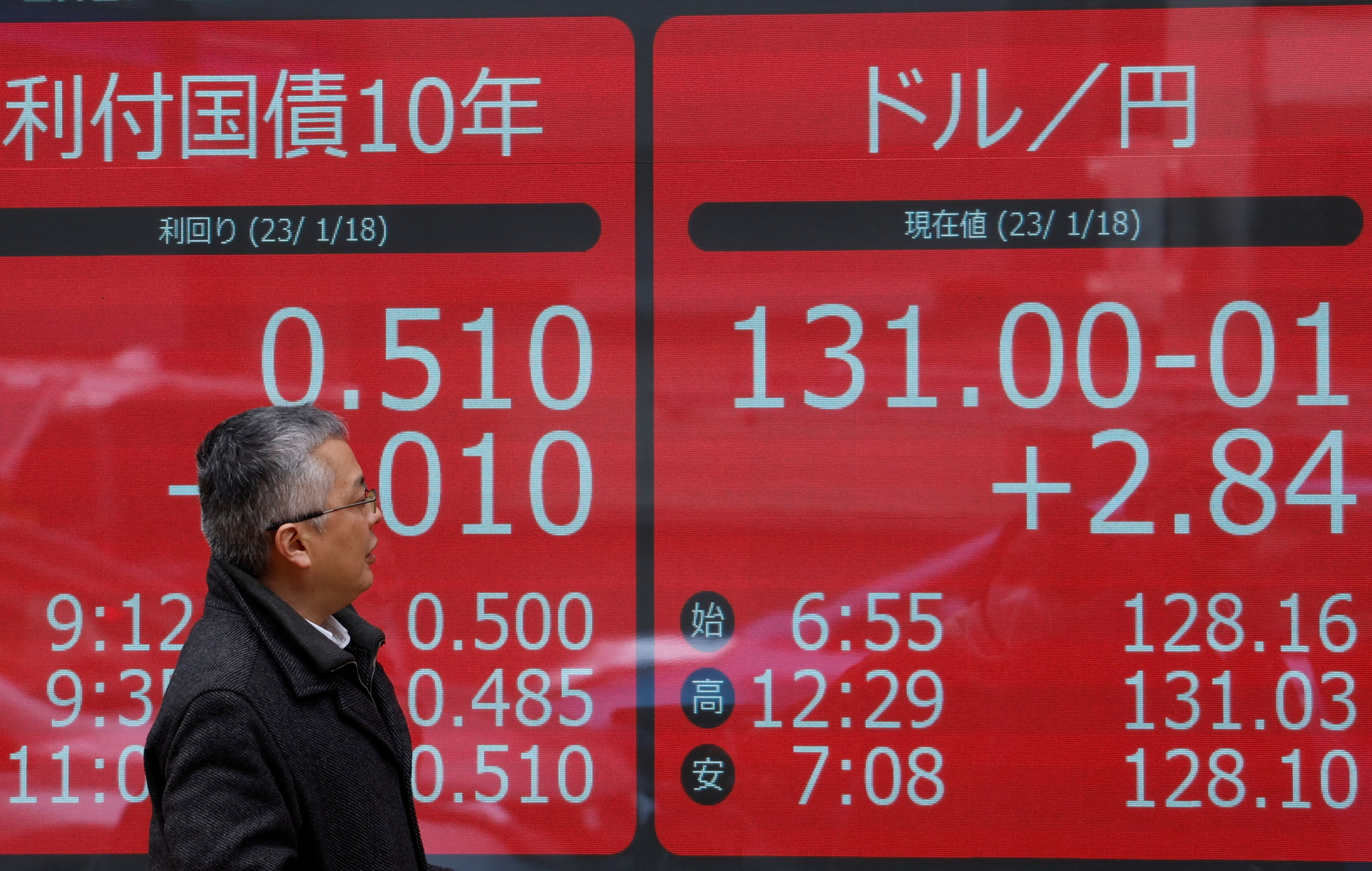
The dollar had touched a three-week high of 132.60 against the lower-yielding yen following reports the Japanese government had offered the job of central bank governor to current deputy Masayoshi Amamiya, viewed as less of a monetary policy hawk than his predecessor.

The dollar rose more than 1.2% to an almost one-month high of 132.85 yen. The euro was down 0.57% to $1.0731.

The drama over the balloon, which Beijing reiterated was a civilian airship that accidentally strayed into U.S. airspace, further strained already-tense relations.

Chinese equities fell on Monday, while the offshore yuan touched a one-month low against the dollar. It has fallen by almost 2% in the space of three days.

“Undoubtedly, the incident is a negative headline for the market,” said Yuan Yuwei, hedge fund manager at Water Wisdom Asset Management.

The dollar’s strength also washed through emerging markets.

The lira , bore much of the brunt of the risk-off mood, falling to a record low of 18.85 to the dollar, while the Thai baht posted its biggest one-day fall against the U.S. currency in over 20 years.

The earthquake is source of additional uncertainty ahead of elections in Turkey that most likely will be held in May, said Piotr Matys, senior FX analyst at In Touch Capital Markets.

“More importantly, the U.S. payrolls published last Friday indicated that the Fed is likely to remain in a tightening mode for longer then the markets currently anticipate at a time when President Erdogan strongly indicated he expects the Turkish central bank to cut interest rates,” Matys said.

A host of Fed officials are set to speak this week, led by Chair Jerome Powell on Tuesday, and the tone could be hawkish. European Central Bank and Bank of England policymakers will also be making appearances.

Futures are almost fully priced for a quarter point U.S. rate rise in March, and likely another in May, leaving the peak now at 5.11% in June from less than 4.9% before the jobs data.

Oil prices edged lower after rising more than $1 as a stronger dollar and fears that slower growth in major economies could curb demand outweighed supply concerns.

U.S. crude fell 1.14% to $72.55 per barrel and Brent was at $79.36, down 0.73% on the day.

Related Galleries:

A street sign for Wall Street is seen outside the New York Stock Exchange (NYSE) in New York City, New York, U.S., July 19, 2021. REUTERS/Andrew Kelly/

The German share price index DAX graph is pictured at the stock exchange in Frankfurt, Germany, November 17, 2022. REUTERS/Staff

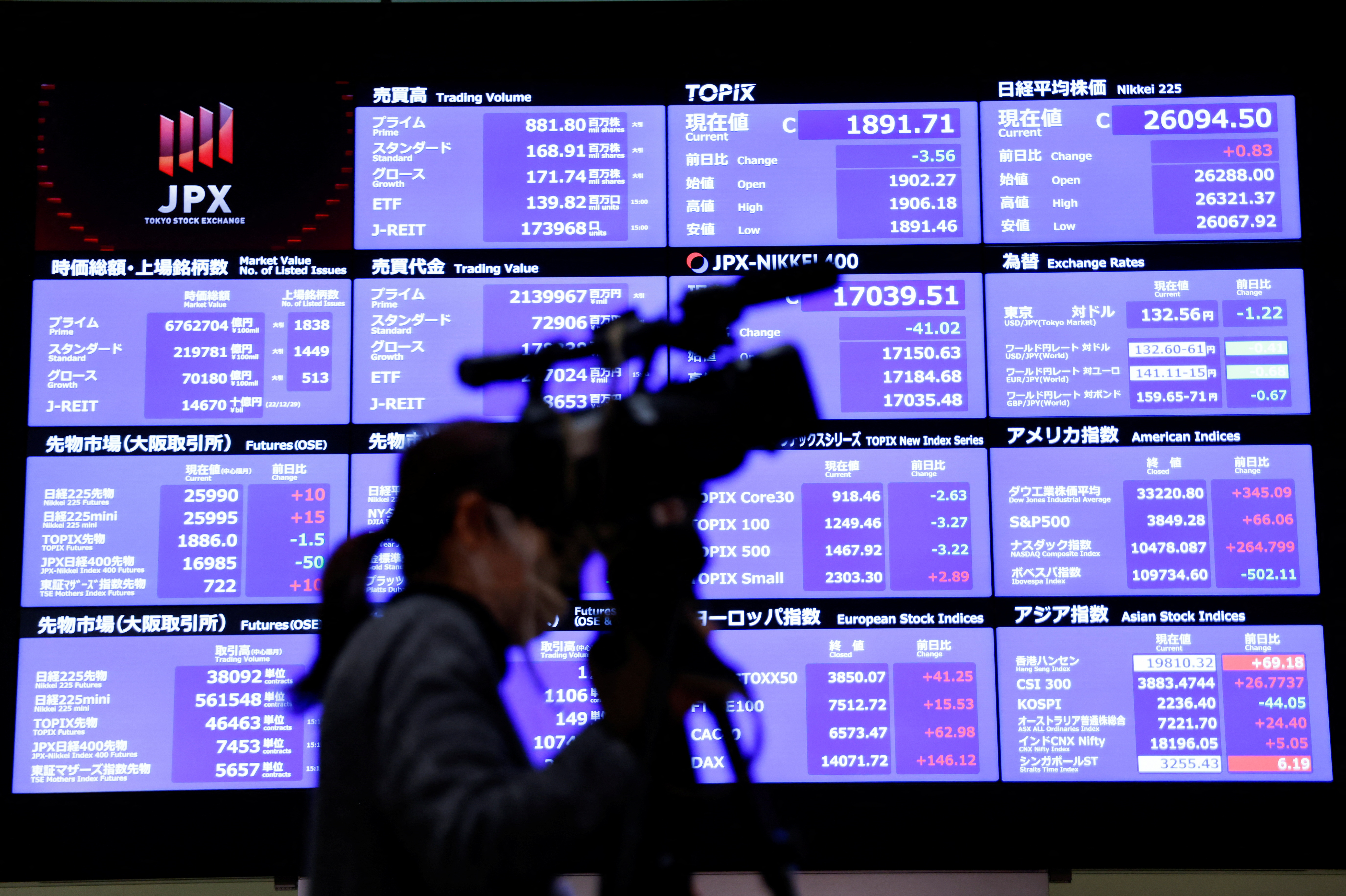
A media person stands in front of the stock quotation board during a ceremony marking the end of trading in 2022 at the Tokyo Stock Exchange (TSE) in Tokyo, Japan December 30, 2022. REUTERS/Issei Kato/Files

A man looks at electric monitors displaying Japan’s 10-year government bond yield on gilts and the exchange rate between the Japanese yen against the U.S. dollar outside a brokerage in Tokyo, Japan January 18, 2023. REUTERS/Issei Kato
Categories
Audio Sources - Full Text Articles

Wall St ends down as investors await Fed“s next steps

2023-02-06T21:02:26Z

The main U.S. stock indexes ended lower on Monday as investors shifted gears after considering the possibility that the U.S. Federal Reserve may take longer to start cutting interest rates.

Traders are keeping a close eye on speeches by Fed officials this week, including Chair Jerome Powell on Tuesday, for any change in the central bank’s rhetoric after data last week showed services activity was strong in January as well as strong job growth.

“We got that blowout jobs report, and people have had to reassess what the outlook for the Fed and the economy is. Tomorrow it will be interesting to see if Powell continues his transformation from hawk to dove,” said Brian Jacobsen, senior investment strategist at Allspring Global Investments.

U.S. Treasury Secretary Janet Yellen said on Monday the United States may avoid a recession as inflation is coming down while the labor market remains strong.

After taking a hit in 2022, U.S. equities have recovered strongly in 2023, led by megacap growth stocks amid short-lived hopes that the Fed will temper its aggressive rate hikes, which in turn could alleviate some pressure on equity valuations.

Money market participants now see the benchmark rate peaking at 5.1% by July, in line with what most policymakers have backed repeatedly.

Yield on the 10-year U.S. Treasury note extended gains to a four-week high.

On the corporate side, analysts expect quarterly earnings of S&P 500 firms to decline 2.8% in the fourth quarter, according to Refinitiv.

According to preliminary data, the S&P 500 (.SPX) lost 25.28 points, or 0.61%, to end at 4,111.20 points, while the Nasdaq Composite (.IXIC) lost 119.63 points, or 1.00%, to 11,887.33. The Dow Jones Industrial Average (.DJI) fell 40.56 points, or 0.12%, to 33,885.45.

Tyson Foods Inc (TSN.N) fell sharply after missing analysts’ estimates for quarterly revenue and profit.

Miner Newmont Corp (NEM.N) slid on its $16.9 billion offer for Australian peer Newcrest Mining Ltd (NCM.AX) to build a global gold behemoth.

Contrary to the overall trend, Tesla Inc (TSLA.O) rose after a U.S. jury on Friday found Chief Executive Elon Musk and his company were not liable for misleading investors when Musk tweeted in 2018 that he had “funding secured” to take the electric-vehicle maker private.

Meme stocks, such as AMC Entertainment (AMC.N) and Gamestop (GME.N), also gained steam late in the session.

U.S.-listed Chinese stocks such as Pinduoduo Inc (PDD.O) and Baidu Inc fell on geopolitical concerns after a U.S. military fighter jet shot down a suspected Chinese spy balloon off the coast of South Carolina on Saturday.

Most of the 11 major S&P 500 sector indexes were in the red, except for utilities.

Related Galleries:

A street sign for Wall Street is seen outside the New York Stock Exchange (NYSE) in New York City, New York, U.S., July 19, 2021. REUTERS/Andrew Kelly//File Photo

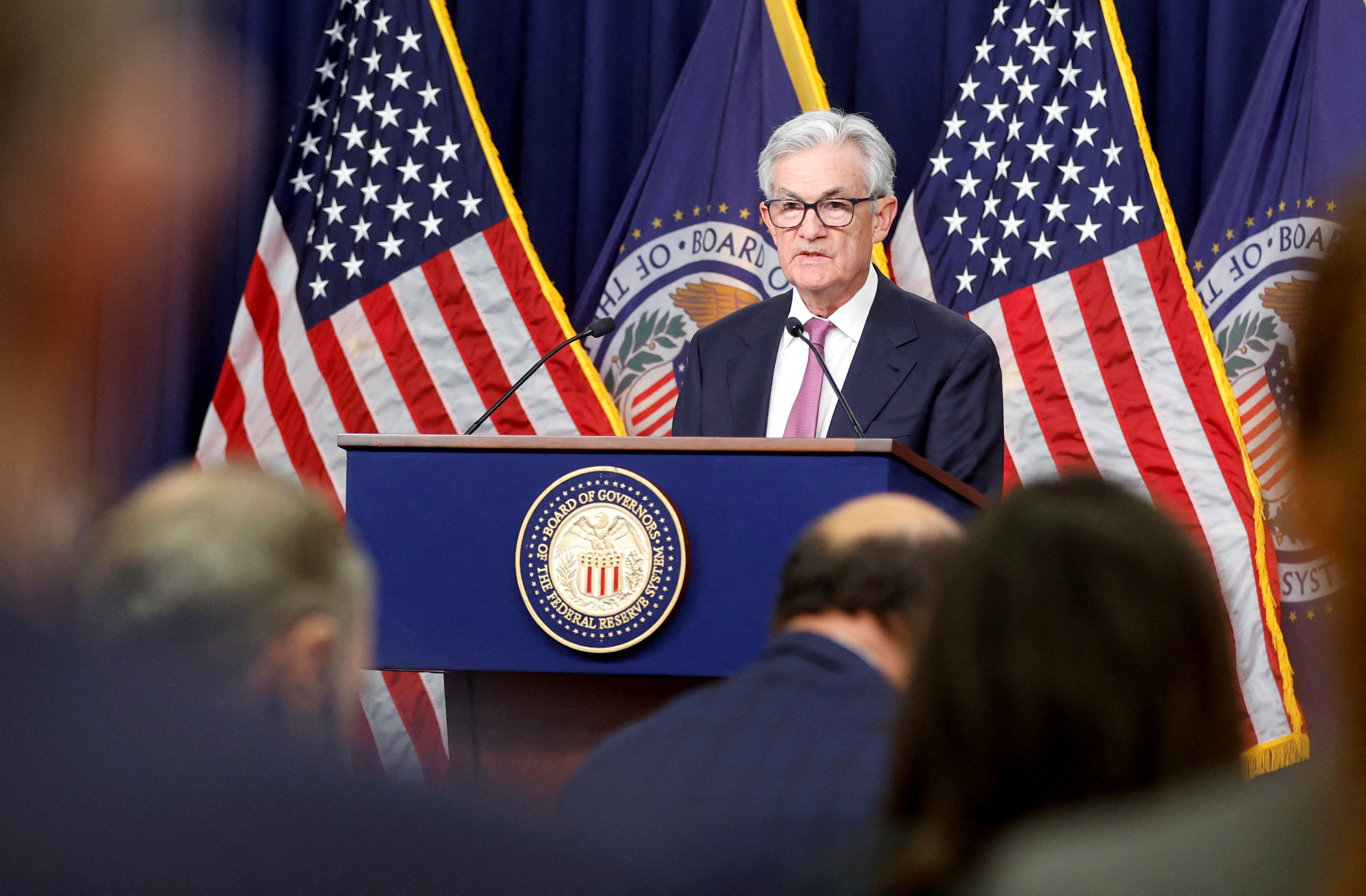
Federal Reserve Chair Jerome Powell speaks in a news conference in Washington, U.S., February 1, 2023. REUTERS/Jonathan Ernst/File Photo


Categories
Audio Sources - Full Text Articles

Turkey’s Earthquakes Struck the Heart of the World’s Largest Refugee Population. Here’s How to Help

The devastating earthquakes that hit Turkey and Syria early Monday, are affecting some of the most vulnerable people in the world. More than four million Syrians who rely on immediate humanitarian aid live in the region, according to the U.N. Office for the Coordination of Humanitarian Affairs (OCHA).

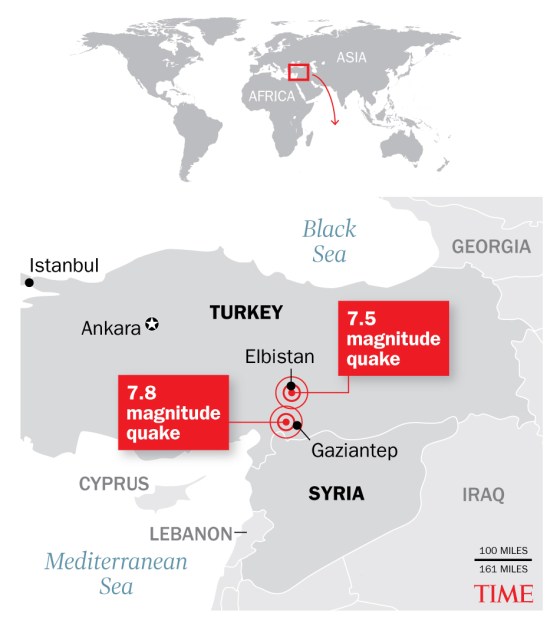
The first earthquake, which was magnitude 7.8, is one of the strongest to hit the region in the last century, affecting an area already confronting a cholera outbreak and harsh winter weather. More than 2,800 people have died and thousands of others were injured in the earthquakes, which struck when people were in bed sleep. First responders are scrambling to rescue people trapped under toppled buildings.

[time-brightcove not-tgx=”true”]

Turkey is the world’s biggest refugee host country. About 3.6 million Syrian refugees live in the nation following the protracted Syrian Civil War. Many of these refugees live in southeastern Turkey in the area where the earthquakes struck.

The humanitarian situation in Syria makes recovery even more precarious for people there, according to U.N.

“Sadly, needs are rising rapidly in Syria and not everyone who requires assistance is visible. Over 75% of all sub-districts in the country are classified as being under severe, extreme, or catastrophic conditions,” said United Nations Resident and Humanitarian Coordinator ad interim for Syria, El- Mostafa Benlamlih, in a statement. “We must act quickly to ensure more communities do not slide into an inescapable loop of deprivation and negative coping mechanisms.”

Turkey earthquakes map
Lon Tweeten–TIMEThe earthquakes that struck early Monday, Feb. 6 were some of the biggest in the region in a century.
Earthquakes jolts Turkiye's provinces
Oguz Yeter—Anadolu Agency/Getty ImagesAn aerial view of a damaged building after an earthquake in Adana, Turkey on Feb. 06, 2023.

Some nations have already committed to sending aid. The U.K. promised to send a team of 76 search and rescue specialists and rescue dogs to Turkey. Greek Prime Minister Kyriakos Mitsotakis expressed condolences and said his government is mobilizing resources to help.

The International Federation of Red Cross and Red Crescent Societies also tweeted that it was launching immediate assistance from their Disaster Response Emergency Fund to make sure relief efforts can continue.

Consider donating to the following organizations to help:

Syrian American Medical Society

The Syrian American Medical Society is a relief organization working on the front lines of the crisis. They continue to service the area though at least one of their hospitals has been closed due to damages caused by the temblors.

They are asking for donations to purchase trauma supplies and continue to provide emergency aid to their patients.

UNICEF

The United Nations International Children’s Emergency Fund (UNICEF) has also mobilized aid to Syria, and is focusing on assessing the impact the quake had on water stations and any other interruptions to services. It is also assessing the damages schools face. UNICEF said another priority is helping unaccompanied children find their families.

You can donate here to help.

Powerful earthquake hits Syria and Turkey
Anas Alkharboutli—picture-alliance/dpa/APSyrian civilians and members of the White Helmets work to save people trapped beneath a destroyed building following a magnitude 7.8 earthquake that hit Syria, on Feb. 6 2023.

The White Helmets

The White Helmets, a nonprofit organization made up of 3,000 volunteers who help the Syrian community, said they need more equipment and supplies to continue numerous search and rescue operations in the region.

The organization previously helped deliver primary care to patients with COVID-19, offered ambulance services to those with more severe cases, and also regularly provides maternal healthcare.

You can make a financial contribution at the following link.

Turkish Red Crescent (Türk Kızılay)

The Turkish Red Crescent has more than 240 staff and hundreds of volunteers in the disaster region providing mobile kitchen and catering services to the region, according to a press release. They are also sending over tents, blankets and beds.

The organization is asking people to donate blood as they continue to ship blood from their existing supplies throughout the day. The Red Crescent provided their bank details for donations in a tweet, but you can also donate here.

International Rescue Committee

The International Rescue Committee (IRC), an organization that responds to the most serious humanitarian crises, works in more than 40 countries. “IRC teams are on the ground and working tirelessly to ensure the safety and well-being of our staff, local partners and those affected,” said Tanya Evans, the Syria Country Director for IRC.

Consider making a gift here.

Aftermath of the deadly earthquake in Kahramanmaras
Cagla Gurdogan—ReutersPeople gather around a bonfire following an earthquake in Kahramanmaras, Turkey on Feb. 6, 2023.

Save the Children

Save the Children is working in northwest Syria and Turkey to best assess aid necessary, but are planning to support affected communities with emergency kits amid the harsh winter weather. You can make a contribution to their Children’s Emergency Fund at the following link.

Global Giving

Global Giving, a nonprofit that connects other nonprofits to donors, has launched the Turkey and Syria Earthquake Relief Fund, with a goal of raising $5 million dollars to help with the immediate food, shelter and water needs. Once the initial need is completed, funds will support longer-term recovery efforts.

Project HOPE

Project HOPE, a global health and humanitarian aid organization, has deployed emergency teams to help on-the-ground. You can support their work here.

Humanitarian Relief Foundation

The IHH Humanitarian Relief Foundation has been serving communities impacted by catastrophe and war since its founding in 1992. It is collecting donations to send water, food, and shelter materials to people in need. They also have a mobile soup kitchen making rounds in the region. Consider donating here.

Categories
Audio Sources - Full Text Articles

Hero Ukrainian medic: “Russia will not stop until it is stopped”

Ukrainian military medic Yulia Paievska has a simple message for anyone who still believes in the possibility of a compromise peace with Putin’s Russia. “They will not stop until they are stopped,” she says.

Paievska’s sobering assessment reflects her own personal experience on the front lines of the war and as a prisoner of the Russians. In the first weeks of the invasion almost one year ago, she served as a medic during the siege of Mariupol and witnessed firsthand how Putin’s troops reduced this once thriving Ukrainian port city of half a million to ruins.

Harrowing bodycam footage recorded by Paievska as she treated wounded soldiers and civilians was smuggled from the besieged city by Associated Press journalists and helped alert the outside world to the scale of the unfolding humanitarian catastrophe. By the time these images reached international audiences, Paievska herself was already in Kremlin captivity.

The Ukrainian medic would spend a total of three months as a prisoner of war. She has since spoken at length about the appalling conditions she encountered during her time in Russian custody. Addressing US lawmakers in September 2022, Paievska described how numerous fellow prisoners including children as young as seven died in her arms as a result of torture or due to a lack of basic medical care. “In this torment of hell, the only things they felt before death were abuse and additional beatings.”

The barbaric treatment of Ukrainian prisoners came as no surprise, she says. On the contrary, Paievska saw it as entirely in keeping with the everyday realities in today’s Russia. “The Putin regime is a police state where everything is built on blood. They routinely torture their own people, so why should they take pity on me or any other Ukrainian prisoners?”

Paievska insists this traumatic experience has not robbed her of her humanity, but admits she is now more convinced than ever of the need to isolate Russia. “I have no feelings of hatred toward them, despite everything they did to me and my comrades. I see them as sick people. You cannot be angry with somebody for being ill, but the international community must do everything in its power to isolate them.”

Subscribe to UkraineAlert

As the world watches the Russian invasion of Ukraine unfold, UkraineAlert delivers the best Atlantic Council expert insight and analysis on Ukraine twice a week directly to your inbox.

2015-08-20T120000Z_1614809784_GF10000177

  • Name

    First

    Last

  • Email*
  • Phone
    This field is for validation purposes and should be left unchanged.

Throughout her incarceration, Paievska says the Russians she encountered frequently expressed hardline political opinions that closely mirrored the most radical forms of Kremlin propaganda. These unsolicited rants left a strong impression of popular support for the Russian invasion of Ukraine and made a mockery of attempts to blame Putin personally for the war. “They seem to sincerely believe Russia has a great mission to free the planet from capitalism, Western dominance, fascism, and other invented problems. They are convinced that only Russians have souls and think Russians will conquer the world.”

These messianic delusions have helped feed a poisonous hatred of all things Ukrainian that shapes Russian attitudes toward the war. For years, the extremist brand of imperialistic Russian nationalism promoted by the Putin regime has portrayed any expressions of Ukrainian independence as hostile acts of anti-Russian betrayal. This warped logic set the stage for the widespread war crimes that have accompanied Russia’s full-scale invasion of Ukraine. “They are absolutely sure there is no such thing as the Ukrainian nation and regard us all as misguided Russians,” says Paievska. “As far as they are concerned, the Ukrainian state does not exist and neither does the Ukrainian language. To them, we are fools and traitors for rejecting Russia.”

Paievska was already a widely respected and well-loved figure in Ukraine long before her role in the siege of Mariupol and subsequent imprisonment brought her to international attention. Better known to the Ukrainian public by her nickname “Taira,” she first volunteered as a medic during the country’s 2013-14 Revolution of Dignity. When Russia responded to the fall of Ukraine’s pro-Kremlin government in February 2014 by invading Crimea and eastern Ukraine’s Donbas region, Paievska headed east as part of a vast volunteer movement that succeeded in saving the country from partition.

In the years following 2014, Paievska emerged as a symbol of the everyman ethos characterizing Ukraine’s ongoing national struggle against Russian aggression. Her release from captivity in summer 2022 was personally announced by Ukrainian President Volodymyr Zelenskyy and sparked an outpouring of emotion across the country. When Time Magazine named Zelenskyy and “the Spirit of Ukraine” jointly as its 2022 Person of the Year, she was one of a handful of Ukrainians depicted on the cover page alongside the Ukrainian leader. Likewise, when Ukraine was collectively awarded the European Union’s annual Sakharov Prize in December 2022, Paievska was among the small delegation chosen to receive the award on behalf of her country.

Brussels is only one of numerous Western capitals Paievska has visited since her release. Regular engagement with Ukraine’s international partners has left her concerned over outside perceptions of the threat posed by Putin’s Russia. “I am not sure everyone fully appreciates how serious the situation is,” she says. “Many still seem to think that only Ukraine is in danger and refuse to believe Russia will go further. This is a dangerous mistake. We Ukrainians were also once absolutely sure an invasion was impossible and it happened all the same. In reality, Russia will go as far as we let them.”

Despite these misgivings, Paievska has been encouraged by the strength of international backing for Ukraine and says this support will likely define the ultimate outcome of the war. She acknowledges that Western arms have played a crucial role in disrupting Putin’s invasion plans but stresses that military aid to Ukraine must be urgently expanded. “We desperately need weapons, weapons, and more weapons. If we don’t receive the supplies we need, we will not be able to stop Russia, despite the courage of our troops and the resilience of our nation.”

As the Russian invasion approaches the one-year mark, few expect hostilities to end any time soon. In recent months, Putin has mobilized hundreds of thousands of additional Russian troops and begun the methodical destruction of Ukraine’s civilian infrastructure. He is now attempting to place the Russian economy on a war footing while preparing domestic audiences for the prospect of a long war.

Paievska is under no illusions regarding the gravity of the challenges that lie ahead but is confident Ukraine will eventually prevail. She sees the current conflict as part of a far longer fight against Russian imperialism stretching back centuries, and is convinced the present generation of Ukrainians have the necessary resolve to bring Europe’s last great independence struggle to a successful conclusion.

Reflecting on the historic roots of today’s Ukrainian resistance, Paievska recalls a series of atrocities that serve as grim milestones of Russian imperialism in Ukraine. Her starting point is the early eighteenth-century sack of Ukrainian Cossack capital city Baturyn by Russian imperial troops, which was accompanied by the massacre of an estimated ten thousand Ukrainian civilians. “Ukrainians have not forgotten Baturyn,” she says. “We have not forgotten the forced famines and the mass executions and the deportations. The genocide of the Ukrainian nation has been going on for more than 300 years. How much longer can this continue? How much more blood must be shed?”

Ultimately, it is this sense of historic mission that Paievska believes will help Ukraine win the war. While modern Russia remains trapped in the imperial past, she argues that Ukrainians have a clear and compelling vision of their future as an independent European democracy. “We are ready to sacrifice a lot for victory because we know we are fighting for the freedom of our children and grandchildren. We are fighting to finally end this three hundred year struggle.”

Peter Dickinson is Editor of the Atlantic Council’s UkraineAlert Service.

Further reading

The views expressed in UkraineAlert are solely those of the authors and do not necessarily reflect the views of the Atlantic Council, its staff, or its supporters.

The Eurasia Center’s mission is to enhance transatlantic cooperation in promoting stability, democratic values and prosperity in Eurasia, from Eastern Europe and Turkey in the West to the Caucasus, Russia and Central Asia in the East.

Follow us on social media
and support our work

The post Hero Ukrainian medic: “Russia will not stop until it is stopped” appeared first on Atlantic Council.

Categories
Audio Sources - Full Text Articles

Seven ways China spies on the US

(NewsNation) — A Chinese balloon floating over America’s heartland captured national attention last week, but balloons are far from the only tool China has to gather intelligence about the U.S.

FBI Director Chris Wray said the agency has more than 2,000 active investigations into Chinese intelligence-gathering operations and they open a new case roughly every 12 hours.

Here are just a few of the ways China spies on the U.S.

Hacking

China’s cyber efforts include an incident where the country accessed the security files for millions of Americans via computers in the Office of Personnel Management and one where the country accessed medical records from Anthem. China has also gone after travel records for Americans, targeting hotels.

Satellites

Like many countries, China has an array of satellites they can use to collect images for their intelligence agencies. Satellites have a number of advantages over balloons, but they are also more expensive to deploy and use.

Cellphone Towers

Cell phone towers and equipment made by Chinese technology companies can be used to intercept communications. While many major carriers don’t use Chinese-made tech, smaller rural carriers might be tempted by the cheaper technology. That includes those in areas near U.S. military bases and missile silos.

Land Purchases

Chinese companies may buy up large plots of land in strategic locations, specifically near military installations. From there, the country can use technology or people to attempt to gain information. Montana Sen. Jon Tester has sponsored bipartisan legislation to try to prevent China, as well as certain other countries, from purchasing farmland due to concerns about espionage.

Academics

Students and researchers from China may come to the U.S. for legitimate purposes, but the Chinese government may still attempt to use them as influencers to advance Beijing’s agenda.

Technology

TikTok has been under scrutiny as parent company ByteDance previously admitted that employees had gathered data on U.S. users. While some lawmakers have moved to ban the social video app at the state or federal level, the company is reportedly working with Congress to help safeguard user data.

Spies

With all the technology at its disposal, China also continues to rely on old-fashioned human espionage to get information. Chinese spies have been found to be working in the U.S. China’s government has also worked to recruit Americans in positions of power, like law enforcement, to gather information for them. The country has also used attractive female agents to get close to U.S. officials, using sex and romance to ply them for secrets.

China’s attempts to gather information don’t just impact the government, as industrial espionage is also a major goal. It’s a costly one too, with an estimated cost of $200 to $600 billion in intellectual property theft per year, according to acting director of the National Counterintelligence and Security Center Mike Orlando.

Categories
Audio Sources - Full Text Articles

Woman charged with plotting to disable Baltimore power grid

BALTIMORE (AP) — A Maryland woman conspired with a Florida neo-Nazi leader to carry out an attack on several electrical substations in the Baltimore area, officials said Monday.

The arrest of Sarah Beth Clendaniel, of Baltimore County, was the latest in a series across the country as authorities warn electrical infrastructure could be a vulnerable target for domestic terrorists. It wasn’t immediately clear Monday whether she had a lawyer to speak on her behalf.

She conspired with Brandon Russell, recently arrested in Florida, to disable the power grid by shooting out substations via “sniper attacks,” saying she wanted to “completely destroy this whole city,” according to a criminal complaint unsealed Monday. The complaint also included a photo of a woman authorities identified as Clendaniel wearing tactical gear that bore a swastika and holding a rifle.

U.S. Attorney Erek Barron praised investigators for disrupting hate-fueled violence.

“When we are united, hate cannot win,” he said at a news conference announcing the charges.

Authorities declined to specify how the planned attack was meant to fulfill a racist motive but suggested the defendants wanted to bring attention to their cause.

Russell has a long history of ties to racist groups and Nazi beliefs, as well as past plans to attack U.S. infrastructure systems, according to the complaint. It also wasn’t clear Monday whether he had a lawyer.

In recent months, concerns about protecting the country’s power grid have been heightened by attacks, or threatened attacks.

In Washington state, two men were arrested last month on charges that they vandalized substations weeks earlier in attacks that left thousands without power around Christmastime. One suspect told authorities they did it so they could break into a business and steal money.

A gunfire attack in December on substations in central North Carolina caused power outages affecting tens of thousands of customers. Law enforcement officials have said the shooting was targeted, though no arrests have been made. Lawmakers there have proposed legislation to toughen penalties for intentionally damaging utility equipment.

Baltimore Gas and Electric, which controls the local power grid, thanked law enforcement and said Monday that there was no damage to any substations, that service wasn’t disrupted and that there are currently no known threats to facilities.

“The substations are not believed to have been targeted out of any connection to BGE or Exelon, or because of any particular vulnerability,” BGE said in a news release. “We have a long-standing partnership with law enforcement and state and federal regulators of the grid to secure critical infrastructure; this work is even more important now as threats have increased in recent years.”

Categories
Audio Sources - Full Text Articles

After US pops 1st balloon, China admits the 2nd one floating over Latin America is also theirs and gave the same excuse that it was just lost

A Chineses surveillance balloon flies above in Charlotte, North Carolina, on February 4, 2023.A Chineses surveillance balloon flies above in Charlotte, North Carolina, on February 4, 2023.

Peter Zay/Anadolu Agency via Getty Images

China’s Foreign Ministry confirmed Monday that a balloon spotted over Latin America last week was owned by China — the same reasoning it gave for a suspected spy balloon that was shot down over the US coast.

Foreign Ministry spokesperson Mao Ning said the unmanned balloon was Chinese, but said it was “of civilian nature and used for flight test.” 

“Affected by the weather and with limited self-steering capability, the airship deviated far from its planned course and entered into the airspace of Latin America and the Caribbean,” Mao said. 

That was the same explanation China offered for the unmanned balloon spotted over the US late last week.

Pentagon officials said the first balloon, which was shot down off the coast of South Carolina Saturday afternoon, was likely a surveillance device. 

US Pentagon officials have said the balloon spotted over Latin America is also a surveillance balloon.

Mao said China had spoken with Latin American countries about the balloon.

“China is a responsible country and always acts in strict accordance with international law. We have informed relevant sides. It is being properly handled and will not pose any threat to any country.”

Mao also addressed reports that Chinese spy balloons flew over the US while former President Donald Trump held office.

“As to the alleged three instances of China flying surveillance balloons over the US during the Trump administration, I noted that Mr. Trump has denied the claim,” Mao said. 

Read the original article on Business Insider
Categories
Audio Sources - Full Text Articles

Russia’s oil and gas revenue crashed by nearly 50% at the start of 2023, leading to a wider budget deficit as Moscow’s spending soars

Russian Prime Minister Vladimir Putin and CEO of Russian natural gas giant Gazprom Alexei Miller attend a ceremony to mark the launch of the Sakhalin-Khabarovsk-Vladivostok natural gas pipeline, September 8, 2011 in Vladivostok, Russia.Vladimir Putin

Sasha Mordovets/Getty Images

  • Russia logged a nearly 50% drop in oil and gas revenue in January, contributing to a wider budget deficit. 
  • Moscow’s spending surged by nearly 60% as the war against Ukraine ordered by Russian President Vladimir Putin neared the one-year mark. 
  • Russia has been selling foreign currency reserves to help make up the budget shortfall. 

A slide in Russian revenue from oil and gas clashed against the Kremlin ramping up spending on its nearly year-long war against Ukraine, resulting in a wider budget deficit for the country in January.

Oil and gas revenue tumbled 46% in January from the same month a year ago to 426 billion rubles ($5.96 billion), Russia’s finance ministry said Monday in a preliminary release. It attributed the decline largely to a drop in prices for its Urals blend — its largest crude oil export — and to a fall in exports for natural gas. 

Russia sold Urals at an average price of $49.48 per barrel in January, lower than the $70 per barrel total in Russia’s budget, according to the Financial Times. Revenue from oil and gas serves as a key source of funding for spending by Moscow, but the country has run into sanctions imposed by Western countries after Russia invaded Ukraine.

Government spending in January, meanwhile, jumped by 58.7% from a year earlier to 3.12 trillion rubles. Expenditures rose amid largely classified plans by Russia to increase defense spending to 3.5 trillion rubles in 2023, the FT reported. 

The lower energy sales and the rise in spending contributed to the federal budget logging a deficit of 1.76 trillion rubles ($24.78 billion) last month. 

Russia has been selling energy to countries, including China and India, to boost its funds. Russia has also increased sales of its foreign exchange reserves to address the budget shortfall stemming from the war it launched in February 2022. 

Last week, the finance ministry said it would sell more than $2 billion worth of foreign currency from February 7 to March 6 – nearly tripling the 54.5 billion rubles worth of currency reserves sold last month.

Read the original article on Business Insider
Categories
Audio Sources - Full Text Articles

The new CEO of FTX charged $690,000 for 2 months of work untangling the failed crypto exchange’s chaotic finances

John J. Ray III

Nathan Howard / Stringer

  • FTX’s new CEO John J. Ray III charged the crypto exchange $690,000 last year.
  • Ray is a long-time Wall Street restructuring exec who oversaw Enron’s bankruptcy process. 
  • Ray said in a congressional testimony that FTX was running an “old-fashioned embezzlement.”

FTX’s new CEO John J. Ray III charged the failed crypto exchange $690,000 for just under two months of work steering the collapsed exchange through bankruptcy, he told a Delaware judge on Monday.  

From November 11 through the end of December, Ray racked up $690,000 in hourly fees after disgraced FTX founder Sam Bankman-Fried resigned as chief executive officer and filed for chapter 11 bankruptcy protection. He has been tasked with overseeing FTX’s bankruptcy process in an attempt to recover billions of dollar worth of funds to pay back customers and creditors. 

Ray previously told the court he charges $1,300 an hour, indicating that he worked 75 hours per week during his nearly two months untangling the company’s chaotic finances. 

The Wall Street restructuring vet, who oversaw Enron’s bankruptcy process, made roughly $1.2 million on an annualized basis as chairman and CEO of the defunct energy giant almost two decades ago. He reportedly also netted $120,582 after billing 156 hours in a two-month span during another bankruptcy case, according to CNBC.

“I’ve just never seen anything like it in all 40 years of doing restructuring work and corporate legal work,” Ray said of FTX during a congressional testimony in December, accusing the company’s former management of “old-fashioned embezzlement.”

The exchange was run by “very small group of grossly inexperienced and unsophisticated individuals who failed to implement virtually any of the systems or controls necessary for a company that is entrusted with other people’s money or assets.”

Recovering assets may take longer than usual because of FTX’s “utter lack of record keeping” since its inception, according to Ray.

“We’re dealing with literally a sort of a paperless bankruptcy in terms of how they created this company,” he said. 

Read the original article on Business Insider
WP Radio
WP Radio
OFFLINE LIVE