Categories
Audio Sources - Full Text Articles

CBS News pressed Sen. Ted Cruz on why he’s running for reelection after he introduced a bill limiting senators to 2 terms in office: ‘Why aren’t you holding yourself to that standard?’

Ted CruzSen. Ted Cruz of Texas.

AP Photo/John Locher

  • Sen. Ted Cruz of Texas is running for a third term while also backing a two-term limit for senators.
  • CBS News “Face the Nation” host Margaret Brennan on Sunday pressed Cruz on his stance.
  • “If and when it passes, I will happily, happily comply. I’ve never said I’m going to unilaterally comply,” he said.

Two-term Sen. Ted Cruz on Sunday sought to fend off questions about his intention to seek a third term after introducing a constitutional amendment that would restrict senators to two terms in office.

During an interview on the CBS News program “Face the Nation,” host Margaret Brennan pressed the Texas Republican about his decision to run for a third term, asking him why he’s doing the very same thing he’s seeking to restrict.

“You also introduced a bill to limit terms to two six-year terms in office for senators. Why aren’t you holding yourself to that standard?” Brennan asked. “You said you’re running for a third term.”

Cruz responded: “Listen, I’m a passionate defender of term limits. I think that Congress would work much better if every senator were limited to two terms if every House member were limited to three terms. I’ve introduced a constitutional amendment to put that into the Constitution.”

Brennan said: “But you’re still running.”

Cruz continued: “If and when it passes, I will happily, happily comply. I’ve never said I’m going to unilaterally comply.”

Brennan then interjected: “Are you running for president?”

The senator added: “I’ll tell you what, when the socialists and when the swamp are ready to leave Washington, I will be more than happy to comply by the same rules that apply for everyone. But until then, I’m going to keep fighting for 30 million Texans because that’s the job they’ve asked me to do.”

—Face The Nation (@FaceTheNation) February 5, 2023

When Cruz introduced the bill alongside Rep. Ralph Norman of South Carolina last month, the senator said that term limits would offer “accountability that is long overdue.”

“Term limits are critical to fixing what’s wrong with Washington, DC. The Founding Fathers envisioned a government of citizen legislators who would serve for a few years and return home, not a government run by a small group of special interests and lifelong, permanently entrenched politicians who prey upon the brokenness of Washington to govern in a manner that is totally unaccountable to the American people,” he said at the time.

Cruz is advocating for the passage of the amendment as his long-term political future remains up in the air.

While Cruz ran for president in 2016 — earning the second-highest number of votes and delegates behind then-Republican presidential candidate Donald Trump — he has not yet indicated if he might also seek the GOP nomination against the former president in 2024. Under Texas law, Cruz can run for the presidency and also seek reelection to the Senate at the same time.

Cruz ran on a staunchly conservative platform during his first campaign, which he would surely replicate in a potential 2024 bid.

But in addition to Trump, who’s already in the race, he would face Gov. Nikki Haley of South Carolina, who is set to join the contest later this month — along with potential candidates like former Vice President Mike Pence, Govs. Ron DeSantis of Florida and Glenn Youngkin of Virginia, and Sen. Tim Scott of South Carolina.

However, Cruz sought to sidestep talk of a presidential bid during the CBS interview, reiterating that he was running for reelection.

“There’s a reason I’m in Texas today. I’m not in Iowa. I’m in Texas, and I’m fighting for 30 million Texans,” he said.

Read the original article on Business Insider
Categories
Audio Sources - Full Text Articles

GOP Rep. Mike Turner said Biden admin lacked ‘urgency’ in addressing Chinese balloon, which ‘completed its mission’

Rep. Mike Turner, R-Ohio, speaks during the House GOP news conference on FY23 government funding on Wednesday, December 14, 2022.Rep. Mike Turner, R-Ohio, speaks during the House GOP news conference on FY23 government funding on Wednesday, December 14, 2022.

Bill Clark/CQ-Roll Call, Inc via Getty Images

  • GOP House Intel Chair Mike Turner said the Biden admin “lacks urgency” following the balloon incident.
  • The Chinese surveillance balloon “completed its mission” in observing US military sites, Turner said.
  • Defense Department officials recommended against downing the balloon until it was over the Atlantic Ocean.

House Intelligence Committee Chair Mike Turner criticized the Biden administration for lacking “urgency” in addressing the Chinese surveillance balloon. 

The balloon, which spent five days drifting over the US and Canada at 60,000 feet, was shot down on Saturday over the Atlantic by an F-22 Raptor. US military officials have been recruited to recover and analyze the debris. 

On Sunday’s “Meet the Press” on NBC News, GOP Rep. Turner expressed skepticism at President Joe Biden’s response to the international incident. 

“Clearly, the president taking it down over the Atlantic is sort of like tackling the quarterback after the game is over,” Turner said. “The satellite had completed its mission. It should never have been allowed to enter the United States, and it never should have been allowed to complete its mission.” 

Turner added: “If you asked somebody to draw an X at every place where our sensitive missile defense sites, our nuclear weapons infrastructure, our nuclear weapons sites are, you would put them all along this path. Clearly, this was an attempt by China to gather information to defeat our command and control of our sensitive missile offensive nuclear weapons sites. And that certainly is an urgency that this administration does not recognize.”

—Meet the Press (@MeetThePress) February 5, 2023


US officials previously said the balloon did not pose a great threat in terms of physical danger or intelligence it could gather. 

Turner joins a legion of Republicans blaming Biden for the balloon gaining access to US airspace and remaining there for several days. Several have called Biden’s response slow, suggesting that his predecessor, former President Donald Trump, wouldn’t have allowed it to happen, Insider’s Lloyd Lee previously reported. Three Chinese surveillance balloons were found over the US during the Trump administration, according to the Associated Press.

Senior officials at the Defense Department recommended against downing the balloon over the mainland due to the risk of falling debris injuring people on the ground, according to a DOD briefing on Thursday. The day before, Biden requested officials shoot down the balloon “as soon as possible.”

“The president allowed this to go across our most sensitive sites and wasn’t even going to tell the American public. If you hadn’t broken this story, the American public would not have even known. There was no attempt to notify Congress, no attempt to put together the Gang of Eight,” Turner said, referring to senior congressional leadership. “I think this administration lacks urgency.”

Read the original article on Business Insider
Categories
Audio Sources - Full Text Articles

Cyprus presidential election goes to runoff

2023-02-05T18:43:46Z

Former foreign minister Nikos Christodoulides took the lead in Cyprus’s presidential election on Sunday and will face off against leftist-backed candidate Andreas Mavroyiannis in a runoff on Feb. 12.

Christodoulides, running as an independent, took 32% of the vote, with career diplomat Andreas Mavroyiannis, backed by the left-wing AKEL party and generally considered an outsider by opinion polls, presenting the surprise at 29.6%.

Mavroyiannis’s showing defied opinion polls which had shown he would likely trail in third place and would be left out of the runoff. But he had the backing of AKEL, a well-organised party which had cranked up the rallying of its supporters in the past month.

“It comes down to Mavroyiannis having the full backing of a party and that Averof (Neophytou) probably didn’t,” said analyst Fiona Mullen of Sapienta Economics, referring to third-placed Averof Neophytou, leader of the ruling right-wing DISY party. “Its an extraordinary result,” she added.

Neophytou had been publicly endorsed by incumbent President Nicos Anastasiades, who by law cannot seek a second five-year term, but his candidacy was overshadowed by Christodoulides, a party member who broke ranks with DISY to run.

Opinion polls had shown Christodoulides gaining roughly one-third of the DISY votes.

The two frontrunners from Sunday’s vote will now have a week to win over voters, after which the victor will have to wrestle with how to break a deadlock in reunification talks on ethnically split Cyprus, as well as with irregular migration, labour disputes, and repairing the country’s image tarnished by corruption scandals.

Cyprus was split in a Turkish invasion in 1974 after a brief Greek-inspired coup. The last round of peace talks collapsed in 2017.

Related Galleries:

Cyprus independent presidential candidate Nikos Christodoulides gestures outside a polling station on the day of the presidential election, in Geroskipou near Paphos, Cyprus, February 5, 2023. REUTERS/Yiannis Kourtoglou

Cyprus independent presidential candidate Nikos Christodoulides casts his ballot for a presidential election at a polling station in Geroskipou near Paphos, Cyprus, February 5, 2023. REUTERS/Yiannis Kourtoglou

A woman hands out flags to supporters of Cypriot presidential candidate Nikos Christodoulides at the campaign headquarters in Nicosia, Cyprus, February 5, 2023. REUTERS/Yiannis Kourtoglou

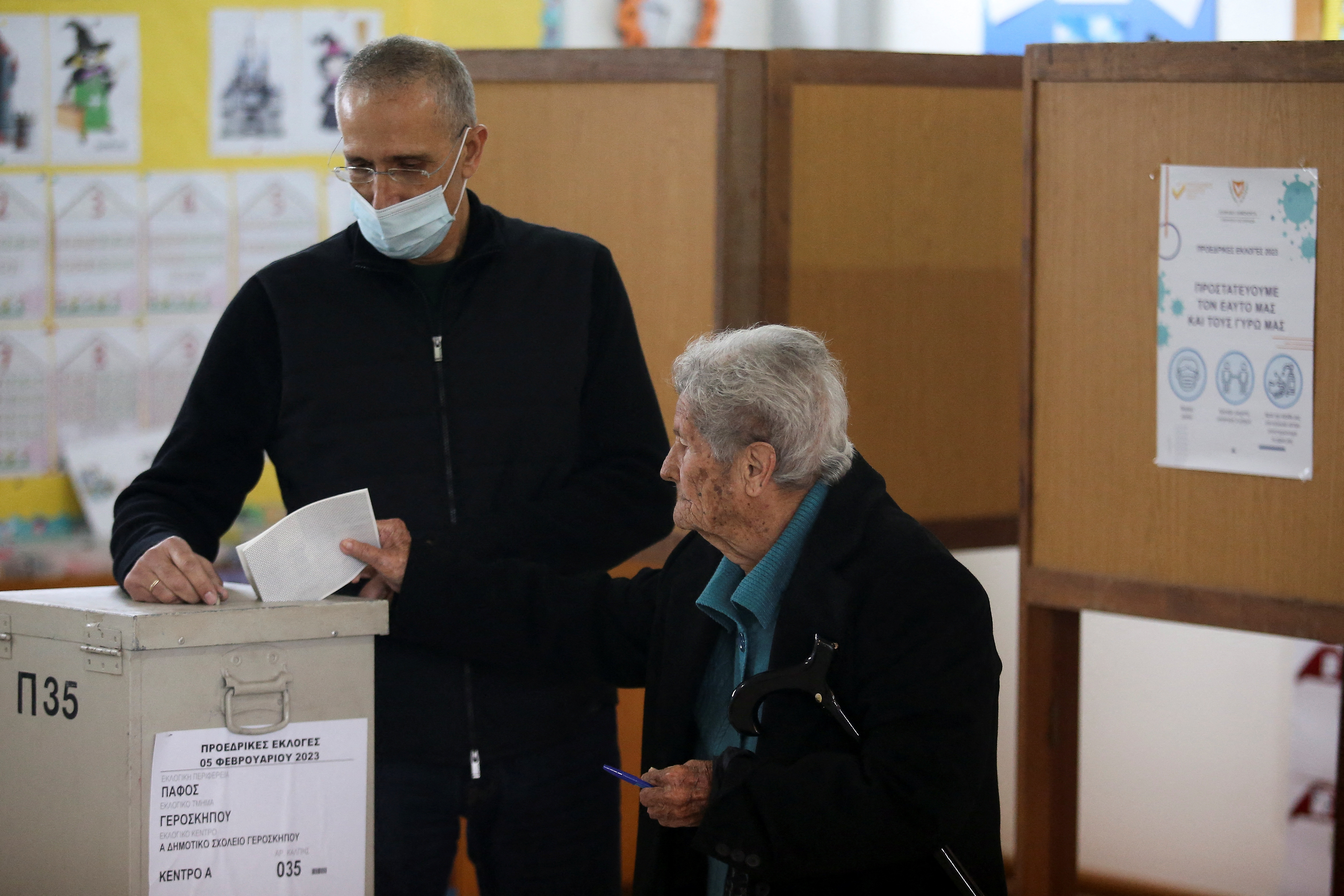
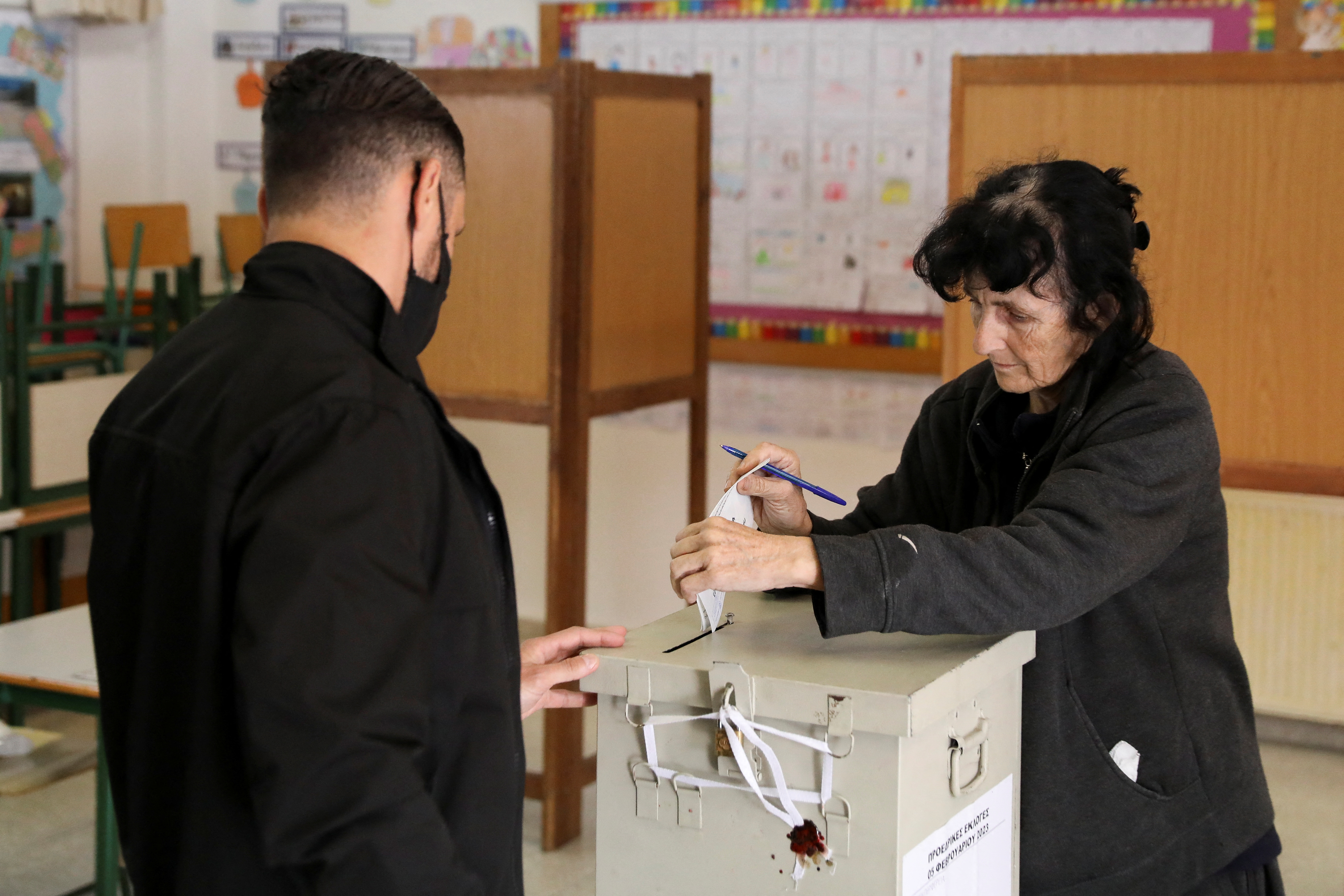
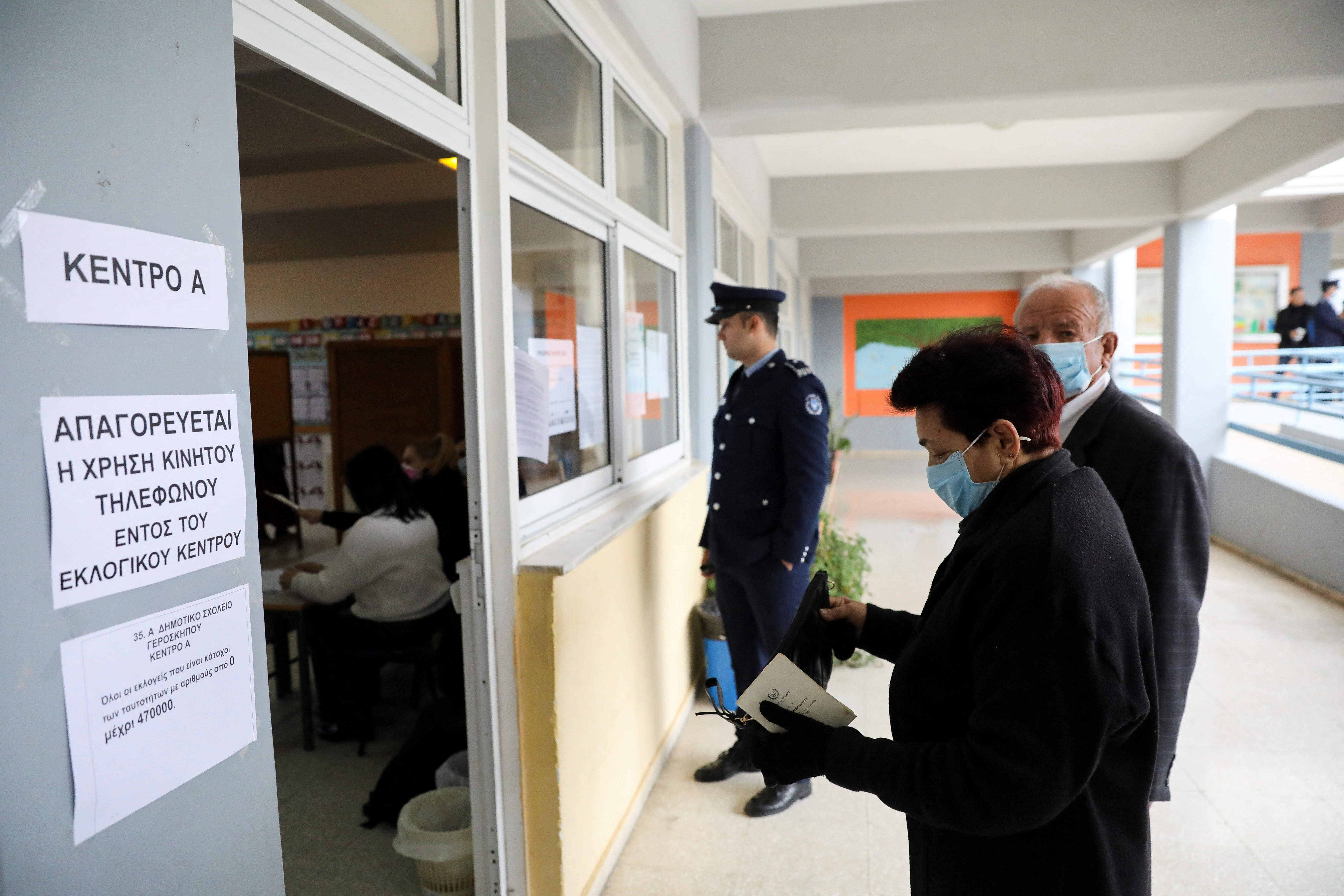
A person casts a ballot for the presidential election at a polling station in Geroskipou near Paphos, Cyprus, February 5, 2023. REUTERS/Yiannis Kourtoglou

A woman casts her ballot for the presidential election at a polling station in Geroskipou near Paphos, Cyprus, February 5, 2023. REUTERS/Yiannis Kourtoglou

People wait to vote in the presidential election at a polling station in Geroskipou near Paphos, Cyprus, February 5, 2023. REUTERS/Yiannis Kourtoglou

A woman walks next to a poster of Cypriot presidential candidate Nikos Christodoulides in Nicosia, Cyprus February 2, 2023. REUTERS/Yiannis Kourtoglou

Cyprus presidential candidate Averof Neophytou, head of the governing right-wing Democratic Rally party, delivers a speech during a pre-election rally in Nicosia, Cyprus February 2, 2023. REUTERS/Yiannis Kourtoglou
Categories
Audio Sources - Full Text Articles

How many surveillance balloons are out there?

(NewsNation) — A Chinese balloon captured national attention as it flew over the U.S. before being shot down over the Atlantic ocean. But how many surveillance balloons are out there?

U.S. officials said Saturday that similar Chinese balloons transited the continental United States briefly at least three times during the Trump administration and once that they know about earlier in the Biden administration. But none of those incidents lasted the length of time or garnered as much attention as this latest, which drifted across the U.S. for several days before it was shot down.

Balloons have been in use for decades for surveillance and other purposes, though they came into more significant use during WWII.

During World War II, Japan launched thousands of hydrogen balloons carrying bombs, and hundreds ended up in the U.S. and Canada. Most were ineffective, but one was lethal. In May 1945, six civilians died when they found one of the balloons on the ground in Oregon, and it exploded.

In the aftermath of the war, America’s own balloon effort ignited the alien stories and lore linked to Roswell, New Mexico.

According to military research documents and studies, the U.S. began using giant trains of balloons and sensors that were strung together and stretched more than 600 feet as part of an early effort to detect Soviet missile launches during the post-World War II era. They called it Project Mogul.

One of the balloon trains crash-landed at the Roswell Army Airfield in 1947, and Air Force personnel unaware of the program found debris. The unusual experimental equipment made it difficult to identify, leaving the airmen with unanswered questions that over time — aided by UFO enthusiasts — took on a life of their own. The simple answer, according to the military reports, was just over the Sacramento Mountains at the Project Mogul launch site in Alamogordo.

As time passed, more sophisticated intelligence-gathering technology took hold, including the use of satellites and drones.

So why would a country like China use a balloon when other intelligence-gathering tools exist? One reason might be to test the political response.

Balloons also offer other advantages, including being cheaper than satellites or drones. Because of their lower altitude, they can get higher-quality images and are also more maneuverable than other technology.

U.S. officials said the most recent balloon, which the Chinese government maintains was being used for meteorological research, would not have been able to get any intelligence China wasn’t already able to gather through other means. However, the government still took steps to reduce the amount of information the balloon could collect on its flight.

Recent reports on unidentified aerial phenomena show the Pentagon had an increase in reports and since 2021, 163 reports of UAPs were later identified as balloons.

Fox News reporter Lucas Tomlinson reported that a similar balloon crashed off the coast of Hawaii four months ago, per U.S. officials.

Pentagon officials also confirmed a second Chinese balloon was believed to be looming over Latin America.

Of course, China isn’t the only country to use balloons. The U.S. government has also continued to use and test balloons for various purposes, including intelligence gathering.

Since governments aren’t eager to share the ways they gather intelligence from other countries, it’s hard to say exactly how many balloons are out there at any given time.

But it might be more than you think.

The Associated Press contributed to this report.

Categories
Audio Sources - Full Text Articles

‘Knock at the Cabin’ knocks off ‘Avatar’ at the box office

NEW YORK (AP) — For the first time in almost two months, the box office doesn’t belong to blue people.

After seven weeks as the top film in theaters, “Avatar: The Way of Water” was finally knocked out of the No. 1 spot by the M. Night Shyamalan thriller “Knock at the Cabin” and the octogenarian comedy “80 for Brady.”

“Knock at the Cabin,” a home invasion horror film with an apocalyptic riff, dethroned James Cameron’s 3-D sci-fi epic with $14.2 million in ticket sales at U.S. and Canadian theaters, according to studio estimates Sunday. The Universal Pictures release stars Dave Bautista as one of four strangers who approach a family vacationing in a rural cabin.

The opening for “Knock at the Cabin” came up shy of some of Shyamalan’s recent releases. His last film, 2021′s “Old,” about a beach that rapidly ages those who visit it, launched with $16.9 million and ultimately collected $90.1 million worldwide. His 2019 film “Glass,” the third installment in the director’s “Unbreakable” trilogy, opened with $40.3 million on its way to grossing $247 million globally. Every other film directed by Shyamalan has opened higher than “Knock at the Cabin.”

But “Knock at the Cabin” still marks Shyamalan’s seventh film as director to open No. 1. With a modest budget of $20 million, “Knock at the Cabin” should easily turn a profit. The film, which drew mostly positive reviews from critics (68% on Rotten Tomatoes), added another $7 million internationally.

Taking second place was “80 for Brady,” a comedy about four friends (Jane Fonda, Lily Tomlin, Rita Moreno and Sally Field) who take a trip to the 2017 Super Bowl. It opened with an estimated $12.5 million. Shortly after announcing his retirement from football (again), Tom Brady attended the film’s premiere.

Paramount Pictures employed a unique strategy in releasing “80 for Brady.” While many films have sought to capitalize on higher ticket prices through large-format or 3-D screenings or surge pricing, which films like “The Batman” have tried, Paramount went the other direction on “80 for Brady.” The studio partnered with exhibitors, including the largest chains, to play “80 for Brady” at matinee prices to help lure its largely older audience. (Half of ticket buyers were over the age of 55.)

It seemed to work. At a time when comedies have struggled mightily in theaters, “80 for Brady” (with a production budget of $28 million) had one of the best openings for a live-action comedy in years. Discount pricing is to continue for the rest of the film’s run.

“Avatar: The Way of Water” slide to third with $10.8 million domestically in its eighth weekend. The film’s No. 1 streak matched the run of 2009′s “Avatar.” In the last four decades, only those two by Cameron and his “Titanic” (1997) have had such sustained reigns atop the box office.

“The Way of Water” continues to perform especially strongly overseas, where its $27.9 million this weekend pushed its overall total to $2.17 billion worldwide. That puts it at fourth highest gross of all-time; Cameron — with two “Avatar” films and “Titanic” — now accounts for three of the top four.

Categories
Audio Sources - Full Text Articles

Dangerously cold temperatures envelop Northeast

BOSTON (AP) — Arctic air descended into the Northeast on Saturday morning, bringing dangerously cold sub-zero temperatures and wind chills that dropped to minus 45 to minus 50 degrees Fahrenheit (minus 43 to minus 45 C) in many areas.

Atop Mount Washington in New Hampshire’s White Mountains, the overnight windchill was measured at minus 108 degrees F (minus 78 C), according to the weather observatory at the peak of the Northeast’s highest mountain, famous for its extreme weather conditions.

“This is just kind of an Arctic intrusion,” said Stephen Baron, a meteorologist with the National Weather Service in Gray, Maine. “Sometimes in the winter the jetsream dips and the Arctic oscillation allows the cold air to come into our area for a day or two.”

Friday’s high winds were blamed for the death of an infant in Southwick, Massachusetts.

The winds brought a tree branch down on a vehicle driven by a 23-year-old Winstead, Connecticut, woman, according to a statement from the Hampden district attorney’s office.

The driver was taken to the hospital with serious injuries, but the infant died, authorities said.

Most people heeded warnings to stay inside on Saturday, but some people had little choice but to go out.

Gin Koo, 36, braved the cold to take his Boston terrier, Bee, out for a necessary walk.

“I can’t remember it being this cold, not since 2015,” said Koo, who was wearing three shirts and a down jacket, as well as a hat and a hood. Bee still shivered despite his doggie coat. “I wouldn’t go out if I didn’t have to.”

Paul Butler, 45, who has been homeless since he was evicted in December 2021, took shelter in South Station, the Boston transit hub that authorities kept open overnight so the unhoused had somewhere warm to stay.

Boston, like many communities, opened warming centers.

“This is the coldest I ever, ever remember, and I worked the door at a bunch of clubs for 15 years,” said the former Marine, who carried two bags with extra clothes and blankets.

The extreme cold curtailed some traditional winter activities. Ski areas scaled back operations, while in New Hampshire, organizers of an annual ice castle attraction in North Woodstock shortened the evening visitor schedule for Friday and Saturday nights.

Erin Trotta of Massachusetts, who had already booked a visit on Saturday afternoon, still planned to go, but was taking extra steps to stay warm.

“We are prepared to take on the polar vortex ice castles. … Snow pants, thick winter coats, hand and foot warmers, face masks, the kind where only your eyes are exposed, and good gloves and winter boots. Plan to drink some hot cocoa to keep warm.”

In New York’s Adirondack Mountains, Old Forge recorded a temperature early Saturday of -36 degrees. Temperatures plunged into the negative teens in dozens of other cities and towns, with wind chill making it feel even colder. Peak winds late Friday exceeded 50 mph (80 kph) in some areas.

Mackenzie Glasser, owner of Ozzie’s Coffee Bar in Old Forge, said frigid temperatures are just part of living in the Adirondacks.

“I even had customers for the first hour that I was open, and I wasn’t expecting that at 7 a.m. So I don’t think it’s keeping too many people away,” she said.

The good news is that the cold air is expected to move out of much of the region by Sunday, when temperatures could rise to the 40s.

“That’s quite a change,” the National Weather Service’s Baron said.

___

Michael Hill in New York and Kathy McCormack in Concord, New Hampshire contributed to this story.

Categories
Audio Sources - Full Text Articles

The Guardian view on the cladding scandal: tough talk must be matched with substance | Editorial

Michael Gove’s admission of failures is welcome, but leaseholders need certainty they won’t be on the hook for any fire defects

For those who bought flats in tower blocks built with flammable materials, the dream of home ownership has become a nightmare. The Grenfell Tower fire in 2017 revealed that thousands of people in Britain were living in flats which were wrapped in unsafe cladding. Five-and-a-half years later, only 7% of dangerous homes have been fixed. Leaseholders have been stung with bills of more than £200,000 for defects they had no hand in creating. The effects of this are psychological as well as financial: one survey found that 90% of people affected by the cladding crisis said their mental health had deteriorated; 23% reported having suicidal feelings or a desire to self-harm.

Ministers long refused to acknowledge that slashing red tape played a role in this scandal. Their evasion was partly founded on hostility to regulations and loyalty to an industry whose leaders are among the key donors to the Conservative party. So a recent admission from the secretary of state for levelling up and housing, Michael Gove, that lax regulations were partly to blame for Grenfell, was a welcome shift in tone. The rulebook was “faulty and ambiguous”, allowing the industry to “put people in danger in order to make a profit”, he said. For those who campaigned tirelessly to make homes safer, this was confirmation that the ideology of deregulation helped to create this scandal, and that its beneficiaries should be on the hook for fixing it.

Continue reading…

Categories
Audio Sources - Full Text Articles

YIVO digitizes writer Chaim Grade’s archive, a Yiddish treasure with a soap opera backstory

(JTA) — Years ago, when I worked at the Forward, I had a cameo in a real-life Yiddish drama.

A cub reporter named Max Gross sat just outside my office, where he answered the phones. A frequent caller was Inna Grade, the widow of the Yiddish writer Chaim Grade and a fierce guardian of his literary legacy. Mrs. Grade would badger poor Max in dozens of phone calls, especially when a Forward story referred kindly to the Nobel laureate Isaac Bashevis Singer. Grade’s widow described Singer as a “blasphemous buffoon” whose fame and reputation, she was convinced, came at the expense of her husband’s.

As Max explains in his 2008 memoir, “From Schlub to Stud,” Mrs. Grade “became a bit of a joke around the paper.” And yet in Yiddish literary circles, her protectiveness of one of the 20th century’s most important Yiddish writers was serious business: Because Inna Grade kept such a tight hold on her late husband’s papers — Chaim Grade (pronounced “Grah-deh”) died in 1982 — a generation of scholars was thwarted in taking his true measure. 

Inna Grade died in 2010, leaving no signed will or survivors, and the contents of her cluttered Bronx apartment became the property of the borough’s public administrator. In 2013, Chaim Grade’s personal papers, 20,000-volume library, literary manuscripts and publication rights were awarded to the YIVO Institute for Jewish Research and the National Library of Israel. They are now stored in YIVO headquarters on Manhattan’s W. 16th Street.

This week YIVO and the NLI will announce the completion of the digitization of “The Papers of Chaim Grade and Inna Hecker Grade,” making the entire archive publicly accessible online. When the folks at YIVO invited me to come and look at the Grade collection, I knew I had to invite Max, not just because of his connection to Inna Grade but because he has become a critically acclaimed novelist in his own right: His 2020 novel “The Lost Shtetl,” which imagines a Jewish village in Poland that has somehow escaped the Holocaust, is in many ways an homage to the Yiddish literary tradition.

We met on Thursday with the YIVO staff, who were tickled by the T-shirt Max was wearing, which had a picture of Chaim Grade and the phrase “Grade is my homeboy.” (Max said his wife bought it for him, although neither could imagine the market for such a shirt.)

Stefanie Halpern, director of the YIVO archives, and novelist Max Gross discuss a thick file containing news clippings relating to the late Yiddish novelist Chaim Grade at YIVO’s Manhattan offices, Feb. 2, 2023. (New York Jewish Week)Stefanie Halpern, director of the YIVO archives, and novelist Max Gross discuss a thick file containing news clippings relating to the late Yiddish novelist Chaim Grade at YIVO’s Manhattan offices, Feb. 2, 2023. (New York Jewish Week) Image by

The Grade papers — manuscripts, photographs, correspondence, lectures, speeches, essays — are stored in folders in gray boxes, whose neatness belies the years of effort that went into putting them in order. Jonathan Brent, executive director and CEO of YIVO, described for us the Grades’ apartment, which he visited shortly after Inna’s death.

“It was like a combination of my grandmother’s apartment and a writer’s home,” he said. “Everything was books, books to the ceiling. You open a drawer in the kitchen where you think there’ll be knives and forks, there are books, there are manuscripts. You open the cabinet in the bathroom, there are more manuscripts and books and books…. But the thing I remember most is that at the top of a shelf there was that much dust.” He held his fingers about two inches apart. 

Inna Grade was Chaim Grade’s second wife. The writer was born in Vilna (now in Lithuania) in 1910. He was able to flee east during the Nazi occupation, leaving behind his mother and his first wife under the assumption that the Germans would only target adult men. It was a tragic miscalculation, and their deaths would haunt Grade the rest of his life. Inna Hecker was born in Ukraine in 1925, and met Grade in Moscow during the war. Married in 1945, they immigrated to the United States in 1948. 

Chaim Grade had already established a reputation as a poet, playwright and prose stylist before the war; English translations of his novels “The Agunah” and “The Yeshiva” and serial publication of his novels in the Yiddish press brought him recognition in America for what the Yiddish scholar Ruth Wisse calls a “Dostoyevskian talent to animate in fiction the destroyed Talmudic civilization of Europe.” Columbia University professor Jeremy Dauber, in a YIVO release, says that Grade was possessed “by the spirit of the yeshiva world he’d left behind; then possessed by the spirits and memories of those who’d been murdered by the Nazis.”

Stefanie Halpern, director of the YIVO archives, showed us the physical evidence of that possession: Grade’s notebooks, in which he wrote down ideas and inspiration in a careful Yiddish script; manuscripts for at least two unpublished dramatic works, “The Dead Can’t Rise Up” and “Hurban” (“Sacrifice”); a photograph of Grade standing amidst the ruins of Vilna during his only visit after the war; pictures of the Bronx apartment taken when the couple was still alive, book-filled but still tidy. 

Halpern also showed us the Yiddish typewriter recovered from the apartment, with what is believed to be the last page he worked on still rolled in its platen.

Chaim Grade’s typewriter, preserved in the condition it was found when the Yiddish author died in 1982, contains what are apparently the last lines he ever wrote. (New York Jewish Week)Chaim Grade’s typewriter, preserved in the condition it was found when the Yiddish author died in 1982, contains what are apparently the last lines he ever wrote. (New York Jewish Week) Image by

The archivists are also careful to give Inna her due. After arriving in America she studied literature and received a master’s degree from Columbia, and often translated her husband’s work. Thanks to her, hundreds of clippings of Grade’s work and articles about him have survived. 

Her correspondence reflects the lengths she went to protect her husband’s legacy during and after his lifetime, including a bizarre and lengthy letter to the Vatican complaining about Singer. “She was a brilliant and creative person, devoted in a way only a widow can be,” said Brent. “And perhaps devoted to a maddening extent.”

If all that sounds like the stuff of Jewish fiction, it is: In 1969, Cynthia Ozick wrote a novella called “Envy; or, Yiddish in America,” about Yiddish writers very much like Grade consumed with envy for a writer very much like Singer. “They hated him for the amazing thing that had happened to him — his fame — but this they never referred to,” wrote Ozick. “Instead they discussed his style: his Yiddish was impure, his sentences lacked grace and sweep, his paragraph transitions were amateur, vile.” 

Halpern showed us a mailgram from Inna to the Forward that makes it clear that she and her husband read and hated the story. In it she describes Ozick as “no less grotesque than evil.”

For all of the gothic Yiddish aspects of its retrieval, “this is probably the single most important literary acquisition in YIVO’s postwar history,” Brent said of the archive. He described publishing projects already underway with Schocken Books and other publishers that will draw on the material. 

Max and I discussed what it felt like to see what had become “a bit of a joke” around the Forward office placed at the center of an epic exercise in literary preservation. Max was struck by the way Inna’s personality came through in the papers. “This was her,” he said. “Her obsession, her struggle, all these things. It was definitely remarkable to see that.”

I recalled overhearing his conversations with Inna, and how her behavior could seem funny and exasperating, but also admirable and more than a little sad — in that her devotion to her husband’s reputation may also have prevented scholars from doing the work that would have made him better known. 

“Exactly, but that’s one of the reasons why you get into Yiddish literature, because all of these things are true at the same time,” said Max. “Those kinds of scores, rivalries, feuds within Yiddish literature is what is so great about it. It is great to see that somebody really cared and that literature was taken so seriously. And the pettiness was something you couldn’t quite divest from the rest of it.”

This article originally appeared on JTA.org.

The post YIVO digitizes writer Chaim Grade’s archive, a Yiddish treasure with a soap opera backstory appeared first on The Forward.


Categories
Audio Sources - Full Text Articles

Republicans criticize Biden for waiting to shoot down Chinese balloon

2023-02-05T18:23:48Z

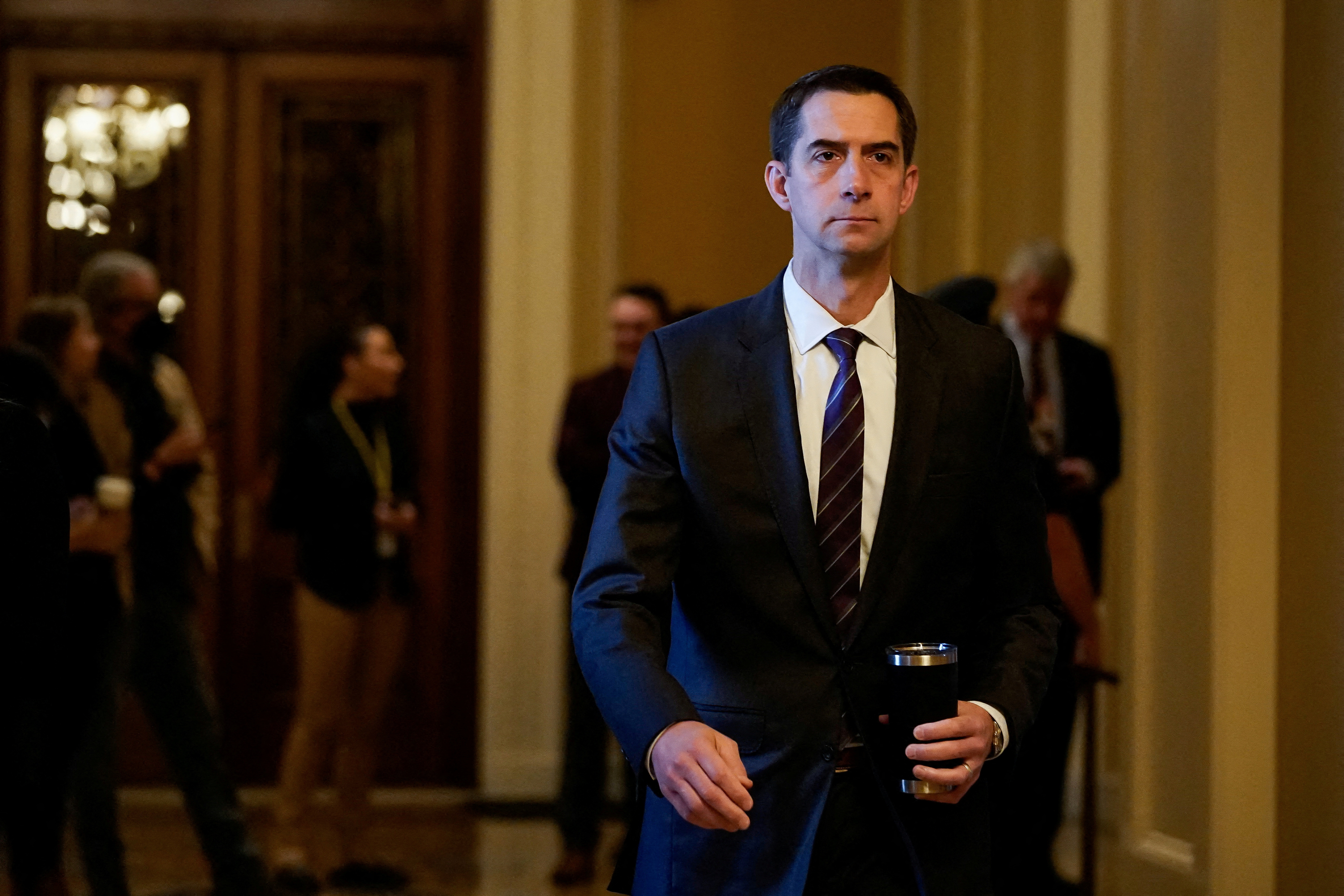
U.S. Senator Tom Cotton (R-AR) arrives as Senate Republicans meet for leadership elections at the U.S. Capitol in Washington, U.S., November 16, 2022. REUTERS/Elizabeth Frantz

Republican U.S. lawmakers on Sunday criticized President Joe Biden for waiting days to shoot down a suspected Chinese spy balloon as it floated over the United States, accusing him of showing weakness toward China and initially trying to keep the breach of U.S. airspace undisclosed.

A U.S. Air Force fighter jet on Saturday shot down the balloon off the coast of South Carolina, a week after it first entered U.S. airspace near Alaska, triggering a dramatic spying saga that has further strained American-Chinese relations.

Defense Secretary Lloyd Austin said on Saturday the U.S. military was able to collect “valuable” intelligence by studying the balloon, and that three other Chinese surveillance balloons had transited the United States during Donald Trump’s administration – a disclosure the Republican former president denied.

“We should have shot this balloon down over the Aleutian Islands. We should never have allowed it to transit the entire continental United States,” said Republican Senator Tom Cotton, a member of the Senate Armed Services Committee, referring to the chain of small islands that arc off the coast of mainland Alaska.

Cotton told the “Fox News Sunday” program that he believed Biden had waited to disclose the penetration of U.S. airspace because he wanted to salvage Secretary of State Antony Blinken’s planned diplomatic trip to Beijing, which ultimately was postponed.

“I think part of it is the president’s reluctance to take any action that would be viewed as provocative or confrontational towards the Chinese communists,” Cotton added.

Biden said on Saturday he issued an order on Wednesday to down the balloon after it crossed into Montana, but the Pentagon had recommended waiting until it could be done over open water to protect civilians from debris crashing to Earth from nearly twice the altitude of commercial air traffic.

Senate Majority Leader Chuck Schumer, a Democrat, said of the Republican criticisms: “they are premature and they are political.”

The Defense Department in the coming week will brief the Senate on the suspected Chinese spy balloon and Chinese surveillance, Schumer told a news conference on Sunday.

Republican Representative Mike Turner, chairman of the House of Representatives Intelligence Committee, said the panel also was set to receive a briefing on the spy balloon this week, though the exact timing has not been determined.

Turner said the balloon traveled unhindered over sensitive U.S. nuclear missile sites, and that he believed China was using it “to gain information on how to defeat the command and control of our nuclear weapons systems and our missile defense systems.”

“The president has allowed this to go across our most sensitive sites and wasn’t even going to tell the American public if you hadn’t broken the story,” Turner told NBC’s “Meet the Press” program. “There was no attempt to notify Congress, no attempt to put together the Gang of Eight (a bipartisan group of congressional leaders). I think this administration lacks urgency.”

Republican U.S. Senator Marco Rubio, vice chair of the Senate Intelligence Committee, told the ABC News program “This Week” that he would ask administration officials what future preparations have been made to prevent such an incident.

Rubio also said China was trying to send a message that it could enter U.S. airspace, adding that he doubted that the balloon’s debris would be of much intelligence value.

Trump on Sunday disputed Austin’s statement that Chinese government surveillance balloons transited the continental United States briefly three times during his presidency.

“China had too much respect for ‘TRUMP’ for this to have happened, and it NEVER did,” Trump wrote on social media.

Speaking on Fox News Channel’s “Sunday Morning Futures” show, Trump’s former director of National Intelligence, John Ratcliffe, also denied such balloon incidents.

China on Sunday condemned the U.S. action against what Beijing called an airship used for meteorological and other scientific purposes that had strayed into U.S. airspace “completely accidentally” – claims rejected by U.S. officials.

“China had clearly asked the U.S. to handle this properly in a calm, professional and restrained manner,” China’s foreign ministry said in a statement. “The U.S. had insisted on using force, obviously overreacting.”

Categories
Audio Sources - Full Text Articles

China plays down Blinken’s canceled visit over balloon

TAIPEI, Taiwan (AP) — China played down the cancellation of a visit by U.S. Secretary of State Antony Blinken after a large Chinese balloon suspected of conducting surveillance on U.S. military sites roiled diplomatic relations, saying that neither side had formally announced any such plan.

“In actuality, the U.S. and China have never announced any visit, the U.S. making any such announcement is their own business, and we respect that,” China’s Ministry of Foreign Affairs said in a statement Saturday morning.

Blinken was due to visit Beijing on Sunday for talks aimed at reducing U.S.-China tensions, the first such high-profile trip after the countries’ leaders met last November in Indonesia. But the U.S. abruptly canceled the trip after the discovery of the huge balloon despite China’s claim that it was merely a weather research “airship” that had blown off course.

The Pentagon rejected that out of hand — as well as China’s contention that the balloon was not being used for surveillance and had only limited navigational ability.

Uncensored reactions on the Chinese internet mirrored the official government stance that the U.S. was hyping up the situation.

Many users made jokes about the balloon. Some said that since the U.S. had put restrictions on the technology that China is able to buy to weaken the Chinese tech industry, they couldn’t control the balloon.

Others called it the “wandering balloon” in a pun that refers to the newly released Chinese sci-fi film called “The Wandering Earth 2.”

Still others used it as a chance to poke fun at U.S. defenses, saying it couldn’t even defend against a balloon, and nationalist influencers leapt to use the news to mock the U.S. One wrote wryly: “The U.S., because of the balloon incident, delays Blinken’s visit to China.”

Censorship was visible on the topic — the “wandering balloon” hashtag on Weibo was no longer searchable by Saturday evening.

“The U.S. is hyping this as a national security threat posed by China to the U.S. This type of military threat, in actuality, we haven’t done this. And compared with the U.S. military threat normally aimed at us, can you say it’s just little? Their surveillance planes, their submarines, their naval ships are all coming near our borders,” Chinese military expert Chen Haoyang of the Taihe Institute said on Phoenix TV, one of the major national TV outlets.

The balloon was spotted earlier over Montana, which is home to one of America’s three nuclear missile silo fields at Malmstrom Air Force Base, defense officials said.

President Joe Biden had declined to shoot down the balloon, following advice of defense officials who worried the debris could injure people below. Meanwhile, people with binoculars and telephoto lenses tried to find the “spy balloon” in the sky as it headed southeastward over Kansas and Missouri at 60,000 feet (18,300 meters).

The Pentagon also acknowledged reports of a second balloon flying over Latin America. “We now assess it is another Chinese surveillance balloon,” Brig. Gen. Pat Ryder, Pentagon press secretary, said in a statement.

China’s Ministry of Foreign Affairs did not immediately respond to a question about the second balloon.

Blinken, who had been due to depart Washington for Beijing late Friday, said he had told senior Chinese diplomat Wang Yi in a phone call that sending the balloon over the U.S. was “an irresponsible act and that (China’s) decision to take this action on the eve of my visit is detrimental to the substantive discussions that we were prepared to have.”

China has denied any claims of spying, and said it is a civilian-use balloon intended for meteorology research. Experts have said that their response was feasible.

But analysts said the unexpected incident will not help the strained ties between the two countries, and particularly China’s initial response where it said they could not control the balloon and “regretted” that it unintentionally entered U.S. space.

On Saturday, China’s Ministry of Foreign Affairs again emphasized that the balloon’s journey was out of its control and urged the U.S. to not “smear” it based on the balloon.

Wang said China “has always strictly followed international law, we do not accept any groundless speculation and hype. Faced with unexpected situations, both parties need to keep calm, communicate in a timely manner, avoid misjudgments and manage differences.”

Alfred Wu, an associate professor at the National University of Singapore, said China’s apology did not appear sincere.

“In the meantime, the relationship will not improve in the near future … the gap is huge.”

___

Associated Press researcher Henry Hou in Beijing contributed to this report.

WP Radio
WP Radio
OFFLINE LIVE