
US officials offer Congress briefing on Trump documents Stars and Stripes
Day: February 5, 2023
LOS ANGELES (AP) — Charles Kimbrough, a Tony- and Emmy-nominated actor who played a straight-laced news anchor opposite Candice Bergen on “Murphy Brown,” died Jan. 11 in Culver City, California. He was 86.
Kimbrough played newsman Jim Dial across the 10 seasons of CBS hit sitcom “Murphy Brown” between 1988 and 1998, earning an Emmy nomination in 1990 for outstanding supporting actor in a comedy series. He reprised the role for three episodes in the 2018 reboot.
The New York Times first reported his death and his son confirmed it Sunday to The Associated Press.
Kimbrough’s wife, actor Beth Howland who played diner server Vera on the 1970s and ’80s CBS sitcom “Alice,” died in 2016. They married in 2002, more than a decade after his 1991 divorce from his first wife, Mary Jane (Wilson) Kimbrough, who died in 2007.
The Times reports that Kimbrough is survived by a sister, Linda Kimbrough, a son, John Kimbrough, and a stepdaughter, Holly Howland.
Born May 23, 1936, Kimbrough spent years in the New York theater scene. He was nominated for a Tony in 1971 for his Broadway performance in the Steven Sondheim musical “Company.”
Kimbrough also lent his voice to a gargoyle named Victor in Disney’s animated film “The Hunchback of Notre Dame.”
Results from 6-year-old Anastasia Weaver’s autopsy may take weeks. But online anti-vaccine activists needed only hours after her funeral this week to baselessly blame the COVID-19 vaccine.
A prolific Twitter account posted Anastasia’s name and smiling dance portrait in a tweet with a syringe emoji. A Facebook user messaged her mother, Jessica Day-Weaver, to call her a “murderer” for having her child vaccinated.
In reality, the Ohio kindergartner had experienced lifelong health problems since her premature birth, including epilepsy, asthma and frequent hospitalizations with respiratory viruses. “The doctors haven’t given us any information other than it was due to all of her chronic conditions. … There was never a thought that it could be from the vaccine,” Day-Weaver said of her daughter’s death.
But those facts didn’t matter online, where Anastasia was swiftly added to a growing list of hundreds of children, teens, athletes and celebrities whose unexpected deaths and injuries have been incorrectly blamed on COVID-19 shots. Using the hashtag #diedsuddenly, online conspiracy theorists have flooded social media with news reports, obituaries and GoFundMe pages in recent months, leaving grieving families to wrestle with the lies.
There’s the 37-year-old Brazilian television host who collapsed live on air because of a congenital heart problem. The 18-year-old unvaccinated bull rider who died from a rare disease. The 32-year-old actress who died from bacterial infection complications.
The use of “died suddenly” — or a misspelled version of it — has surged more than 740% in tweets about vaccines over the past two months compared with the two previous months, the media intelligence firm Zignal Labs found in an analysis conducted for The Associated Press. The phrase’s explosion began with the late November debut of an online “documentary” by the same name, giving power to what experts say is a new and damaging shorthand.
“It’s kind of in-group language, kind of a wink wink, nudge nudge,” said Renee DiResta, technical research manager at the Stanford Internet Observatory. “They’re taking something that is a relatively routine way of describing something — people do, in fact, die unexpectedly — and then by assigning a hashtag to it, they aggregate all of these incidents in one place.”
The campaign causes harm beyond just the internet, epidemiologist Dr. Katelyn Jetelina said.
“The real danger is that it ultimately leads to real world actions such as not vaccinating,” said Jetelina, who tracks and breaks down COVID data for her blog, “Your Local Epidemiologist.”
Rigorous study and real-world evidence from hundreds of millions of administered shots prove that COVID-19 vaccines are safe and effective. Deaths caused by vaccination are extremely rare and the risks associated with not getting vaccinated are far higher than the risks of vaccination. But that hasn’t stopped conspiracy theorists from lobbing a variety of untrue accusations at the vaccines.
The “Died Suddenly” film features a montage of headlines found on Google to falsely suggest they prove that sudden deaths have “never happened like this until now.” The film has amassed more than 20 million views on an alternative video sharing website, and its companion Twitter account posts about more deaths and injuries daily.
An AP review of more than 100 tweets from the account in December and January found that claims about the cases being vaccine related were largely unsubstantiated and, in some cases, contradicted by public information. Some of the people featured died of genetic disorders, drug overdoses, flu complications or suicide. One died in a surfing accident.
The filmmakers did not respond to specific questions from the AP, but instead issued a statement that referenced a “surge in sudden deaths” and a “PROVEN rate of excess deaths,” without providing data.
The number of overall deaths in the U.S. has been higher than what would be expected since the start of the COVID-19 pandemic, in part because of the virus, overdoses and other causes. COVID-19 vaccines prevented nearly 2 million U.S. deaths in just their first year of use.
Some deaths exploited in the film predate the pandemic. California writer Dolores Cruz published an essay in 2022 about grieving for her son, who died in a car crash in 2017. “Died Suddenly” used a screenshot of the headline in the film, portraying his death as vaccine related.
“Without my permission, someone has taken his story to show one side, and I don’t appreciate that,” Cruz said in an interview. “His legacy and memory are being tarnished.”
Others featured in the film survived — but have been forced to watch clips of their medical emergencies misrepresented around the world. For Brazilian TV presenter Rafael Silva, who collapsed while reporting on air because of a congenital heart abnormality, online disinformation prompted a wave of harassment even before the “Died Suddenly” film used the footage.
“I received messages saying that I should have died to serve as an example for other people who were still thinking about getting the vaccine,” Silva said.
Many of the posts online cite no evidence except that the person who died had been vaccinated at some point in the past, using a common disinformation strategy known as post hoc fallacy, according to Jetelina.
“People assume that one thing caused another merely because the first thing preceded the other,” she said.
Some claims about those who’ve suffered heart issues also weaponize a kernel of truth — that COVID-19 vaccines can cause rare heart inflammation issues, myocarditis or pericarditis, especially in young men. Medical experts say these cases are typically mild and the benefits of immunization far outweigh the risks.
The narrative also has leveraged high-profile moments like the collapse of Buffalo Bills safety Damar Hamlin as he suffered cardiac arrest during a game last month after a fierce blow to his chest. But sudden cardiac arrest has long been a prominent cause of death in the U.S. — and medical experts agree the vaccine didn’t cause Hamlin’s injury.
For some families, the misinformation represents a sideshow to their real focus: understanding why their loved ones died and preventing similar tragedies.
Clint Erickson’s son, Tyler, died in September just before his 18th birthday while golfing near their home in Florida. The family knows his heart stopped but still doesn’t know exactly why. Tyler wasn’t vaccinated, but his story appeared in the “Died Suddenly” film nonetheless.
“It bothers me, him being used in that way,” Erickson said. But “the biggest personal issue I have is trying to find an answer or a closure to what caused this.”
Day-Weaver said it was upsetting to see people exploiting her daughter’s death when they knew nothing about her. They didn’t know that she loved people so much she would hug strangers at Walmart, or that she had just learned how to snap.
Still, Day-Weaver said, “I wouldn’t wish the loss of a child on anybody. Even them.”
___
Natália Scarabotto in Río de Janeiro contributed to this report.
The founder of an educational program for at-risk youth in Des Moines says he will remain “all in on helping kids that are not reachable in so many peoples’ eyes” after he was wounded in last month’s shooting that killed two of his students.
Will Keeps, 49, a former Chicago gang member who moved to Iowa in his 20s and later founded the Starts Right Here program, made his first public comments about the shooting this weekend in a video the police department posted online.
“We went all in on helping kids that are not reachable in so many peoples’ eyes,” he said. “Our youth is looking to us to not run. If they constantly keep seeing us say, ‘Oh, we can’t, we’re done,’ what do you think they’re going to do? They going to be done. So become a beast. We need you to fight, become a warrior. And we need to do it together.”
Keeps, a rapper whose given name is Will Homes, had his right arm in a cast held up by a blue sling in the video and kept a walker sitting next to his chair. He was just released from the hospital last week.
Students Gionni Dameron, 18, and Rashad Carr, 16, were killed in the Jan. 23 shooting at the program, which provides help to students under a contract with Des Moines Public Schools. Two other teens have been charged with murder in the shooting. Police have said all four teens were involved with gangs, although the families of the victims denied that.
Keeps said he continues to encounter the kind of violence he experienced as a youth in Chicago when he saw rival gang members kill his friend and he was himself severely beaten.
“I’ve lived it and I’ve seen it every day of my life. I’m not going to sit up here and ignore the fact that we’re killing each other. And we’re killing each other as easy as seeing a fly on the wall and swatting it or seeing an ant on the ground and stomping on it,” he said. “Our youth is in trouble, and we constantly kept doing the same thing over and over and over and over again, and it ain’t working.”
Police have charged Preston Walls, 18, and Bravon Michael Tukes, 19, both of Des Moines, with two counts of first-degree murder, one count of attempted murder and one count of criminal gang participation. Bail was set at $2.5 million for each.
Police say Walls, a Starts Right Here participant, entered a common area of the building Jan. 23 and opened fire before fleeing in a car driven by Tukes. The two belong to a gang and committed the shootings “in connection with that gang membership,” according to police.
Walls waived his preliminary hearing and is awaiting an arraignment that is scheduled for next month, according to online court records. His attorney has declined to comment.
Tukes’ preliminary hearing is set for Tuesday. The lawyers who have been appointed to represent him were not reachable Sunday.

A Romanian barge with tonnes tons of Ukrainian wheat, which was to be exported to the EU, has sunk in the port of Reni on the Danube River in the Odesa location.
That’s in accordance to the Romanian tv channel Stirile Pro-Tv set, Ukrinform reports.
According to the shipowner, during the loading functions, h2o begun getting into the engine room.
The crew, 5 Romanian sailors, could not reduce the lead to of the leak and protect against the incident, so they experienced to go away the barge. No one was hurt in the course of the incident.
The boat belongs to a Romanian enterprise based in Constanța.
Image: bessarabiainform.com
The post Romanian barge with 860 tonnes of Ukrainian wheat sinks in port of Reni appeared first on Ukraine Intelligence.
2023-02-05T19:19:42Z
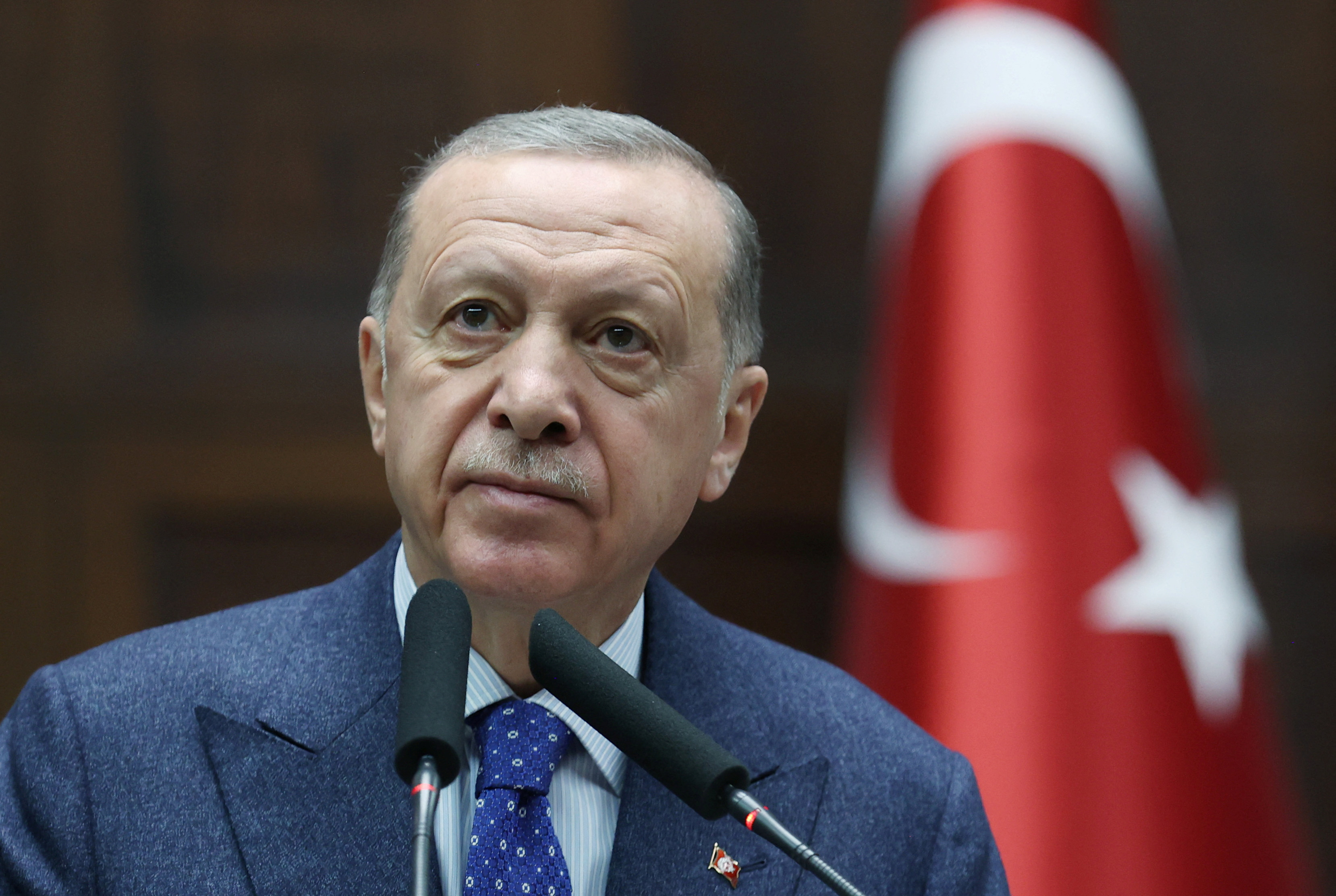
Turkish President Tayyip Erdogan addresses lawmakers of his ruling AK Party during a meeting at the parliament in Ankara, Turkey February 1, 2023. Presidential Press Office/Handout via REUTERS.
Turkish President Tayyip Erdogan said Western missions would “pay” for issuing security warnings and temporarily closing consulates in Turkey last week, while police said there was no serious threat to foreigners after detaining 15 Islamic State suspects on Sunday.
Ankara summoned the ambassadors of nine countries on Thursday to criticise their decisions to temporarily shut diplomatic missions and issue security alerts. Turkish officials said the following day that Western nations, including the United States and Germany, had not shared information to back up their claims of a security threat.
“The other day our foreign ministry summoned all of them and gave the necessary ultimatum, told them ‘You will pay for this heavily if you keep this up,'” Erdogan said during a meeting with youth that was pre-recorded and broadcast on Sunday.
Alongside the closures, several Western states warned citizens of a heightened risk of attacks to diplomatic missions and non-Muslim places of worship in Turkey, following a series of far-right protests in Europe in recent weeks that included several incidents of burning copies of the Muslim holy book, the Koran.
Turkey suspended negotiations for Sweden and Finland’s NATO accession last month following a protest in Stockholm during which a copy of the Koran was burned.
Erdogan said that the Western states were “playing for (more) time” and that the “necessary decisions” would be taken during Monday’s cabinet meeting, without elaborating.
Earlier on Sunday, police said they had not found evidence of any concrete threat to foreigners in the detentions of 15 Islamic State suspects accused of targeting consulates and non-Muslim houses of worship, state media reported.
Anadolu Agency cited an Istanbul police statement saying the suspects had “received instructions for acts targeting consulates of Sweden and the Netherlands, as well as Christian and Jewish places of worship”.
While the suspects’ ties to the jihadist group were confirmed, no concrete threats toward foreigners were found, the statement said.
Foreign Minister Mevlut Cavusoglu repeated on Saturday Turkey’s frustration with what it says is Sweden’s inaction toward entities that Ankara accuses of terrorist activity. All 30 NATO members must ratify newcomers.
Turkey, Sweden and Finland signed an agreement in June aimed at overcoming Ankara’s objections to their NATO bids, with the Nordic states pledging to take a harder line primarily against local members of the banned Kurdistan Workers Party (PKK), which took up arms against the Turkish state in 1984.
Cameras recorded Leonard “Raheem” Taylor passing through security at St. Louis Lambert International Airport on the morning of Friday, November 26, 2004. Wearing dark pants, a pink shirt, and a cream-colored hat, Taylor carried two black bags as he made his way to Gate 16 to catch the Southwest Airlines flight departing at 8:10 for Ontario, California.
That Taylor made this trip is undisputed; what it means depends on who you believe. According to the state of Missouri, the trip was evidence that Taylor, then 40, was fleeing St. Louis after brutally murdering his 28-year-old girlfriend, Angela Rowe, and her three young children. According to Taylor, the trip was for business, but with a twist: He was planning to meet his 13-year-old daughter, Deja, for the first time. During the visit, both Deja and her mother, Taylor’s former girlfriend, say that Taylor called Rowe in St. Louis and put Deja on the phone to chat with one of Rowe’s daughters. In other words, in the days after Taylor boarded that westbound flight, Rowe and her children were very much alive.
Despite the discrepancy, Taylor was arrested two weeks later. He was tried on four counts of first-degree murder and sentenced to death. He has always maintained his innocence, arguing that police fixated on him as a suspect and ignored a compelling alibi supported by witness statements in favor of a theory in which he slaughtered his loved ones and then stayed at the crime scene for days before flying to California. The state’s case rested on Taylor’s brother, Perry, who was relentlessly harassed by police until he implicated his brother in the crime — and who recanted his statements long before Taylor’s 2008 trial. The state also relied on testimony from a medical examiner who changed his time-of-death estimate dramatically to support the state’s version of events.
“All they wanted was SOMEBODY to heap these crimes on,” Taylor wrote in an email to The Intercept. “Even if it was the wrong SOMEBODY.”
Nevertheless, Missouri is scheduled to execute Taylor on February 7. All of Taylor’s appeals have been denied, leaving open a host of unanswered questions and doubts about his guilt. His efforts to avail himself of a Missouri law that allows prosecutors to reopen possible wrongful convictions have been rebuffed by St. Louis County Prosecuting Attorney Wesley Bell. Although the Missouri Supreme Court denied a request to stay Taylor’s execution, the Midwest Innocence Project has asked Gov. Mike Parson to intervene and conduct an inquiry into the case. The lawyers “have grave concerns that Missouri is going to execute an innocent man,” they wrote in their request to the governor. Without such an inquiry, “Leonard Taylor will be executed without a single factfinder ever reviewing the evidence of his actual innocence.”

Leonard Taylor and Angela Rowe before Rowe’s murder in 2004.
Photo: Courtesy of Kent Gipson
A Horrifying Scene
Angela Rowe’s family was worried. It was Friday, December 3, and no one had talked to her in several days. They called her children’s school and were told the kids hadn’t been there all week. That raised alarms, her older sister Gerjuan recalled; Rowe’s kids — 10-year-old Alexus, 6-year-old Acqreya, and 5-year-old Tyrese — never missed school. The police arrived at Rowe’s home in Jennings, just outside the St. Louis city limits, to check on the family around 6 p.m. The front of the house was dotted with Christmas decorations. Editions of the St. Louis Post-Dispatch were rolled up in plastic bags on the lawn, and mail had accumulated behind the storm door.
Inside, police confronted a horrifying scene. Rowe’s three children were lying on the four-postered bed in the back bedroom, fully dressed, a comforter pulled over them; they’d each been shot in the head. A TV in the room was blaring loudly. In the front bedroom was Rowe, also clothed and under a blanket. She too had been shot in the head. The air conditioning was set at around 50 degrees. Joseph Lebb, an investigator from the medical examiner’s office, reported that Rowe’s body was in rigor mortis — a stiffening of the muscles that generally takes hold not long after death — and her core body temperature was just over 51 degrees. The bodies exhibited early signs of decomposition, Lebb reported. Outside, Gerjuan told Lebb that she’d last seen Rowe the previous Saturday, November 27, when Rowe came over to lend her $50.
The next morning, medical examiner Phillip Burch performed the autopsies. Based on “the condition of the bodies,” Rowe and her children had likely been murdered at least a day — and no more than a week — before they were found, he told defense lawyers during a 2006 deposition. He was most confident, he said, that the family had died sometime during the week of November 29.
Police quickly latched on to Leonard Taylor, Rowe’s live-in boyfriend, as their main suspect. The night the bodies were found, Gerjuan asked the cops whether Taylor was inside the house, and police reports indicate that various members of Rowe’s family said that her relationship with Taylor was not without its struggles.
Taylor had a criminal record and a history of violence. He’d done time in California for rape and was accused in 2000 of raping his 16-year-old stepdaughter. He was also a seasoned drug dealer who trafficked cocaine across the country, amassing a string of aliases and fraudulent IDs. Still, the state never offered a cogent motive to explain the vicious and cold-blooded crime.
Taylor had overlapping intimate relationships that followed the path of his illicit business dealings, which earned him the nickname “Cass” — short for Casanova. While Taylor was involved with Rowe, he also had a wife in California and a girlfriend in Kentucky.
Among his past partners was Mia Perry, Deja’s mother, who he became involved with in the late 1980s. In 1991, the same year that Deja was born, Taylor was popped for drug dealing and sentenced to time in federal prison; he never got to meet his baby daughter. While inside, Taylor told the Kansas City Star, he “hooked up with some cats that were on some corporate stuff, doing corporate check fraud.” Upon his release, Taylor began a short-lived career in white-collar crime, which landed him in Missouri state prison.
Rowe, the younger sister of Taylor’s former neighbor in St. Louis, visited him often while he was incarcerated. When he was released in 2002, Taylor re-upped his cross-country drug trade, staying with Rowe when he was in town. In the summer of 2004, Taylor, Rowe, and the kids moved into the house in Jennings. Rowe had Taylor’s name tattooed on her arm. Around the home, there were pictures of the smiling couple and love notes Rowe had written. The move was a relief, according to Taylor, because he’d recently had a drug deal go bad with the notoriously violent Gangster Disciples, who operated in St. Louis and southern Illinois. Meanwhile, he’d also gotten a lead on his long-lost daughter, Deja, whom he ultimately tracked down in California just days after Thanksgiving.
During their reunion, Taylor called back home to St. Louis to share the news with Rowe. Taylor had plans to bring Deja out to St. Louis and wanted her to chat with Rowe and 10-year-old Alexus. The following Monday, Taylor boarded a Greyhound bus carrying a kilo of cocaine and headed back east on business, he told the KC Star. On December 9, Taylor was arrested in Kentucky for the murders of Rowe and her children.

Angela Rowe’s children Tyrese, left; Alexus, middle; and Acqreya, right.
Photo: Courtesy of Kent Gipson
No Other Suspects
Eight hours after the bodies were found, at 2:15 a.m. on December 4, Perry Taylor got a phone call from a St. Louis police detective. Perry, who has since died, worked as a truck driver for Gainey Transportation Services, which sent him all over the country hauling freight. He spent so much time on the road that he’d moved out of his St. Louis apartment earlier that year, storing his belongings at the home his brother shared with Rowe. Perry’s truck had everything he needed for the most part, including a TV and DVD player. On the rare nights he spent in St. Louis, he parked in a lot behind the house and slept in his truck.
Perry was spending the night south of Atlanta when he got the call. It’s unclear from the record whether police were the first to inform him that Rowe and her children had been shot to death. But according to a police report, a detective asked Perry if he knew where his younger brother was. Perry said Taylor was probably in California. He estimated that it had been about a month since they’d spoken. Asked about his brother’s relationship with Rowe, Perry said it had been strong, as far as he knew. According to the report, the detective hung up and immediately called local police in Georgia, who descended on the truck stop where Perry was staying, hoping to find Taylor in his rig. But he wasn’t there.
Undeterred, St. Louis detectives continued to track Perry, using GPS coordinates provided by the trucking company. Upon learning that he was scheduled to make a delivery in New Jersey, three detectives flew in to meet him. They found Perry at a truck stop on the New Jersey Turnpike. According to their report, they took him to a local police station, where they asked him again when he last spoke to his brother. When Perry recalled the conversation taking place in early November — his brother had called about a rap show in Alabama, he said — detectives said they had records that showed otherwise. They also asked if Taylor had a gun. Perry said it wouldn’t surprise him, given his brother’s lifestyle. “He dresses fancy and wanted to hang out with rappers,” Perry said, according to the report. The detectives asked if Perry had given Taylor a ride. No, Perry said, adding that they were free to look for fingerprints in his rig.
On December 8, detectives finally got what they wanted from Perry. He had just arrived back in St. Louis when they stopped him at a gas station off Highway 70. They arrested him, took him to the Jennings police station, and asked him to give a videotaped statement. In the video, Perry sits in front of two white detectives wearing a dark blue hoodie, glasses, and a pair of handcuffs, which are eventually removed. The original video, which was more than three hours long, was later edited into several brief clips totaling less than eight minutes. Jurors would only see the shortened version. In the first clip, which starts around 11 p.m., Perry is asked again when he last talked to his brother. “The last time I spoke with him was the night he told me he did that,” he says.
Perry said Taylor had called him asking for money because he had to “get away.” When Perry asked why, he said, “I killed Angela.” At first he thought his brother was joking, Perry said, but then Taylor told him that Rowe had come at him with a knife. He also said something about killing her children, though Perry could not say precisely what. “He either said ‘I’m gonna kill the kids too’ or ‘I killed the kids.’ And I don’t remember which one he said.” In another clip, recorded close to 1 a.m., Perry struggles to tell the police when, exactly, that phone conversation took place. “He already told you before Thanksgiving what had happened, right?” one detective prompts him. “Yeah,” Perry says. “Was that the day before? Two days before?” Perry pauses, hesitating, saying he really isn’t sure. “If I had to guess, I would say it was on the day before.”
“Anything I told the police in that video was all coerced, sir, every fucking word of it.”
In a pre-trial deposition three years later, Perry angrily insisted that he had been coerced into giving the statements against his brother. From the moment they first found him in Atlanta, he told lawyers on both sides, the police had verbally and physically abused him, pulling him out of his truck, and punching, kicking, and threatening him. In New Jersey, they ransacked his truck, destroying his TV and DVD player and leaving black fingerprint dust everywhere, then locked him up at the local jail. On the day he finally gave the statement implicating his brother, he said, police had surrounded him with weapons drawn, forcing him into a police car. “And some detective right off the bat told me, ‘OK, before we get to the station, here’s what you’re going to say.’”
Perry recalled the cops threatening that if he didn’t say what they wanted, they would hurt his mother, who was disabled and lived on the fifth floor of her building. “It would be a shame if something was to happen to her, like she was to fall out the window,” he remembered one officer saying. The police told him what to say, rehearsed it with him, and made him repeat it on tape, he said. “Anything I told the police in that video was all coerced, sir, every fucking word of it, it was all bullshit.”
The conduct by police ultimately cost him his job and everything he owned, Perry told the attorneys. His truck was impounded, and he was unable to retrieve any of his belongings from Rowe’s house. “The police told me I could not go and get any of my shit, they didn’t give a damn what happened to it.” But what angered him most was how they mistreated his mother. “She’s never had so much as a parking ticket. And for the police to go to my mom’s house and harass her the way they did and threaten her the way they did … that’s the kind of shit that makes you hate law enforcement.”
Perry repeatedly insisted that Taylor was innocent. “My brother ain’t capable of that bullshit. I don’t believe in my heart that he did it. You fucking people look at his criminal record, looked at his past and his background, and you fucking went on a witch hunt, you ain’t considered no other suspects,” he said.
Nevertheless, one year later, Perry’s videotaped statements would become the state’s primary evidence against Taylor at trial.

An undated photo of Leonard Taylor, who joined the Army after graduating high school in St. Louis.
Photo: Courtesy of Missourians to Abolish the Death Penalty
Rolling Back the Clock
Determining time of death is at best an inexact science. While shows like “Law and Order” feature pathologists and other crime-fighters who announce a precise time of death based on mere visual examination, figuring this out in real life is a trickier proposition. There are clues that pathologists often consider, like rigor mortis, lividity — the gravitational pooling of blood after death — body cooling, post-mortem insect activity, and putrefaction. But each physical change can depend on any number of other factors. Still, there is a reliable way to sort it out amid the corporeal uncertainties: If you know when somebody was last seen alive and when they were found dead, you can bet that time of death is somewhere in between.
Almost immediately, investigators had concrete information about when Rowe and her children were last seen alive. At the crime scene, Rowe’s sister Gerjuan said that Rowe had visited her on Saturday, November 27. Beverly Conley, one of the children’s aunts, said she got a call from Alexus around midnight on Saturday; it stood out because Alexus never called her so late and she sensed anxiety in the child’s voice. In the background, she said, she could hear arguing. Sherry Conley, another aunt, said that she spoke on the phone to both Alexus and Acqreya around noon on Saturday. Sherry also told police that she talked to Rowe on Sunday morning at 10 a.m. to discuss plans for the children to stay with her the following weekend, starting December 3. She could hear the kids playing in the background and heard Alexus shout out that she was excited about the visit. Finally, a neighbor named Elmer Massey, whose daughter regularly played with Rowe’s kids, told police that he’d seen Rowe and her children over the weekend, and that at some point during the week of November 29, he’d seen a Black man looking out from behind Rowe’s storm door.
Despite these consistent accounts, police reports don’t reveal any efforts by investigators to figure out what happened after November 28 — the last day that witnesses report having talked to Rowe and the kids. At trial, prosecutors rolled back the clock instead, leaning into Perry’s videotaped statement and arguing that Taylor murdered Rowe and the children in the wee hours of November 24, then remained in the house until he flew to California on the morning of November 26.
“These are people just making honest mistakes.”
In pressing this alternate timeline, the state had a strong ally: medical examiner Phillip Burch. Burch, who died in 2014, had previously said that the most likely time of death was within days of the bodies being found on December 3, and no more than a week beforehand — a window that would exclude Taylor. But at trial Burch changed his story, claiming that he hadn’t taken into account the air conditioner being set at 50 degrees (even though he had mentioned the temperature during his deposition). With that in mind, he testified that Rowe and the children could have been killed up to three weeks before they were found. The expanded timeline caught the defense flat-footed; they hadn’t retained their own pathology expert to testify on Taylor’s behalf.
The state bolstered this narrative with testimony from a reluctant witness, an ex-girlfriend of Perry’s named Betty Byers, who made clear on the stand that she did not want to be there. She said that Perry had called her the day before Thanksgiving; when she asked how Taylor was doing, he replied, “You don’t want to know what he did.” She answered, “What he do, kill somebody?” Yes, Perry said. “He killed Angie and the kids.” The next day, Byers testified, she saw Perry in person and overheard a phone call between him and his brother in which it became clear that Taylor was still at Rowe’s home with the bodies. “Man, what the fuck you still doing there?” she heard Perry say.
It’s unclear how many times Byers spoke to detectives. But police records show at least one of her interviews was recorded on a DVD alongside that of another witness who had a similarly incriminating account — and whose interview was accidentally erased, according to police. In fact, the case record shows that at least five videotaped interviews — including with key witnesses — were destroyed, all of them unintentionally, according to the state.
The state sought to undermine the witnesses who contradicted its timeline. Alan Key, one of the prosecutors, argued that Rowe’s neighbor, Massey, had gotten his dates confused — he’d actually seen the man, who Key insisted was Taylor, a week earlier. “It’s silly” to think otherwise, Key told the jury.
The prosecution brought in a representative of the company Rowe used for her home phone line to testify that there weren’t records of the calls that Gerjuan and the Conleys said they had with Rowe and the kids. That witness failed to mention that the company, Charter Communications, had a disclaimer regarding its phone records: The company “DOES NOT keep or have records for every incoming or outgoing call made or received by our telephone subscribers,” it read. This significant caveat wouldn’t come out until after the trial.
In his closing argument, Key told the jury that Perry Taylor had the facts straight, while Gerjuan and the Conleys were deluded. Gerjuan had substance abuse problems, he said, and Sherry and Beverly, overcome by grief, were understandably confused, their memories unreliable. “These are people just making honest mistakes,” he said.

A newspaper on the lawn of Angela Rowe’s home in a crime scene photograph taken by police on Dec. 3, 2004.
Photo: Courtesy of Kent Gipson
Another Victim
Deja Taylor was in her late teens when her father was sent to death row. At first, she didn’t know what had happened; no sooner had she met him than he disappeared from her life again. Nor did her father’s attorneys track her down so that she could share her recollection of his visit to California. It was not until November 2022, when she was 31 years old, that she gave a declaration that could have been critical to his case. It described the visit with her father on Thanksgiving weekend in 2004, the phone call with Rowe and her daughter, and the plans they had made for her to visit St. Louis. “Angela seemed very excited to meet me and I was excited as well,” she said. “I was so happy to connect with my father and his new family that I cried quite a bit that day.”
“I live in constant fear of his possible execution and have no idea what I will do without my father.”
“Finding out that my father was back in prison, and this time on death row, was very hard for me to deal with,” Deja said. She kept it to herself even as she reconnected with Taylor, communicating with him regularly in phone calls and letters. “My father is a constant source of positive support,” she said, giving her advice and helping her during painful periods, like when her grandmother died last year. “I was extremely close to my grandmother and completely devastated by her death, but my dad helped me get through the grieving process,” she said. Now she was terrified that she would soon lose him too. “I live in constant fear of his possible execution and have no idea what I will do without my father in my life.”
On February 3, Deja flew to St. Louis expecting to meet with County Prosecuting Attorney Wesley Bell. Advocates for Taylor had asked for a meeting so that Deja could share her account. A relatively new Missouri law allows elected prosecutors to intervene in possible wrongful convictions, but earlier in the week, Bell had issued a statement saying that there were no facts “to support a credible claim of innocence” in Taylor’s case. Confusingly, on the same day, Bell’s office also wrote a letter to the Missouri Supreme Court, saying that it supported Taylor’s efforts to delay his execution in order to give his attorneys additional time to investigate his innocence claim.
Deja was accompanied by Midwest Innocence Project Executive Director Tricia Rojo Bushnell. When they arrived at the office, however, Bell was nowhere to be found. Instead, an investigator appeared and told them that he would be interviewing Deja alone; he would not allow Rojo Bushnell to accompany her. The investigator did not ask questions, simply listening as Deja spoke. “She did not feel hopeful about their role afterwards,” Rojo Bushnell said.
In a statement to The Intercept, a spokesperson for Bell denied that Deja was ever told she would meet with the prosecuting attorney. And he suggested that Deja had not done enough to prove her father’s alibi. “She either has probative evidence or not. We encourage her to finally come forward so that we can evaluate any potential evidence she has.”
Taylor’s predicament — that he’s so close to execution without his claim of innocence being thoroughly vetted — is emblematic of a criminal legal system that routinely ignores its own failures. The Midwest Innocence Project’s request for the governor to convene an independent panel to investigate the case, known as a Board of Inquiry, is an extraordinary and unusual action that amplifies the case’s sprawling failures. “Leonard Taylor, throughout every level of his state and federal proceedings, has had the misfortune of being represented by ineffective counsel who did little, if any, investigation on his behalf and, as a result, failed to appropriately litigate his claims or present his actual innocence,” the lawyers wrote.
To Michelle Smith, co-director of Missourians to Abolish the Death Penalty, there’s plenty of blame to go around. Smith argues that Taylor’s post-conviction attorneys put too much faith in Bell and his promises to correct past wrongs. Bell’s persona as a progressive prosecutor did not mean he would automatically intervene in Taylor’s case, she said. “There was too much trust put into what a progressive prosecutor is supposed to be in St. Louis County, which is not the reality.”
For Deja, who visited her father after he was transferred to the prison where he is scheduled to die Tuesday evening, Taylor’s execution will make her another victim in the case. “I know that he has had his day in court and the jury found him guilty,” she said. “But the legal system seems blind to the impact that his death will have on innocent loved ones.”
The post Missouri Is About to Kill a Man Who Witnesses Say Was 2,000 Miles Away at the Time of the Crime appeared first on The Intercept.
Chris Delmas/AFP via Getty Images
- Early reviews have praised Universal’s Super Nintendo World for bringing the Mario Bros. to life.
- Size restrictions for the park’s flagship ride have spurred backlash among critics.
- Super Mario World is set to open in Florida February 17.
Universal’s Super Nintendo World in Florida, set to open later this month, has received rave reviews for bringing a vibrant video game world into reality.
But its flagship Mario Kart ride has spurred backlash, because its seat-size limits riders to those with a waistline smaller than 40 inches.
“Nothing but wonderful things to say about Super Nintendo World except this: the body size limitations on the Mario Kart ride are absolutely ridiculous,” Rocco Botte, a prominent gaming influencer, wrote on Twitter. “I’ve never had any issue fitting into any ride in my entire life, and I can BARELY fit into this one. Completely absurd.”
—Rocco Botte (@rocco_botte) January 31, 2023
The virtual reality ride takes park-goers through a race course using a slow-moving kart attached to a rail. A safety handbook released by Universal advises that the ride is not suited for riders whose waistlines are larger than 40 inches.
Four other rides at the park have similar restrictions, prompting discussion online over limited accessibility at theme parks.
“Man, Universal Studios’ Mario Kart ride is a bummer for those of us who don’t fit the size requirements!” one user wrote on Twitter.
—Bit Boy (@BitBoy682) February 3, 2023
Others took to humor, as well as hostility over the ride’s accessibility.
“How does the Mario Kart ride at Universal have a size limit when it’s inspired by the game that has Wario, Bowser, DK, and Peach in her wide diameter dress driving the karts no problem?” one user wrote.
—Darsan Solomon 🐀 (@Dizzyidiot) February 1, 2023
Read the original article on Business Insider