Categories
Audio Sources - Full Text Articles

Lawyer: Principal unaware boy had gun before teacher shot

The former principal of the Virginia elementary school where a 6-year-old shot his teacher was not aware of reports that the student had a gun before the shooting occurred, her lawyer said Thursday.

Briana Foster Newton was principal at Richneck Elementary in Newport News last month when first-grade teacher Abby Zwerner was shot and wounded in her classroom.

“It continues to be reported that unidentified school administrators were aware that the 6-year-old student had a gun at school on January 6 and simply failed to act,” attorney Pamela Branch said during a news conference in Richmond, Virginia.

“Mrs. Newton has been assumed to have been one of those administrators,” Branch said. “However, this is far from the truth. The fact of the matter is that those who were aware that the student may have had a gun on the premises that day did not report this to Mrs. Newton at all.”

Branch provided the first public statement from Newton since the shooting occurred and sought to clarify Newton’s role in an incident that has drawn mounting criticism of the school’s administrators.

Newport News Police Chief Steve Drew has repeatedly characterized the shooting as “intentional.” He said there was no warning and no struggle before the child pointed the gun at Zwerner and fired one round, striking her in the hand and chest inside her classroom.

Zwerner, 25, hustled her students out of the classroom before being rushed to the hospital, where she stayed for nearly two weeks.

Diane Toscano, Zwerner’s lawyer, said last month that concerned staff at Richneck warned administrators three times that the boy had a gun and was threatening other students, but that no one called police, removed the boy from class or locked down the school before the shooting occurred.

Toscano said she has notified the school board that Zwerner intends to sue the school district.

Then-Superintendent Gary Parker took the brunt of criticism from outraged parents and teachers. Before the school board fired him last month, Parker said at least one administrator at Richneck received a tip that the boy may have taken a weapon to school. Parker said the boy’s backpack was searched but that no weapon was found.

Newton is no longer listed as the principal on the school’s website. Michelle Price, a spokesperson for the school district, said last month that Newton is still employed by the district, but she did not say what position Newton now holds.

Assistant Principal Ebony Parker has resigned from the school division, Price said.

Karen Lynch, who has worked as a principal in Newport News for 17 years, is now listed as the school’s administrator. In a letter to Richneck families this week, Lynch said she was working “on special assignment” at Richneck.

The boy’s family has also retained an attorney. Police have said the 9 mm handgun used in the shooting was legally purchased by the boy’s mother. The family has said the gun had been “secured.” Their attorney, James Ellenson, told The Associated Press in January that his understanding was that the gun was in the woman’s closet on a shelf well over 6 feet (1.8 meters) high and had a trigger lock that required a key.

The family also said the boy has an “acute disability” and was under a care plan “that included his mother or father attending school with him and accompanying him to class every day.” The week of the shooting was the first when a parent was not in class with him, the family said.

Richneck resumed class on Monday, a full three weeks after the shooting occurred.

___

For more coverage of the shooting: https://apnews.com/hub/newport-news

Categories
Audio Sources - Full Text Articles

U.S. transfers Pakistani Guantanamo Bay detainee Khan to Belize

2023-02-02T18:38:45Z

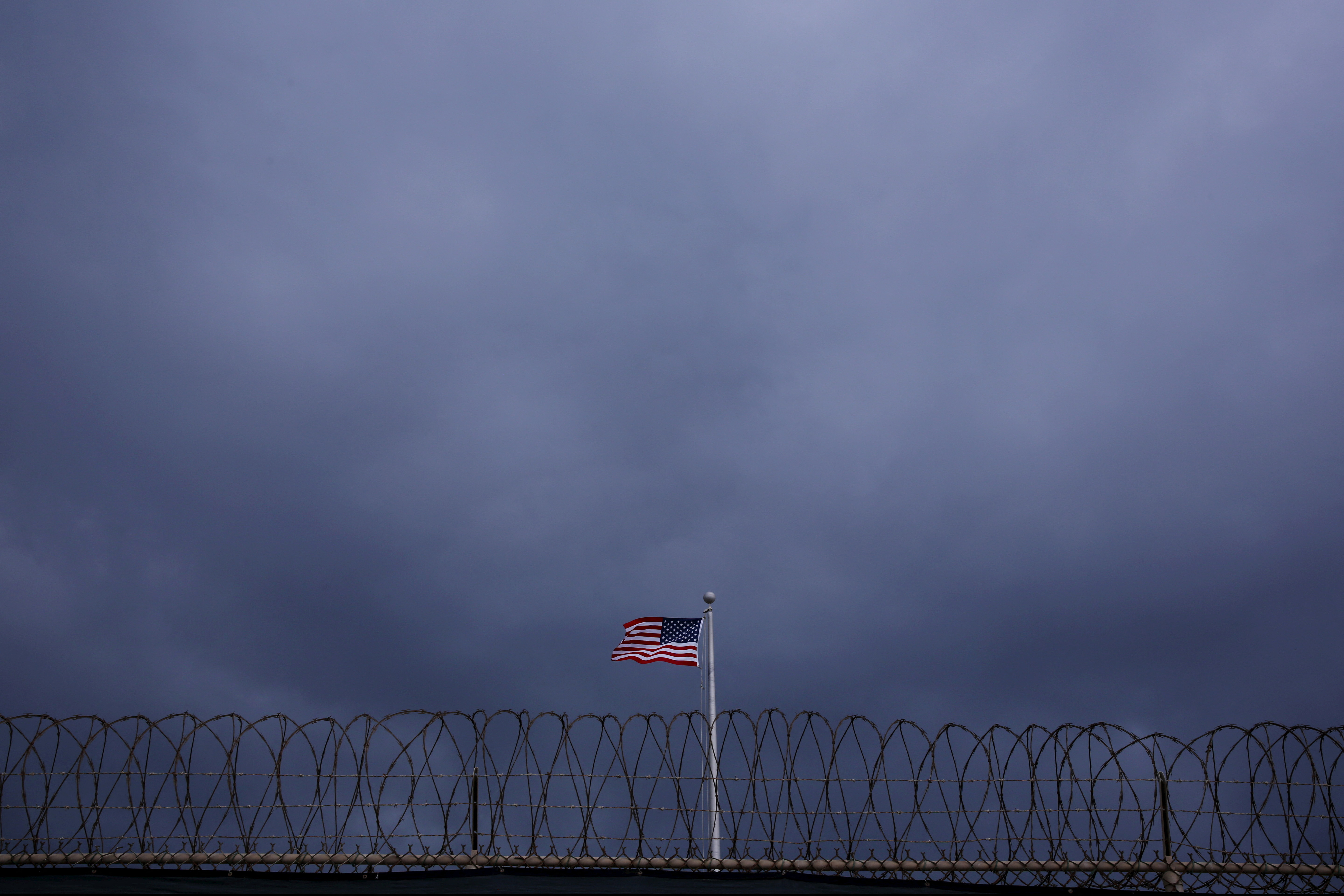
The United States flag flies inside of Joint Task Force Guantanamo Camp VI at the U.S. Naval Base in Guantanamo Bay, Cuba March 22, 2016. REUTERS/Lucas Jackson

Majid Khan, a Pakistani man who has described in graphic detail his torture by the Central Intelligence Agency in the aftermath of the Sept. 11, 2001, attacks on the United States, has been transferred from the Guantanamo Bay U.S. detention facility in Cuba to Belize, the Pentagon said on Thursday.

Khan, 42, admitted in 2012 to conspiring with members of the al Qaeda Islamist militant organization responsible for the 2001 attacks to commit murder as well as providing material support for terrorism and spying and had been serving as a government witness since, according to U.S. officials.

He was captured in Pakistan and held at an unidentified CIA “black site” from 2003 to 2006 before being placed at the detention camp at the U.S. naval base at Guantanamo Bay.

In a statement issued through his legal team, Khan welcomed what he called a second chance in life.

“I deeply regret the things that I did many years ago, and I have taken responsibility and tried to make up for them. I continue to ask for forgiveness from God and those I have hurt. I am truly sorry,” Khan said.

Khan was the first Guantanamo detainee released since last October, leaving 34 detainees – down from a peak of 800 – at the facility, with 20 others already deemed as eligible for transfer to another country, according to U.S. officials.

There were 40 detainees at Guantanamo when President Joe Biden, a Democrat, took office in 2021. Biden has said he hopes to close the facility. The federal government is barred by law from transferring Guantanamo detainees to U.S. mainland prisons.

“We remain dedicated to a deliberate and thorough process focused on responsibly reducing the detainee population at Guantanamo Bay and ultimately closing the facility,” White House Press Secretary Karine Jean-Pierre told reporters.

Khan’s transfer was accepted by Belize’s Cabinet and paid for by the U.S. government, Belize’s Foreign Minister Eamon Courtenay said.

“Mr. Khan is not a terrorist. He has fully recanted, accepted responsibilities for his action and asks Allah for forgiveness,” Courtenay told a news conference in the Central American country.

Courtenay, who met with Khan upon his arrival in Belize, said the released man is free to live the rest of his life there if he chooses.

In a 39-page statement that Khan read aloud to a U.S. military sentencing commission in 2021, he described his treatment at the CIA site. Khan told of being beaten, subjected to the simulated drowning technique called waterboarding and raped anally by objects.

Khan said he was hung from a beam by his hands for days, naked except for a hood over his head, and that guards there would “throw ice water on my naked body every hour or two and placed a fan to blow directly on me.”

He also said he had been deprived of sleep and food, kept isolated and shackled in a cell with music blaring 24 hours a day. This went on for three years, from the time of his arrest in Karachi in 2003 until his 2006 Guantanamo transfer, Khan said.

Established by Republican President George W. Bush in 2002 to house foreign terrorism suspects following the 2001 hijacked plane attacks on New York and the Pentagon that killed about 3,000 people, the Guantanamo camp came to symbolize the excesses of the U.S. “war on terror” because of harsh interrogation methods that critics have said amounted to torture.

Defense Secretary Lloyd Austin notified U.S. lawmakers about his intent to transfer Khan last year, the Pentagon said.

The Center for Constitutional Rights, the legal group representing Khan, welcomed his freedom.

“Belize has done an outstanding job to prepare for his resettlement, and their success serves as a model for other countries to accept men who no one thinks should remain at Guantanamo but who cannot return to their home countries for humanitarian reasons,” said Wells Dixon, a lawyer with the group.

Categories
Audio Sources - Full Text Articles

Shun ethnic rivalry and corruption, pope tells African youth

2023-02-02T18:38:52Z

Pope Francis on Thursday (February 2) urged young people in Democratic Republic of Congo to forge a new future without the ethnic rivalry, corruption and distrust that have fuelled so many bloody conflicts in Africa.

Pope Francis on Thursday urged young people in Democratic Republic of Congo to forge a new future without the ethnic rivalry, corruption and distrust that have fuelled so many bloody conflicts in Africa.

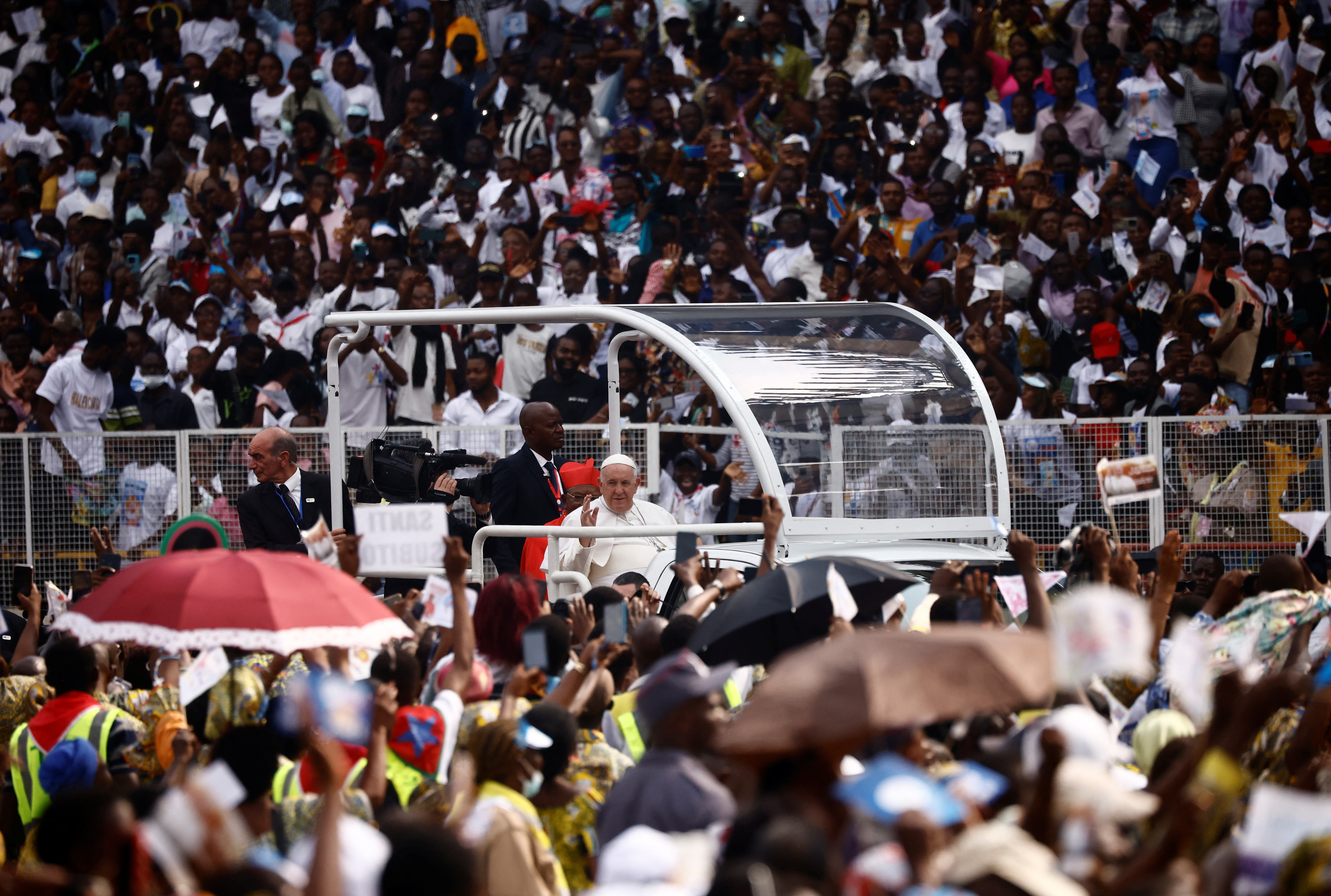
Addressing more than 65,000 young people in Martyrs Stadium, Francis spoke of forgiveness and reconciliation, themes that have dominated his visit to Congo, where armed conflict has killed and displaced millions of people over the past decades.

The speech was interrupted so often by applause and cheers that an organiser took a microphone and shouted “let the pope speak” before he could continue.

At one point, a large proportion of the crowd burst into a political chant in Lingala aimed at President Felix Tshisekedi: “Your mandate is over!”. Tshisekedi, who did not appear to be in the stadium, is seeking a second term in office in elections scheduled for December.

While the pope has made no comment that could be interpreted as taking sides in Congolese politics, he called in a speech on Tuesday for free, transparent and credible elections and said: “Power is meaningful only if it becomes a form of service.”

Thursday’s speech at the stadium focused on what the pope called “ingredients for the future”.

“To create a new future we need to give and receive forgiveness. That is what Christians do,” he said.

Congo has been plagued by violence for decades, driven partly by the struggle for control of its vast mineral deposits, and partly by the complex fallout from the 1994 genocide in neighbouring Rwanda.

“Beware of the temptation to point a finger at someone, to exclude another person because he or she is different; beware of regionalism, tribalism, or anything that makes you feel secure in your own group,” Francis told young people in the stadium.

“You know what happens: first, you believe in prejudices about others, then you justify hatred, then violence, and in the end, you find yourself in the middle of a war,” he said.

In urging the young people in the packed stadium to “do the right thing”, Francis also asked them not to repeat the mistakes of previous generations. He singled out “corruption, which never seems to stop spreading”.

He led the stadium in an impromptu chant of “no to corruption” in French, Congo’s lingua franca.

The theme struck a chord with many in the crowd, who denounced their own leaders as corrupt and complained of routinely having to pay bribes for ordinary services.

“The pope is right,” said Joel Muhemereri Amani, 21, an art student. “To enter somewhere you have to corrupt the police…I hope that the government, the police will change.”

Genovic Lobombo, a medical student, said he had experienced corruption during his time at university. “In order to succeed, you have to give money,” he said. “Corruption reigns here.”

The United Nations says African economies lose nearly $150 billion to corruption each year.

Minister of communication and government spokesman Patrick Muyaya said after the pope’s speech that corruption was a scourge in many countries and there were structural problems, but the government would work to solve them.

The 86-year-old pope, who arrived in Congo on Tuesday, flies to neighbouring South Sudan on Friday. He will be visiting jointly with the Archbishop of Canterbury and the Church of Scotland Moderator, in what the three Christian leaders have described as an unprecedented “pilgrimage of peace”.

South Sudan, the world’s youngest country, is also grappling with conflict and hunger following a civil war that was fought mostly on ethnic lines and killed 400,000 people.

Related Galleries:

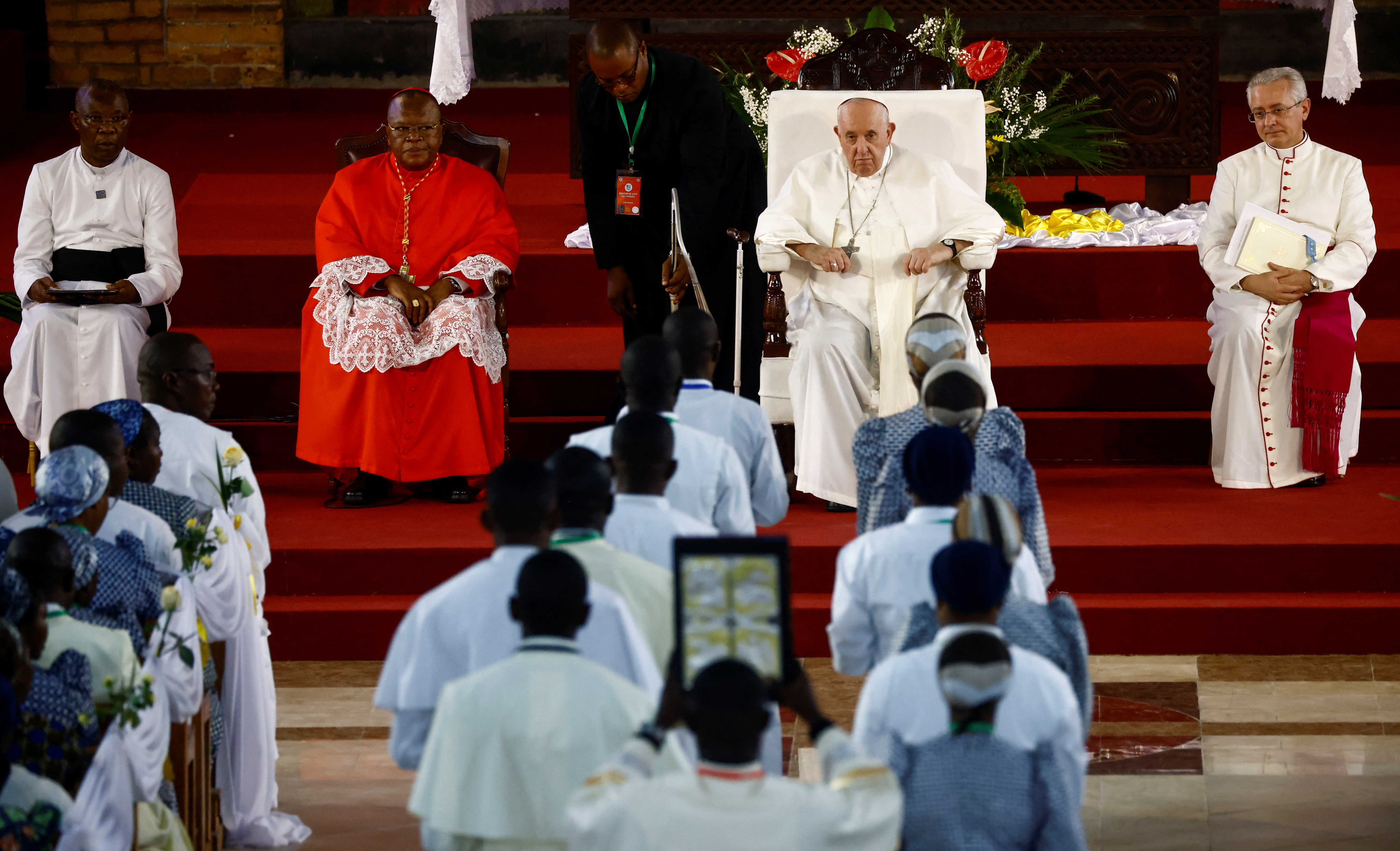
Pope Francis attends a meeting with priests, deacons, consecrated persons and seminarians at the Our Lady of the Congo Cathedral during his apostolic journey, in Kinshasa, Democratic Republic of Congo, February 2, 2023. REUTERS/Yara Nardi

Pope Francis attends a meeting with priests, deacons, consecrated persons and seminarians at the Our Lady of the Congo Cathedral during his apostolic journey, in Kinshasa, Democratic Republic of Congo, February 2, 2023. REUTERS/Yara Nardi

Pope Francis attends a meeting with priests, deacons, consecrated persons and seminarians at the Our Lady of the Congo Cathedral during his apostolic journey, in Kinshasa, Democratic Republic of Congo, February 2, 2023. Simone Risoluti/Vatican Media/Handout via REUTERS

Pope Francis visits the Stade des Martyrs stadium to address young people during his apostolic journey, in Kinshasa, Democratic Republic of Congo, February 2, 2023. Vatican Media/Handout via REUTERS

People gather as they wait for Pope Francis’ address at the Stade des Martyrs, in Kinshasa, Democratic Republic of the Congo February 2, 2023. REUTERS/Luc Gnago

Pope Francis visits the Stade des Martyrs stadium to address young people during his apostolic journey, in Kinshasa, Democratic Republic of Congo, February 2, 2023. Vatican Media/­Handout via REUTERS

People gather as Pope Francis visits the Stade des Martyrs stadium to address young people during his apostolic journey, in Kinshasa, Democratic Republic of Congo, February 2, 2023. Vatican Media/­Simone Risoluti/Handout via REUTERS

Pope Francis attends a meeting with young people and catechists at the Stade des Martyrs during his apostolic journey, in Kinshasa, Democratic Republic of Congo, February 2, 2023. REUTERS/Yara Nardi

Pope Francis waves as he attends a meeting with young people and catechists at the Stade des Martyrs during his apostolic journey, in Kinshasa, Democratic Republic of Congo, February 2, 2023. REUTERS/Yara Nardi

Pope Francis attends a meeting with young people and catechists at the Stade des Martyrs during his apostolic journey, in Kinshasa, Democratic Republic of Congo February 2, 2023. REUTERS/Luc Gnago

Pope Francis watches a performance as he attends a meeting with young people and catechists at the Stade des Martyrs during his apostolic journey, in Kinshasa, Democratic Republic of Congo, February 2, 2023. REUTERS/Yara Nardi

People gather as they wait for Pope Francis’ address at the Stade des Martyrs, in Kinshasa, Democratic Republic of the Congo February 2, 2023. REUTERS/Luc Gnago

People gather as they wait for Pope Francis’ address at the Stade des Martyrs, in Kinshasa, Democratic Republic of the Congo February 2, 2023. REUTERS/Luc Gnago

People gather as they wait for Pope Francis’ address, at the Stade des Martyrs, in Kinshasa, Democratic Republic of the Congo February 2, 2023. REUTERS/Luc Gnago

People gather as they wait for Pope Francis’ address, at the Stade des Martyrs, in Kinshasa, Democratic Republic of the Congo February 2, 2023. REUTERS/Luc Gnago REFILE – QUALITY REPEAT

Youth hold flags and placards as they wait for Pope Francis’ address at the Stade des Martyrs, in Kinshasa, Democratic Republic of the Congo February 2, 2023. REUTERS/Luc Gnago
Categories
Audio Sources - Full Text Articles

Explainer: Why U.S. seeks closer security cooperation with the Philippines

2023-02-02T18:47:09Z

The Philippines this week granted the United States greater access to its military bases, amid mounting concern over China’s intentions toward self-ruled Taiwan and Beijing’s extensive claims in the disputed South China Sea.

Here are answers to some questions about the U.S.-Philippines relationship:

The Philippines will give the United States access to four more locations under the 2014 Enhanced Defense Cooperation Agreement (EDCA), which allows for joint training, pre-positioning of equipment and the building of facilities such as runways, fuel storage and military housing, but not a permanent presence.

In announcing the deal, which brings the total number of EDCA sites to nine, the two sides did not specify where the new facilities will be located, noting they were still consulting local governments.

Manila’s former military chief said last year Washington had asked for access to bases on the main northern island of Luzon, the closest part of the Philippines to Taiwan, and on Palawan, near the disputed Spratly Islands in the South China Sea.

Southeast Asia Expert Gregory Poling at Washington’s Center for Strategic and International Studies said the sites would be in “strategic areas” and likely include navy and perhaps Marine Corps facilities.

“The choice of new sites in Luzon will be the most telling,” he said, listing the new Philippine Navy facility at the former Hanjin Shipyard in Subic Bay and a facility in northern Luzon, such as at the coastal Cagayan Province, as other possibilities.

The Philippines is a former U.S. colony and became a U.S. treaty ally in 1951, five years after independence. During the Cold War, it hosted some of America’s largest overseas bases, facilities vital to the wars in Korea and Vietnam. Philippine nationalism forced Washington to vacate those in the 1990s, but the allies have since cooperated on counter-terrorism and in response to rising Chinese military pressure in the South China Sea, where the Philippines has rival claims.

Of the five U.S. treaty allies in the Indo-Pacific – Australia, South Korea, Japan, the Philippines and Thailand – the Philippines is closest to Taiwan, its northernmost land mass of Luzon just 200 km (120 miles) away.

Experts say Luzon is of great interest to the U.S. military as a potential location for rockets, missiles and artillery systems that could be used to counter an amphibious invasion of Taiwan.

A senior U.S. official called EDCA a Biden administration priority and “part of our strategic effort across the region.”

The political environment for greater military access improved under Philippine President Ferdinand Marcos after a rocky period of relations under his predecessor Rodrigo Duterte, who sought closer ties with China.

China has said greater U.S. access to Philippine military bases undermines regional stability and raises tensions.

“This is an act that escalates tensions in the region and endangers regional peace and stability,” China’s foreign ministry spokesperson Mao Ning told a regular briefing on Thursday.

Poling says it would be difficult for Manila to remain neutral in a Taiwan conflict given its proximity and its treaty obligations to Washington. It would be the most likely destination for Taiwanese refugees and some 150,000 Filipinos living on the island would be endangered by any Chinese attack.

Jose Manuel Romualdez, Manila’s ambassador to Washington and a relative of Marcos, said last year Manila would let U.S. forces use its bases in the event of a Taiwan conflict only “if it is important for us, for our own security.”

Speaking to Reuters this week, Romualdez highlighted the Filipino workers on Taiwan and said Manila would respect its defense treaty with the United States.

Poling said providing Manila funding to modernize its long-neglected armed forces was key. Washington recently announced $100 million in foreign military financing and $82 million for EDCA sites, but amounts are small compared to what Washington sends to the Middle East and Ukraine.

“The second Philippine demand is a continued clear commitment to defend Filipinos in the South China Sea,” Poling said. “They have that rhetorically, but the question for both sides is, do they have it functionally? If there was a Chinese attack on a Philippine base in the South China Sea tomorrow, could the Americans actually do anything about it? And that is far less clear, which is another reason EDCA is so important.”

Related Galleries:

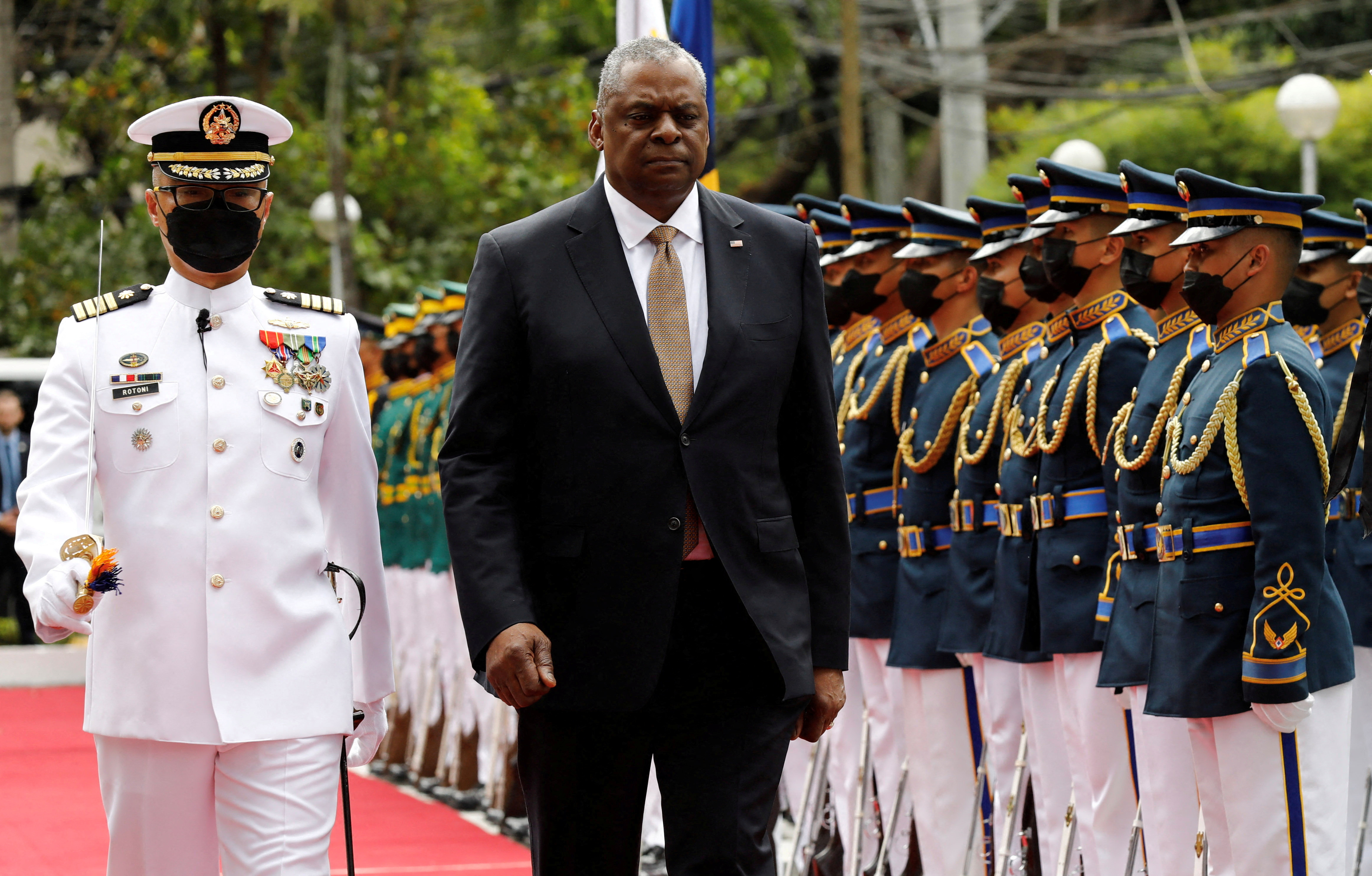
U.S. Defense Secretary Lloyd Austin III walks past military guards during arrival honors at the Department of National Defense in Camp Aguinaldo military camp in Quezon City, Metro Manila, Philippines, February 2, 2023. Rolex dela Pena/Pool via REUTERS

Filipino activists burn a mock U.S. flag during a protest against the visit of U.S. Defense Secretary Lloyd Austin, outside the military headquarters, Camp Aguinaldo, in Quezon City, Philippines, February 2, 2023. REUTERS/Eloisa Lopez

U.S. Vice President Kamala Harris holds a roundtable with Civil Society on Climate and Clean Energy at Chief of Mission Residence in Bangkok, Thailand, on Sunday, Nov. 20, 2022. Haiyun Jiang/Pool via REUTERS
Categories
Audio Sources - Full Text Articles

How Logan Paul’s Crypto Empire Fell Apart

A version of this article was published in TIME’s newsletter Into the Metaverse. Subscribe for a weekly guide to the future of the Internet. You can find past issues of the newsletter here.

In late 2021, 20-year-old Rueben Tauk asked his father for £50,000 ($67,000 at the time) to invest in YouTuber Logan Paul’s crypto project, CryptoZoo.

Paul, one of the most famous influencers in the world, described CryptoZoo as a game in which you could hatch and breed hybrid NFT animals that would gain in value over time. Speaking in August 2021 to his massive audience of the podcast Impaulsive, which has 4 million subscribers on YouTube, Paul had called it “a really fun game that makes you money.” In October that year, he called it “probably even more relatable and universal than Pokemon” in Forbes.

[time-brightcove not-tgx=”true”]

Tauk, who is from Newcastle, U.K., enjoyed Paul’s podcast and videos. He had already put £30,000 of his own money into the project, which he had earned from some savvy crypto investments. But he was convinced that this project was going to explode in popularity and gain in value enormously. So he asked his father for a loan. “I was brainwashed. I was like, ‘Logan Paul is a trustworthy guy. He makes good content and kind of leads the space,’” Tauk says. “So I invested a lot more, sourced from my family.”

More than a year later, Tauk and his father have lost almost all of that investment. CryptoZoo still does not exist as a game, and as of the day of publication, the value of its tokens has plummeted to less than a hundredth of its August 2021 peak. Paul, who told TIME in April 2022 that his involvement with the project was “super minimal,” now faces a mass arbitration action from CryptoZoo buyers who find themselves down thousands of dollars, just like Tauk.

Tom Kherkher, an attorney spearheading the effort, alleges that Paul committed fraud, express breach of contract and negligence among other claims, and is gearing up for months of legal action against Paul and CryptoZoo’s founders as he seeks damages for the some of the people who lost thousands on CryptoZoo. The NFT project’s terms of service prevent users from filing a class action lawsuit, so Kherkher must file arbitration demands on behalf of individual clients, one by one. “We’re committed to the long haul. if we have to go arbitrate 500 cases, case after case after case after case, that’s something that we’ll do,” he says.

On January 13th, Paul pledged to relinquish his stake in the game, refund holders at least $1.3 million, and finish the game. “To say I am disappointed in how this was handled internally is an understatement,” he said at the time.

A representative for Logan Paul said they were “unaware of any arbitration claims that have been filed” and declined to comment on all other questions.

But CryptoZoo is not the only crypto project spearheaded by Logan Paul that has gone awry. Over the past two years, Paul has dedicated a huge chunk of time building a vast crypto empire: serving as a founder of multiple projects and rallying his millions of fans to invest in the next big thing in cryptocurrency. But a pattern has emerged, in which he touts a project’s success, only to abandon it when things go south. And in the instance of the meme coin Dink Doink, blockchain evidence suggests that Paul profited enormously off a token he promoted to his fans after failing to disclose his own role in creating the project.

Here’s a history of Paul’s crypto dealings.

Read More: Influencers Are Scamming Their Fans Through Crypto. Here’s How Their Tactics Have Evolved.

CryptoZoo

As cryptocurrency has risen in popularity over the last few decades, thousands of new crypto tokens, games and NFTs have been created out of thin air by entrepreneurs. Some projects, like CryptoPunks and the Bored Ape Yacht Club, have proved valuable for buyers: their prices rose dramatically in 2021, giving their buyers perks and allowing them access into exclusive social clubs. Other tokens, like Sam Bankman-Fried’s FTT, rose before crashing to near zero.

Before venturing into crypto, Paul had risen to fame as a video blogger. While he earned notoriety for posting footage of himself with a dead body in a Japanese forest, his enormous popularity persisted, with Insider naming him the most famous influencer in the world in 2021. Paul became a WWE wrestler in 2022 and recently appeared on the Royal Rumble stage.

Paul told TIME last April that he had been introduced to crypto by the entrepreneur Gary Vaynerchuk. “The technology felt very inevitable. Verification on digital assets: I don’t know why that just made so much sense to me,” he said.

The influencer began his crypto journey as an NFT collector, buying over 100 NFTs for more than $2 million over the course of 2021. In the summer of that year, Paul went one step further and created his own NFT project: CryptoZoo. The idea was partially inspired by Pokémon. People could use a new crypto token created by the project’s founders, called Zoo, to buy a virtual NFT egg. The egg could then hatch into a hybrid animal, like an elephant-panda. If you bred one animal with another, it could produce an even more rare and valuable animal, that you could turn back into crypto, and then into cash.

Paul said that he had put a million dollars of his own money into making the game, and had hired top-notch artists and engineers. In October 2021, he told Forbes that the project “could be one of the biggest things I do.”

On its launch day on Sept. 3, 2021, the project’s initial 10,000 “Base Eggs” sold out within minutes. One buyer, Dan, who goes by cptdandan online, bought several thousand dollars worth of Zoo from his home in Sydney, Australia. Like Tauk, he also heard about CryptoZoo from Paul’s podcast.

“I basically thought that if it gets a good marketing push from this guy that’s so world-renowned, it will take off,” Dan says. (Dan works in financial services and requested TIME not print his last name out of professional concerns.) Dan also has two children, and thought the animal aspect had family appeal. “If the game is any good and it can make you money, it could be something that you can play on the side, and my kids can have a go,” he says.

Paul himself openly advocated that children get involved with CryptoZoo. “Kids are going to care about the blockchain because of my project. Imagine if your first experience on the blockchain is with CryptoZoo,” Paul told Forbes.

But after CryptoZoo buyers dumped thousands of dollars into the project, its creative team started to announce one delay after the other. Dan says that when he tried asking questions about progress in the project’s Discord group chat, the creative team would give vague responses and deny anything was amiss. “There was always something wrong. No date was ever hit successfully. No questions were answered properly,” he says.

Paul virtually disappeared from the project. In a video taken of him and the DJ Steve Aoki in March 2022, he dismisses CryptoZoo, instead telling Aoki that his next crypto project, 99 Originals, will be “the craziest sh-t I’ve ever done.”

When TIME asked Paul about CryptoZoo in April 2022, Paul said that his involvement in the project was “super minimal,” and that he received “the occasional, like, monthly check-in.” “It was a project that turned a little backwards because of some bad actors, which is a shame because I really liked the concept,” he said. “I’m like, okay, something didn’t turn out the way I expected it to. Let’s fix it. Let’s do the best we can. And let’s keep going, because like, I don’t have time to look back.” He then promised to put his “rocket fuel” behind the project.

But by the end of 2022, no rocket fuel had emerged. Several development teams had been hired and then dropped from the project. And in December, a YouTube journalist named Stephen Findeisen, who goes by CoffeeZilla, published a three-part series investigating CryptoZoo. He reported that the founders had lied to investors and each other, and that there was bitter infighting. He also told the stories of many investors who claimed they had lost thousands or hundreds of thousands in the project.

Findeisen’s videos brought widespread negative attention to the project. In January, Paul released a video threatening to sue Findeisen, before deleting and publishing a much more contrite video, promising to fix the CryptoZoo project once again.

But his fans had seen enough. On Jan. 15, Kherkher, the lawyer from Texas, filed his first arbitration demand against Paul and the other CryptoZoo founders. Because CryptoZoo’s terms of service ban its users from suing the company in a public court or creating class action lawsuits, Kherkher and his clients must file arbitration actions in Delaware, one by one. Dan helped Kherkher compile evidence from audio and text messages. Tauk is not involved in the arbitration.

Typically, the outcomes of arbitrations are skewed heavily towards companies as opposed to plaintiffs. Kherkher acknowledges this, but says that CryptoZoo investors like Dan have been for months compiling evidence that he says supports claims of fraud, negligence and express breach of contract.

“We are going to file our first batch of cases in hopes that maybe Logan Paul’s legal team will reach out to us and say, ‘We understand that maybe we have a big problem here,’” Kherkher says. “And maybe they can work to a quicker resolution to get these victims compensated in a reasonable time.” Kherkher says he has filed three cases so far, and has not heard any response from Paul’s legal team. He says it’s possible that Paul’s team has yet to be served by the process servers he hired.

But CryptoZoo was not the first time Paul heavily promoted a crypto project before apparently abandoning it. In June 2021, just a couple months before CryptoZoo’s launch, Paul had told his followers to invest in a new meme coin called Dink Doink.

Dink Doink

Meme coins are crypto tokens that are worth as much as people are willing to pay for them. Dogecoin is a prime example: it was created based on a meme, and largely rides on social media hype and injections of enthusiasm from Elon Musk. Whereas all markets or investments rely on investor faith, meme coins have very little regulation to protect customers, and also are usually not tied to any sort of real-world value.

In June 2021, Paul threw his clout behind a newly-created meme coin called Dink Doink, which was marketed via a singing South Park-like cartoon character. On his podcast and Twitter, Paul encouraged his followers to buy into the coin, saying that he was “all in” on the coin and that it was “a sh-tcoin I believe in.” (“Sh-tcoin” is a derogatory term for a meme coin.)

But what Paul didn’t mention was that he helped create the project—and had received a large chunk of Dink Doink coins before it launched, something he later admitted to the New York Times. The project’s leader was Paul’s roommate, Jake Broido. On the YouTube show Steven Steele Live!, Broido claimed that he and Logan created the project together, and that Paul designed the character on his phone. “Logan and I are being very cautious about how we roll this out,” Broido said. Referring to the price chart of Dink Doink, he added: “That chart is our reputation.”

After the coin cratered to fractions of a cent, Paul distanced himself from Broido and the coin. He called it “the project from hell” in his interview with the Times, and said that he never sold his tokens or profited from the project.

TIME asked the analytics company MyChargeBack to conduct blockchain research about Paul’s ties to Dink Doink. Evan Spicer, the director of cryptocurrency investigations at MyChargeBack, examined a crypto wallet that had received more than 120 trillion DINK tokens in the days before the coin’s official launch in June 2021. In July, when the coin was being traded publicly and still held value, that wallet began cashing out large amounts of DINK for more stable cryptocurrencies like Binance Coin (BNB) and Tether, according to Spicer. Then, in August, the wallet sent 36.5 Ether—virtually all of the Ether in the account, worth more than $100,000 at the time—straight to Logan Paul’s public account, Spicer’s research shows.

Spicer says there’s not yet enough evidence that Paul controlled the first wallet. But he described the connection between that wallet and Paul’s public wallet as a “cozy relationship” in which Paul “was getting fed a lot of the funds that went into that address.” Spicer also says that the first wallet’s general activity at the time, which consisted of coins constantly being swapped out for each other through various mixers and tumblers, “are indicators of nefarious activities.”

A representative for Paul did not immediately respond to these claims.

And in August 2021, well before CryptoZoo’s launch, the same wallet was gifted 95 billion Zoo tokens, suggesting that whoever owned the wallet was involved in both Dink Doink and CryptoZoo at early stages of both projects.

Aaron Lazor, the CEO of MyChargeBack, says that some of the wallet’s activity, including the rapid movement of money, resembled that of the investment scams that his company typically investigates. However, he says other scams typically took more precautions. “What we’ll see very often is multiple hops: to go from one cold storage to another exchange to another cold storage: they’re trying to mix it up. Here, some of it was going through the swaps, but there were some straight shots. It was literally Dink Doink to Ethereum to his wallet.”

In TIME’s April interview, Paul declined to discuss Dink Doink, saying, “I’m not saying sh-t about that sh-tcoin.” When asked a question about Dink Doink over email in January 2023, a representative for Paul declined to comment.

Liquid Marketplace

When TIME interviewed Paul in April, what Paul really wanted to talk about was his new crypto project, Liquid Marketplace. Co-founded by Paul, Liquid Marketplace allows investors to buy fractions of collectibles, like Pokemon cards, sports trading cards, and NFTs. While those items can be worth millions on their own, Liquid allows investors to own a stake in a card for as little as 10 cents.

“I want to see as many people own top-tier assets as possible,” Paul told TIME. Alluding to the CryptoZoo in-fighting, Paul said, “There’s a lot of dark people in this space that we kind of had to work around. But if you find the right people and the right teams, like when I found [CEO] Ryan [Bahadori] and the gang at Liquid, I was like, ‘okay, these guys have a great head on their shoulders.’ That’s where I’m not focusing and prioritizing my energy. I’m always super enthusiastic to prove people wrong.”

But this new exchange soon began to trace a similar pattern to its predecessors. Thanks to Paul’s initial boost on social media, investors flooded into the platform, driving prices up. But the market quickly cooled, and Paul stopped promoting the project altogether. Last June, a frequent user of Marketplace with the username youssef complained about the lack of activity and Paul’s absence in the project’s Discord. “We are literally like 10 active users tops , allot [sic] of ppl aren’t interested anymore so something needs to be done, not only social media marketing, I mean real logan paul type marketing,” they wrote.

In November, an avid member of Liquid who goes by cardboard_preacher, and who had posted over 1,300 times in the chat over the course of seven months, announced that they were leaving the platform. “So naive and trusted all of you that we were going to the moon together. But losing a ton of money or having money tied up that is not liquid (irony intended) takes a toll on people. To all my OGs, peace and love.”

Paul has not tweeted about Liquid Marketplace or posted in the Liquid Marketplace Discord since July. TIME understands that several employees at Liquid were laid off at around the same time last fall. Ryan Bahadori, Liquid Marketplace’s CEO, did not respond to a request for comment on the layoffs.

“Some users within the discord feel as Logan needs to be constantly talking about Liquid MarketPlace,” Bahadori wrote to TIME in an email in January. “However, we view things a little differently, we don’t want everything to be so artificial, we want our advertising to come across organically.”

Recovering Losses

Paul isn’t the only social media influencer to have used their platform to promote crypto schemes. In October, Kim Kardashian paid $1.26 million in fines after being charged by the Securities and Exchange Commission with unlawfully promoting a crypto scheme on Instagram. Fans have often put their trust in influencers touting crypto projects, but these can be volatile and involve technicalities that some investors are unaware of when they sign up.

After months of holding out hope that Paul would put his “rocket fuel” behind CryptoZoo, most of its diehard investors have sold out of the project, taking heavy losses and moving on. Tauk hopes he will one day be able to repay the £50,000 to his father. “It was a serious amount of money to him: He’s a middle class person,” Tauk says. “But we’re not going to live in regret. It was actually quite relieving when I sold because I was like, ‘alright, let’s not try to kid myself anymore.’”

Dan says he’s in touch with many investors who are taking it way harder than Tauk is. “A lot of these guys, I know they’ve been hit mentally,” he says. Some of these guys are pretty young. They’ve got some not just financial problems now but they’re very depressed: Being taken for a ride, being promised things.”

As for Paul, he posted a video in January titled “Why 2022 Was the Best Year of My Life.” It made no mention of CryptoZoo or Liquid Marketplace.

Categories
Audio Sources - Full Text Articles

Washington Is Turning Against TikTok. Should Users Be Worried About a Ban?

The future of Tiktok in the U.S. was once again cast into doubt after a prominent U.S. lawmaker raised national security concerns, citing fears that user data from around 100 million Americans could be shared with Beijing.

On Thursday, Colorado Senator Michael Bennet joined a growing number of Democrats to take issue with the Chinese-owned company, calling on Apple and Google to remove the video platform from its app stores. Bennet—a member of the Senate Intelligence Committee—outlined his concerns in a letter to Apple CEO Tim Cook and Alphabet Inc CEO Sundar Pichai.

“No company subject to CCP (Chinese Communist Party) dictates should have the power to accumulate such extensive data on the American people or curate content to nearly a third of our population,” Bennet wrote, referring to the millions of Americans who use the app regularly. “Given these risks, I urge you to remove TikTok from your respective app stores immediately.”

[time-brightcove not-tgx=”true”]

Bennet also warned that China’s government could compel TikTok to influence what U.S. users see on the app. “Beijing’s requirement raises the obvious risk that the Chinese Communist Party (CCP) could weaponize TikTok… [to] manipulate the content Americans receive to advance China’s interests,” Bennet wrote.

Leaders across the U.S. political spectrum say they are concerned that Chinese internet technology company ByteDance, which owns TikTok, is required by Chinese law to make TikTok data available to the CCP.

In December, a counter-surveillance bipartisan bill was introduced to Congress that could result in a nationwide ban of the app. The House Foreign Affairs Committee is due to hold a vote this month on the bill.

TikTok has already been banned from federal government devices and some college campuses have restricted access to the app on school devices and WiFi servers.

Read More: Universities Are Banning TikTok on Their Campuses. Here’s Why

Republicans had previously been the most ardent critics of the app, with the Trump administration’s unsuccessful attempt to outlaw it alongside another Chinese app, WeChat, in September 2020. But the move was twice blocked by the courts who said Trump officials “acted in an arbitrary and capricious manner by failing to consider obvious alternatives” for the app.

More recently, Democrats such as Senator Dick Durbin have also called on Americans to boycott the app.

A blanket ban would also leave U.S. content creators without access to ad revenue on the platform or its Creator Fund, which allows them to monetize their videos if they have at least 10,000 followers and 100,000 views in a 30-day period.

TikTok users are paid according to how many followers they have on the app. It is estimated that content creators with 100,000 followers or more can get paid $200 to $1,000 a month. Meanwhile, creators with 1 million or more followers can get paid $1,000 to over $5,000 a month.

TikTok has been in confidential negotiations with the Biden administration’s Committee on Foreign Investment in the United States, or CFIUS, for two years now. The company also presented a 90-page proposal in August on how it would prevent the Chinese government from having access to this data by storing it on domestic servers on American-owned software, the New York Times reported.

Additionally, TikTok’s chief executive, Shou Zi Chew, has this month been meeting with think tanks and interested groups in Washington to share how the company plans to prevent data collection from its American users. Zi Chew is set to appear before a House committee in March to discuss TikTok’s data security practices.

It is currently unclear how much weight Bennet’s letter will carry among the technology giants he has called on, but with pressure mounting from all sides, the app store owners are paying attention.

Categories
Audio Sources - Full Text Articles

Heat-Related Deaths Are Rising. Here’s How Cities Can Keep Residents Safer

Living in a city sometimes feels like living in the future. Urban life can mean exposure to new technologies, new ideas—and, sometimes, previews of the temperatures coming soon to nearby regions. In Europe, during hot periods, cities are an average of 2.7°F (1.5°C) warmer than surrounding areas, according to research published Jan. 31 in the Lancet. That amount may sound small, but scientists have also pinpointed it as the increase above pre-industrial temperatures that humanity will have to stick to for the best-case climate-change scenario.

[time-brightcove not-tgx=”true”]

These so-called urban heat islands can be deadly, especially as heat waves become more frequent in high-density places around the world. In summer 2022, urban areas across Europe clocked record-breaking highs, and 26 U.S. cities recorded their hottest ever seasons. The result is a public health crisis for cities not designed to withstand extreme heat. “London could be as hot as Barcelona in 20 years’ time if we’re not careful, and Barcelona could be like Marrakech,” says Mark Nieuwenhuijsen, the study’s co-author and director of urban planning, environment, and health at the Barcelona Institute for Global Health.

Cities really need to chill out, and while adding air conditioning is more likely to contribute to global warming than it is to fix it, the study models a more sustainable approach. The paper, which includes data from 93 European cities, found that in 2015, more than 4% of summertime deaths in those cities could be traced back to the effects of urban heat islands. But when researchers adjusted the model to reflect a hypothetical, much leafier Europe—with 30% of city spaces shrouded by trees—the number of heat-related deaths dropped by more than a third.

Modeling cities that are 30% shaded by trees isn’t random; it’s an actual target that many European cities are working towards, and that some, like Oslo, have already achieved. But with a current average coverage of 14.9%, many cities in warmer areas—for instance, Split, Croatia (5.4%); Paris (9%); and Lisbon (3.6%)—have a ways to go. (For comparison, in the U.S., New York City’s tree cover clocked in at 22% in 2017.)

Read More: Cow Burps Have a Big Climate Impact. Solving That is Harder than You’d Think

Trees provide more cooling services than just shade. Leaves are full of water, and when it gets hot out, that water evaporates and fizzles into the warm air, causing a cooling effect not unlike a microscopic mist. Then, there are the less measurable implications of additional tree coverage in an area. “Where you have trees, you don’t have roads,” says Nieuwenhuijsen, and every inch without asphalt matters. The problem of asphalt is multifold, he explains. Aside from slurping up every ounce of daytime sunlight and releasing its warmth gradually, often hijacking otherwise-cooler night air, asphalt means cars. About 60% of the energy that fossil-fuel powered cars release is in the form of heat.

“If asphalt is an indicator for having more cars, generally, trees are an indicator for having a more livable area,” Nieuwenhuijsen adds. In Barcelona, which has a thriving bus system, only one out of every four transit trips is by car, yet those very vehicles take up 60% of the city’s space.

For some cities that were originally designed with cars in mind—only 12.4% of Phoenix, Ariz., was covered by trees when it began a 2010 greening project—reaching 30% tree coverage could mean undertaking a fundamental redesign of certain city spaces and the ways that people move within them. “Having more trees in urban areas makes them more thermally comfortable and safer. But I would add that it’s also important that we use the right species of trees and put them in the right locations in order to maximize the effect,” says Robert Brown, a professor of landscape architecture and urban planning at Texas A&M University, who was not involved with the study. Trees in urban areas already face higher risks of dying in their first few years after being planted, and with limited local budgets, there’s a good case for prioritizing species that can easily thrive in the neighborhoods where they’re needed most.

Heat is the leading weather-related killer, but death is only the most extreme measure of the health toll that increased temperatures can take. Heat can also put a major strain on mental health, in part by potentially impairing sleep. Tree coverage wouldn’t just keep more people alive, Nieuwenhuijsen argues—it could make those lives better day-to-day.

Cities with limited budgets should also remember to care for the green spaces that they do already have, says Nieuwenhuijsen. And additional greening doesn’t always have to mean a lush new 10-block park. The relationship between tree coverage and preventable deaths demonstrated in the study is linear, which means that every bit helps.

Categories
Audio Sources - Full Text Articles

In Memphis, Tyre Nichols Beating Carries Echoes of Atlanta REDDOG Unit

Cerelyn “C.J.” Davis, chief of police in Memphis, won praise for her immediate response to the Tyre Nichols beating death. Amid criticism, she and the city shuttered the SCORPION unit, created as one of her first acts as Memphis’s new police chief in 2021, whose officers conducted the traffic stop and beating of Nichols.

Davis, of all people, should have understood how high-intensity, politically driven specialized policing units could go wrong. Davis ran Atlanta’s checkered REDDOG unit for about 18 months in 2006 and 2007, according to the resume she gave Durham, North Carolina, in 2016 before being named police chief there.

When asked, a Memphis Police Department spokesperson said that its SCORPION unit was modeled on Boston Police Department’s Operation Ceasefire, which — at least in design — is meant to be a very different system than what was on display in the Nichols video. But people in Atlanta who experienced REDDOG’s tactics recognized the similarity to the jarring video released last Friday of Nichols’s beating death.

Atlanta’s REDDOG, which stood for Run Every Drug Dealer Out of Georgia, predated Davis’s tenure in Atlanta by a decade. Still, Atlanta created it in 1988 under very similar political conditions to those in Memphis today. At the time, Atlanta was setting national homicide records, even as the city was preparing for the Democratic National Convention. Then-Mayor Andrew Young faced massive political pressure to show action against street crime.

REDDOG met violence with a roving wave of violence of its own. For 23 years, REDDOG officers regularly terrorized poor Black neighborhoods and Black residents of Atlanta.

Emery Carter was a 27-year-old military veteran in 1998 when two Atlanta REDDOG cops barreled into him while chasing someone else. “The REDDOGs blamed me for letting him get away, so they took me to the park, beat me up, and let me go,” he said. “They say, ‘Do you want to go to jail, or do you want us to beat you up and take your money?’ This became a regular thing. Who are you going to tell? You can’t call the police on the police.”

Terrick Young was a homeless 15-year-old on Cleveland Avenue at the same time Carter was on Jonesboro Road, both in impoverished parts of South Atlanta. Rather than help him find shelter, cops from the unit found him with marijuana, beat him, and took $150 away from him, leaving him to find his way to a hospital to get stitches. The incident — and other run-ins with REDDOG — left him with permanent physical and emotional scars.

“This was the odd thing about REDDOGs, man. They didn’t arrest most people,” Young said. “They mostly just robbed you and beat you up and let you go. A lot of people don’t know that. I guess they didn’t want to do paperwork or whatever.”

There is no shortage of stories about REDDOG’s conduct. Outkast, T.I., Young Dro, Killer Mike, and dozens of other rappers have referenced run-ins with REDDOG over the years. Atlanta’s immortal rap group Goodie Mob titled a song “Dirty South” on their 1995 album “Soul Food.” “One to da two da three da four/ Dem dirty REDDOGS done hit the door / And they got everybody on they hands and knees / And they ain’t gonna leave until they find them keys.”

Atlanta disbanded the unit in 2011 in the wake of a police raid on an LGBTQ night club where patrons were made to kneel in broken glass and subjected to racist and homophobic abuse. REDDOG joined a growing list of specialized policing units like CRASH of the Rampart scandal in Los Angeles and the Gun Trace Task Force in Baltimore, shuttered after wide-ranging corruption and misconduct.

Davis, the current Memphis police chief, served with the Atlanta Police Department for 16 years and commanded the REDDOG unit between June 2006 and November 2007. (Notably, REDDOG was not responsible for the infamous Kathryn Johnston shooting of 2007.) She left Atlanta to run Durham’s police department until 2021.

Like most American cities, Durham’s violent crime rate spiked during the pandemic. City leaders faced calls to do something quickly, said former Mayor Steve Schewel. But the city had also long been committed to reform, even before the George Floyd protests of 2020 threw criminal justice issues into sharp relief, he said.

“We have a big, politically vigorous democracy here,” Schewel said. “People were in the streets. She kept the police away from demonstrations. I give her really high marks for that.”

Davis had embraced reforms, like a requirement for police to obtain written consent before searching a car and pushing cases into the misdemeanor first-offender programs in court, Schewel said. “She walked the line between having the confidence of the community and having the confidence of the police department.”

Durham lost Davis to a bigger job. When she arrived in Memphis, the city was wrestling with the highest homicide rate among America’s largest cities, driven by youth street crime. Memphis broke its record in 2021, with 346 homicides, a rate of about 48 per 100,000 residents.

Memphis’s political leadership sounded much like Durham’s: desperate to keep shootings, like the murder of the rapper Young Dolph, from defining the city’s culture, but looking for long-term solutions to the underlying causes of crime.

“There is no quick fix,” Memphis Mayor Jim Strickland said at the “State of the City” address in January 2022. “Unfortunately, the actions we take today don’t mean the crime problems will go away tomorrow.”

In that address, Strickland touted arrests and seizures made by the city’s new SCORPION unit, noting that “we must remove from our streets those predators who perpetrate violence and use guns to harm and rob others.”

Communities implement a Ceasefire-style program — as the SCORPION unit was meant to be — to reduce gun violence, particularly youth gun violence.

That kind of program begins with intense data analysis to isolate the fraction of a percent of a community who tend to be responsible for most of its violence. Police then contact those at highest risk for committing an act of gun violence to tell them that they’re being observed. They’re offered a choice: an off-ramp from their gang activities with enhanced resources as part of the program, or intense prosecution by the system if they shoot someone.

Nothing of this approach — rigorous targeted intervention with available resources — had anything at all to do with Tyre Nichols, except perhaps that he was a young Black man in a Memphis crime hot spot that the model had decided merited intense policing.

The post In Memphis, Tyre Nichols Beating Carries Echoes of Atlanta REDDOG Unit appeared first on The Intercept.

Categories
Audio Sources - Full Text Articles

Tidbits: Israelis’ home-style restaurants • Huge audience at Holocaust education event

photo-noam-preisman.jpg

Tidbits is a weekly feature of easy news briefs in Yiddish that you can listen to or read, or both!

If you read the articles and don’t know a word, just click on it and the translation appears. You’ll also find the link to the article in English after each news brief.

Listen to the report here:

הערט דעם באַריכט אויף אוידיאָ דאָ:

https://forward.com/wp-content/uploads/2023/02/texas.m4a

ישׂראלישע היימישע רעסטאָראַנען • ריזיקער עולם אויף חורבן־הזכּרה אין טעקסאַס

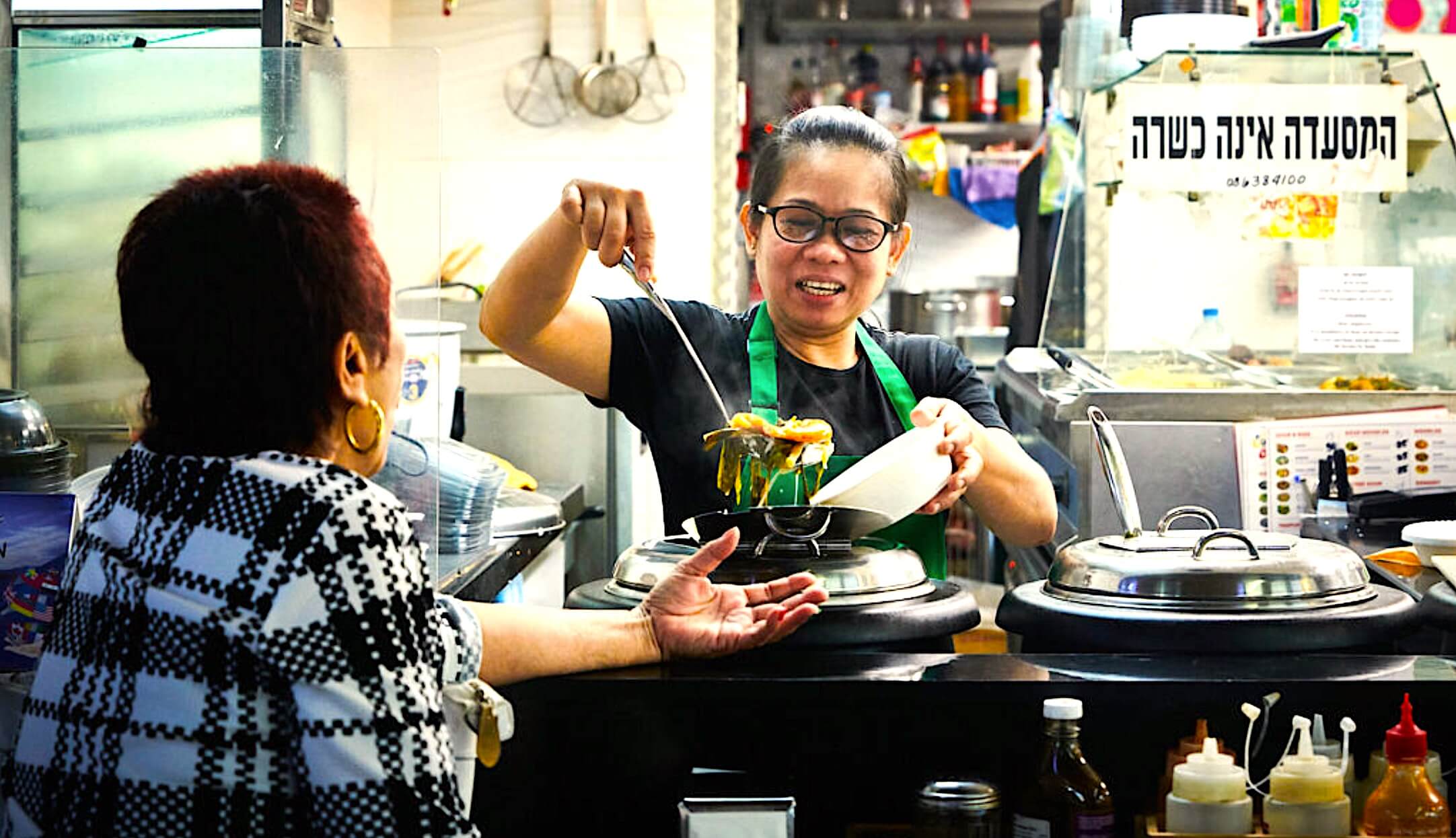
ישׂראלים האָבן ליב צו עסן וואַרעמע מאכלים אויף מיטאָג, צי עס רעדט זיך פֿון אַן איראַקישער קובע־זופּ, שניצל מיט פֿריטלעך („טשיפּס“) אָדער רײַז מיט בעבלעך.

אַזוינע מאכלים סערווירט מען אויך אין די אַזוי־גערופֿענע אַרבעטער־רעסטאָראַנען וואָס געפֿינען זיך אין די אינדוסטריעלע טיילן פֿון ישׂראל. לעצטנס האָט זיך אינעם תּל־אָבֿיבֿער קולינאַרן צענטער געעפֿנט אַן אויסשטעלונג וועגן אַזוינע רעסטאָראַנען וואָס ווײַזט ווי זיי גרייטן צו די מאָלצײַטן. די אויסשטעלונג הייסט „די היים, וואָס איז ווײַט פֿון דער היים“.

אין דער אויסשטעלונג זעט מען ווידעאָס און אַ זאַמלונג טעלער געשאַפֿן פֿון קינסטלער, וואָס ווײַזט די געשיכטע און אַנטוויקלונג פֿון די אַרבעטער־מאָלצײַטן.

„די מאכלים וואָס מע סערווירט אין אַזוינע רעסטאָראַנען רעפּרעזענטירן אַ געוויסן קאָנטראַקט צווישן די קונים און די קוכערס,“ האָט דערקלערט ליורה ראָזען, איינע פֿון די קוראַטאָרן פֿון דער אויסשטעלונג. „דער קונה באַקומט אַ פֿולן, געשמאַקן מאָלצײַט נאָענט צו זײַן אַרבעטפּלאַץ און דאָס דערמעגלעכט אים גיך צוריקצוגיין צו דער אַרבעט.“

To read the news in English, click here.

כּדי צו לייענען די נײַעס אויף ענגליש גיט אַ קוועטש דאָ.

•

נישט געקוקט אויף די טאָרנאַדאָס וואָס האָבן באַדראָט טעקסאַס די פֿאַרגאַנגענע וואָך האָבן 50,000 תּלמידים אין היוסטאָן זיך באַטייליקט אין אַ ווירטועלער פּראָגראַם לזכּרון די זעקס מיליאָן ייִדן וואָס זענען אומגעקומען אינעם חורבן. די פֿאָרשטעלונג איז געווען אַ טייל פֿון אַ פּראָגראַם אָפּצומערקן דעם אינטערנאַציאָנאַלן טאָג פֿון חורבן־אָנדענק.

מאָנאַ גאָלאַבעק, אַ ייִדישע פּיאַניסטקע און לעקטאָרין, האָט אויפֿגעטראָטן אינעם זאַל פֿון אַ מיטלשול אין היוסטאָן, בעת די קינדער האָבן זיך צוגעקוקט דורך זום. זי האָט זיי דערציילט געשיכטעס פֿון ייִדן וואס האָבן זיך געראַטעוועט פֿון די נאַציס, און באַגלייט די מעשׂיות מיט מוזיק, וואָס זי האָט אַליין געשפּילט אויף דער פּיאַנע.

צום מערסטן האָט זי גערעדט וועגן איר מאַמען, ליסאַ יוראַ, וואָס איז געווען אַ יונג מיידל אין עסטרײַך ווען ס׳האָט אויסגעבראָכן „קרישטאָלנאַכט“. „אַרויסקוקנדיק פֿונעם פֿענצטער האָט מײַן מאַמע געזען ווי די נאַציס שלאָגן איר טאַטן און ווי מע צווינגט אים צו וואַשן די גאַס,“ האָט גאָלאַבעק געזאָגט. „מײַן באָבע האָט זיך אַזוי געזאָרגט וועגן דעם עמאָציאָנעלן עפֿעקט דערפֿון אויף איר טאָכטער, אַז זי האָט זיך אַוועקגעזעצט בײַ דער פּיאַנע און אָנגעהויבן שפּילן ‘קלער דע לונע’ פֿון דעביוסי, כּדי זי צו באַרויִקן.“

די ייִדישע באַפֿעלקערונג אין טעקסאַס איז אַ קליינע. אינעם שטאַט וווינען כּמעט 30 מיליאָן מענטשן, אָבער בלויז 100,000 זענען ייִדן.

To read the news in English, click here.

כּדי צו לייענען די נײַעס אויף ענגליש גיט אַ קוועטש דאָ.

The post Tidbits: Israelis’ home-style restaurants • Huge audience at Holocaust education event appeared first on The Forward.

Categories
Audio Sources - Full Text Articles

Eric Swalwell slams House GOP for moving against Ilhan Omar after supporting the openly anti-semitic Kanye West

Eric SwalwellRepresentative Eric Swalwell of California.

JACQUELYN MARTIN/POOL/AFP via Getty Images

  • Rep. Eric Swalwell tore into the House GOP for removing Rep. Ilhan Omar from a powerful committee.
  • Swalwell pointed out that an official GOP Twitter account praised Kanye West and took months to delete the message.
  • The California Democrat said Republicans should “look in your own damn mirror” for antisemitism.

Democratic Rep. Eric Swalwell lit into House Republicans on Thursday for seeking to Rep. Ilhan Omar from her seat on the powerful House Foreign Affairs Committee over perceived antisemitic comments while waiting for weeks to tweet a praising Kanye West after the rapper proclaimed he would go “death con 3 on Jewish people.”

“So, I thought we’re going to hold someone accountable for antisemitism, surely it’s the author of this tweet,” Swalwell said on the House floor while pointing to a large printout of the tweet published on the official House Judiciary GOP account. “Kanye. Elon. Trump. October 6, written by Chairman Jim Jordan. October 8, what does Kanye say? I’m going to declare ‘death con 3’ on the Jews. So surely, this tweet came down? It was deleted? No. Two more months it was kept up. Two more months.”

Swalwell then added, “So don’t come here looking at us for antisemitism. Look in your own damn mirror before you ever come over here.”

—Nicholas Wu (@nicholaswu12) February 2, 2023


House Republicans later voted to remove Omar from the panel.

In response to Swalwell’s comments, Russell Dye, the communications director for the House Judiciary Committee panel, said that Jordan, who now chairs the powerful committee, does not run the panel’s Twitter account. 

Insider previously reported that the tweet stayed up even after West began increasingly antisemitic comments that ended up with unbridled praise for Adolph Hitler. It was amid West’s praise for Hitler that the tweet was deleted.

House Judiciary GOP tweet stating: "Kanye. Elon. Trump."In October, the Twitter account for Republicans on the House Judiciary Committee expressed solidarity with Kanye West.

Screenshot/Twitter

“Mr. Swalwell is lying much like he lies about his relationships with Chinese spies,” Dye added, a reference to a 2020 Axios report that the California Democrat was targeted by a Chinese intelligence agent.

Swalwell has repeatedly claimed he did nothing wrong and ended all communication with the suspected spy after meeting with the FBI. House Republicans cited that report in a separate effort to remove Swalwell from the House Intelligence Committee. 

The GOP had long vowed that it would punish the Minnesota Democrat for a series of comments she made in 2019, including that US support for Israel was “all about the Benjamins baby.” Members of both parties condemned Omar’s remarks and pointed out that the “Benjamins” comment furthered an old antisemitic trope. Omar has apologized for her past statements. 

Just before the vote, Omar said that the punishment was aimed at silencing her voice. She vowed that the setback would not stop her.

“My leadership and voice will not be diminished if I am not on this committee for one term,” Omar said on the House floor. “My voice will get louder and stronger and my leadership will be celebrated around the world as it has been.”

Read the original article on Business Insider
WP Radio
WP Radio
OFFLINE LIVE