Categories
Audio Sources - Full Text Articles

Four-time NBA champion Steph Curry joins his rich neighbors in opposing much-needed new housing near their Bay Area backyards

Steph Curry.Steph Curry.

Getty/Ezra Shaw

  • Steph and Ayesha Curry penned a letter opposing a townhouse development near their home in Atherton, California.
  • The move comes as California regulators attempt to bolster the state’s stock of much-needed affordable homes.
  • Other wealthy individuals, such as Marc Andressen to Dave Chappelle, have also voiced opposition to similar proposals.

Golden State Warriors superstar Steph Curry has joined a cadre of other wealthy individuals in opposing multifamily housing developments in one of the most expensive cities in the US. 

Curry and his wife Ayesha sent a letter to Atherton, California’s town council on January 18 indicating that they oppose a plan to upzone a piece of land to develop 16 townhouses near their $30 million mansion. Upzoning refers to a process of obtaining approval for higher density or taller building height on a plot of land that a builder plans to redevelop. 

Atherton’s 94027 zip code is one of the richest in America, according to Bloomberg’s 2020 Richest Places Index. The town has about 7,000 residents and is located in San Mateo County just outside of Menlo Park, which is home to Silicon Valley behemoth Meta Platforms. Redfin estimates that the median home price in Atherton is just above $8.2 million as of December 2022, which represents a staggering 17% increase year-over-year. 

“Safety and privacy for us and our kids continues to be our top priority and one of the biggest reasons we chose Atherton as home,” the letter reads in part. “With the density being proposed at 23 Oakwood, there are major concerns in terms of privacy and safety with three-story townhomes looming directly behind us.”

The Currys are just the latest high-profile family to oppose more density near their home. In February 2022, comedian Dave Chappelle helped kill an ordinance that would have allowed the town of Yellow Springs, Ohio to build a mix of single-family homes, duplexes, and apartments on a recently annexed 55-acre site, according to Reason Magazine.  

Then in August 2022, Billionaire venture capitalist Marc Andreessen and his neighbors successfully thwarted a proposal to amend Atherton’s zoning code to allow multifamily apartments units within the town’s borders, Bloomberg reported. 

Despite the pushback from the Currys and other local families, Atherton’s city council approved the plan to redevelop 23 Oakwood on January 31, NBC Bay Area reported. The Currys had also asked the city council to invest in “considerably taller fencing and landscaping” to block the sightline onto their property. 

“This is a tough thing for a community like Atherton to change,” Atherton City Manager George Rodericks told NBC. “It’s a sea change. We’ve never had multi-family zoning.”

The move to upzone a lot in Atherton comes amid a renewed state-mandated push to ensure all cities and towns in California provide sufficient housing for their residents. 

Since 1969, California law has required cities to update their housing and land use needs, known as “Housing Elements,” every eight years to ensure enough affordable housing is available to residents. State lawmakers updated this law in 2021 to add more stringent reporting requirements for local jurisdictions and set a deadline for cities to develop their next eight-year plan by January 31, 2023. Cities who fail to comply with the deadline could lose grant funding and face lawsuits from the state Attorney General. 

Cities spanning from San Francisco to Los Angeles have had their plans approved by state regulators, with many plans including efforts to increase density on developable land. 

Read the original article on Business Insider
Categories
Audio Sources - Full Text Articles

Mercedes’ cheapest electric car is more luxurious than a Tesla but with way less range

The Mercedes-Benz EQB 350.The Mercedes-Benz EQB 350.

Tim Levin/Insider

  • The Mercedes-Benz EQB is the German brand’s cheapest electric vehicle, starting at around $55,000. 
  • It’s more luxurious inside than a Tesla, but lacks range and some fun quirks of EVs. 
  • It’s quick and fun, with 288 horsepower in the EQB 350 version I tested. 

In 2022, Tesla officially became the best-selling luxury brand in the US, and Mercedes-Benz is officially over it. 

In an effort to claw back customers from Elon Musk, the German brand now offers Americans four electric vehicles in all shapes and sizes. That’s up from zero just a couple of years ago. 

The entry point into Benz’s EV lineup is the compact EQB SUV. While it may not be the most exciting electric option on the market, it’s comfy, quick, and shouldn’t scare off anybody hesitant about leaving their gas car. Plus, it’s way more luxurious than any Tesla. 

The basics

The Mercedes-Benz EQB 350.The Mercedes-Benz EQB 350.

Tim Levin/Insider

The EQB slots in below the larger and more expensive EQE and EQS offerings. To make it, Mercedes took its gas-fueled GLB SUV, swapped in a battery pack, added some electric motors, and made some styling tweaks. Namely a shiny, closed-off grille, a snazzy light strip, and some blue badging. As everybody knows, electricity is blue. 

What results is an e-SUV with almost no learning curve. It looks and feels like a regular SUV inside, and isn’t so stuffed with screens that you have to relearn how to operate an automobile, which some buyers may appreciate. 

The Mercedes-Benz EQB 350.The Mercedes-Benz EQB 350.

Tim Levin/Insider

It comes in two flavors: the 225-horsepower EQB 300 and the 288-horsepower EQB 350. It starts at $54,500, and the 2022 EQB 350 Mercedes lent me came out to $58,050, including optional heated seats. 

What stands out: A luxurious interior and comfy ride

Teslas have a lot going for them, sure, but they aren’t known for being particularly luxurious inside. They go the more techy, minimalist route. 

The Mercedes-Benz EQB 350.The Mercedes-Benz EQB 350.

Tim Levin/Insider

If you desire nothing less than renowned German sturdiness and fanciness in your new EV, try the EQB instead. It’s nice and quiet, with plush leather seats that don’t leave you sore after a long drive. It’s filled with elegant metallic accents and feels well put together. Rather than relying too much on touchscreen controls, Mercedes includes a plethora of satisfying switches. 

Even if the EQB doesn’t give the same open feeling as an uncluttered Tesla, it provides plenty of headroom and legroom for tall people. 

The Mercedes-Benz EQB 350.The Mercedes-Benz EQB 350.

Tim Levin/Insider

On the road, the EQB is composed and smooth, offering the same brisk, exciting acceleration you get in practically any EV. Switch on sport mode, and the all-wheel-drive EQB flies forward with every stab of the throttle. In comfort and eco settings, things are more subdued. The little SUV’s exceptional turning radius comes in handy in parking lots and around town. 

What falls short: Range and packaging

Range is many buyers’ key concern when buying an electric car. That’s understandable, given the underwhelming state of charging infrastructure today. 

The Mercedes-Benz EQB 350.The Mercedes-Benz EQB 350.

Tim Levin/Insider

Sporting an EPA-estimated range of 227 miles, the EQB 350 doesn’t exactly alleviate that anxiety. The EQB 300 is slightly better, rated at 243 miles. But neither come close to the max ranges you can get in a Tesla Model Y, Mustang Mach-E, or Hyundai Ioniq 5, for example, which all offer at least 300 miles. The Model Y delivers 330 miles of driving range for $53,490. 

Still, 200 or so miles may be plenty depending on how often you drive long distances and your daily routines.

The Mercedes-Benz EQB 350.The Mercedes-Benz EQB 350.

Tim Levin/Insider

Since it’s based on a combustion-engine vehicle, the EQB also lacks some of the best parts of other EVs. Using a dedicated electric platform lets car companies break free of the boundaries set by an engine, transmission, and gas tank and have a little fun with things. That’s why so many EVs have flat floors, more interior room, and extra cargo capacity. 

The EQB, however, has a vestigial tunnel running through its cabin, no front trunk, and slightly less cargo space than the GLB thanks to its bulky battery.

Our impressions

The EQB’s swanky cabin, pleasant ride quality, and quick acceleration make it appealing. But if range is your top priority, there are better options out there.

Read the original article on Business Insider
Categories
Audio Sources - Full Text Articles

Gmail creator warns Google is ‘only a year or two away from total disruption’ because of AI like ChatGPT

Insider asked ChatGPT, the viral AI chatbot sweeping the internet, to whip up a layoff memo for a pretend tech company, Gomezon.ChatGPT and AI chatbots like it are going to majorly disrupt Google’s search engine, said an early employee who created Gmail.

CFOTO/Future Publishing via Getty Images

  • Gmail creator Paul Buchheit says Google is only one or two years away from “total disruption” due to AI chatbots.
  • The engineer said advancements in AI like ChatGPT could make Google’s search engine irrelevant.
  • In December, Google issued a “code red” warning because of the viral chatbot.

Gmail creator Paul Buchheit say AI chatbots like ChatGPT will destroy Google in the same way that the search engine killed The Yellow Pages.

“Google may be only a year or two away from total disruption,” Buchheit tweeted on Wednesday. “AI will eliminate the Search Engine Result Page, which is where they make most of their money. Even if they catch up on AI, they can’t fully deploy it without destroying the most valuable part of their business!”

While the Gmail creator said it might not be ChatGPT itself that disrupts Google’s monopoly, advancements in technology are certain to shift the way people access information.

“The way I imagine this happening is that the URL/Search bar of the browser gets replaced with AI that autocompletes my thought/question as I type it while also providing the best answer (which may be a link to a website or product),” he said on Twitter, adding that AI will be able to “instantly do what would take many minutes for a human” to do using a search engine like Google.

—Paul Buchheit (@paultoo) December 1, 2022


ChatGPT, which has generated headlines for its ability to do anything from write an essay to provide coding advice, is an AI chatbot that can answer questions in a clear,  conversational manner using data collected from millions of websites.

But it’s not perfect: The site has been known to give incorrect answers at times as the chatbot has some difficulty identifying misinformation.

Buccheit, who was the 23rd employee hired at Google, according to Crunchbase, is a computer engineer who helped develop the company’s first AdSense prototype, a system that serves targeted ads on sites and allows publishers to profit off pageviews. 

The bulk of Google’s revenue comes from selling ads, many of which appear on its search engine. In 2021, about 80% of Google’s $257.64 billion in revenue came from advertisements.

The Gmail creator is far from the first to sound the alarm on ChatGPT’s potential impact on Google. In December, Google issued a “code red” warning over the chatbot. Since the latest version of ChatGPT was released on November 30, Sundar Pichai, the CEO of Google and its parent company, Alphabet, has participated in several meetings around Google’s AI strategy in response to the threat the chatbot represents to the company’s search engine, The New York Times reported in December.

The company also called in Google cofounders Larry Page and Sergey Brin to help address the issue, the Times reported in January. At the time, The Information had reported that Microsoft planned to use ChatGPT to power its own search engine, Bing.

Read the original article on Business Insider
Categories
Audio Sources - Full Text Articles

Meet OpenAI CEO Sam Altman, who learned to code at 8 and is a doomsday prepper with a stash of gold, guns, and gas masks

Sam Altman HeadshotSam Altman is well known in the startup scene in Silicon Valley, and his latest company’s product, ChatGPT, is the talk of the AI industry.

Courtesy of Sam Altman

  • Sam Altman is the CEO of OpenAI, the buzzy AI firm he cofounded with Elon Musk.
  • Before that, he was well known in Silicon Valley as president of startup accelerator Y-Combinator.
  • Here’s how the serial entrepreneur got his start — and ended up helming one of today’s most-watched companies.
Sam Altman, 37, grew up in St. Louis, Missouri. He learned how to program and take apart a Macintosh computer when he was 8 years old.A view of st Louis with buildings and archway

f11photo/Shutterstock

Source: The New Yorker


He told The New Yorker that having a Mac helped him with his sexuality. Altman came out to his parents when he was 16.macintosh microsoft visitor center

Matt Weinberger/Business Insider

“Growing up gay in the Midwest in the two-thousands was not the most awesome thing,” he told The New Yorker. “And finding AOL chat rooms was transformative. Secrets are bad when you’re eleven or twelve.”

Source: The New Yorker

He attended John Burroughs School, a private, non-sectarian college-preparatory school in St. Louis.St. Louis, Missouri

Joseph Sohm / Shutterstock

Altman came out as gay to the whole community after a Christian group boycotted an assembly at his school that was about sexuality.

“What Sam did changed the school,” his college counselor, Madelyn Gray, told The New Yorker. “It felt like someone had opened up a great big box full of all kinds of kids and let them out into the world.”

Source: The New Yorker

Altman studied computer science at Stanford University for two years before he and two of his classmates dropped out to work full time on their mobile app, Loopt, that shared a user’s location with their friends.Stanford University

turtix/Shutterstock

Source: The New Yorker

Loopt was part of the first group of eight companies at startup accelerator Y Combinator. Each startup got $6,000 per founder, and Loopt was in the same batch as Reddit.Sam Altman Y Combinator

Getty Images

Source: The New Yorker, The Business of Business

Loopt eventually reached a $175 million valuation, but it didn’t garner enough interest, so the founders sold it for $43 million in 2012.sam altman

Drew Angerer/Getty

The $43 million sale price was close to how much it had raised from investors. The company was acquired by Green Dot, a banking company known for prepaid cards.

One of Loopt’s cofounders, Nick Sivo, and Altman dated for nine years, but they broke up after they sold the company.

It’s unclear what Altman’s current net worth is.

Source: The Wall Street Journal, All Things Digital, Y Combinator, The New Yorker

After Loopt, Altman founded a venture fund called Hydrazine Capital, and raised $21 million. That included a large part of the $5 million he got from Loopt, and an investment from billionaire entrepreneur and venture capitalist Peter Thiel.Peter Thiel, co-founder of PayPal, Palantir Technologies, and Founders Fund, holds hundred dollar bills as he speaks during the Bitcoin 2022 Conference at Miami Beach Convention Center on April 7, 2022 in Miami, Florida.Peter Thiel holding hundred dollar bills while speaking at the Bitcoin 2022 Conference.

Marco Bello/Getty Images

Altman invested 75% of that money into YC companies, and led Reddit’s Series B fundraising round.

He told The New Yorker, “you want to invest in messy, somewhat broken companies. You can treat the warts on top, and because of the warts the company will be hugely underpriced.”

At 31, Altman was chosen by Paul Graham, who founded Y Combinator in 2005, to succeed him as president in 2014.Sam AltmanSam Altman, chief executive officer of Y Combinator, speaks to reporters on the first day of the annual Allen & Company Sun Valley Conference, July 11, 2017 in Sun Valley, Idaho.

Drew Angerer/Getty Images

While he was YC president, Altman taught a lecture series at Stanford called “How to Start a Startup,” in the fall of 2014.sam altman

Lucy Nicholson/Reuters

Source: How to Start a Startup

In 2015, Altman was featured on the Forbes 30 Under 30 list for venture capital at age 29.Sam Altman HeadshotSam Altman.

Courtesy of Sam Altman

Source: Forbes

After he became YC president, he wanted to let more science and engineering startups into each batch, and chose a fission and a fusion startup for YC because he wanted to start a nuclear-energy company of his own. He invested his own money in both companies and served on their boards.sam altmanSam Altman, president of Y Combinator and co-chairman of OpenAI, attends the annual Allen & Company Sun Valley Conference, July 8, 2016 in Sun Valley, Idaho.

Drew Angerer/Getty

Mark Andreessen, cofounder of venture capital firm Andreessen Horowitz, said, “Under Sam, the level of YC’s ambition has gone up 10x.”

Source: The New Yorker

Altman once told two YC founders that he likes racing cars and had five, including two McLarens and an old Tesla. He also said he likes renting planes and flying them all over California.An orange McLaren 720S on a wooded road.The McLaren 720S.

McLaren

Source: The New Yorker

Altman told the founders of the startup Shypmate that, “I prep for survival,” and warned of either a “lethal synthetic virus,” AI attacking humans, or nuclear war.sam altman

Drew Angerer/Getty

“I try not to think about it too much,” Altman told the founders in 2016. “But I have guns, gold, potassium iodide, antibiotics, batteries, water, gas masks from the Israeli Defense Force, and a big patch of land in Big Sur I can fly to.”

Source: The New Yorker

Altman’s mom is a dermatologist, and told The New Yorker, “Sam does keep an awful lot tied up inside. He’ll call and say he has a headache—and he’ll have Googled it, so there’s some cyber-chondria in there, too. I have to reassure him that he doesn’t have meningitis or lymphoma, that it’s just stress.”Sam Altman

Getty Images

Source: The New Yorker

Altman has a brother, Jack, who is also a cofounder and CEO at Lattice, an employee management platform. Along with their brother Max, the Altmans launched a fund in 2020 called Apollo that is focused on funding “moonshot” companies.jack altman and his wife, julia, standing in front of a blurred palm tree in a parkJulia and Jack Altman walk near their home in the Mission District of San Francisco, Calif., on Sunday, July 7, 2019.

San Francisco Chronicle/Hearst Newspapers via Getty Images/Contributor

“Moonshot” companies are startups that are financially risky but could potentially pay off with a breakthrough development.

Source: Insider

In 2015, Altman cofounded OpenAI with Elon Musk, CEO of Tesla and SpaceX at the time. Their goal for the non-profit artificial intelligence company was to make sure AI doesn’t wipe out humans.L-R) Tesla Motors CEO and Product Architect Elon Musk and Y Combinator President Sam Altman speak onstage during "What Will They Think of Next? Talking About Innovation" at the Vanity Fair New Establishment Summit at Yerba Buena Center for the Arts on October 6, 2015 in San Francisco, California.Elon Musk and Sam Altman speak onstage during the Vanity Fair New Establishment Summit on October 6, 2015 in San Francisco, California.

Michael Kovac/Getty Images for Vanity Fair

“We discussed what is the best thing we can do to ensure the future is good?” Elon Musk told The New York Times in 2015. “We could sit on the sidelines or we can encourage regulatory oversight, or we could participate with the right structure with people who care deeply about developing A.I. in a way that is safe and is beneficial to humanity.”

Source: Insider, The New York Times

Some of Silicon Valley’s most prominent names pledged $1 billion to OpenAI along with Altman and Musk, including Reid Hoffman, the cofounder of LinkedIn, and Peter Thiel.Reid HoffmanLinkedIn cofounder Reid Hoffman is a financial backer of OpenAI.

Tony Avelar/AP

Source: Insider

After the 2016 election, Altman, who tweeted that he voted against Donald Trump, said he decided to talk to 100 Trump supporters around the US to understand what they did and didn’t like about the president. He also wanted to know “what would convince them not to vote for him in the future.”Donald Trump Hillary ClintonDonald Trump and Hillary Clinton

Drew Angerer/Getty Image

In a thread on Twitter, Altman said he was “voting against Trump because I believe the principles he stands for represent an unacceptable threat to America.”

He also said Peter Thiel, who was still working with YC at the time, “is a high profile supporter of Trump,” and that, “I disagree with this.”

But, he said, “YC is not going to fire someone for supporting a major party nominee.”

YC and Thiel stopped working together a year later in 2017 for unspecified reasons.

During his interviews, Altman said he “did not expect to talk to so many Muslims, Mexicans, Black people, and women in the course of this project.”

He said almost everyone he approached was willing to talk to him, but they also didn’t want to share their names in fear of being “targeted by those people in Silicon Valley if they knew I voted for him.” Altman said one of the people he talked to in Silicon Valley made him sign a confidentiality agreement before talking because she was scared of losing her job for supporting Trump.

Source: Twitter, Sam Altman, Insider

Altman stepped down as YC president in March 2019 to focus on OpenAI. He stayed in a chairman role at the accelerator.sam altmanSam Altman, CEO of Y Combinator

@sama

Source: Insider

At a StrictlyVC event in 2019, Altman was asked how OpenAI planned to make a profit, and he said the “honest answer is we have no idea.”OpenAI CEO Sam Altman and Elon MuskOpenAI CEO Sam Altman and Elon Musk

Getty

Altman said OpenAI had “never made any revenue,” and that it had “no current plans to make revenue.” 

“We have no idea how we may one day generate revenue,” he said at the time.

Source: TechCrunch

Altman became CEO of OpenAI in May 2019 after it turned away from being a nonprofit company into a “capped profit” corporation.Sam Altman

Skye Gould/Business Insider

“We want to increase our ability to raise capital while still serving our mission, and no pre-existing legal structure we know of strikes the right balance,” OpenAI said on its blog. “Our solution is to create OpenAI LP as a hybrid of a for-profit and nonprofit — which we are calling a ‘capped-profit’ company.”

Source: Insider, Fortune

Altman flew to Seattle to meet with Microsoft CEO Satya Nadella, where demonstrated OpenAI’s AI models for him, WSJ reported. After that, OpenAI received a $1 billion investment from Microsoft in 2019.Sam AltmanPresident of Y Combinator, Sam Altman speaks at TechCrunch Disrupt NY 2014 – Day 1 on May 5, 2014 in New York City.

Brian Ach/Getty Images for TechCrunch

Source: The Wall Street Journal, LinkedIn, Insider

Current and former insiders at OpenAI told Fortune that after Altman took over as CEO, and after the investment from Microsoft, the company started focusing more on developing natural language processing.Sam Altman sitting in a chair at a conference.Sam Altman, founder of OpenAI, the maker of ChatGPT.

Steve Jennings/Getty Images

Altman and OpenAI’s chief scientist, Ilya Sutskever, said the move to focus on large language models is the best way for the company to reach AGI, or adjusted gross income. 

Source: Fortune

On October 21, 2021, Altman and his cofounders, Alex Blania and Max Novendstern, launched a global cryptocurrency project called Worldcoin, which wanted to give everyone in the world access to crypto by scanning their iris with an orb.Worldcoin founders Sam Altman and Alex BlaniaWorldcoin founders Alex Blania and Sam Altman

Marc Olivier Le Blanc/Worldcoin

The company was started in 2020, but stopped operating in a few countries in 2022 due to logistics issues. The company recently tweeted that it has reached 1 million people, and has onboarded over 150,000 first-time crypto users.

Source: Bloomberg, Insider, Twitter

Under Altman’s tenure as CEO, OpenAI has released popular generative AI tools to the public, including DALL-E and ChatGPT.Screenshot of Dall-E webpageScreenshot of Dall-E webpage

OpenAI

Both DALL-E and ChatGPT are known as “generative” AI, meaning the bot creates its own artwork and text based off information it has been fed.

After ChatGPT was released on November 30, Altman tweeted that it had reached over 1 million users in five days.

Source: Insider, Insider, Twitter

ChatGPT was made public so OpenAI could use feedback from users to improve the bot. A few days after its launch, Altman tweeted that it “is incredibly limited, but good enough at some things to create a misleading impression of greatness.”An image of a phone with ChatGPT and OpenAI's logo visible.

Getty Images

Altman tweeted in December that ChatGPT was “great” for “fun creative inspiration,” but “not such a good idea” to look up facts.

ChatGPT recently began testing a paid version of ChatGPT called “ChatGPT Professional” that is supposed to give better access to the bot. Back in December, Altman tweeted that OpenAI “will have to monetize it somehow at some point; the compute costs are eye-watering.”

Source: Insider, Insider, Twitter, Twitter, Twitter

This month, Microsoft again announced it was making a “multibillion dollar” investment into OpenAI. Although specifics of the investment were not shared, it is believed Microsoft’s investment is worth $10 billion.Y Combinator President Sam AltmanY Combinator President Sam Altman

David Paul Morris/Bloomberg via Getty Images

Before Microsoft’s investment, other venture capitalists wanted to buy shares from OpenAI employees in a tender offer that valued the company at around $29 billion.

Source: Insider, Fortune

Altman is still interested in nuclear fusion, and gave Helion Energy $375 million last year.sam altman wearing a black t shirt, black jacket, grey pants and sunglassesSam Altman, CEO of OpenAI, walks from lunch during the Allen & Company Sun Valley Conference on July 06, 2022 in Sun Valley, Idaho.

Kevin Dietsch/Getty Images

“Helion is more than an investment to me,” Altman told TechCrunch. “It’s the other thing beside OpenAI that I spend a lot of time on. I’m just super excited about what’s going to happen there.”

He told TechCrunch that he’s “happy there’s a fusion race,” to build a low-cost fusion energy system that can eventually power the Earth.

Source: TechCrunch, CNBC

OpenAI just launched its pilot subscription plan for ChatGPT Plus, which costs $20 a month.Illustration: ChatGPTIllustration: ChatGPT

Future Publishing/

People who pay $20 a month for ChatGPT Plus get benefits such as using the site even when traffic is high, faster responses from the bot, and first access to new features and ChatGPT improvements.

The subscription is only available for people in the US, and OpenAI said it will start inviting people on the waitlist to join in the next few weeks. 

Source: OpenAI

Read the original article on Business Insider
Categories
Audio Sources - Full Text Articles

NBC is closing down ‘The Blacklist’ after decade on the air

NEW YORK (AP) — The NBC series “The Blacklist” is closing down.

NBC said Wednesday that the James Spader drama will end after its upcoming season, its 10th on the air. It will return for its final run of episodes on Feb. 26.

Spader has played the character Raymond Reddington, an FBI informant on old criminal colleagues. This last season, Reddington confronts “unparalleled danger” as some of those he’s identified seek revenge, NBC said.

The show’s 200th episode, a milestone in the often fleeting world of television, will air on March 19.

Diego Klattenhoff, Hisham Tawfiq, Anya Banerjee and Harry Lennix are other regulars on “The Blacklist.”

The final episode will air sometime this year. An NBC spokesperson said it’s not immediately clear when that will be.

Categories
Audio Sources - Full Text Articles

Top Dem on House intel seeks briefings on classified records

WASHINGTON (AP) — The new top Democrat on the House Intelligence Committee on Wednesday called for more information about the classified records discovered in the private possession of President Joe Biden and former President Donald Trump.

Rep. Jim Himes of Connecticut was named the committee’s ranking member Wednesday by House Minority Leader Hakeem Jeffries. Along with Ohio Rep. Mike Turner, the committee’s new Republican chairman, Himes will lead a panel that has been split by highly political fights in a break from its traditionally quieter oversight of the U.S. spy agencies.

Turner and the leaders of the Senate Intelligence Committee have in recent weeks pushed the White House to share more in private about the classified material found. The U.S. Office of the Director of National Intelligence has declined to comment on its review of classified material, which is also the subject of multiple Justice Department investigations.

“There’s a strong bipartisan concern that Congress is not being briefed on even preliminary reviews of classified information that might have been exposed,” Himes said in an interview Wednesday with The Associated Press. “That’s wrong. That’s wrong as a matter of law.”

The intelligence committees already face several major tests this year, from multiple discoveries of top leaders keeping classified documents to the fight over whether to renew foreign surveillance powers used by the FBI, National Security Agency and other spy agencies.

Himes succeeds Rep. Adam Schiff, who was Jeffries’ original pick to lead the Democrats but along with Rep. Eric Swalwell was denied a spot on the panel by House Speaker Kevin McCarthy.

McCarthy accused Schiff of lying to Americans when he led the Intelligence Committee during the first impeachment of Trump, who was accused of withholding military aid to Ukraine unless President Volodymyr Zelenskyy announced an investigation of Biden and his son.

And McCarthy alleged Swalwell was compromised based on his contact with a suspected Chinese spy. Both Schiff and Swalwell denied McCarthy’s allegations and accused him of taking political retribution.

Himes said Republicans had wrongly accused Swalwell of being a security risk and said Schiff had been a strong leader of the panel.

“It’s not that hypocrisy is a new thing to me, but in this case, it obviously removed some real institutional knowledge from the committee, so I was disappointed,” Himes said.

But Himes said he and Turner have a “really good working relationship” and noted that they traveled to Ukraine together last year to meet Zelenskyy.

“When you spend 12 hours on an overnight train together, you get to know each other a little bit,” Himes said. “He’s extremely knowledgeable on a lot of topics, so I’m really looking forward to working with him.”

In the interview, Himes outlined his priorities for the committee as well as his views on Russia and China.

He called on the Biden administration to supply Ukraine with the longer-range missiles it has long sought to fend off Russia, saying the U.S. must prevent the war from becoming a stalemate.

Himes and others say the U.S. should grant Ukrainian requests for the Army Tactical Missile System, known as ATACMS, which use the same launchers as the HIMARS rockets that Kyiv has successfully used but have a range as much as three times greater. U.S. officials have been concerned that Ukraine could use longer-range missiles to strike targets inside Russia and possibly provoke a direct war between Washington and Moscow.

“We’ve done a great job, but that we haven’t pressed the accelerator quite as much as we should have,” he said. “A stalemate is a Russian victory, and that can’t be the ending. So we need to give the Ukrainians the tools they need to continue to push the Russians backwards.”

Himes also called for greater discussion of how a war between Beijing and Taiwan would damage American interests and particularly the U.S. economy, given China’s ownership of U.S. sovereign debt and the business relationships between the two countries. He criticized a recent reported statement by Air Force Gen. Michael Minihan, who predicted in a memo that China and the U.S. could be at war in two years.

“Everybody’s starting to listen to the drums of war and how do we arm and how do we fight,” Himes said. “It’s time to really sober up and think harder about how we avoid a military conflict with China.”

___

Associated Press writer Tara Copp contributed to this report.

Categories
Audio Sources - Full Text Articles

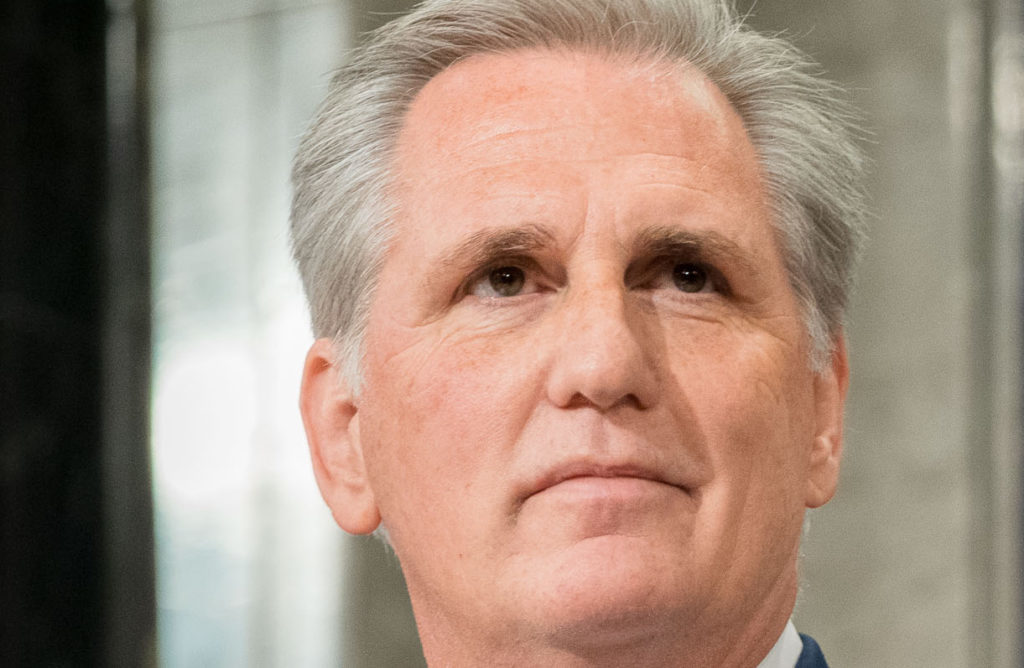
Kevin McCarthy caves

kevin-mccarthy-1024x668.jpg

Help support Palmer Report! Our articles are all 100% free to read, with no forced subscriptions and nothing hidden behind paywalls. If you value our content, you’re welcome to pay for it:

Pay $5 to Palmer Report:

Pay $25 to Palmer Report:

Pay $75 to Palmer Report:


Help fund Palmer Report here

Pay $5 to Palmer Report:

Pay $25 to Palmer Report:

Pay $75 to Palmer Report:


On Sunday, Kevin McCarthy did yet another predictable thing – officially announcing that he was no longer going to force cuts to Medicare and Social Security in the fight his party decided to pick with Democrats over the debt ceiling.

The problem is that these comments came out in a place he didn’t really want them to – while he was doing the rounds on Sunday political shows. McCarthy was almost always going to have to make this move – since he doesn’t have the numbers within his own caucus to force cuts to the programs that Republicans have been wanting to cut from the day they were created.


McCarthy, like just about any other rabid Republican, wanted to gut these programs, but the House GOP members in swing districts have largely made it impossible. This is in part due to us getting out the word that Republicans would do whatever they could to destroy the social safety net if trusted with power when we fought them last year.

McCarthy knows that he’s fairly limited in what he can do until 2024 – and we just need to keep reminding him of it until we can vote out the Republican House majority for good.

Help fund the Ruben Gallego 2024 Senate campaign here

Help fund Palmer Report here

Pay $5 to Palmer Report:

Pay $25 to Palmer Report:

Pay $75 to Palmer Report:

Help fund the Ruben Gallego 2024 Senate campaign here

Help fund Palmer Report here

Pay $5 to Palmer Report:

Pay $25 to Palmer Report:

Pay $75 to Palmer Report:

The post Kevin McCarthy caves appeared first on Palmer Report.

Categories
Audio Sources - Full Text Articles

Iran on Cusp of Weapons-Grade Nuclear Materials

Iran is on the cusp of producing enough fissile material to power several nuclear weapons, according to the United Nations.

A confidential U.N. report leaked on Wednesday indicates that Iran is enriching uranium, the key component in a nuclear weapon, up to 60 percent purity at its Fordow nuclear site, according to Reuters. The technological know-how needed to enrich uranium to these levels demonstrates that Iran has surpassed the threshold required for bomb-making.

Iran is believed to have altered nuclear centrifuges stored at the Fordow site, allowing the country to enrich uranium to these high levels of purity. The news comes less than a week after a suspected Israeli drone strike hit another Iranian military facility in Isfahan, believed to be a weapons depot. Iran has vowed to take revenge for the attacks, setting the stage for a burgeoning war between Tehran and Israel. The news also further complicates the Biden administration”s efforts to revive the 2015 nuclear deal, which stalled as the Iranian government cracks down on anti-regime protests across the country.

“The attack on Isfahan will not go unanswered,” Mahmoud Abbaszadeh Meshkini, the spokesman for the Iranian parliament”s national security and foreign policy committee, said on Wednesday.

Iranian military leaders also said on Wednesday that they are increasing defenses aimed at countering future drone strikes, like the one Israel is believed to have conducted.

“The powerful Air Defense Force is ready to confront any threat in the safe skies of our beloved country using its new domestically built systems,” Brigadier General Alireza Sabahifard, the commander of the Iranian Army”s air defense forces, said in Iran”s state-controlled press. This buildup includes the installation of defense systems and radars meant to ward off a potential attack, according to Sabahifard.

The post Iran on Cusp of Weapons-Grade Nuclear Materials appeared first on Washington Free Beacon.

Categories
Audio Sources - Full Text Articles

College Board Backtracks on Woke AP Curriculum After DeSantis Criticism

The College Board revised its new Advanced Placement course after Florida governor Ron DeSantis (R.) criticized the curriculum for having woke and inaccurate content.

The College Board released Wednesday the official curriculum for its new high school course in African-American studies, stripped of the controversial critical race theory, “queer experience,” and “Black feminism” subject matter that DeSantis slammed earlier this month, the New York Times reported. In a Jan. 12 letter to the College Board, the DeSantis administration rejected the draft curriculum, saying it is “inexplicably contrary to Florida law and significantly lacks educational value.”

“In the future, should College Board be willing to come back to the table with lawful, historically accurate content, [the Florida Department of Education] will always be willing to reopen the discussion,” the letter stated.

The revised curriculum removed the topic of Black Lives Matter as well as other CRT sources, the Times reports:

The College Board purged the names of many Black writers and scholars associated with critical race theory, the queer experience and Black feminism. It ushered out some politically fraught topics, like Black Lives Matter, from the formal curriculum.

And it added something new: “Black conservatism” is now offered as an idea for a research project.

David Coleman, the head of the College Board, defended the revisions, saying they were for “pedagogical reasons, not to bow to political pressure.”

The post College Board Backtracks on Woke AP Curriculum After DeSantis Criticism appeared first on Washington Free Beacon.

Categories
Audio Sources - Full Text Articles

Biden State of the Union 2023: Debt ceiling rhetoric is politically potent but often wrong

By Isabel V. Sawhill

President Biden’s address to the nation provides an opportunity to educate the public on the issue of the debt ceiling in a way that will help to counteract Republican rhetoric. That rhetoric is superficially plausible and thus politically potent but often just plain wrong. Here are seven specific myths about the debt ceiling that need to be debunked.

Myth 1: Keeping the lid on debt will reduce government spending.

The national debt is the consequence of actions already taken by the Congress. It represents the bill for past wars, past tax cuts, and spending that has already occurred. To not honor such debt because of an arbitrary limit would produce uncertain but likely disastrous consequences for financial markets and the economy. It would increase not reduce future government spending due to the likely rise in interest rates. Additionally, any slowing of the economy in response to a threatened or actual default would automatically balloon deficits.

Myth 2: The debt that’s been accumulated over the past several decades is because of runaway government spending.

Both parties are at fault. At the end of the Clinton Administration in 2000, the federal budget was in surplus and the national debt was in decline. But since that time, about half of the increase in debt was due to laws enacted under Presidents Bush and Trump while the other half was the result of measures enacted under Presidents Obama and Biden. Republican tax cuts were a significant contributor to the red ink. The Bush tax cuts of 2001 and 2003 and their later extension added almost $6 trillion to the debt while the Republican tax cut of 2017 added close to $2 trillion with virtually none of the promised benefits to the economy. But much of the problem of growing debt is not the result of legislative action; it is the consequence of the automatic growth of entitlement spending which Democrats have been unwilling to curtail.

Myth 3: The new Congress is the party of fiscal responsibility.

In bargaining with their new Speaker, Kevin McCarthy, House Republicans put some budgetary limits on spending but none at all on further tax cuts. Instead of Pay-as-you-go, we now have Cut-as-you-go. The old budget rule applied to both spending and taxes. The new one affects spending only. That means no restraint on further tax cuts and thus much less restraint on rising debt.

Myth 4: The Biden Administration doesn’t care about deficits and debt.

To be sure, the Biden Administration could have done more; his student loan proposal would have ballooned deficit to the tune of $300 billion over a decade. At the same time, the Inflation Reduction Act, included new resources for the Internal Revenue Service to help it collect the $7 trillion in taxes that it estimates will be due but not paid over the next decade. House Republicans are trying to rescind most of this new funding for the IRS. That would hamper its ability to collect those taxes, overwhelmingly owed by the very wealthy. The problem isn’t tax avoidance; the problem is tax evasion.

Myth 5: We can balance the budget in ten years by cutting nonessential programs without hurting seniors or other vulnerable groups. 

Some of the House conservatives extracted a pledge from Speaker McCarthy to balance the budget in 10 years. But to do so without tax increases and without cutting social security, Medicare, veterans programs, and defense would almost eliminate the rest of government, requiring cuts of 85 percent in all other programs.

Myth 6: The federal government is bloated and out of control; the “deep state” is the problem. 

The number of federal civilian government employees has not increased since the 1960s, despite a more than five-fold increase in federal spending. That spending has increased primarily because the population is aging and the costs of Social Security and Medicare have risen, accounting for most of the growth. The popularity of these programs has motivated even former President Trump to argue for their protection while the budget math has led many Democrats to see this pledge as a backdoor threat to these same programs.

Myth 7: Republicans have a realistic plan to control spending. They just need to get Democrats to go along with their plan.

The truth is that today’s Republicans are all hat and no cattle. They talk a big game without having the courage to even specify the programs that they want to cut. The President must submit a very detailed budget in March. Perhaps Republicans will produce something equally detailed but until they put their cards on the table, their fiscal credibility remains questionable.

2023-01-13T182802Z_308764564_RC22US96ECD
fblike20.png pinterest20.png twitter20.png email20.png rss20.png  
WP Radio
WP Radio
OFFLINE LIVE