Categories
Audio Sources - Full Text Articles

‘Life Is Fragile.’ The Monterey Park Hero Speaks at a Ceremony to Honor His Act of Bravery

A week after the devastating Lunar New Year shooting in Monterey Park, Calif. that killed 11 people, the city of Alhambra honored Brandon Tsay, the bystander that disarmed gunman Huu Can Tran.

The city decided to move forward with the Lunar New Year celebration on Sunday, awarding 26-year-old Tsay with a medal of courage from the Alhambra Police Department during the opening ceremony on Sunday. “The carnage would have been so much worse had it not been for Brandon Tsay,” said California Representative Judy Chu during the ceremony.

[time-brightcove not-tgx=”true”]

“I realized that life is fragile. I feel that we as a community should spend our precious time reaching out to one another,” Tsay said at the event Sunday. Despite the devastation, Tsay said he hoped the victims’ families would be able to “heal” from the tragedy. “I pray for them to be able to find joy again,” he added.

Read More: How to Help the Victims and Community After the Monterey Park Shooting

Surveillance video of the night of the shooting shows Tsay single-handedly wrestling a firearm from the shooter. The 72-year-old gunman arrived at the Lai Lai Ballroom & Studio in Alhambra, which Tsay’s family has run for the last three decades, about 20 minutes after he attacked people at another dance studio in Monterey Park. Tsay was working at the ticket office when the gunman arrived, and struggled with him to wrench the gun away. “I can tell you that the suspect walked in there probably with the intent to kill more people,” Los Angeles County Sheriff Robert Luna previously said.

Tran fled the scene and later shot himself when police surrounded his white cargo van in Torrance, Calif.

On Sunday in Alhambra, Tsay was received by a standing ovation, with some of the more than 20,000 attendees holding posters in support. “Brandon Tsay is our hero,” one of them read.

The Alhambra Lunar New Year Festival
Gary Coronado—Los Angeles Times via Getty ImagesBecki Pang, center, cheers for Brandon Tsay, 26, after he was awarded a medal of courage from the Alhambra Police Department during a ceremony at the the Alhambra Lunar New Year Festival on Jan. 29, 2023 in Alhambra, Calif.

President Biden called Tsay last week to thank him for taking “incredible action in the face of danger.”

“You are America, pal. You are who we are,” Biden said on the call. “America’s never backed down, we’ve always stepped up, because of people like you.” Tsay will be President Biden’s guest at the upcoming State of the Union address on Feb. 7.

In the midst of much praise, Tsay said he was also still processing the grief and pain that forced him to take such heroic actions. “Most of the victims I knew personally,” Tsay revealed at the award ceremony. “They’d always come by the dance studio and I considered them friends. They were some of the most caring people I have ever met. And, for them to be taken from us is such an excruciating experience.”

Categories
Audio Sources - Full Text Articles

Playful learning creates multigenerational opportunities with intergenerational impacts

By Irv Katz, Hailey M. Gibbs

Play is an important part of children’s learning and development. While it generally evokes a picture of a small child running, jumping, and shouting, the benefits that play offers in promoting early development and better health outcomes extend far beyond childhood. In fact, playful learning—an area of research that examines how children learn best through playful exchanges—shares many of the same core foundations as the study of intergenerational learning—a body of research involving older and younger generations coming together in the service of mutually-beneficial learning experiences.

As the COVID-19 pandemic introduced new layers to our understanding of the importance of social connection for a range of outcomes, researchers have an opportunity to look to the future of the playful learning and intergenerational learning movements together—what they share and how they can be leveraged jointly to support social interactions that foster well-being throughout life.

Playful Learning Landscapes support enriching interactions and promote learning

As a natural medium for fostering rich interactions, play creates opportunities for children to develop language skills, engage in collaboration, test theories about how the world works, and even develop better self-regulation. Child development experts, recreation and play professionals, and educators have long examined the connection between play and learning—and, more recently, how the kinds of enriching interactions that take place during play can be fostered through the built environment.

Enter Playful Learning Landscapes: a growing movement of community-based research partnerships across a number of cities in the U.S. and abroad, including in Brazil, Israel, and South Africa, that morph public spaces in places that foster interaction, learning, and joy (see illustrative photo below). By reimagining everyday environments in ways that encourage play while embedding a targeted learning goal, the movement fosters a learning model known as playful learning, in which children build content knowledge while simultaneously playing freely. Playful learning research has not only generated improvements to children’s language and literacy, numeracy, spatial reasoning, and executive functioning—all skills that set the foundation for later development and school readiness—but also strong civic engagement, increased ownership of communal spaces, enriched interactions between children and their caregivers, and a deeper understanding among caregivers of the role of play in their children’s learning.

pll

This PLL installation, which is located in Philadelphia, is called Urban Thinkscape.

Photographer credit: Sahar Coston-Hardy Photography.

But the benefits are not for children alone—playful interactions can also be a boon for older adults, supporting better health and social engagement, staving off cognitive decline, and creating multigenerational learning opportunities with intergenerational impacts.

Intergenerational research showcases benefits to, and contributions of, older adults

A century ago, multiple generations lived, worked, and played together. Today, much of our society treats young children and older adults as fundamentally different from one another—and, more likely than not, we live apart, sometimes a great distance, from even the closest generations of our own families. We now each belong to a separate “named generation” that reinforces generational differences, which may contribute to the persistent and widespread problem of ageism, that has well-documented negative effects on physical and mental health, economic well-being, and access to critical support services. Though the developmental literature acknowledges that many of our needs evolve as we age, the benefits we experience from rich social connections, learning opportunities that support cognitive function, and activity that promotes physical health remain constant throughout life.

The intergenerational movement, which has emerged over the past several decades and gained momentum in recent years, emphasizes the benefits of enriching interactions in mitigating social isolation—which became all the more critical in periods of isolation during the COVID-19 pandemic—creating health and learning opportunities for older adults, and promoting powerful community connections. Social service leaders, academic researchers, public officials, and others demonstrated that there are reciprocal benefits to children and older adults as a product of interacting and engaging with one another. In a 2021 review of intergenerational programs, Generations United and the RRF Foundation for Aging identified benefits of intergenerational programs for children at several different developmental periods, parents, and older adults—even those aged 100 and older.

Among the many positive outcomes, researchers found that children in preschool partnered with older adult volunteers show better socio-emotional outcomes (e.g., empathy and acceptance); elementary school children partnered with older adults show increased learning, reading comprehension, and improvement in writing; and older adults report less social isolation and a sense of connectedness and community when engaged with children and youth. This connectedness is a critical component for supporting both physical and mental health and well-being in older adults and for staving off some age-related declines in cognitive functioning.

Play is not just for the kids: Intergenerational learning has lifelong benefits

By bringing these two areas of study together—one based in a long history of intergenerational research, the other in a rich and growing playful learning movement—researchers and advocates can integrate and build on opportunities to engage adults and children in their day-to-day environments in ways that promote enriching and mutually-beneficial learning and health outcomes. This could include, for example, puzzles embedded in bus stops or at local parks, featuring iconic references from a grandparent’s generation that can promote both shape language that supports foundational math skills and storytelling that helps boost rich language interactions and gives older adults an opportunity to share their experiences. It could look like grocery store games, where older adults are prompted to discuss favorite foods and recipes from their childhood, or it could look like story fragments printed on the sidewalk outside of an elderly home that prompts older adults and young children to take it in turns to build out narratives together. Redesigning playful learning spaces with an intergenerational framework in mind can facilitate these kinds of rich interactions between young and old and lead to improvements in their respective well-being, bridge generational divides at the earliest stages of children’s lives, and strengthen community resilience across the lifespan.

Photographer credit for cover image: Saxum.

The authors thank Sarah Lyttle, Kathy Hirsh-Pasek, and Jennifer Vey for their reviews of this blog.

fblike20.png pinterest20.png twitter20.png email20.png rss20.png  
Categories
Audio Sources - Full Text Articles

Will a global circular economy help or hurt Africa?

By Bright Simons

In Davos, many of the assembling elites had circular economy on their mind and lips, and the program was replete with its implications. “Circular economy” is a concept described by its supporters as the biggest economic opportunity since the industrial revolution. They peg its scale at $1 trillion by 2025 and $4.5 trillion by 2030.

As both an economic means and an end, circularity is about “designing waste out of the system.” According to its proponents, by reusing resources, repurposing end-of-lifecycle items, recycling garbage, refurbishing the broken, and rewiring the torn, we can build a more sustainable world reset from the current course of depleting nature at rates unprecedented in millions of years.

It is estimated that if circularity gathers steam, global consumption of new materials could be reduced by 32 percent in 15 years and by 53 percent in 30 years. On the other hand, business as usual will see the human population increase by 20 percent by 2050 but waste expand by a far more staggering 70 percent.

A bonanza for Africa?

Considering Africa’s status as one of the most marginalized continents, circularity is expected to have massive positive impacts. Modelers relying on Cambridge University’s FRAMES tool who have undertaken deep dives into the prospects of several African countries report substantial gains should the principles of circularity take root. Below is a sample summary of circularity’s benefits to Ghana by 2030 in one such report:

fig 1

All well and good, and some of the earliest examples of economic circularity target supply chains with a strong presence in Africa, such as minerals. Tons of these minerals in their refined form end up in electronic waste (e-waste). Last year, the scale of e-waste was said to dwarf the Great Wall of China.

Experts say this is tantamount to dumping $57 billion worth of precious minerals into landfills around the world. Unsurprisingly, European companies like Umicore and Ecomet (much beloved by the Vatican) are leading the charge to recover these precious substances from the waste heaps of the world.

It is to be expected that those regions that consume the most electronics and have the best technologies will be able to safely recover the most value without causing further harm to health and the environment. In low-technology contexts, such as West Africa, initiatives to manually recycle e-waste pose additional pollution and health hazards.

Furthermore, minerals usually concentrated in Africa in their raw form have the greatest commercial attraction to international recyclers. Take discarded printed circuit boards, one category of e-waste. For them, 85 percent of the value of recovery is in gold and palladium, Africa’s most prominent minerals besides petroleum. It is obvious that in a world where circularity in mineral processing is run full cycle in mineral processing, far less minerals would be required from Africa.

Poorer prospects for income-poor, resource-rich DRC

In a country like the Democratic Republic of Congo (DRC), where minerals generate 99.3 percent of exports and nearly 50 percent of government revenue, just two minerals and their derivatives, copper, and cobalt, bring in 90 percent of mineral income. DRC accounts for three-fourths of the world’s cobalt supply. These minerals are vital for the battery components of the emerging green power transition.

While many Western companies have been renewing their interest in the DRC’s riches because of the green wealth boom, others like Canada’s Electra (formerly “First Cobalt”) are choosing to recycle cobalt from discarded lithium-ion batteries as well.

It is not difficult to imagine a world where such recovery technologies mature exponentially, recovery rates soar, and source countries like DRC see their importance in the equation fall. Compounded by the intensification of an ongoing decline in demand for minerals and materials due to miniaturization of systems and components in the electronic industries.

fig 2

Yet, the official development strategy of Africa’s mineral-rich countries is to add value to their resources as the primary precursor to industrialization. How would that be possible in a world where those who consumed the final forms of the most minerals in the past—the Global North—will produce the most going forward?

Not all of Africa is like the DRC

But the economic significance of minerals in Africa is exaggerated. It is also true that since Harvard’s Atlas of Economic Complexity gained popularity, most analysts have realized that traditional value addition theories based on vertical integration and so-called “beneficiation” are not how industrialization happens nowadays. Rather than foster linkages, many national value-addition strategies have deepened “enclaves”.

Industrialization today principally involves the lateral expansion of production scope as a country extends capabilities from one value chain to an adjacent one by building general innovation capacity. Hence resource-rich Western countries like Australia, Canada, and Norway still export massive amounts of raw resources even as they boost R&D spending for strategic innovation capacity.

Still, resource-based industrialization policies have been triggers and catalysts for countries in tackling barriers in the way of innovation generally. By using lessons from resource-based industrialization, both Malaysia and Chile have with varying but consistent levels of success diversified from resource-dependence.

There is thus a real risk of abrupt transitions to high-tech-enabled resource circularity denying currently resource-dependent African countries from getting onto the ladder of industrialization if their mines become stranded assets.

Traceability and repeated royalties

One solution to this dilemma of encouraging circularity without deepening poverty in the Global South is to use traceability solutions. By efficiently tracking the lifecycle of precious minerals throughout the value chain, African countries could earn “royalties” each time a quantity of minerals originating in Africa is recycled.

The idea is not outlandish. Such thinking is now respectable in the market of intangibles, through concepts like intellectual property. Furthermore, Africa is a global pioneer of traceability (this author has operated in this field for a decade and a half) and can illuminate its end of the chain.

Traceability has other benefits. If not coupled with modern traceability technologies, the growth of local recycling could create an entry point for shady, conflict, and other dodgy minerals masquerading as recovered materials. In that sense, lifecycle traceability is a fundamental requirement for effective circularity anyway.

Circular royalties and reparations earned through “track and trace” have to be re-invested through multilateral arrangements into innovative circular industries in Africa in order to build resilience. For this, African nations have to improve government accountability.  Otherwise they will suffer the fate of traditional royalties that in many countries are being squandered due to poor governance.

fblike20.png pinterest20.png twitter20.png email20.png rss20.png  
Categories
Audio Sources - Full Text Articles

Bolsonaro, Brazil“s former president, has applied for U.S. tourist visa

2023-01-30T20:06:35Z

Former Brazil President Jair Bolsonaro has applied for a six-month tourist visa to remain in the United States, his lawyer said on Monday, despite calls for any U.S. visas held by Bolsonaro to be revoked following violent protests in Brasilia.

The United States received his application on Friday, his lawyer, Felipe Alexandre, said, adding that Bolsonaro will remain in the United States while his application is pending.

“He would like to take some time off, clear his head, and enjoy being a tourist in the United States for a few months before deciding what his next step will be,” Alexandre said in an email response to Reuters.

“Whether or not he will use the full six months will be up to him and whatever strategy we agree to embark on based on his plans as they develop,” Alexandre added.

The Financial Times first reported that Bolsonaro had requested a tourist visa.

A State Department spokesperson said visa records are confidential under U.S. law, adding that the department cannot discuss details of individual visa cases.

Far-right Bolsonaro flew to Florida two days before his term ended on Jan. 1 and leftist President Luiz Inacio Lula da Silva took office, before the former president’s supporters stormed the country’s capital.

Supporters of Bolsonaro ransacked Brazil’s Congress, Supreme Court and presidential palace, calling for a military coup to overturn the October election that Lula won.

Brazil’s Supreme Court has agreed to open an investigation into Bolsonaro for allegedly encouraging anti-democratic protests that ended in the storming of government buildings by his supporters in Brasilia.

Earlier this month, 41 Democratic members of the U.S. House of Representatives asked U.S. President Joe Biden’s administration on Thursday to cooperate with Brazil’s investigation into violent protests in Brasilia and revoke any U.S. visas held by Bolsonaro.

The State Department has said repeatedly its policy is not to discuss specific visa cases.

The State Department has said it was incumbent on an individual who entered the United States on a so-called “A” visa reserved for diplomats and heads of state to depart the country within 30 days or apply for a change of immigration status if they are no longer engaged in official business. Bolsonaro is believed to have entered on such a visa.

Related Galleries:

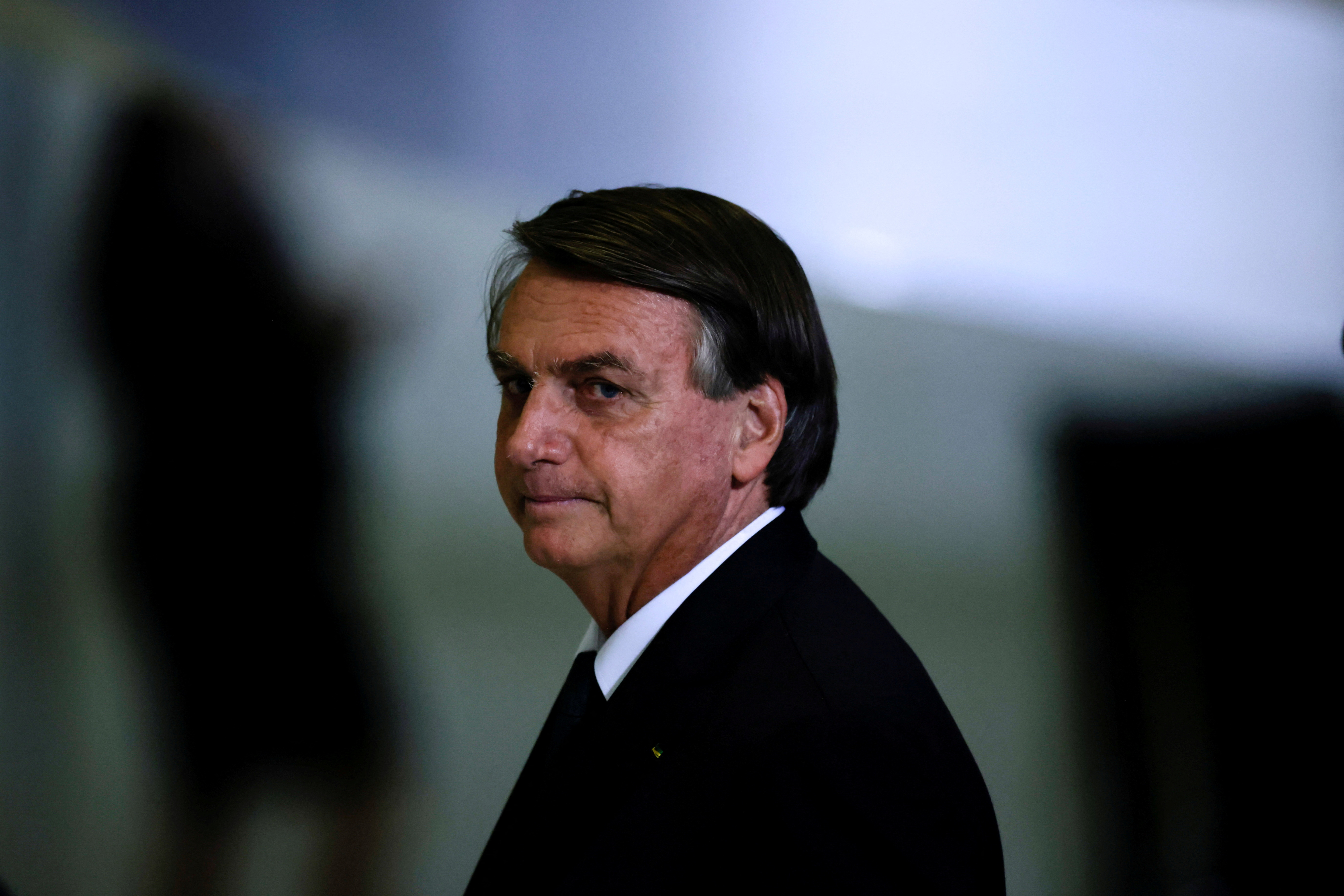
Brazil’s President Jair Bolsonaro looks on after a ceremony about the National Policy for Education at the Planalto Palace in Brasilia, Brazil June 20, 2022. REUTERS/Ueslei Marcelino

A couple walks in front of the house where former Brazilian President Jair Bolsonaro is staying, in Kissimmee, Florida, U.S., January 11, 2023. REUTERS/Marco Bello
Categories
Audio Sources - Full Text Articles

Memphis police suspend officer after firing 5 in Tyre Nichols case

2023-01-30T20:22:14Z

Days after five Memphis police officers were fired and charged with murder in the fatal beating of Tyre Nichols, a sixth officer was suspended pending an investigation into his role in the case, the department said on Monday.

The suspended officer – identified as Preston Hemphill – was relieved of duty with pay pending a hearing, a Memphis Police Department spokesperson said, noting that an investigation was under way. He declined to comment on Hemphill’s specific involvement in the case.

No criminal charges have been announced against Hemphill, who has worked for the department since 2018.

The five dismissed officers – all of them Black – have been charged with second-degree murder, assault, kidnapping, official misconduct and oppression in the death of Nichols, a 29-year-old who was beaten by police after a traffic stop. Hemphill is white.

One of four videos of the arrest released to the public on Friday included footage from Hemphill’s body camera, the New York Times reported, citing a statement from his attorney, Lee Gerald. Reuters could not immediately reach Gerald for comment.

Gerald told the Times that Hemphill was present for the traffic stop but not the beating of Nichols, which took place in a second location after Nichols ran away.

“He was never present at the second scene,” Gerald said, adding that Hemphill was cooperating with the investigation.

In one of the videos, an officer is seen using a Taser on Nichols while other officers held him down on the ground. Hemphill has been identified as the officer who fired the Taser at Nichols, according to WHBQ, a local Fox affiliate in Memphis.

On Friday, the department released footage from body-worn cameras and a camera mounted on a utility pole showing officers kicking, punching and striking Nichols with a baton in his mother’s neighborhood after the Jan. 7 traffic stop. He was hospitalized and died of his injuries three days later.

After the release of the videos, protesters over the weekend gathered and called for policing reforms in Memphis and other cities throughout the nation, from New York City to Sacramento, California, where Nichols once lived.

The peaceful demonstrations have been a stark contrast to scenes of civil unrest after bystander video of the 2020 police murder of George Floyd in Minneapolis shocked the nation.

The Memphis branch of the NAACP on Sunday called for all officers and first responders involved in the violent incident to be held accountable.

Some of the officers involved in the beating were a part of SCORPION, the specialized police unit that the department disbanded on Saturday.

Since the incident, protesters in Memphis have demanded that the department identify all officers on the scene of the beating and release their personnel files, the Commercial Appeal newspaper reported.

Last week, the Memphis Fire Department said that two employees who responded to the incident were “relieved of duty.”

Related Galleries:

A view shows a memorial for Tyre Nichols at the intersection of Castlegate Lane and Bear Creek Cove in Memphis, Tennessee, U.S., January 30, 2023. This memorial marks the area where Tyre Nichols was beaten during a traffic stop by Memphis police officers. He later died from his injuries. REUTERS/Alyssa Pointer

Memphis Police Department officer Preston Hemphill poses at a graduation ceremony for the 97th Crisis Intervention Class in Memphis, Tennessee, U.S. July 21, 2022. Memphis Police Department/Handout via REUTERS

A Memphis Police Department video surveillance camera is mounted near a memorial for Tyre Nichols at the intersection of Castlegate Lane and Bear Creek Cove in Memphis, Tennessee, U.S., January 30, 2023. This memorial marks the area where Tyre Nichols was beaten during a traffic stop by Memphis police officers. He later died from his injuries. REUTERS/Alyssa Pointer

People protest against the fatal beating of Black motorist Tyre Nichols by Memphis Police officers, during a rally in Oakland, California, U.S. January 29, 2023. REUTERS/Laure Andrillon

An image is projected onto the facade of the Oakland Police Department during a protest against the fatal beating of Black motorist Tyre Nichols by Memphis Police officers, during a rally in Oakland, California, U.S. January 29, 2023. REUTERS/Laure Andrillon


Categories
Audio Sources - Full Text Articles

Investors are pouring cash into crypto at the highest level in 6 months as risk appetite returns and bitcoin wraps up best January since 2013

Bitcoin offices in Istanbul, Turkey on June 21, 2022.Bitcoin has

Umit Turhan Coskun/Getty Images

  • Inflows into crypto more than tripled last week to the highest amount since July 2022.
  • The bulk of the funds went into bitcoin as the cryptocurrency’s price has soared to kick off 2023.
  • Investors veered away from products that made short bets on bitcoin. 

Inflows into cryptocurrency investment products more than tripled last week, with the swift spike concentrated in bitcoin as the world’s most popular token headed for its strongest January performance in nearly a decade. 

Investment in digital assets rose to $117 million, the largest amount since July 2022, digital asset management firm CoinShares said in a weekly update published Monday. The bulk of that amount—$116 million—was poured into bitcoin.  

A week earlier, inflows into crypto products clocked in at $36 million, but 68% went into short-investment products or those that profit when the price of the underlying asset falls. 

The funding wave accelerated as bitcoin’s price continued to rise from the start of 2023. This month through mid-Monday trade, the cryptocurrency has soared about 40%, putting it on track for its best January gain since 2013. It traded at around $23,125 on Monday. 

The inflows into short-bitcoin products were “minor” last week, at $4.4 million, CoinShares said. 

Bitcoin has been in recovery mode so far this year after its 64% plunge in 2022.  

“[Speculators] believe that bitcoin’s winter is over,” Naeem Aslam, chief market analyst at AvaTrade, said in a note late last week. At the same time, weakness in the US dollar as the Federal Reserve appears closer to pausing rate hikes has supported price gains for bitcoin and other cryptocurrencies, he said. 

Total assets under management in investment products have risen 43% from their lows in November to $28 billion. 

Geographically, Germany last week drew in the highest inflow amount, with 40% at $46 million. Canada logged $30 million, the US pulled in $26 million, and Switzerland landed $23 million.

Read the original article on Business Insider
Categories
Audio Sources - Full Text Articles

The sizzling rally in stocks is nearing its end as investors are about to realize a recession has merely been postponed, JPMorgan says

trader nyse asleep

Getty Images

  • The sizzling rally in stocks will come to an end, as the risks of recession have only been postponed, JPMorgan said.
  • Though investors are less worried about a downturn, some areas of GDP data are still weak, and interest rates remain high.
  • “A weak trajectory for US domestic demand keeps recession risk elevated, even as the tightness in labor markets postpones this recession risk.”

The sizzling rally in stocks is coming to an end soon as investors are about to realize that a recession has only been postponed, not avoided, according to JPMorgan.

After a dismal performance in 2022, the S&P 500 has jumped 5% since the start of the year, largely spurred by positive economic data. December inflation clocked in below economists’ expectations at 6.5%, and fourth-quarter GDP showed the economy grew a robust 2.9%, leading some investors to worry less about a recession.

Not so fast, said JPMorgan strategists led by Marko Kolanovic.

“We believe investors should fade the [2023] rally as recession risks are merely postponed rather than diminished,” the bank said in a note on Monday, warning investors not to grow too bullish on the latest gains in stocks.

Markets are now pricing in a 59% chance of a downturn, compared to a 90% chance in mid-October.

But that optimism about the economy could be premature, strategists warned. They noted that while headline GDP was strong, the report showed weaker performance in specific areas, such as private demand, fixed investments, and exports – all signs that economic activity is slowing down. 

“A weak trajectory for US domestic demand keeps recession risk elevated, even as the tightness in labor markets postpones this recession risk,” the note said.

That weakness is also exacerbated by high interest rates, strategists said, with the fed funds rate approaching 5%. 

Central bankers hiked interest rates aggressively last year in a scramble to bring down inflation and cool the hot labor market, but rates that high could easily tip the economy into a recession, experts warn. 

At 4.25%-4.50%, the benchmark rate is currently at its highest level since the 2008 recession, and markets are broadly expecting at least two more 25-basis-point hikes before the Fed pauses its tightening efforts.

“Unless the Fed starts cutting its nominal policy rates, these restrictive real policy rates would represent an ongoing headwind, keeping the risk of an eventual recession later in the year relatively high,” strategists added.

Separately, JPMorgan’s chief investment officer warned that a recession was needed in order for inflation to come down.

CEO Jamie Dimon also has said he saw at least a mild recession hitting the US economy this year, though his team was preparing for a more serious downturn. That could cause the S&P 500 to lose 20%, he predicted, forecasting another tough year for stocks.

Read the original article on Business Insider
Categories
Audio Sources - Full Text Articles

BuzzFeed writers react with a mix of disappointment and excitement at news that AI-generated content is coming to the website

BuzzFeedSome BuzzFeed writers express a mix of disappointment and excitement over the use of AI to generate content.

SOPA Images/Getty Images

  • Some BuzzFeed writers told Insider that they are disappointed by the company’s move to use AI for content.
  • But one BuzzFeed staffer said that its an exciting development and that it won’t replace jobs. 
  • The mixed reactions come amid conversations over whether AI will replace the need for writers.

BuzzFeed announced last week that it will be using AI technology made by ChatGPT maker OpenAI to help generate quizzes and new forms of content.

The response from writers for the website was mixed.

Some told Insider that they are worried about how the AI will impact the quality of Buzzfeed’s content. Another source was unfazed by the news, even excited by it.

One BuzzFeed writer — a contracted freelancer who requested anonymity in order to speak freely — told Insider that she was “hugely disappointed” to learn that BuzzFeed will be using the chat bot to make content, though she wasn’t surprised since BuzzFeed laid off 12% of its workforce last December.

“It was clear things were only going to go downhill from there,” she said.

The freelancer said that she doesn’t think the AI will squeeze her out of her job. However, she’s concerned that readers will stop engaging with BuzzFeed if they realize the articles aren’t written by real people and feel the content is worse.

“My general thought process right now is it’s less likely for me to lose the contract because of the AI installation itself and instead a worry that Buzzfeed itself will dissolve after losing all integrity and any remaining trust that existed once the AI articles begin popping up,” she said. 

Another BuzzFeeder who is on-staff told Insider that the adaptation of AI “is obviously a terrible move for all of BuzzFeed Inc’s employees.

Like the freelancer, the BuzzFeed employee isn’t afraid that the move will terminate her job. But she worries that the quality of BuzzFeed content will suffer as a result. 

“The best thing about BuzzFeed and the part everyone has always gravitated towards is the personality-driven content and the connection it fosters with readers/viewers,” the employee said. “If you take that away, I don’t see how the quality and performance won’t crash and burn.”

But a second BuzzFeed staffer told Insider that she isn’t worried that AI will replace writers at the company. In fact, she said that she is looking forward to the AI integration.

During an all-hands meeting Thursday, the second BuzzFeed staffer recalled hearing from CEO Jonah Peretti that AI — as of now — will only be used to generate new forms of quizzes where they will spit out different answers depending on the person. And this is content that only AI can produce, she recalled Peretti saying. 

“I think the actual applications of how this will apply to new quiz formats is exciting,” the second BuzzFeed staffer said.

A BuzzFeed spokesperson clarified to Insider that its AI tool will not be fully creating the quizzes. Rather, BuzzFeed staffers will be responsible for writing the quizzes and the AI will only be used to generate an infinite number of responses, they said.

It’s all part of BuzzFeed’s new strategy to “build the premier platform for AI-powered content” with the goal to “maximize the success” of its content creators in an effort to cut costs and stay financially afloat, according to an internal memo from CEO Jonah Peretti sent to BuzzFeed staff that was obtained by Insider.

‘When you see this work in action, it is pretty amazing’

Jonah PerettiBuzzFeed CEO Jonah Peretti emailed staff about the company’s plan to use ChatGPT maker OpenAI’s tech in future content.

Getty Images/Kimberly White

“Our work in AI-powered creativity is also off to a good start, and in 2023, you’ll see AI inspired content move from an R&D stage to part of our core business,” Peretti wrote in the memo. 

In addition to generating new quiz formats, BuzzFeed’s internal AI tool will also be used for “informing our brainstorming” and “personalizing our content for our audience,” the memo said.

Amid a challenging economy, the rise of ChatGPT continues to spark debates on whether the impressive AI will replace writers and jobs. An internal AI tool has already been used by tech news site CNET which revealed that it has been using AI to write dozens of articles for months as part of an experiment.

However, CNET later announced that it is pausing its usage of AI to produce content after identifying multiple errors, such as incomplete company names and errors in basic math that required corrections.

Peretti told CNN that BuzzFeed will use AI responsibly. 

“There’s the CNET path, and then there is the path that BuzzFeed is focused on,” Peretti told CNN. “One is about costs and volume of content, and one is about ability.”

While the move to adapt AI like ChatGPT has irked some writers, investors are loving it. In fact, BuzzFeed’s stock jumped to as high as 200% after the news was announced

One concerned BuzzFeed staffer called the stock price jump “darkly hilarious.”

“It just shows how the free market truly does not care about humans, whether consumers OR laborers, just the perception of growth and innovation,” she said. 

For now, BuzzFeed said that the AI tool will only be used by the quiz team starting in February and expressed excitement over its editorial possibilities.

“When you see this work in action, it is pretty amazing,” Peretti said in the memo. 

Read the original article on Business Insider
Categories
Audio Sources - Full Text Articles

VIDEO: Iran reports that drones attacked a military factory in Isfahan

63d815dafc184700195558a5?format=jpeg

  • Iran says that several drones targeted a military factory in Isfahan.
  • US media outlets reported that Israel was behind the attacks, citing senior US officials.
  • The attacks come as Iran supplies Russia with arms in its war on Ukraine.

Iran says multiple drones targeted one of its military factories. US media reported Israel was behind the attack.

Read the original article on Business Insider
Categories
Audio Sources - Full Text Articles

Donald Trump is now in the process of being criminally indicted by grand juries in three different jurisdictions

Help support Palmer Report! Our articles are all 100% free to read, with no forced subscriptions and nothing hidden behind paywalls. If you value our content, you’re welcome to pay for it:

Pay $5 to Palmer Report:

Pay $25 to Palmer Report:

Pay $75 to Palmer Report:


Help fund Palmer Report here

Pay $5 to Palmer Report:

Pay $25 to Palmer Report:

Pay $75 to Palmer Report:


When Manhattan District Attorney Alvin Bragg decided last year not to criminally indict Donald Trump for his Trump Organization financial fraud, it seemed obvious that Bragg was simply trying to avoid being the first to indict Trump, and that he’d eventually indict him on something. After all, Bragg would have zero chance of reelection in Manhattan if he doesn’t end up indicting Trump.

Last week Fulton County District Attorney Fani Willis told the court that indictment decisions in her criminal probe against Donald Trump were “imminent.” Now that Willis is seemingly just days away from indicting Trump, it’s perhaps not a surprise that Alvin Bragg is now also in the process of indicting Trump.

Bragg is presenting evidence of Donald Trump’s campaign finance fraud to a grand jury, per the New York Times. Specifically, Trump is being criminally targeted for illegally using campaign money as part of his payoff scheme to keep Stormy Daniels quiet. This is the same Trump criminal plot which previously sent Michael Cohen to prison. So all that Bragg really has to do is show that Cohen was acting upon Trump’s instruction.

Michael Cohen responded to today’s news by retweeting a reminder that he met with the Manhattan DA’s office just two weeks ago. Cohen also retweeted a reporter who stated that campaign finance charges could be the “most dangerous criminal case” against Trump, in terms of landing a conviction.


The public will understandably be wary of Alvin Bragg until he actually indicts Trump, given how badly Bragg has dragged his feet up to this point. But there would be no reason for Bragg to go to the effort of presenting a criminal case against Trump to a grand jury, and leaking to the media that he’s doing so, unless he’s already decided to go through with indicting Trump. Bragg was seemingly just waiting until word came down that the Fulton County DA is now just days away from indicting Trump, meaning Bragg will get to indict Trump second (or third) instead of first.

This all comes after Bloomberg reported roughly two weeks ago that DOJ Special Counsel Jack Smith was just weeks away from critical indictment decisions in his own criminal case against Donald Trump. This means Trump is now on track to be indicted by three different sets of prosecutors, each of which will put him on criminal trial. It’s been tricky to predict the timing, but this was always coming. And now we’re here.

Help fund the Ruben Gallego 2024 Senate campaign here

Help fund Palmer Report here

Pay $5 to Palmer Report:

Pay $25 to Palmer Report:

Pay $75 to Palmer Report:

Help fund the Ruben Gallego 2024 Senate campaign here

Help fund Palmer Report here

Pay $5 to Palmer Report:

Pay $25 to Palmer Report:

Pay $75 to Palmer Report:

The post Donald Trump is now in the process of being criminally indicted by grand juries in three different jurisdictions appeared first on Palmer Report.

WP Radio
WP Radio
OFFLINE LIVE