Categories
Audio Sources - Full Text Articles

‘The Bachelor’ season 27 stars former ‘Bachelorette’ contestant Zach Shallcross — here’s how to stream new episodes

When you buy through our links, Insider may earn an affiliate commission. Learn more.

jesse palmer, brianna, and zach shallcross of season 27 of the bachelor standing on stage of the finale‘The Bachelor’ season 27 follows Zach Shallcross’ quest for love.

ABC/Craig Sjodin

  • “The Bachelor” season 27 premieres on January 23 at 8 p.m. ET on ABC.
  • The reality dating competition stars former “Bachelorette” contestant Zach Shallcross. 
  • You can watch new “Bachelor” episodes on ABC, or stream them the next day on Hulu.

“The Bachelor” kicks off its 27th season on January 23 at 8 p.m. ET on ABC. The two-hour premiere follows Zach Shallcross as he meets 30 women looking for love. 

Shallcross is a 26-year-old tech executive from Anaheim Hills, California, searching for his true match. The former “Bachelorette” contestant didn’t win in season 19, but now he has another shot at love with a roster of hopefuls fighting for his rose.

Check out the trailer for ‘The Bachelor’ season 27

This season, the show visits Estonia, The Bahamas, England, Hungary, Thailand, and more. However, it all begins in the series’ famous Los Angeles mansion. Host Jesse Palmer, who began presenting the show in 2021, returns for season 27.

How to watch ‘The Bachelor’ season 27

You can watch “The Bachelor” season 27 on ABC starting January 23 at 8 p.m. ET. The premiere is a two-hour special, and a new episode is set to debut at the same time every Monday. Episodes will also stream weekly on Hulu every Tuesday.

If you don’t already have access to ABC through cable or a digital antenna, you can stream “The Bachelor” at the same time it airs on TV through services like Fubo TV, YouTube TV, and Hulu with Live TV. Of those platforms, YouTube TV is the cheapest at $65 a month ($55 a month for your first three months).

If you don’t mind waiting an extra day, however, your cheapest option to watch season 27 of “The Bachelor” is a standard Hulu subscription. New episodes of “The Bachelor” will be available to stream on Hulu the day after they air on ABC. 

Hulu costs $8 a month for ad-supported streaming, or $15 a month for ad-free streaming. Once you become a member, you can watch Hulu on web browsers, smart TVs, tablets, smartphones, or gaming consoles from most major brands. 

Can I watch ‘The Bachelor’ season 27 for free?

You can stream “The Bachelor” season 27 premiere for free if you sign up for a trial to a live TV streaming service. To catch the show as it airs on ABC, we recommend signing up for a free seven-day trial to Fubo TV. You’ll be able to stream one episode as it airs before your trial ends.

Alternatively, new Hulu subscribers can get their first 30 days for free. Though Hulu won’t let you watch episodes of “The Bachelor” as they air on TV, you can stream new episodes on-demand the next day. If you’re hoping to catch the entire season without paying, we suggest waiting until the final episodes premiere to sign up — that way you can watch every episode during your 30-day trial. 

“The Bachelor” is also available to watch for free via over-the-air TV if you have a digital antenna with broadcast reception to ABC in your area.

Who is competing in season 27 of ‘The Bachelor’?

Season 27 of “The Bachelor” features a cast of 30 contestants competing for Shallcross’ affections. They range in age from 23 to 30, with a wide variety of occupations. 

Here’s a list of “The Bachelor” season 27 hopefuls:

  • Alyssa “Aly” Jacobs (Smyrna, GA)
  • Anastasia Keramidas (Baltimore, MD)
  • Ariel Frenkel (Manhattan, NY)
  • Bailey Brown (Brentwood, TN)
  • Becca Serrano (Burbank, CA)
  • Brianna Thorbourne (Jersey City, NJ)
  • Brooklyn Willie (Mineola, TX)
  • Cara Ammon (Pittsburgh, PA)
  • Catherine “Cat” Wong (Chevy Chase, MD)
  • Charity Lawson (Columbus, GA)
  • Christina Mandrell (Henderson, TN)
  • Davia Bunch (Roebuck, SC)
  • Gabriella “Gabi” Elnicki (Pittsford, VT)
  • Genevie Mayo (Baltimore, MD)
  • Greer Blitzer (Bellaire, TX)
  • Holland Parsons (Boca Raton, FL)
  • Jessica “Jess” Girod (Winter Springs, FL)
  • Kaitlyn “Kaity” Biggar (Kingston, Ontario)
  • Katherine Izzo (Tampa, FL)
  • Kimberly Gutierrez (Stroudsburg, PA)
  • Kylee Russell (Charlotte, NC)
  • Lekha Ravi (Miami, FL)
  • Madison Johnson (Fargo, ND)
  • Mercedes Northup (Bloomfield, IA)
  • Olivia Lewis (Churchville, NY)
  • Olivia Miller (Delphos, OH)
  • Sonia Sharma (Jericho, NY)
  • Vanessa Dinh (Farmington Hills, MI)
  • Victoria Jameson (Keller, TX)
  • Viktoria Eichner (Vienna, Austria)

Read the original article on Business Insider
Categories
Audio Sources - Full Text Articles

The Fight Over Non-Competes Is Heating Up. The FTC Must Stand Strong

On January 5, the Federal Trade Commission announced a policy initiative that could be a major boon for labor. It proposed to ban non-compete clauses for all workers—no exceptions. These contracts bind tens of millions of workers today across nearly all occupations. The FTC estimated its proposed prohibition could increase workers’ collective earnings by as much as $300 billion per year.

The FTC’s proposal did not come easily or quickly. In March 2019, a broad public interest and labor coalition, led by the Open Markets Institute (where I work) and included the AFL-CIO, Public Citizen, and SEIU, petitioned for this rule—a petition lauded by two of the Democrats on the four-member Commission in their statement supporting the FTC’s proposal. Since the submission of our petition, we repeatedly urged the FTC to initiate action. President Joe Biden gave the effort a big boost when he encouraged the FTC to regulate non-compete clauses in a July 2021 executive order.

[time-brightcove not-tgx=”true”]

But the real fight is just beginning. The proposed rule opened a public comment period that ends on Monday, March 20 in which we can all submit comments (including anonymously). After the close of this window, the FTC will review all the comments and publish a final rule, incorporating and responding to the input it receives. Employers and their trade associations have already attacked the proposal and will lobby to weaken the FTC’s final rule. And they will certainly challenge the rule in court. The FTC, however, must hold the line and do everything it can to deliver a win for all workers in the United States.

Non-compete clauses have no place in labor markets. These contracts prevent workers from leaving for greener employment pastures and starting their own businesses.

In its thoroughly researched proposal, the FTC described the negative effects of non-compete contracts in rich detail. They depress labor market mobility and reduce wages and wage growth (regardless of whether employers can or do enforce them in court) and contribute to racial and gender wage gaps. This negative effect extends even to the very top of the income scale. Economic analysis found that non-competes depress compensation for chief executive officers. If CEOs, who typically hire lawyers to negotiate their employment contracts and enjoy significant bargaining power, cannot protect themselves from the adverse effects of non-competes, what hope do the rest of us have? Further, non-compete clauses shore up the power of dominant corporations by closing off paths to entrepreneurship and restricting workers’ ability to move from big businesses to small firms.

The common justification for non-competes does not withstand scrutiny. Employers insist they need these contracts to protect, among other things, their investment in training workers and trade secrets. As legal scholar Viva Moffat wrote, however, non-competes are “the wrong tool for the job.” Employers have superior means of retaining workers and safeguarding business information. As we have seen of late, employers can and should attract and keep workers by paying good wages, offering better benefits, and improving working conditions—not by locking them up through contractual restraints.

To protect trade secrets and other proprietary information, employers have several legal tools, such as trade secret law and tailored non-solicitation agreements. Further, while some legal protection of information encourages the production of creative works and inventions, which is why Congress enacted the copyright and patent laws, too much protection, through non-competes or other means, can impede the important sharing and synthesis of knowledge and knowhow that drive technological advancement.

Because it deprives them of an important tool to control workers, corporate interests will fight an FTC rule. Many employers would much rather use non-compete clauses than pay higher wages to retain staff.

Industry trade associations wasted no time expressing their opposition to the FTC’s proposal. On the day the FTC announced its proposed ban, the U.S. Chamber of Commerce called the FTC’s action “blatantly unlawful” and asserted “noncompete agreements are an important tool in fostering innovation and preserving competition.”

Voices less hostile or even sympathetic to FTC action against non-competes will cite legal risk as a reason to weaken the final rule. A diluted, alternative rule might protect only a segment of the workforce, such as low-wage workers, or permit employers to offer justifications for using non-competes. To be sure, the courts today are generally against progressive administrative action. The Supreme Court has manufactured new legal doctrines that give itself and judges on the lower courts broad authority to strike down regulations and other administrative actions they do not like. An FTC rule is far from certain to survive a judicial challenge.

Opponents of the rule will have no shortage of possible legal arguments. In her dissenting statement against the proposal, Christine Wilson, the one Republican commissioner at the FTC, served up a menu of theories to those who want to challenge an eventual rule in court.

Yet, given the abundant evidence supporting the FTC’s proposal, the threat of judicial invalidation is not enough to justify a watered-down final rule. Indeed, the factual record presented by the FTC makes anything short of a complete ban hard for the agency to defend. Finessing the rule in an attempt to win over judges ideologically opposed to FTC action on non-competes is unlikely to succeed and more likely to produce disappointment and disenchantment among supporters of the FTC in Congress and the broader public.

Instead the FTC (and other regulators contemplating big moves) should do the right thing, forcing judges’ hand and making them do things that are bad for the public and unpopular, if they so choose. This would make the practical consequences of judicial supremacy even more clear for everyone. Reining in the awesome power of the courts calls for direct confrontation, not defensiveness and timidity.

The fight over the future of non-compete clauses in the U.S. has begun in earnest. During the ongoing public comment period on its proposed rule, the FTC will hear from supporters and opponents. People from all walks of life will share their experiences with non-compete clauses, including forsaking opportunities for raises and career advancement, not pursuing entrepreneurial dreams, finding a new line of work, and being forced to stay in abusive and discriminatory work environments. Their stories will likely only further strengthen the FTC’s case for a complete ban on these coercive contracts. Despite the intense pressure it will face from some of the most powerful interests in the country, the FTC, following the comment period, should quickly make clear it is on the side of working people and enact a complete ban on non-compete clauses.

Categories
Audio Sources - Full Text Articles

FDA Proposes Annual COVID-19 Shots for Most Americans

WASHINGTON — U.S. health officials want to make COVID-19 vaccinations more like the annual flu shot.

The Food and Drug Administration on Monday proposed a simplified approach for future vaccination efforts, allowing most adults and children to get a once-a-year shot to protect against the mutating virus.

This means Americans would no longer have to keep track of how many shots they’ve received or how many months it’s been since their last booster.

The proposal comes as boosters have become a hard sell. While more than 80% of the U.S. population has had at least one vaccine dose, only 16% of those eligible have received the latest boosters authorized in August.

[time-brightcove not-tgx=”true”]

The FDA will ask its panel of outside vaccine experts to weigh in at a meeting Thursday. The agency is expected to take their advice into consideration while deciding future vaccine requirements for manufacturers.

In documents posted online, FDA scientists say many Americans now have “sufficient preexisting immunity” against the coronavirus because of vaccination, infection or a combination of the two. That baseline of protection should be enough to move to an annual booster against the latest strains in circulation and make COVID-19 vaccinations more like the yearly flu shot, according to the agency.

Read More: How COVID-19 Immunity Works at This Point in the Pandemic

For adults with weakened immune systems and very small children, a two-dose combination may be needed for protection. FDA scientists and vaccine companies would study vaccination, infection rates and other data to decide who should receive a single shot versus a two-dose series.

FDA will also ask its panel to vote on whether all vaccines should target the same strains. That step would be needed to make the shots interchangeable, doing away with the current complicated system of primary vaccinations and boosters.

The initial shots from Pfizer and Moderna — called the primary series — target the strain of the virus that first emerged in 2020 and quickly swept across the world. The updated boosters launched last fall were also tweaked to target omicron relatives that had been dominant.

Under FDA’s proposal, the agency, independent experts and manufacturers would decide annually on which strains to target by the early summer, allowing several months to produce and launch updated shots before the fall. That’s roughly the same approach long used to select the strains for the annual flu shot.

Ultimately, FDA officials say moving to an annual schedule would make it easier to promote future vaccination campaigns, which could ultimately boost vaccination rates nationwide.

Read More: Here’s How Effective the Original Vaccines Are Against Omicron

The original two-dose COVID shots have offered strong protection against severe disease and death no matter the variant, but protection against mild infection wanes. Experts continue to debate whether the latest round of boosters significantly enhanced protection, particularly for younger, healthy Americans.

Categories
Audio Sources - Full Text Articles

Russia installs air-defense systems in Moscow, as US focus remains on ‘supporting Ukraine’

Russia has installed air-defense techniques in quite a few destinations in and all over Moscow soon after several Ukrainian drone strikes in Russian territory, Fox News has figured out, but some officers are not involved and keep on being concentrated on encouraging Ukraine defend itself. 

One particular air-defense technique, according to social media posts Friday, was put in on leading of the Russian Protection Army headquarters in Moscow.

“We’re mindful of the current reviews, but we’re not going to speculate on hypothetical predicaments,” a Pentagon spokesman, Maritime Corps Lt. Col. Garron J. Garn, explained to Fox Information Electronic Monday.

UKRAINE-RUSSIA WAR: ZELENSKYY Suggests HE Are unable to USE ‘WORDS Instead OF GUNS’ AS Protection CHIEFS Fail ON TANK Deal

One air-defense system, according to social media posts Friday, was installed on top of the Russian Defense Military headquarters in Moscow.

One particular air-defense procedure, according to social media posts Friday, was set up on top rated of the Russian Defense Armed forces headquarters in Moscow.

(AP)

“Our target continues to be on supporting Ukraine with the means to deter and defend alone in opposition to even more Russian aggression,” Garn added.

Some western officers advised Fox News they are not concerned that Ukraine would deploy unmanned aerial motor vehicle (UAV) strikes that deeply into Russia that Moscow would be affected.

However, some U.S. analysts imagine the Kremlin has found Ukraine’s long-vary UAV capabilities in the latest strikes, and has set up the methods in response.

Fox Information has also figured out that those analysts believe the installation comes as a signal that Russia acknowledges the porous mother nature of its existing air-defense methods.

US ADVISES UKRAINE TO Hold OFF ON Big OFFENSIVE Right until Newest ARMS Cargo: REPORT

But former U.S. intelligence official Rebekah Koffler informed Fox Information Digital she believes that Putin is preparing for “substantial escalation.”

Fox News has learned that analysts believe the installation comes as a signal that Russia acknowledges the porous nature of its current air-defense systems.

Fox Information has figured out that analysts think the set up arrives as a signal that Russia acknowledges the porous nature of its recent air-protection techniques.

(Sputnik/Mikhail Klimentyev/Kremlin by using Reuters)

“These are preparations for a big-scale war that could entangle the United States,” Koffler said. “That is what Putin is making ready for.”

Koffler, a previous DIA intelligence officer and the writer of “Putin’s Playbook: Russia’s Key Strategy to Defeat The us,” instructed Fox News Digital that the air-protection devices are “strategically positioned in areas where by Putin and the Russian elites reside.”

“There is another broader missile protection that addresses the complete Moscow, but there are gaps,” Koffler described, noting that even though this motion is a preparing for an internal conflict, it could “spin out of handle.” 

US SENDING An additional $2.5 BILLION IN Military Support TO UKRAINE

“This is a company path to escalation,” Koffler stated.

Russian officials have not commented on the installations.

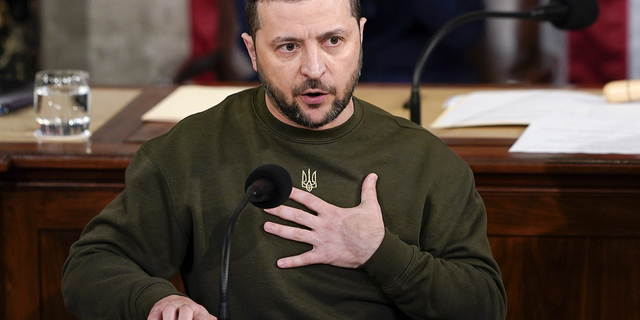
Ukrainian President Volodymyr Zelenskyy addressed a joint meeting of Congress on Capitol Hill on Dec. 21, 2022.

Ukrainian President Volodymyr Zelenskyy resolved a joint meeting of Congress on Capitol Hill on Dec. 21, 2022.

(AP/Carolyn Kaster)

Russia invaded Ukraine in February 2022. 

The U.S. has encouraged Kyiv to keep off on any major counter-offensives towards Russian forces in Ukraine until finally Washington’s hottest supply of weaponry and trainings have been supplied, a senior White Dwelling official reported, according to Reuters Saturday.

Simply click TO GET THE FOX Information App

Kyiv has not officially announced that it is scheduling an additional main counter-offensive just months just after it effectively ousted Russian troops from Kharkiv in the north and from the town of Kherson in the south, however it has continuously warned it thinks Moscow is taking methods to ramp up its war effort. 

The Associated Press contributed to this report. 

Brooke Singman is a Fox News Electronic politics reporter. You can reach her at Brooke.Singman@Fox.com or @BrookeSingman on Twitter.

Source connection

The post Russia installs air-defense systems in Moscow, as US focus remains on ‘supporting Ukraine’ appeared first on Ukraine Intelligence.

Categories
Audio Sources - Full Text Articles

Stocks, euro gain as Fed, ECB rate hike outlooks diverge

2023-01-23T22:07:47Z

Global equity markets surged on Monday as easing recession fears and hopes of a less aggressive Federal Reserve buoyed sentiment, while the likelihood of more jumbo interest rate hikes in Europe pushed the euro to a nine-month peak against the dollar.

Gains in chipmakers boosted beaten-down U.S. tech stocks as the market priced in a 95.8% probability of the Fed raising rates by 25 basis points to a range of 4.50% to 4.75% on Feb. 1.

Easing fears of a recession also helped lift equities, as they did in the euro zone, despite expectations the European Central Bank will hike rates by 50 basis points both on Feb. 2 and in March, according to a Reuters poll of economists.

The start of a big week for U.S. corporate earnings is expected to test a recent bounce in tech and other growth stocks as companies discuss their outlook amid a slowing economy.

Stocks are rallying as people mistakenly believe a proximate change in Fed policy will resolve worries about higher rates and their impact on the economy, said Jason Pride, chief investment officer of private wealth at Glenmede in Philadelphia.

“We are already at a point where if we stick at these numbers and hold them for a period of time, it is not good for the economy,” said Pride, referring to rates that he believes are now “restrictive” and squeezing economic growth.

“This is like other market rallies that we’ve seen within an ongoing bear market in that you have these periods of optimism seep in because people think that the story is changing enough that the problem is gone,” he said.

The Dow Jones Industrial Average (.DJI) rose 0.76%, the S&P 500 (.SPX) gained 1.19% and the Nasdaq Composite (.IXIC) added 2.01%, extending gains since late last month to more than 11%.

In Europe, technology firms also spearheaded gains as optimism about Europe likely avoiding a steep recession overshadowed recent hawkish remarks from ECB officials.

The pan-European STOXX 600 (.STOXX) closed up 0.6%, as declining natural gas prices eased recession fears.

Trading was thin in Asia, as markets in China, Hong Kong, Singapore, Malaysia, South Korea and Taiwan were closed for the Lunar New Year holiday.

MSCI’s U.S.-centric all-country index of stock performance in 47 countries (.MIWD00000PUS) rose 0.99% to close at an almost five-month high.

Investors are waiting for euro zone and U.S. flash PMI data on Tuesday, which are expected to show less severe economic contractions than the previous month, according to analysts polled by Reuters. The data is forecast to show more improvement in Europe than in the United States.

The difference in expectations for Fed and ECB policy led the euro to hit $1.0927 as it climbs from a two-decade low of $0.953 set in September. The single currency later pared gains against the dollar as it slid to $1.0869.

“The combination of a risk-off mood in the stock market and the divergence between the Fed and ECB allowed the euro to make new highs above 109,” said Marc Chandler, chief market strategist at Bannockburn Global Forex in New York.

Sterling traded at $1.2375, down 0.15%, while the Australian dollar, seen as a proxy for risk appetite, rose 0.86% to $0.7026. The Japanese yen weakened 0.83% at 130.67 per dollar.

Treasury yields rose to further erode a recent bond rally that some investors say was overdone in reflecting fears that the U.S. economy may soon enter a recession.

The yield on 10-year Treasury notes rose 3.7 basis points to 3.521%.

Euro zone bonds were little changed, with the benchmark 10-year German yield at 2.209% .

Crude prices settled mixed, retreating as investors cashed in on a jump to a seven-week high on optimism about a possible recovery in demand at top oil importer China, as the economy recovers this year from pandemic lockdowns.

Brent crude settled 56 cents higher at $88.19 a barrel. U.S. crude fell two cents to settle at $81.62.

U.S. gold futures settled little changed at $1,928.6.

Related Galleries:

A new 100-euro banknote is presented at the ECB headquarters in Frankfurt, Germany, September 17, 2018. REUTERS/Kai Pfaffenbach

Traders work on the trading floor at the New York Stock Exchange (NYSE) in New York City, U.S., January 5, 2023. REUTERS/Andrew Kelly

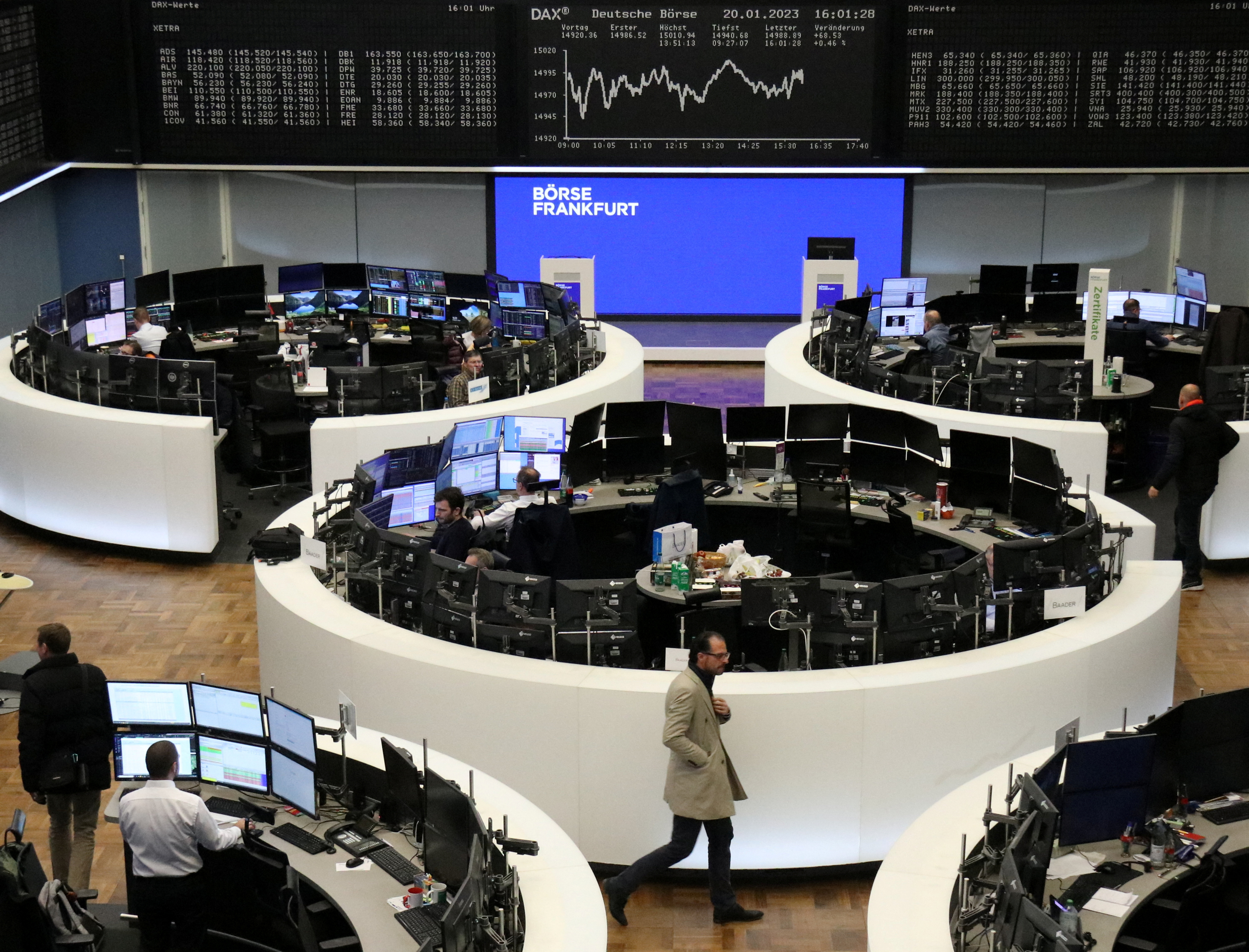
The German share price index DAX graph is pictured at the stock exchange in Frankfurt, Germany, January 20, 2023. REUTERS/Staff
Categories
Audio Sources - Full Text Articles

White House: DOJ searched Biden“s home after “voluntary, proactive offer“ by president“s lawyers

2023-01-23T22:10:36Z

U.S. President Joe Biden waves as he boards Air Force One for return travel to Washington, at Dover Air Force Base in Dover, Delaware, U.S., January 23, 2023. REUTERS/Ken Cedeno

The White House said on Monday that the search by the Justice Department of President Joe Biden’s home was carried out after a “voluntary, proactive offer” by the president’s personal lawyers to the Department of Justice.

Biden’s lawyers have kept him informed throughout this process as they have been in discussions with the Justice Department, White House spokesman Ian Sams said.

Sams declined to provide more clarity on the exact content of the materials taken from Biden’s Wilmington, Delaware, home.


Categories
Audio Sources - Full Text Articles

California shooting suspect was a regular at Monterey Park dance studio

2023-01-23T22:22:32Z

Brandon Tsay describes the moment he realized he had to disarm a gunman at the Lai Lai Ballroom, his family-run dance hall, in Alhambra, California, on Saturday (January 21) night and the “struggle” between them that came afterwards.

Flowers are left near the scene of a shooting that took place during a Chinese Lunar New Year celebration, in Monterey Park, California, U.S. January 22, 2023. REUTERS/Allison Dinner

The 72-year-old suspected gunman in Saturday night’s mass shooting at a Los Angeles-area dance studio had been a regular there, giving informal lessons and even meeting his ex-wife at the venue, according to friends and media reports.

Authorities say Huu Can Tran opened fire during a celebration of the Lunar New Year at the Star Ballroom Dance Studio, popular in the predominantly Asian American city of Monterey Park, east of Los Angeles. The death toll rose to 11 on Monday.

Tran went to another dance club in the neighboring city of Alhambra soon after the massacre, police say, but a patron there wrestled away his gun, possibly thwarting a second attack. Later, Tran died from a self-inflicted gunshot wound on Sunday as police approached a van he was driving.

It is exceedingly rare for a person over 70 to carry out a mass shooting. While authorities have not identified a motive, some details have emerged about Tran’s background.

Adam Hood, who said he has been a tenant for years in a property Tran owned and spoke to him frequently, told Reuters Tran was an angry, aggressive, distrustful person who did not have many friends but liked ballroom dancing, his main social activity.

“He was a good dancer,” said Hood, who met Tran in the early 2000s and said they bonded over their shared experience as Chinese immigrants. “But he was distrustful of the people at the studio, angry and distrustful. I think he just had enough.”

Tran complained that people at the studio were talking behind his back, Hood said.

CNN reported, citing an unnamed friend, that Tran complained the dance instructors said “evil things about him” and that Tran was “hostile” to a lot of people at the studio.

On Jan. 7 and Jan. 9, Tran visited the police department in Hemet, where he lived about 90 minutes from Monterey Park, to make “past fraud, theft and poisoning allegations involving his family” stemming from 10 to 20 years ago, according to a statement from the department on Monday.

He said he would come back with documentation but never returned, the statement said. A department spokesperson said police are not releasing more details about his claims at this time.

Police in Monterey Park had no prior interactions with Tran, Chief Scott Wiese said at a news conference on Monday.

Tran had an active trucking license and previously owned a company called Tran’s Trucking starting in 2002. He lived in San Gabriel, near Monterey Park, from the early 1990s until around 2014, records show.

Tran moved in 2020 to a mobile home in a private, gated senior living community with a nine-hole golf course in Hemet.

He met his ex-wife at the studio about two decades ago, she told CNN in an interview. Tran introduced himself to her and offered her free lessons.

While Tran was never violent, he was quick to anger, for instance if she missed a step while dancing, she told CNN. They divorced in 2005.

Efforts to interview the ex-wife at a house listed in records as her residence were unsuccessful on Monday. Tran never remarried and did not have a girlfriend, according to Hood, his tenant.

A database of 185 mass shootings between 1966 and 2022 maintained by The Violence Project, a nonprofit, includes only one carried out by someone 70 or older: a retired miner who killed five people in a store in Allen, Kentucky in 1981.

Categories
Audio Sources - Full Text Articles

Voters want Congress to address gun violence and mass shootings

By Gabriel R. Sanchez

Gun violence continues to be a major public health crisis across the country with the rise of mass shootings. There were more than 600 mass shooting events that took place in 2022 alone, and 2023 is so far unfortunately following the same trend, with an astonishing 36 mass shootings having already taken place across the country. In fact, over the past weekend, two mass shootings occurred, including an incident in Monterey Park, California that left 10 people dead, and a separate shooting at a night club in Louisiana resulting in numerous serious injuries.

The 2022 Midterm Voter Election Poll made clear that voters want Congress to address mass shootings and support a host of public policies aimed at addressing gun violence. When asked to identify the most important issues that they want Congress and the President to address, 17% of voters identified “mass shootings and gun policy” as one of their top priorities. Mass shootings were sixth among all priorities mentioned by voters, coming in higher than education or immigration. Mass shootings and gun policy are a high priority for voters regardless of whether they live in rural, suburban, or small or large urban areas of the country—voters from all geographical areas named gun policy as a key priority at either 16% or 17%.

GS_01232023_RPI_fig1

Although gun violence and mass shootings are a high priority for voters across all demographic groups, younger voters are more likely to view mass shootings and gun policy as a priority for Congress relative to older Americans across all racial groups. For example, a fourth (24%) of Latino and Black voters in the 18 to 29-year-old range found gun violence to be the most important issue for Congress to address, which is a higher share than older voters from these same communities.

The significance of gun violence among young adults is indicative of the generation that grew up in a challenging era in the United States where mass shooting events have been far too common, requiring regular mass shooting drills in schools to be employed. Young voters who prioritize gun policy reform are exasperated by the lack of movement from Congress to address gun violence in this country. They have since taken the matter into their own hands and have come together to create organizations aimed at gun violence prevention, with the most notable being March For Our Lives and Students Demand Action.

Race is also an important source of variation for voters when it comes to prioritizing mass shootings and gun violence as a policy issue. Mass shootings were particularly salient for voters from Latino, Black, and Asian-American communities, each of which ranked this issue fourth across policy priorities, just behind economic oriented issues and access to abortion and reproductive health.

This is likely a product of greater experience with mass shootings and gun violence among these communities. For example, a recent national survey of Latino families identified that nearly a fifth (18%) of Latino parents or their children have personally experienced gun violence at school or another public place. Given the surprisingly high rate of exposure to gun violence among Latino families, greater concern about mass shootings and gun violence among Latinos is unsurprising. As reflected in the figure below, over 80% of Latino parents are concerned that their child could be a victim of a mass shooting at some point in their life—with 62% admitting that they felt extremely concerned. This helps explain why two thirds of Latino parents believe it is very important that policymakers in their state “take more aggressive steps to address mass shootings.”

GS_01232023_RPI_fig2

Latino parents are much more likely (+31%) to believe that laws covering the sale of guns in their state should be stricter than to believe that people should be able to own firearms without limit or restriction. Nearly all survey respondents who believe there should be mandatory universal background checks for all firearms sales and that there should be a 10-day waiting period to purchase a firearm.

Regarding policy preferences, 68% of all 2022 voters support banning AR-15 style rifles. Similar to issue salience, there are significant differences based on race on this item. As reflected in the figure below, support for banning assault rifles is much higher among Black, Asian-American, and Latino voters. At 64% respectively, support for banning AR-15 style rifles nationwide is supported by a strong majority of both white and Native American voters as well.

Support for banning AR-15 style rifles varies by where voters live. Support is significantly higher in large urban areas, with 82% of voters who live in large cities expressing support for banning AR-15 rifles, compared to 70% of suburban residents and 59% of residents of small towns. Voters who live in rural areas are less likely to support banning AR-15 style rifles nationwide at 47% support.

GS_01232023_RPI_fig4(label3)

Federal and State Level Policy Interventions are Needed Now to Address Escalating Gun Violence

Banning assault rifles like AR-15s is a policy intervention being considered across the country. For example, at the federal level, Representative Cicilline (D-R.I.) introduced H.R.1808, the Assault Weapons Ban, in March of 2021. The bill is currently being reviewed by the Committee on the Judiciary, and then the Senate will vote on it. At the state level, eight states (California, Connecticut, Delaware, Hawaii, Maryland, Massachusetts, New Jersey, and New York), as well as the District of Columbia, have laws that generally ban the sale, manufacture, and transfer of assault weapons within their borders. However, there are active attempts to block this type of legislation. This includes gun rights activists in Maryland who have submitted a second filing with the Fourth U.S. Circuit Court of Appeals against the assault weapons ban in their state considering the Supreme Court’s decision in New York State Rifle & Pistol Association Inc. v. Bruen. This decision opens up the door for challenges to the constitutionality of these bans, which may prove to be problematic for the future of H.R.1808.

The Biden administration has plans to implement long-term strategies aimed at addressing the root causes of gun violence, including community violence intervention programs . These programs will take time to combat gun violence, so more immediate policy interventions will be needed to address the growing demand among the public to address mass shootings, which have skyrocketed over the past two years.

fblike20.png pinterest20.png twitter20.png email20.png rss20.png  
Categories
Audio Sources - Full Text Articles

Report: Biden Defense Department’s Weapon Supply Is Unprepared for a Conflict With China

The armaments industry that provides the Department of Defense’s weapon supply is “not adequately prepared” for any major regional conflicts, including a war with China in the Taiwan Strait, according to a study by the Center for Strategic and International Studies (CSIS).

The Washington, D.C.-based think tank found through a series of war games that the United States would quickly run out of munitions, particularly long-range, precision-guided munitions, if it ever faced a Taiwan Strait conflict. Outdated military contracting procedures and a sluggish bureaucracy are among the weaknesses that make it “extremely difficult for the United States to sustain a protracted conflict.”

The report took aim at the Foreign Military Sales program under President Joe Biden for failing to adapt to the current security environment and remaining “risk-averse, inefficient, and sluggish.” CSIS senior vice president Seth Jones, who wrote the report, is concerned that the problems with the industrial base are hurting the country’s ability to deter conflict in the Indo-Pacific region.

“How do you effectively deter if you don’t have sufficient stockpiles of the kinds of munitions you’re going to need for a China-Taiwan Strait kind of scenario?” Jones told the Wall Street Journal. “The bottom line is the defense industrial base, in my judgment, is not prepared for the security environment that now exists.”

The Biden administration’s military aid to Ukraine has exposed these major weaknesses, the study reports. The $27 billion worth of military supplies the United States has doled out to Ukraine has drained the U.S. munitions inventory to low levels, and defense manufacturers are not equipped to replenish them quickly, the Journal reports:

The number of Javelin shoulder-fired missiles sent to Ukraine since last August, for example, is equal to about seven years of production based on fiscal 2022 production rates, the study said.

The number of antiaircraft Stinger systems provided to Kyiv represent roughly the same number of systems exported abroad over the past 20 years, the study said. Meanwhile, the more than one million rounds of 155 mm ammunition sent to Ukraine by Washington has shrunk the U.S. military’s own supplies, which the study says are now considered low.

“The U.S. Department of Defense, in coordination with Congress, should develop a plan now that involves taking steps to streamline and improve production, acquisitions, replenishment, Foreign Military Sales, [International Traffic in Arms Regulations], and other policies and procedures,” the report’s summary says. “It is time to prepare for the era of competition that now exists.”

The post Report: Biden Defense Department’s Weapon Supply Is Unprepared for a Conflict With China appeared first on Washington Free Beacon.

Categories
Audio Sources - Full Text Articles

‘Blatant Obstruction’: GOP Lawmaker Blasts Biden for Withholding Information on Afghanistan Withdrawal

The Biden administration is withholding scores of documents and communications related to its botched withdrawal from Afghanistan, according to the newly installed chair of the House Foreign Affairs Committee. 

“I will not tolerate the Biden administration’s blatant obstruction of numerous congressional requests relating to the disastrous Afghanistan withdrawal,” Rep. Michael McCaul (R., Texas), chair of the House Foreign Affairs Committee, told the Washington Free Beacon. “Democrats have utterly failed to hold this administration accountable when our veterans and gold star wives deserve answers.”

McCaul says Republicans are ramping up oversight efforts meant to expose how the United States ignored intelligence indicating the country would fall to the Taliban. Upon taking the reins at the House Foreign Affairs Committee, McCaul sent a letter to the State Department asking it to turn over documents that could be used to provide the American public with a full account of the chaotic operation.

The State Department has refused for nearly a year and a half to hand over information about how many Americans remain stranded in the country, intelligence reports warning the country could collapse, internal assessments about the threat posed by ISIS and the Taliban, information about the Biden administration’s current engagement with the Taliban, and internal documents related to the deadly strike on Hamid Karzai International Airport that killed 13 American military members.

Without these documents, lawmakers are unable to piece together how the Biden administration’s hurried evacuation from the country fell apart. This information is viewed as central to efforts by both Democrats and Republicans to hold the administration accountable for its actions during the 2021 withdrawal.

“Past requests for documents and information on the withdrawal dating back to August 2021 have generally gone unanswered for well over a year,” McCaul wrote in the Jan. 12 letter to the State Department. “It is imperative that the State Department provide complete responses to these longstanding requests, and the committee will not tolerate continued delay.”

Congressional sources familiar with the issue said the State Department has not provided any documents requested by lawmakers as far back as August 2021.

The amount of information and documentation being withheld by the State Department comprises nearly 10 pages of McCaul’s letter, revealing the sheer number of documents the administration is keeping hidden.

This includes “all reports, intelligence assessments, and intelligence community products” centered on “the potential collapse or sustainability of the pre-Taliban government.” These documents are seen as vital to questions about whether the Biden administration knew its planned withdrawal would create the conditions needed for the Taliban to resurface and take power.

McCaul also wants “all documents resulting from State Department internal reviews related to the Afghanistan withdrawal.” This information could show the State Department did not adequately plan to evacuate U.S. personnel from the country and was caught off guard when the Taliban began preventing Americans from leaving the country. In the weeks after the 2021 evacuation, it became clear that the Biden administration has abandoned far more Americans than it publicly admitted, the Free Beacon reported at the time.

The Foreign Affairs Committee also is seeking “a list of all State Department and all other U.S. Government meetings and engagements with the Taliban since January 20, 2021.” These documents will show exactly how the United States is conducting diplomacy with the Taliban since they retook power. The Biden administration has been slow to answer specific questions about whether it is propping up the Taliban government and still providing it with taxpayer funds.

The State Department would not answer Free Beacon questions about McCaul’s oversight efforts, instead directing a reporter to recent remarks by spokesman Ned Price.

“This secretary is committed to engagement with this Congress,” Price said at a Jan. 12 press briefing. “We deeply believe, truly believe, that our foreign policy will be more effective, it will convey more legitimacy when the Congress understands what it is that we are doing, why are we seeking to do it, and optimally if it has bipartisan support.”

Price said McCaul was able to raise his concerns during meetings with Secretary of State Antony Blinken and other senior officials held on Jan. 11.

Asked if the administration will comply with McCaul’s oversight efforts, Price said, “we look forward to continuing our engagement with this Congress on those areas that are of interest to them and that most importantly are of priority to the American people.”

The post ‘Blatant Obstruction’: GOP Lawmaker Blasts Biden for Withholding Information on Afghanistan Withdrawal appeared first on Washington Free Beacon.

WP Radio
WP Radio
OFFLINE LIVE