Categories
Audio Sources - Full Text Articles

Russia, Syria restore Syrian air base for joint use

2023-01-23T22:27:05Z

Russia and Syria have restored the al-Jarrah military air base in Syria’s north to be jointly used, Russia’s Defence Ministry said late on Monday.

“Russian and Syrian military personnel restored the destroyed al-Jarrah airfield,” the ministry said on the Telegram messaging app.

“The joint basing of aviation of the Russian Aerospace Forces and the Syrian Air Force at the al-Jarrah airfield makes it possible to cover the state border.”

The small base east of Aleppo was recaptured from Islamic State fighters in 2017.

Russia has been a dominant military force in Syria since launching air strikes and ground operations there in 2015. It further asserted its presence after the United States pulled out its forces in 2019.

Categories
Audio Sources - Full Text Articles

U.S. raises “grave concerns“ over Mexico“s agricultural biotech policy

2023-01-23T22:43:37Z

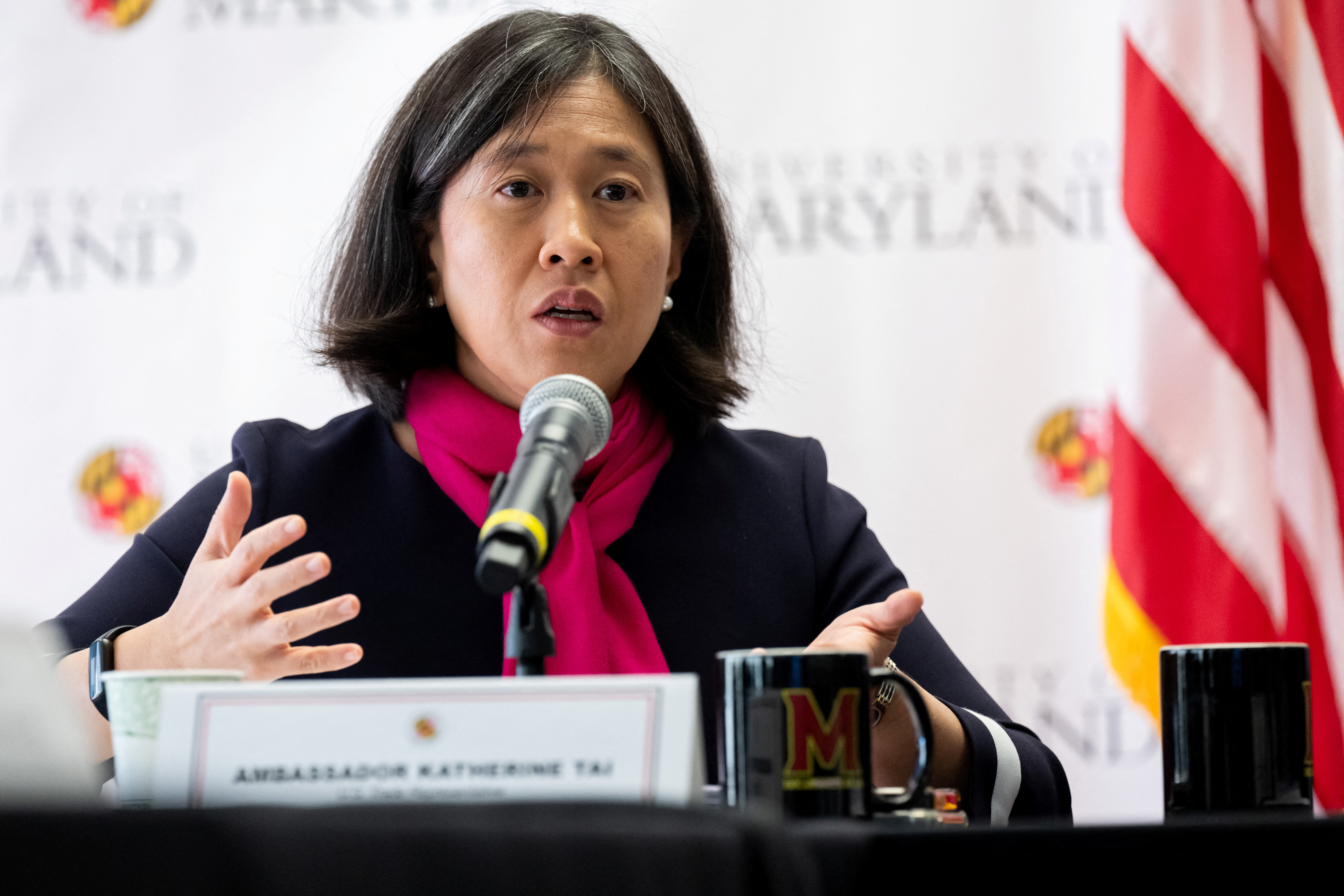
U.S. Trade Representative Katherine Tai participates in a US – EU Stakeholder Dialogue during the Trade and Technology Council (TTC) Ministerial Meeting at the University of Maryland in College Park, Maryland, U.S., December 5, 2022. Saul Loeb/Pool via REUTERS

U.S. officials raised “grave concerns” over Mexico’s agricultural biotechnology policies in meetings with their Mexican counterparts on Monday, the office of U.S. Trade Representative Katherine Tai said.

“We made it clear today that if this issue is not resolved, we will consider all options, including taking formal steps to enforce our rights under the U.S.-Mexico-Canada Agreement,” the USTR office said in a statement. U.S. agriculture and trade officials traveled to Mexico to discuss Mexico’s approach to agricultural biotech products.

Categories
Audio Sources - Full Text Articles

White House: DOJ searched Biden home after “voluntary, proactive offer“ by lawyers

2023-01-23T22:50:14Z

U.S. President Joe Biden waves as he boards Air Force One for return travel to Washington, at Dover Air Force Base in Dover, Delaware, U.S., January 23, 2023. REUTERS/Ken Cedeno

The White House said on Monday that a search by the Justice Department of President Joe Biden’s home on Friday was carried out after a “voluntary, proactive offer” by his personal lawyers to the department.

A new search of Biden’s home in Wilmington, Delaware, by the department found six more items, including documents with classification markings, a lawyer for the president said in a statement on Saturday night.

Some of the classified documents and “surrounding materials” dated from Biden’s tenure in the U.S. Senate, where he represented Delaware from 1973 to 2009, according to his lawyer, Bob Bauer. Other documents were from his tenure as vice president in the Obama administration, from 2009 through 2017, Bauer said.

“This was a voluntary, proactive offer by the president’s personal lawyers to DOJ to have access to the home,” said White House spokesman Ian Sams.

Sams declined to provide more clarity on the exact content of the materials taken from the Wilmington house. Biden had been kept informed throughout this process, the White House said.

The search increases the legal and political stakes for Biden, who has insisted that the previous discovery of classified material at his home and former office would eventually be deemed inconsequential.

Sams also said the White House counsel has sent a letter to the Chairman of the Republican-controlled House of Representatives Oversight Committee in response to his inquiries about the classified documents found at Democrat Biden’s home and office.

Republicans have compared the investigation to an investigation into how Biden’s predecessor Donald Trump, a Republican, handled classified documents after he left office in January 2021.

The White House has said Biden’s team has cooperated with authorities in their investigation of documents and turned them over. Trump resisted doing so until an FBI search in August at his Florida resort.

Categories
Audio Sources - Full Text Articles

Four Oath Keepers guilty of seditious conspiracy in U.S. Capitol attack

2023-01-23T22:26:24Z

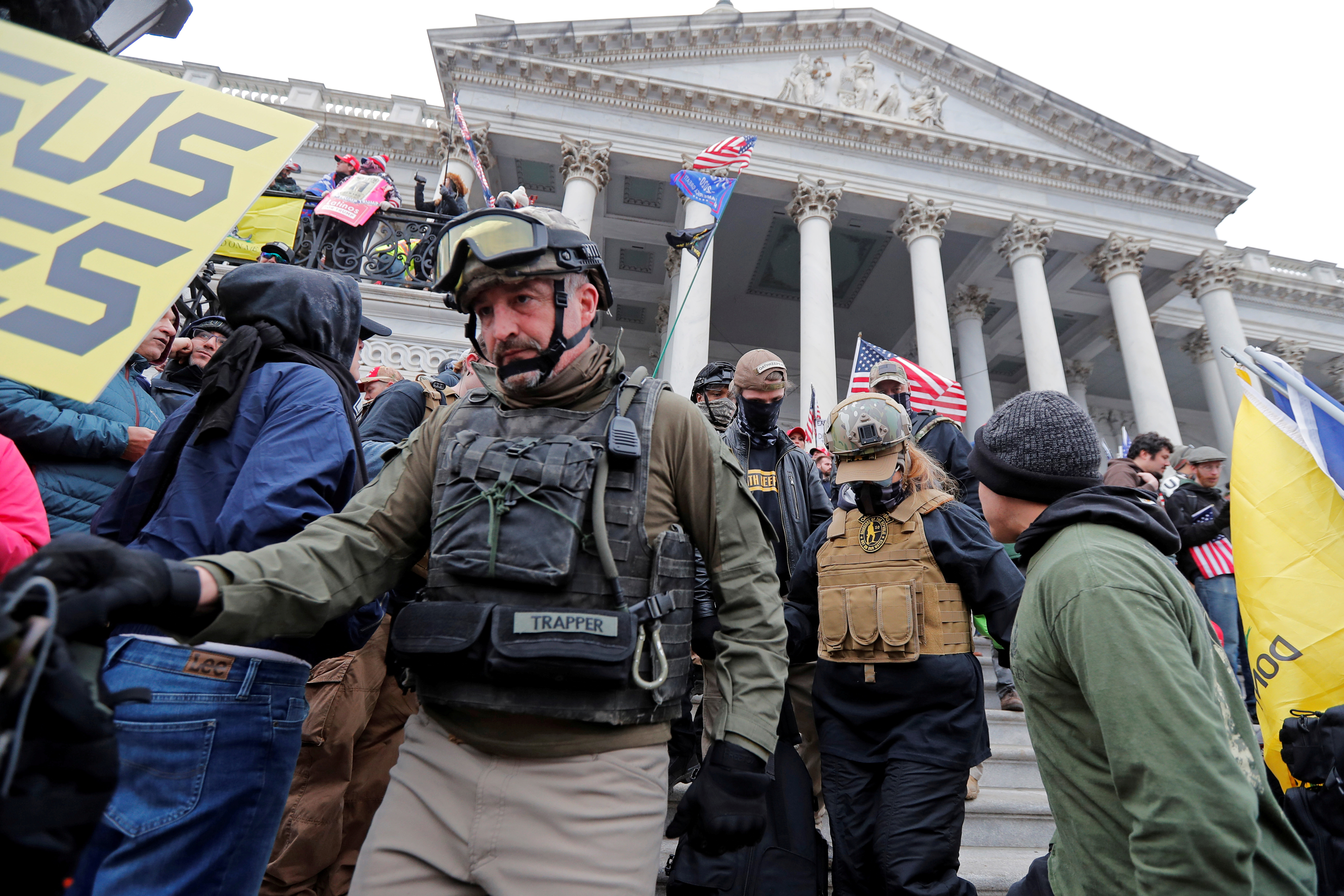
Members of the Oath Keepers are seen among supporters of U.S. President Donald Trump at the U.S. Capitol during a protest against the certification of the 2020 U.S. presidential election results by the U.S. Congress, in Washington, U.S., January 6, 2021. REUTERS/Jim Bourg/File Photo

Four more members of the far-right Oath Keepers were found guilty on Monday of seditious conspiracy for taking part in the Jan. 6, 2021 assault on the U.S. Capitol by supporters of Donald Trump, in another big win for federal prosecutors.

The verdict marks the end of the second major sedition trial against members of the extremist group, who were among the hundreds who attacked the Capitol in an unsuccessful attempt to prevent Congress from certifying Democrat Joe Biden’s victory over Trump, a Republican, in the 2020 presidential election.

The 12-member jury found Oath Keeper members David Moerschel, Joseph Hackett, Roberto Minuta and Edward Vallejo guilty of seditious conspiracy.

All four were also found guilty of obstructing Congress from certifying the 2020 presidential election, and for two other conspiracy charges in connection with the Capitol attack.

Seditious conspiracy is a rarely prosecuted Civil War-era law that prohibits plotting to overthrow or destroy the government and carries up to 20 years in prison.

A jury found Oath Keepers founder Stewart Rhodes and another Florida-based leader of the group guilty of seditious conspiracy in a separate trial in November.

Three other members in that trial were found not guilty of that charge, but all five defendants were found guilty of obstructing Congress from certifying the election.

Prosecutors have brought criminal charges against more than 950 people following the riot. Four people died during the chaos, and five police officers died of various causes after the attack.

U.S. District Judge Amit Mehta split the Oath Keepers seditious conspiracy case into two separate trials due to space limitations and the risks of COVID-19 contagion.

In both trials, Rhodes’ fiery rhetoric and inflammatory statements about “civil war” and “bloody war” took center stage, with prosecutors saying the other members were inspired to carry out his vision.

A third seditious conspiracy trial against five members of the Proud Boys, another right-wing militant group, is ongoing.

Jurors heard testimony and evidence in the second Oath Keepers case for several weeks.

None of the four defendants played major leadership roles in the organization, and their attorneys have said there is no evidence they plotted to block certification of the election.

On the day of the attack, Moerschel, Hackett and Minuta all entered the Capitol clad in tactical gear.

Prosecutors said Minuta led a group of several Oath Keepers into the Capitol and clashed violently with police, all the while screaming it was “their building.”

Scott Weinberg, an attorney for Moerschel, told reporters he believes it may have been easier for the defendants if they had been tried in the same trial with Rhodes because it would have been easier to point to him as the “real bad guy.”

“Obviously, these men were swept up by the Stop the Steal nonsense that was pushed by the president,” Weinberg added. “When you follow somebody blindly, you end up in a terrible situation.”

Though all four defendants were found guilty of the most serious charges they faced, some were acquitted on others.

Jurors convicted Hackett of tampering with evidence, but acquitted him of destruction of federal property. Moerschel was acquitted on both charges, while Minuta was acquitted of tampering.

Vallejo was not charged with tampering or federal property destruction. He was accused of staying back at a hotel in Northern Virginia, where the Oath Keepers staged a “quick reaction force” that prosecutors said was equipped with firearms ready to be quickly transported into Washington.

All four men will be required to remain in home detention pending sentencing. Some are expected to appeal the verdict.

The trial featured testimony from law enforcement officials and several fellow Oath Keepers who had previously pleaded guilty to other crimes, who said they had acted to stop the vote count.

Categories
Audio Sources - Full Text Articles

Sundance documentary ‘Under G-d’ details the Jewish legal response to the Dobbs decision

(JTA) — Last summer, in the days after the Supreme Court’s reversal of Roe v. Wade, the landmark 1973 decision that protected the right to an abortion, Paula Eiselt was doing press work for her acclaimed documentary “Aftershock.”

The film — which documents how the American healthcare system disproportionately fails to keep women of color healthy during and after giving birth — kept her busy with interviews as it earned a wide audience on Hulu and in theaters. But Eiselt felt pulled into thinking about a project tied to the Court’s ruling in Dobbs v. Jackson Women’s Health Organization, which overturned Roe.

Staying true to her Jewish roots, Eiselt found a Jewish angle: the rabbis and Jewish organizations who are helping lead the charge in bringing lawsuits against the Dobbs decision.

“As a Jewish woman, a Jewish mother, to see that there are Jews, rabbis, organizations, standing up to these bans, to the Dobbs decision, and finding ways to flip the script on many of these laws was very inspiring,” said Eiselt, whose first film focused on an Orthodox female emergency responder service in Brooklyn. 

Her new short documentary “Under G-d,” which premiered at the Sundance Film Festival on Sunday and plays there throughout the week, shows how Jewish people and institutions are using state laws called Religious Freedom Restoration Acts (RFRAs) — often used in the past by religious organizations on the opposite side of the abortion issue — to argue that Dobbs violates their religious freedom as American Jews. Traditional Jewish law permits (and even requires) abortion in some circumstances, particularly when the life or health of the pregnant person is at stake.

Among the first lawsuits aimed at Dobbs came from Congregation L’Dor Va-Dor in Boynton Beach, Florida. Its rabbi, Barry Silver, is a figure in Eiselt’s film, alongside Elly Cohen, an Indiana activist and mother who is part of the Hoosier Jews for Choice group; Jeremy Wieder, a leading rabbi at the theological seminary of Yeshiva University; and Rachel K. Laser, who in 2018 became the first woman, Jew and non-Christian to lead Americans United for Separation of Church and State.

A woman named Elly shown in film at a protest in Indianapolis with the Hoosier Jews for Choice group. (Courtesy of “Under G-d”)A woman named Elly shown in film at a protest in Indianapolis with the Hoosier Jews for Choice group. (Courtesy of “Under G-d”) Image by

“The test is this: Are you going to use RFRA only to protect fundamentalist Christians and their intolerance,” Silver asks in the 24-minute film, “or do Jews get to use it too?”

Cohen’s group led a lawsuit that led to a judge issuing a preliminary injunction in December against Indiana’s abortion ban, blocking its enforcement for now. Laser’s group joined a lawsuit filed in Missouri just last week. And three Jewish women filed a lawsuit alleging infringement of their religious freedom in Kentucky in October.

“The fact that Jews were leading this tactic and this battle, really no other group was thinking about it this way,” Eiselt said. “But as Jews, we know what it’s like when there is no separation between church and state, and this is the prime example of that. 

“Of course, now there are many communities joining in with Jews, but Jews are kind of the one who started this,” she added. “I think that’s really true to Jewish involvement in civil rights and human rights, and it was inspiring.” 

She noted that people from across the Jewish spectrum were included in the film — which ends with a rally that includes a Havdalah, or post-Shabbat service — and that the overwhelming majority of American Jews favor abortion rights, more than any other religious group, according to studies.

“Diverse Jews, different denominations,” the director said of her interview subjects. “The vast majority of Jews agree on this, from Orthodox to non-observant. There are very few Jews who will say that these bans are in line with values and law.” 

Wieder, from Yeshiva University, says in the film that a minority view within Orthodox Judaism believes that “life begins at 40 days after conception,” while the majority says life begins at birth, and seemingly no Jewish religious tradition states that life begins at conception. 

Eiselt, a mother of four, identifies as a Modern Orthodox Jew and is a board member of the Jewish Orthodox Feminist Alliance, where she focuses on reproductive justice issues. She describes the group as “a feminist organization within the Orthodox space that uplifts women’s leadership and participation in Jewish ritual.” 

Her first film, “93Queen,” told the story of Ezras Nashim, a female ambulance corps that had to fight for acceptance in the Borough Park haredi Orthodox community.

Funding for the new film came from various film companies and philanthropic organizations, including Concordia Studios and the Sundance Institute, as well as Jewish Story Partners, the foundation backed by Steven Spielberg that launched in 2021. 

The film debuted Jan. 22 — on the 50th anniversary of the Roe v. Wade ruling — and is showing in competition at Sundance. After that there are other plans: A “large impact campaign,” as Eiselt described it, will include screenings around the country, including with “Jewish groups, political groups, and reproductive rights groups.” 

“Whatever communities you’re in, women are having abortions,” Eiselt said. “Whether they’re mothers, not mothers, whether they have five children, no children. This is part of women’s health care, so it affects everybody and in certain communities, such as more Orthodox communities where I come from, people don’t really talk about it, but it happens commonly.” 

This article originally appeared on JTA.org.

The post Sundance documentary ‘Under G-d’ details the Jewish legal response to the Dobbs decision appeared first on The Forward.

Categories
Audio Sources - Full Text Articles

Israeli democracy isn’t in danger. Minority rule is

Israel-protests-tel-aviv-hero-scaled.jpg

It’s time to sit shiva for Israeli democracy — at least, according to Thomas Friedman.

In an open letter to President Biden about the new government’s push to reform the country’s justice system, the New York Times commentator charged that Prime Minister Benjamin Netanyahu’s “ultranationalist, ultra-Orthodox, extremist coalition” is poised to turn Israel into an “illiberal bastion of zealotry.” 

These same accusations have become a staple of left-leaning media following our most recent election. But since Justice Minister Yariv Levin announced proposed judicial reforms two weeks ago, the volume has only increased.

Downgrading the power of the courts, critics allege, would at a stroke remove the protections afforded by law to minorities, Reform and Conservative Jews and Palestinians, and set the stage for a meltdown of relations with Jordan and thus betray American values and interests.

But the plain truth is that Israel’s democracy isn’t under threat — minority rule is. Rather than making Israel more illiberal, the proposed reforms — including limits on judges’ ability to overturn laws and increasing political involvement in the selection of justices — are intended to make Israel’s democracy more like America’s, not less.

An activist court

The real trigger for the chorus of shrill responses isn’t hard to divine: it’s that the proposed changes are the start of a process that’s uncomfortable for the left — one in which it loses influence.

“In Israel, the people’s will is not being expressed — the majority can’t govern,” Simcha Rothman, a lawmaker from the conservative National Religious Party and chairman of the Knesset’s influential Constitution, Law and Justice Committee told me in a recent interview. “The High Court is progressive, and it takes Israel to where it thinks its laws should be.

“Over a number of decades, the Court in Israel usurped power from legislators, which created a situation where the Knesset, which represents the will of the majority of the country’s voters, is no longer in charge. Time and again, under coalitions from the right, center, and left, the government has passed laws that were then struck down by the High Court.”

On a laundry-list of issues — fighting terror, the ultra-Orthodox draft, deporting illegal migrants — the “Bagatz,” as Israel’s highest court is known, has acted in the name of human rights to strike down laws passed by a clear majority of the Knesset.

On the fundamental questions that divide Israel’s right and left, the Court skews heavily left.

“We go to the polls, and time after time, people we didn’t elect choose for us,” was how Justice Minister Yariv Levin put it when announcing the reforms.

It’s to reverse that decades-long usurpation of power, says Rothman, that the Netanyahu government is now acting — proposing legislation that Rothman himself helped write. Enacting an “override clause” will enable an absolute 61-seat majority of the Knesset to veto the High Court’s interventions.

At the same time, introducing more political participation in the selection of justices will end the status quo where the judges themselves select their successors — ensuring liberal group-think in the highest court in the land.

While the shortcomings of Israel’s current constitutional arrangements are acknowledged even by detractors, the latter allege that the drive to hobble the courts is to benefit Netanyahu — currently under trial for corruption — and his ally, Shas Party leader Aryeh Deri, whose tenure as interior minister was ruled illegal by the High Court.

But the push to reform Israel’s justice system began long before Netanyahu’s legal woes, and gained broad political support only after a years-long political crisis was triggered by the High Court striking down a solution to the ultra-Orthodox draft problem that had been agreed upon by the Knesset.

If the Netanyahu government follows through on the promised changes, we can indeed expect a rightward tilt to lawmaking — for example, an easing of the rules around the demolition of terrorists’ houses — a policy whose implementation currently lacks teeth due to the High Court’s rulings.

Judicial bans on public funding for voluntarily gender-separate events for the ultra-Orthodox — surely a militantly liberal reading of women’s rights — will be a thing of the past, and legitimately so. Balancing competing rights is complex, and conservative values are well within the parameters of democracy.

In an article heavy on questionable assertions, though, Thomas Friedman was right about one thing: Israel is changing.

After years of voting right and getting left, Israeli conservatives are getting their act together. They’re unwilling to put up with the continued rule of a progressive minority that governs by court fiat even as it loses at the ballot box.

But if Friedman is worried about Israel distancing itself from American values, he can rest assured.

Like the Slurpees recently imported from the US and now on sale to great fanfare in the heart of Tel Aviv, the judicial reforms are the latest front in a Made-in-Israel kulturkampf — and there’s nothing more American than the culture wars.

To contact the author, email opinion@forward.com.

The post Israeli democracy isn’t in danger. Minority rule is appeared first on The Forward.

Categories
Audio Sources - Full Text Articles

4 expensive psychological tricks retailers use that I’ve learned to decode

Ariana ArghandewalAriana Arghandewal.

Ariana Arghandewal

  • If you’ve ever bought something because an influencer used it, you’ve experienced social proof.
  • The scarcity principle drove many people to buy way too much dry pasta at the start of the pandemic.
  • When you see that you could get free shipping by spending just a little more, that’s loss aversion.

We’re a few weeks into a new year, which is a great time to take stock of your financial goals and how to create better habits to achieve them.

One of my goals is to cut back on gratuitous spending. While I largely avoided the temptation of holiday sales, I made my share of impulse buys that put a dent or two in my wallet. We’ve all had our moments of weakness when shopping and that’s not entirely our fault — there’s an entire industry built around getting us to spend money, even when we don’t intend to.

The solution? Learn the psychological principles driving these marketing strategies and beat them at their own game. Here are four psychological principles you can use to cut back on needless spending.

1. Social proof

In psychology, social proof refers to the idea that people adapt their behaviors to emulate other people. It’s why influencers are so successful at getting us to buy six tubes of mascara or the same Revlon lipstick that keeps popping up on your Instagram Explore page. Watching other people use a product successfully and discuss its benefits triggers us to want to emulate them.

I’ve seen this in action many times — it’s how I ended up with a drawer full of The Ordinary skincare products that I probably won’t get through any time soon. When you’re inundated with social media posts touting the same product over and over, it’s tempting to give in and buy said product. Especially when doing so is just a few clicks away.

So what can you do about it? I, for one, have stopped watching YouTube videos of product reviews — unless it’s something I actually need. I also stay off the Instagram Explore page, where influencers are constantly hawking the miracles of skincare products. Knowing what triggers your impulse shopping habits is the first step in addressing it.

2. Anchoring bias

Anchoring bias refers to our tendency to rely on the first piece of information we’re presented with to make a decision. When shopping, anchoring can distort our ability to accurately value a product by focusing our attention on the original versus sale price. By seeing the price difference, you might feel you’re getting a good deal and thus become more likely to purchase an item.

In this scenario, it’s important to remember what an item is worth rather than how much you’re saving on the sale price. I fell into this trap with an Amex Offer recently, making a purchase merely because the discount made it more palatable. But I wasn’t really saving money because I was still spending more on an item than it was intrinsically worth. Keep this in mind and avoid falling for the trap of comparing past and present pricing.

3. Scarcity principle

The scarcity principle is technically an economic principle, but it explains a crucial aspect of consumer behavior that leads to overspending. Consumers are more likely to buy items that they perceive as dwindling in supply. This is one reason grocery shelves were empty in the early days of the pandemic. Many consumers heard about dwindling supplies of toilet paper and dried pasta on the news and rushed to stock up on items before they ran out completely.

Retailers will use the scarcity principle to convince consumers to purchase items by emphasizing dwindling supplies or limited-time offers.

Here’s the workaround: Remember that most things are quickly replenished and sales will come around again. Don’t let a sale dictate your purchases — instead, time the purchase of necessities around sales.

4. Loss aversion

Have you ever bought something online and then spent more money than you intended just to get free shipping? That might have been loss aversion at play. According to this behavioral principle, the negative impact of losing money is perceived as worse than gaining that same amount. It becomes preferable to “gain” free shipping by adding more items to your cart than to “lose” money on shipping.

I’ve definitely been in that position, stockpiling things and spending more than I needed because it made more sense to spend money on items than shipping. By recognizing this habit, you can reassess whether the extra spending is worth it. Maybe you don’t need to place that Target order after all and can instead walk into a store to make your $20 purchase. You’ll get it faster and will avoid the shipping charge.

Read the original article on Business Insider
Categories
Audio Sources - Full Text Articles

Lands’ End almost lost its wealthy boomer customers when it tried to court millennials and Gen Z. Now it’s going for Gen X.

A storefront for a Lands' End retail location at night

Lands’ End

  • Lands’ End’s baby-boomer shoppers are among the most loyal of any brand, but they are aging.
  • Sales fell when the company tried to attract millennials in 2015 with a move into party dresses and heels.
  • In recent years Lands’ End has made a concerted effort to reach oft-overlooked Gen X shoppers.

Once America’s largest mail-order clothing company, Lands’ End has cultivated spectacularly high loyalty from its core customers with its offerings of sensible swimwear, cozy parkas, and mom jeans.

But as the Wisconsin-based company looks to expand its reach, it’s eyeing a demographic that gets little love from retailers: Generation X.

The average Lands’ End shopper stays with the brand for 18 years, outgoing CEO Jerome Griffith said at the annual ICR conference earlier in January, and that’s a trait the company is hoping to replicate with new customers, too.

“Our customer is — actually, she is a great woman,” Griffith said according to a recording and transcript from AlphaSense. “She is a baby boomer. She is in her mid-50s. She lives in suburbia. She works. She’s frugal. She has a pretty good household income, well over $100,000 a year. She is having children at home — or had children at home — and she buys for the whole family. She’s the one that makes all the decisions.”

The flipside to that long relationship is that those customers aren’t getting any younger.

“If your customer gets a year older every year, you’re all going to die,” Griffin added. “You want your database to either stay at the same age or bring in younger people.”

In 2015, the company attempted to attract younger buyers in the millennial and Gen Z segment by hiring a former Ferrari and Dolce & Gabbana executive to give the 60-year-old midwestern brand a modern Italian makeover, featuring party dresses and high heels.

The results were — in technical terms — catastrophic.

Within just one year Lands’ End swung from a $9.2 million profit to a $7.7 million loss and customers were abandoning the brand. The boomer moms weren’t having it.

The company booted the new CEO after just 19 months on the job, and brought Griffith on board for 2017.

During Griffith’s tenure, which ends on Friday, the company leaned into its comfy practical bona fides and made a deliberate effort to connect with shoppers beyond its stores and outside the pages of its seasonal catalogs.

The company has followed boomer and Gen X shoppers to e-commerce marketplaces, including Walmart, Target, Kohl’s, and of course Amazon, where the shoppers generally have the same profile — apart from age.

“New customers come in through these marketplaces,” Griffith said. “Seventy-five percent of them either never shopped at Lands’ End, or are lapsed customers and haven’t shopped at Lands’ End for five years. So we’re bringing in a new customer who’s actually the same customer, but 10 years younger. They’re Gen Xers.”

Incoming CEO Andrew McLean shared the ICR stage with Griffith and has indicated he shares his predecessor’s vision for the company.

“That’s an astonishing place to be underpinned by a 7 million-strong customer database.” McLean said. “When they join, they join forever.”

Read the original article on Business Insider
Categories
Audio Sources - Full Text Articles

Leopard tanks are the ‘right’ weapon to send Ukraine, but don’t expect a ‘silver bullet,’ military expert says

A Leopard 2 A7V battle tank prior an event to mark the reception of the first units of the new tank on September 15, 2021 in Bad Frankenhausen, Germany.A Leopard 2 A7V battle tank prior an event to mark the reception of the first units of the new tank on September 15, 2021 in Bad Frankenhausen, Germany.

Photo by Jens Schlueter/Getty Images

  • European countries are continuing to press Germany to green light Leopard tanks to Ukraine.
  • One military expert told Insider that these German-made weapons are the “right tank” to send.
  • But their battlefield utility will ultimately depend on how many Leopards Ukraine gets, he said.

NATO members and other European partners are pressing Germany to green light the transfer of Leopard tanks to Ukraine, which is in need of heavy armor.

One military expert said the much-sought-after tanks are the “right” tanks to send to Ukraine at this moment and would be “militarily useful” depending on how many are sent, but don’t expect them to be a “silver bullet.”

Germany has been reluctant to send its Leopards or permit other countries that operate the German-made armor to send tanks to Ukraine, and some countries are growing impatient. Poland, for instance, previously suggested it might go rogue and act without German approval. The foreign minister said on Monday that while Warsaw will seek Germany’s permission, his country will “certainly” send the formidable Leopard tanks to Ukraine. 

“We will be in touch with the German government about it, but regardless of the decisions of other countries, we are more than determined, as we promised the Ukrainian side, to send the tanks,” Minister of Foreign Affairs Zbigniew Rau, whose country has led the push to send the German-made Leopards to Kyiv, told reporters in Brussels.  

German Foreign Minister Annalena Baerbock indicated on Sunday in an interview with French television that if Poland asked for Germany’s permission to send tanks to Ukraine, Berlin would not object. Her remarks came after a slew of senior European officials called upon Berlin to show a sense of urgency on this matter and allow the delivery of the tanks. 

Leopards are the ‘right tank to send’

The Leopard 2 main battle tank was developed in the 1970s and has had operational experience in Afghanistan, Syria, and Kosovo. It weighs about 70 tons but can travel up to 44 mph, has composite armor with ballistic and mine protections, and is armed with a 120 mm cannon, machine gun, and automatic grenade launchers.  

Leopards are highly mobile and are a “little bit easier to maintain” than the American M1 Abrams, Deputy Pentagon Press Secretary Sabrina Singh told reporters at a briefing last week, adding that “they can maneuver across large portions of territory before they need to refuel.”

Mark Cancian, a retired US Marine Corps colonel and a senior advisor with the Center for Strategic International Studies security program, told Insider that the Leopard “is the right tank to send,” as opposed to the British Challenger 2 or the M1 Abrams. Around 2,000 Leopards have been produced, and they could be sent to Ukraine in mass quantities at a quicker speed than other Western tanks. 

leopard 2 tanks ukraine russiaTwo Leopard 2A6 main battle tanks of the German armed forces participate in NATO military exercises in Pabrade, Lithuania, on October 27, 2022.

Sean Gallup/Getty Images

If Leopard tanks do eventually make their way to Ukraine, it doesn’t necessarily mean that they’ll break open the front lines, Cancian said. But they would help during a Ukrainian offensive — a maneuver during which tanks can provide their most utility because they give a boost in firepower, protection, and mobility.

Indeed, Leopard tanks “would be militarily useful depending on how many were sent,” he said. European countries would need to send a “fairly large number” of these weapons — like 100 or 200 — to Ukraine. “Sending 15 [tanks] from Poland has an important psychological and political effect, and that should not be ignored, but it won’t have a significant battlefield effect,” he added.

There’s no ‘silver bullet’ to win the war

Ukraine, which has mainly relied on Soviet-era tanks, has for months been squaring off against Russian T-72, T-64, T-80, and T-90 tanks, according to Oryx, an open-source intelligence site that tracks war losses on both sides. 

Leopards — like other NATO tanks — have the potential to bring a “fire control” advantage to the battlefield, Cancian said. These weapons can spot and hit targets at longer ranges than Moscow’s forces can because they have more sophisticated sighting and aiming mechanisms. 

That said, there’s “no silver bullet out there,” Cancian explained. There is no weapon that can be sent to Ukraine or training program that will guarantee a win in the war. Rather, it’s the accumulation of all the military aid — like tanks, air defense systems, and artillery — that would give Kyiv an upper hand to expel the Russians from its territory. 

And security assistance continues to pile up. Western countries have rushed to commit to providing Ukraine with lots of armor vehicles in the first few weeks of this year, with five countries announcing recently their intention to send armored combat vehicles to Kyiv.  

Ukraine has repeatedly urged countries to provide it with tanks that could help Kyiv make progress in what has turned into a grinding and slow-moving 11-month-long war. Gen. Mark Milley, chairman of the Joint Chiefs of Staff, said last week that the war is currently a “very, very difficult fight,” with a relatively “static” front line. 

Read the original article on Business Insider
Categories
Audio Sources - Full Text Articles

Proud Boys try to keep jurors from seeing their ‘politically incorrect’ guide to masturbation, slavery, ‘housewives’

Proud Boys leader Dominic Pezzola, whose seized initiation manual is being fought over at his DC sedition trial.Proud Boys leader Dominic Pezzola, whose seized initiation manual is being fought over at his DC sedition trial.

Manuel Balce Ceneta/AP

  • A Proud Boys ‘initiation ceremony manual’ was fought over in the sedition trial of two members.
  • It’s too ‘politically incorrect’ for the jury, says a lawyer for defendant Dominic Pezzola.
  • The manual sets masturbation limits and includes lyrics to a Broadway-inspired sing-along anthem.

A heated battle broke out at the Proud Boys sedition trial on Monday over an internal “initiation ceremony manual” that the federal government wants to show to jurors, but which a defense lawyer says is too “politically incorrect” to be in evidence.

Read the “how to run a Proud Boys meeting” manual here.

The manual was seized by the government via search warrant two years ago, but was only just made public, according new court papers in the US District Court trial in Washington, DC.

It details how a Proud Boys chapter leader must run the group’s meetings, or “meet ups.” It includes the required language for calling meetings to order and a required reading from Pat Buchanan’s “The Death of the West,” which calls on “Western Man” to stop apologizing to “race racketeers” about slavery and colonization.

The Anti-Defamation League considers the Proud Boys a violent, right-wing extremist group whose members commonly engage in misogynistic, Islamaphobic, transphobic, and anti-immigration rhetoric.

The manual instructs Proud Boys on which order to offer such drinking toasts as, “To guns,” “To housewives,” and, “to the greatest civilization on earth and the men who built it.” 

It also describes the extremist group’s rules and ideas, including a committement to “rebuilding the patriarchy” and the belief that, “All other cultures are not merely different than us. They are worse.” 

Oddly, the manual includes the lyrics to “Proud of Your Boy,” a heartfelt solo, sung by the Genie character to his mother, from the Broadway musical “Aladdin.”

Apparently, the Proud Boys see the ballad as “our anthem.”

“It is healthy to sing our anthem at least once a night but this isn’t always possible,” the manual tells novice Proud Boys leaders before helpfully providing the words for any sing-alongs.

“Ideally, we seek out venues that have a jukebox with this song available,” the manual advises. 

But as proud as the defendants may be of their strange rituals, a defense motion seeking to bar the manual from being shown to jurors acknowledges that “The document is riddled with politically incorrect remarks and assertions which would cause most or many Americans to recoil in anger, hatred and disgust.”

An excerpt from a Proud Boys defense motion filed January 23, 2023 in US District Court in Washington, DC.An excerpt from a Proud Boys defense motion filed January 23, 2023 in US District Court in Washington, DC.

Insider

“The document is bizarre and humorous in some places, and intensely politically incorrect in others,” wrote the lawyer for Pezzola, who is accused of using a forcibly-stolen Capitol Police riot shield to break the first window into the Capitol.

While defense lawyers claim the document is unsigned, unauthenticated, and, ultimately, irrelevant, lawyers for the Department of Justice have countered that the document’s 11 pages demonstrate Pezzola’s knowledge and state of mind while at the Capitol. 

Details of the Proud Boys’ beliefs and membership requirements — including their so-called “fraternity creed” — have been public before, including on their websites and political campaigns.

But the fight over the “initiation ceremony manual” appears to have led to the first airing of an an internal, “How to” for actually running a Proud Boys meeting. 

The  manual veers wildly among topics, at one point giving meticulous dress advice — “a recommended shoe is the black Red Wing classic moccasin toe boot” — in the same paragraph as it vows “This is about taking our civilization back. This is about rebuilding patriarchy.”

But the first four pages stick to how to run a meeting, including this requirement: “Before the meeting begins, clear the area of all women” and of all non-Proud Boys.

Two guards are to monitor “the perimeter,” the manual instructs, as the “brother in charge” leads the meeting with a series of recitations and “toasts,” including, “to the housewives that create human life, shape it, and build the communities in which we live.”

The final toast is more of a threat.

“To the parasites both on the streets and in the White House who want to attack us and take what we earn,” it begins. “To the trespassers who want to attack us and take what we earn. To the trespassers who want to sabotage our culture our family and our way of life.

“You want a war?” it continues. “Well, you’ve got one. To all of our enemies both high and low.” 

At that point the Proud Boys members are to shout, “Bring it on!”

Read the original article on Business Insider
WP Radio
WP Radio
OFFLINE LIVE