Categories
Audio Sources - Full Text Articles

Russian finance pivots east

In 2014, following a wave of US and European Union sanctions on Russia in response to its annexation of Crimea, Russian President Vladimir Putin initiated his “Pivot to the East” (povorot na vostok). The strategy aims to shift the Russian economy away from its European partners and toward Beijing. Despite a minor economic downturn in both countries disrupting the strategy in 2015, the reorientation was largely successful in integrating their respective economies. China’s share of Russia’s total trade grew from around 10 percent in 2013 to 18 percent by the end of 2021. 

Russia’s 2022 invasion of Ukraine, as well as G7 sanctions imposed in retribution, have expedited Moscow’s pivot to Beijing. While Russia’s economic reorientation has most prominently played out in its goods trade, particularly with hydrocarbons, Russia’s financial relationships have undergone a parallel shift. As a result, Russia’s economy is now heavily reliant on Chinese capital. Though this may be favorable for Russia now, overreliance on Chinese finance will reinforce Russia’s status as the junior partner in the two countries’ relationship.

Chinese authorities do not publicly report their banks’ consolidated positions, but alternative data sources suggest that Chinese lenders may have maintained or extended additional credit to Russian borrowers in the aftermath of Russia’s invasion of Ukraine. One notable example is syndicated lending—a type of loan provided by a group of lenders and preferred by international financiers, as it allows them to share risk. Syndicated lending data suggests loans originating from Chinese banks now account for nearly half the global total of syndicated loans to Russia. In the coming months, this overreliance will likely grow as financial institutions in other parts of the world, namely Europe, halt new lending to Russia and refuse to refinance or roll over existing loans, with many banks pulling out of the country altogether. 

Russia first identified China as a viable source of alternative financing in 2014 after Moscow found itself blocked or ostracized in the Western financial hubs of London and New York. Hoping to instead rely on Shanghai and Hong Kong, Russia began to more intentionally engage Beijing to foster a stronger economic and financial relationship. The Kremlin lifted political barriers such as a ban on asset purchases in the natural resource sector and investment in infrastructure contracts in sensitive industries like roads and railways. Beijing, in turn, encouraged its firms to invest or enter the Russian market. Borrowers and lenders followed, and the portion of Chinese lending in the Russian economy tripled from where it stood in 2014 to 2022. 

Although Moscow began to look elsewhere for its financing, not all European financial institutions saw the writing on the wall. While the UK, France, and Germany viewed Russia’s 2014 annexation of Crimea as an inflection point in their relationship with the Kremlin and began to reduce their exposure to Russia, Italy, and to a lesser extent Austria, did the opposite. Driven by a combination of high returns and a domestic political climate with more favorable views towards Russia, Italian banks increased their syndicated loan exposure to Russia from around 4.6 percent in the months following the seizure of Crimea to around 7.5 percent going into Q3 2022. Italy’s banking sector, led by the banking group UniCredit, is now forced to deleverage itself from Russia by writing off its cross border exposure, swapping loans with Russian banks, and identifying international buyers for its loans to Russian clients. 

Beware of financial overreliance 

While the Kremlin’s eastern pivot worked well in the aftermath of 2014 when the Chinese economy was booming, today Shanghai and Hong Kong may be less willing to fill the new gaps that are opening as Western lenders exit the Russian market. Chinese lending is typically shaped by the geopolitical and economic objectives of the Chinese Communist Party. In 2014, this benefited Russia. The Chinese economy was growing at upwards of 7 percent, its financial sector was flush with capital, and its government encouraged its firms to look internationally via a “going out” strategy. 

The opposite is now true. In 2022, China grew at a meager 3 percent—well below its target rate of 5.5 percent. Under Beijing’s direction, its financial sector is now focused on ensuring ample liquidity in domestic markets and low funding costs for businesses. Consequently, Chinese international lending has dropped by around 14 percent from the start of 2022 to July, when the latest data is available. In the short term, Beijing is far more likely to direct its banks to support its own ailing economy to meet its GDP target than to shore up any gaps opening in Russia. 

In the medium to long term, however, Chinese lenders will likely increase their exposure to the Russian economy. As western lenders shun the Russian market, Shanghai and Hong Kong will be able to extract new deals with more favorable terms for China. Russia could provide a friendly market for Beijing to test new financial policies it will eventually need to implement as it opens its own financial system to the rest of the world. 

While China remains Russia’s best option as a source of finance, Moscow is becoming overdependent. Even with a strong Chinese economy, the Chinese financial sector’s willingness to cover all gaps left by other lenders remains unclear. State-owned banks dominate the Chinese financial sector, and these banks are subservient to Beijing’s political interests. If they provide a foreign company access to credit, this implies that the project meets a strategic or economic interest for China. While this may be fine for a Russian firm hoping to raise capital to develop a new oil field for export to the Chinese market, if the final buyer resides in India or Turkey, Chinese banks may lose interest. Without a diverse lending base, otherwise viable projects will go unfunded. 

China’s dominance in Russian external financing will also amplify Beijing’s leverage in its relationships with Moscow. As the relationship becomes increasingly asymmetric, China will be able to force Russia to accept previously untenable concessions. China is already using this influence to its advantage in negotiations on a new pipeline to connect Siberian gas fields to China by asking for a price structure that benefits Chinese consumers, additional legal allowances that benefit Beijing, and, naturally, the use of the renminbi as the contract currency.

While Putin and Chinese President Xi Jinping present their countries’ partnership as a “no limits” friendship, Russia’s invasion of Ukraine has cemented Russia’s status as the junior partner of an increasingly one-sided relationship. As the West decouples itself from Russia, Moscow will increasingly rely on Beijing, not just for financing but a range of areas including trade, technology, and international diplomatic support.


Niels Graham is an Assistant Director with the Atlantic Council GeoEconomics Center focusing on the Chinese economy.

At the intersection of economics, finance, and foreign policy, the GeoEconomics Center is a translation hub with the goal of helping shape a better global economic future.

The post Russian finance pivots east appeared first on Atlantic Council.

Categories
Audio Sources - Full Text Articles

Pres says Serbia faces international isolation over Kosovo

BELGRADE, Serbia (AP) — Serbia could face international isolation and economic decline if it rejects a new Western plan for normalizing relations with its former wartime foe Kosovo, the Balkan country’s president Aleksandar Vucic said on Monday, in what appeared to be a shift from his previous hardline rhetoric.

Serbia received that warning last week during a visit by a group of U.S. and European envoys who have stepped up efforts to defuse longtime tensions in the volatile Balkan region amid Russia’s invasion of Ukraine.

“Serbia must talk, take part in dialogue and continue its European road,” Vucic said. “We would be economically and politically lost without it and, as a president, I would not agree to lead the country that is alone and isolated.”

The dispute between Serbia and its former province of Kosovo has remained a source of instability in the Balkans long after the 1998-99 war, which ended with a NATO intervention that forced Serbia to pull out of the territory.

Kosovo in 2008 declared independence from Serbia, which Belgrade has refused to recognize, relying on Russia and China to help Serbia maintain its claim over the territory. The U.S. and most EU nations have recognized Kosovo, while Russia and China have not.

The new Western plan for normalizing Serbia-Kosovo relations has not been officially made public. Vucic said in his televised address that the plan stipulates that Serbia would not be against membership of Kosovo in international organizations, including the United Nations.

The U.S. and EU want to push forward an EU-mediated dialogue that has been stalled for months because they fear Russia, a Serbia ally, could try to stir instability in the Balkans to avert attention from the war in Ukraine.

“These talks were among the toughest in the past decade,” Vucic added, describing the meeting. “It was never like this.”

The West wants to defeat Russia and anyone standing in the way will be “swept away,” Vucic said.

“Europe is de-facto in war, whatever they may say,” said Vucic. “They (EU) want everything in their backyard — and Balkans is their backyard — to be the way they want it.”

Serbia, which has formally sought EU entry, has not gone along with EU sanctions against Russia, but that hasn’t spared Vucic from being criticized by the pro-Russian nationalist opposition in Serbia for saying he’s ready to consider the latest Western plan.

Despite the anti-Western and pro-Russian sentiment that prevails in Serbia since former ultranationalist Vucic came to power 10 years ago, he said a isolated Serbia would economically collapse without Western help and investments.

Vucic said Monday that “nothing will happen “in the next day or two” but that the country will face tough decisions in the near future. The first repercussion Serbia would face if it rejects the latest Western Kosovo plan would be abolishment of a visa-free regime with the EU, he warned.

“To be fair, the European Union is the biggest investor in Serbia,” he said. “We have to look at things in a fair and objective manner.”

Vucic previously said Serbia would never recognize the independence of Kosovo, which many Serbs consider the country’s historic heartland.

Last month, Western officials mediated in resolving a tense situation in northern Kosovo, where Serbs erected barricades on the main roads to protest the arrest of a former Serb police officer. And in the latest incident, Serb officials said Kosovo police wounded a Serb man on Monday in the Serb-dominated north of the country.

Categories
Audio Sources - Full Text Articles

Monterey Park death toll rises as California authorities identify victims

2023-01-23T21:20:28Z

A man lights a candle at the entrance of the Star Ballroom Dance Studio after a mass shooting during Chinese Lunar New Year celebrations in Monterey Park, California, U.S. January 23, 2023. REUTERS/David Swanson

The Los Angeles county coroner’s office on Monday began identifying the 11 people killed in the Lunar New Year massacre inside a popular dance parlor in Monterey Park, California.

Ten victims died at the scene of the Saturday shooting. Authorities on Monday said an 11th person died while being treated at a local hospital.

The coroner’s office confirmed the names of two women – My Nhan, 65, and Lilan Li, 63 – who were among the patrons who died in Saturday’s shooting at the Star Ballroom Dance Studio.

While not releasing the other victims’ names, the coroner’s office said the five women and five men who were killed were all in their 50, 60s and 70s. No information was immediately made available about the 11th victim.

Nhan’s family said in a written statement released on Twitter that “we are starting the Lunar New Year broken.” They said Nhan, whom they remembered for her warm smile and kindness, had visited the dance studio on weekends for many years.

“It’s what she loved to do,” they said. “But unfairly, Saturday was her last dance.”

Friends and frequenters of the ballroom identified another victim as Ming Wei Ma, believed to be in his 60s. He was a frequent presence at the dance studio, and friends told a CBS affiliate that he was among the first to rush the shooter.

“He was just caring, an ‘others first, people first’ kind of person,” Ma’s friend Eric Chen told local media.

Lauren Woods, a tango dance instructor at the ballroom, said Ma was “the heart” of the studio.

Woods wrote on her Facebook profile that Ma would greet her with a kiss on the cheek and say “my teacher! My teacher!” and “Love you! Love you!”

Other victims’ identifications were withheld pending notification of next of kin.

The coroner’s office said one woman who died was in her 50s and two other women, in addition to the ones identified, were in their 60s. Three men killed were in their 70s and two were in their 60s.

Categories
Audio Sources - Full Text Articles

U.S. energy chief says Biden would veto House Republican bill on oil reserve

2023-01-23T21:05:14Z

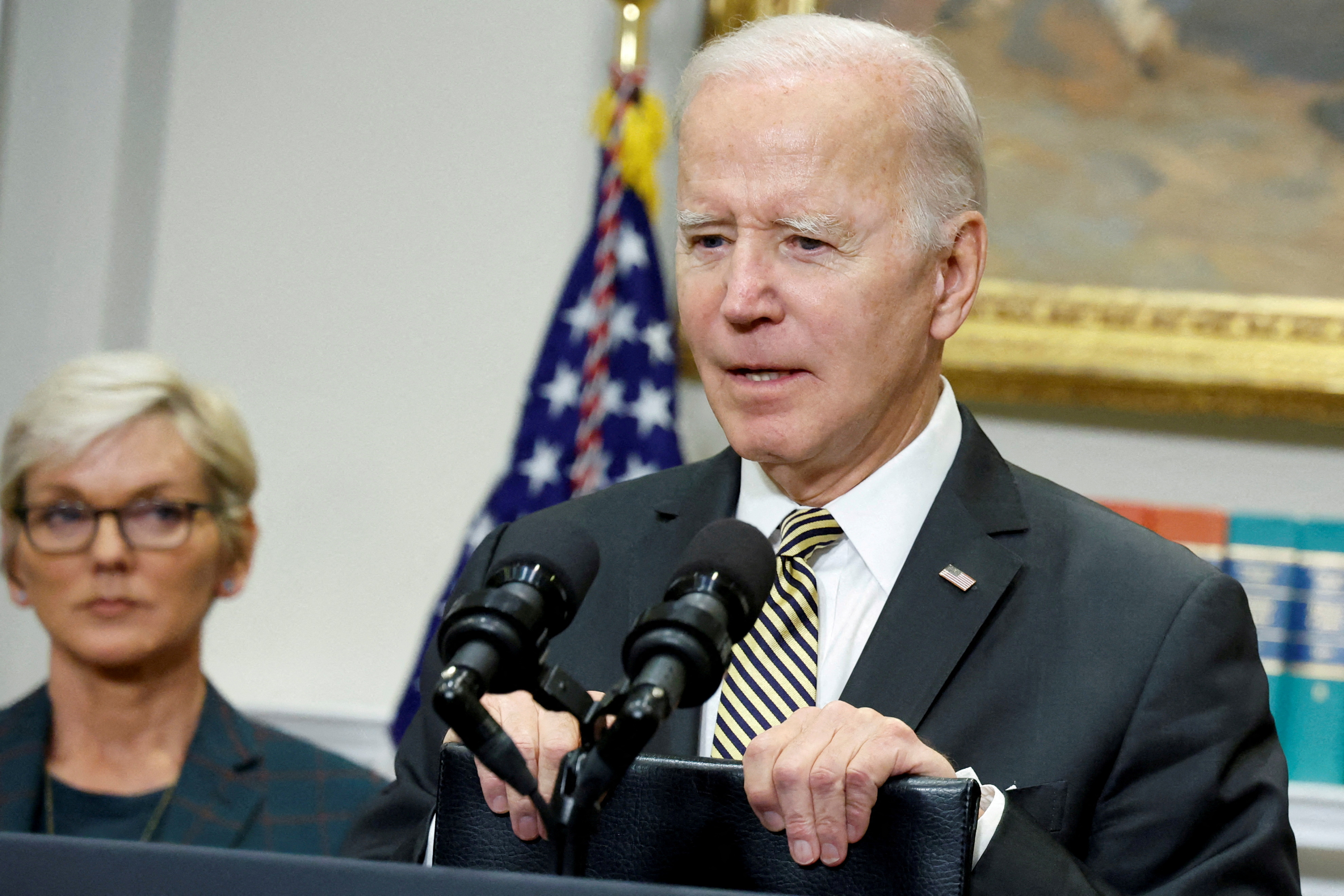
President Joe Biden will veto a bill by U.S. House of Representatives Republicans on the Strategic Petroleum Reserve (SPR) if it passes Congress, Energy Secretary Jennifer Granholm said on Monday.

In a letter last week, Granholm warned Republicans that limiting the Democratic president’s authority to tap the nation’s oil reserves would undermine national security, cause crude oil shortages, and raise gasoline prices.

“He will not allow the American people to suffer because of the backwards agenda that House Republicans are advancing” Granholm, speaking to reporters at a White House briefing, said of Biden.

The bill, called HR21, would require an administration that taps the SPR to advance a plan to increase oil and gas leasing on federal lands, unless the release is for a severe oil supply emergency.

Biden tapped the SPR repeatedly last year in response to oil prices that jumped due to Russia’s invasion of Ukraine and as travel increased as the COVID-19 pandemic eased.

Biden announced last March a record 180 million-barrel sale over six months that drove the reserve’s level to its lowest since late 1983. The Energy Department this month rejected the first batch of bids from oil companies to resupply a small amount of oil to the SPR.

Despite that rejection, Granholm said she is confident the United States will be able to refill the SPR and save taxpayers money by buying oil at a lower price than the government originally purchased the supplies.

“The offers that we received did not meet specification or price,” the secretary said. She said the administration would soon announce how it will buy back some initial replenishment oil for the reserve.

Related Galleries:

The Bryan Mound Strategic Petroleum Reserve, an oil storage facility, is seen in this aerial photograph over Freeport, Texas, U.S., April 27, 2020. REUTERS/Adrees Latif/File Photo

U.S. Secretary of Energy Jennifer Granholm hosts a U.S. Department of Energy news conference to announce that scientists at the Lawrence Livermore National Laboratory (LLNL) have made a breakthrough on fusion energy, the process that powers the sun and stars that one day could provide a cheap source of electricity in Washington, U.S., December 13, 2022. REUTERS/Mary F. Calvert/File Photo

U.S. President Joe Biden, with Energy Secretary Jennifer Granholm, answers questions after his remarks on the national Strategic Petroleum Reserve form the Roosevelt Room at the White House in Washington, U.S. October 19, 2022. REUTERS/Jonathan Ernst/File Photo


Categories
Audio Sources - Full Text Articles

Wall Street extends rally, powered by tech bounce

2023-01-23T21:21:00Z

Traders work on the floor of the New York Stock Exchange (NYSE) in New York City, U.S., December 7, 2022. REUTERS/Brendan McDermid

Wall Street closed sharply higher on Monday, fueled by surging technology stocks as investors began an earnings-heavy week with a renewed enthusiasm for market-leading momentum stocks that were battered last year.

All three major stock indexes extended Friday’s gains, with the tech-heavy Nasdaq leading the pack, boosted by semiconductor shares (.SOX).

“(Chips are) a group that’s been depressed, so I’m not too surprised,” said Peter Tuz, president of Chase Investment Counsel in Charlottesville, Virginia. “We’re going to see earnings from these companies over the next couple of weeks and that will be where the rubber meets the road.”

“It’s a group that was ripe for a rebound.”

The session marks a calm before the storm in a week jam-packed with high profile earnings reports and back-end loaded with crucial economic data.

Investors are all but certain the Federal Reserve will implement a bite-sized interest rate hike next week even as the U.S. central bank remains committed to taming the hottest inflationary cycle in decades.

“(Investors) are pretty comfortable that they’re going to see lower rate hikes from the Fed, that we are rounding the corner on inflation and interest rate hikes,” Tuz added. “Stocks can do well in that environment, especially the big growth stocks that drive the market.”

Financial markets have priced in a 99.9% likelihood of a 25 basis point hike to the Fed funds target rate at the conclusion of its two-day monetary policy meeting next Wednesday, according to CME’s FedWatch tool.

The Dow Jones Industrial Average (.DJI) rose 254.07 points, or 0.76%, to 33,629.56, the S&P 500 (.SPX) gained 47.2 points, or 1.19%, to 4,019.81 and the Nasdaq Composite (.IXIC) added 223.98 points, or 2.01%, to 11,364.41.

Of the 11 major S&P 500 sectors, all but energy (.SPNY) ended green, with tech shares (.SPLRCT) enjoying the largest percentage gain, up 2.3% on the session.

The fourth-quarter reporting season has shifted into overdrive, with 57 of the companies in the S&P 500 having posted results. Of those, 63% have delivered better-than-expected earnings, according to Refinitiv.

Analysts now see S&P 500 fourth-quarter earnings, on aggregate, dropping 3% year-on-year, nearly twice as steep as the 1.6% annual drop seen at the beginning of the year, per Refinitiv.

This week, Microsoft Corp (MSFT.O) and Tesla Inc , along with a spate of heavy-hitting industrials including Boeing CO (BA.N), 3M Co (MMM.N), Union Pacific Corp (UNP.N), Dow Inc (DOW.N), and Northrop Grumman Corp (NOC.N), are expected to post quarterly results.

The Philadelphia SE semiconductor index (.SOX) jumped 5.0%, its biggest one-day gain since Nov. 30 after Barclays upgraded the sector to “overweight” from “equal weight.”

Tesla surged 7.7% after Chief Executive Elon Musk took the stand in his fraud trial related to a tweet saying he had backing to take the electric automaker private.

Baker Hughes Co (BKR.O) missed quarterly profit estimates due to inflation pressures and ongoing disruptions due to Russia’s war on Ukraine. The oilfield services company’s shares dipped 1.5%.

Cloud-based software firm Salesforce Inc (CRM.N) jumped 3.1% following news that activist investor Elliot Management Corp has taken a multi-billion dollar stake in the company.

Spotify Technology SA (SPOT.N) joined the growing list of tech-related companies to announce impending job cuts, shedding 6% of its workforce as rising interest rates and the looming possibility of recession continue to pressure growth stocks. The music streaming company’s shares rose 2.1%.

On the economic front, the U.S. Commerce Department is expected to unveil its initial “advance” take on fourth-quarter GDP on Thursday, which analysts expect to land at 2.5%.

On Friday, the wide-ranging personal consumption expenditures (PCE) report is due to shed light on consumer spending, income growth, and crucially, inflation.

Advancing issues outnumbered declining ones on the NYSE by a 2.77-to-1 ratio; on Nasdaq, a 1.73-to-1 ratio favored advancers.

The S&P 500 posted 11 new 52-week highs and no new lows; the Nasdaq Composite recorded 82 new highs and 19 new lows.

Volume on U.S. exchanges was 11.99 billion shares, compared with the 10.62 billion average over the last 20 trading days.

Categories
Audio Sources - Full Text Articles

Musk testifies Saudis backed taking Tesla private before they backpedaled

2023-01-23T21:04:07Z

Elon Musk attends the opening ceremony of the new Tesla Gigafactory for electric cars in Gruenheide, Germany, March 22, 2022. Patrick Pleul/Pool via REUTERS

Elon Musk testified on Monday that he was sure he had backing from Saudi financiers in 2018 to take Tesla Inc (TSLA.O) private, but said the fund later backpedaled on its commitment.

At a trial in San Francisco federal court, Musk told the investors’ lawyer Nicholas Porritt that he met on July 31, 2018, with representatives of Saudi Arabia’s sovereign wealth fund, the Public Investment Fund, at Tesla’s Fremont, California, factory.

Musk acknowledged he did not discuss a takeover price with representatives of the Saudi fund, but said they made clear they would do what it took to make a buyout happen.

“PIF unequivocally wanted to take Tesla private,” he testified.

Musk subsequently said that Yasir Al-Rumayyan, governor of the fund, later backpedaled on the commitment to take Tesla private.

“I was very upset because he had been unequivocal in his support for taking Tesla private when we met and now he appeared to be backpedaling,” Musk testified.

Attorneys for Al-Rumayyan did not immediately return a request for comment.

The lawyer for the investors told the court that written evidence does not support Musk’s claim that the Saudi fund made a commitment to him, adding that minutes of a meeting between Musk and the Saudis showed the Saudis wanted to learn more about Musk’s plan.

Musk is defending against claims that he defrauded investors when the billionaire tweeted on Aug. 7, 2018, that he had “funding secured” to take Tesla private at $420 per share, and that “investor support is confirmed.”

Investors say they lost millions as a result of Musk’s tweets.

The trial tests Musk’s penchant for taking to Twitter to air his sometimes irreverent views, and when the world’s second-richest person can be held liable for crossing a line.

Tesla’s stock price surged after Musk’s tweets, and later fell as it became clear the buyout would not materialize.

A jury of nine will decide whether the Tesla CEO artificially inflated the company’s share price by touting the buyout’s prospects, and if so by how much.

U.S. Judge Edward Chen ruled last May that Musk’s post was untruthful and reckless.

But in Monday’s testimony, Musk said he believed he could have sold enough shares of his rocket company SpaceX to fund a buyout, and “felt funding was secured” with SpaceX stock alone.

Musk testified that when he sent the tweet announcing the deal, he was saying “not that it will happen, but that I am thinking about it” and that funding was secured, in his “opinion.”

Musk was also sued by the U.S. Securities and Exchange Commission over the tweets, leading to a combined $40 million in settlements for him and Tesla and a requirement that a Tesla lawyer screen some of his tweets in advance.

The SEC had alleged that Musk rounded the alleged buyout offer to $420 per share from $419 because he had recently learned about the higher amount’s “significance in marijuana culture” and thought his girlfriend would find it funny.

Musk denied having thought that.

“It was chosen because it was a 20% premium over the stock price,” he testified. “The $420 price was not a joke.”

Musk testified calmly, in contrast to his occasional combative testimony in earlier trials.

He began testifying on Friday, telling jurors that while Twitter, which he bought in October, was the most democratic way to communicate, his tweets did not always affect Tesla stock the way he expects.

“Just because I tweet something does not mean people believe it or will act accordingly,” Musk said.

The defendants also include current and former Tesla directors, whom Spiro said had “pure” motives in their response to Musk’s plan.

Categories
Audio Sources - Full Text Articles

VIDEO: Memories of Yiddish linguist and teacher Dr. Mordkhe Schaechter

dovid-braun-conference-scaled.jpg

צווישן די פֿאַרשידענע סעסיעס וואָס מע האָט דורכגעפֿירט אויף דער ניו־יאָרקער ייִדיש־קאָנפֿערענץ אין נאָוועמבער 2022 איז געווען דאָס טיילן זיך מיט זכרונות וועגן דעם ייִדישן לינגוויסט, לעקסאָגראַף און לערער, מרדכי שעכטער. דער ציל פֿון דער אונטערנעמונג איז טאַקע געווען אָפּצומערקן מרדכי שעכטערס 15טן יאָרצײַט.

די ייִדיש־ליגע, וואָס האָט אָרגאַניזירט די אונטערנעמונג בשותּפֿות מיט קאָלאָמביע־אוניווערסיטעט און דעם ייִדישן טעאָלאָגישן סעימינאַר, האָט אויך רעקאָרדירט ווידעאָס פֿון די סעסיעס, וואָס מע קען איצט זען אויף דער אינטערנעץ.

אין דעם ווײַטערדיקן ווידעאָ וועט איר הערן זכרונות פֿון שעכטערס מיטאַרבעטער, סטודענטן און פֿרײַנד: מרים אײַזיקס (אויף ענגליש); יודזשין אָרענשטיין (ייִדיש); דוד בראַון (ייִדיש); איציק גאָטעסמאַן (ייִדיש); הערשל גלעזער (ייִדיש); שבֿע צוקער (ייִדיש) און גיטל שעכטער־ווישוואַנאַט (ייִדיש).


The post VIDEO: Memories of Yiddish linguist and teacher Dr. Mordkhe Schaechter appeared first on The Forward.

Categories
Audio Sources - Full Text Articles

The ADL launches a Twitter account to track antisemitism. Now it’s looking for followers.

iStock-157772056.jpeg

A new Twitter account launched by the Anti-Defamation League aims to become a “one-stop shop for understanding modern antisemitism” according to the vice president of the organization’s Center on Extremism. 

The ADL Tracker will be “a resource that enables people to see the different ways that antisemitism manifests itself,” said Oren Segal.

Welcome to @ADL’s newest twitter account: @adl_tracker! We’ll be using this feed to share the latest news, trends and developments in antisemitism and related activity.

— ADL Tracker (@ADL_Tracker) January 20, 2023

So far the new account has been limited to tweeting out news articles describing various antisemitic crimes and incidents from across the United States, which makes it similar in concept to the already operative HEAT map curated by the ADL. Segal said the plan is to include context, analysis and research that will allow followers to have “a sense, or a snapshot of antisemitism at any given moment.”

The tracker will also include incidents that would not be included on the map, such as antisemitic comments made by online influencers or government officials. 

So far, the rollout for the tracker has been slow, with fewer than 100 accounts following it since it first began tweeting on Jan. 20. Segal said the hope is that people will find it over time and that the ADL felt a Twitter account would be less “static” than a dedicated web page as the organization would be able to refresh the feed as antisemitic incidents happened in real time. He acknowledged that Twitter itself has become a hotbed of antisemitism and didn’t rule out expanding to other social media platforms in the future but that as of now, there are no concrete plans to do so. 

“Obviously, a handful of followers right now is not our goal,” he said. “We hope that over time people will view this as a resource to understand the issues and that the audience will grow.”

The post The ADL launches a Twitter account to track antisemitism. Now it’s looking for followers. appeared first on The Forward.

Categories
Audio Sources - Full Text Articles

Cop City Goes National

A protester wears a shirt that says "No Cop City" during a candlelight vigil for an eco-activist who was shot and killed in an incident near the site of a proposed Atlanta law enforcement training center on Jan. 18, 2023 in Atlanta, GA.

A protester wears a shirt that says “No Cop City” during a candlelight vigil for an eco-activist who was shot and killed in an incident near the site of a proposed Atlanta law enforcement training center on Jan. 18, 2023, in Atlanta, Ga.

Photo: Collin Mayfield/Sipa via AP


A death is a beacon. After police killed an activist protesting a police training facility in Atlanta on Wednesday, vigils sprung up instantly across the country, from Massachusetts to Miami.

“This will become another Standing Rock,” said Casey Sharp, an archaeologist who has been helping bridge communications between protesters and local leaders. “There are a lot of locals who are there … but there’s a massive network — Telegram channels, Signal, all these other networks of people from all over the world.”

Cop City, the colloquial term for the proposed $90 million, 85-acre police training center in forested land just outside of Atlanta, might have been a local issue two years ago. Over the last few months, activists from around the country have traveled to Atlanta to inhabit the land — called Intrenchment Creek Park, South River Forest, or Weelaunee Forest, depending on who you’re talking to — and to face off against police in an increasingly strident confrontation.

Some of that became evident on Saturday night, when vandals split off from a march down Peachtree Street after reaching the headquarters of the Atlanta Police Foundation to break windows. A police cruiser was set aflame, and the storefronts of Wells Fargo and Truist bank branches — firms financially supporting the foundation — were smashed in before police were able to make arrests and break up the march.

In the run-up to the Saturday night protests, state patrol officers made a dozen arrests on charges ranging from criminal trespass to aggravated assault and domestic terrorism. All but one were from out of state — California, Maine, Maryland, Nebraska, New York, Ohio, Pennsylvania, and Wisconsin.

The same was true of the six people the police managed to tackle in the street on Saturday night. All six of the arrestees were white. Five were from out of state. Other activists were quick to say that there may have been other arrests tied to the protests that the police aren’t publicizing.

One does not have to be a police abolitionist to raise questions about the propriety of Cop City.

Police have suggested that out-of-state activists are causing most of the trouble. “Many of them don’t live in Atlanta, or the state of Georgia, and they don’t represent the voices of Atlanta,” said Atlanta Mayor Andre Dickens at an evening press conference.  “We will continue to protect the right to peacefully protest. We will not tolerate violence or property destruction.”

“It doesn’t take a rocket scientist or an attorney to tell you that setting fires and breaking windows isn’t protest,” said Atlanta Police Chief Darin Schierbaum. “It’s terrorism.”

The vandalism is performative outrage. The strident condemnations of “terrorism” or a “riot” are also performative outrage. Still, one does not have to be a police abolitionist to raise questions about the propriety of Cop City.

“We should be listening to the local residents of DeKalb County, bringing community and environmental leaders to the table to work out an enforceable solution,” said Doug Williams, a resident of Atlanta’s East Lake neighborhood and political activist. “The problem with the police training center and the Atlanta forest is a classic Atlanta issue. Those in power did what they wanted without a lot of concern for what local residents wanted. This is the Atlanta way.”

Sometimes, it takes a finely tuned ear to distinguish authentic public sentiment from a well-crafted public relations campaign. Not here. The city council approved the plan by a 10-4 vote only after 17 hours of public comment, almost all of which was in opposition. Among those voting in favor: then-city councilman Dickens. Amid a generational rise in violent crime in Atlanta and Buckhead signaling open revolt, the Atlanta Police Foundation made it clear in an election year that it would attack any politician who voted against it.

A new training facility for Atlanta police had been long discussed before the announcement in 2020. But the timing of that announcement could not have been worse. Amid street protests about police misconduct that had left the public’s relationship with the police in tatters, the Atlanta Police Foundation announced a plan to build a facility on public land earmarked for a public park. While the public-private partnership to build the project relied on millions from Atlanta’s corporate funders, it required about $30 million more from the city budget.

The plan met a firestorm of environmentalism and equity concerns from two overlapping groups: environmental activists and policing abolitionists. Opponents argued that the land was environmentally sensitive and that the phase one environmental review was perfunctory by design. Intrenchment Creek Park is on the site of a former prison farm, where the graves of prisoners might be found. Protesters descended on the wooded site almost immediately, staking out tents and interfering with site development. The activism of “forest defenders” and enforcement by state and local police has been increasing in a cycle of escalation for the last few months.

The deal also relies on a controversial land swap with film production studio Shadowbox, formerly named Blackhall Studios. Ryan Millsap, the studio CEO, signed a deal to swap his 53 acres of land for 40 acres of Intrenchment Creek Park in 2020 on an understanding that he would pour $1.5 million into a new park and amenities. A year later, he sold the studio to a private equity firm in Los Angeles that is under no obligation to keep Millsap’s promises to DeKalb County. Private entities like the studio and the Atlanta Police Foundation stand to profit from the construction of the facility — the revenues from its use flow to the foundation, not the city.

When asked about their position on the training facility since the shooting, foundation communications staff directed an email seeking comment to the Atlanta police, suggesting that the police department speaks in part for the nonprofit organization. The foundation has historically resisted meaningful inquiry by journalists. Notably, the Atlanta Journal-Constitution has had to run a disclaimer under its reporting about the training facility because the project’s funding is led by a Cox Communications executive. They’re not subject to open records requests, hold their meetings in private, and generally refer inquiries to the police, as they did with me.

“Atlanta residents and unincorporated DeKalb residents who thought this was all going to be park land were told, ‘This is what we’re doing, accept it.’” 

The land itself is in a legally curious gray zone. Because it’s in unincorporated DeKalb County and not the city limits, a project would normally need the approval of the DeKalb County government. But because it’s municipally owned, state law allows the project to sidestep some elements of local approval. The site’s neighbors have neither legal nor political recourse.

“Atlanta residents and unincorporated DeKalb residents who thought this was all going to be park land were told, ‘This is what we’re doing, accept it,’” Williams said. “Everyone who opposed the training center for any reason was lumped together as ‘anti-cop.’ Now there is no trust, and in this vacuum we are seeing this become a nationalized issue for those who oppose the militarization of police, and those who want to paint democratic communities as being anti-police.”

The shooting of Tortuguita, a nonbinary person who went by that sole name, shocked activists, who say Tortuguita had been a vocal proponent of nonviolence. A Georgia Bureau of Investigation spokesperson said Tortuguita refused orders to leave a tent and shot a state trooper. Other law enforcement officers returned fire, killing them, the GBI said.

It took police the better part of a day to recover a gun from the scene. No body-worn cameras captured the event, the GBI’s Nelly Miles said. “Although we have bodycam footage from the day of the operation, we do not have bodycam footage of the shooting incident. The law enforcement officers wearing bodycam were not close enough to the shooting itself to capture it.” Calls for an independent investigation are growing.

It has also shocked area politicians, who are now forced to confront the politics of this project head-on.

Anyone who can call off Cop City is in a tough political position. If the project is now delayed, police officers may react as they did when two were charged with murder following the Rayshard Brooks killing in 2020 and call a “blue flu” walkout. Violent crime continues to rise incrementally in Atlanta, and it is an issue that a demagogue could use to change the political direction of the city. Atlanta’s middle class is mostly Black and tends to be politically moderate on matters of crime, at odds with the progressive activist base. But they vote. They are why Dickens is mayor.

But if it continues, any serious act of police misconduct in the future may drive activists into the street in a replay of 2020. Law enforcement agencies across metro Atlanta have been setting records for increases in police shootings and deaths in custody. Atlanta’s police averaged two fatal shootings a year before the pandemic. They had seven last year. The most remarkable thing may be how little outrage those shootings provoked, but that may not be a forbearance Atlanta’s leaders enjoy moving forward.

That’s especially true if Cop City becomes the new cause equivalent to the Keystone XL pipeline, expanding into an activist Lollapalooza. As the number of strident demonstrators for police accountability — or abolition — relocate to south DeKalb County, public tolerance for misconduct will diminish and the likelihood of conflict will increase.

The post Cop City Goes National appeared first on The Intercept.

Categories
Audio Sources - Full Text Articles

NYC Jails Want to Ban Physical Mail, then Privatize Scanning of Digital Versions

The New York City Department of Correction wants to stop incarcerated people from receiving physical mail inside city jails. The department, known as DOC, said the proposed changes are part of an effort to increase safety in the jail system by cracking down on illegal contraband following the deaths of 19 people last year at Rikers Island, the city’s jail complex. Several of the people died from apparent drug overdoses, including at least one from fentanyl.

The main source of contraband inside city jails, though, has been corrections staff, not mail, critics of the policy change said. Instead, the move to scrap physical mail opens the door to private firms to set up surveillance systems against incarcerated people. City officials and advocates are concerned about an apparent plan to contract with a company called Securus — a leading provider of phone calling systems for prisons and jails with a controversial past — to digitize detainees’ mail and make it available to searches.

“Contractors are explicitly advertising unprecedented surveillance,” said Stephanie Krent, a staff attorney at the Knight First Amendment Institute at Columbia University, speaking about firms like Securus that specialize in prison communications. “That’s surveillance that’s going to fall most harshly on marginalized communities.”

The proposed changes follow a nationwide trend of prisons and jails moving to stop incarcerated people from receiving physical mail. Prisons in Pennsylvania stopped physical mail in 2018, and prisons in Massachusetts started sending incarcerated people photocopies of original letters. Last year, prisons in New Mexico and Florida adopted similar changes, and Texas has also limited in-person mail. There is little evidence that those changes have stopped the flow of drugs, the Vera Institute wrote in a March report: “With no evidence that these bans improve security, it’s only the for-profit contractors that stand to benefit from these arrangements.”

One public official to raise the alarm about the mail policy changes proposed by the Department of Correction, along with the arrangement with Securus, is New York City Comptroller Brad Lander.

“The proposed variance also represents a large-scale violation of the privacy and civil rights of people in DOC custody,” Lander wrote in a January 6 letter. “This is of particular concern given that the tablets, scanning, and delivery services will apparently be provided, for profit, by Securus Technologies, a vendor that has repeatedly undermined the privacy and civil liberties of people in custody.”

The Department of Correction said the changes are designed for the safety of both staff and detainees. “Keeping our staff and individuals in our custody safe is paramount, and one of the key ways we can do that is by eradicating contraband in our jails,” a Department of Correction spokesperson said in a statement to The Intercept. “We have zero tolerate [sic] for anyone smuggling contraband into our facilities, and that includes our staff, contracted providers, and visitors. Scanning mail onto tablets will not only help keep drugs out of our jails, but it will also likely increase the efficiency of mail processing. We are doing all that we can to ensure that our jails are safer for all who work and live here.”

The Department of Correction did not respond to questions about whether it would contract Securus to digitize mail if the program is approved, but Danielle DeSouza, a spokesperson, pointed The Intercept to a City Council hearing where Department of Correction Commissioner Louis Molina addressed an existing contract with Securus to provide digital tablets in New York City jails, which could be used for reading digitized mail.

Jade Trombetta, a spokesperson for Securus only said the company had not and would never sell data related to its digital mail service. Trombetta later asked for more time to answer questions but then referred The Intercept to the Department of Correction.

There is ample evidence in New York that prison guards play a central role in contraband smuggling. Since 2017, more than two dozen guards have been arrested for bringing a variety of drugs into city jails after inquiries by the city’s Department of Investigation.

“Correction officers and staff are a major entry point for the smuggling of contraband into the City’s jails,” Diane Struzzi, director of communications at the Department of Investigation, said in a statement to The Intercept.

The Department of Investigation is not taking a position on the corrections department’s proposed changes to the mail system, but previous investigations by the agency have provided evidence that guards are often the source of drugs. The amount of drugs seized inside city jails spiked after New York City stopped allowing in-person jail visitors during the height of the Covid-19 pandemic, The City reported in February. While some drugs were seized in mail, the bulk of drugs seized between April 2020 and May 2021 came from other sources.

“It’s not going to help the overdoses or the use of drugs in the jails, which we know is a problem.”

Prohibiting physical mail would not stop the flow of drugs into the city’s jails but would increase punishment and surveillance for incarcerated people and their loved ones, said Lucas Marquez, the associate director of civil rights and law reform at Brooklyn Defender Services, a public defense group.

“It’s not going to help the overdoses or the use of drugs in the jails, which we know is a problem,” Marquez said. “We know that most drugs come in through staff, and this is not going to have an impact on that.”

At a hearing earlier this month, the Board of Correction postponed a vote on the requested changes until its next meeting in February.

Securus, the company advocates and elected officials said would get the mail contract, has a controversial history. Under a previous contract with the Department of Correction, the company illegally recorded phone calls between incarcerated people and their lawyers.

The company has also come under fire for illegally recording privileged legal phone calls between incarcerated people and their defense attorneys in other states, as well as for upcharging incarcerated people and their loved ones for calling services.

While New York City typically holds a competitive bidding process for contracted services, there has been no request for proposal or competitive bidding process for the proposed changes to the mail system.

Elected officials in New York are already raising alarms about the potential for Securus to handle digitizing the city’s jail mail. Given the company’s history, the proposed changes “would be significantly increasing the City’s liability,” Lander, the city comptroller, wrote in his January 6 letter.

In a January 9 letter to the Department of Correction, 10 City Council members, led by Crystal Hudson and Carlina Rivera, raised their own fears. “We are concerned about the fundamentally dehumanizing effects of such a system as well as the privacy and surveillance concerns that would come with it,” the members wrote.

In addition to covering letters, the Department of Correction has also proposed a change that would limit packages received in city jails to a preapproved list of vendors like Amazon and Walmart, which would stop incarcerated people from receiving personalized care packages from loved ones or advocates.

The mail and package proposals, combined with ongoing recording of phone calls “means that nearly every interaction a family member has with a loved one who is incarcerated will be tracked and recorded,” the council members wrote. “Such data can be retained far into the future and be used against people even if they have never been charged with a crime, have been released from jail, or have had charges dismissed. These records will likely be shared with law enforcement, regardless of any stated policy. Such widespread surveillance raises serious First and Fourth Amendment concerns.”

“Essentially what the provider advertises is a dragnet that will sweep up all incoming mail and will store it.”

The Department of Correction is trying to downplay the extent of the proposed changes, said Krent, the Knight First Amendment Institute lawyer, “but essentially what the provider advertises is a dragnet that will sweep up all incoming mail and will store it.” Such a change far exceeds traditional review of mail in prisons in jails, Krent said. “And that’s really scary.”

“It will lead to a huge increase in surveillance and monitoring of anyone that’s trying to send mail into facilities,” she said. Most contractors say they’ll keep mail for at least seven years following the end of the recipient’s period of incarceration. “That’s really frightening when you think about the fact that most people who are incarcerated are there on a transient basis, especially at a place like Rikers where people are awaiting trial,” said Krent. “The mail is being stored despite the fact that neither the recipient nor the sender has been convicted of any crime.”

The changes could have a chilling effect on free speech for both incarcerated people in their loved ones — and potentially expose people to legal liabilities. Defense lawyers are concerned that Securus could sell information collected from mail or share the information with law enforcement. If the information is stored in a searchable database, it can be used more easily by law enforcement, Marquez said. “There’s definitely a big question when DOC and law enforcement have access to a database that has all this information,” he said. “These ‘guilty by association’ networks start forming.”

Securus is a commercial entity that has settled numerous lawsuits over improperly recording phone calls inside prisons and jails. “What safeguards, if any, are there for them to be using that data, to sell that data, or to otherwise share that data with law enforcement?” Marquez said. “We know from their history of recording attorney phone calls and lawsuits against them all across the county, that they don’t have safeguards, they don’t care about safeguards. They’d rather pay a settlement.”

Some advocates are concerned that if approved, the proposed changes would lead to more violence inside jails.

“The system constantly punishes people with the least power, which is incarcerated people and their loved ones, without actually taking any accountability for the Department of Correction themselves,” said Ashley Conrad, an organizer with Freedom Agenda, a member-led project that organizes with people who have been directly or indirectly impacted by Rikers Island; Conrad has a nephew who is incarcerated at Rikers. “DOC and COBA” — the Correction Officers’ Benevolent Association — “are trying to paint this picture that this mail variance is going to keep our jails safer but it’s actually not,” she said. “It’s going to cause more violence. It’s inhumane, it’s going to be even more hurtful.”

Getting a handwritten letter from your daughter or wife could be the thing that keeps an incarcerated person from going into a dark mental space, Conrad said. “Say your wife sprays her perfume on a letter. It’s something to keep your mind in the right place,” she said. “People are literally in a gladiator school all day where you are fighting for your safety by all means. Any little thing can trigger you.”

“The system constantly punishes people with the least power, which is incarcerated people and their loved ones, without actually taking any accountability for the Department of Correction themselves.”

It’s not clear that the Department of Correction has eliminated other possible ways that drugs are entering jails, Rivera, the council member for a part of downtown Manhattan, told The Intercept. “Until we can actually see that the Department of Correction has put forward an effort to eliminate all other possible variables, it just seems cruel to eliminate this one sort of tangible human connection that is made through physical mail.”

Rivera’s office has requested data from the department on plans to contract with Securus, and she said she has concerns about the possibility given the company’s history.

“We have a lot of questions as to why this administration would go that route,” Rivera said. “I don’t have any details on whether an RFP was issued” — a request for proposals that announces project bids for public contracts.

“We have had challenge after challenge in trying to secure information, data from DOC and from this administration,” Rivera said. “That lack of transparency has been incredibly frustrating.”

Hudson, a council member representing parts of Brooklyn, told The Intercept the proposed changes would not address the growing crisis at Rikers and called for the complex to be shut down.

“The proposed variances — stripping New Yorkers of their right to physical mail and further privatizing City services — do nothing to address the safety issues the Board of Correction is seeking to remedy. Rather than addressing the rot in their ranks, the Board is bent on further criminalizing, surveilling, and exploiting incarcerated New Yorkers and their loved ones,” Hudson said in a statement. “Our reflex has always been to punish. Now, we have the opportunity to shape the discussion in City Hall.”

There are numerous other changes the Department of Correction could make to crack down on the presence of drugs in its facilities without taking away physical mail at the further expense of the mental health and stability of incarcerated people, said Veronica Vela, a supervising attorney at the Legal Aid Society Prisoners’ Rights Project. The department, for instance, could make guards go through the same scanners that incarcerated people and their loved ones must go through during visitations.

Instead, Vela said, the department prioritized other changes that could do more harm than good. Soon after he started the job in January 2022, Molina, the Department of Correction commissioner, sought to eliminate a rule that barred staff from wearing cargo pants. The rule had been in place to stop smuggling of drugs and alcohol after an undercover city investigator was able to smuggle drugs and alcohol into a DOC facility using cargo pants. The city, however, rebuffed the request to change the rule.

“It’s a pretty telling move on his part,” Vela said, “that he comes into this department that’s in complete crisis and disarray, and he’s like, ‘You know what, I’m gonna get these officers cargo pants.’”

The post NYC Jails Want to Ban Physical Mail, then Privatize Scanning of Digital Versions appeared first on The Intercept.

WP Radio
WP Radio
OFFLINE LIVE