Categories
Audio Sources - Full Text Articles

Equity for Ukraine

Equity is the avowed watchword of the Biden Administration on issues of social justice and equalization of outcomes. However, this principle has yet to be fully applied in the case of Ukraine.  

Equity is a part of the laws of war. All countries have the right to proportionate retaliation. Without this right, international law would be powerless. It is time to stop obstructing Ukraine from applying this law.

Since Russia’s full-scale invasion of Ukraine began in February 2022, the West has provided Ukraine with critical support. However, Western leaders have also limited the scope of the military aid they are prepared to provide. As a consequence, Russia been able to attack inside Ukraine with impunity while Ukraine has been severely restricted in its ability to engage in anything remotely resembling proportionate retaliation on Russian soil.

This has led to a surreal kind of war. The aggressor gets to punish the victim and wreak havoc on the victim’s terrain. The damage is limited to Ukrainian soil, while the aggressor’s own country remains virtually untouched. The current approach encourages international aggression and war crimes. It sets a dangerous precedent and needs to be reversed.

Subscribe to UkraineAlert

As the world watches the Russian invasion of Ukraine unfold, UkraineAlert delivers the best Atlantic Council expert insight and analysis on Ukraine twice a week directly to your inbox.

2015-08-20T120000Z_1614809784_GF10000177

  • Name

    First

    Last

  • Email*
  • Phone
    This field is for validation purposes and should be left unchanged.

The generous explanation for this policy is that it is motivated by fear of Russia. Ukraine’s partners know they must act but they are intimidated by Moscow’s threats and are deeply reluctant to do anything that might lead to accusations of provoking Putin. This caution is encouraging exactly the kind of escalation that Western leaders claim they are seeking to avoid.

The first step back to reality is to acknowledge that Ukraine has the right of proportionate retaliation. This begins with a right to destroy critical infrastructure in Russia and plunge Moscow and other cities into darkness. If convincing, the threat of such consequences would likely deter Russia from further strikes on Ukrainian infrastructure. Facing real retaliation, Russia would lose the “escalation dominance” that the West has thus far guaranteed it.

The West should end restrictions on the supply of long-range missiles and arm Ukraine so that it can seriously threaten Russia with counterstrikes. That is how deterrence is done: not by arming Ukraine to occasionally poke Russia in the eye, but by arming it to deliver a proportionate response.

Ukraine’s rights of equity don’t end there. Truly proportionate retaliation would mean occupying entire Russian regions and reducing dozens of Russian towns and cities to rubble. I do not favor this extreme interpretation of proportionality, but do think Western leaders should be aware of it in order to underline the folly of asking Ukraine to bend over backwards.

What about Ukraine’s right to return of the nuclear missiles surrendered to Russia in 1994 in an agreement backed by the US? The security assurances received by Ukraine in 1994 have been repeatedly dishonored. As a co-signatory, the United States has been embarrassed by Russia.

Ukraine has every right to a deterrent that is as credible as the nuclear arsenal it unilaterally gave up. This conventional deterrent force should be capable of inflicting heavy damage on the territory of the aggressor state and not merely defending Ukrainian land. Ukraine must be able to hit back hard inside Russia and cause more damage than the Kremlin would find politically bearable. Only this level of deterrence can enable Ukraine to deter further attacks and end the war. 

Equal outcomes is not the measure of international relations. Practical bargaining is far more common, leading to an equitable settlement of claims in the traditional meaning of the word. But bargaining requires deterrence of gross infringements on equity, not impunity for them. This is the reason why the rules of war evolved to include the right of proportionate retaliation. Grotesque inequities do not go unpunished in nature, even when backed by an unequal power balance.

For this reason, the West should examine all equity goals. It should think over which ones it can aim at practically. Equity is the declared yardstick of the Biden Administration for all its policies. It has inevitably fallen short on this for Ukraine. But it is not too late to change tack.

With the Russian invasion now approaching the one-year mark, Western leaders must try to understand what true equity for Ukraine would require. They can start by recognizing Ukraine’s full right of retaliation against Russian infrastructure and arm Ukraine accordingly.

Ira Straus is Chair of the Center for War/Peace Studies and a senior advisor of the Scowcroft Center for Strategy at the Atlantic Council.

Further reading

The views expressed in UkraineAlert are solely those of the authors and do not necessarily reflect the views of the Atlantic Council, its staff, or its supporters.

The Eurasia Center’s mission is to enhance transatlantic cooperation in promoting stability, democratic values and prosperity in Eurasia, from Eastern Europe and Turkey in the West to the Caucasus, Russia and Central Asia in the East.

Follow us on social media
and support our work

The post Equity for Ukraine appeared first on Atlantic Council.

Categories
Audio Sources - Full Text Articles

Belarus and Russia Begin Joint Air Force Exercises

647116871580fc7d0e59e946b4ea0929.jpg?w=1

Aviation units of both countries are carrying out joint drills until Feb.1.

Categories
Selected Articles

US Covid surge is big risk and is ‘not being taken seriously’ | First Thing

2971.jpg?width=1200&height=630&quality=8

Good morning.

In the fourth year of the pandemic, Covid-19 is once again spreading across the US and is being driven by the recent holidays, fewer precautions and the continuing evolution of Omicron subvariants.

New subvariants are causing concern because of their increased transmissibility and ability to evade some antibodies, but the same tools continue to curtail the spread of Covid, especially bivalent boosters, masks, ventilation, antivirals and other precautions, according to experts.

Yet booster uptake had been “pitiful”, said Dr Neil Sehgal, an assistant professor of health policy and management at the University of Maryland School of Public Health. Antiviral uptake was low, and few mandates on masking, vaccination and testing had resumed despite the increase in cases this winter, which was once again putting pressure on healthcare systems, he added.

New Covid admissions to hospital are now at the fourth-highest rate of the pandemic, according to the US Centers for Disease Control and Prevention. Covid hospitalizations declined after the summer wave but not to the low levels recorded after previous spikes, persisting through the fall and rising again during the winter holidays.

  • How big is the increase? Covid deaths rose by 44%, from 2,705 in the week ending 4 January to 3,907 in the week ending 11 January. This is one of the greatest increases in cases since the pandemic began, according to wastewater analyses of the virus. It is much lower than the peak in January 2022 but similar to the summer 2022 increase.

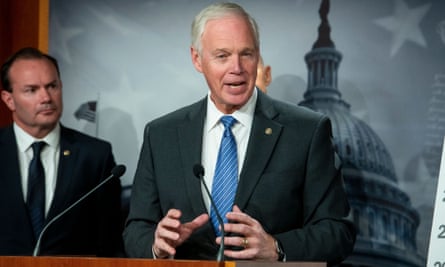
Ron Johnson speaks to reporters in Washington.Ron Johnson speaks to reporters in Washington. Photograph: Rex/Shutterstock

The Wisconsin senator, Ron Johnson, refused to say whether Republicans planning investigations of Hunter Biden for profiting from his connection to the presidency should also investigate Jared Kushner, Donald Trump’s son-in-law and adviser who secured a $1.2bn loan from Qatar while working in the White House. “I’m concerned about getting to the truth,” Johnson insisted. “I don’t target individuals.”

Republicans are undoubtedly targeting Biden, for allegedly making money thanks to his father, Joe. In the House, newly under GOP control, committees have promised investigations.

Appearing on NBC’s Meet the Press on Sunday, Johnson focused his fire on the president’s surviving son.

The host, Chuck Todd, said: “Senator, do you have a crime that you think Hunter Biden committed because I’ve yet to see anybody explain? It is not a crime to make money off of your last name.”

The Russian River, swollen with storm water, flows alongside Highway 101 in Hopland, CaliforniaThe death toll rose to 19 after a prolonged spell of rain and snow caused by atmospheric rivers. Photograph: Fred Greaves/Reuters

The president has declared a major disaster in California after devastating winter storms caused flooding and mudslides and the deaths of at least 19 people. On Saturday, Joe Biden ordered federal aid to supplement state, tribal and local recovery efforts in areas affected by storms since late December.

“The president’s action makes federal funding available to affected individuals in the counties of Merced, Sacramento and Santa Cruz,” the White House said. “Federal funding also is available to state, tribal and eligible local governments and certain private nonprofit organizations on a cost-sharing basis for emergency work in the counties of Merced, Sacramento, and Santa Cruz.”

Storms and flooding were expected to continue into Monday, the National Weather Service warned on Sunday. Drier weather is expected from Tuesday.

Flood warnings were issued for the region north of San Francisco Bay, including Marin, Napa, Sonoma and Mendocino counties.

  • How did the fast-moving floods have such a deadly toll? Over the past two weeks, a parade of powerful atmospheric rivers, narrow bands of enhanced water vapor, has brought both relief and ruin to California. While the rain is a welcome sight in the drought-hit state, the violent storms landed in quick succession, causing flash floods, billions of dollars in damage and killing at least 19 people.

Mafia boss Matteo Messina DenaroMatteo Messina Denaro was sentenced in absentia to a life term for his role in the 1992 murders of anti-mafia prosecutors. Photograph: Studio Camera di Lannino/Rex

  • Italian police have arrested Matteo Messina Denaro, Italy’s most wanted mafia boss who had been on the run for three decades. Denaro, who was detained at a clinic in Palermo is alleged to be in Sicily’s Cosa Nostra mafia.

  • In the moments before Nepal’s deadliest air crash in decades on Sunday, four friends from India who were onboard began recording the descent on a Facebook live video. Before the crash, all appears calm in the plane, with no emergency announcements or warnings from the pilot or staff.

  • Dr Dre has successfully blocked the Republican congresswoman Marjorie Taylor Greene from using his music in any context to do with her political career after she used his 1999 hit Still Dre to soundtrack a promotional video. Billboard reports that Greene’s lawyers formally acknowledged a cease and desist letter.

  • The New York Republican congressman George Santos, whose résumé has been shown to be largely fictional and who is under local, federal and international investigation, is a “bad guy” who has done “really bad” things, the new the new chair of the House oversight committeesaid on Sunday.

Evanston Alderman Robin Rue Simmons, who spearheaded the city’s reparations initiative, poses near her home in the Fifth Ward in Evanston, IllinoisRobin Rue Simmons: ‘We have to recognize that we have to start somewhere. We have to take a first step. We can’t be paralyzed.’ Photograph: Eileen Meslar/Reuters

In the heated debate over reparations in the US, the daunting task before those fighting for compensation for Black Americans is twofold. Their first challenge is justifying to those against reparations what has already been documented throughout history time and time again: that the lasting legacy of slavery, and the racism and discrimination tied to it, stretches centuries after the Emancipation Proclamation and continues to harm Black Americans today. The second is proving that the messy and complicated process of meting out this restitution, be it monetary or through policy – an endeavor some economic experts have estimated could result in tens of millions of dollars being paid out to millions of Black Americans – is even possible.

In this photo illustration the Facebook social media app company logo seen displayed on a smartphone, face of Donald Trump and the United States of America flag seen in the background. Company logo on a smartphoneMeta suspended Donald Trump from Facebook and Instagram in 2021. Lawmakers, activists and researchers have called for a permanent ban. Photograph: Filip Radwański/Sopa/Rex/Shutterstock

It has been a little more than two years since Meta suspended Donald Trump from Facebook and Instagram over his actions during the January 6 Capitol riots. Now, a major decision looms – reinstate Trump’s account, or keep him off the platform for good? It is a widely watched decision that will set a new precedent on how social media firms balance free speech with content moderation, especially when it comes to world leaders and other newsworthy individuals. The announcement, which is expected this month, stems from a self-imposed deadline. While Trump’s ban was initially indefinite, the company later pledged to revisit the decision two years after the suspension began, writes Kari Paul.

Indigenous people from Malaysia’s Mah Meri perform a thanksgiving to the sea. Asia is one of the region’s most affected by population displacement.Indigenous people from Malaysia’s Mah Meri perform a thanksgiving to the sea. Asia is one of the region’s most affected by population displacement. Photograph: Mohd Daud/Zuma/Rex/Shutterstock

Every 40 days a language dies. This “catastrophic” loss is being amplified by the climate crisis, according to linguists. If nothing is done, conservative estimates suggest that half of the 7,000 languages still spoken will be extinct by the end of the century, writes Karen McVeigh. Speakers of minority languages have experienced a long history of persecution. As a result half of all Indigenous languages in Australia, the US, South Africa and Argentina were extinct by the 1920s. The climate crisis is now considered the “final nail in the coffin” for many Indigenous languages and the knowledge they represent.

The Manhattan skyline looms over the East River.The Manhattan skyline looms over the East River. Photograph: Spencer Platt/Getty Images

Several groups of treasure hunters have been seen on the East River in New York City after a guest on the Joe Rogan podcast claimed a boxcar of valuable prehistoric mammoth bones was dumped in the river in the 1940s. Despite a lack of evidence, people have used boats, diving gear and remote-operated cameras to search. “I think the chances are just as good as the lottery. And people buy those tickets every day,” said Don Gann, 35, of North Arlington, New Jersey, a commercial diver who has been out on the water since early last week. Gann said he had seen about two dozen other sets of fossil hunters out searching for mammoth remains.

Sign up for the US morning briefing

First Thing is delivered to thousands of inboxes every weekday. If you’re not already signed up, subscribe now.

If you have any questions or comments about any of our newsletters please email newsletters@theguardian.com

Categories
Audio Sources - Full Text Articles

Rescue hopes fade after Russian attack on Dnipro

2023-01-16T02:32:15Z

Ukraine saw little hope of pulling any more survivors from the rubble of an apartment block in the city of Dnipro on Sunday, a day after the building was hit during a major Russian missile attack, with dozens of people expected to have died. Flora Bradley-Watson reports.

Russia and Belarus will begin joint air force drills on Monday, which have triggered fears in Kyiv and the West that Moscow could use its ally to launch a new ground offensive in Ukraine.

Minsk says the drills are defensive, and since Moscow used its neighbour as a springboard for its invasion of Ukraine last February Belarus has conducted numerous military exercises, both on its own and jointly with Russia.

Together with Moscow, Minsk has also been bolstering the drills with weaponry and military equipment.

Unofficial Telegram military monitoring channels have been reporting a series of fighters, helicopters and military transport planes coming to Belarus since the start of the year – eight fighters and four cargo planes on Sunday alone.

Reuters was not able to verify the reports. The Belarusian defence ministry said only that “units” of Russia’s air forces have been arriving in Belarus.

“During the tactical flight exercise, all airfields and training grounds of the Air Force and Air Defence Forces of the Armed Forces of Belarus will be involved,” the ministry said in a statement.

The situation on Belarus’s southern border – the border with Ukraine – was “not very calm,” and Ukraine has been “provoking” Belarus, said Pavel Muraveyko, first deputy state secretary of Belarusian Security Council, according to a post on the Belarusian defence ministry’s Telegram app on Sunday.

“We’re maintaining restraint and patience, keeping our gunpowder dry,” Muraveyko said. “We have the necessary set of forces and means that will respond to any manifestations of aggression or a terrorist threat on our territory.”

Ukraine has continuously warned of possible attacks from Belarus and President Volodymyr Zelenskiy said last week that the country must be ready at its border with Belarus.

The Kremlin has denied that it has been pressuring Belarusian President Alexander Lukashenko to take a more active role in the conflict in Ukraine. Minsk has said it will not enter the war.

Ukraine saw little hope of pulling any more survivors from the rubble of an apartment block in the city of Dnipro on Sunday, a day after the building was hit during a major Russian missile attack, with dozens of people expected to have died.

The regional governor’s adviser, Natalia Babachenko, said 30 people were confirmed dead so far and more than 30 were in hospital, including 12 in a serious condition. Between 30 to 40 people could still be trapped under debris, she said.

Emergency workers said they had heard people screaming for help from underneath piles of debris from the nine-storey apartment block in the east-central city and were using moments of silence to help direct their efforts. Freezing temperatures added to rescuers’ concerns.

“The chances of saving people now are minimal,” Dnipro’s Mayor Borys Filatov told Reuters. I think the number of dead will be in the dozens.”

Ukraine’s Air Force said the apartment block was struck by a Russian Kh-22 missile, which is known to be inaccurate and that Ukraine lacks the air defences to shoot down. The Soviet-era missile was developed during the Cold War to destroy warships.

Russia fired two waves of missiles at Ukraine on Saturday, striking targets across the country as fighting raged on the battlefield in the eastern towns of Soledar and Bakhmut.

Moscow, which invaded last February, has been pounding Ukraine’s energy infrastructure with missiles and drones since October, causing sweeping blackouts and disruptions to central heating and running water.

In his nightly address after the Dnipro strike, Zelenskiy called on Western allies to supply more weapons to end “Russian terror” and attacks on civilian targets.

Western powers are considering sending battle tanks to Kyiv and ahead of a meeting of Ukraine’s allies in Ramstein in Germany next Friday, where governments will announce their latest pledges of military support.

On Saturday, Britain followed France and Poland with promises of further weapons, saying it would send 14 of its Challenger 2 main battle tanks as well as other advanced artillery support in the coming weeks.

The first despatch of Western-made tanks to Ukraine is likely to be viewed by Moscow as escalation of the conflict. The Russian Embassy in London said the tanks would drag out the confrontation.

Russia’s invasion, which Moscow calls a “special military operation”, has already killed thousands, displaced millions and turned many cities into rubble.

In Ukraine’s eastern Donbas region – the focal point of Russia’s drive to capture more territory – Ukraine’s forces were battling around the small salt-mining town of Soledar.

Russian forces claimed to have taken control of the town, but Ukraine insisted on Sunday that its forces were battling to hold the town, with street fighting raging and Russian forces advancing from various directions.

“Put simply, THE BATTLE CONTINUES,” Deputy Defence Minister Hanna Maliar said on the Telegram messaging app. “Everything else is unverified information.”

The Washington-based Institute for the Study of War said it was highly unlikely that Ukrainian forces still held positions within Soledar itself.

Reuters could not immediately verify the situation in the town.

Related Galleries:
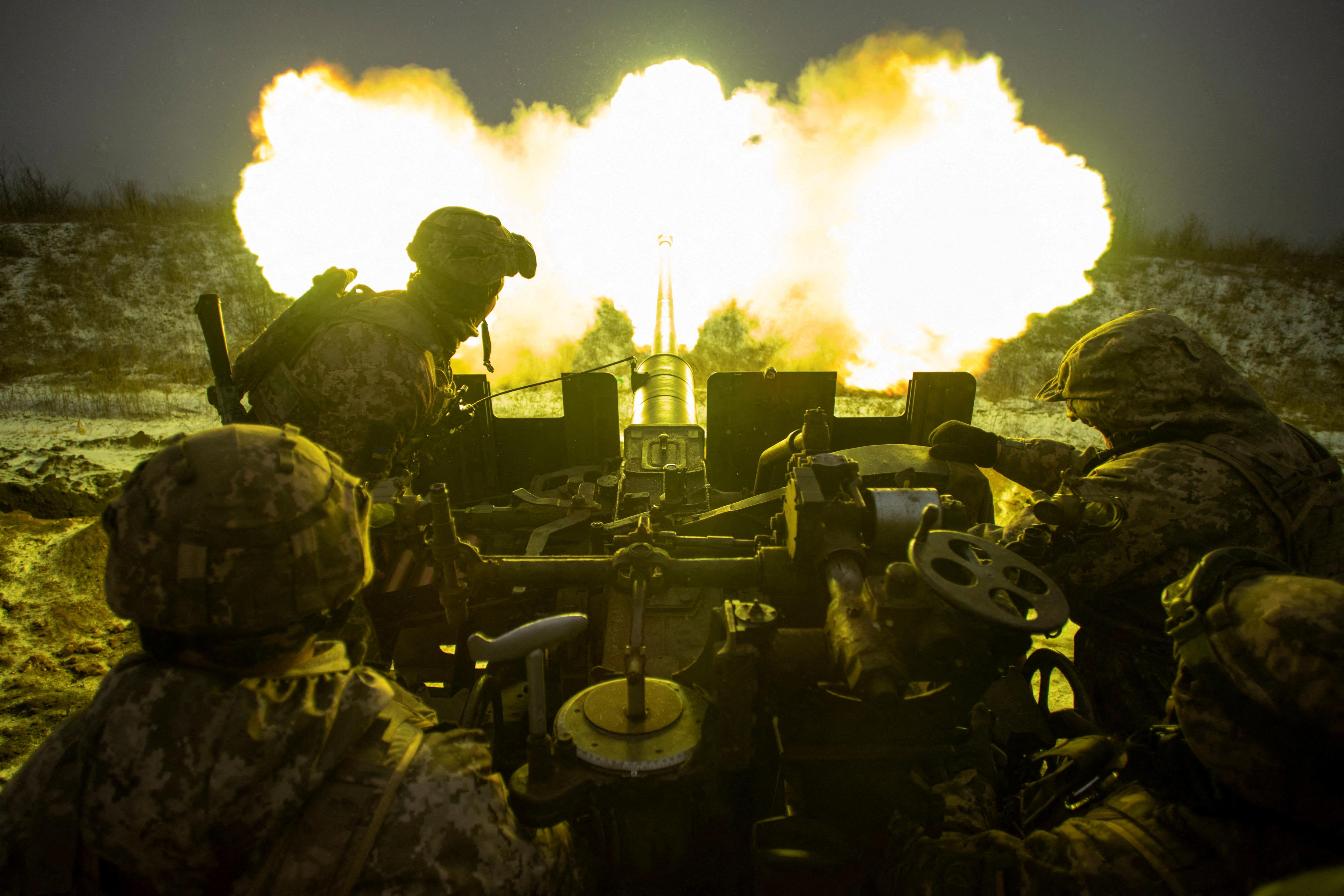
Ukrainian servicemen fire an anti-aircraft gun towards Russian positions on a frontline near the town of Bakhmut, amid Russia’s attack on Ukraine, in Donetsk region, Ukraine January 15, 2023. REUTERS/Oleksandr Ratushniak
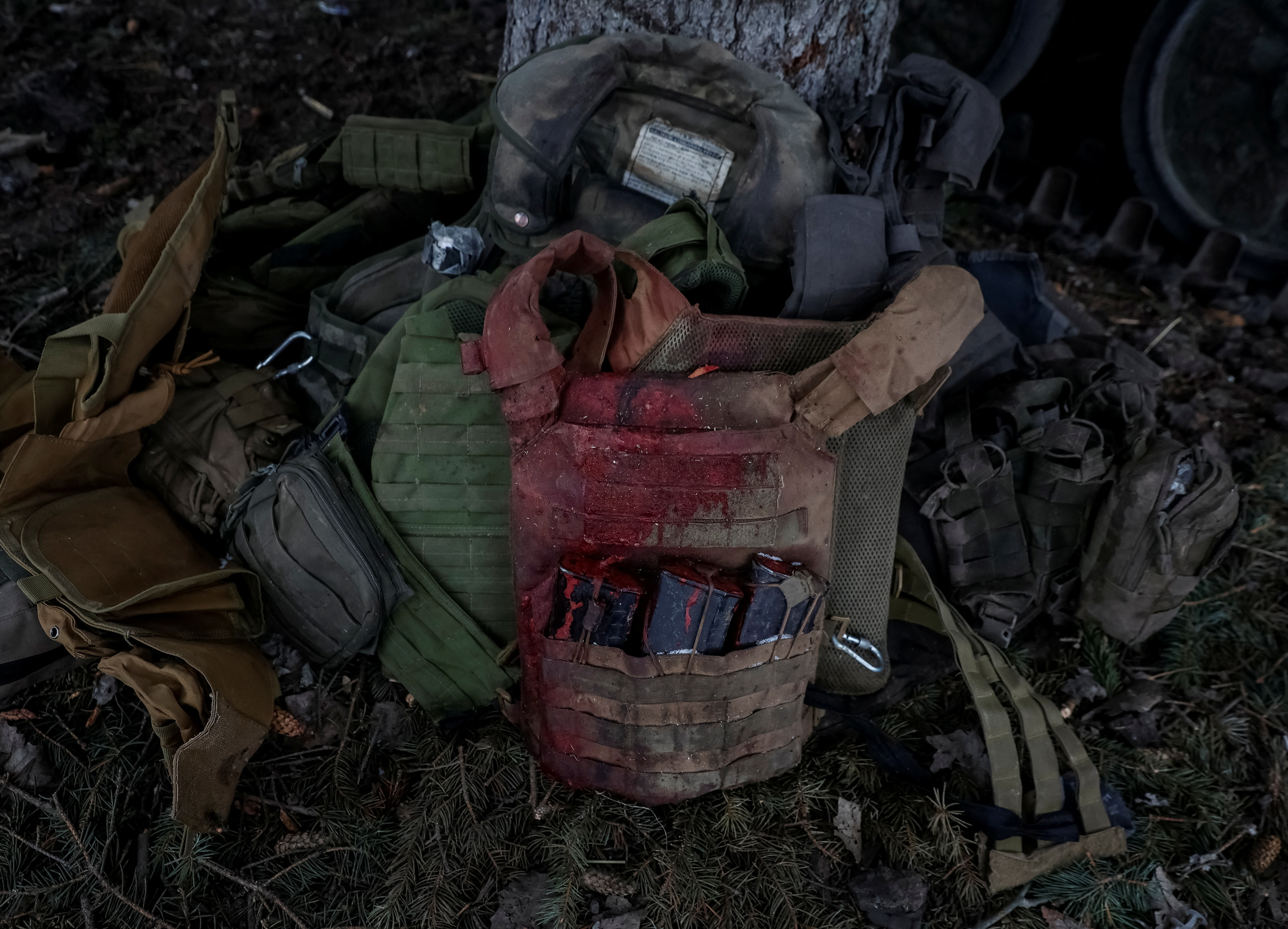
The bloodied bulletproof of a Ukrainian serviceman is seen, amid Russia’s attack on Ukraine, on a frontline near the town of Soledar in Donetsk region, Ukraine January 14, 2023. Radio Free Europe/Radio Liberty/Serhii Nuzhnenko via REUTERS
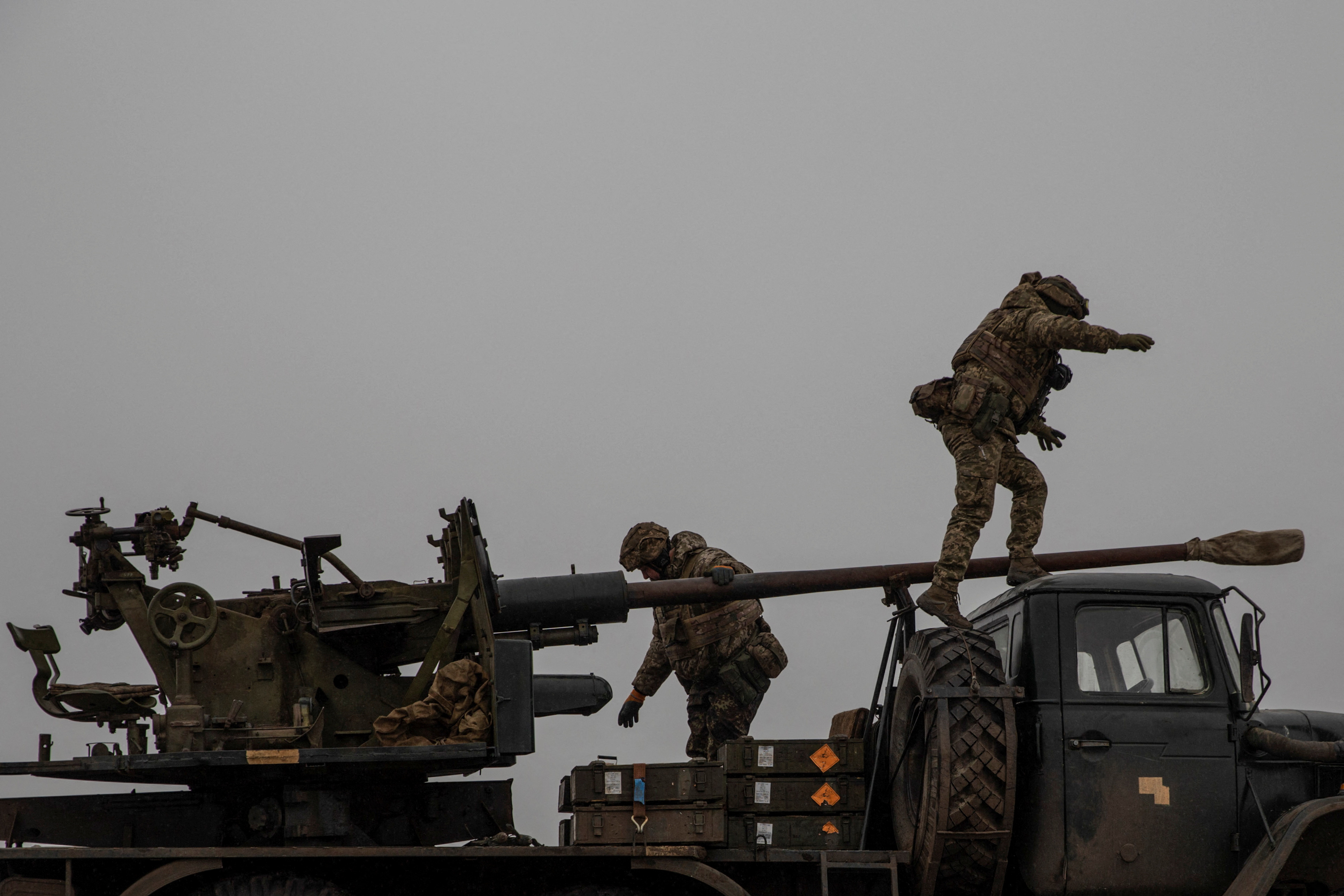
Ukrainian servicemen prepare an anti-aircraft gun to fire towards Russian positions on a frontline near the town of Bakhmut, amid Russia’s attack on Ukraine, in Donetsk region, Ukraine January 15, 2023. REUTERS/Oleksandr Ratushniak
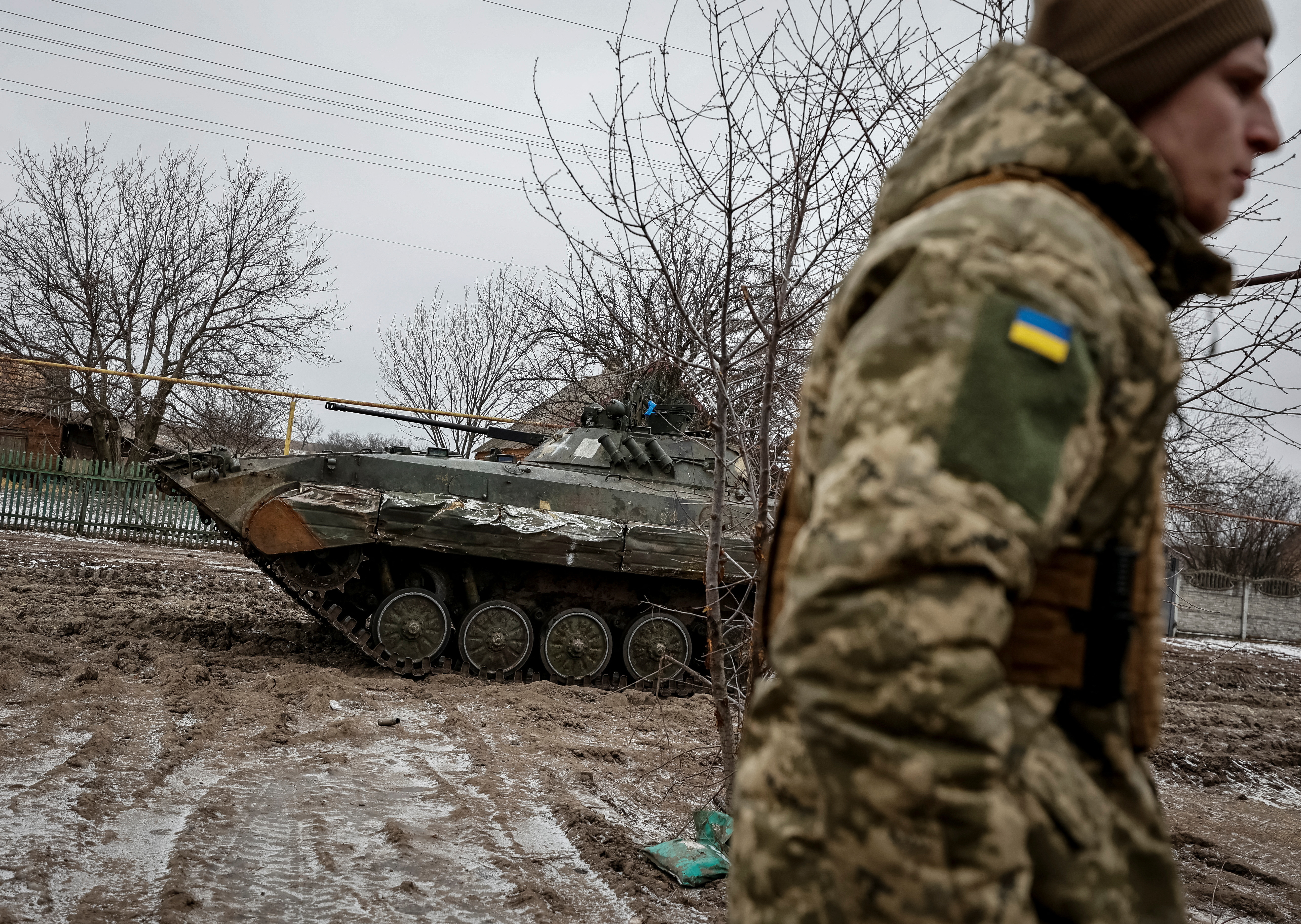
A Ukrainian service member walks near a BMP-2 infantry fighting vehicle, amid Russia’s attack on Ukraine, on a frontline near the town of Soledar in Donetsk region, Ukraine January 14, 2023. Radio Free Europe/Radio Liberty/Serhii Nuzhnenko via REUTERS
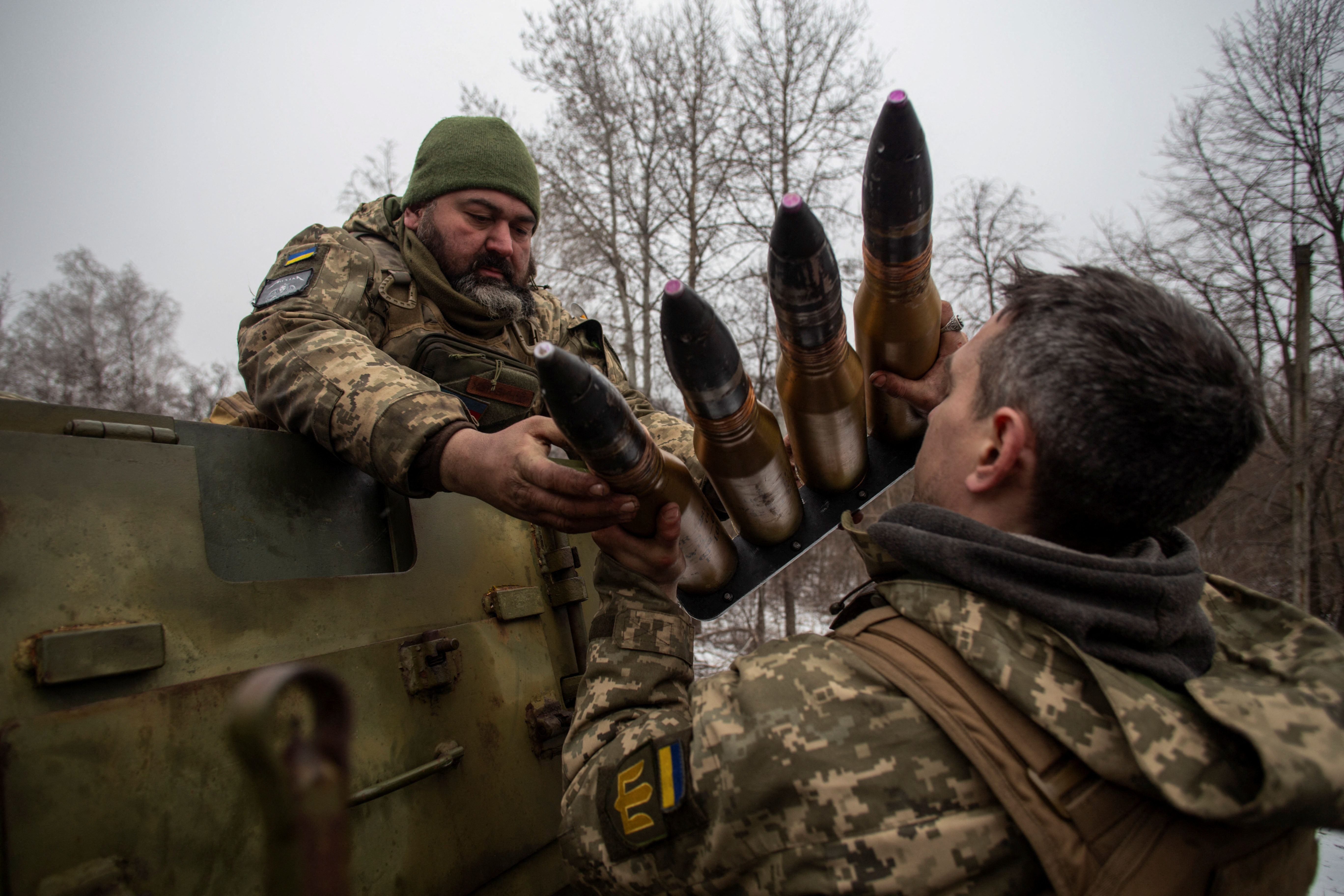
Ukrainian servicemen load shells for an anti-aircraft gun before moving to their position on a frontline near the town of Bakhmut, amid Russia’s attack on Ukraine, in Donetsk region, Ukraine January 15, 2023. REUTERS/Oleksandr Ratushniak
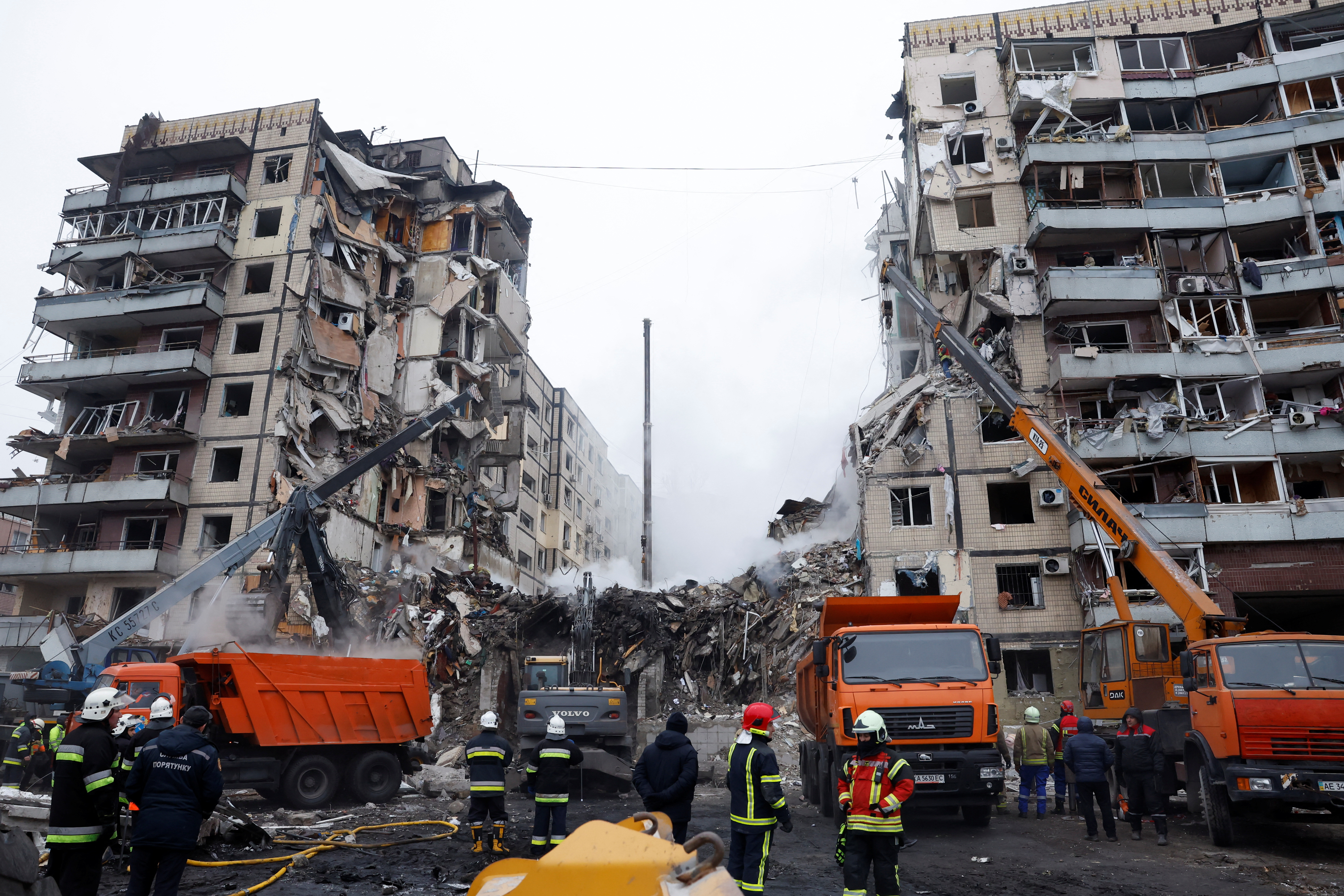
Emergency personnel work at the site where an apartment block was heavily damaged by a Russian missile strike, amid Russia’s attack on Ukraine, in Dnipro, Ukraine January 15, 2023. REUTERS/Clodagh Kilcoyne
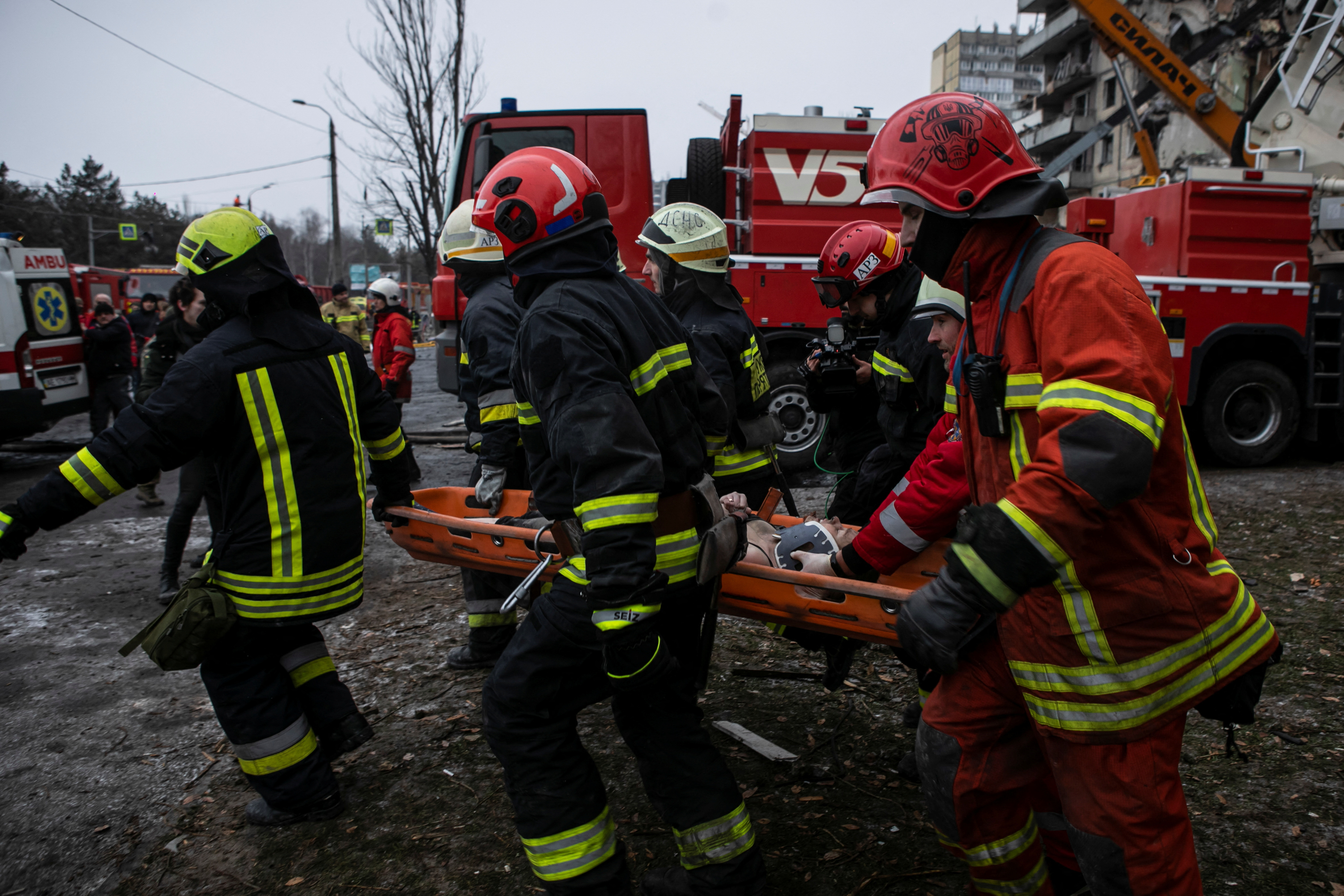
Emergency workers carry a woman released from debris at the site where an apartment block was heavily damaged by a Russian missile strike, amid Russia’s attack on Ukraine, in Dnipro, Ukraine January 15, 2023. REUTERS/Yevhenii Zavhorodnii
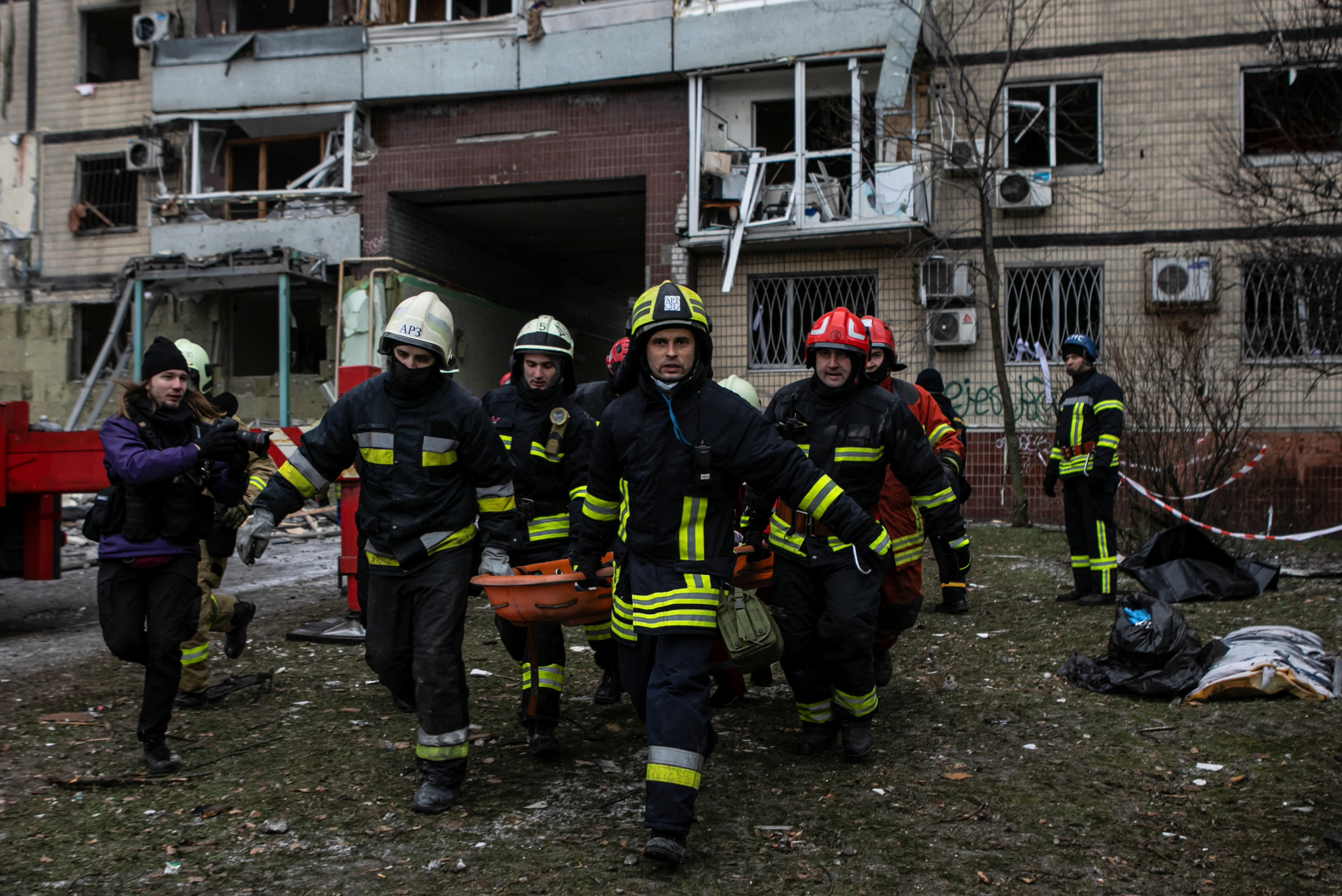
Emergency workers carry a woman released from debris at the site where an apartment block was heavily damaged by a Russian missile strike, amid Russia’s attack on Ukraine, in Dnipro, Ukraine January 15, 2023. REUTERS/Yevhenii Zavhorodnii
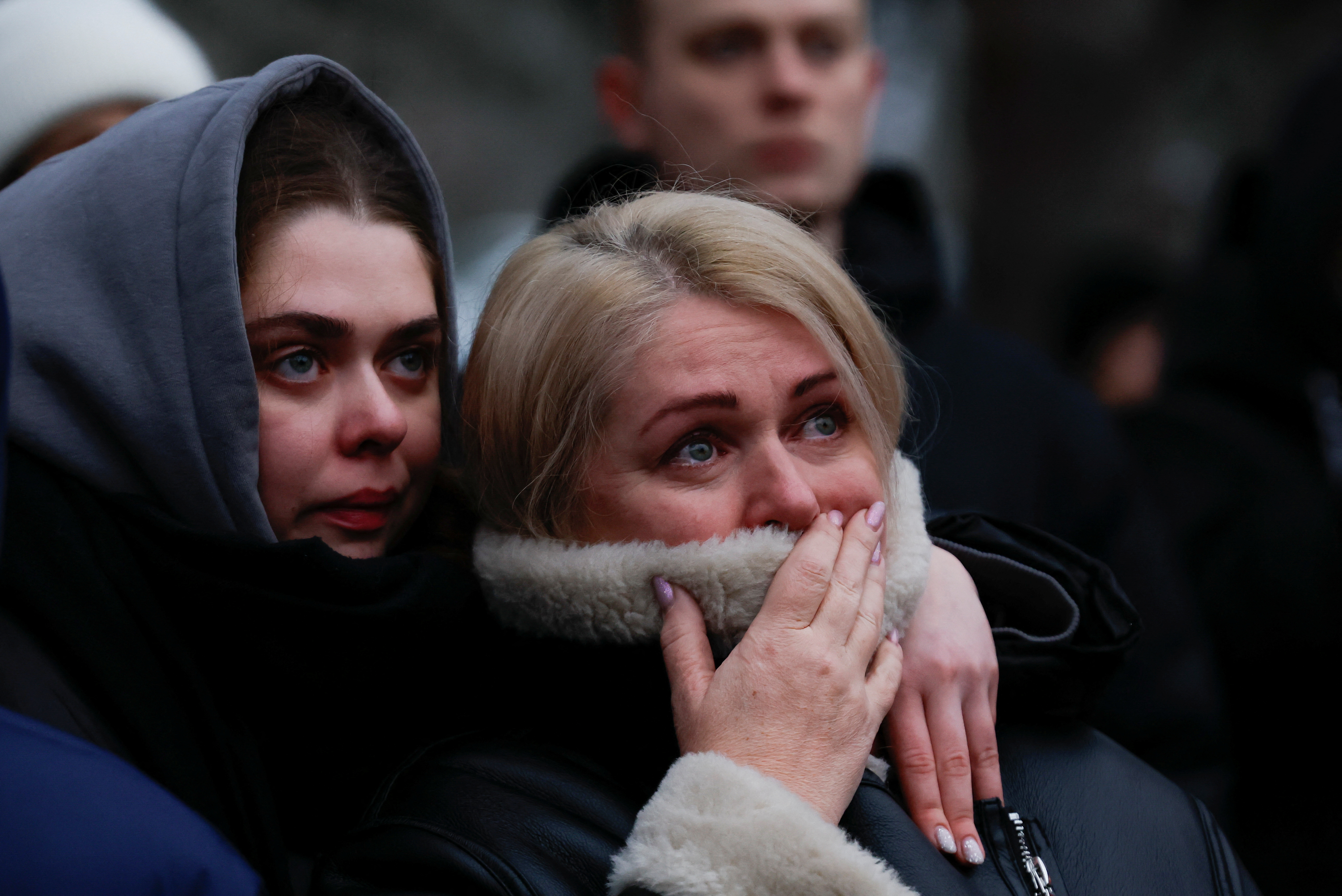
Women look on as emergency personnel work at the site where an apartment block was heavily damaged by a Russian missile strike, amid Russia’s attack on Ukraine, in Dnipro, Ukraine January 15, 2023. REUTERS/Clodagh Kilcoyne
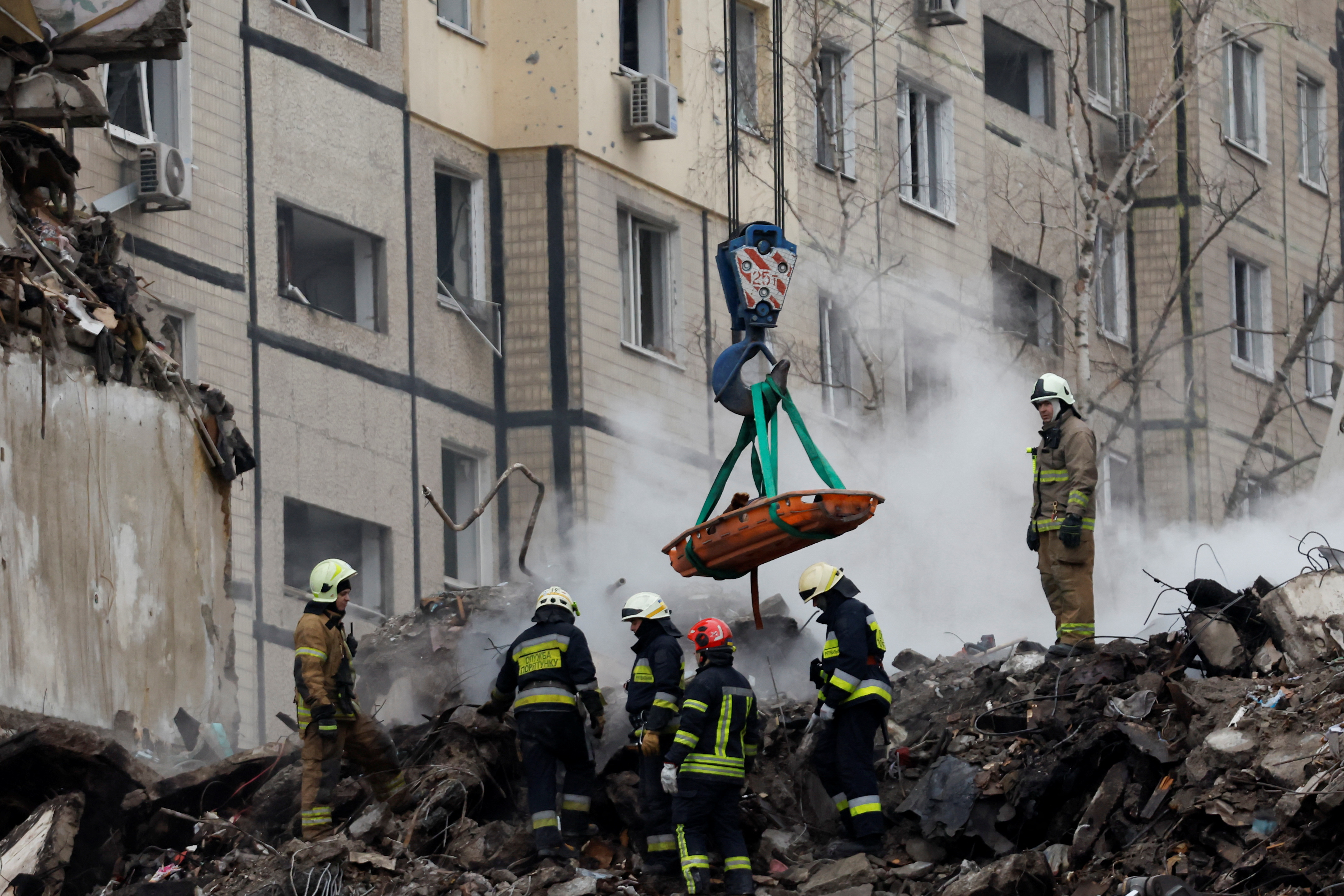
Emergency personnel retrieve a dead body at the site where an apartment block was heavily damaged by a Russian missile strike, amid Russia’s attack on Ukraine, in Dnipro, Ukraine January 15, 2023. REUTERS/Clodagh Kilcoyne
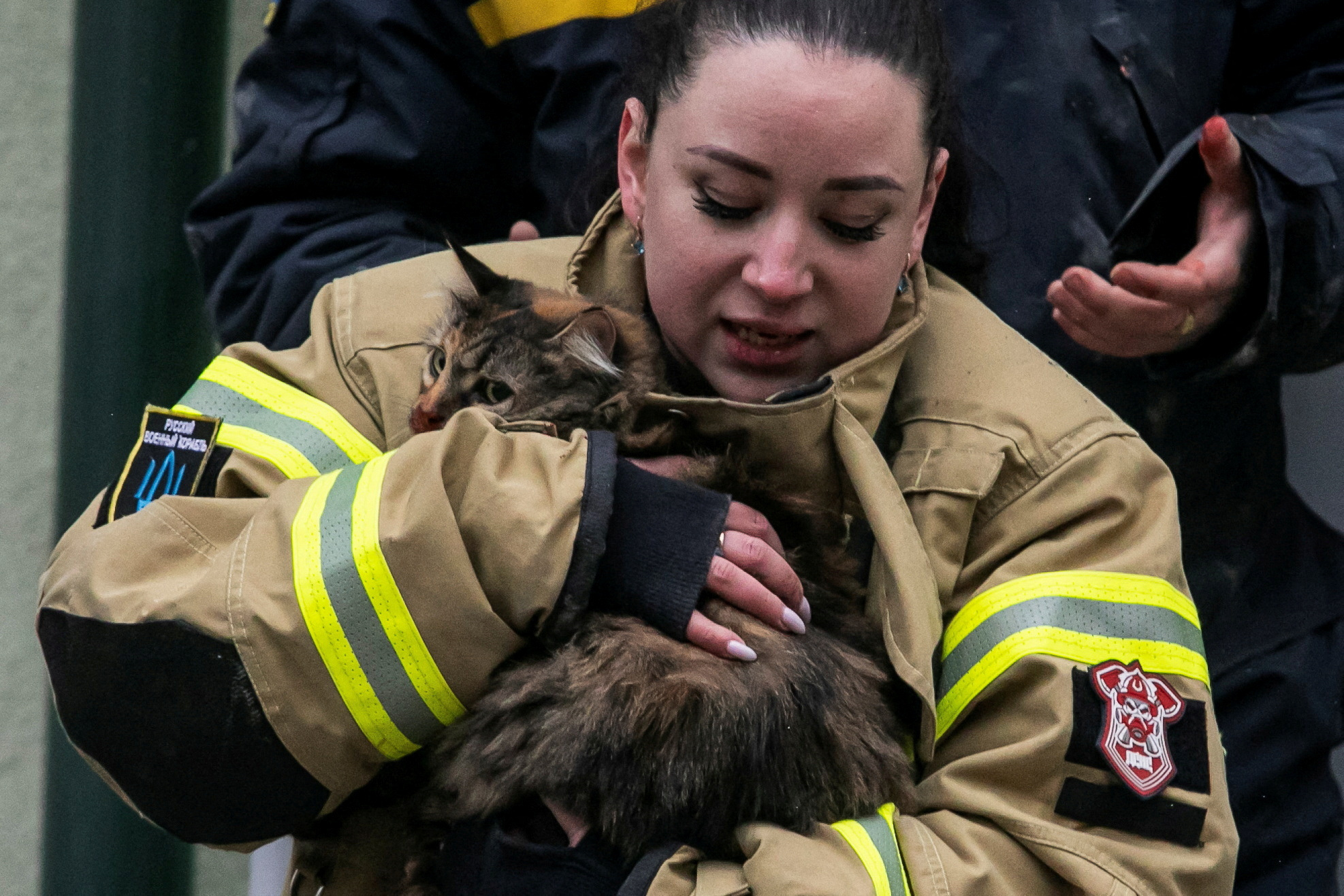
An emergency worker holds a cat rescued at the site where an apartment block was heavily damaged by a Russian missile strike, amid Russia’s attack on Ukraine, in Dnipro, Ukraine January 15, 2023. REUTERS/Yevhenii Zavhorodnii
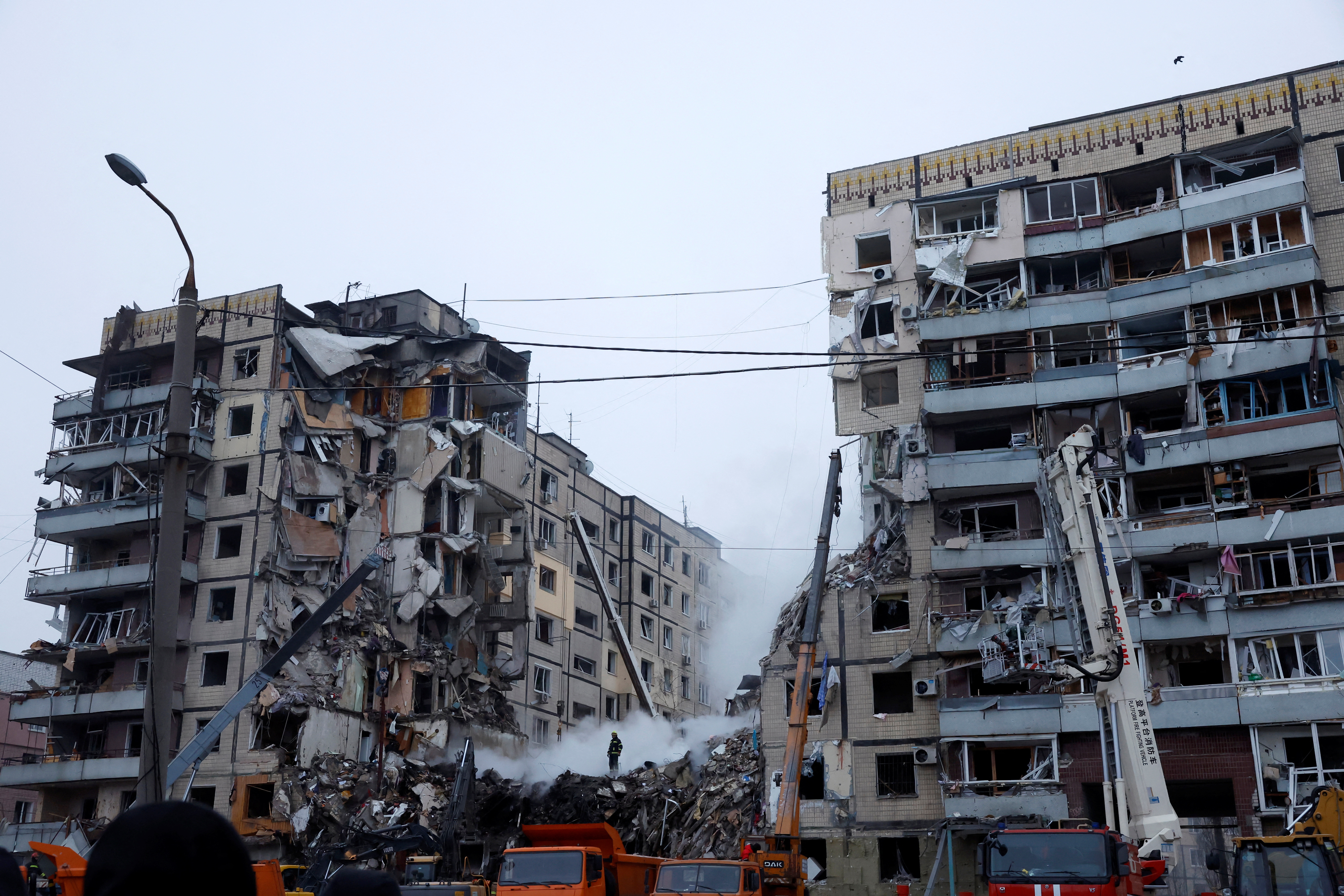
Emergency personnel work at the site where an apartment block was heavily damaged by a Russian missile strike, amid Russia’s attack on Ukraine, in Dnipro, Ukraine January 15, 2023. REUTERS/Clodagh Kilcoyne
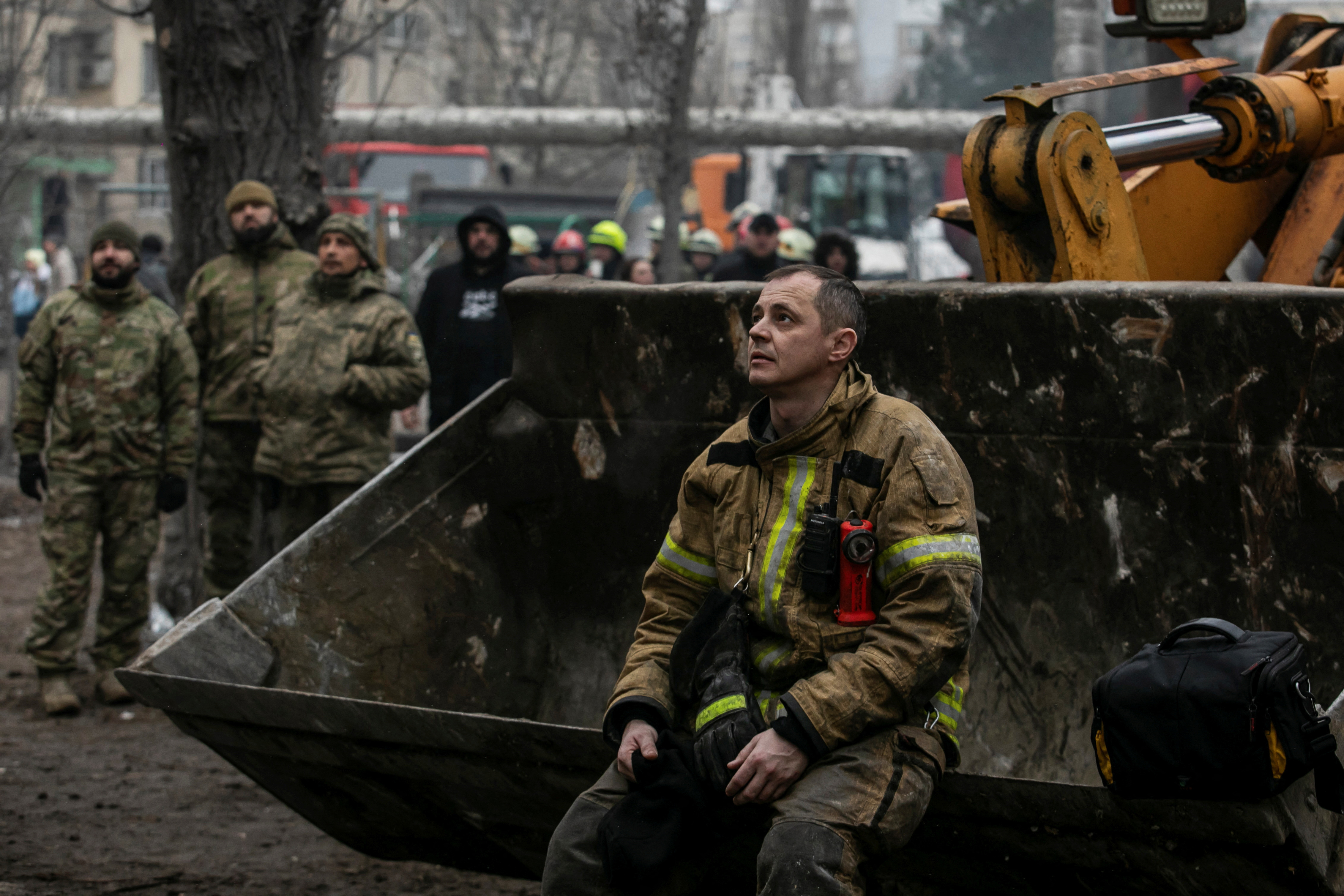
An emergency worker rests at the site where an apartment block was heavily damaged by a Russian missile strike, amid Russia’s attack on Ukraine, in Dnipro, Ukraine January 15, 2023. REUTERS/Yevhenii Zavhorodnii
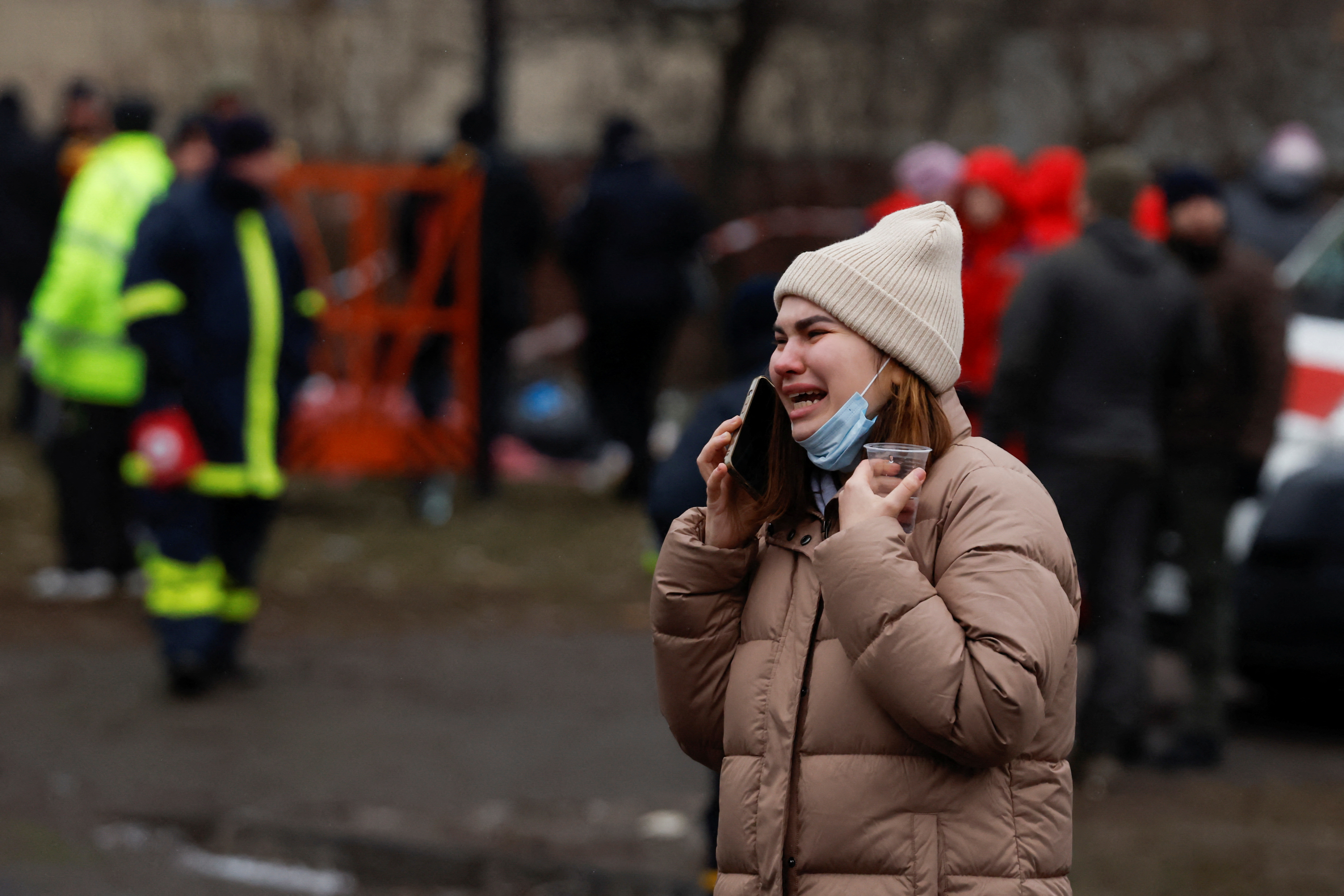
A woman reacts while holding a phone as emergency personnel work at the site where an apartment block was heavily damaged by a Russian missile strike, amid Russia’s attack on Ukraine, in Dnipro, Ukraine January 15, 2023. REUTERS/Clodagh Kilcoyne
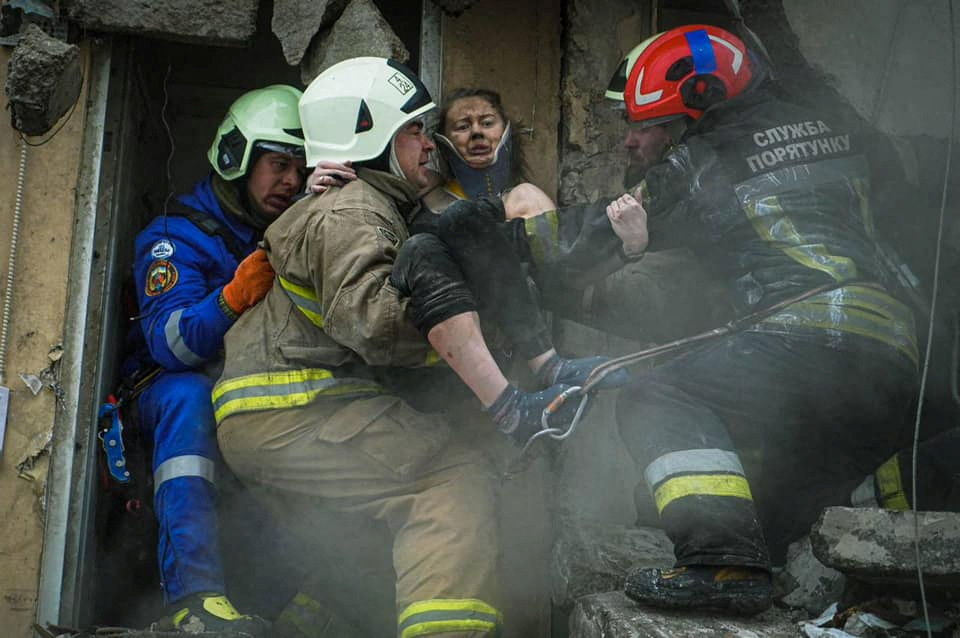
Emergency workers carry a woman released from debris at the site where an apartment block was heavily damaged by a Russian missile strike, amid Russia’s attack on Ukraine, in Dnipro, Ukraine January 15, 2023. Press service of the State Emergency Service of Ukraine/Handout via REUTERS
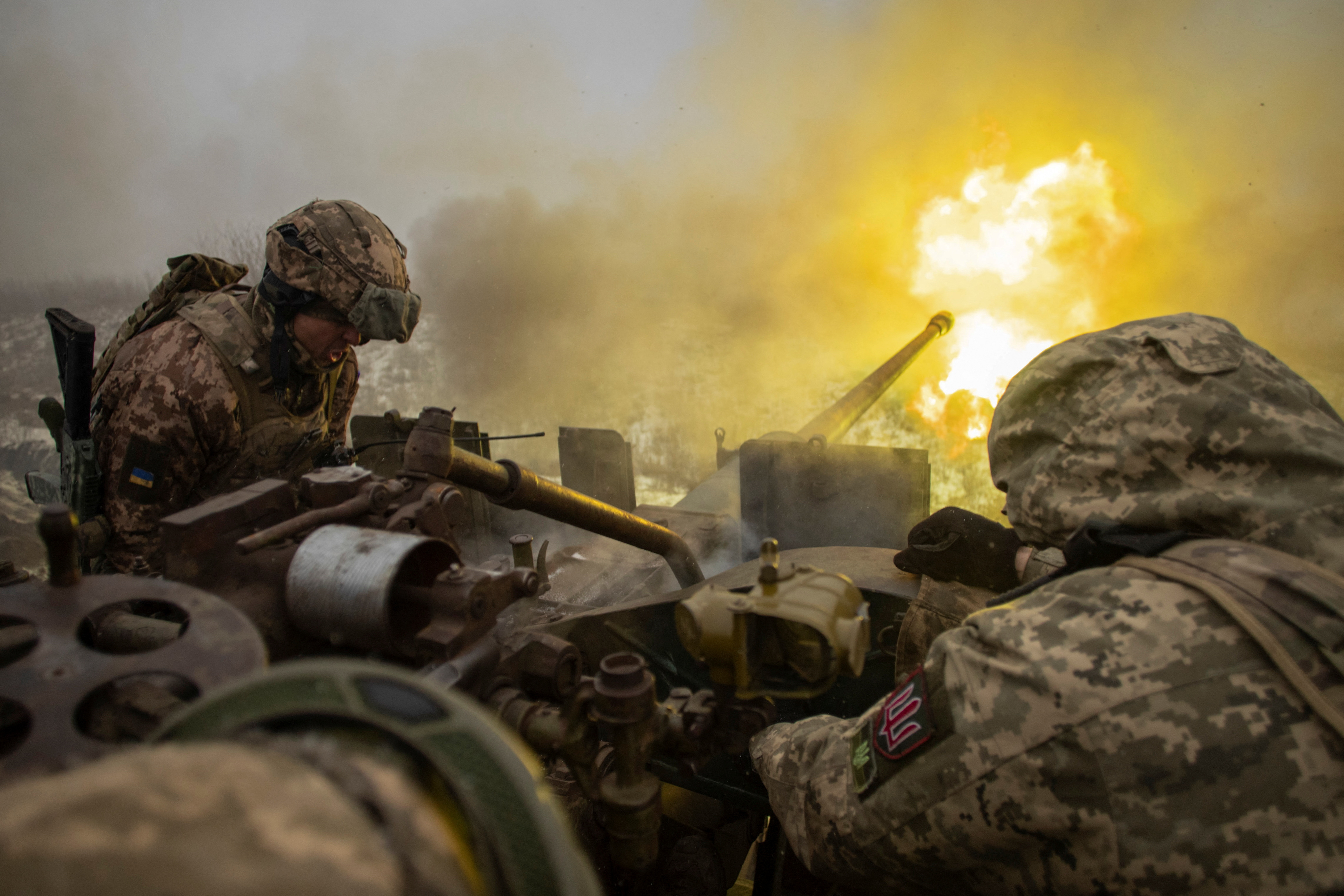
Ukrainian servicemen fire an anti-aircraft gun towards Russian positions on a frontline near the town of Bakhmut, amid Russia’s attack on Ukraine, in Donetsk region, Ukraine January 15, 2023. REUTERS/Oleksandr Ratushniak
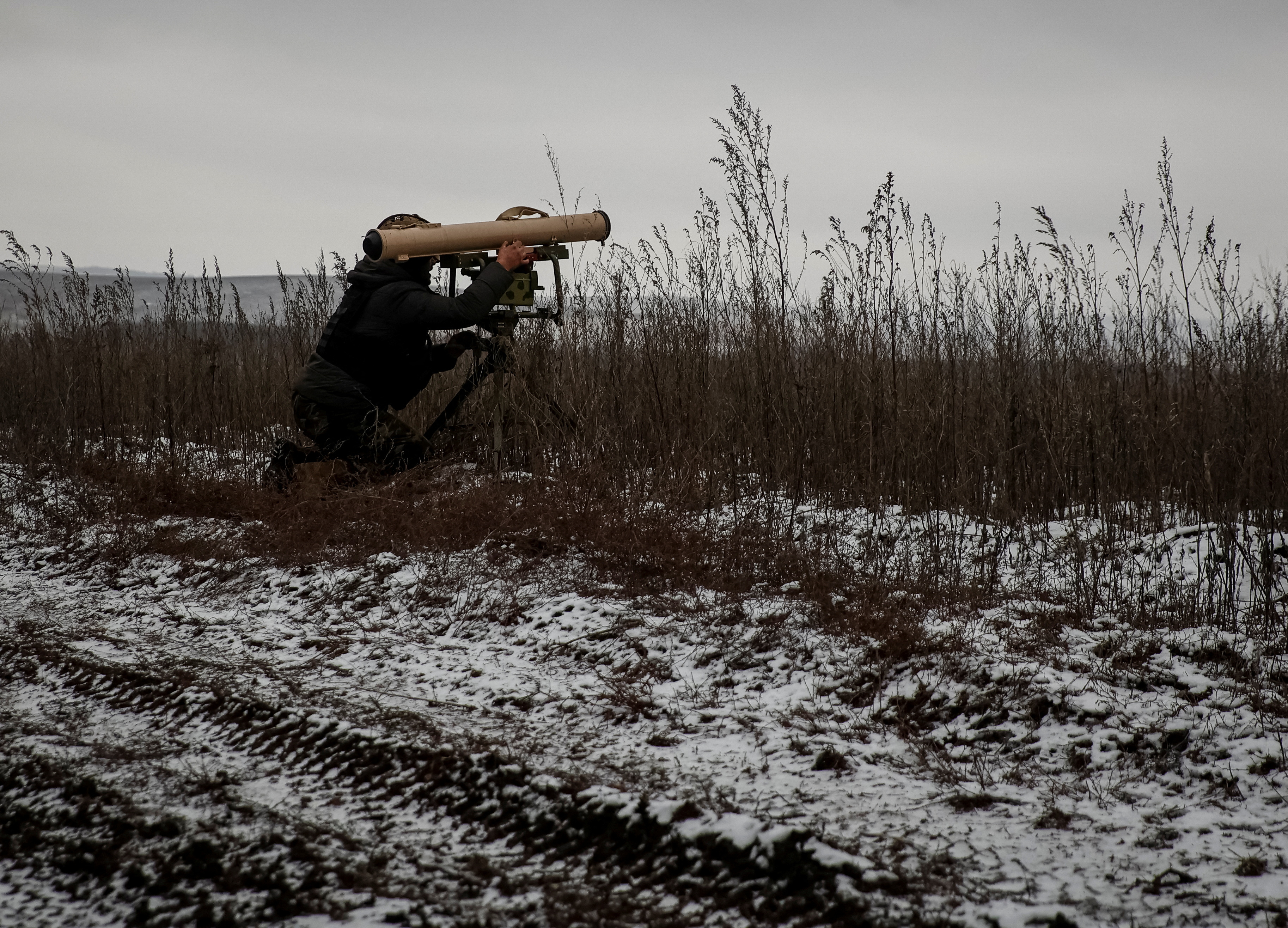
A Ukrainian service member prepares an anti-tank guided missile weapon system, amid Russia’s attack on Ukraine, on a frontline near the town of Soledar in Donetsk region, Ukraine January 14, 2023. Radio Free Europe/Radio Liberty/Serhii Nuzhnenko via REUTERS
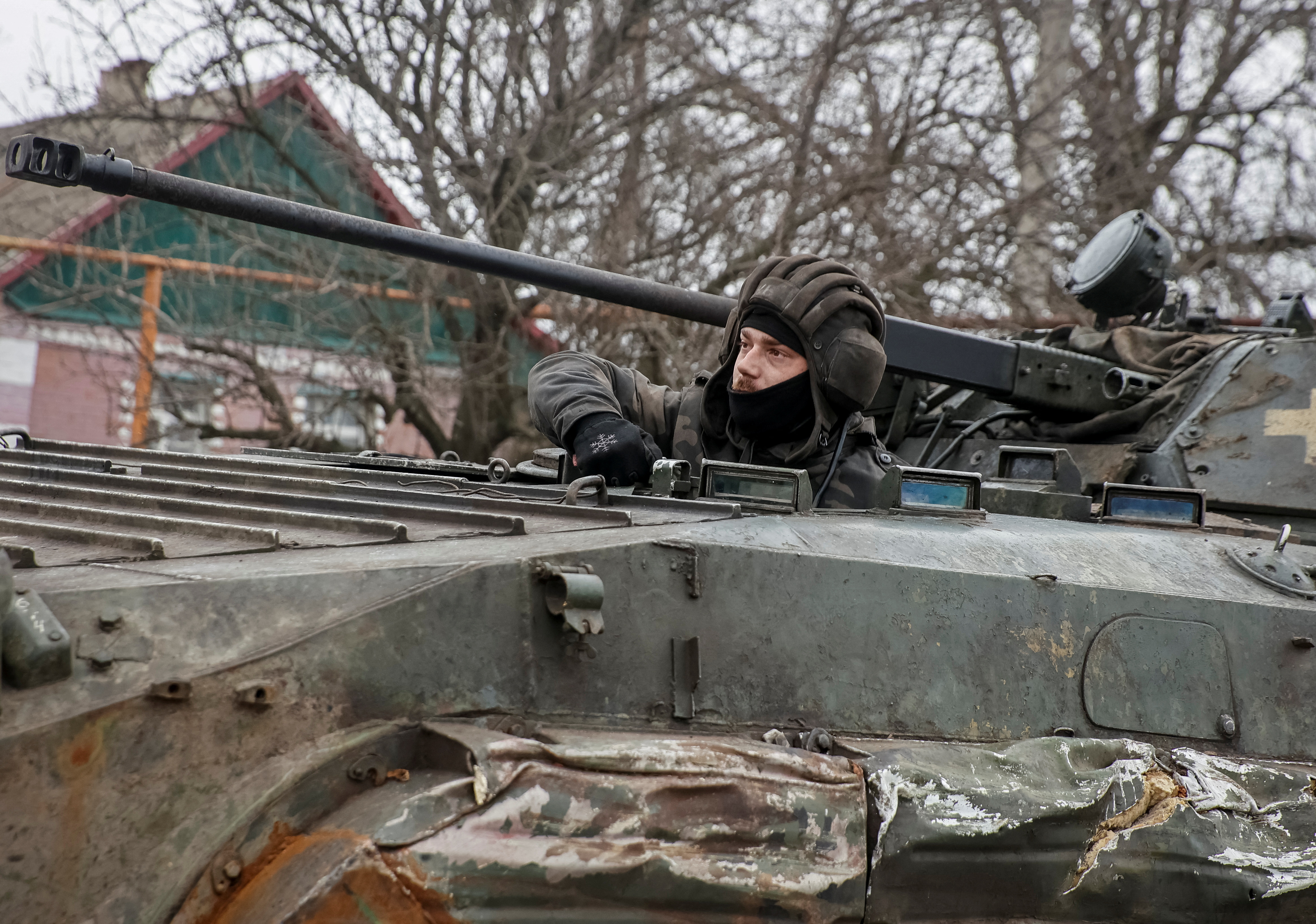
A Ukrainian service member looks out from a BMP-2 infantry fighting vehicle, amid Russia’s attack on Ukraine, on a frontline near the town of Soledar in Donetsk region, Ukraine January 14, 2023. Radio Free Europe/Radio Liberty/Serhii Nuzhnenko via REUTERS
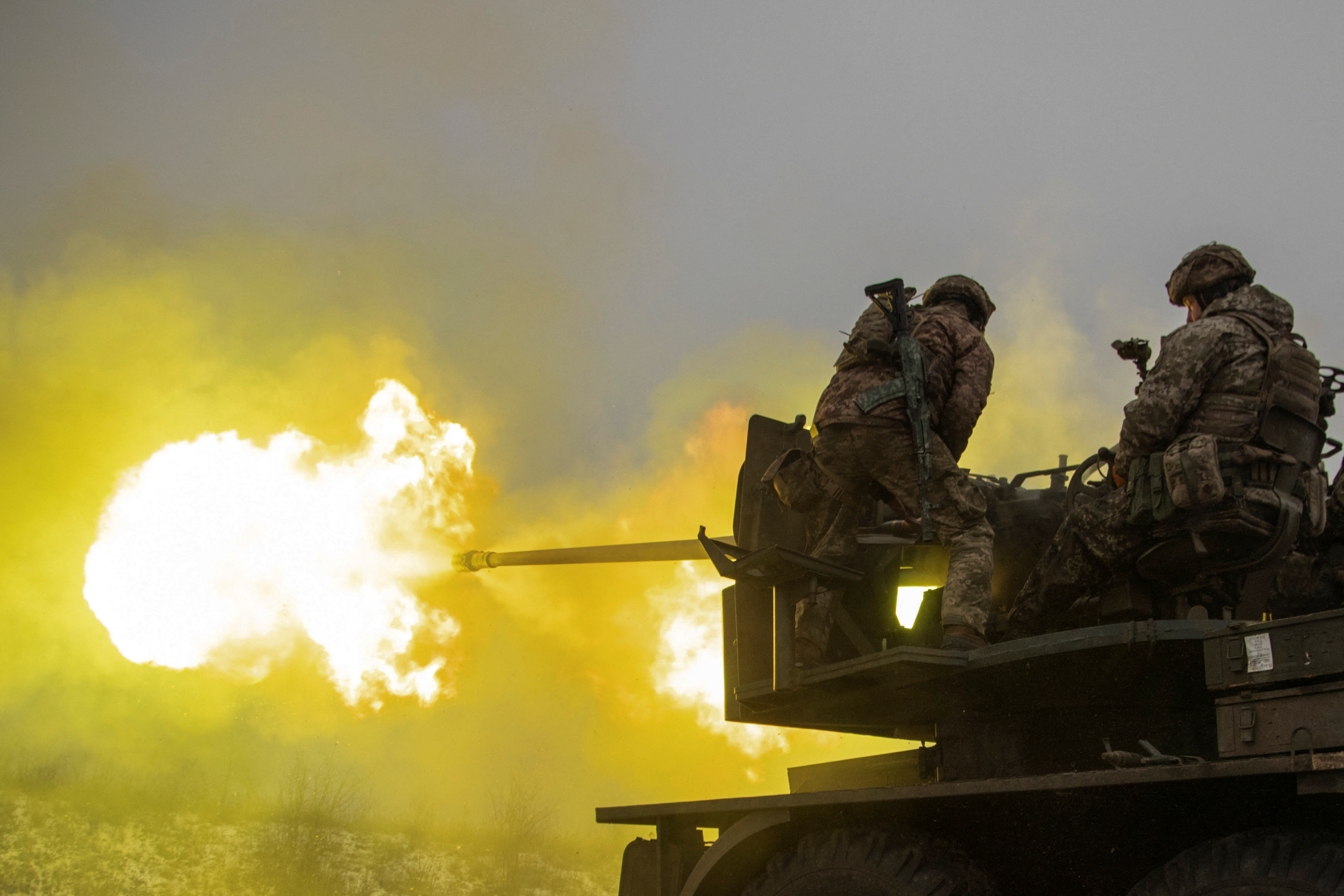
Ukrainian servicemen fire an anti-aircraft gun towards Russian positions on a frontline near the town of Bakhmut, amid Russia’s attack on Ukraine, in Donetsk region, Ukraine January 15, 2023. REUTERS/Oleksandr Ratushniak
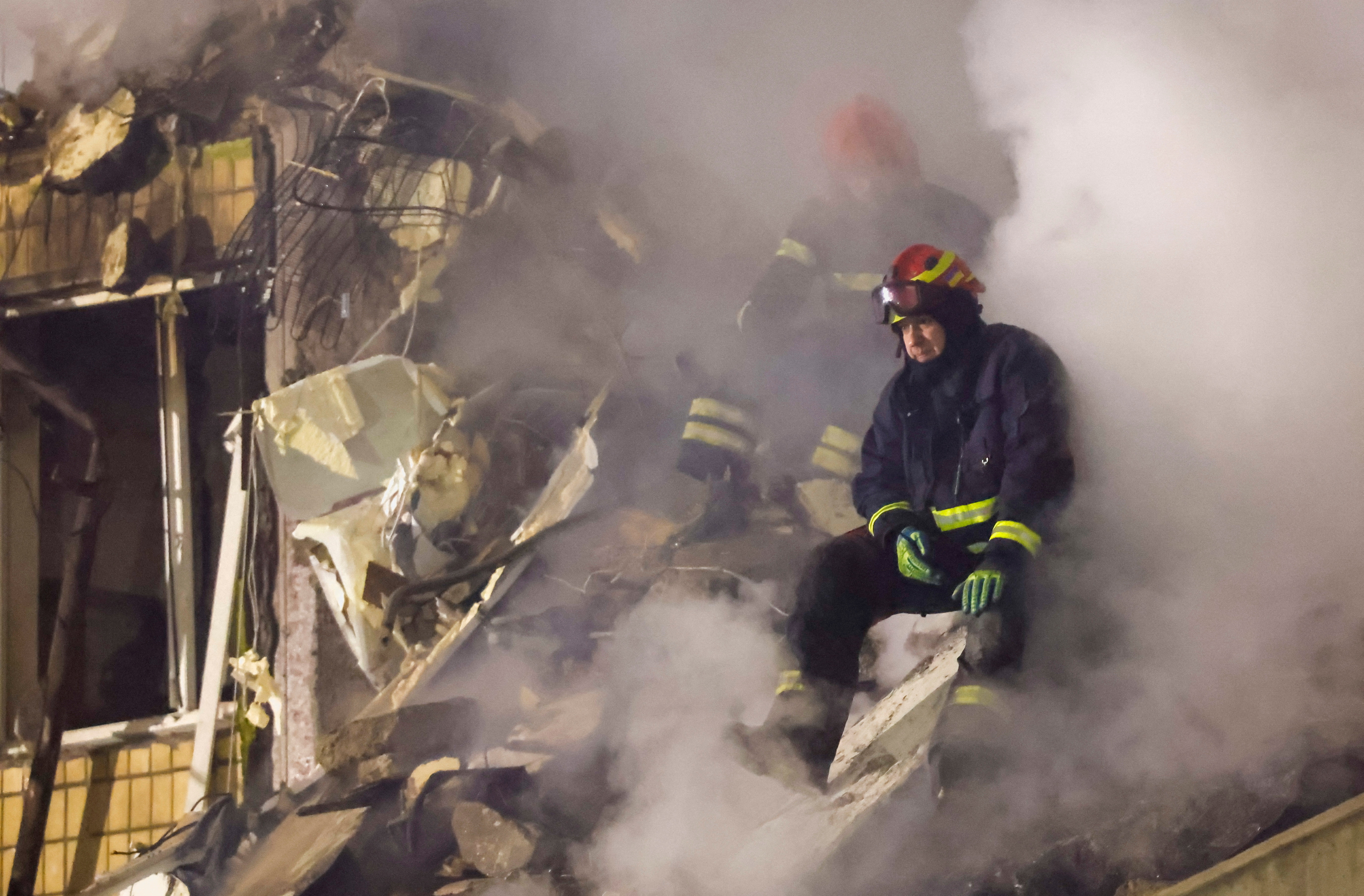
Emergency personnel work at the site where an apartment block was heavily damaged by a Russian missile strike, amid Russia’s attack on Ukraine, in Dnipro, Ukraine January 15, 2023. REUTERS/Clodagh Kilcoyne
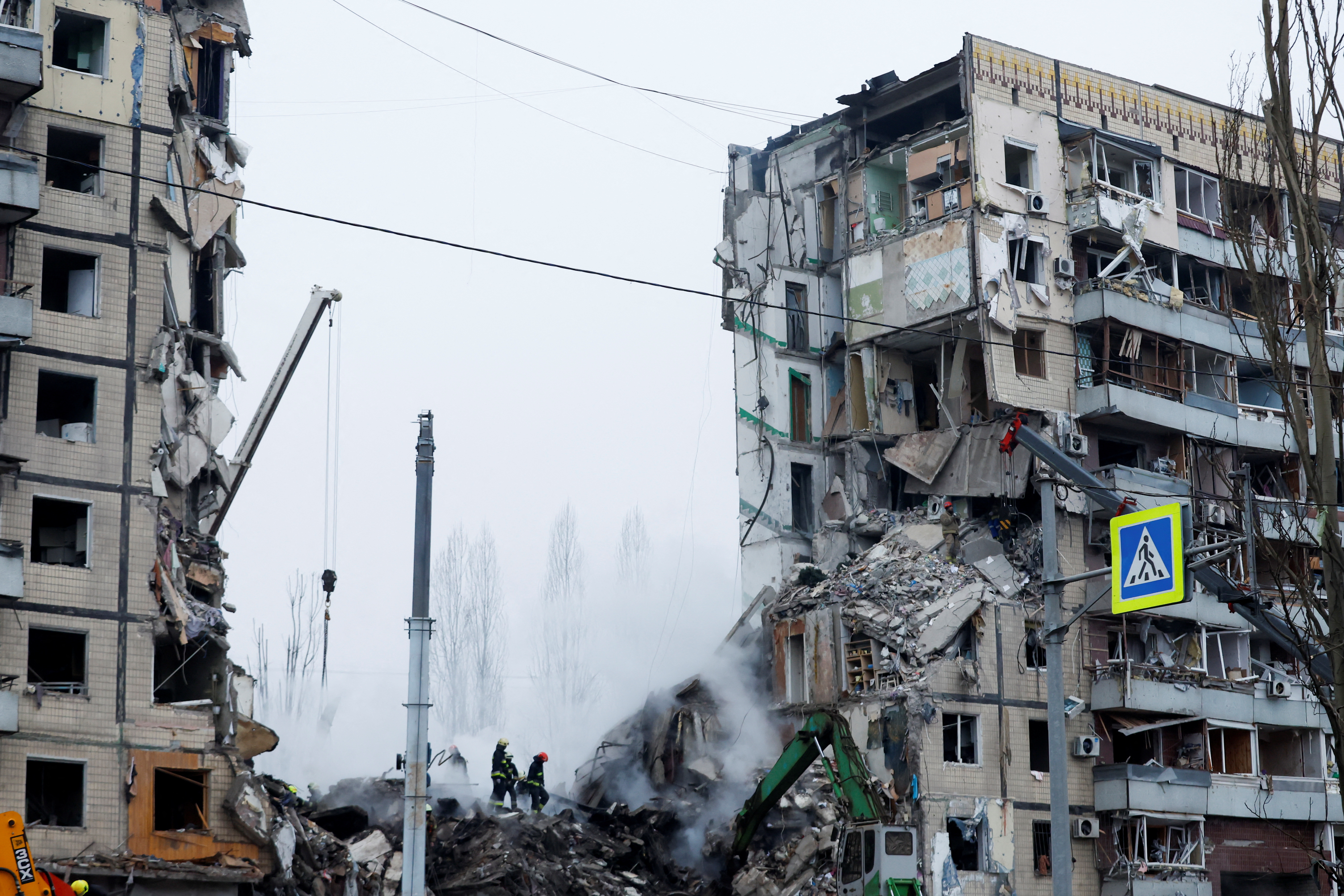
Emergency personnel work at the site where an apartment block was heavily damaged by a Russian missile strike, amid Russia’s attack on Ukraine, in Dnipro, Ukraine January 15, 2023. REUTERS/Clodagh Kilcoyne
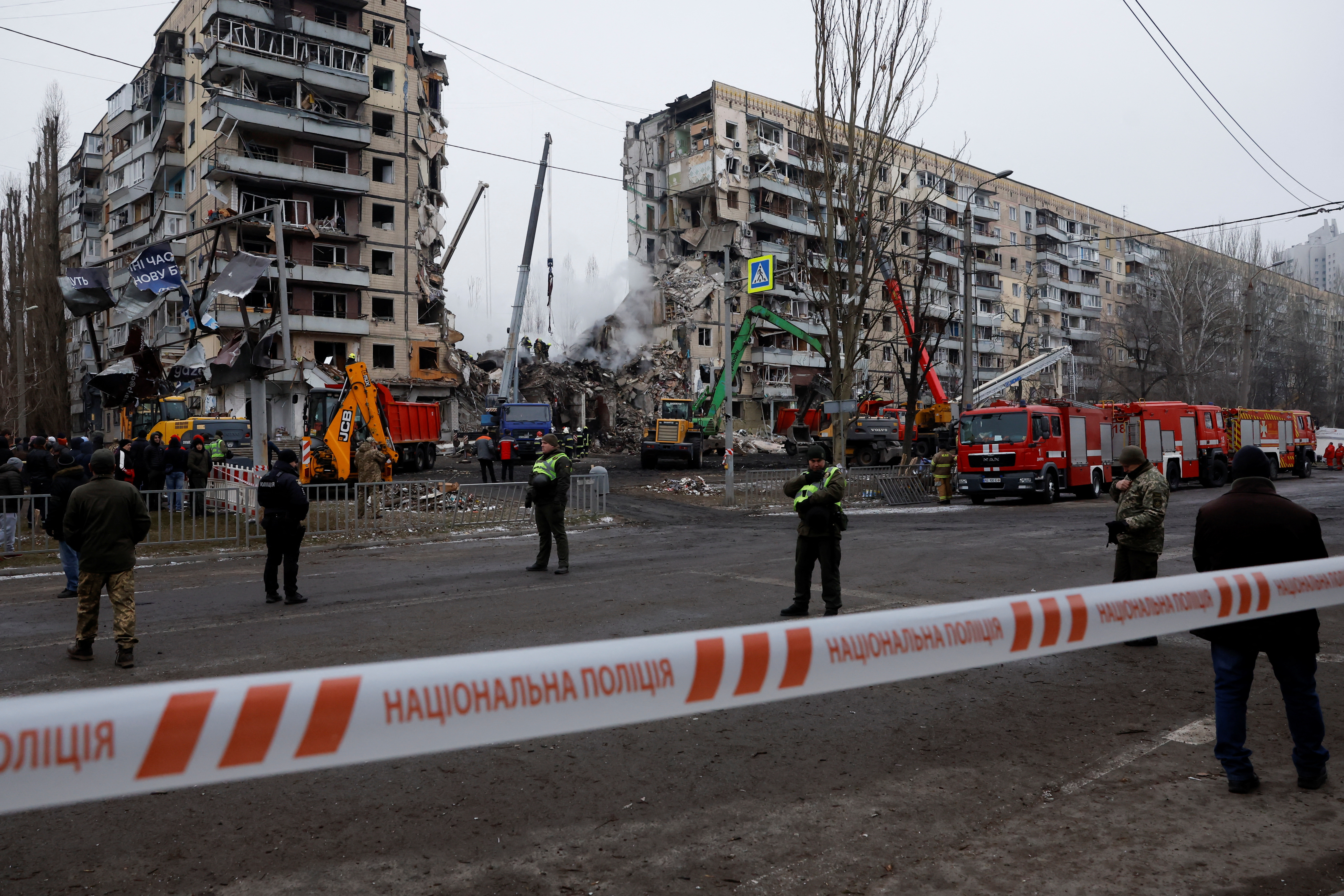
People look on as emergency personnel work at the site where an apartment block was heavily damaged by a Russian missile strike, amid Russia’s attack on Ukraine, in Dnipro, Ukraine January 15, 2023. REUTERS/Clodagh Kilcoyne
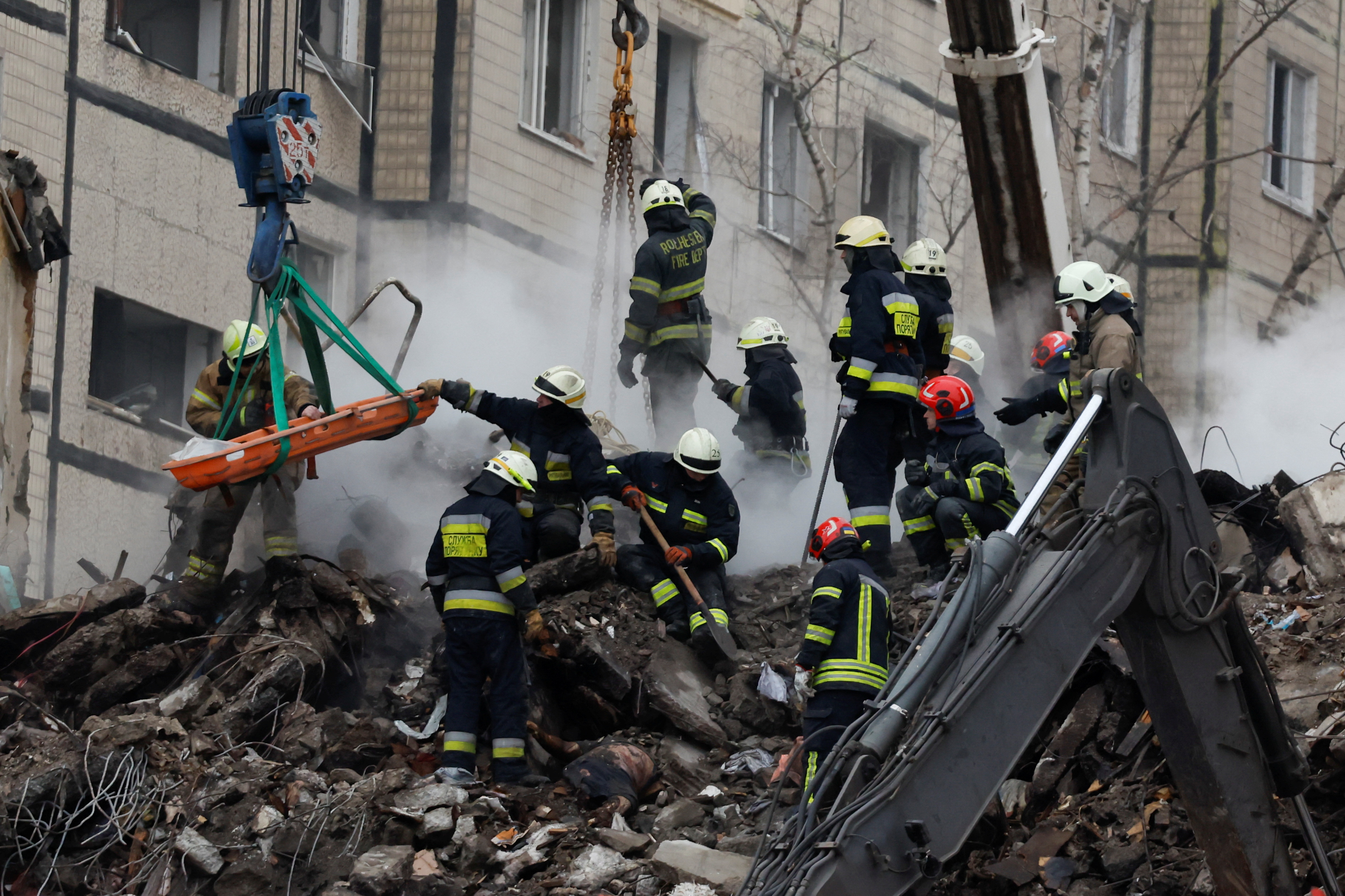
Emergency personnel retrieve a dead body at the site where an apartment block was heavily damaged by a Russian missile strike, amid Russia’s attack on Ukraine, in Dnipro, Ukraine January 15, 2023. REUTERS/Clodagh Kilcoyne
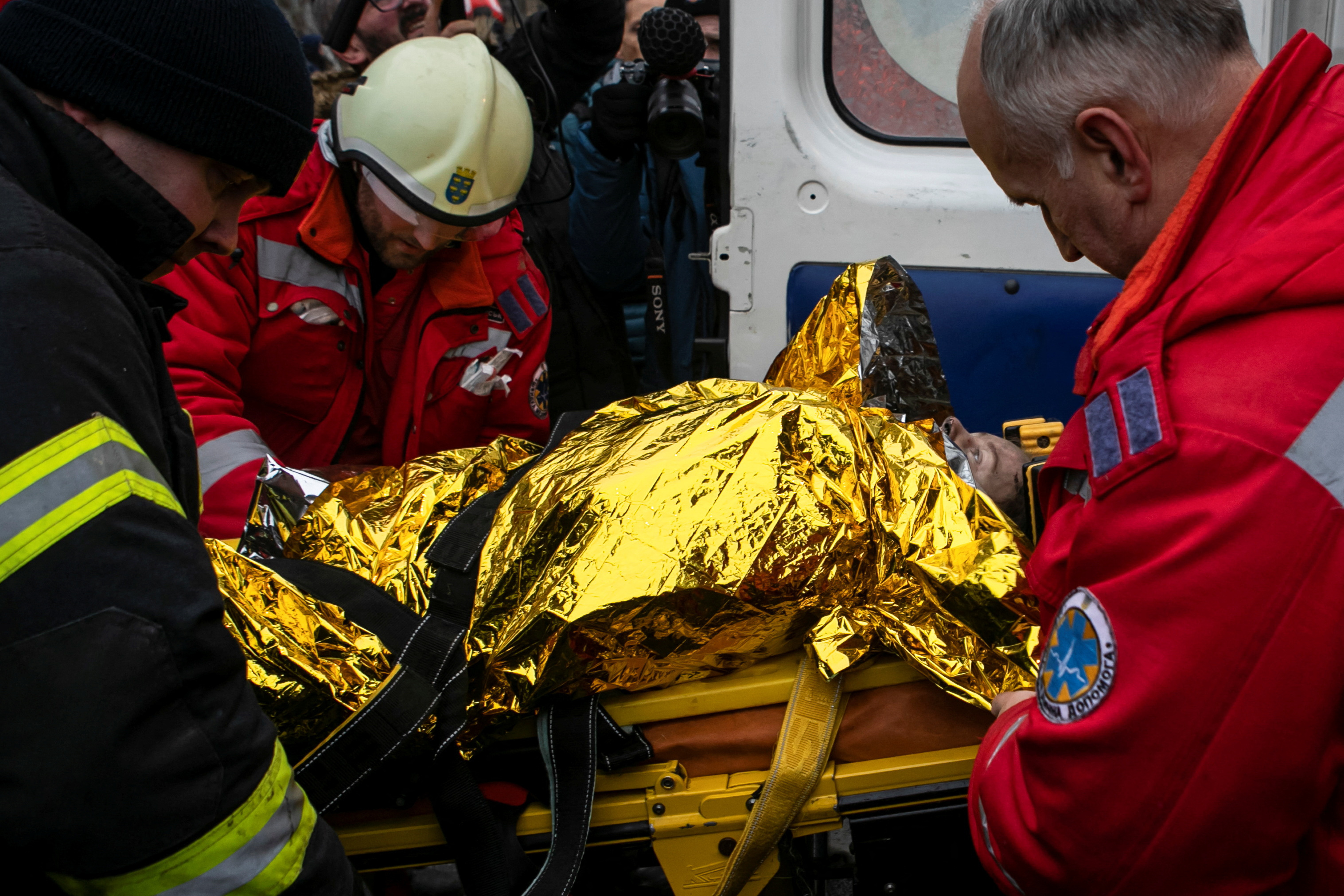
Emergency workers and medics transport a woman released from debris at the site where an apartment block was heavily damaged by a Russian missile strike, amid Russia’s attack on Ukraine, in Dnipro, Ukraine January 15, 2023. REUTERS/Yevhenii Zavhorodnii
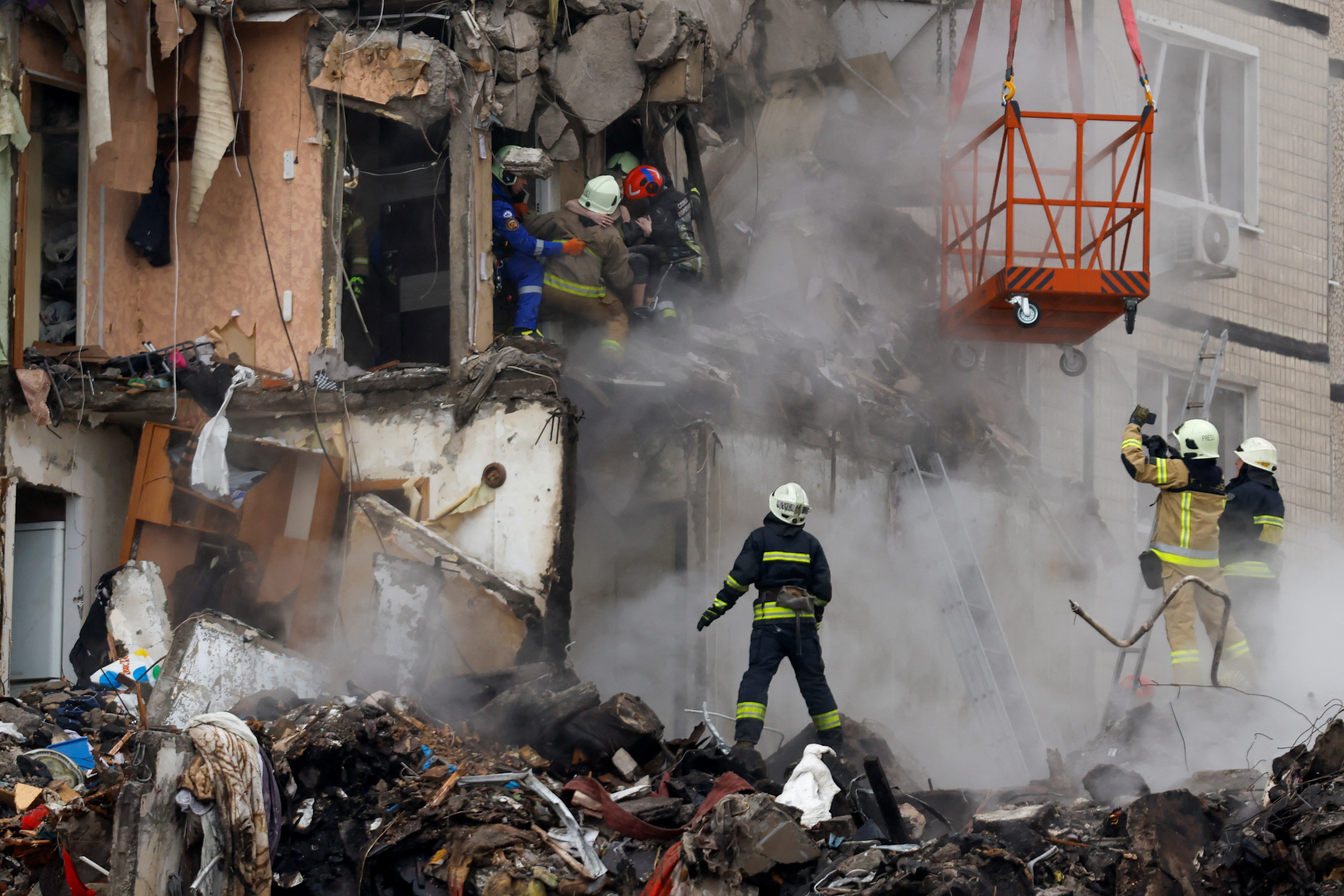
Emergency personnel evacuate a person at the site where an apartment block was heavily damaged by a Russian missile strike, amid Russia’s attack on Ukraine, in Dnipro, Ukraine January 15, 2023. REUTERS/Clodagh Kilcoyne
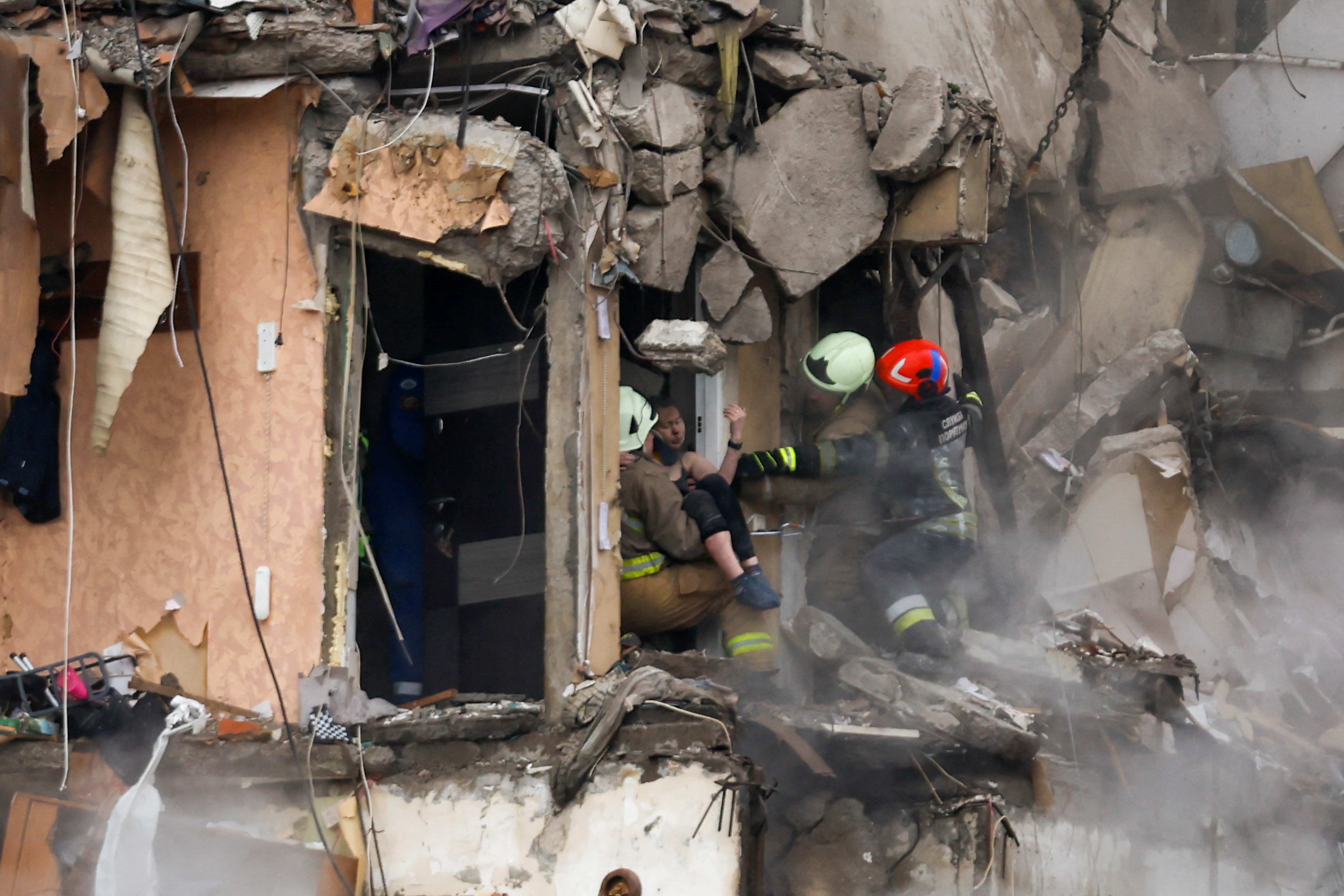
Emergency personnel evacuate a person at the site where an apartment block was heavily damaged by a Russian missile strike, amid Russia’s attack on Ukraine, in Dnipro, Ukraine January 15, 2023. REUTERS/Clodagh Kilcoyne
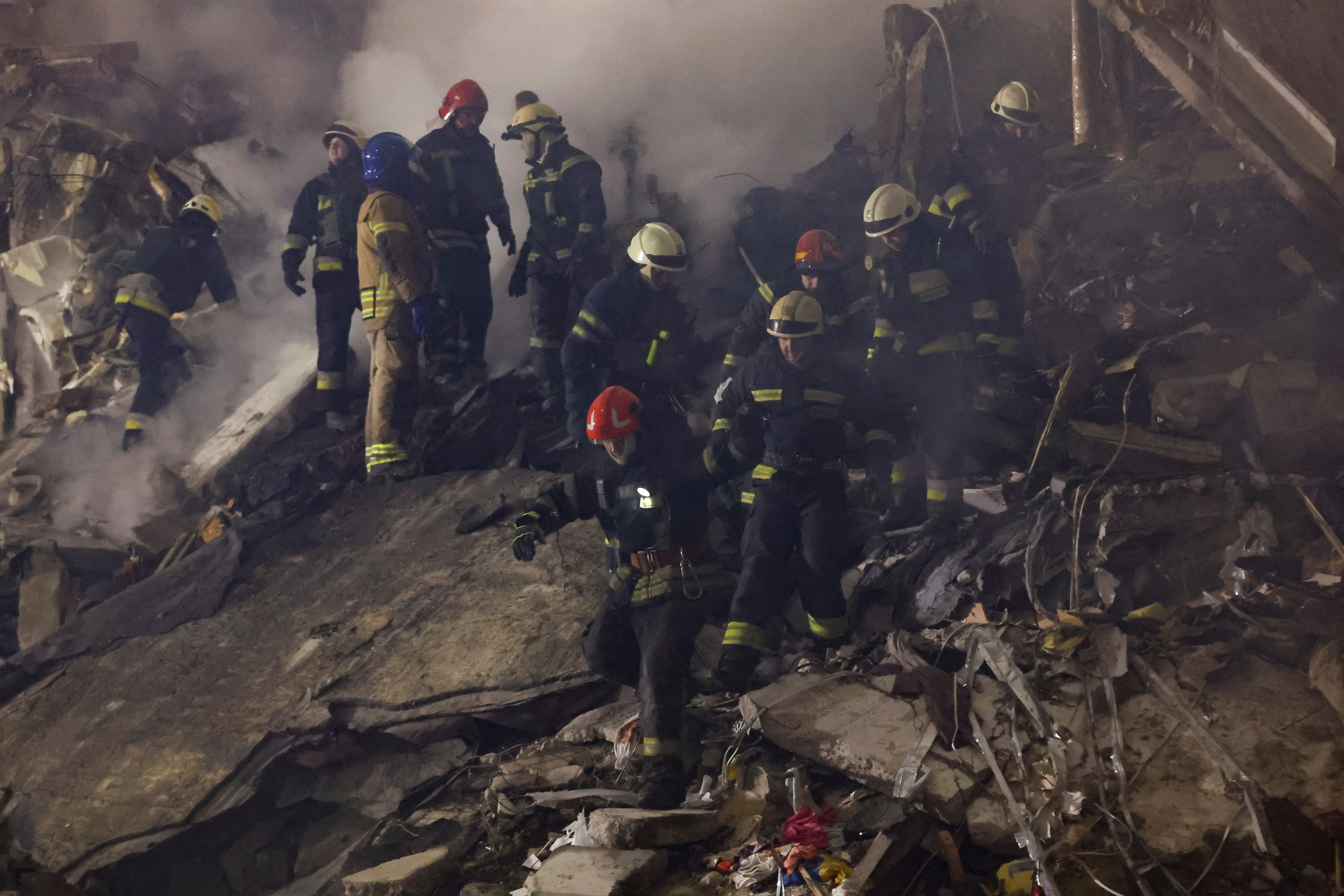
Emergency personnel work at the site where an apartment block was heavily damaged by a Russian missile strike, amid Russia’s attack on Ukraine, in Dnipro, Ukraine January 15, 2023. REUTERS/Clodagh Kilcoyne
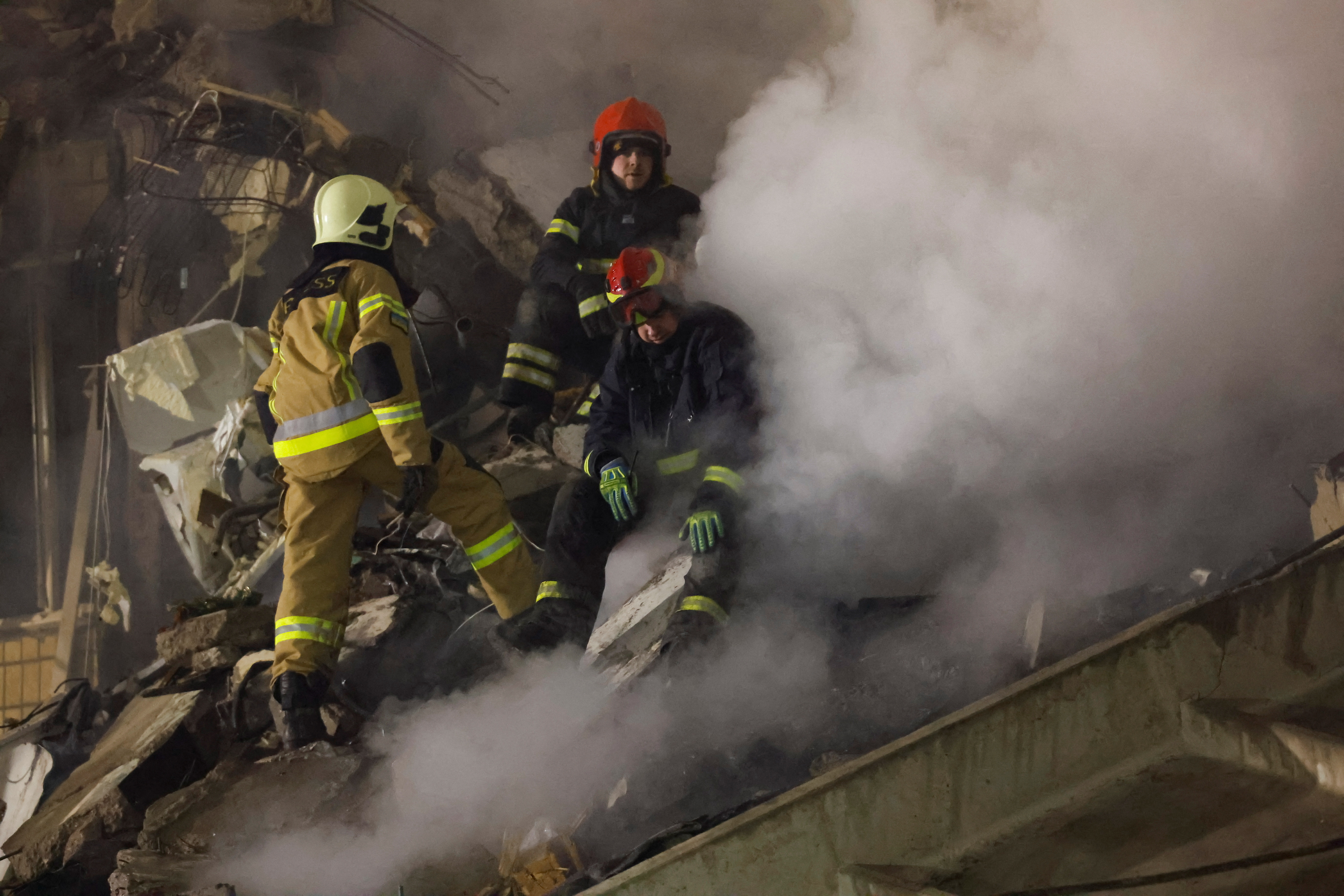
Emergency personnel work at the site where an apartment block was heavily damaged by a Russian missile strike, amid Russia’s attack on Ukraine, in Dnipro, Ukraine January 15, 2023. REUTERS/Clodagh Kilcoyne
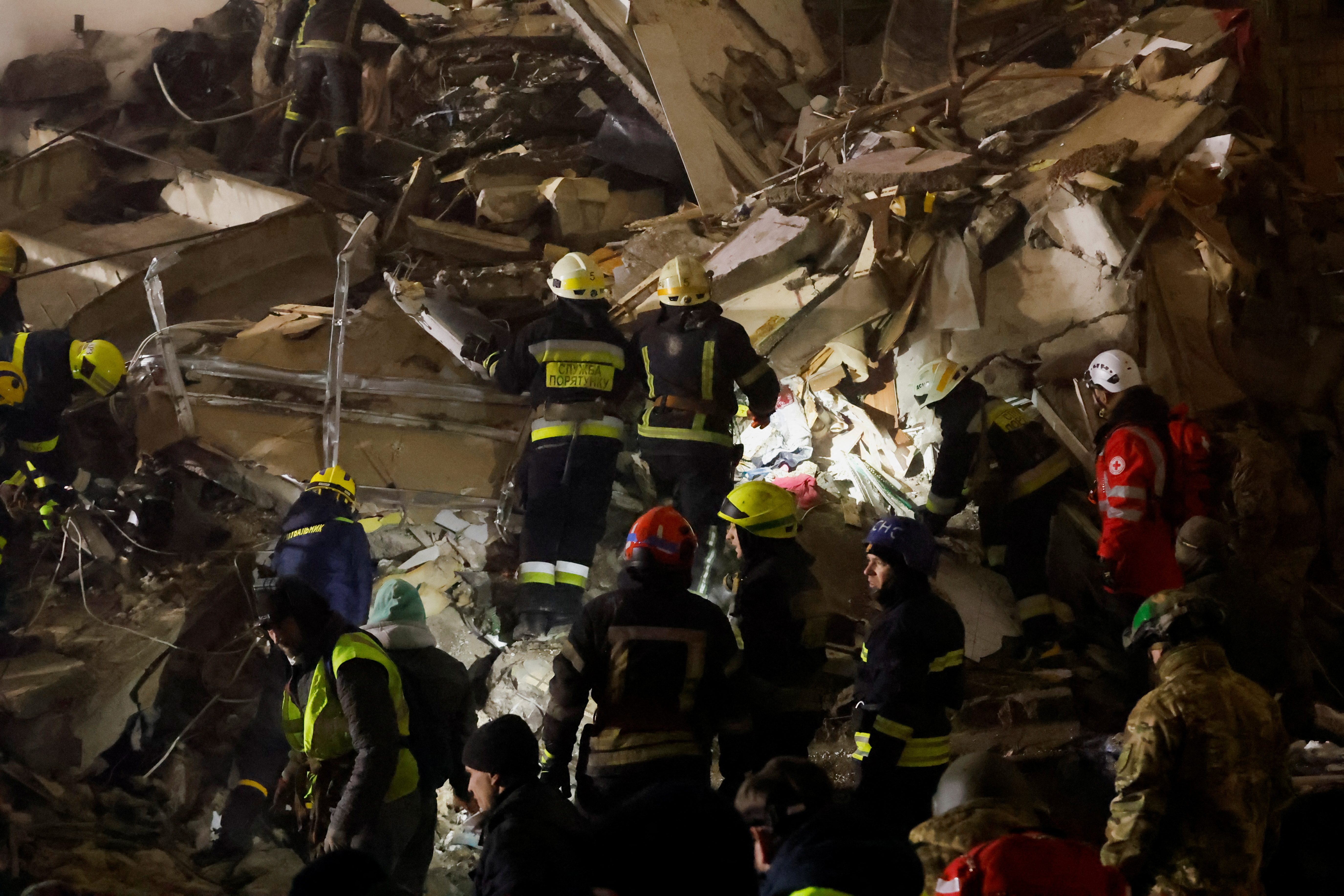
Emergency personnel work at the site where an apartment block was heavily damaged by a Russian missile strike, amid Russia’s attack on Ukraine, in Dnipro, Ukraine January 15, 2023. REUTERS/Clodagh Kilcoyne
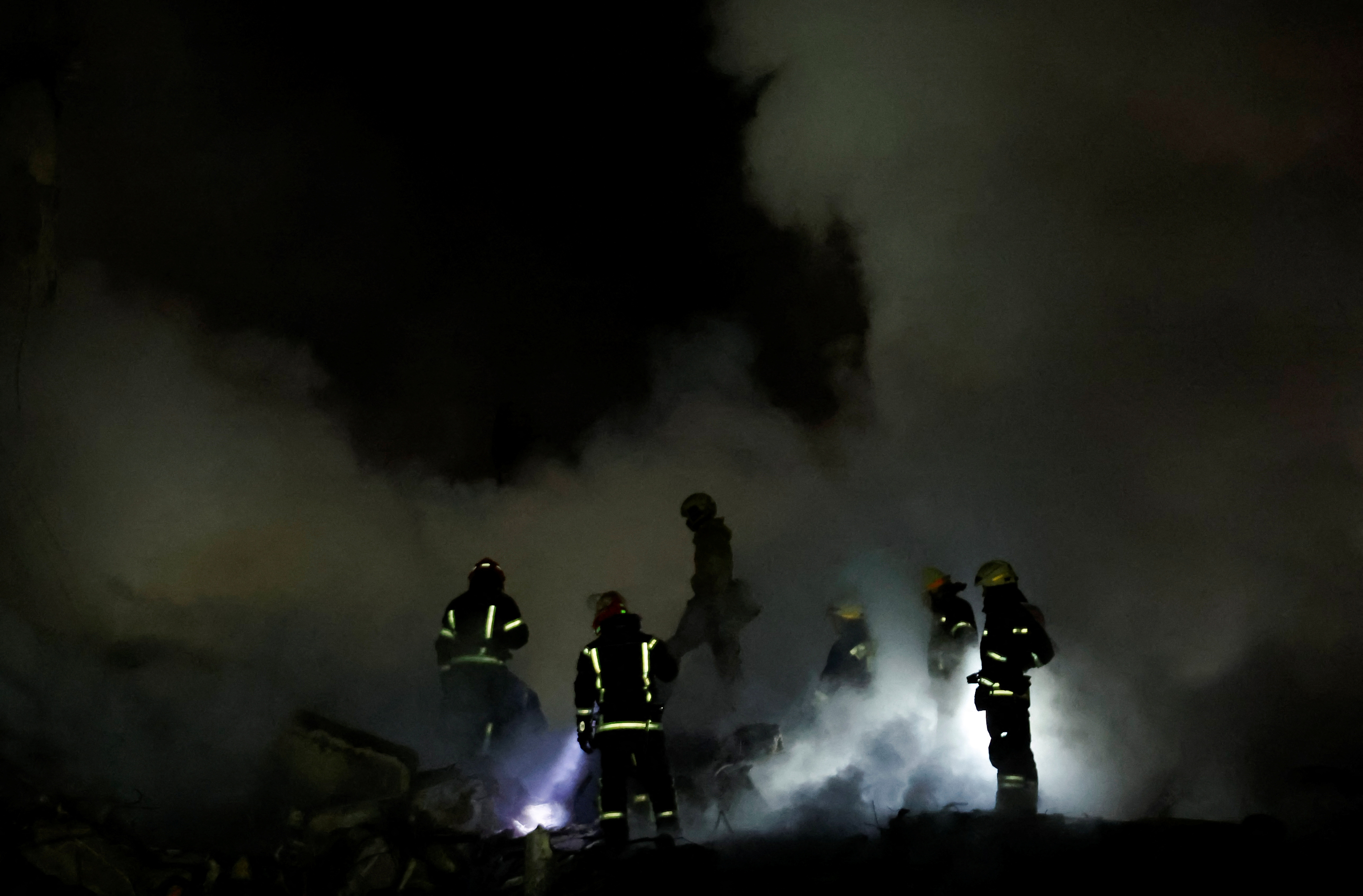
Emergency personnel work at the site where an apartment block was heavily damaged by a Russian missile strike, amid Russia’s attack on Ukraine, in Dnipro, Ukraine January 15, 2023. REUTERS/Clodagh Kilcoyne
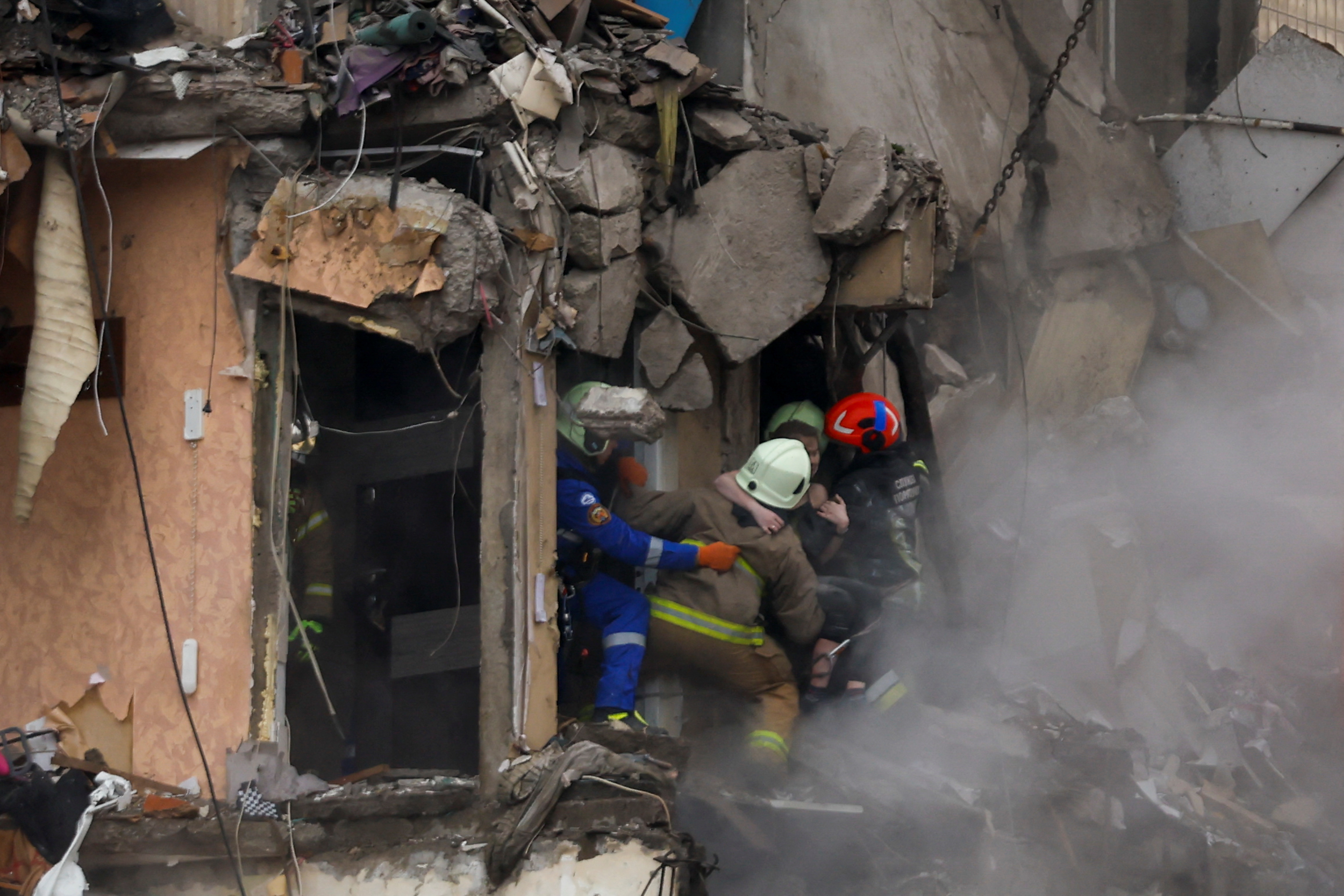
Emergency personnel evacuate a person at the site where an apartment block was heavily damaged by a Russian missile strike, amid Russia’s attack on Ukraine, in Dnipro, Ukraine January 15, 2023. REUTERS/Clodagh Kilcoyne
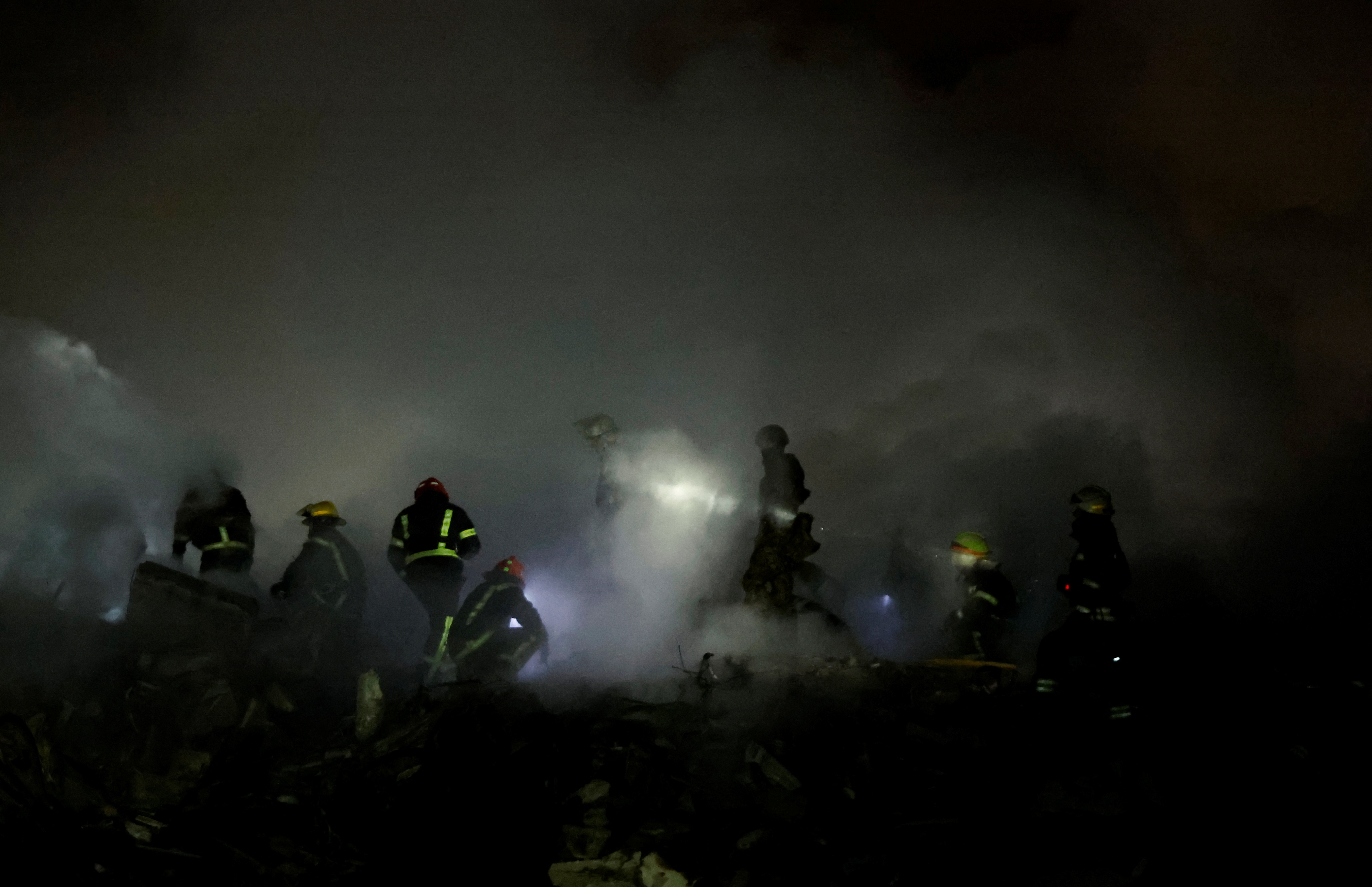
Emergency personnel work at the site where an apartment block was heavily damaged by a Russian missile strike, amid Russia’s attack on Ukraine, in Dnipro, Ukraine January 15, 2023. REUTERS/Clodagh Kilcoyne

Categories
Audio Sources - Full Text Articles

Google’s cookie crumbles

Hello! I’m Dave Smith. You may remember me from such newsletters as “These might be the last words you ever read,” and “Newsletter? I hardly know ‘er!”

But in all seriousness, I was a deputy tech editor at Insider years ago, and now I’m part of the group running Insider’s newsletters. It’s nice to formally meet you. Our US team is off today in observance of Martin Luther King Jr. Day — and if you’re also off, I hope you’re having a restful day.

You know what doesn’t take a holiday though? You guessed it: technology. Today’s edition will be a bit shorter, but don’t you fret my fine-feathered friend, we’ll be back with our regular programming tomorrow. For now, though, let’s dive right in.


If this was forwarded to you, sign up here.


Google CEO Sundar Pichai speaks during Google I/O 2016 at Shoreline Amphitheatre on May 19, 2016 in Mountain View, California. The annual Google I/O conference is runs through May 20.Google CEO Sundar Pichai speaking during a Google event in California in 2016.

Justin Sullivan/Getty Images

1. Google’s cookie concept crumbles. In an effort to stave off regulatory scrutiny around privacy, Google has spent the last few years devising a plan to replace third-party cookies in its Chrome browser. Cookies, if you remember, let advertisers track you as you browse the web to serve you ads — and ads are the preeminent way Google makes its money.

Google’s been testing a bunch of cookie-less proposals since 2020. And one of those ideas, called Topics API, would let advertisers target ads to users based on broad topics from their browsing history, like “fitness.” 

Unfortunately, the web standards body W3C rejected Google’s Topics API proposal, saying it maintains “the status quo of inappropriate surveillance on the web.” 

Mind you, this proposal was the follow-up to a different failed proposal to replace cookies, and the deadline to end third-party cookies has already been delayed multiple times. Google, meanwhile, is facing pressure from regulators. 

Read more about Google’s various paths forward.


In other news:

A Tesla car dealership in Maplewood, Minnesota.A Tesla car dealership in Maplewood, Minnesota.

Michael Siluk/Getty Images

2. Tesla kicks off an electric-car price war. The company announced a series of discounts ranging from 6% to 20% on its Model 3 and Model Y cars. That’s putting added pressure on legacy car companies like Ford and GM that are trying to enter the space. Why one analyst calls this a “strategic poker move.”

3. Billionaire Larry Ellison got a speeding ticket — on an island he owns. What a flex, am I right? He ran a stop sign on the Hawaiian island of Lanai, but told the officer “there’s no excuse.” Read how it all went down.

4. “I’m a college student, and my YouTube side hustle brought in $31,000 last year.” Thirty-one thousand smackers can buy you a whole lot of Ramen noodles. Here’s how this 23-year-old established himself as an editor and producer.

5. The coolest electric cars hitting the streets this year. Tesla may have been the car company to make electric cars cool again, but this year you can expect major brands like Chevy and upstarts like Polestar to explode onto the scene with some new hotness. From an electric Hummer to the much-hyped Cybertruck, here’s a look at what’s coming.


Curated by Dave Smith in Toronto. Feedback or tips? Email dsmith@insider.com or tweet @redletterdave. Edited by Hallam Bullock in London.

Read the original article on Business Insider
Categories
Audio Sources - Full Text Articles

Russia has screwed up over and over in its war in Ukraine, and Western militaries need to learn from its mistakes, former US Army general says

Ukrainian soldiers fire in the recently retaken Kupiansk in the Kharkiv region, Ukraine, Friday, Sept. 23, 2022.Ukrainian soldiers fire in the retaken Kupiansk in the Kharkiv region, Ukraine, Friday, Sept. 23, 2022.

AP Photo/Kostiantyn Liberov

  • The West needs to learn from Russia’s screw-ups in its war with Ukraine, a former US Army general said.
  • “Russia has shown us what kinds of problems a large army can have if it hasn’t done its homework,” he said.
  • Retired US Army Brig. Gen. Kevin Ryan told Insider that the West “should be preparing our own militaries.”

Western militaries, including the United States, need to make sure they are learning from the many unforced errors and screw-ups Russia has made in its unprovoked war with Ukraine, a former US Army general said. 

“Russia has shown us what kinds of problems a large army can have if it hasn’t done its homework before it starts a war or enters a war,” retired US Army Brig. Gen. Kevin Ryan told Insider on Wednesday. 

“They’ve had lots of problems with personnel and mobilization,” Ryan explained, noting that the US “would have similar problems.” Several US service branches, for instance, are currently struggling to hit their recruitment numbers, and the US military and other Western armies are having to re-evaluate how they achieve desired force strength.

Moscow has also had “lots of problems” with its supply of munitions “and we would have those same kinds of problems,” said Ryan, who served as the defense attaché to Russia for the US. Logistics is a crucial component of warfare, and for the US and other Western armies, some critical capabilities have atrophied over the years.

Ryan warned that what Russian President Vladimir Putin has essentially done is “created the reality” of conflict and confrontation with the West through his invasion of Ukraine and said that Western nations need to try to “get ahead” of Moscow by prepping and strengthening their militaries and examining production rates for “key weapons and munitions.”

“The US has the greatest economy in the world, but there are probably many things we could do and should do to better prepare ourselves,” Ryan said.

According to a recent report by the British think tank Royal United Services Institute on lessons on conventional warfighting from Russia’s invasion of Ukraine, “no country in NATO, other than the US, has sufficient initial weapons stocks for warfighting or the industrial capacity to sustain large-scale operations.” And even the US has expressed some concern about its stockpiles.

The report said that in modern warfare, “the enemy can strike throughout operational depth” and that warfighting “demands large initial stockpiles and significant slack capacity.”

And the lessons from Ukraine extend far beyond just weapons and munitions. For example, cellphone usage by the Russians has been a major problem for the invading army, as it has at times allowed Ukraine to pinpoint their positions and then fire on them. The US Marine Corps top general said recently that the war shows why troops need to put their phones away.

There have been quite a few Russian missteps and miscalculations throughout the war, and they have at times cost Russia dearly.

Russian President Vladimir Putin.Russian President Vladimir Putin.

MIKHAIL KLIMENTYEV/RIA NOVOSTI/AFP via Getty Images

‘A huge miscalculation by the Russians’

When Putin launched his full-scale invasion of Ukraine last February, he expected his troops — which outnumbered and outgunned Ukraine’s — to seize the Eastern European country’s capital of Kyiv in a matter of days, but Putin greatly underestimated Ukrainian forces and miscalculated the Western response, which has taken the form of severe sanctions against Russia and military aid to Ukraine. 

In recent months, Ukraine has forced Russian troops to give up large swaths of occupied territory in a stunning counteroffensive. The fighting is taking its toll on both armies though.

America’s top general, Mark Milley, the chairman of the Joint Chiefs of Staff, recently estimated that “well over” 100,000 Russian soldiers had been “killed and wounded” in the war so far with the “same thing probably on the Ukrainian side.” The results for Russia are clearly not what was expected.

“There was a huge miscalculation by the Russians,” said Ryan, a senior fellow at Harvard’s Belfer Center for Science and International Affairs. 

Military analysts have told Insider that Russia botched its initial invasion, as well as follow-up actions, and that its assault on Ukraine has been stymied by misjudgments, poor communication, and mass confusion. The US and the West, Ryan emphasized in discussions with Insider, should be learning from Russia’s mistakes. 

“We should be preparing our own militaries for a possible war with Russia and or China,” the former general said. 

“The consequences are that if we have to suddenly go to war and we’re not prepared for the intensity of that war, then there will come a time when soldiers and sailors are dying because we can’t give them all the support that they need,” he added.

Under federal law in the US, nearly all American men ages 18 to 25 must register with the Selective Service System, commonly known as the draft. One way to prepare, Ryan said, could be to “add on basic military training to the registration requirements for the Selective Service.”

Russia’s first mobilization of 300,000 reservists to beef up the Kremlin’s forces in Ukraine “was a goat rope,” said Ryan. “There were so many errors and problems and issues and obstacles, and it was primarily tied to the fact that none of these guys had much training.”

Looking at the future of the war in Ukraine and Western involvement, Ryan said “the West will probably increase its reactions to Russia’s actions as they unfold.”

“But if you’re asking what should the West do,” he said, “the West should try to get ahead of Russia.”

Read the original article on Business Insider
Categories
Audio Sources - Full Text Articles

5 of the easiest online businesses to start in 2023

online businessesAn increasing number of founders are launching brands fully online.

lemono/Getty Images

  • Many Americans are looking for easy and entrepreneurial ways to make money.
  • Some are creating online businesses, which often have lower startup costs than brick-and-mortars.
  • Here are five of the easiest types to start, including content creation, coaching, and marketing.
Suss out the need for your potential online businessBusinesswoman Working with DocumentConduct market and consumer research to determine what’s needed.

Morsa Images/Getty Images

It’s important for aspiring founders to ensure that the product or service is needed in the marketplace, said Cynthia Franklin, an entrepreneurship professor at New York University.

When deciding what type of business to start, “looking at where societal forces are heading and seeing if you can get ahead of the trend” is a good start, she said.

“Start with scratching your own itch,” Franklin suggests for aspiring online business owners. “Whatever you do, find something you care about because you’re going to need to put a lot of time and energy into making it succeed.”

Here are 5 of the easiest online businesses to start in 2023. 

1. Content creation and social-media managementLauren Mabra and Lauren FerryLauren Mabra and Lauren Ferry founded the social-media content agency Lauren Labeled.

courtesy of Lauren Labeled

Content creation and social-media management can be simple and lucrative businesses to start. With many free or cheap platforms and editing tools, the field has low financial barriers to entry and is popular given social media’s prevalence. But popularity also means the competition can be stiff.

Lauren Mabra and Lauren Ferry are the Gen Z founders of the social-media advertising agency Lauren Labeled, which launched in 2021.

Their business helps other brands write, film, and produce social-media advertisements and campaigns. They specialize in marketing meant to reproduce the look and feel of user-generated content, or the kind of material an everyday social-media user might post from their iPhone, Mabra said.

“We saw that it was a broken system,” Mabra said. “Businesses either had to do it in-house — and a lot of teams are already short-staffed and overflowing with tasks — or they are going to influencers and paying $2,000 for one single video. How sustainable is that when you need new videos every single week?”

Before Lauren Labeled’s website launched, it already had a waiting list of customers, Mabra said. Now, the business regularly books five figures in revenue a month, documents verified by Insider show.


2. CoachingJessica Hawks (left) and Amy Lee (right)Jessica Hawks and Amy Lee are virtual coaches.

Jackie Sterna, P. Mastro

Online coaching has grown in recent years, whether entrepreneurs are offering virtual workout classes, leadership advice, or guidance on starting a business.

Amy Lee, for instance, is a life coach. She booked nearly $60,000 in revenue in her first 10 months in business, documents verified by Insider show.

There are no required credentials for life coaches, Lee said. While this can make some coaching communities seem like the Wild West, it also creates a low barrier to entry for professionals looking to enter the space.

Other types of coaches, like Jessica Hawks, seek to help their clients build startups.

Business coaching is an option for those who want to share their expertise in a certain field. Hawks started her online career as a virtual assistant, and when she realized her community was looking for advice on starting their own VA agencies, she launched her coaching program, the Digital Creatives Academy.

Hawks books seven figures in sales a year, documents verified by Insider show.

3. BloggingLisa Andrea, founder of The Financial CookbookLisa Andrea, the founder of The Financial Cookbook.

courtesy of Andrea

Blogging is another popular business avenue, especially for those who can share knowledge about a particular subject.

For instance, Lisa Andrea, the creator of The Financial Cookbook, started her blog as a side hustle in 2021. She shares tips on how to become financially independent and on investing, along with other money guidance. “The Financial Cookbook is a guide for everything they should have taught us in school,” she previously told Insider.

Her income streams include affiliate marketing and brand partnerships. She recommends other bloggers and digital founders take advantage of company affiliate programs by applying to be part of them online, as she did.

But it’s also important to stay authentic and work only with companies that align with your brand messaging, she added. That way, your community will stay engaged and be more interested in the links you’re promoting, which can help you earn more money.

Andrea regularly books $8,000 in monthly revenue, documents verified by Insider show.

4. Virtual assistingVivian PurcellVivian Purcell is a full-time virtual assistant.

courtesy of Purcell

Vivian Purcell is a virtual assistant who lives in Canada. She started her online career as a freelance writer in 2016, seeking flexibility to travel and live wherever she wanted, she said. 

“I did the switch into virtual assistant because I wanted to bring in more of my corporate experience and educational training into freelancing to offer something of higher value,” she said.

Purcell earned more than $132,000 in 2022 sales from her virtual-assistant work, documents verified by Insider show.

Virtual assistants can work with both small-business clients as well as major firms looking to hire contract or one-time employees, said Arun Sundararajan, a professor of entrepreneurship and technology, operations, and statistics at New York University’s Stern School of Business. 

“It’s getting increasingly hard to hire full-time employees for anything,” said Sundararajan, who is also the author of “The Sharing Economy.” “So more and more businesses that didn’t consider gig work are now considering gig or freelance workers as an option.”  

5. MarketingCody MayCody May is a founder and a digital nomad.

courtesy of May.

Cody May is a digital-nomad founder who built his business entirely online. He runs SheridanSt., a marketing firm for real-estate agents.

SheridanSt. helps agents with tasks like lead generation along with call and email marketing. In 2017, he left his corporate role and applied his marketing experience to start StudioPTBO, the precursor to SheridanSt. Then, in 2021, he connected with his current business partner, who worked in real estate, to relaunch the company within the real-estate niche, he said.

He’s recruited most of his staff by offering a fully remote, travel-friendly workplace, he added. What’s more, online real estate is a hot sector: The National Association of Realtors’ 2022 Profile of Home Buyers and Sellers report found that 51% of this year’s buyers found the home they purchased online.

Read the original article on Business Insider
Categories
Audio Sources - Full Text Articles

Salesforce’s Marc Benioff joked ‘Did I miss something?’ after arriving late to a meeting the day after laying-off 8,000 staff, report says

Marc Benioff speaks during TIME100 Next Gala at SECOND Floor on October 25, 2022Marc Benioff speaks during the TIME100 Next Gala in October 2022.

Kevin Mazur/Getty Images for TIME

  • Marc Benioff showed up 15 minutes late to an all-company meeting after layoffs, per The Times of London.
  • The Times reports that Salesforce’s CEO then upset many employees by joking: “Did I miss something?”
  • Insider previously reported how staff expressed anger at Benioff, saying he dodged questions about layoffs.

Marc Benioff, the Salesforce CEO, showed up 15 minutes late to a company-wide meeting on January 5, the day after the company announced it would be laying-off 8,000 staff, The Times of London reported.

The businessman then made am ill-timed joke, asking: “Did I miss something?”

One person on the call told The Times: “We knew more [layoffs] were coming, so we were all there to find out if we would still have jobs.”

“It was so inappropriate,” they added. “Employees were very, very upset.”

Insider’s Ashley Stewart and Ellen Thomas earlier reported how Benioff compared the layoffs to death, and staff expressed anger that he was dodging questions during the town-hall meeting.

Benioff also admonished employees for leaking messages to the press, and shared a YouTube link to a joke from the 2004 movie “Meet the Fockers” about having a “circle of trust,” Insider reported.

A day earlier, Salesforce announced it was laying-off 10% of its staff. It came amid a spate of layoffs in the industry, with Amazon, Meta, and Twitter among the other companies who have cut their workforce over the last few months. Over the first 15 days of this year, an average of 1,600 tech workers were laid off every day.

In an email to staff, Benioff said: “As our revenue accelerated through the pandemic, we hired too many people leading into this economic downturn we’re now facing, and I take responsibility for that.”

The company is also reportedly considering laying-off a further 10% of staff depending on financial performance.

Salesforce has completed more than $50 billion worth of acquisitions since 2018, with $27.7 billion spent on the loss-making messaging platform Slack in 2021. Stewart Butterfield, the Slack cofounder, then quit the company, along with a further two executives. 

Salesforce did not immediately respond to Insider’s request for comment, sent outside US working hours. 

Read the original article on Business Insider
Categories
Audio Sources - Full Text Articles

How to get ahead in 2023

Hello friends. Insider’s newsletter editor Hallam Bullock here, reporting from London while Phil Rosen is out. Even though ChatGPT wrote a convincing article for Phil last week, AI can’t hope to deliver the best insights for our Opening Bell readers.

So, as the New York Stock Exchange shutters to observe Martin Luther King Jr. Day, I’ve rounded up some of our top markets stories from the past couple of weeks.

We’ve got top tips for stocks (and serving prison time), a path to financial freedom, and what to expect for the rest of 2023.

Buckle up.


If this was forwarded to you, sign up here. Download Insider’s app here.


A home with a for sale sign.Data from the US Census Bureau shows not a single home sold in November was under $200,000.

Steve Pfost/ Getty Images

1. Want to build up a property portfolio? This real-estate investor has some advice for you.

At the age of 28, Thomas Harr owns 42 properties, many of which are multifamily homes that have numerous rental units within them. Achieving a portfolio of that size is no easy feat — nor is his goal this year: to grow that portfolio by another 75 to 80 properties. 

Even as the housing market faces a correction, Harr says knowing what to expect in advance allows him to adjust his deals — and the six top tips he shared with Insider could help others prepare. 

If you want to start investing in real estate this year, Harr says don’t be deterred by uncertainty or high-interest rates. From utilizing government-based loans to negotiating potential corrections into an offer, he’s got some advice to get you started. 

Read his top tips here. 


In other news:

Warren Buffett speaks onstageWarren Buffett speaks onstage during Fortune’s Most Powerful Women Summit at the Mandarin Oriental Hotel on October 13, 2015 in Washington, DC.

Paul Morigi/Getty Images

2. US stock futures are down early Monday. Meanwhile, bitcoin topped $21,000 over the weekend and is currently trading just below that level. Here are the latest market moves.

3. On deck today: Saudi Electricity Company Bearer, Almarai Co, and more, all reporting.

4. Goldman Sachs says these 40 stocks have at least 34% upside. US stocks got off to a choppy start in the first week of 2023, however, Goldman Sachs still sees attractive investing opportunities. Check out their 40 high-upside picks.

5. Paul Krugman, Jeremy Siegel, and Cathie Wood weighed in on Tesla. Krugman, the Nobel Prize-winning economist, compared Tesla to bitcoin. He added that he wouldn’t trust Musk to feed his cat. Meanwhile, Siegel thinks the EV maker’s valuation is too high, and Wood suggested one way that Musk will try and tempt customers back. Read more here. 

6. “Pharma Bro” Martin Shkreli offered advice to Sam Bankman-Fried on potential prison time. As Bankman-fried awaits trial after pleading not guilty to eight counts of fraud, Shkreli suggested he should shave his head and start listening to rap music. Here’s the full story.

7. The best of Warren Buffett in 2022. It’s never too late to listen to the 92-year-old investing titan’s advice. Last year, he called out stock-market gamblers, savaged bitcoin, and praised Elon Musk and Jeff Bezos. He also recommended one way for people to offset inflation. Check out Buffett’s top quotes of 2022.

8. There’s a big investing opportunity in 2023. According to a couple with a 47-unit real-estate portfolio worth $19 million, the housing market could offer some significant returns. They broke down the top regions to buy in.

9. A financially independent millennial is predicting a short-lived money making boom. According to Grant Sabatier, 2023 will be the year of the “the creator millionaire” — here’s how he plans to take advantage of it.

10. Feeling inflation? The worst is yet to come for Americans. Last year saw the Federal Reserve hike interest rates seven times, but the real impact still hasn’t hit many Americans. As one expert said: “2023 is going to be the survival of the fittest.” Here’s what you want to know.


Curated by Hallam Bullock in London. Feedback or tips? Email hbullock@insider.com.

Edited by Karen Friar in London. 


Read the original article on Business Insider
Categories
Selected Articles

Russia likely preparing decisive strategic action in Ukraine in the next six months – ISW

fCcdc0p.png


Russia has failed to achieve most of its major operational objectives in Ukraine over the past eleven months. Russian forces failed to capture Kyiv, as well as Donetsk and Luhansk oblasts, and to maintain gains in Kharkiv Oblast or hold the strategic city of Kherson. The Russian air and missile campaign targeting Ukrainian critical infrastructure under Army General Sergey Surovikin in late 2022 also failed to generate significant operational effects or demoralize Ukrainian society, as the Kremlin likely intended. Putin and senior Kremlin officials continue reiterating that Russia has not abandoned its maximalist objectives despite Russian defeats on the battlefield.

While Putin has not changed his objectives for the war, there is emerging evidence that he is changing fundamental aspects of Russia’s approach to the war by undertaking several new lines of effort.

ISW has observed several Russian lines of effort (LOEs) likely intended to support a decisive action in the next six months:

  • LOE 1: The Kremlin is intensifying both near- and long-term force-generation efforts.
  • LOE 2: The Russian military is conserving mobilized personnel for future use — an inflection from the Kremlin’s initial approach of rushing untrained bodies to the front in fall 2022.
  • LOE 3: Russia is attempting to reinvigorate its defense industrial base (DIB).
  • LOE 4: Putin is re-centralizing control of the war effort in Ukraine under the Ministry of Defense and appointed Russia’s senior-most uniformed officer, Chief of the General Staff Valery Gerasimov, as theater commander.
  • LOE 5: The Kremlin is intensifying its conditioning of the Russian information space to support the war.

The Kremlin’s effort to prepare for a likely intended decisive strategic action in 2023 is not mutually exclusive with the Kremlin’s efforts to set conditions for a protracted war.

Russia’s decisive strategic action in 2023 can manifest itself in multiple possible courses of action (COAs) that are not mutually exclusive. According to US military doctrine, a military can undertake a decisive action at every level of war to produce a definitive result and achieve an objective. Decisive actions can be at the tactical, operational, or strategic level and can be either offensive or defensive.

  • COA 1: A major Russian offensive, most likely in the Luhansk Oblast area.
  • COA 2: A Russian defensive operation to defeat and exploit a Ukrainian counteroffensive.

The most dangerous course of action (MDCOA) of a Russian offensive against northern Ukraine remains unlikely at this time. However, the Kremlin is creating planning flexibility and will likely expand Russia’s military presence in Belarus in the period leading up to planned major exercises (which could possibly support a combat operation) in September 2023.

The Kremlin retains its maximalist goals to seize all of Ukraine, despite its poor conduct of the war to date. Russian forces remain dangerous, and Ukraine requires sustained support.

Read also:

Ammo shortages likely to hinder Russia’s ability to sustain offensive operations in 2023 – ISW

Russia continues to weaponize religion to perpetuate long-standing info ops and discredit Ukraine – ISW

Russia to struggle to keep pace of operations as it burns through its artillery ammo stocks – ISW

Ukraine needs independent journalism. And we need you.
Join our community on Patreon and help us better connect Ukraine to the world. We’ll use your contribution to attract new authors, upgrade our website, and optimize its SEO.
For as little as the cost of one cup of coffee a month, you can help build bridges between Ukraine and the rest of the world, plus become a co-creator and vote for topics we should cover next. Become a patron or see other ways to support.
Become a Patron!

Tags: Russian invasion of Ukraine

WP Radio
WP Radio
OFFLINE LIVE