Categories
Audio Sources - Full Text Articles

Michael Novakhov retweeted: Wir machen Politik, damit wir unsere #Klimaziele erreichen. Es ist unsere Aufgabe zu zeigen, dass Wohlstand auch in einer CO2-neutralen Welt möglich ist. @tazgezwitscher hat mich zu unserer Klima- und Energiepolitik und den Krieg in der #Ukraine gefragt: bundesregierung.de/breg-de/aktuel…

Michael Novakhov retweeted:

Wir machen Politik, damit wir unsere #Klimaziele erreichen. Es ist unsere Aufgabe zu zeigen, dass Wohlstand auch in einer CO2-neutralen Welt möglich ist. @tazgezwitscher hat mich zu unserer Klima- und Energiepolitik und den Krieg in der #Ukraine gefragt: bundesregierung.de/breg-de/aktuel…

Categories
Audio Sources - Full Text Articles

Effectiveness of a fourth dose of covid-19 mRNA vaccine against the omicron variant among long term care residents in Ontario, Canada: test negative design study bmj.com/content/378/bm…

Effectiveness of a fourth dose of covid-19 mRNA vaccine against the omicron variant among long term care residents in Ontario, Canada: test negative design study bmj.com/content/378/bm…
Categories
Audio Sources - Full Text Articles

Michael Novakhov retweeted: The congressman reportedly used different names and nationalities—like Russian—on dating app profiles. He used variations of his name, too, including George Devolder, Anthony Devolder, and Anthony Zabrovski. motherjones.com/politics/2023/…

Michael Novakhov retweeted:

The congressman reportedly used different names and nationalities—like Russian—on dating app profiles. He used variations of his name, too, including George Devolder, Anthony Devolder, and Anthony Zabrovski.

motherjones.com/politics/2023/…

Categories
Audio Sources - Full Text Articles

How Gas Stoves Became the Latest Right-Wing Cause in the Culture Wars

There’s a new political firestorm lighting up Washington, and it has nothing to do with inflation or the new congressional leadership. Instead, all eyes are on gas stoves.

The common kitchen appliance was thrust into the spotlight this week after a Democratic member of the U.S. Consumer Product Safety Commission (CPSC), an agency charged with protecting the public from dangerous household products, told Bloomberg News gas stoves could potentially be banned due to their health hazards. The conversation triggered a sharp rebuke from the oil and gas industry, but also many Republicans who used the issue to push back against what they say is Democrats’ overzealous environmental regulation.

[time-brightcove not-tgx=”true”]

The agency clarified on Wednesday that there is no plan to ban gas stoves in the near future and that it is only “researching gas emissions” and “exploring new ways to address any health risks.” But that didn’t stop conservatives from pushing a narrative—sometimes joking, sometimes not—that federal agents are going to come into your home and rip out your gas range.

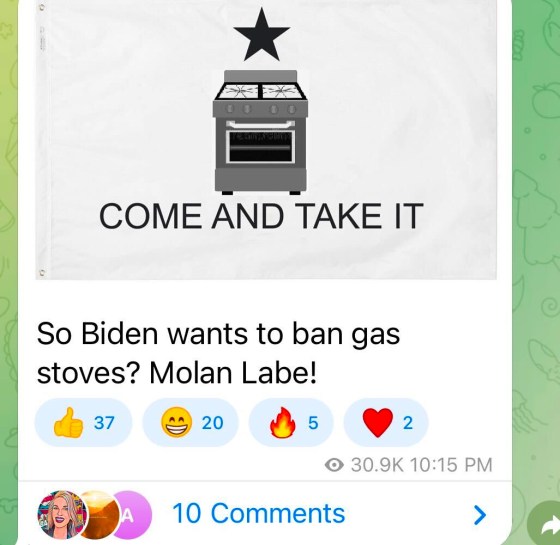
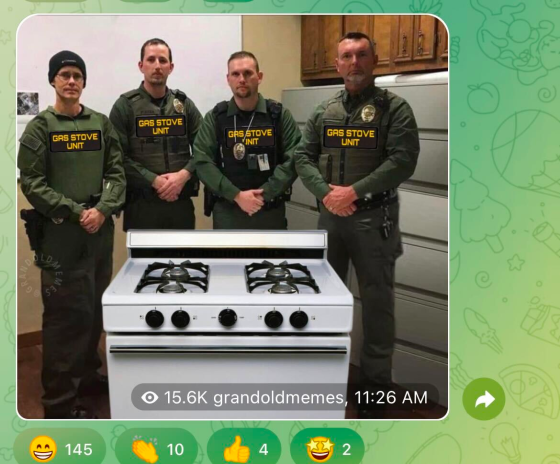
Gas stove meme
On right-wing forums and social media outlets, memes like this—largely tongue-in-cheek—began cropping up.

Catching fire on right-wing social media

“I’ll NEVER give up my gas stove,” Rep. Ronny Jackson, a Texas Republican who served as the physician to former Presidents Barack Obama and Donald Trump, tweeted to his nearly 550,000 followers on Tuesday. “If the maniacs in the White House come for my stove, they can pry it from my cold dead hands. COME AND TAKE IT!!” He also encouraged supporters to sign a petition on WinRed, a fundraising platform endorsed by the Republican National Committee, to “stop Biden from banning our stoves.”

I’ll NEVER give up my gas stove. If the maniacs in the White House come for my stove, they can pry it from my cold dead hands. COME AND TAKE IT!!

— Ronny Jackson (@RonnyJacksonTX) January 10, 2023

Right-right gas stove meme
This meme uses “Molon labe”—a popular right wing phrase adapted from the Greek, meaning “come and take it.”

Read more: What the Potential Ban on Gas Stoves Means If You Have One

Photographs of First Lady Jill Biden and Rep. Alexandria Ocasio-Cortez, a New York Democrat and popular villain of the right, using gas stoves quickly circulated across right-wing media channels, along with memes framing the issue as a distraction attempt by Democrats. “The Gas Stove Ban was to keep Biden’s Mishandling Classified Docs out of the news” wrote one image shared on a popular right-wing forum. Another post claimed that Democrats “will erode our freedoms from every possible angle.”

The controversy over gas stoves is just the latest subject in the nation’s ongoing culture war, a dynamic popularized in recent years in which cultural issues like family values and religion are taking over politics. In a four-word tweet on Thursday, Republican Rep. Jim Jordan of Ohio summarized a few of those cultural issues, including a new addition: “God. Guns. Gas stoves.”

God. Guns. Gas stoves.

— Rep. Jim Jordan (@Jim_Jordan) January 12, 2023

A history of conservative opposition

This isn’t the first time a culture war has targeted a common household appliance. Republicans have been venting their frustration over federal energy-efficiency standards for more than two decades—including over the Energy Independence and Security Act of 2007 that forced U.S. consumers to switch to more energy-efficient light bulbs.

“Light bulbs, refrigerators, toilets, you name it. You can’t go around your house without being told what to buy,” libertarian-leaning Sen. Rand Paul of Kentucky said during an appliance efficiency hearing in 2011. “You restrict my purchases. You don’t care about my choices. You don’t care about the consumer.” Former President Donald Trump also complained about federal energy-efficiency standards, including light bulbs that make you “look orange” and showers that lack a “full shower flow.”

But Florida Gov. Ron DeSantis pushed back against the notion that Republicans are the ones engaging in culture war over gas stoves. During a speech on Thursday, where he held up a “Don’t Tread on Florida” gas stove sign, the Republican told supporters that Democrats and the media are trying to stoke the issue.

“They want to do it, I mean, let’s be honest,” DeSantis said of the calls to ban gas-fueled stoves. “You start to see the narrative kick into gear, CNN segments saying how it’s causing asthma in kids. They start propagating the narrative.”

Don’t tread on Florida, and don’t mess with gas stoves! pic.twitter.com/FNETzpuANe

— Ron DeSantis (@GovRonDeSantis) January 12, 2023

Around 92% of Florida households currently use electric cooking appliances, the most of any U.S. state, according to government data from the 2020 Residential Energy Consumption Survey.

The science behind the controversy

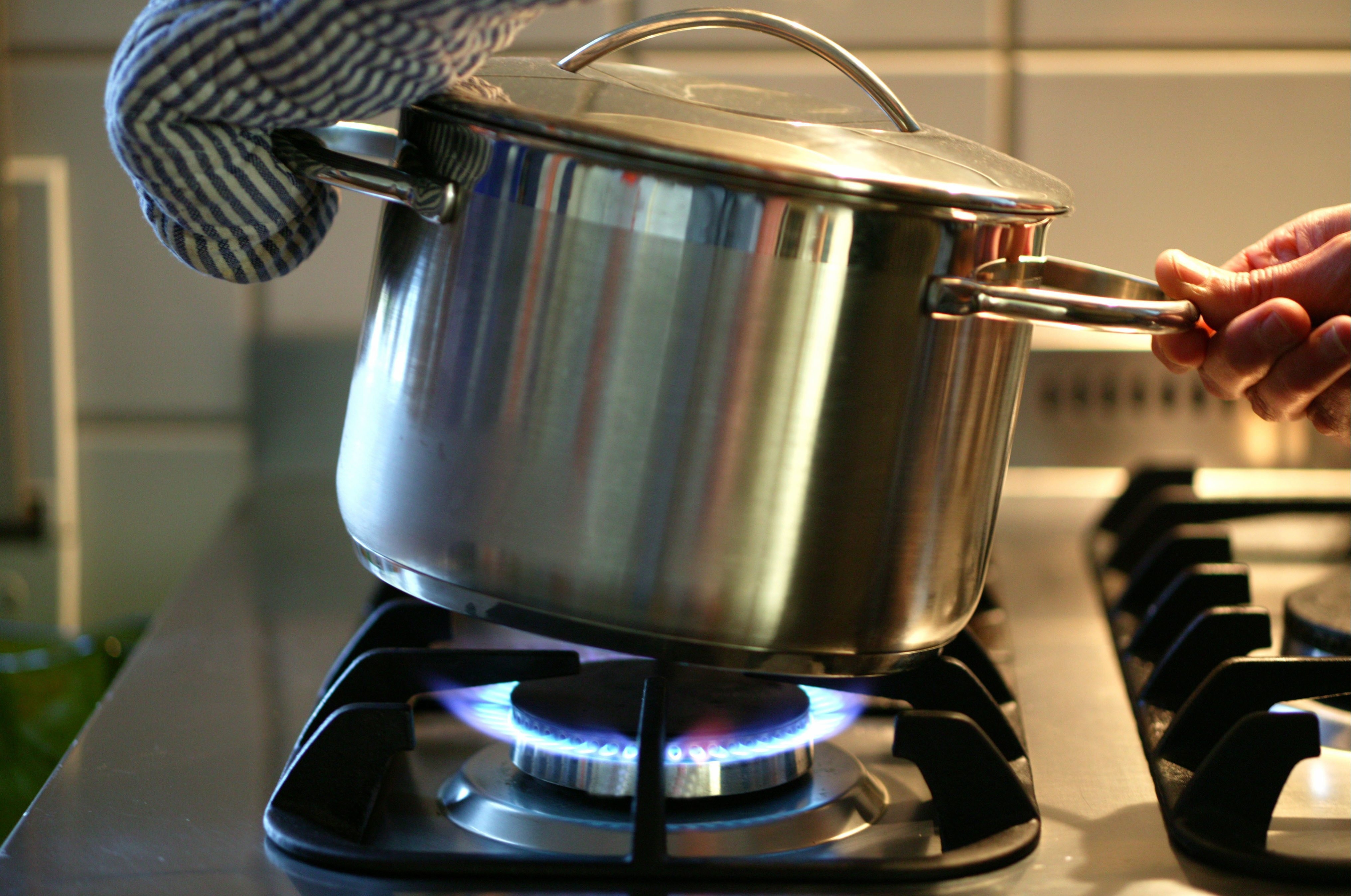
Scientists and public health experts say a growing body of research shows that the indoor air pollution from gas stoves is linked to respiratory and other health problems. A peer-reviewed study published last month suggested that more than 12% of current childhood asthma cases in the U.S. can be attributed to gas stove use. Brady Seals, a co-author of the study, told TIME that in-home gas cooking produces about the same level of risk for children to develop asthma as does exposure to secondhand smoke.

That’s because cooking with gas stoves releases nitrogen dioxide with other tiny airborne particles known as PM2.5—30 times smaller than the width of a human hair—both of which are lung irritants and have been linked with childhood asthma.

Natural gas stoves are currently used in about a third of households in the U.S., or about 40 million homes, mostly in coastal states. Any regulations would only affect new appliances and not existing ones.

Read more: The Best Stove for Your Health and the Environment

The federal government does not currently have any laws or guidelines in place that require gas stove emissions be vented outdoors, even though such laws do exist for gas furnaces, water heaters, and dryers. Seals says the CPSC could also decide to implement new rules for gas stove ventilation instead of outright banning the appliances.

However, New York Gov. Kathy Hochul, a Democrat, on Tuesday called for the state to ban natural gas heating and appliances in new buildings. Some cities, including Los Angeles, Seattle and New York, have also moved to limit gas use in new homes and apartments.

But Republican state officials have fought back against such efforts in at least 21 states that have passed laws to prevent cities from prohibiting gas use in buildings. Ohio Gov. Mike DeWine, a Republican, last week signed legislation to legally redefine natural gas as a source of “green energy.”

And on Thursday, a group of 44 House Republicans introduced federal legislation called the “Guard America’s Stoves” Act—or GAS Act for short—that would prohibit the CPSC from banning gas stoves. Two House Republicans also introduced the “Stop Trying to Obsessively Vilify Energy (STOVE) Act.”

The backlash highlights the difficult road ahead for Democrats’ climate agenda—particularly as the Biden Administration hopes to halve the nation’s greenhouse gas emissions by the end of the decade.

Categories
Audio Sources - Full Text Articles

How My Father’s Brain Helped Develop More Effective Treatment For Alzheimer’s

My father is at the Selkoe Laboratory at Brigham and Women’s Hospital. And he is at work.

That may seem improbable given that, in March 2022, my father died of Alzheimer’s disease. But, since he died, my father has helped pioneer the validation of effective treatments that weren’t available for him; research conducted on his brain tissue is helping scientists understand how to (hopefully) improve upon the recently FDA-approved lecanemab and develop even more effective treatment for Alzheimer’s disease.

Over the years my mother, sisters, and I cared for my dad, we focused on navigating immediate obstacles. We stood next to him at social gatherings, so we could jump in if he needed help holding a conversation. We researched tracking devices to keep him safe if he wandered. We learned to understand him when he went weeks without speaking. Medications helped manage symptoms, but not slow or reverse the disease. As my dad’s Alzheimer’s advanced, I’d imagine two lines sloping upward: one the progression of my father’s disease and one the curve of scientific innovation; my father’s disease always racing faster than scientists’ ability to understand and stop it.

[time-brightcove not-tgx=”true”]

Read More: How to Be There for a Spouse with Alzheimer’s

In the 1990s, Dennis Selkoe and other leading scientists hypothesized that Alzheimer’s Disease is started by the accumulation of a clumped protein—amyloid—in the brain, and that removing amyloid could prevent cognitive decline. While this theory, known as the Amyloid Hypothesis, has been the basis for much of Alzheimer’s research, early trials attempting to target the amyloid did not slow memory decline, perhaps because they did not remove much amyloid.

The FDA’s 2021 approval of Aduhelm, the first medication to drive lower amyloid levels in patients’ brain, was unfortunately clouded by controversy. Poor decision-making by its manufacturer led to a prematurely ending two trials. Incomplete and conflicting data, as well as high rates of temporary brain swelling, left serious questions of Aduhelm’s efficacy that were compounded by a much-criticized FDA approval process.

Regardless, Aduhelm was not suitable for my father, who, by the time of its approval, had progressed to advanced Alzheimer’s, past the point where scientists believe amyloid removal might be effective.

Before he was sick, my father, the ultimate caregiver, was never frustrated. If he saw a problem, he focused on a solution. When I was a child, he designed a perfect step stool. The legs, brace, and seat joined together perfectly to offer you this: step up, you cannot tip and fall. He would balance like a flamingo on one foot on the seat’s edge, delighting in how the stool improbably distributed the weight from his six-foot frame.


Courtesy of Rebecca Leventhal

In the first several years of his sickness, he made nearly a hundred stools for kids he knew.

As we cared for my dad, we tried to offer him what he had offered us: a solid foundation to stand on. When he took off on a walk, I quietly trailed behind. If he decided to swim, I jumped in the pool clothed, reveling in seeing him enjoy the feeling of warm water and the sound of his grandchildren splashing.

As his Alzheimer’s progressed, we struggled to offer him appropriate support. He grew frustrated, unable to work around his new limitations. We’d find him jiggling a broken hinge, aware it needed to be fixed but unable to identify a solution. In that moment, I’d feel a sharp pang in my chest—one of pain and pride; I loved that he was still a problem solver, and I wanted to support him in solving this particular one.

We had three weeks from when doctors told us my father was dying until he died. In those blurry days, as my mother, sisters, and I went from thinking he would live several years to understanding he would not be alive for much longer, we decided to donate his brain for Alzheimer’s research.

That first week the idea of donating my dad’s brain popped into my head. I called my mother and asked what she thought. She seemed put off by the idea, mentioning the Jewish tenet that you should bury the body whole.

Knowing nothing about brain donation, I googled “brain donation” and saw a list of places that accepted brain tissue. I pictured my dad’s unaccompanied brain being sent across the country in a padded envelope to a lab that I didn’t know. I felt like we’d be abandoning him. I dropped the topic.

A few weeks later, one of my sisters called and asked again, “Should we think about donating dad’s brain?”

She emailed Seth Gale, my dad’s neurologist, to ask if we could learn about the process. My dad had made a stool for Seth’s children not long after Seth diagnosed him. The next morning, three days before my father died, my sisters, my mother, Seth and I zoomed.

In the years my dad was sick, no one suggested brain donation. I imagine it is impossibly hard for a medical professional to bring up the topic. My sisters and I do not know why we thought of it except, perhaps, that the act of watching my dad die made us ask ourselves, “Is there something we should be doing?”

Seth explained the process without assuming we’d ultimately decide to do it. Repeatedly, he told us, “You don’t have to do this.”

Seth said that if we made the donation, my father’s brain would stay at the Brigham and Women’s Hospital, where he was treated. I realized we would know where his brain was and who had it. My mother, who had been concerned about burying his body whole, called me after and said “if I had a tumor, I’d remove it and then one day, I’d be buried without it. This isn’t any different.” After Seth dropped off the Zoom, my mother, sisters, and I took a minute to talk. Each of us knew he would want the opportunity to help people. The answer was clear.

I asked Seth to connect me to the brain donation team. Andrew Stern, a physician-scientist in the Selkoe Lab, called me to talk about logistics.

Two weeks prior, I had leaned my head to my dad’s and told him “Dad, you are dying. But it’s ok. We are here. We are all ok and we will take care of one another.” Now, I crouched on my dad’s bed, put my head on his, and said “Dad, you are taking care of people. You are donating your brain so this doesn’t happen to other families. ”

Three days later, at my father’s bedside, I texted Andrew to let him know my father had died. Andrew called the funeral home and ensured the team at the hospital was ready. That evening, when I emailed my father’s obituary to family and friends, I bcc’d Andrew. If he had my father’s brain, he would know my father.

I told my dad he was helping, but the help felt abstract. I had no sense of what the research might look like or how quickly his brain would be put to work.

On Nov. 29, 2022, at the 15th Clinical Trials on Alzheimer’s Disease (CTAD) Eisai presented its large Phase III randomized control trial of lecanemab, an anti-amyloid medication. The results showed that lecanemab slowed the decline of cognitive function, functional capacity, and quality of life for patients with early Alzheimer’s compared to a placebo. Like Aduhelm but unlike preceding medications, lecanemab wiped amyloid from patients’ brains. Importantly, unlike Aduhelm, lecanemab completed its clinical trials as intended and had much lower rates of swelling or bleeding. These results are understood to confirm that removing amyloid helps prevent cognitive decline. On Jan. 6, 2023, lecanemab (now branded Leqembi) was approved by the FDA. Lecanemab may become the first change in the standard of care for early Alzheimer’s patients in nearly 20 years. (Current Medicare policy makes lecanemab hard to access for most patients, though that will hopefully change soon.) The mechanism underlying lecanemab, unlike any of the treatments available to my father, has the potential to halt the disease. This is a giant leap for Alzheimer’s research.

The study shows that lecanemab can work but questions remain about how it works—in particular scientists are still learning the exact size and shape of amyloid that is so injurious to the brain. At the same conference, Andrew Stern and Dennis Selkoe presented the first images that illustrate in detail—down to the individual atom—exactly what lecanemab sticks to in the human brain, and, perhaps, how scientists can improve upon this advance.

I know these images well. They are images of lecanemab bound to amyloid fibrils, tiny stick-shaped protein clumps, from my father’s brain.

In Sept. 2022, Dennis and Andrew invited my family to the Selkoe Laboratory. Dennis and Andrew walked us through scientists’ understanding of Alzheimer’s, the Amyloid Hypothesis, and then images showing how lecanemab bound to amyloid from my father’s brain tissue. My dad is now fuel for the curve of scientific innovation.

As Andrew and Dennis detailed their research, they referenced my dad by name, like a colleague.

My father, who died of Alzheimer’s, who did not have disease-modifying drugs available to him has, in Dennis and Andrew’s hands, demonstrated how Alzheimer’s could potentially be stopped. In collaboration with Dennis and Andrew, he is solving his most frustrating problem. He gets a chance to build for others the foundation he didn’t have. There, in the Selkoe Lab, looking at images of lecanemab bound to my dad’s brain tissue, I could see my dad balancing like a flamingo on the edge of a step stool.

Categories
Audio Sources - Full Text Articles

NTSB: Cloud shot up in front of plane before turbulence

HONOLULU (AP) — A cloud shot up vertically like a plume of smoke in a matter of seconds before a Hawaiian Airlines flight last month hit severe turbulence and 25 people on board were injured, according to a preliminary report Friday by the National Transportation Safety Board.

The captain of the Dec. 18 flight from Phoenix to Honolulu told investigators that flight conditions were smooth with clear skies when the cloud shot up in front of the plane and there was no time to change course, the report said. He called the lead flight attendant and told her there might be turbulence. Within one to three seconds, the plane “encountered severe turbulence,” the report states.

Shortly afterward, the lead flight attendant told the crew there were multiple injuries in the cabin.

Twenty-five of the 291 passengers and crew members on board were injured, including four passengers and two crew members who were seriously hurt, the report says. The plane sustained minor damage.

Hawaiian Airlines Chief Operating Officer Jon Snook said at the time that such turbulence is unusual, noting that the airline had not experienced anything like it in recent history. The fasten-seatbelts sign was on at the time, though some of the injured were not wearing them, he said.

The report includes factual information but not a probable cause. That is typically included in the final report, which could take a year or two to complete.

Categories
Selected Articles

Covid vaccine to have only ‘marginal impact’ on winter hospital admissions

4775.jpg?width=1200&height=630&quality=8

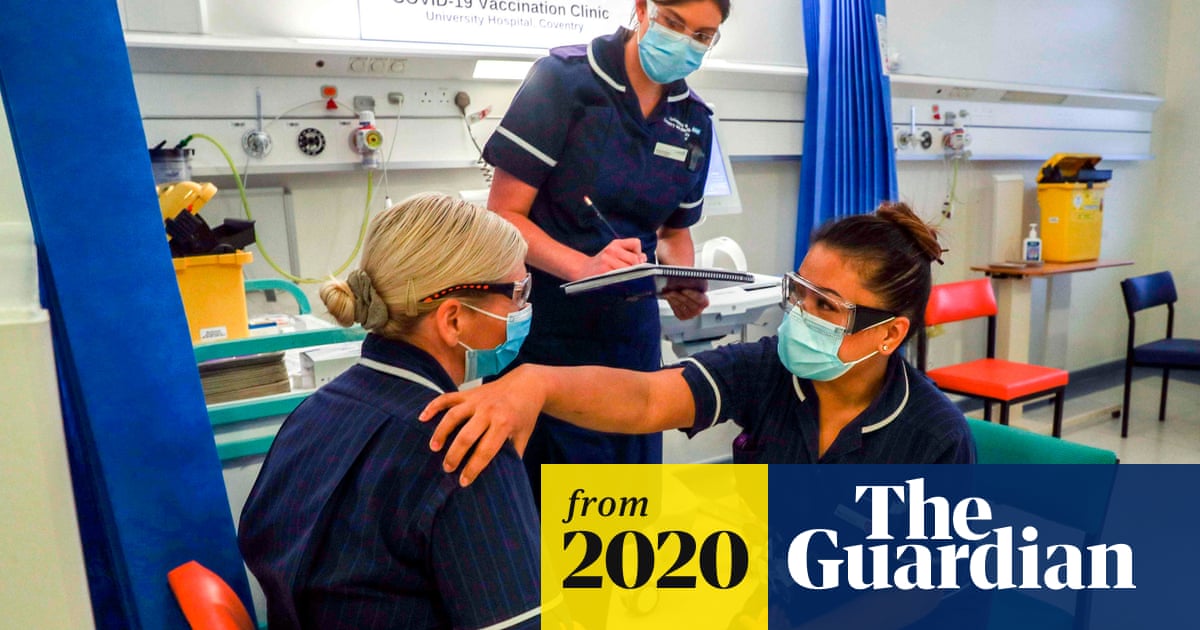
The coronavirus vaccine will have only a marginal impact on hospital admissions over the next three months with the festive season likely to put additional pressure on health services, the UK’s chief medical officers have warned.

In a letter to healthcare staff sent on Friday, the CMOs for England, Wales, Scotland and Northern Ireland said the effects of vaccination would likely be felt by spring but workers should brace themselves for an “especially hard” winter.

They wrote: “Although the very welcome news about vaccines means that we can look forward to 2021 with greater optimism, vaccine deployment will have only a marginal impact in reducing numbers coming into the health service with Covid over the next three months … The social mixing which occurs around Christmas may well put additional pressure on hospitals and general practice in the New Year and we need to be ready for that.”

The Medicines and Healthcare products Regulatory Agency (MHRA) approved the Pfizer/BioNTech vaccine on Wednesday, meaning the UK is the first country in the world to have an approved vaccine.

The vaccines are expected to be administered in England for the first time on Tuesday after they have been distributed to hospital hubs. Northern Ireland has also said it is on track to begin immunisations next week.

Hospitals will begin by immunising care home staff, and hospital inpatients and outpatients aged over 80. Care home residents, who are in the highest priority category, pose a more difficult logistical challenge. At one point NHS staff were mooted to be the first to receive the vaccine but the letter states: “All healthcare workers would agree that the principal aim of the initial vaccination programme should be to protect the most vulnerable and those at highest risk of mortality.”

Dr June Raine, chief executive of the MHRA, told BBC Radio Cumbria that getting vaccines into care homes might be “variable” but, “I would say definitely within the next two weeks”.

The letter also pointed out that while the vaccine can prevent disease symptoms, there is a lack of firm data as to their effects on transmission of the virus. “It is going to be essential that people continue to maintain current PPE (personal protective equipment) and other measures to reduce transmission even after vaccination as we accumulate that data,” they say.

Expressing admiration at the continued efforts of healthcare staff, the authors also encourage them to take part in trials, echoing Friday’s warning by Mike Ryan, the World Health Organization’s top emergency expert, that “vaccines do not equal zero Covid”.

“We do not expect Covid to disappear even once full vaccination has occurred although it will be substantially less important as a cause of mortality and morbidity. It is therefore absolutely essential that we use the next months to learn as much as we can as we expect Covid to be less common in the future,” they said.

“This will allow us to have the best chance of a strong evidence base for managing it over the coming years. We would therefore strongly encourage colleagues to continue to recruit or to participate in drug trials such as Recovery, vaccine trials, and observational studies such as Siren. We will all be very grateful for the results this will lead to in future years.”

The chief medical officers said that lockdowns and other restrictions had helped reduce the peak and that in most areas of the UK hospital numbers were likely to fall over the next few weeks. But they warned that this would not happen everywhere and that the relaxation of restrictions over Christmas could change the outlook.

Categories
Audio Sources - Full Text Articles

UK indicates it will send battle tanks to Ukraine

2023-01-14T12:21:09Z

Prime Minister Rishi Sunak has indicated that Britain would send Ukraine send some of its main battle tanks along with additional artillery support during a phone call on Saturday with Ukrainian President Volodymyr Zelenskiy.

Media reports have suggested Britain was in discussions with Ukraine to deliver the Challenger 2 tanks to help the country fight invading Russian forces.

Sunak’s office has previously said Britain would co-ordinate its support with allies after Germany, France and the United States all indicated last week they would provide armoured vehicles to Ukraine.

“The prime minister outlined the UK’s ambition to intensify our support to Ukraine, including through the provision of Challenger 2 tanks and additional artillery systems,” a spokesperson for Sunak said.

“They agreed on the need to seize on this moment with an acceleration of global military and diplomatic support to Ukraine.”

Sunak’s office said further details would be provided shortly.

The Challenger 2 is a battle tank designed to attack other tanks, and has been in service with the British Army since 1994. It has been deployed in Bosnia and Herzegovina, Kosovo and Iraq, according to the army.

“The prime minister and President Zelenskiy welcomed other international commitments in this vein, including Poland’s offer to provide a company of Leopard tanks,” Sunak’s spokesperson said.

Andriy Yermak, head of the Ukrainian president’s staff, thanked Britain for its new defence package.

“This is an important contribution to the defense of freedom and democracy in Europe. We are grateful to Rishi Sunak and the (British) people for their help,” he said on Twitter.

Related Galleries:

Ukraine’s President Volodymyr Zelenskiy attends a phone call with Britain’s Prime Minister Rishi Sunak, amid Russia’s attack on Ukraine, in Kyiv, Ukraine January 14, 2023. Ukrainian Presidential Press Service/Handout via REUTERS

British Prime Minister Rishi Sunak attends a Joint Expeditionary Force (JEF) plenary session in Riga, Latvia December 19, 2022. REUTERS/Henry Nicholls/Pool
Categories
Audio Sources - Full Text Articles

Michael Novakhov retweeted: Another episode of Putin’s paranoia. A memorial service for a regional strongman, former Bashkortostan leader Murtaza Rakhimov. For Putin, they removed all honor guards, relatives, and other visitors.

Michael Novakhov retweeted:

Another episode of Putin’s paranoia. A memorial service for a regional strongman, former Bashkortostan leader Murtaza Rakhimov. For Putin, they removed all honor guards, relatives, and other visitors.

FmXPPhzaUAATdLR.jpg:large

Categories
Audio Sources - Full Text Articles

Michael Novakhov retweeted: UK 🇬🇧 has made the decision to send 12 Challenger 2 Tanks to Ukraine 🇺🇦 reports British Media Four Challenger 2 tanks would be sent to Eastern Europe immediately and eight will be sent later on

Michael Novakhov retweeted:

UK 🇬🇧 has made the decision to send 12 Challenger 2 Tanks to Ukraine 🇺🇦 reports British Media

Four Challenger 2 tanks would be sent to Eastern Europe immediately and eight will be sent later on

FmbDdnQXgAAEHeA.jpg:large

WP Radio
WP Radio
OFFLINE LIVE