Categories
Audio Sources - Full Text Articles

Spare Might Be the Biggest Bombshell Royal Memoir Ever. But It’s Not the Only One

Prince Harry’s much anticipated memoir Spare doesn’t technically hit shelves until Jan. 10, but some of its more explosive parts have already leaked.

According to the Guardian, which obtained a copy ahead of the official release, Harry details a violent 2019 confrontation at his London home in which Harry claims William “grabbed me by the collar, ripping my necklace, and … knocked me to the floor,” resulting in scrapes and bruises on his back. The duo had been fighting over Harry’s wife Meghan Markle, and Harry claims William called her “rude” and “abrasive.” The Sun, which obtained a copy of Spare in Spanish, also reports that Harry begged Charles not to marry Camilla, while Page Six says that Harry claims Prince William and Kate Middleton encouraged him to wear the infamous Nazi outfit to a costume party in 2005, rather than a pilot getup.

[time-brightcove not-tgx=”true”]

The memoir comes out exactly two years after the Duke of Sussex and his wife, the Duchess of Sussex Meghan Markle, announced that they were planning to give up their royal duties. Now based outside Los Angeles, the couple has been making a name for themselves as media moguls, from their explosive 2021 interview with Oprah Winfrey dishing about racism in the royal family to releasing a docu-series on Netflix.

“I’m writing this not as the prince I was born but as the man I have become,” the Duke of Sussex said in a 2021 press release announcing his autobiography. “I’ve worn many hats over the years, both literally and figuratively, and my hope is that in telling my story—the highs and lows, the mistakes, the lessons learned—I can help show that no matter where we come from, we have more in common than we think.”

Harry will be the first in his immediate family to put out a tell-all. But, that doesn’t mean they haven’t made sure their side of events were reflected in print. Harry’s father, the current sovereign King Charles III, and his mother Princess Diana provided letters and materials to royal biographers, and Queen Elizabeth II cooperated with documentary filmmakers.

Read more: How Princess Diana is still shaping the royal family 25 years later

Accounts like Spare are not typical—if not unprecedented.

“It’s quite rare for a royal to do that, particularly one who’s as close to the institution,” says Laura Clancy, author of Running the Family Firm: How the Monarchy Manages Its Image and Our Money. “Harry’s will be the most influential royal memoir in decades. There’s not many to compare it to.”

Here are some other examples of other eyebrow-raising royal memoirs and autobiographies.

Queen Victoria

Until the mid-19th century, royals’ reflections were usually just shared with family, and often consisted of advice for their heirs.

Queen Victoria’s diaries are one early example of royal reflections that were published for a broader audience. In the 1860s, her family and friends received copies of Leaves from the Journal of our Life in the Highlands, a compilation of her diary entries from the time she spent in the Scottish Highlands.

“Some of her ministers were against the publication,” says Carolyn Harris, a historian and expert on the British monarchy at the University of Toronto, School of Continuing Studies. “They thought it would look like the head of state was on holiday a lot of the time rather than attending to her royal duties.”

A second volume in which the widowed sovereign went in-depth about her friendship with her beloved servant John Brown raised eyebrows, fueling rumors about whether they were romantically involved.

Read more: How Queen Victoria influenced wedding culture

The Duke of Windsor/King Edward VIII

Memoirs of A King
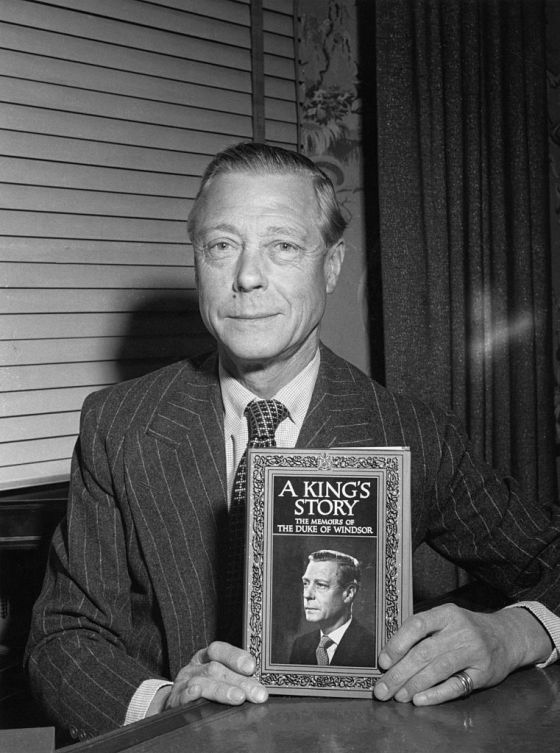
Erika Stone—Getty ImagesThe Duke of Windsor (1894 – 1972), formerly King Edward VIII, with his memoirs, entitled ‘A King’s Story: The Memoirs of the Duke of Windsor’, circa 1951.

Prince Harry’s memoir also comes out 75 years after the one released by the Duke of Windsor, the former King Edward VIII who abdicated in 1936 so he could marry American divorcée Wallis Simpson. Titled, A King’s Story (1947), he addressed what he felt was a misconception that he didn’t want to be king, arguing, “I wanted to be a successful king, but a king in a modern way.” A decade later, Simpson, known as the Duchess of Windsor, came out with her own memoir, The Heart Has Its Reasons (1956), in which she stated that she offered to end the relationship with the Duke of Windsor so he could stay on the throne, but “he insisted that he needed me, and as a woman in love I was prepared to go through rivers of woe, seas of despair and oceans of agony for him.”

Questions about the couple’s motives surfaced following the publication of their memoirs. “There was a sense of the Duke and Duchess of Windsor trying to augment their incomes while in exile,” as Harris puts it.

Read more: Wallis Simpson: 100 Women of the Year

The Duke of Kent

The most recent royal memoir is Prince Edward, the Duke of Kent’s A Royal Life, published in May 2022 from a series of Zoom conversations with biographer Hugo Vickers during the COVID-19 pandemic.The Duke of Kent is Queen Elizabeth II’s cousin, the son of King George VI’s youngest brother.

Now the Duke of Kent has become the first member of the Royal Family to have spoken extensively of the modern reign and his part in it,” as Vickers explained the significance of the project in an op-ed. “Like so many of us during the Covid-19 lockdown, the Duke was stuck at home and could do little for his charities and regiments so the idea formed that he might write something.”

The parts about Queen Elizabeth II’s warmth towards him when he lost his father as a child resonate as the memoir came out the same year that the monarch passed away. “I always felt I wanted to support her,” the Duke wrote. “That’s by far the most important thing in life.” Throughout the memoir, his dedication to royal service is clear.

It’s because of this dedication to royal service for most royals that Clancy says she does not expect memoirs to become the norm for the British royal family anytime soon. She argues they’re somewhat antithetical to the institution of the monarchy. The royals, she says, “rely on this balance between visibility and invisibility. We have to have big royal events, but they also need to be invisible—and to not allow people to ask too many questions and know too much about it. A memoir, or a confessional television interview, or a documentary gives too much access and too much visibility. There’s the potential that might risk shedding too much light on the institution.”

Categories
Audio Sources - Full Text Articles

Would Bryan Kohberger, a Criminology student, leave the #knifesheath on the scene? Only if he wanted to get caught. Was this knife sheath, with his DNA so conveniently printed right on the knob, obtained earlier, before the murders, and planted there?

Would Bryan Kohberger, a Criminology student, leave the #knifesheath on the scene? Only if he wanted to get caught.

Was this knife sheath, with his DNA so conveniently printed right on the knob, obtained earlier, before the murders, and planted there?
Categories
Audio Sources - Full Text Articles

#FBI FBI #BryanKohberger #Criminology Idaho Murders #IdahoMurders #knifesheath Would Bryan Kohberger, a Criminology student, leave the knife sheath on the scene? Only if he wanted to get caught. Did someone else want him to “get caught”? Is this a sign? thenewsandtimes.blogspot.com/2023/01/would-…

#FBI FBI #BryanKohberger #Criminology

Idaho Murders #IdahoMurders #knifesheath

Would Bryan Kohberger, a Criminology student, leave the knife sheath on the scene? Only if he wanted to get caught. Did someone else want him to “get caught”? Is this a sign?

thenewsandtimes.blogspot.com/2023/01/would-…

Fl3fngsaEAAhxGp.png:large

Categories
Audio Sources - Full Text Articles

London to host international meeting on alleged war crimes in Ukraine

2023-01-07T11:33:12Z

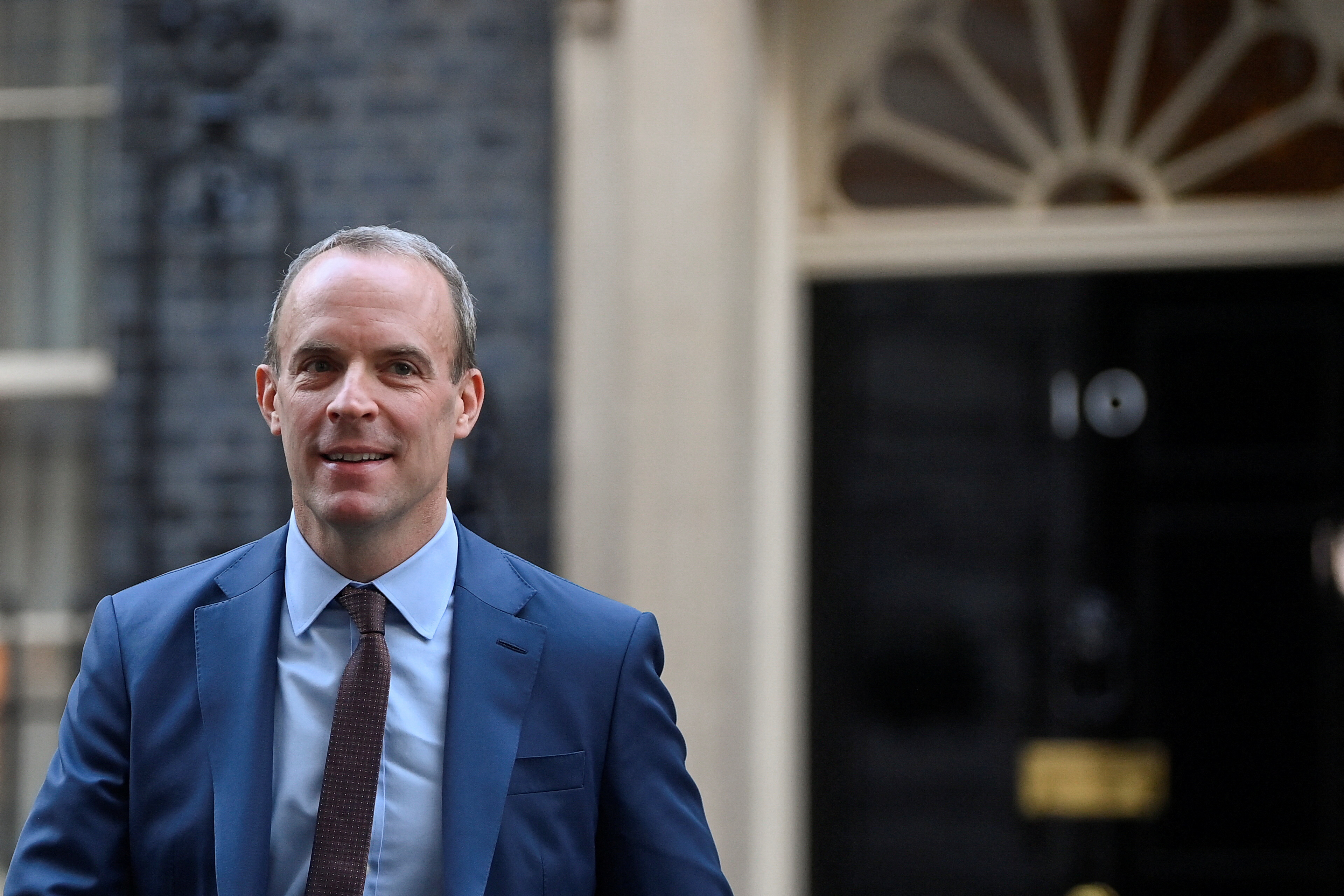
British Deputy Prime Minister and Justice Secretary Dominic Raab walks outside Number 10 Downing Street, in London, Britain, November 22, 2022. REUTERS/Toby Melville

Justice ministers from around the world will gather in London to scale up the support being offered to the International Criminal Court in its investigations of alleged war crimes in Ukraine, the British government said on Saturday.

The meeting in March, which will be hosted by UK Justice Secretary Dominic Raab and his Dutch counterpart Dilan Yesilgoz-Zegerius, will be attended by ICC Chief Prosecutor Karim Khan, according to a statement.

“Almost a year on from the illegal invasion, the international community must give its strongest backing to the ICC so war criminals can be held to account for the atrocities we’re witnessing,” said Raab, who is also Britain’s deputy prime minister.

The meeting will seek to increase the global financial and practical support to the ICC and coordinate efforts to ensure it has all it needs to carry out investigations and prosecute those responsible, the statement said.

Russia, which calls its actions in Ukraine a “special military operation”, has denied targeting civilians and other war crimes. Ukraine and the West say Moscow has no justification for what they say is an imperial-style war of occupation.

Britain has been steady in its backing for Ukraine, having provided 2.3 billion pounds ($2.78 billion) in military support to Kyiv.

Russian and Ukrainian forces exchanged artillery fire at the front line in Ukraine on Friday, even after Moscow said it had ordered its troops to stop shooting for a unilateral truce that was rejected by Kyiv.

The ICC’s Khan last year opened an investigation into possible war crimes in Ukraine. Legal experts say the court’s jurisdiction on aggression only extends to member states and countries that have agreed to its jurisdiction, such as Ukraine but not Russia. Moscow does not recognise the tribunal.

“For us it is crystal clear: these crimes may not go unpunished,” said Yesilgoz-Zegerius, describing the reports and images coming out of Ukraine as “horrific”.

($1 = 0.8270 pounds)

Categories
Audio Sources - Full Text Articles

Would Bryan Kohberger, a Criminology student, leave the knife sheath on the scene? Only if he wanted to get caught.

Would Bryan Kohberger, a Criminology student, leave the knife sheath on the scene? Only if he wanted to get caught. 


Did someone else want him to “get caught”? 

Was this knife sheath, with his DNA so conveniently printed right on the button, obtained earlier, before the murders, and planted there, in the bed, intentionally and deliberately by the real killers, to point to him as the targeted patsy, and to get the chase off the trail? 

Is there a sign in the criminal world: to leave the empty knife sheath on the scene? What does this mean? 

“The knives are out”? 

The News And Times Information Network – Blogs By Michael Novakhov – thenewsandtimes.blogspot.com
Categories
Audio Sources - Full Text Articles

Putin praises Russian Orthodox Church for backing troops in Ukraine

2023-01-07T11:09:29Z

President Vladimir Putin on Saturday praised the Russian Orthodox Church for supporting Moscow’s forces fighting in Ukraine in an Orthodox Christmas message designed to rally people behind his vision of modern Russia.

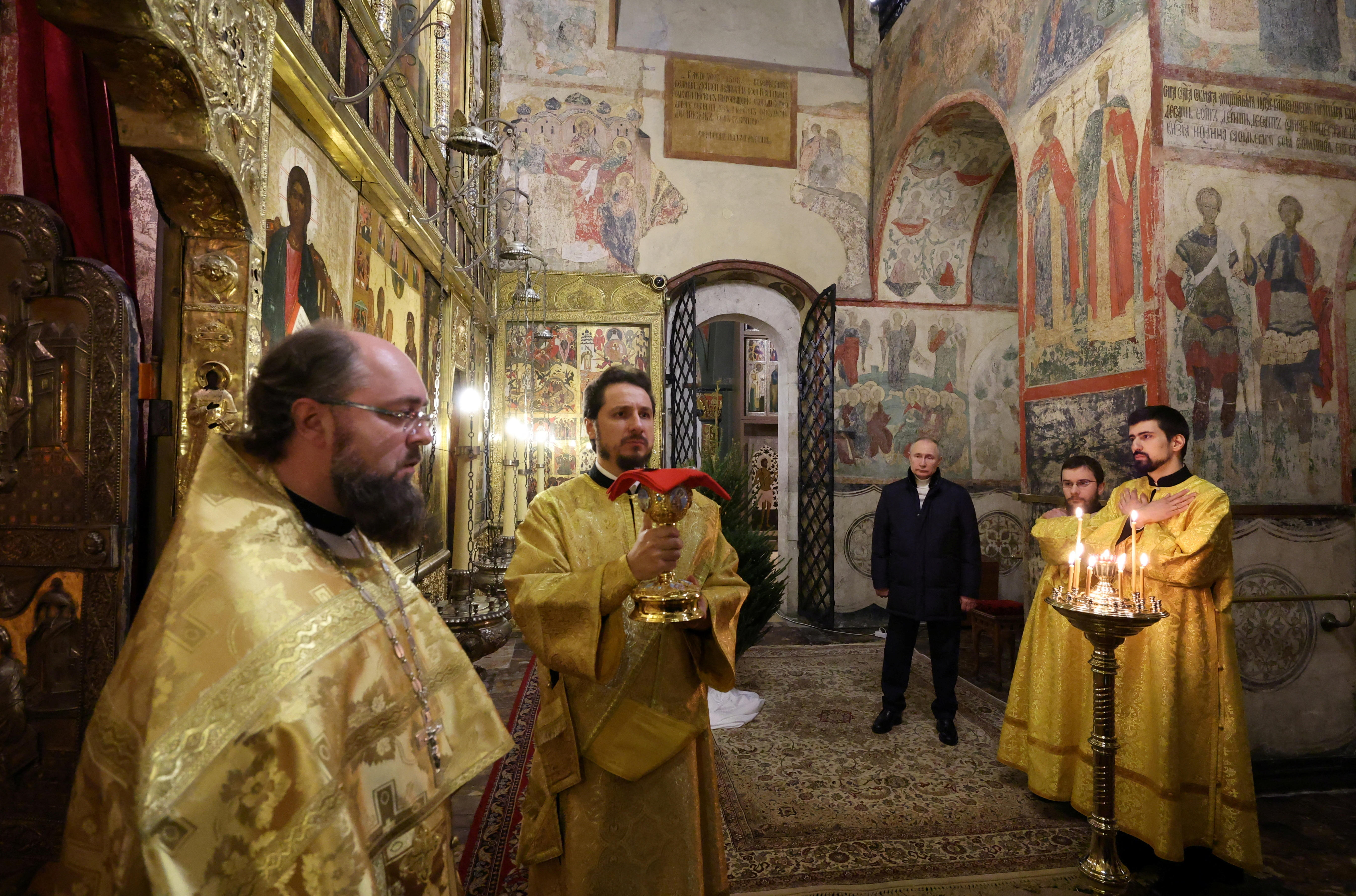
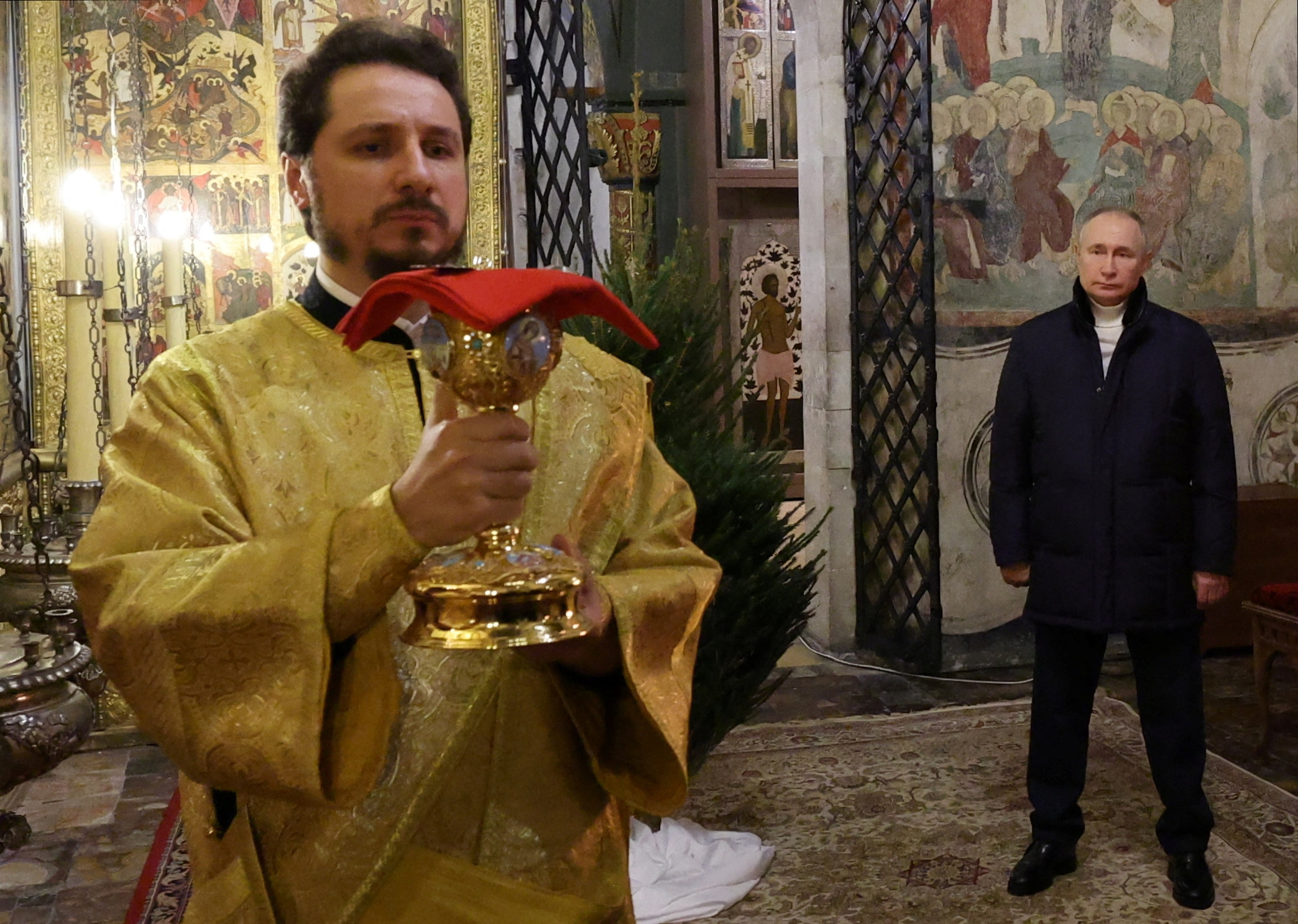
The Kremlin issued Putin’s message after the Russian leader attended an Orthodox Christmas Eve service on his own inside a Kremlin cathedral rather than joining other worshippers in a public celebration.

In his message, accompanied on the Kremlin website by an image of him standing before religious icons, Putin made it clear he saw the Russian Orthodox Church as an important stabilising force for society at a time he has cast as a historical clash between Russia and the West over Ukraine and other issues.

“It is deeply gratifying to note the enormous constructive contribution of the Russian Orthodox Church and other Christian denominations in unifying society, preserving our historical memory, educating youth and strengthening the institution of family,” said Putin.

“Church organisations prioritise … supporting our warriors taking part in the special military operation (in Ukraine). Such massive, complex and truly selfless work deserves sincere respect.”

On Friday, Putin ordered a 36-hour ceasefire for the celebrations, but Kyiv rejected it as Moscow’s ploy to buy time and regroup and Russian and Ukrainian forces exchanged artillery fire after the announcement.

Many Orthodox Christians celebrate Christmas on Jan. 7, but the Russian Orthodox Church’s backing for Moscow’s war in Ukraine has angered many Ukrainian Orthodox believers and splintered the worldwide Orthodox Church.

Of 260 million Orthodox Christians in the world, about 100 million are in Russia itself and some of those abroad are in unity with Moscow.

Others are strongly opposed, however, and reject Moscow’s assertion that its Feb. 24 invasion last year was an essential pre-emptive strike to defend its own security and that of Russian speakers in Ukraine.

Ukraine has about 30 million Orthodox believers, divided between the Ukrainian Orthodox Church of the Moscow Patriarchate and two other Orthodox Churches, one of which is the autocephalous, or independent, Ukrainian Orthodox Church.

In a service on Friday, Patriarch Kirill of Moscow criticised Ukraine for cracking down on the branch of the Orthodox church with longstanding ties to Moscow.

Related Galleries:

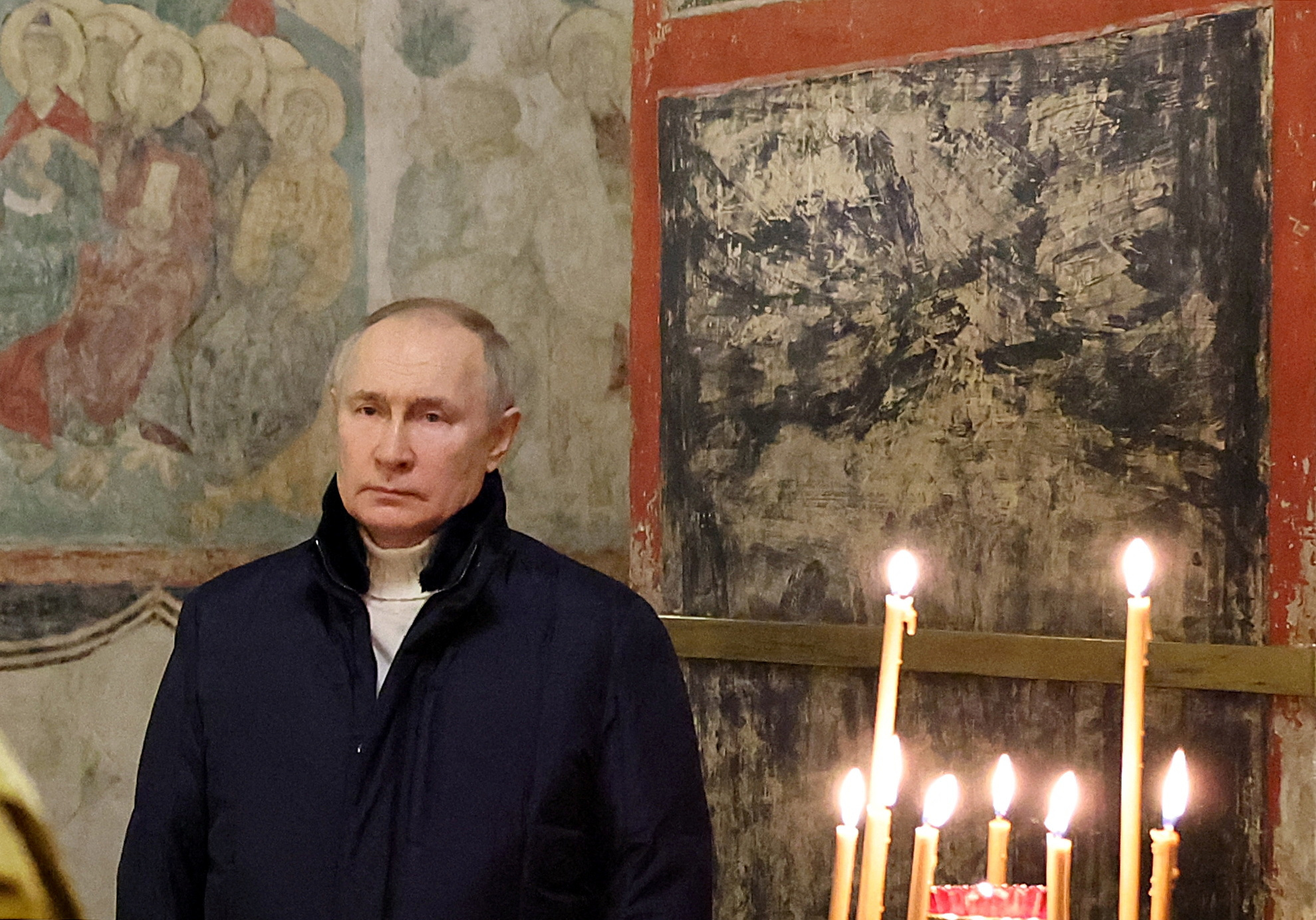
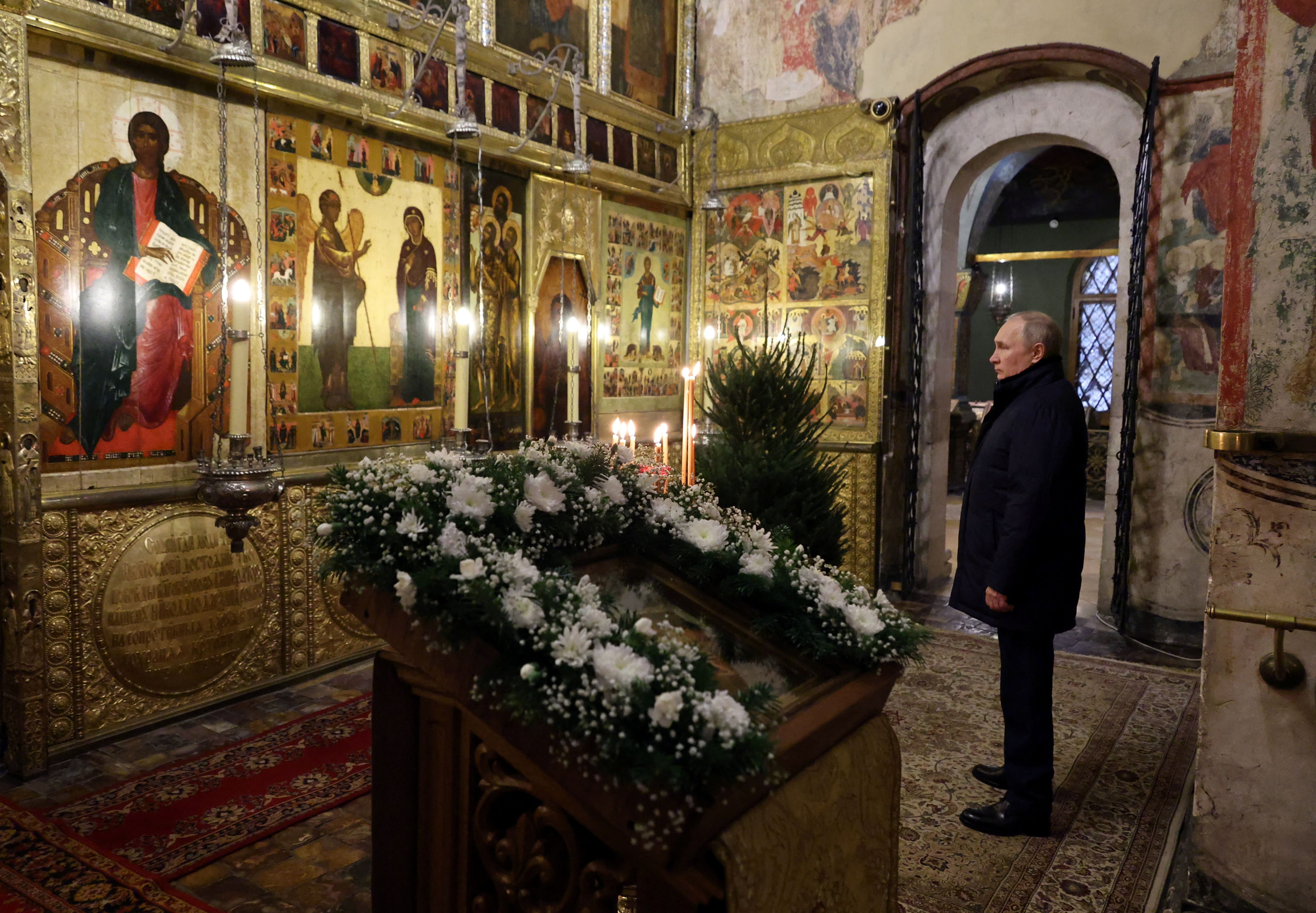
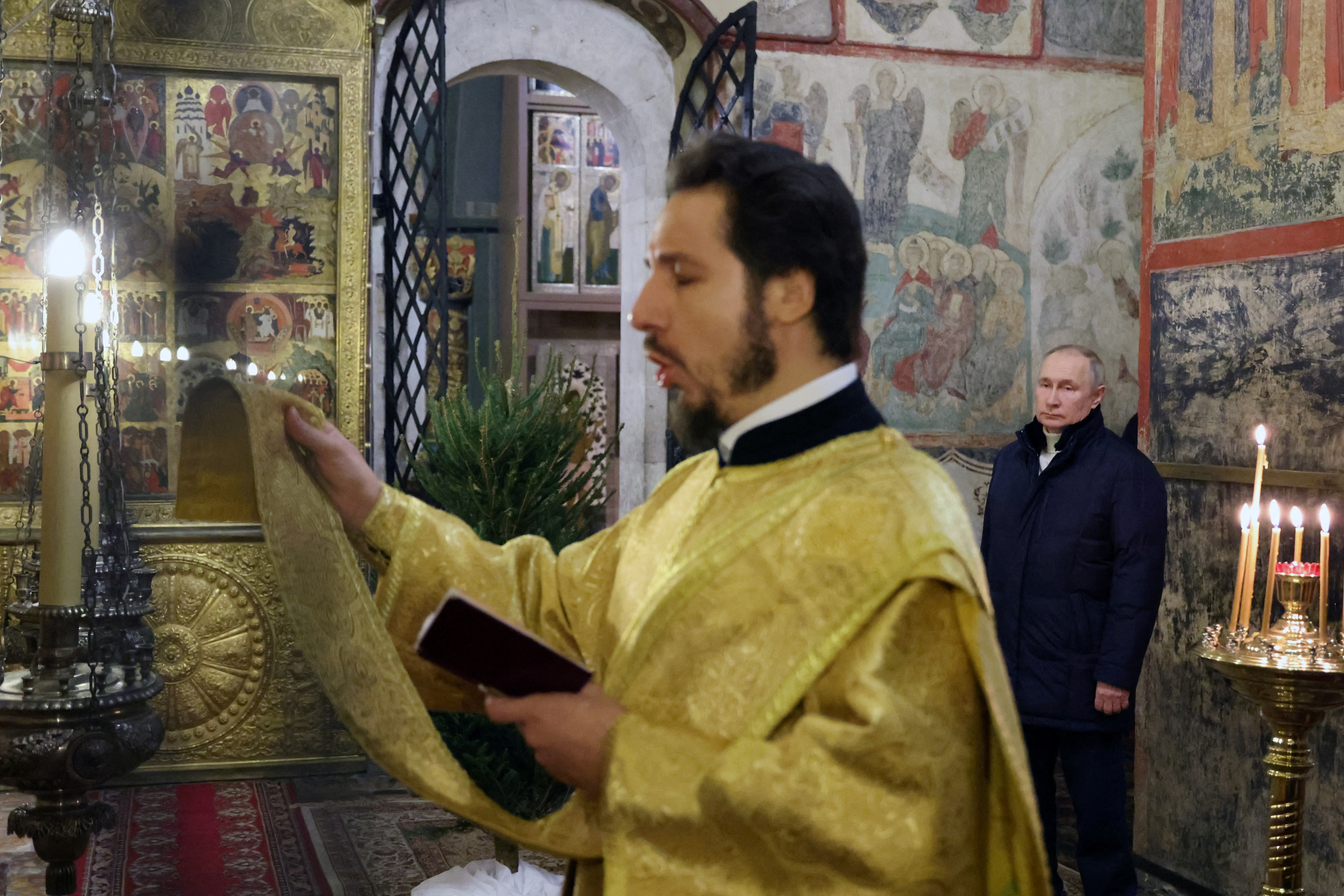
Russian President Vladimir Putin attends the Orthodox Christmas service at the Kremlin in Moscow, Russia January 7, 2023. Sputnik/Mikhail Klimentyev/Kremlin via REUTERS

Russian President Vladimir Putin attends the Orthodox Christmas service at the Kremlin in Moscow, Russia January 7, 2023. Sputnik/Mikhail Klimentyev/Kremlin via REUTERS

Russian President Vladimir Putin attends the Orthodox Christmas service at the Kremlin in Moscow, Russia January 7, 2023. Sputnik/Mikhail Klimentyev/Kremlin via REUTERS

Russian President Vladimir Putin attends the Orthodox Christmas service at the Kremlin in Moscow, Russia January 7, 2023. Sputnik/Mikhail Klimentyev/Kremlin via REUTERS

Russian President Vladimir Putin attends the Orthodox Christmas service at the Kremlin in Moscow, Russia January 7, 2023. Sputnik/Mikhail Klimentyev/Kremlin via REUTERS

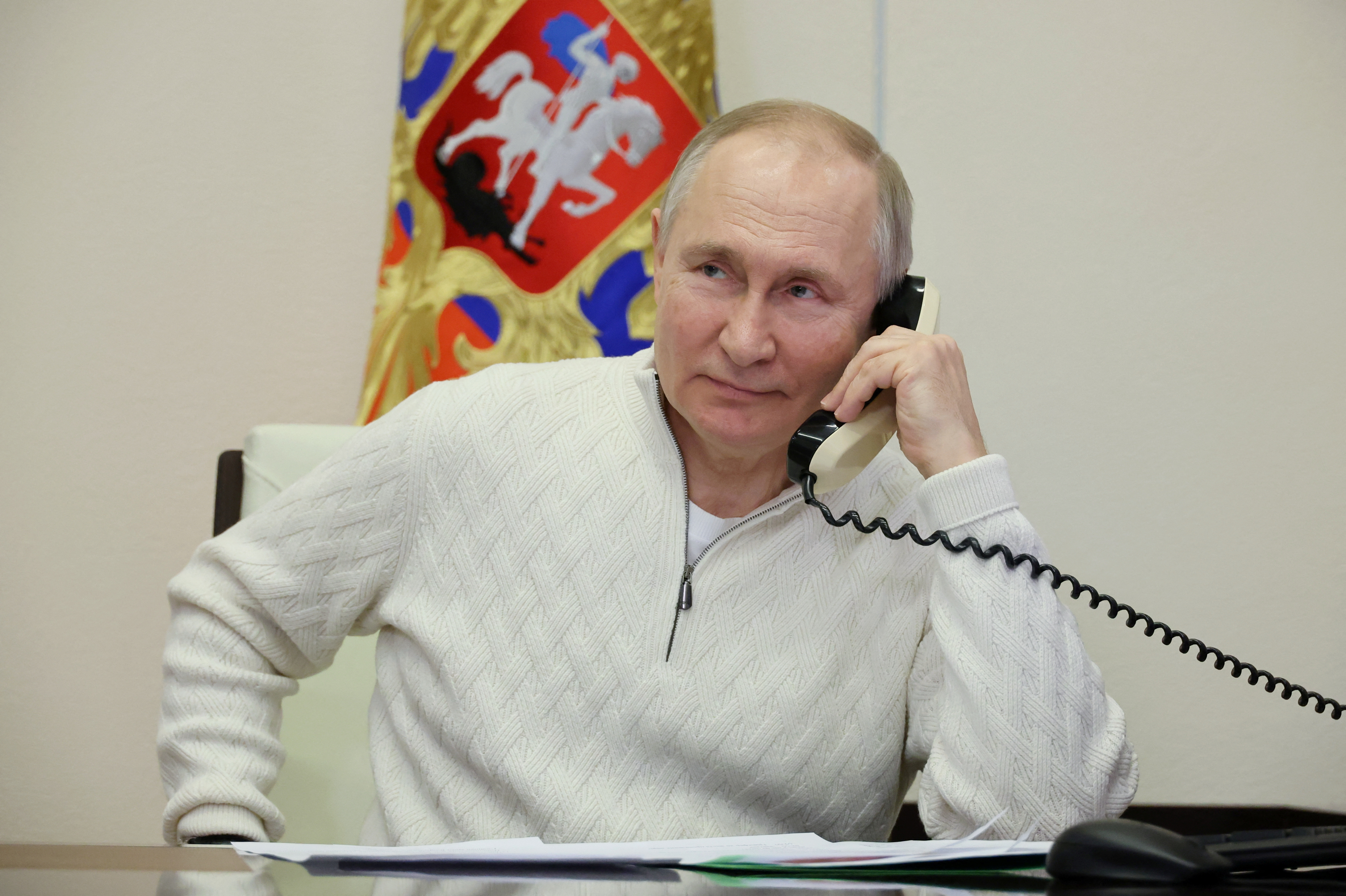
Russian President Vladimir Putin speaks on the phone with David Shmelev from Stavropol Region, a 7-year-old participant of a New Year’s and Christmas charity event, at the Novo-Ogaryovo state residence outside Moscow, Russia January 5, 2023. Sputnik/Mikhail Klimentyev/Kremlin via REUTERS
Categories
Audio Sources - Full Text Articles

Russia“s war on Ukraine latest: Putin praises Russian Orthodox Church for its support

2023-01-07T11:21:51Z

Russia acknowledged on Monday (January 2) that scores of its troops were killed in one of the Ukraine war’s deadliest strikes, drawing demands from nationalist bloggers for commanders to be punished for housing soldiers alongside an ammunition dump. Sarah Charlton reports.

President Vladimir Putin praised the Russian Orthodox Church for supporting Moscow’s forces fighting in Ukraine in an Orthodox Christmas message designed to rally people behind his vision of modern Russia.

* Russian and Ukrainian forces exchanged artillery fire at the front line in Ukraine on Friday after Moscow said it had begun a truce that was firmly rejected by Kyiv.

* The Russian-installed governor of the Crimean city of Sevastopol said on Saturday that air defences had shot down a drone in what he suggested was the latest attempted Ukrainian attack on a port where Russia’s Black Sea Fleet is based.

* The United States will provide more than $3.75 billion in military assistance to Ukraine and countries affected by the Russian invasion of its neighbour, Secretary of State Antony Blinken said on Friday.

* A U.S. commitment to supply Kyiv with Bradley Fighting Vehicles for the first time is exactly what Ukraine needs, President Volodymyr Zelenskiy said on Friday.

* Germany said on Friday it wants to deliver around 40 Marder infantry fighting vehicles to Ukraine before the end of March, and Vice Chancellor Robert Habeck said Berlin could ultimately send its entire functioning fleet of the weapons.

* Ukraine will need at least $1.79 billion to restore its telecommunications sector to pre-war levels, a U.N. agency said on Friday, alleging Russia had “destroyed completely or seized” networks in parts of the country.
* Costs for hiring ships to transport commodities from the Black Sea have risen by more than a fifth since the start of the year, reflecting higher war risk insurance rates, industry sources have said.

* Ukraine’s power grid operator issued a new appeal to civilians on Friday to save electricity as temperatures fell and energy consumption rose, threatening new strains on a network devastated by Russian air strikes.

Related Galleries:

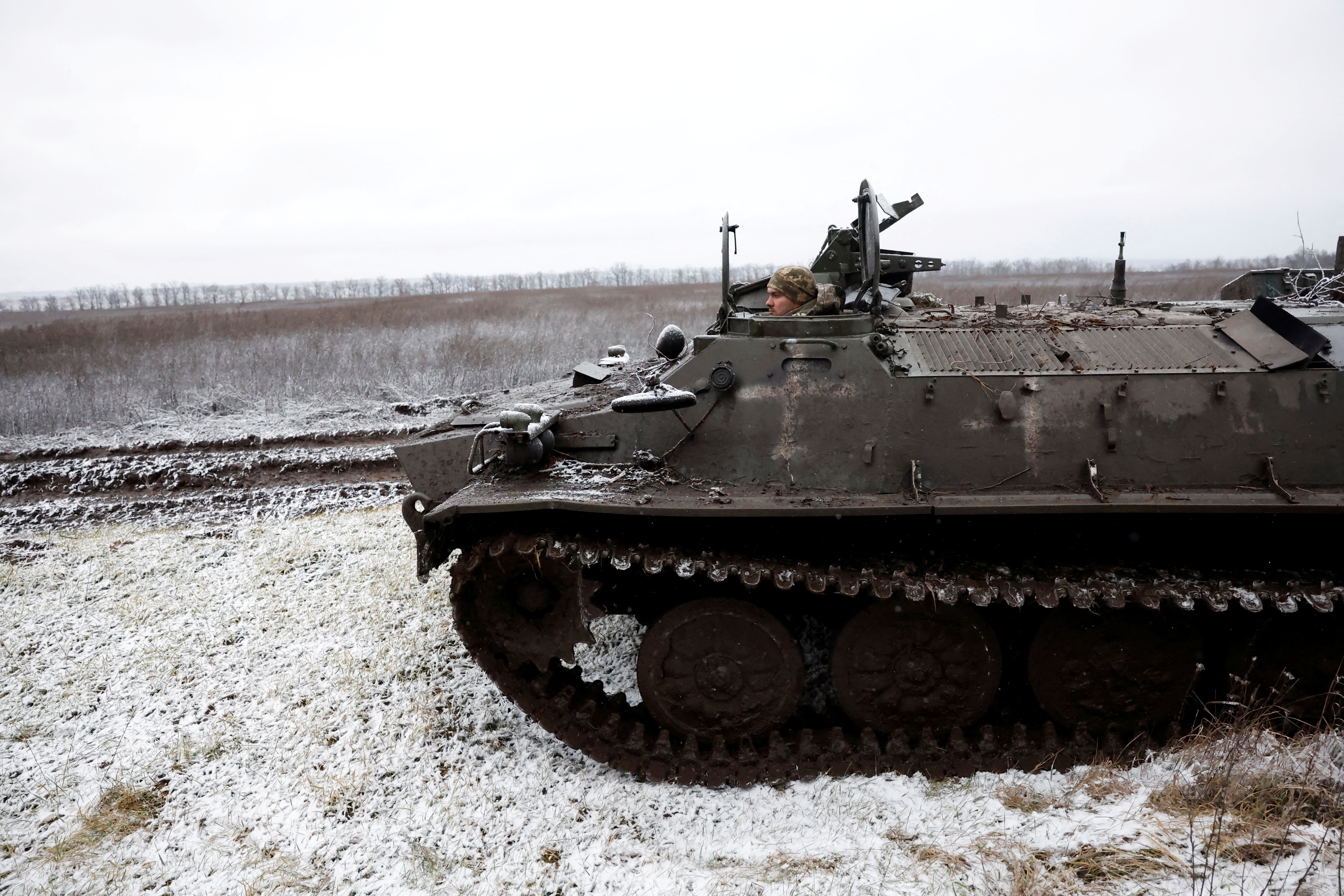
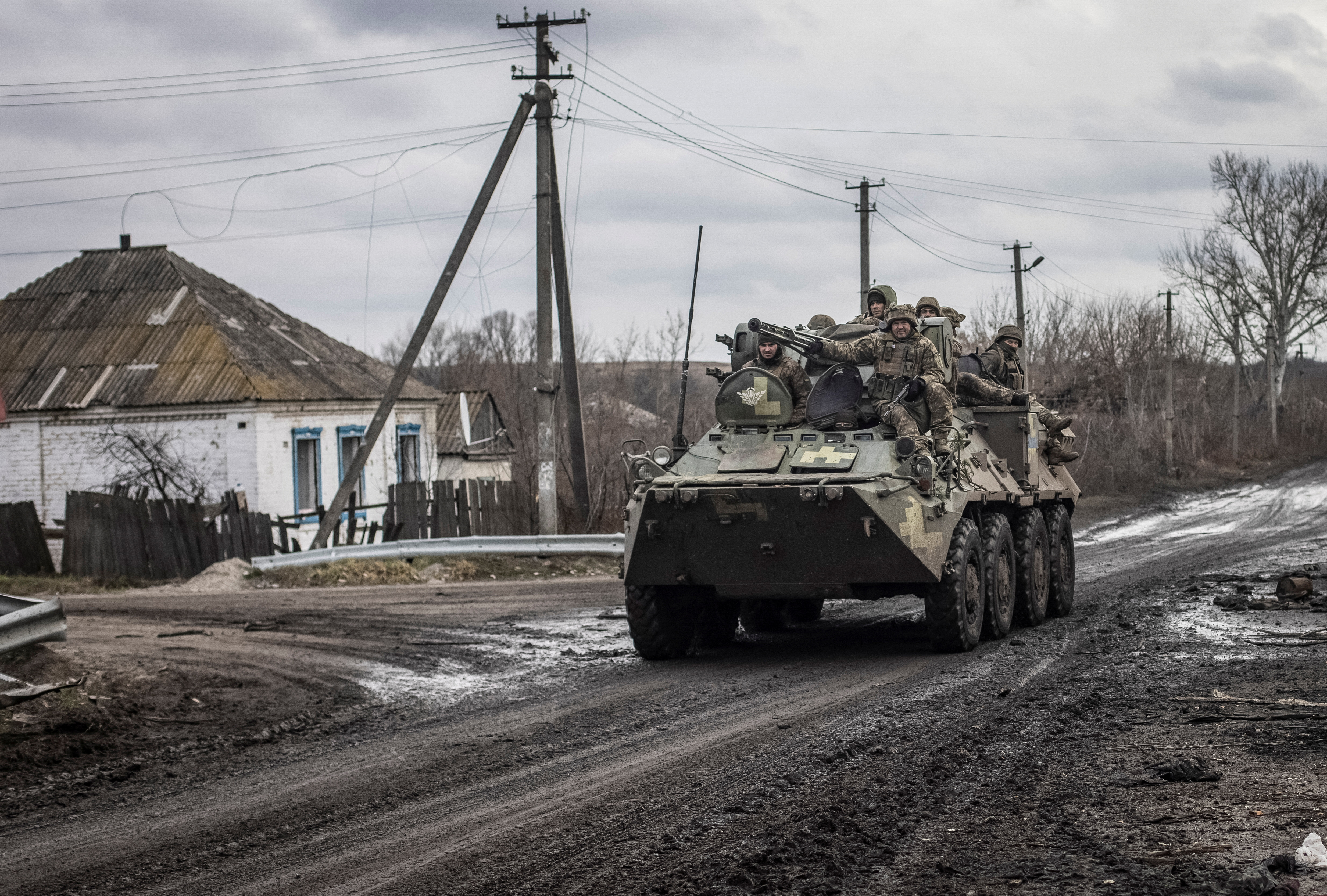
Vlad from the 80th Separate Air Assault Brigade drives an APC on the front line at Orthodox Christmas, during a ceasefire announced by Russia over the Orthodox Christmas period, from the frontline region of Kreminna, Ukraine, January 6, 2023. REUTERS/Clodagh Kilcoyne

Ukrainian servicemen ride an Armoured Personnel Carrier (APC), as Russia’s attack on Ukraine continues, in the village of Torske, Donetsk region, Ukraine December 30, 2022. REUTERS/Yevhen Titov

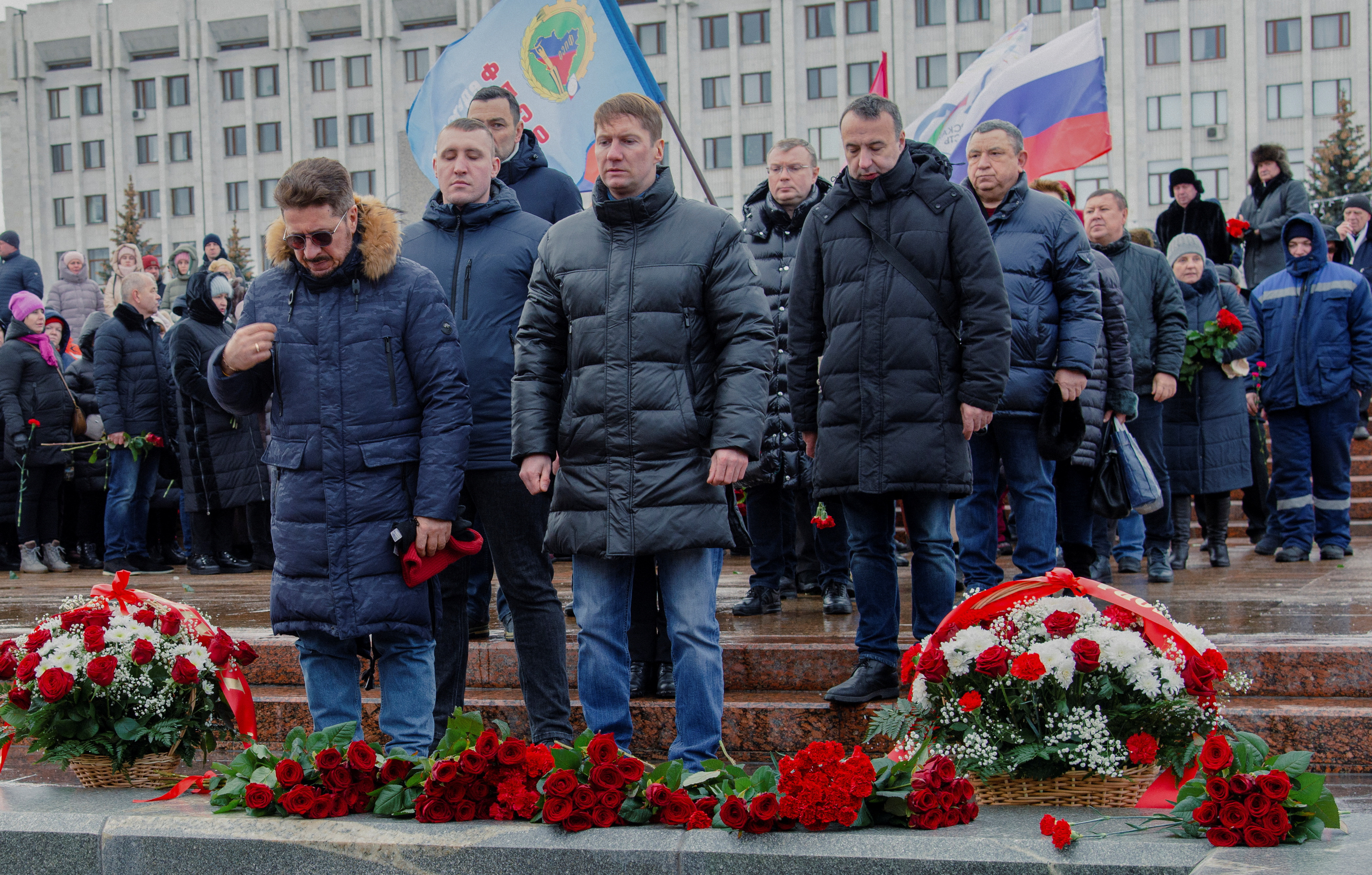
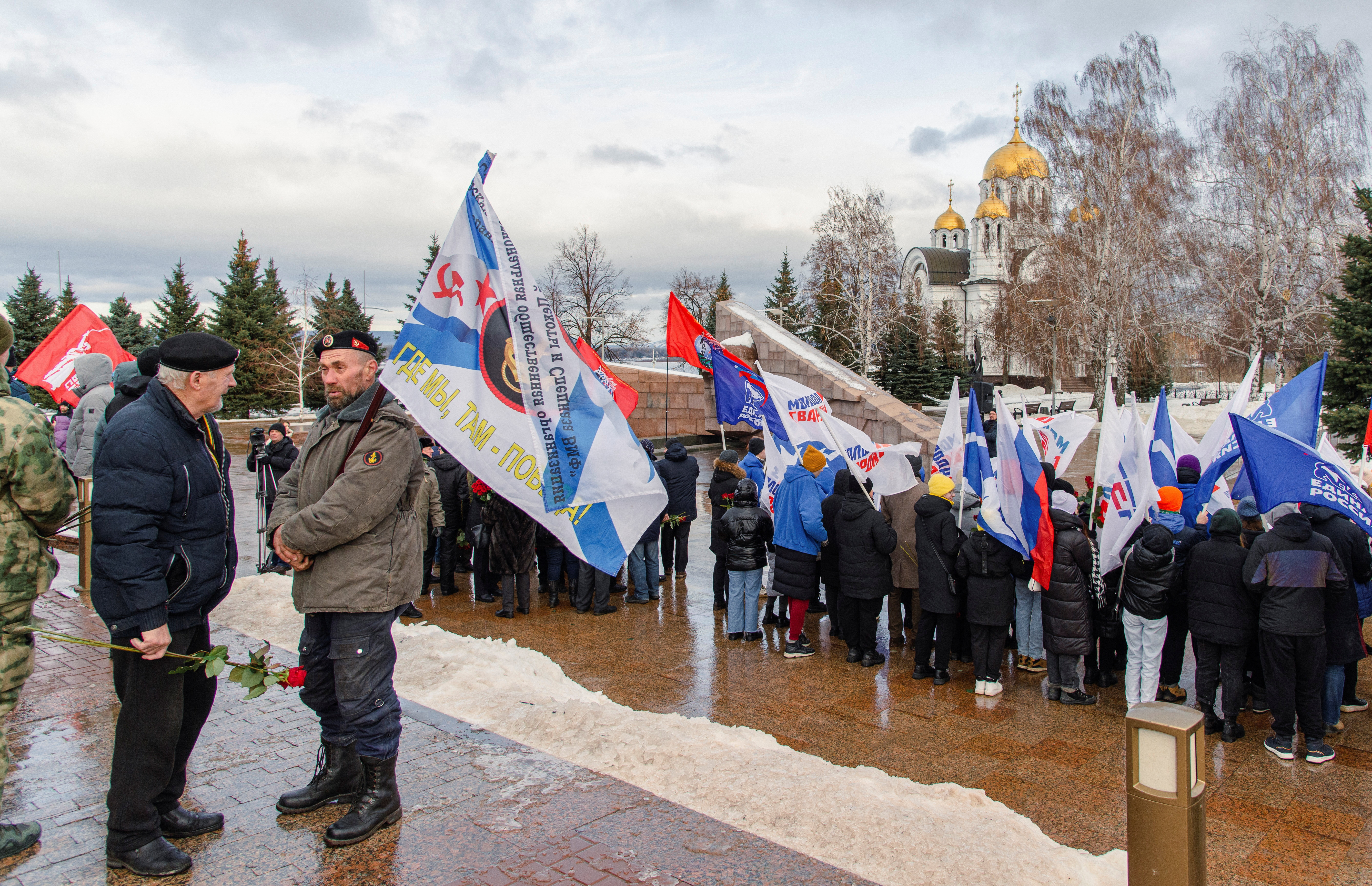
People take part in a ceremony in memory of Russian soldiers killed in the course of Russia-Ukraine military conflict, the day after Russia’s Defence Ministry stated that 63 Russian servicemen were killed in a Ukrainian missile strike on their temporary accommodation in Makiivka (Makeyevka) in the Russian-controlled part of Ukraine, in Glory Square in Samara, Russia, January 3, 2023. REUTERS/Albert Dzen

People take part in a ceremony in memory of Russian soldiers killed in the course of Russia-Ukraine military conflict, the day after Russia’s Defence Ministry stated that 63 Russian servicemen were killed in a Ukrainian missile strike on their temporary accommodation in Makiivka (Makeyevka) in the Russian-controlled part of Ukraine, in Glory Square in Samara, Russia, January 3, 2023. REUTERS/Albert Dzen
Categories
Audio Sources - Full Text Articles

Republican U.S. House Speaker Kevin McCarthy“s dream job could become a nightmare

2023-01-07T11:09:26Z

WASHINGTON (Reuters) – Kevin McCarthy wakes up on Saturday morning with a long-held dream fulfilled: After a four-day standoff, he was elected speaker of the U.S. House of Representatives, becoming the most powerful member of the Republican Party.

?m=02&d=20230107&t=2&i=1619321392&r=LYNX

U.S. House Republican Leader Kevin McCarthy (R-CA) looks over at Rep. Patrick McHenry (R-NC) shortly after things became physical between Republican representatives on the floor of the House as the House of Representatives holds a late night 14th round of voting for a new House Speaker on the fourth day of the 118th Congress at the U.S. Capitol in Washington, U.S., January 6, 2023. REUTERS/Jon Cherry

But that role could turn into a nightmare because it requires leading a caucus that strongly rejects leadership. Conservatives have regularly excoriated top Senate Republican Mitch McConnell for agreeing to compromises of any kind with Democrats and earlier this week rejected former President Donald Trump’s call to quickly fall in line behind McCarthy.

The 57-year-old Californian showed tenacity in pushing through 15 rounds of voting and dismantling what had been a cadre of 20 right-wing hardline opponents, finding compromises that would pull most of them into his camp. He told reporters on Friday night that he would be a more effective leader because of the drawn-out process.

“Because it took this long, now we’ve learned how to govern. So now we’ll be able to get the job done,” McCarthy said. “At the end of the day, we’re going to be more effective, more efficient and definitely government is going to be more accountable.”

McCarthy agreed to major concessions to get a role that is second in line to the Oval Office behind Democratic Vice President Kamala Harris, including a rule that means that any of the 435 members of the House could force a vote for his removal at any time.

Republicans’ weaker-than-expected performance in the November elections left them with a narrow 222-212 majority and gives outsized power to a small group of right-wing hardliners. They railed against McCarthy, who served as minority leader since 2019, accusing him of being soft and too open to compromise with President Joe Biden and his Democrats, who also control the U.S. Senate.

“We do not trust Mr. McCarthy with power, because we know who he will use it for. And we are concerned that it will not be for the American people,” said Representative Matt Gaetz, who dealt McCarthy one final humiliation on Friday night when he cost him the second-to-last vote by withholding his support.

But compromise will be necessary in a divided government, and McCarthy’s concessions raise the risk that the two parties could fail to reach a deal when the federal government comes up against its $31.4 trillion debt limit later this year. Failure to reach agreement, or even a long standoff, could bring a default that would shake the global economy.

McCarthy shrugged off suggestions that the deal could weaken his power.

“That gives me no problem or concern whatsoever,” McCarthy told reporters, describing his deal with critics as a “very good” agreement that “empowers the members.”

He also agreed to pursue deep cuts in government spending to achieve a balanced federal budget in 10 years, beginning in October, and promised his hardline critics greater influence on key committees.

The week-long stalemate over his candidacy has emboldened individual lawmakers, at a time when the thin Republican majority affords him the loss of no more than four votes to enact legislation.

McCarthy has spent his adult life in politics, first as a congressional staffer and then state legislator before being elected to the House in 2006. He made an unsuccessful run for speaker once before, in 2015, and the election represents the pinnacle of his career.

But the speaker’s post has proved to be a formidable challenge for Republicans in recent years, with John Boehner resigning the post in 2015 after a struggle with rebellious conservatives.

Boehner’s successor, Paul Ryan, a frequent target for conservatives, decided not to seek reelection in 2018 as then-President Trump shifted the party focus from Ryan’s fiscal priorities to immigration and culture-war issues.

McCarthy ran afoul of hardliners when he publicly acknowledged that Trump bore responsibility for the deadly Jan. 6, 2021, attack on the U.S. Capitol, days after the violence. He later repeatedly voiced allegiance to the former president.

McCarthy visited at least 34 states to campaign for more than 165 candidates ahead of the midterms. The Congressional Leadership Fund, a group tied to him, contributed more than $160 million to help Republican House candidates. McCarthy sent candidates $6.5 million from his own campaign and four other entities under his control, according to his campaign team.

But to reach the speakership, he also agreed not to interfere in future Republican primaries, even if it meant boosting candidates that he thought were likelier to win a general election than right-wing rivals.

“Kevin is a good man. He’s a man of God,” Republican Representative Mike Garcia said in a speech nominating McCarthy on Friday. “He’s a patriot. He’s a leader who has led this conference to our current majority over the last four years. Those things are unassailable.”

Categories
Audio Sources - Full Text Articles

Sabri al-Qurashi Has Lived Without Legal Status in Kazakhstan Since His 2014 Guantánamo Release

“I’m trying to be OK,” Sabri al-Qurashi texted me one afternoon after I asked how he was. Al-Qurashi has made it through a lot, but he’s increasingly depressed, tired, and has become desperate for his living conditions to change. By now, he has spent two decades feeling trapped with no end in sight.

Al-Qurashi lived the nightmare of languishing in a cage as a detainee at the notorious U.S. military prison at Guantánamo Bay, Cuba. He never expected he’d be living in another version of a cage after he was released in 2014. For nearly a decade, he has found himself stuck in Kazakhstan. Promises once made to him of starting a life and starting a family after Guantánamo have now been all but shattered. His life now feels like one of permanent purgatory as he holds no form of basic identification at the mercy of the Kazakh government. With no hope or patience left, al-Qurashi is now threatening a hunger strike.

“Truly, my life now is just as bad as w­­hen I was in Guantanamo, and in many aspects even worse. At least there, I knew I was in prison and that I would get out one day,” al-Qurashi wrote in an account shared with The Intercept, which is set to be published by CAGE, a group that advocates for “war on terror” victims and detainees. “Now I’m living as if I’m dead and being told I am free when I am not.”

“Now I’m living as if I’m dead and being told I am free when I am not.”

When al-Qurashi met with representatives from Kazakhstan’s government while still at Guantánamo, he was optimistic about being sent to a new strange home. He agreed to a secretive resettlement deal negotiated by the U.S. State Department.

Unable to return to Yemen because of the country’s instability, al-Qurashi said he was offered a good life elsewhere. His understanding, and that of his legal team, was that, after living under some restrictions for two years, he would be a free man, with all the same rights as Kazakh citizens. It is a Muslim country, he was told, and he would be treated as a member of society. Instead, he said now he finds himself without the most basic needs.

“I have no official status, no ID card, no right to work or education, and no right to see my family,” al-Qurashi said. “I have been married for eight years, but my wife is not allowed to come and live with me.”

Al-Qurashi lives under conditions that are in stark contrast to the stability that the State Department had tried to guarantee in his deal. “The United States’ goal in resettling former Guantánamo detainees was to create conditions for these men to integrate into their new societies and give them the opportunity to start a new life in a manner that protected the security of the United States,” a former State Department official familiar with the Obama administration’s efforts to transfer Guantánamo detainees told The Intercept. “Among other things, successful resettlements entailed housing, access to medical care, educational opportunities, the ability to work, and the opportunity to start or reunify with their families.”

In an interview with The Intercept, al-Qurashi said that he has been repeatedly told over the years that his wife and other family are not allowed to visit, much less join him, from Yemen because he is “illegal.” He said he was told, “You have no rights.” According to a message viewed by The Intercept, the Red Crescent Society is currently negotiating with Kazakh officials for al-Qurashi’s wife to finally be allowed a brief first visit. “We are waiting for a reply. I will keep you informed,” an International Committee of the Red Cross representative working on al-Qurashi’s behalf texted him in late October. Al-Qurashi hasn’t heard anything since.

A spokesperson for the State Department said that once security agreements around resettlement expired, responsibility for treatment of the former detainees fell to the host governments. “Repatriation or resettlement of former detainees is a carefully negotiated process between the United States and receiving countries based on mutually reached security and humane treatment assurances. While security assurances are time-limited, assurances related to humane treatment do not expire,” said Bureau of Counterterrorism spokesperson Vincent Picard in a statement. “While host governments are encouraged to consult with us, the U.S. government does not exercise any sort of custody over the treatment of resettled individuals. We encourage all host governments to exercise their responsibilities humanely and with consideration of appropriate security measures.” (The Kazakh Embassy to the U.S. did not respond to a request for comment.)

For al-Qurashi to have gone so long without even documentation of his identity, in defiance of the diplomatic efforts of the State Department, is something his legal advocates never imagined.

“Ultimately, he never received proper identification to be a documented individual in the country, and that poses problems in any country,” Greg McConnell, al-Qurashi’s pro bono counsel, said. “That’s something that was never appropriately fulfilled in the way that we understood it would be by the Kazakh government.”

Following the broken promises, al-Qurashi now feels that no one cares about him. With the ICRC financing his apartment, food, and even a place to paint, al-Qurashi worries that Kazakh officials may ask, “What more could you possibly want?” For al-Qurashi, though, the new life he signed up for was one where his wife could join him, and they could build a home together. His existence now, he said, is sustained by aid, but it isn’t really life at all.

“Of course, I try not to give up,” he said, “but everything is against me.”

GTMO_Sabri

A painting Sabri al-Qurashi made while imprisoned at Guantánamo shows an airplane in the sky, seen through a broken chain-link fence, in 2014.

Illustration: Sabri al-Qurashi

Road to Guantánamo

Al-Qurashi maintains a calm confidence. His infectious smile is matched by a warm hospitality that can be felt through our WhatsApp video calls. His big hands wave around and often stop suddenly, palms up toward the ceiling when he emphasizes his most exasperating moments. When he’s not caught up in despair, his humor shines through.

On a call one afternoon in late fall, he asked me where I was sitting. “It’s a little backyard, like a garden,” I said, panning the laptop around my ground-floor, concrete yard in Brooklyn.

“Oh, I’ve got a garden too,” he said. “Let me show you.” He walked through a stark apartment and plunges the camera into the saddest-looking attempt at an indoor herb garden I’ve ever seen. Small green seedlings of basil and mint fight for life in a halved plastic water jug. A big laugh follows, his face transformed by a joyful moment of self-deprecation. A few weeks later, all the plants were dead.

For years, al-Qurashi has tried to keep himself sane by painting; his illustrations are sophisticated and conceptual, and his talent, discovered at Guantánamo, is immense. The power of escape afforded by making art, however, has diminished lately. “Even drawing, which is the best thing in my life, and I love it — I’m no longer enthusiastic about it,” he told me.

Al-Qurashi opened up about his youth in a series of interviews. Born in Saudi Arabia to Yemeni parents, he spent all his youth in Hafar al-Batin, doing odd jobs for vendors at the market so he could run home with 10 or 20 riyals in his pocket after school. With dreams of becoming a “rich man,” he began selling perfume oils in the Saudi markets in his mid-20s. Eventually, he took a trip to the wholesale factories in Pakistan, his first such solo visit. That’s when the 9/11 attacks happened. In a desperate attempt to leave the country while security forces were rounding up foreigners, al-Qurashi was grabbed in a raid of the apartment he was staying in.

“It is in my nature that I forgive even those who have wronged me.”

At the time, the U.S. government was doling out up to $5,000 to Afghan warlords and to the government of Pakistan for capturing suspected members of Al Qaeda or the Taliban and turning them over. According to the Center for Constitutional Rights, 86 percent of the men jailed at Guantánamo were sold for a bounty. Al-Qurashi had no idea he was about to join hundreds of men handed over to American intelligence by Pakistani officials.

At the American makeshift prison in Kandahar, Afghanistan, al-Qurashi said he was stripped naked, shaved, intimidated with dogs and deprived of water, warmth, and basic dignity. The worst day of his life, he said, was the flight to Cuba. He waited for his captors to realize their mistake, but the day never came. Through brutal interrogations, hunger strikes, and solitary confinement, he maintained his innocence.

Al-Qurashi said he feels no bitterness about what happened to him, even expressing gratitude for the friends he’s made along the way. I asked if he forgave the people who tortured him. “Of course,” he responded without hesitation. “It is in my nature that I forgive even those who have wronged me.”

kazakhstan_sabri_2022

A painting by Sabri al-Qurashi of a snowy landscape scene in Kyzylorda, Kazakhstan, in 2021.

Illustration: Sabri al-Qurashi

Another Prison

By the end of 2014, three Yemenis, including al-Qurashi, and two Tunisian men arrived in Kazakhstan from Guantánamo Bay — the first and last group to be sent to the former Soviet country. The destination may seem odd, but Kazakhstan is majority Muslim and could address the U.S.’s security concerns about a handoff. Harsh treatment, intensive surveillance, and harassment started immediately, as documented in a Vice investigation shortly after the men arrived.

Al-Qurashi and Lotfi bin Ali, a 6-foot-8 Tunisian, were first placed along the Russian border in Semey, a small city in the shadow of the Semipalatinsk nuclear weapon testing site. The men expected to be welcomed in a Muslim country, but instead they found outward hostility.

Al-Qurashi struggled to learn Kazakh from a non-Arabic-speaking teacher, in a city that mostly spoke Russian. Lotfi, at the time, couldn’t find a winter coat that fit his huge frame.

Bin Ali frequently spoke to reporters about his conditions in Kazakhstan and, perhaps because of the embarrassing media reports, was resettled again in Mauritania, along with fellow Tunisian, Adel Hakimi. Never having returned home to Tunisia, bin Ali died on March 9, 2021, after struggling to find adequate medical treatment for heart disease.

“The State Department didn’t even pretend to give a shit,” said Mark Denbeaux, bin Ali’s former lawyer. “All they wanted to do was get people out of Guantánamo. They dumped them in Kazakhstan and didn’t care what happened.”

Another former Guantánamo detainee shipped to Kazakstan — Asim Thabit Al Khalaqi, a Yemeni without documented health problems — died four months after the transfer from a sudden severe illness. Friends and family allege medical malpractice and say his body was never returned to Yemen or properly buried.

Al Qurashi, too, now struggles to find adequate medical care for an injury he sustained three years ago, when a man violently assaulted him on the street. Struck in the face and left with nerve damage, he was told after the attack that he could not report the incident or have any sort of day in court. The police said al-Qurashi, because of his lack of status in the country, did not have standing to bring charges. His treatment for the partial facial paralysis is ongoing — he’s been given acupuncture and a jar of blood-sucking leeches — but he needs a complicated surgery that he is afraid to have performed because of how he’s been treated so far.

In addition to leaving his body in peril, the Kazakhs authorities’ approach to al-Qurashi has left him virtually unable to make meaningful social contact with those around him, he said.

“I have no basic dignity or freedom to move even in the streets around my apartment,” al-Qurashi explained in the CAGE account. “The government harasses anyone I get in contact with which makes it impossible to socialize. The government deters people from associating with me by telling us that we are terrorists and dangerous. Because of not wanting to put anybody in harm, I have stopped attempting to integrate with locals.”

Because of his lack of identification, al-Qurashi is unable to do basic things like send and receiving money, packages, or mail. He is unable to work. When he wants to leave his apartment, for instance to go fishing nearby, he must call the Red Crescent office and ask for his assigned chaperone to accompany him. Sometimes the wait is days long. He cannot leave his neighborhood, let alone drive or travel outside Kyzylorda, his open-air prison. “I exist in life, but I do not live it,” al-Qurashi told me.

The experience echoes those of other former prisoners speaking out against the relentless stigma of life after Guantánamo. “When they leave Guantánamo, it’s not as if they’re exonerated, it’s not as if the United States says that they’re innocent or that they were wrongfully detained,” said Maha Hilal, author of “Innocent Until Proven Muslim” and a scholar of the effect of the so-called war on terror on Muslims. “And so, obviously, they leave Guantánamo with the stigma of ‘terrorist’ on their back.”

Al-Qurashi said, “I have been treated like a terrorist since the day I stepped off the plane here.”

Of the five detainees sent to Kazakhstan, only al-Qurashi and Muhammad Ali Husayn Khanayna, who declined to comment, remain today in Kyzylorda.

Whose Responsibility?

When the Obama administration ended, so, too, did the diplomatic effort of the State Department working with men cleared for release from Guantánamo. The Trump administration disbanded the office responsible for the resettlements, then called the Special Envoy for the Closure of the Guantánamo Bay Detention Facilities. Former Guantánamo prisoners were left with no support to hold their host countries to account for mistreatment. The men cleared for release from Guantánamo remained in prison as President Donald Trump canceled all outbound transfers.

Once the two-year deal between a host country and the State Department expired, there was no longer a means for maintaining that the hosting countries would treat the resettled detainees with basic human rights, said Martina Burtscher, a fellow at the human rights group Reprieve who works on Guantánamo issues. (“Once security assurances have expired, and pending any specific renegotiation of assurances, it largely falls to the discretion of the host country to determine what security measures they continue to implement,” said Picard, the State Department spokesperson.)

The complete collapse in communication and lack of diplomatic pressure allowed host countries like Kazakhstan, the United Arab Emirates, and Senegal to do whatever they wanted with the resettled detainees — including imprisoning them and, in the case of Senegal, forced repatriation to Libya.

“This is not the solution the U.S. wanted, but [it happened] because of lack of care and lack of resources,” Burtscher said. “I understand that they need to empty Guantánamo. But they also have a responsibility to follow up.”

“They implanted these men in countries where they have no family, no friends, no connections, don’t speak the language, have nothing,” she continued. “The very least they can do is make sure that they have a solid legal status.”

“They implanted these men in countries where they have no family, no friends, no connections, don’t speak the language, have nothing. The very least they can do is make sure that they have a solid legal status.”

After Joe Biden assumed the Oval Office in 2021, the State Department created a desk with a mandate similar to the old special envoy, now the office of the Senior Representative for Guantánamo Affairs. Tina Kaidanow was appointed in August.

For resettled men like al-Qurashi, the appointment makes them no less desperate for their host country’s mistreatment to radically change. Through his lawyer, Greg McConnell, al-Qurashi sent a message to Kaidanow asking for help in his case. “Please, I’m asking you to review my case,” al-Qurashi wrote. “If I stay in Kazakhstan, I must be given the right to live and work as a free man, have legal status, be able to travel, and be allowed for family visits. If this is not possible in Kazakhstan, please, help [me] be relocated to another country where I can live as a free man.”

As al-Qurashi’s advocates continue to request legal status for him in the country, al-Qurashi said the only offer on the table from Kazakh officials is a trip back to Yemen — an offer that may violate the international law of nonrefoulement, Burtscher said. He has so far refused, the stigma of being branded an Al Qaeda terrorist by the U.S. potentially making him a target for various factions in the Yemeni civil war.

The State Department’s new office could conceivably intervene — should they make it a priority over transfers of detainees out of Guantánamo — and negotiate for al-Qurashi to be transferred to a more hospitable country.

Al-Qurashi, however, said he would stay in Kazakhstan if the authorities give him legal residence and allow his wife to live with him. “If I were given my freedom and rights, I could achieve so much more here,” he told me.

So far, the new State Department office has seemed slow to act. “Having the ambassador named is helpful and that certainly shows some level of commitment from the Biden administration,” McConnell said. “I have yet to really hear anything meaningful from them about what’s happening to remedy this situation. They’re very polite, very appreciative, and absorb a lot of information — and I get nothing back — and that hasn’t changed in a long time.”

Mansoor Adayfi, another Yemeni that was formerly held in Guantánamo, said nothing will happen without meaningful U.S. moves. “His case needs the U.S. government to get involved again to fix the problem. And either they need to talk to Kazakhstan to guarantee legal status, so he can see his wife, be able to get permission to work and live legally, like anyone else,” Adayfi said. “Or they should send him to a better country so he can build his life.”

McConnell said, “This was something of their making. It’s failed. And they need to help rectify it.”

The post Sabri al-Qurashi Has Lived Without Legal Status in Kazakhstan Since His 2014 Guantánamo Release appeared first on The Intercept.

Categories
Audio Sources - Full Text Articles

Any winners? Numbers drawn for $940M Mega Millions jackpot

DES MOINES, Iowa (AP) — The numbers have been drawn for a $940 million Mega Millions jackpot, but it wasn’t immediately known if there was a winner of the massive prize.

The numbers drawn late Friday were: 3, 20, 46, 59, 63 and gold Mega Ball 13.

Mega Millions normally takes hours before announcing whether there has been a grand prize winner.

More than two months have passed since anyone matched all six numbers and won the jackpot, allowing the prize to roll over week after week.

The prize is now the sixth-largest in U.S. history and will grow even bigger if there isn’t a winner ahead of the next drawing Tuesday night.

The full $940 million jackpot would be for winners who choose an annuity paid annually over 29 years. Grand prize winners usually take the cash option, which for Friday night’s drawing would be an estimated $486 million.

As the prize grows larger, the odds of winning remain 1 in 302.6 million.

Elijah Kouza, assistant manager of Buscemi’s convenience store in the Detroit suburb of Livonia, Michigan, said the Mega Millions jackpot has drawn lots of customers.

“When the big games get this high, that’s when people that never play the lottery got to come in,” he said. “The Mega and Power is a fantasy more than anything. But all it takes is one.”

At Buscemi’s, which sells liquor, pizza and, of course, lottery tickets, the $940 million jackpot is prominently advertised outside and inside the store.

The store will sell 20 to 25 Mega Millions tickets on a normal Friday, but this time Kouza said he was anticipating the figure would rise to the triple digits.

“It’s kind of hilarious to me, because if it’s like $100 million, people are like, ‘Nah.’ They’ll pass,” he said.

Mega Millions is played in 45 states as well as in Washington, D.C., and the U.S. Virgin Islands.

WP Radio
WP Radio
OFFLINE LIVE