
Categories
Audio Sources - Full Text Articles

Inside the ‘Fly Fleet’: billionaire Google founder Sergey Brin’s growing flotilla of megayachts, boats, and jet skis

photo of Sergey Brin's yacht on a neutral background with triangles in the Google colorsThe Google founder Sergey Brin has spent the past few years building up his “Fly Fleet,” including the 40-meter Butterfly.

Insider; Marianne Ayala/Insider

In a quiet harbor in California’s Redwood City, 30 miles south of San Francisco, there often sits a gleaming 40-meter yacht flying the flag of the Marshall Islands.

The sleek, silver-and-white vessel sits among a smattering of other high-end cruisers, but this boat is a bit different: Butterfly, as the yacht is known, is owned by the world’s 13th-richest person, Google’s cofounder Sergey Brin.

Butterfly isn’t the tech mogul’s only oceangoing investment. Brin has quietly collected a fleet of luxury yachts and water-sports vehicles that those in his inner circle call the “Fly Fleet,” a recent Insider investigation into the post-Google lives of the 49-year-old and his fellow Google founder, Larry Page, found.

The blossoming armada is just one part of how he’s keeping busy since stepping back from Google’s parent company, Alphabet, in 2019 — along with a string of high-flying parties, an effort to build a new generation of zeppelins, and hundreds of millions of dollars in philanthropic donations.

Butterfly, a yacht owned by Sergey BrinAlong with Butterfly, which often docks in Redwood City, California, Brin maintains a growing flotilla of yachts, jet skis, and skiffs.

Insider

According to people close to Brin, the Fly Fleet consists of three major vessels and a coterie of small craft and water-sports equipment. First, there’s Dragonfly — a 73-meter flagship yacht that features a helipad and movie theater and that was once described by Boat International as the “fastest, most fuel-efficient long-range cruising superyacht on the water.”

There’s also the 40-meter Butterfly, which is often moored in the Bay Area, can sleep up to eight guests, and was built by Danish Yachts.

According to associates of Brin, Butterfly’s crew members often spend their afternoon downtime kitesurfing in the bay off Redwood City and have gotten involved in the local community, from helping out with scientific research to giving swimming lessons to kids.

Rounding out the main trio is a smaller pleasure craft called Firefly, the lowest profile of the three vessels.

To maintain the fleet, along with a whole flotilla of jet skis, dinghies, kiteboards, and other sports vessels that Brin splashes around on, the Google founder employs a 50-person team around the globe, led by the master mariner Mike Gregory.

Butterfly, a yacht owned by Sergey BrinTo maintain the fleet, Brin employs a 50-person team around the globe, led by the master mariner Mike Gregory.

Insider

Many of Brin’s smaller water-sports toys — as well as Page’s — have been supplied by Kai Concepts, a startup that builds high-tech aquatic vehicles, including foilboards and a kite-propelled boat. Based in Alameda, California, the company is run by the world-champion windsurfer Don Montague, who cofounded a wind-power company called Makani, which Google acquired in 2013 and later shut down.

Brin is believed to have put money into the business — and Kai employees have helped out with manufacturing projects for Page’s now defunct flying-car startup Kittyhawk, two people familiar with the arrangement said.

Page is taking a different approach to boating, sources said. While he spends much of his time at his collection of tropical islands around the world, he has sold his superyacht Senses and downsized to an assortment of smaller vessels.

Read Insider’s full investigation into Sergey Brin’s and Larry Page’s post-Google lives»

Read the original article on Business Insider
Categories
Audio Sources - Full Text Articles

With Bing and ChatGPT, Google is about to face competition in search for the first time in 20 years

Google's logo seen on a computer screen and on a mobile phone

NurPhoto/Getty Images

  • Microsoft put $1 billion in OpenAI, which built ChatGPT, and plans to integrate ChatGPT into Bing.
  • Bing has not come close to touching Google’s search dominance since it was launched in 2009.
  • Many have said Google Search has stagnated, and competition from Bing and ChatGPT might change that.

ChatGPT, the generative AI app which went mega-viral at the tail end of 2022, has been touted as the savior — or destroyer — of everything ranging from academic rigor to the entire marketing profession..

Also on that list: search engines. While Google has been the undisputed leader in internet search, many were quick to say ChatGPT could disrupt its reign. While there’s been valid skepticism that ChatGPT is an immediate threat to Google, that could change soon. 

The Information reported Microsoft and ChatGPT creator OpenAI are working on integrating the technology into Microsoft’s perpetually overlooked search site Bing. Microsoft invested $1 billion in OpenAI in 2019, and it seems like that investment is paying dividends. 

Bing has lost to Google search for over a decade, but with the integration of ChatGPT, Bing may offer the first compelling reason why people might want to switch from Google. The big questions are: How much can ChatGPT improve Bing? And will it force Google to change its own search engine in response?

Microsoft gets a shot in the arm

News that Bing is looking to integrate ChatGPT prompted investment bank D.A. Davidson to initiate coverage on Microsoft, with a price target of 17% higher than the current price of $222.34.

“We believe incorporating ChatGPT capabilities into Bing may provide Microsoft with a once-a-decade opportunity to unseat Google’s Search dominance,” said analyst Gil Luria. 

Luria added that while Bing is a distant second to Google, incorporating ChatGPT’s capabilities allows Bing to grow at much higher rates for both the search and advertising business. While Luria takes into account Google’s own forays into generative AI, he believes these projects have not made the same strides as ChatGPT. 

Beyond using ChatGPT’s advancements to improve Bing, Microsoft also wins because OpenAI runs on its Azure cloud. 

“In the short term, we believe the unprecedented activity on OpenAI’s ChatGPT is translating into incremental volumes into Azure,” Luria said. “We expect those levels to increase significantly with the introduction of GPT 4.0 later this year and the many product offshoots that will link to OpenAI via APIs.” 

D.A. Davidson estimates OpenAI has annual expenses of $250 million to $1 billion, with the majority spent on Azure. 

As ChatGPT gained popularity, some Google executives told Insider’s Tom Dotan that the underlying technology powering ChatGPT — large language models — has inherent limitations, often presents wrong answers, and is expensive to run. 

However, reporting from the New York Times said the company declared a “code red” around ChatGPT and management had meetings hoping to push for more generative AI-type products. 

Can ChatGPT deliver? And will Google be forced to improve?

Google’s search product has come under scrutiny for the past few years. The Atlantic decried Google Search “is not what it used to be,” Fast Company said it’s getting worse, and former Yahoo CEO and Google employee Marissa Mayer said Google Search’s quality is directly related to a drop in the quality of websites it has to look at, per Search Engine Journal. In August, TechCrunch reported Google rolled out ways to improve the ranking of high-quality websites. 

But ChatGPT has a ways to go before fully upending a legacy product, though some users said using ChatGPT has come out with “scarily impressive” results. ChatGPT’s integration with Bing could even flounder. As Morgan Stanley said in an analyst note, to truly disrupt something, a competitor has to offer solutions ten times better than the second-best option. The new ChatGPT-powered Bing has extremely big shoes to fill. 

But if Bing’s integration with ChatGPT does take off with web users, it could spur Google to respond and roll out its own natural language search functionality.

Google is no stranger to language models that ChatGPT uses. The exact model ChatGPT runs on was built by former Googlers. The internet giant has its own language model called LaMDA, short for Language Model for Dialogue Applications. The model briefly went viral after a Google engineer claimed it was sentient. (It was not.) 

But Google also has to think about the impact integrating natural language models would have on its overall business. Google relies on advertising and frequently inserts sponsored links into search results. The jury is still out if a natural language model supports that.

Still, for the first time since it was launched in 2009, Bing, the perpetual second-choice search engine that once offered to pay people just to use it, might finally have a chance. 

And thanks to an investment in OpenAI and a bet on the buzzy generative AI sector, Microsoft may finally force Google to compete if it wants to maintain market dominance.

Read the original article on Business Insider
Categories
Audio Sources - Full Text Articles

I’m a New York City broker. Here’s my advice for buyers and renters looking to land the best deals in a volatile market.

headshot of Abdul MuidAbdul Muid.

Courtesy of Abdul Muid

  • Abdul Muid, 44, is a licensed real-estate broker based in Brooklyn and the founder of Ivey North.
  • In 2022, his company navigated extreme market fluctuations, including sharp declines in commissions.
  • He says inflation, increased borrowing costs, and the current market have all affected his business.

This as-told-to essay is based on a conversation with Abdul Muid, a Brooklyn-based broker and the founder and principal of the real-estate firm Ivey North, about his experience with the current real-estate market. His company’s earnings have been verified by Insider with documentation. The following has been edited for length and clarity.

A few months ago, New York City’s real-estate market was on fire, with no signs of slowing down. Fueled by lower mortgage interest rates and a supply shortage, both the rental and sales markets were inundated with bidding wars — including closings far above asking prices — and dozens of people at various viewings and open houses.

But that’s changed as inflation continues to rise, federal interest rates spike, and construction costs climb — making it extremely expensive to purchase a home. In the current economy, competition is less intense, and I keep finding myself having to explain to reluctant sellers and property owners why it might be necessary to lower their prices, typically by around 10% for sales and 3% to 5% for rentals. This isn’t what they want to hear, but with the market slowdown, many properties are now worth a lot less than they were just a short while ago.

I can’t say I didn’t see this coming 

The market frenzy earlier in the year was largely driven by lower interest rates making home ownership more affordable. Even though prices were high in New York City, the ability to finance at a low rate persuaded a lot of prospective buyers to take the leap. Now, the reality is that it’s a lot harder for first-time buyers — or anyone looking to buy — because you’re paying double what you would’ve a year ago.

For instance, a $2 million property with last year’s interest rates of 3.2% now yields a rate of 6.8%, meaning your mortgage payments are drastically higher for the same amount of space. Economists are advising prospective buyers to hold off on making home purchases until at least 2024, but anything can change from one quarter to the next, so it’s a waiting game for both buyers and sellers at this point.

In Brooklyn neighborhoods like Park Slope, Bed-Stuy, and Brooklyn Heights, there’s still plenty of demand since these neighborhoods are considered prime locations, but prospective homebuyers are less aggressive about making offers above asking price. Just a few months ago, it was the complete opposite. Homeowners in neighborhoods like East Flatbush, Flatbush, and Ocean Hill will likely have to lower their asking prices or risk having their homes linger on the market.

A recently listed two-bedroom, one-bathroom apartment in Boerum Hill came to market asking $5,000 a month, and while it did receive around five offers, none of them were over the asking price. The same unit would’ve easily attracted no fewer than 10 applicants over the summer, when the competition was at its peak. The apartment ultimately rented for $4,800 a month, after nearly a month on the market, and the broker’s commission was lowered from 15% of the annual rent to one month’s rent.

Rising interest rates have affected my real-estate firm

Earlier this year, my team of 13 brokers and agents enjoyed gross commission boosts of more than 100% on closed rental deals alone. Now, our year-over-year decrease for third-quarter gross commissions averaged around 54%, and from July 2021 to July 2022, commissions on all closed transactions dropped from nearly $161,000 to around $63,000. September year-over-year losses were even greater, from $127,000 in 2021 to around $42,000 during the same period this year. In October, we managed to see a 41% boost from the same time last year, with commissions up from $47,000 to just under $81,000.

The real-estate market requires flexibility and patience, so that’s what I’m focusing on right now. I think federal guidance on mortgage rates will continue to dictate prices and transaction volume, so my firm will have to play things by ear and just focus on one quarter at a time. I understand the role inflation has on the market slowdown, and I know that with so many companies laying off employees, many people are quietly concerned about a potential recession and how that might affect their employment status.

Buyers — and sellers — beware

For those who must buy now, consider your personal finances and be comfortable with your employment status — are you certain that you’ll still have your primary source of income for the next 12 to 18 months?

Buyers should also look for red flags in any potential home purchase, including deals that seem too good to be true and homes that have been on the market for extended periods of time. Both of these factors can indicate there are expensive problems with the home or issues related to the sales process.

If you must buy now, small repairs and cosmetic upgrades are OK to overlook if they align with your budget and are the biggest issue you’ve encountered. Renters should also still be prepared to pay a premium for properties in highly desirable neighborhoods, though if an apartment is on the market for more than 30 days, you have more negotiating power.

As for sellers, before taking your chances with the current market, evaluate the amount of equity in your property and if inflation is impacting it. Understand that the price you want might not be what you ultimately get, and decide if you’re OK with that or if it’s better to wait it out. Time has repeatedly shown us that the real-estate market is cyclical, and at some point, it will turn, for better or worse.

Read the original article on Business Insider
Categories
Audio Sources - Full Text Articles

EXPLAINED: Ukraine’s New Weapons Bonanza

71a2e2feb704cdff019af1391d555936.jpg?w=1

Firepower and armor mark turning point in western support.

Categories
Audio Sources - Full Text Articles

EXPLAINED: Ukraine’s New Weapons Bonanza

71a2e2feb704cdff019af1391d555936.jpg?w=1

Firepower and armor mark turning point in western support.

Categories
Audio Sources - Full Text Articles

EXPLAINED: Ukraine’s New Weapons Bonanza

71a2e2feb704cdff019af1391d555936.jpg?w=1

Firepower and armor mark turning point in western support.

Categories
Audio Sources - Full Text Articles

EXPLAINED: Ukraine’s New Weapons Bonanza

71a2e2feb704cdff019af1391d555936.jpg?w=1

Firepower and armor mark turning point in western support.

Categories
Audio Sources - Full Text Articles

EXPLAINED: Ukraine’s New Weapons Bonanza

71a2e2feb704cdff019af1391d555936.jpg?w=1

Firepower and armor mark turning point in western support.

Categories
Audio Sources - Full Text Articles

Strong U.S. jobs, wages growth expected in December

2023-01-06T05:06:51Z

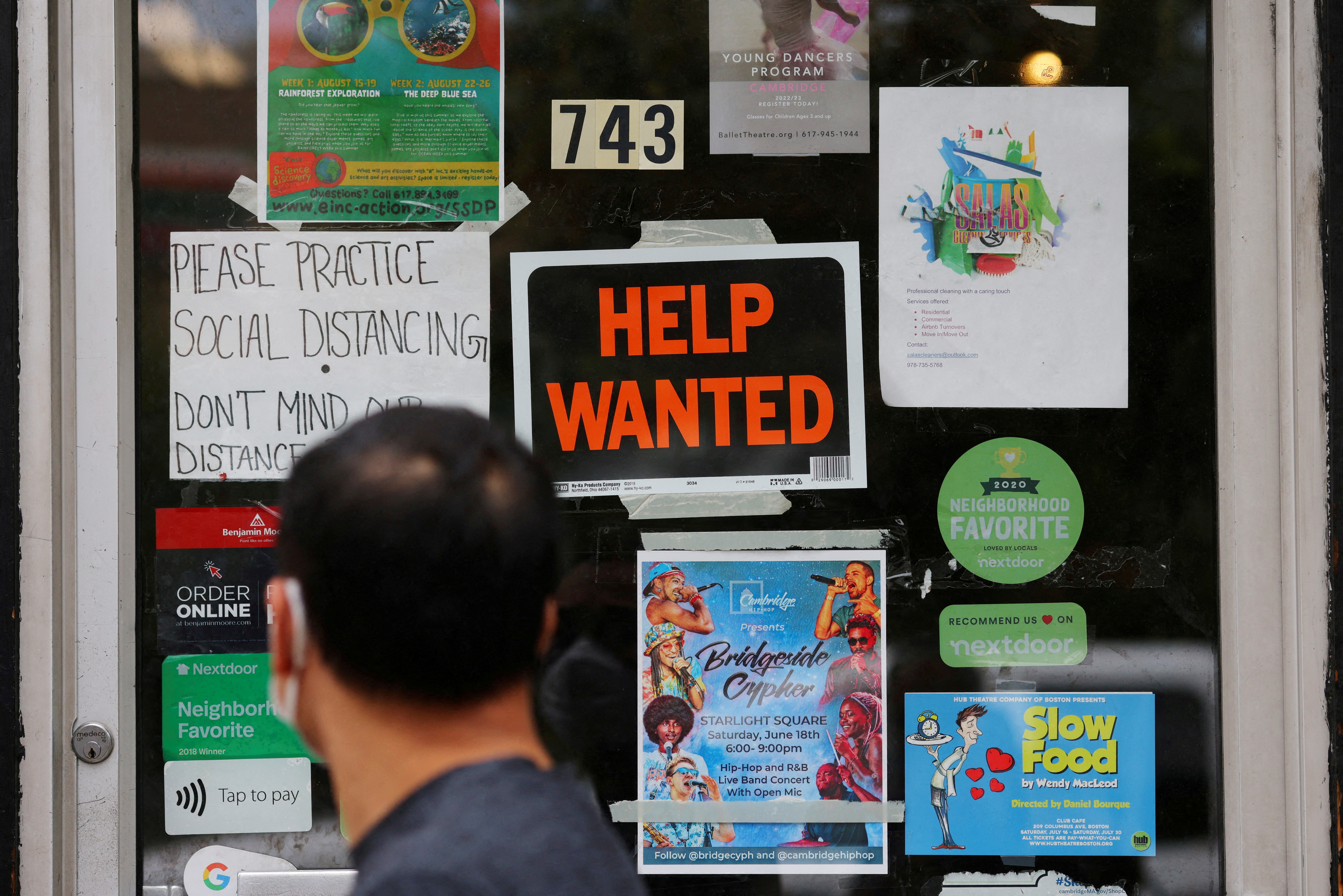
A pedestrian passes a “Help Wanted” sign in the door of a hardware store in Cambridge, Massachusetts, U.S., July 8, 2022. REUTERS/Brian Snyder

The U.S. economy likely maintained a solid pace of job and wage growth in December, but rising borrowing costs as the Federal Reserve fights inflation could slow labor market momentum significantly by mid-year.

The Labor Department’s closely watched employment report on Friday is also expected to show the unemployment rate unchanged at 3.7% last month. The labor market has remained strong since the Fed embarked last March on its fastest interest rate-hiking since the 1980s.

Rate-sensitive industries like housing and finance, as well as technology companies, including Twitter, Amazon (AMZN.O) and Facebook parent Meta (META.O) have slashed jobs, yet airlines, hotels, restaurants and bars are desperate for workers as the leisure and hospitality industries continue to recover from the pandemic.

Labor market resilience has underpinned the economy by sustaining consumer spending, but could prompt the Fed to lift its target interest rate above the 5.1% peak the U.S. central bank projected last month and keep it there for a while.

“All indications are that the labor market remains strong,” said Sung Won Sohn, a finance and economics professor at

Loyola Marymount University in Los Angeles. “Leisure and hospitality employers are not able to get anybody even after wages have been going up. That pattern has and will continue for a while, so that’s where the rubber hits the road.”

The survey of business establishments is likely to show that nonfarm payrolls increased by 200,000 jobs last month after rising 263,000 in November, according to a Reuters poll of economists. That would be the smallest gain in two years.

However, job growth would far exceed the pace needed to keep up with growth in the working-age population, comfortably in the 150,000-300,000 range that economists associate with tight labor markets.

Estimates ranged from as low as 130,000 to as high as the 350,000 predicted by TD Securities.

Data from payroll scheduling and tracking company Homebase showed employers held on to workers in December, which suggested a smaller-than-normal drop in not seasonally adjusted (NSA) terms.

“This means that the seasonal factor, which should be adjusting over a plus 200,000 NSA decline, would be adding over a stronger than expected figure,” said TD Securities macro strategist Oscar Munoz. “The seasonal adjustment has added around 430,000 jobs, on average, over the last five Decembers.”

An ongoing strike by 36,000 teachers in California is seen depressing government payrolls. The government will revise the seasonally adjusted data for the household survey, from which the unemployment rate is derived, for the last five years.

Household employment decreased in October and November, leading some economists to speculate that overall job growth was overstated. Some Fed officials have also latched on to the divergence between the two measures.

Yet the household survey tends to be volatile and most economists expect household employment would be revised toward nonfarm payrolls.

“Whenever trends in household employment have diverged from payroll employment, corrections have tended to come through household employment correcting towards now-stronger payrolls,” said Veronica Clark, an economist at Citigroup in New York. “We would not be surprised to see an even larger rebound in household employment in December or over the coming months.”

Little impact is seen on the unemployment rate from the revision to the household data. Average hourly earnings are expected to have risen by 0.4% after surging 0.6% in November. That would lower the year-on-year increase in wages to 5.0% from 5.1% in November.

Strong wage growth is likely to persist in January as several states raise their minimum wage and most workers across the country get cost of living adjustments. There were 10.458 million job openings at the end of November, which translated to 1.74 jobs for every unemployed person.

But the trend in employment growth could slow significantly by mid-year. The Fed last year raised its policy rate by 425 basis points from near zero to a 4.25%-4.50% range, the highest since late 2007. Last month, it projected at least an additional 75 basis points of hikes in borrowing costs by the end of 2023.

Confidence among chief executive officers is at its lowest level since the Great Recession, according to a recent survey from the Conference Board.

“If they think demand is weakening and revenues are going to slow, they’re probably going to feel pressure to cut costs to maintain profitability,” said James Knightley, chief international economist at ING in New York. “That does suggest that the pace of employment growth is likely to slow quite quickly through this year, and we could in fact, start to see some job losses in the middle of the year.”

Categories
Audio Sources - Full Text Articles

TIMELINE: DNA, video lead officials to Idaho suspect

Court documents unsealed Thursday after the suspect in the November fatal stabbings of four University of Idaho students made his first court appearance in Idaho reveal the timeline for how Bryan Kohberger went from being on law enforcement radar to becoming the man charged with four counts of first-degree murder and one count of burglary. Below is a timeline from the documents:

– Nov. 13, 2022: Ethan Chapin and Xana Kernodle returned to the King Road house, where Kernodle was living, at about 1:45 a.m. after visiting the Sigma Chi house on the University of Idaho campus. Kaylee Goncalves and Madison Mogen were at a local bar in Moscow, Idaho, between 10 p.m. on Nov. 12, 2022 until 1:30 a.m. on Nov. 13. They visited a food truck and then an unnamed person gave them a ride at about 1:56 a.m. to the King Road house, where they were living. Two unharmed roommates identified in the affidavit as D.M. and B.F. said everyone was home by 2 a.m. and in their rooms by 4 a.m.

– Nov. 13, 2022: The suspect’s vehicle, a white sedan, was seen on Washington State University surveillance cameras traveling away from campus at about 2:53 a.m.

– Nov. 13, 2022.: Kernodle received a DoorDash order at about 4 a.m.

– Nov. 13, 2022: Unharmed roommate D.M. was awoken at about 4 a.m. to what sounded like Goncalves playing with her dog in a bedroom on the third floor. Soon after, D.M. said she heard what sounded like Goncalves say something like, “there’s someone here.” Cellphone records show that it might have been Kernodle who made the statement.

– Nov. 13, 2022: D.M. reported thinking she heard crying from Kernodle’s room and heard a male voice saying something like, “it’s ok, I’m going to help you.”

– Nov. 13, 2022: At about 4:17 a.m., a security camera at a house northwest of the King Road residence picked up the sound of voices or a whimper followed by a loud thud.

– Nov. 13, 2022: D.M. opened her door a third time after she heard crying and saw a man with bushy eyebrows dressed in black with a mask over his nose and mouth walking toward her. She froze and the man walked to the sliding glass door and she locked herself in her room.

– Nov. 13, 2022: Investigators believe the four students were killed between 4 a.m. and 4:25 a.m. Police investigators arrived and located the bodies of the students, along with a tan leather knife sheath that carried the suspect’s DNA and a shoe print outside the roommate’s door.

– Nov. 13, 2022: Footage from security videos show the suspect’s vehicle in the King Road neighborhood starting at 3:29 a.m. Police say it made three passes by the house and made a fourth pass at about 4:04 a.m. before leaving the area at a high rate of speed at about 4:20 a.m.

– Nov. 13, 2022: Surveillance video recorded the suspect vehicle in Pullman and the WSU campus around 5:25 a.m.

– Nov. 13, 2022: Investigators tracking Kohberger’s phone said it left his residence at about 9 a.m. and traveled to Moscow. It pinged cellular services that would cover the King Road home between 9:12 a.m. and 9:21 a.m. It then traveled back to the Kohberger home at about 9:32 a.m.

– Nov. 13, 2022: There was no police response to the killings until later in the day.

– Nov. 18, 2022: Bryan Kohberger changed the registration of his white Elantra from Pennsylvania plates to Washington state license plates.

– Nov. 25, 2022: Law enforcement were on the lookout for a Hyundai Elantra.

– Nov. 29, 2022: A WSU police officer learned that a 2015 white Elantra with a Pennsylvania license plate was registered to Bryan Kohberger. The officer tracked down Kohberger’s driver’s license and noted that he was a white male, 6-feet tall and weighed about 185 pounds (83.91 kilograms). His photograph showed bushy eyebrows.

– Dec. 13, 2022: Kohberger’s vehicle was seen in Loma, Colorado.

– Dec. 15, 2022: Kohberger, traveling to Pennsylvania with his father, was stopped by law enforcement in Hancock County, Indiana.

– Dec. 23, 2022: Officials obtained a warrant to search Kohberger’s phone records. They show that the phone was in Pullman at 2:42 a.m. on Nov. 13, 2022 but then stops reporting to the network. It does not connect again until 4:48 a.m.

– Dec. 29, 2022: Based on the information gathered, law enforcement secured an arrest warrant for Bryan Kohberger. He was taken into custody early in the morning by the Pennsylvania State Police at a home in Chestnuthill Township.

– Jan. 3, 2023: Kohberger appeared at Pennsylvania’s Monroe County Courthouse and agreed to waive extradition in order to be moved back to Idaho to face charges.

– Jan. 4, 2023: Kohberger arrived in Moscow on a small plane.

– Jan. 5, 2023: Kohberger made his first court appearance in Latah County and the court records in the case have been unsealed.

WP Radio
WP Radio
OFFLINE LIVE